
Pulp Fiction, 1922 · page 96 of 126
Photoplay Magazine Cover — page 96: what you’re looking at
What you’re looking at
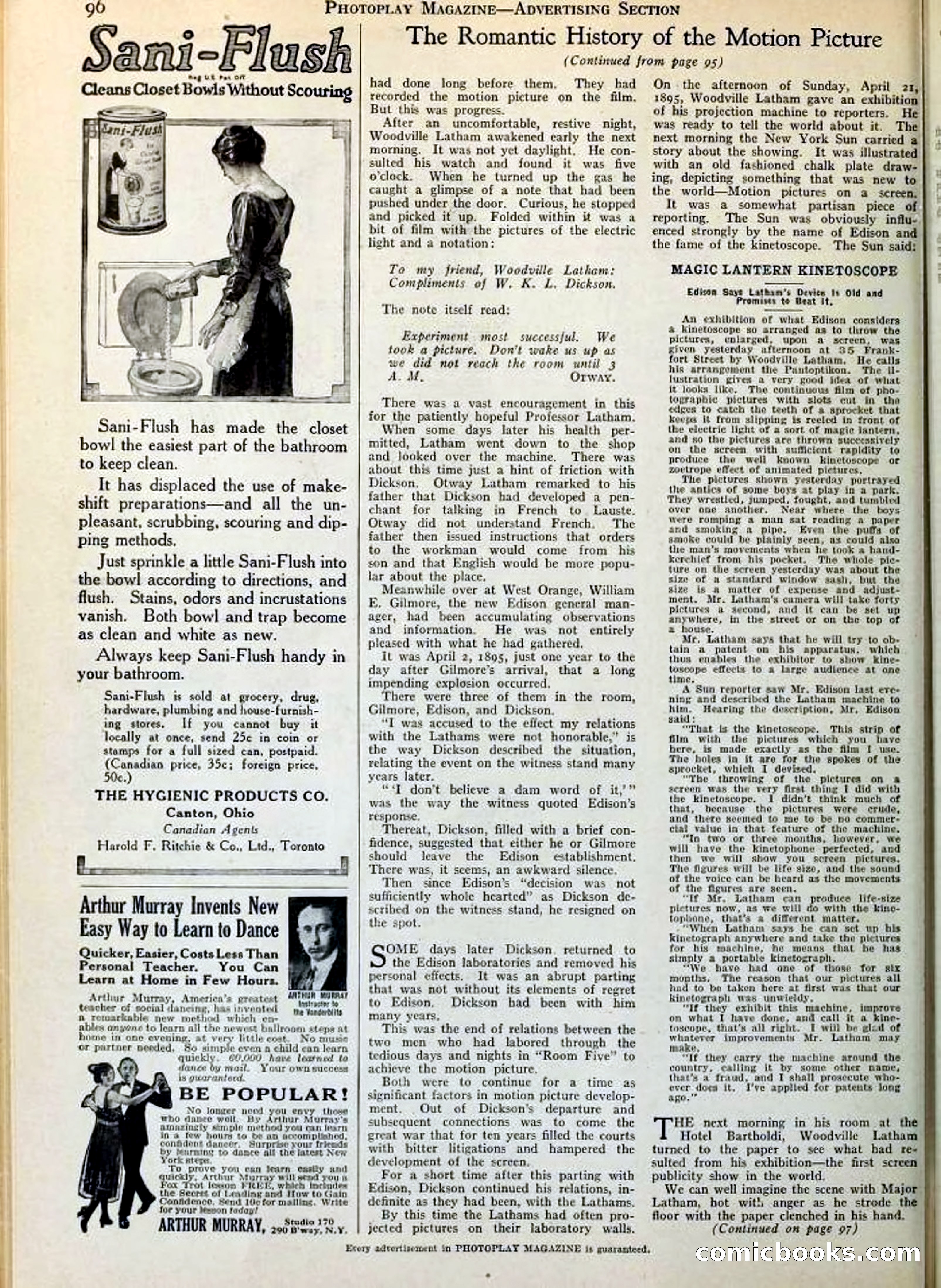
# Page Content Analysis This is page 96 from *Photoplay Magazine*'s advertising section. The page contains advertisements mixed with continuation of an article titled "The Romantic History of the Motion Picture." The visible text discusses early motion picture history, including an anecdote about Professor Latham and Edison's kinetoscope experiments. There's an advertisement for "Sani-Flush" (a bathroom cleaning product), another for "Magic Lantern Kinetoscope" by Edison, and a third promoting Arthur Murray's dance instruction method. The main article text describes the development of motion picture technology and Edison's role in early cinema, with references to Dickson and other early figures in film history.
📄 Transcribed text from this page (OCR, searchable)
Machine-transcribed from the original scan — historical spelling and the odd misread are preserved.
PHOTOPLAY MAGAZINE—ADVERTISING SECTION Sani -Flush Cleans Closet Bowls Without Scouring _—_——— | Sani-Flush has made the closet bowl the easiest part of the bathroom to keep clean. It has displaced the use of make- shift preparations—and all the un- pleasant, scrubbing, scouring and dip- ping methods, Just sprinkle a little Sani-Flush into the bow! according to directions, and flush. Stains, odors and incrustations vanish. Both bowl and trap become as clean and white as new. Always keep Sani-Flush handy in your bathroom. Sani-Flush is sold at grocery, drug, hardware, plumbing and house-furnish- ing stores, you cannet buy it locally at once, send 25c¢ in coin or stomps for a full sized can, postpaid. a price, 35c; foreign price, THE HYGIENIC PRODUCTS Co. Canton, Ohio Canadian Agents Harold F. Ritchie & Co,, Ltd., Toronto Arthur Murray Invents New Easy Way to Learn to Dance Quicker, Easier, Costs Less Than Personal Teacher. You Can Learn at Home in Few Hours. Arthur Murray, America’s greatest teacher of social dancing, has inventedt n romarkable new method which on ables anyone to learn all the newest ballroom stepa at home in one evening, at very littl: coat. No muse or partner posed, So simple even a child ean learn quickly. 60.000 have loaned to lance ty mast. Your own succes is otearant ord. BE POPULAR! No Jonger nom! you envy thos WhO dapee woll, By Arthur Murray's atnazingty staple methed you oun Imearn in & few holirs to be am eocompliened, canddent daneér. Surprise your friends by Murning to damce all the latest New York at ‘Fo prove you can learn casity and — . Arthur Misrray will os ‘ox Trot lewon Pick, w bec buacles the Secret of Losding and Mow to Gain Confidence, Xend 10c for mailing, Write for your Meson fodap! ARTHUR MURRAY, 208 s3," N,v. Esory advertisement {9 PHOTOPLAY MAGAZINE is guaranteed, The Romantic History of the Motion Picture (Continued from page 95) had done long before them, They had recorded the motion picture on the film. But this was progress. After an uncomfortable, restive night, Woodville Latham awakened early the next morning. It was not yet daylight, He con- sulted his watch and found it was five o'clock, When he turned up the gas he caught a glimpse of a note that had been pushed under the door. Curious, he stopped and picked it up. Folded within it was a bit of film with the pictures of the electric light and a notation: To my friend, Woodville Latham: Compliments of W. K. L, Dickson. The note itself read: Experiment most successjul. We took a picture. Don't wake us up as we did not reach the room until 3 A. M, Orway. There was a vast encouragement in this for the patiently hopeful Professor Latham. When some days later his health per- mitted, Latham went down to the shop and looked over the machine. There was about this time just a hint of friction with Dickson, Otway Latham remarked to his father that Dickson had developed a pen- chant for talking in French to Lauste. Otway did not understand French. The father then issued instructions that orders to the workman would come from his son and that English would be more popu- lar about the place. Meanwhile over at West Orange, William E, Gilmore, the new Edison gencral man- ager, had been accumulating observations and information. He was not entirely pleased with what he had gathered, it was April 2, 1895, just one year to the day after Gilmore’s arrival, that a long impending explosion occurred, There were three of them in the room, Gilmore, Edison, and Dickson. “T was aceused to the effect my relations with the Lathams were not honorable,” is the way Dickson described the situation, relating the event on the witness stand many years later. “*F don’t believe a dam word of it,’” was the way the witness quoted Edison's response, Thereat, Dickson, filled with a brief con- fidence, suggested that either he or Gilmore should leave the Edison establishment. There was, it seems, an awkward silence, Then since Edison’s “decision was not sufficiently whole hearted” as Dickson de- scribed on the witness stand, he resigned on the spot. OME days later Dickson, returned to the Edison laboratories and removed his personal effects. It was an abrupt parting that was not without its elements of regret to Edison. Dickson had been with him many years, This was the end of relations betwren the two men whe had labored through the tedious days and nights in “Room Five” to achieve the motion picture. Both were to continue for a time as significant factors in motion picture develop- ment. Out of Dickson's departure and subsequent connections was to come the great war that for ten years filled the courts with bitter litigations and hampered the development of the screen, Por a short time after this parting with Edison, Dickson continued his relations, in- definite as they had been, with the Lathams. By this time the Lathams had often pro- jected pictures on their laboratory walls. On the afternoon of Sunday, April 2z,] 1895, Woodville Latham gave an exhibition} of his projection machine to reporters. He was ready to tell the world about it. The next morning the New York Sun carried a story about the showing. It was illustrated with an old fashioned chalk plate draw- ing, depicting something that was new to the world—Motion pictures on a It was a somewhat partisan piece of | i reporting. The Sun was obviously influe. enced strongly by the name of Edison the fame of the kinetoscope. The Sun said : MAGIC LANTERN KINETOSCOPE Edison Says Bam's Devices Is Old and Premiecs te Beat it, An exhibition of what Edison constders & kineftoscope so arranged as to throw the pictures, colarged, upon @ screen, was given yesterntay afternoon at 25 Frank- fort Street by Woodville Latham, He calls his arrangoment tle Puntoptikeon. The li- lustration gives a very good iilea of what it looks like, The continuous film ef pho. — tographic pictures with slots cut In the — etipes to catch tho teeth of a sprocket that kevges it from slipping ts reeled in fromt of the electric light of a sort of magic lantern, and so the pictures ace thrown successively on the screen with sufficient rapidity to produce the well koown kKinetosoope or zoulrope effect of animated pleturcs. The pictures shown yesterday portrayed the antics of some boys at play in a park, They wrestled, jumped, fought, and tumbled over one another. Near where the boys were romping a man sat reading a paver ant smoking a pipe. Even the pull of smoke could be plainly seen, as could also the man’s movements whens he took a hand- kerelilef from his pocket. The whole pic- ture on the screen yesterday wan about the sixe of u standard window sash, but the sixe ig a matter of expense and adjust- ment. Mr. Latham's cumera will take forty pictares @ second, and it can be set up anywhere, in the street or on the top of = house. Mr. Latham says that he will try to ob- tuin a patent on his apparatus. which thus enables the exhibitor t» show kine} tosoope effecla to a large audience at ane | time. | A Stim reporter saw Mr, Edison last ere- ning and deseribed the Latham machine to she Hearing the description, Mr, Edison said: “That Is the kinttoseope. This strip of Him with the pletures whieh you have bere, is mode exactly as the film I use. The holes in it aro for the spokes of We sprocket, whieh I devived. "The throwing of the pletures on & sereen was the very first thing I did with the kinctoscope. 2 didn't think much af j that, because the pictures wore crude, — and there seemed (6 me to be po commer- chal value in that feature of the machine. H “In two or three montla, however, we ; will have the kinctophene perfected, and then we will shaw you screen pictures, The Ogures will be life size, and the sound f of the voice can be heard as the movements of the figures are seen. “If Mr. Latham can prodtce life-size pleturcs now, as we will with the kino- toplwone, that’s a different matter. "When Latham says he can set up bis kinetograph anywhere and take tho pletures for his machine, he means that he has simply a portable kinefograph. “We have had one of those for six munoths, The reason that our pictures all | had to bo taken here at first was that our kinetograpl: wes unwieldy. "If they exhibit this machine, improre on what I have dene, and call it a kine- toscope, that’s all right. ET will be glad of — meter improvementw Mr. thom may make, "It they carry the machine around the. country, calling it by some other name, that’s a fraud, and T shall prosecute who- f ever does it. I’ve applied for patents long ago.” a ee oe ee HE next morning in his room at Hotel Bartholdi, Woodville Latham turned to the paper to see what had re+ sulted from his exhibition—the first screen - publicity show in the world. a We can well imagine the scene with Major Latham, bot with anger as he strede the floor with the paper clenched in his hand. (Continued on page 97) EGomicbooks (E(0) a é th Red the Ge fe O° "Te