
Pulp Fiction, 1922 · page 21 of 126
Photoplay Magazine Cover — page 21: what you’re looking at
What you’re looking at
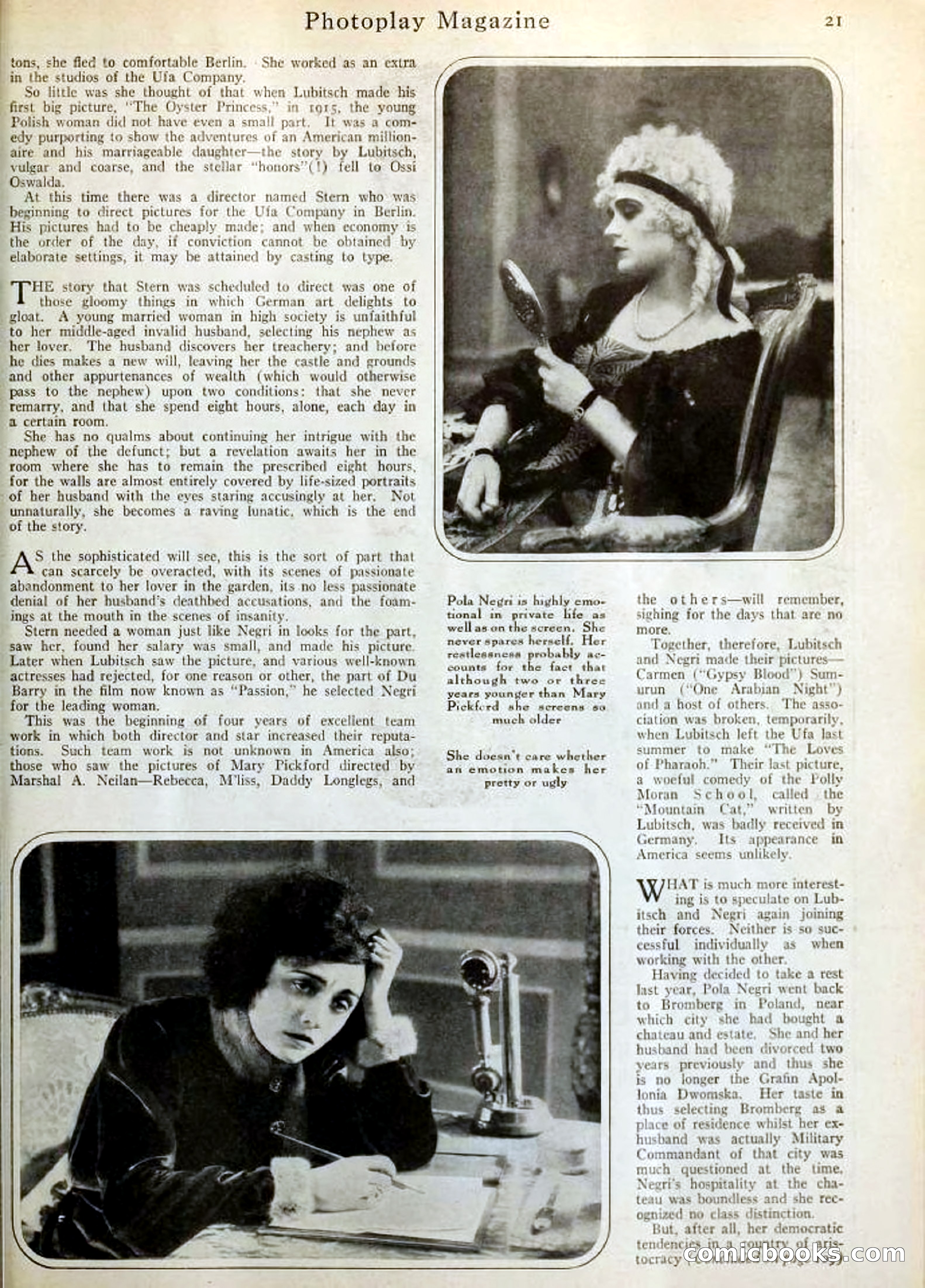
# Page 21 of Photoplay Magazine This is a text and illustration page from an early 20th-century film magazine. The prose discusses director Stern's production of a German film about an unfaithful noblewoman whose husband, upon discovering her infidelity, leaves her his estate conditionally—she must never remarry and spend eight hours daily alone in a room lined with life-sized portraits of him. The story ends with her descent into madness. Two black-and-white photographs show what appears to be the actress Pola Negri in costume and at a vanity, illustrating the film being discussed.
📄 Transcribed text from this page (OCR, searchable)
Machine-transcribed from the original scan — historical spelling and the odd misread are preserved.
Photoplay Magazine tons, she fied to comfortable Berlin. She worked as an extra in the studios of the Ufa Company So little was she thought of that when Lubitsch made his first big picture, “The Oyster Princess rors, the young Polish woman did not have even a smal! part, It was a com- edy purporting to show the adventures of an American million- aire and his marriageable daughter—the story by Lubitsch, vulear and coarse, and the stellar “honors’(!) fell te Ossi Oswalda. At this time there was a director beginning to direct pictures for the His pictures had to be cheaply made the order of the day, if conviction elaborate settings, it may be attained by named Stern who was Ufa Company in Berlin and when economy 1s cannot be obtaimed by casting to type HE story that Stern was scheduled to direct was one of those gloomy things in which German art delights to gloat. A young married woman in high society is unfaithful to her middle-aged invalid husband, selecting his nephew as her lover, The husband discovers her treachery; and before he dies makes a new will, leaving her the castle and grounds and other appurtenances of wealth (which would otherwise pass to the nephew) upon two conditions: that she never remarry, and that she spend eight hours, alone, each day in a certain room. She has no qualms about continuing her intrigue with the nephew of the defunct; but a revelation awaits her in the room where she has to remain the prescribed eight hours, for the walls are almost entirely covered by life-sized portraits of ber husband with the eves staring accusingly at her. Not unnaturally, she becomes a raving lunatic, which is the end of the story. S the sophisticated will see, this is the sort of part that can scarcely be overacted, with its scenes of passionate abandonment to her lover in the garden, its no less passionate denial of her husband's deathbed accusations, and the foam- ings at the mouth in the scenes of insanity, Stern needed a woman just like Negri in looks for the part, saw her. found her salary was small, and made his picture Later when Lubitsch saw the picture, and various well-known actresses had rejected, for one reason or other, the part of Du Barry in the film now known as “Passion,” he selected Negri for the leading woman. This was the beginning of four vears of excellent team work in which both director and star increased their reputa- tions. Such team work is not unknown in America also; those who saw the pictures of Mary Pickford directed by Marshal A. Neilan—Rebeeca, M'liss, Daddy Longlegs, and Pola Negri is highly cmo- tional in private hfe as well ason the screcn, She never spares heractf, Her reatleasnesa probably ac- counts for the fact that although two or three years younger than Mary Picks. rd uhe screens 50 murels older She dvocan't care whether an emotion makes her pretty or ugly others—will remember, sighing for the davs that are no more, Together, therefore, Lubitsch and Negri made their pictures Carmen ("Gypsy Blood”) Sum- urun (“Qne Arabian Night") and a host of others, The asso- ciation was broken, temporarily when Lubitsch left the Ufa last make “The Loves Their jast picture, Polly the summer to of Pharaoh.” a woeful comedy of the Morun School called the “Mountain Cat,” written by Lubitsch, was badly received im Germany Its appearance in America seems unlikely HAT is much more interest- ing is to speculate on Lub- itsch and Negri again joiming their forces. Neither is-so suc- cessful individually as when working with the other Having decided to take a rest ust year, Pola Negri went back to Bromberg im Poland, near which city had bourht a chateau and estate, She and her husband had been divorced two years previously and thus she is no longer the Grafin Apol- she lonia Dwomska. Her taste in ihus selecting Bromberg at a [ lace of residence whilst her ex- husband actually Military Commandant of that city was much questioned at the time, Negri’s hospitality at the cha- ] 1 «he rec- estinclion was teau was boundless ant ogn ned th? Chiss But. after all, her democratic emcomicbooks Om