
Pulp Fiction, 1922 · page 61 of 126
Photoplay Magazine Cover — page 61: what you’re looking at
What you’re looking at
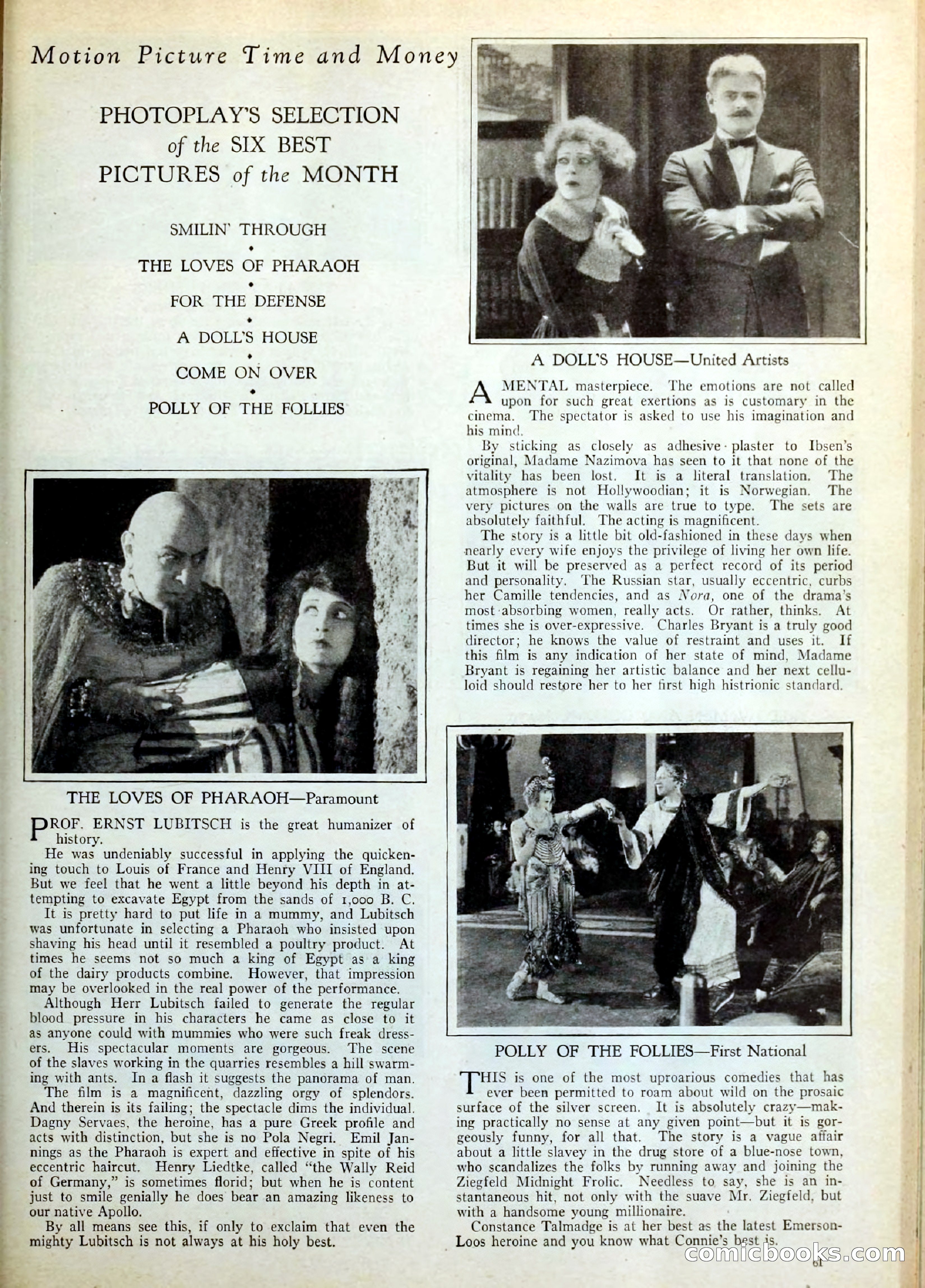
# Page Analysis This is a content page from *Motion Picture Time and Money*, a trade publication reviewing current films. It features Photoplay's selection of six best pictures of the month, with three reviews visible: "A Doll's House" (United Artists), "The Loves of Pharaoh" (Paramount), and "Polly of the Follies" (First National). Each review includes a photograph from the film and critical commentary. The page discusses the films' artistic merit, performances, and production values, addressing an audience of industry professionals interested in cinema's commercial and creative aspects.
📄 Transcribed text from this page (OCR, searchable)
Machine-transcribed from the original scan — historical spelling and the odd misread are preserved.
Motion Picture Time and Money PHOTOPLAY’S SELECTION of the SIX BEST PICTURES of the MONTH SMILIN’ THROUGH THE LOVES OF PHARAOH FOR THE DEFENSE A DOLL'S HOUSE COME ON OVER POLLY OF THE FOLLIES THE LOVES OF PHARAOH—Paramount ROF. ERNST LUBITSCH is the great humanizer of history. He was undeniably successful in applying the quicken- ing touch to Louis of France and Henry VIII of England. But we feel that he went a little beyond his depth in at- tempting to excavate Egypt from the sands of 1,000 B. C. It is pretty hard to put life in a mummy, and Lubitsch was unfortunate in selecting a Pharaoh who insisted upon shaving his head until it resembled a poultry product. At times he seems not so much a king of Egypt as a king of the dairy products combine. However, that impression may be overlooked in the real power of the performance. Although Herr Lubitsch failed to generate the regular blood pressure in his characters he came as close to it as anyone could with mummies who were such freak dress- ers. His spectacular moments are gorgeous. The scene of the slaves working in the quarries resembles a hill swarm- ing with ants. Ina flash it suggests the panorama of man. The film is a magnificent, dazzling orgy of splendors. And therein is its failing; the spectacle dims the individual. Dagny Servaes, the heroine, has a pure Greek profile and acts with distinction, but she is no Pola Negri. Emil Jan- nings as the Pharaoh is expert and effective in spite of his eccentric haircut. Henry Liedtke, called “the Wally Reid of Germany,” is sometimes florid; but when he is content just to smile genially he does bear an amazing likeness to our native Apollo. By all means see this, if only to exclaim that even the mighty Lubitsch is not always at his holy best. A DOLL’S HOUSE—United Artists MENTAL masterpiece. ‘The emotions are not called upon for such great exertions as is customary in the cinema. The spectator is asked to use his imagination and his mind By sticking as closely as adhesive: plaster to Ibsen’s original, Madame Nazimova has seen to it that none of the vitality has been lost. It is a literal translation, The atmosphere is not Hollywoodian; it is Norwegian. The very pictures on the walls are true to type. The sets are absolutely faithful. The acting is magnificent. The story is a little bit old-fashioned in these days when nearly every wife enjoys the privilege of living her own life. But it will be preserved as a perfect record of its period and personality, The Russian star, usually eccentric, curbs her Camille tendencies, and as Nora, one of the drama’s most absorbing women, really acts. Or rather, thinks. At times she is over-expressive. Charles Bryant is a truly good director; he knows the value of restraint and uses it. If this film is any indication of her state of mind, Madame Bryant is regaining her artistic balance and her next cellu- loid should restore her to her first high histrionic standard. POLLY OF THE FOLLIES—First National HIS is one of the most uproarious comedies that has ever been permitted to roam about wild on the prosaic surface of the silver screen. It is absolutely crazy—mak- ing practically no sense at any given point—but it is gor- geously funny, for all that. The story is a vague affair about a little slavey in the drug store of a blue-nose town, who scandalizes the folks by running away and joining the Ziegfeld Midnight Frolic. Needless to say, she is an in- stantaneous hit, not only with the suave Mr. Ziegfeld, but with a handsome young millionaire. Constance Talmadge is at her best as the latest Emerson- Loos heroine and you know what Connie’s bgst jis. co Om Cooks