
Pulp Fiction, 1922 · page 23 of 126
Photoplay Magazine Cover — page 23: what you’re looking at
What you’re looking at
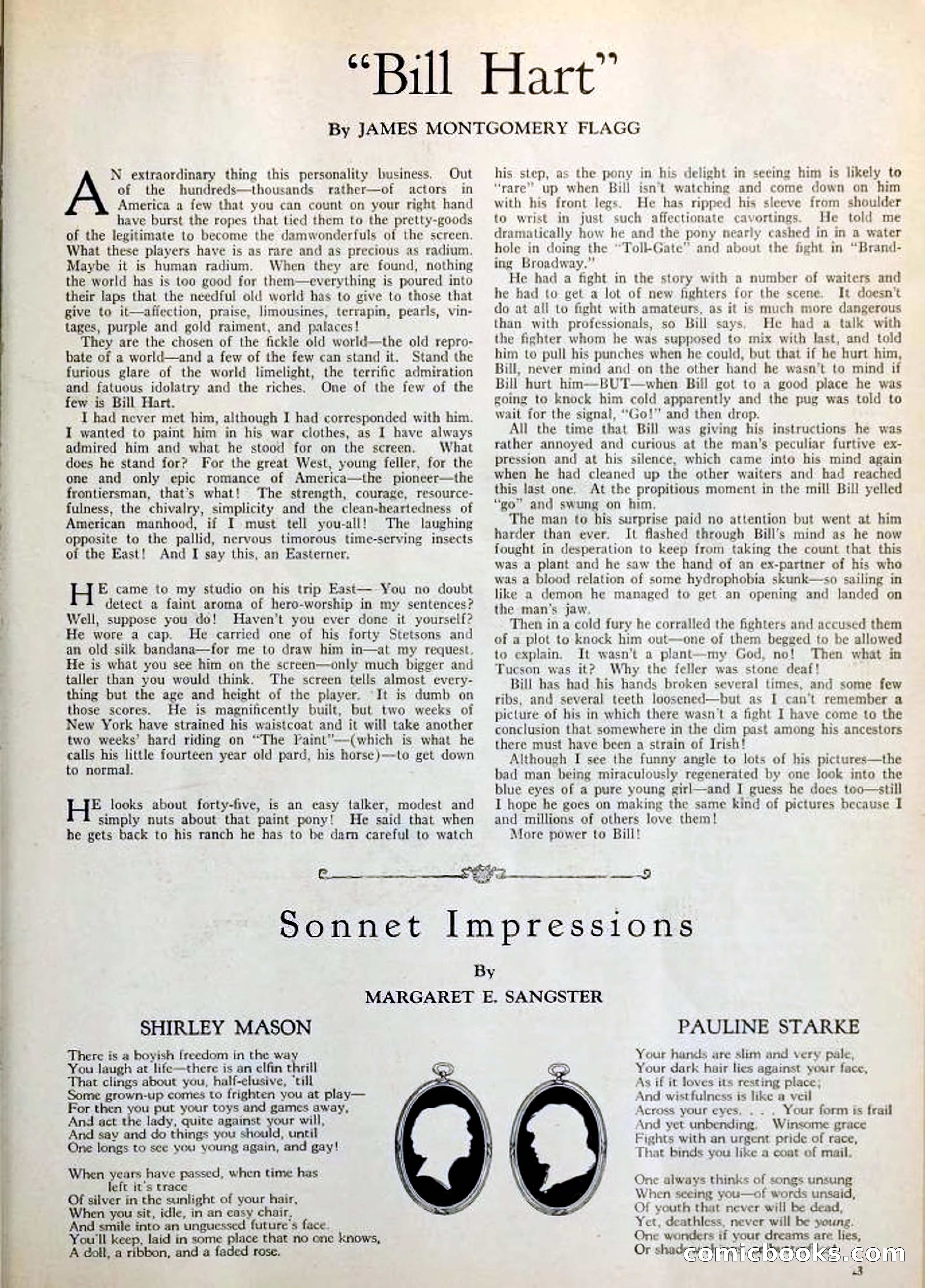
# Page Content Description This is a text-only interior magazine page containing two literary works. The upper portion features "Bill Hart," an essay or article by James Montgomery Flagg discussing an extraordinary personality in American cinema—apparently someone Flagg admired for embodying frontier qualities and epic romance. The lower section presents "Sonnet Impressions," a poetry piece by Margaret E. Sangster featuring two sonnets titled "Shirley Mason" and "Pauline Starke," with silhouette portraits of two profile faces between them. The sonnets appear to be romantic or sentimental verses about young women. The page uses decorative typography and line breaks typical of early-20th-century magazine design.
📄 Transcribed text from this page (OCR, searchable)
Machine-transcribed from the original scan — historical spelling and the odd misread are preserved.
COs am —— eC > 7 “yO ee a ae * “Bill Hart” By JAMES MONTGOMERY FLAGG N extraordinary thing this personality business, Out of the hundreds—thousands rather—of actors in America a few that you can count on your right hand have burst the ropes that tied them to the pretty-goods of the legitimate to become the damwonderfuls of the screen. What these players have is as rare and as precious as radium. Maybe it is human radium. When they are found, nothing the world has is too good for them—everything is poured into their laps that the needful old world has to give to those that give to it—affection, praise, limousines, terrapin, pearls, vin- tages, purple and gold raiment, and palaces! They are the chosen of the fickle old world—the old repro- bate of a world—and a few of the few can stand it. Stand the furious glare of the world limelight, the terrific admiration and fatuous idolatry and the riches, One of the few of the few is Bill Hart. I had never met him, although I had corresponded with him. I wanted to paint him in his war clothes, as I have always admired him and what he stood for on the screen, What does he stand for? For the great West, young feller, for the one and only epic romance of America—the pioneer—the frontiersman, that’s what! The strength, courage, resource- fulness, the chivalry, simplicity and the clean-heartedness of American manhood, if I must tell you-all! The laughing opposite to the pallid, nervous timorous time-serving insects of the East! And I say this, an Easterner, H® came to my studio on his trip East— You no doubt detect a faint aroma of hero-worship in my sentences? Well, suppose you do! Haven't you ever done it yourself? He wore a cap. He carried one of his forty Stetsons and an old silk bandana—for me to draw him in—at my request. He is what you see him on the screen—only much bigger and taller than you would think. The screen tells almost every- thing but the age and height of the player. It is dumb on those scores. He is magnificently built, but two weeks of New York have strained his waistcoat and it will take another two weeks’ hard riding on “The VPaint’-——(which is what he calls his little fourteen year old pard, his horse)--to get down to normal. E looks about forty-five, is an easy talker, modest and simply nuts about that paint pony! He said that when he gets back to his ranch he has to be dam careful to watch his step, as the pony in his delight in secing him is likely to “rare’’ up when Bill isn't watching and come down on him with his front legs. He has ripped his sleeve from shoulder to wrist in just such affectionate cavortings. He told me dramatically how he and the pony nearly cashed in in a water hole in doing the “Toll-Gate” and about the ght in “Brand- ing Broadway.” He had a fight in the story with a number of waiters and he had to get a lot of new fighters for the scene. It doesn't do at all to fight with amateurs, as it is much more dangerous than with professionals, so Bill says. He had a talk with the fighter whom he was supposed to mix with last, and told him to pull his punches when he could, but that if he hurt him, Bill, never mind and on the other hand he wasn’t to mind if Bill hurt him-—-BUT—when Bill got to a good place he was going to knock him cold apparently and the pug was told to wait for the signal, “Go!” and then drop. All the time that Bill was giving his instructions he was rather annoyed and curious at the man’s peculiar furtive ex- pression and at his silence, which came into his mind again when he had cleaned up the other waiters and bad reached this last one, At the propitious moment in the mill Bill yelled “go” and swung on him, The man to his surprise paid no attention but went at him harder than ever. It flashed through Bill's mind as he now fought in desperation to keep from taking the count that this was a plant and he saw the hand of an ex-partner of his who was a blood relation of some hydrophobia skunk—so sailing in like a demon he managed to get an opening and landed on the man’s jaw, Then in a cold fury he corralled the fighters and accused them of a plot to knock him out—one of them begged to be allowed to explain. It wasn't a plant—my God, no! Then what in Tucson was it? Why the feller was stone deaf! Bill has had his hands broken several times, and some few ribs, and several teeth loosened—but as I can't remember a picture of his in which there wasn't a fight I have come to the conclusion that somewhere in the dim past among his ancestors there must have been a strain of Irish! Although I see the funny angle to lots of his pictures—the bad man being miraculously regenerated by one look into the blue eyes of a pure young girl—and I guess he does too—still I hope he goes on making the same kind of pictures because I and millions of others love them! More power to Bill! Sonnet Impressions By MARGARET E. SANGSTER SHIRLEY MASON There is a boyish [reedom in the way You laugh at life—there is an elfin thrill That clings about you, half-elusive, ‘till Some grown-up comes to frighten you at play— For then you put your toys and games away, And act the lady, quite against your will, And say and do things you should, until One longs to see you young again, and gay! When years have passed, when time has feft it's trace Of silver in the sunlight of your hair, When you sit, idle, in an easy chair, And smile into an unguessed future's face. You'll keep, laid in some place that no one knows, A doll, a ribbon, and a faded rose. PAULINE STARKE Your haruls are slim and very pale, Your dark hair lies against your face, As if it loves its resting place; And wistfulness is like a veil Across your eyes. . . . Your form is frail And yet unbending. Winsome grace Fights with an urgent pride of race, That binds you like a coat of mail. Once always thinks of songs unsung When seeing you—of words unsaid, Of youth that never will be dead, Yet, deathless, never will be young. One wonders if your dreams are lies, e-COmMiGDOOkKS com