
Pulp Fiction, 1922 · page 66 of 126
Photoplay Magazine Cover — page 66: what you’re looking at
What you’re looking at
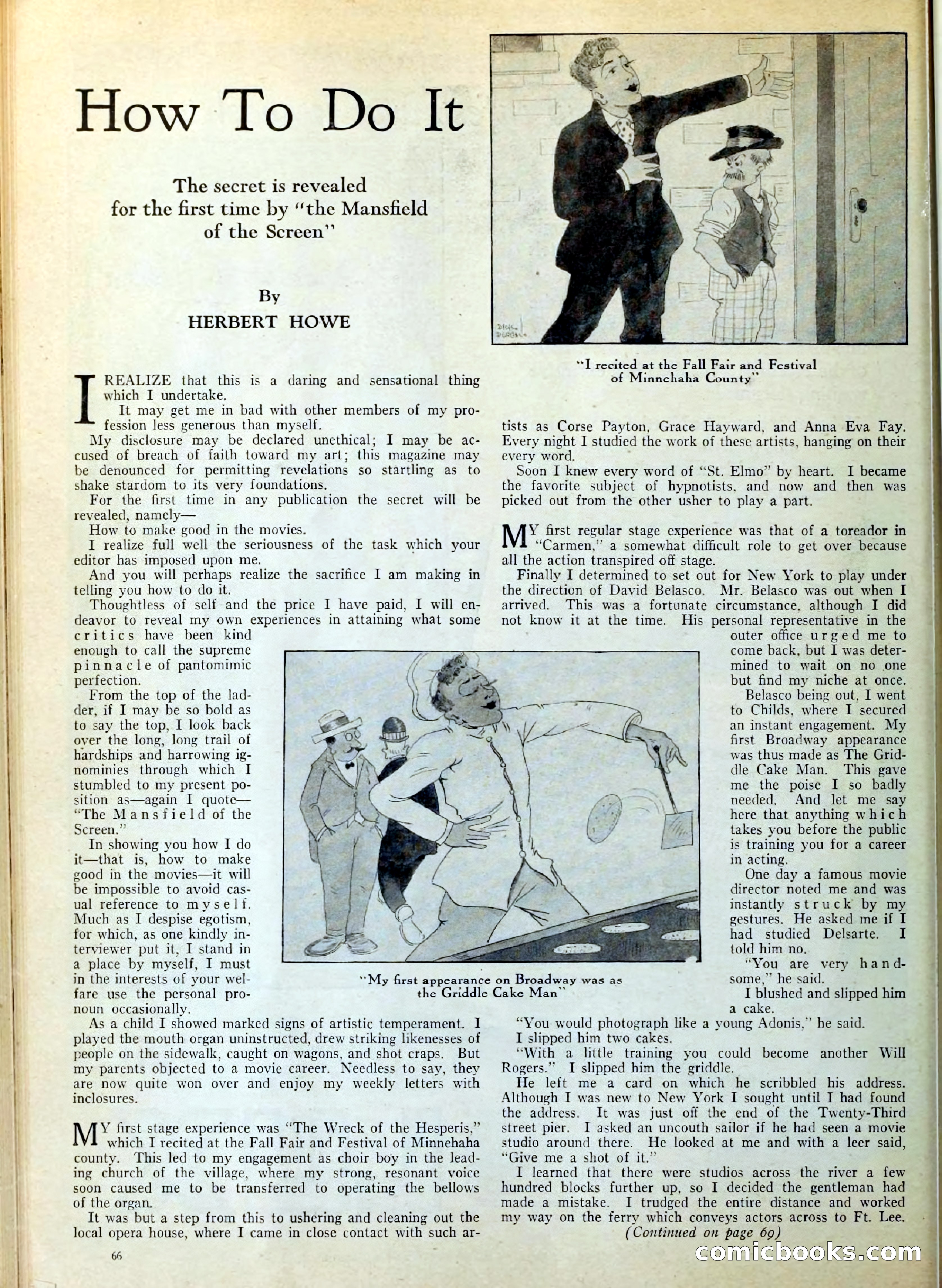
# Page Content Description This is an interior story page from a pulp magazine featuring an article titled "How To Do It" by Herbert Howe. The article appears to be a first-person account about breaking into the film industry and achieving success in movies. Two illustrations accompany the text: one showing what appears to be a tall man pointing at a shorter man in formal attire, and another sketch depicting figures in casual poses. The prose describes the author's early stage experiences, including performing in "The Wreck of the Hesperis" at a county fair and his eventual transition to Broadway and film work. The article discusses encounters with notable figures and advice about pursuing an acting career in early cinema.
📄 Transcribed text from this page (OCR, searchable)
Machine-transcribed from the original scan — historical spelling and the odd misread are preserved.
How To Do It The secret is revealed for the first time by “the Mansfield of the Screen’”’ By HERBERT HOWE REALIZE that this is a daring and sensational thing which I undertake. It may get me in bad with other members of my pro- fession less generous than myself. My disclosure may be declared unethical; I may be ac- cused of breach of faith toward my art; this magazine may be denounced for permitting revelations so startling as to shake stardom to its very foundations. For the first time in any publication the secret will be revealed, namely— How to make good in the movies. I realize full well the seriousness of the task which your editor has imposed upon me. And you will perhaps realize the sacrifice I am making in telling you how to do it. Thoughtless of self and the price I have paid, I will en- deavor to reveal my Own experiences in attaining what some critics have been kind enough to call the supreme pinnacle of pantomimic perfection. From the top of the lad- der, if I may be so bold as to say the top, I look back over the long, long trail of hardships and harrowing ig- nominies through which I stumbled to my present po- sition as—again I quote— “The Mansfield of the Screen.” In showing you how I do it—that is, how to make good in the movies—it will be impossible to avoid cas- ual reference to myself. Much as I despise egotism, for which, as one kindly in- terviewer put it, I stand in a place by myself, I must in the interests of your wel- fare use the personal pro- noun occasionally, As a child I showed marked signs of artistic temperament. I played the mouth organ uninstructed, drew striking likenesses of people on the sidewalk, caught on wagons, and shot craps. But my parents objected to a movie career. Needless to say, they are now quite won over and enjoy my weekly letters with inclosures. Y first stage experience was “The Wreck of the Hesperis,” which I recited at the Fall Fair and Festival of Minnehaha county. This led to my engagement as choir boy in the lead- ing church of the village, where my strong, resonant voice soon caused me to be transferred to operating the bellows of the organ. It was but a step from this to ushering and cleaning out the local opera house, where I came in close contact with such ar- 66 My first appearance on Broadway was as the Griddle Cake Man" “TI recited at the Fall Fair and Festival of Minnehaha County” tists as Corse Payton, Grace Hayward, and Anna Eva Fay. Every night I studied the work of these artists, hanging on their every word. Soon I knew every word of “St. Elmo” by heart. I became the favorite subject of hypnotists, and now and then was picked out from the other usher to play a part. Y first regular stage experience was that of a toreador in ‘Carmen,’ a somewhat difficult role to get over because all the action transpired off stage. Finally I determined to set out for New York to play under the direction of David Belasco. Mr. Belasco was out when I arrived. This was a fortunate circumstance, although I did not know it at the time. His personal representative in the outer office urged me to come back, but I was deter- mined to wait on no one but find my niche at once. Belasco being out, I went to Childs, where I secured an instant engagement. My first Broadway appearance was thus made as The Grid- dle Cake Man. This gave me the poise I so badly needed. And let me say here that anything which takes you before the public is training you for a career in acting. One day a famous movie director noted me and was instantly struck by my gestures. He asked me if I had studied Delsarte. I told him no. “You are very hand- some,” he said. I blushed and slipped him a cake. “You would photograph like a young Adonis,” he said. I slipped him two cakes. “With a little training you could become another Will Rogers.”’ I slipped him the griddle. He left me a card on which he scribbled his address. Although I was new to New York I sought until I had found the address. It was just off the end of the Twenty-Third street pier. I asked an uncouth sailor if he had seen a movie studio around there. He looked at me and with a leer said, “Give me a shot of it.” I learned that there were studios across the river a few hundred blocks further up, so I decided the gentleman had made a mistake. JI trudged the entire distance and worked my way on the ferry which conveys actors across to Ft. Lee. (Continued on page 69) GComichooks (e(o) - ee ee ee ees eee ee oon eS me ee ae ee ee ee ee ee eee ele eal ae . 2a