
Pulp Fiction, 1922 · page 37 of 126
Photoplay Magazine Cover — page 37: what you’re looking at
What you’re looking at
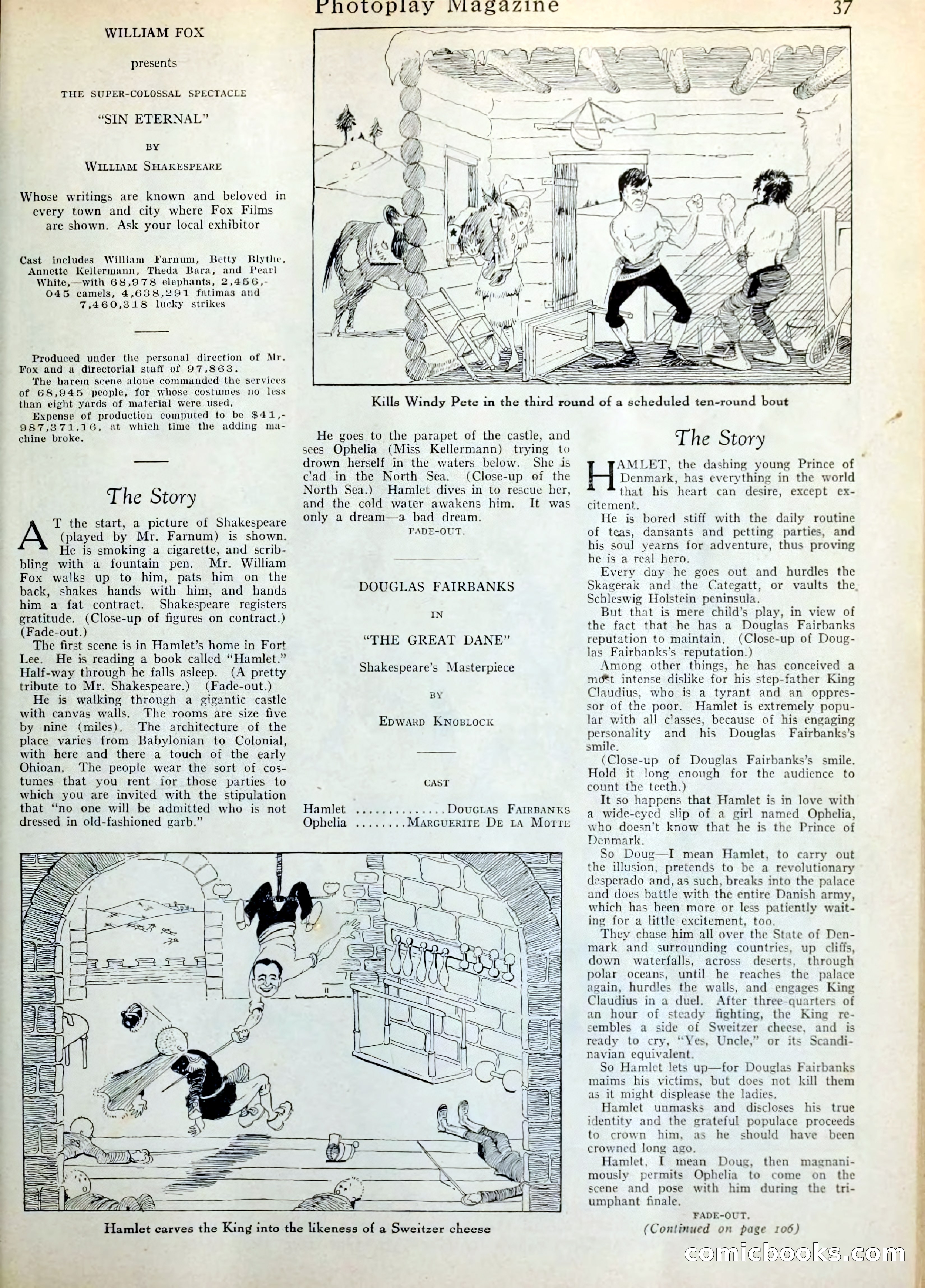
# Page 37 of Photoplay Magazine This page contains article text and illustrations promoting William Fox's film adaptation of Shakespeare's "Sin Eternal" and Douglas Fairbanks's film "The Great Dane." The main text describes the plot of "The Great Dane," which appears to involve Hamlet and a character named Douglas Fairbanks pursuing adventures across Denmark, including scenes with waterfalls and deserts. Two illustrations accompany the articles: one showing a boxing match scene labeled "Killa Windy Pete in the third round of a scheduled ten-round bout," and another below depicting what appears to be an action sequence labeled "Hamlet carves the King into the likeness of a Switzer cheese."
📄 Transcribed text from this page (OCR, searchable)
Machine-transcribed from the original scan — historical spelling and the odd misread are preserved.
WILLIAM FOX presents THE SUPER-COLOSSAL SPECTACLE “SIN ETERNAL” BY WILLIAM SHAKESPEARE Whose writings are known and beloved in every town and city where Fox Films are shown. Ask your local exhibitor Cast includes William Farnum, Betty Blythe, Annette Kellermann, Theda Bara, and Pearl White,—with 68,978 elephants, 2,456,- 045 camels, 4,638,291 fatimas and 7,460,818 lucky strikes Produced under the personal direction of Mr. Fox and a directorial staff of 97,863. The harem scene alone commanded the services of 68,945 people, tor whose costumes no less than eight yards of material were used. Expense of production computed to be $41,- 987,871.16, «at which time the adding mua- chine broke. The Story T the start, a picture of Shakespeare (played by Mr. Farnum) is shown. He is smoking a cigarette, and scrib- bling with a fountain pen. Mr. William Fox walks up to him, pats him on the back, shakes hands with him, and hands him a fat contract. Shakespeare registers gratitude. (Close-up of figures on contract.) (Fade-out.) The first scene is in Hamlet’s home in Fort Lee. He is reading a book called “Hamlet.” Half-way through he falls asleep. (A pretty tribute to Mr. Shakespeare.) (Fade-out.) He is walking through a gigantic castle with canvas walls, The rooms are size five by nine (miles), The architecture of the place varics from Babylonian to Colonial, with here and there a touch of the early Ohioan. The people wear the sort of cos- tumes that you rent for those parties to which you are invited with the stipulation that “no one will be admitted who is not dressed in old-fashioned garb.” == Wee * M | q] Z i = —— ALT Fnotopilay lviagaZine —_—— ——_ G, , SSS SS =| eS Mii, SS We “——ss Z i ee > =) bi Kills Windy Pete in the third round of a scheduled ten-round bout He goes to the parapet of the castle, and sees Ophelia (Miss Kellermann) trying to drown herself in the waters below. (Close-up of the Hamlet dives in to rescue her, c'ad in the North Sea. North Sea.) and the cold water awakens him. only a dream—a bad dream. She is It was FADE-OUT. DOUGLAS FAIRBANKS IN “THE GREAT DANE” Shakespeare’s Masterpiece BY Epwarp KNospLock CAST Harmlet cose 9G ae Douctas FAaAirRBANKS Ophelia... ci: MarcurEriteE De tA Motte NN i SS a Hamlet carves the King into the likeness of a Sweitzer cheese The Story LH bene the dashing young Prince of : Denmark, has everything in the world that his heart can desire, except ex- citement. He is bored stiff with the daily routine of teas, dansants and petting parties, and his soul yearns for adventure, thus proving he is a real hero. Every day he goes out and hurdles the Skagerak and the Categatt, or vaults the. Schleswig Holstein peninsula. But that is mere child’s play, in view of the fact that he has a Douglas Fairbanks reputation to maintain, (Close-up of Doug- las Fairbanks’s reputation.) Among other things, he has conceived a mé*t intense dislike for his step-father King Claudius, who is a tyrant and an oppres- sor of the poor. Hamlet is extremely popu- lar with all classes, because of his engaging personality and his Douglas Fairbanks’s smile. (Close-up of Douglas Fairbanks’s smile. Hold it long enough for the audience to count the teeth.) It so happens that Hamlet is in love with a wide-eyed slip of a girl named Ophelia, who doesn’t know that he is the Prince of Denmark. So Doug—I mean Hamlet, to carry out the illusion, pretends to be a revolutionary desperado and, as such, breaks into the palace and does battle with the entire Danish army, which has been more or less patiently wait- ing for a little excitement, too. They chase him all over the State of Den- mark and surrounding countries, up cliffs, down waterfalls, across deserts, through polar oceans, until he reaches the palace again, hurdles the walls, and engages King Claudius in a duel. After three-quarters of an hour of steady fighting, the King re- sembles a side of Sweitzer cheese, and is ready to cry, “Yes, Uncle,” or its Scandi- navian equivalent. So Hamlet lets up—for Douglas Fairbanks maims his victims, but does not kill them as it might displease the ladies. Hamlet unmasks and discloses his true identity and the grateful populace proceeds to crown him, as he should have been crowned long ago. Hamlet, I mean Doug, then magnani- mously permits Ophelia to come on the scene and pose with him during the tri- umphant finale, FADE-OUT. (Continued on page 106) COMmichboo S co ee 8 8 eee eee