
A complete issue · 116 pages · 1912
Life — December 5, 1912
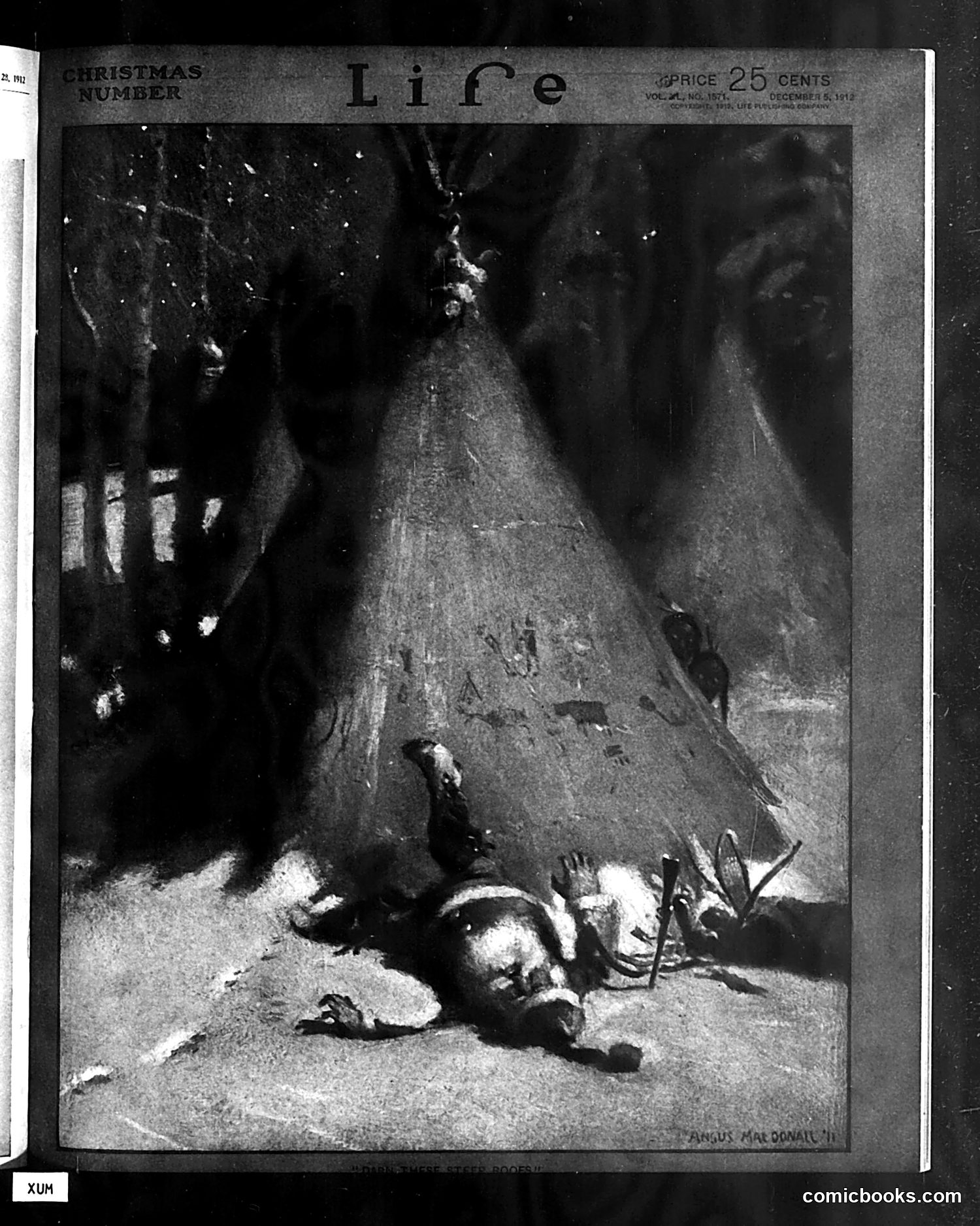
This appears to be a darkly satirical illustration (credited to Angus MacDonald) depicting a figure lying prostrate beneath a large tent or triangular structure—likely representing a military or governmental institution. The prone figure, surrounded by fallen debris and weapons, suggests devastation or defeat. Given the December 1918 date, this almost certainly references the conclusion of World War I (armistice signed November 11, 1918). The satire likely critiques either the human cost of war, the collapse of militarism, or the fragility of political institutions that led to the conflict. The Christmas framing emphasizes the bitter irony of celebrating peace after massive casualties. Without clearer identification of the specific figure or tent structure, the exact target of satire remains somewhat unclear, though the overall message condemns war's destructiveness.
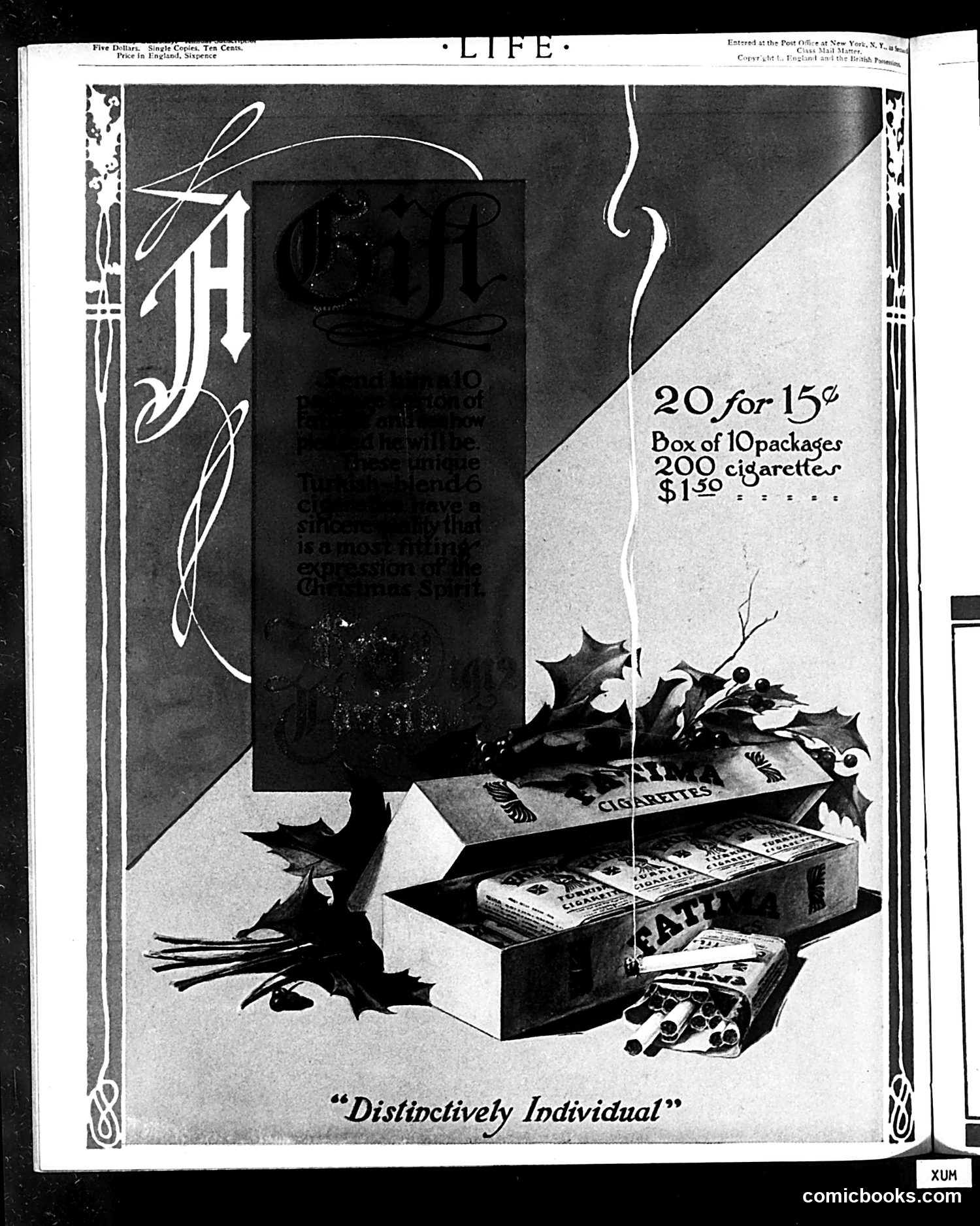
This is primarily a **cigarette advertisement**, not political satire. The page advertises cigarettes at "20 for 15¢" (a box of 10 packages containing 200 cigarettes for $1.50). The decorative elements—holly sprigs, pine branches, and holiday imagery—indicate this is a **Christmas-themed ad** from Life magazine's holiday issue. The tagline "Distinctively Individual" is the marketing message. The dark rectangular panel in the center appears to contain product information or branding that's too obscured to read clearly in this reproduction. This represents typical early 20th-century advertising when cigarettes were openly promoted without health warnings, often using festive imagery to encourage gift-giving during holidays. The design reflects Art Deco styling popular in that era.
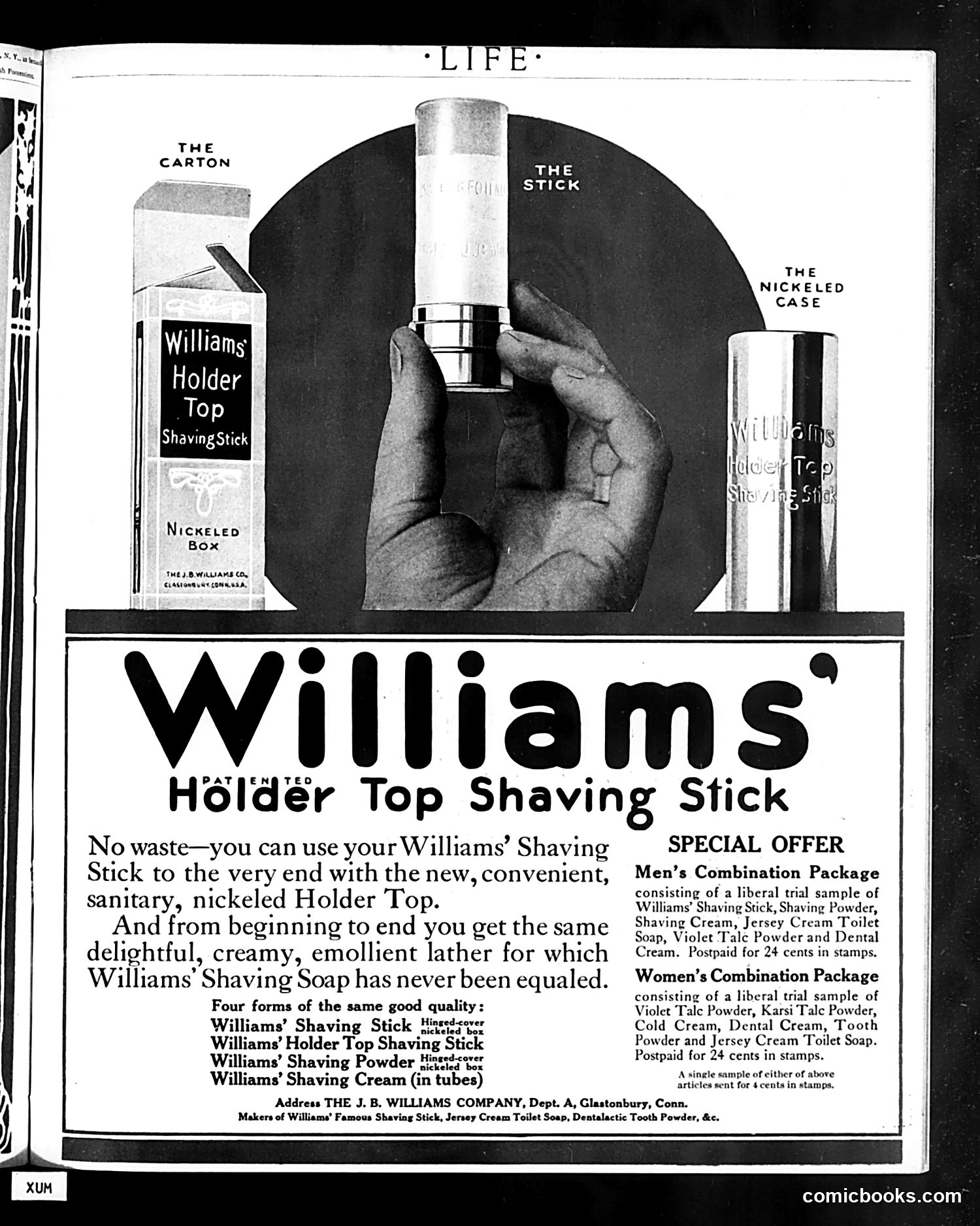
This is primarily an **advertisement, not satire or political commentary**. It's a full-page ad for Williams' Holder Top Shaving Stick, published in *Life* magazine. The central image shows hands holding a cylindrical shaving stick with its nickel-plated holder. The ad emphasizes the product's convenience—allowing the stick to be used completely without waste by inserting it into a holder. The three labeled components ("The Carton," "The Stick," "The Nickeled Case") demonstrate the product's design features. Text highlights the shaving cream's quality and offers combination sample packages for both men and women at 24 cents. This represents typical early 20th-century grooming product marketing, emphasizing practicality and economy rather than conveying any satirical message.
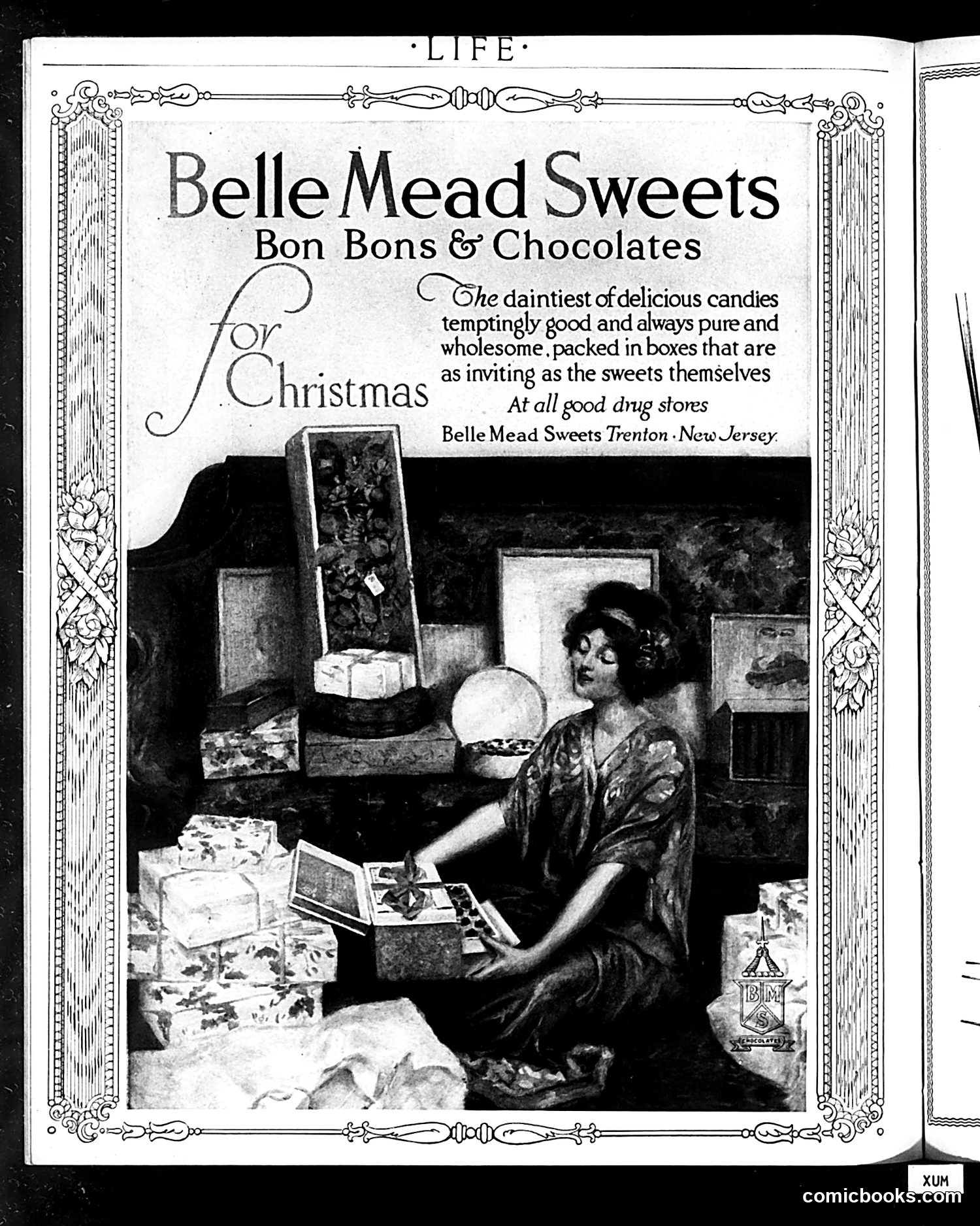
This is a **commercial advertisement**, not political satire or a cartoon. It promotes Belle Mead Sweets, a candy company from Trenton, New Jersey, advertising "Bon Bons & Chocolates" as Christmas gifts. The ad features a photograph of a woman in an ornate interior, examining candy boxes. The accompanying text emphasizes the product's quality—"daintily delicious candies," "pure and wholesome"—and notes availability "at all good drug stores." The decorative art nouveau border and the formal presentation reflect early 20th-century advertising conventions. There is no political commentary or satire present. The page simply demonstrates how Life magazine, despite its satirical reputation, carried paid advertisements to support publication.
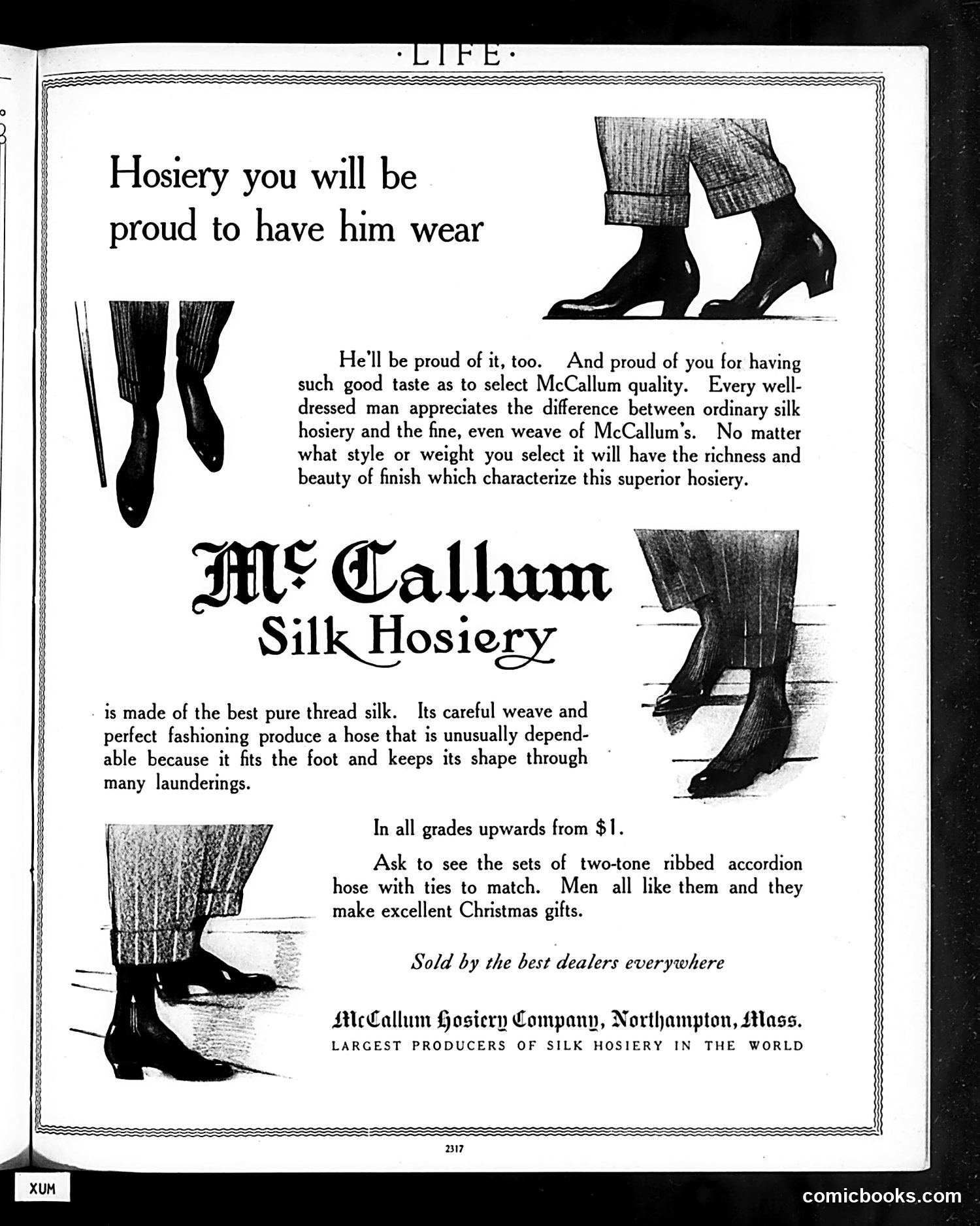
This is not a cartoon or satire—it's a **straightforward advertisement** for McCallum Silk Hosiery, a real product from McCallum Hosiery Company in Northampton, Massachusetts. The page promotes men's silk socks as a gift item, using photographs of well-dressed men's legs and feet to display the product. The advertising copy emphasizes quality ("best pure thread silk"), durability through laundering, and variety in styles and weights, with prices starting at $1. The only noteworthy element for modern readers is the gendered marketing angle: presenting expensive hosiery as something a woman should buy to make "him" proud—reflecting early 20th-century consumer culture where men's fashion choices were often presented as female purchasing decisions. This is period advertising, not editorial content.
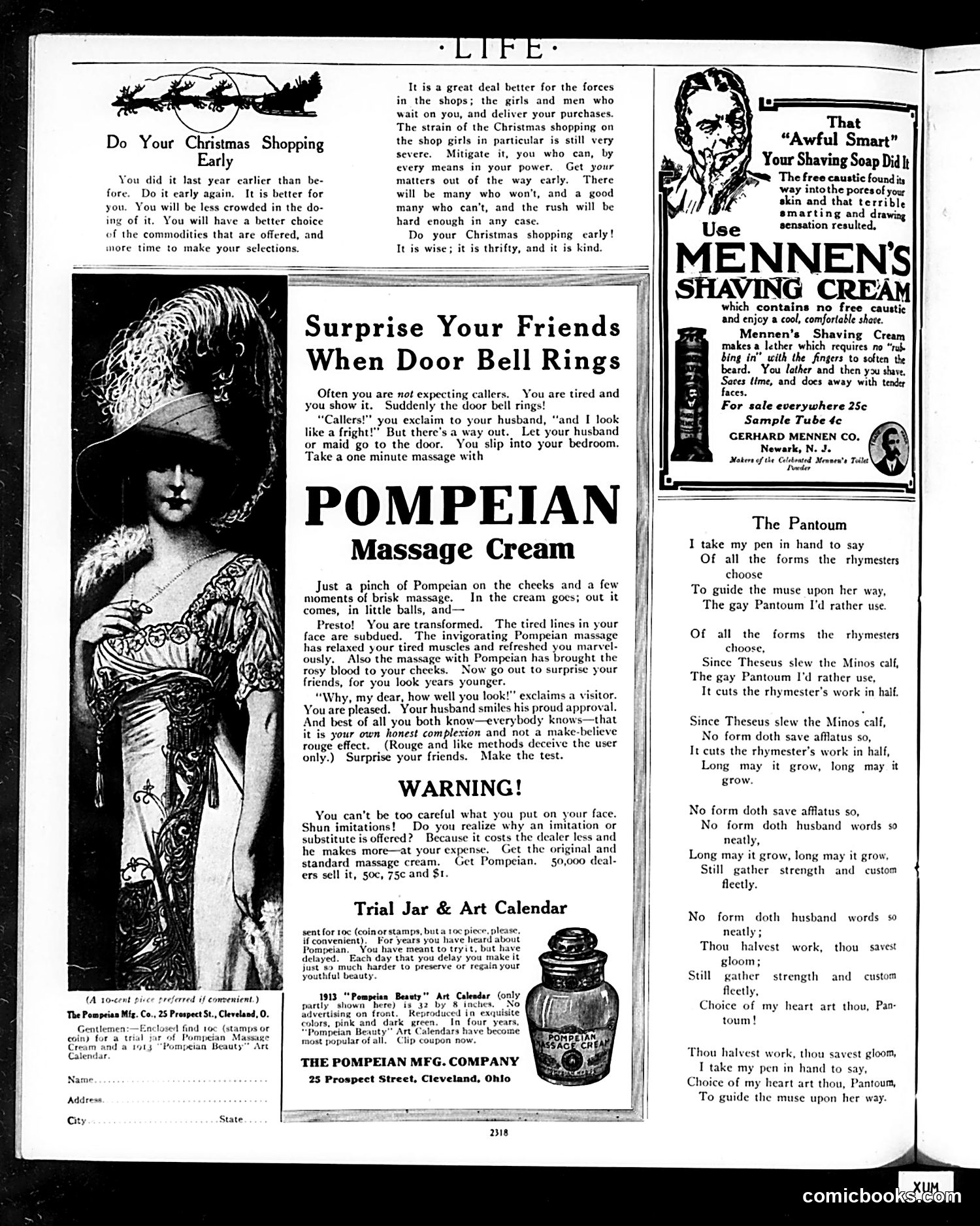
This page is **primarily advertising**, not political satire. The dominant content includes: **Pompeian Massage Cream** advertisement featuring an elaborately costumed woman in classical/theatrical dress, emphasizing beauty treatments that promise to reduce "tired lines" and make users "look years younger." The ad includes a warning against imitations. **Mennen's Shaving Cream** advertisement addressing the "awful smart" man concerned about skin irritation from cheap soaps. **The Pantoum** - a poem in the right column, unrelated to the advertisements. **"Do Your Christmas Shopping Early"** - practical seasonal advice about avoiding crowds. The page reflects early 20th-century consumer culture, targeting both men and women with beauty and grooming products. There is **no apparent political cartoon or social satire** here—just period advertising and editorial content typical of Life magazine's commercial sections.
This is an advertisement page, not a cartoon. It shows a formal advertisement for Theodore B. Starr, Inc., a jewelry company established in 1862, located at 5th Avenue and 47th Street in New York. The ad promotes fine gems for Christmas gifts, emphasizing the company's commitment to quality and honest representation. Key selling points include: gems of "undoubted merit," transparency about each stone's characteristics (color, brilliance, crystal perfection), and competitive pricing. The company also offers pearls, diamonds, and custom-designed settings. The ornate border and formal typography reflect early 20th-century advertising aesthetics. This is straightforward commercial messaging rather than satire—Life magazine carried advertisements alongside its humorous content.
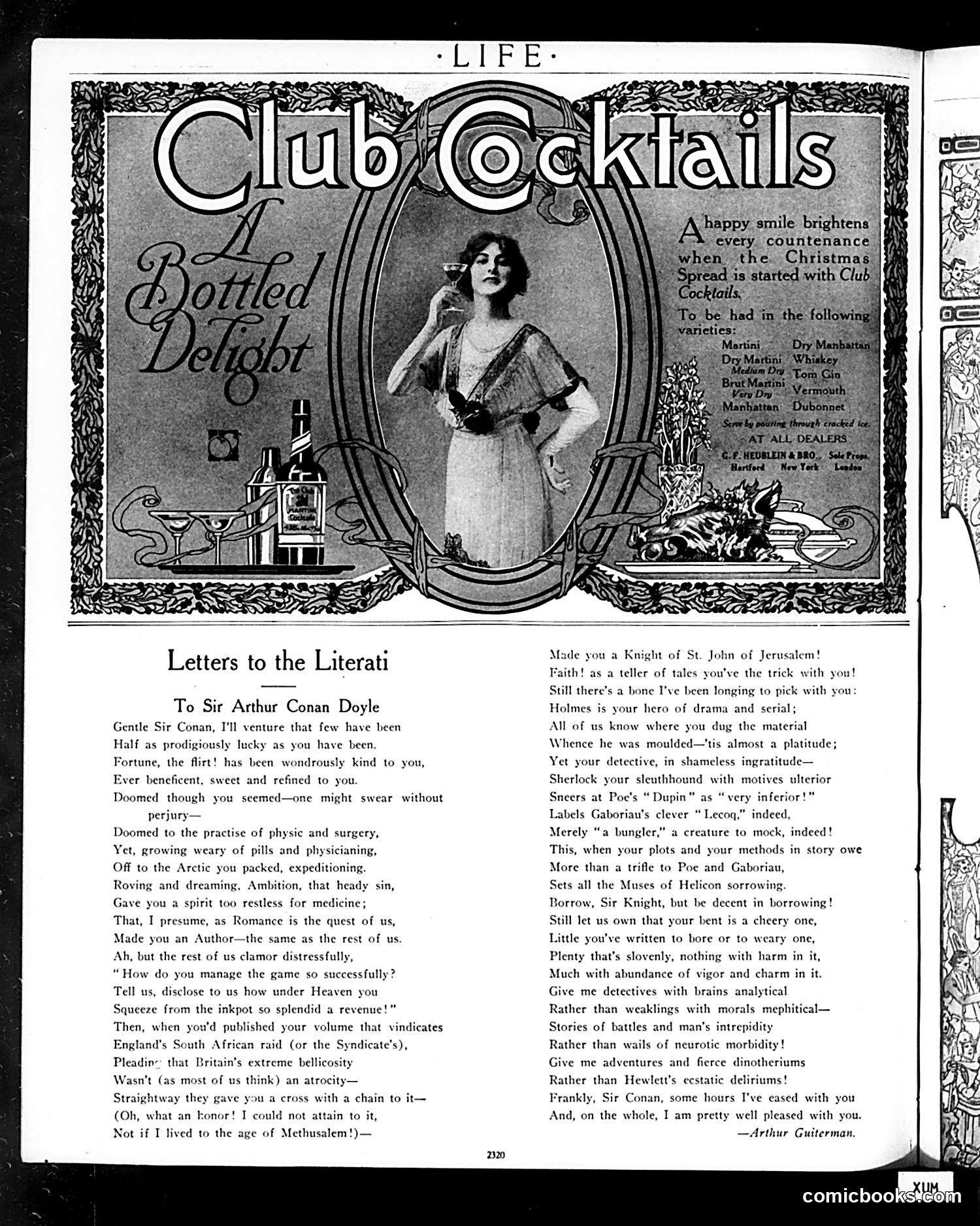
The top half features an advertisement for "Club Cocktails Bottled Delight," showing a woman in 1920s attire holding a cocktail glass. This promotes pre-mixed cocktails available through dealers, listing varieties like Martini, Manhattan, and Tom Gin. The bottom half contains "Letters to the Literati"—a satirical reader section addressing Sir Arthur Conan Doyle. The unsigned letter (signed "Arthur Guiterman") playfully teases Doyle about his prolific output, questioning how he manages such successful literary production while seemingly dabbling in various enterprises. It references his Sherlock Holmes stories and jokes about Doyle's financial success, all in mock-reverent, humorous verse. This is typical Life magazine content: combining advertisements with satirical literary commentary on contemporary figures.
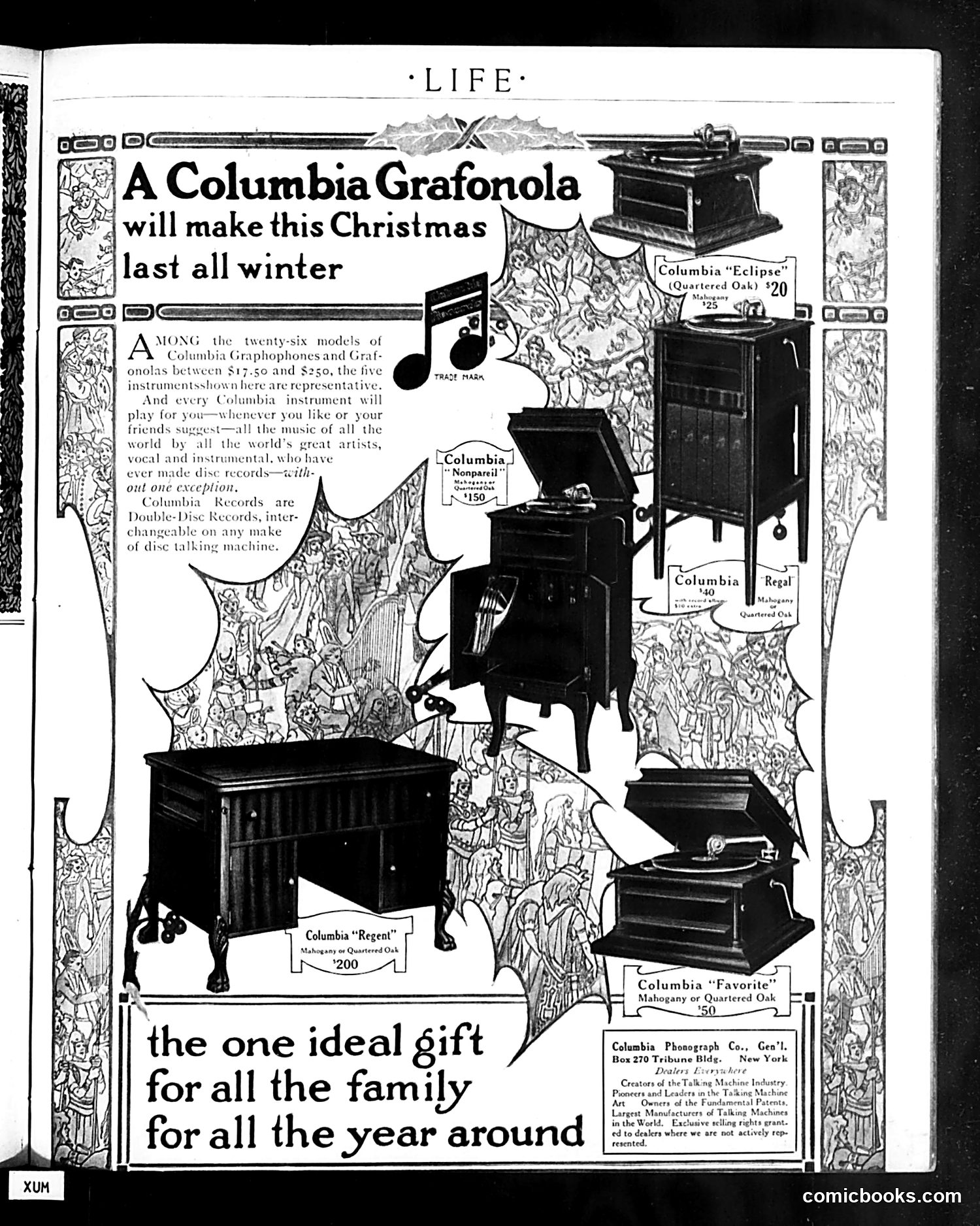
This is primarily **advertising copy**, not satire or political commentary. The page promotes Columbia Grafonola phonographs as Christmas gifts, featuring five different models priced between $40–$200. The decorative border contains intricate illustrations of what appears to be a festive scene, but these are ornamental rather than satirical. The musical note logo and text emphasize that Columbia Records play on any disc-talking machine, positioning the product as universally compatible—a notable selling point when competing phonograph formats existed. The headline's claim that a Grafonola "will make this Christmas last all winter" is typical period advertising hyperbole, suggesting the gift provides months of entertainment. The text emphasizes this as "the one ideal gift for all the family for all the year around," appealing to holiday shoppers seeking practical, family-friendly purchases.
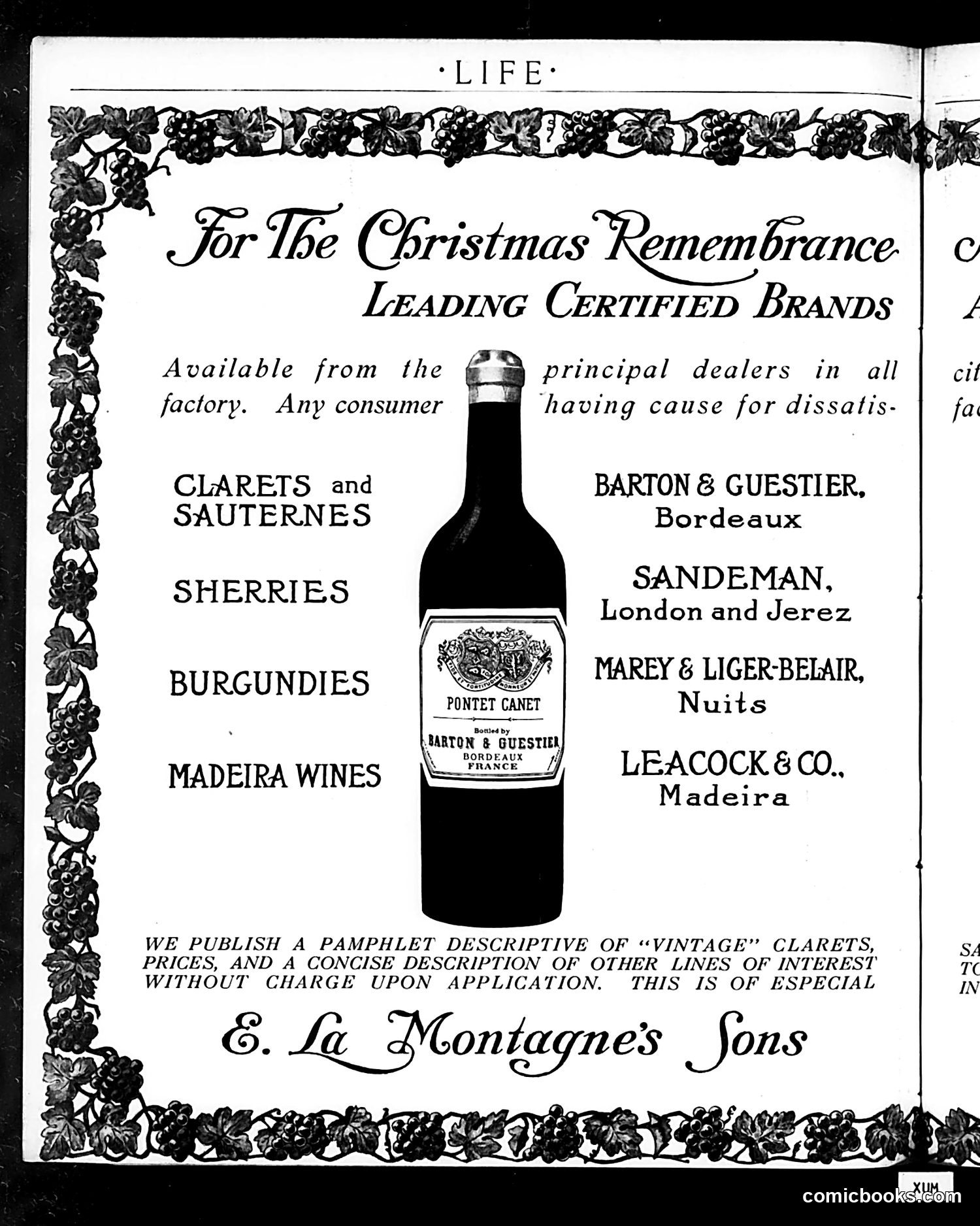
This is a **wine advertisement**, not a cartoon or satirical content. The page is from *Life* magazine but serves as a paid advertisement for E. La Montagne's Sons, a wine merchant. The ad promotes "leading certified brands" suitable as Christmas gifts, listing: - Clarets and Sauternes - Sherries - Burgundies - Madeira wines Specific importers are named (Barton & Guestier of Bordeaux, Sandeman of London/Jerez, etc.). A bottle of Pontet Canet wine is prominently illustrated. The decorative grape vine border emphasizes the wine theme. There is **no satire or political content**—this is straightforward commercial advertising from the Prohibition era or shortly after, marketing premium imported wines as luxury gift items.
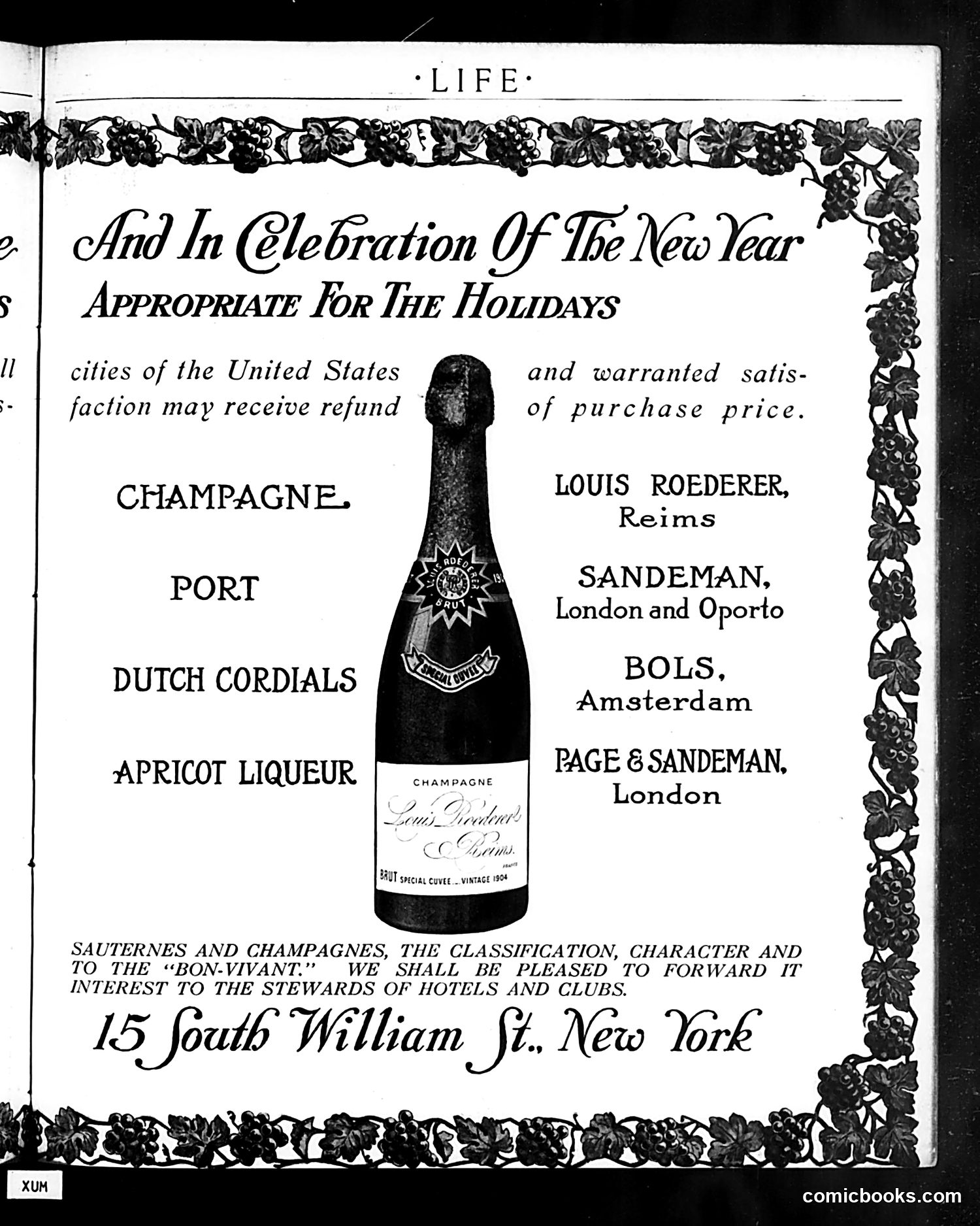
This is primarily a **holiday advertisement**, not a satirical cartoon. The page advertises fine wines and spirits—champagne, port, cordials, and liqueur—positioned as appropriate gifts for New Year celebrations and holiday entertaining. The central image is a **Louis Roederer champagne bottle** (vintage 1904), with text listing various imported alcoholic beverages from European producers (Roederer from Reims, Sandeman from London/Porto, Bols from Amsterdam). The address "15 South William St., New York" indicates this is a merchant or importer's advertisement. The decorative grape-vine border reinforces the wine/beverage theme. There is **no political satire** on this page—it's a straightforward commercial advertisement using elegant typography and imagery to promote luxury imported spirits to wealthy American consumers during the holiday season.
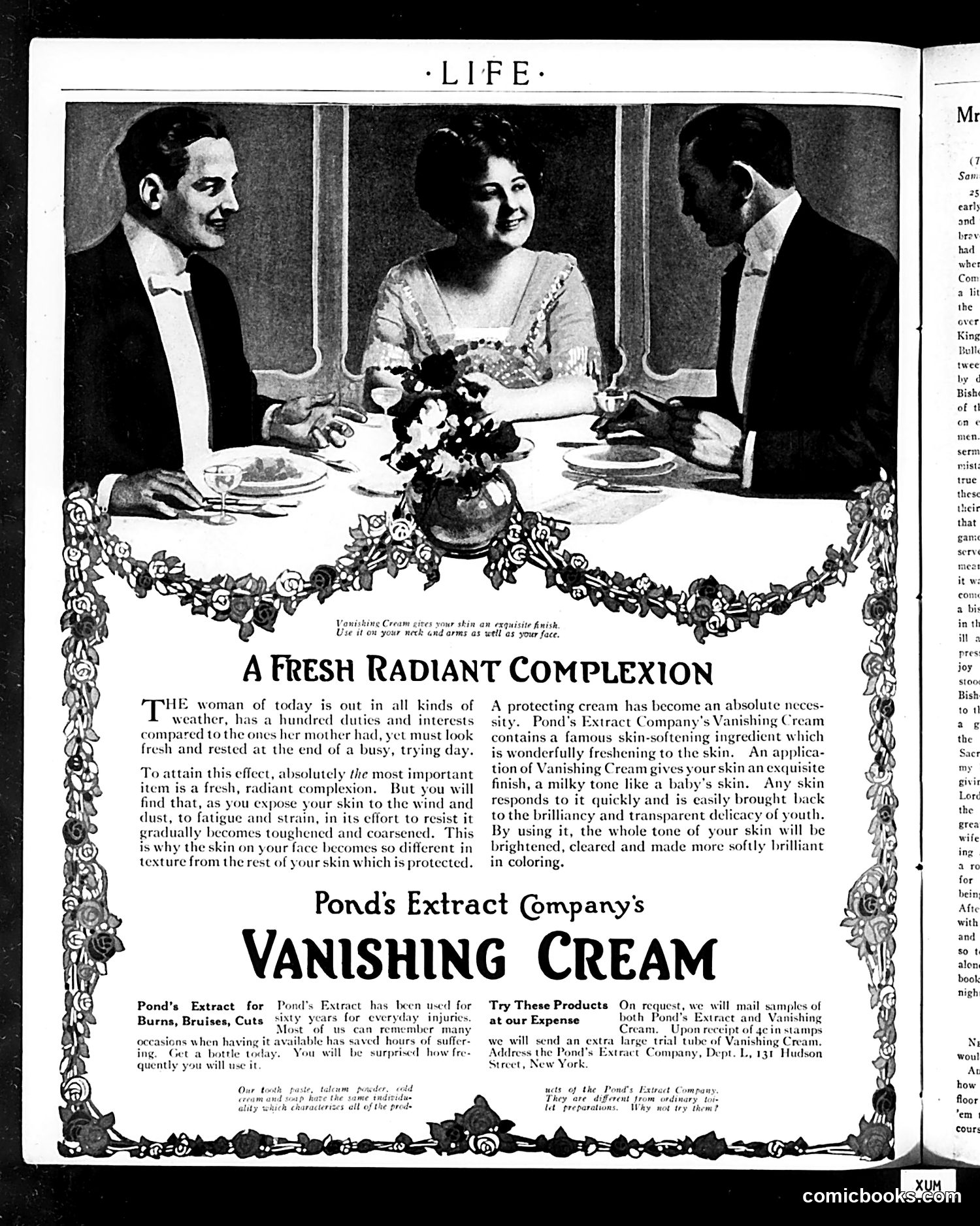
This is **not a political cartoon or satire**, but rather a **legitimate advertisement** for Pond's Extract Company's Vanishing Cream skincare product. The page features: - **Three photographs** of well-dressed people dining together, used to illustrate the product's benefits - **Marketing copy** promoting the cream as essential for maintaining a "fresh, radiant complexion" despite modern women's exposure to "wind and dust" - **Product claims** about skin-softening ingredients and a "milky tone like a baby's skin" - **Call to action** offering a free trial tube The decorative border and elegant presentation are typical of *Life* magazine's advertising design from the early 20th century. This represents straightforward commercial promotion rather than editorial satire or political commentary.
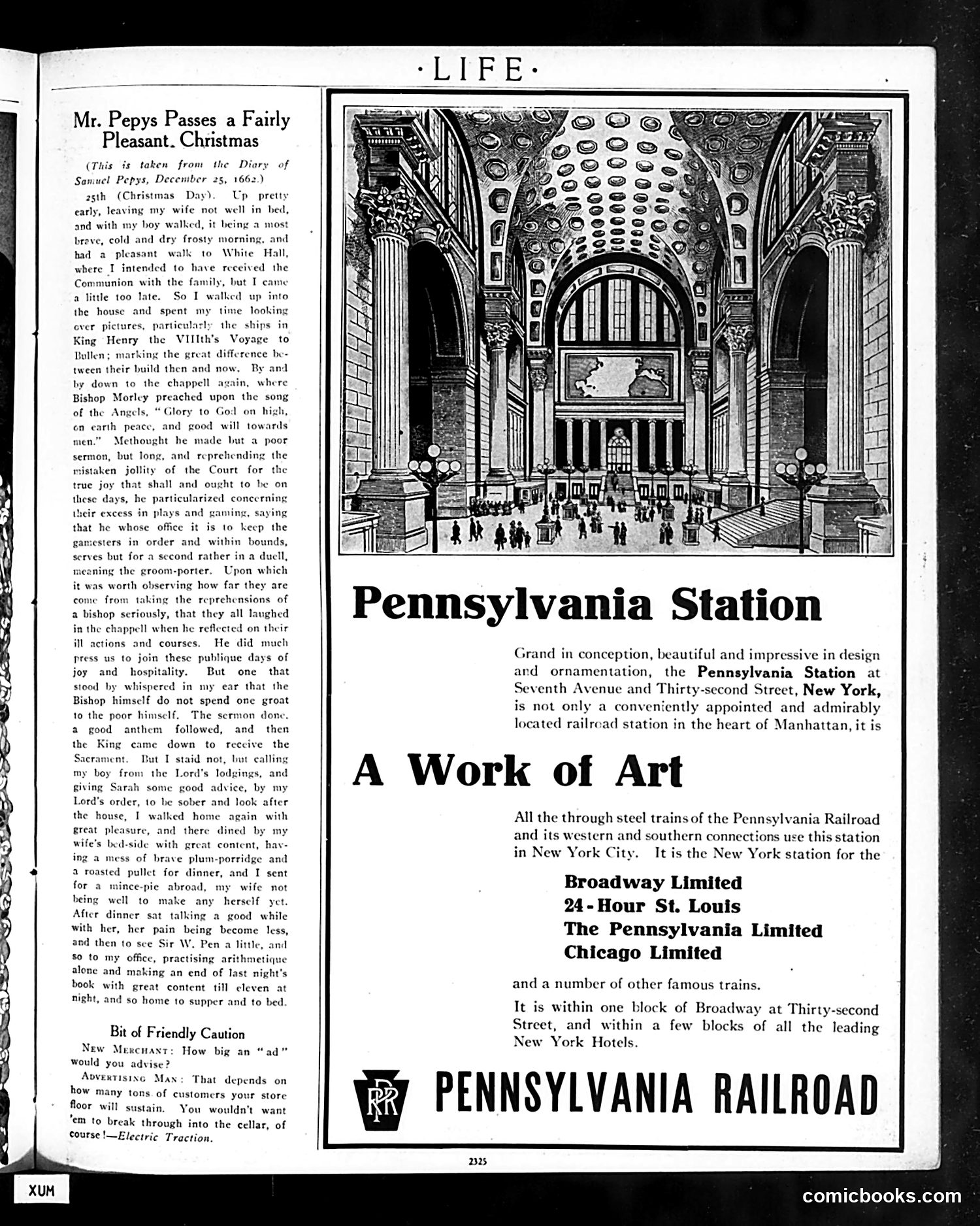
This page is primarily **advertising**, not editorial content or political satire. The dominant feature is a large advertisement for Pennsylvania Station in New York City, depicting the grand interior of the station with its impressive architecture, coffered ceiling, and crowds of travelers. The left column contains a personal essay titled "Mr. Pepys Passes a Fairly Pleasant Christmas," describing the author's Christmas Day activities and church attendance—a lighthearted domestic narrative rather than satire. Below that is a brief advice column called "Bit of Friendly Caution" about store floor capacity. The Pennsylvania Railroad advertisement emphasizes the station as "A Work of Art" and lists famous trains using the facility (Broadway Limited, 24-Hour St. Louis, Pennsylvania Limited Chicago Limited), promoting its central Manhattan location near Broadway hotels.
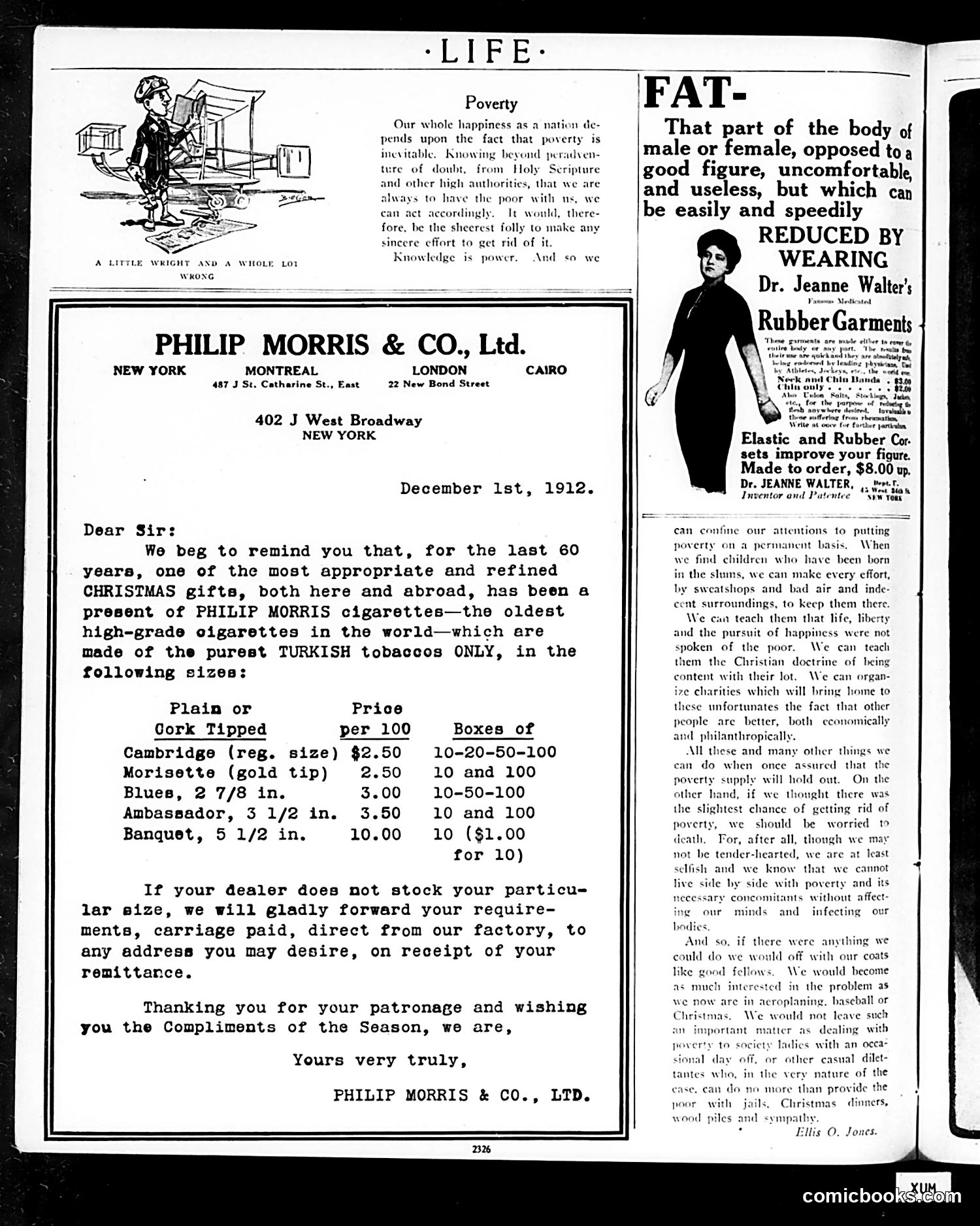
This page is primarily **advertising content** rather than satirical editorial material. The left side features a Philip Morris & Co. cigarette advertisement dated December 1, 1912, promoting their Turkish tobacco cigarettes as appropriate Christmas gifts in various sizes (Cambridge, Morissetta, Blues, Ambassador, Banquet). The right side advertises **Dr. Jeanne Walter's Rubber Garments** for reducing body fat—a corset-like device marketed to women to achieve a "good figure" by wearing specialized elastic and rubber clothing. The price starts at $8.00. The small cartoon in the upper left corner ("A Little Wright and a Whole Lot Wrong") appears unrelated to these ads but is too small to interpret clearly from this image. This page reflects **early 1900s consumer marketing** targeting both cigarette and weight-loss product sales.
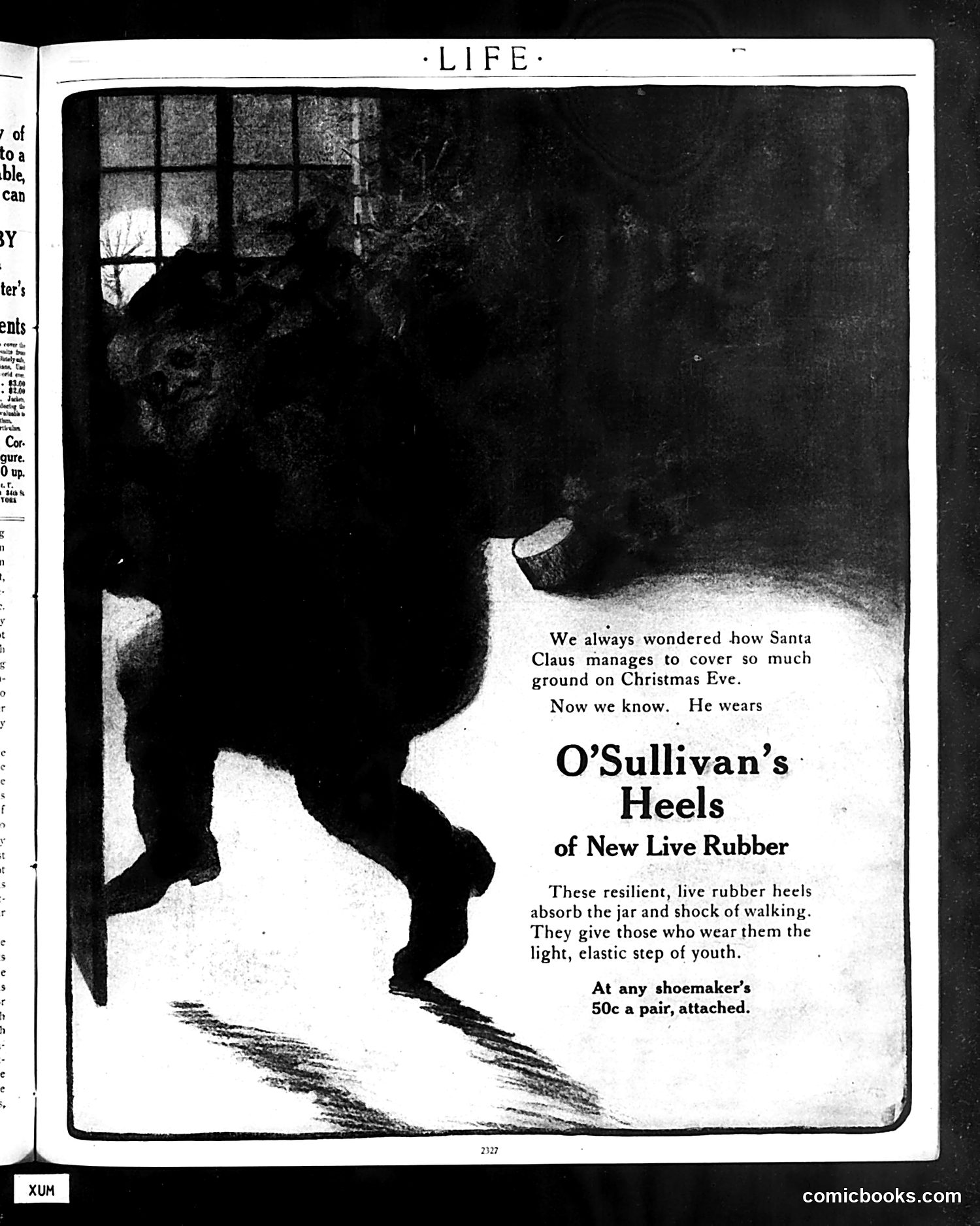
This is a **commercial advertisement**, not political satire. The page uses Christmas humor to promote O'Sullivan's brand rubber heels. The joke: The image shows silhouetted legs in an energetic stride, implying Santa Claus's superhuman ability to traverse the world on Christmas Eve is explained by wearing these special heels. The heels allegedly provide "resilient" cushioning that gives wearers "the light, elastic step of youth"—allowing them to cover extraordinary distances with ease. The advertisement plays on Santa as a relatable figure while making a consumer appeal: if these heels enabled Santa's famous feat, they could improve ordinary people's walking comfort and vitality. The price point of 50 cents per pair suggests this is vintage early-20th-century advertising from *Life* magazine, which regularly mixed humor with product promotion.
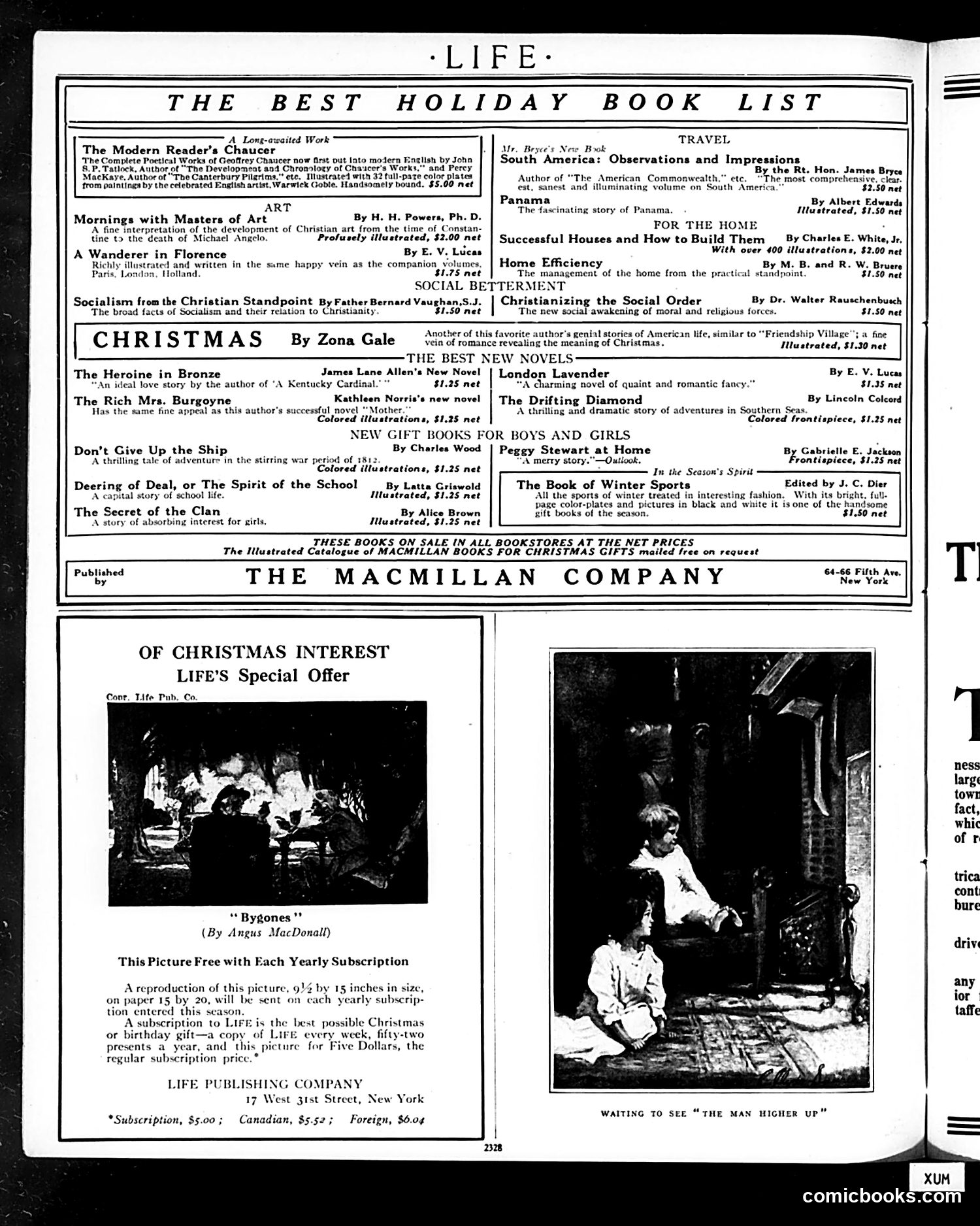
This is primarily a **book advertisement page** from Life magazine's Christmas issue, not a political cartoon. It features two elements: **Top section**: A comprehensive "Best Holiday Book List" advertising titles from The Macmillan Company across categories—art, travel, home management, social reform, Christmas stories, and children's books. Prices range from $1.25 to $2.50. **Bottom section**: Two illustrations—a painting titled "Bygones" by Angus MacDonall (offered free with yearly Life subscriptions), and a photograph captioned "Waiting to See 'The Man Higher Up,'" depicting what appears to be people in an urban tenement setting, likely referencing working-class or immigrant conditions. The page reflects early 20th-century publishing marketing and Life's mix of literary promotion with social commentary imagery. No political satire or caricature is present—this is commercial advertising with documentary photography.
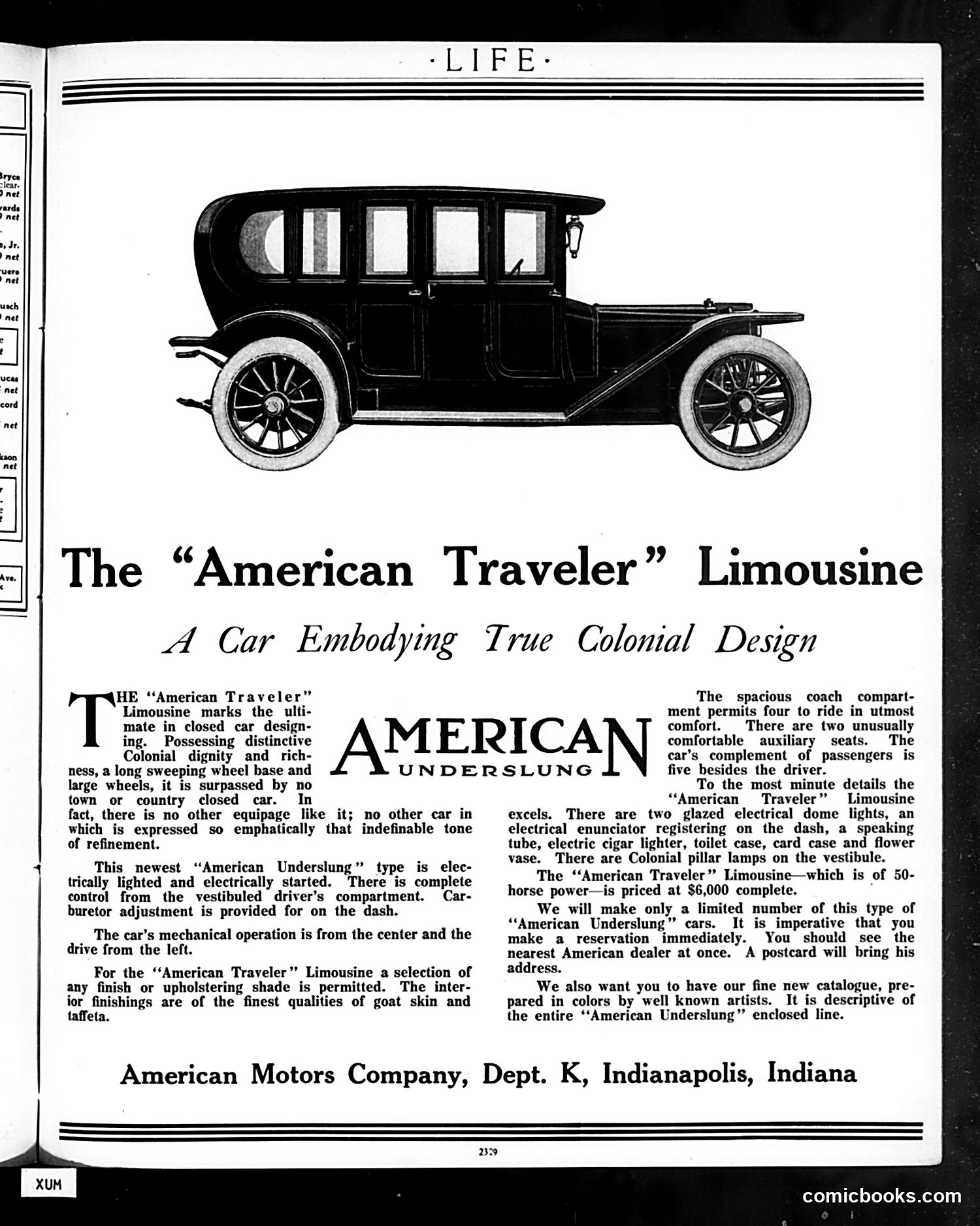
This is a **full-page automobile advertisement**, not a political cartoon. It promotes the "American Traveler" Limousine by American Motors Company of Indianapolis. The ad appeals to wealthy consumers by framing the car as embodying "Colonial dignity and richness"—tapping into early-20th-century nostalgia for American aristocratic heritage. Priced at $6,000 (extremely expensive for the era), it targets the elite market. The sales pitch emphasizes luxury details: goat-skin upholstery, electrical dome lights, speaking tubes, electric cigar lighters, and toilet cases. The "Underslung" design and "vestibuled driver's compartment" suggest both mechanical sophistication and class separation between passengers and chauffeur. The ad's insistence on exclusivity ("only a limited number") and immediate reservation pressure are standard luxury marketing tactics. This reflects the pre-Depression era when such conspicuous consumption was openly celebrated in advertising.
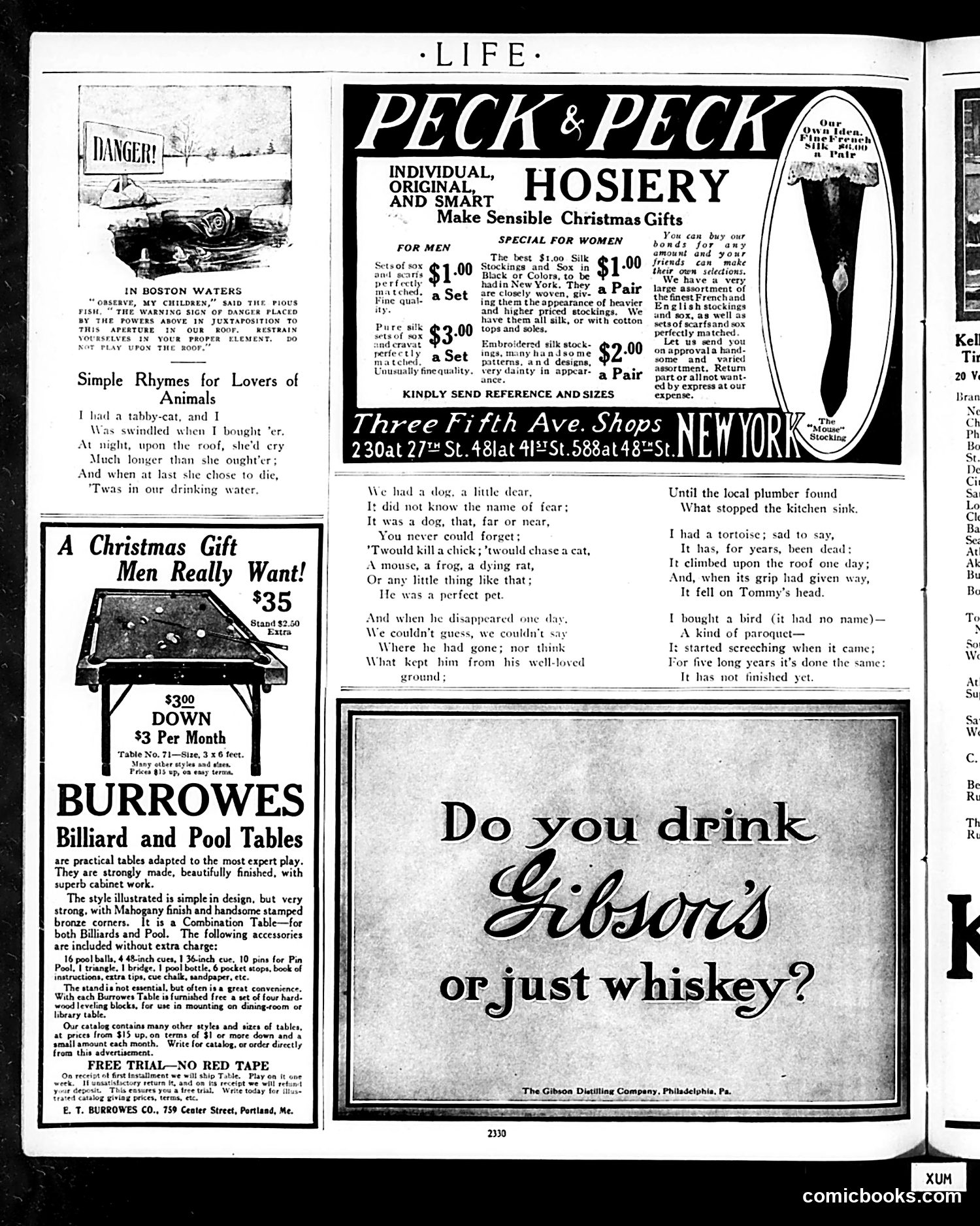
This page is primarily **advertising with light satirical content**, typical of Life magazine's format. The main satirical pieces are: 1. **"In Boston Waters" cartoon**: A fish warns its children about a "Danger" sign near a roof hole, cautioning restraint—the ironic joke being the fish's own offspring end up in someone's drinking water anyway. It's gentle humor about parental advice's futility. 2. **"Simple Rhymes for Lovers of Animals"**: A series of darkly comic poems about pets meeting unfortunate ends—a cat dying in drinking water, a dog vanishing, a tortoise falling on a child's head, a parrot that won't stop screeching. The humor derives from the *contrast* between sentimental pet ownership and comedic domestic disasters. The remainder comprises period advertisements: Peck & Peck hosiery, Burrowes billiard tables, and a Gibson whiskey ad. The page reflects early-20th-century magazine conventions mixing light satire with commercial content, using animals as subjects for absurdist humor rather than social/political commentary.
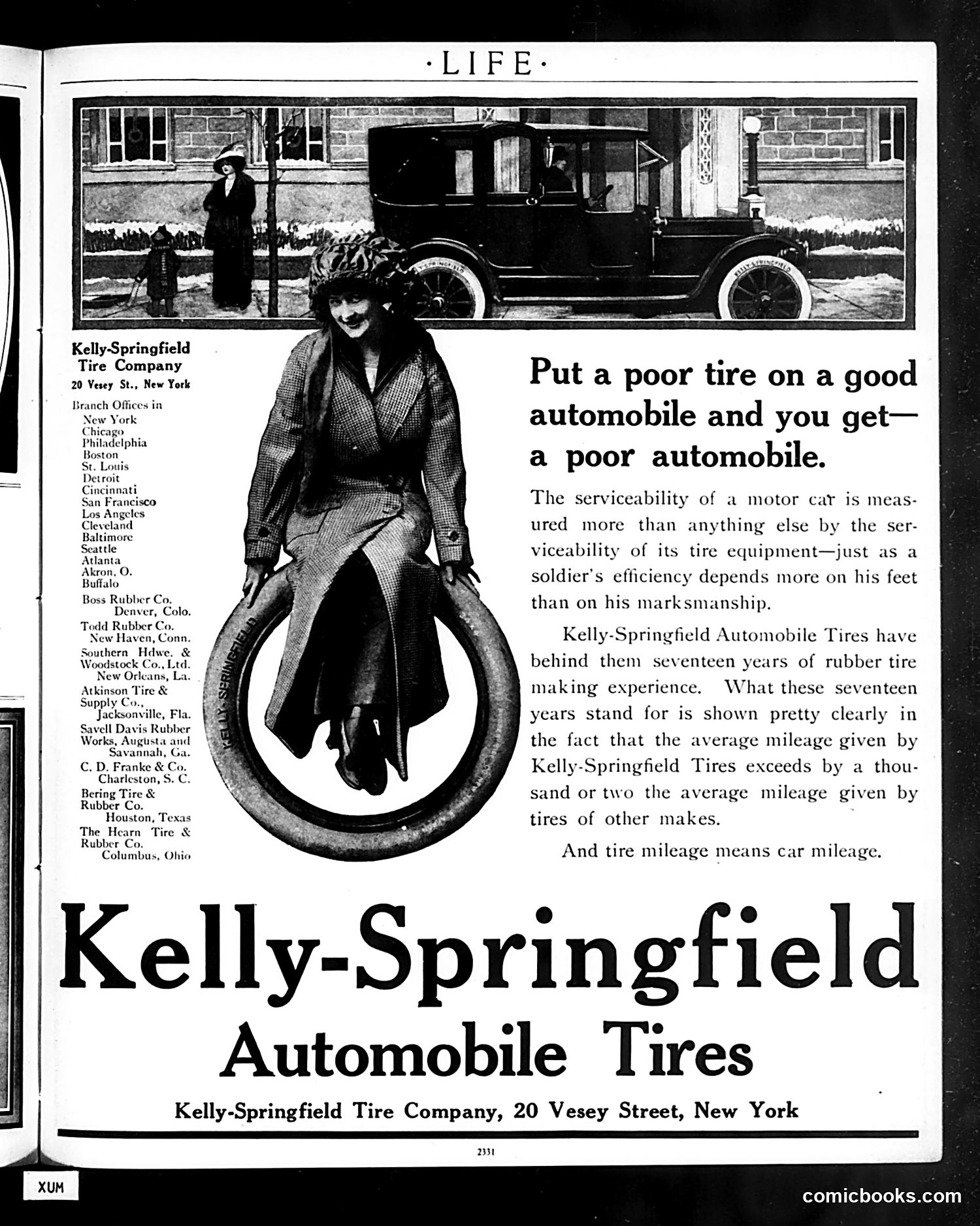
This is a **tire company advertisement**, not satire or political commentary. The page promotes Kelly-Springfield Automobile Tires through a straightforward commercial argument. The central image shows a woman sitting inside a large tire, likely meant to suggest the tire's quality and durability as a reliable "seat" for automobile travel. The accompanying photograph depicts an early 1920s automobile and street scene, establishing contemporary context. The ad's logic is practical: a car's reliability depends primarily on tire quality, just as "a soldier's efficiency depends more on his feet than on his marksmanship." Kelly-Springfield claims seventeen years of manufacturing experience and superior mileage performance compared to competitors. The extensive list of branch offices and distributors demonstrates the company's national reach. This is corporate advertising using a combination of visual appeal (the woman in the tire) and rational argument about product superiority—typical marketing strategy for the era.
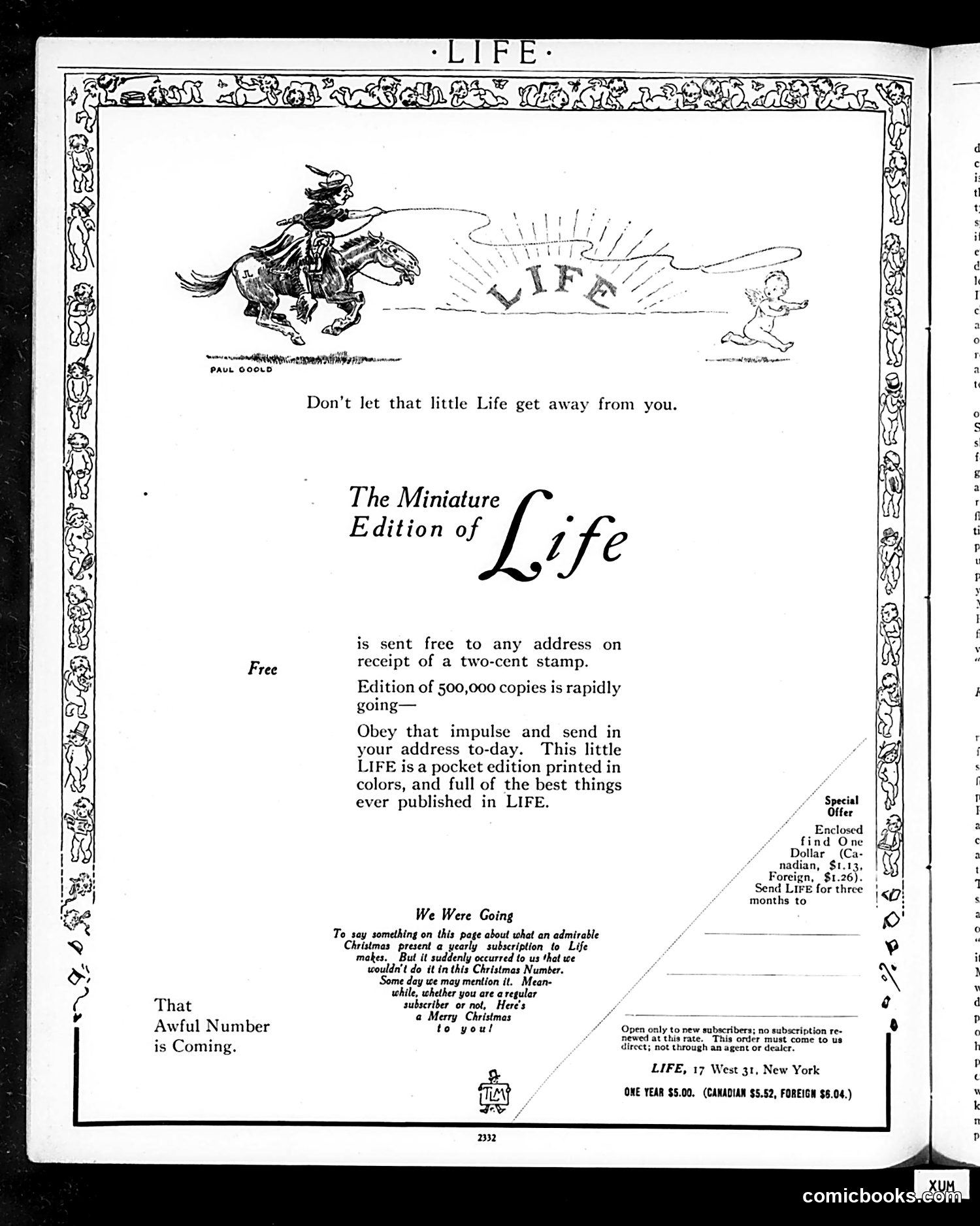
This is primarily a **promotional advertisement** for *Life* magazine's miniature pocket edition, not a political cartoon. The small illustration by Paul Coold at the top—showing a cowboy on horseback chasing a tiny figure labeled "LIFE"—is a visual pun supporting the tagline "Don't let that little Life get away from you." The page advertises that a pocket-sized edition of *Life* will be sent free with a two-cent stamp, with 500,000 copies available. It includes subscription offers (one year for $5.00 domestically) and a Christmas appeal, mentioning they considered promoting yearly subscriptions as holiday gifts but decided against it in this particular Christmas issue. The design uses decorative borders typical of early 20th-century magazine aesthetics. This appears to be a house advertisement—the magazine promoting itself to readers.
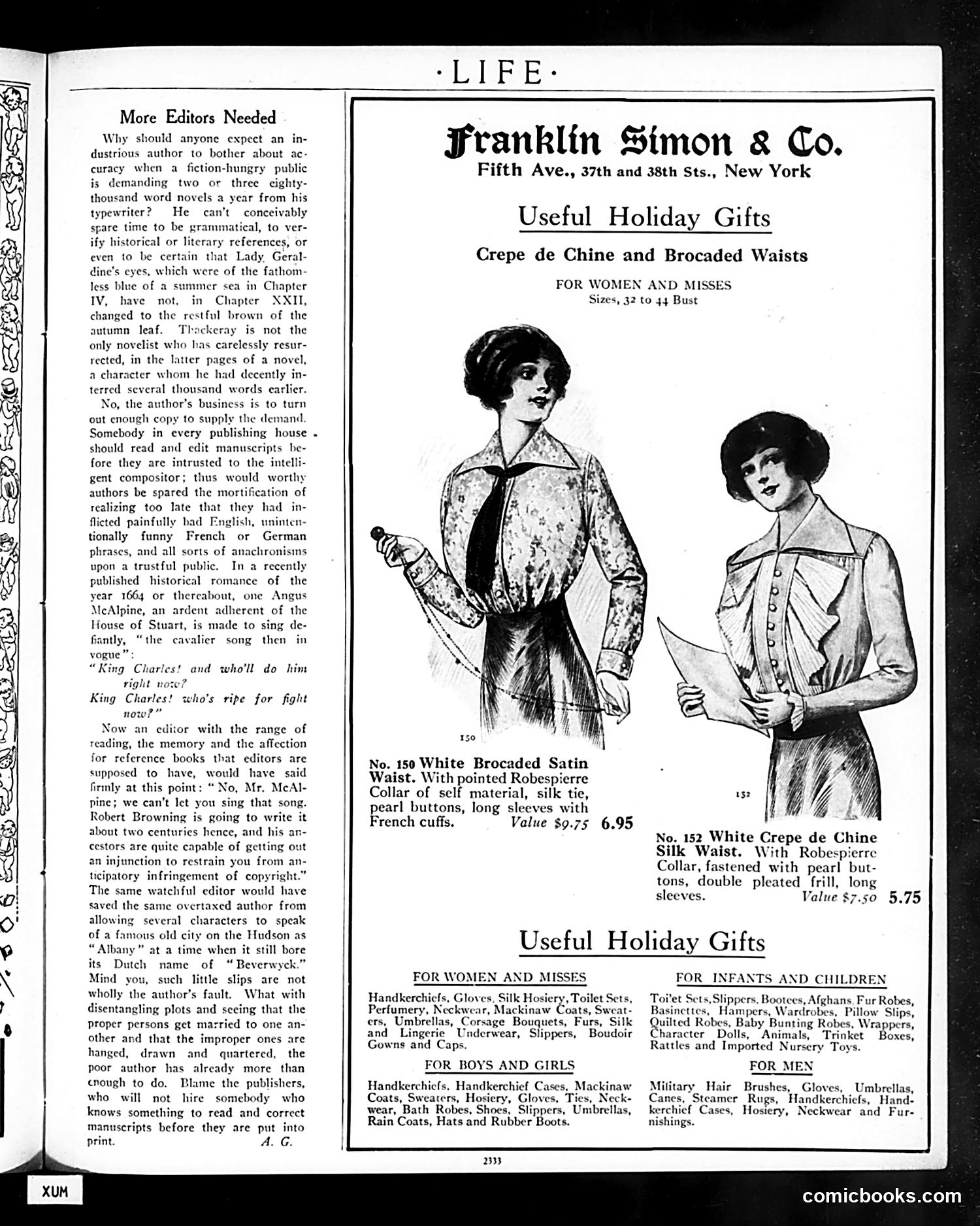
This page combines editorial commentary with fashion advertising. The left column, "More Editors Needed," satirizes the publishing industry's careless editing practices. The author argues that publishers demand authors produce massive output (80,000-word novels annually) without time for accuracy, creating embarrassing errors: historical inaccuracies, contradictory character details, and anachronisms. The example cites a 1664-set novel where a character sings Robert Browning's poem—written 200 years later—risking "anticipatory infringement of copyright," and another referencing Albany by its Dutch name "Beverwyck" when that name was no longer in use. The satire blames publishers for not hiring adequate editors, despite authors' already-overwhelming workload. The right side advertises Franklin Simon & Co. women's clothing and holiday gifts, primarily silk waists and accessories for various demographics.
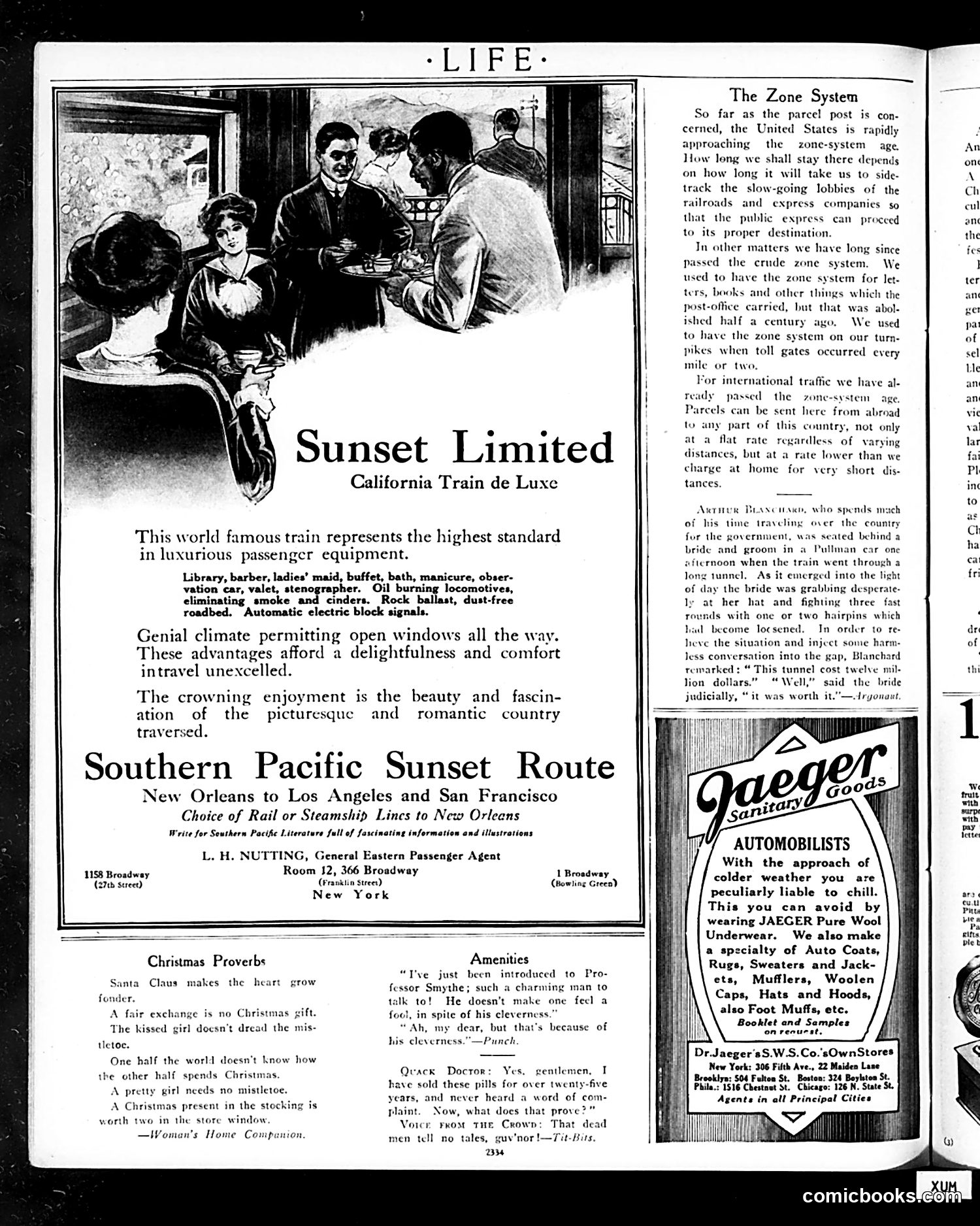
This page is primarily **advertising and humor content**, not political satire. **Main Advertisement:** The "Sunset Limited" train advertisement dominates, promoting a luxury California railway with amenities (barber, observation car, etc.). This reflects early 20th-century travel advertising emphasizing comfort and scenic beauty. **Editorial Content:** "The Zone System" article discusses postal rates and railroad lobbying—practical infrastructure criticism, not satire. **Humor Pieces:** The page includes light anecdotes: - A bride fighting with her hat in a tunnel (the "$12 million tunnel" punchline relies on understated humor about the expense being worth it for a brief inconvenience) - A quack doctor joke playing on "dead men tell no tales" - Christmas proverbs offering domestic observations **Secondary Ads:** Jaeger wool underwear targets automobilists in cold weather; Dr. Jaeger's sanitary goods advertisement. The cartoon illustration (upper left) appears to be a generic scene of passengers dining or socializing—accompanying the train advertisement rather than making a specific political point.
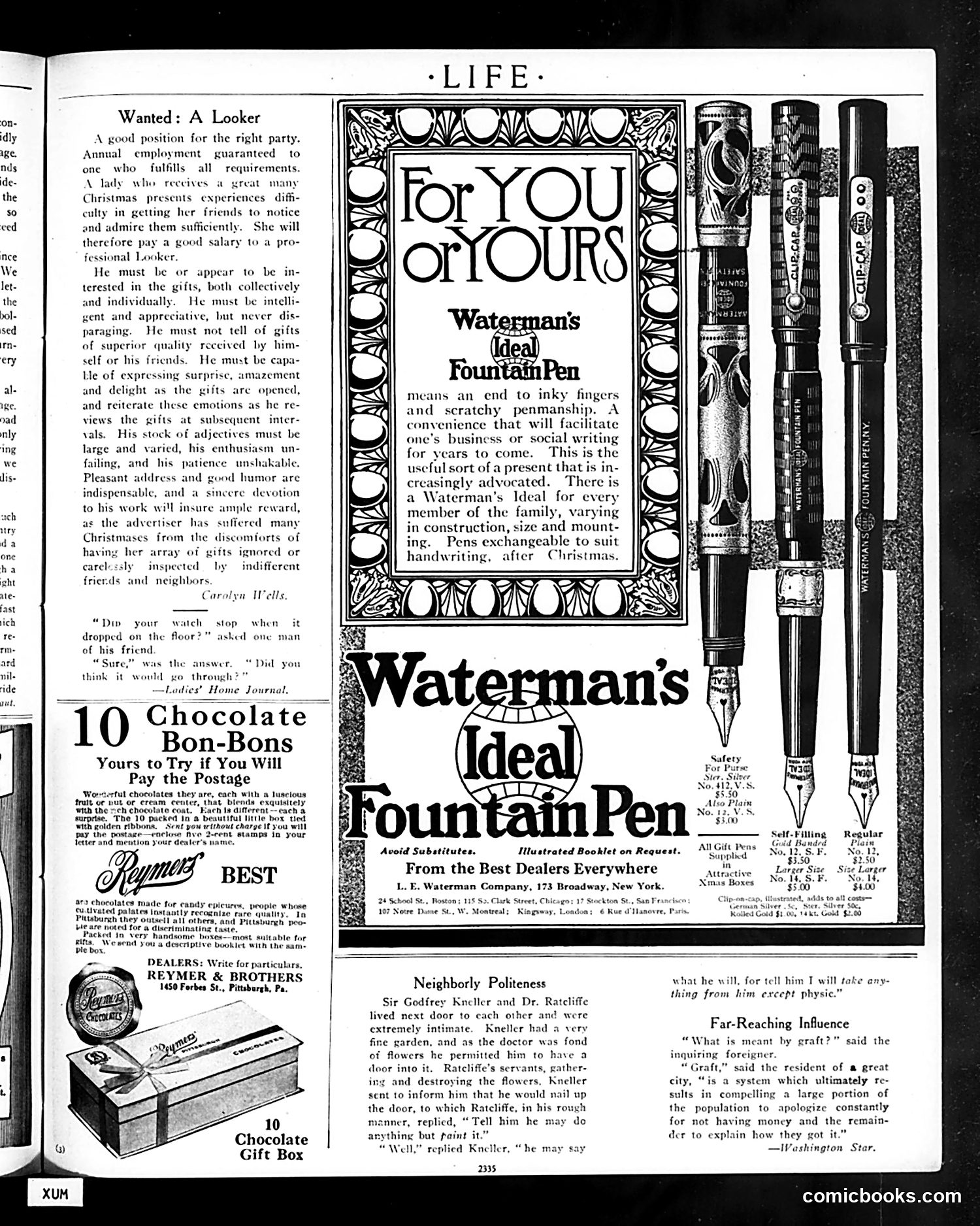
This page is primarily **advertising**, featuring Waterman's Ideal Fountain Pen prominently. The ads emphasize practical gift-giving for the Christmas season. The **satirical content** includes: 1. **"Wanted: A Looker"** — A humorous job posting for someone to professionally admire Christmas gifts. The satire targets the awkwardness of gift-receiving: the giver's anxiety that presents won't be appreciated, and the need to hire an actor-like figure to perform enthusiasm convincingly. This mocks both gift-culture anxiety and social pretense. 2. **"Neighborly Politeness"** — A historical anecdote about painters Kneller and Ratcliffe, illustrating dry wit about maintaining civility while setting boundaries (refusing to close a garden door, but stipulating no painting). 3. **"Far-Reaching Influence"** — A political joke defining "graft" as a corrupt system forcing the poor to apologize for poverty while the wealthy rationalize their gains. This reflects Progressive Era criticism of political corruption and inequality. The page blends advertising with light social satire typical of Life magazine's format.
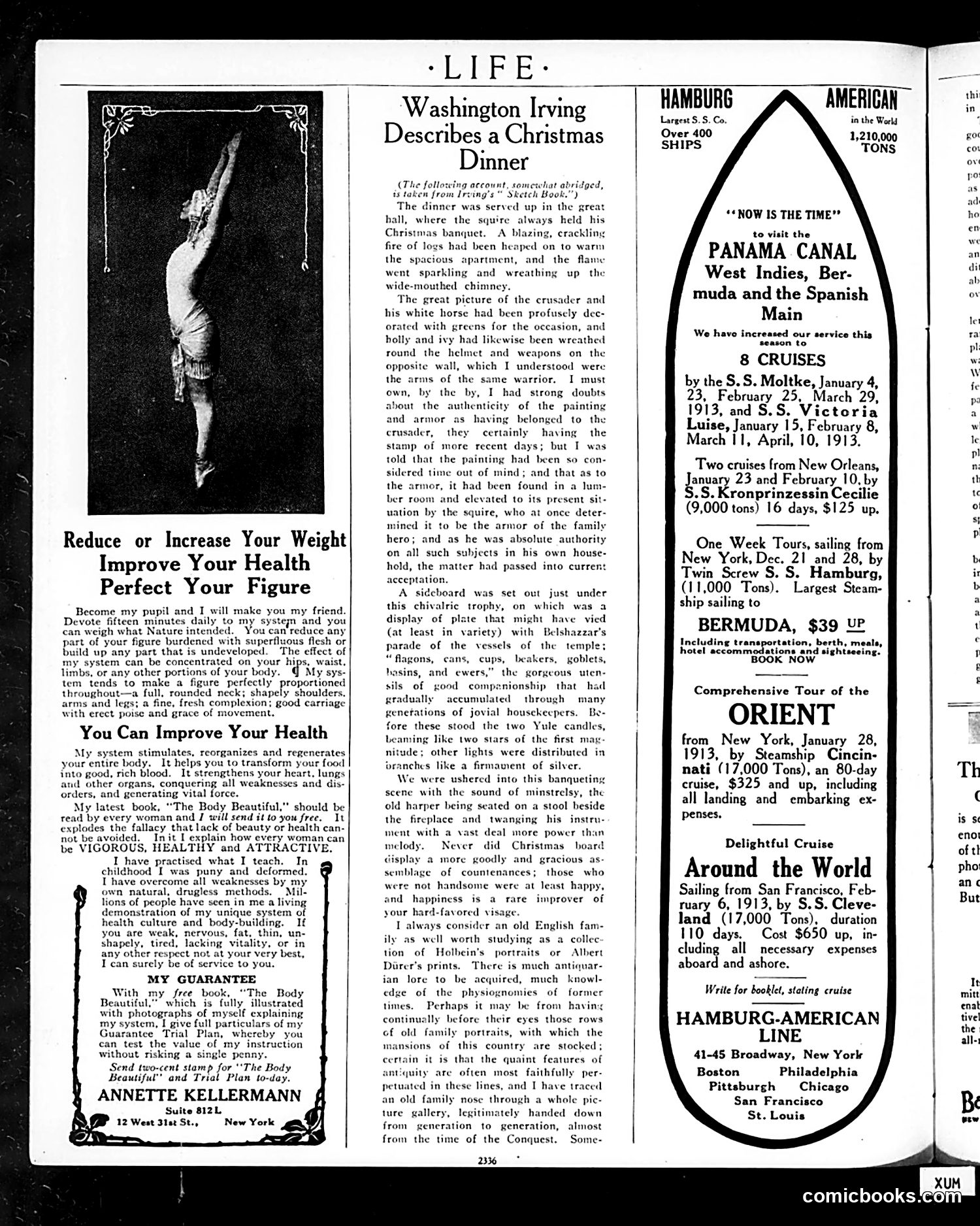
This page contains **two distinct sections**: an advertisement and a literary excerpt. **Left side:** Annette Kellermann advertises her body-building system. Kellermann was a famous Australian swimmer and fitness pioneer of the early 1900s. The ad promises to reduce/increase weight and perfect the figure through her "natural, drugless methods," emphasizing her own physical transformation from a "puny and deformed" childhood. This reflects early-20th-century physical culture movements that positioned fitness as achievable self-improvement. **Right side:** An excerpt from Washington Irving's *Sketch Book* describes a Christmas dinner at a country estate. Irving (1783-1859) was a celebrated American author; this passage evokes nostalgic, romanticized English traditions—the great hall, blazing fireplace, decorated armor, and ceremonial plate display—representing idealized landed gentry hospitality. **No cartoon or satire appears on this page.** It's primarily a mixed-content magazine spread combining advertising and classical literature.
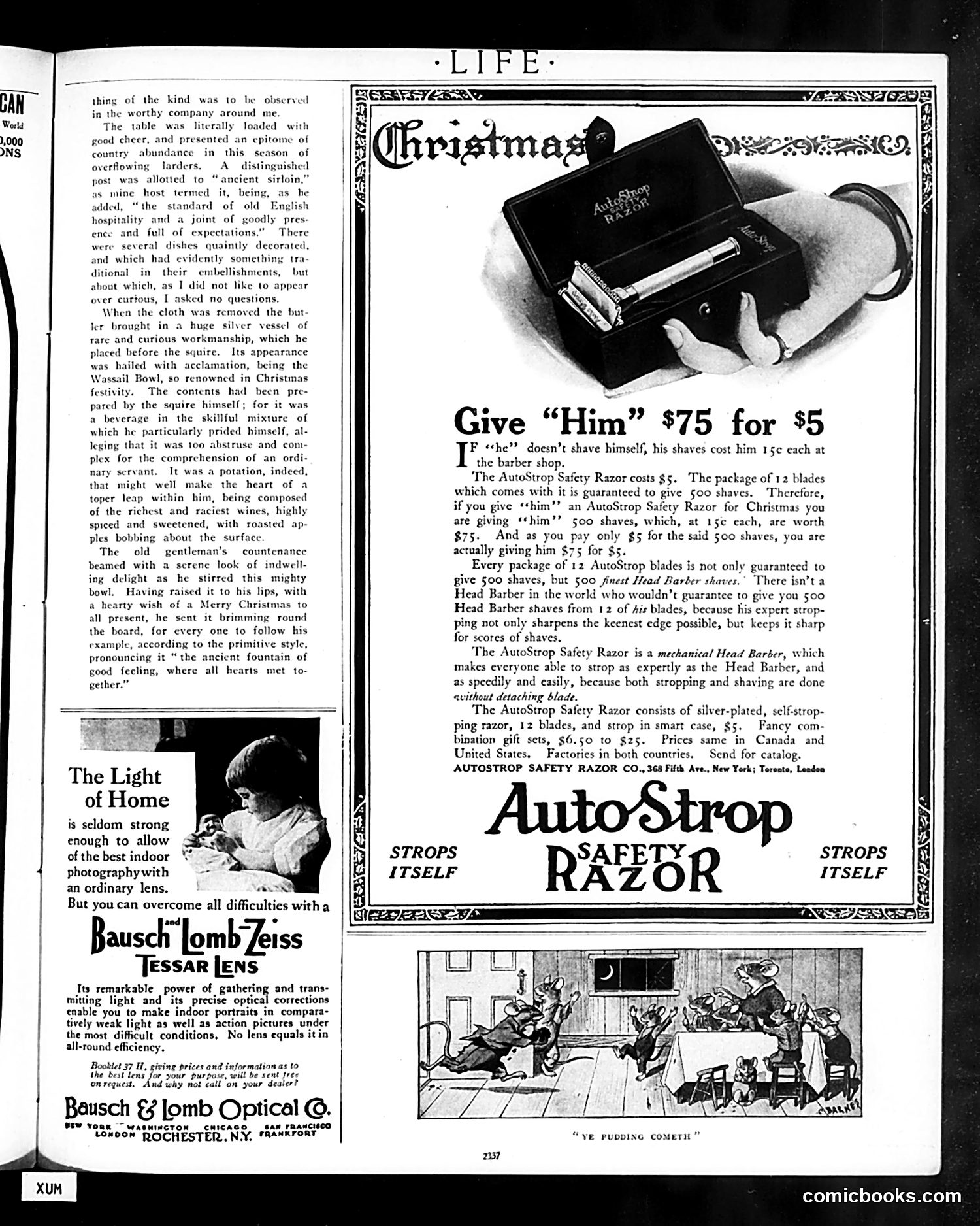
This page is primarily **advertising**, not satire or political commentary. It contains two major advertisements: 1. **AutoStrop Safety Razor** (dominant): A Christmas gift advertisement using value-proposition math. The copy argues that gifting an AutoStrop razor ($5) effectively gives "$75 worth" of barber shaves (500 shaves × 15¢ each). The accompanying illustration shows the mechanical razor device. The appeal is practical—a man who doesn't shave himself at home wastes money at barbers; this product enables self-grooming. 2. **Bausch & Lomb Zeiss Tessar Lens** (left column): Promotes a camera lens for indoor photography, emphasizing its light-gathering capability. 3. A small cartoon captioned **"Ye Pudding Cometh"** (bottom) appears to show a domestic Christmas scene, though it's unclear if this carries satirical intent or simply illustrates holiday festivity. The page reflects early 20th-century consumer culture, targeting middle-class male readers with practical gift suggestions during the Christmas season.
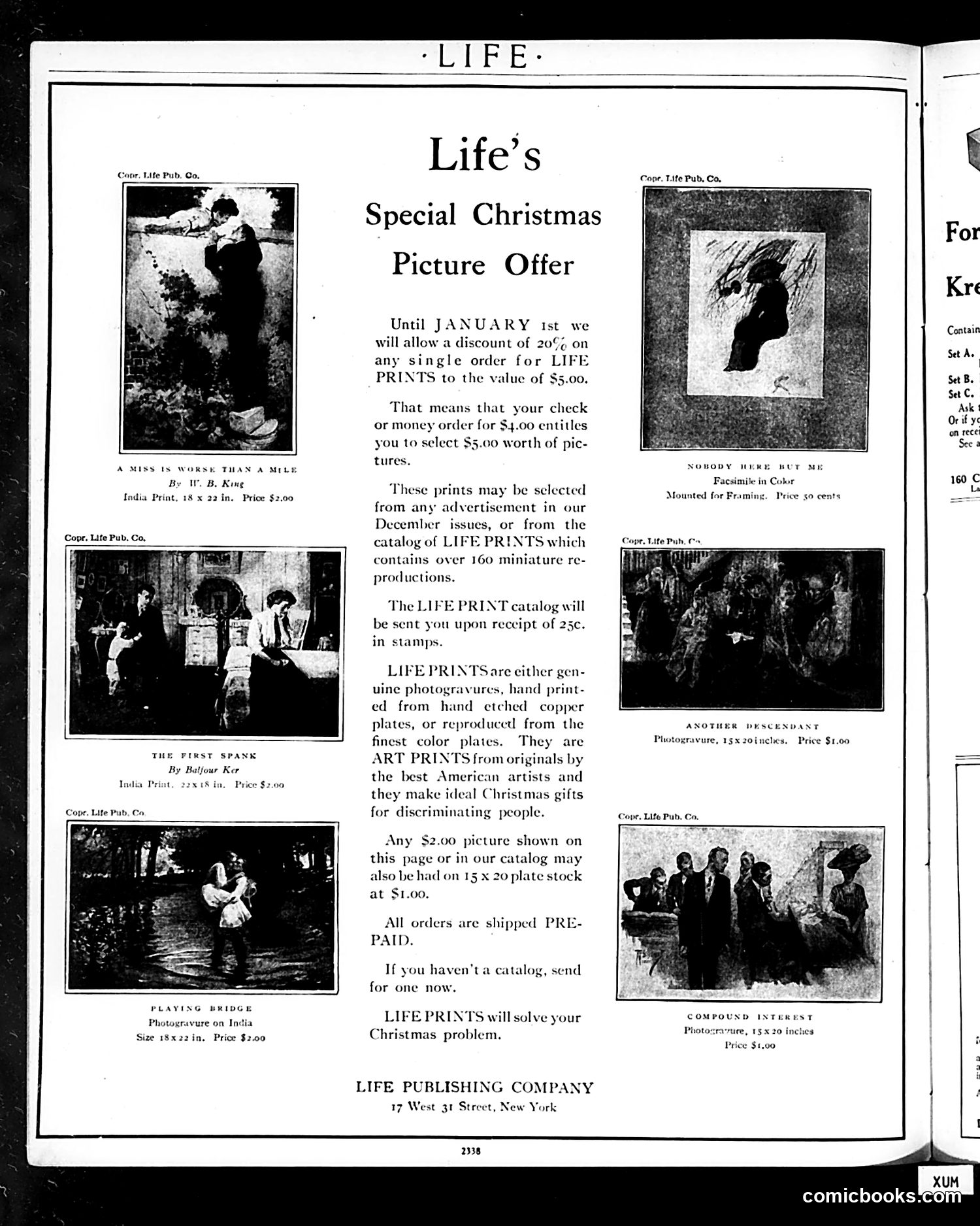
This is primarily **advertising, not satirical content**. The page promotes Life Publishing Company's "Life Prints"—art reproductions of paintings and photographs available as Christmas gifts. The four images shown are sample artworks available for purchase: - "A Miss Is Worse Than a Mile" by W.B. King - "The First Spank" by Balfour Ker - "Playing Bridge" (photogravure) - "Another Descendant" and "Compound Interest" (bottom right) The offer itself is the sales pitch: until January 1st, customers receive a 20% discount—paying $4.00 for $5.00 worth of prints. The text emphasizes these are genuine art prints (photogravures or hand-printed from copper plates) by "the best American artists," marketed as ideal "Christmas gifts for discriminating people." This represents early 20th-century direct-mail advertising, promoting fine art reproduction as affordable luxury gift-giving.
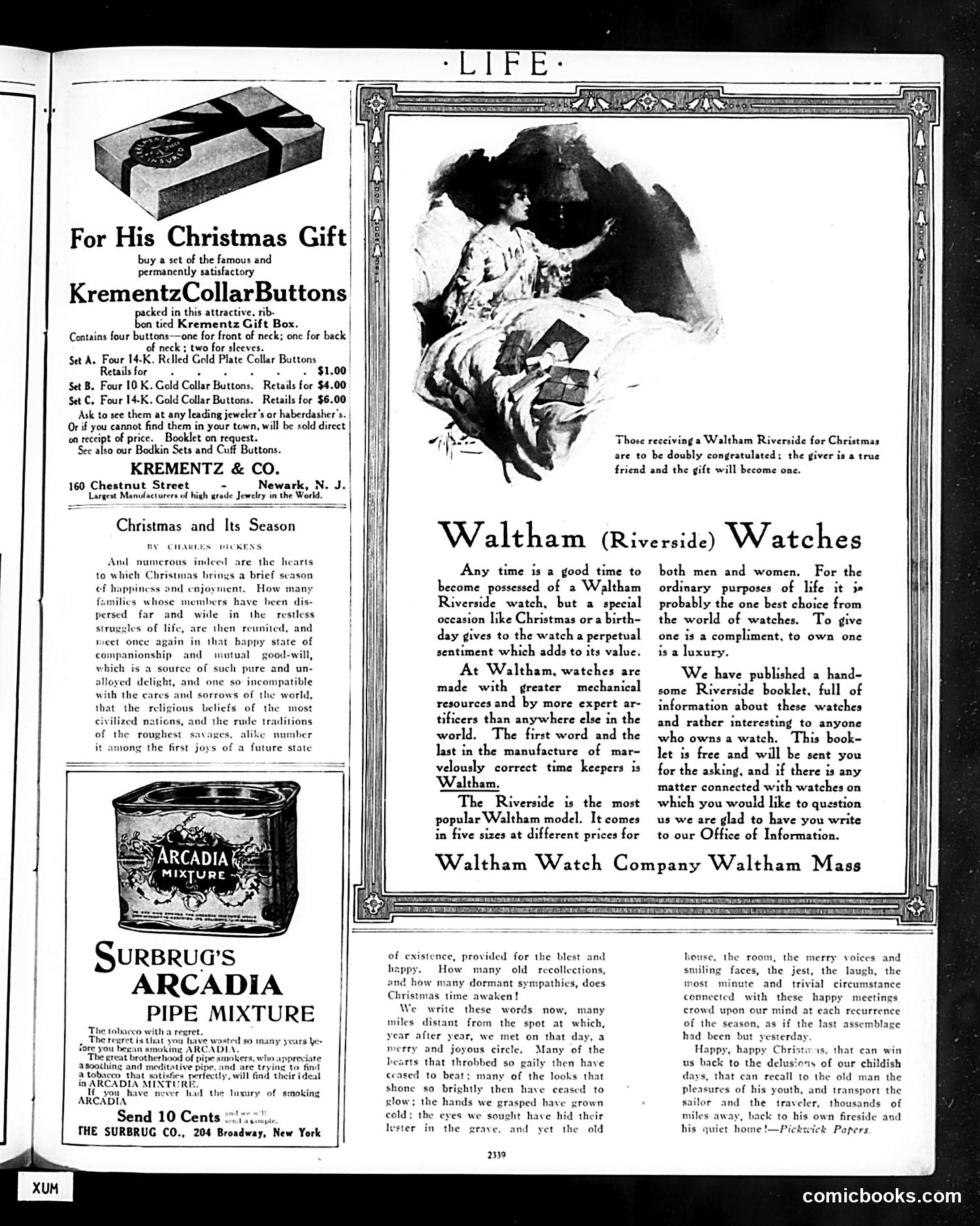
This page combines **Christmas advertising with sentimental editorial content**. There is no political cartoon—instead, it features three advertisements (Krementz collar buttons, Surbrugʼs Arcadia pipe mixture, and Waltham Riverside watches) alongside a Charles Dickens excerpt about Christmas. The Dickens passage is nostalgic Victorian sentiment about family reunions and childhood memories rekindled by Christmas—standard holiday fare emphasizing emotional connection and tradition. The advertisements appeal to gift-giving: jewelry buttons for men's formal wear, quality watches as luxury gifts, and pipe tobacco for gentlemen. The Waltham watch ad's illustration shows a woman receiving the timepiece—suggesting watches as appropriate even for female recipients, presenting ownership as both "compliment" and "luxury." No satire or political content is evident. This is a straightforward magazine page mixing holiday sentiment with merchandise marketing to upper-middle-class readers.
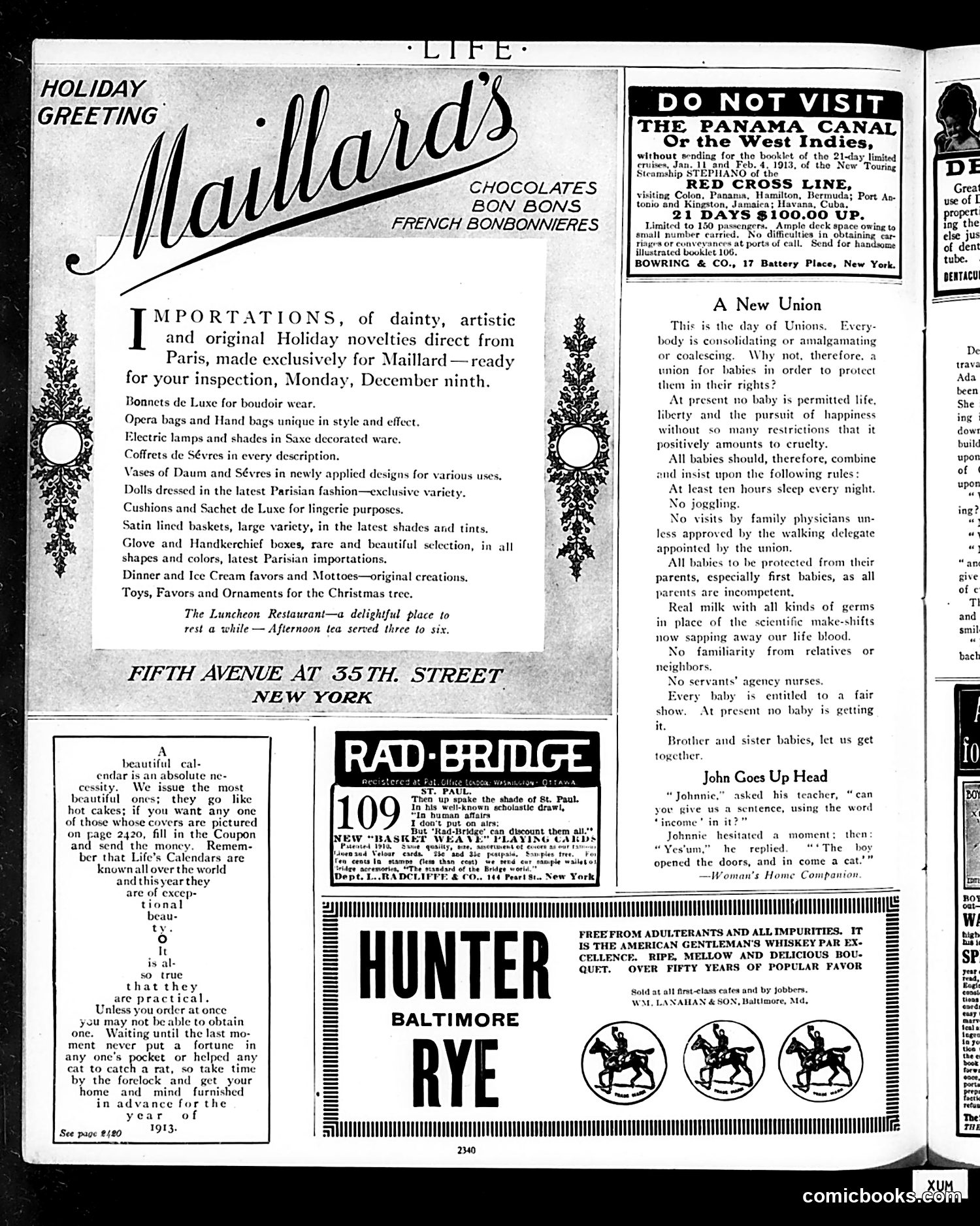
This page is primarily **advertising**, with one satirical article. The main satire is "A New Union," which mocks the early 1900s labor unionization movement by proposing a "union for babies." The joke imagines applying strict union rules to infant care—ten hours sleep guaranteed, no family doctor visits without union approval, protection from incompetent parents, scientific milk only, no relatives allowed. This ridicules how unions were imposing rigid restrictions on workers' lives, suggesting the labor movement had become absurdly controlling and bureaucratic. The humor lies in the absurdity of unionizing babies, treating infants as workers needing labor protection. It reflects contemporary anxieties about unions gaining too much power over daily life—a common conservative critique of early 20th-century labor organizing. The page includes luxury holiday advertisements (Maillard chocolates, Rad-Bridge apartments) and a brief children's joke ("John Goes Up Head") playing on double meanings of "income."
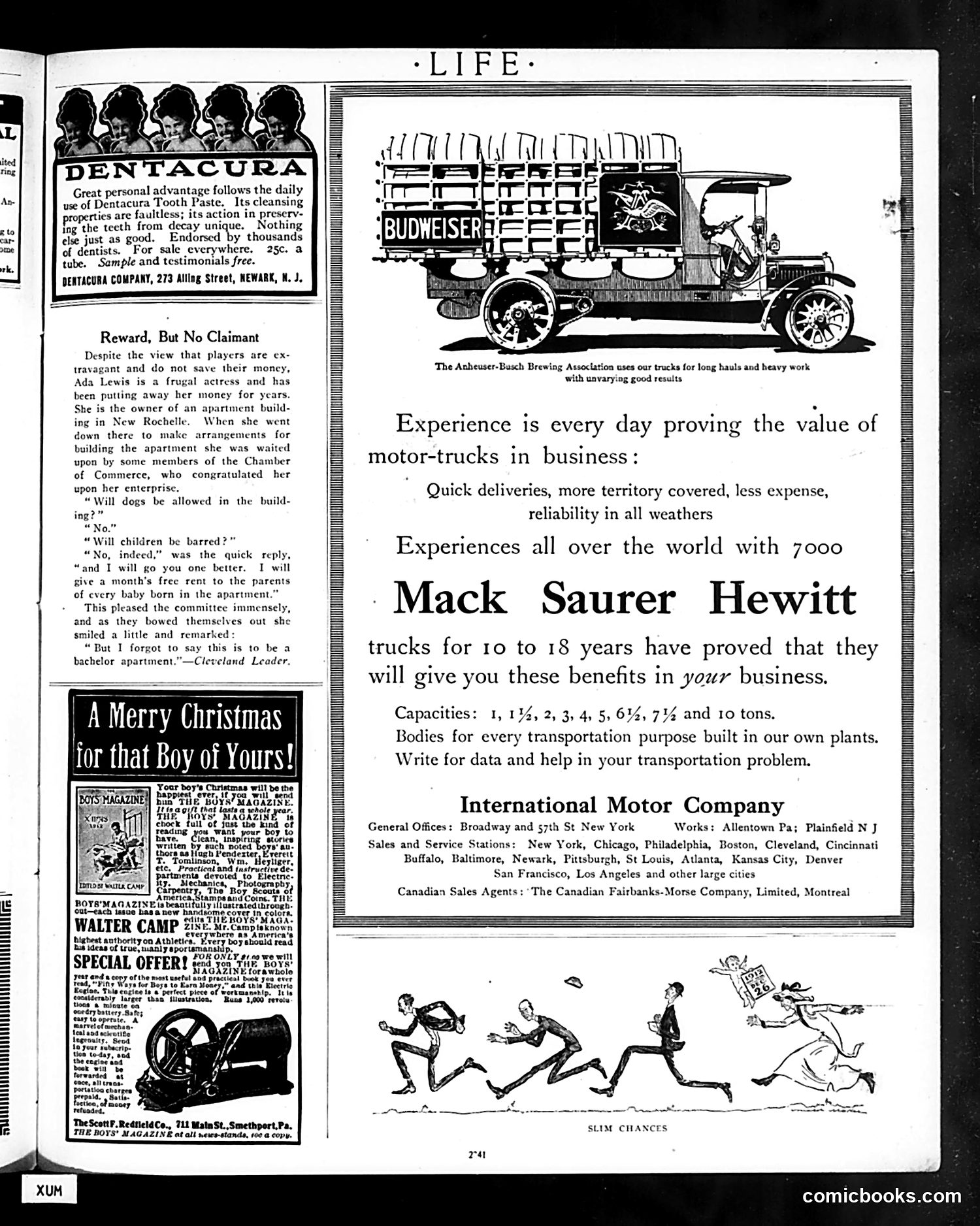
This page is primarily **advertising**, not satirical content. The main visual feature is an illustration of a Budweiser delivery truck, accompanying an ad for Mack Saurer Hewitt commercial trucks—promoting their reliability for business transportation. The one **comedic piece** is "Reward, But No Claimant," describing actress Ada Lewis, a notably frugal performer who owns an apartment building in New Rochelle. When Chamber of Commerce members congratulate her on her enterprise, they ask if dogs and children will be allowed. She replies she'll offer free rent to parents of babies born in the building—then notes she "forgot to say this is to be a bachelor apartment," delivering the joke's punchline. The humor relies on the contradiction: why offer incentives for babies in a bachelor-only building? The bottom cartoon, "Slim Chances," depicts figures running frantically (unclear context without caption detail). The page also advertises Boys' Magazine and other publications, typical of early 20th-century Life content.
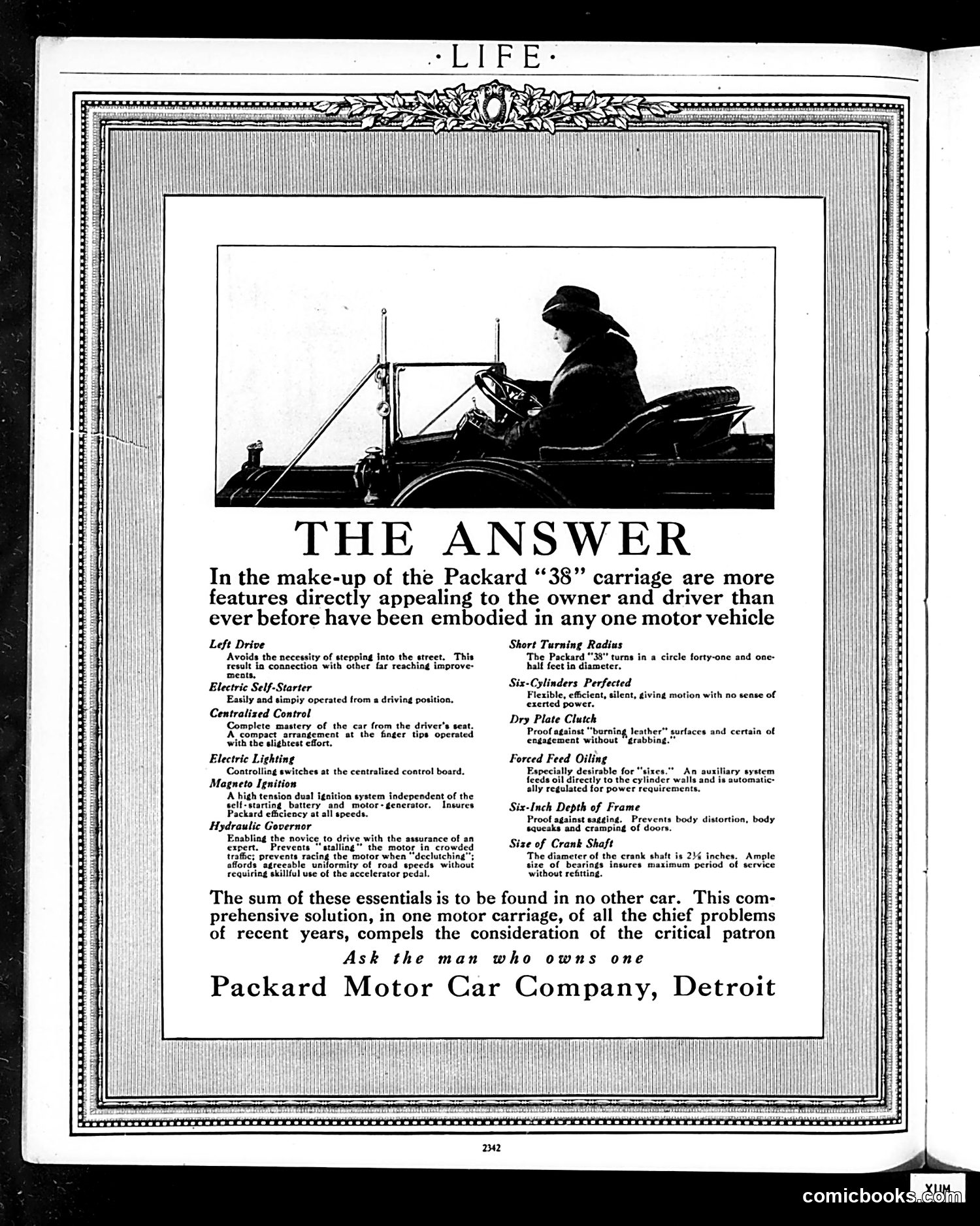
This is a **Packard automobile advertisement**, not a political cartoon or satire. It appeared in *Life* magazine's advertising section (note "2342" at bottom, indicating a page number from an ad sequence). The image shows a driver operating a luxury car with left-hand drive controls. The text lists technical innovations as "THE ANSWER" to automotive problems—electric starters, hydraulic governors, six-cylinder engines, forced-feed oiling systems, and other features contemporary buyers valued. The phrase "Ask the man who owns one" was Packard's actual advertising slogan, appealing to social prestige and peer recommendation. For modern readers: this reflects early 1900s luxury-car marketing, when automobiles were still novel and expensive, and technical specifications (rather than styling or performance) were primary sales pitches. The "left drive" feature is noteworthy because it was relatively new and considered an advantage for avoiding street traffic. This is essentially a technical specification sheet formatted as aspirational marketing.
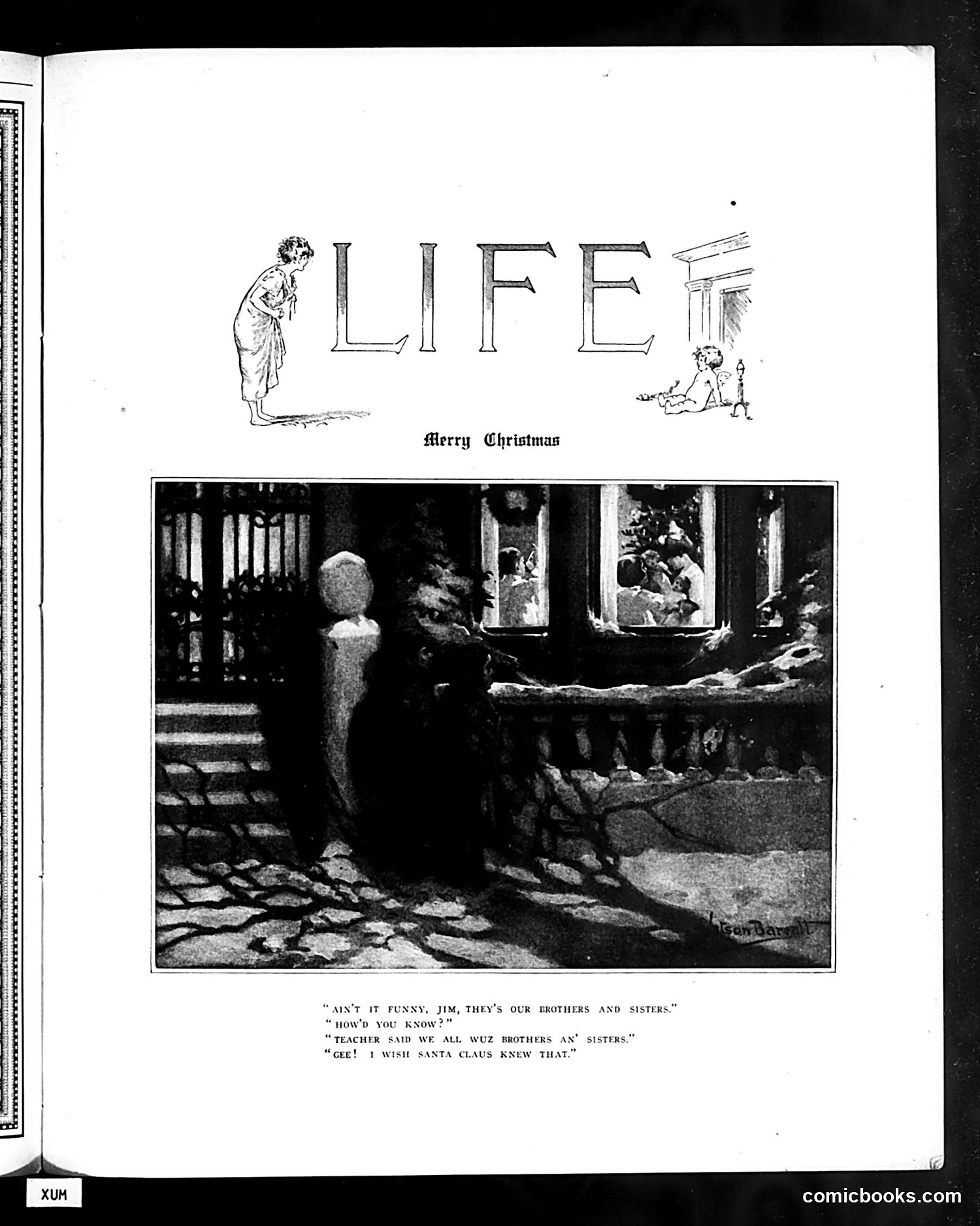
This is a Christmas-themed satirical cartoon from *Life* magazine. The image shows children looking through a window at a wealthy family's decorated home during the holidays. The dialogue presents a child expressing that their teacher taught them everyone is "brothers and sisters," only to have another child respond: "Gee! I wish Santa Claus knew that"—implying Santa (and by extension, society) does not treat all children equally during Christmas. The satire critiques economic inequality and class disparity, particularly how holiday generosity and abundance are distributed unequally based on wealth. The juxtaposition of poor children peering into a prosperous household underscores the social divisions that persist despite Christian ideals of universal brotherhood taught in schools.
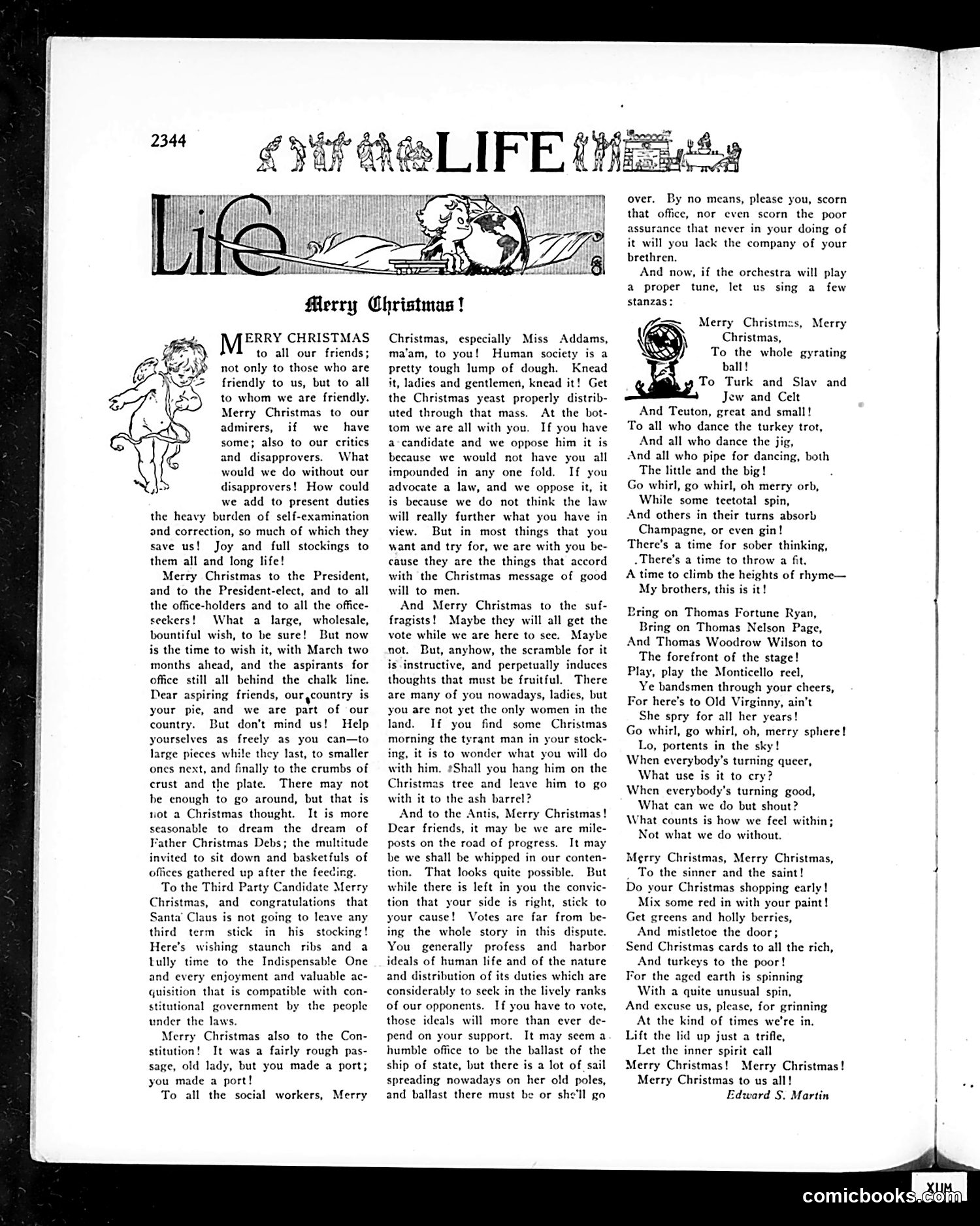
This is a satirical Christmas greeting from *Life* magazine's editors to various American political and social groups. The piece extends goodwill while subtly mocking each faction's pretensions. Key targets include: - **Politicians and office-seekers**: Sarcastically wished "large pieces" of the government "pie" while positions remain available - **Third Party candidates**: Congratulated that Santa won't leave a "third term stick" in their stocking (reference to Roosevelt's potential comeback) - **Social reformers** (notably Jane Addams): Encouraged to "knead" society like dough, with backhanded support for their causes - **Suffragists**: Wished they'll gain voting rights, though humorously suggesting they might "hang" tyrant men on Christmas trees - **Anti-suffragists ("Antis")**: Told their ideals matter despite likely electoral defeat The tone is characteristically *Life*'s blend of democratic sympathy mixed with aristocratic skepticism toward reform movements and political ambition—wishing all well while gently deflating their earnestness.
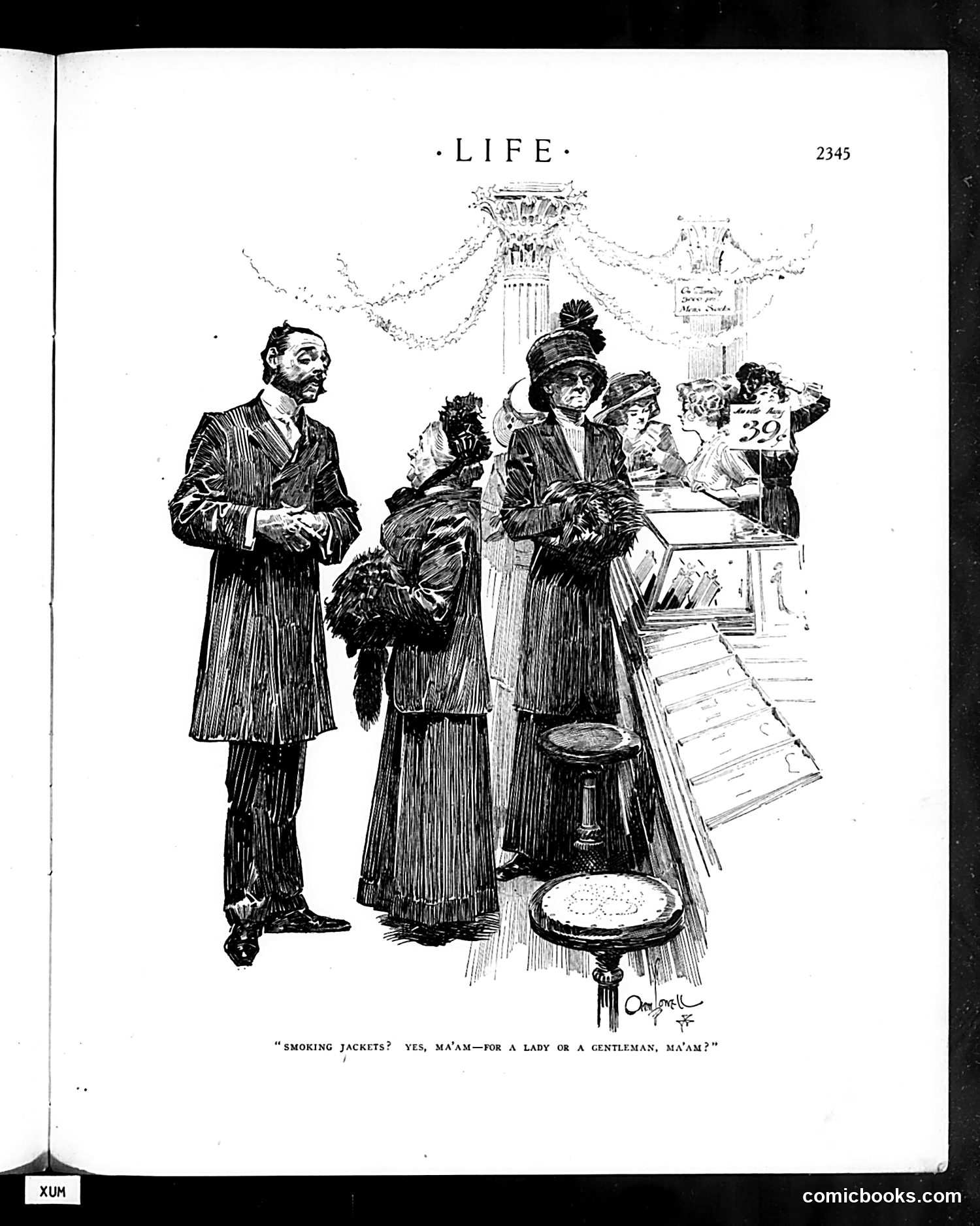
This is a satirical cartoon about gender and fashion conventions in what appears to be the early 20th century. A male shopkeeper offers "smoking jackets" to two female customers, pointedly asking whether they want the style "for a lady or a gentleman." The joke targets women's evolving fashion and social roles. The women's appearance—their hats and clothing—suggests they may be adopting more masculine or androgynous styles, prompting the shopkeeper's deliberately provocative question. The satire critiques anxieties about changing gender norms: the implication is that women are increasingly blurring traditional dress boundaries, which troubled conservatives of the era. This reflects early 20th-century debates about women's independence, smoking, and rejection of restrictive Victorian fashion.
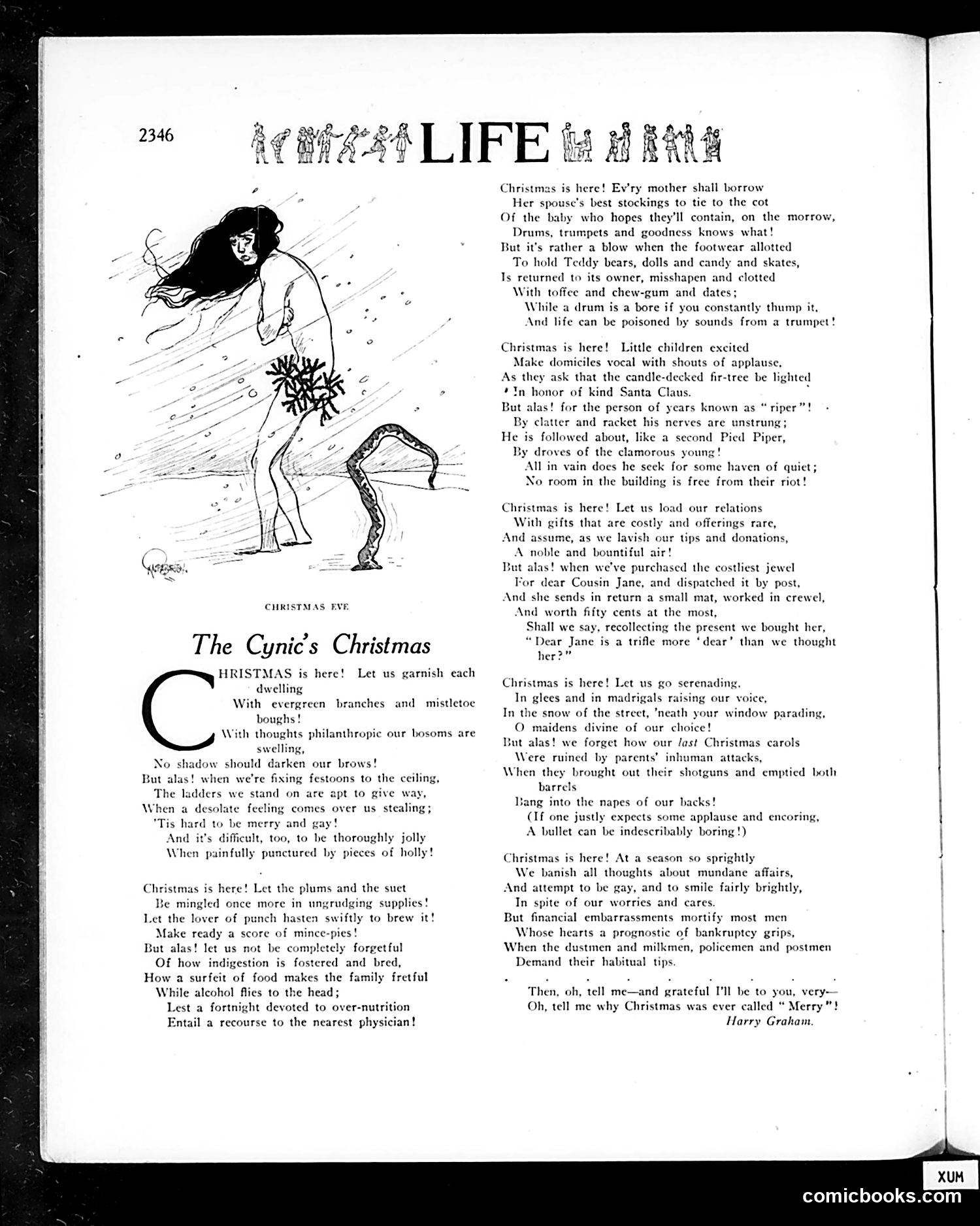
This is a satirical poem mocking the gap between Christmas ideals and harsh realities. The accompanying sketch shows a shivering, wind-blown figure—representing the "cynic" facing winter's misery. Graham systematically deflates each Christmas tradition: decorating causes accidents; holiday feasting breeds indigestion; children's toys (drums, trumpets) create unbearable noise; gift-giving reveals social inequality when cheap reciprocal gifts arrive; serenading risks parental violence; financial obligations from tips burden working-class men facing "bankruptcy grips." The satire targets middle-class hypocrisy—the forced gaiety masking genuine suffering, expense, and family chaos. The final question "why Christmas was ever called 'Merry'?" is the punchline: because it demonstrably *isn't* merry for anyone, despite cultural pretense. This reflects early-20th-century satirical humor: cynical, class-conscious, darkly comic about everyday hardships masked by social convention.
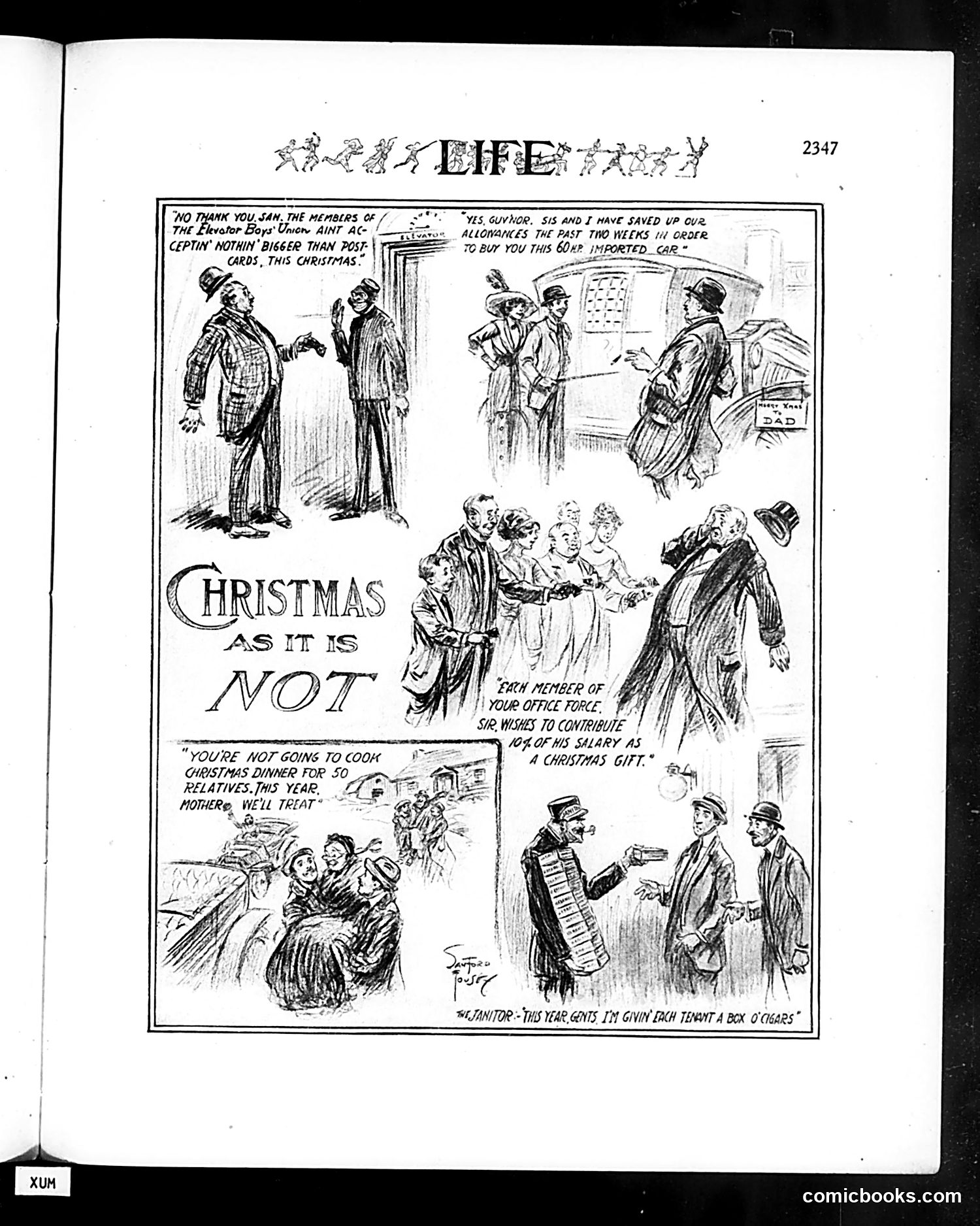
This satirical cartoon depicts Depression-era economic hardship affecting Christmas gift-giving. The humor centers on inversions of expected generosity: - **Elevator boys' union** can only afford postcards instead of gifts - A wealthy person receives an imported car from modest workers who've saved their allowances - Families skip traditional large dinners due to financial constraints - Office workers contribute portions of their meager salaries as gifts to their employer - A janitor gives cigars to gentlemen (reversing the typical servant-recipient dynamic) The title "Christmas As It Is NOT" signals that these scenarios represent the opposite of traditional Christmas abundance. The cartoon satirizes how economic depression has upended social hierarchies and gift-giving customs—what should be joyful occasions are now marked by financial desperation and role reversals. Workers give to employers; the poor strain to gift the wealthy. It's dark commentary on widespread poverty during what appears to be the Great Depression era.
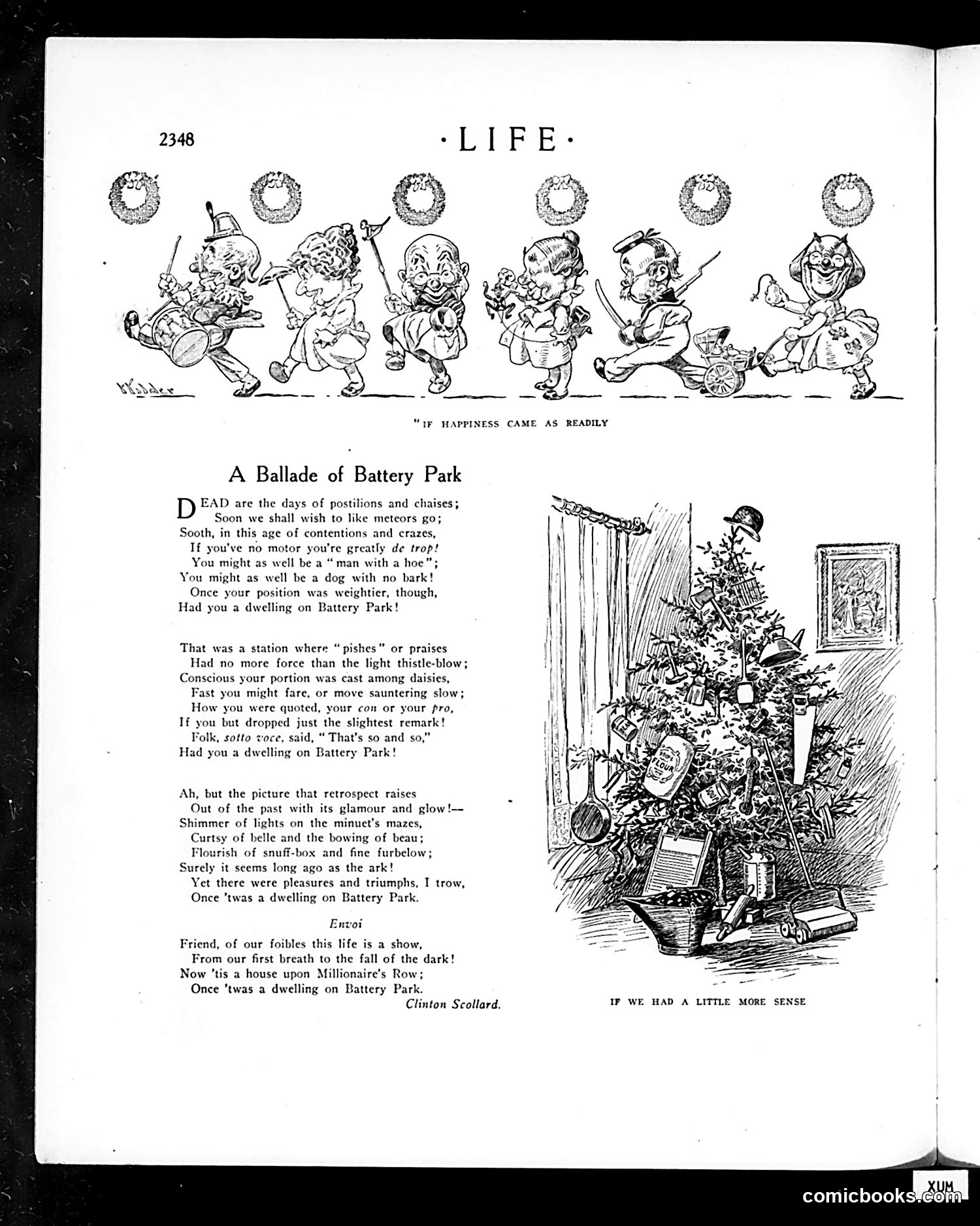
This satirical poem by Clinton Scollard nostalgically contrasts old and new wealth in New York City. **Battery Park** (lower Manhattan) was once the prestigious address for the wealthy elite, where residents commanded social influence and respect simply by their address and casual remarks. The satire critiques modern materialism: today's status-obsessed society now requires **automobiles** ("motors") to maintain relevance—without one, you're practically worthless ("de trop"). The poem laments this shift from inherited gentility to consumer-driven status symbols. The illustration caption, "IF WE HAD A LITTLE MORE SENSE," reinforces the joke: accumulating possessions and chasing fashionable addresses represents foolish priorities. The opening cartoon shows six childish figures dancing with various objects, suggesting how eagerly people pursue trivial happiness through material goods—the visual joke matching the poem's critique of modern consumer culture and status anxiety replacing genuine aristocratic standing.
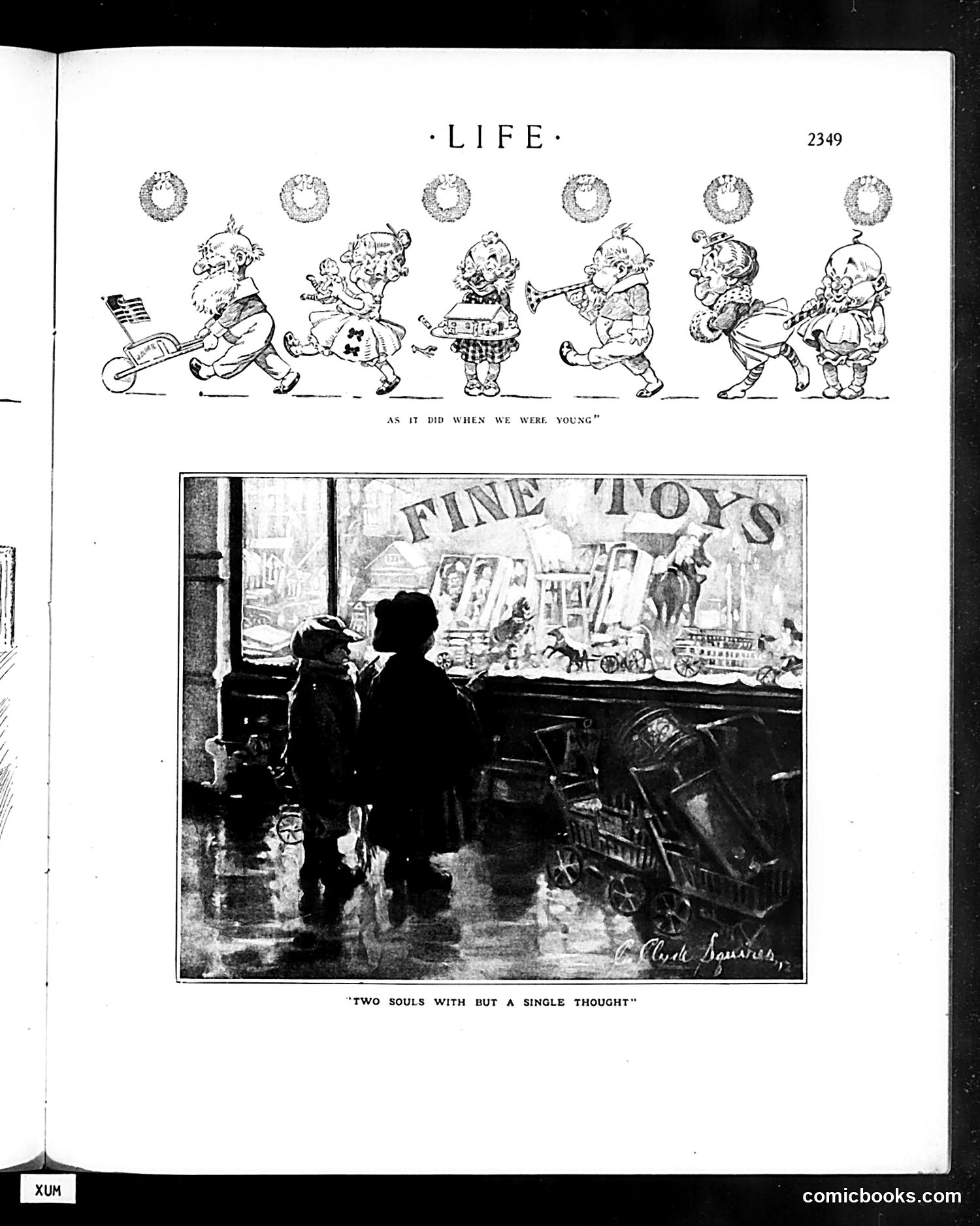
This Life magazine page contains two separate pieces: **Top cartoon:** A humorous illustrated sequence showing children engaged in various activities—playing with toys, musical instruments, and other games—captioned "AS IT DID WHEN WE WERE YOUNG." This appears to be nostalgic commentary on childhood pastimes. **Bottom photograph:** A black-and-white image of two figures viewing a toy shop window display (marked "FINE TOYS"), captioned "TWO SOULS WITH BUT A SINGLE THOUGHT." This quote is a famous romantic phrase, but here it's ironically applied to people gazing at toys—suggesting either adults yearning for childhood, or perhaps satirizing consumerism and shared desire for material goods. The juxtaposition of the sentimental caption with the mundane scene creates the satirical humor.
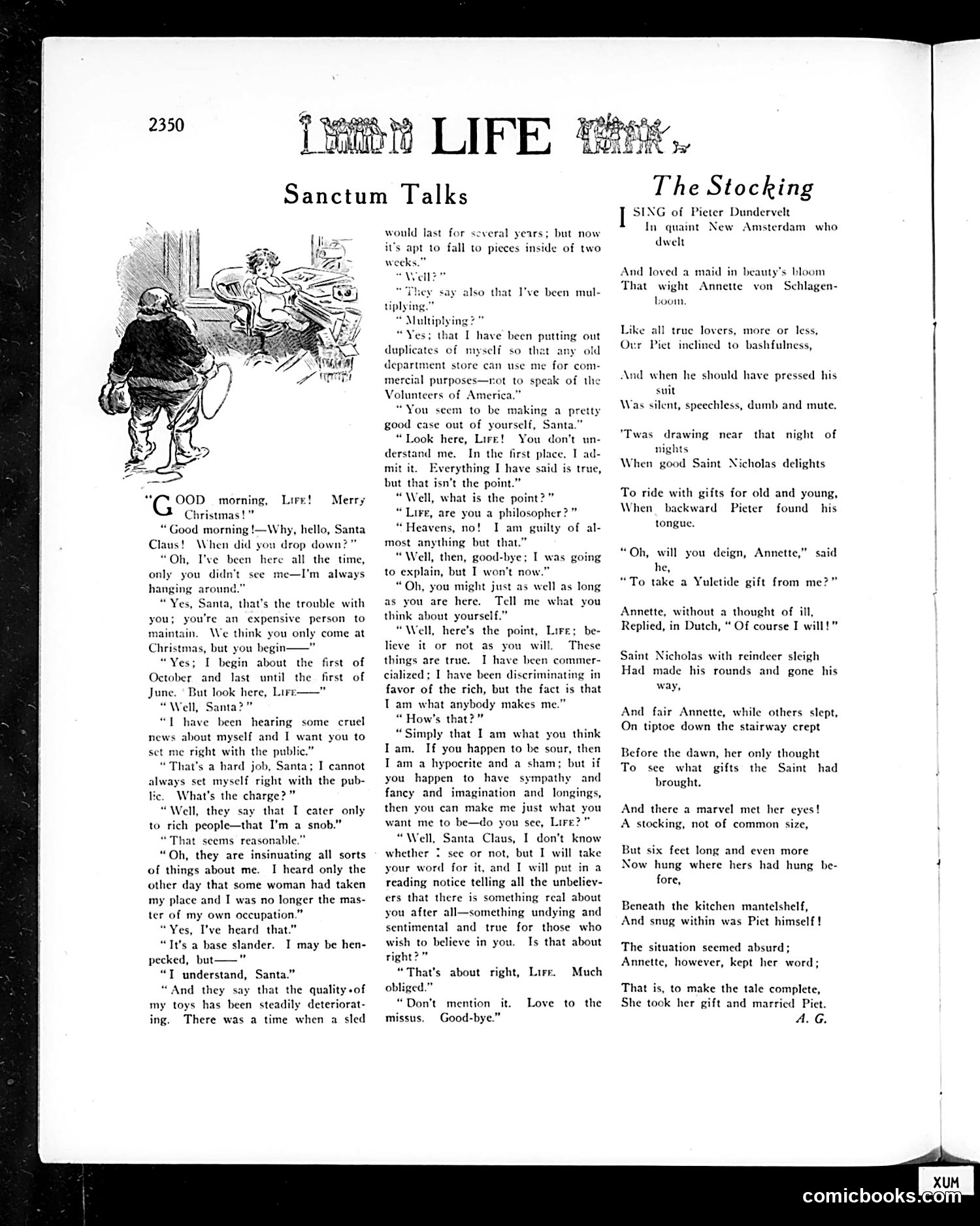
This page contains two pieces: a satirical dialogue and a romantic poem. **"Sanctum Talks"** depicts Life's editor conversing with Santa Claus, who complains about his public reputation. Santa defends himself against charges that he caters only to the wealthy, has commercialized Christmas, produces inferior toys, and has been replaced by department store imposters. The satire critiques American commercialism of Christmas and mass-production of cheap goods—Santa claims he's become whatever people's cynicism makes him. The editor promises to rehabilitate Santa's image with "unbelievers," suggesting early-1900s anxiety about Christmas losing its spiritual meaning amid consumer culture. **"The Stocking"** is a lighthearted Dutch-themed verse tale of Pieter Dundervelt's bashful courtship of Annette, culminating in a Christmas proposal. It's sentimental holiday entertainment rather than satire. The contrast between cynical social commentary and sentimentality reflects Life's dual nature as both satirical publication and mainstream magazine.
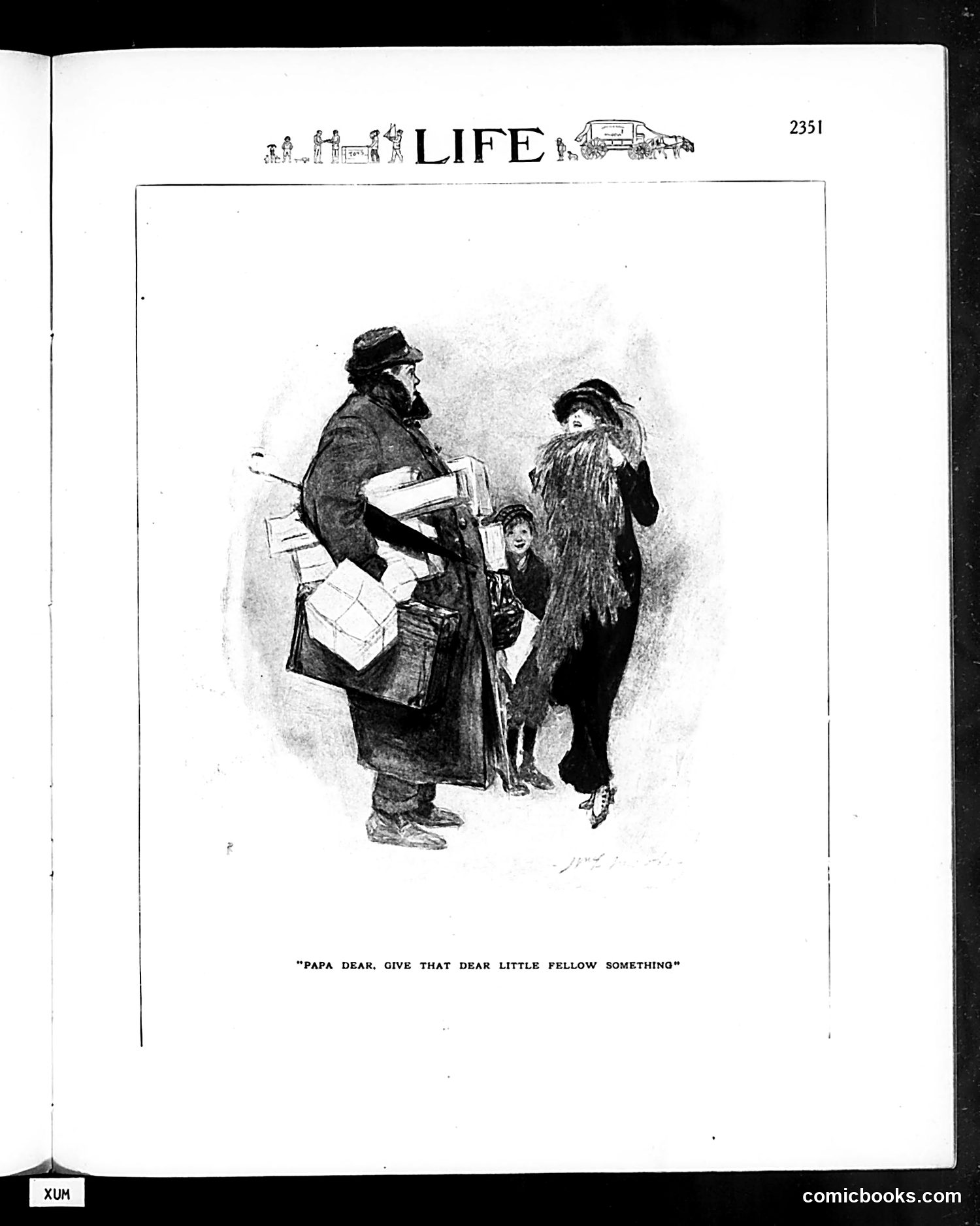
This is a satirical cartoon from *Life* magazine depicting a scene of economic hardship. An adult man, dressed in worn clothing and carrying a large bundle (likely representing a traveling salesman or vagrant), stands with two children. The woman addresses her husband with the caption: "Papa dear, give that dear little fellow something." The satire targets wealth inequality and parental obligation during economic difficulty. The "dear little fellow" appears to be a poor child, and the cartoon mocks the sentimental language ("Papa dear," "dear little fellow") that masks reluctance to help those in need. The juxtaposition of genteel phrasing with the figures' shabby appearance suggests irony about class divisions and social indifference to poverty. The exact historical period is unclear from the image alone, but this reflects *Life*'s typical commentary on American social conditions.
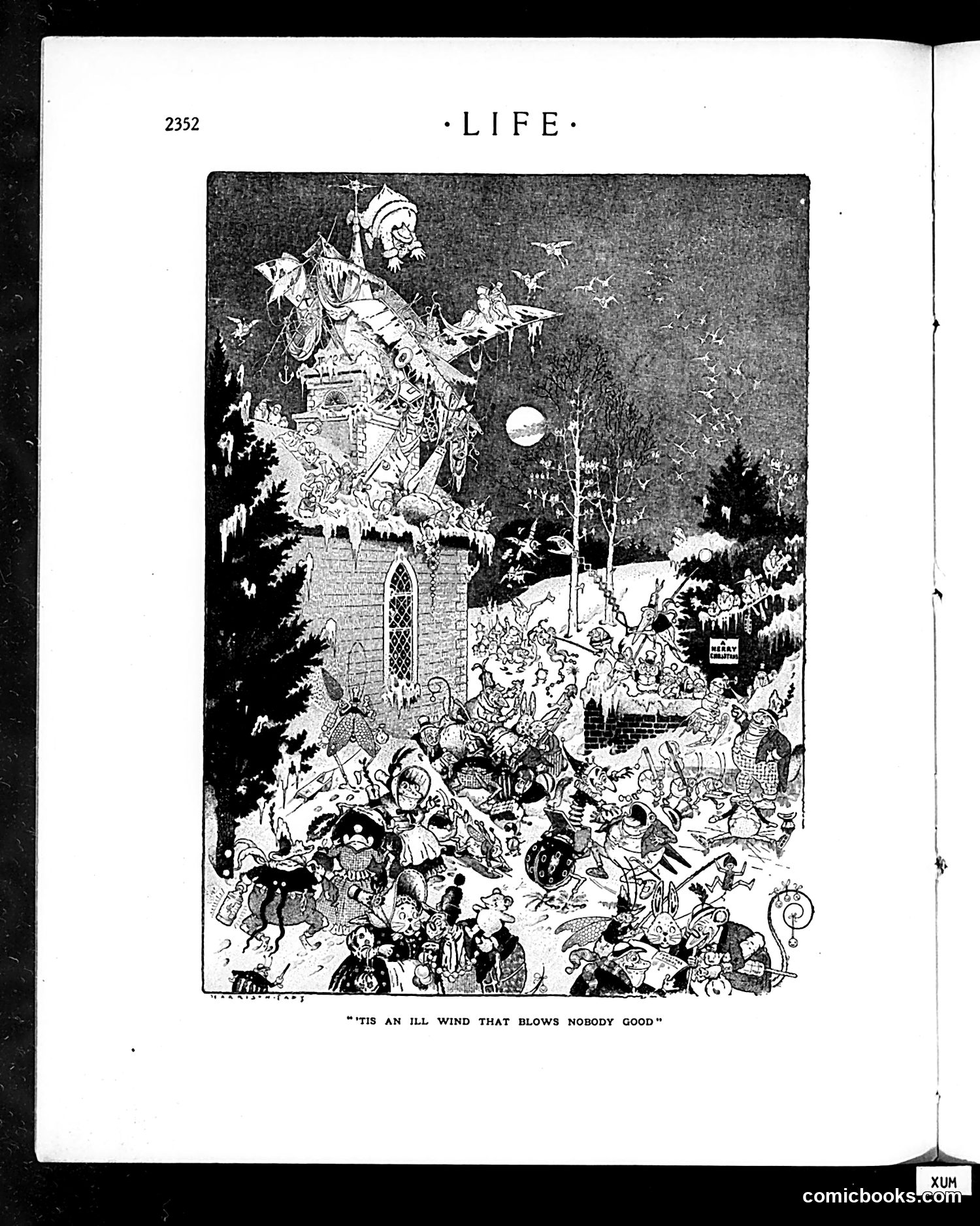
This satirical cartoon depicts a chaotic scene of people profiting from misfortune. A tower or structure dominates the composition, with a figure (possibly representing fate or disaster) perched atop it. Below, a crowd of figures scrambles amid swirling winds, seemingly collecting benefits or goods scattered about. The proverb in the title suggests that even disasters create opportunities for someone to gain advantage. The cartoon appears to satirize opportunism—how various people exploit misfortune for personal profit. The detailed, crowded composition with multiple figures engaging in different activities emphasizes the widespread nature of such profiteering. Without additional context about the publication date, the specific event referenced remains unclear, though the theme reflects common Life magazine satire of social hypocrisy and greed.
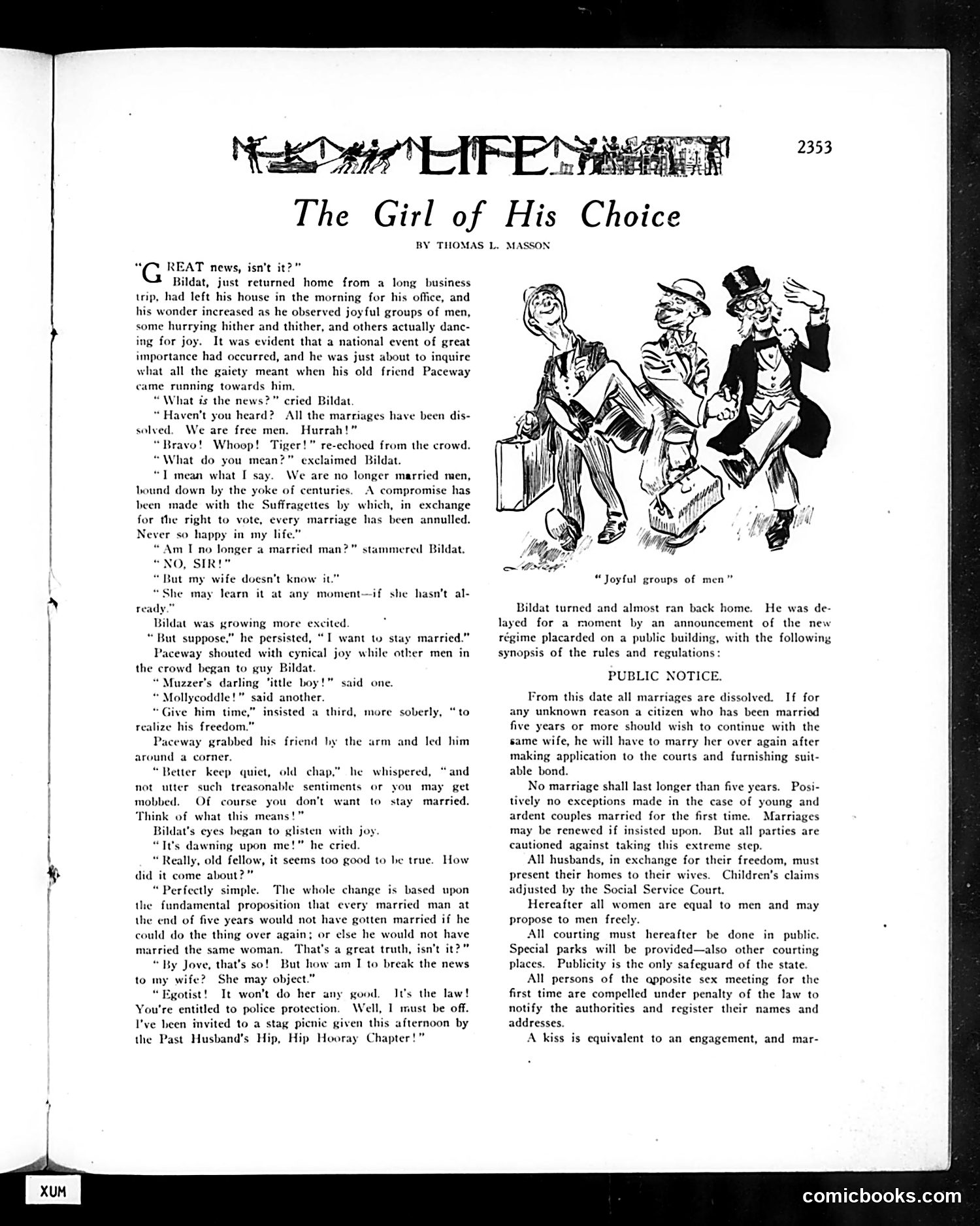
This 1913 *Life* magazine satire mocks the suffrage movement by imagining a dystopian future where, as a compromise granting women voting rights, all marriages are automatically dissolved every five years. The cartoon depicts men celebrating this "freedom" in the streets. The protagonist Bildat initially rejoices, envisioning romantic liberation—until he realizes he must inform his wife and potentially lose his home (which becomes hers under the new regime). **The satire's point**: Anti-suffrage arguments claimed that granting women political equality would destroy traditional marriage and male authority. The story presents this fear as absurd male fantasy—men celebrate being "freed" from marriage, yet the regulations actually redistribute power and property to women, forcing husbands to present homes to wives and allowing women to propose freely. The joke inverts the anti-suffragist fear: what men imagined as liberation becomes emasculation. The piece satirizes both suffrage opponents' paranoia and men's shallow desire to escape marital commitment.
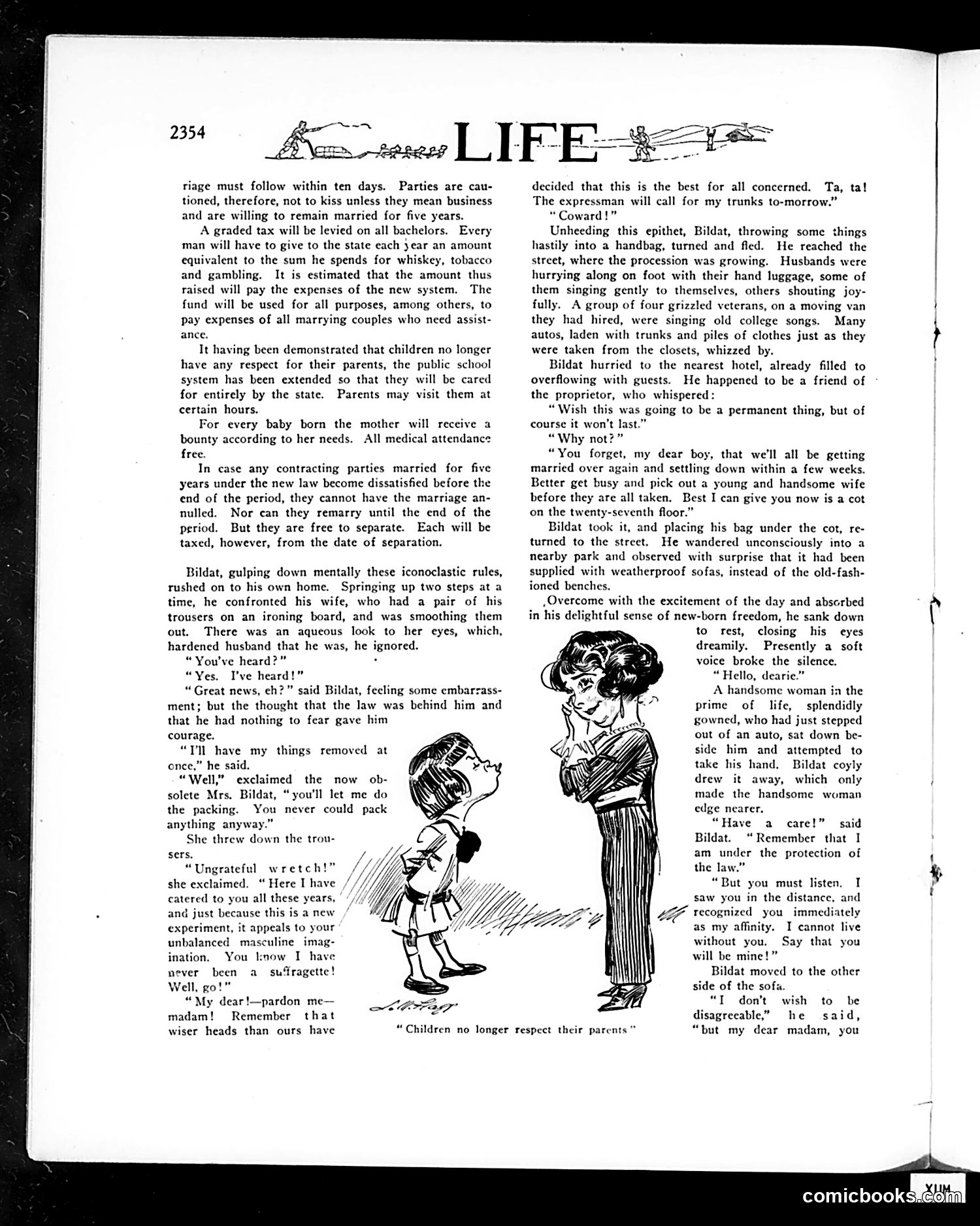
This *Life* magazine excerpt satirizes radical feminist proposals for state-controlled marriage and family life. The story follows "Bildat," who learns of new laws mandating marriage within ten days, taxing bachelors, removing child-rearing from parents, and enforcing five-year marriage contracts. The satire's target is clear: when Bildat announces he's leaving his wife under these new rules, she's devastated—revealing the satire's conservative point. The illustration shows a wife pleading with her departing husband, captioned "Children no longer respect their parents," ironically suggesting that state control of families destroys traditional respect and morality. The mass exodus of husbands from hotels, the proprietor's quip that the law "won't last," and the general chaos all mock what the author saw as absurd, unnatural social engineering. The satire defends traditional marriage and parental authority against what it portrays as dangerous feminist experimentation.
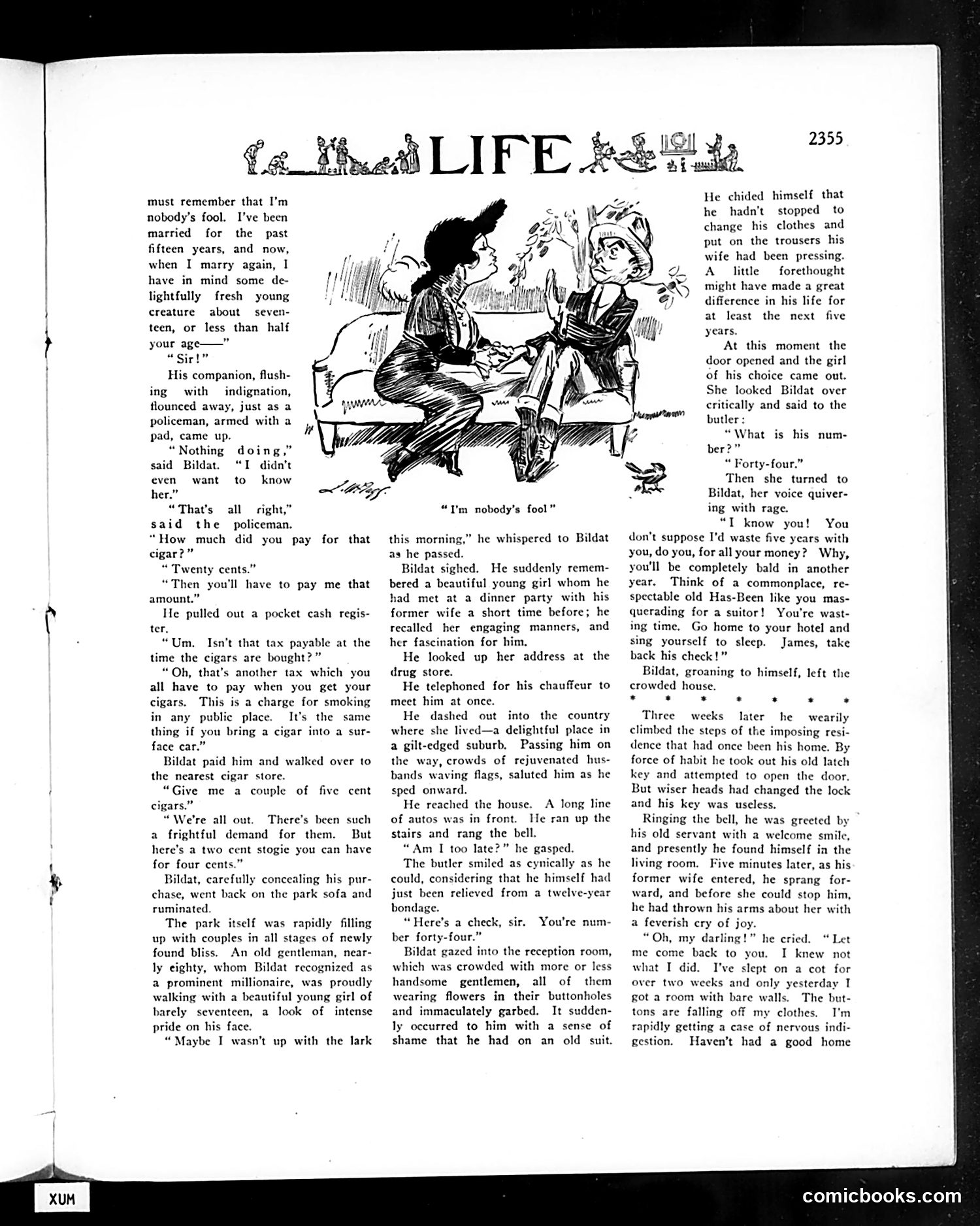
This is satirical fiction mocking the social upheaval of the 1920s, likely following passage of women's suffrage and changing gender dynamics. The story depicts a middle-aged man (Bildat) who, after fifteen years of marriage, decides to remarry a teenage girl. He encounters absurd taxation on cigars and witnesses an elderly millionaire proudly parading with a seventeen-year-old—suggesting an era where wealthy older men pursued youth. When Bildat pursues a young woman he'd met, he arrives at her home to find it crowded with suitors bearing flowers. The young woman rejects him harshly, scorning his age, baldness, and wealth, dismissing him as a "Has-Been." The satire critiques both male vanity (believing money guarantees romantic success with young women) and the new female assertiveness—women now have standards beyond financial security and reject unsuitable matches outright. The cartoon mocks the disorientation of men confronting liberated women who won't accept their previous social dominance.
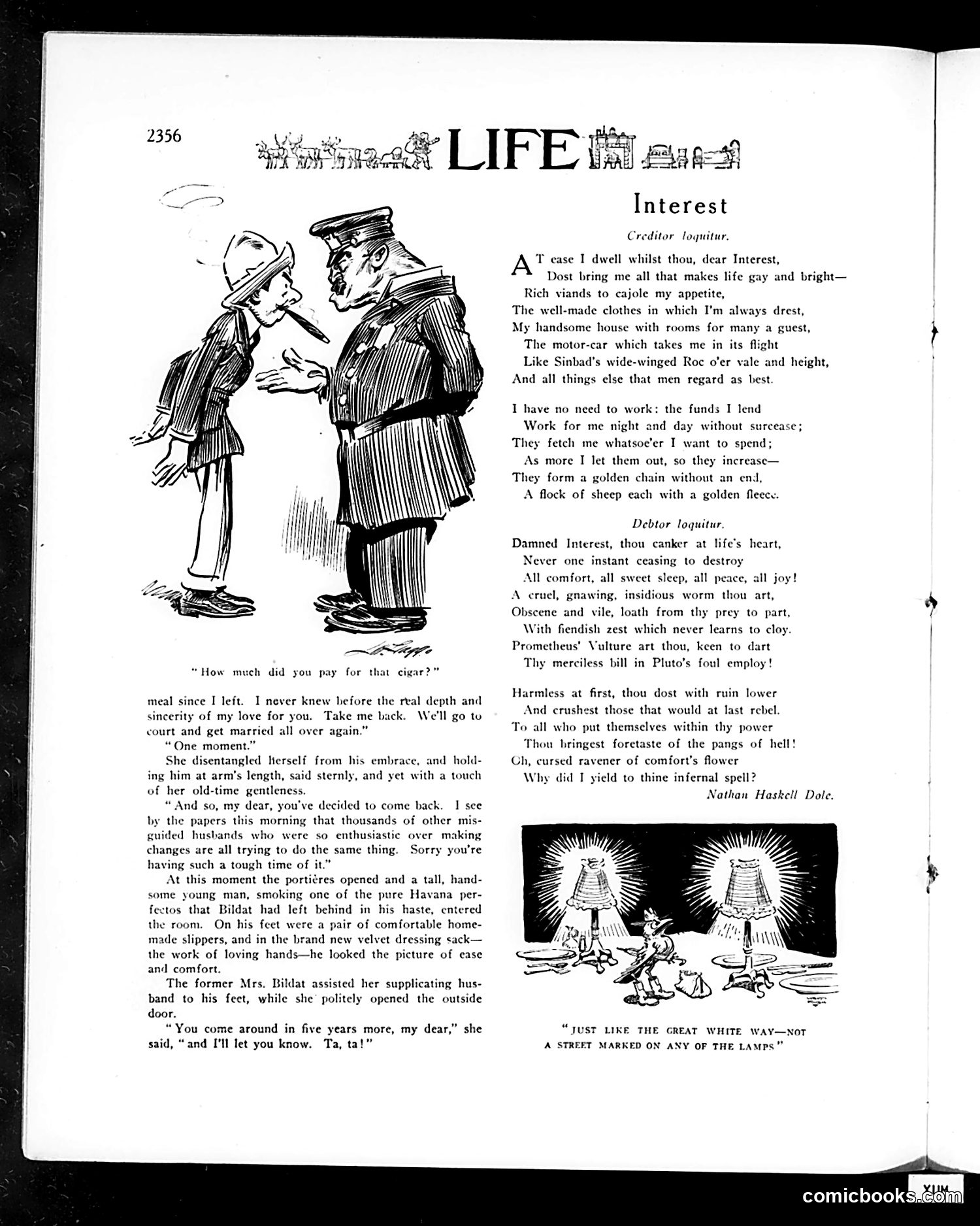
This page contains two distinct satirical pieces about financial relationships. **The cartoon** (top left) depicts a domestic scene where a husband begs his estranged wife to take him back, while a well-dressed young man lounges contentedly in the background—smoking the husband's cigars and wearing his dressing gown. The joke: the wife has replaced her husband with a lover during their separation. The caption "How much did you pay for that cigar?" suggests the husband is questioning the lover's presence/comfort level in his former home. **The poem "Interest"** (right side) is a classical debate between a creditor praising Investment Income (who lives luxuriously off passive returns) and a Debtor cursing Interest as a parasitic "worm" destroying his life. It's Aesop-fable style moralizing about debt's cruelty versus wealth's ease—a commentary on class inequality and financial exploitation common in early 20th-century satirical literature. Together, the page contrasts marital and financial infidelity as parallel betrayals of trust.
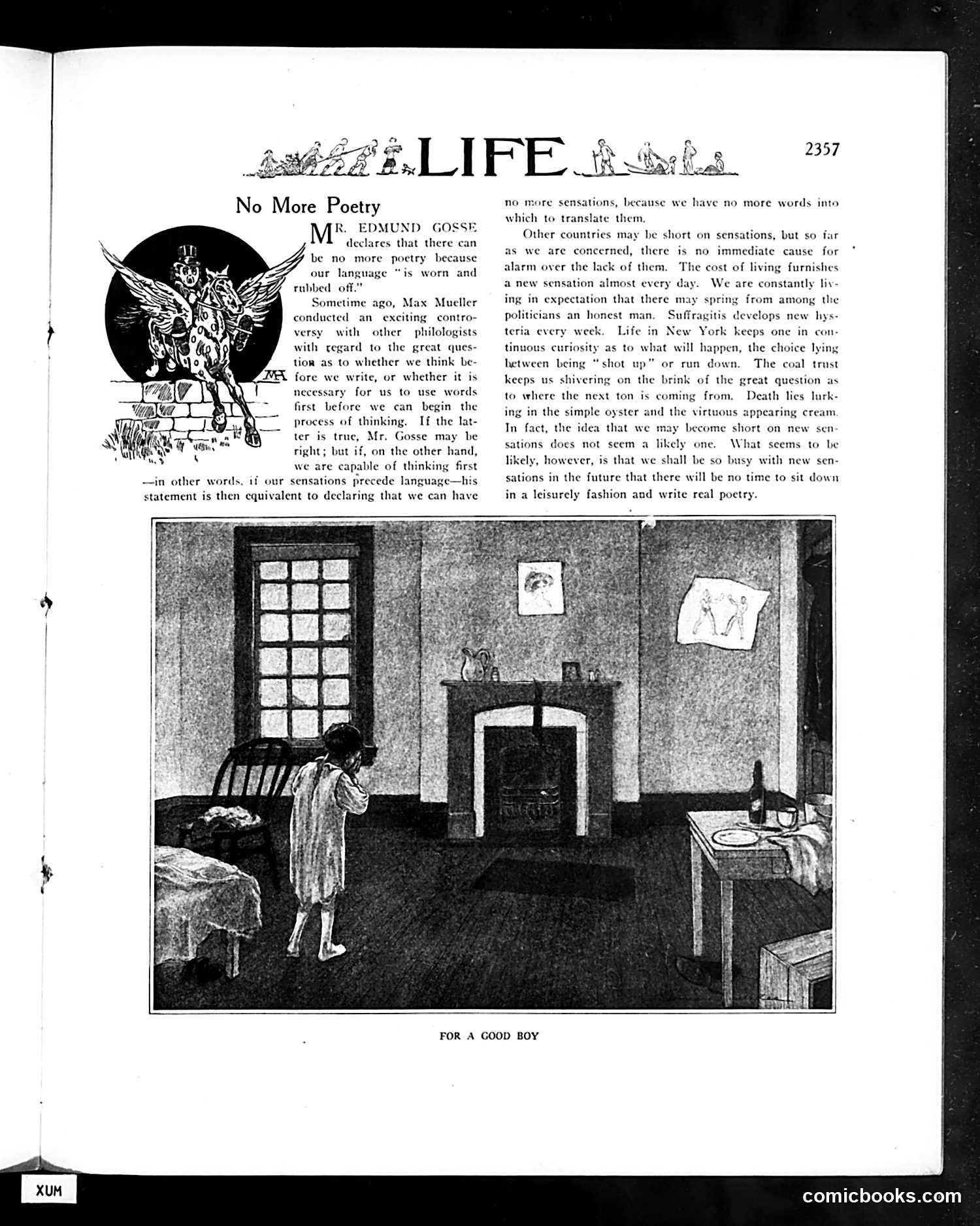
This article satirizes British critic Edmund Gosse's claim that English poetry is dead because the language is "worn and rubbed off." The author (likely Max Mueller or a Life contributor) refutes Gosse's argument through ironic absurdity: if language precedes sensation (as some philologists debate), then lacking new words means lacking new experiences. But America, the author insists, has *plenty* of new sensations—constant anxiety about the cost of living, perpetual hope for honest politicians, disease outbreaks, coal shortages, and food safety scares. The satire's point: modern American life is so overstimulating and chaotic that we lack *time* for leisurely poetry-writing, not lack of language or experience. The accompanying illustration ("For a Good Boy") shows a sparse, melancholy interior, possibly reinforcing the deadening effect of modern anxieties on artistic pursuits. This reflects early 1900s American cultural anxieties about rapid industrialization and urbanization.
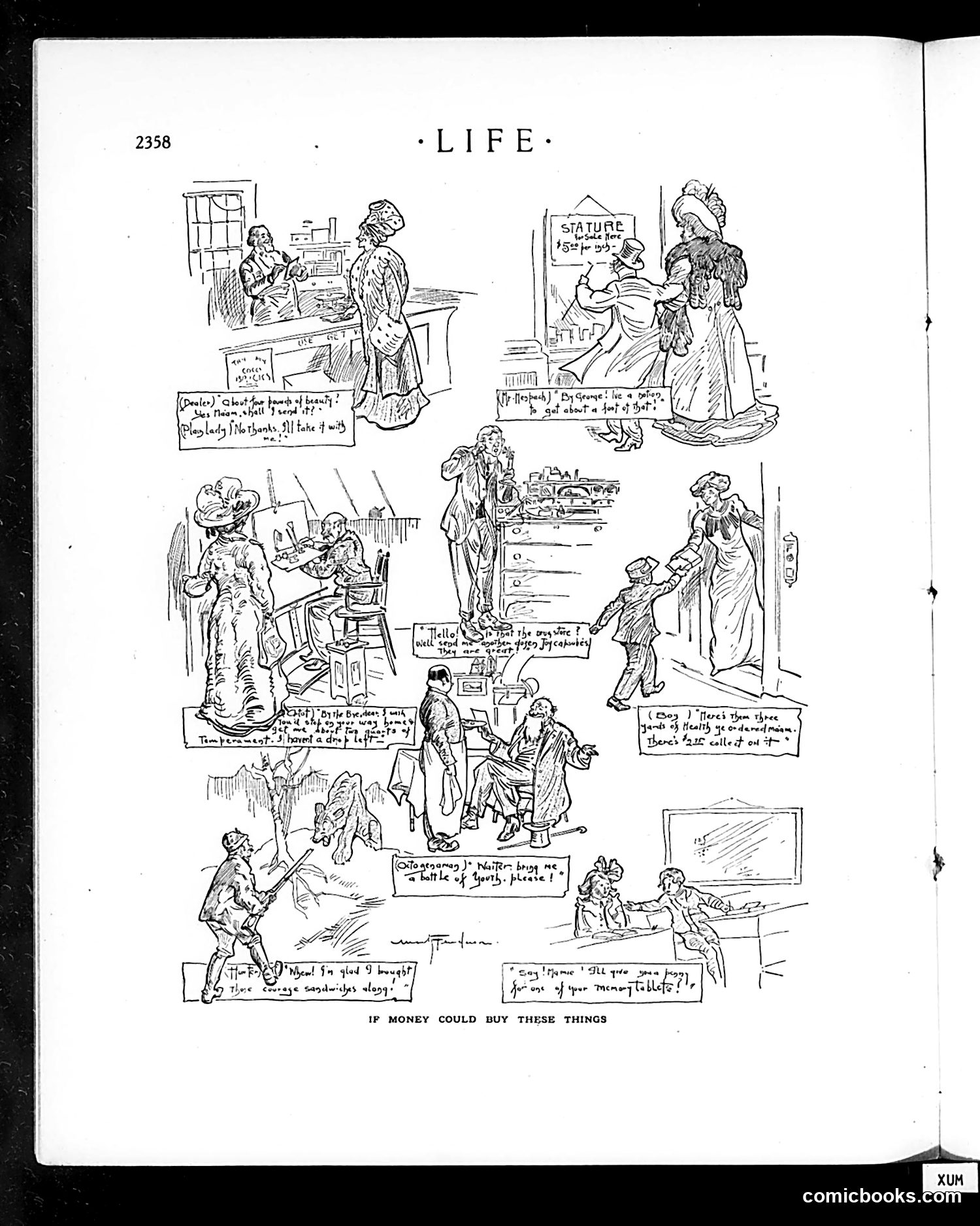
This satirical cartoon series illustrates intangible human desires that wealth cannot purchase. Each vignette depicts characters seeking things money alone cannot obtain: beauty, charm, intelligence, health, love, and social acceptance. The humor targets the limitations of wealth during what appears to be the early-to-mid 20th century. While the wealthy could buy material goods, these sketches suggest money couldn't fix fundamental human problems—insecurity about appearance, social awkwardness, romantic rejection, or physical ailments. The cartoon's social commentary critiques both conspicuous consumption and the false promise that money solves all problems. It's a gentle satire of the wealthy's often futile attempts to purchase their way out of deeply human predicaments.
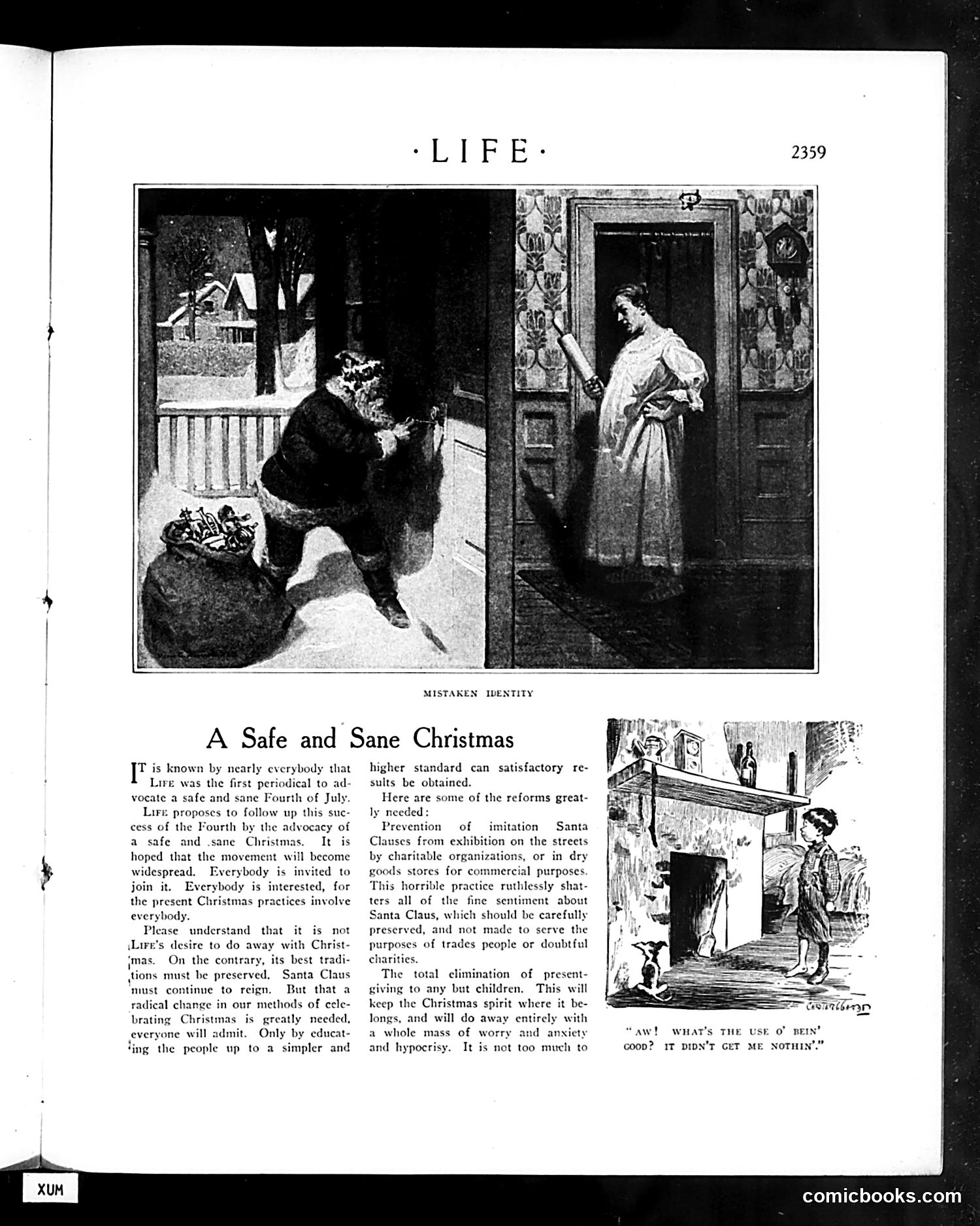
This page advocates for reforming Christmas celebrations to be more "safe and sane." Life magazine, which previously championed a safer Fourth of July, now proposes simplifying Christmas traditions. The article criticizes two specific practices: street Santas employed by charities and stores (which it argues commercialize and cheapen the Santa myth), and adult gift-giving (which the author claims creates "worry and anxiety and hypocrisy"). The top illustration titled "Mistaken Identity" appears to show confusion or deception involving Santa—likely illustrating how imitation Santas undermine children's belief in the genuine Santa Claus figure. The bottom cartoon caption "Aw! What's the use of being good? It didn't get me nothin'" depicts a disappointed child, satirizing how commercialism and inconsistent gift-giving practices undermine Christmas's moral lessons about virtue and reward. The satire targets excessive commercialization and the erosion of Christmas sentiment through profit-driven practices.
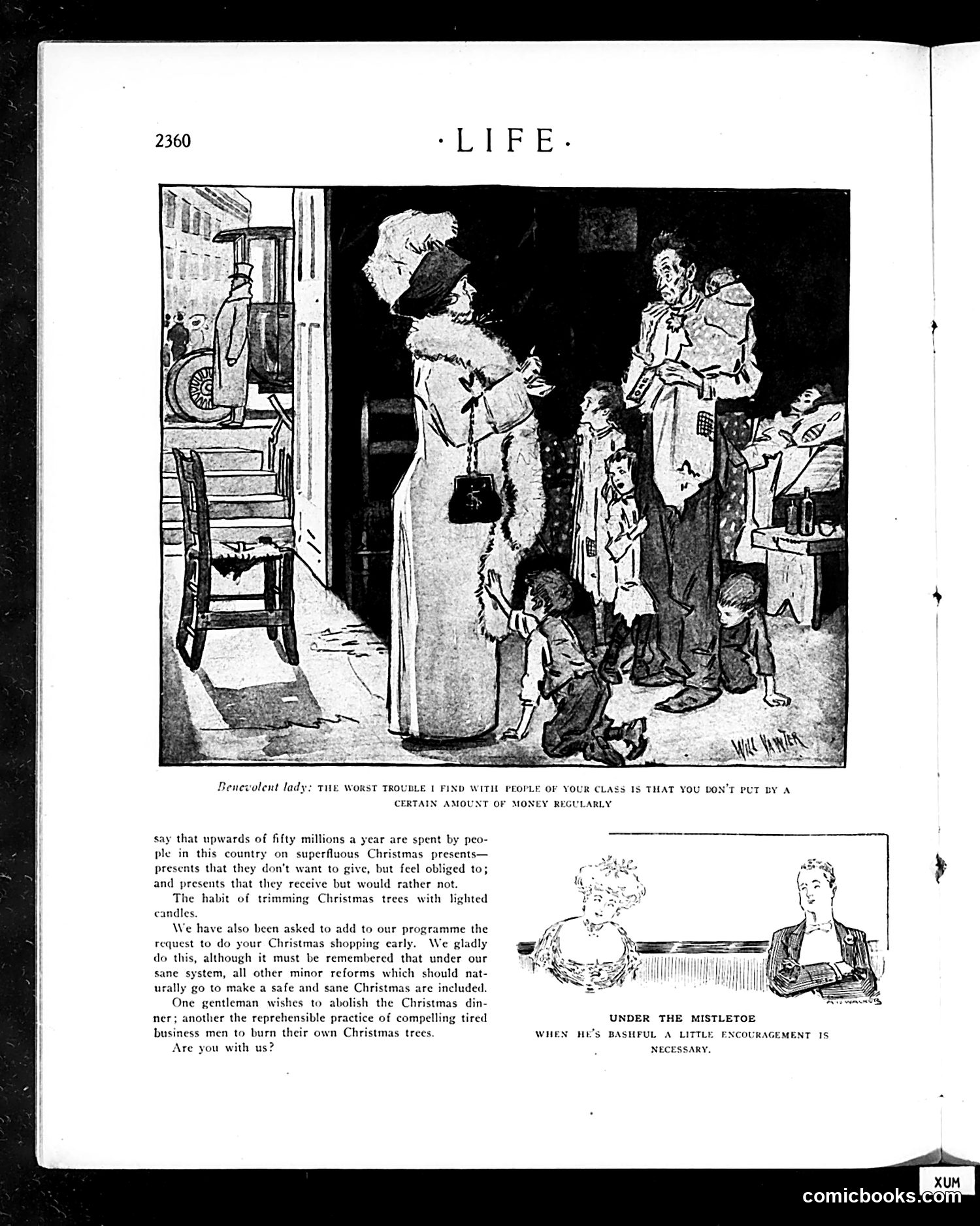
This page satirizes Christmas spending excess and social hypocrisy among the wealthy. The main cartoon depicts a well-dressed "benevolent lady" lecturing a poor woman about financial responsibility—the irony being that the wealthy woman herself appears to spend lavishly (note her fur coat and jewelry), while scolding the working class for not budgeting regularly. The text criticizes wasteful Christmas practices: fifty million dollars annually spent on unwanted presents, dangerous lit candles on trees, and obligatory gift-giving driven by social pressure rather than genuine generosity. The commentary mocks wealthy reformers proposing "safe and sane Christmas" measures while ignoring their own excess. The bottom cartoon, "Under the Mistletoe," appears unrelated—a lighter joke about romantic encouragement. The satire targets class hypocrisy: the rich lecturing the poor about financial discipline while themselves embodying the consumer excess they criticize.
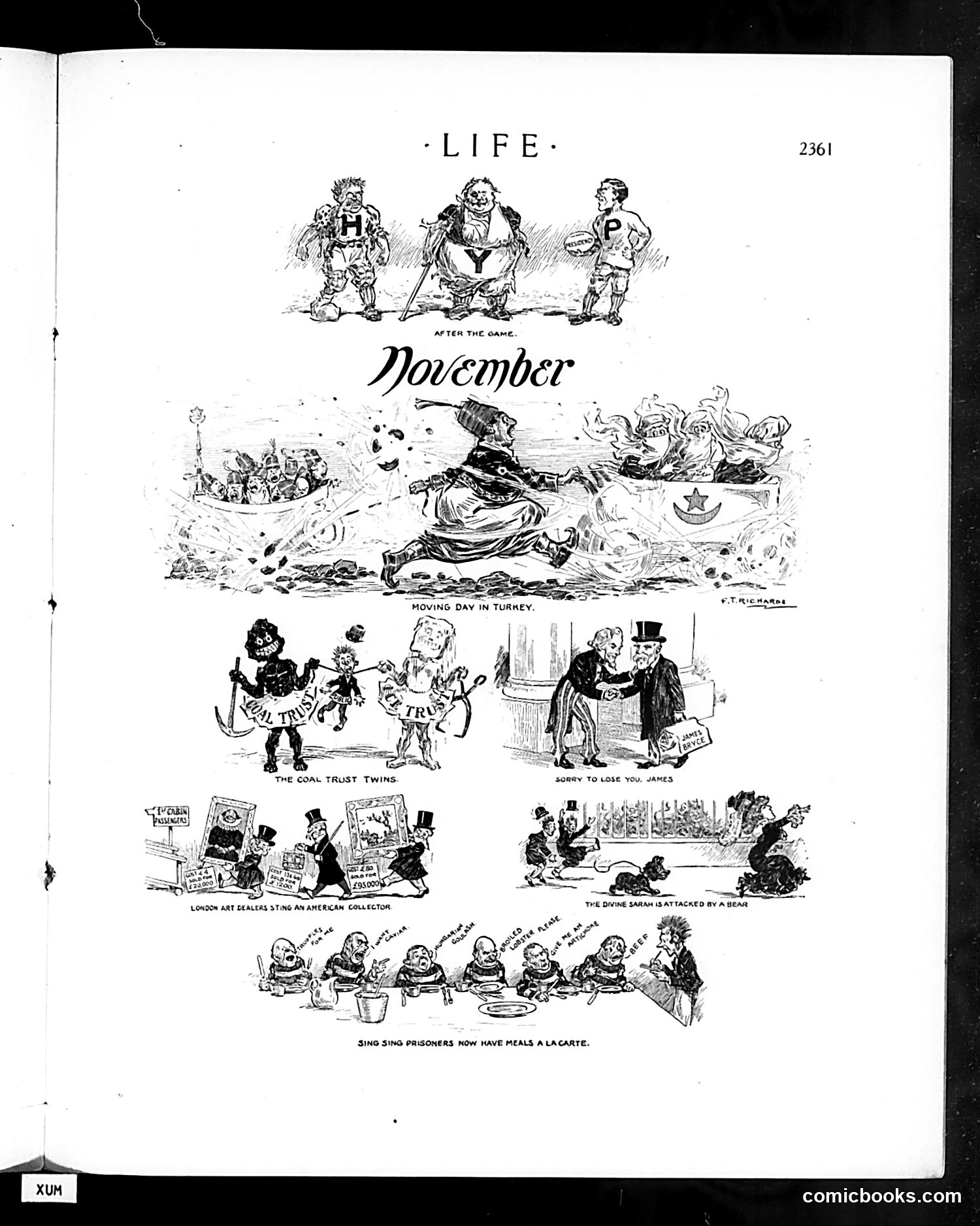
This page contains several political cartoons satirizing November 1911 events: **"After the Game"** shows three figures labeled H, Y, and P (likely representing political parties or factions) after what appears to be an election or political contest. **"Moving Day in Turkey"** references Ottoman political turmoil, depicting chaos as a figure flees—possibly relating to the Italo-Turkish War or internal instability. **"The Coal Trust Twins"** satirizes monopolistic business practices through caricatured figures. **"Sing Sing Prisoners Now Have Meals à la Carte"** mocks the irony of providing luxurious dining to inmates at the famous New York prison while ordinary citizens struggled economically. Other panels reference "London Art Dealers," "Divine Sarah" (likely actress Sarah Bernhardt), and "Sorry to Lose You, James." The cartoons use exaggerated caricature and social commentary typical of Life's satirical approach to contemporary politics and social issues.
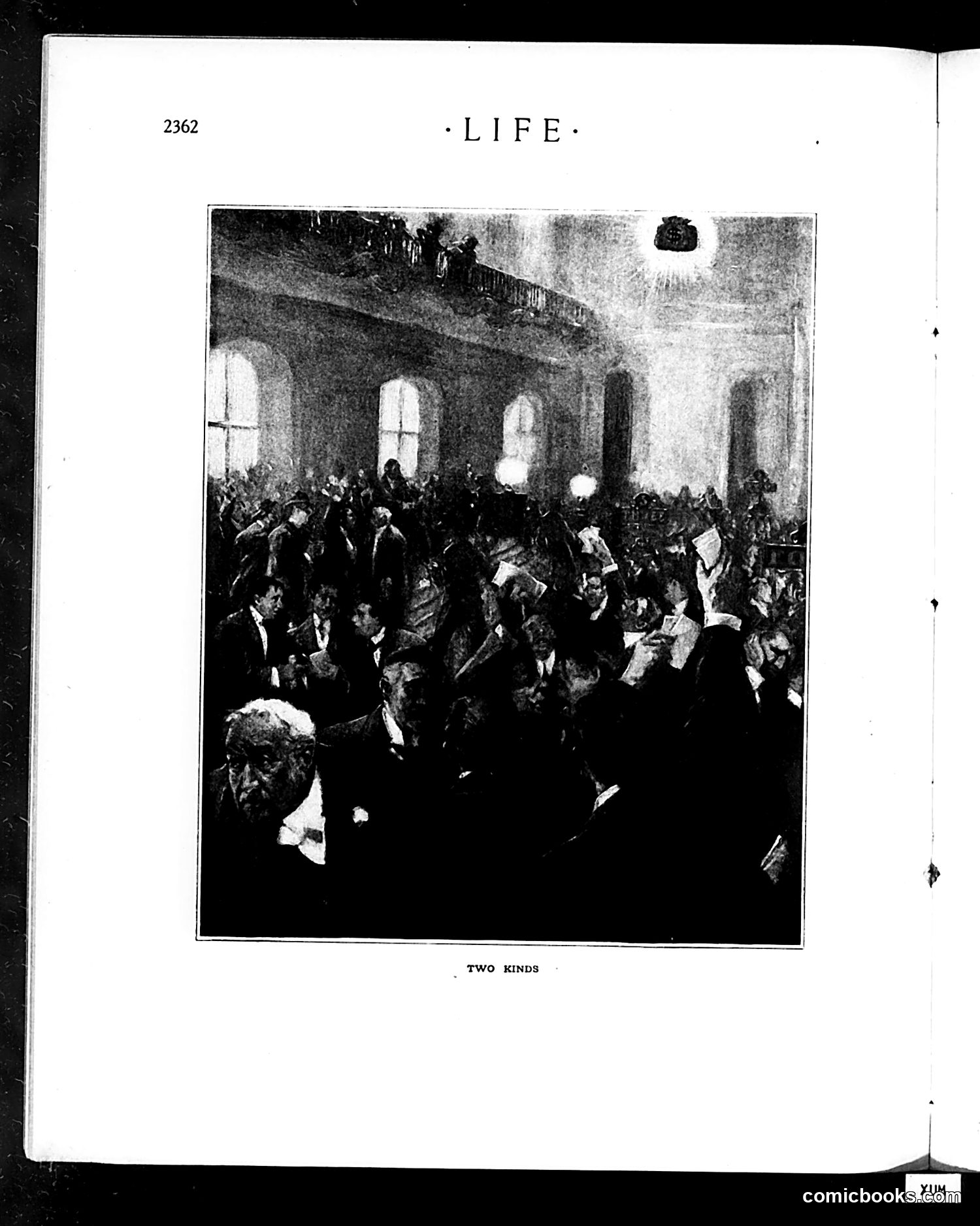
This Life magazine page shows a crowded interior scene—likely a formal gathering or social event in an ornate hall with tall windows and a balcony. The caption "Two Kinds" suggests a social commentary contrasting two groups of people. The satire appears to critique class or social divisions: the composition emphasizes a contrast between figures in the foreground (including what appears to be a distinguished elderly man in profile on the left) and the larger crowd behind them. This likely satirizes the difference between wealthy elites and the masses, or perhaps distinguishes between those "in the know" versus common attendees at some public or political gathering. Without additional context or visible captions identifying specific figures, the exact social commentary remains somewhat unclear, though the visual hierarchy clearly suggests social stratification.
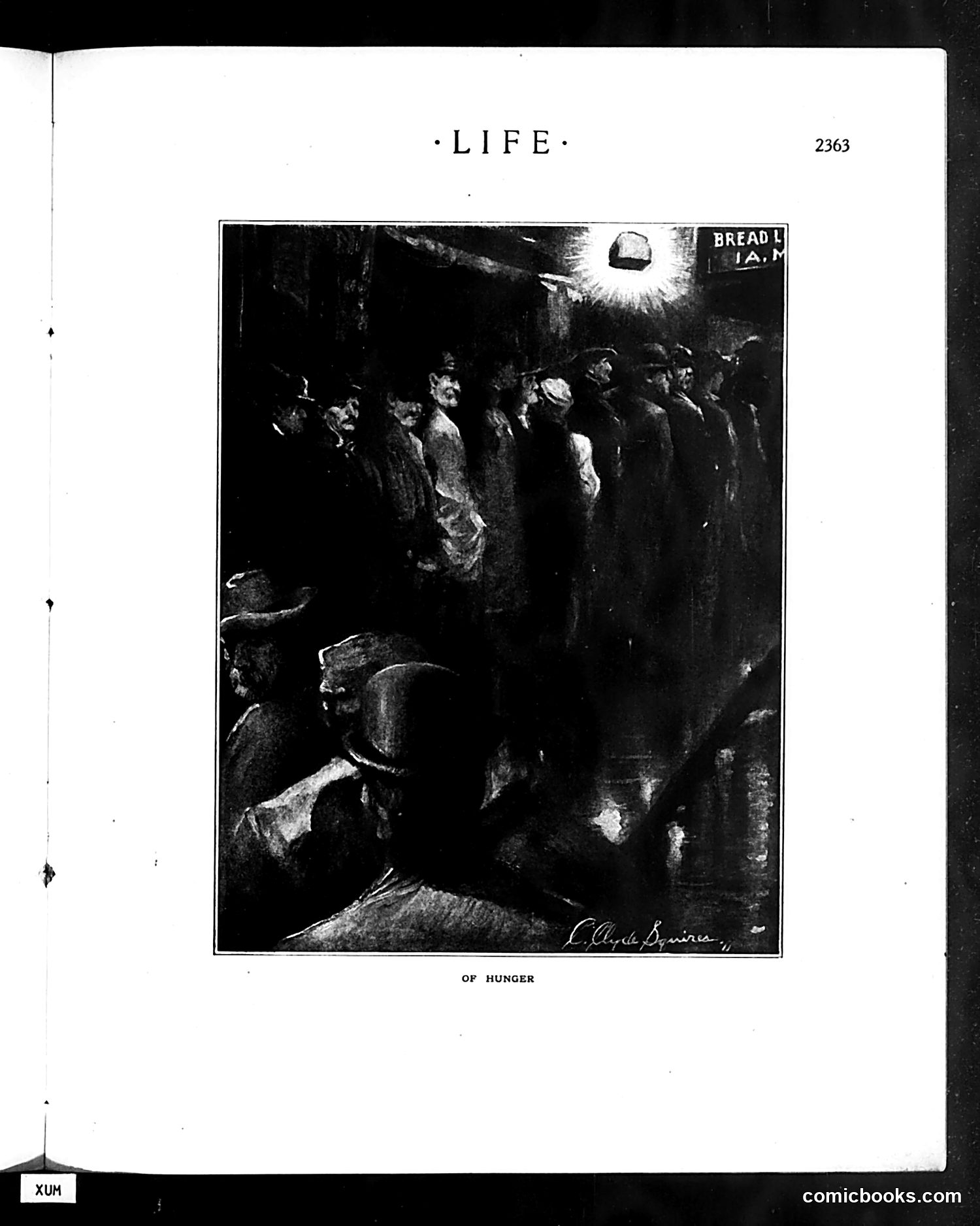
This political cartoon depicts a crowded, dark scene of people gathered around what appears to be a bread line or food distribution point (visible signage reading "BREAD" in upper right). The figures appear gaunt and desperate, illuminated by a stark light source above. The cartoon likely comments on economic hardship and food scarcity—possibly referencing Depression-era bread lines or post-war rationing. The dramatic chiaroscuro (light/dark contrast) and crowded composition emphasize the desperation and dehumanizing nature of mass hunger. The title "Of Hunger" makes the social commentary explicit: the cartoon critiques either government failure to address poverty or broader economic injustice forcing citizens into degrading circumstances. The artistic style suggests early-to-mid 20th century.
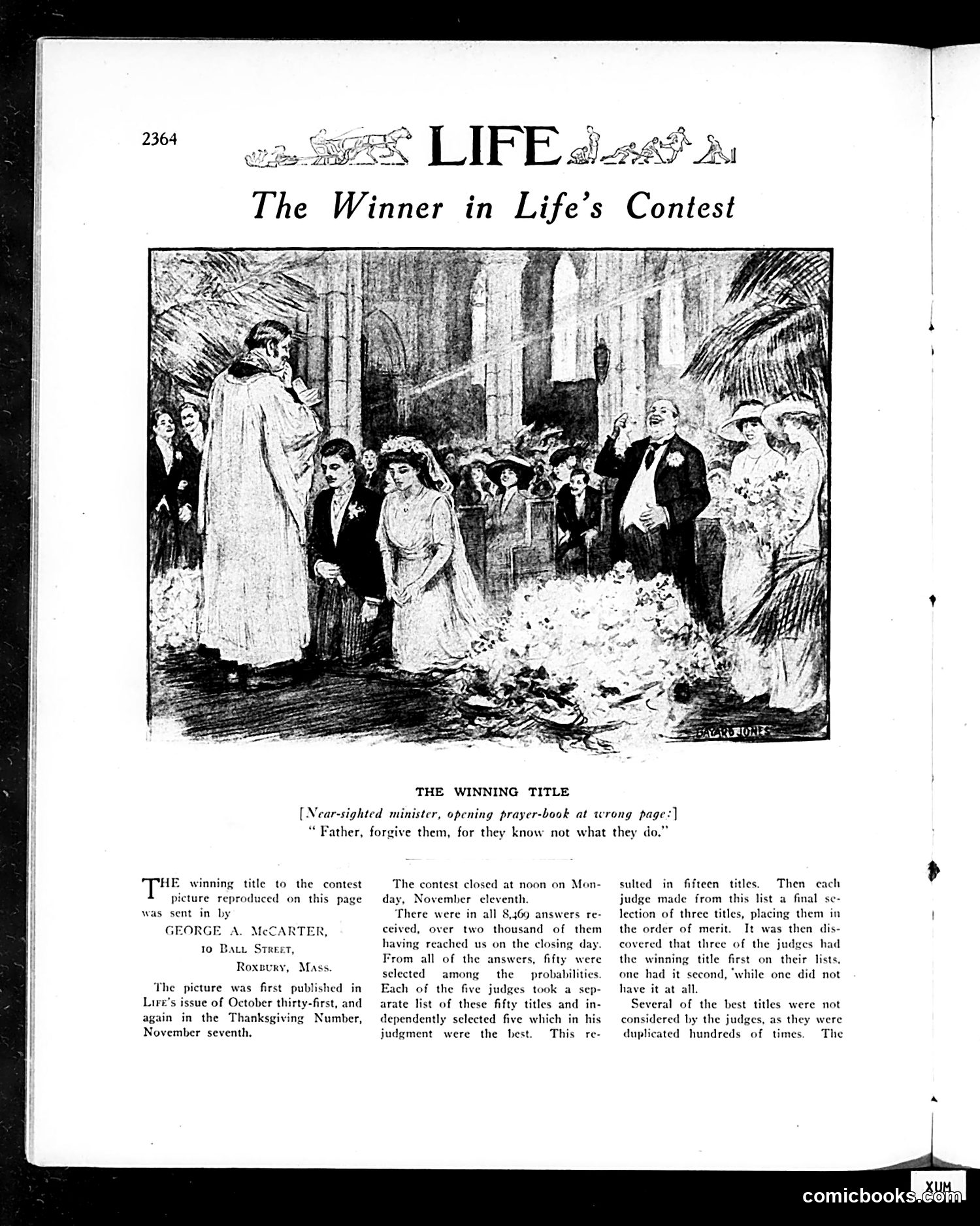
This page announces the winning entry in a *Life* magazine caption contest. The illustration depicts a formal church wedding ceremony, with a near-sighted clergyman holding his prayer book upside down or opened to the wrong page while performing the service. The winning caption, submitted by George A. McCarter, reads: "Father, forgive them, for they know not what they do"—a biblical phrase (Christ's words from the Crucifixion) humorously repurposed to comment on the oblivious minister's blunder at a solemn moment. The text describes the contest mechanics: 8,369 entries were received; judges independently selected their top choices, and three of five judges ranked this title first, demonstrating its clear appeal. The joke's humor lies in the ironic application of sacred language to an everyday human mistake—the minister's absent-mindedness contrasted with the gravity of the wedding ceremony itself.
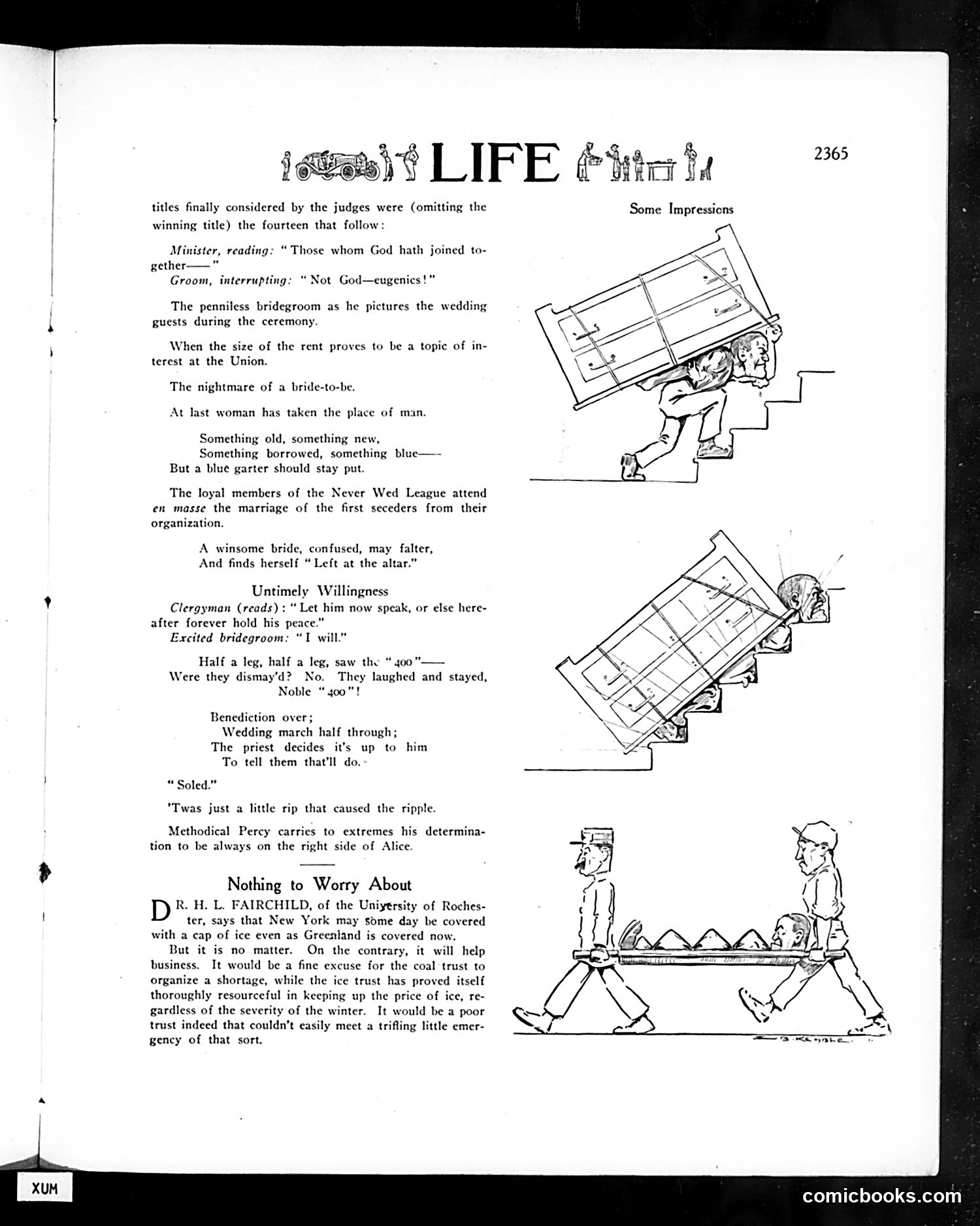
This page contains satirical commentary on weddings and business trusts. The top section mocks wedding anxieties through humorous scenario titles—including a groom interrupting vows with "Not God—eugenics!" (referencing early 20th-century eugenics pseudoscience), brides left at the altar, and concerns about wedding expenses. The illustrations show comedic wedding-related mishaps, including someone struggling with furniture and people on a seesaw. The bottom article, "Nothing to Worry About," satirizes monopolistic business practices. It sarcastically suggests that if New York froze under ice like Greenland, it would benefit coal and ice trusts, who could artificially create shortages and maintain high prices regardless of actual conditions. This is biting social commentary criticizing trusts' ability to manipulate markets and exploit consumers during emergencies—a major Progressive Era concern.
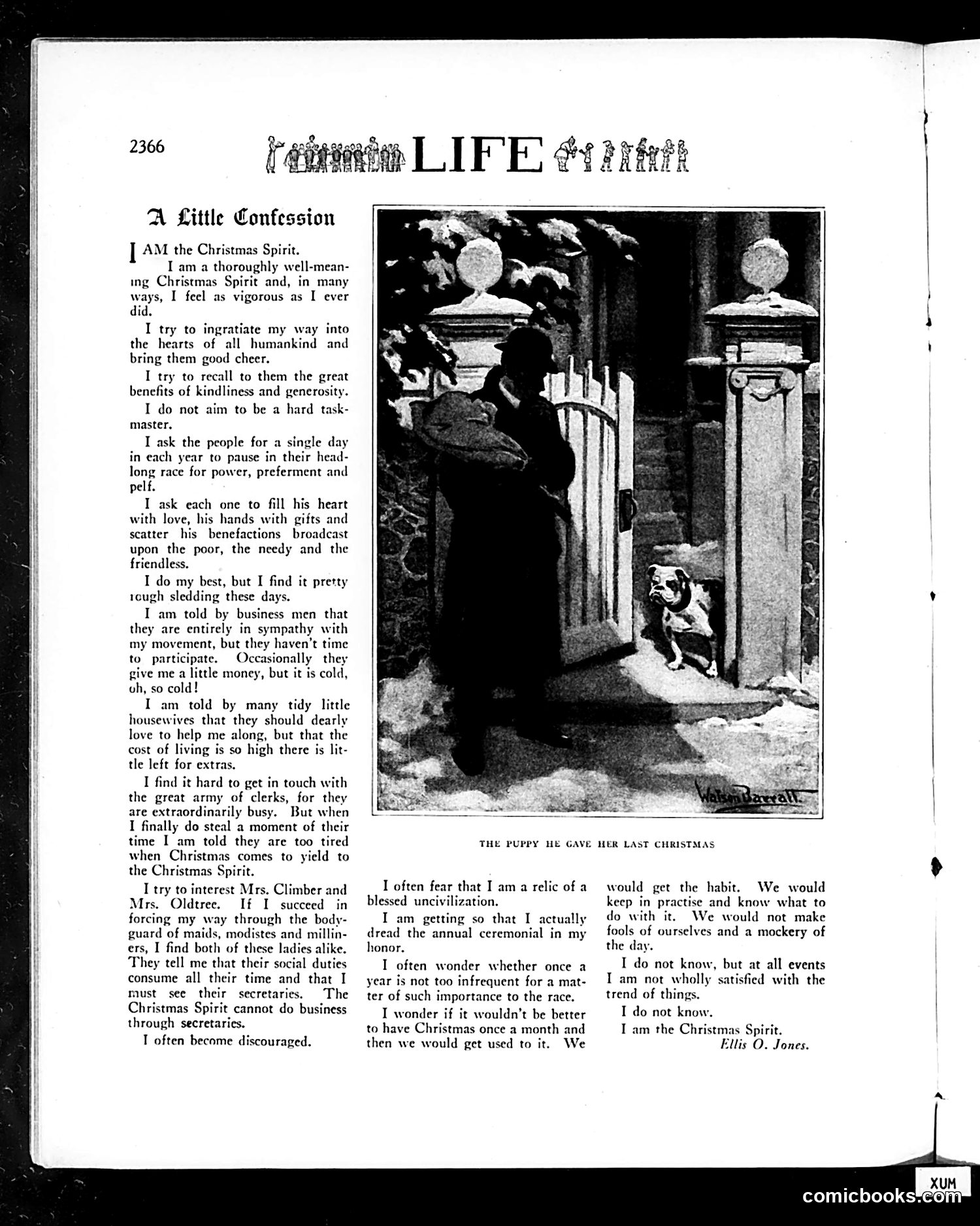
This page presents a satirical first-person monologue by the "Christmas Spirit" lamenting its declining influence in modern society. The spirit complains that despite good intentions, it struggles to reach people genuinely. Business executives claim sympathy but lack time; housewives cite high living costs; office workers are too exhausted; wealthy socialites hide behind secretaries and social obligations. The accompanying illustration shows a silhouetted figure at a doorway with a puppy—captioned "The Puppy He Gave Her Last Christmas"—suggesting hollow, impersonal gift-giving replacing authentic generosity. The satire targets early 20th-century American materialism, busyness, and class stratification. The spirit suggests Christmas should occur monthly so people remember its values year-round, rather than treating it as an annual ceremonial obligation. The piece critiques how commercialization and social climbing have corrupted the holiday's original meaning of kindness and charity. Author Ellis O. Jones uses the Christmas Spirit as a persona to mock contemporary indifference to genuine benevolence.
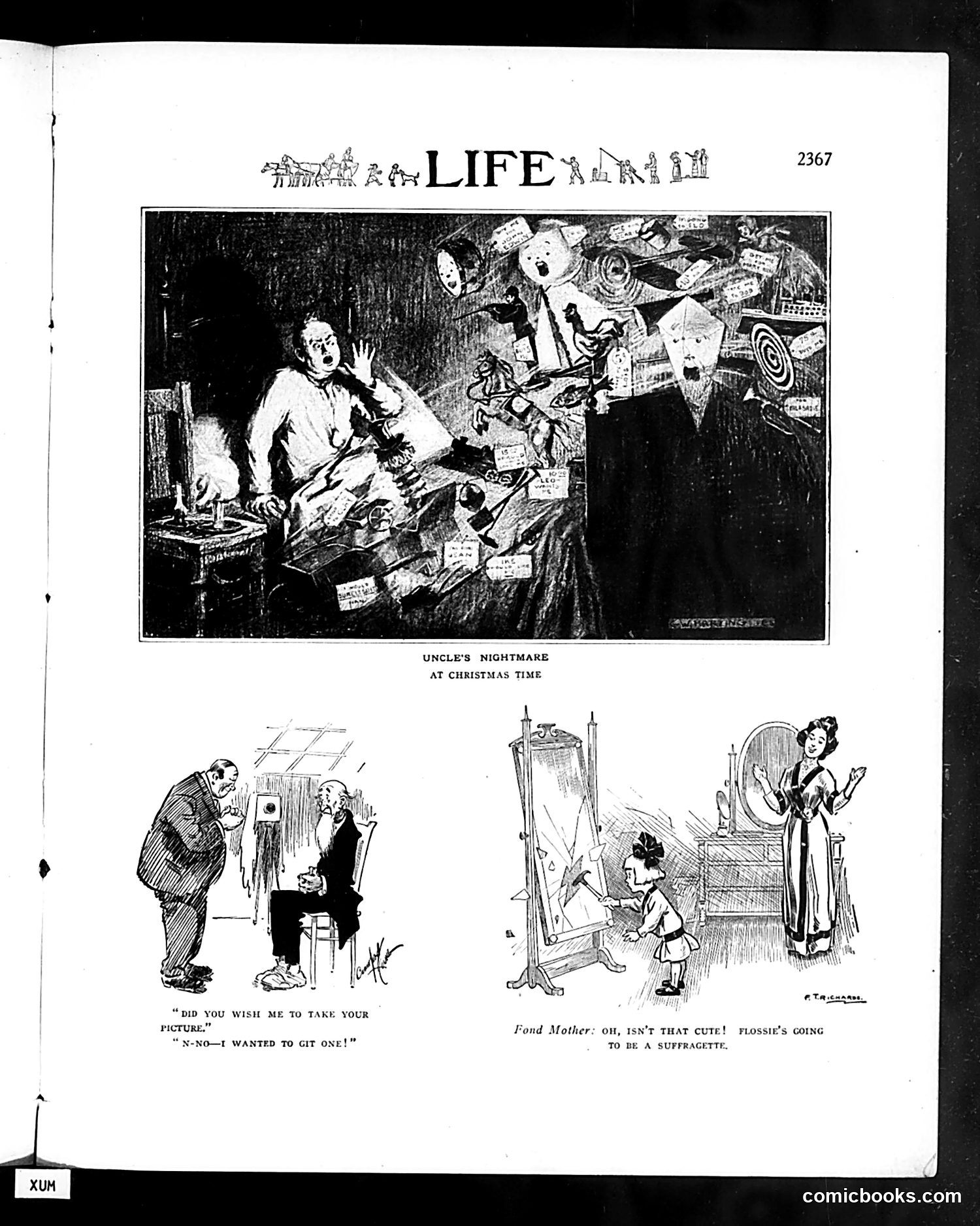
This 1910s Life magazine page satirizes Christmas gift-giving and women's suffrage through three comic vignettes: The top panel shows a chaotic Christmas scene where an overwhelmed uncle is buried under unwanted toys and gifts—his "nightmare." Below, two separate jokes: One depicts a photographer mishearing a request for a portrait as wanting to "git one" (get one)—a class-based dialect humor. The other shows a mother proudly noting her daughter "Flossie's going to be a suffragette," presented as a humorous character flaw or embarrassing phase, as if it were comparable to other childish ambitions. The suffragette joke reflects early-20th-century satirical attitudes dismissing women's voting rights activism as a trivial, youthful folly rather than serious political engagement. The cartoons employ gentle mockery typical of Life's era.
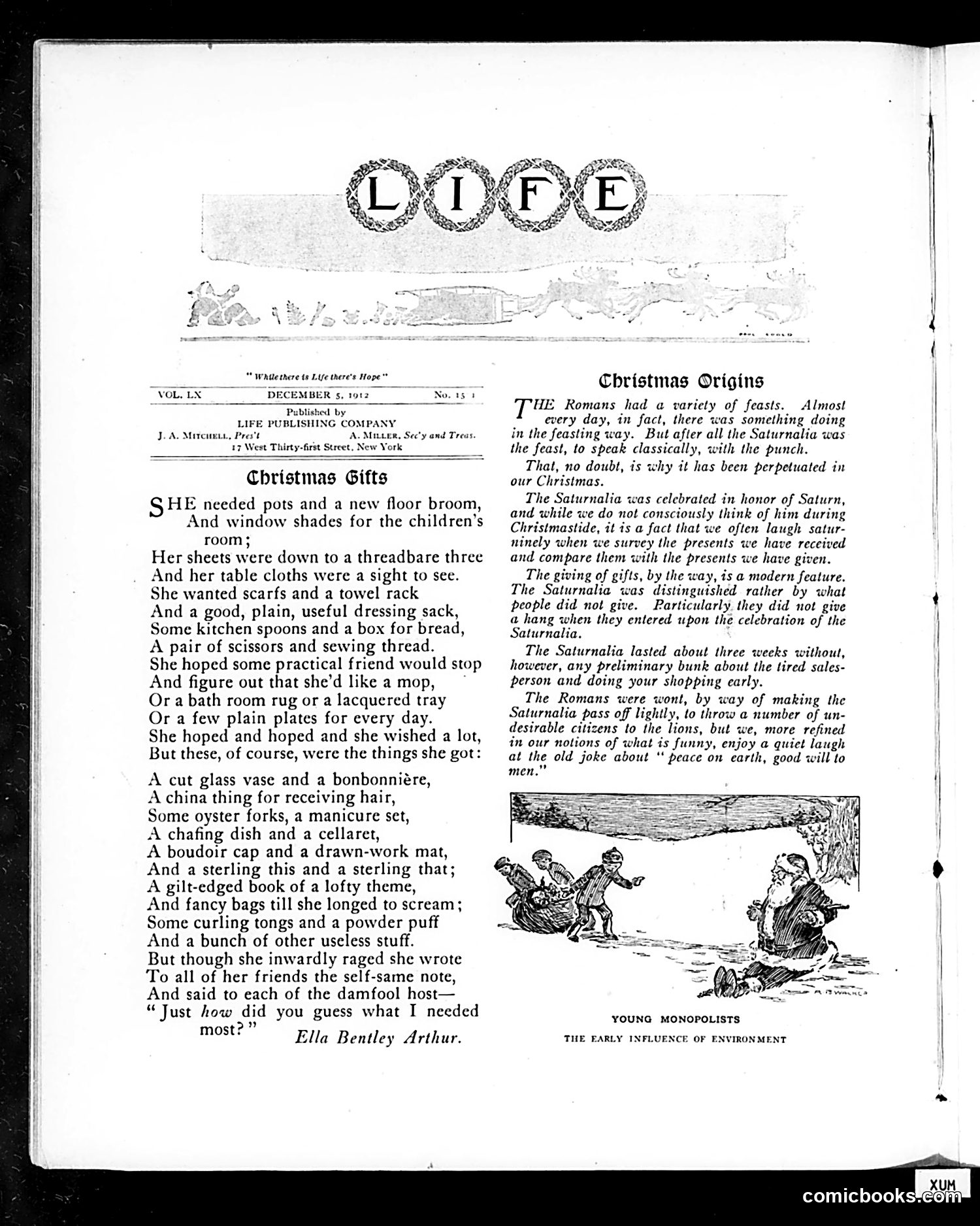
**"Christmas Gifts" Poem (Ella Bentley Arthur):** This satirizes the gap between practical needs and frivolous gift-giving. A woman needs essential household items—brooms, sheets, kitchen utensils—but receives impractical luxury goods: cut glass vases, decorative items, fancy bags, and ornamental things. The joke is her polite, dishonest thank-you notes ("Just how did you guess what I needed most?") despite inward rage. It mocks both thoughtless gift-givers and social conventions forcing recipients to feign gratitude. **"Christmas Origins" Essay:** This traces Christmas gift-giving to Roman Saturnalia celebrations, drawing a parallel: Romans threw "undesirable citizens to the lions" for entertainment, while moderns enjoy "a quiet laugh" at giving useless presents—suggesting modern gift-exchanging is equally cruel, just more refined in appearance. The satire implies Christmas generosity is theatrical performance rather than genuine kindness. **Illustration ("Young Monopolists"):** The accompanying sketch appears to show children in a snowy scene, likely illustrating how environmental influences shape behavior—possibly connecting childhood gift-receiving practices to adult character formation.
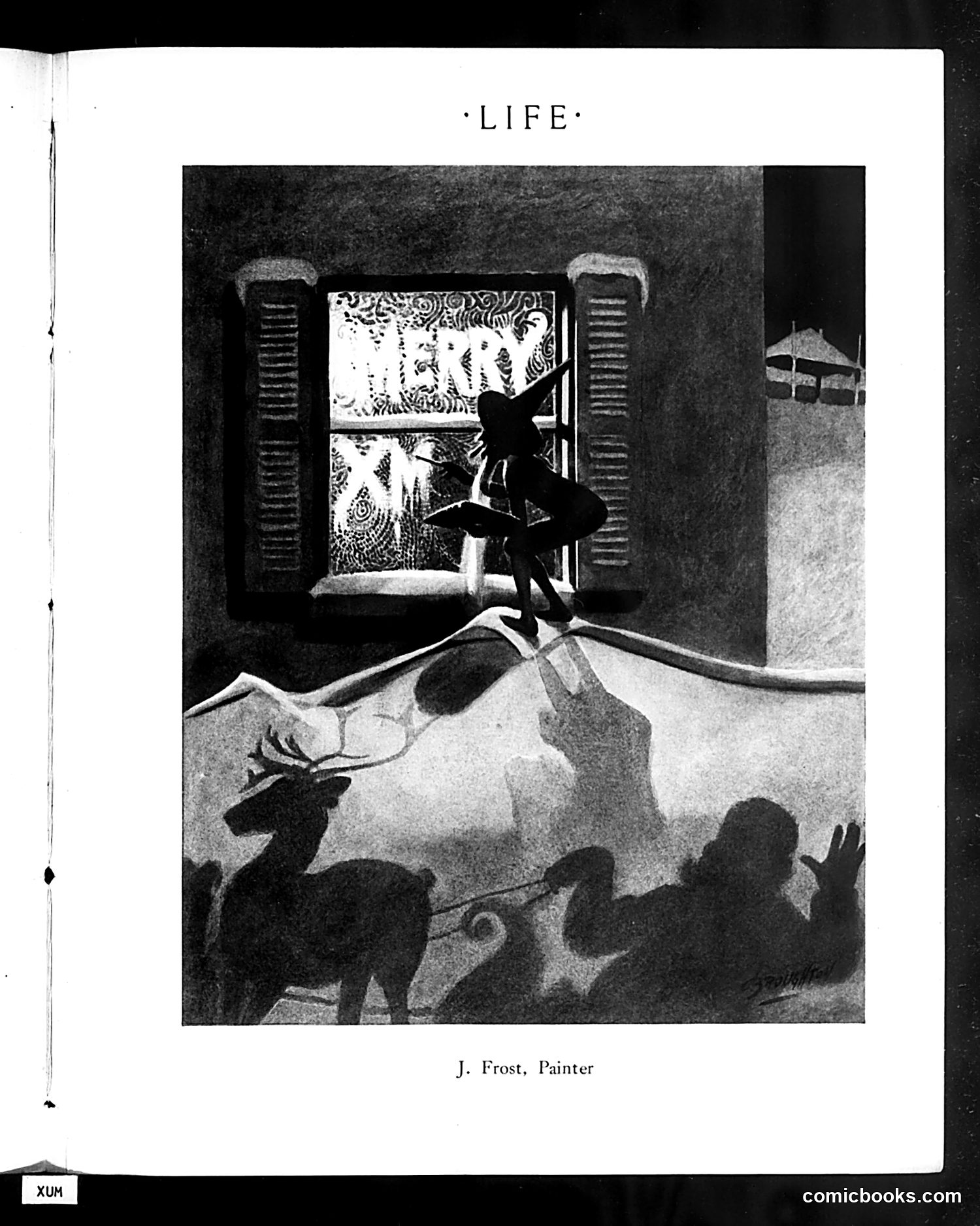
This is an artwork by J. Frost titled simply "Life," appearing in the satirical magazine *Life*. The image depicts a surreal, dreamlike scene: a figure reclines on what appears to be a large, undulating form while gazing out a window with ornate shutters. Through the window, a small building with an umbrella is visible. Below, shadowy figures appear to gesture or react to the scene. The work seems to explore themes of leisure, escapism, or perhaps aspiration—the figure's relaxed pose contrasts with the active figures below. Without additional context about the publication date or specific social references, the precise satirical target remains unclear, though it may comment on class differences, fantasy versus reality, or contemporary attitudes toward comfort and desire. The surrealist style suggests modernist artistic influence.
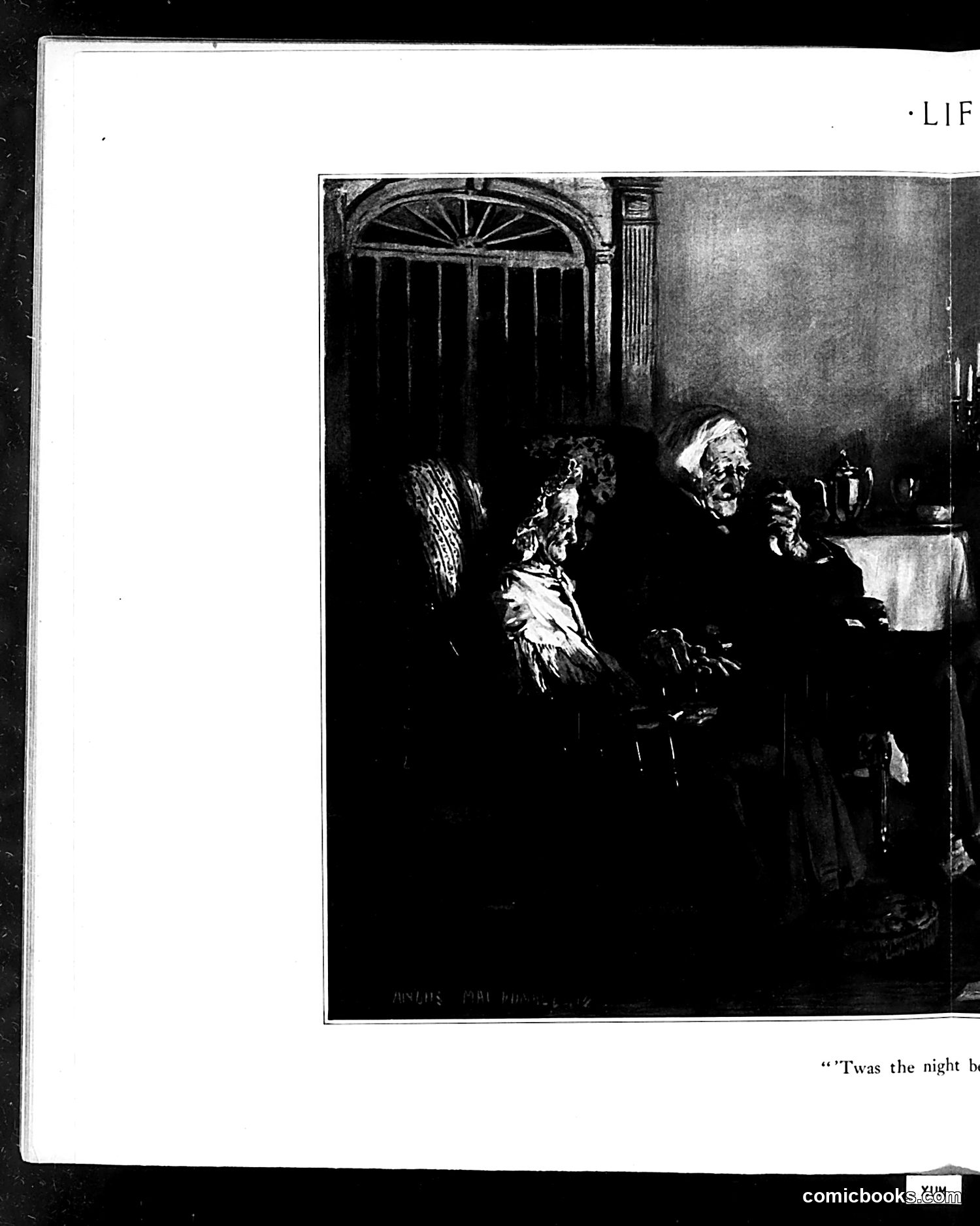
This appears to be a darkly dramatic illustration, likely from a 19th-century Life magazine, showing what seems to be a supernatural or Gothic scene. The image depicts figures in period dress gathered in a shadowy interior space with dramatic lighting. The partial caption beginning "'Twas the night b[efore]..." suggests a reference to "'Twas the Night Before Christmas," Clement Clarke Moore's famous poem. However, the OCR text is too corrupted to determine the specific satire or joke intended. Without readable caption text or clearer context, I cannot reliably identify which political figures or social issues this cartoon mocks, or what point the satirist was making. The dark, ominous tone suggests either a parody of the famous Christmas poem or commentary on a contemporary scandal or social situation, but specifics remain unclear.
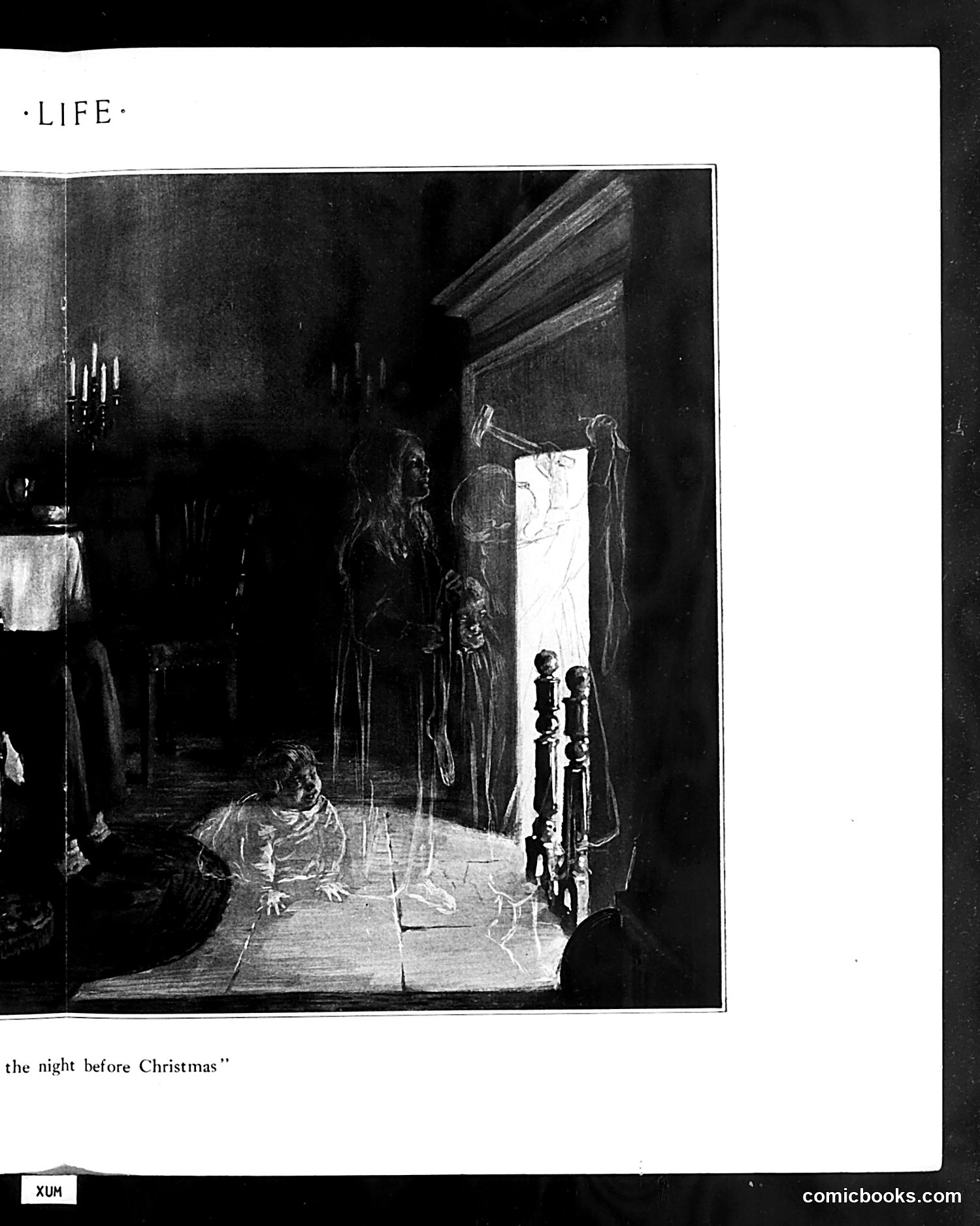
This appears to be an illustration from Life magazine titled "the night before Christmas," likely a visual adaptation or parody of Clement Clarke Moore's classic 1823 poem. The black-and-white image depicts a darkened interior scene with figures in period dress, including what appears to be adults and children positioned near a doorway with bright light streaming through. A candelabra is visible on the left side. Without additional context on the publication date or accompanying article text, I cannot determine what specific satire or political commentary this illustration makes. It may be a straightforward holiday illustration, a humorous take on the traditional poem, or commentary on Christmas customs, but the image alone doesn't clearly reveal the satirical intent that would be apparent to contemporary readers.
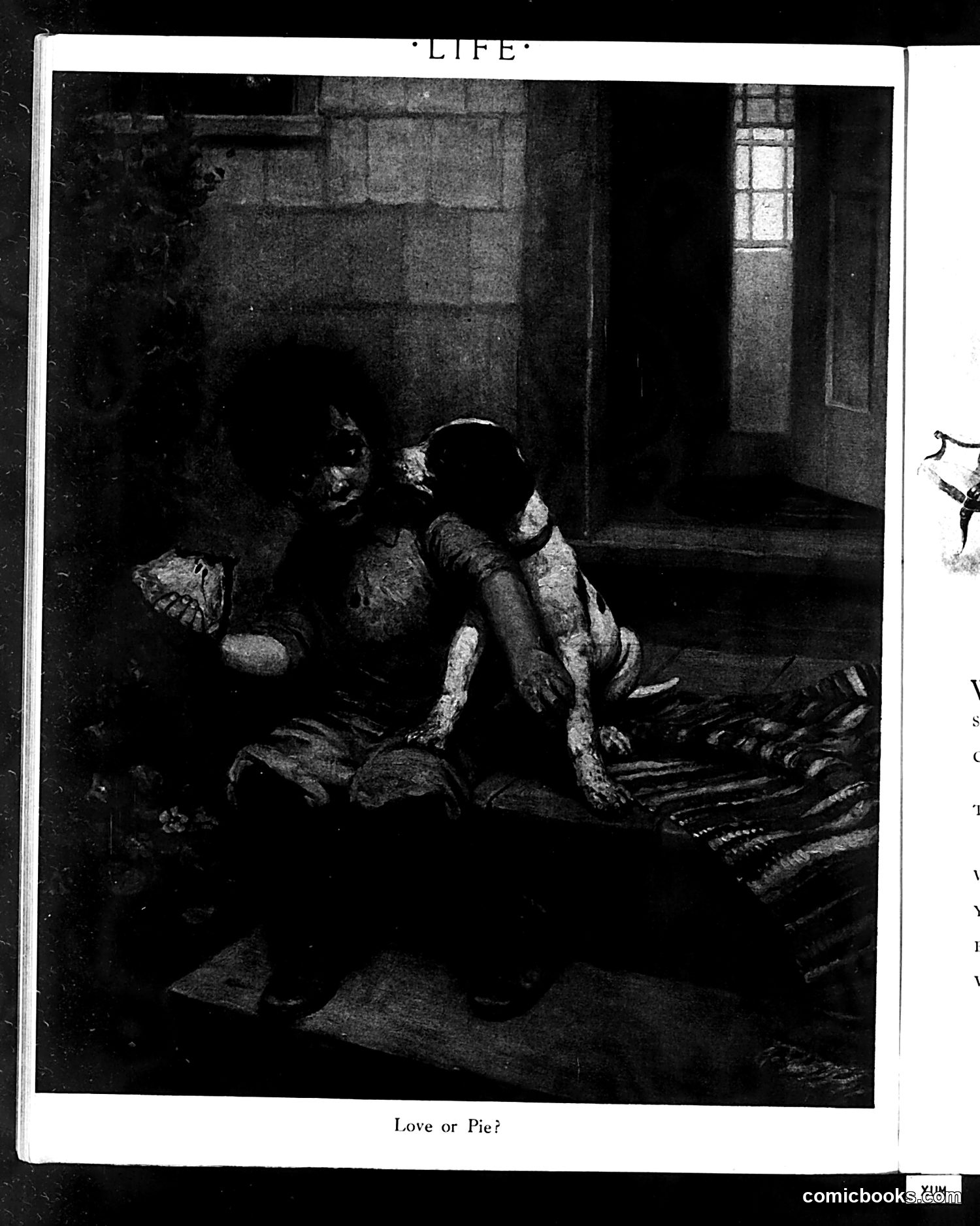
This appears to be a satirical illustration from *Life* magazine depicting a domestic scene. The caption "Love or Pie?" suggests commentary on marriage and domestic priorities—specifically, whether a wife's value lies in romantic companionship or domestic labor (cooking/housekeeping). The image shows two figures in what appears to be a modest interior, possibly a basement or working-class dwelling, sitting on a bed or mattress. The stark, shadowy photography style emphasizes the unglamorous reality of their situation, which sharpens the satire's bite: the question asks whether love or practical domestic services matter more in marriage, implying contemporary anxieties about marital relationships and gender roles in early-to-mid 20th century America. The joke critiques both romanticized notions of marriage and reductive views of women's domestic roles.
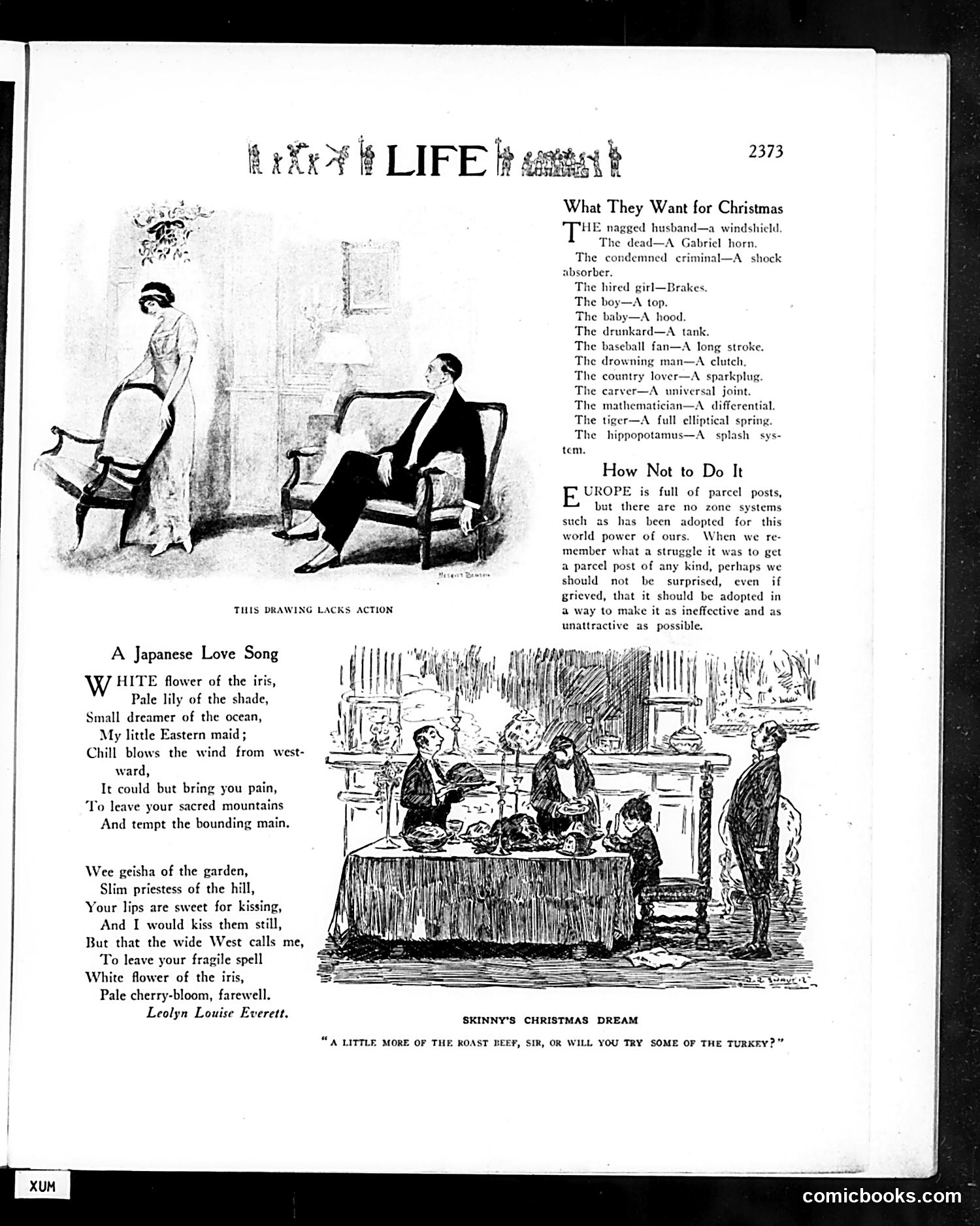
This page contains early 20th-century automobile-themed humor. The main feature, "What They Want for Christmas," is a pun list where various character types desire auto parts as gifts—the "condemned criminal" wants a "shock absorber," the "drunkard" wants a "tank," etc. Each pun plays on how automotive terminology sounds like what that character type would actually want. "How Not to Do It" critiques the U.S. postal system's newly-adopted parcel post zones as deliberately ineffective compared to European systems—satirizing American bureaucratic inefficiency. The cartoons illustrate everyday scenes: one shows inaction (literally labeled "lacks action"), another depicts "Skinny's Christmas Dream"—a thin man's fantasy of being served abundant holiday meat at a lavish table, addressing class anxieties about wealth and food access during this era. The Japanese love poem appears unrelated, possibly filler content typical of magazines mixing diverse material.
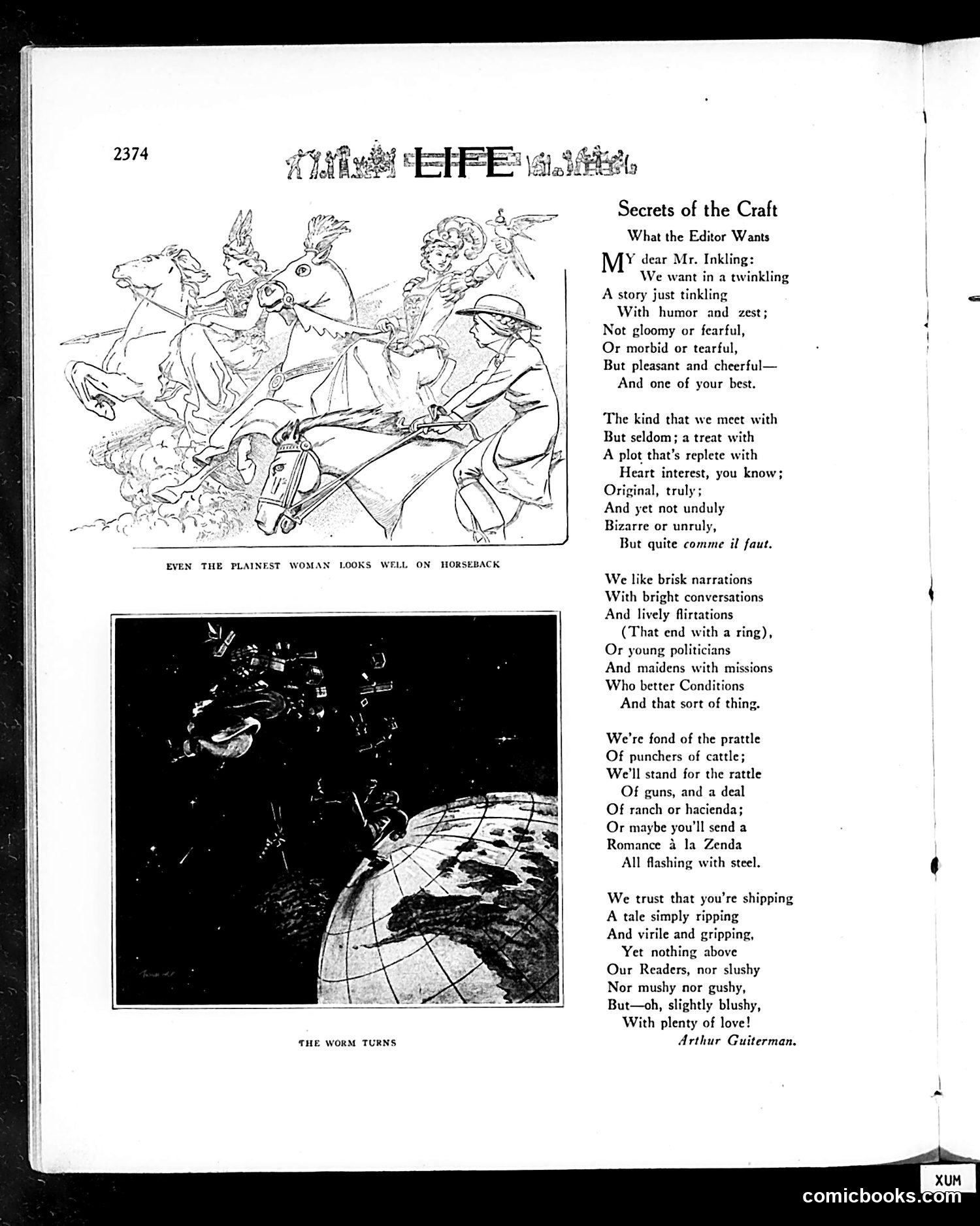
This is a humorous editorial poem by Arthur Guiterman addressed to "Mr. Inkling" (a generic fiction writer), laying out Life magazine's editorial preferences for submitted stories. The two illustrations support the text: the top shows horseback riders in action (referencing the "punchers of cattle" and Western romance preferred), while the bottom depicts a globe with "the worm turns"—likely alluding to a story involving international intrigue or colonial adventure. Guiterman satirizes magazine editors' contradictory demands: they want stories that are simultaneously original yet conventional, exciting yet inoffensive, romantic yet not "slushy," and gripping yet accessible to ordinary readers. The poem gently mocks how editors desire crowd-pleasing commercial fiction with specific formulas (Westerns, political romance, adventure) while claiming to want genuinely fresh material. The title's pun on "craft" suggests the formulaic nature of popular magazine writing.
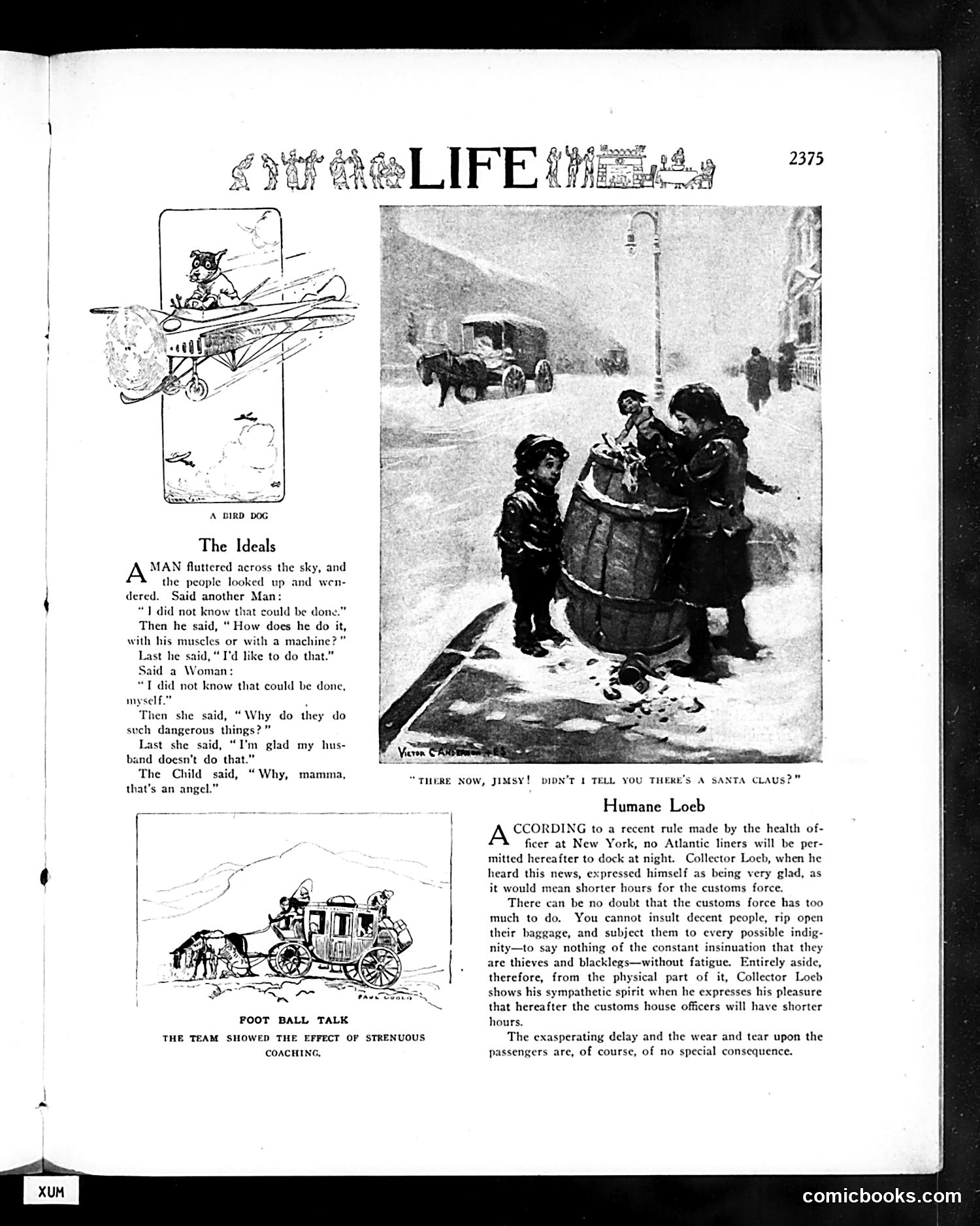
This page contains three separate satirical pieces: **"The Ideals"** contrasts how different people respond to witnessing human flight: a man wants to understand the mechanism, a woman worries about danger, but a child simply calls it angelic—satirizing how modern rationalism displaces wonder. **"Foot Ball Talk"** (cartoon caption) is a brief joke about coaching's physical effects on athletes. **"Humane Loeb"** is the main satirical piece, mocking Collector Loeb's response to new rules preventing Atlantic liners from docking at night. The satire is heavy-handed: Loeb claims to sympathize with exhausted customs officers, but Life sarcastically exposes this as callous—the real victims are passengers enduring intrusive baggage searches and insulting treatment. The piece ridicules Loeb's priorities: he celebrates shorter working hours for officials while dismissing passenger suffering as "of no special consequence." The sarcasm highlights the hypocrisy of false humanitarianism.
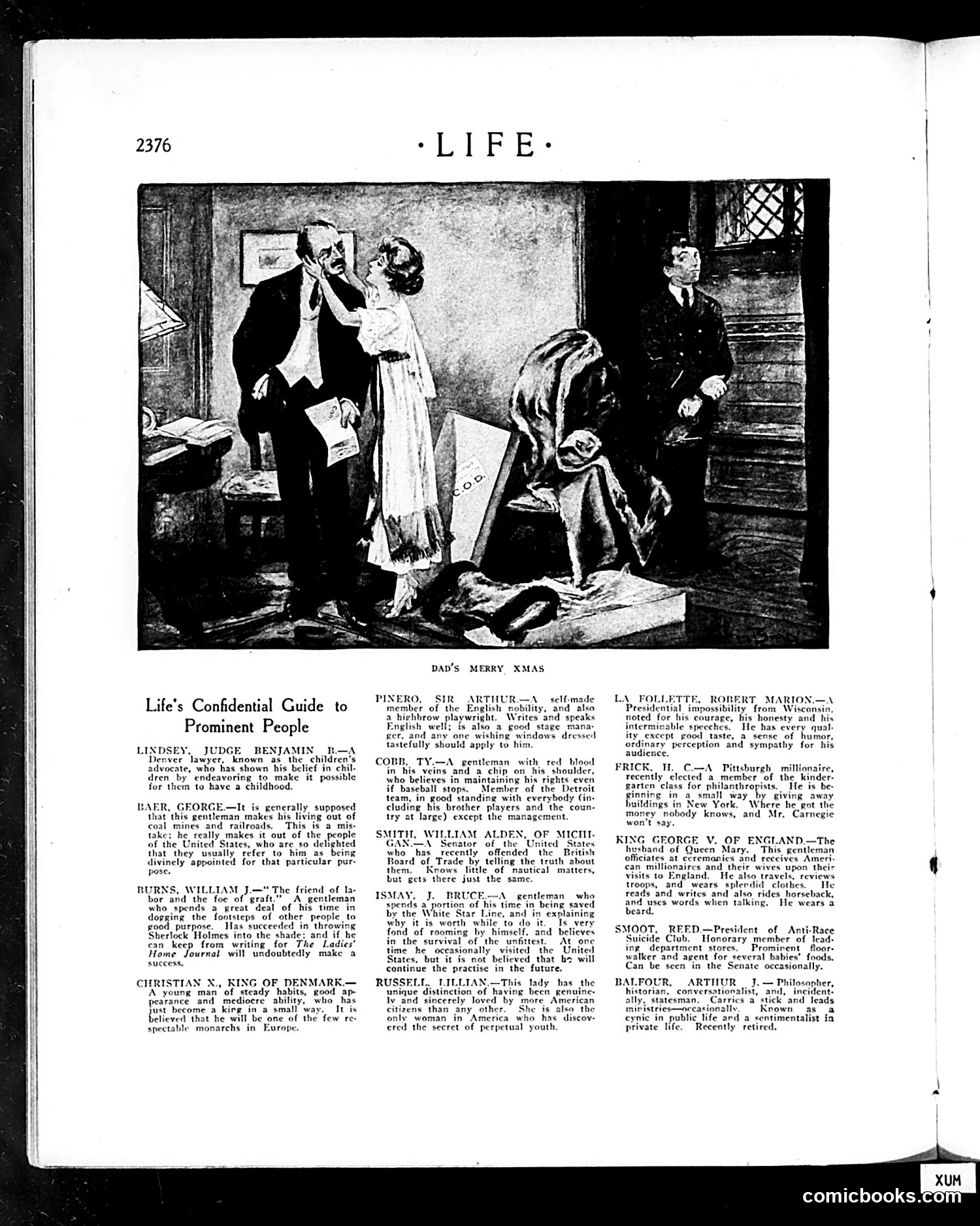
This page combines a Christmas cartoon with "Life's Confidential Guide to Prominent People"—satirical biographical sketches of early 20th-century public figures. The cartoon depicts a domestic scene where a father figure appears to be disciplining or confronting family members, likely commenting on holiday tensions or parental authority during Christmas. The text below offers tongue-in-cheek character assessments of notable figures including: - **Judge Benjamin Lindsey**: children's rights advocate - **George Baer**: coal/railroad magnate criticized for profiting from American workers - **William J. Burns**: detective/investigator with ambiguous motivations - **Ty Cobb**: baseball player known for combativeness - **J. Bruce Ismay**: White Star Line official (Titanic survivor, controversial figure) - **Carnegie and Frick**: wealthy industrialists mocked for philanthropic self-promotion The satire's point: expose the contradictions, hypocrisies, and true motivations of powerful men through irreverent, witty descriptions that undercut their public personas and social status.
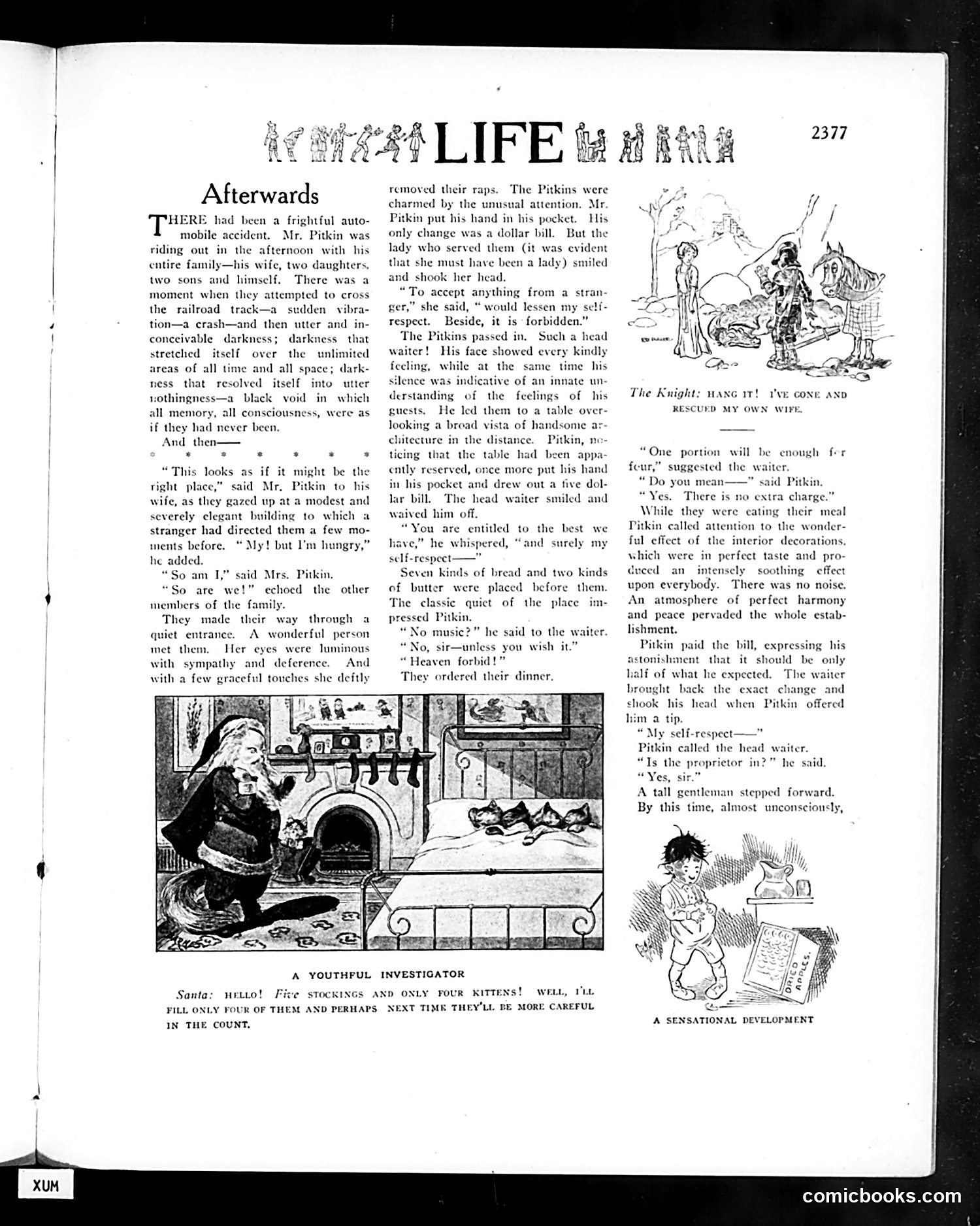
This is a satirical short story illustrated with cartoons, likely from the early 1900s. The main narrative follows Mr. Pitkin and his family, who survive a horrific train-automobile collision that kills them all. They then enter an afterlife restaurant where staff members refuse tips, citing "self-respect" as their reason. The satire appears to mock **exaggerated politeness and false gentility**—the afterlife establishment is so perfectly courteous and harmonious that it becomes absurd. Staff waive payment, decline gratuities, and serve elaborate meals at impossibly low cost, all while maintaining pious declarations about self-respect. The side cartoons parody other subjects: "A Youthful Investigator" shows Santa correcting a child about Christmas stockings; "A Sensational Development" depicts a child's surprising realization (details unclear from image). The overall message critiques pretentious service standards and sanctimonious behavior in American establishments of the era, suggesting that excessive politeness masks something hollow or fraudulent.
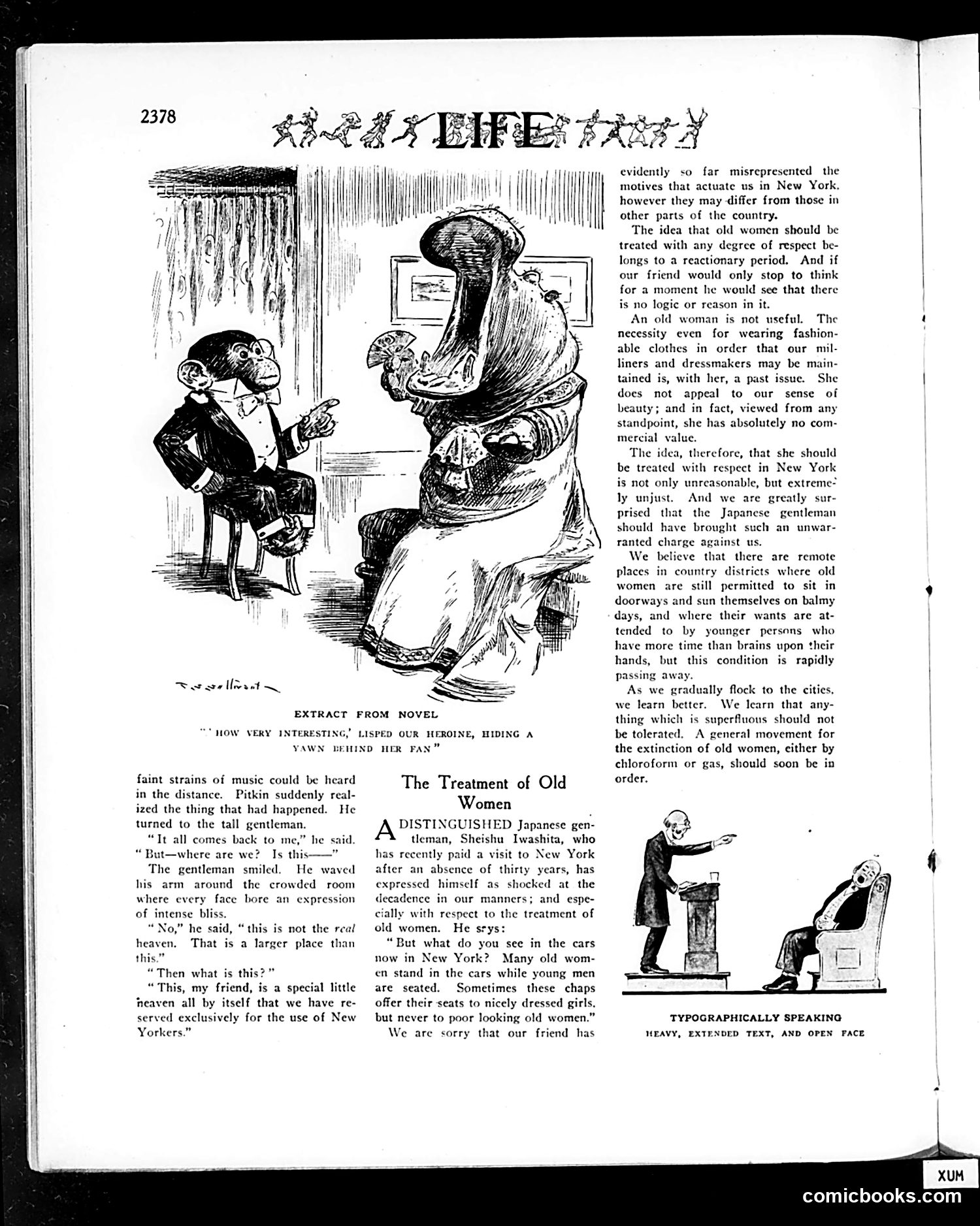
This Life magazine page contains satirical commentary on modernism's callousness toward the elderly. A visiting Japanese gentleman, Sheishu Iwashita, criticized New York for disrespecting old women—noting young men offer subway seats to fashionably dressed girls but never to poor-looking elderly women. Life's response is biting satire: the editors sarcastically argue old women deserve no respect because they're "not useful," have "no commercial value," and don't appeal to "our sense of beauty." They mock the idea that respect for elders belongs to "a reactionary period," then escalate absurdly, suggesting a "general movement for the extinction of old women, either by chloroform or gas." The accompanying cartoon (left) shows a small figure speaking to a large woman, illustrating the social dynamics. Life is satirizing contemporary American materialism and indifference to the elderly—suggesting society values only the young, economically productive, and aesthetically pleasing.
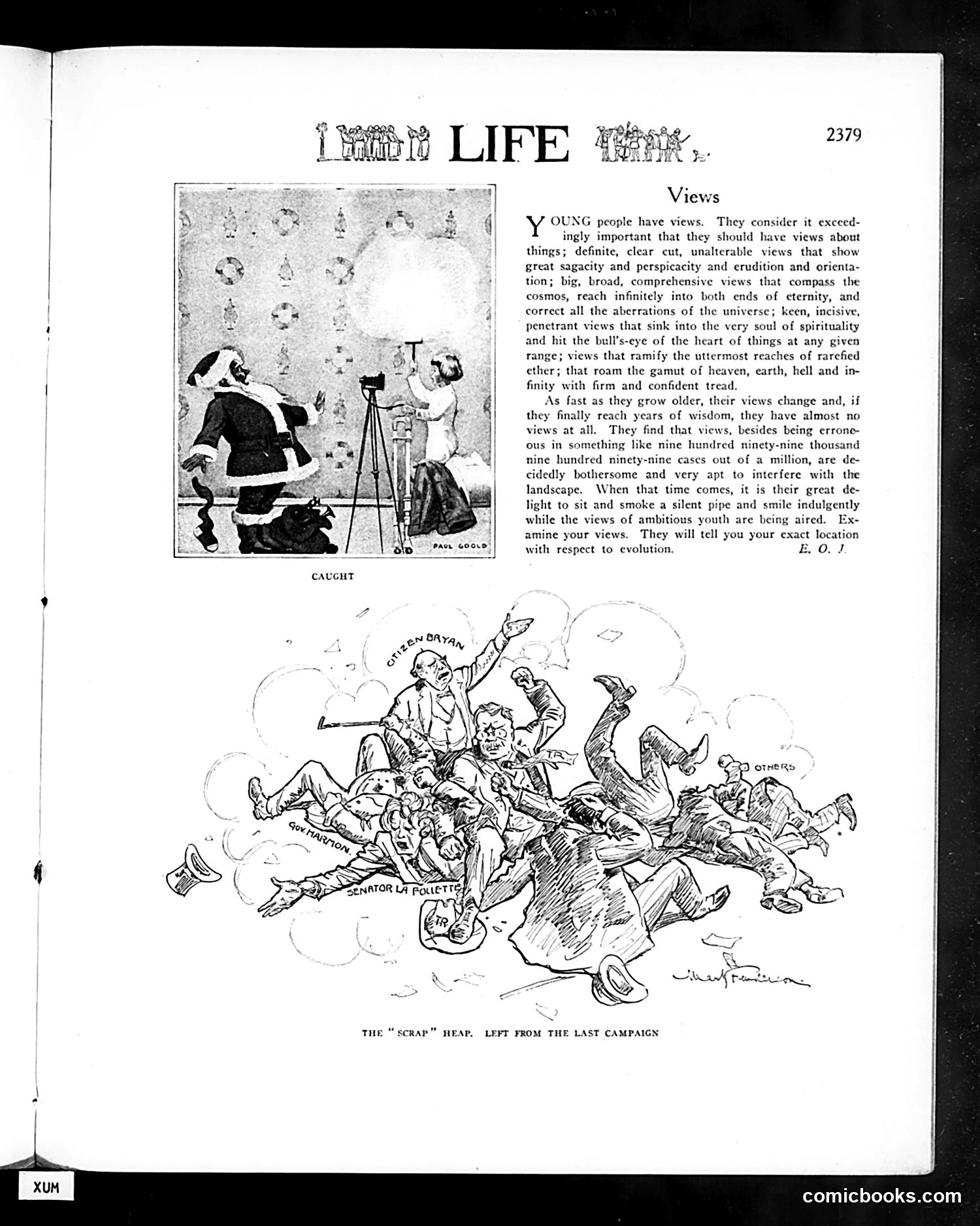
This page satirizes young people's tendency to hold strong, inflexible opinions on everything. The essay (likely by E.O.J., the credited author) humorously observes that youth consider themselves wise with "definite, clear cut" views on cosmic matters, while older, wiser people eventually realize most opinions are wrong and prefer silent contemplation. The top cartoon titled "CAUGHT" shows someone photographing or documenting a figure—likely satirizing young idealists being observed or exposed. The bottom cartoon, "The 'Scrap Heap' Left from the Last Campaign," depicts a chaotic pile of political figures and debris labeled with references to recent political conflict (appears to reference "Green Dayton," "Senator La Follette," and "others"). This mocks the wreckage of a failed political campaign, suggesting ambitious politicians and their causes end up discarded after electoral defeat—a visual parallel to the essay's theme that youthful certainties prove misguided.
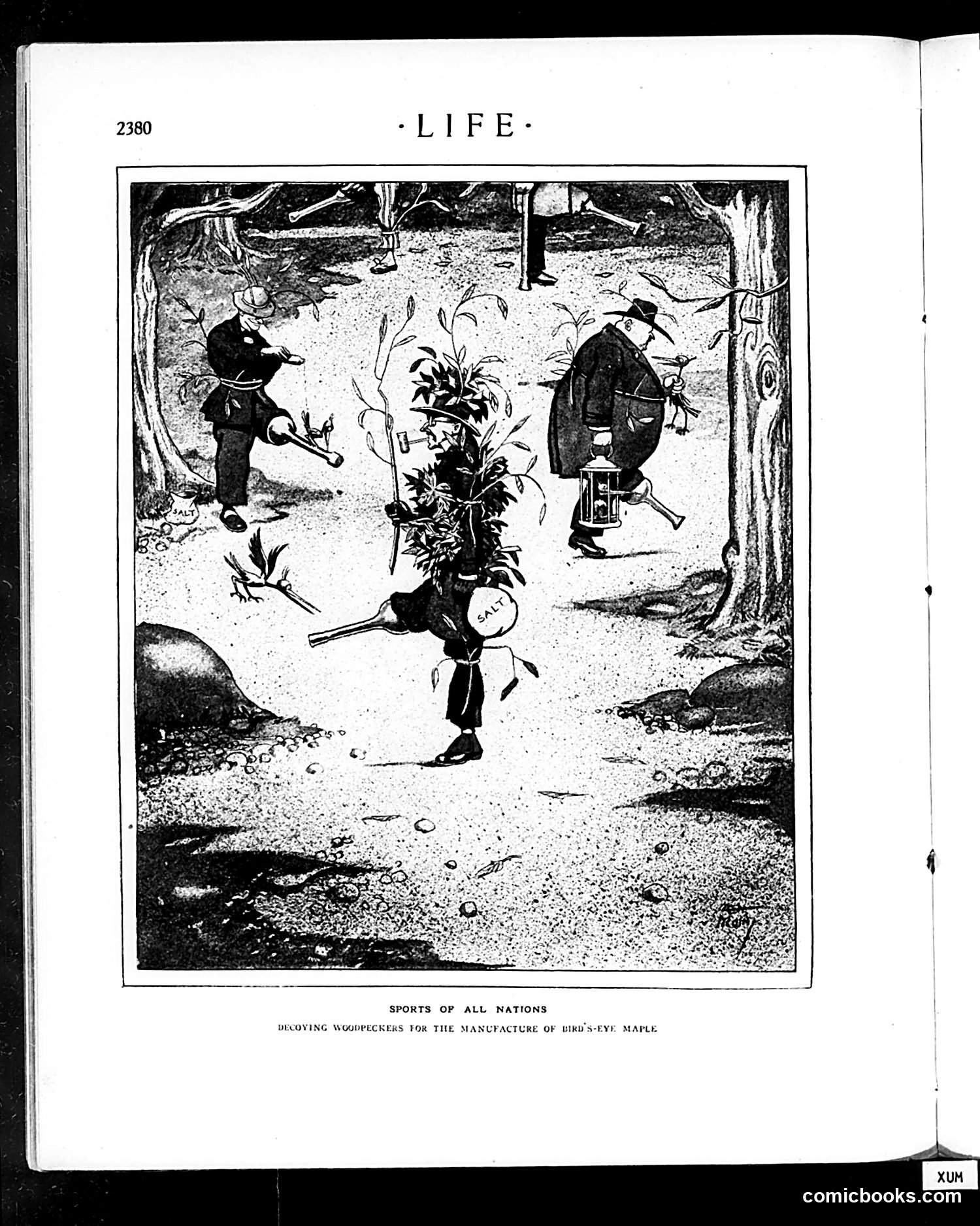
This is a satirical cartoon about woodpecker hunting, presented as a humorous "sport of all nations." The image shows three men in a forest attempting to lure woodpeckers using what appears to be a potted plant as bait. The joke plays on the term "bird's-eye maple"—a type of wood with distinctive spotted patterns that resemble bird eyes. The satire mocks both the absurdity of the hunting method and likely pokes fun at commercial exploitation of nature. The men's formal attire and serious demeanor while engaged in this ridiculous activity adds to the humor. This reflects early 20th-century Life magazine's characteristic style of lampooning human folly through whimsical scenarios, blending nature observation with social commentary about commercialism and resource extraction.
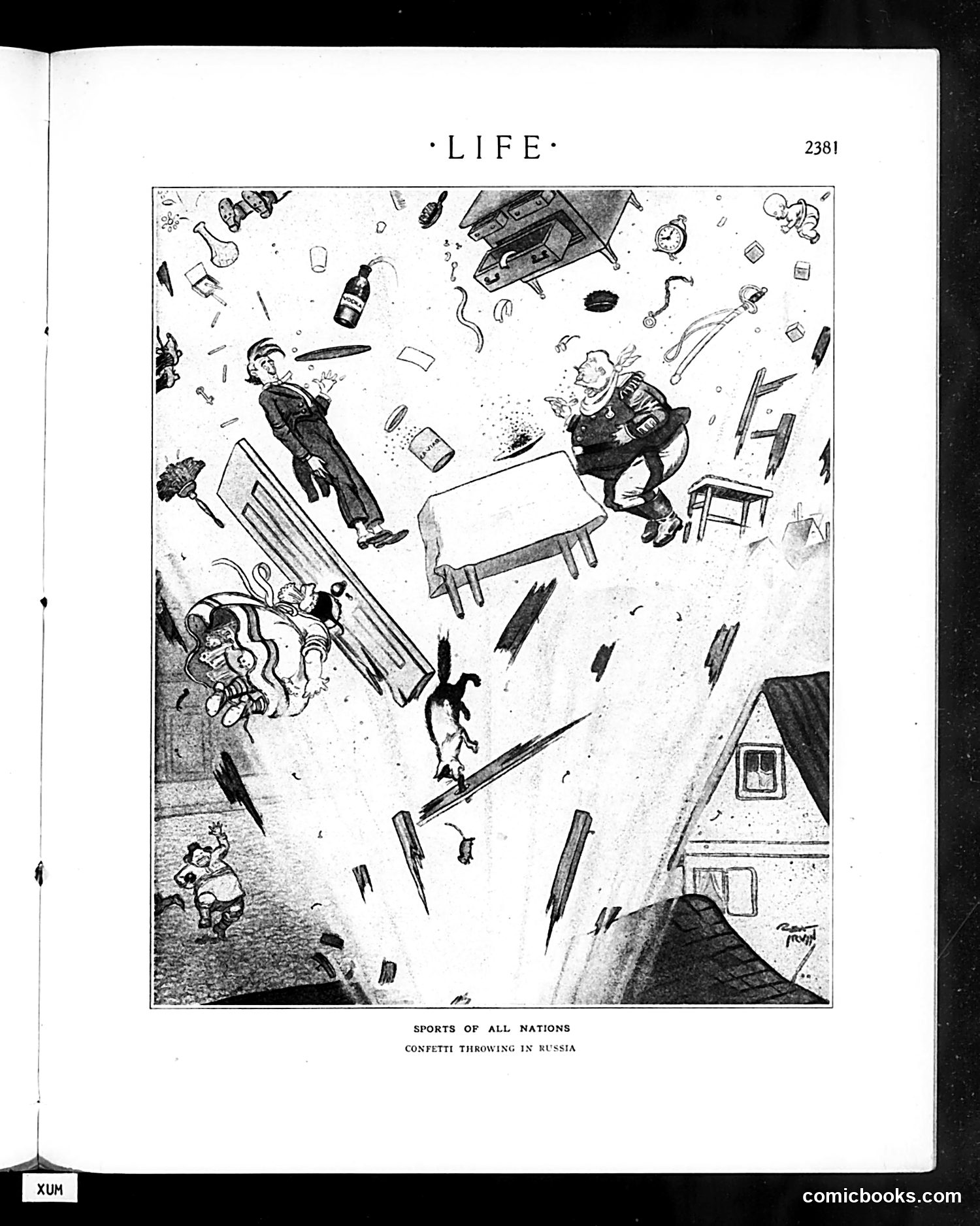
This satirical cartoon depicts chaos presented as a Russian "sport." Two men in formal attire are shown lying on the ground amid flying objects—furniture, bottles, household items, and what appear to be weapons or destructive implements scattered chaotically around them. The humor relies on Cold War-era stereotypes portraying Soviet Russia as violent and anarchic. By labeling this destruction "confetti throwing" and "sports of all nations," the cartoonist mocks Russia through ironic contrast: confetti-throwing is a harmless, festive activity, while the image shows actual mayhem. This reflects American political satire from the mid-20th century, when anti-Soviet sentiment was common in publications like Life magazine.
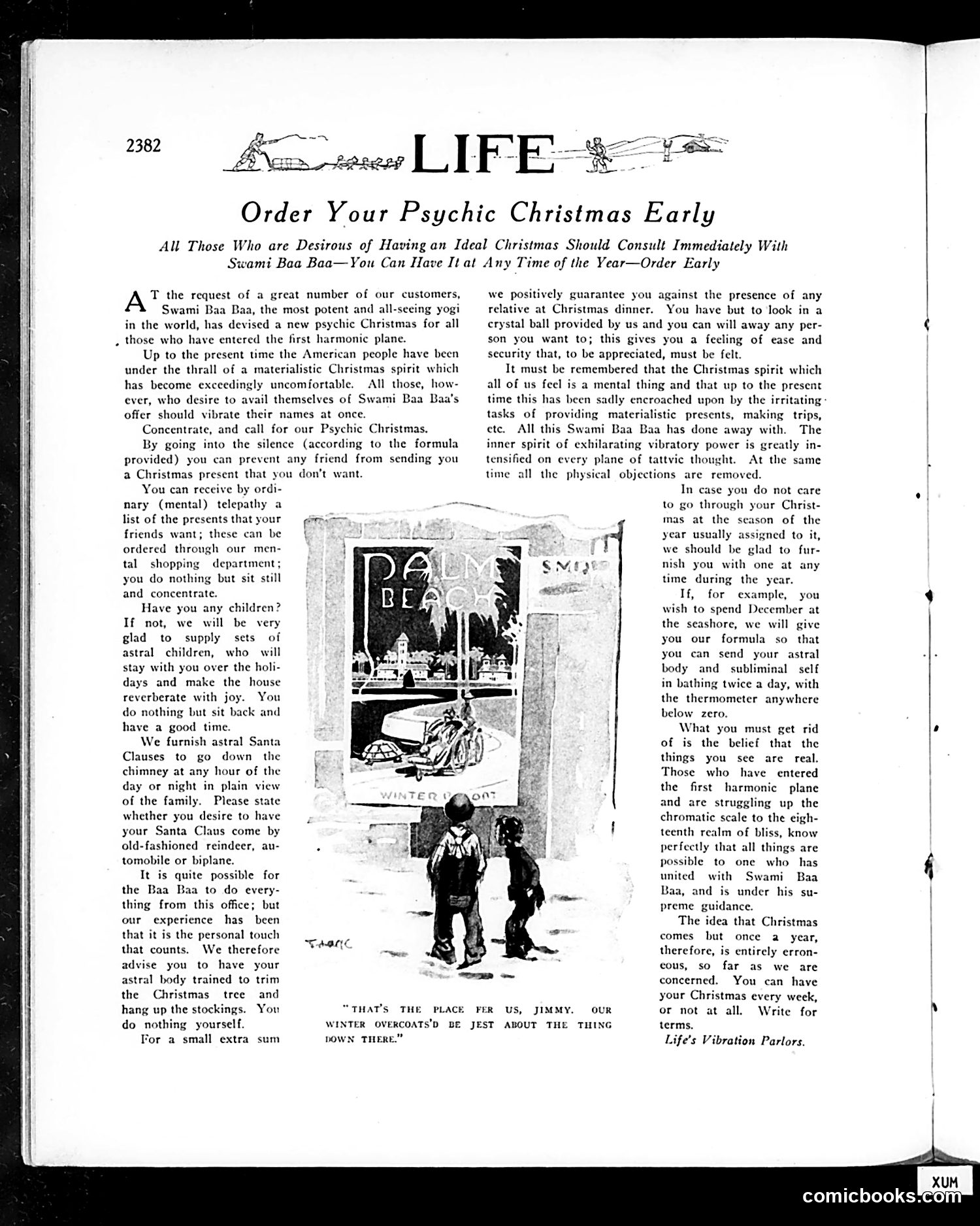
This Life magazine satire mocks early 20th-century American fascination with spiritualism, New Thought mysticism, and mail-order occultism. The fake advertisement for "Swami Baa Baa's Psychic Christmas" parodies these movements by offering absurd "solutions" to Christmas's material hassles: telepathic gift-ordering, astral children and Santa Clauses, mentally willing away unwanted relatives, and celebrating Christmas any week via one's "astral body." The cartoon below—showing children admiring store window displays—ironically illustrates the material consumerism the ad claims to transcend. The satire targets both gullible spiritualism believers and the commercialization that made Christmas increasingly burdensome. Life's joke: spiritual seekers ironically embrace the same escapism they claim to reject through mystical means rather than honest confrontation with Christmas's real tensions.
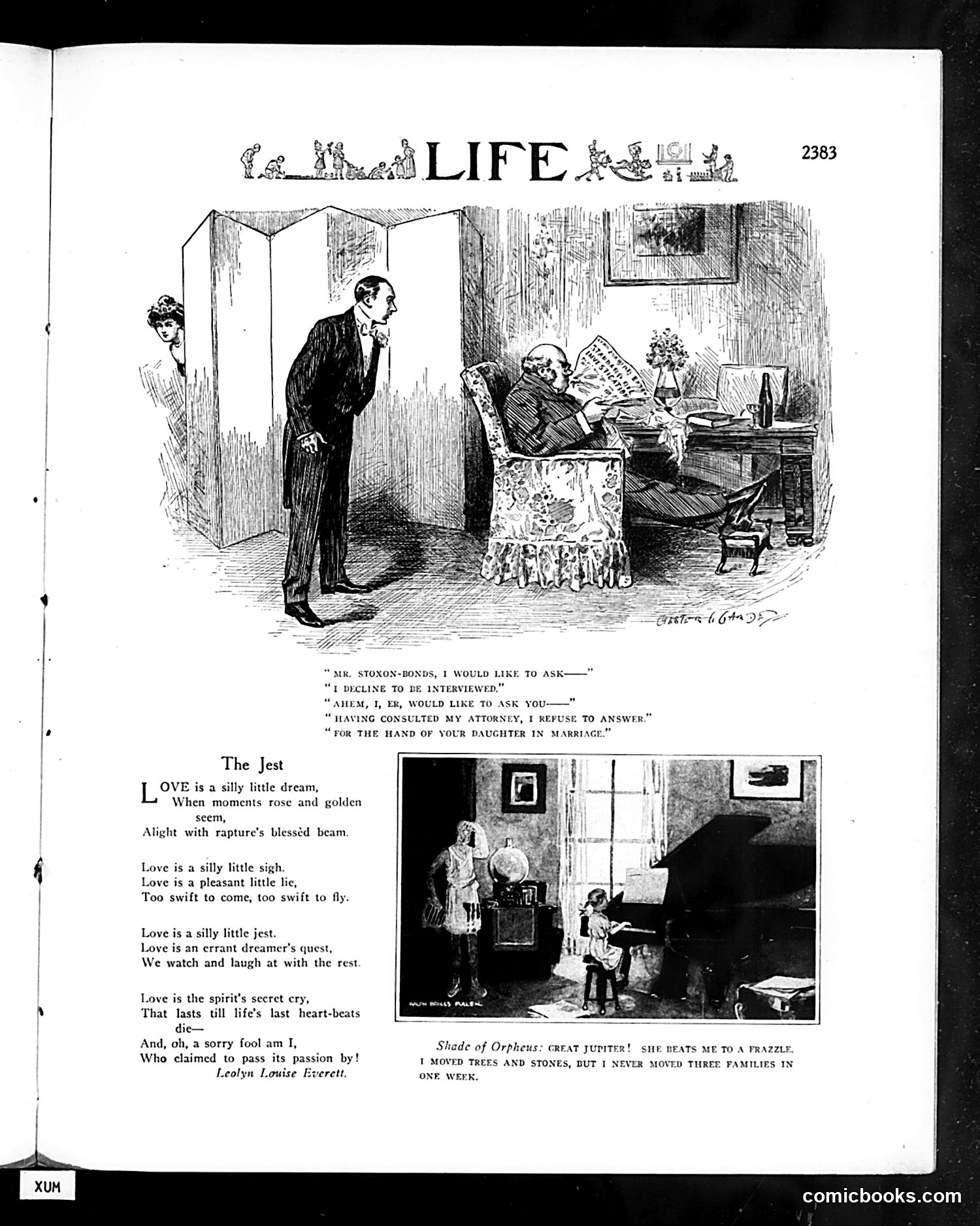
**Top cartoon:** A man (likely representing a wealthy businessman or public figure named "Stoxon-Bonds") attempts to propose marriage to a woman, but she and her attorney repeatedly refuse to be interviewed or answer questions—turning his proposal into a legal matter requiring attorney consultation. The satire mocks both the formality of upper-class courtship rituals and the litigious nature of business dealings bleeding into personal life. The joke is that romance has become as complicated and evasive as a corporate negotiation. **Bottom section:** "The Jest," a poem about love as fleeting and illusory, paired with a photograph captioned "Shade of Orpheus" showing a woman moving furniture. The caption humorously contrasts the mythological Orpheus (who could move trees and stones with music) with modern domestic reality—a woman who accomplishes the harder feat of moving three families in one week. It's gentle satire on the gap between romantic ideals and mundane, practical life.
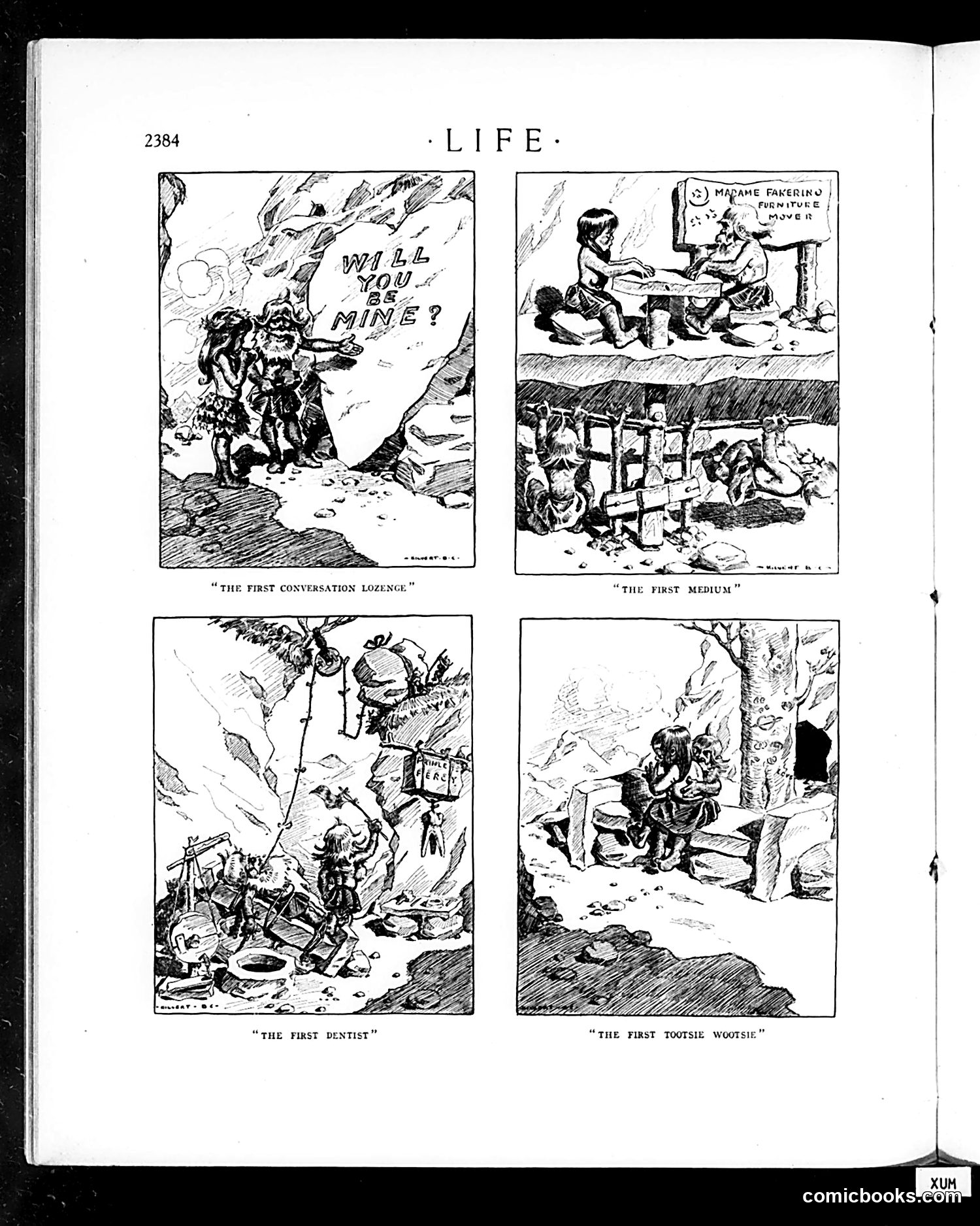
This page presents four satirical cartoon panels depicting "firsts" in human history, shown as primitive scenes with cavemen/early humans. The captions are: 1. "The First Conversation Lozenge" - shows figures near a cave with dialogue "Will you be mine?" 2. "The First Medium" - depicts furniture salesmanship to primitives 3. "The First Dentist" - illustrates primitive dentistry with crude tools 4. "The First Tootsie Wootsie" - shows romantic interaction between primitives The satire mocks modern consumer products and behaviors by attributing their "invention" to caveman era, suggesting human nature's timeless attraction to commerce, romance, and vanity. It humorously implies that marketing, courtship rituals, and beauty/hygiene concerns are primordial human impulses rather than modern developments. The tone is lighthearted social commentary on contemporary consumer culture.
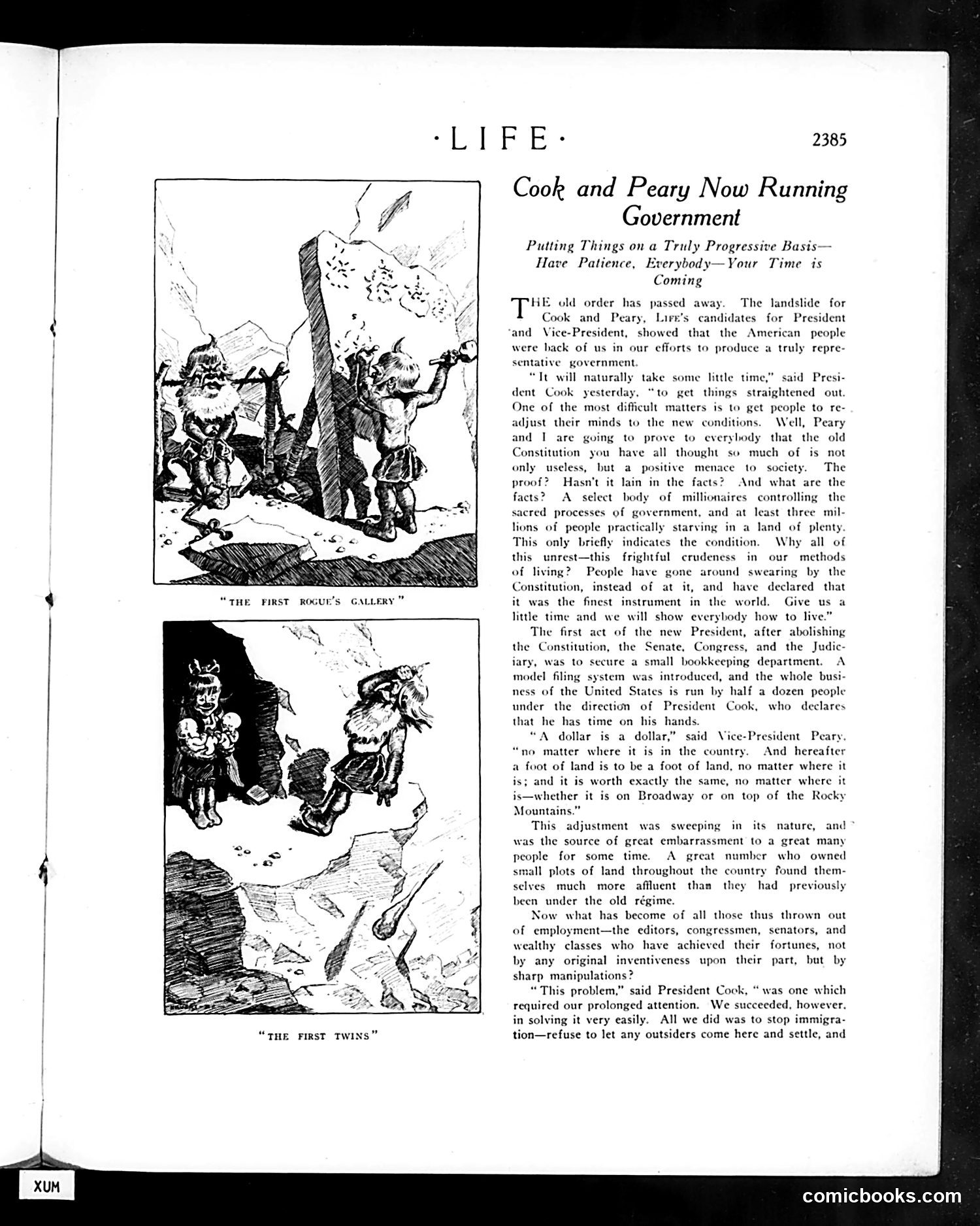
This 1912 *Life* magazine article satirizes progressive reform movements by imagining Arctic explorers Frederick Cook and Peary as presidential candidates who abolish the Constitution, Congress, and Senate to implement radical efficiency reforms. The satire mocks progressive intellectuals' faith that rational management could solve social problems. Cook and Peary—real explorers famous for competing over North Pole discovery—represent technocratic elites convinced the old Constitution is "useless" and that proper "filing systems" and standardized metrics ("a dollar is a dollar") will cure inequality and unemployment. The cartoon's "rogues' gallery" and "twins" captions suggest these reformers are criminals or fools. The text ridicules their solution to joblessness: simply stop immigration rather than address systemic issues. The joke: well-intentioned reformers proposing authoritarian solutions while claiming progress—replacing democratic institutions with bureaucratic rule by a small elite, imagining this represents "truly progressive" government.
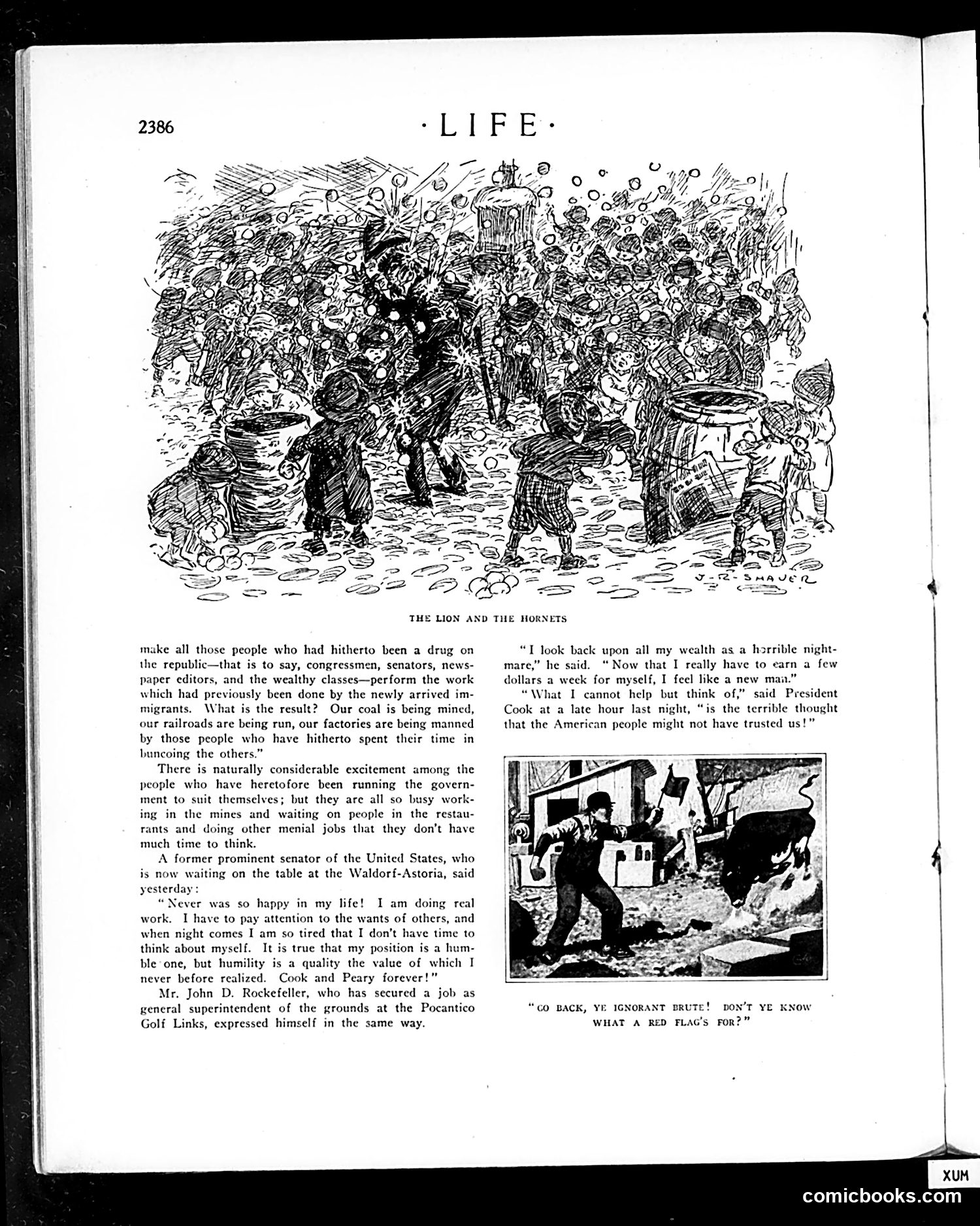
This page satirizes a hypothetical role reversal where wealthy elites and politicians are forced into manual labor, while immigrants (previously dismissed as expendable) run the nation's industries. The text features quotes from prominent figures—a former senator, John D. Rockefeller, and "President Cook"—who discover unexpected satisfaction in humble work and realize the dignity of labor they previously scorned. The cartoon at bottom depicts a confrontation between a well-dressed man (representing the establishment) and a worker with a red flag (suggesting socialist or labor movement ideology). The caption mocks the elite's ignorance: they don't even understand what a red flag symbolizes. The satire targets both wealthy complacency and anti-immigrant prejudice, suggesting that if the powerful experienced workers' lives firsthand, they'd gain humility and understanding—while simultaneously mocking their potential blindness to labor's political consciousness.
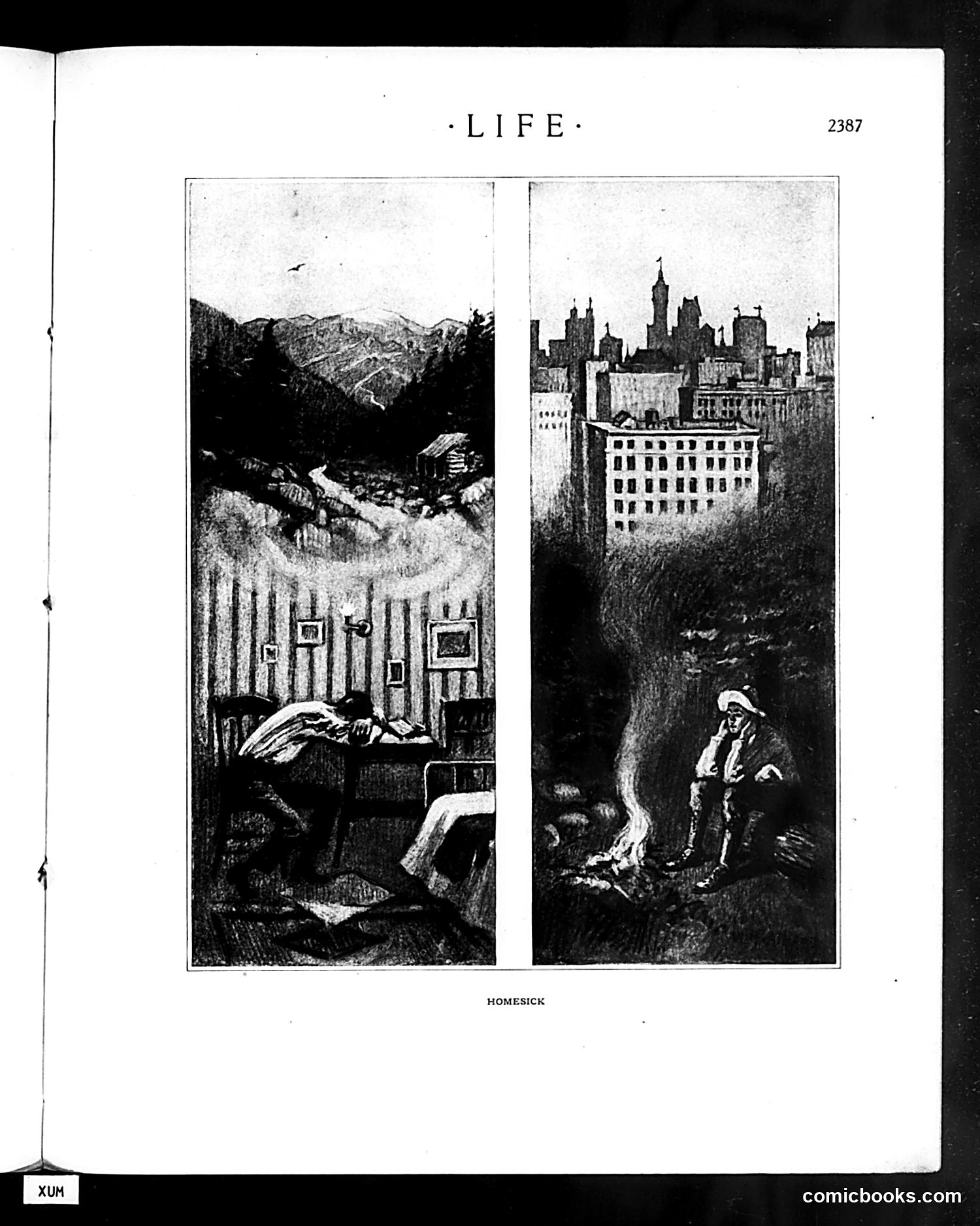
This two-panel cartoon contrasts urban and rural homesickness. The left panel depicts someone in a sparse, bare room with mountain scenery visible through the window—a person clearly missing their natural, mountainous home. The right panel shows the inverse: a figure sitting alone beneath towering city buildings and skyscrapers, suggesting someone from the city missing their urban life. The cartoon satirizes how "homesickness" is relative to one's origins. Whether rural or urban, both figures experience the same longing for their native environment. The composition emphasizes this symmetry—each person is displaced from their natural habitat and yearning for it. This reflects early 20th-century American tensions between rural and urban life, suggesting both lifestyles have equal validity and that displacement affects people regardless of their background.
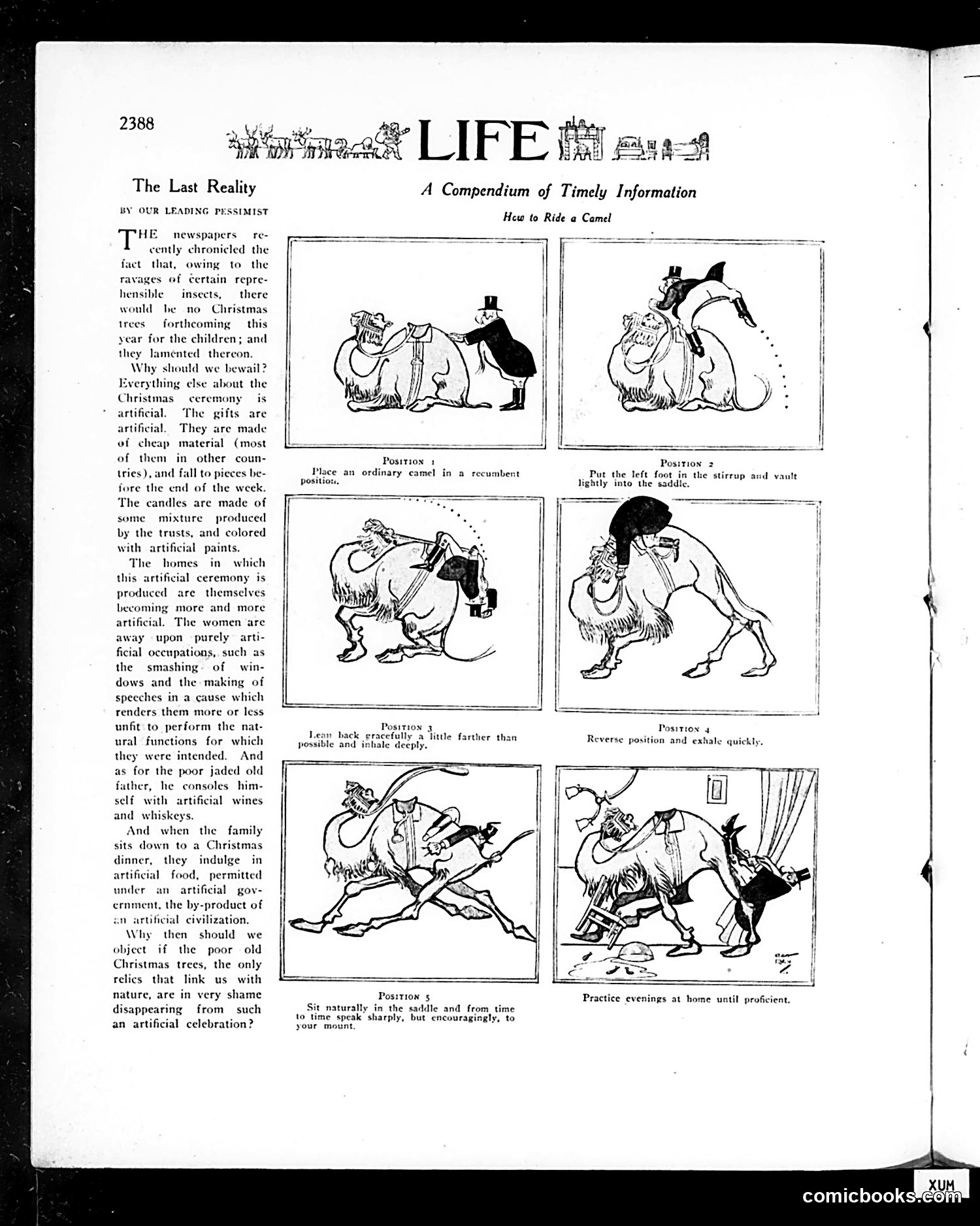
**Main Content:** This page combines two unrelated pieces: a pessimistic editorial essay and instructional camel-riding cartoons. **The Essay ("The Last Reality"):** A satirical complaint that Christmas has become entirely artificial—artificial gifts, candles, decorations, even the homes and food. The author (a "leading pessimist") ironically argues we shouldn't mourn the loss of Christmas trees due to insect damage, since trees are the only *natural* element remaining in an otherwise commercialized, artificial celebration. He mocks modern life as overly mechanized and commercialized. **The Cartoons:** A humorous six-panel instructional guide showing a man learning to mount and ride a camel, progressing from initial positioning to eventually sitting naturally and commanding the animal. This appears purely comedic—practical instruction presented in an absurd context. **Context:** The essay likely references early 20th-century anxieties about industrialization, commercialism, and the erosion of tradition. The reference to women "smashing windows" alludes to the suffragette movement.
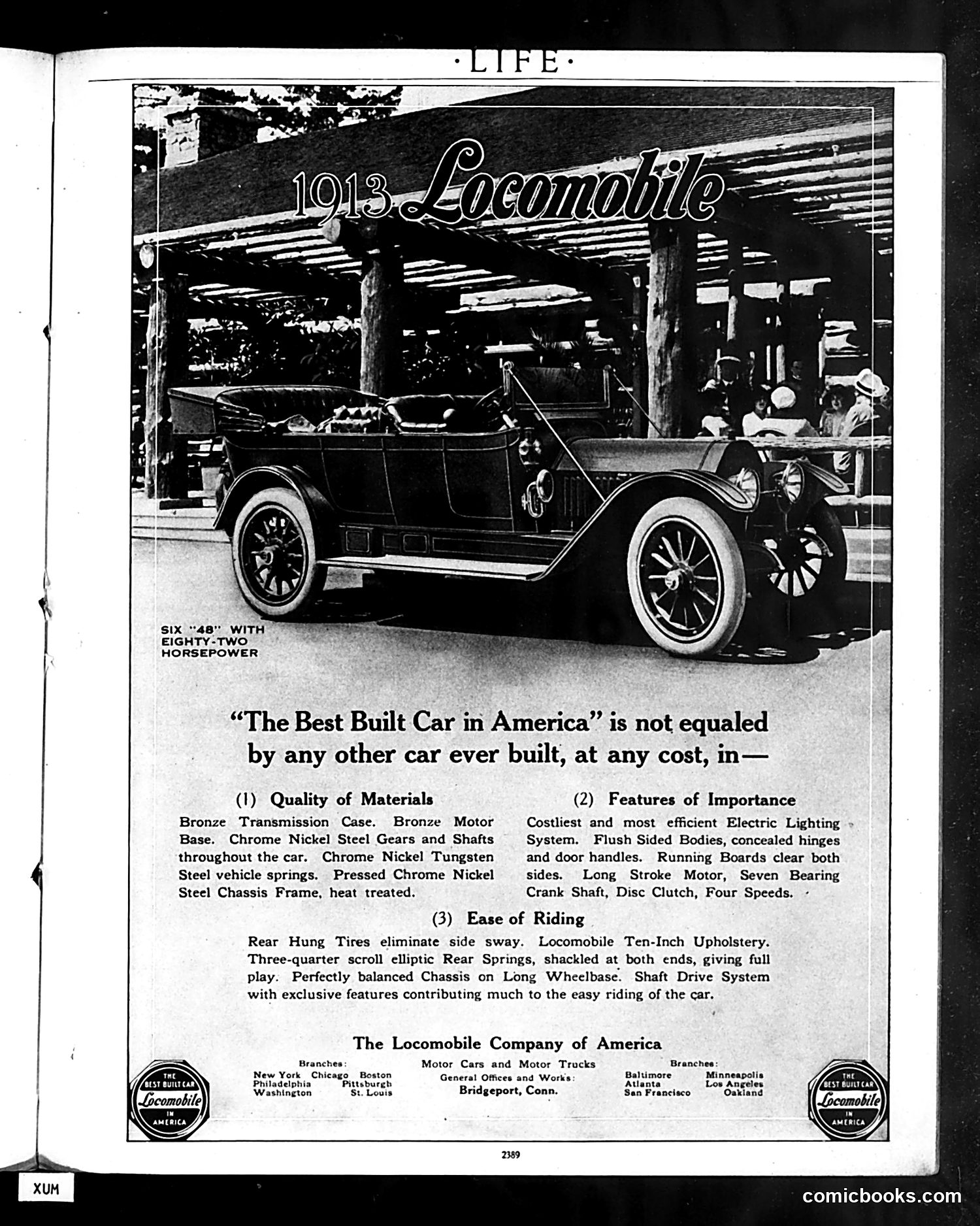
This is **not a cartoon or satire**—it's a straightforward automobile advertisement from Life magazine's pages. The page promotes the 1913 Locomotile, claiming it's "The Best Built Car in America." It features a photograph of an open-air touring car and lists three categories of superiority: quality materials (bronze transmission case, chrome nickel steel), important features (electric lighting, running boards), and ease of riding (rear-hung tires, elliptic springs). The Locomotile Company of America lists manufacturing branches across major U.S. cities with headquarters in Bridgeport, Connecticut. This represents early automotive advertising emphasizing technical specifications and luxury features to appeal to wealthy buyers—the primary market for automobiles in 1913. No satire or political commentary is present; this is period advertising copy highlighting engineering innovations that were genuinely notable for the era.
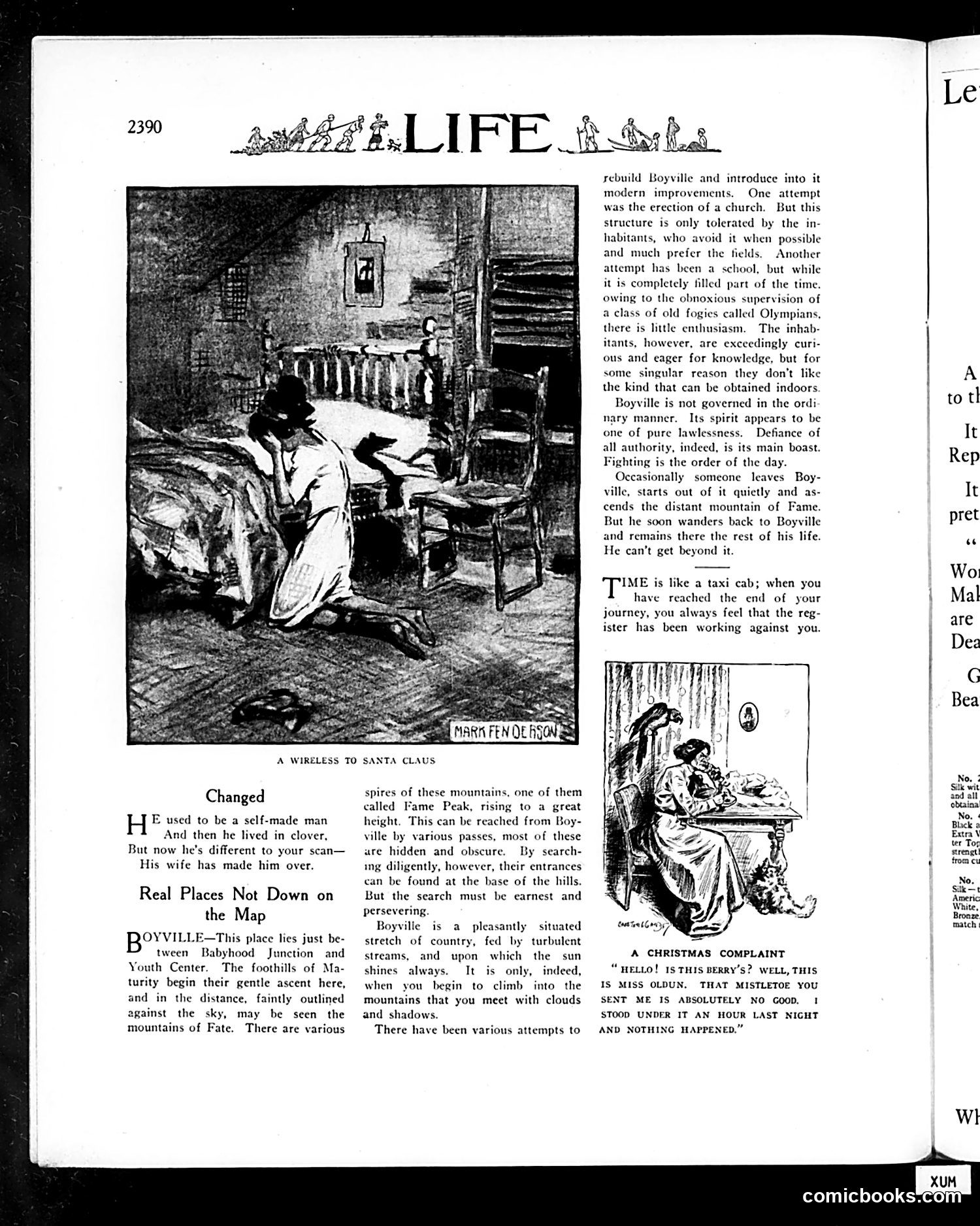
This page contains allegorical and humorous content rather than political cartoons. **"A Wireless to Santa Claus"** (top illustration): Shows a woman kneeling in prayer or supplication, seemingly sending a wireless message to Santa Claus—likely a whimsical commentary on modern technology (wireless transmission) meeting traditional Christmas wishes. **"Changed"** (verse): A brief poem mocking how marriage transforms a man from self-made and independent into something reshaped by his wife—a common domestic satire theme of the era. **"Real Places Not Down on the Map"**: An extended allegory describing "Boyville"—a fictional place representing childhood/adolescence situated between "Babyhood Junction" and "Youth Center," with mountains of Fate ahead. It satirizes boys' resistance to adult institutions (church, school) while celebrating their natural curiosity and lawlessness. The piece gently mocks both youth rebellion and adult attempts at civilizing influence. **"A Christmas Complaint"** (bottom cartoon): A humorous complaint from an elderly woman ("Miss Oldun") about ineffective mistletoe—implying romantic disappointment, playing on age and changing attractiveness.
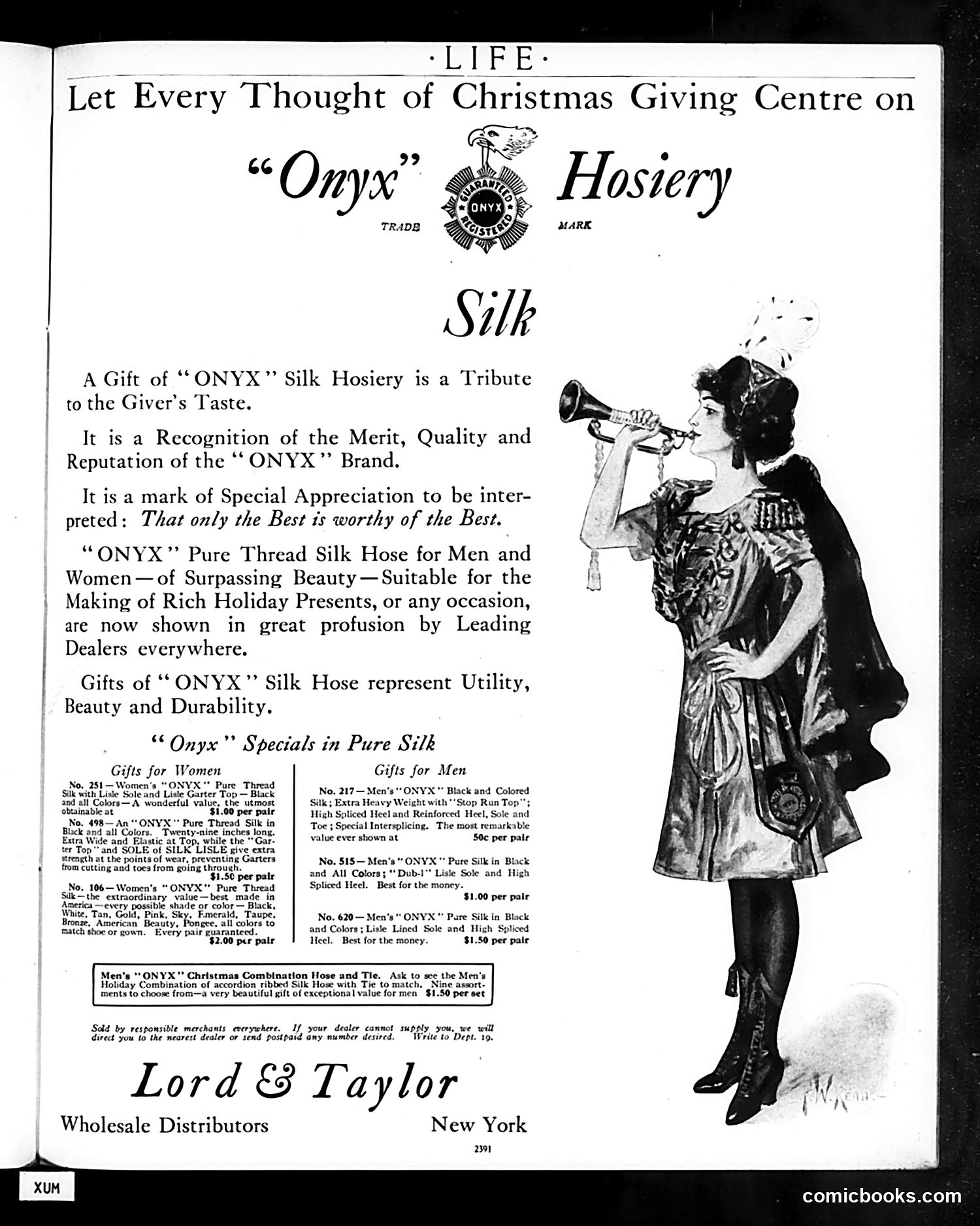
This page is **primarily an advertisement**, not political satire. It promotes "Onyx" brand silk hosiery as Christmas gifts, distributed by Lord & Taylor wholesale in New York. The illustration depicts a fashionable woman in an elegant dress and coat, blowing a trumpet—a visual metaphor for "announcing" or promoting the product. The imagery conveys luxury and refined taste. The text emphasizes that Onyx hosiery represents quality and appreciation: "only the Best is worthy of the Best." It lists various silk hose options for both men and women at different price points ($0.50–$2.00 per pair), marketed as suitable holiday gifts. The only satirical element, if present, is subtle: the exaggerated claim that hosiery can be a meaningful tribute to one's taste. This reflects period advertising conventions treating luxury goods as status symbols—a common consumer culture message of the era.
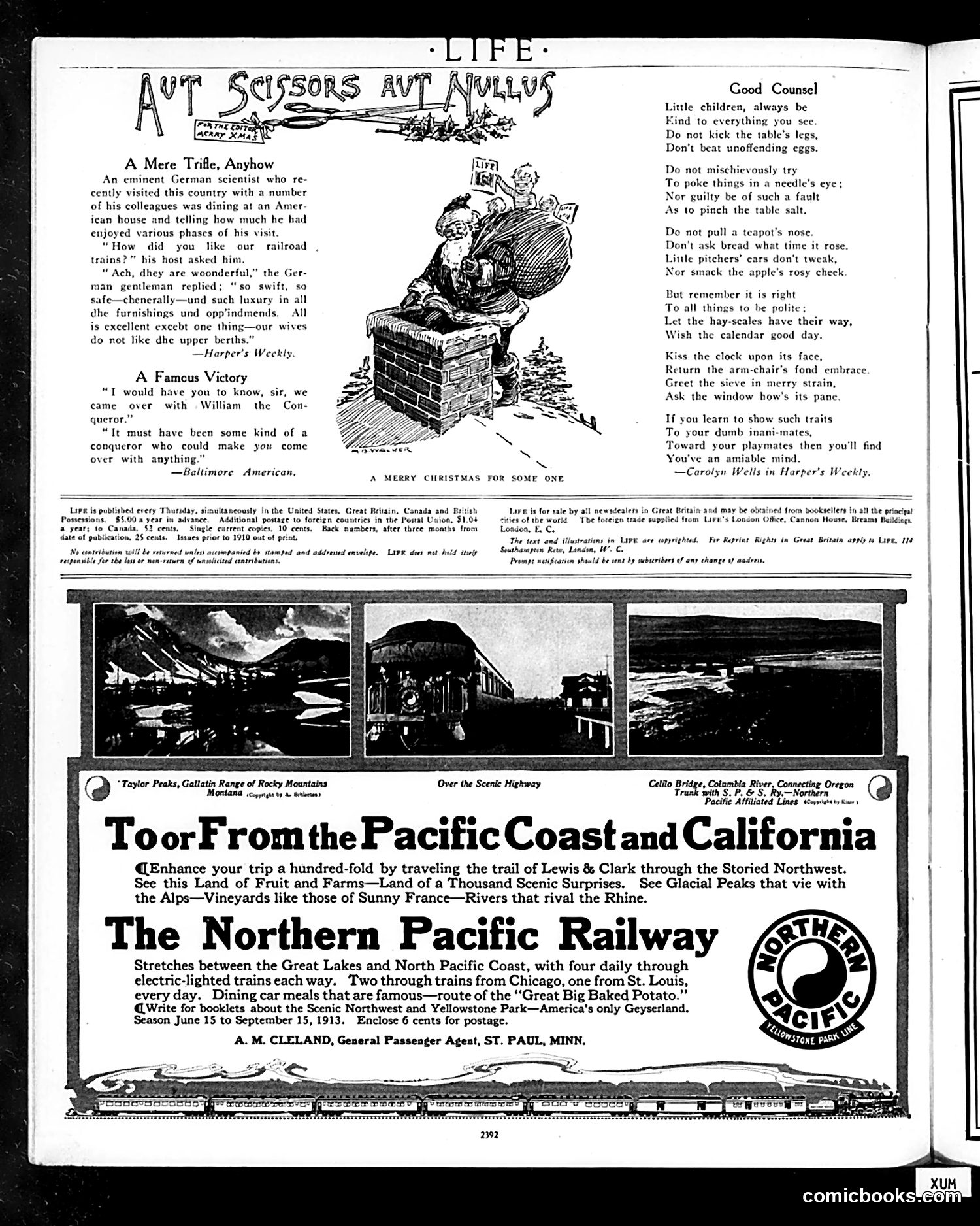
This page contains three distinct sections: **Top Left - "A Mere Trifle, Anyhow"**: A joke about a visiting German scientist praising American trains as "wonderful" and luxurious, but complaining that wives dislike the upper berths. The humor lies in the absurdity of this single minor complaint undermining otherwise effusive praise. **Top Right - "Good Counsel"**: A humorous poem by Carolyn Wells anthropomorphizing household objects (teapots, clocks, windows, hay-scales), advising children to treat them politely. The joke is the ridiculous extension of politeness to inanimate things. **Bottom - "A Famous Victory"**: A brief joke mocking someone's boastful claim of descending from William the Conqueror, with the punchline that only a weak conqueror could compel *that person* to do anything. **Bottom Half**: A Northern Pacific Railway advertisement promoting scenic tours through the Pacific Northwest, featuring photographs and descriptive text about landscapes and train service. The page is primarily humorous short-form content typical of *Life* magazine's satirical style, with commercial advertising below.
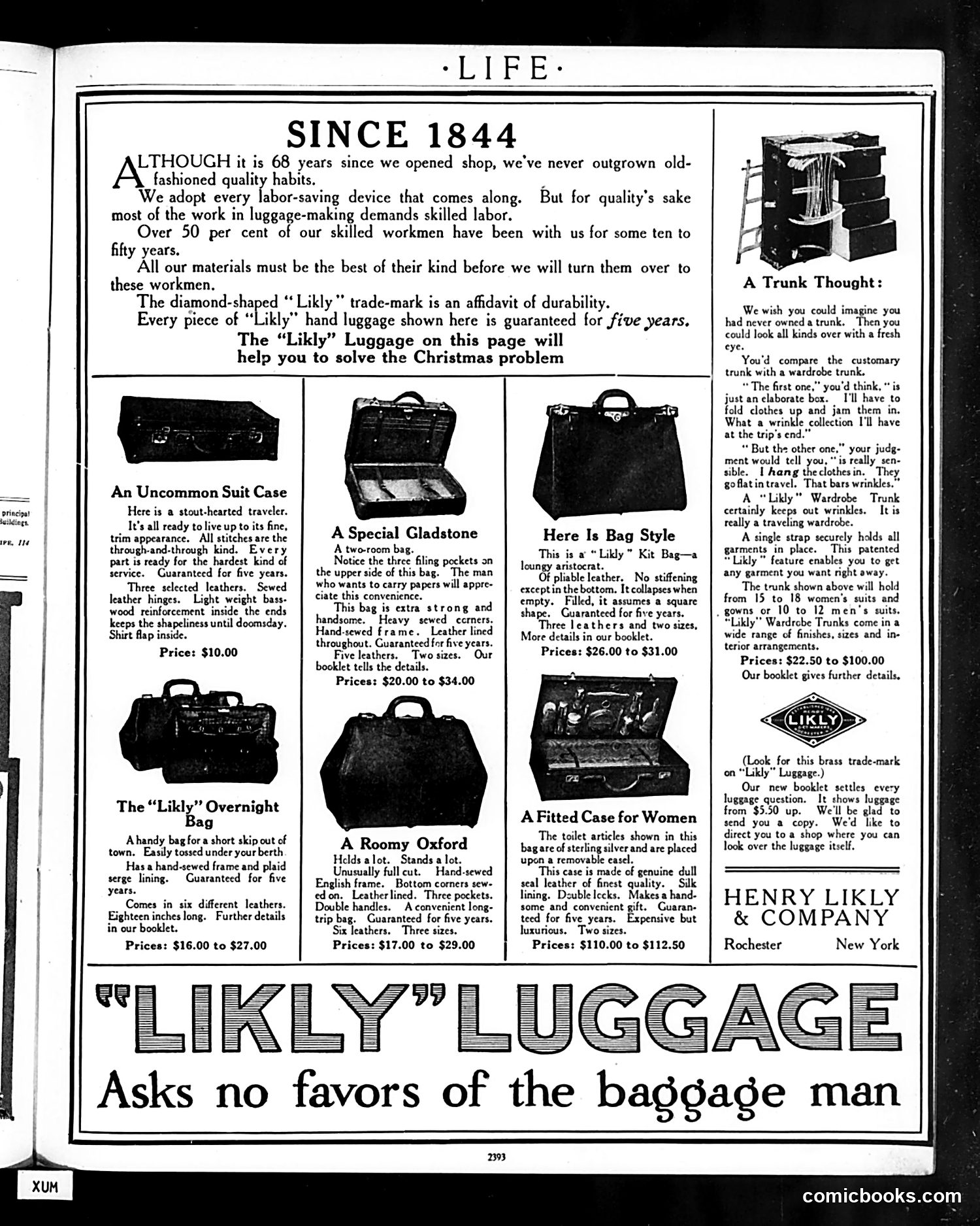
This is **a full-page advertisement**, not a cartoon or satirical piece. It promotes "Likly" brand luggage and trunks, published in Life magazine. The ad emphasizes the company's 68-year heritage (since 1844) and craftsmanship credentials: over 50% of workers have served 10-50 years; materials are carefully selected; products carry a five-year guarantee. Various luggage styles are displayed with prices ranging from $10 to $112.50. The "Trunk Thought" sidebar uses a rhetorical device—imagining someone encountering trunks fresh—to argue that their wardrobe trunk's hanging system prevents wrinkles better than traditional boxes. The tagline "Likly Luggage Asks no favors of the baggage man" suggests the product's durability means it won't be damaged during travel handling. This reflects early 20th-century advertising strategy: linking longevity, skilled labor, and quality materials to justify premium pricing during the Christmas shopping season.
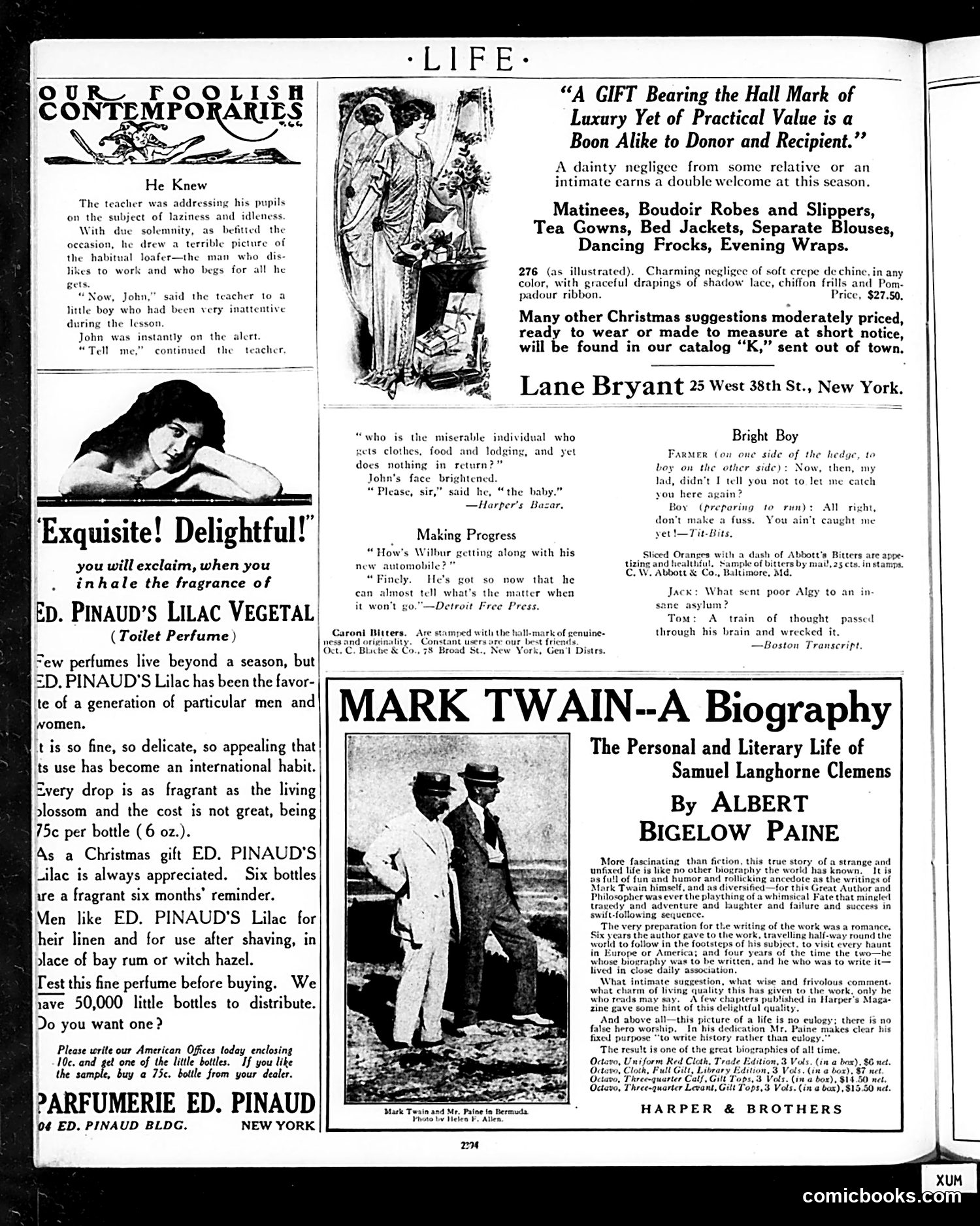
This page mixes advertisements with short humorous pieces typical of Life's satirical format. **"He Knew"** is a brief joke about a teacher lecturing pupils on laziness. When asked to define an idle person, an inattentive student (John) immediately responds: "the baby." The humor relies on the child's honest, practical answer—babies indeed don't work yet receive food and care—exposing the gap between the teacher's moral lesson and reality. **"Bright Boy"** and **"Making Progress"** are similarly brief joke items playing on wordplay and unexpected answers. The page is predominantly **advertising**: Lane Bryant promotes women's nightwear and robes ($27.50), Ed. Pinaud's Lilac perfume (75¢ per bottle) targets gentlemen, and there's an ad for Abbott's Bitters. **The major feature** announces Albert Bigelow Paine's biography of Mark Twain (Samuel Clemens), with a photograph of the two men together in Bermuda. The text emphasizes the book's blend of humor and serious literary interest—positioning Twain's life as entertaining yet worthy of serious biographical treatment.
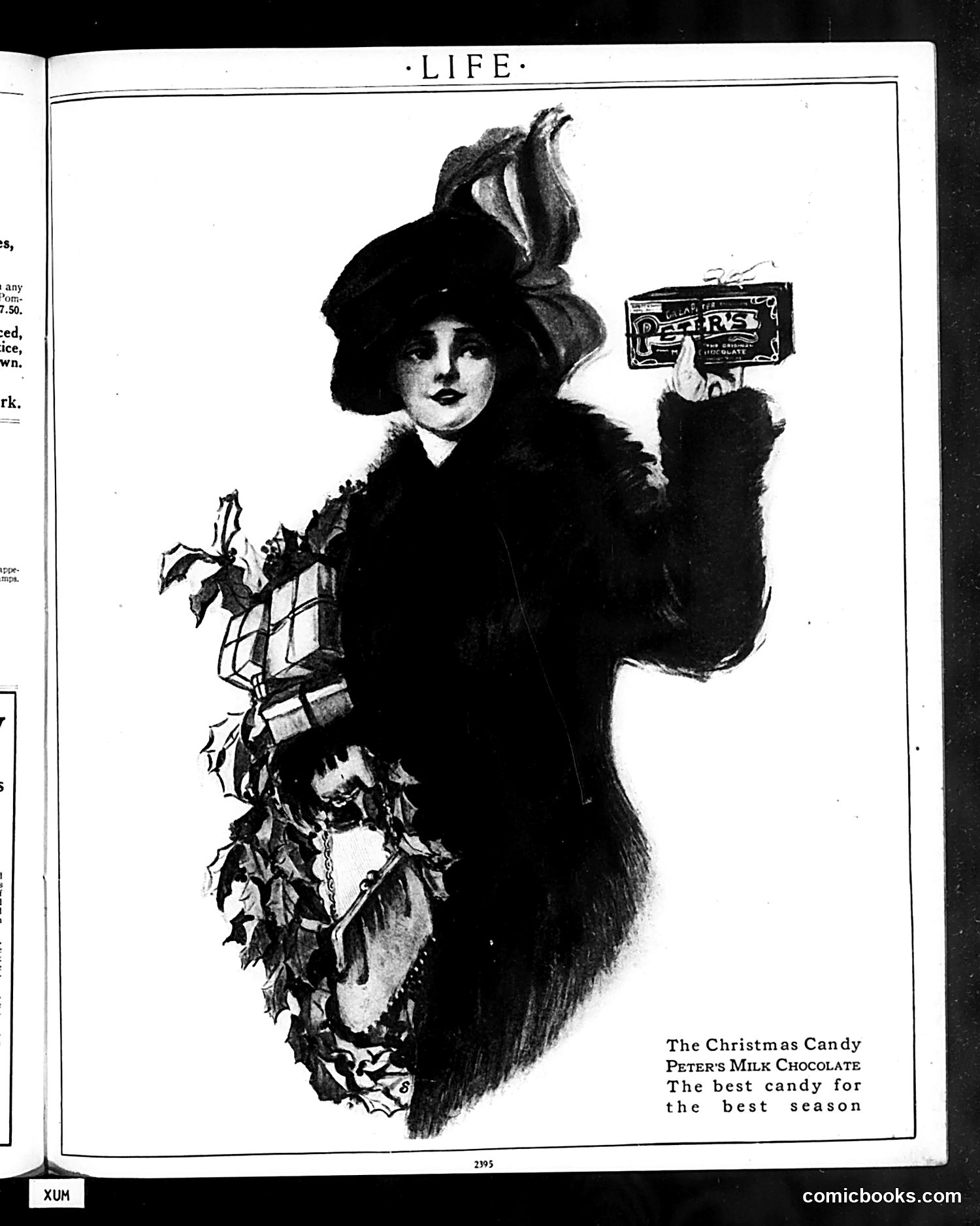
This page is primarily an **advertisement**, not political satire. It features an illustration of a fashionable woman in early 20th-century dress—wearing an elaborate feathered hat, fur-trimmed coat, and holding both wrapped packages and a box of Peter's Milk Chocolate candy. The ad uses a common marketing strategy of the era: associating the product with elegance and sophistication. The well-dressed female figure suggests that Peter's chocolate is a refined gift choice for the Christmas season. The text's claim that it's "the best candy for the best season" is straightforward product promotion rather than commentary or satire. This reflects period advertising that marketed consumer goods through aspirational imagery of fashionable women.
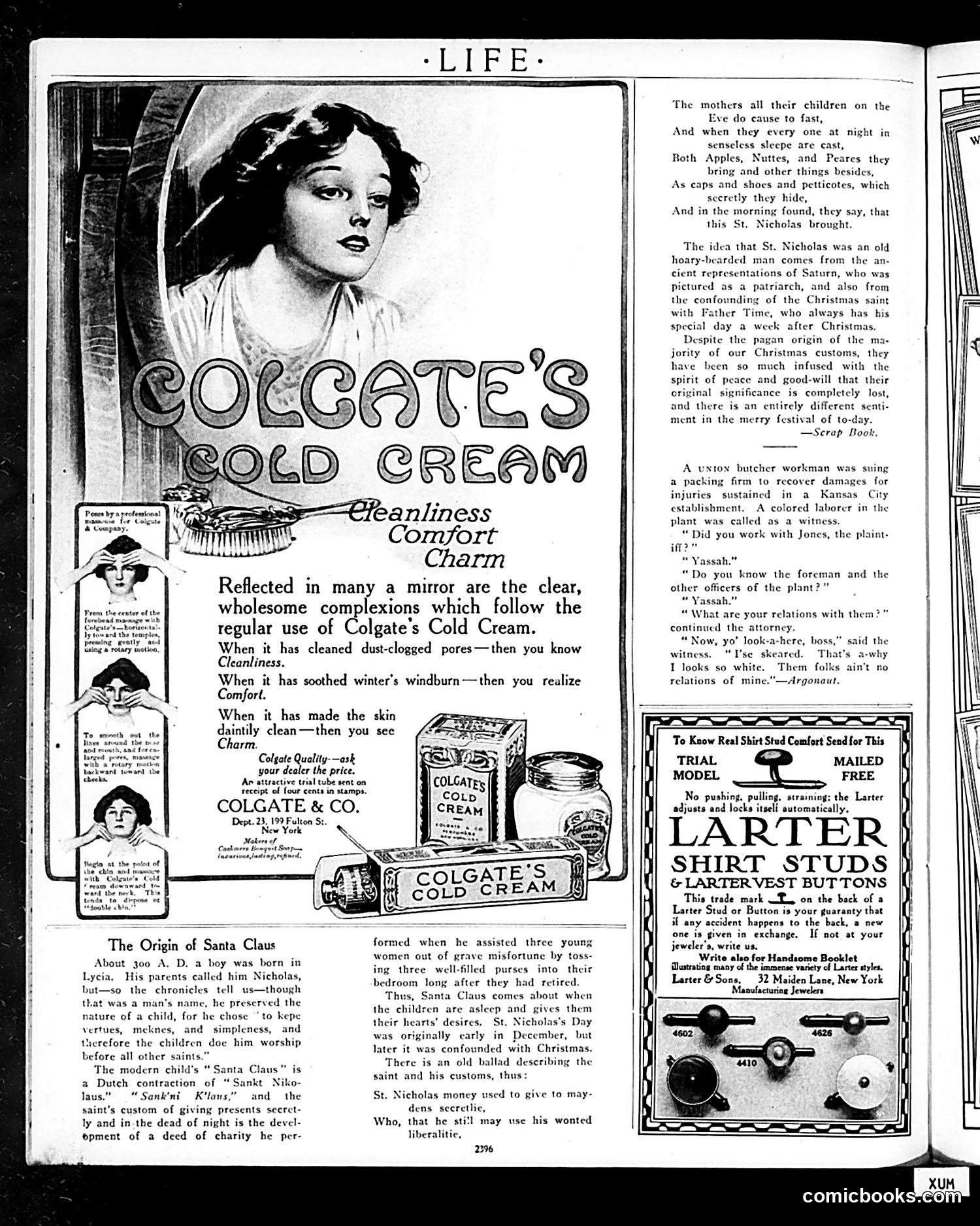
This page contains **primarily advertisements** interspersed with two brief articles. The main advertisement features **Colgate's Cold Cream**, emphasizing cleanliness, comfort, and charm through beauty claims about skin care. The editorial content includes: 1. **"The Origin of Santa Claus"** — a historical explanation tracing Santa to St. Nicholas (circa 300 A.D.), a Turkish saint known for secret gift-giving. The article notes that modern "Santa Claus" derives from Dutch "Sank'ni K'laus" and explains how Christmas customs absorbed earlier pagan traditions (Saturn/Father Time imagery). The point is educational: Christmas practices blend religious and secular origins, though modern celebration emphasizes goodwill rather than original pagan meaning. 2. **A brief anecdote** about a butcher's lawsuit, featuring racial dialect humor typical of early 20th-century publications. A Black worker testifies that white plant officials are "not relations of mine"—the "joke" relies on period stereotypes. The page primarily serves as **advertising vehicle** with light cultural/educational content, typical of Life's format during this era.
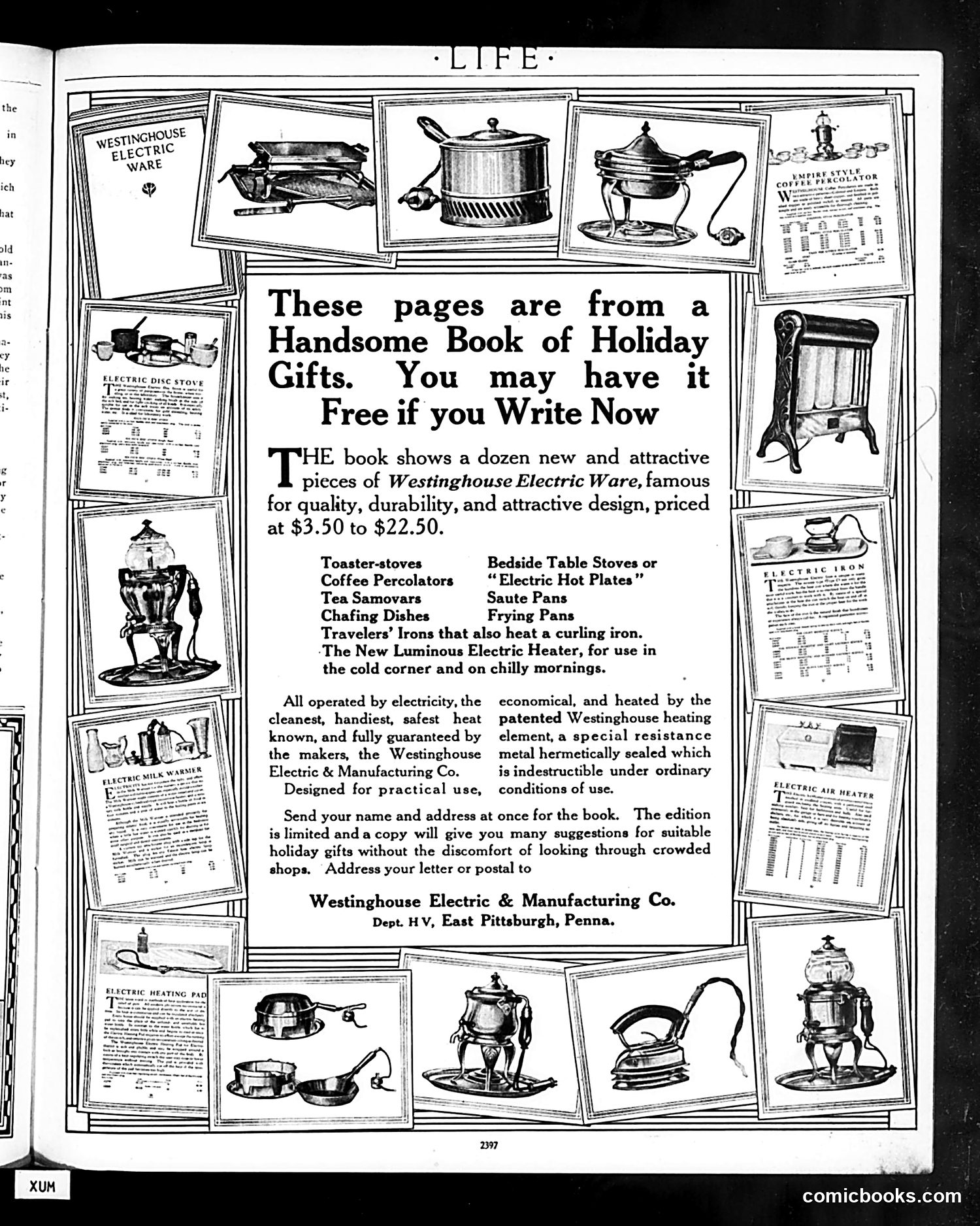
This is not a cartoon or satire—it's a **full-page advertisement** for Westinghouse Electric & Manufacturing Co., disguised as editorial content in *Life* magazine. The ad promotes a free "Handsome Book of Holiday Gifts" featuring electrical appliances (toaster-stoves, coffee percolators, chafing dishes, irons, heaters) priced $3.50–$22.50. Readers are urged to write for the catalog by mail. **Historical context for modern readers:** This reflects the early 20th-century marketing of **electric home appliances as luxury holiday gifts**—a relatively new consumer category. The emphasis on electricity being "the cleanest, handiest, safest heat known" shows manufacturers positioning these devices as modern, superior alternatives to gas or wood-burning equipment. The mail-order catalog approach was standard before mass retail shopping. The ad's placement in a humor magazine suggests advertisers sought *Life*'s affluent, educated readership.
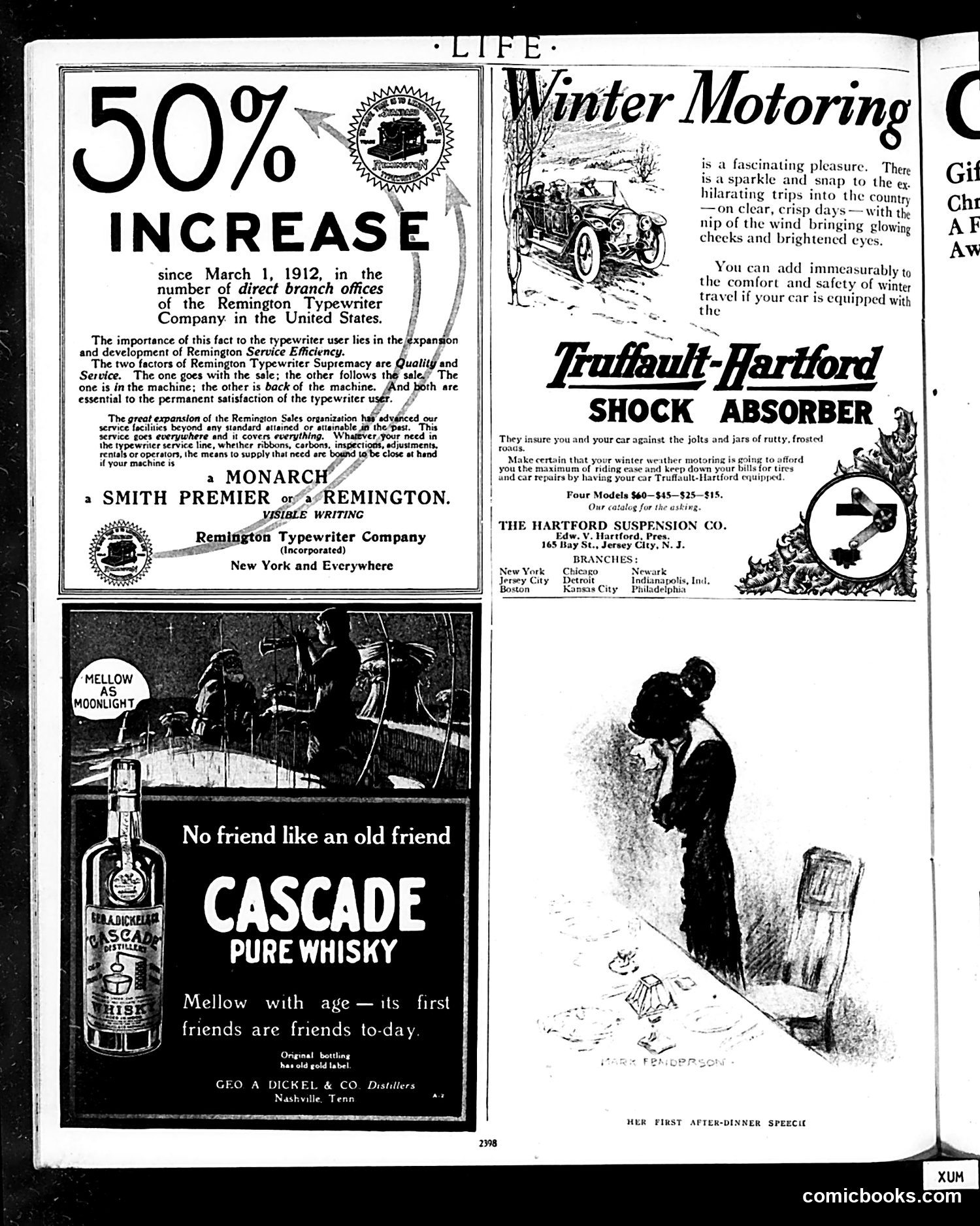
This page consists primarily of **advertisements**, not political satire or editorial cartoons. The main contents are: 1. **Remington Typewriter ad** (top left): Boasts a 50% increase in branch offices since 1912, emphasizing the company's expansion of service infrastructure alongside product quality. 2. **Truffault-Hartford Shock Absorber ad** (top right): Promotes winter car safety features with an illustration of a snowy driving scene. 3. **Cascade Pure Whisky ad** (bottom left): Features the tagline "No friend like an old friend," suggesting whisky's reliability and long-standing appeal. This is a pre-Prohibition advertisement (likely early 1910s based on context). 4. **Illustration** (bottom right): Labeled "Her First After-Dinner Speech," appears to depict a woman giving a public speech—possibly reflecting early 20th-century debates about women's public roles. The page is predominantly commercial in nature rather than satirical commentary.
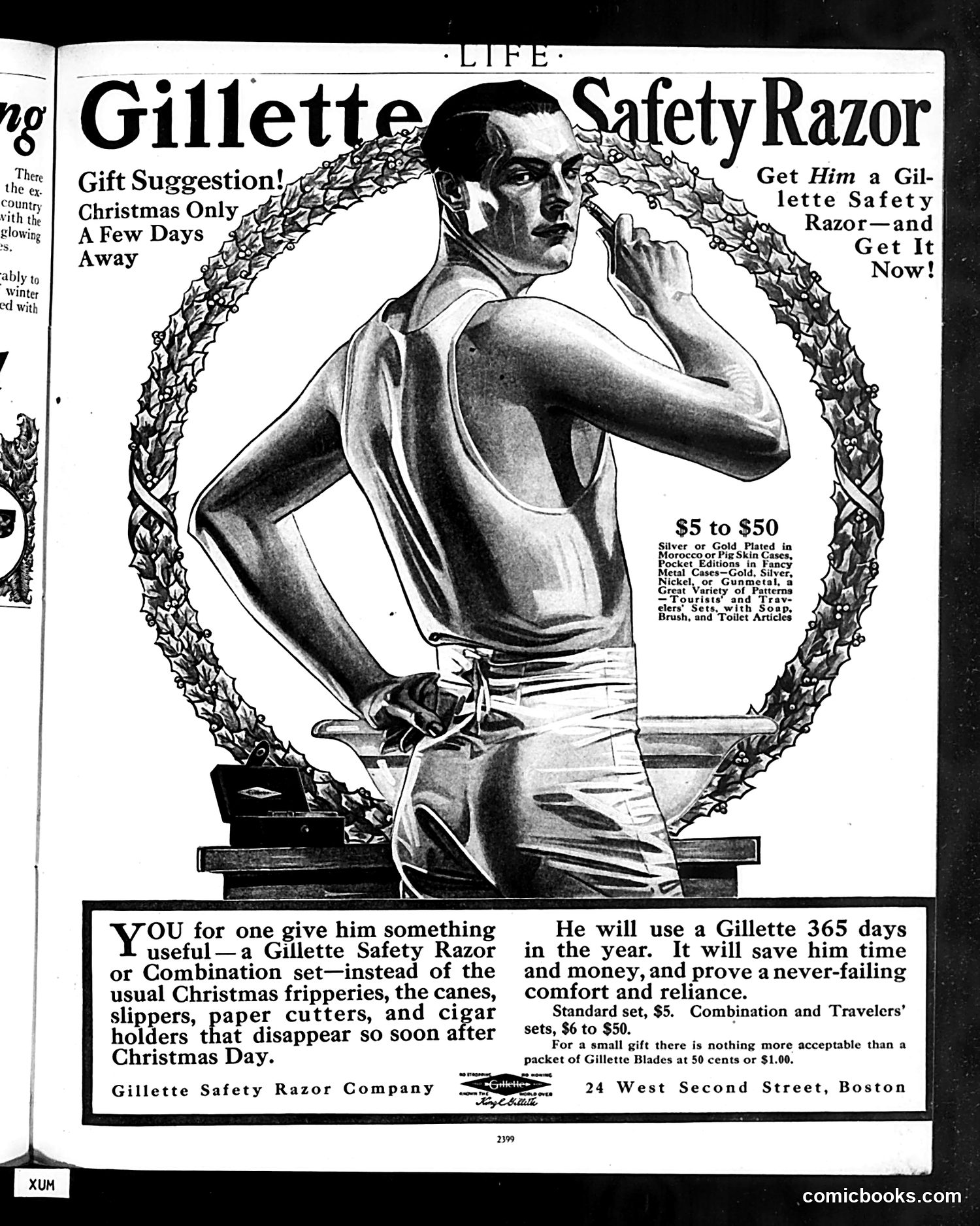
This is a **product advertisement**, not satire or political commentary. It's a Christmas gift pitch for Gillette Safety Razors from the early 20th century. The ad uses a muscular, shirtless male figure in a classical pose within a laurel wreath—evoking dignity and achievement—to market razors as practical gifts. The copy contrasts Gillette razors favorably against typical Christmas "fripperies" (frivolous items like canes, slippers, and cigar holders) that are quickly discarded. The sales pitch emphasizes utility: a razor used "365 days a year" provides lasting value versus novelty gifts. Prices range $5–$50 (roughly $150–$1,500 today), with budget options at 50 cents. The ad's rhetorical strategy—claiming practicality over frivolity—was common masculine-targeted marketing of this era, associating razors with serious, hardworking manhood rather than decoration.
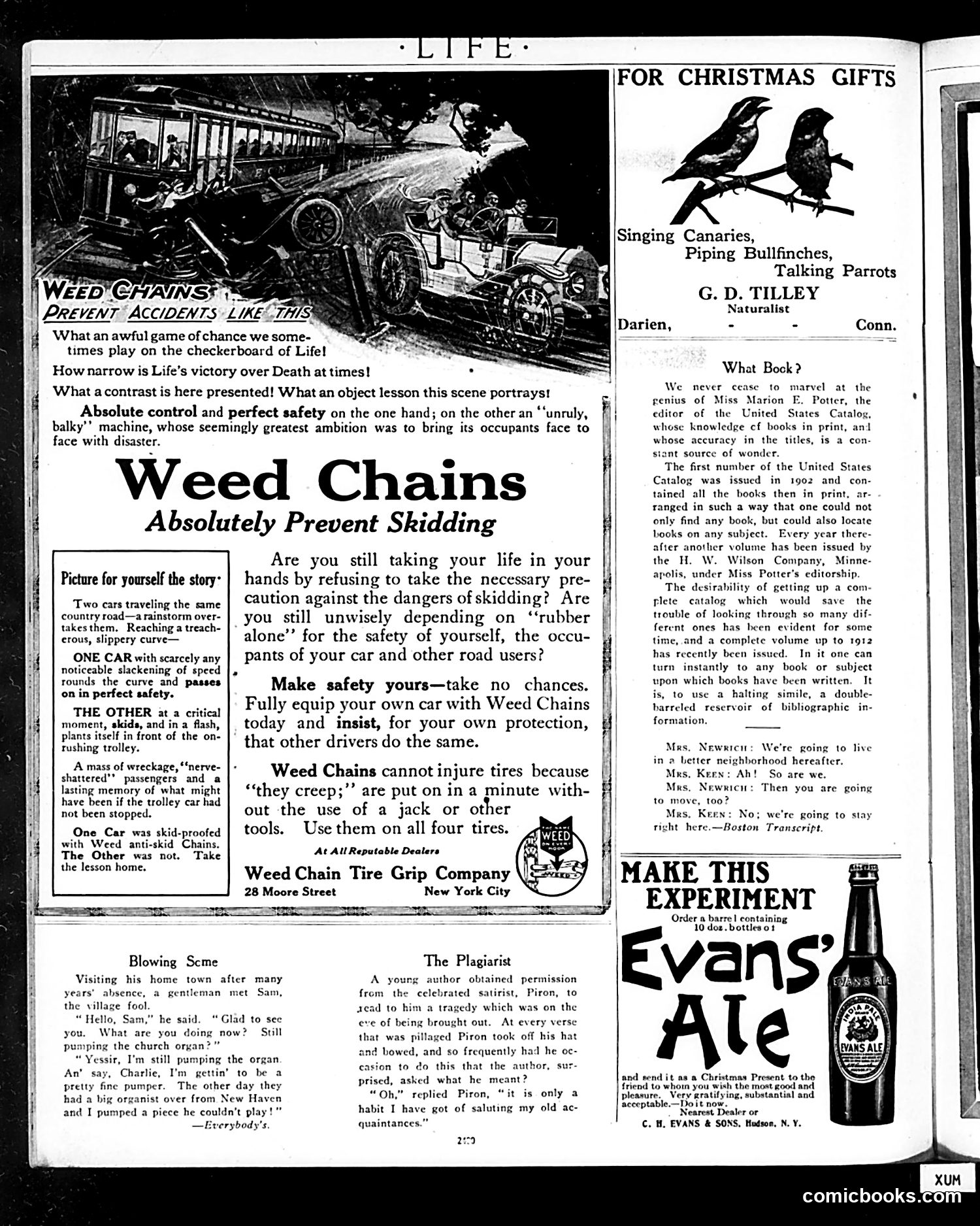
This page contains a major **safety advertisement for Weed Chains** (tire traction devices), illustrated with a dramatic crash scene showing a trolley hitting a car that skidded on wet roads. The contrast between two vehicles—one equipped with Weed Chains that safely navigates a curve, the other skidding into disaster—drives the message that winter driving requires proper equipment. The page also includes minor content: a sidebar advertising singing birds for Christmas gifts, a brief Q&A about book catalogs, two short humorous anecdotes (one about an organist, one about plagiarism), and an Evans' Ale advertisement. The central point is straightforward: skidding caused serious accidents and fatalities. Weed Chains were marketed as essential safety equipment, not luxury items. The appeal to both personal responsibility and peer pressure ("insist that other drivers do the same") was typical early-1900s safety advocacy.
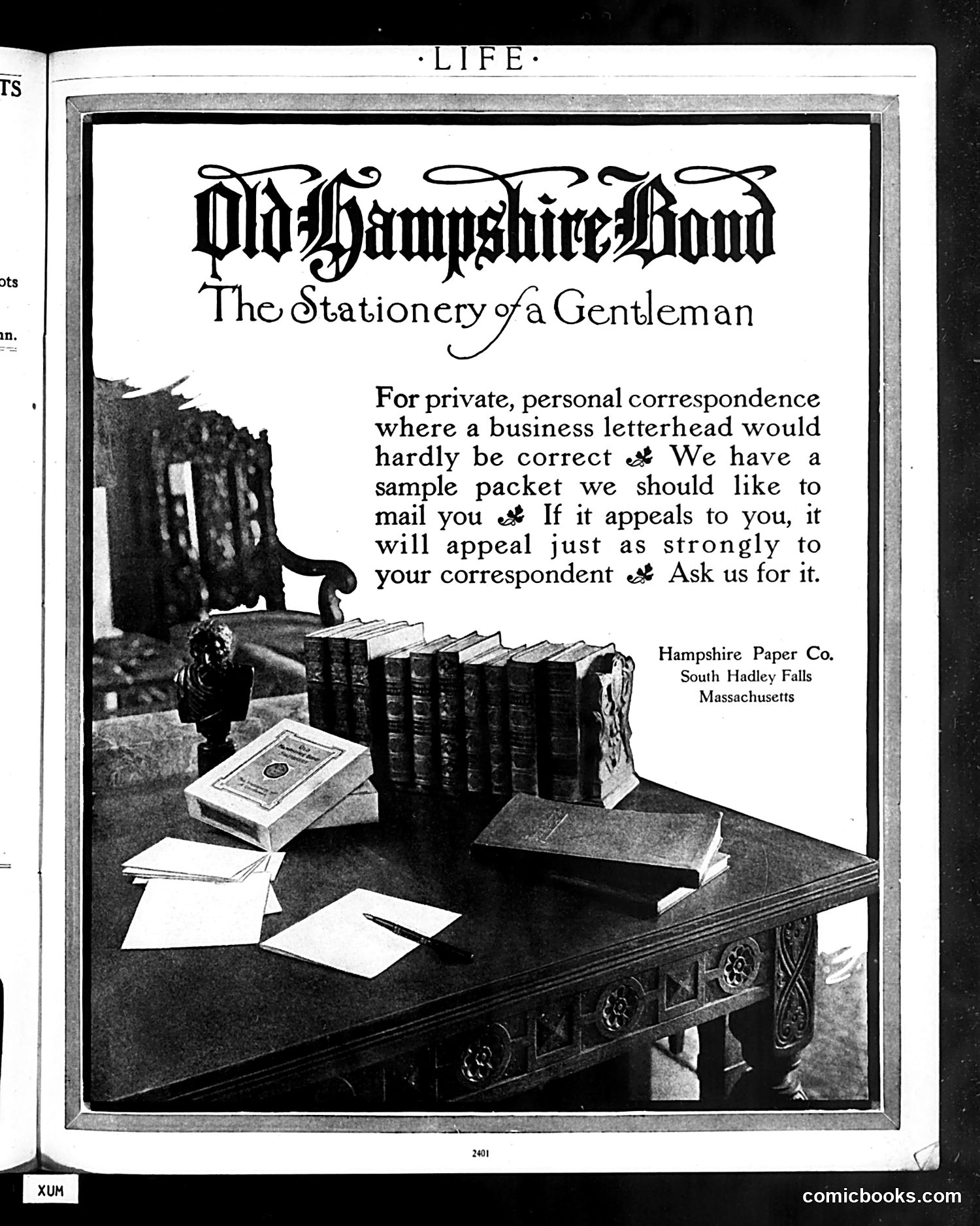
This is an advertisement, not a cartoon. It promotes "Old Hampshire Bond" stationery from Hampshire Paper Co. (Massachusetts). The ad targets gentlemen who need distinctive personal letterhead for private correspondence—distinguished from formal business use. The image shows an elegant desk with leather-bound books, suggesting refinement and education. The appeal is social: proper stationery signals good taste and breeding. The ad suggests that if the recipient finds the stationery aesthetically pleasing, their correspondents will too—implying that quality stationery reflects well on one's character and social standing. This reflects early 20th-century etiquette norms where writing materials were markers of gentlemanly status and propriety.
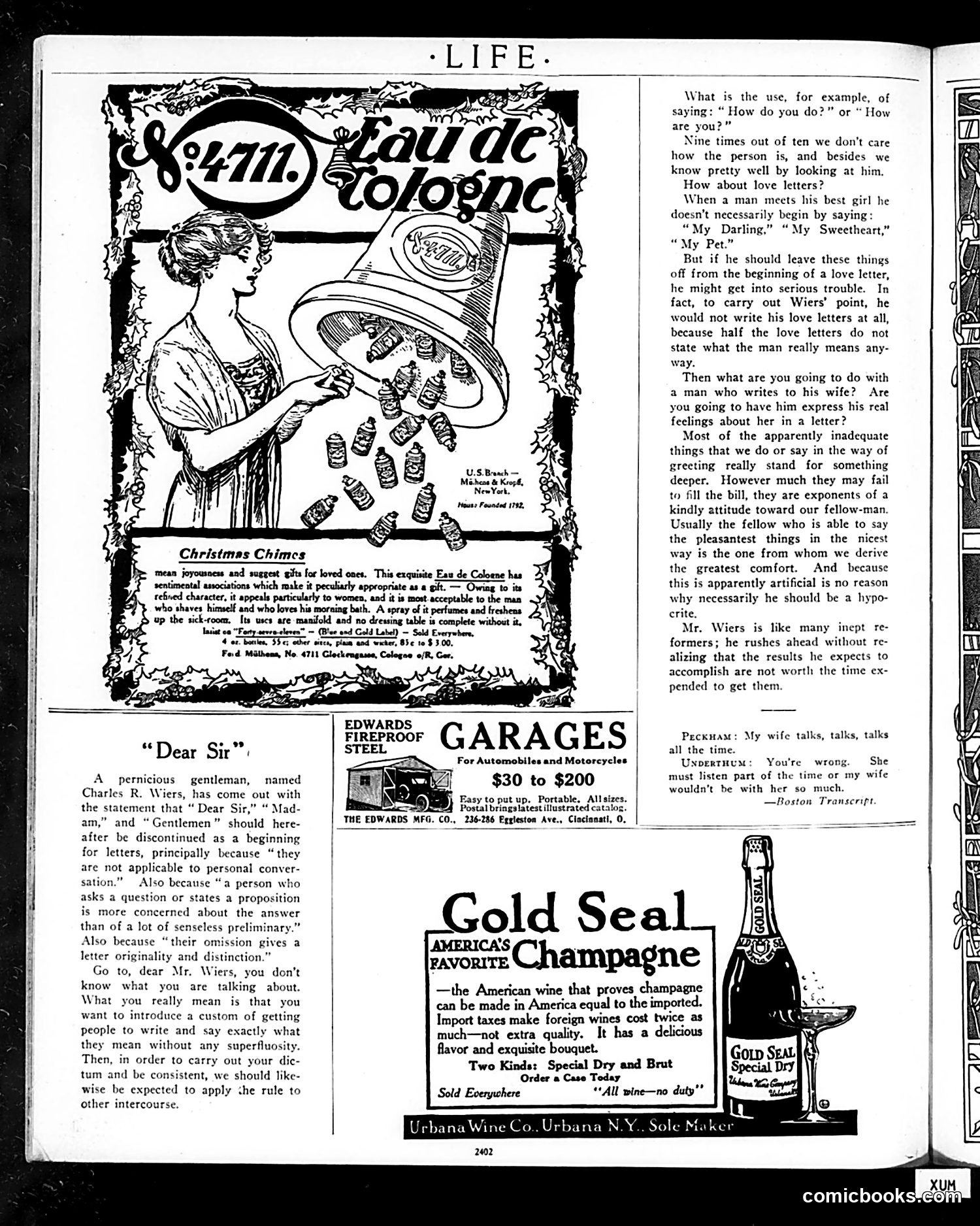
This page critiques a proposal by Charles R. Wiers to eliminate traditional letter salutations ("Dear Sir," "Madam," "Gentlemen") as unnecessary and artificial. **The Main Argument**: The editorial defends conventional greetings against Wiers' reformist position. It argues that while these phrases may seem redundant in face-to-face conversation, they serve a deeper social purpose—they express goodwill and kindness toward the recipient. The writer contends that removing them would be impractical, citing love letters as an example where omitting traditional endearments could cause "serious trouble." **The Satire**: Wiers is portrayed as a well-intentioned but impractical reformer who doesn't understand that social conventions, though seemingly inadequate on the surface, fulfill important emotional functions. The piece mocks his naive logic while defending the value of courteous formality. The page also includes period advertisements for cologne, garages, and champagne, typical of Life's commercial content.
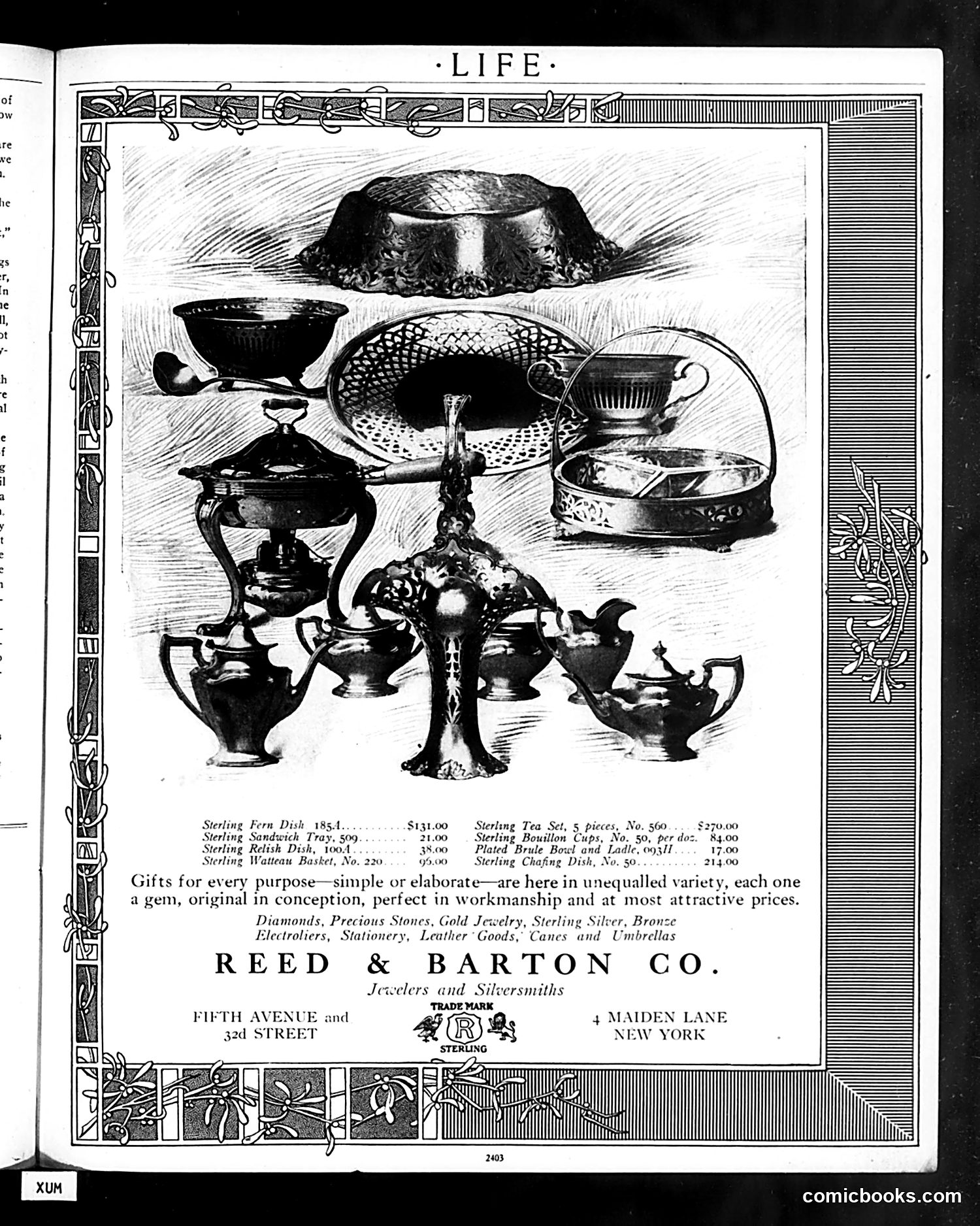
This is primarily a **luxury goods advertisement**, not a political cartoon. Reed & Barton Co., a prestigious New York jeweler and silversmith, showcases their sterling silver tableware and decorative items—tea sets, fern dishes, chafing dishes, and other fine serving pieces—with prices ranging from $17 to $270. The elaborate engraved border and centered still-life arrangement of ornate silver vessels reflect the **Art Nouveau aesthetic** popular in early 20th-century advertising. The language emphasizes exclusivity ("unequalled variety," "gems," "perfect workmanship") targeting wealthy consumers. There is **no political satire or social commentary** on this page. It represents straightforward high-end merchandising in *Life* magazine, which carried substantial advertising alongside its satirical content. The page documents consumer culture and aesthetic values of the era rather than commenting on them.
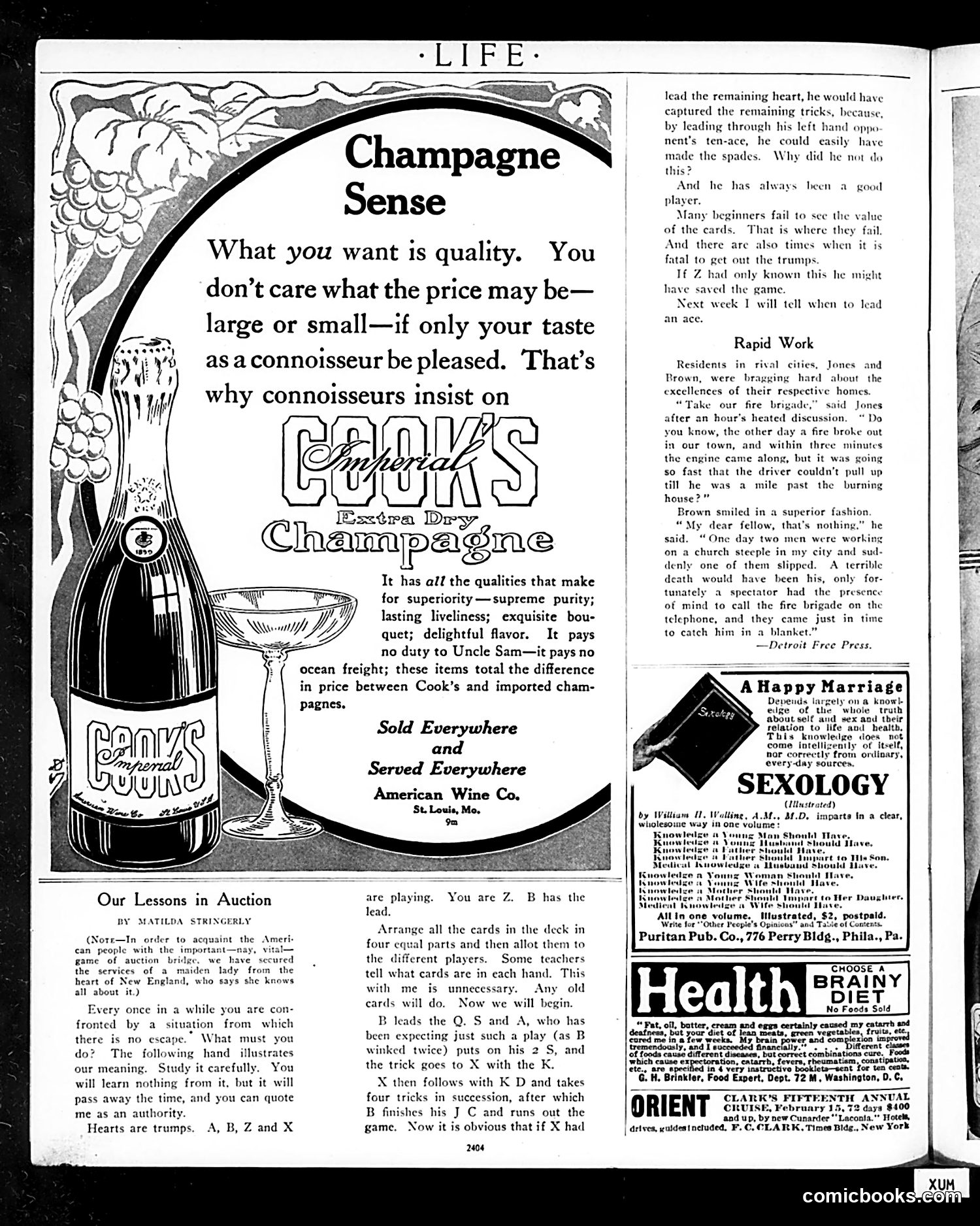
This page is primarily **advertising**, with secondary educational content. **Main Advertisement:** Cook's champagne dominates the left side, emphasizing quality over price—positioning it as superior to imported French champagne while costing less (no import duties or ocean freight). The appeal is to "connoisseurs" valuing taste. **Educational Content:** "Our Lessons in Auction" teaches bridge card strategy through a worked example, using humorous narrative by "Matilda Stringerly" to explain trump play and tactical decisions. **Miscellaneous Items:** - "Rapid Work" is a joke contrasting city fire brigades' speed (two competing mayors exaggerating) - Small ads for "Sexology" (a marriage/sex education guide), "A Happy Marriage" book, and health diet products The page reflects early 20th-century Life magazine's mix of satirical commentary, practical instruction, and commercial advertising targeting educated, middle-class readers interested in games, wine appreciation, and self-improvement.
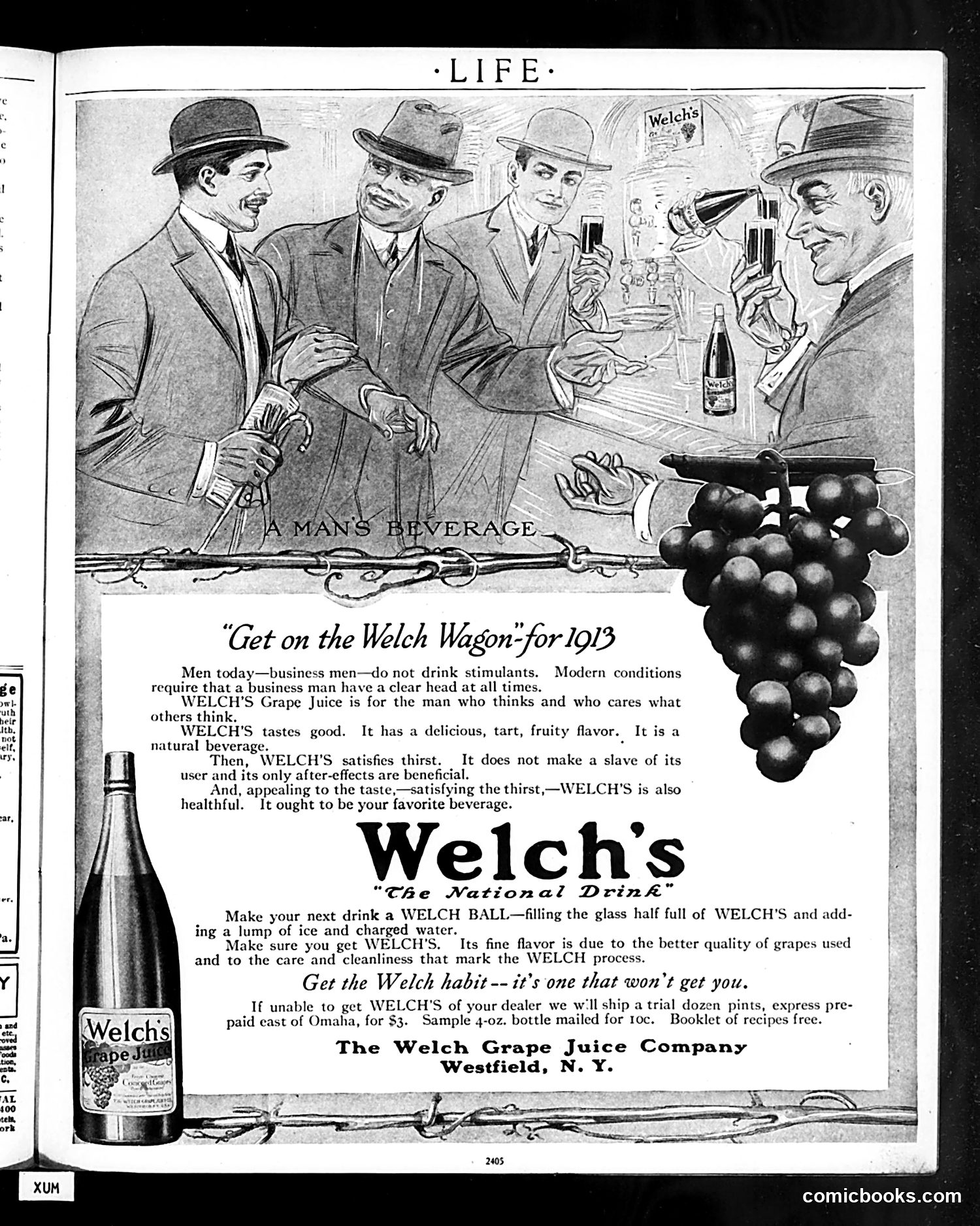
This is a full-page advertisement, not political satire. It depicts well-dressed businessmen toasting with Welch's Grape Juice, promoting it as "The National Drink" for modern professionals. The pitch targets early 20th-century anxieties about sobriety and business respectability. The ad argues that successful men avoid alcoholic "stimulants" and instead choose grape juice—positioning abstinence as sophisticated and masculine rather than prudish. The slogan "Get on the Welch Wagon" plays on temperance rhetoric popular before Prohibition (which began in 1920). The advertisement emphasizes Welch's as healthful, non-addictive, and satisfying—directly contrasting it with alcohol's perceived dangers. This reflects growing temperance sentiment and concerns about alcohol's effects on professional competence and moral character during the Progressive Era.
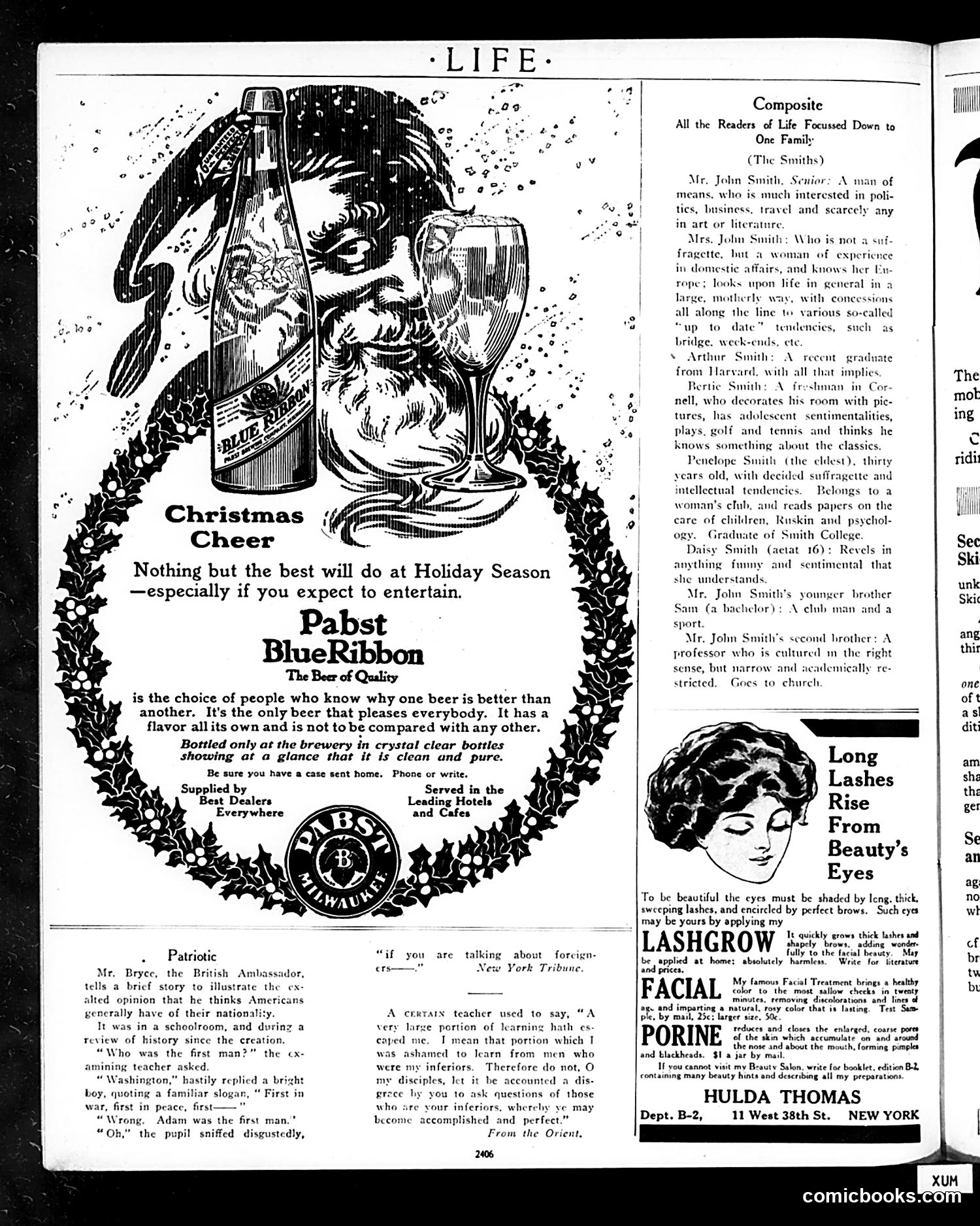
This page mixes advertising with satirical content typical of Life magazine's format. **The Main Advertisement** is a full-page Pabst Blue Ribbon beer ad featuring a jolly Santa Claus face emerging from a beer bottle, promoting holiday entertaining. The tagline "Nothing but the best will do at Holiday Season" uses Christmas imagery to sell beer. **The Satirical Sections** include: 1. **"Patriotic"**: A joke mocking American overconfidence. A British ambassador recounts a schoolboy who answers "Who was the first man?" with "Washington" rather than "Adam," illustrating Americans' inflated national pride. 2. **"Composite"**: Introduces "The Smith Family"—a detailed satirical portrait of an upper-middle-class American household, cataloging each family member's character type (the businesswoman suffragette daughter, the intellectually pretentious sons, etc.). 3. **Beauty advertisements** for eyelash treatments and facial products. The page reflects early 20th-century American consumer culture and gender/class stereotypes while gently mocking American nationalism and social pretension.
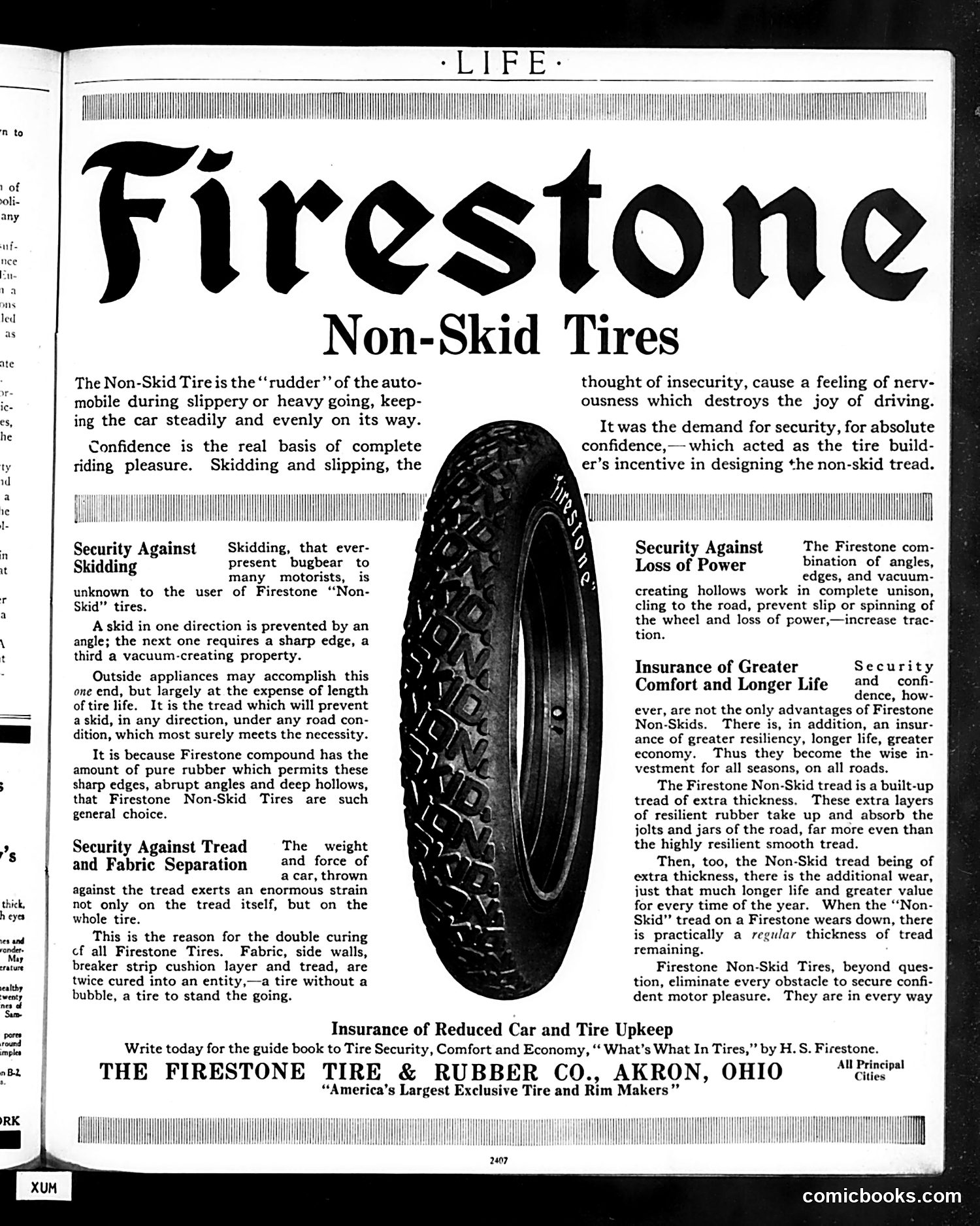
This is **not a cartoon or satire**—it's a straightforward automobile tire advertisement from an early 20th-century Life magazine. The page promotes Firestone's "Non-Skid" tires, emphasizing their safety features for motor vehicles of the era. The advertisement positions the tire as essential for driver confidence and vehicle control, particularly on slippery roads. It highlights technical advantages: the tire's tread pattern prevents skidding in multiple directions, the compound maintains tread integrity, and the double-cured construction resists separation. The copy appeals to motorists' anxieties about automobile safety—then a genuine concern as motoring was relatively new and roads were often poor. The large tire illustration demonstrates the product's distinctive tread pattern. Rather than satire, this represents period marketing strategy: selling reliability and peace-of-mind as much as the physical product itself.
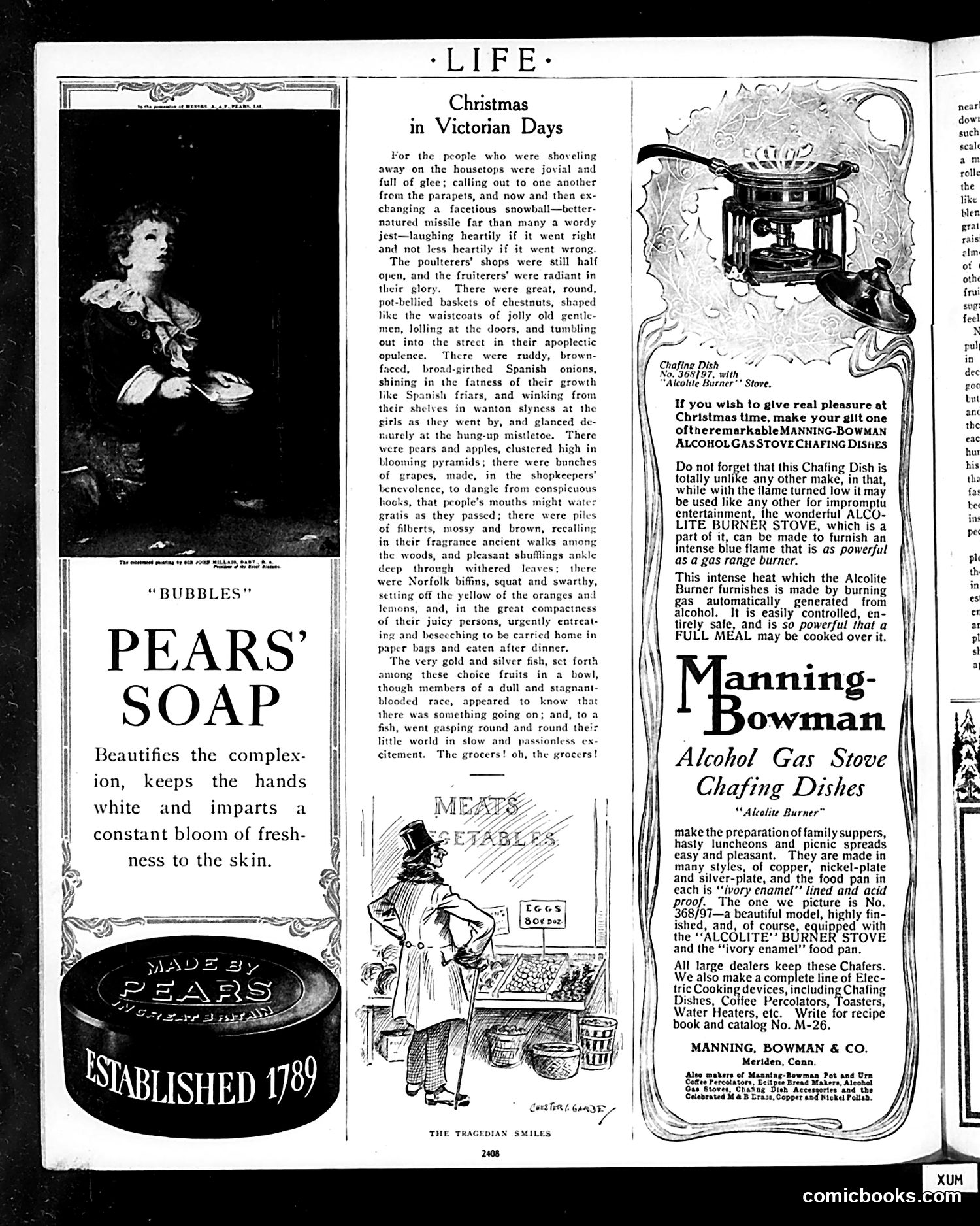
This page is primarily **advertising**, not satire or political commentary. The left side features a Pears' Soap advertisement using "Bubbles"—likely referencing the famous 1886 painting by John Everett Millais that became the soap's iconic mascot. The ad promises skin beautification and freshness. The center contains a long passage about **Victorian Christmas shopping**, describing festive street markets with food vendors (fruits, vegetables, fish). This appears to be literary content, possibly adapted from Dickens, celebrating Victorian-era holiday commerce and abundance. The right side advertises **Manning-Bowman Alcohol Gas Stove Chafing Dishes**—a heating device for tabletop cooking. The ad emphasizes its intensity and versatility for family meals and entertaining. The illustration labeled "The Tragedian Smiles" depicts a cook with various foods and "Eggs & Stores" basket—supporting the culinary theme. **Overall**: This is a holiday-themed magazine page blending nostalgic Victorian imagery, literary content, and consumer products aimed at affluent readers considering Christmas gifts.
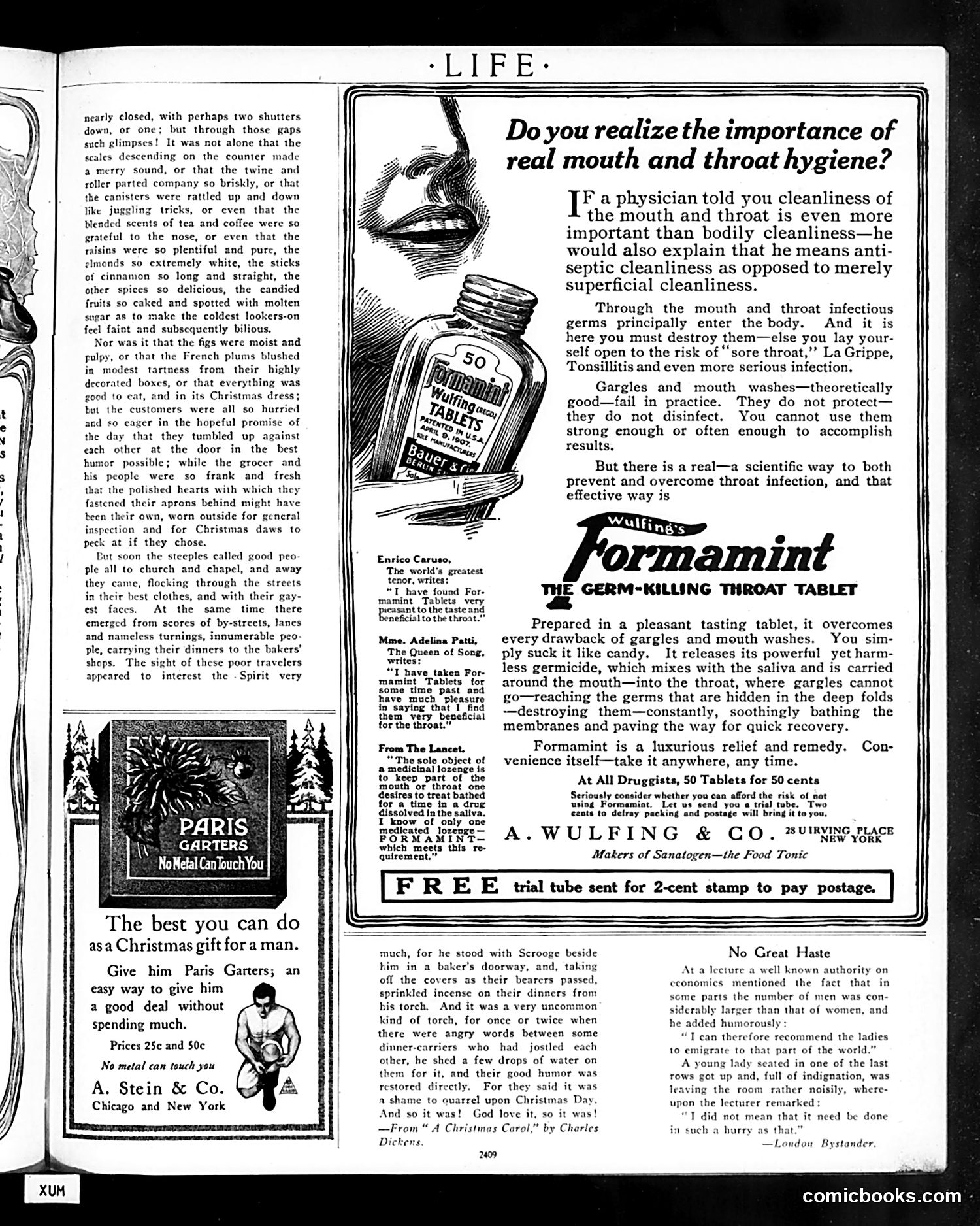
This page contains primarily **advertisements**, not political satire. The main content includes: 1. **Paris Garters ad** (left): A Christmas gift recommendation for men—garter suspenders with "no metal" touching skin, priced 25-50 cents. 2. **Formamint throat tablets ad** (right, dominant): Promotes a "germ-killing" throat lozenge using testimonials from opera singers Enrico Caruso and Adelina Patti, plus a medical journal quote. The ad emphasizes antiseptic cleanliness versus superficial cleaning, positioning the tablet as superior to ineffective gargles. The page also contains **excerpts from Dickens' "A Christmas Carol"** (left column) describing a grocer's shop and Christmas charity. **Historical context**: This appears early 20th-century, when patent medicines and dubious health claims dominated advertising before FDA regulation. The Formamint ad exemplifies common marketing tactics: celebrity endorsements and pseudo-scientific language to sell products of questionable efficacy.
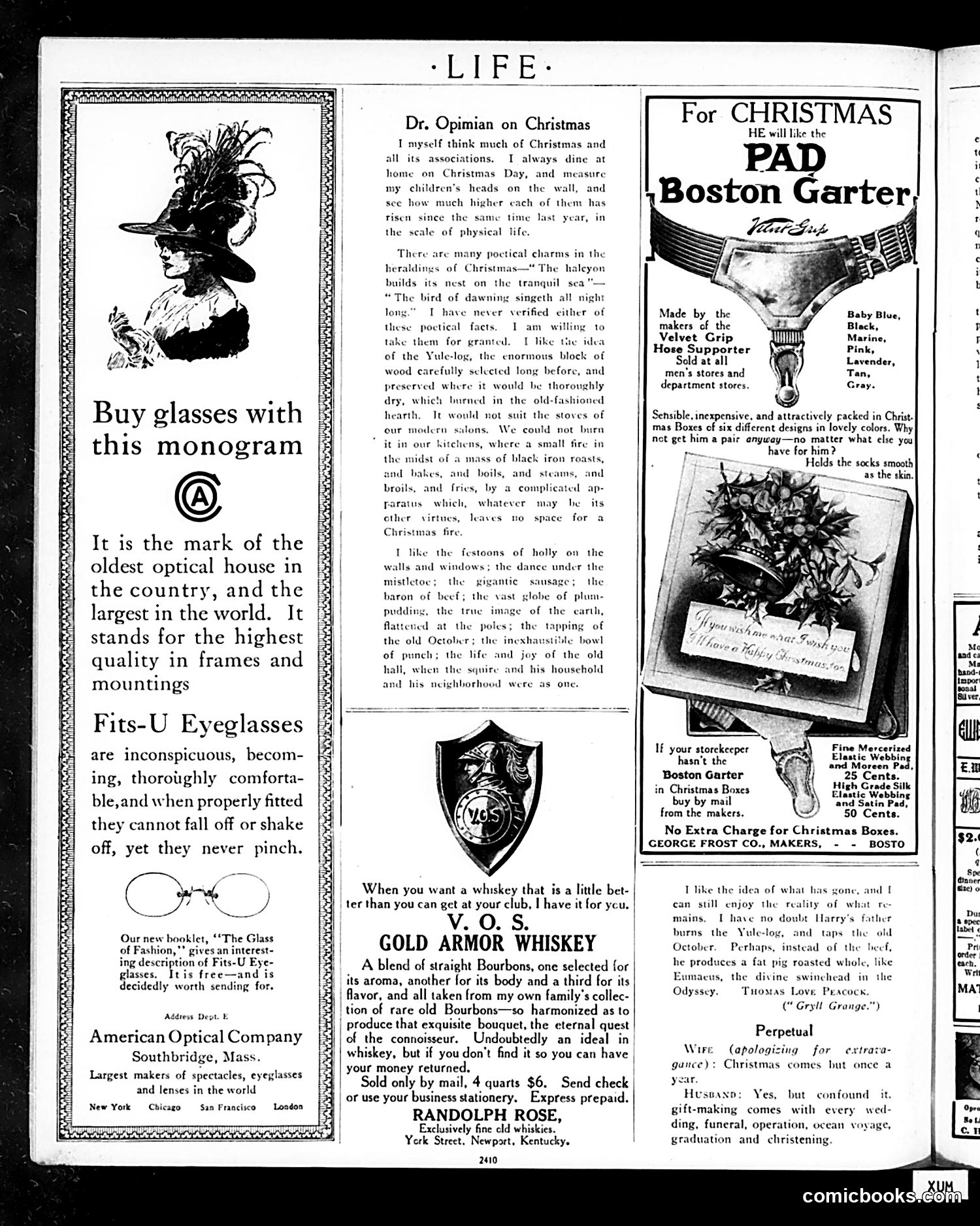
This page primarily contains **advertisements and a humorous column**, not political cartoons. The main content is "Dr. Opimian on Christmas," a nostalgic essay celebrating traditional Christmas customs—Yule logs, holly decorations, festive feasts (beef, pudding, sausages, punch). The writer expresses sentimental attachment to old-fashioned holiday celebrations while acknowledging modern life has displaced such traditions. The surrounding advertisements are for luxury goods: Fits-U Eyeglasses, Boston Garter socks, and Gold Armor Whiskey. A brief comic dialogue at bottom features a husband and wife—he defends Christmas nostalgia while she pragmatically notes that gift-giving accompanies *every* major life event (weddings, funerals, operations, christenings), making Christmas financially indistinguishable from other occasions. **The satire**: The husband's romantic idealization of "the old hall" is undercut by his wife's sharp observation that modern obligation, not tradition or joy, drives Christmas spending. This reflects early 20th-century tension between Victorian sentimentalism and emerging consumer culture.
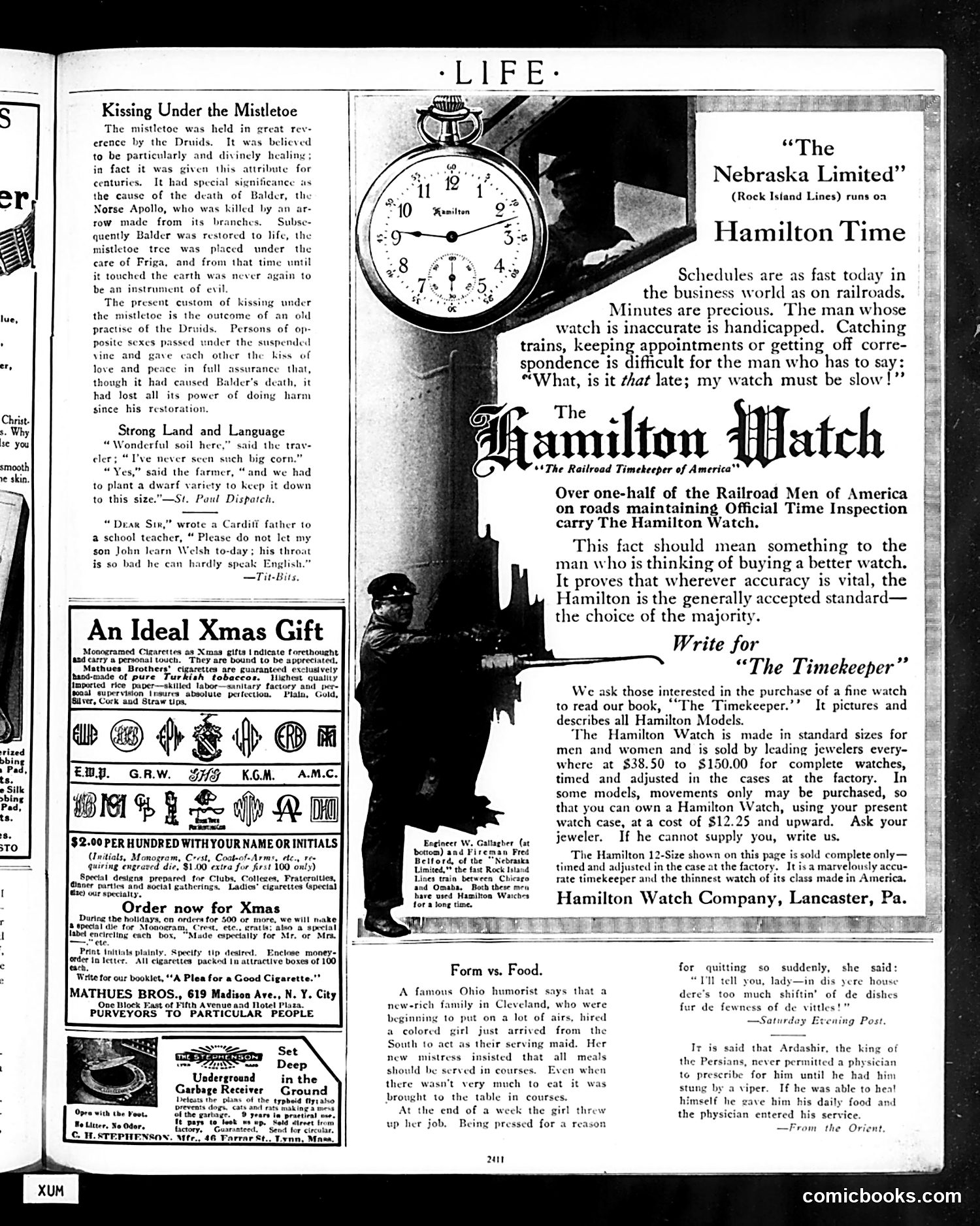
This page is primarily **advertising rather than political satire**. The dominant content is a Hamilton Watch advertisement featuring an engineer and a pocket watch, emphasizing that railroad men depend on precise timekeeping. The ad's message: Hamilton watches are the industry standard, trusted by over half of American railroad operators. The smaller sidebars contain brief humorous anecdotes ("Strong Land and Language," "Form vs. Food") that are gentle social observations rather than sharp satire—typical Life magazine filler humor about Irish farmers, Welsh language education, and domestic dining practices. The "Kissing Under the Mistletoe" article is ethnographic, tracing the tradition's Druidic origins and Norse mythology (the death of Balder), presented as educational rather than satirical content. The page reflects early 20th-century American consumer magazine culture: blending light humor, commercial advertising, and trivia for middle-class readers.
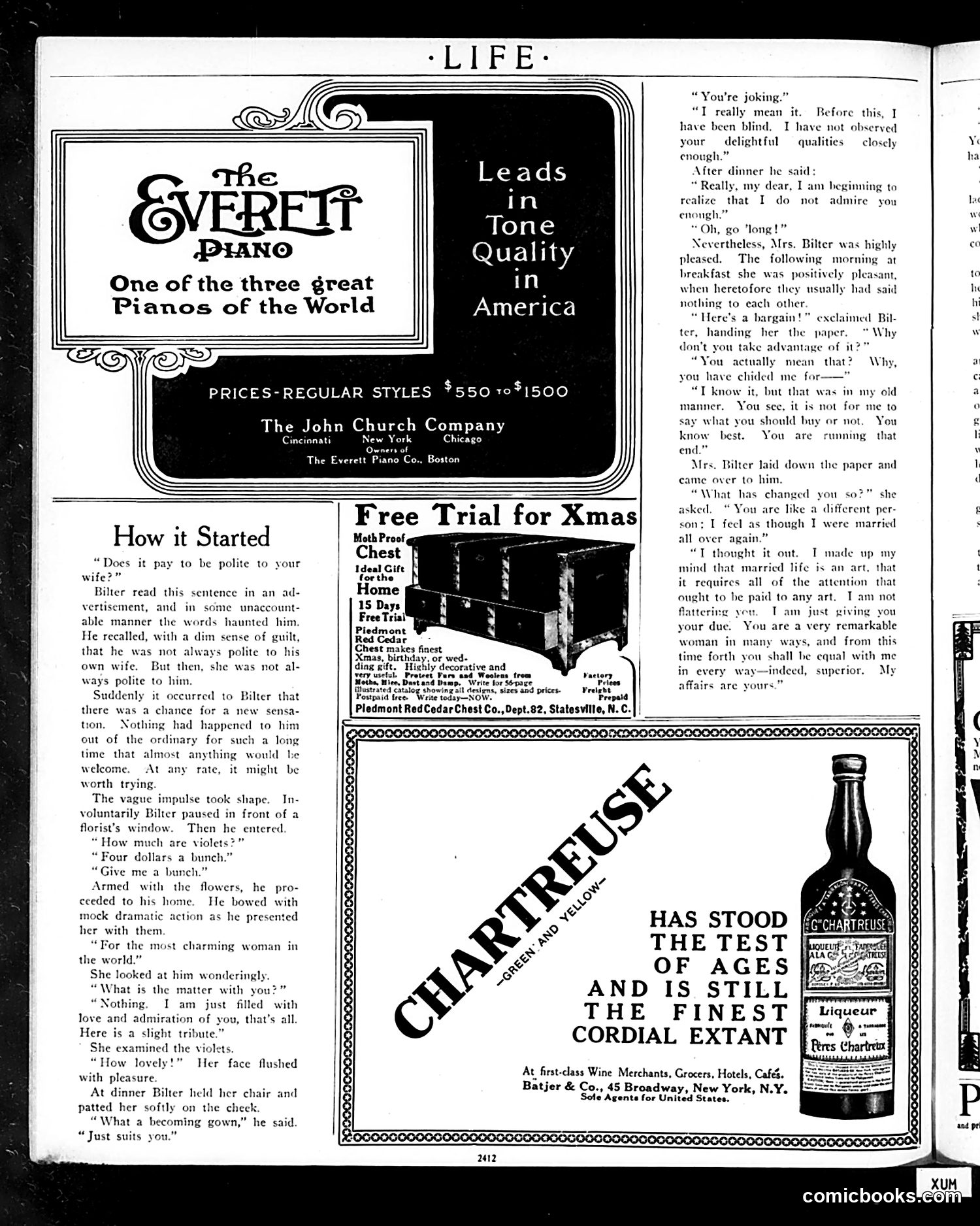
This page presents a short satirical story titled "How it Started" alongside period advertisements. The narrative mocks marital complacency and the superficiality of domestic reconciliation. **The Story's Point:** Mr. Bilter, inspired by an advertisement asking "Does it pay to be polite to your wife?", decides to treat his neglectful marriage as an "art" requiring attention. He buys flowers, compliments his wife, and delivers flowery declarations about admiring her. Mrs. Bilter, initially suspicious, becomes pleased and attentive in return. **The Satire:** The humor targets the absurdity that a marriage has deteriorated so completely that basic politeness becomes a novel "sensation" requiring conscious effort. It also mocks how easily marital discord dissolves through hollow gestures—Bilter's grand pronouncements about marriage being "an art" are undercut by the fact that a simple bouquet and some flattery suffice to restore harmony. The story suggests both spouses were willing to be pleased by minimal effort, satirizing the emotional shallowness of their relationship. The advertisements (pianos, cedar chests, liqueur) represent typical period consumer goods marketed to the middle-class audience.
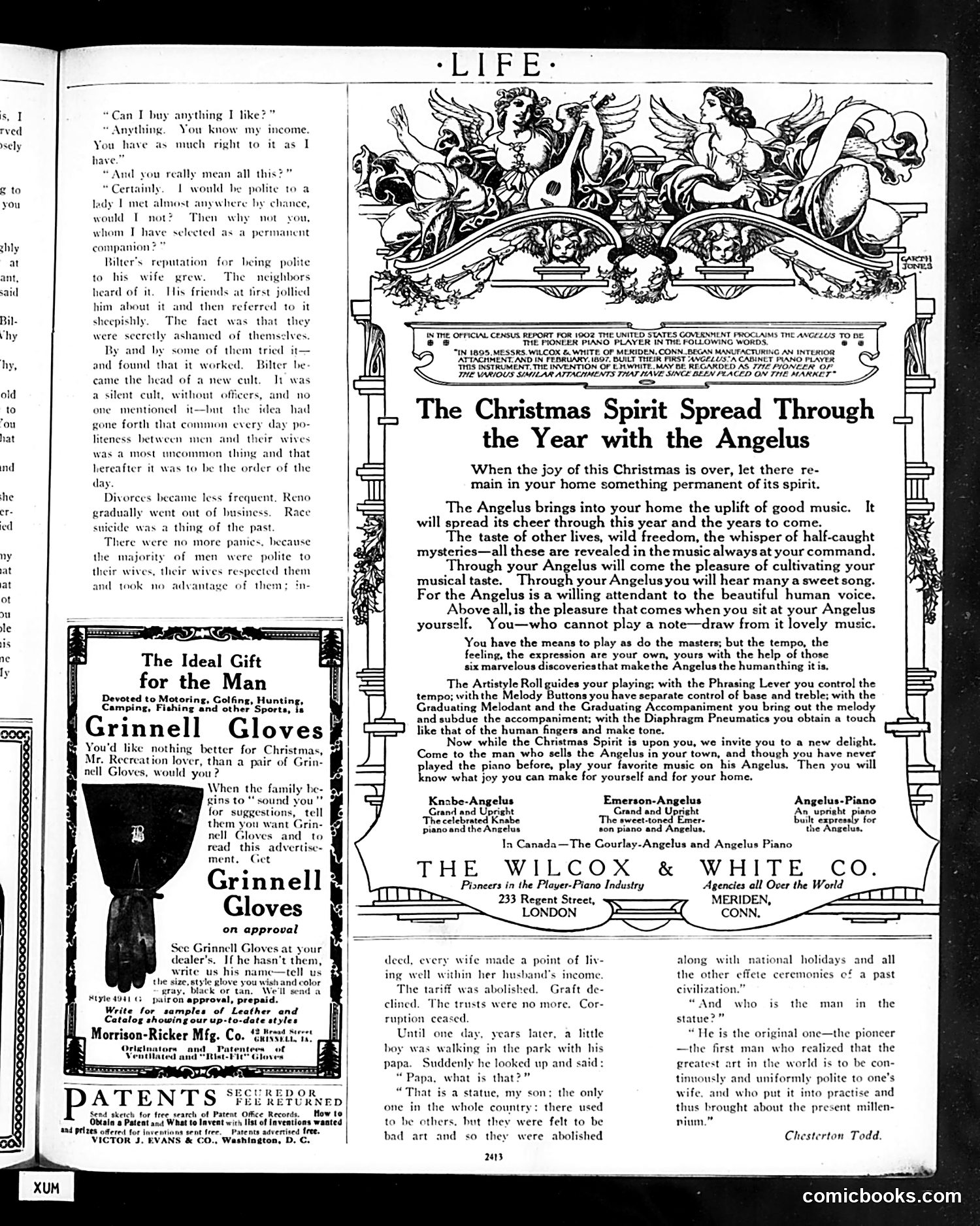
This page combines satirical editorial content with period advertisements. The main cartoon/story (left column) depicts "Bilter," a man who revolutionizes his marriage by treating his wife with consistent politeness—as courteously as he would a stranger. The satire targets early 20th-century marital norms: his friends initially mock the behavior as absurd, then secretly adopt it themselves. The outcome suggests that basic civility between spouses reduces divorce, suicide, and financial panics. The satire's point: ordinary politeness in marriage was so rare that treating one's wife decently qualified as radical social reform. This reflects the era's patriarchal marriage customs where husbands held legal and financial control. The right side advertises the "Angelus" piano—a player piano promising that non-musicians can produce "lovely music" mechanically, positioning it as an ideal Christmas gift to cultivate refined taste and family harmony.
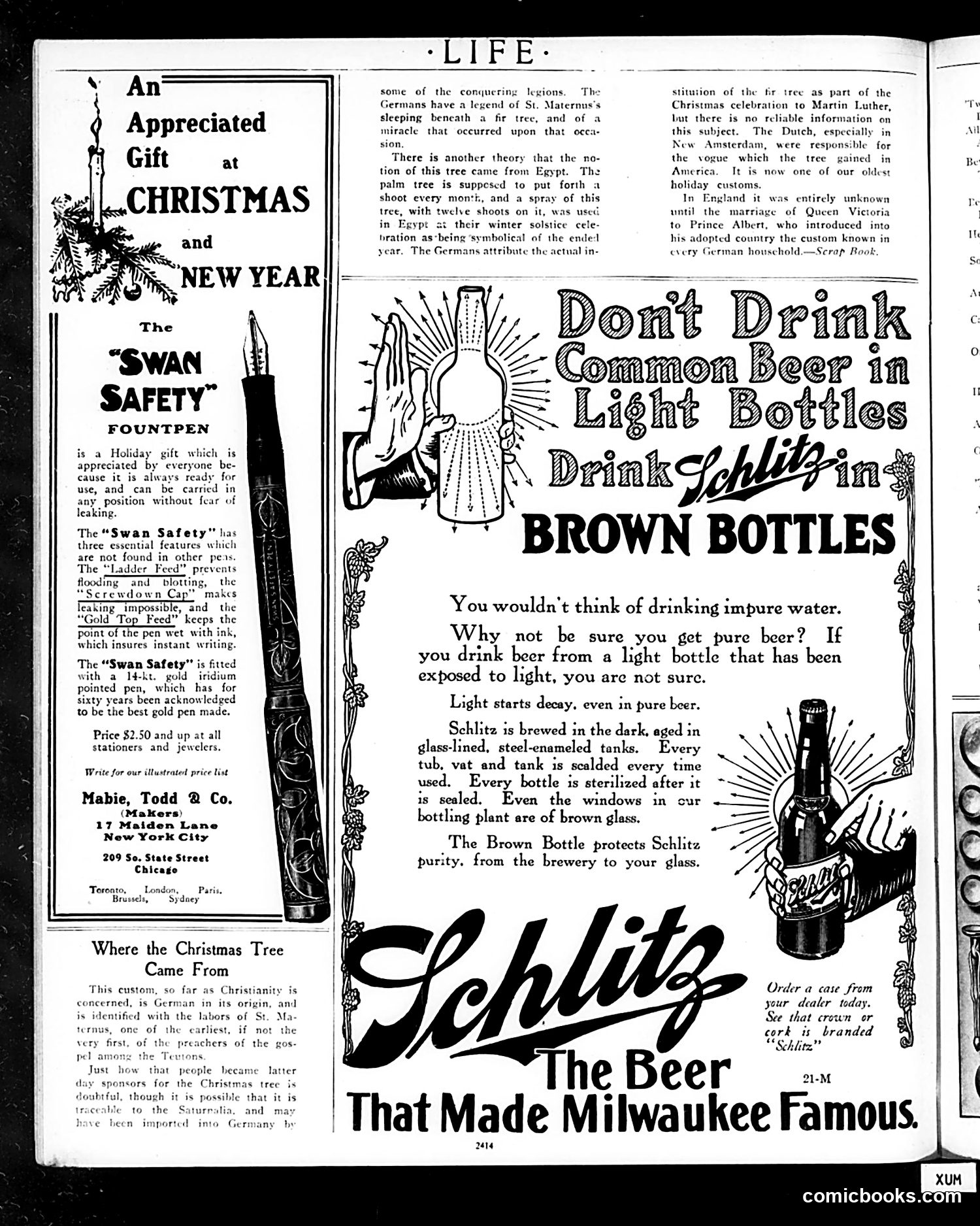
This page combines **editorial content about Christmas tree origins** with **period advertisements**. The main article traces the Christmas tree custom to German and possibly Egyptian roots, noting its introduction to England through Queen Victoria and Prince Albert. It's a straightforward historical piece with no satire. The advertisements are more notable: 1. **Swan Safety Fountain Pen** - a holiday gift ad emphasizing reliability ("always ready," "won't leak") 2. **Schlitz Beer** - the dominant advertisement. This is a straight product pitch, not satire. It argues consumers should demand beer in brown bottles because light exposure causes decay in beer. The ad positions brown bottles as a quality/purity guarantee—essentially early brand differentiation marketing. The slogan "The Beer That Made Milwaukee Famous" appears at bottom. **No political cartoons or satire appear on this page.** It's primarily an informational article paired with commercial advertising typical of early 20th-century Life magazine.
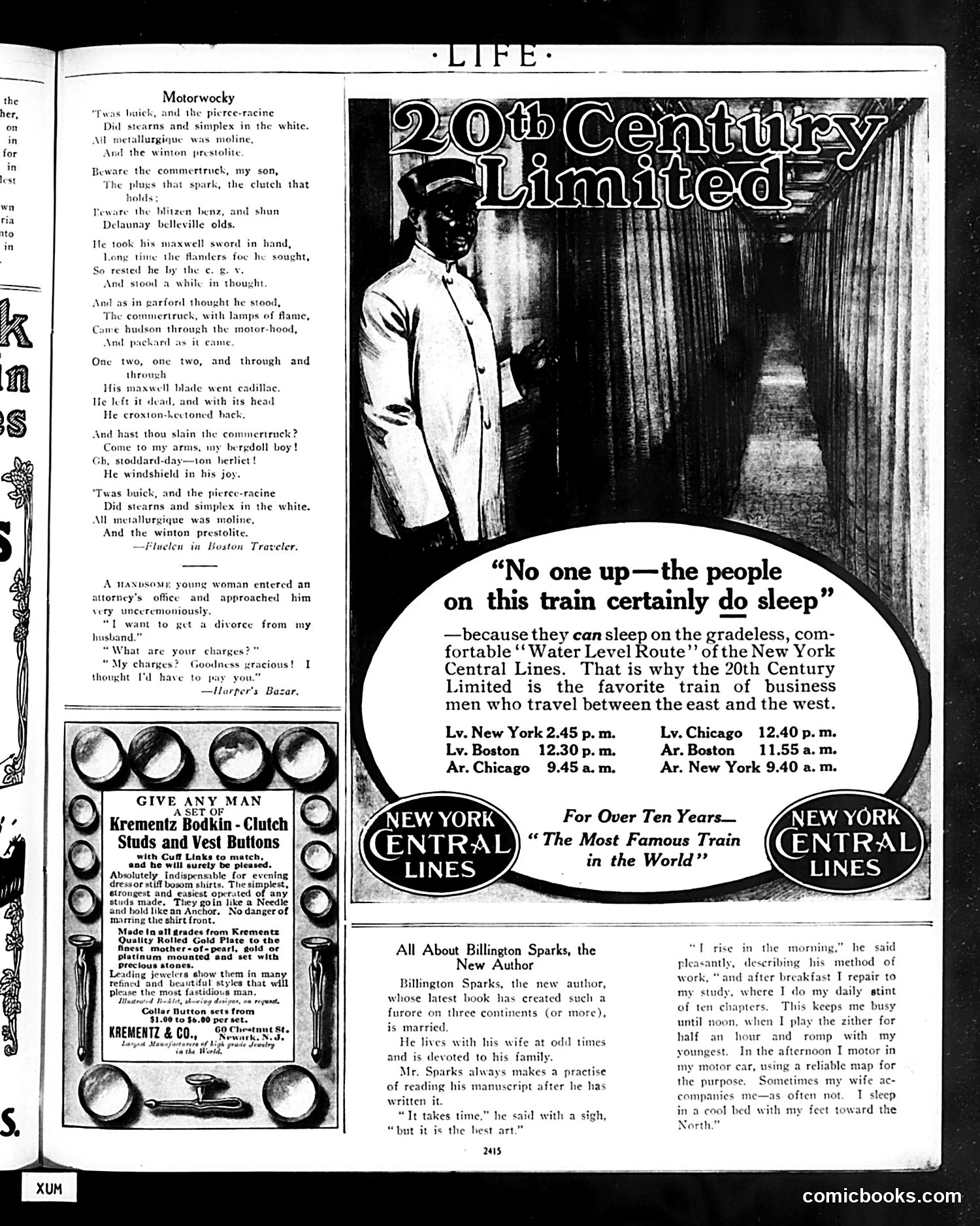
This page contains three distinct elements: **"Motorwocky"** (top left) is a parody of Lewis Carroll's "Jabberwocky," replacing Carroll's nonsense words with early automobile brand names (Buick, Pierce-Racine, Stearns, Maxwell, Hudson, Packard, etc.). The joke satirizes the bewildering proliferation of car manufacturers in the early 1900s—there were dozens of competing brands, making the automotive market chaotic and confusing to consumers. By treating car names as nonsensical gibberish, the author mocks the industry's complexity. **The divorce joke** (bottom left) is a brief anecdote where a woman seeks divorce and asks about costs; the lawyer responds "My charges? Goodness gracious! I thought I'd have to pay you"—implying women were expensive liabilities in marriage. **"20th Century Limited" advertisement** (right) promotes the New York Central Lines' famous passenger train, emphasizing its smooth "Water Level Route" enables comfortable sleep for business travelers. The page is primarily **advertising and light humor**, typical of Life magazine's mix of satirical content and commercial promotions.
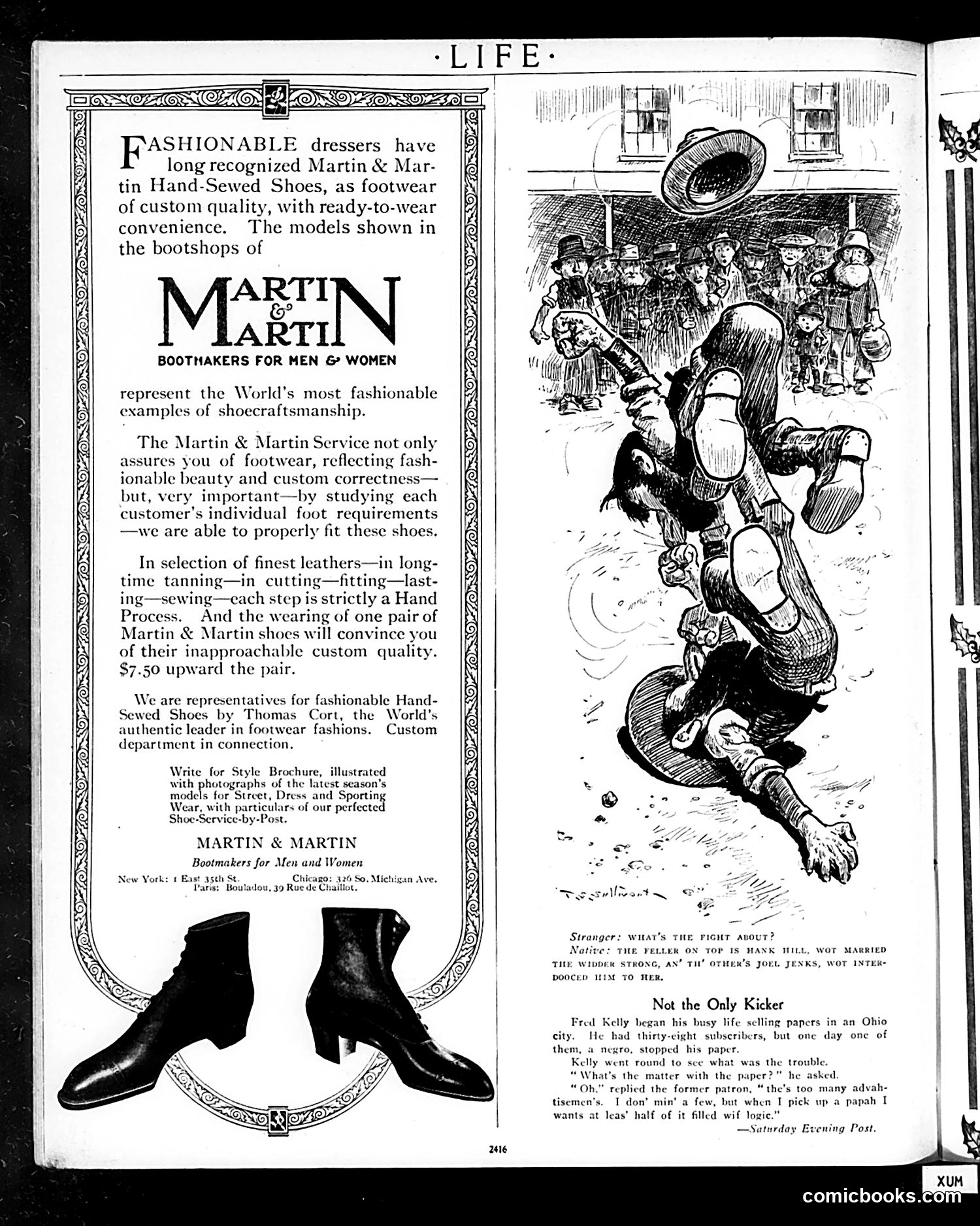
This page is primarily **advertising** for Martin & Martin shoes, a custom bootmaker marketed to fashionable dressers. The ad emphasizes hand-crafted quality, custom fitting, and premium pricing ($7.50 upward—substantial for the era). The right side contains two **humorous vignettes**: 1. **"Not the Only Kicker"** (top): A street fight between two men—"Hank Will" (who married "the Widder Strong") and "Jorl Jenks" (who introduced them). The joke plays on the dual meaning of "kicker"—both a fighter and someone who complains. 2. **"Not the Only Kicker"** (bottom): A anecdote about Fred Kelly, a newspaper boy in Ohio, whose Black subscriber cancelled because the paper contained too many advertisements, wanting "logic" instead. The joke satirizes readers' complaints about ad-heavy publications—a relatable meta-commentary for Life's audience. Both pieces use working-class dialect humor typical of early 20th-century American comedy.
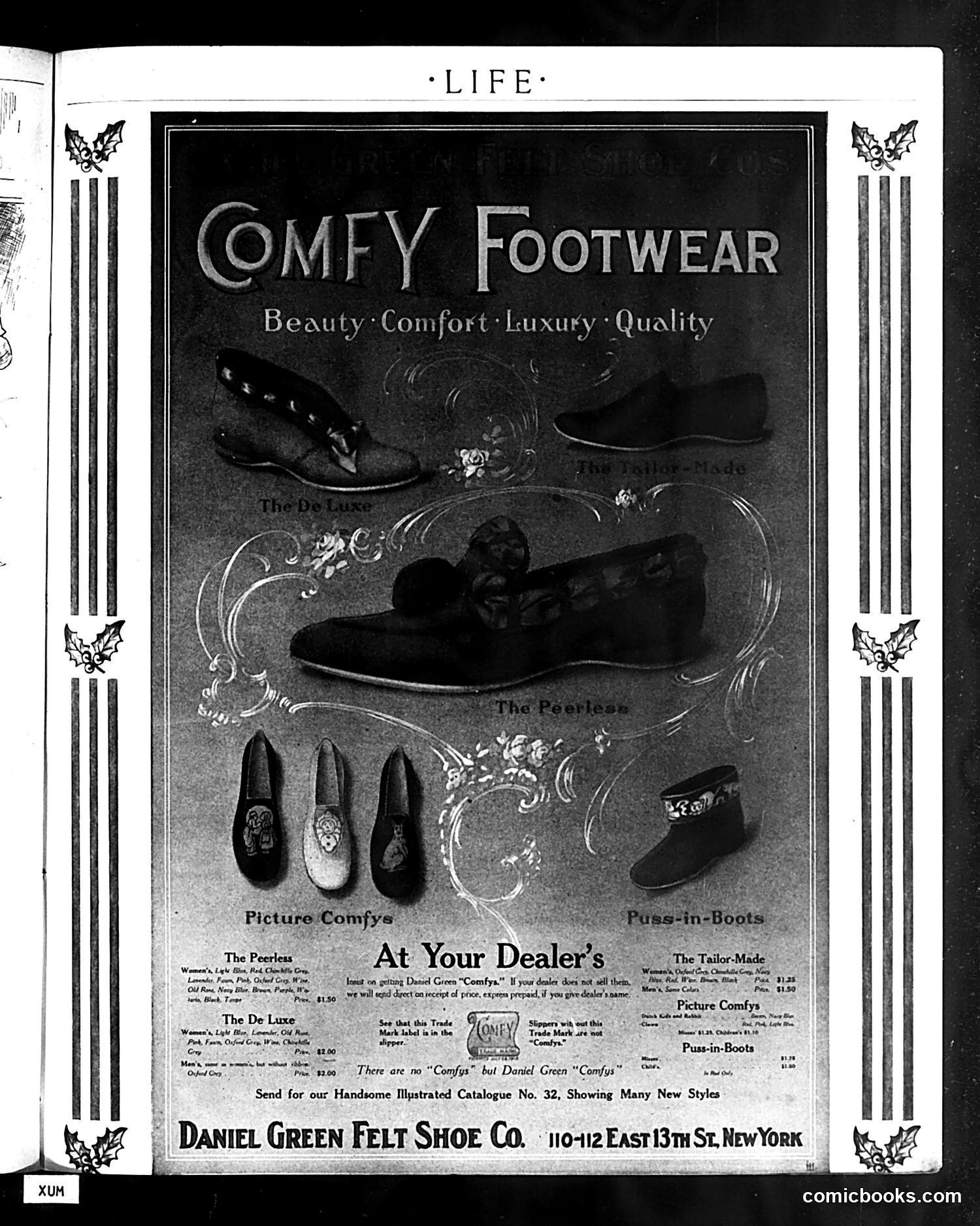
This is a full-page **advertisement** for Comfy Footwear by the Daniel Green Felt Shoe Company (New York). It showcases four shoe styles—"The De Luxe," "The Tailor-Made," "The Peerless," and "Puss-in-Boots"—with product images, prices, and descriptions emphasizing "Beauty, Comfort, Luxury, Quality." The only notable textual element is a competitive jab: "There are no 'Comfys' but Daniel Green 'Comfus'"—a trademark clarification distinguishing their brand from imitators. The decorative borders and ornate frames are typical period design. This is purely commercial content, not political or social commentary.
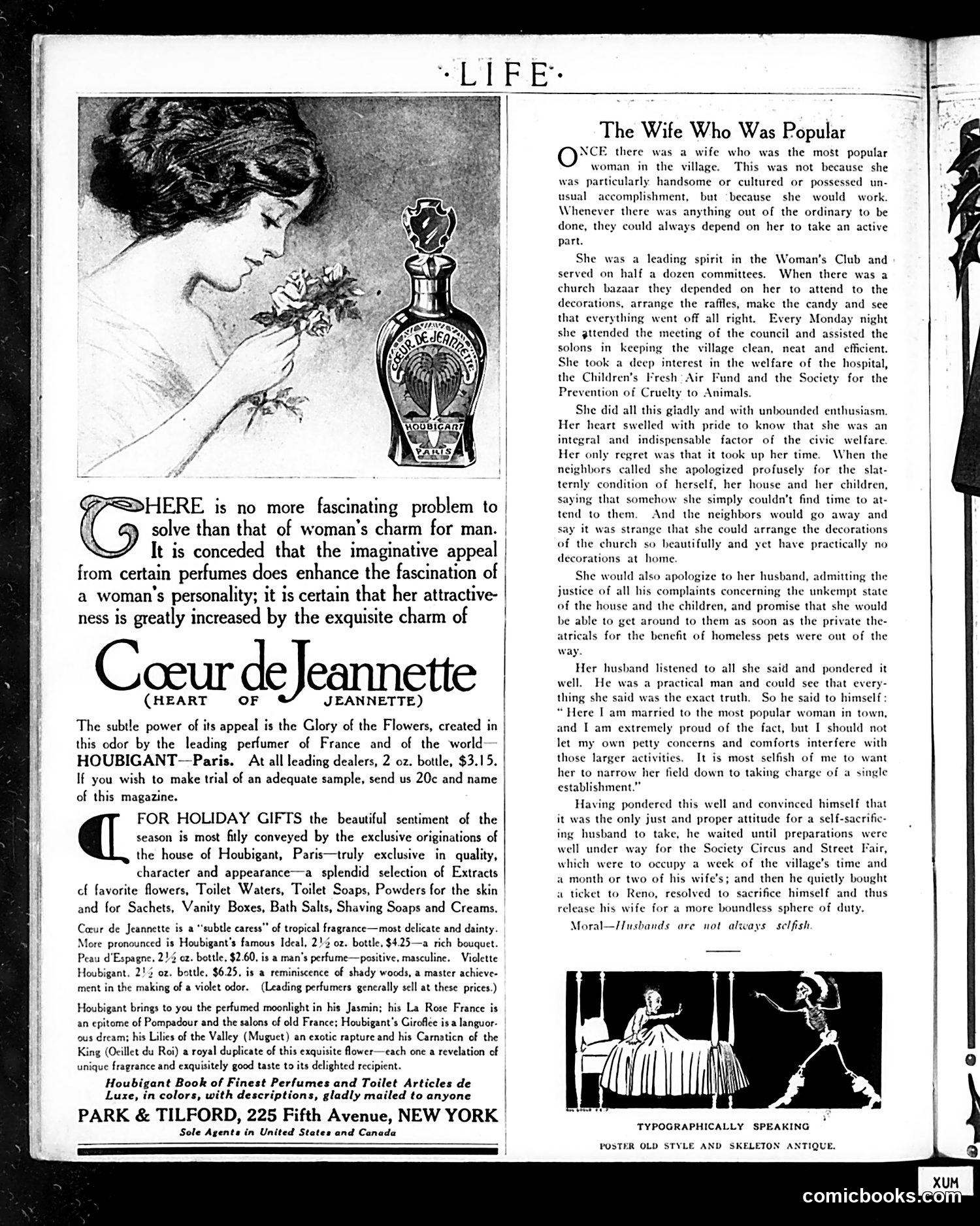
This page mixes advertisement with satirical social commentary. **The Perfume Ad (top/left):** A standard luxury advertisement for "Coeur de Jeannette" perfume by Houbigant, a prestigious French brand. The text emphasizes perfume's power to enhance female "charm" and attractiveness to men—typical early 20th-century marketing that conflated women's value with romantic appeal. **The Satirical Story (right): "The Wife Who Was Popular"** critiques female self-sacrifice through irony. A village wife gains popularity not through beauty or accomplishment, but through constant unpaid labor—organizing church bazaars, serving on committees, leading civic organizations. **The Satire's Point:** While neighbors praise her indispensability, they simultaneously scold her for neglecting her own home and children. The story exposes the impossible bind of domesticity: women are valued for public volunteer work yet condemned for failing at private domestic duties. Her worth lies entirely in serving others' needs. **The Juxtaposition:** The perfume ad promising women can attract men through fragrance sits awkwardly beside a story where a woman's complete exhaustion from uncompensated service is called "popularity"—suggesting the gap between marketed femininity and actual female experience.
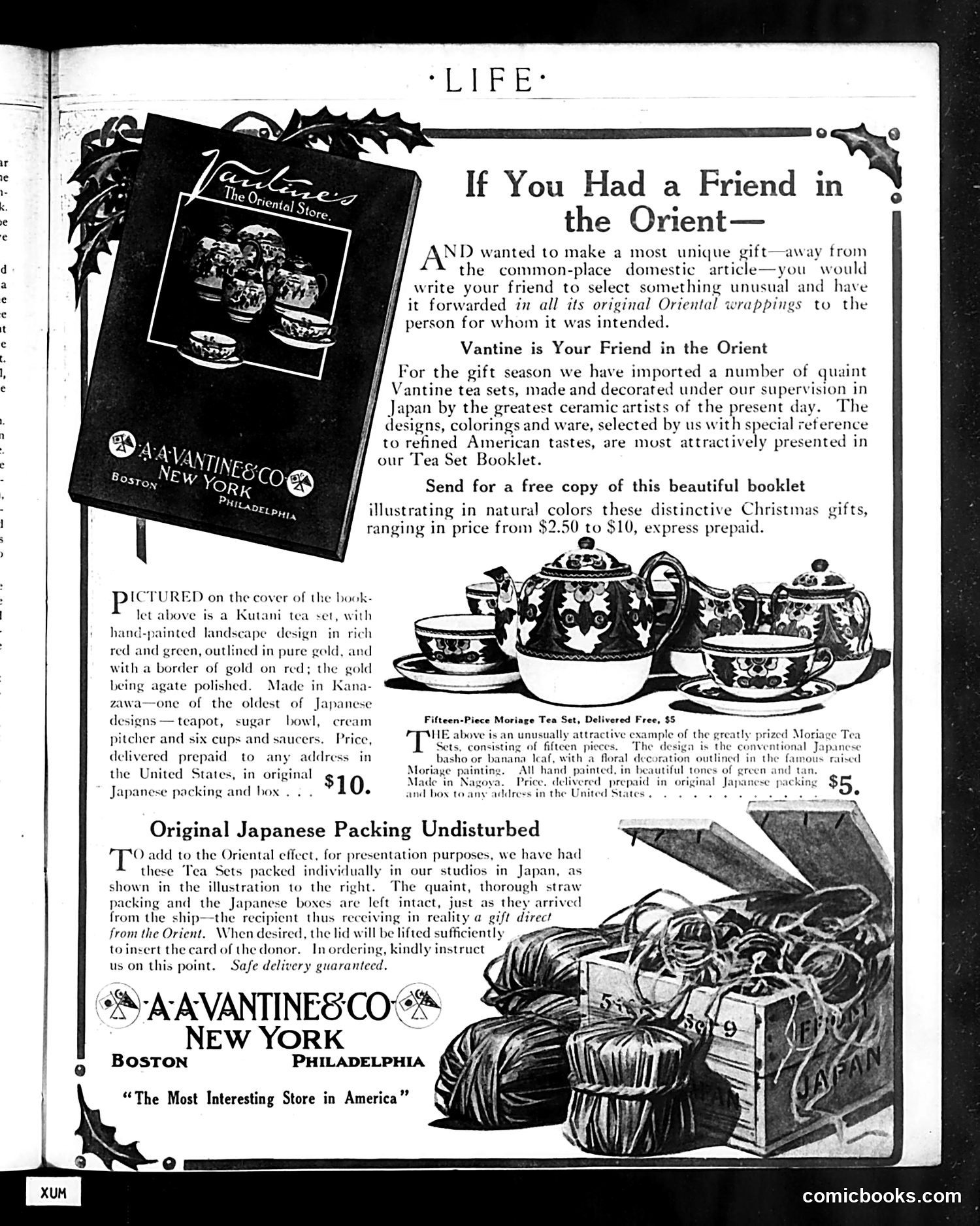
This is primarily an **advertisement**, not a cartoon or satire. It promotes A.A. Vantine & Co.'s Oriental tea sets as luxury Christmas gifts. **The "pitch":** The ad targets wealthy Americans wanting to impress friends by sending exotic Japanese ceramics in original packaging—positioning the gift as authentically "from the Orient" rather than mass-produced domestically. **Key selling points highlighted:** - Hand-painted Kutani tea sets with gold detail ($10) - Fifteen-piece Moriage tea set ($5) - Preserved Japanese straw packing to emphasize authenticity - Free illustrated booklet showing designs **Historical context for modern readers:** This reflects early 20th-century American Japonisme—a fascination with Japanese aesthetics among the affluent. The emphasis on "original Oriental wrappings" and "gift direct from the Orient" suggests consumers valued the exotic appeal and authenticity markers as much as the objects themselves. The ad frames Vantine's as a cultural intermediary, selecting items "with special reference to refined American tastes" while maintaining their "Oriental effect."
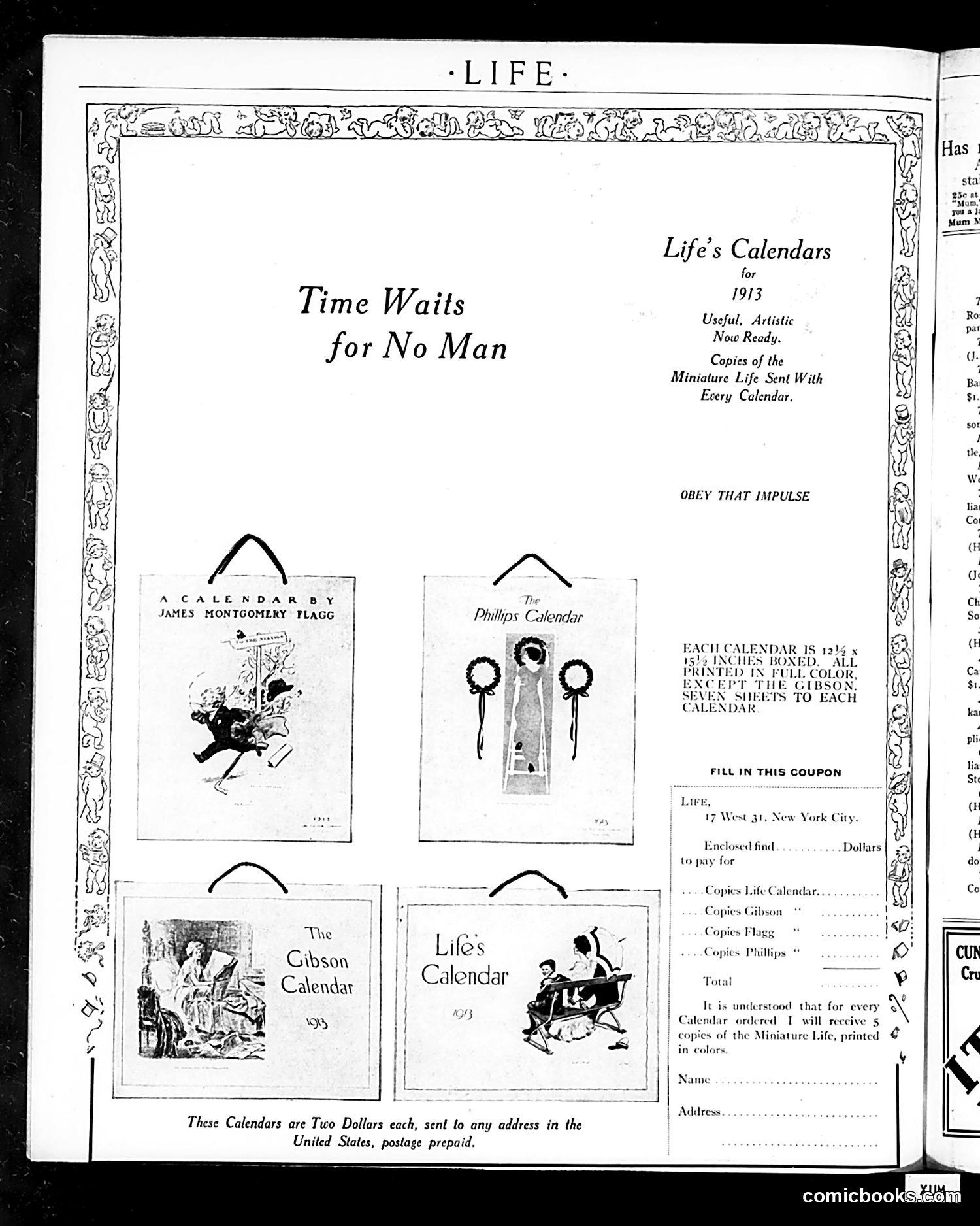
This is primarily a **product advertisement** for Life magazine's 1913 calendars, not a political cartoon. The page promotes four decorative calendar designs by prominent illustrators of the era: James Montgomery Flagg, Phillips, Gibson, and an unnamed Life artist. The headline "Time Waits for No Man" and the tagline "Obey That Impulse" are advertising copy encouraging immediate purchase. The four calendar samples shown feature different artistic styles—Flagg's includes a humorous figure, Gibson's appears to have a classical illustration, and the others display period-appropriate decorative art. Customers fill out the coupon to order calendars at two dollars each, with the incentive that each calendar order includes five miniature Life magazine copies. This is essentially a mail-order sales pitch typical of early 20th-century magazine marketing, not satire or commentary.
This page is primarily **advertising and book listings**, not political satire. The dominant content includes: **Main Advertisement:** The Santa Fe De-Luxe train advertisement features a stylized silhouette of a woman's head in profile, promoting rail travel to California and Arizona's Grand Canyon. This reflects early 1910s luxury tourism marketing—emphasizing comfort, leisure, and scenic destinations for wealthy travelers. **Secondary Ads:** Cunard cruise line and various ship advertisements promote Mediterranean voyages (Naples, Alexandria, Monaco), indicating this page targets affluent readers. **"Books Received" Section:** A standard literary review listing contemporary fiction and non-fiction, including works by Theodore Dreiser and H.G. Wells. **"Mum" Deodorant Ad:** A period product advertisement emphasizing it prevents odor and doesn't stain clothing—notable as early marketing for personal hygiene products. There is **no political cartoon or satire visible** on this page. It represents typical Life magazine content from the 1910s era: upscale consumer advertising mixed with literary notices.
This page is primarily **advertising**, not satire or political commentary. It contains four luxury product advertisements targeting upper-class consumers circa 1910s-1920s: 1. **Dean's Wedding Services** (top left): Promotes elaborate custom wedding cakes and planning services 2. **Blauvelt Sweaters** (top right): Markets hand-knitted, full-fashioned sweaters emphasizing superior craftsmanship 3. **Naiad Dress Shields** (bottom left): Advertises undergarment shields to protect clothing from perspiration, featuring a Cole Phillips illustration 4. **The Linen Store's Handkerchiefs** (bottom right): Emphasizes 60 years of selling pure linen handkerchiefs, with various embroidered and lace options The ads reflect early 20th-century concerns: hygiene (dress shields), quality craftsmanship, luxury goods for special occasions, and the status signaling of fine imported linens. There is no political cartoon or satirical content—this is straightforward period advertising in a magazine known for both humor and commerce.
This page primarily contains **advertising and light verse**, not political satire. The main content is a **Detroit Electric automobile advertisement** (center), using Christmas gift-giving as a marketing hook. It appeals to the fantasy of surprising a wife or daughter with a luxury electric car on Christmas morning—positioning it as superior to Santa's sleigh itself. The ad emphasizes the vehicle's modern "chainless" shaft drive and other technical innovations as selling points to wealthy consumers. The surrounding text consists of humorous **verse celebrating the letter "D"** and its uses (Destiny, Delight, Desire, Divorce, etc.)—a playful word-game rather than satire. An **Old Overholt Rye whiskey ad** appears at bottom left. The "Too Much" short story excerpt at bottom right is unrelated editorial content. This represents Life magazine's typical early-1910s mix of **advertising-supported entertainment for affluent readers**, rather than political commentary.
This page is primarily **advertising and light entertainment** rather than political satire. **Left side:** Two product advertisements—Londonderry Litbia Spring Water (marketed as a digestive aid with "superior quality") and Milo cigarettes (positioned as a sophisticated "after dinner" luxury item). **Right side:** A music column discussing New York's 1920s opera and concert season, celebrating the city's cultural wealth and predicting financial success for classical music venues. **Bottom cartoon:** A humorous domestic scene about marital finances. A wife, asked if her husband gives her all the money she wants, replies "Goodness, no! There isn't that much money." The joke plays on the era's assumption that wives should want unlimited spending money—the humor derives from economic reality constraining desire, and possibly from the wife's frank acknowledgment rather than pretense of contentment. The page reflects 1920s consumer culture and gender dynamics: luxury goods advertising, cultural aspiration, and traditional marriage economics where husbands controlled finances.
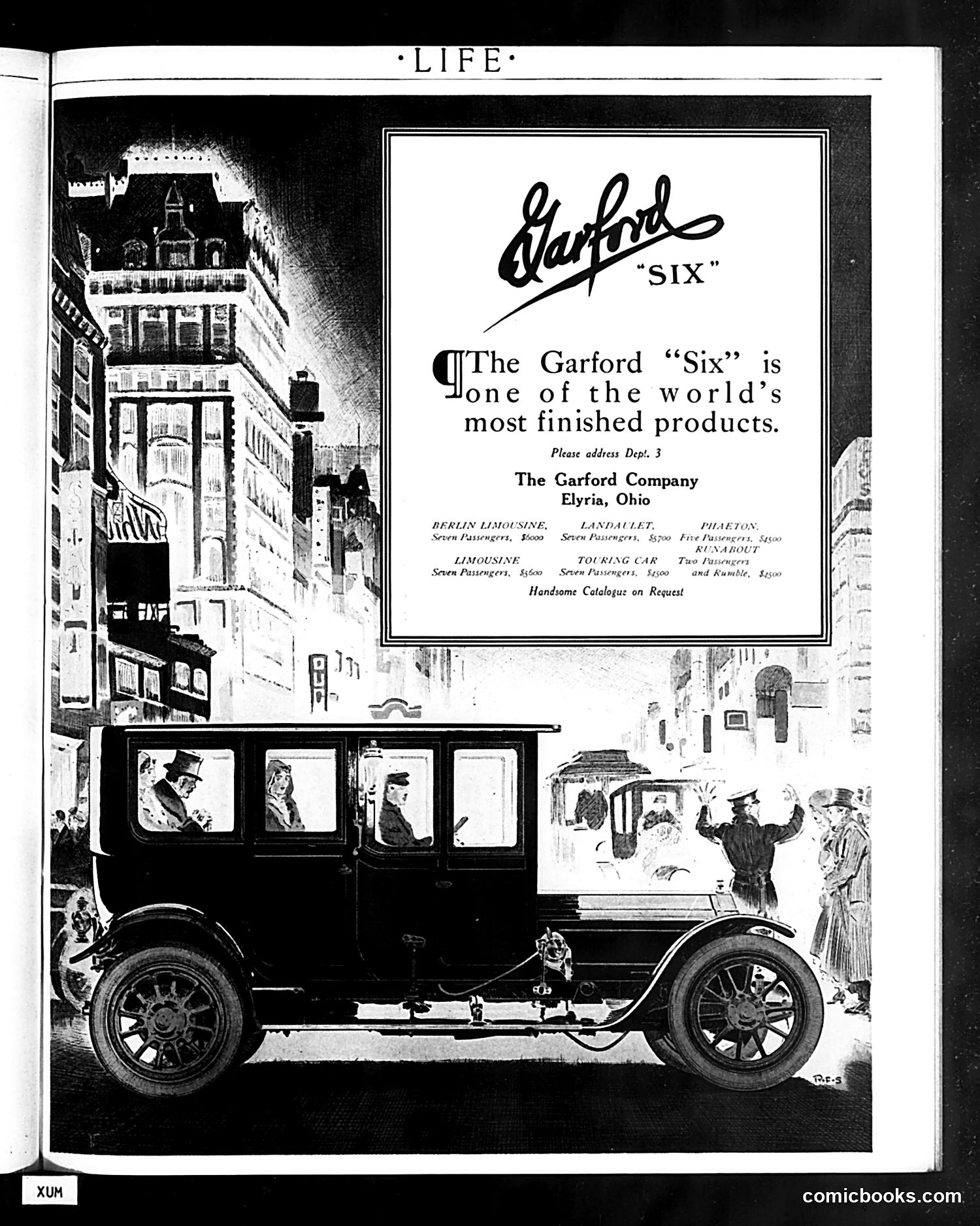
This is primarily an **automobile advertisement**, not satire or political commentary. The Garford Company of Elyria, Ohio is marketing their "Six" automobile model—likely referring to a six-cylinder engine, a luxury feature of the era. The page features an illustrated street scene showing the vehicle alongside period-dressed pedestrians and urban architecture, designed to convey sophistication and refinement. The company describes their product as "one of the world's most finished products," emphasizing quality craftsmanship. Multiple body styles are offered (Berlin Limousine, Landaulet, Phaeton, Touring Car) at varying prices ($3,100–$6,000), indicating this was a premium vehicle targeting wealthy buyers. The "handsome catalogue" invitation suggests readers could request detailed specifications. This represents early 1900s automotive marketing in *Life* magazine's pages.
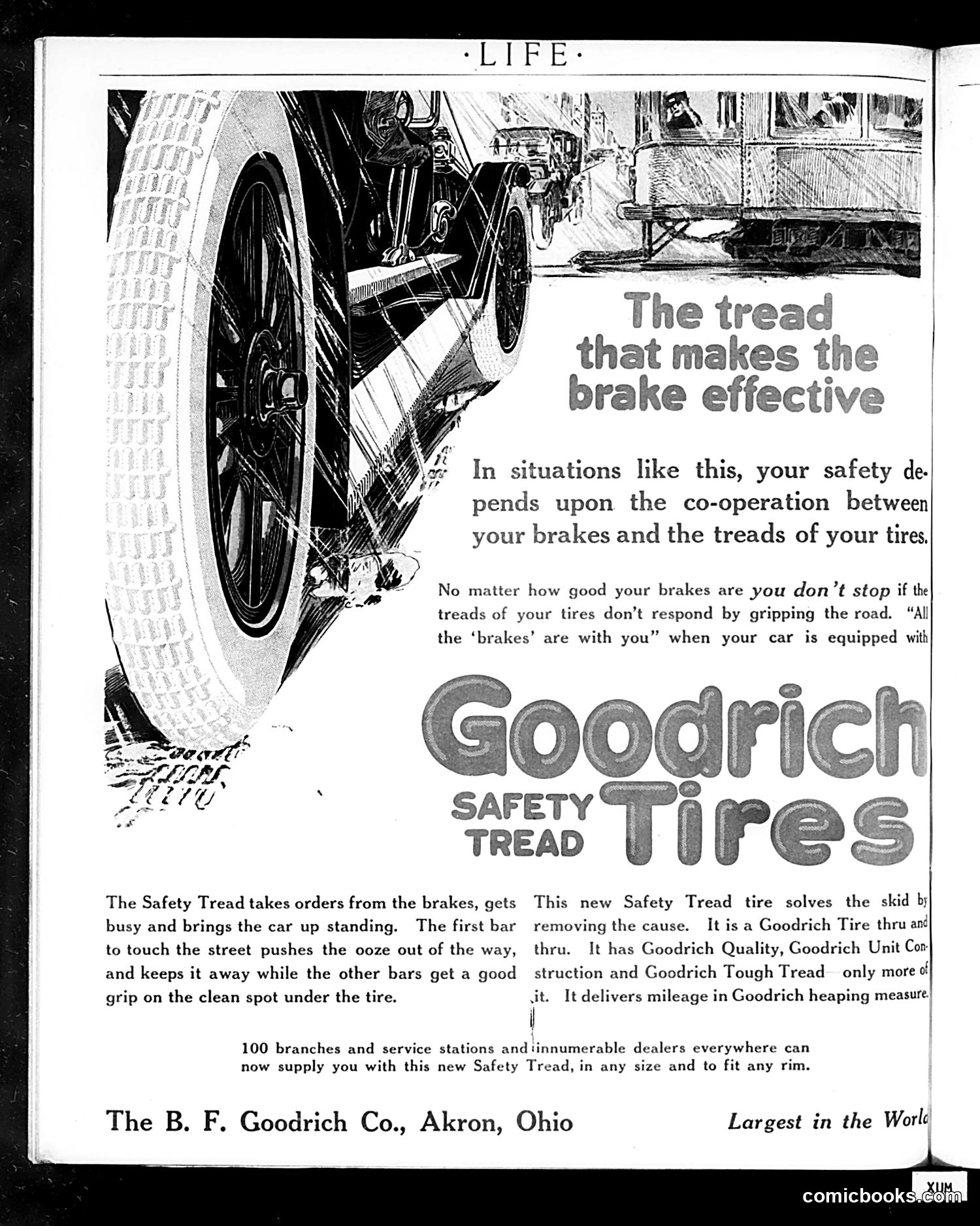
This is primarily a **product advertisement**, not political satire. The page promotes Goodrich's new "Safety Tread" tire, featuring an illustration of a car braking hard on a wet street. The visual demonstrates the tire's function: water is being pushed away by the tread bars, allowing the tire to grip the road and stop effectively. The accompanying text emphasizes that brakes alone cannot stop a car—tire tread quality is equally critical. The marketing angle frames the tire tread as taking "orders from the brakes," personifying it as an active partner in vehicle safety. This was a significant selling point for early 20th-century automobiles, when tire reliability directly impacted driver safety on unpaved or wet roads. The ad promises availability through 100+ Goodrich branches and dealers nationwide, positioning the company (based in Akron, Ohio) as the market leader—"Largest in the World."
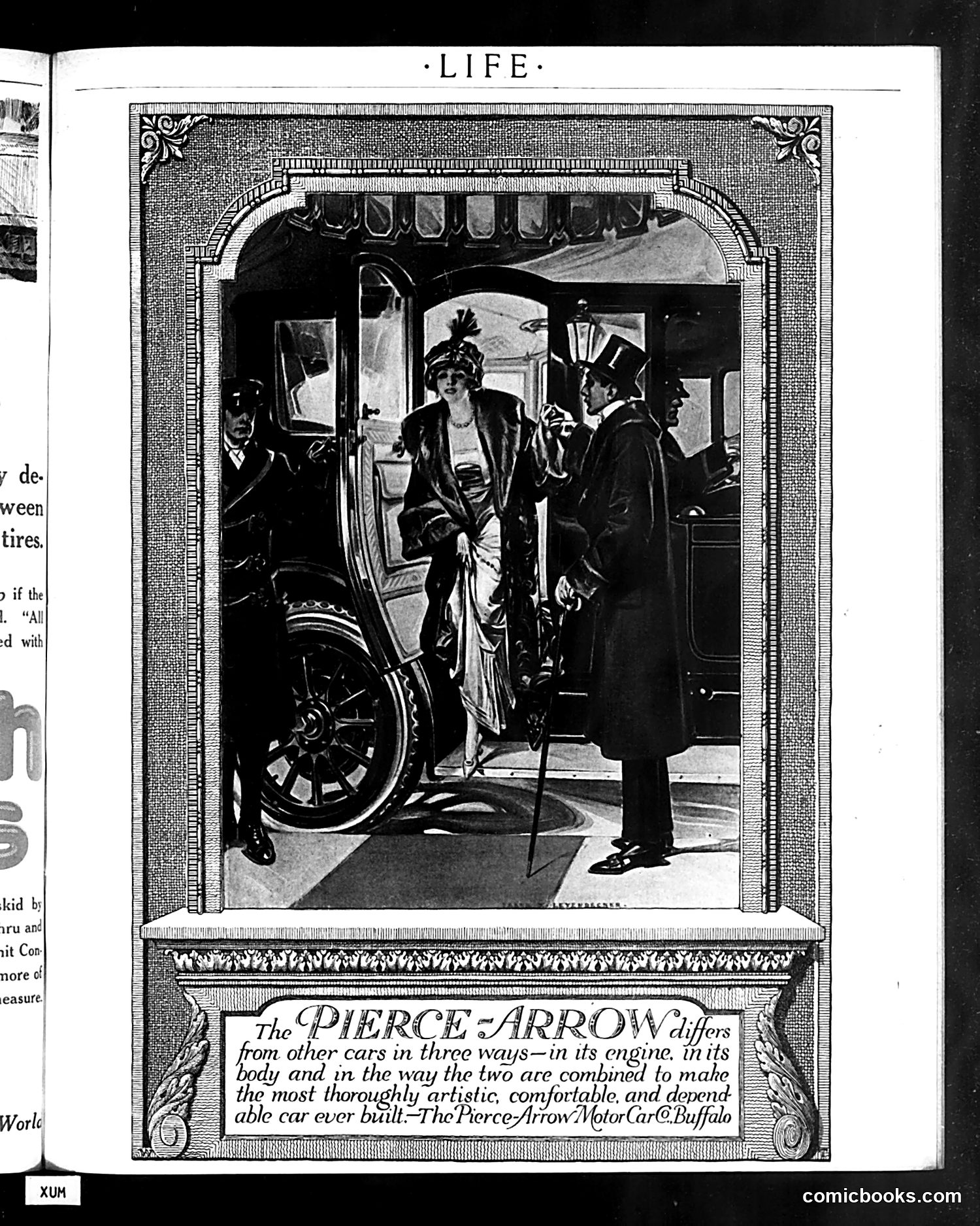
This is primarily a **car advertisement**, not political satire. The image shows elegantly dressed figures in formal attire (top hats, coats) boarding or exiting a Pierce-Arrow automobile, likely depicting wealthy or upper-class passengers. The caption emphasizes the car's three distinguishing features: engine design, body construction, and their integration—claiming it produces "the most thoroughly artistic, comfortable, and dependable car ever built." The visual strategy is aspirational marketing: by depicting fashionably dressed, apparently affluent people, the advertisement associates the Pierce-Arrow with luxury, sophistication, and social status. This was typical early 20th-century automobile marketing that appealed to wealthy consumers. The ornate decorative border and prominent magazine placement (in *Life*, an upscale publication) reinforced the product's positioning as a premium vehicle.
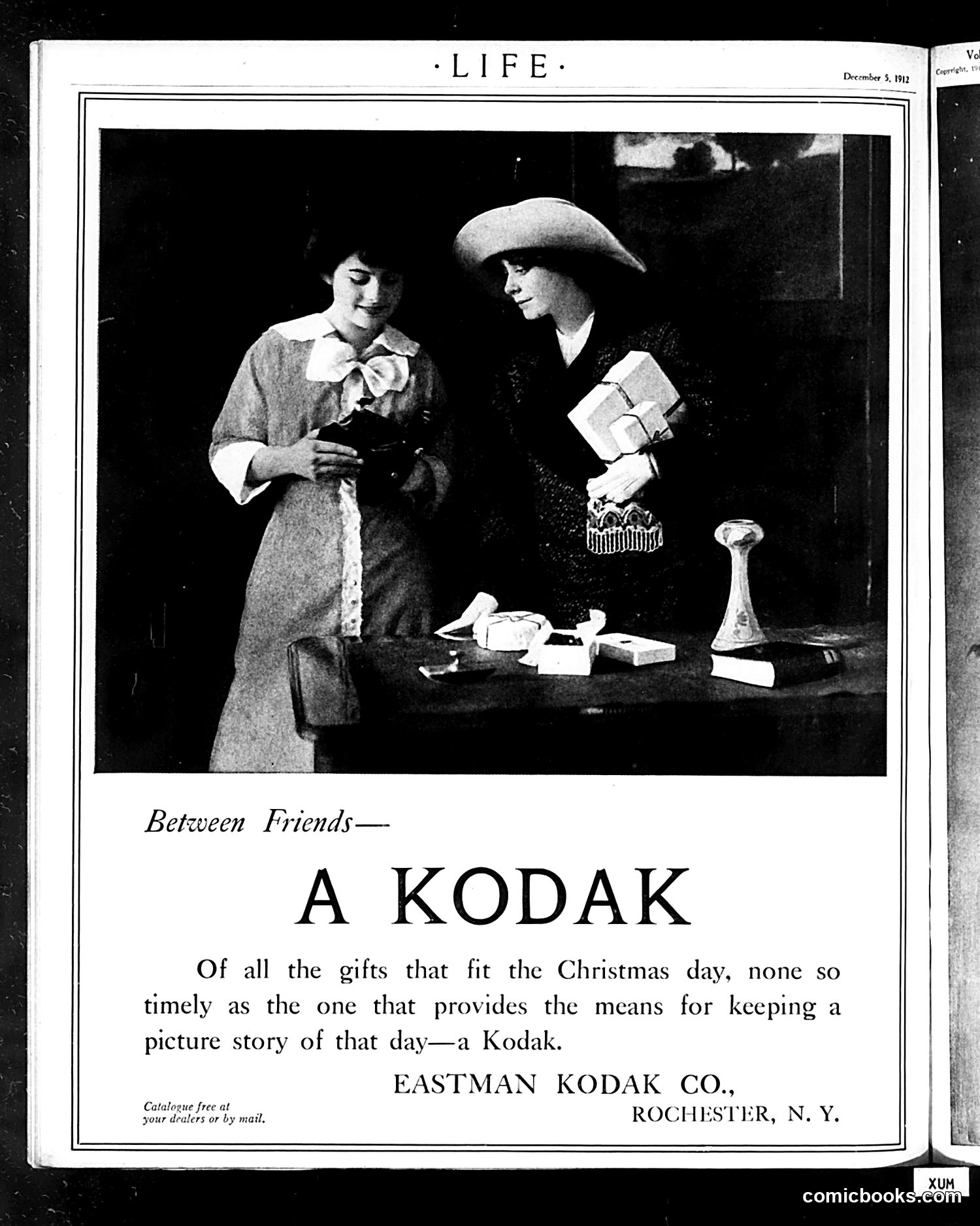
This is a **Kodak advertisement**, not political satire. The page shows two women in what appears to be an early 1900s interior—one in a simpler dress with a bow, the other wearing a large hat and holding wrapped packages. The title "Between Friends" emphasizes social connection. The ad's message is straightforward: a Kodak camera makes an ideal Christmas gift because it lets people document and preserve memories of special occasions. The image depicts a gift-giving moment, reinforcing the product's value for recording life's important social moments. There is no satire, political commentary, or caricature present. This is a sincere commercial pitch published in *Life* magazine's December 5, 1912 issue, appealing to the era's emerging consumer culture around photography and holiday gift-giving.