
Life, 1912-12-05 · page 84 of 116
Life — December 5, 1912 — page 84: what you’re looking at
What you’re looking at
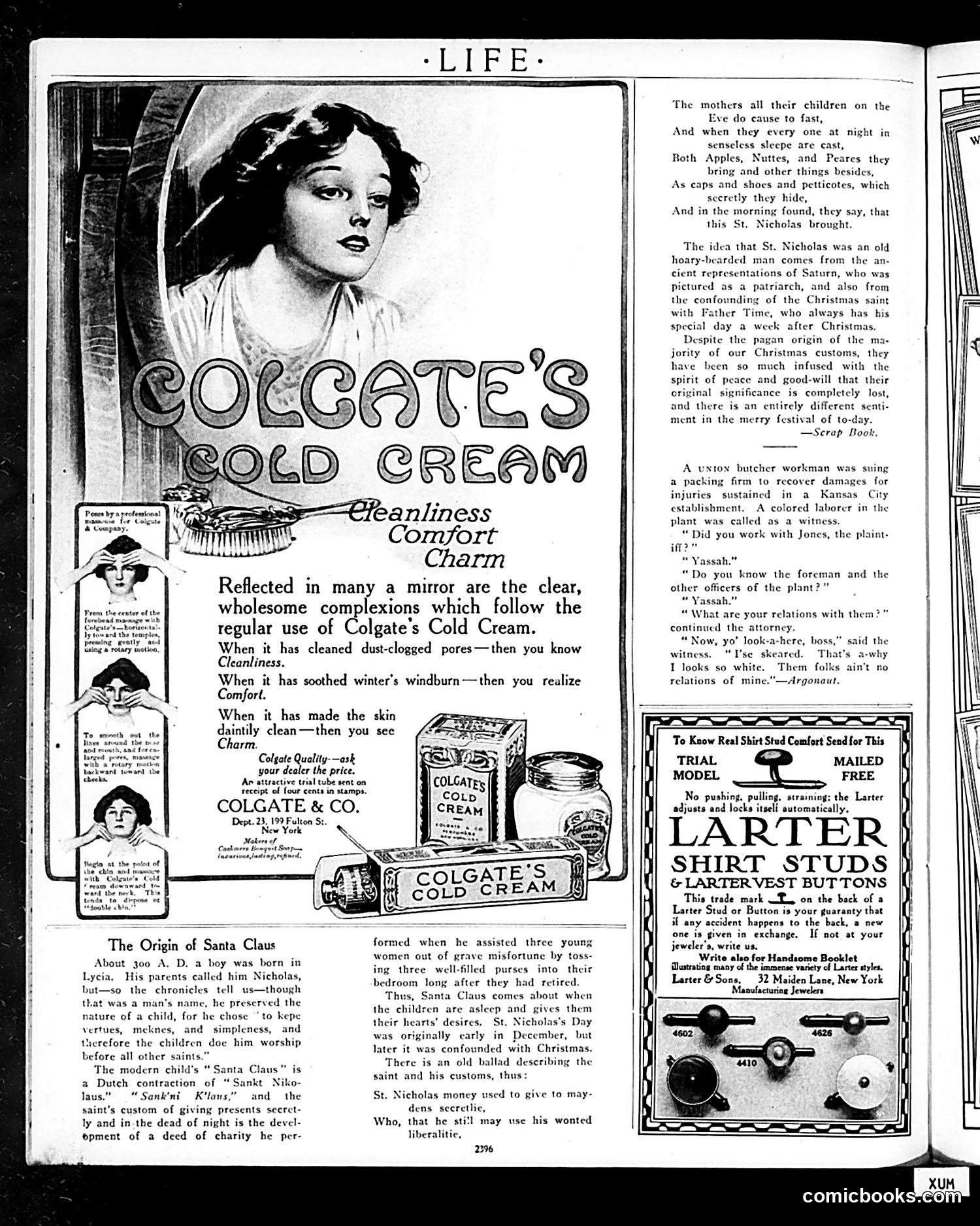
This page contains **primarily advertisements** interspersed with two brief articles. The main advertisement features **Colgate's Cold Cream**, emphasizing cleanliness, comfort, and charm through beauty claims about skin care. The editorial content includes: 1. **"The Origin of Santa Claus"** — a historical explanation tracing Santa to St. Nicholas (circa 300 A.D.), a Turkish saint known for secret gift-giving. The article notes that modern "Santa Claus" derives from Dutch "Sank'ni K'laus" and explains how Christmas customs absorbed earlier pagan traditions (Saturn/Father Time imagery). The point is educational: Christmas practices blend religious and secular origins, though modern celebration emphasizes goodwill rather than original pagan meaning. 2. **A brief anecdote** about a butcher's lawsuit, featuring racial dialect humor typical of early 20th-century publications. A Black worker testifies that white plant officials are "not relations of mine"—the "joke" relies on period stereotypes. The page primarily serves as **advertising vehicle** with light cultural/educational content, typical of Life's format during this era.
📄 Transcribed text from this page (OCR, searchable)
Machine-transcribed from the original scan — historical spelling and the odd misread are preserved.
The mothers all their children on the Eve do cause to fast, And when they every one at night in senseless sleepe are cast, Both Apples, Nuttes, and Peares they bring and other things besides, As caps and shoes and petticotes, which secretly they hide, And in the morning found, they say, that holas_ brought. The idea that St. Nicholas was an old hoary-bearded man comes from the an- cient representations of Saturn, who was pictured as a patriarch, and also from the confounding of the Christmas saint with Father Time, who always has his special day a week after Christmas. Despite the pagan origin of the jority of our Christmas customs, they have been so much infused with the spirit of peace and good-will that their criginal significance is completely lost, and there is an entirely different senti- ment in the merry festival of to-day. —Serap Book. A vunton butcher workman was suing a packing firm to recover damages for fe : injuries sustained in a Kansas City , blishment. A colored Jaborer in the Teeter = eanliness plant vas called as 2 witness, j r Comfort _* Did you work with Jones, the plaint- Charm ey ¥ e & “Do you know the foreman and the Reflected in many a mirror are the clear, other officers of the plant?” “ Yassah.” wholesome complexions which follow the “ What are your relations with them?” regular use of Colgate’s Cold Cream. | continued the attorney. tS ‘A “Now, yo" look-a-here, boss,” said the Cine rotary motion, When it has cleaned dust-clogged pores—then you know ihe ie Wesel awhy Cleanliness. I looks so white. Them folks ain't no When it has soothed winter's windburn—then you realize ' relations of mine.”"—Argonaut. Comfort. When it has made the skin daintily clean—then you see ‘harm. Coltate Quality sat } ? TRIAL MAILED ir deales rice, yout r the price. = ; MODEL FREE Ap attractive trial tube sent on receipe fot cents in Reap No pushing, pulling, straining; the Larter COLGATE & CO. adjusts and locks itself automatically. Dept. 23. 199 Fulton = - iH es 6) ||| LARTER Makers of : i — 5 SHIRT STUDS & LARTER VEST BUT TONS This trade mark —D. on the back of a Larter Stud or Button is your guaranty that if any accident happens to the back, a new one is given in exchange. If not at your The Origin of Santa Claus formed ici he aasigted three young jeweler's, write us, . . women out of grave misfortune by toss- Write alto for Handsome Booklet About 300 A. D. a boy was born in ing three well-filled purses into their lastrating many of the immense variety of Larter styles, Lycia. His parents called him holas, See @ 3 buk-—so: ie chronicles teil’ us—ahoush. long after they had retired. Easter Sone, 32 Mi iden Lane, New York that was a man’s name, he preserved the nature of a child, for he chose ‘to kepe vertues, meknes, and simpleness, and therefore the children doc him worship before all other saint The modern child's “ Santa Claus” is a Dutch contraction of “Sankt Niko- . laus.” “Sank'ni K'laus," and the St. Nicholas money used to give to may- saint's custom of giving presents secret- dens scerctlie, ly and in the dead of night is the devel- Who, that he sti!l may use his wonted opment of a deed of charity he per- liberaliti aus comes about wh the children are asleep and gives them their hearts’ desires. St. Nicholas’s Day was originally carly in December, but later it was confounded with Christmas. There is an old ballad describing the saint and his customs, thus: 296 comicbookseeml