
Life, 1912-12-05 · page 42 of 116
Life — December 5, 1912 — page 42: what you’re looking at
What you’re looking at
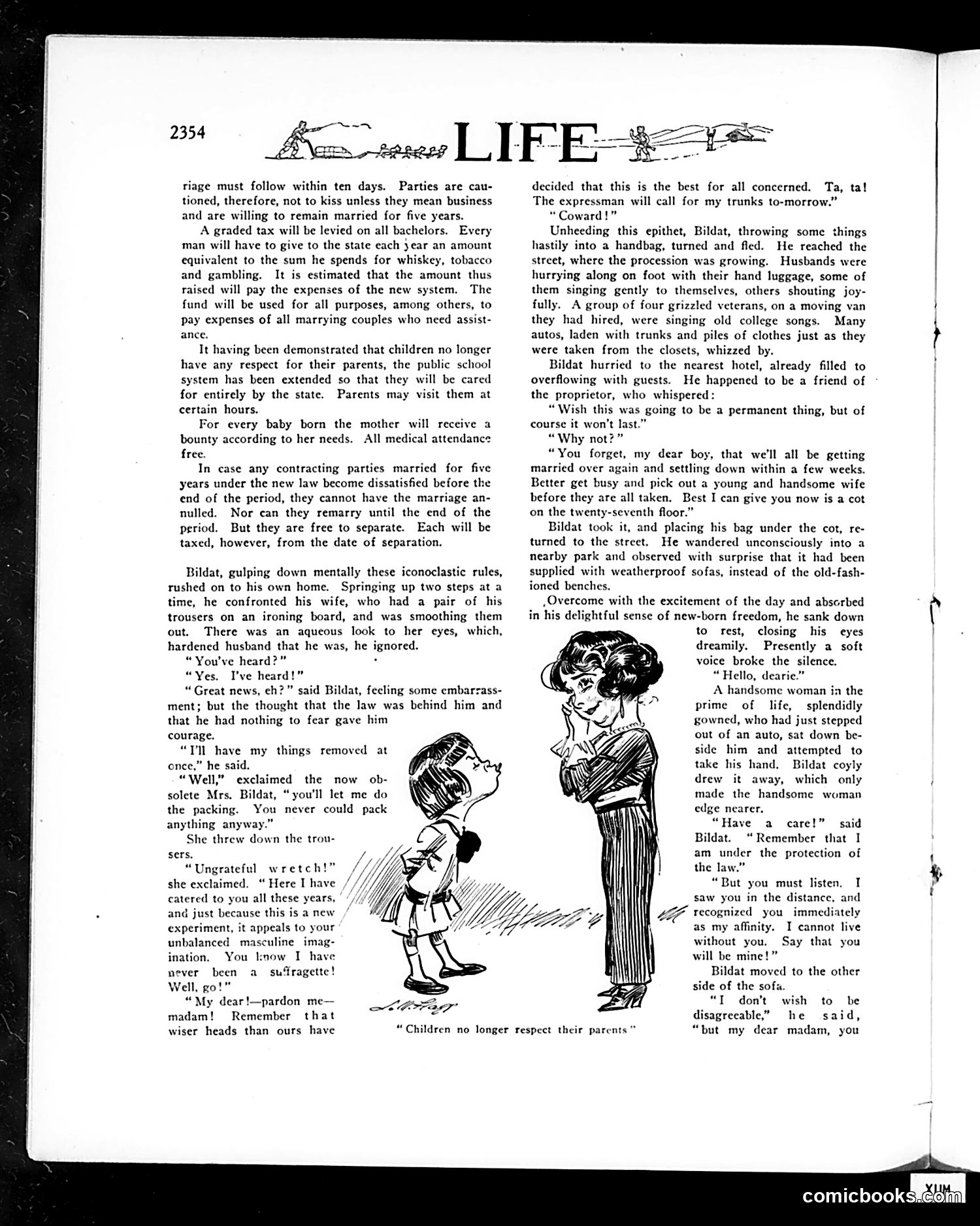
This *Life* magazine excerpt satirizes radical feminist proposals for state-controlled marriage and family life. The story follows "Bildat," who learns of new laws mandating marriage within ten days, taxing bachelors, removing child-rearing from parents, and enforcing five-year marriage contracts. The satire's target is clear: when Bildat announces he's leaving his wife under these new rules, she's devastated—revealing the satire's conservative point. The illustration shows a wife pleading with her departing husband, captioned "Children no longer respect their parents," ironically suggesting that state control of families destroys traditional respect and morality. The mass exodus of husbands from hotels, the proprietor's quip that the law "won't last," and the general chaos all mock what the author saw as absurd, unnatural social engineering. The satire defends traditional marriage and parental authority against what it portrays as dangerous feminist experimentation.
📄 Transcribed text from this page (OCR, searchable)
Machine-transcribed from the original scan — historical spelling and the odd misread are preserved.
riage must follow within ten days. Parties are cau- tioned, therefore, not to kiss unless they mean business and are willing to remain married for five years. A graded tax will be levied on all bachelors. Every man will have to give to the state each year an amount equivalent to the sum he spends for whiskey, tobacco and gambling. It is estimated that the amount thus raised will pay the expenses of the new system. The fund will be used for all purposes, among others, to pay expenses of all marrying couples who need assist- ance, It having been demonstrated that children no longer have any respect for their parents, the public school system has been extended so that they will be cared for entirely by the state. Parents may visit them at certain hours. For every baby born the mother will receive a bounty according to her needs. All medical attendance free. In case any contracting parties married for five years under the new law become dissatisfied before the end of the period, they cannot have the marriage an- nulled. Nor can they remarry until the end of the period. But they are free to separate. Each will be taxed, however, from the date of separation. Bildat, gulping down mentally these iconoclastic rules, rushed on to his own home. Springing up two steps at a time, he confronted his wife, who had a pair of his trousers on an ironing board, and was smoothing them out. There was an aqueous look to her eyes, which, hardened husband that he was, he ignored. “You've heard?” . “Yes. I've heard!” “Great news, eh?” said Bildat, feeling some embarrass- ment; but the thought that the law was behind him and that he had nothing to fear gave him courage. “Tl have my things removed at once,” he said, “Well,” exclaimed the now ob- solete Mrs. Bildat, “you'll let me do the packing. You never could pack anything anyway.” She threw down the trou- sers. “Ungrateful wretch!” she exclaimed. “ Here I have catered to you all these years, and just because this is a new experiment, it appeals to your unbalanced masculine ima ination. You know I have never been a sufragette! Well, go!” “My dear!—pardon me— madam! Remember that wiser heads than ours have Oras “Children no longer respect their parents” aad decided that this is the best for all concerned. Ta, ta! The expressman will call for my trunks to-morrow.” “Coward!” Unheeding this epithet, Bildat, throwing some things hastily into a handbag, turned and fled. He reached the street, where the procession was growing. Husbands were hurrying along on foot with their hand luggage, some of them singing gently to themselves, others shouting joy- fully. A group of four grizzled veterans, on a moving van they had hired, were singing old college songs. Many autos, laden with trunks and piles of clothes just as they were taken from the closets, whizzed by. Bildat hurried to the nearest hotel, already filled to overflowing with guests. He happened to be a friend of the proprietor, who whispered: “Wish this was going to be a permanent thing, but of course it won't last. “Why not?” “You forget, my dear boy, that we'll all be getting married over again and settling down within a few weeks. Better get busy and pick out a young and handsome wife before they are all taken. Best I can give you now is a cot on the twenty-seventh floor.” Bildat took it, and placing his bag under the cot, re- turned to the street. He wandered unconsciously into a nearby park and observed with surprise that it had been supplied with weatherproof sofas, instead of the old-fash- ioned benches. , Overcome with the excitement of the day and absorbed in his delightful sense of new-born freedom, he sank down to rest, closing his eyes dreamily. Presently a soft voice broke the silence. “Hello, dearie.” A handsome woman ia the prime of life, splendidly gownced, who had just stepped out of an auto, sat down be- side him and attempted to take his hand. Bildat coyly drew it away, which only made the handsome woman edge nearer, “Have a care!” said Bildat. “Remember that I am under the protection of the law, “But you must listen. I saw you in the distance, and recognized you immediately as my affinity. I cannot live without you. Say that you will be mine!” Bildat moved to the other side of the sofa. “T don’t wish to be disagreeable,” he said, “but my dear madam, you t comicbookMee a