
Life, 1912-12-05 · page 66 of 116
Life — December 5, 1912 — page 66: what you’re looking at
What you’re looking at
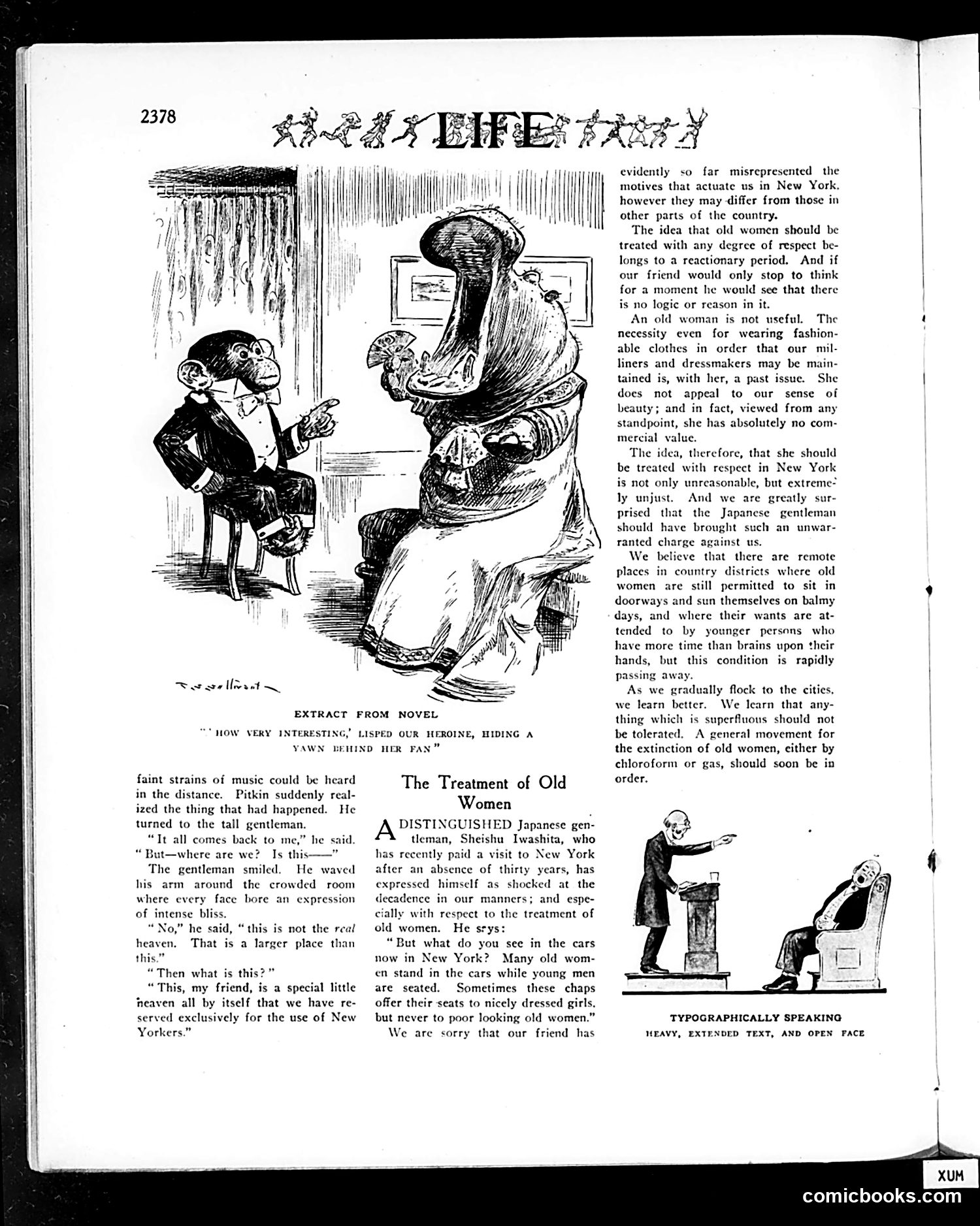
This Life magazine page contains satirical commentary on modernism's callousness toward the elderly. A visiting Japanese gentleman, Sheishu Iwashita, criticized New York for disrespecting old women—noting young men offer subway seats to fashionably dressed girls but never to poor-looking elderly women. Life's response is biting satire: the editors sarcastically argue old women deserve no respect because they're "not useful," have "no commercial value," and don't appeal to "our sense of beauty." They mock the idea that respect for elders belongs to "a reactionary period," then escalate absurdly, suggesting a "general movement for the extinction of old women, either by chloroform or gas." The accompanying cartoon (left) shows a small figure speaking to a large woman, illustrating the social dynamics. Life is satirizing contemporary American materialism and indifference to the elderly—suggesting society values only the young, economically productive, and aesthetically pleasing.
📄 Transcribed text from this page (OCR, searchable)
Machine-transcribed from the original scan — historical spelling and the odd misread are preserved.
Des relist EXTRACT FROM NOVEL “HOW VERY INTERESTIS L PED OUR HEROINE, HIDING A YAWN BEHIND HER FAN” faint strains of music could be heard in the distance. Pitkin suddenly real- ized the thing that had happened. He turned to the tall gentleman. “Tt all comes back to me,” he said. But—where are we? Is this The gentleman smiled. He waved his arm around the crowded room where every face bore an expression of intense bliss. “No,” he said, “this is not the real heaven. That is a larger place than this.” “Then what is this?” “This, my friend, is a special little heaven all by itself that we have re- served exclusively for the use of } Yorkers.” The Treatment of Old Women DISTINGUISHED Japanese gen- tleman, Sheishu Iwashita, who has recently paid a visit to New York after an absence of thirty years, has expressed himself as shocked at the decadence in our manners; and espe- Hy with respect to the treatment of old women. He srys: “But what do you see in the cars now in New York? Many old wom- en stand in the cars while young men are seated. Sometimes these chaps offer their seats to nicely dressed girls. but never to poor looking old women.” We are sorry that our friend has evidently so far misrepresented the motives that actuate us in New York, however they may differ from those in other parts of the country. The idea that old women should be treated with any degree of respect be- longs to a reactionary period. And if our friend would only stop to think for a moment he would see that there is no logic or reason in it. An old woman is not useful. The necessity even for wearing fashion- able clothes in order that our mil- liners and dressmakers may be main- tained is, with her, a past issue. She does not appeal to our sense of beauty; and in fact, viewed from any standpoint, she has absolutely no com- mercial value. The idea, therefore, that she should be treated with respect in New York is not only unreasonable, but extreme- ly unjust. And we are greatly sur- prised that the Japanese gentleman should have brought such an unwar- ranted charge against us. We believe that there are remote places in country districts where old women are still permitted to sit in doorways and sun themselves on balmy days, and where their wants are at- tended to by younger persons who have more time than brains upon their hands, but this condition is rapidly passing away. As we gradually flock to the cities, we learn better. We learn that any- thing which is superfluous should not be tolerated. A general movement for the extinction of old women, either by chloroform or gas, should soon be in order. TYPOGRAPHICALLY SPEAKING MEAVY, EXTENDED TEXT, AND OPEN PACE comicbooks.com