
Life, 1912-12-05 · page 45 of 116
Life — December 5, 1912 — page 45: what you’re looking at
What you’re looking at
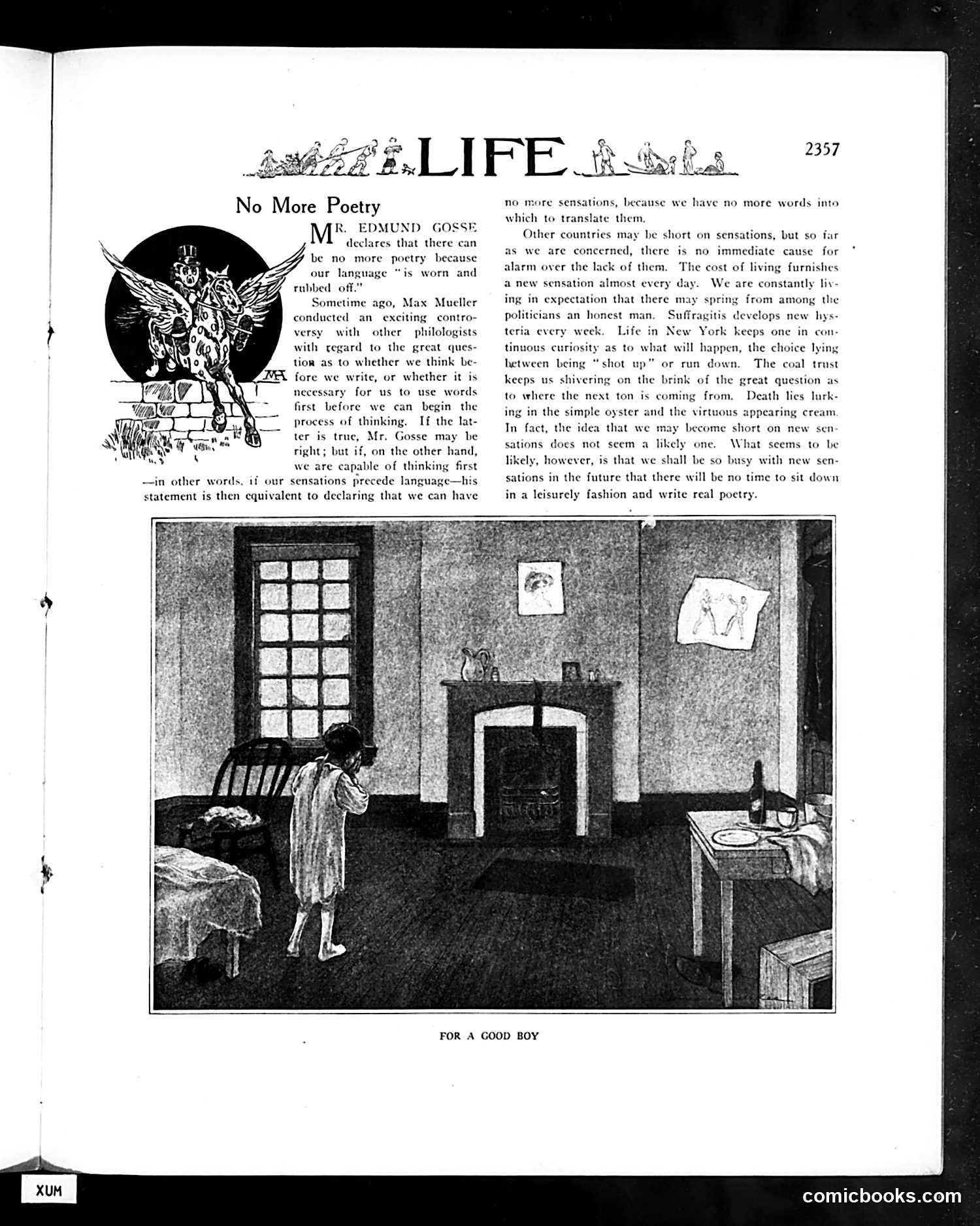
This article satirizes British critic Edmund Gosse's claim that English poetry is dead because the language is "worn and rubbed off." The author (likely Max Mueller or a Life contributor) refutes Gosse's argument through ironic absurdity: if language precedes sensation (as some philologists debate), then lacking new words means lacking new experiences. But America, the author insists, has *plenty* of new sensations—constant anxiety about the cost of living, perpetual hope for honest politicians, disease outbreaks, coal shortages, and food safety scares. The satire's point: modern American life is so overstimulating and chaotic that we lack *time* for leisurely poetry-writing, not lack of language or experience. The accompanying illustration ("For a Good Boy") shows a sparse, melancholy interior, possibly reinforcing the deadening effect of modern anxieties on artistic pursuits. This reflects early 1900s American cultural anxieties about rapid industrialization and urbanization.
📄 Transcribed text from this page (OCR, searchable)
Machine-transcribed from the original scan — historical spelling and the odd misread are preserved.
No More i ME. EpMUND Gosse declares that there can be no more poetry because our language “is worn and rubbed off.” Sometime ago, Max Mueller conducted an exciting contro- versy with other _philologists with regard to the great ques- tion as to whether we think be- fore we write, or whether it is necessary for us to use words first before we can begin the process of thinking. If the lat- ter is true, Mr. sse may be right; but if, on the other hand, we are capable of thinking first —in other words, if our sensations precede language—his statement is then equivalent to declaring that we can have 2357 f no more sensations, because we have no more words into which to translate them, Other countries may be short on sensations, but so far ned, there is no immediate cause for of them, as we are cone alarm over the The cost of living furnishes a new sensation almost every day. We are constantly liv- ing in expectation that there may spring from among the politicians an honest man, Suffragitis d teria every week. Life clops new hys- New York keeps one in con- tinuous curiosity as to what will happen, the choice lying hetween being “shot up” The coal trust keeps us shivering on the brink of the great question as to where the next ton is coming from. or run down. Death lies lurk- ing in the simple oyster and the virtuous appearing cream In fact, the idea that we may become short on new sen sations does not seem a like! one. What seems to be likely, however, is that we shall be so busy with new sen- sations in the future that there will be no time to sit down in a leisurely fashion and write real poetry. Re PTA ACS FOR A GOOD BOY comicbooks.com