
Life, 1912-12-05 · page 112 of 116
Life — December 5, 1912 — page 112: what you’re looking at
What you’re looking at
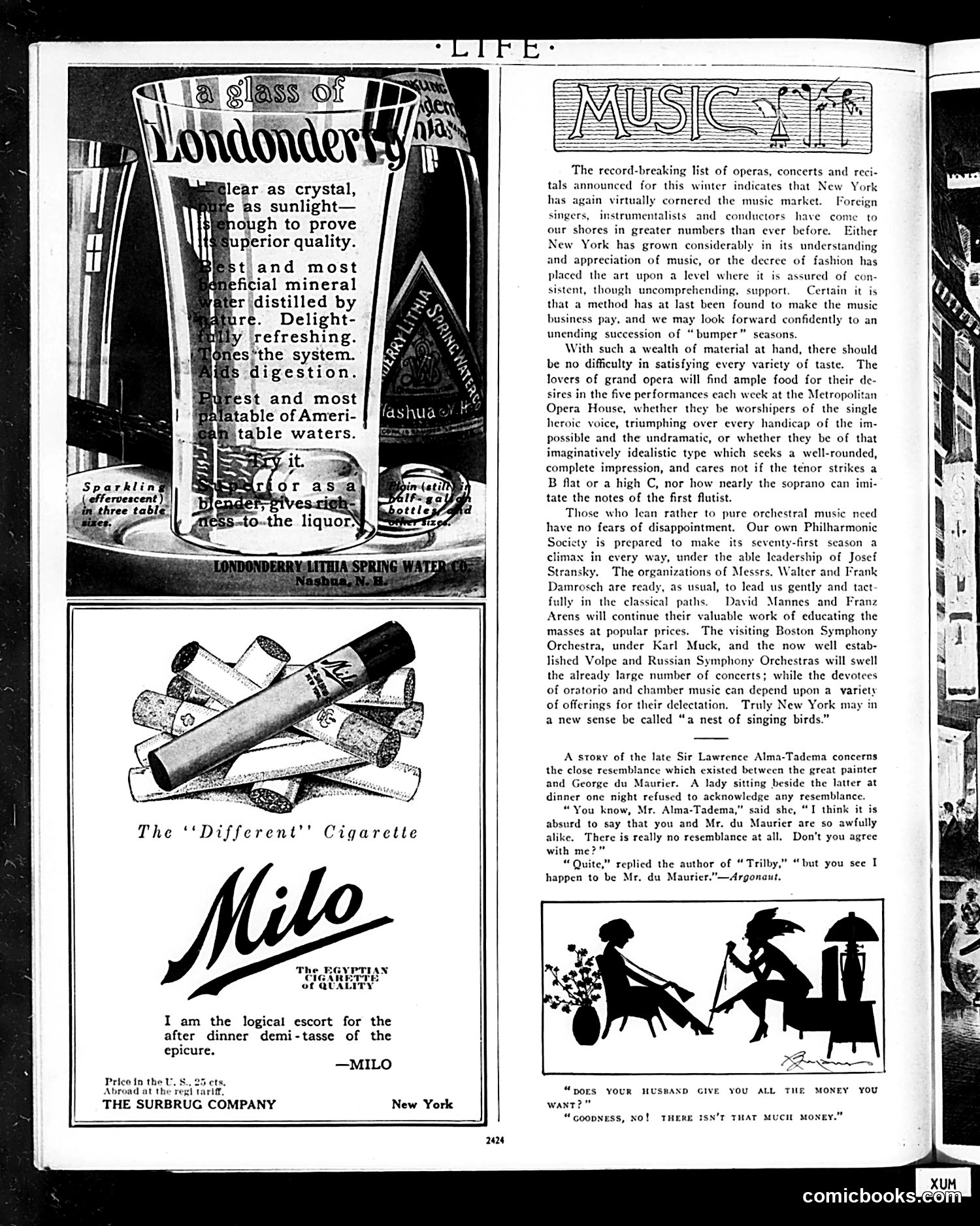
This page is primarily **advertising and light entertainment** rather than political satire. **Left side:** Two product advertisements—Londonderry Litbia Spring Water (marketed as a digestive aid with "superior quality") and Milo cigarettes (positioned as a sophisticated "after dinner" luxury item). **Right side:** A music column discussing New York's 1920s opera and concert season, celebrating the city's cultural wealth and predicting financial success for classical music venues. **Bottom cartoon:** A humorous domestic scene about marital finances. A wife, asked if her husband gives her all the money she wants, replies "Goodness, no! There isn't that much money." The joke plays on the era's assumption that wives should want unlimited spending money—the humor derives from economic reality constraining desire, and possibly from the wife's frank acknowledgment rather than pretense of contentment. The page reflects 1920s consumer culture and gender dynamics: luxury goods advertising, cultural aspiration, and traditional marriage economics where husbands controlled finances.
📄 Transcribed text from this page (OCR, searchable)
Machine-transcribed from the original scan — historical spelling and the odd misread are preserved.
e as sunlight— ough to prove perior quality. t.and most eficial mineral = refreshing. ones*the system. digestion. I am the logical escort for the after dinner demi-tasse of the epicure. —MILO Price in the U. cts, Abroad at the regi tariff. THE SURBRUG COMPANY New York The record-breaking list of operas, concerts and reci- announced for this winter indicates that New York again virtually cornered the music market. Foreign singers, instrumentalists and conductors have come to our shores in greater numbers than ever before. Either New York has grown considerably in its understanding and appreciation of music, or the decree of fashion has placed the art upon a level where it is assured of con- sistent, though uncomprehending, support. Certain it is that a method has at last been found to make the music business pay, and we may look forward confidently to an unending succession of “bumper” seasons. With such a wealth of material at hand, there should be no difficulty in satisfying every variety of taste. The lovers of grand opera will find ample food for their de- sires in the five performances each week at the Metropolitan Opera House, whether they be worshipers of the single heroic voice, triumphing over every handicap of the im- possible and the undramatic, or whether they be of that imaginatively idealistic type which seeks a well-rounded, complete impression, and cares not if the tenor strikes a B flat or a high C, nor how nearly the soprano can imi- tate the notes of the first flutist. Those who lean rather to pure orchestral music need have no fears of disappointment. Our own Philharmonic Society is prepared to make its seventy-first season a climax in every way, under the able leadership of Josef Stransky. The organizations of Messrs, Walter and Frank Damrosch are ready, as usual, to lead us gently and tact fully in the classical paths. David Mannes and Franz Arens will continue their valuable work of educating the masses at popular prices. The visiting Boston Symphony Orchestra, under Karl Muck, and the now well estab- lished Volpe and Russian Symphony Orchestras will swell the already large number of concerts; while the devotces of oratorio and chamber music can depend upon a_ variety of offerings for their delectation, Truly New York may in a new sense be called “a nest of singing birds.” A story of the late Sir Lawrence Alma-Tadema concerns the close resemblance which existed between the great painter and George du Mau A lady sitting beside the latter at dinner one night refused to acknowledge any resemblance. “You know, Mr. Alma-Tadema,” said she, “I think it is absurd to say that you and Mr. du Maurier are so awfully alike. There is really no resemblance at all, Don't you agree with me?” “Quite,” replied the author of “Trilby,” “but you see I happen to be Mr. du Maurier."”—Argonaut. “DOES YOUR HUSBAND GIVE YOU ALL TIE MONEY want?” “Goopness, NO! THERE ISN’T THAT MUCIL MONEY.” comicbooks Men