
Life, 1912-12-05 · page 43 of 116
Life — December 5, 1912 — page 43: what you’re looking at
What you’re looking at
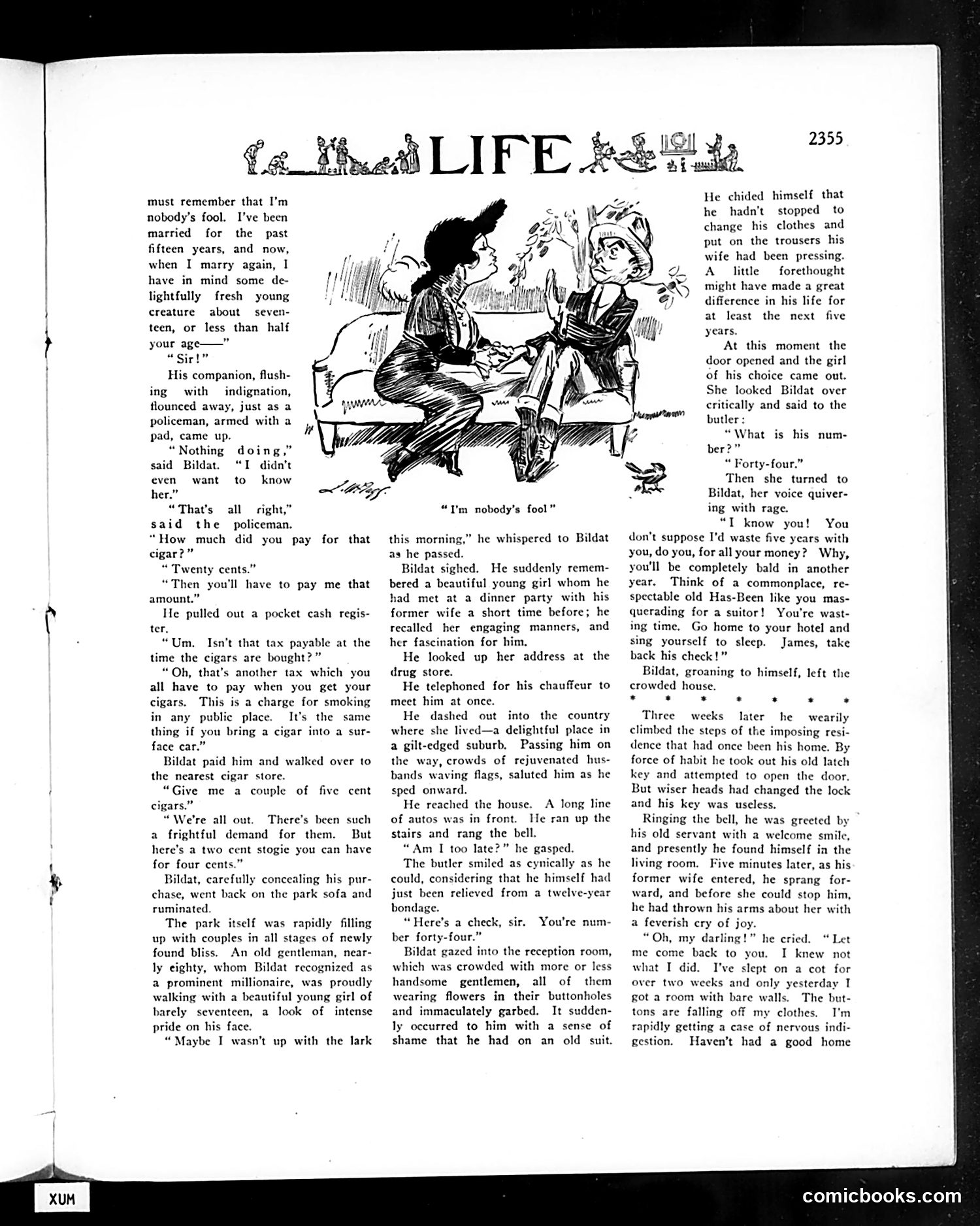
This is satirical fiction mocking the social upheaval of the 1920s, likely following passage of women's suffrage and changing gender dynamics. The story depicts a middle-aged man (Bildat) who, after fifteen years of marriage, decides to remarry a teenage girl. He encounters absurd taxation on cigars and witnesses an elderly millionaire proudly parading with a seventeen-year-old—suggesting an era where wealthy older men pursued youth. When Bildat pursues a young woman he'd met, he arrives at her home to find it crowded with suitors bearing flowers. The young woman rejects him harshly, scorning his age, baldness, and wealth, dismissing him as a "Has-Been." The satire critiques both male vanity (believing money guarantees romantic success with young women) and the new female assertiveness—women now have standards beyond financial security and reject unsuitable matches outright. The cartoon mocks the disorientation of men confronting liberated women who won't accept their previous social dominance.
📄 Transcribed text from this page (OCR, searchable)
Machine-transcribed from the original scan — historical spelling and the odd misread are preserved.
fa thal LIFE ee must remember that I’m nobody’s fool. I’ve been married for the past fifteen years, and now, when I marry again, I have in mind some de- lightfully fresh young creature about seven- teen, or less than half your age—” “Sich” His companion, flush- ing with indignation, flounced away, just as a policeman, armed with a pad, came up. “Nothing doing,” said Bildat. “I> didn’t even want to know her.” “That's all right,” said the policeman. “How much did you pay for that cigar?” “ Twenty cents.” “Then you'll have to pay me that amount.” He pulled out a pocket cash regis- ter. “Um. Isn't that tax payable at the time the cigars are bought?” “Oh, that’s another tax which you all have to pay when you get your cigars. This is a charge for smoking in any public place. It’s the same thing if you bring a cigar into a sur- face car.” Bildat paid him and walked over to the nearest cigar store. “Give me a couple of five cent cigars.” “We're all out. There's been such a frightful demand for them. But here’s a two cent stogie you can have for four cents.” Bildat, carefully concealing his pur- chase, went back on the park sofa and ruminated. The park itself was rapidly filling up with couples in all stages of newly found bliss. An old gentleman, near- ly eighty, whom Bildat recognized as a prominent millionaire, was proudly walking with a beautiful young girl of barely seventeen, a look of intense pride on his face. “Maybe I wasn’t up with the lark “I'm nobody's fool” this morning,” he whispered to Bildat as he passed. Bildat sighed. He suddenly remem- bered a beautiful young girl whom he had met at a dinner party with his former wife a short time before; he recalled her engaging manners, and her fascination for him, He looked up her address at the drug store. He telephoned for his chauffeur to mect him at once. He dashed out into the country where she lived—a delightful place in a gilt-edged suburb. Passing him on the way, crowds of rejuvenated hus- bands waving flags, saluted him as he sped onward. He reached the house. A long line of autos was in front. He ran up the stairs and rang the bell. “Am I too late?” he gasped. The butler smiled as cynically as he could, considering that he himself had just been relieved from a twelve-year bondage. “Here's a check, sir. ber forty-four.” Bildat gazed into the reception room, which was crowded with more or less handsome gentlemen, all of them wearing flowers in their buttonholes and immaculately garbed. It sudden- ly occurred to him with a sense of shame that he had on an old suit. You're num- 2355 He chided himself that he hadn't stopped to change his clothes and put on the trousers his ife had been pressing. little forethought might have made a great difference in his life for at least the next years. At this moment the door opened and the girl of his choice came out. She looked Bildat over critically and said to the butler: “What ber?” Forty-four.” Then she turned to Bildat, her voice quiver- ing with rage. “T know you! You don’t suppose I'd waste five years with you, do you, for all your money? Why, you'll be completely bald in another year. Think of a commonplace, re- spectable old Has-Been like you mas- querading for a suitor! You're wast- ing time. Go home to your hotel and sing yourself to sleep. James, take back his check!” Bildat, groaning to himself, left the crowded house. . * * * * * . five is his num- Three weeks later he wearily climbed the steps of the imposing resi- dence that had once been his home. By force of habit he took out his old latch key and attempted to open the door, But wiser heads had changed the lock and his key was useless. Ringing the bell, he was greeted by his old servant with a welcome smile, and presently he found himself in the living room. Five minutes later, as his former wife entered, he sprang for- ward, and before she could stop him, he had thrown his arms about her with a feverish cry of joy. “Oh, my darling!” he cried. me come back to you. I knew not what I did. I've slept on a cot for over two weeks and only yesterday T got a room with bare walls. The but- tons are falling off my clothes. I'm rapidly getting a case of nervous indi- gestion. Haven’t had a good home “Let comicbooks.com