
Life, 1912-12-05 · page 56 of 116
Life — December 5, 1912 — page 56: what you’re looking at
What you’re looking at
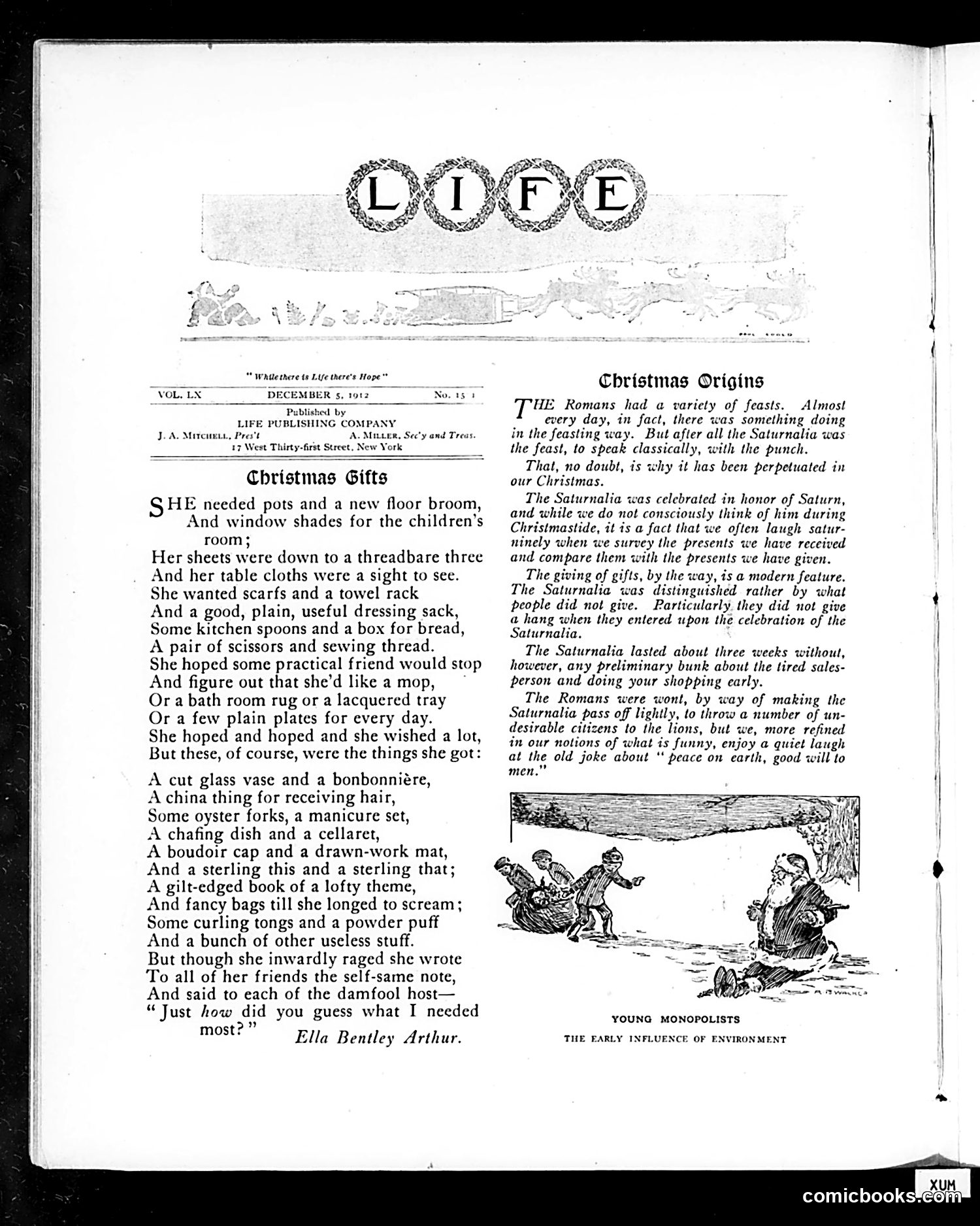
**"Christmas Gifts" Poem (Ella Bentley Arthur):** This satirizes the gap between practical needs and frivolous gift-giving. A woman needs essential household items—brooms, sheets, kitchen utensils—but receives impractical luxury goods: cut glass vases, decorative items, fancy bags, and ornamental things. The joke is her polite, dishonest thank-you notes ("Just how did you guess what I needed most?") despite inward rage. It mocks both thoughtless gift-givers and social conventions forcing recipients to feign gratitude. **"Christmas Origins" Essay:** This traces Christmas gift-giving to Roman Saturnalia celebrations, drawing a parallel: Romans threw "undesirable citizens to the lions" for entertainment, while moderns enjoy "a quiet laugh" at giving useless presents—suggesting modern gift-exchanging is equally cruel, just more refined in appearance. The satire implies Christmas generosity is theatrical performance rather than genuine kindness. **Illustration ("Young Monopolists"):** The accompanying sketch appears to show children in a snowy scene, likely illustrating how environmental influences shape behavior—possibly connecting childhood gift-receiving practices to adult character formation.
📄 Transcribed text from this page (OCR, searchable)
Machine-transcribed from the original scan — historical spelling and the odd misread are preserved.
“* While there ts Life there's Hope DECEMBER 5, 1012 Published by LIFE PUBLISHING COMPANY J. A. Marcus, Pre A. Miter, Sec'y and Treas. 17 West Thirty-first Street, New York Christmas Gifts SHE needed pots and a new floor broom, And window shades for the children’s room; Her sheets were down to a threadbare three And her table cloths were a sight to see. She wanted scarfs and a towel rack And a good, plain, useful dressing sack, Some kitchen spoons and a box for bread, A pair of scissors and sewing thread. She hoped some practical friend would stop And figure out that she'd like a mop, Ora bath room rug or a lacquered tray Or a few plain plates for every day. She hoped and hoped and she wished a lot, But these, of course, were the things she got: A cut glass vase and a bonbonniére, A china thing for receiving hair, Some oyster forks, a manicure set, A chafing dish and a cellaret, A boudoir cap and a drawn-work mat, And a sterling this and a sterling that; A gilt-edged book of a lofty theme, And fancy bags till she longed to scream; Some curling tongs and a powder puff And a bunch of other useless stuff. But though she inwardly raged she wrote To all of her friends the self-same note, And said to each of the damfool host— “Just how did you guess what I needed most?” Ella Bentley Arthur. Christmas Origins Tie Romans had a variety of feasts. Almost every day, in fact, there was something doing in the feasting way. But after all the Saturnalia was the feast, to speak classically, with the punch. That, no doubt, is why it has been perpetuated in our Christmas. The Saturnalia was celebrated in honor of Saturn, and while we do not consciously think of him during Christmastide, it is a fact that we often laugh satur- ninely when we survey the presents we have received and compare them with the presents we have given. The giving of gifts, by the way, is a modern feature. The Saturnalia was distinguished rather by what people did not give. Particularly. they did not give a hang when they entered upon the celebration of the Saturnalia. The Saturnalia lasted about three weeks without, however, any preliminary bunk about the tired sales- person and doing your shopping early. The Romans were wont, by way of making the Saturnalia pass off lightly, to throw a number of un- desirable citizens to the lions, but we, more refined in our notions of what is funny, enjoy a quiet laugh at the old joke about “ peace on earth, good will to men. YOUNG MONOPOLISTS THE EARLY INFLUENCE OF ENVIRONMENT