
Life, 1912-12-05 · page 41 of 116
Life — December 5, 1912 — page 41: what you’re looking at
What you’re looking at
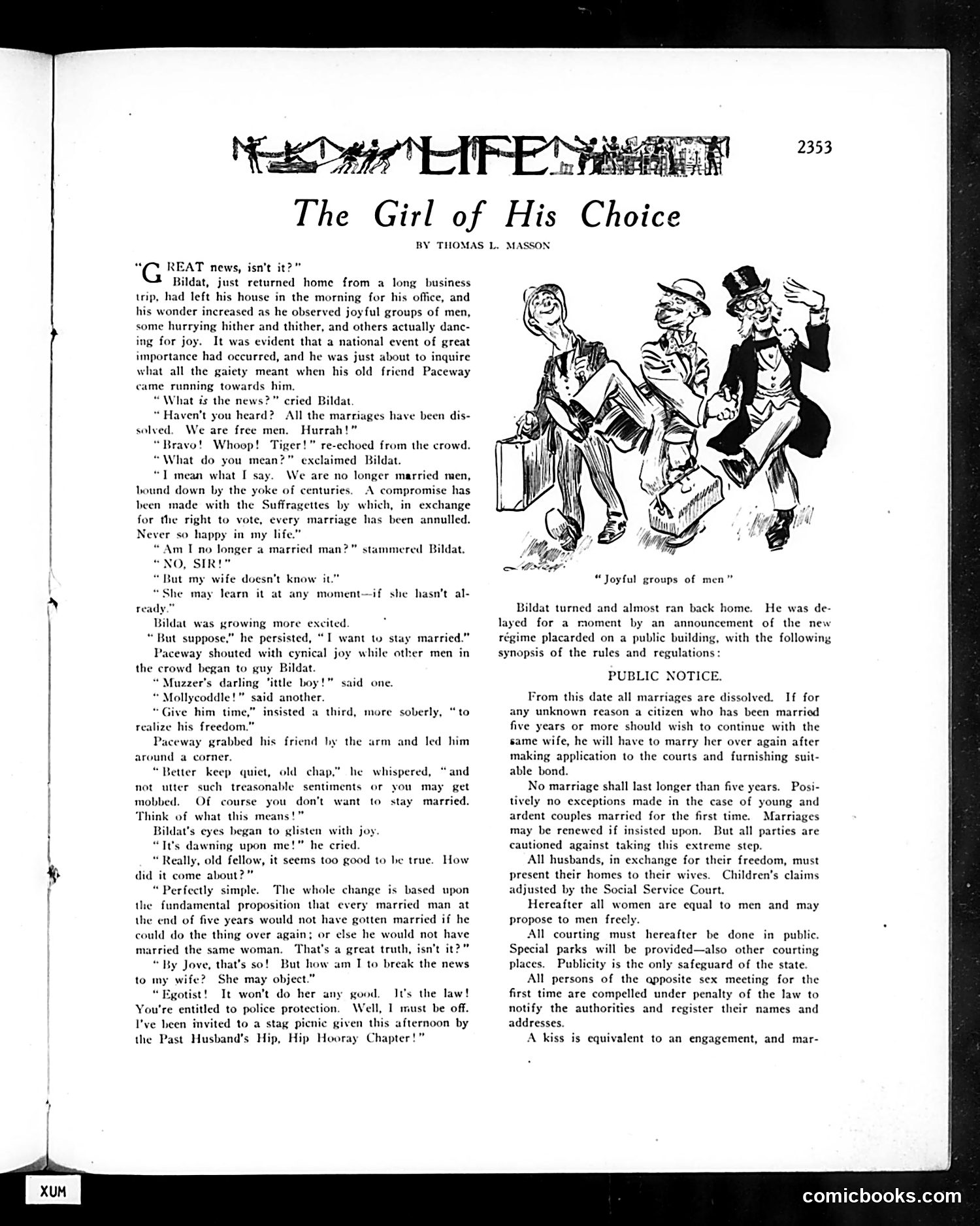
This 1913 *Life* magazine satire mocks the suffrage movement by imagining a dystopian future where, as a compromise granting women voting rights, all marriages are automatically dissolved every five years. The cartoon depicts men celebrating this "freedom" in the streets. The protagonist Bildat initially rejoices, envisioning romantic liberation—until he realizes he must inform his wife and potentially lose his home (which becomes hers under the new regime). **The satire's point**: Anti-suffrage arguments claimed that granting women political equality would destroy traditional marriage and male authority. The story presents this fear as absurd male fantasy—men celebrate being "freed" from marriage, yet the regulations actually redistribute power and property to women, forcing husbands to present homes to wives and allowing women to propose freely. The joke inverts the anti-suffragist fear: what men imagined as liberation becomes emasculation. The piece satirizes both suffrage opponents' paranoia and men's shallow desire to escape marital commitment.
📄 Transcribed text from this page (OCR, searchable)
Machine-transcribed from the original scan — historical spelling and the odd misread are preserved.
9 —— 2353 The Girl of His Choice BY THOMAS L " G REAT news, isn’t it?” Bildat, just returned home from a long business trip, had left his house in the morning for his office, and his wonder increased as he observed joyful groups of men, some hurrying hither and thither, and others actually danc- ing for joy. It was evident that a national event of great importance had occurred, and he was just about to inquire what all the gaiety meant when his old friend Paceway came running towards him, “What is the news?” cried Bildat. “Haven't you heard? All the marriages have been dis- vived. We are free men. Hurrah!" “Bravo! Whoop! Tiger!” re-echoed from the crowd. “What do you mean? aimed Bildat. “JT mean what [ say. We are no longer married men, bound down by the yoke of centuries. A compromise has been made with the Suffragettes by which, in exchange for the right to vote, every marriage has been annulled. Never so happy in my life.” “Am I no longer a married man?” stammered Bildat. “NO, SIR!” : wife doesn't know it learn it at any moment—if she hasn't al- Bildat was growing more excited. “ But suppose,” he persisted, “I want to stay married.” eway shouted with cynical joy while other men in the crowd began to guy Bildat. “Muzzer’s darling ‘ittle boy!" said one. “ Mollycoddle!” said another. jive him time,” insisted a third, more soberly, “to realize his freedom. Paceway grabbed his friend by the arm and led him around a corner. “Better keep quiet, old chap,” he whispered, “and not utter such treasonable sentiments or you may get mobbed. Of course you don’t want to stay married. Think of what this means!” Bildat’s eyes began to glisten with joy. “T's dawning upon me!" he cried. “Really, old fellow, it seems too good to he true. How did it come about?” “Perfectly simple. The whole change is based upon the fundamental proposition that every married man at the end of five years would not have gotten married if he could do the thing over again; or else he would not have married the same woman. That's a great truth, isn’t it?” “ By Jove, that’s so! But how am I to break the news to my wife? She may object.” “Egotist! It won't do her any good. It's the law! ‘ou're entitled to police protection. Well, 1 must be off. I've heen invited to a stag picnic given this afternoon by the Past Husband's Hip, Hip Hooray Chapter!” MASSON “Joyful groups of men” Bildat turned and almost ran back home. He was de- layed for a moment by an announcement of the new régime placarded on a public building, with the following synopsis of the rules and regulations: PUBLIC NOTICE. From this date all marriages are dissolved. If for any unknown reason a citizen who has been married five years or more should wish to continue with the same wife, he will have to marry her over again after making application to the courts and furnishing suit- able bond. No marriage shall last longer than five years. Posi- tively no exceptions made in the case of young and ardent couples married for the first time. Marriages may be renewed if insisted upon. But all parties are cautioned against taking this extreme step. All husbands, in exchange for their freedom, must present their homes to their wives. Children’s claims adjusted by the Social Service Court. Hereafter all women are equal to men and may Propose to men freely. All courting must hereafter be done in public. Special parks will be provided—also other courting places. Publicity is the only safeguard of the state. All persons of the apposite sex meeting for the first time are compelled under penalty of the law to notify the authorities and register their names and addresses. A kiss is equivalent to an engagement, and mar- comicbooks.com