
Life, 1912-12-05 · page 44 of 116
Life — December 5, 1912 — page 44: what you’re looking at
What you’re looking at
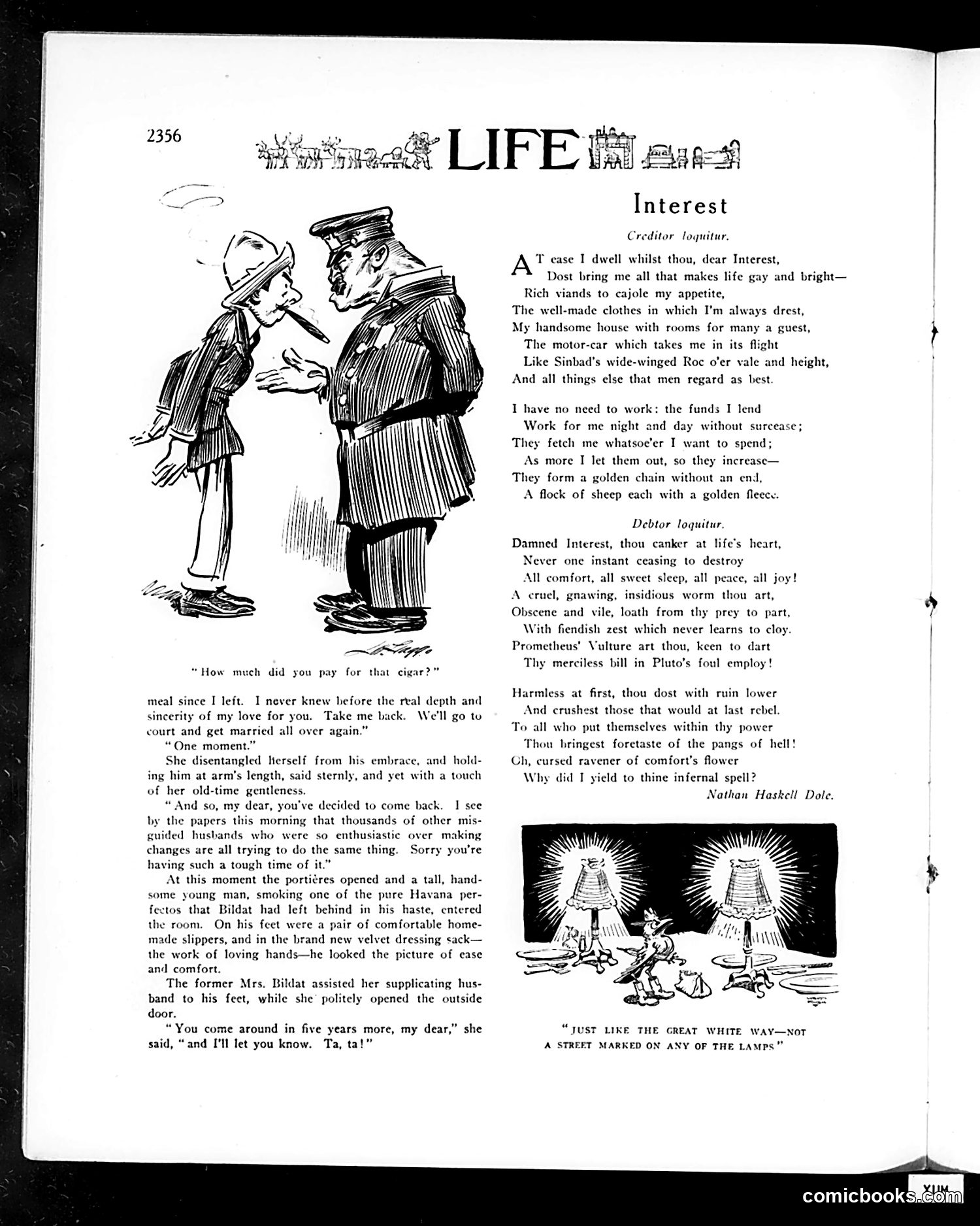
This page contains two distinct satirical pieces about financial relationships. **The cartoon** (top left) depicts a domestic scene where a husband begs his estranged wife to take him back, while a well-dressed young man lounges contentedly in the background—smoking the husband's cigars and wearing his dressing gown. The joke: the wife has replaced her husband with a lover during their separation. The caption "How much did you pay for that cigar?" suggests the husband is questioning the lover's presence/comfort level in his former home. **The poem "Interest"** (right side) is a classical debate between a creditor praising Investment Income (who lives luxuriously off passive returns) and a Debtor cursing Interest as a parasitic "worm" destroying his life. It's Aesop-fable style moralizing about debt's cruelty versus wealth's ease—a commentary on class inequality and financial exploitation common in early 20th-century satirical literature. Together, the page contrasts marital and financial infidelity as parallel betrayals of trust.
📄 Transcribed text from this page (OCR, searchable)
Machine-transcribed from the original scan — historical spelling and the odd misread are preserved.
~~ “How much did you pay for that cigar?” meal since I left. 1 never knew before the real depth and sincerity of my love for you. Take me back. We'll go to court and get married all over again.” “One moment.” She disentangled herself from his embrac ing him at arm's length, said sternly, and yet with a touch of her old-time gentleness. “And so, my dear, you've decided to come back by the papers this morning that thousands of other mi: guided husbands who were so enthusiastic over making changes are all trying to do the same thing. Sorry you're having such a tough time of At this moment the portiéres opened and a tall, hand- some young man, smoking one of the pure Havana per- fectos that Bildat had left behind in his haste, entered the room. On his feet were a pair of comfortable home- made slippers, and in the brand new velvet dressing sack— the work of loving hands—he looked the picture of ease and comfort. The former Mrs. Bildat assisted her supplicating hus- band to his feet, while she’ politely opened the outside door. “You come around in five years more, my dear,” she said, “and I'll let you know. Ta, ta!” and hold- I see aoe Interest Creditor loquitur. T case I dwell whilst thou, dear Interest, Dost bring me all that makes life gay and bright— Rich viands to cajole my appetite, The well-made clothes in which I’m always drest, My handsome house with rooms for many a guest, } The motor-car which takes me in its flight Like Sinbad’s wide-winged Roc o'er vale and height, And all things else that men regard as best I have no need to work: the funds I lend Work for me night and day without surcease; They fetch me whatsoc’er I want to spend; As more I let them out, so they increase— They form a golden chain without an end, A flock of sheep each with a golden fleece. Debtor loquitur. Damned Interest, thou canker at life's heart, Never one instant ceasing to destroy All comfort, all sweet sleep, all peace, all joy! A cruel, gnawing, insidious worm thou art, Fy Obscene and vile, loath from thy prey to part, { With fiendish zest which never learns to cloy. | Prometheus’ Vulture art thou, keen to dart Thy merciless bill in Pluto’s foul employ! Harmless at first, thou dost with ruin lower And crushest those that would at last rebel, To all who put themselves within thy power Thou bringest foretaste of the pangs of hell! Ch, cursed ravener of comfort’s flower Why did I yield to thine infernal spell? Nathan Haskell Dole. en “JUST LIKE THE GREAT WHITE Way. A STREET MARKED ON ANY OF THE LAMPS comicbookMeom