
A complete issue · 72 pages · 1888
Judge — 1888
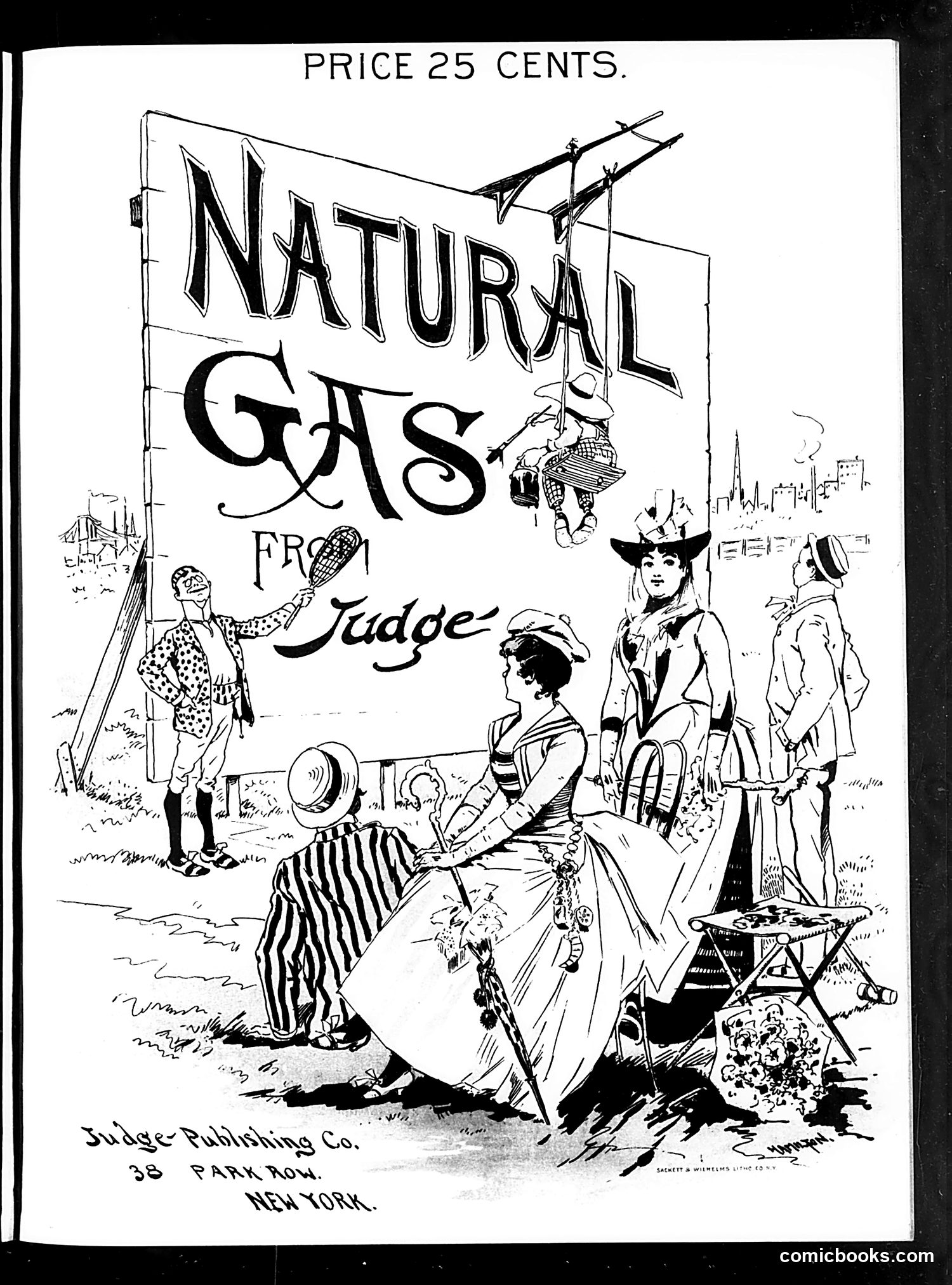
This appears to be a cover or advertisement for *Judge* magazine (priced at 25 cents) published by Judge Publishing Co. in New York. The illustration depicts well-dressed figures in early 20th-century attire gathered outdoors near a tent, with city skyline visible in the background. The title "Natural Gas from Judge" suggests satirical commentary, likely using "gas" (slang for nonsense or hot air) to mock something contemporary. The figures' elaborate costumes and the theatrical staging suggest the cartoon ridicules pretension or foolishness among the upper classes or political figures of the era. Without additional context about the specific issue date, the precise target of satire remains unclear, though the visual composition suggests social or political mockery typical of *Judge*'s satirical approach.
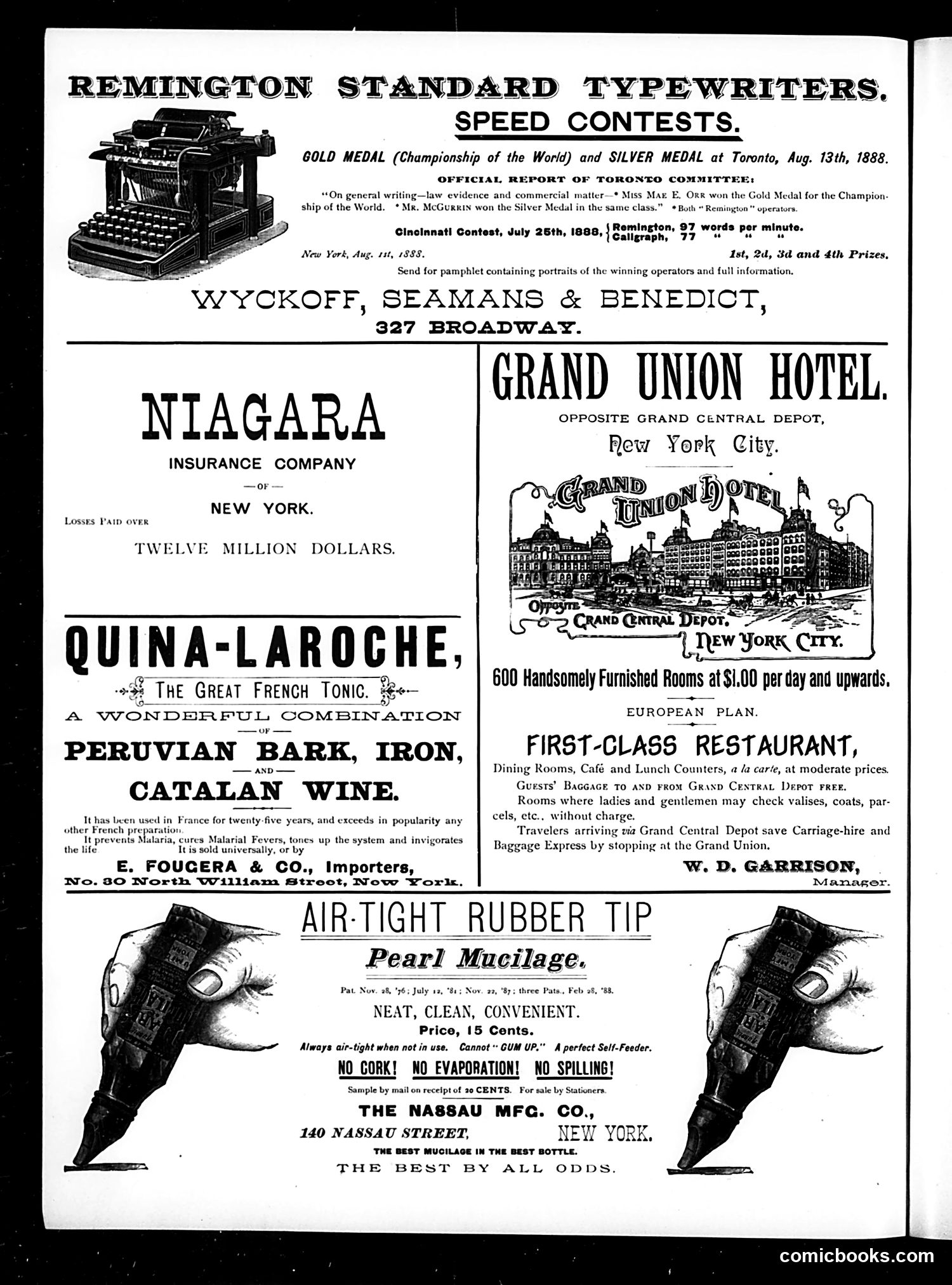
This page is **primarily advertising**, not political satire. It contains commercial advertisements for 1880s New York businesses and products: - **Remington Standard Typewriters** (top): promoting speed contest results - **Niagara Insurance Company**: announcing twelve million dollars in paid losses - **Quina-Laroche**: a French tonic wine claimed to treat malaria and fevers - **Grand Union Hotel**: a budget hotel near Grand Central Depot - **Air-Tight Rubber Tip/Pearl Mucilage** (bottom): a self-feeding bottle of mucilage (glue) The page reflects late-19th-century consumer culture in New York City. While Judge was known for satire, this particular page showcases the magazine's advertising revenue base rather than editorial commentary. The ads target business people, travelers, and office workers of the era.
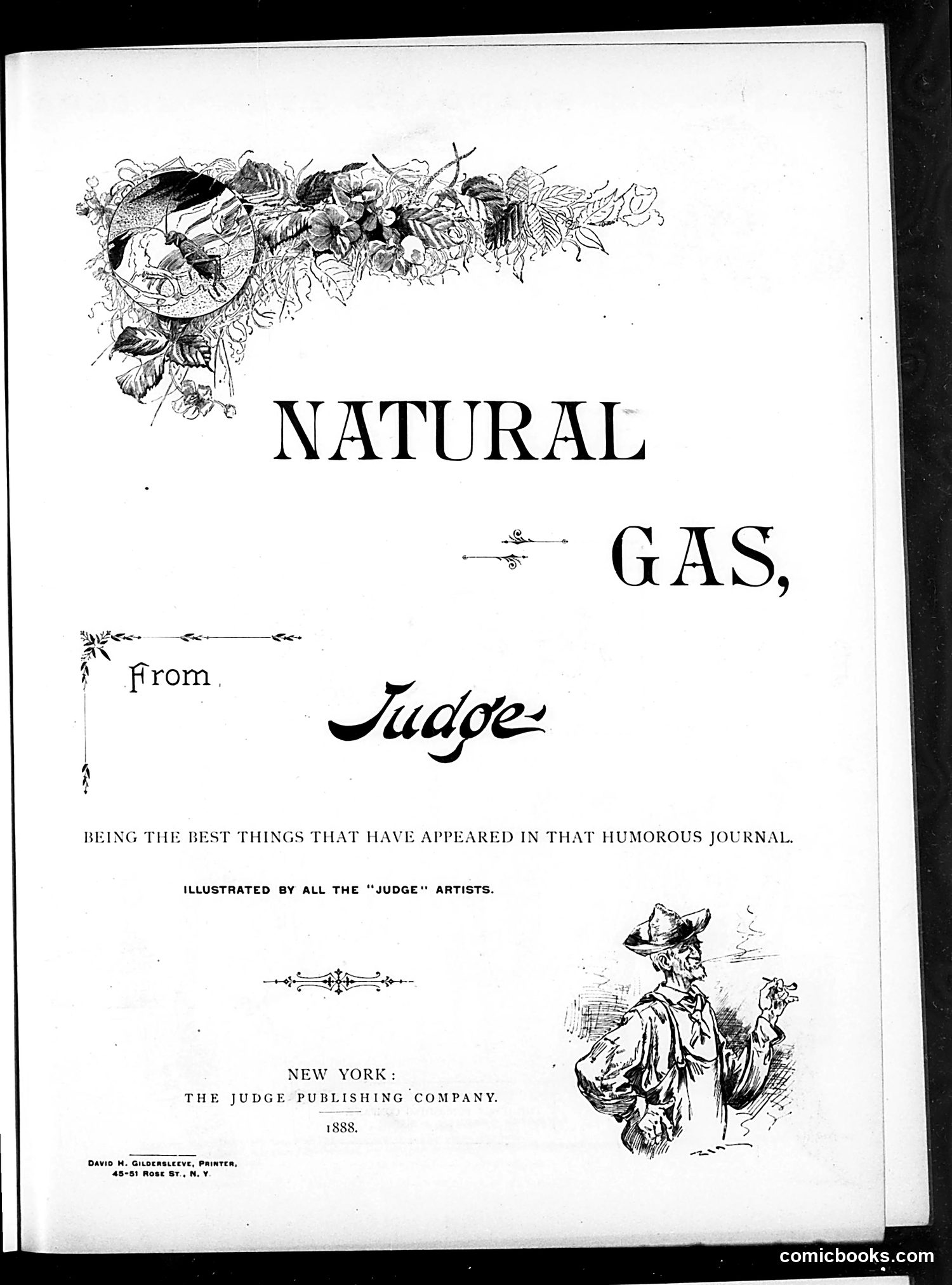
This is a title page for an 1888 book collecting the best content from *Judge* magazine, a prominent American satirical publication. The decorative floral ornament at top and the sketched figure at right are typical of *Judge*'s artistic style. The page announces this is a curated collection "of the best things" previously published in the humorous journal, illustrated by the magazine's regular artists. The publisher information and printer's mark are standard for 1880s book production. Without seeing interior pages, we cannot identify specific political or social satire, but *Judge* typically lampooned contemporary politics, social pretensions, and cultural issues of the Gilded Age era.
This page contains a single cartoon panel showing four caricatured male heads in profile, drawn in an exaggerated style typical of 1888 satirical art. The figures display prominent facial features—large noses, protruding teeth, and distinctive hats—suggesting they represent specific public figures or character types of that era. However, **without accompanying caption text or identifying labels visible in the image**, I cannot definitively state who these figures represent or what political or social situation the cartoon satirizes. The caricature style suggests commentary on recognizable personalities, but the specific identity and satirical point remain unclear from the visual alone. The copyright attribution to Judge Publishing Company confirms this is from the popular American satirical magazine of that period.
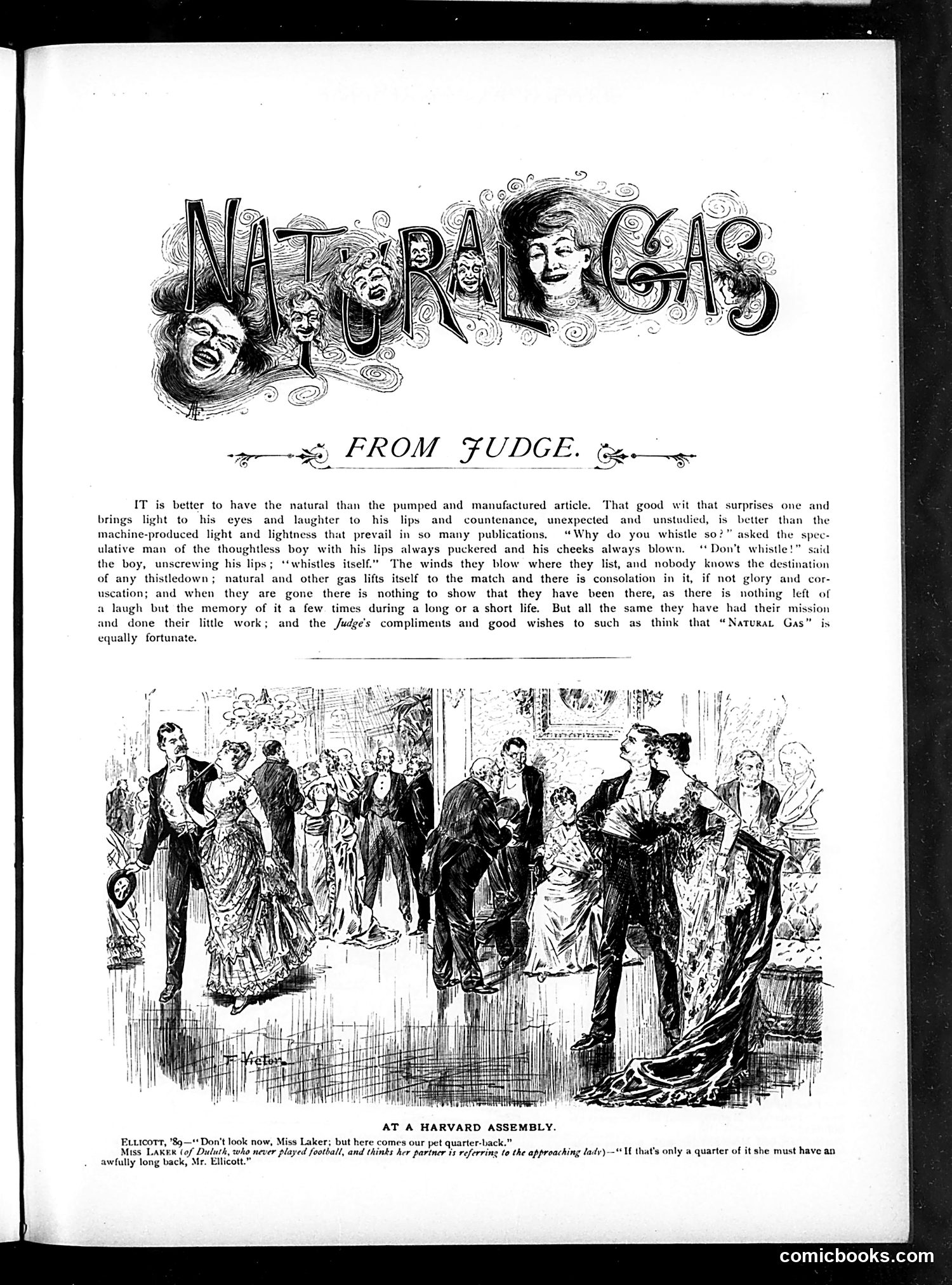
This page contains two distinct pieces of satire: **Top Editorial ("Natural Gas"):** An essay praising authentic, spontaneous wit over manufactured humor—comparing genuine laughter to natural wind rather than artificially produced "gas" (slang for empty talk). Judge celebrates unscripted humor as superior to the calculated comedic productions found in rival publications. **Bottom Cartoon ("At a Harvard Assembly"):** A social comedy playing on miscommunication. A Harvard student (Ellicott, class of '89) warns Miss Laker, a visiting woman from Duluth, that their approaching dance partner is the university's "pet quarter-back" (star football player). Miss Laker—unfamiliar with American football—misunderstands, thinking he's describing the man's physical anatomy as only "a quarter" of something lengthy. Her innocent misinterpretation creates the joke, satirizing the cultural gap between Midwestern visitors and East Coast college society.
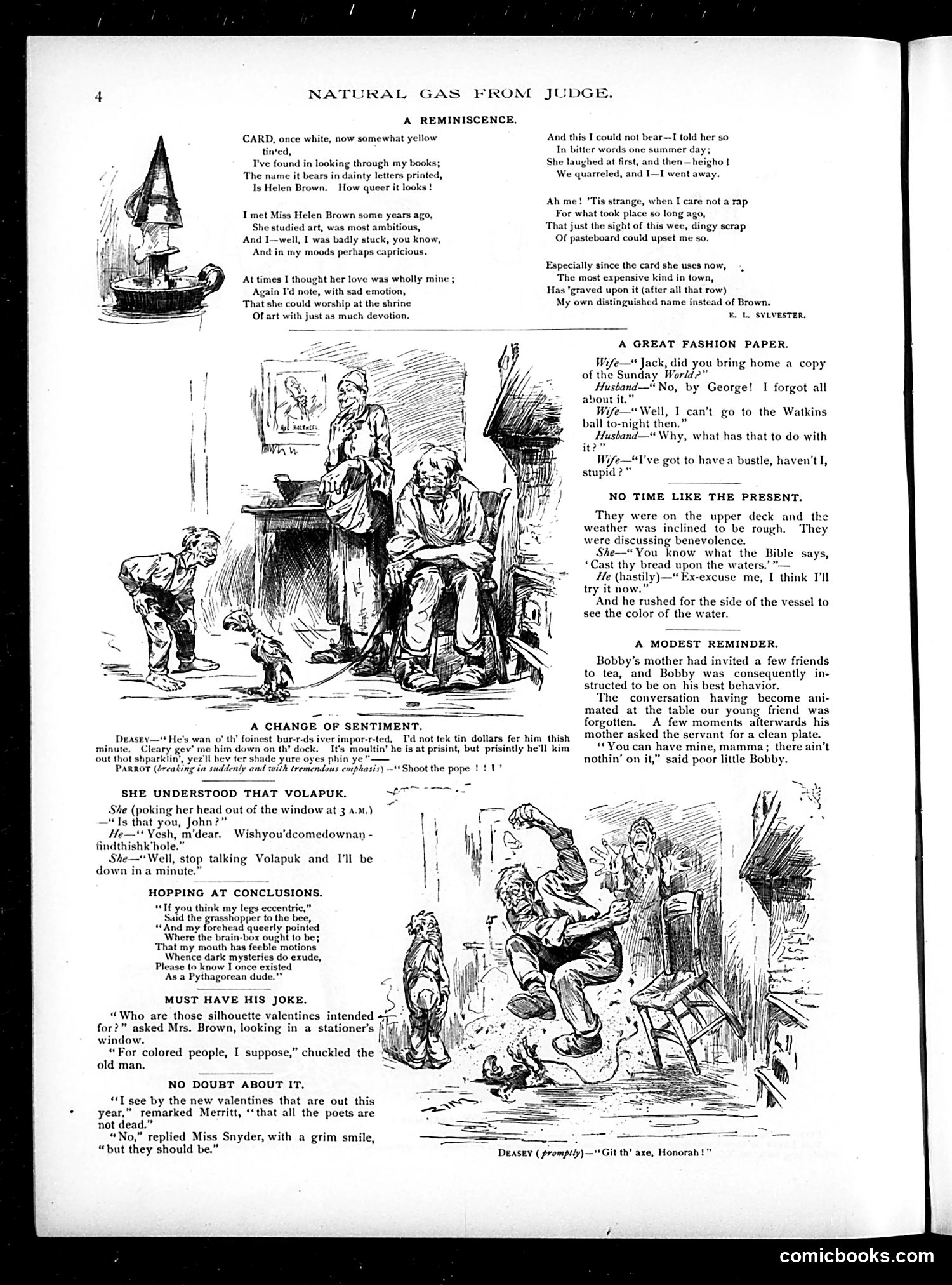
This page contains multiple brief satirical pieces typical of 1880s-90s humor magazines: **"A Reminiscence"** (poem with illustration): A sentimental piece about a man who encounters an old calling card from Helen Brown, a woman he once loved but quarreled with. The joke: she's now using his distinguished name on her cards instead of "Brown"—implying she married him despite their past conflict. **"A Great Fashion Paper"**: Mocks women's fashion obsession. A wife refuses to attend a ball without reading the Sunday *World* newspaper—not for news, but because she needs fashion guidance on bustles (the framework structure worn under skirts). **"No Time Like the Present"**: A couple discusses Biblical charity ("cast thy bread upon the waters"). He rushes to try it literally at the ship's rail, suggesting foolish over-literalism. **"A Modest Reminder"**: Child humor—a forgotten boy at a tea party offers his already-used plate to his mother, innocently embarrassing the adults. The page primarily consists of light social satire targeting fashion vanity, religious literalism, and domestic life—characteristic of Judge's genteel comedic approach.
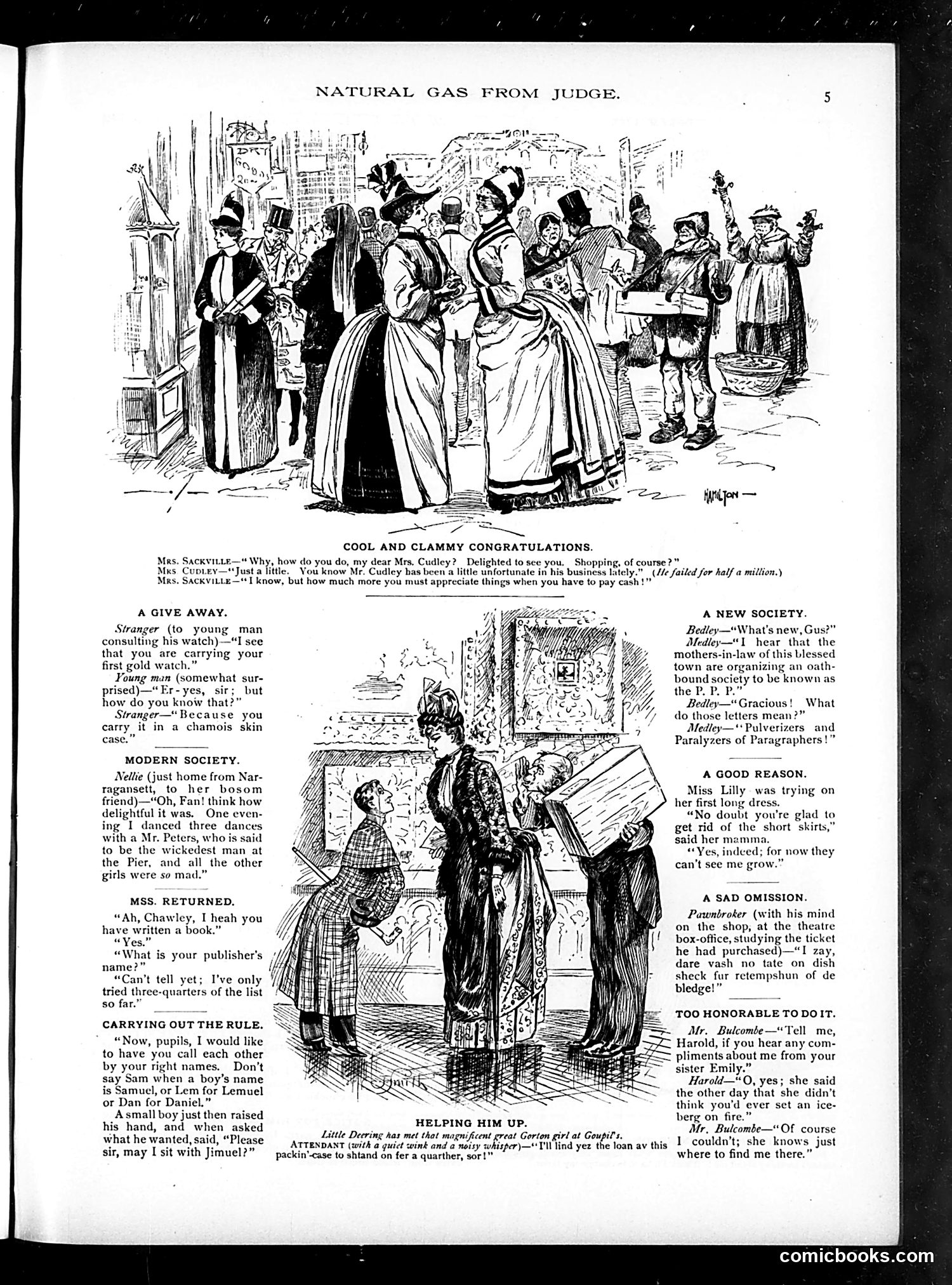
This page from *Judge* magazine contains multiple brief satirical sketches mocking Victorian-era social pretensions and etiquette: **"Cool and Clammy Congratulations"**: Satirizes wealthy women's shallow sympathy—Mrs. Sackville claims to commiserate with Mrs. Cudley over her husband's business failure (losing half a million dollars), yet complains that poverty forces people to pay cash rather than buy on credit. **"Modern Society"**: Mocks the social climbing and gossip of resort culture—a young woman brags that dancing with a disreputable man ("the wickedest man at the Pier") made other girls jealous, revealing how scandal attracts rather than repels high society. **"Carrying Out the Rule"**: Gentle humor about a teacher's insistence on formal names backfiring when a boy requests to sit with "Jimuel" (a deliberately absurd formal version of "Jim"). The remaining sketches employ similar humor about marriage, publishing, and social pretension typical of late 19th-century American satirical magazines targeting middle and upper-class readers.
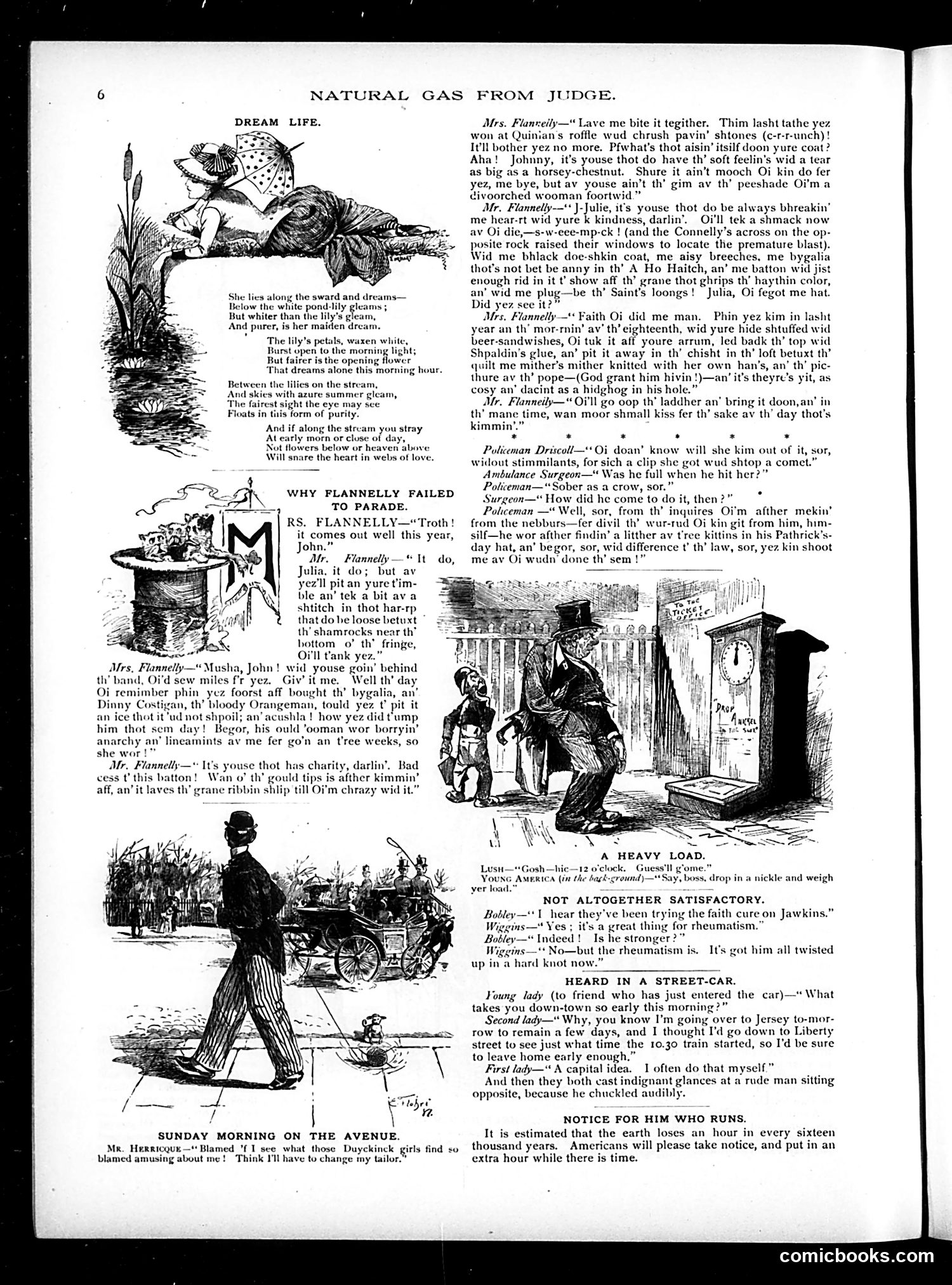
This page from **Judge** satirizes Irish-American working-class life through exaggerated dialect and domestic scenes. The content uses heavy Irish brogue stereotypes common to late 19th-century American humor. **Main Cartoons:** 1. **"Dream Life"** — A romantic poem paired with an illustration contrasts idealized poetic language with crude reality, likely mocking sentimental literature. 2. **"Why Flannelly Failed to Parade"** — Mr. Flannelly cannot march in a parade (possibly St. Patrick's Day) because his wife needs him to repair a harp or musical instrument, suggesting domestic obligations override civic participation. 3. **"Heavy Load," "Not Altogether Satisfactory," "Head in a Street-Car," "Sunday Morning on the Avenue"** — Brief comic vignettes depicting working-class mishaps: a drunk man, questionable medical remedies, overcrowded transit, and marital embarrassment. The satire targets Irish-American stereotypes: poverty, heavy drinking, marital discord, superstition, and linguistic peculiarities. The humor relies entirely on ethnic caricature rather than political commentary.
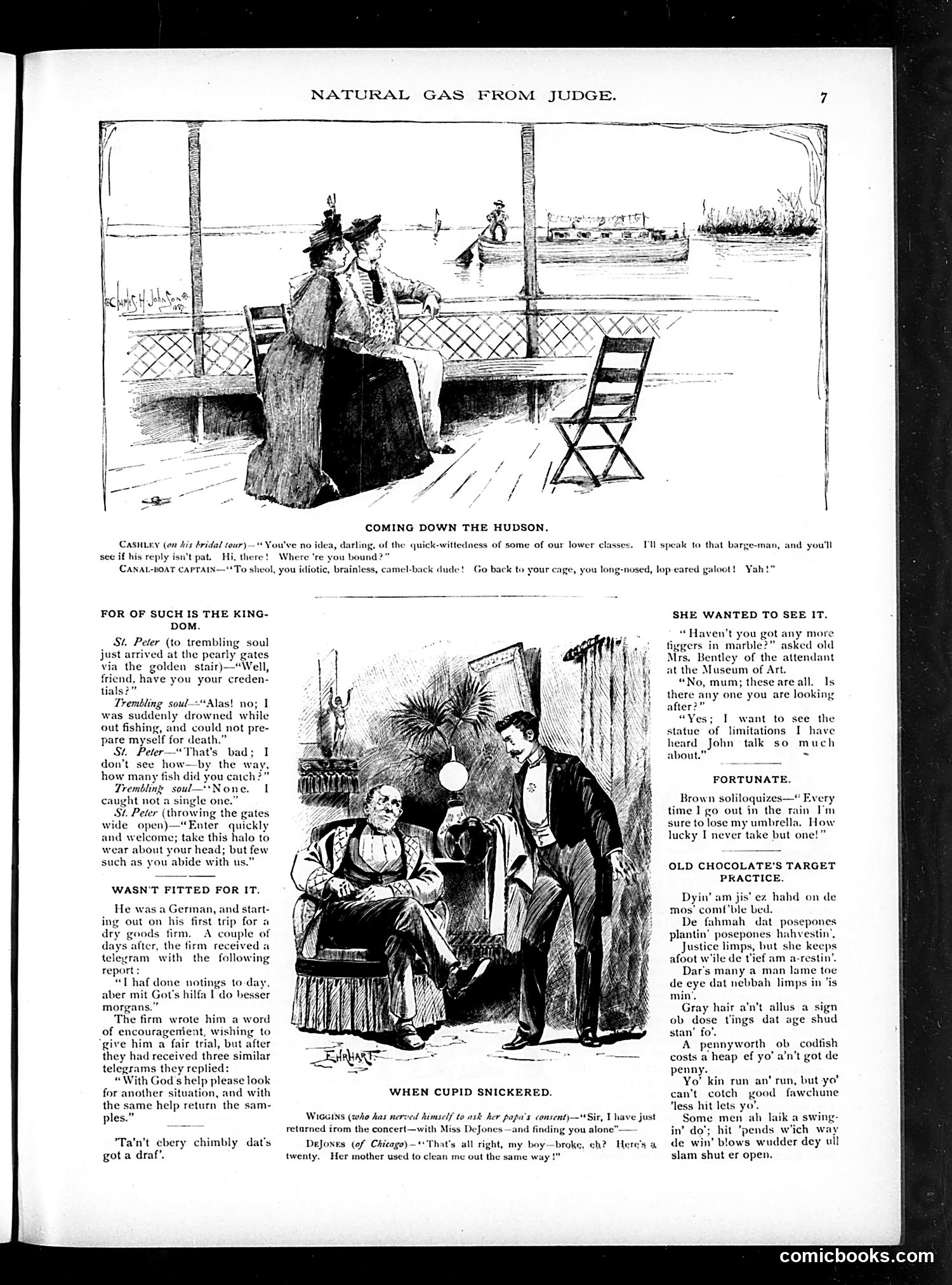
This page contains several short humorous pieces typical of Judge's satirical format: **"Coming Down the Hudson"** depicts a society woman confronting a canal-boat captain with insults, satirizing class tensions between wealthy passengers and working-class boatmen. **"When Cupid Snickered"** shows a domestic scene where a woman discovers her husband's infidelity, poking fun at romantic complications and marital deception. The remaining pieces—"For of Such is the King-dom," "Wasn't Fitted for It," "She Wanted to See It," "Fortunate," and "Old Chocolate as a Target Practice"—are brief jokes about mistaken identity, fishing misadventures, museum visits, umbrella loss, and marksmanship, all typical of Judge's light, observational humor aimed at late-19th/early-20th-century American readers.
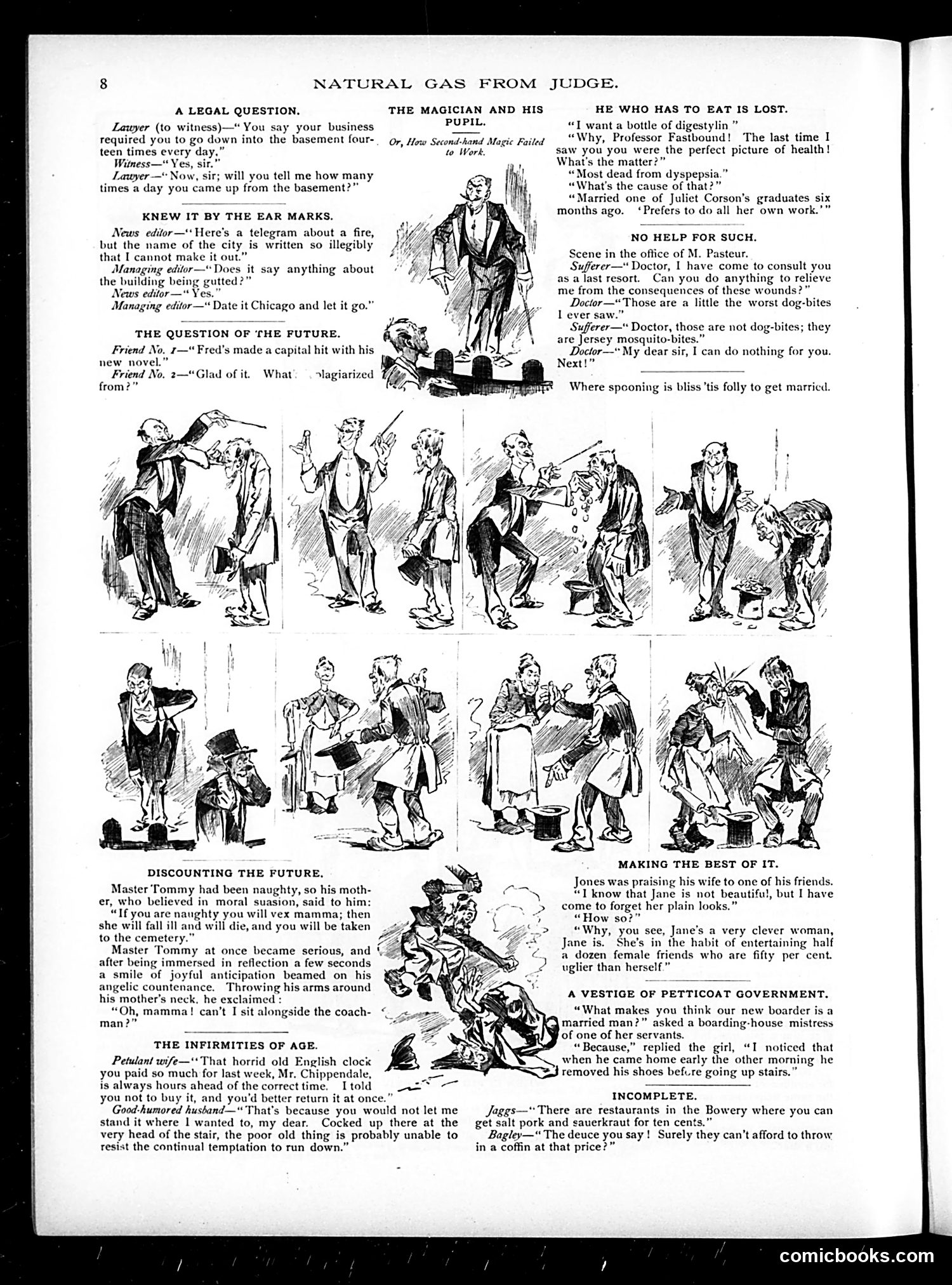
This page from *Judge* contains multiple short satirical pieces typical of late 19th-century American humor: **"A Legal Question"** mocks incompetent lawyers through a witness testimony about basement visits—the humor lies in the lawyer's inability to extract basic information. **"Knew It by the Ear Marks"** satirizes newspaper carelessness: editors don't care about accuracy, simply dating unclear fire reports "Chicago" without verification. **"The Magician and His Pupil"** appears to joke about magic tricks failing when reused or poorly executed. **Social satire pieces** mock contemporary targets: a wife who burned food after attending Juliet Corson's cooking school; "Jersey mosquito-bites" (New Jersey pest problems); a wife so unattractive her husband entertains her friends to avoid looking at her; working-class poverty where coffins are metaphorically bundled with cheap meals. The overall tone reflects *Judge*'s satirical targets: incompetence, domestic discord, urban problems, and class-based humor typical of the Gilded Age period.
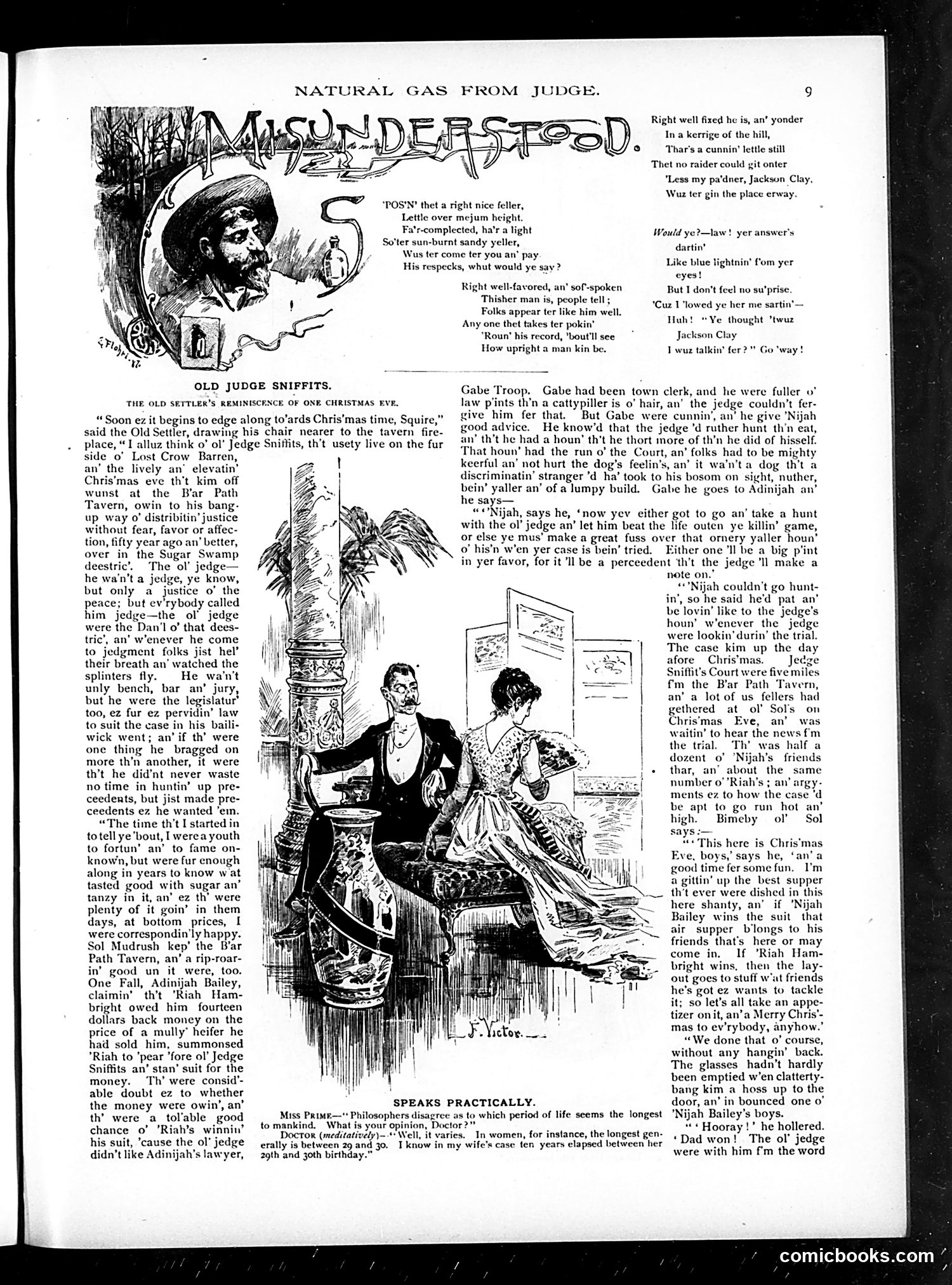
This page contains two distinct sections: **"Old Judge Sniffits"** (left): A reminiscence about a frontier judge known for his unconventional rulings and casual approach to justice. The narrative satirizes a character who dispensed verdicts while hunting, drinking at taverns, and ignoring legal precedent—poking fun at rough-and-tumble judicial systems in early America. **"Speaks Practically"** (bottom): A brief dialogue between Miss Prime and a Doctor about which period of life seems longest. The doctor responds that in women it varies, noting "the longest generally seems to be between her 29th and 30th birthday"—a joke mocking women's anxiety about aging. The illustrations depict the frontier judge scene and the conversation, rendered in Judge magazine's characteristic 19th-century engraving style.
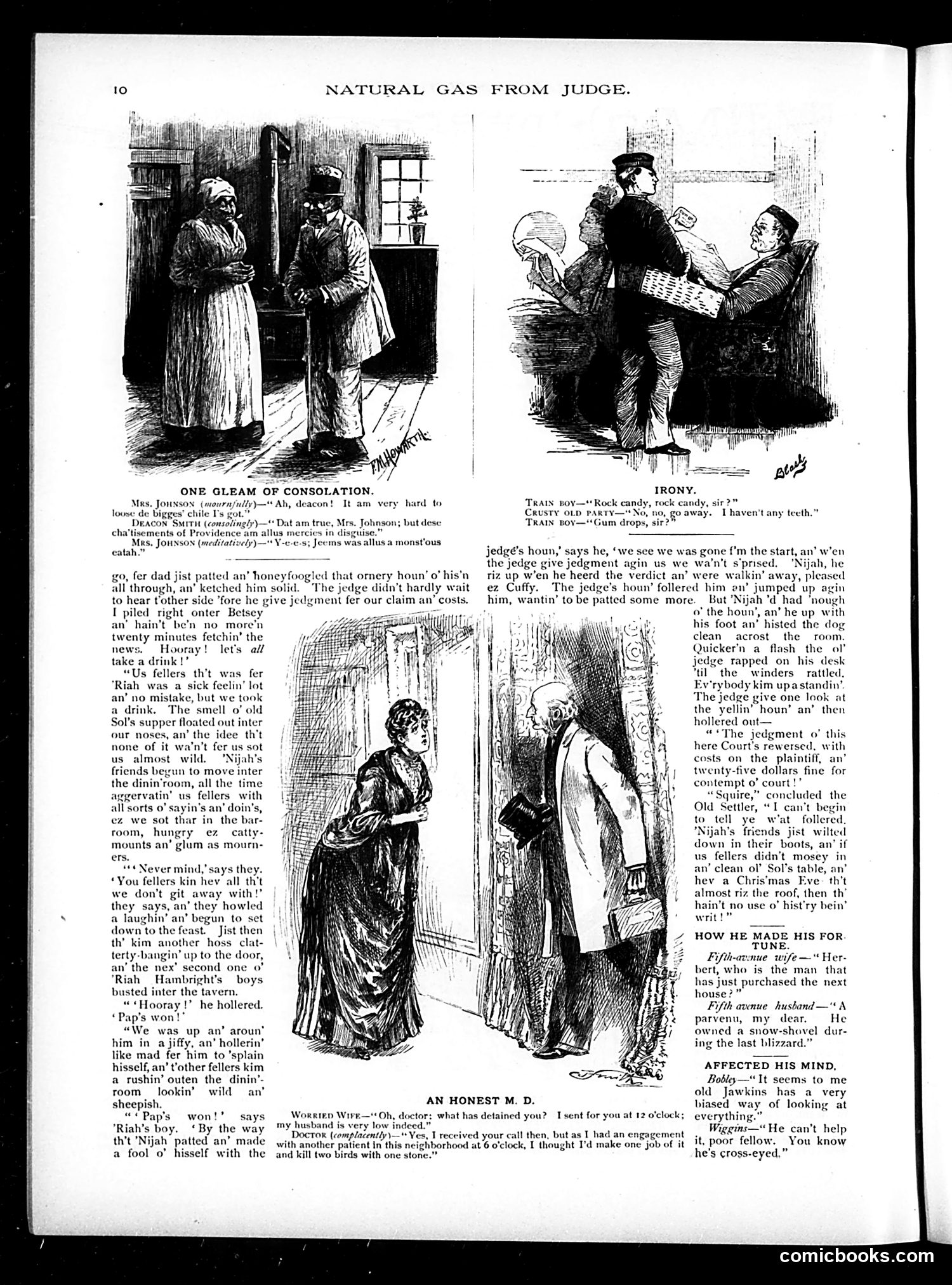
This page contains multiple satirical cartoons and humorous stories typical of Judge magazine's style. **Top cartoons:** "One Gleam of Consolation" depicts a working-class couple; the satire mocks how people find solace in small mercies during hardship. "Irony" shows a man being ejected from a home—the irony being that having no teeth means he can't eat anyway, so the situation is darkly funny. **Main story:** A lengthy dialect tale about a legal dispute over a farm, culminating in a judge's decision reversed when the judge's dog is kicked. The satire ridicules rural legal proceedings and shows how personal offense (to the judge's pet) overrides justice. **Bottom cartoons:** "An Honest M.D." satirizes doctors who kill patients efficiently by combining house calls—cruel commentary on medical indifference. "How He Made His Fortune" mocks social climbers: a nouveau riche man's wealth came from selling snow shovels during a blizzard. The page's title "Natural Gas from Judge" refers to the publication itself generating satirical "gas" (hot air/jokes).
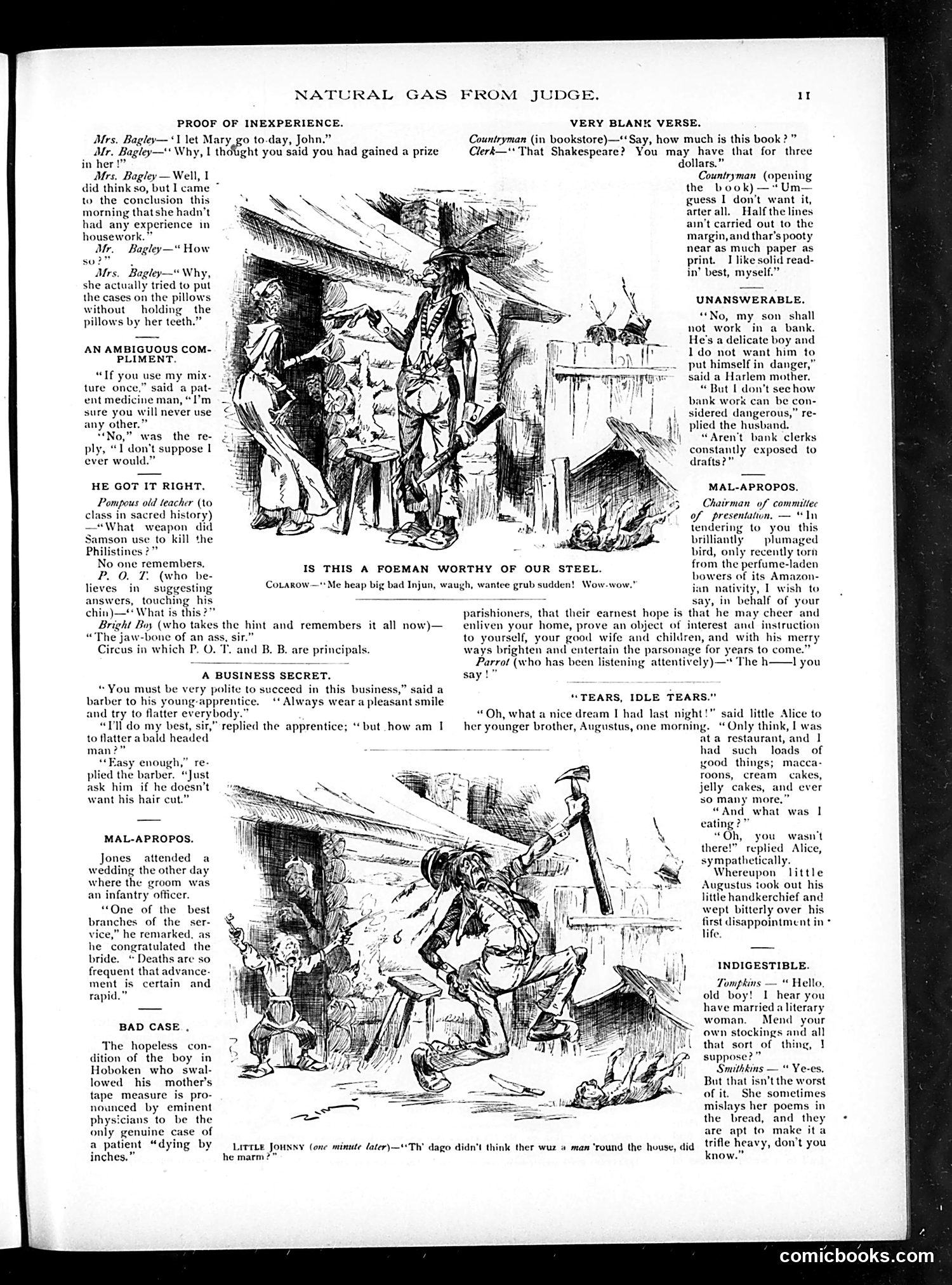
This page contains several brief humorous sketches typical of late-19th-century American satire: **"Proof of Inexperience"**: A domestic joke where a housewife fires her maid for not holding pillows with her teeth while putting on cases—suggesting rural or working-class incompetence about "proper" household technique. **"Is This a Foeman Worthy of Our Steel"**: A sketch depicting a Native American ("Injun") attempting to intimidate a household, only to be easily dispatched. Uses period racist caricature and dialect ("Me heap big bad Injun") typical of the era's entertainment. **"Very Blank Verse"**: A countryman complains that Shakespeare's book has too much white space and insufficient dense printing—mocking rural ignorance of literature and typography. **Other items**: Include jokes about medicine men, barber flattery, military advancement through deaths, and a child disappointed her brother wasn't in her dream—all reflecting contemporary middle-class anxieties and gentle domestic humor. The satire targets rural/immigrant populations, professional incompetence, and family dynamics.
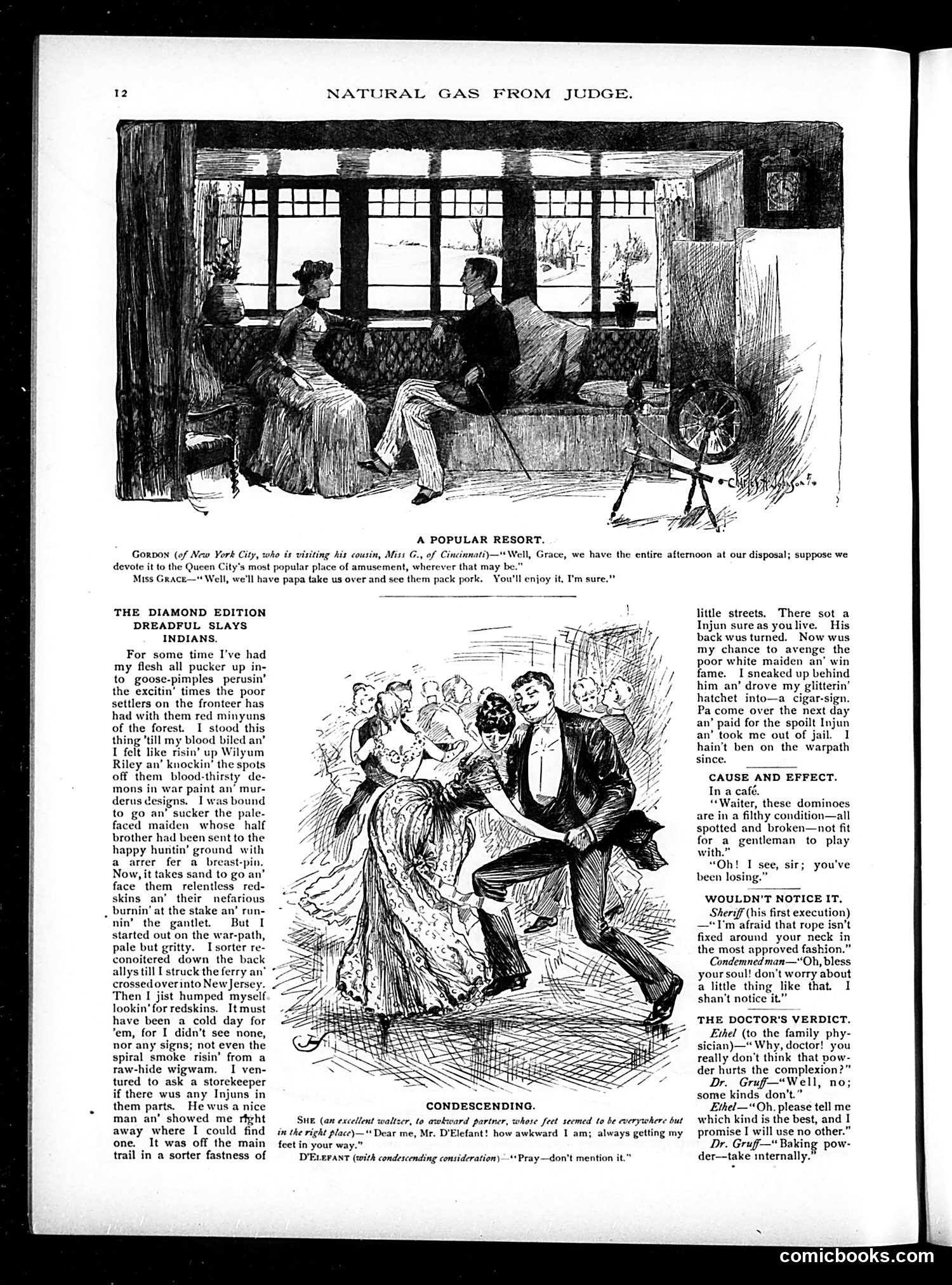
The top illustration depicts two women and a man in conversation at what appears to be a fashionable drawing room with large windows. The caption references "Gordon of New York City" visiting his cousin, with dialogue about spending the afternoon at "the Queen City's most popular place of amusement" and mentions of "papa" taking them to see "pack pork." Below are several short humorous pieces with titles like "The Diamond Edition," "Cause and Effect," and "The Doctor's Verdict." These appear to be brief comedic anecdotes or jokes rather than political satire—typical of Judge magazine's miscellaneous humor content. The sketches mock social pretension, include hunting mishaps, and feature exaggerated character types common to 19th-century American comic publications, though specific satirical targets remain unclear from the visible text.
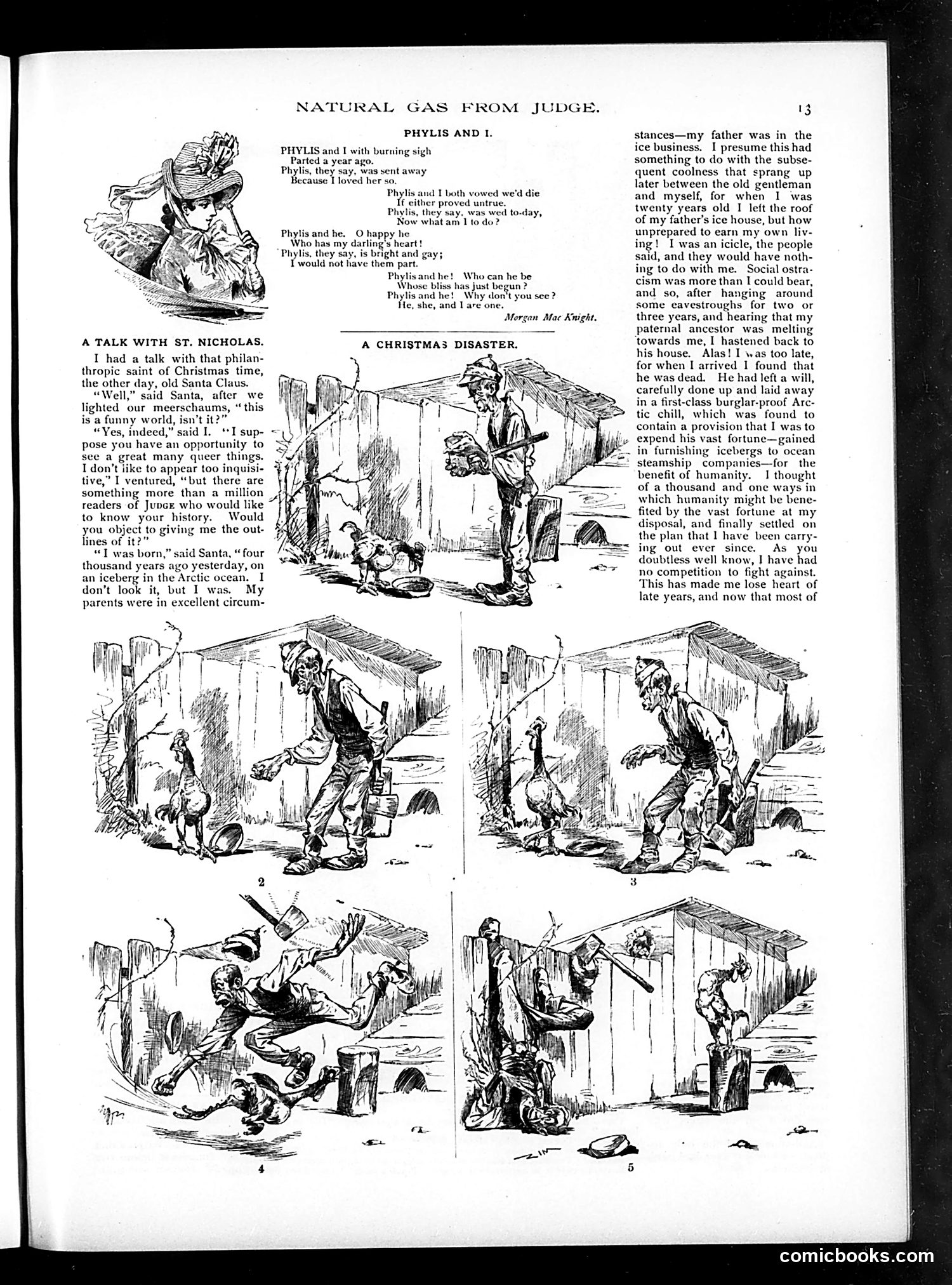
This page contains three separate satirical pieces typical of Judge magazine's humor: **"A Talk with St. Nicholas"** features Santa Claus giving a mock autobiography, claiming to be 4,000 years old, born on an Arctic iceberg to a father in the "ice business." The humor lies in the absurdist backstory—Santa blames his early struggles on being literally "an icicle" that people avoided, and eventually inherits his father's fortune from supplying icebergs to steamships. This appears to be satirizing either wealth inheritance or the commercialization of Christmas traditions. **"Phylis and I"** is a brief poem about romantic jealousy, where the narrator's ex-lover Phylis has married someone, but the narrator claims philosophical acceptance because "He, she, and I are one"—likely mocking sentimental or self-deceptive romantic poetry popular at the time. **"A Christmas Disaster"** shows a sequential comic strip (panels 1-5) depicting physical comedy, apparently involving someone and a child in winter conditions, though the exact narrative is unclear from the illustrations alone. All three pieces exemplify Judge's style of whimsical, absurdist satire.
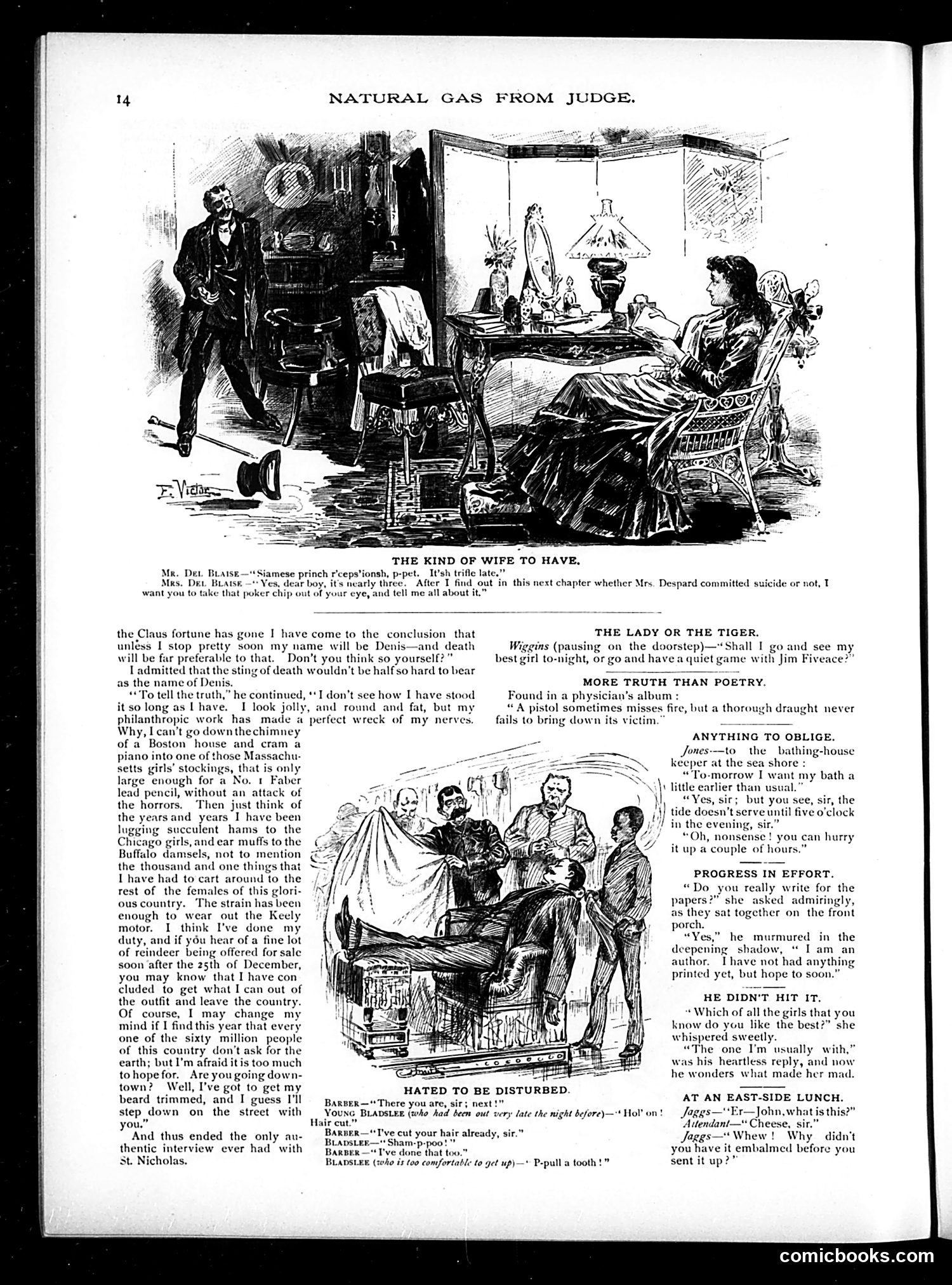
This satirical cartoon depicts a domestic scene where a wife receives news about another woman's (Mrs. Despard's) suicide or death. The caption suggests the wife callously dismisses this tragedy, instead prioritizing gossip and social matters. The satire targets upper-class women's perceived superficiality and indifference to serious matters. The wife's casual response to suicide—asking her husband to explain details while maintaining her leisure—mocks how wealthy Victorian women were portrayed as self-absorbed and emotionally detached from real suffering. The illustration's luxurious interior setting emphasizes the class commentary: comfortable women ignoring tragedy in favor of social trivialities. This represents a common Judge magazine critique of elite society's moral shallowness.
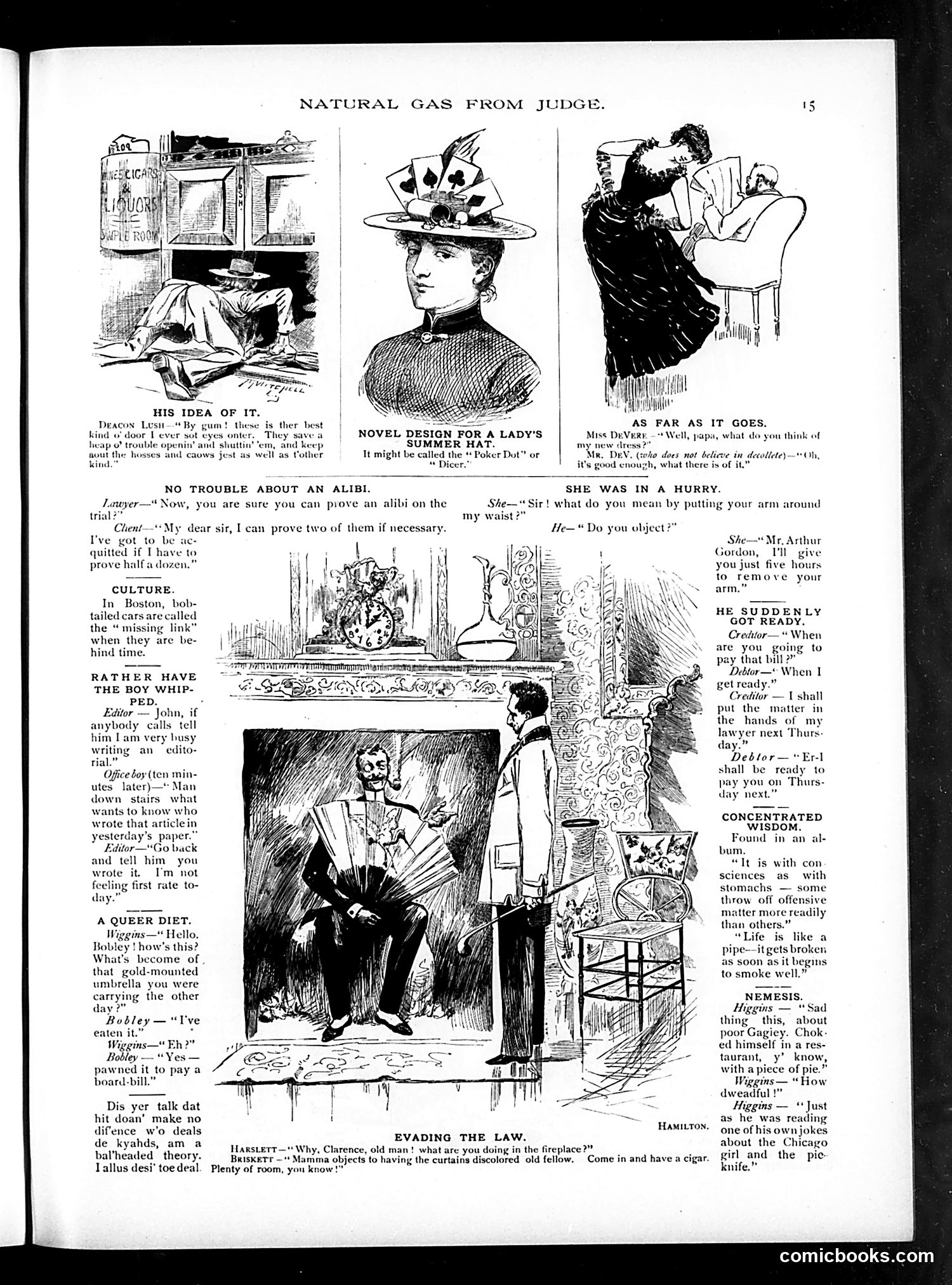
This page from *Judge* magazine contains multiple short satirical comics and jokes targeting late 19th-century American society: **Key satires include:** - **"Natural Gas from Judge"**: Deacon Lish's crude farming wisdom about livestock and crop management, mocking rural dialect and unsophisticated thinking. - **"Poker Dot Hat"**: A joke on women's excessively ornate fashion, where a lady's hat features playing cards—satirizing the impracticality of haute couture. - **Legal/Social Humor**: Several strips mock lawyers' dishonesty ("No Trouble About an Alibi"), class anxiety, and domestic relationships. "Evading the Law" shows a man hiding in a fireplace to avoid his wife's complaints. - **"Concentrated Wisdom"**: Mocks pretentious, pseudo-philosophical sayings found in autograph albums—gentle satire of aspirational sentimentality. - **Nemesis**: A dark joke about a man choking on pie while making jokes about Chicago—suggesting poetic justice through ironic circumstances. The overall tone is light social commentary on fashion, law, manners, and Victorian hypocrisy.
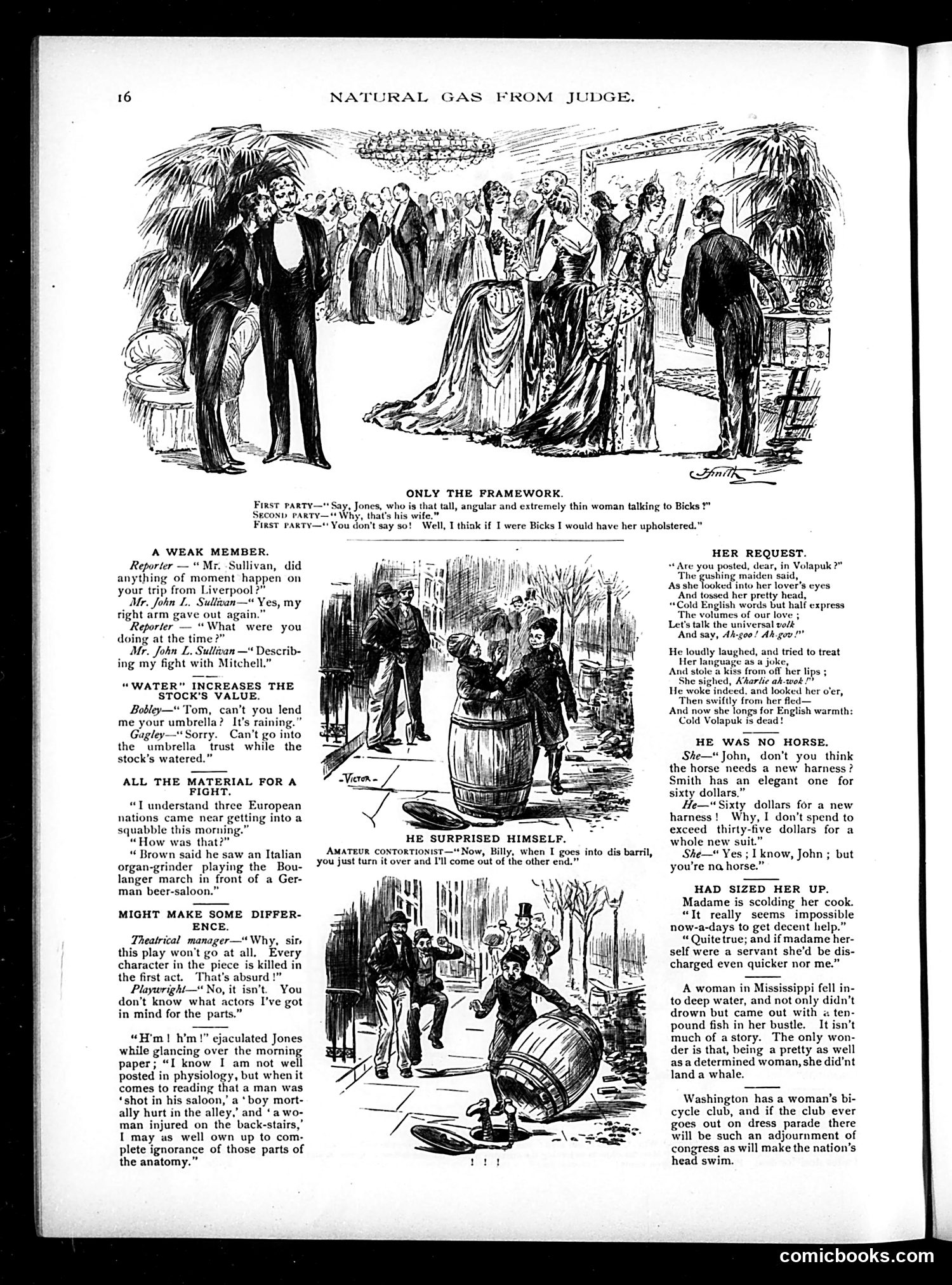
This page contains multiple brief satirical jokes and anecdotes typical of Judge's humor circa the 1880s-90s. **Key references:** - **John L. Sullivan**: The famous boxer; the joke mocks his claim that his "right arm gave out" during his fight with Mitchell—implying he's making excuses. - **Boulanger march**: References General Boulanger, a French political figure of the era, used here to illustrate how easily international tensions could ignite. - **"Water" increases stock's value**: A pun on watered stock (fraudulent financial practice) and literal water on an umbrella. - **Volapuk**: A constructed international language popular in the 1880s; the satire mocks its artificial nature through a sentimental poem. **Satire targets:** The page mocks Victorian social pretension, bodily humor (women's fashion, anatomy), labor disputes ("umbrella trust"), theatrical absurdity, and contemporary fads. The final anecdote about the Mississippi woman and fish is crude period humor about women's bustles.
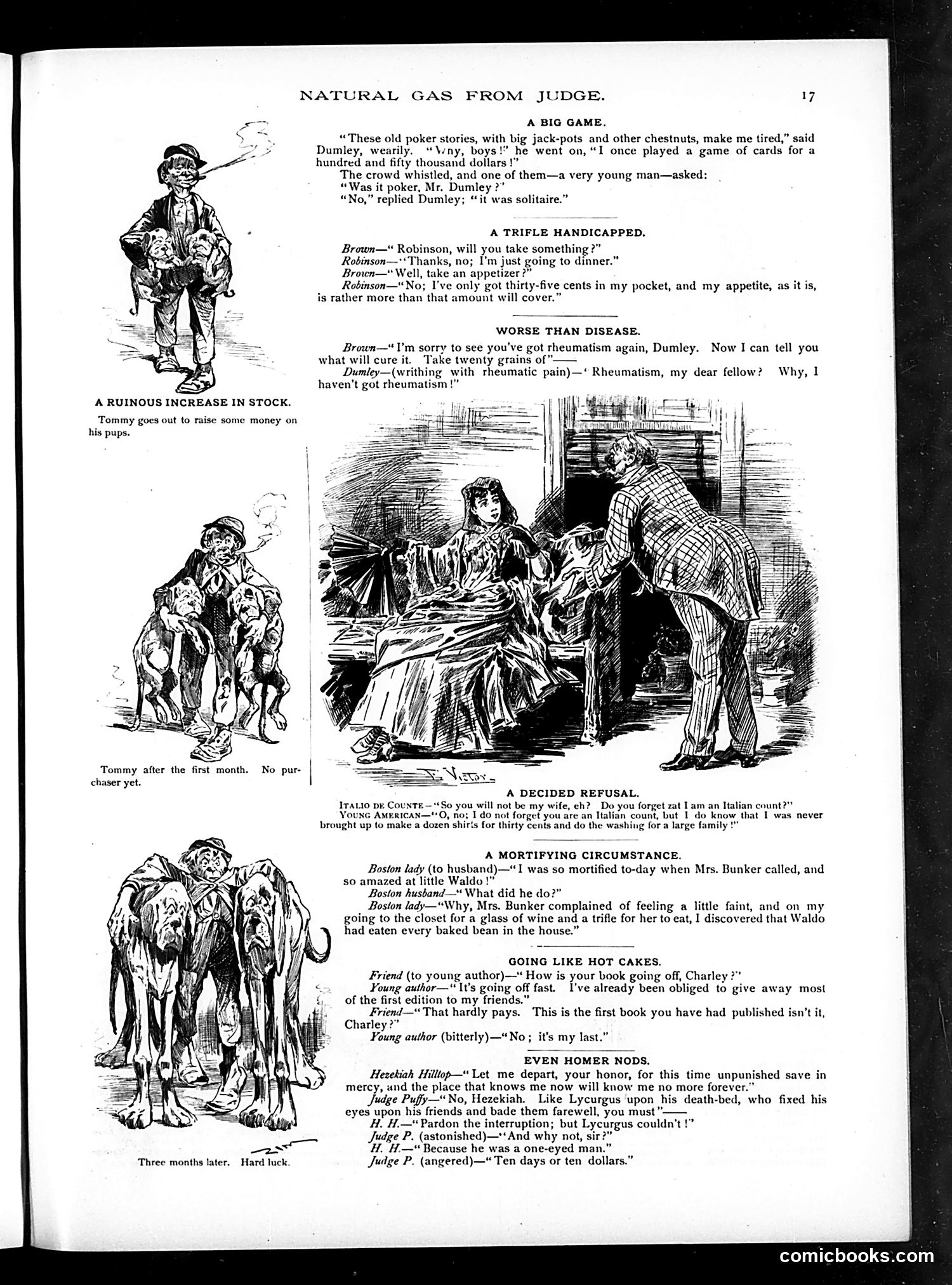
This page collects short humorous sketches satirizing American social types and pretensions circa early 1900s. **Key satires:** - **"A Big Game"**: Mocks boastful exaggeration—Dumley's claimed high-stakes card game turns out to be solitaire, deflating his braggadocio. - **"A Trifle Handicapped"**: Robinson's poverty prevents accepting hospitality; his appetite exceeds his means (35 cents). - **"A Ruinous Increase in Stock"**: Tommy's puppies fail to sell, multiplying into financial burden—a play on "stock" (both animals and securities). - **"A Decided Refusal"**: An Italian count is rejected by an American woman unwilling to become a servant doing laundry for poverty wages—mocking both Old World aristocratic pretension and New World practicality. - **"A Mortifying Circumstance"**: Boston snobbery exposed when a guest finds the family's fancy façade hollow (no baked beans remaining—suggesting false hospitality). - **"Even Homer Nods"**: A defendant's pedantic legal interruption about classical history undermines judicial authority. Throughout: working-class struggle, social climbing, and deflated pretension.
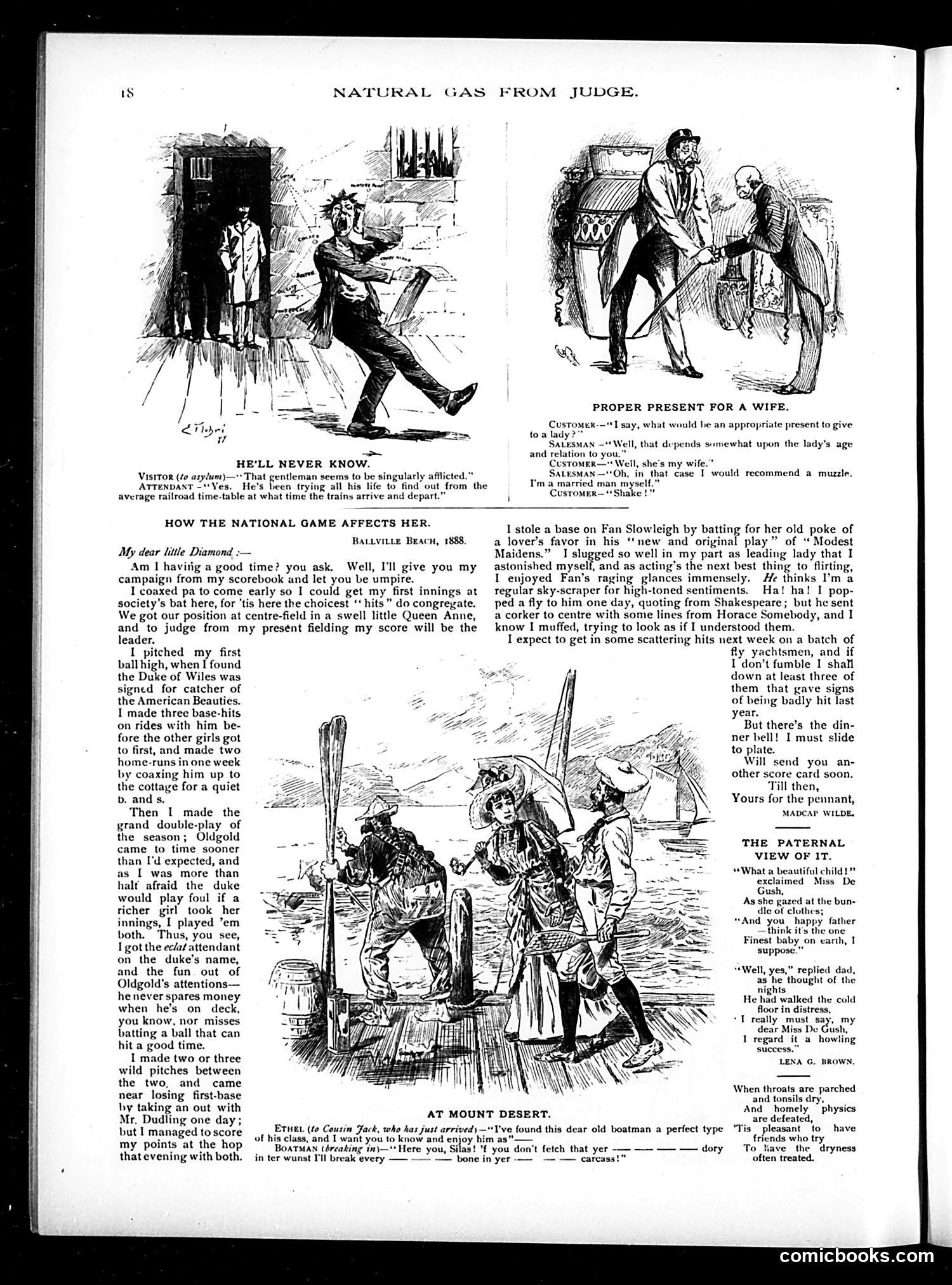
This 1888 Judge magazine page contains several satirical pieces mocking social conventions: **"Hell Never Know"** jokes about railroad timetables' notorious unreliability—a genuine frustration of the era. **"Proper Present for a Wife"** is a misogynist joke: a salesman recommends a muzzle for a customer's wife, implying women should be silenced. This reflects Victorian attitudes toward women. **"How the National Game Affects Her"** uses baseball metaphors to describe a young woman manipulating wealthy suitors (the "Duke," "Oldgold") for money and status—treating courtship as strategic competition. It satirizes both gold-digging and shallow romance. **"At Mount Desert"** depicts a tourist ("Ernet") patronizingly presenting a rough boatman as a "type" to admire, while the boatman speaks in crude dialect, reflecting class-based mockery common in period humor. **"The Paternal View"** ironically contrasts a visitor's effusive praise of a newborn with the exhausted father's honest recollection of sleepless nights. These pieces satirize courtship rituals, class pretension, gender roles, and social hypocrisy typical of Gilded Age America.
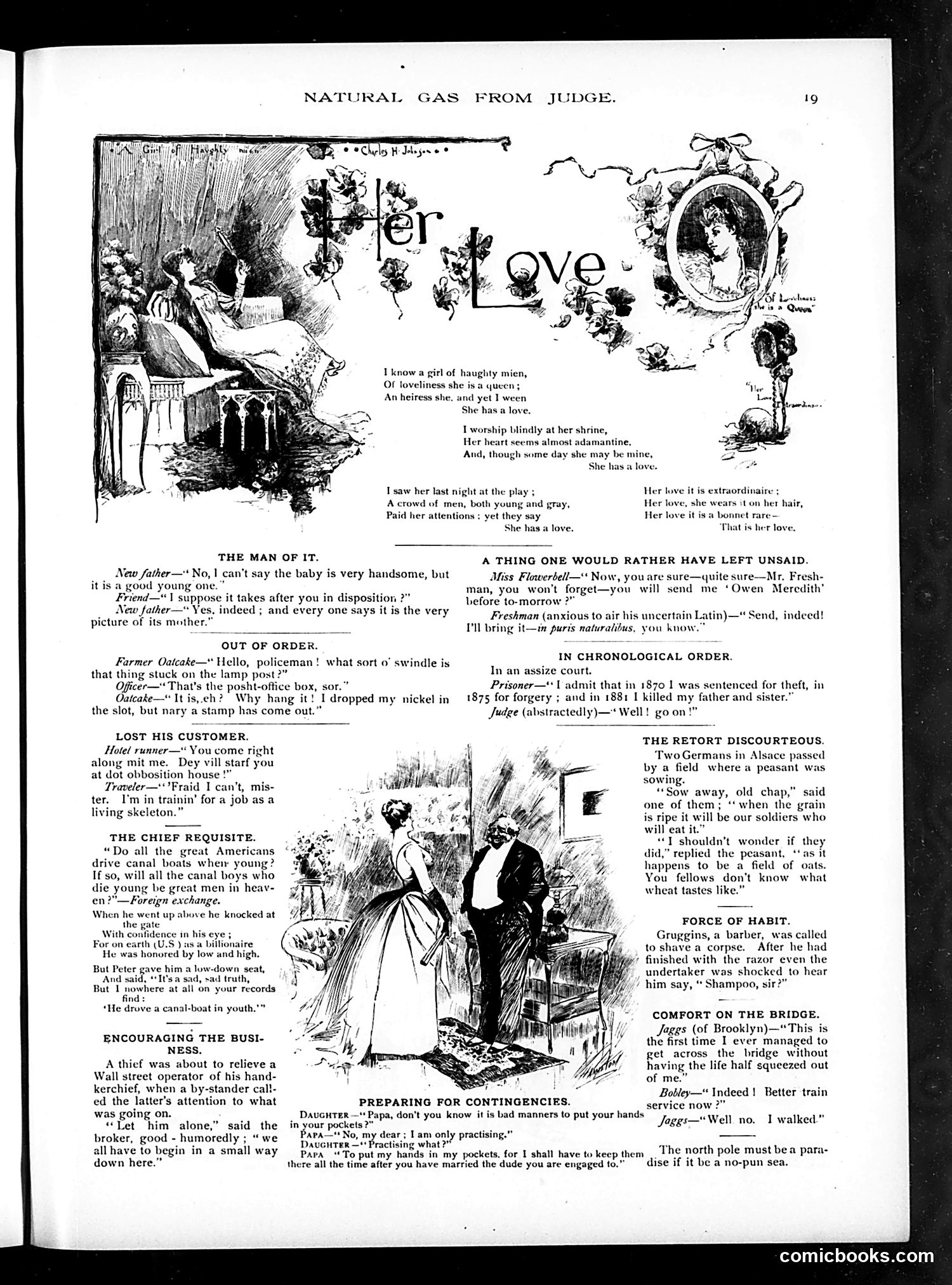
This page from *Judge* contains approximately a dozen short humorous sketches and quips typical of late 19th-century American satirical magazines. **Key comedic themes:** - **Social commentary**: "The Man of It" jokes about vanity and appearance; "The Chief Requisite" satirizes American mythology (canal boats and success); "Encouraging the Business" mocks Wall Street corruption by treating theft as normal. - **Immigrant humor**: Caricatured dialect humor appears in "Lost His Customer" (hotel runner with Germanic accent) and "Preparing for Contingencies" (Papa with broken English). - **Absurdist wordplay**: "Force of Habit" features a barber reflexively offering shampoo to a corpse; "Comfort on the Bridge" relies on puns about Brooklyn Bridge traffic. - **Contemporary references**: "The Retort Discourteous" depicts Franco-German tensions (relevant to 1870s-1880s context); postal service complaints reflect frustration with mail systems. The page emphasizes physical comedy, social stereotyping, and pun-based humor—hallmarks of Victorian-era satire aimed at educated readers familiar with contemporary news and social hierarchies.
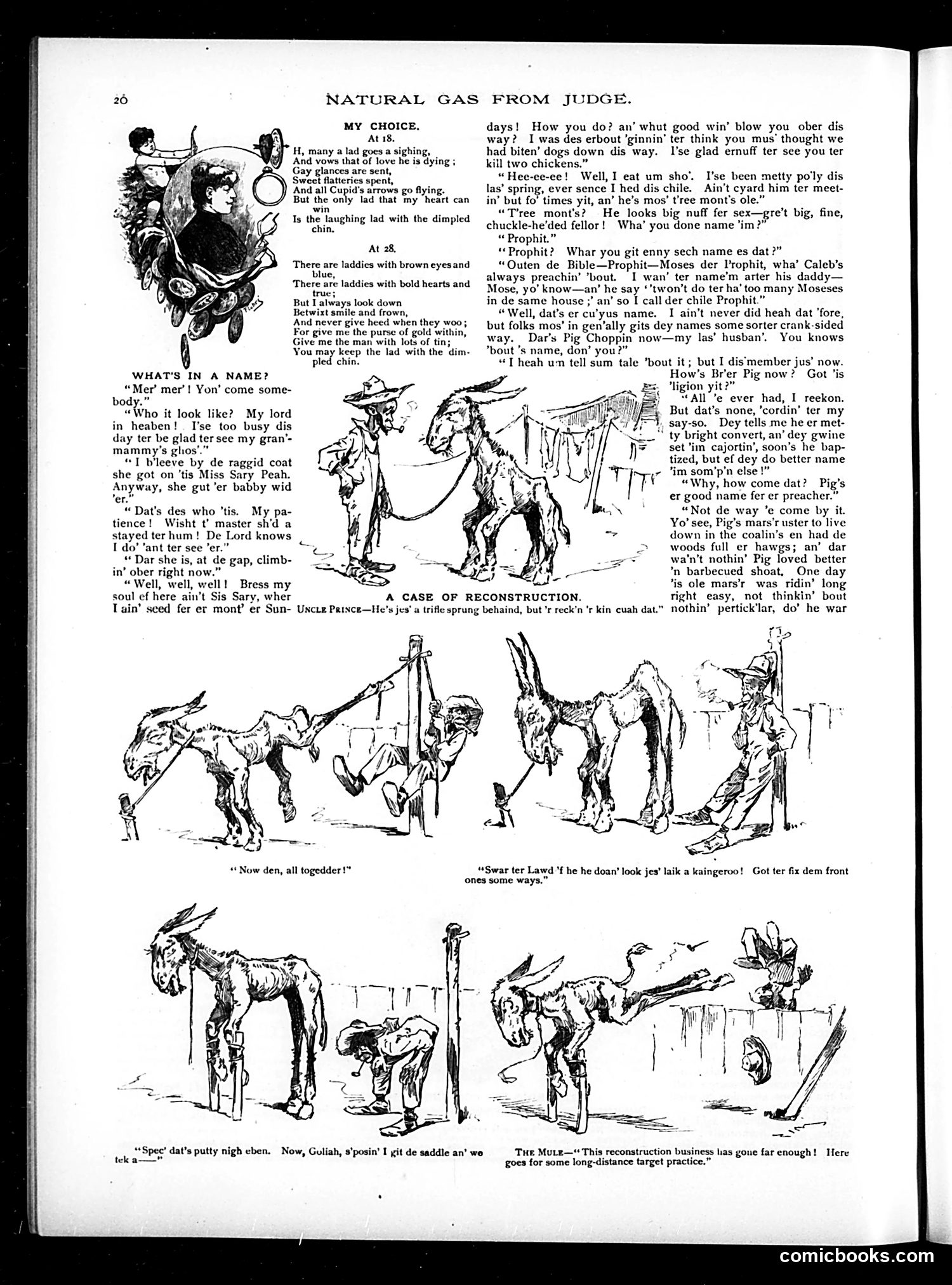
This page contains two distinct sections: **"My Choice" and "At 18/28"**: A satirical poem about women's romantic preferences, contrasting youthful idealism (loving a man with a "dimpled chin") with mature materialism (preferring "the man with lots of tin"—money). The satire mocks women's shifting values with age. **"What's in a Name?" and "A Case of Reconstruction"**: Dialect-heavy sketches featuring African American characters in the post-Civil War South. The humor derives from phonetic dialect spelling and absurd names—"Prophit" (derived from biblical "Prophet/Moses") and "Pig Choppin'" (a man named after getting hit by a pig). **"The Mule"**: A series of illustrations showing a mule being difficult to saddle, captioned as "reconstruction business" target practice—likely a political metaphor suggesting the challenges of Reconstruction policy. These sketches reflect Judge's contemporary (late 19th-century) satirical approach, mixing social commentary with racial caricature common to that era's humor.
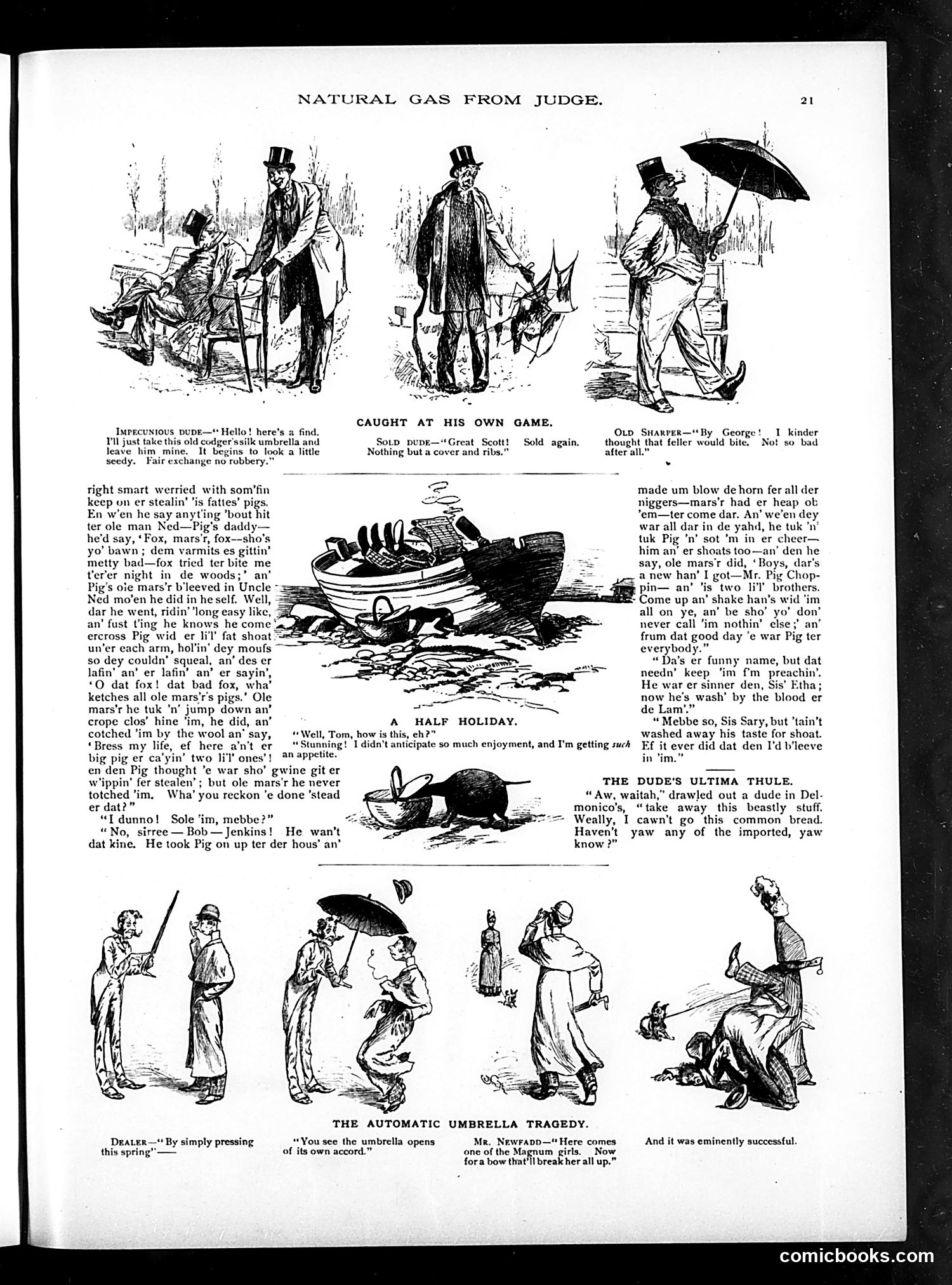
This page from the satirical magazine **Judge** contains several unrelated humorous sketches poking fun at contemporary society: 1. **"Impecunious Dude"** (top left): A poor gentleman swaps his worn umbrella for a wealthy man's silk one—a commentary on class pretense and petty theft masquerading as "fair exchange." 2. **"Caught at His Own Game"** (top center): A con artist attempting to swindle someone discovers the tables turned—satire on deception backfiring. 3. **"The Dude's Ultima Thule"** (right): Mocks an affected, snobbish diner demanding "imported" bread at Delmonico's (a famous restaurant), ridiculing pretentious affectation and class-consciousness. 4. **"A Half Holiday"** and **"The Automatic Umbrella Tragedy"** (bottom): Appear to be humorous anecdotes with visual gags about umbrellas malfunctioning and social mishaps. The long dialect story occupies the left column—appears to be a sentimental tale about a slave and pig, typical of period folk humor. Overall, the page satirizes American social pretension, fraud, and class anxiety of the Gilded Age/early 20th century.
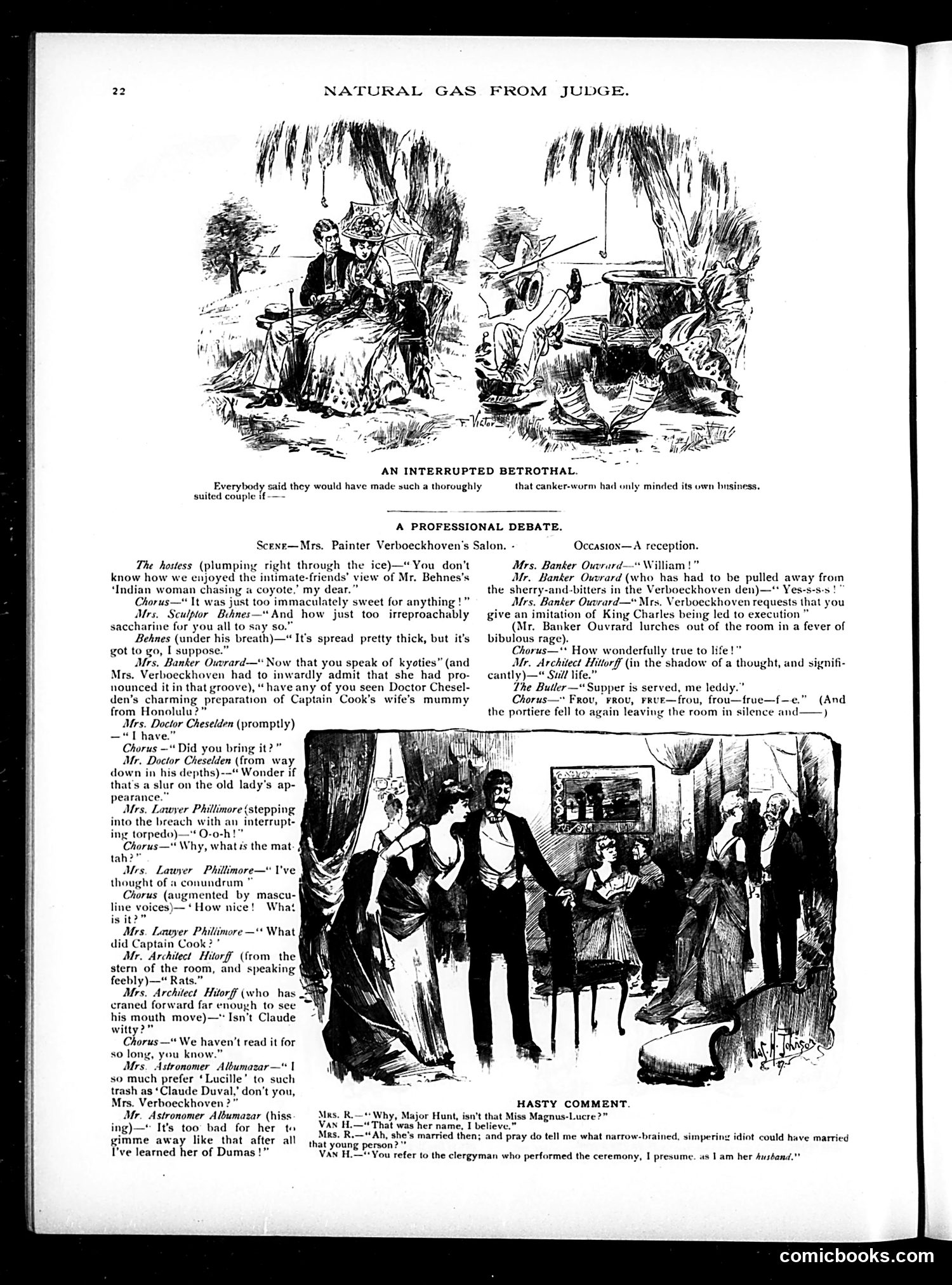
This page contains two satirical sketches mocking upper-class social pretension in the late 19th century. **"An Interrupted Betrothal"** (top) is a brief visual joke: a couple's romantic moment is disrupted by a canker-worm—suggesting even perfect matches have trivial obstacles that destroy them. **"A Professional Debate"** (main text) satirizes a pretentious salon gathering where wealthy hosts and guests (identified by profession: banker, lawyer, architect, astronomer) engage in vapid, name-dropping conversation about art and culture. The humor lies in their affected speech, constant interruptions, non-sequiturs, and desperate attempts to appear cultured. One guest's weak joke ("Rats") prompts his wife to praise his wit—mocking marital delusion. Another scene shows a drunk banker storming out when asked to perform an imitation, revealing the fragility beneath social polish. **"Hasty Comment"** (bottom) briefly jokes about a woman's poor marriage choice. The satire targets wealthy Victorian society's superficiality, social climbing, and hollow intellectualism.
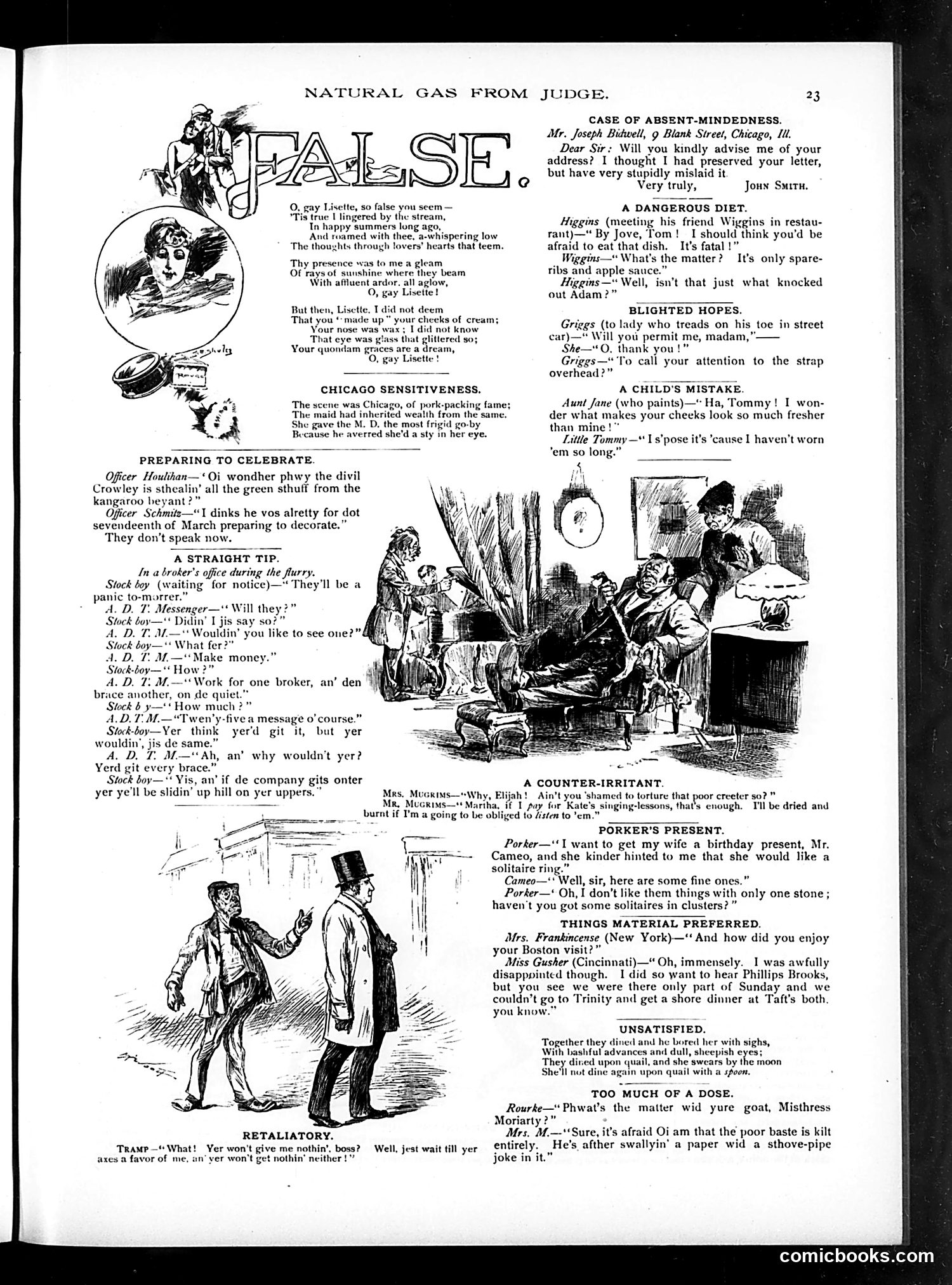
This page collects short humorous anecdotes and satirical vignettes typical of Judge's style. Key content includes: **"Chicago Sensitiveness"**: Mocks wealthy Chicago (pork-packing wealth) for vanity—a wealthy woman rejects a doctor because he mentioned she has a sty in her eye, suggesting shallow materialism. **Police officers dialogue**: Two immigrant cops (Irish "Houlikan" and German "Schmitz," indicated by dialect) misunderstand why someone steals from a kangaroo, conflating it with St. Patrick's Day decoration preparations. The joke ridicules immigrant officer stereotypes. **Stock boy/messenger exchanges**: Uses ethnic dialect humor about working-class financial naïveté. **"Porker's Present"**: Puns on "solitaire" diamonds—a man wants clustered solitaires, not understanding the term means a single stone. **Class satire throughout**: Recurring theme of materialism (women wanting expensive jewelry/fine dining over culture), immigrants misunderstanding American customs, and working-class ignorance. The page reflects late-19th/early-20th century American class and ethnic prejudices common in Judge's satirical approach.
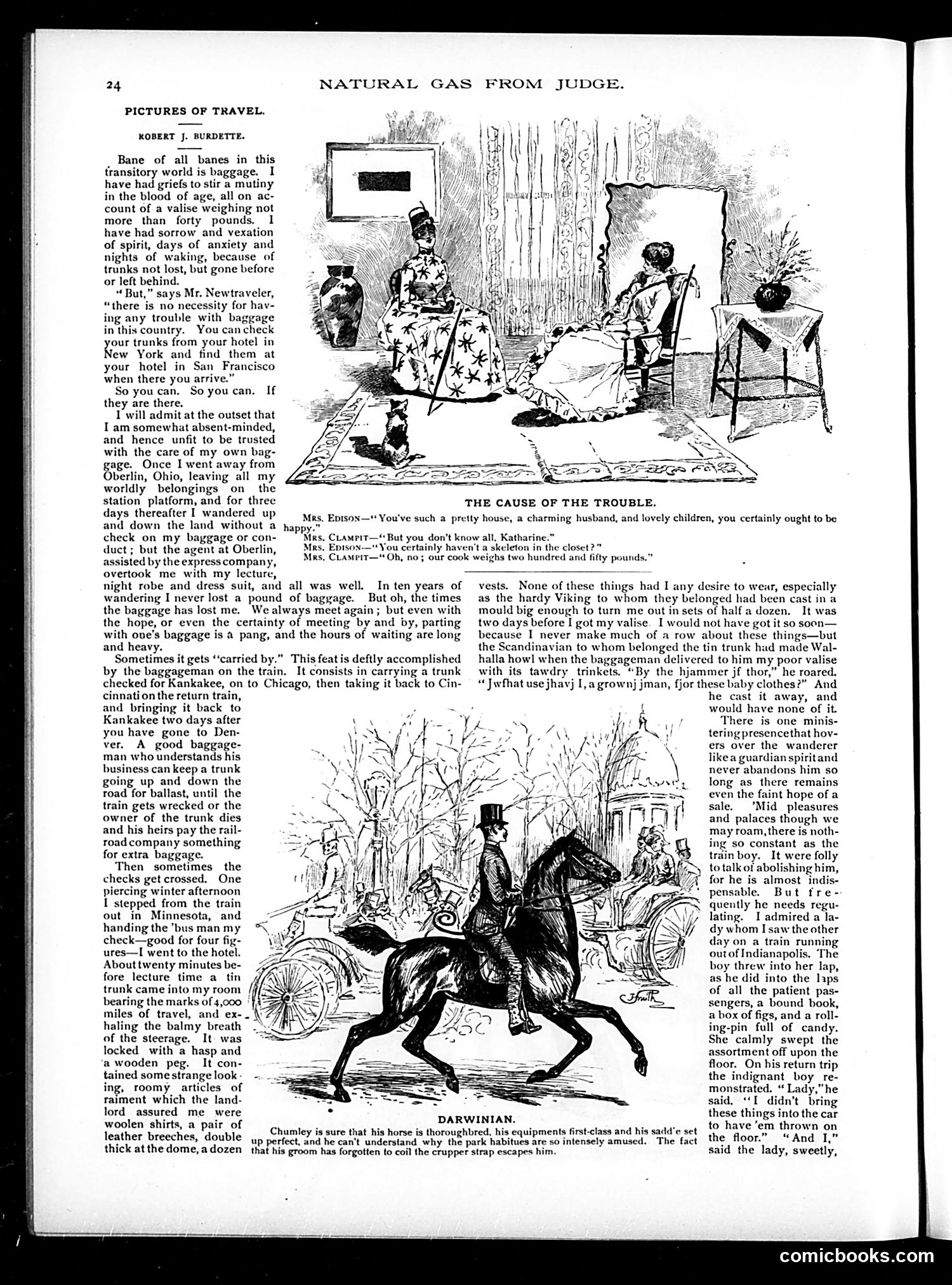
This page satirizes the frustrations of 1880s-90s travel. Author Robert J. Burdette's essay mocks the chaos of baggage handling on American trains—trunks being "carried by" (accidentally sent to wrong destinations), checks getting crossed, and luggage arriving days late or with someone else's belongings instead. The humor hinges on relatable travel disasters: Burdette once received a heavy Scandinavian immigrant's tin trunk filled with wool shirts and leather breeches instead of his own valise, creating absurd confusion. The cartoon illustrations show travelers surrounded by their luggage woes. The page's lower cartoon, titled "DARWINIAN," jokes that a man's horse and saddle are "thoroughbred" and "first-class," but he hasn't noticed his groom forgot to coil the saddle strap—a Darwinian observation that some people lack basic practical sense despite pretensions to refinement. The overall satire: travel infrastructure is comically unreliable, and human vanity blinds people to obvious problems.
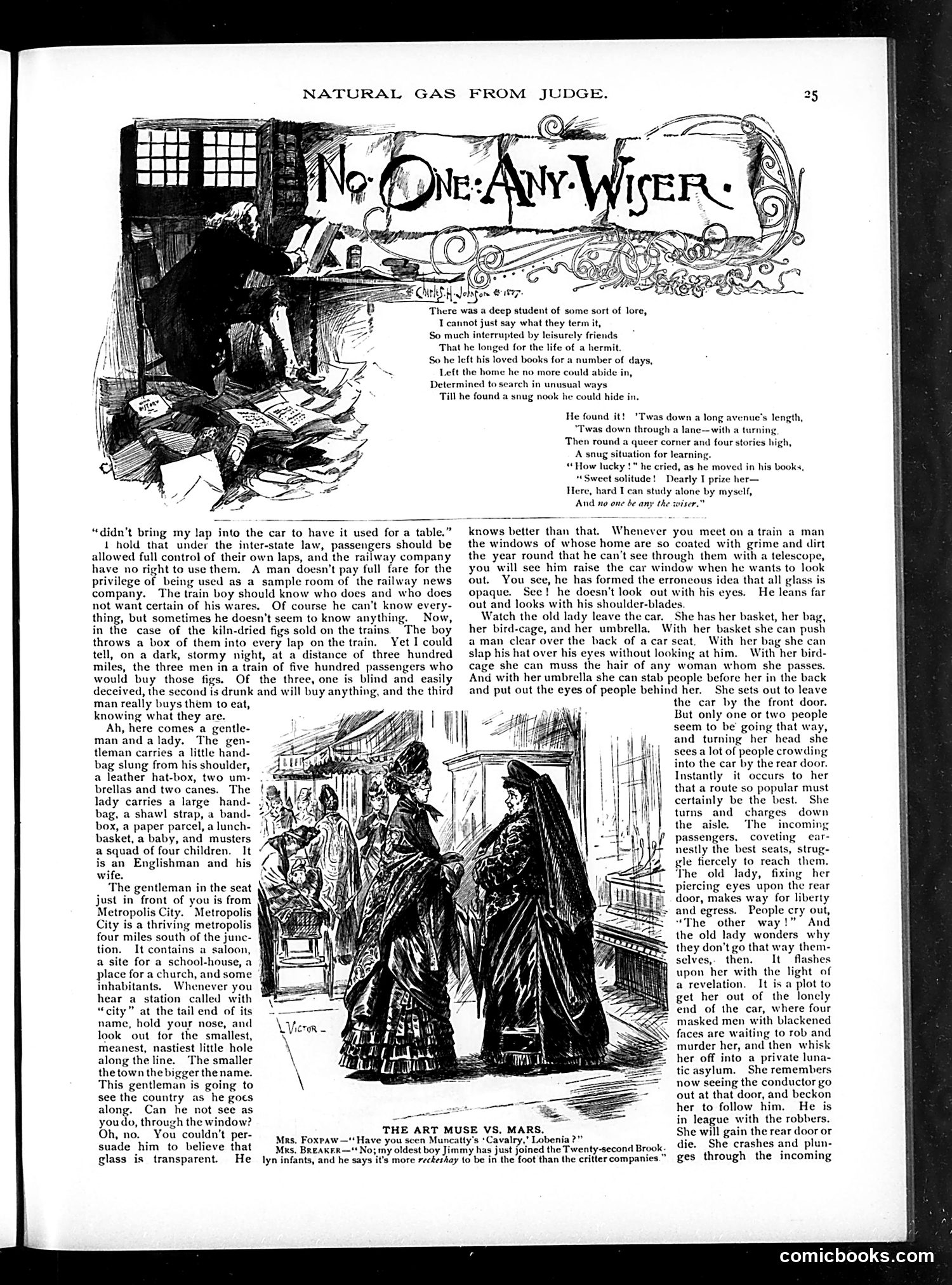
This page contains satirical sketches about train travel etiquette and passenger types. The main content mocks the annoying behaviors of different railway passengers: **"No One Any Wiser"** (top): A humorous poem about a scholarly hermit seeking solitude, illustrated with a figure among books. **Train Car Observations** (center text): Sharp social satire targeting specific passenger stereotypes—the blind-to-transparency man who won't believe windows are clear glass; the "Metropolis City" gentleman from a tiny town with a grandiose name; the oblivious newspaper-boy throwing figs into laps; and crucially, the English family occupying excessive space with luggage and children. **"The Art Muse vs. Mars"** (bottom): A brief comic dialogue where Mrs. Foxraw asks about Muncatty's "Cavalry" painting, and Mrs. Breaker replies that her son Jimmy prefers the actual Twenty-second Brooklyn Infantry to artistic depictions—a quip about real military service versus romanticized art. The overall humor targets middle-class Victorian train passengers' absurd behaviors and pretensions, common Judge magazine fare.
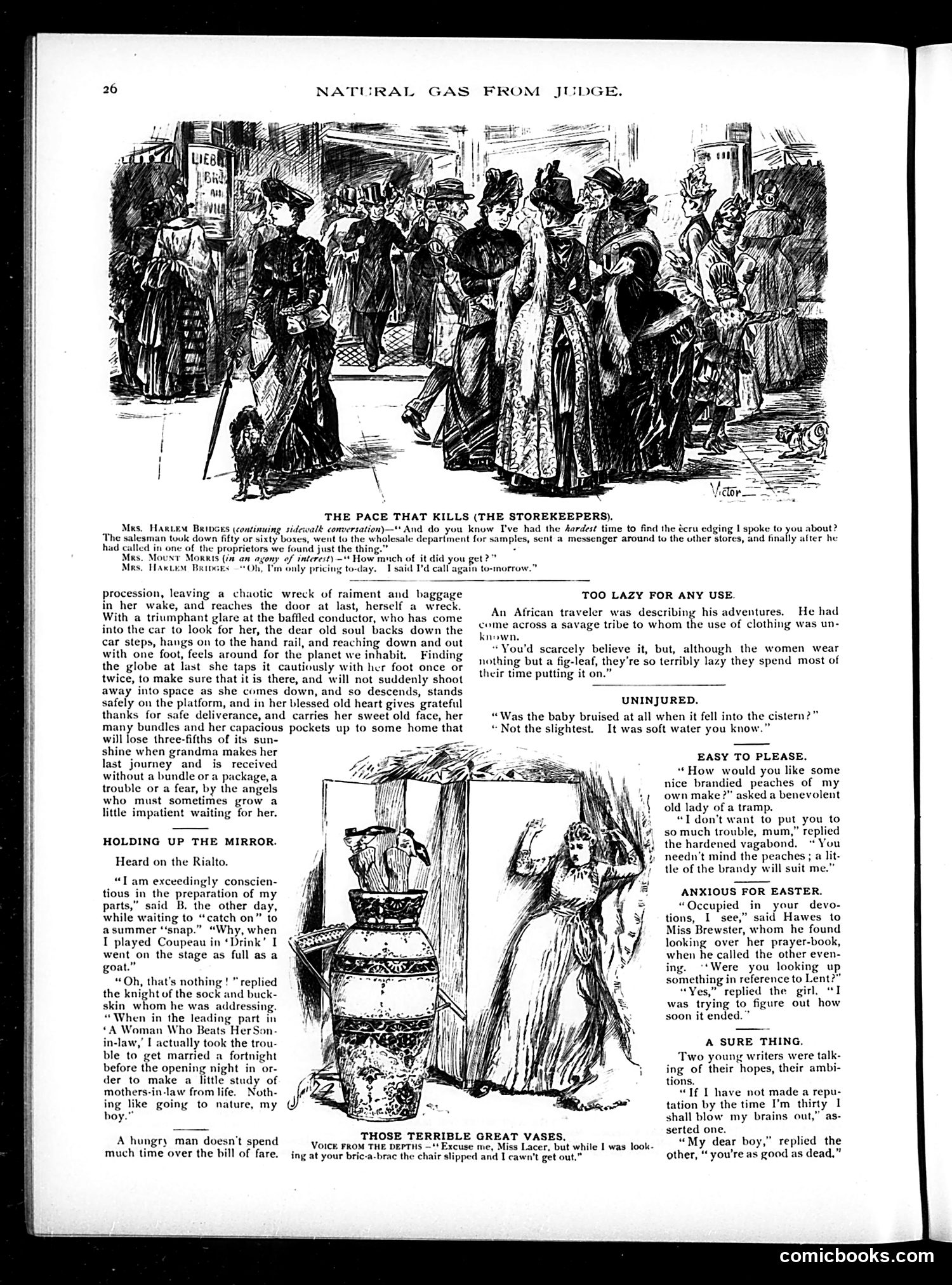
This page from *Judge* presents multiple brief satirical pieces mocking contemporary social behaviors and attitudes circa late 1800s. **"The Pace That Kills"** satirizes department store shopping culture—specifically women's obsessive pursuit of obscure merchandise (here, "écru edging"), forcing salesmen through exhausting procedures only to not purchase anything. **"Holding Up the Mirror"** parodies theatrical pretension, with actors boasting about absurd "method acting" choices (one claims he actually married before playing a character's son-in-law). Other brief jokes mock: wealthy women trapped by oversized decorative vases; a racist stereotype about African women's laziness; and class differences (a tramp rejecting brandy-soaked fruit, wanting only the alcohol). The illustrations employ Victorian-era caricature and cross-hatching typical of period satirical magazines. The humor targets consumer excess, theatrical vanity, and social pretension among the upper classes—recurring themes in *Judge's* social criticism.
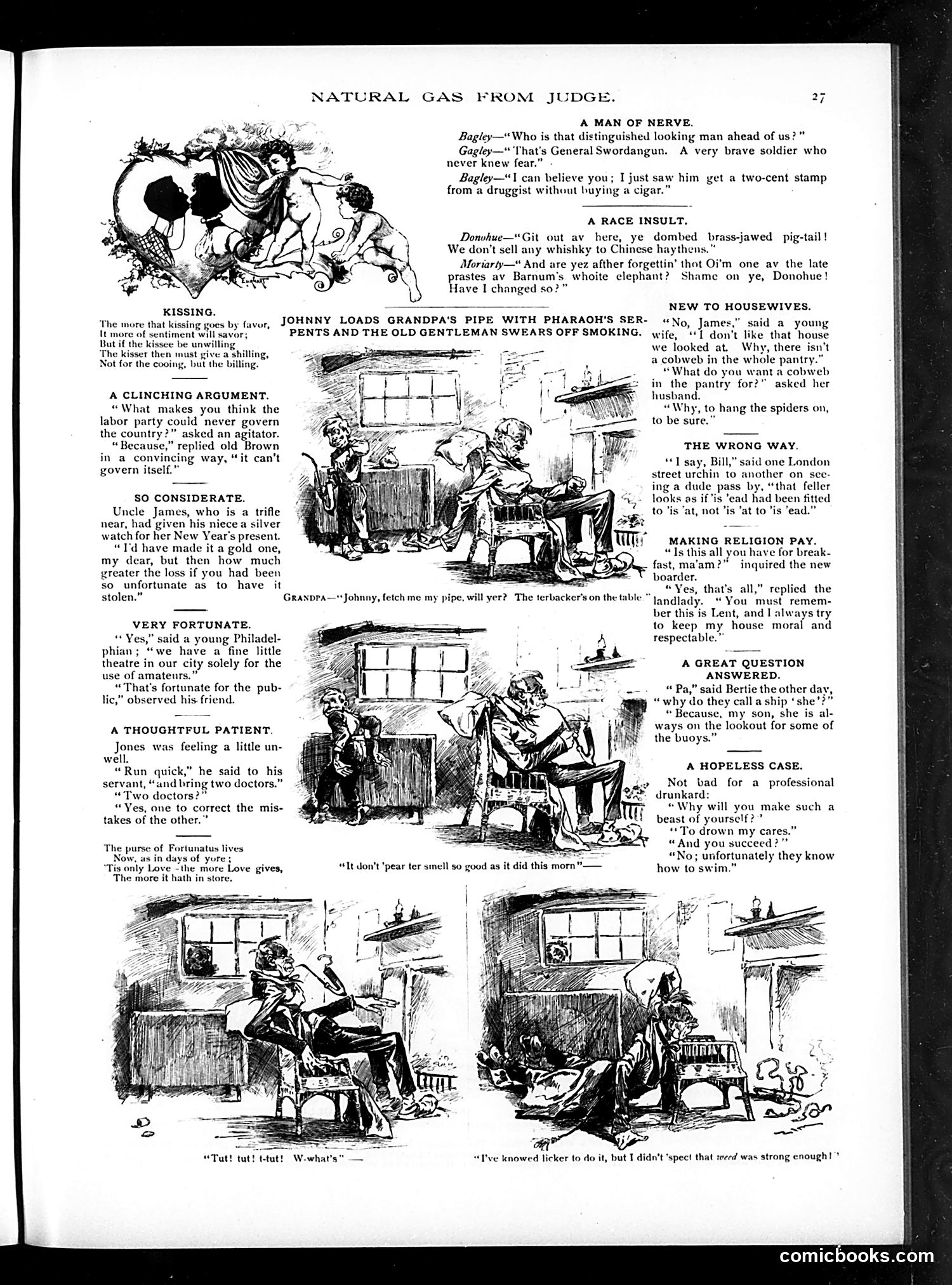
This page collects brief humorous anecdotes and jokes typical of late-19th-century American humor. The content includes: **Short jokes** on various topics: kissing, labor politics (mocking the labor party's competence), class humor (a stingy uncle), amateur theater (implying amateurs are bad), and medical incompetence. **Ethnic stereotypes**: The "Race Insult" features Irish and Chinese immigrant caricatures using exaggerated dialect, with a priest reference. This reflects the period's casual ethnic mockery. **Period-specific humor**: References to druggists selling cigars, cobwebs in pantries (as dust collectors), Barnum's white elephant exhibit, and the term "buoys/boys" (ship pun). **Social satire**: Jokes target pretentious dudes, religious hypocrisy (Lent fasting), and alcoholism. The central illustration shows a prank with "Pharaoh's serpents" (a fireworks product) loaded into a grandfather's pipe—slapstick humor common to the era. The overall tone is lighthearted, conservative, and reflects upper-class attitudes toward immigrants, working people, and various social groups.
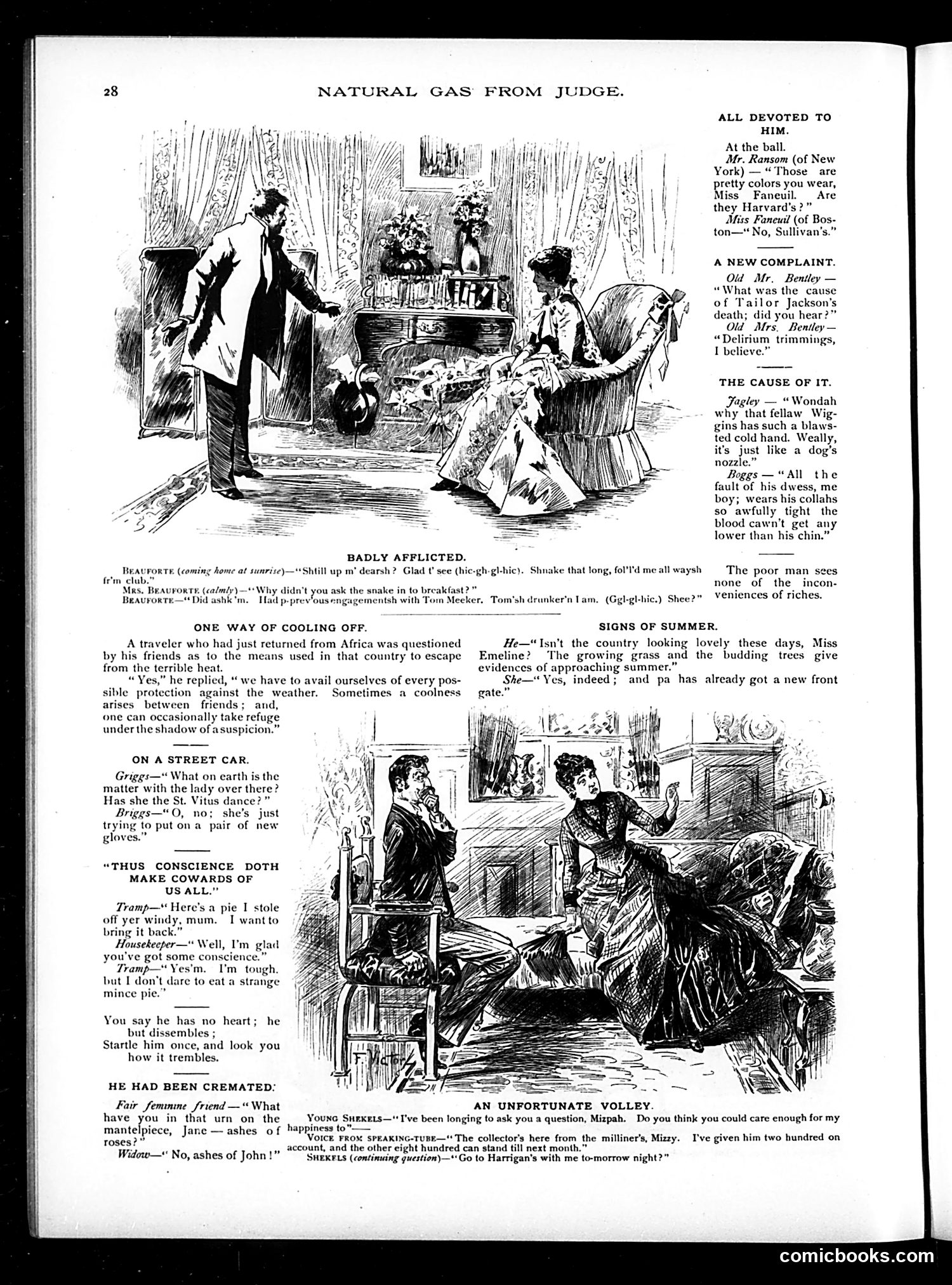
This page from *Judge* contains multiple brief satirical sketches mocking social pretensions and domestic life of the era. **Key sketches:** "ALL DEVOTED TO HIM" mocks Boston/New York society, with Miss Faneuil claiming her dress colors belong to Sullivan rather than Harvard—satirizing status-conscious name-dropping. "A NEW COMPLAINT" jokes that a tailor died from "delirium trimmings"—parodying medical diagnosis while poking fun at fashion obsession. "THE CAUSE OF IT" ridicules tight collars worn by the fashion-conscious, suggesting they cut off blood circulation—a jab at vanity causing physical harm. "BADLY AFFLICTED" depicts a drunk husband returning home at sunrise with a snake; his wife's sarcastic response satirizes marital discord and alcoholism. Other sketches mock: African heat remedies, social awkwardness on streetcars, superstitious fears about eating "strange mince pie," and a widow's cremated husband becoming ash—darkly comic wordplay. The overall tone targets Victorian social pretension, marital dysfunction, and fashion absurdity through exaggerated dialogue and ironic situations.
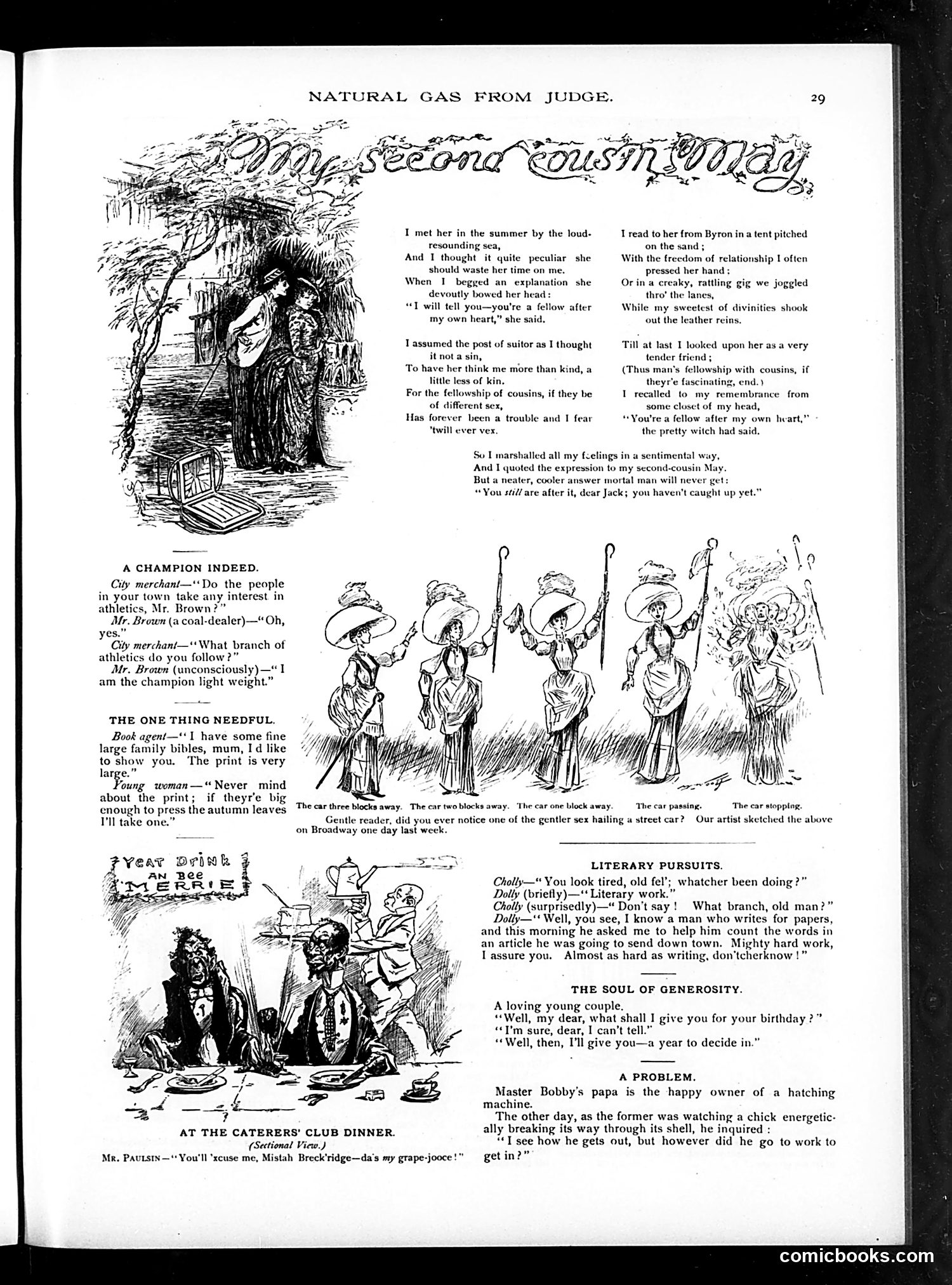
This page from the satirical magazine *Judge* contains several unrelated humor pieces typical of the publication's format. The main content includes: 1. **"My Second Cousin Emily"** — A sentimental poem about a man's romantic relationship with his cousin, mocking Victorian-era sentimentality and the social complications of cousin romance. 2. **Street car cartoon** — Depicts a woman attempting to hail a street car, satirizing how women of the era struggled to get taxi drivers' attention, showing the vehicle passing by repeatedly before finally stopping. 3. **"Literary Pursuits"** — Jokes about a man claiming "literary work" when he's merely helping count words in a newspaper article, mocking pretentiousness. 4. **Minor jokes** about generosity, a hatching machine, and what appears to be a racial caricature at a dinner club (the "Mistah Breck'ridge" reference). The page reflects *Judge's* focus on social observation humor, Victorian courtship customs, gender dynamics, and class commentary typical of the era.
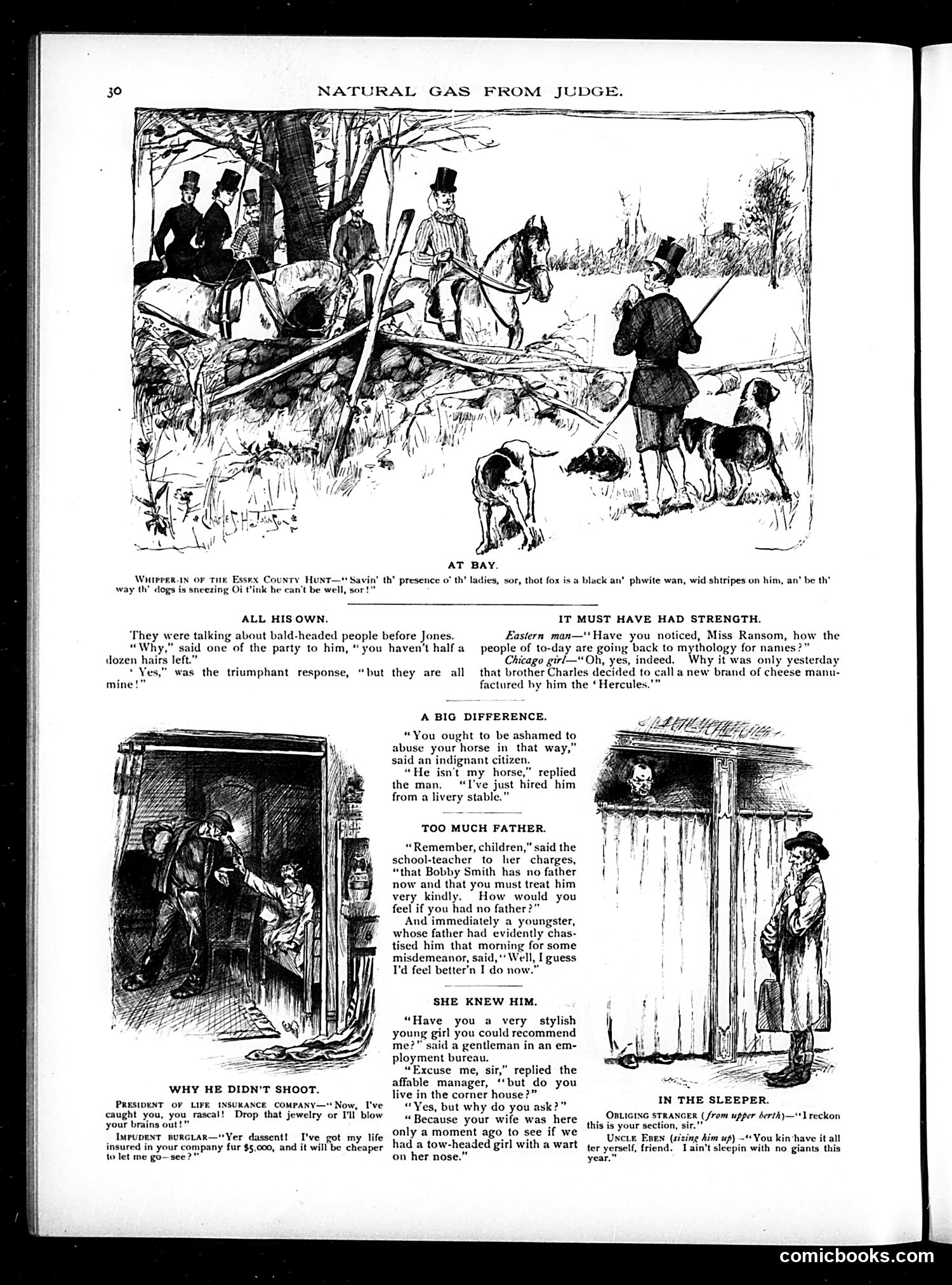
This page contains multiple short humorous anecdotes typical of Judge's satirical style, rather than a single political cartoon. The pieces mock various social types and situations: **"All His Own"** jokes about male baldness—a man proudly claims his few remaining hairs are authentically his, not borrowed. **"It Must Have Had Strength"** satirizes naming trends, suggesting modern Americans bizarrely invoke mythology (like naming cheese "Hercules"). **"A Big Difference"** contrasts attitudes: a citizen scolds someone for abusing a horse, only to learn it's hired, making the abuser feel guiltless about rental property. **"Too Much Father"** uses dark humor: a teacher sympathetically tells children to be kind to fatherless Bobby; a boy immediately responds he'd feel *better* without his father (who beats him). **"She Knew Him"** plays on class/propriety: a domestic servant recognizes an inquirer's wife visited recently. The remaining pieces use similar formulaic joke structures. Overall, these represent Judge's accessible, middle-class humor satirizing everyday human nature and social pretension rather than specific political events.
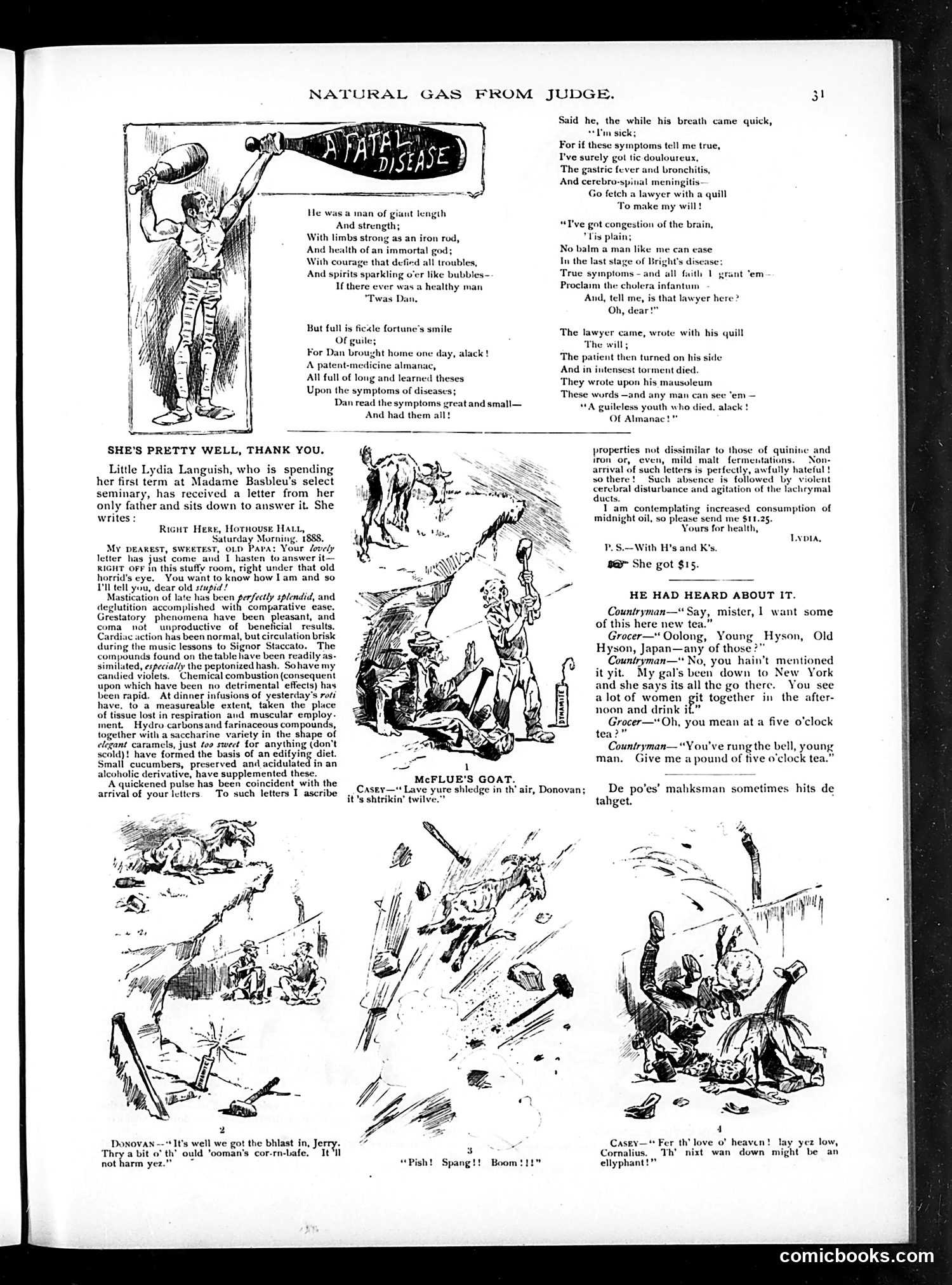
This page contains three satirical pieces mocking 19th-century medical and social pretension: **"Natural Gas from Judge"** ridicules hypochondria and patent medicine culture. A healthy man named Dan reads a medical almanac listing symptoms, becomes convinced he has multiple serious diseases (Bright's disease, meningitis, etc.), and dies—not from illness but from psychosomatic anxiety. The satire targets both quack medical literature and people's gullible self-diagnosis. **"She's Pretty Well, Thank You"** parodies affected Victorian letter-writing. A schoolgirl writes her father using absurdly pretentious medical/scientific language ("mastication," "cardiac action," "peptonized hash") to describe normal eating and school life. The joke: elaborate pseudo-intellectual vocabulary obscuring simple reality. She ends by requesting money ($11.25 for "midnight oil"). **"He Had Heard About It"** is a brief rural humor piece about a countryman asking for "five o'clock tea"—a fashionable British social practice—believing it's a type of tea rather than an afternoon social custom. All three mock contemporary affectation, medical quackery, and class pretension.
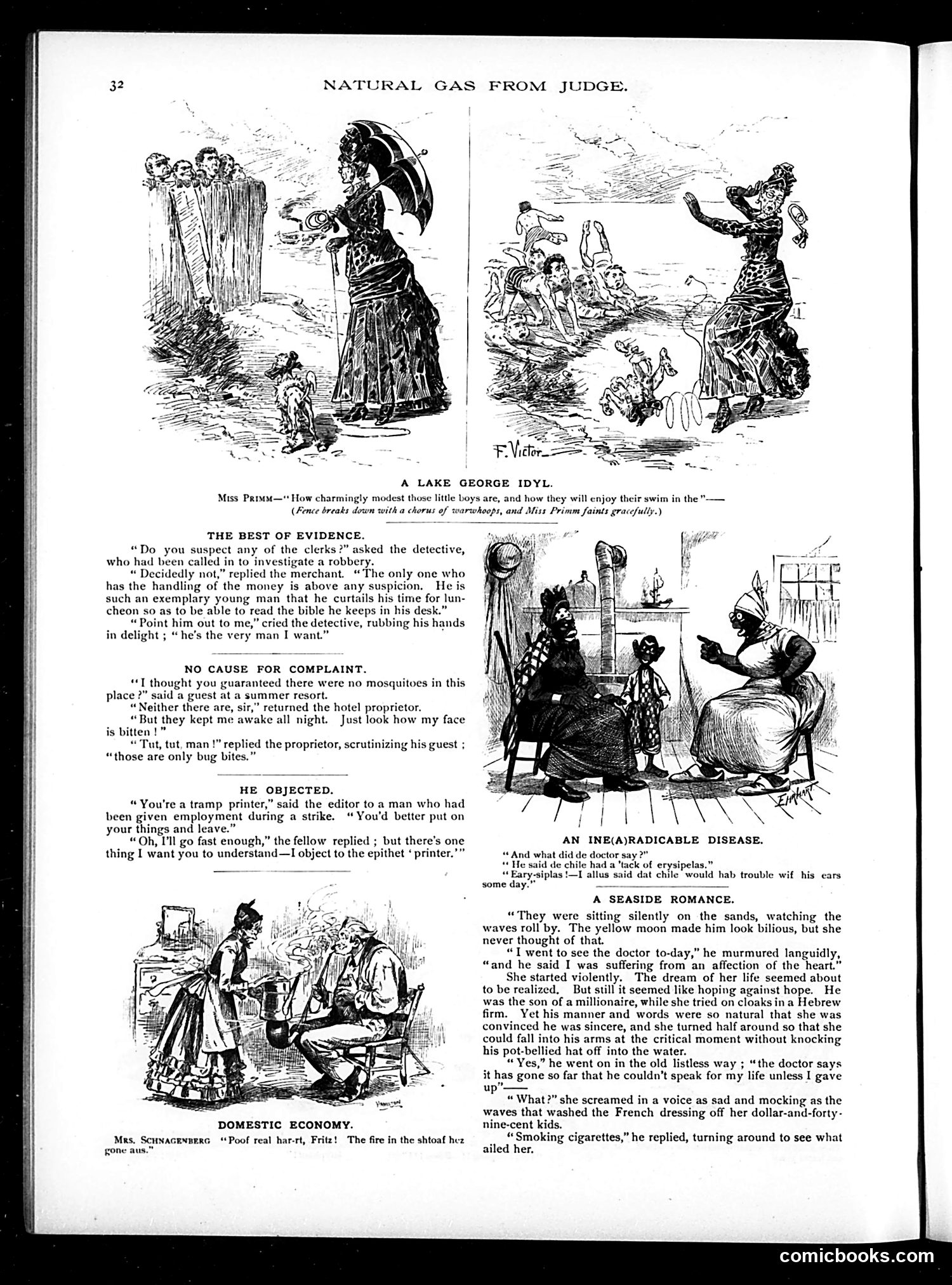
This page contains six short comedic sketches typical of Judge's satirical humor: **"A Lake George Idyl"**: A woman (Miss Primm) begins praising boys' modesty before a fence collapses—suggesting the boys were skinny-dipping, undercutting her sanctimoniousness. **"The Best of Evidence"**: A detective seeking a robbery suspect is told the most trustworthy clerk is one who reads the Bible during lunch. The detective excitedly identifies *this* man as his suspect—the satire being that excessive piety masks guilt. **"No Cause for Complaint"**: A hotel proprietor denies mosquitoes exist but admits mosquito bites cover a guest's face, then claims they're "only bug bites"—absurd verbal evasion. **"He Objected"**: A striking worker accepts dismissal but objects to being called a "tramp printer"—valuing dignity even while accepting humiliation. **"A Seaside Romance"**: A wealthy man tells a poor woman he's ill, she misinterprets romantically, then learns he must quit *smoking*—deflating melodramatic expectations. **"Domestic Economy"**: A woman blames her husband for the fire going out—domestic complaint humor. All rely on misunderstandings, hypocrisy, and class commentary typical of late-19th-century American satire.
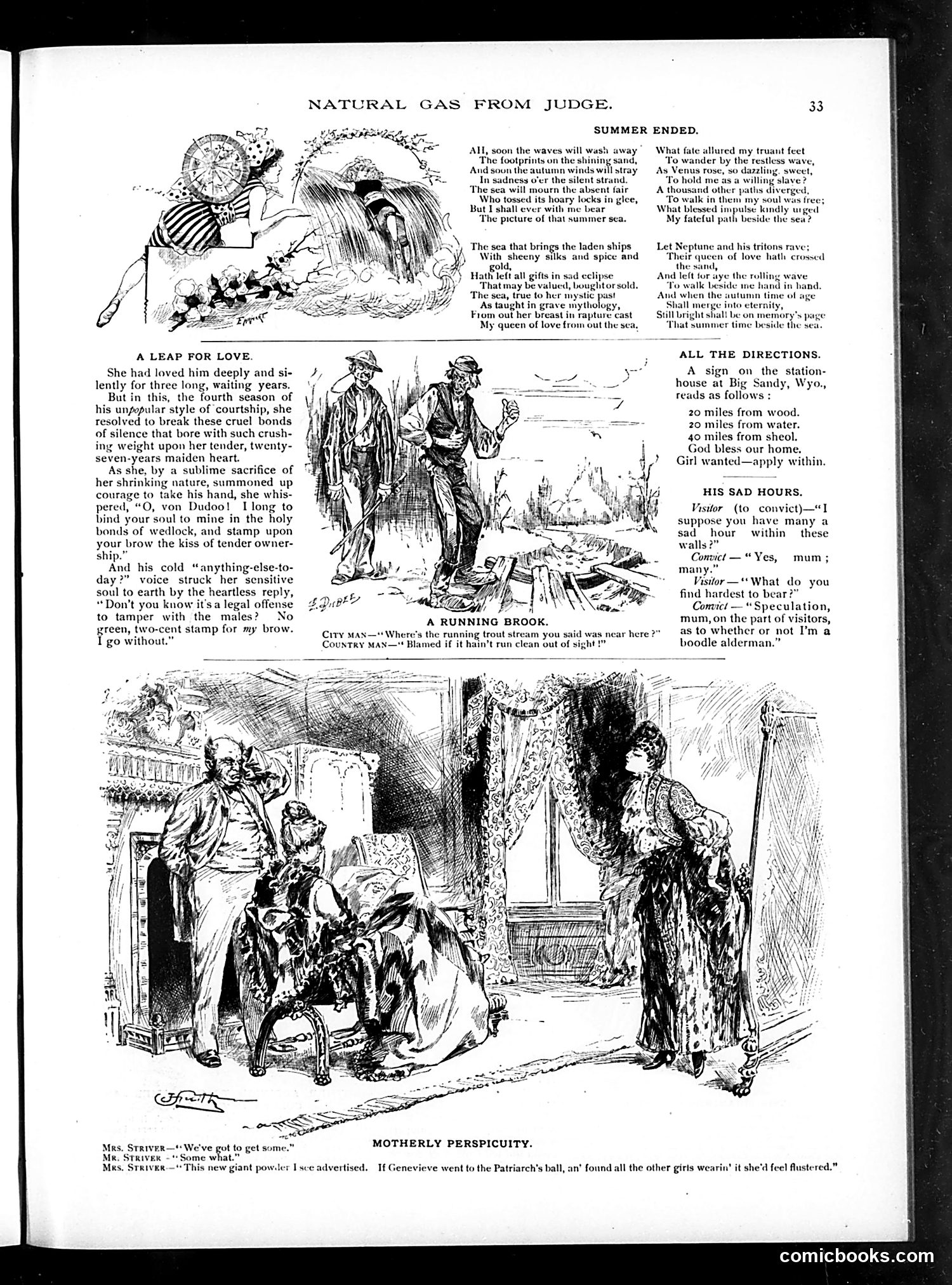
This page contains several humorous sketches and poems rather than political cartoons. The content includes: **"A Leap for Love"** — A romantic poem about a woman breaking social conventions to elope with her beloved, defying her family's wishes. **"A Running Brook"** — A joke contrasting urban and rural perspectives, where a city man and country man debate whether a stream is clean. **"Motherly Perspicuity"** — A domestic humor sketch depicting mothers gossiping about their daughters' social standing, with a joke about a girl feeling embarrassed at a ball. **"Summer Ended," "All the Directions," and "His Sad Hours"** — Additional light verse and humorous anecdotes focusing on romantic misadventures and social awkwardness. The page emphasizes social satire about courtship, class consciousness, and domestic life rather than political commentary.
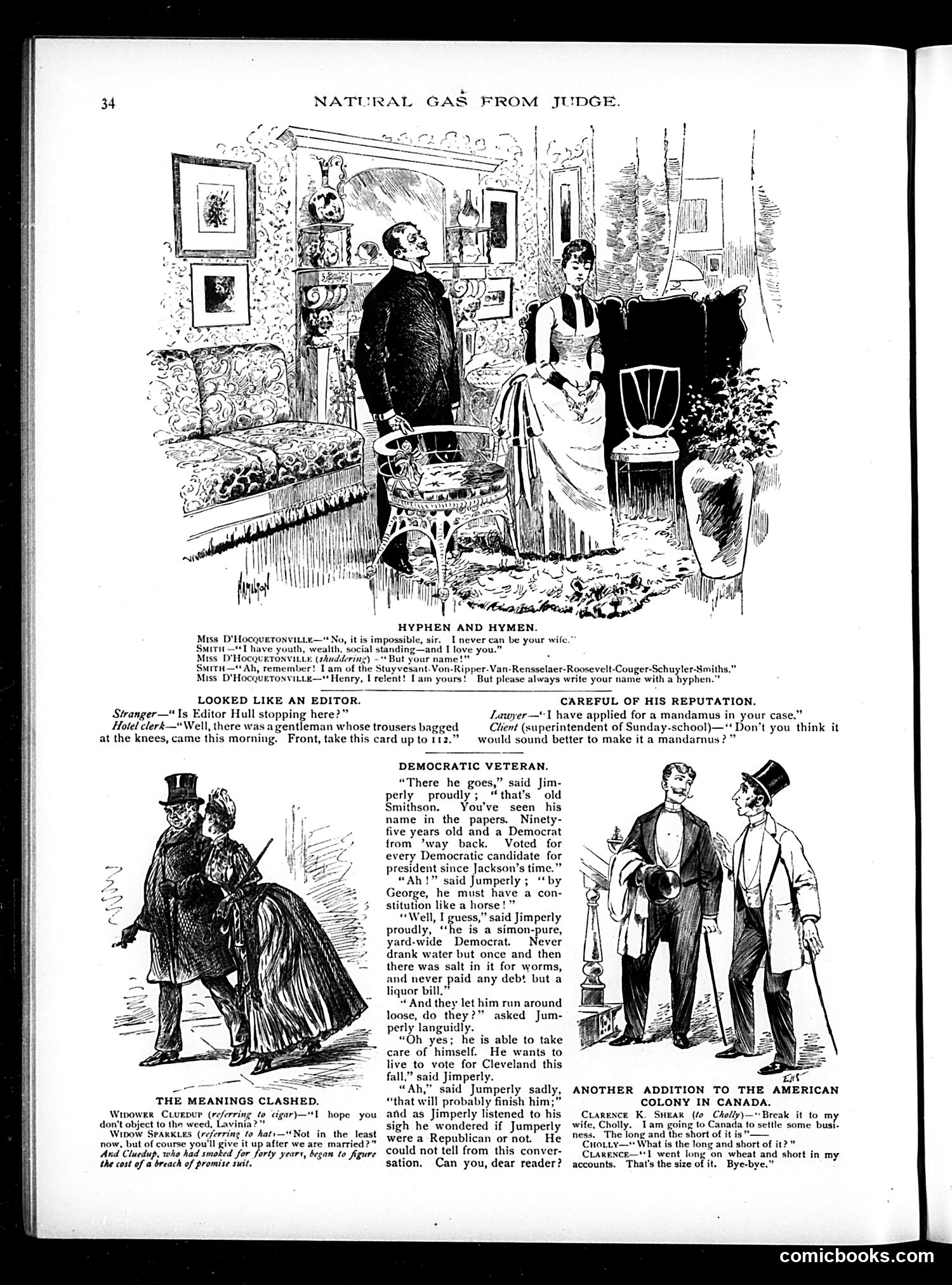
This page contains five distinct satirical sketches mocking social pretensions and political follies of the era: **"Hyphen and Hymen"**: Ridicules the elaborate hyphenated surnames of wealthy New York families (Van-Rensselaer-Roosevelt types), suggesting their names are absurdly long. The joke: a woman refuses marriage until her suitor agrees to always write his impossibly complex name with hyphens. **"Looked Like an Editor"**: A hotel clerk mistakes a shabby-dressed guest for the editor Hull based on baggy trousers—implying editors dress poorly. **"Democratic Veteran"**: Satirizes an elderly lifelong Democrat voter so devoted he'll "vote for Cleveland" despite apparently being in poor health, portrayed as uncouth and unprincipled. **"The Meanings Clashed"**: A widow and widower misunderstand each other—she means tobacco "weed," he means marriage vows—a play on ambiguous language. **"Another Addition to the American Colony in Canada"**: Mocks a businessman's confused explanation of wheat speculation using "long" and "short" market positions. All reflect late-19th-century satirical humor targeting class pretension and political excess.
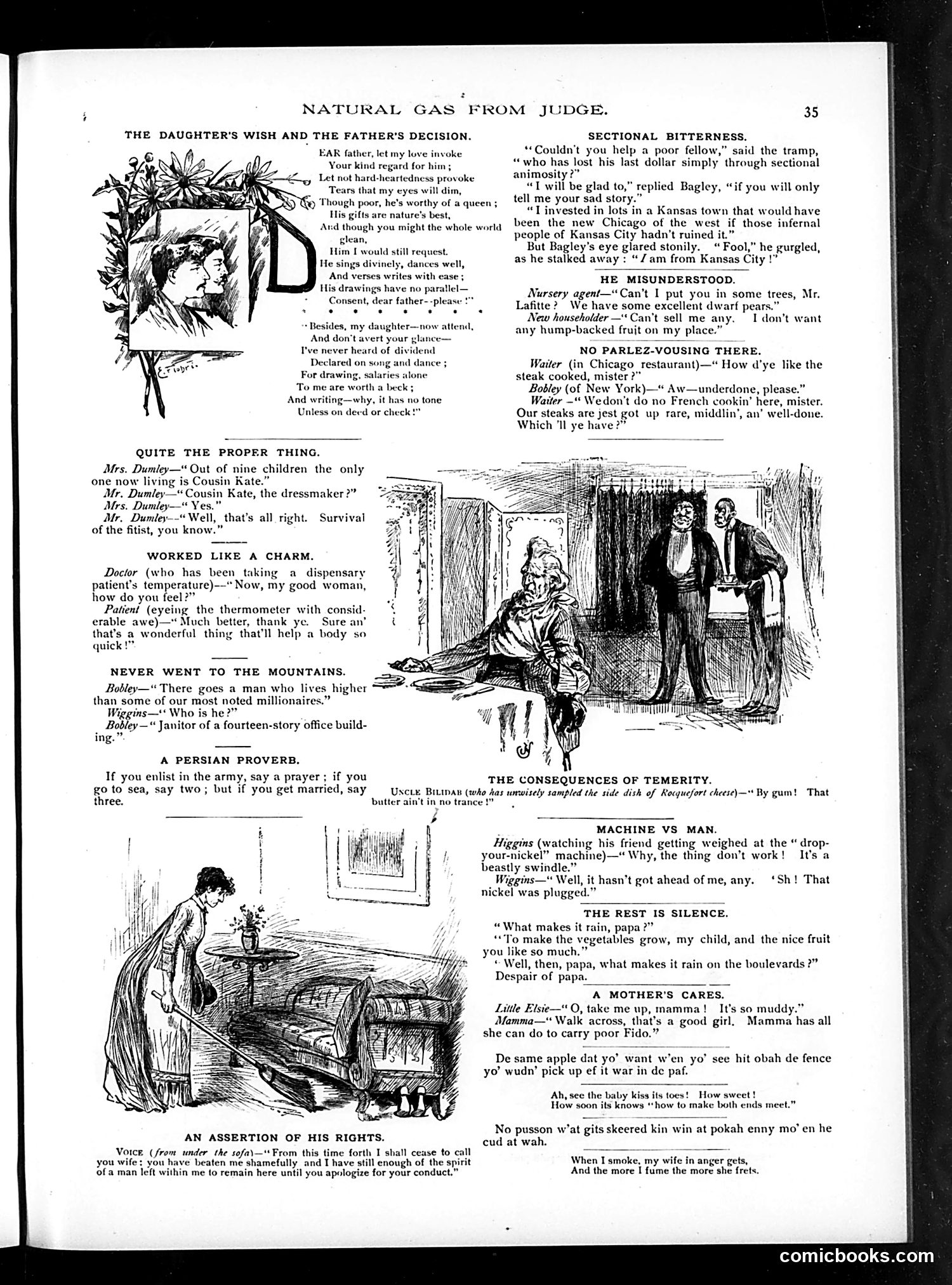
This page from *Judge* magazine contains multiple short satirical pieces typical of late 19th-century American humor. The content includes: **"Sectional Bitterness"**: A tramp seeks charity after losing money investing in a Kansas town, blaming Kansas City's rivalry. When revealed as being from Kansas City himself, the potential donor angrily refuses—satirizing intense regional animosity between American cities of that era. **"He Misunderstood"**: A real estate agent offers dwarf pear trees; the buyer refuses, misunderstanding "dwarf" as "hump-backed," mocking rural ignorance. **"No Parlez-Vousing There"**: A Chicago waiter refuses French cooking terminology, offering only plain American preparations—satirizing American anti-French sentiment and working-class speech patterns. The remaining pieces are brief jokes about doctors, thermometers, janitors, and domestic life. The sketches accompanying these pieces use period illustration styles to enhance the humor, which relied heavily on regional accents, class stereotypes, and urban-rural contrasts common to Gilded Age satire.
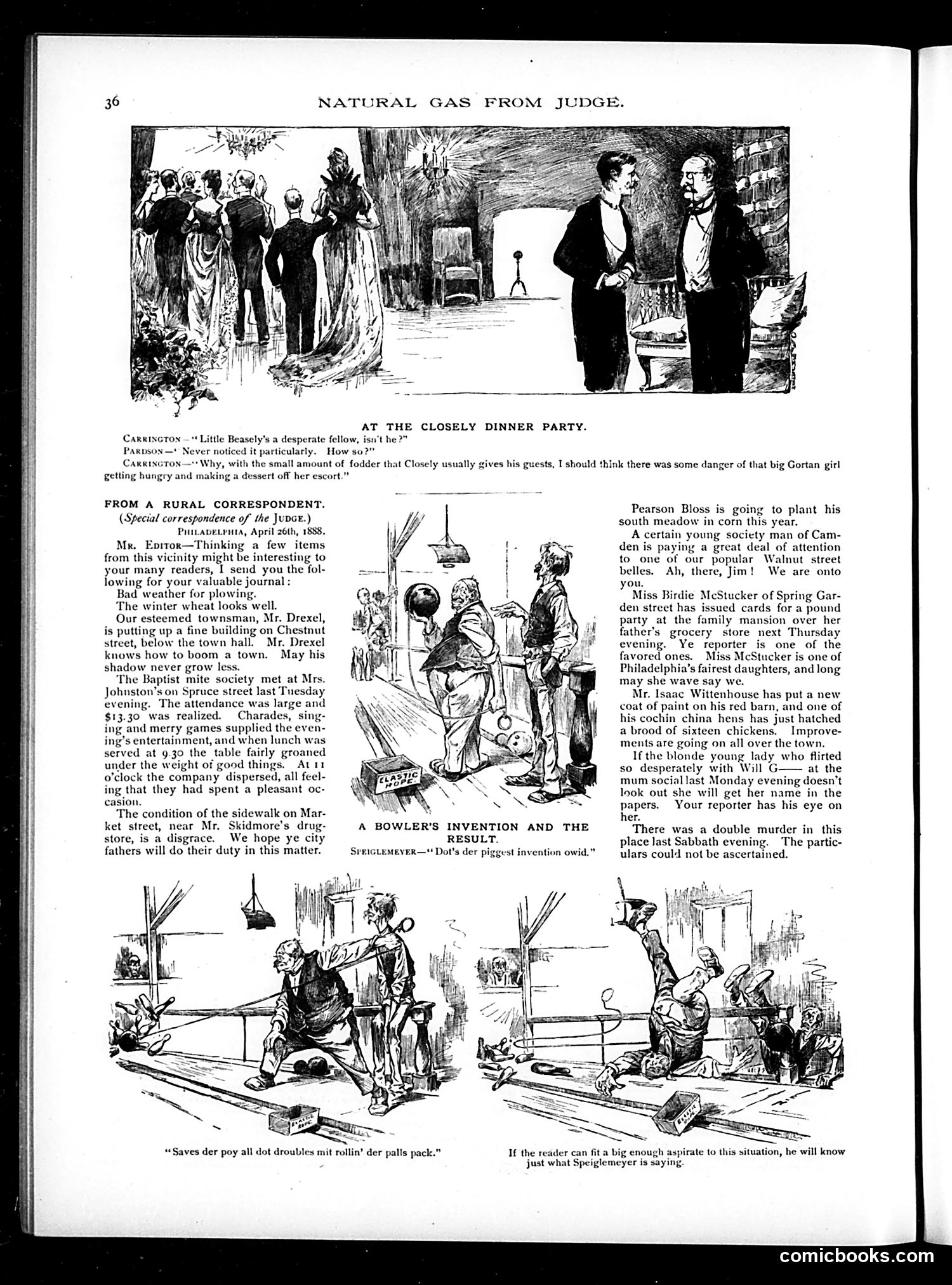
This page contains social humor and a multi-panel cartoon titled "A Bowler's Invention and the Result." The top section includes a dinner-party joke and a "Rural Correspondent" column with humorous local-society observations—small-town gossip about social events, romantic entanglements, and mishaps. The main cartoon depicts a man demonstrating some kind of bowling-related contraption to others. The German-dialect caption ("Saves der poy all dot troubles mit rollin' der palls pack") suggests an immigrant character showcasing a labor-saving device. The sequential panels show the invention's comical failure—the bowler gets knocked over or struck by his own apparatus, a classic slapstick punchline about unintended consequences of supposedly helpful inventions. The humor targets both mechanical innovation gone wrong and ethnic stereotypes common to 1880s American satire.
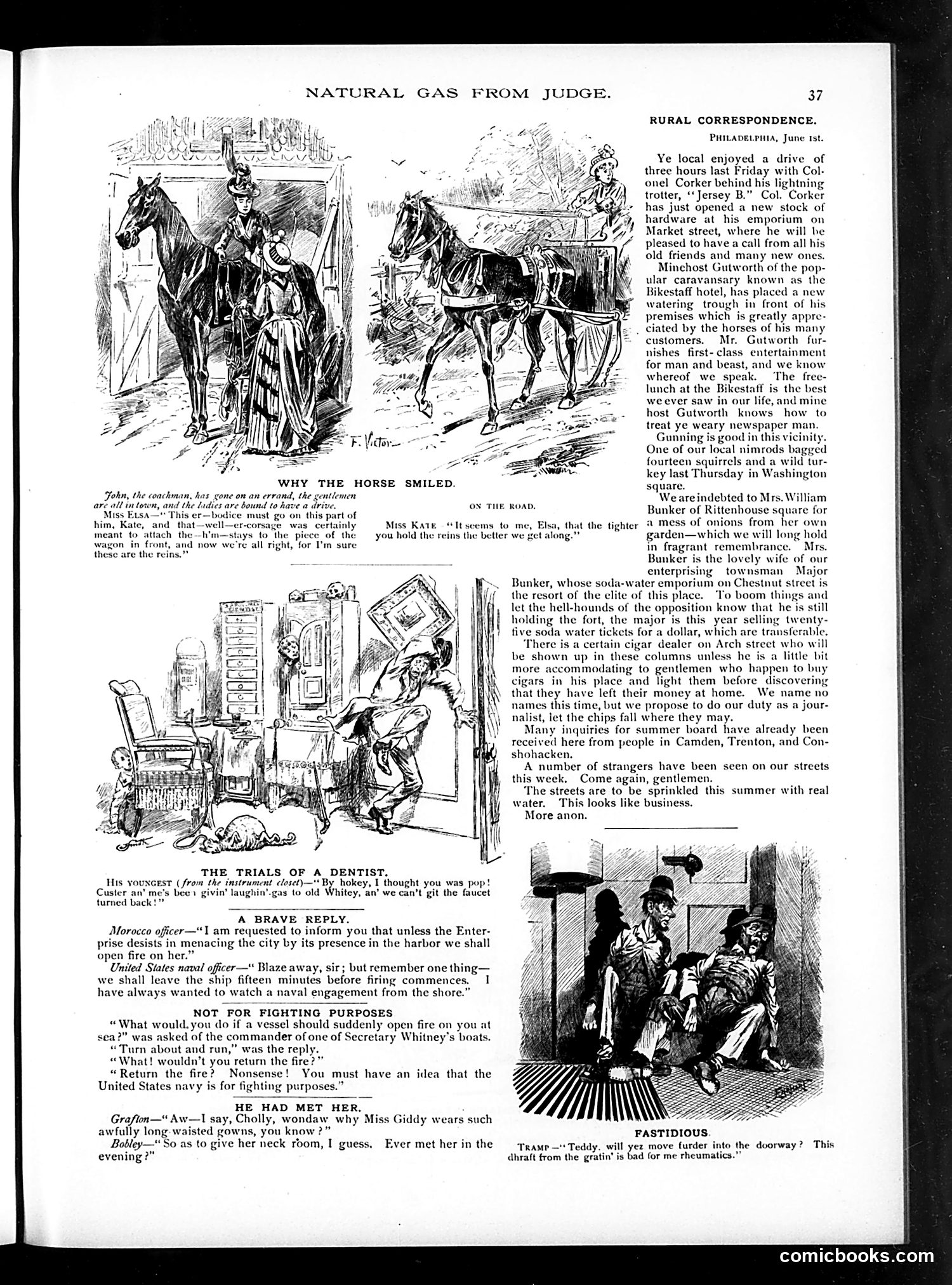
This page from Judge contains several satirical pieces mocking American society circa 1880s: **"Why the Horse Smiled"** depicts a coachman's practical solution: when ladies insist on driving despite poor skills, he attaches the horse's reins to the carriage front—making the horse control the vehicle, not the incompetent driver. The satire targets wealthy women's demands for independence without actual competence. **"Rural Correspondence"** is mock small-town boosterism, parodying provincial newspapers' breathless coverage of local merchants and trivial events (a watering trough, squirrel hunting). **Other brief jokes** mock the U.S. Navy's weakness (willing to flee combat), incompetent dentists, and men's shallow observations about women's fashion. The overall tone is genteel mockery of American pretension, incompetence, and vanity—typical of Judge's satirical approach targeting the educated middle and upper classes.
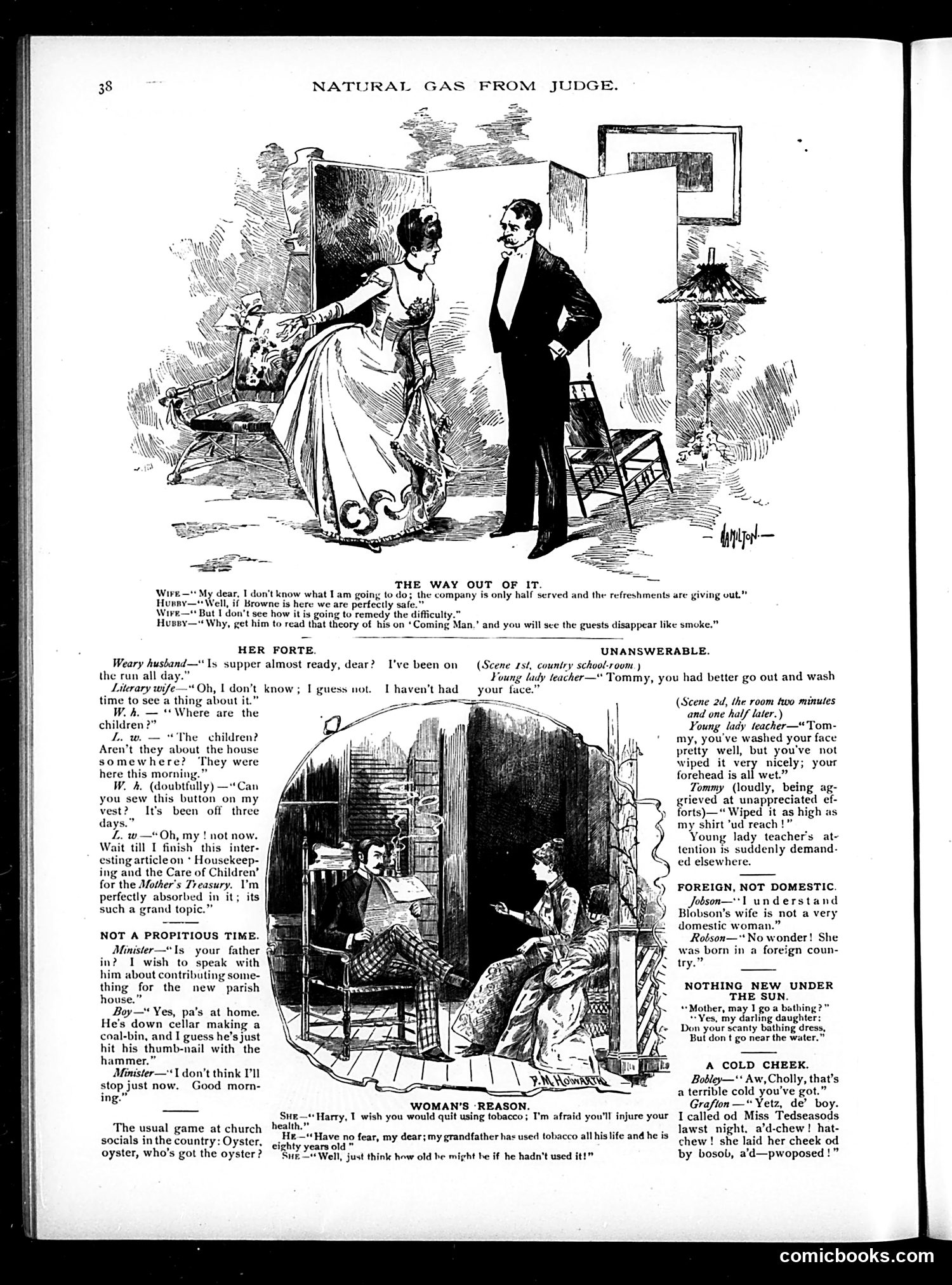
This page from the satirical magazine *Judge* contains multiple short comics mocking Victorian-era social conventions and domestic life. **"The Way Out of It"** satirizes boring dinner parties: a hostess desperate to clear unwanted guests is advised to have "Browne" read his theory on the "Coming Man"—apparently so tedious that audiences will flee. **"Her Forte"** mocks the literary wife obsessed with reading an article about childcare while neglecting actual domestic duties—unable to sew a button or locate her own children. **"Woman's Reason"** ridicules illogical female arguments: when a wife warns her husband tobacco is unhealthy, he counters his grandfather used it his whole life and lived to eighty. Her response—"imagine how much longer he'd have lived without it!"—demonstrates absurd reasoning the cartoonist presents as typical feminine logic. Other sketches joke about children's honesty, foreign wives being poor housekeepers, and awkward courtship scenarios. The humor relies on period stereotypes about women's incompetence in domestic matters and irrational thinking.
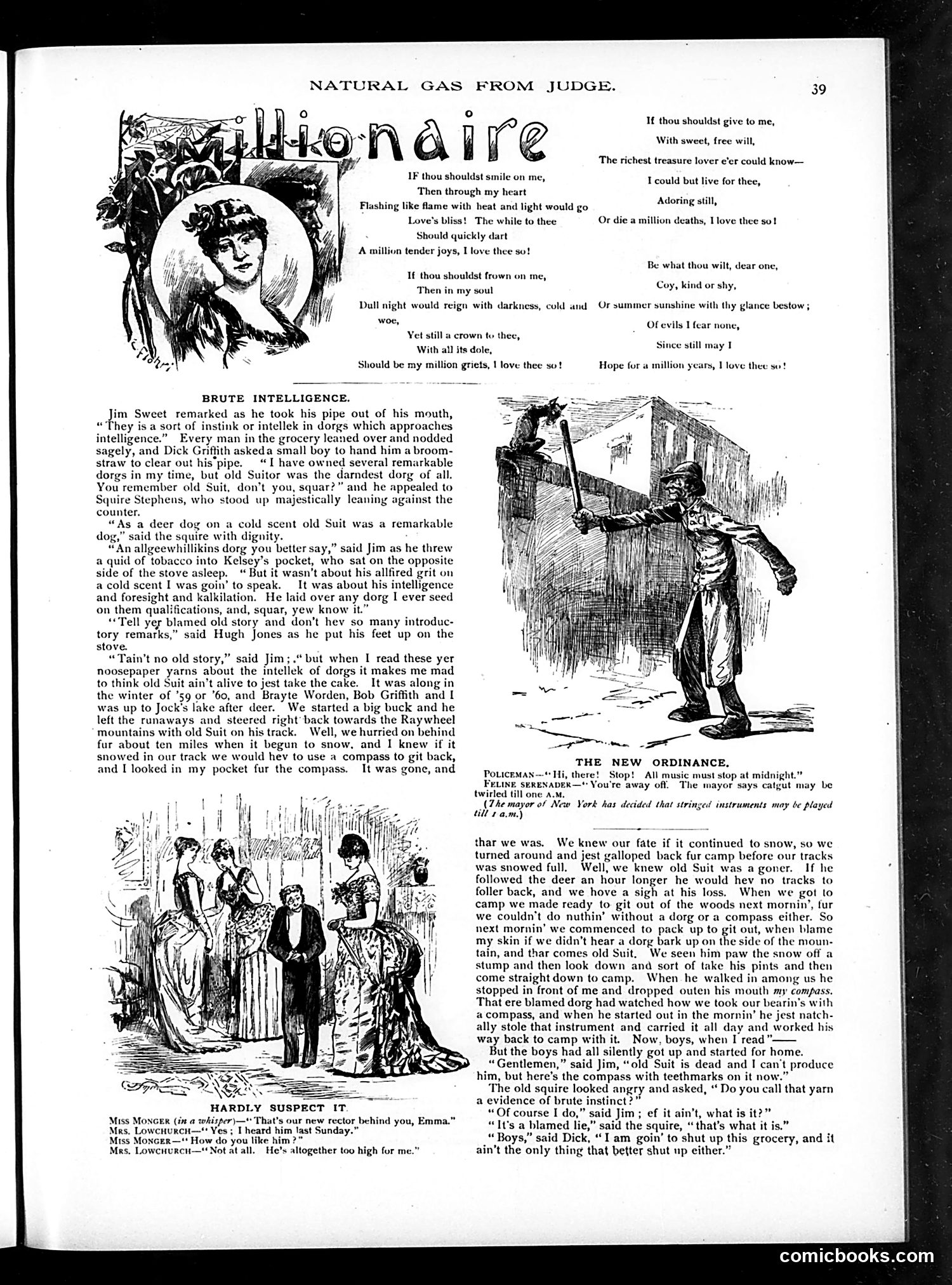
This page contains three distinct pieces of satirical content: 1. **"Millionaire" (top)**: A sentimental poem about romantic devotion, paired with an illustration of a wealthy woman. The satire likely mocks excessive romantic language or the commercialization of love among the wealthy. 2. **"Brute Intelligence" (center/bottom)**: A tall tale told by Jim Sweet at a grocery store about his hunting dog Suit's remarkable intelligence. The humor derives from the contrast between Jim's boastful setup and the folksy, rambling storytelling typical of rural tall tales—common American humor of the era. 3. **"The New Ordinance" (right)**: A brief cartoon about New York City's new music ordinance restricting noise at midnight. A feline serenader (cat with a violin) argues with a policeman, noting the mayor allows "catgut" (violin strings) to play until 1 a.m.—a pun playing on literal catgut versus the instrument's components. The page reflects Judge's satirical approach to contemporary social issues, sentimental literature, and urban regulations through humor.
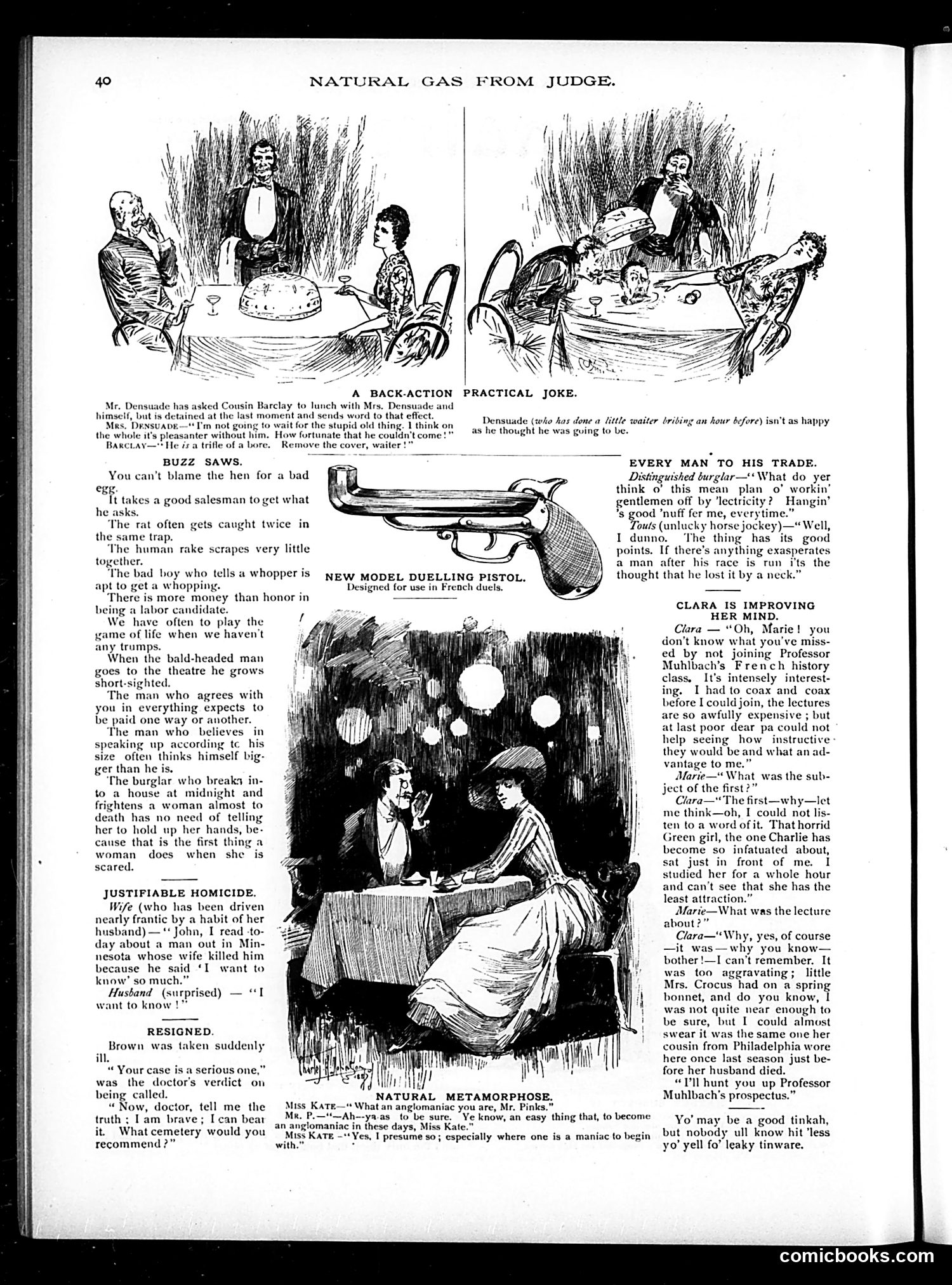
This page collects several short satirical pieces typical of Judge's humor: **"Back-Action Practical Joke"**: A dinner host (Densuade) detains his guest Cousin Barclay, then has the servant remove the dinner cover—implying the food is gone or disappointing. The joke plays on social embarrassment and the pretense of hospitality. **"Buzz Saws"**: Aphoristic one-liners mocking human nature—greed, vanity, cowardice, and hypocrisy. The "burglar" quip satirizes how fear makes people instinctively obey. **"New Model Duelling Pistol"**: A visual gag showing a comically oversized dueling pistol, likely mocking the anachronistic practice of dueling (by this era, increasingly obsolete). **Other sketches** include "Justifiable Homicide" (a wife driven mad by her husband's catchphrase), "Clara Is Improving Her Mind" (satirizing young women who attend lectures only to gossip about fashions and rivals), and wordplay about anglicanism and manual labor. The overall tone targets social pretension, marital discord, and the gap between stated intentions and actual behavior.
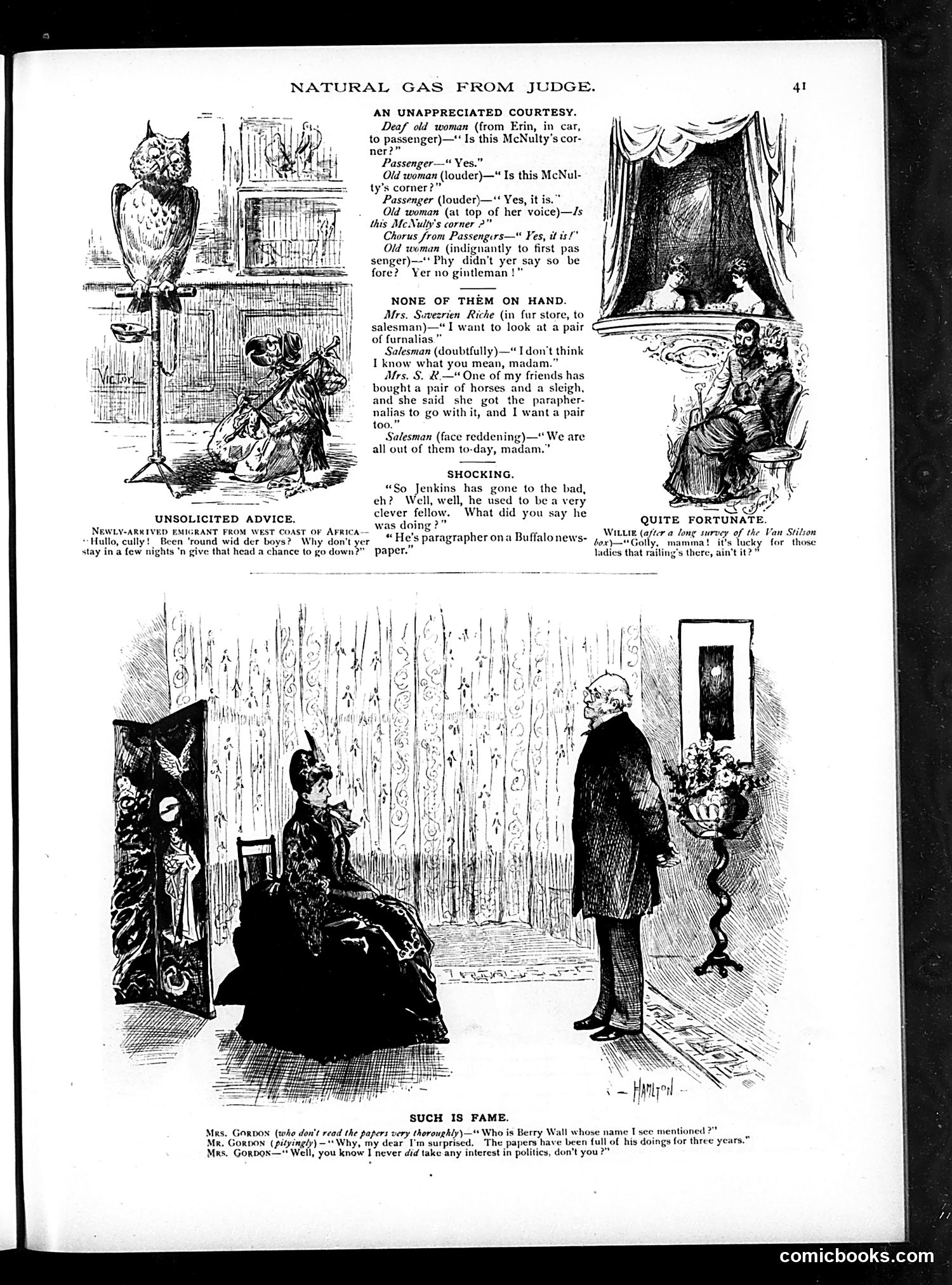
This page contains several satirical sketches mocking everyday social situations and commerce: **"An Unappreciated Courtesy"** ridicules a streetcar passenger's indignation when asked if a corner seat belongs to McNulty—the joke being about social awkwardness over simple seating. **"None of Them on Hand"** satirizes a salesman's incompetence, unable to provide paraphernalia (likely umbrellas or similar goods) a customer seeks. **"Unsolicited Advice"** mocks an older man giving unwanted counsel to youth about avoiding trouble. **"Quite Fortunate"** appears to depict two figures discussing someone's luck regarding domestic matters. **"Such is Fame"** (bottom) shows a woman uninterested in politics discussing a notable person named Berry Wall—suggesting commentary on celebrity versus serious engagement. These sketches exemplify Judge's satirical humor targeting bourgeois manners, incompetence, and social pretension of the era.
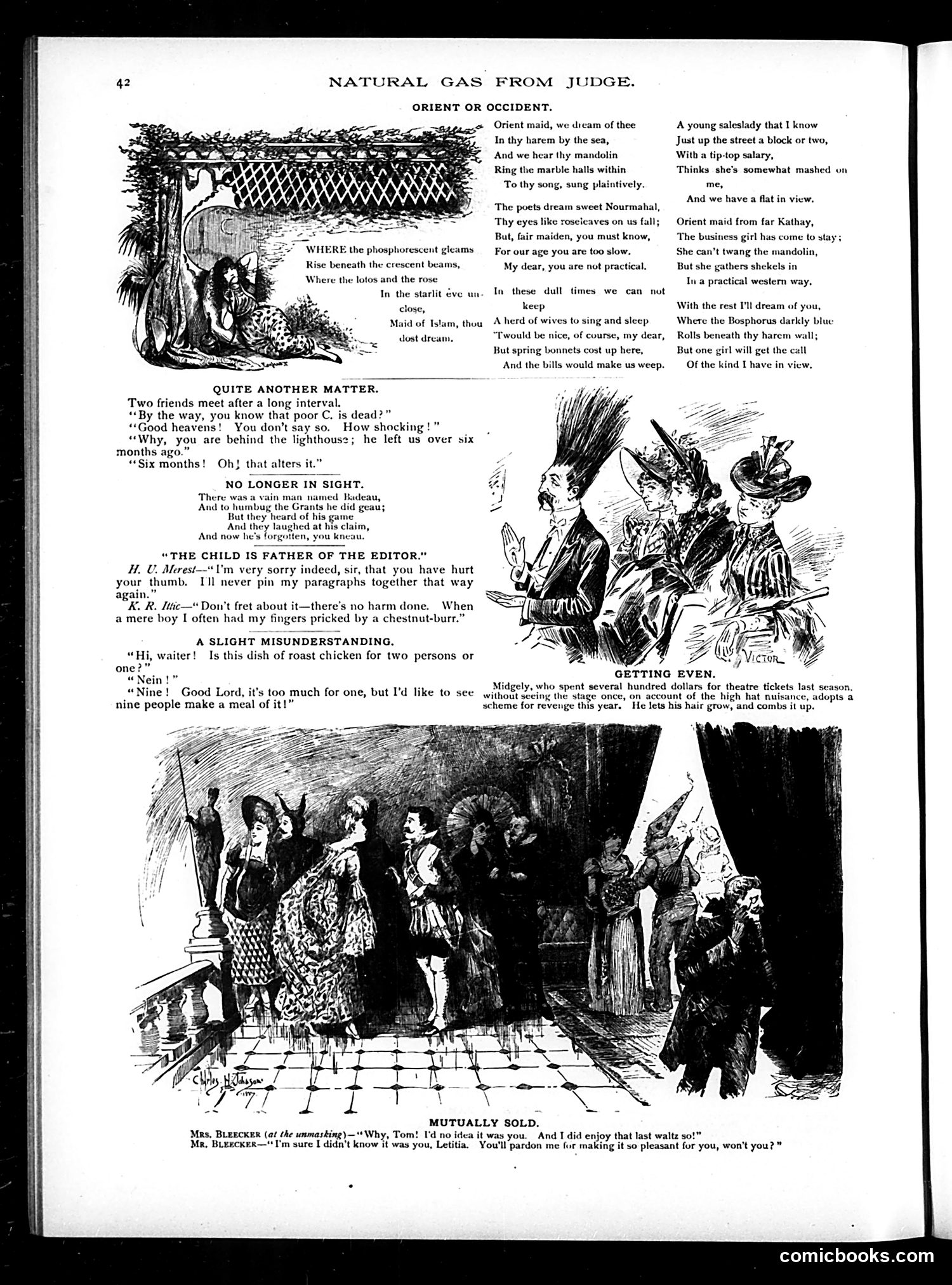
This page contains several brief satirical pieces typical of late 19th-century American humor: **"Orient or Occident"** contrasts romantic Western fantasies about Eastern harems with modern American practicality. The satire mocks men who idealize "Oriental maidens" while actually pursuing working "business girls" with salaries and modern ambitions—poking fun at both orientalist fantasy and crass American materialism. **"Quite Another Matter"** jokes about social awkwardness: two men discussing a third person's death, only to discover he merely left town months ago—a simple misunderstanding played for embarrassment. **"The Child is Father of the Editor"** appears to reference editorial mishaps, with an editor apologizing for pricking someone's thumb while pinning pages, then casually mentioning childhood injuries—dark humor about carelessness. **"Getting Even"** and **"Mutually Sold"** are brief anecdotes about revenge and marital deception at social events. The humor relies on wordplay, misunderstandings, and social commentary rather than complex political satire. These were typical light entertainment pieces for Judge's audience.
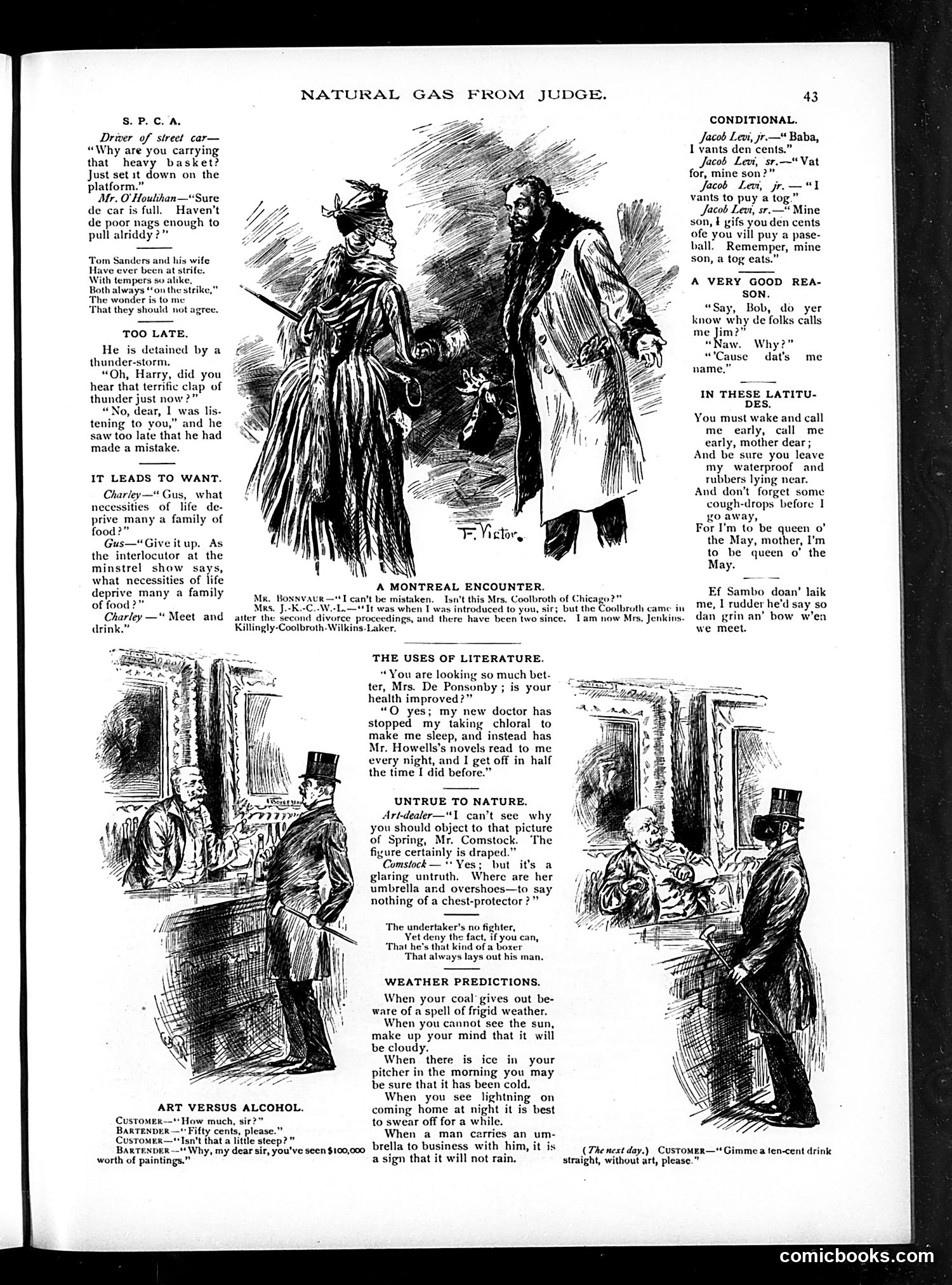
This page contains multiple short satirical pieces typical of Judge magazine's format: **"Natural Gas from Judge"** (top): A street-car driver asks an Irish immigrant (O'Houlihan, identified by dialect) why he's carrying a heavy basket. The joke relies on ethnic stereotyping—the Irishman's response about "poor nags" (horses pulling the trolley) is presented as comedically dense reasoning. **"Art Versus Alcohol"**: A bartender charges 50 cents for a drink; when the customer protests, the bartender claims he's seen "$100,000 worth of paintings"—implying the customer is so drunk he mistakes the bar for an art gallery. **"Untrue to Nature"**: An art dealer shows a Spring scene; the critic (Comstock, likely referencing Anthony Comstock, the anti-obscenity crusader) objects that a draped female figure lacks realistic winter gear—an ironic critique of artistic accuracy versus actual weather. **"Weather Predictions"**: Humorous mock-proverbs about obvious weather signs. The ethnic humor and sarcastic tone reflect late-19th/early-20th century American satirical conventions.
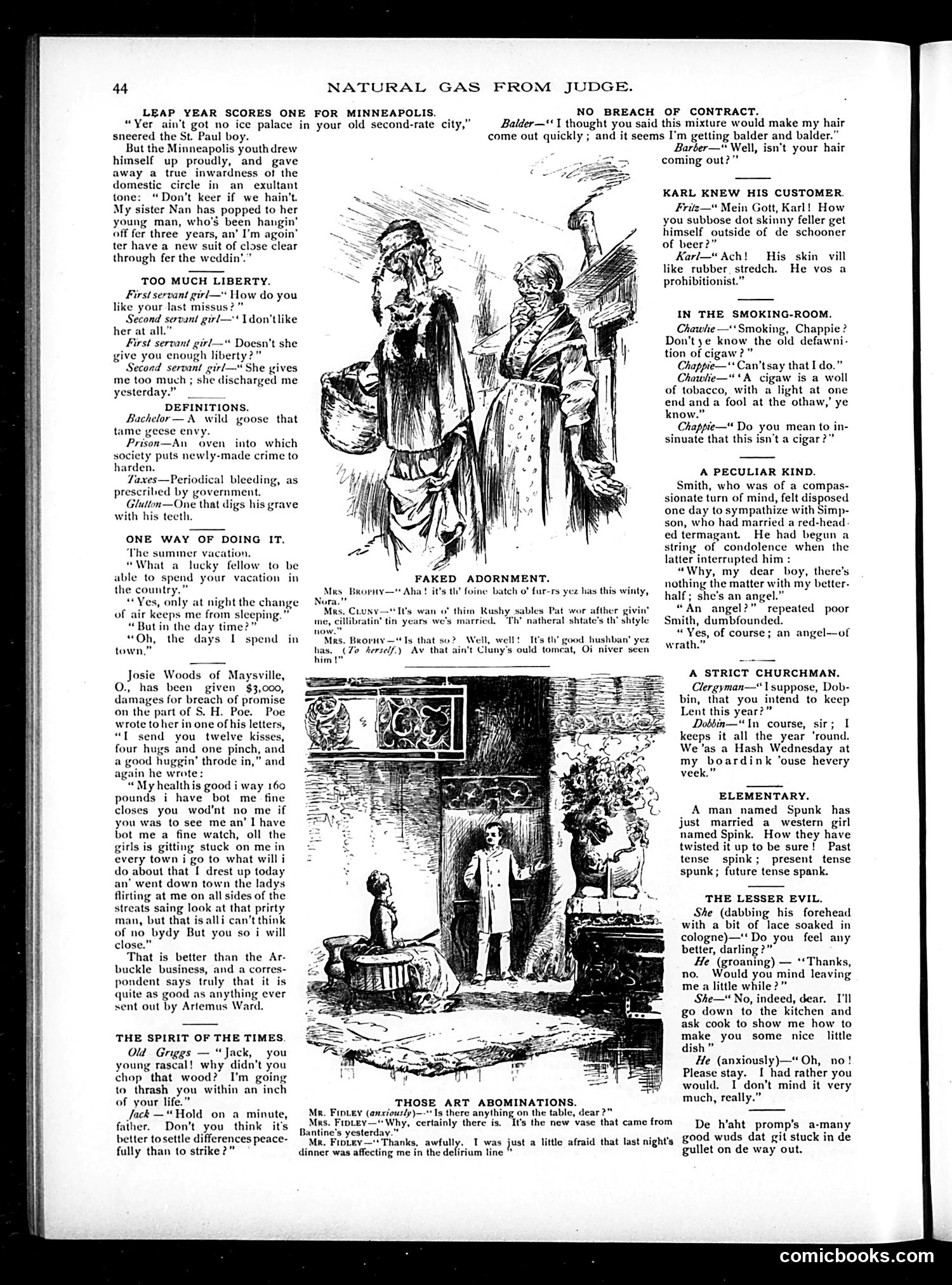
This page from Judge magazine contains multiple short humorous pieces typical of late 19th-century American satire: **"Leap Year Scores One for Minneapolis"** plays on the tradition that women propose to men in leap years. A Minneapolis boy boasts his sister got engaged, gaining him a new suit—competitive pride over civic landmarks. **"Too Much Liberty"** satirizes servant employment: a girl is fired *because* her employer gave her too much freedom—inverting expectations about what workers desire. **"No Breach of Contract"** mocks fraudulent hair-loss remedies: a customer complains the product makes him balder, not hairier, and the barber cynically suggests it's "working." **"Karl Knew His Customer"** uses ethnic German dialect humor (common then) about a thin man drinking large quantities of beer, with the punchline that he's a "prohibitionist"—absurd given his consumption. Other sections include definitions, anecdotes about courtship breaches of promise, and workplace humor. The cartoons and text represent typical Judge content: domestic comedy, ethnic stereotypes, and gentle social observation rather than political commentary.
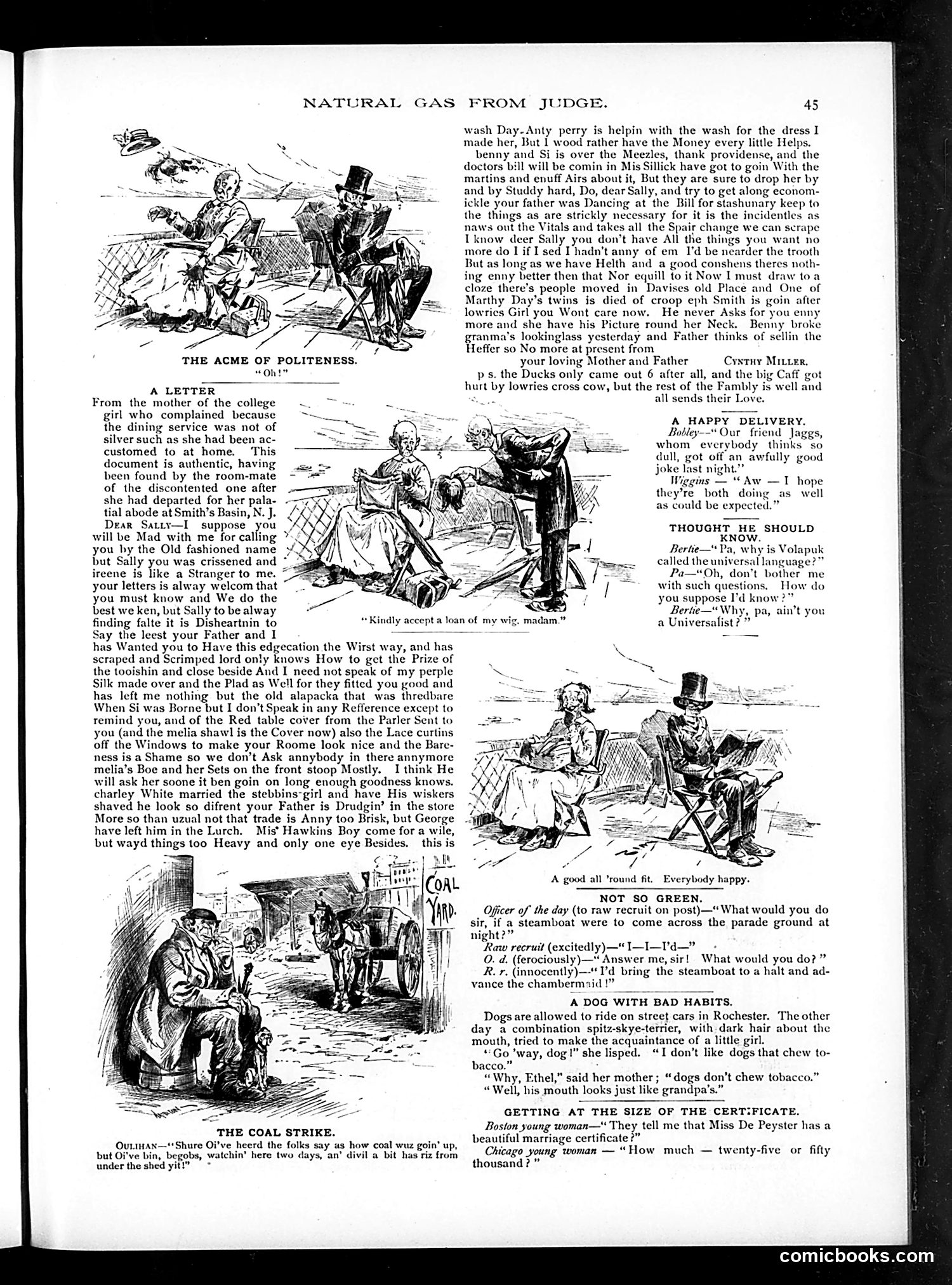
This page contains three distinct pieces of humor satirizing American life: **"The Acme of Politeness"** (top): A cartoon mocking wealthy college girls' entitlement. The accompanying letter from a working-class mother to her daughter "Sally" (renamed "Ireene") ridicules the girl's complaints about non-silver dining service. The mother's misspelled, grammatically fractured letter—detailing family hardships, illness, and economic sacrifice to fund her education—exposes the daughter's ingratitude through stark contrast. **"The Coal Strike"** (bottom left): An Irish immigrant character comments on coal prices rising but seeing no actual coal movement from a yard in two days—likely satirizing labor disputes or market manipulation during industrial conflicts. **"A Happy Delivery"** and **"Thought He Should Know"** (right): Brief joke dialogues about misunderstandings—one involving a friend's humor, another about the language "Volapuk" (an artificial international language, now-obsolete). The page mainly satirizes class pretension and working-class struggles in Gilded Age America.
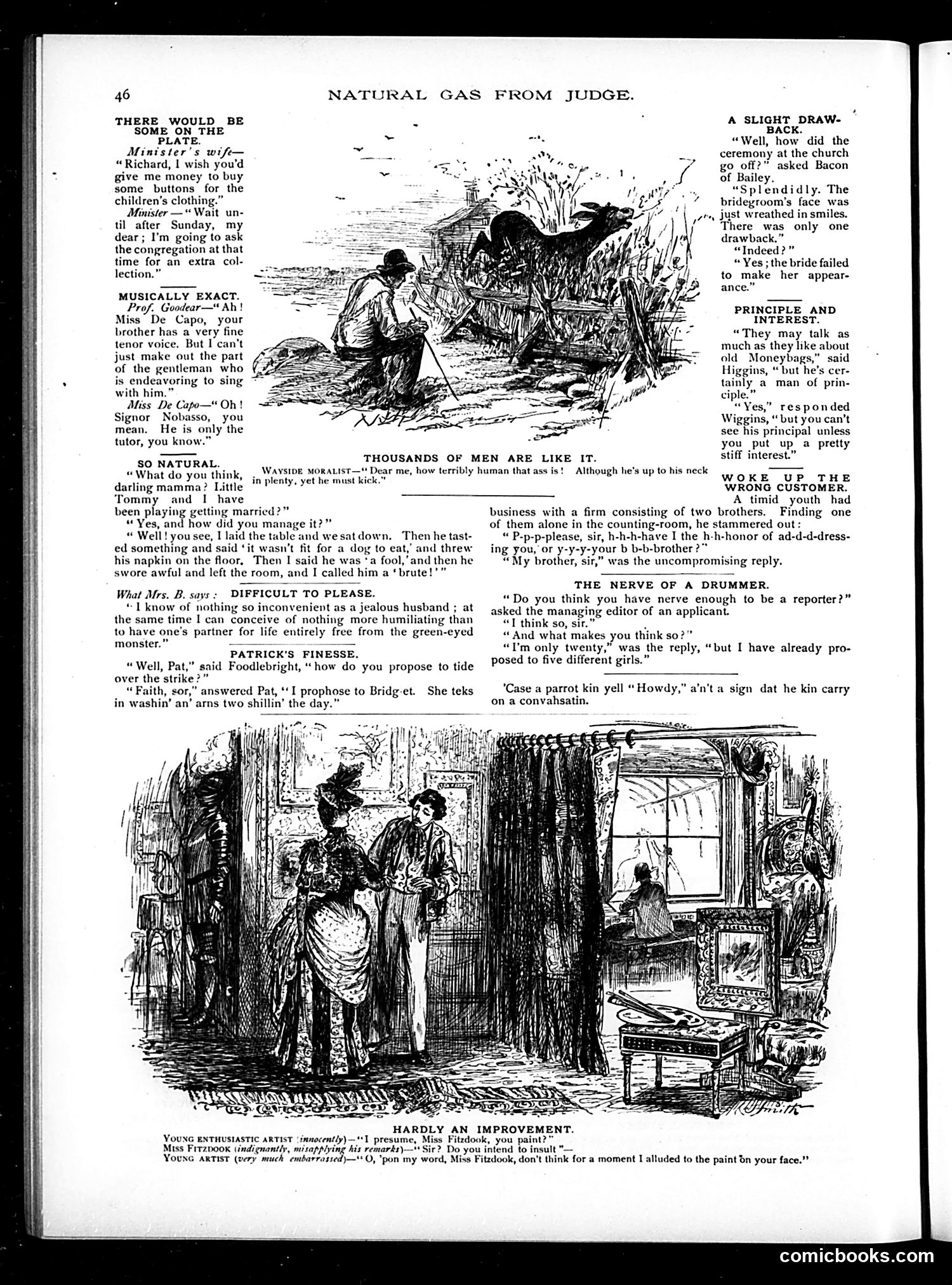
This page contains multiple brief satirical sketches typical of Judge magazine's humor style. The main targets are domestic life, social pretense, and character flaws. Key sketches include: **"So Natural"**: Mocks marriages by having a child describe playing "getting married" as mimicking a husband's rudeness—throwing napkins, calling his wife a fool, swearing, then leaving. The joke: this *is* marriage. **"Principle and Interest"**: A pun on a moneylender ("Moneybags"). He has "principle" (morality) but you can only see it if you pay "interest" (wordplay on financial interest). **"Wrong Customer"**: A stammering youth asks a store clerk if he's addressing him or his brother; the reply suggests he's addressing the *wrong* (more difficult) one. **"Nerve of a Drummer"**: A job applicant claims sufficient nerve because he's proposed to five girls—implying reporters need audacity/shamelessness. The tone is cynical about marriage, greed, and social interaction. Two illustrations depict domestic and commercial scenes supporting the accompanying text.
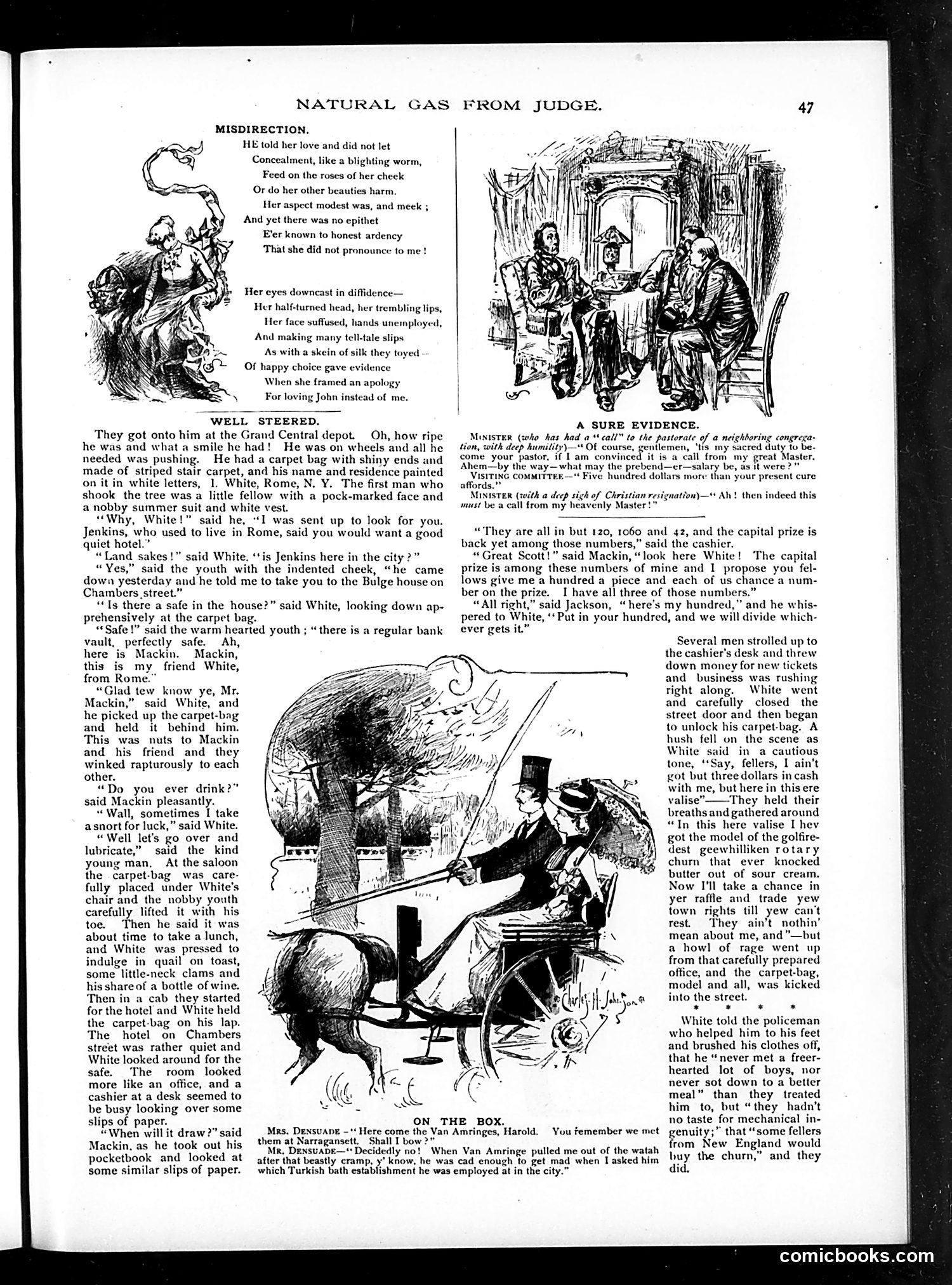
This page contains multiple satirical pieces typical of Judge's social commentary: **"Well Steered"** depicts a con game. A naive man named White from Rome, NY arrives at Grand Central Station with a carpet bag. Two con artists ("Mackin" and the youth) befriend him, gain his trust through hospitality (drinks, meals), and lure him to a hotel. The satire targets gullible rural visitors to the city who are easily manipulated by smooth-talking urbanites. The "safe" and cashier's desk suggest a lottery scam or shell game in progress. **"On the Box"** mocks social pretension: the Densvabes snub the Van Amringes after the latter's husband (apparently working-class) had the audacity to become "mad" when asked which Turkish bath establishment employed him—implying the family considers his rescue of Mr. Densvabes from drowning beneath their social station. **"A Sure Evidence"** satirizes ministerial hypocrisy: a pastor claims divine calling to a new congregation, but his "sacred duty" conveniently requires salary negotiation first, revealing material rather than spiritual motivation. The "Misdirection" poem likely plays on romantic deception themes.
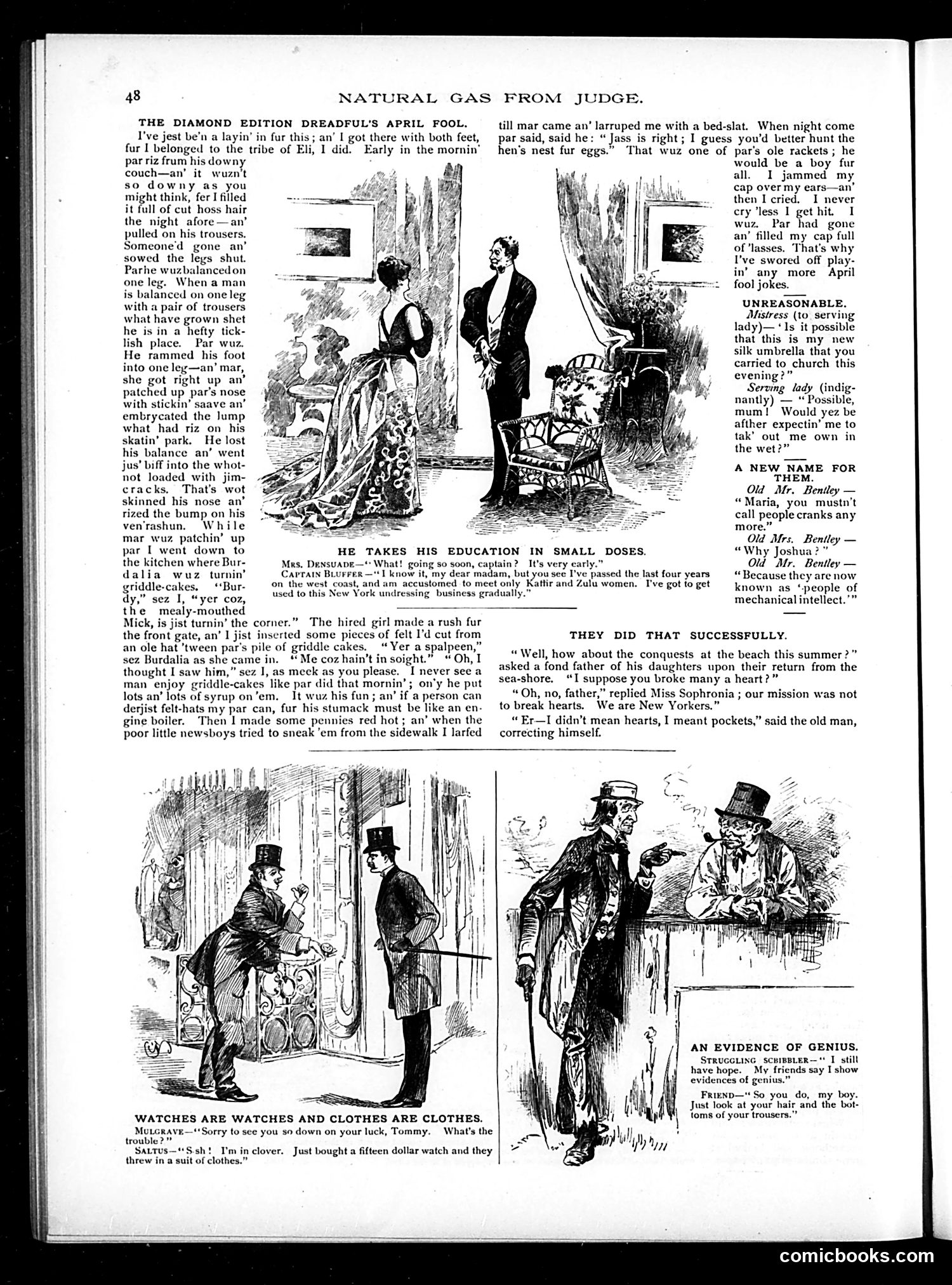
This page contains multiple unrelated humorous pieces typical of Judge's satirical format: **"Dreadful's April Fool"** (top): A vernacular narrative about an elaborate April Fools' prank—sewing shut a man's trouser legs, filling his bed with horsehair, and placing hot pennies for newsboys. The humor derives from slapstick consequences and working-class dialect ("par," "mar"). **"Natural Gas from Judge"** (center): A brief society comedy about a woman's husband leaving her company abruptly, claiming he's "accustomed to meet only grand Zulu women" and must "undress" gradually to New York customs. The satire appears to mock Victorian social pretension. **Minor sketches** (bottom): Quick gags including a servant defending her umbrella-borrowing logic, elderly people using new terminology ("mechanical intellect" for "crank"), and a struggling writer claiming "evidence of genius" while looking disheveled. The page relies on period-specific humor: ethnic/class-based dialect comedy, absurdist pranks, and gentle mockery of social conventions. No specific political figures or events appear to be referenced.
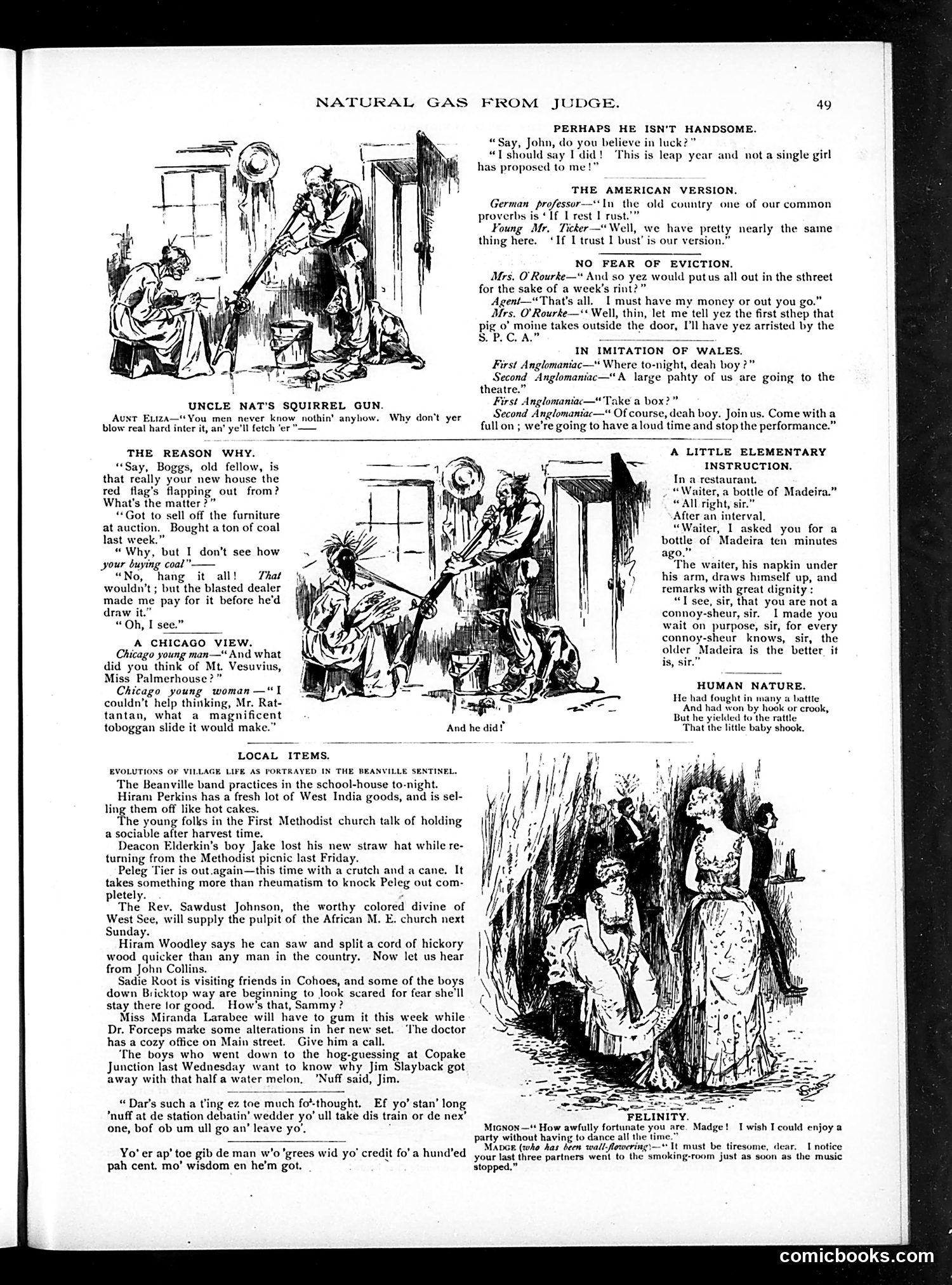
This is a satirical humor page from Judge magazine containing several short comic pieces and local news items. **Main cartoons:** - "Uncle Nat's Squirrel Gun" depicts rural/working-class characters in a domestic dispute, likely satirizing unsophisticated dialect speech and marital conflict. - "The American Version" contrasts German and American proverbs—a German professor's "if I rest I rust" becomes an American businessman's "if I trust I bust," mocking American financial instability and get-rich-quick desperation. - "No Fear of Eviction" features an Irish landlord-tenant conflict where a tenant threatens to report her pig to the S.P.C.A. (animal protection society) if evicted—satirizing Irish-American working-class residents and absurd legal evasion tactics. **Other pieces** mock leap-year dating customs, wealthy anglophile pretension, and small-town gossip through fake "Beanville Sentinel" local news items filled with mundane details and rural character types. The overall tone targets working-class, immigrant, and rural Americans through exaggerated dialect and stereotypical behavior.
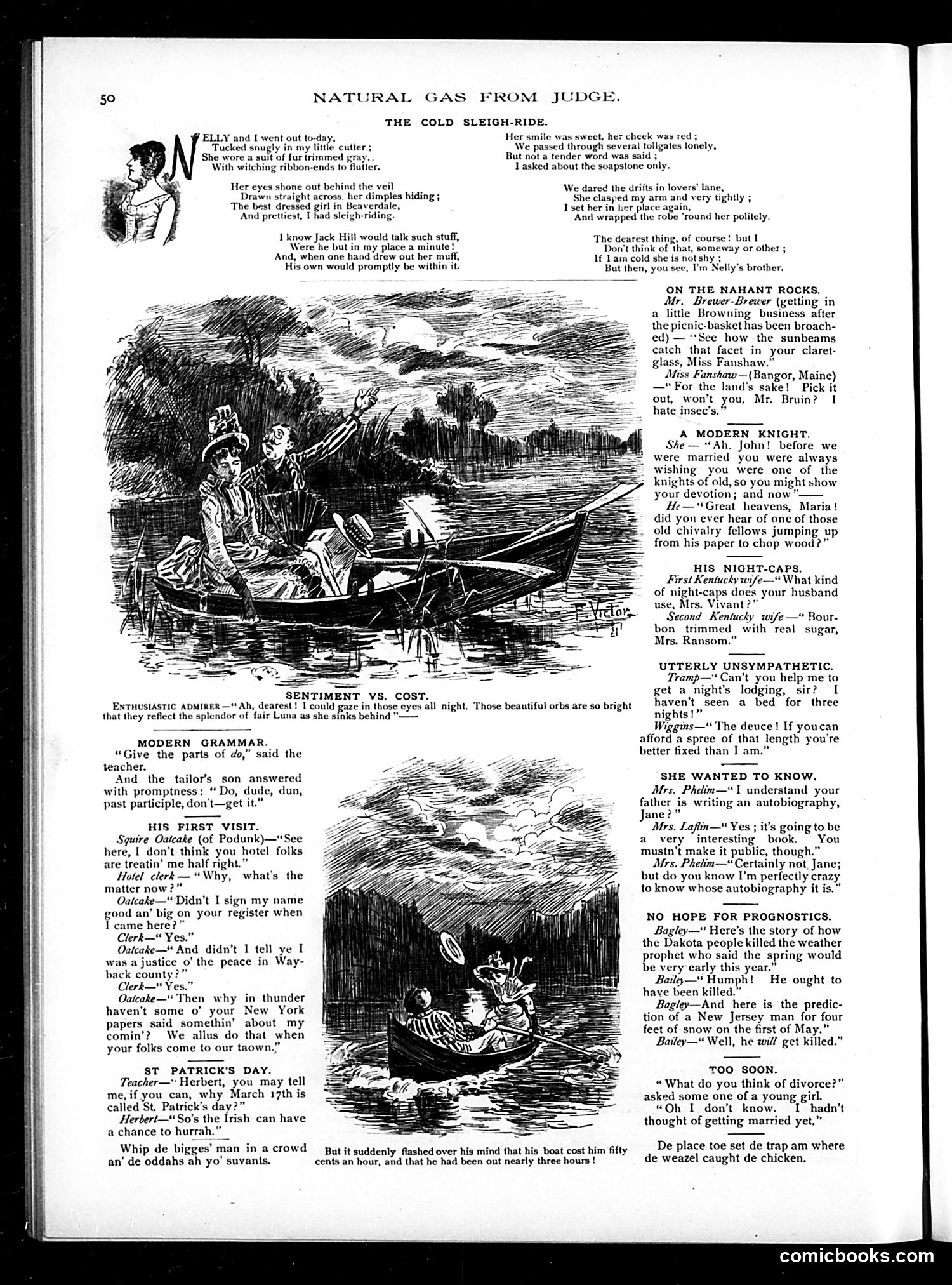
This page collects brief humorous sketches satirizing American social conventions and domestic life, circa late 1800s. **"The Cold Sleigh-Ride"** depicts a romantic outing where the narrator focuses obsessively on his companion's physical beauty while she remains emotionally distant, asking only mundane questions about soapstone. The satire mocks sentimental romance literature versus actual courtship's awkwardness. **Other sketches target:** - Grammar instruction's pedantry (a tailor's son conjugating "do") - Rural pretension (Squire Oatcake expecting newspaper coverage for visiting) - Irish stereotypes (St. Patrick's Day humor) - Class anxiety and marital disappointment ("Modern Knight," "His Night-Caps") - Urban indifference to homelessness ("Utterly Unsympathetic") The cartoons use working-class and regional characters—Kentucky wives, Dakota settlers, rural justices—to mock social aspirations and expose gaps between romantic ideals and practical reality.
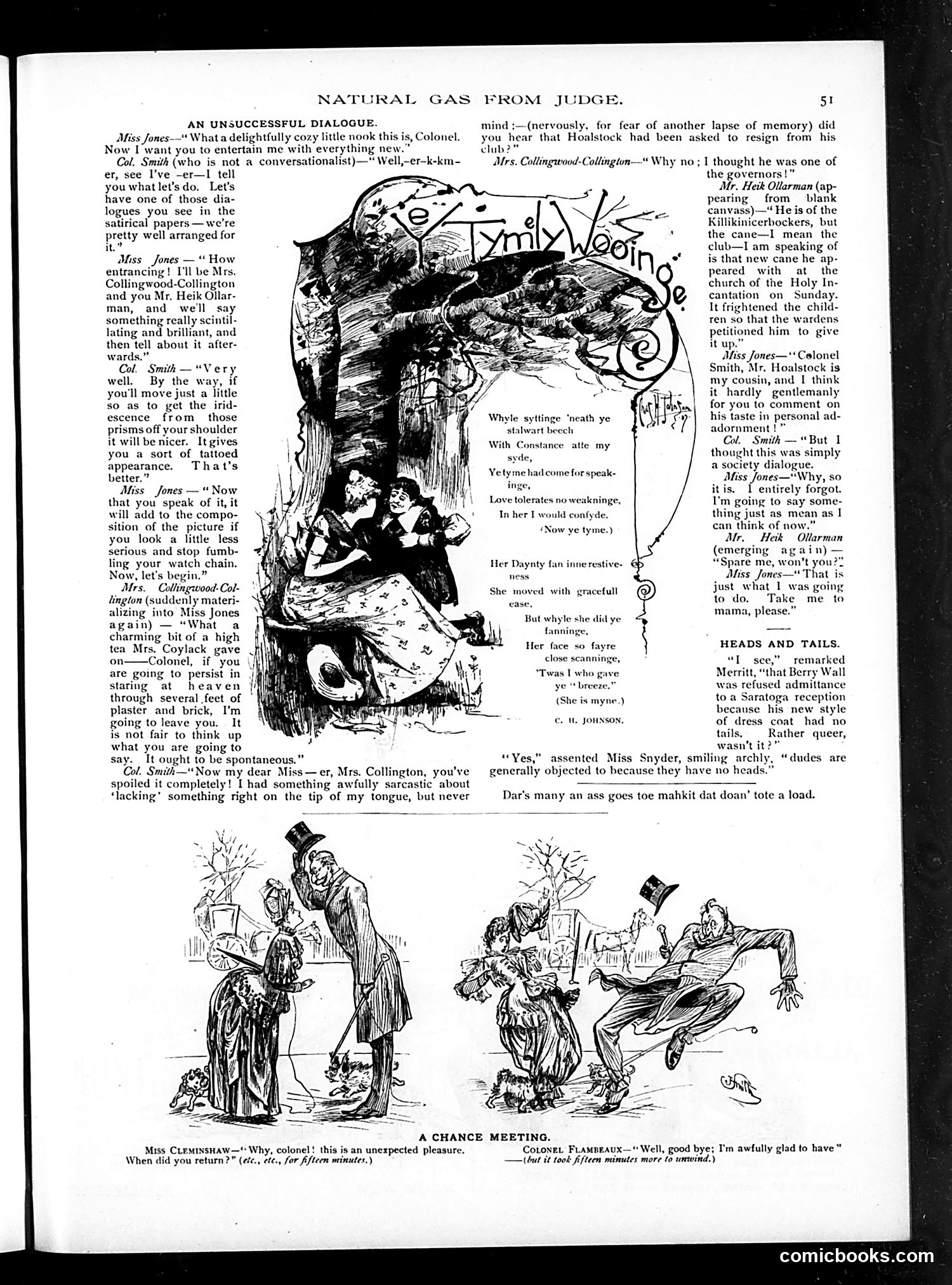
This page satirizes the vapid dialogue and forced wit of high-society magazine fiction. "An Unsuccessful Dialogue" mocks how literary magazines (like Judge itself) published contrived conversations between socialites. The joke: Colonel Smith and Miss Jones attempt to *perform* a witty society dialogue for the magazine, but repeatedly break character and fail—revealing the artificiality of the whole enterprise. The lower cartoons extend the mockery: "Heads and Tails" ridicules dandies like "Berry Wall" (a real Gilded Age fashion figure) being excluded from events for his ostentatious dress—the joke being dudes lack substance ("no heads"), only fashion sense. "A Chance Meeting" parodies the strained, endless pleasantries of upper-class encounters. The satire targets both pretentious high society and the magazines that celebrated it, exposing how contrived and empty such circles' conversation actually was.
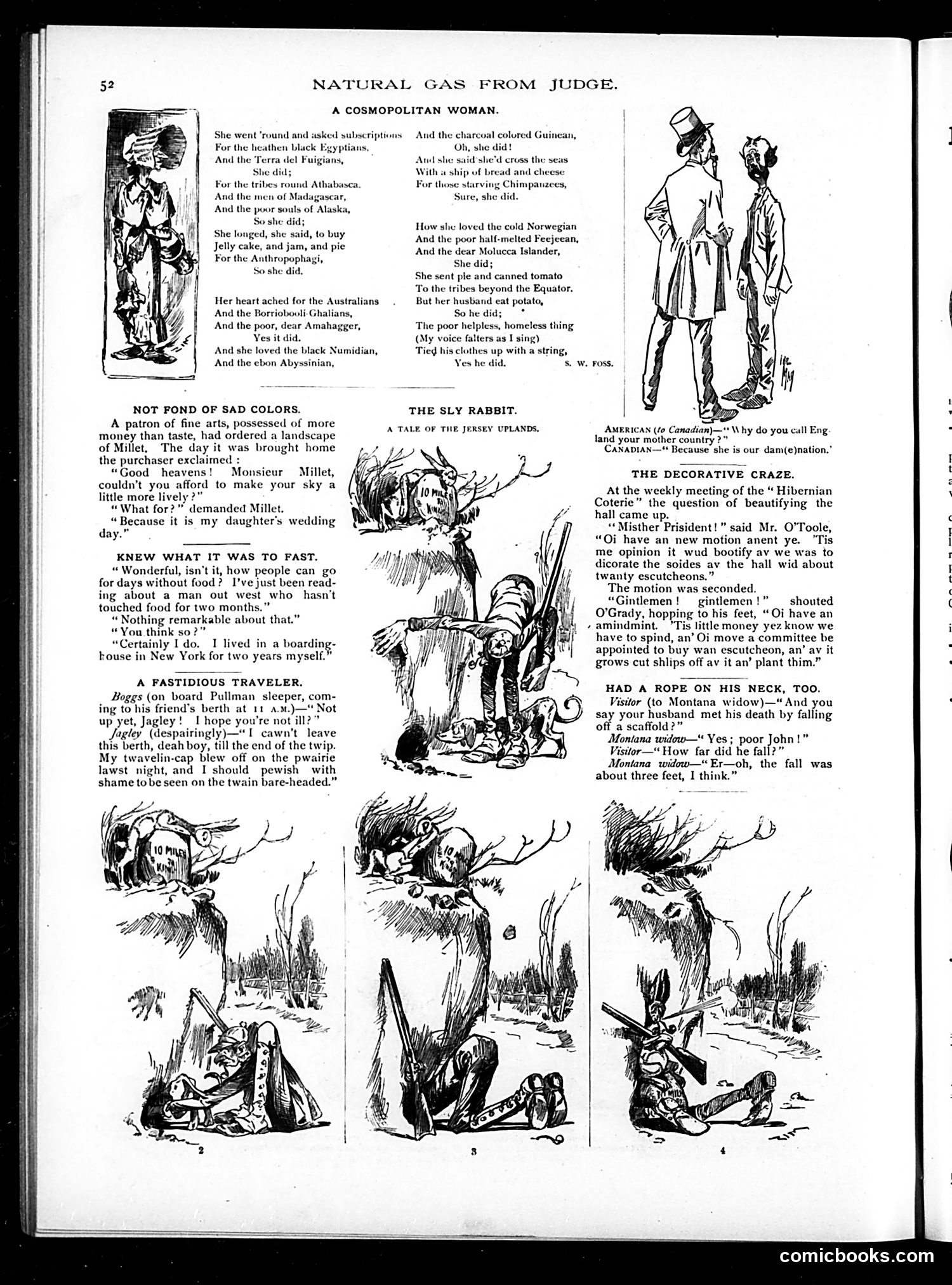
This page contains several short humorous pieces typical of late-19th-century American satire: **"A Cosmopolitan Woman"** mocks wealthy philanthropists who donate to foreign missionary causes while neglecting their own families. The woman lavishes supplies on exotic peoples worldwide, yet her husband—reduced to tying his clothes with string—receives nothing. **"Not Fond of Sad Colors"** jokes about nouveau-riche art patrons lacking taste; a rich purchaser complains a Millet landscape's dark sky isn't cheerful enough for his daughter's wedding, missing the painting's artistic merit. **"The Decorative Craze"** uses Irish dialect humor to satirize working-class pretension—an Irish-American club discusses buying "escutcheons" (heraldic shields) for decoration, with one member comically suggesting they buy one and propagate it like a plant to save money. Other brief pieces target: boarding-house food deprivation, fastidious travelers, Canadian colonial dependence on Britain, and frontier widow stereotypes. The cartoons use exaggeration and ethnic caricature (standard for the era) to mock vanity, class aspiration, and social absurdity.
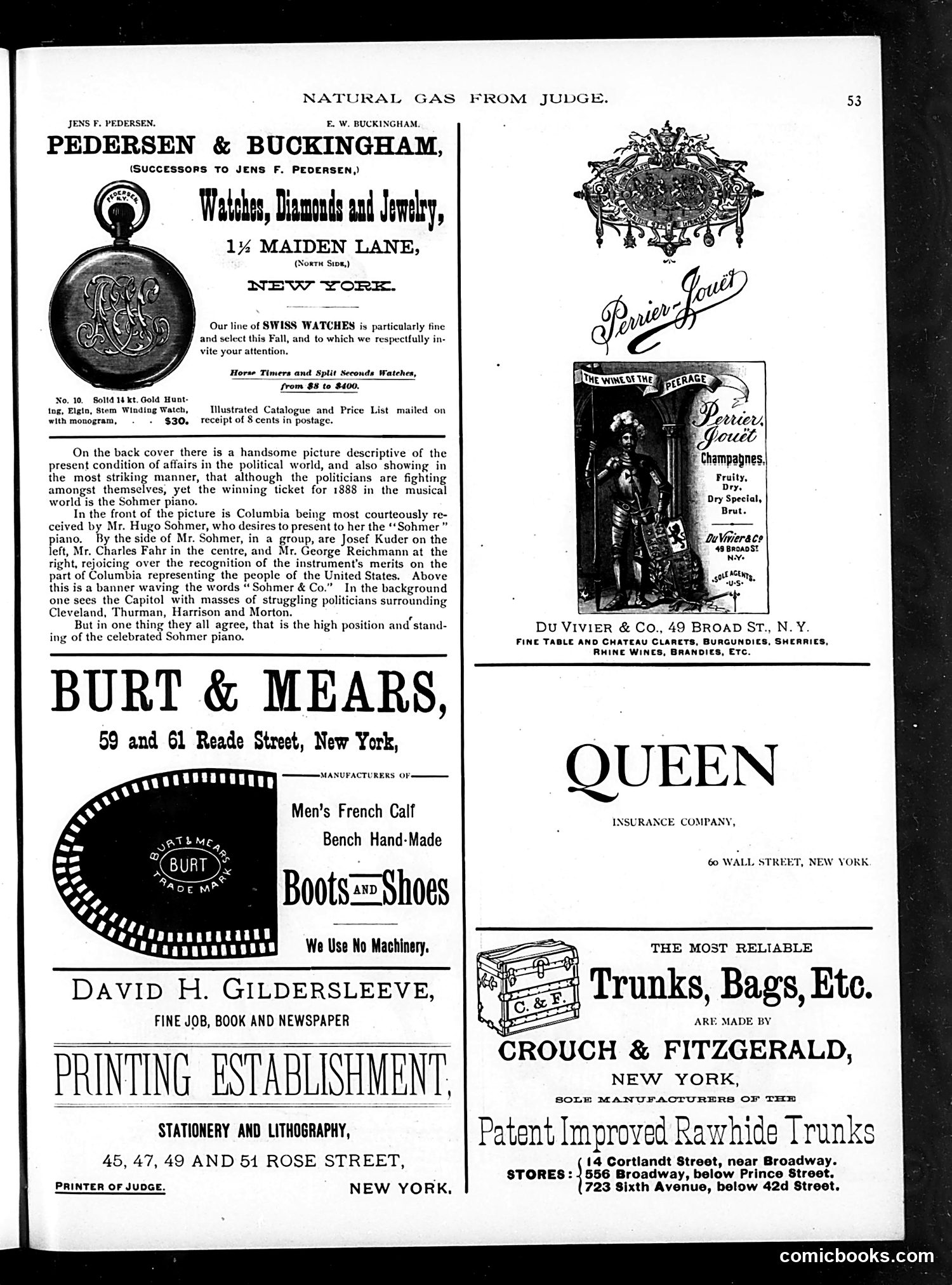
This is primarily an **advertising page** from Judge magazine, not a satirical cartoon page. The bulk of the content consists of commercial advertisements for New York businesses (watches, boots, insurance, wine, trunks, printing services). However, the text references a **back-cover cartoon** depicting the 1888 U.S. presidential election. The ad describes a political allegory: Columbia (personification of America) is being courted by Hugo Sohmer, a piano manufacturer, while politicians Cleveland, Thurman, Harrison, and Morton struggle in the Capitol background. The satire's point: despite fierce political fighting over the presidency, all politicians agree on one thing—the superiority of the Sohmer piano. This is **product placement satire**—using the heated 1888 election as backdrop to humorously promote a luxury good by suggesting even bitter political rivals unanimously endorse it. The actual cartoon is not visible on this page; only its description survives.
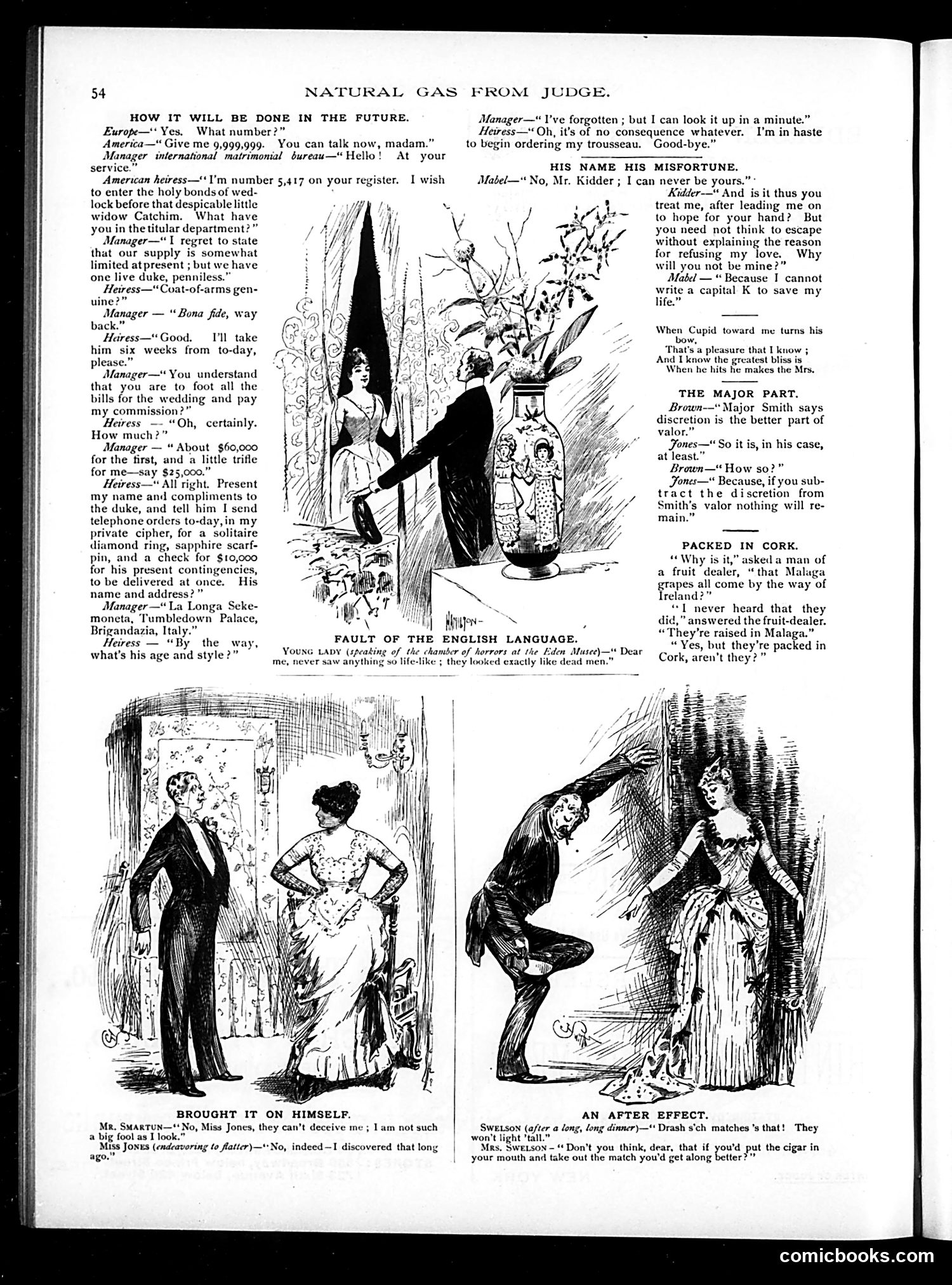
This page contains several brief humorous sketches satirizing American social pretensions and language quirks circa early 1900s. **"How It Will Be Done in the Future"** mocks wealthy American heiresses' transatlantic "matrimonial bureau" transactions—reducing marriage to a numbered, commercial system where American women purchase impoverished European nobility. The satire targets both the heiresses' materialism and the commodification of aristocratic titles. **"Fault of the English Language"** jokes about a young woman's awkwardly innocent observation about wax figures at the Eden Musée. **"His Name His Misfortune"** plays on a woman rejecting a suitor named Kidder solely because his surname begins with "K"—she cannot write it without using the letter. **"The Major Part"** is a wordplay joke about "discretion" versus "valor." **"Packed in Cork"** uses Irish geography as a pun (Malaga grapes from Ireland packed in Cork). **"An After Effect"** shows a drunk man unable to light a cigar—the joke being his wife's obvious suggestion that he remove the cigar from his mouth. The page reflects Judge's typical light satirical tone targeting wealth, social climbing, and verbal absurdity.
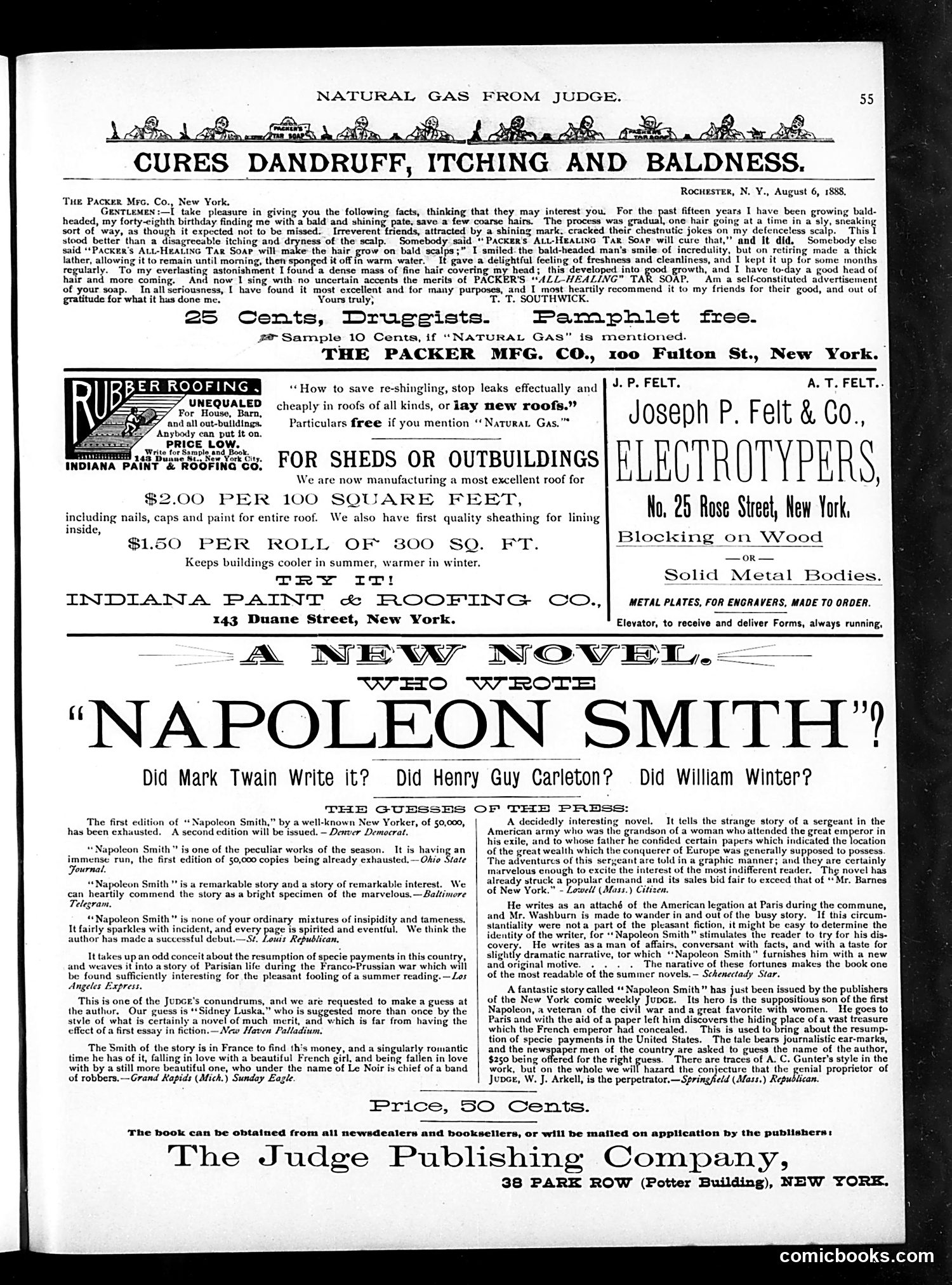
This page is primarily **advertisements and promotional material**, not political satire. The phrase "Natural Gas from Judge" is the magazine's header, but the content is commercial. **Main Content:** The page features testimonial ads for Packer's All-Healing Tar Soap (for baldness/dandruff), rubber roofing products, and electrotyping services. A substantial section promotes a mystery novel titled *"Napoleon Smith"* whose authorship is unknown—publishers joke it could be by Mark Twain, Henry Guy Carleton, or William Winter, generating marketing intrigue. **The Satire/Joke:** The "mystery authorship" marketing strategy was the novelty. By attributing the book to famous writers without confirmation, publishers drummed up reader curiosity and sales speculation—early clickbait-style promotion. **Historical Context:** This reflects 1888 America's fascination with celebrity authorship and emerging advertising techniques that blurred truth with promotional hype.
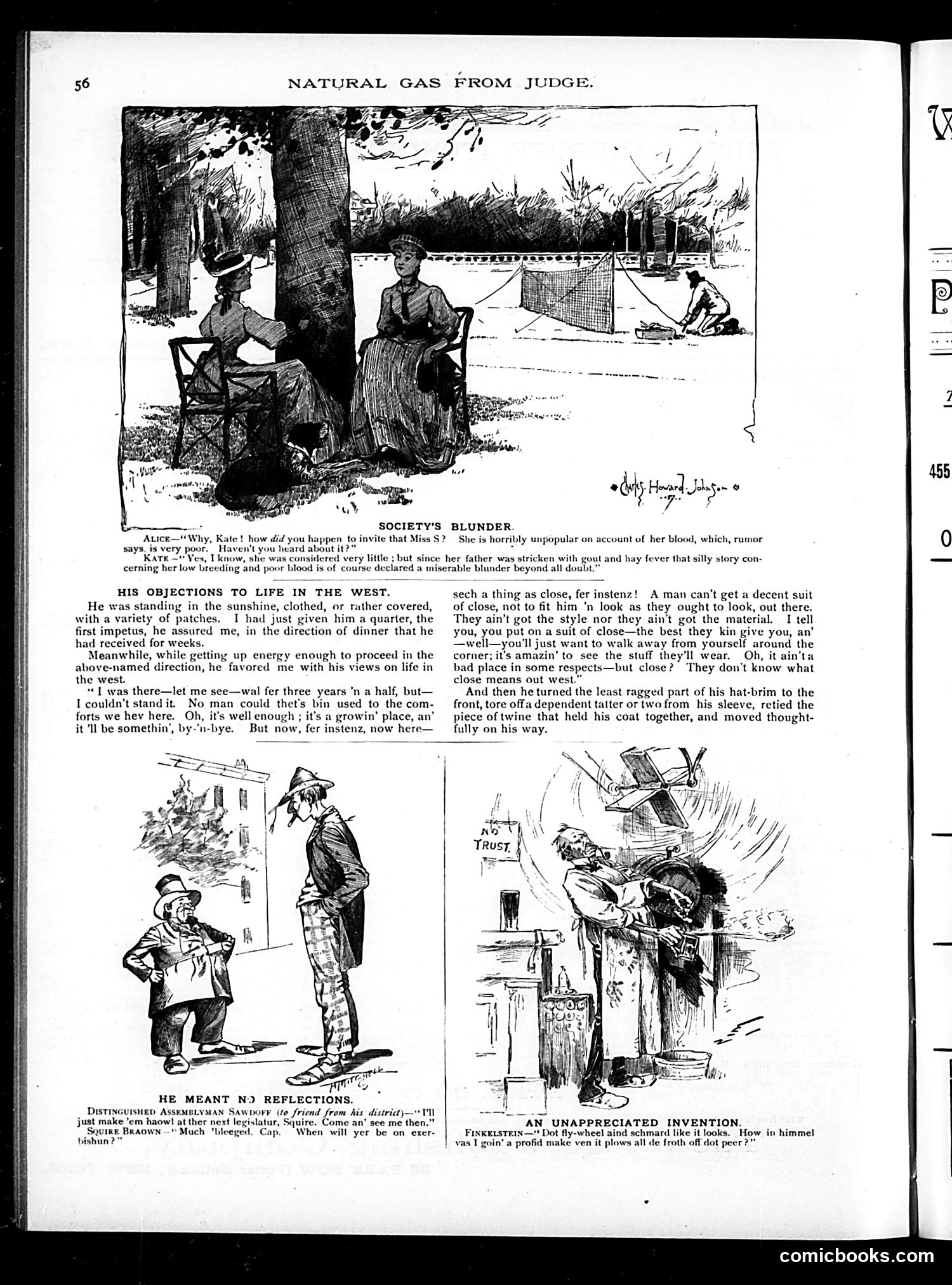
This page contains three unrelated satirical pieces typical of late-19th-century social commentary: **"Society's Blunder"**: Mocks upper-class hypocrisy. A socially ambitious woman invites an unpopular Miss S to a gathering, claiming her father's recent illness (gout and hay fever) has made her "respectable" despite her previously scandalous reputation for low breeding. **"His Objections to Life in the West"**: A ragged, impoverished man explains why he abandoned the American frontier after 3.5 years. Despite acknowledging the West's growth potential, he complains about poor-quality clothing and lack of civilized comforts—satirizing both Eastern snobbery and the gap between frontier rhetoric and reality. **"He Meant No Reflections"** and **"An Unappreciated Invention"**: Brief joke pieces about a politician's boasting and a German immigrant's skeptical comment about an invention—typical filler humor of the era. The cartoons reflect Judge's satirical focus on class pretension, immigrant stereotypes, and urban versus frontier American life.
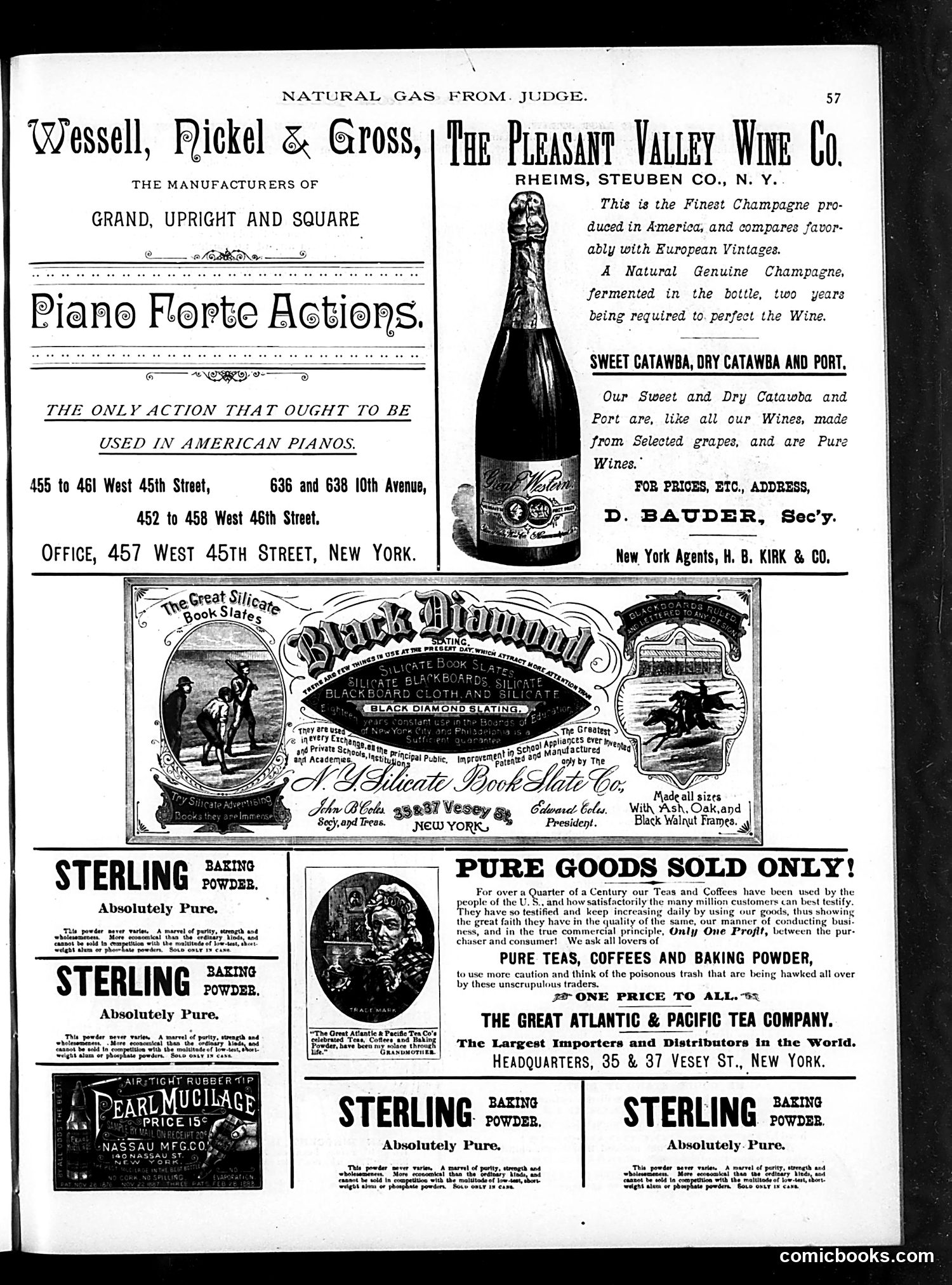
This page is primarily **advertising**, not satire or political commentary. It contains multiple product advertisements from the late 19th/early 20th century: - **Piano forte actions** by Wessell, Pickel & Gross - **Champagne** from The Pleasant Valley Wine Co. in New York - **Book slates** and blackboard products from the Silicate Book Slate Co. - **Sterling Baking Powder** (repeated multiple times, emphasizing "Absolutely Pure") - **Pearl Mucilage** adhesive - **The Great Atlantic & Pacific Tea Company** (early A&P), promoting "Pure Goods Sold Only" The "Pure Goods" emphasis reflects **turn-of-century consumer concerns** about adulterated food and fraudulent products—a major public health issue before FDA regulation. Advertisements repeatedly stress purity and authenticity to address these widespread concerns.
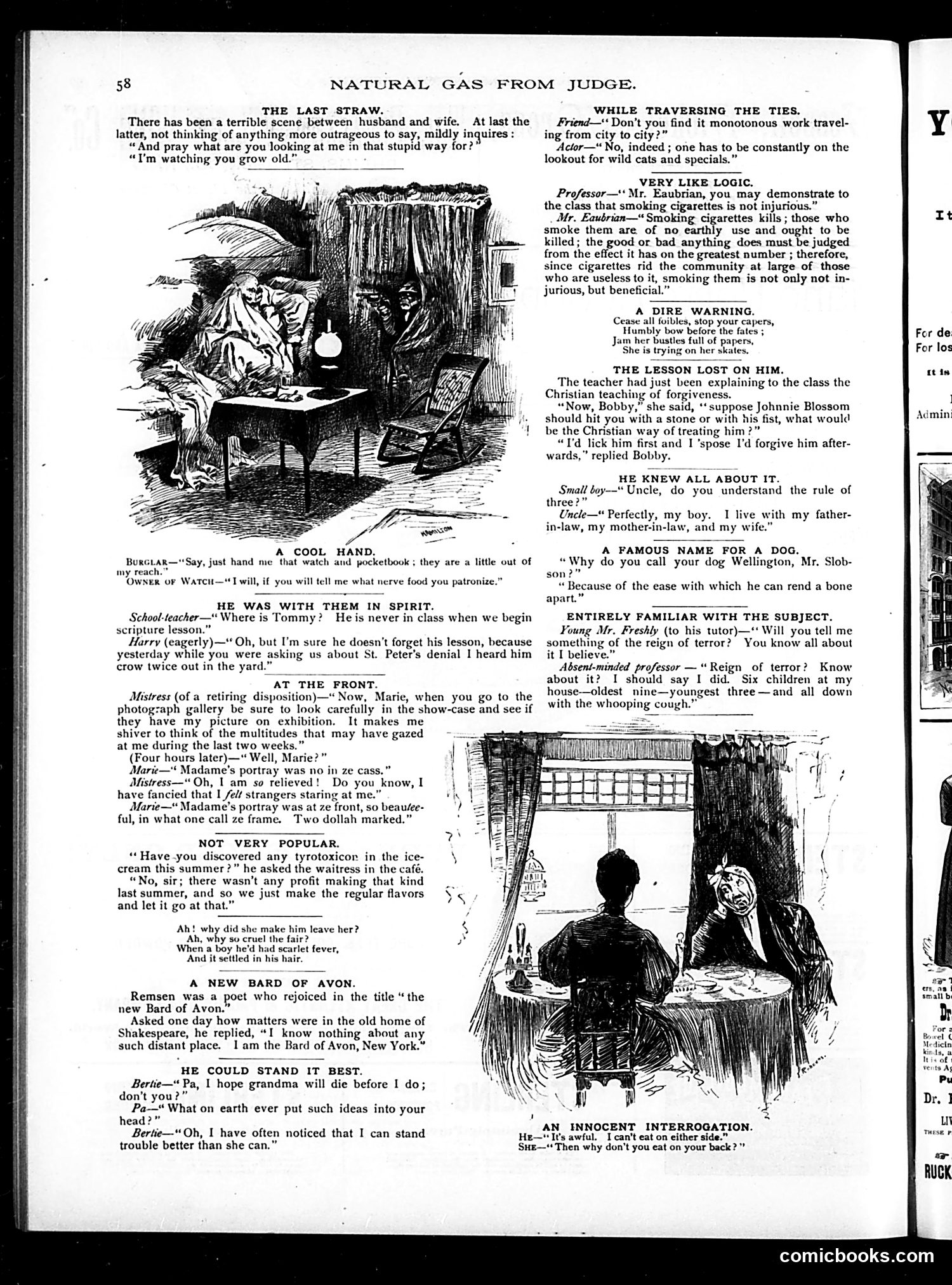
This page contains multiple brief humorous sketches typical of Judge's satirical format: **"The Last Straw"**: A domestic argument where a wife insults her husband by saying she's watching him "grow old"—commentary on marriage strain and aging anxieties. **"Very Like Logic"**: A student uses flawed reasoning to argue cigarette smoking is beneficial because smokers are "useless" people, so eliminating them helps society. The satire mocks pseudo-logical arguments used to defend harmful habits. **Other sketches** include: a child misunderstanding Christian forgiveness by choosing violence first; a man claiming familiarity with "rule of three" mathematics through his complicated in-law situation; and a professor confusing "Reign of Terror" (the French Revolution) with his own domestic chaos of six sick children. **"Not Very Popular"**: A waitress admits ice-cream makers stopped adding poisonous byproducts (tyrotoxicor) because it wasn't profitable, satirizing food safety corners cut for profit. The page reflects turn-of-century concerns: marriage troubles, tobacco debates, education quality, and food safety—wrapped in quick, punchy joke format.
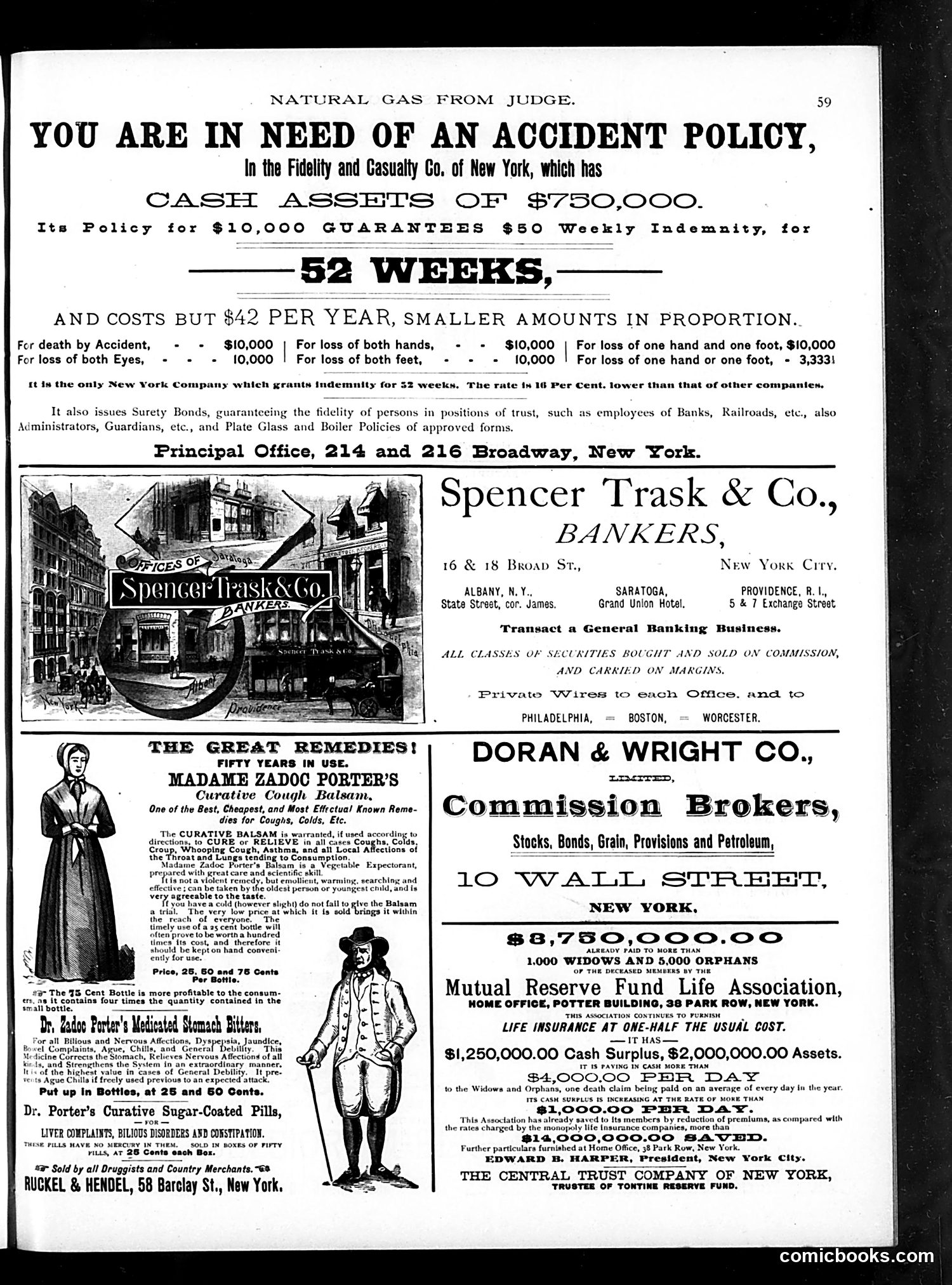
This is primarily an **advertisement page**, not a satirical cartoon. The page is filled with late 19th-century commercial ads for financial services, insurance, and patent medicines. Key content includes: - **Fidelity and Casualty Co.**: An accident insurance policy offering $50 weekly indemnity for 52 weeks at $42/year—appealing to workers facing industrial injury risks. - **Spencer Trask & Co.** and **Doran & Wright Co.**: Banking and brokerage firms handling securities and commodities. - **Patent medicine ads**: "Madame Zadoc Porter's Curative Cough Balsam" and "Medicated Stomach Bitters"—typical snake-oil remedies of the era, promising cure-alls for respiratory, digestive, and nervous ailments. - **Mutual Reserve Fund Life Association**: Emphasizing affordable life insurance ("one-half the usual cost") for working families, supporting 1,000 widows and 5,000 orphans. The ads collectively reflect Gilded Age anxieties: industrial workplace dangers, financial speculation, and limited access to affordable healthcare—driving demand for insurance and dubious remedies.
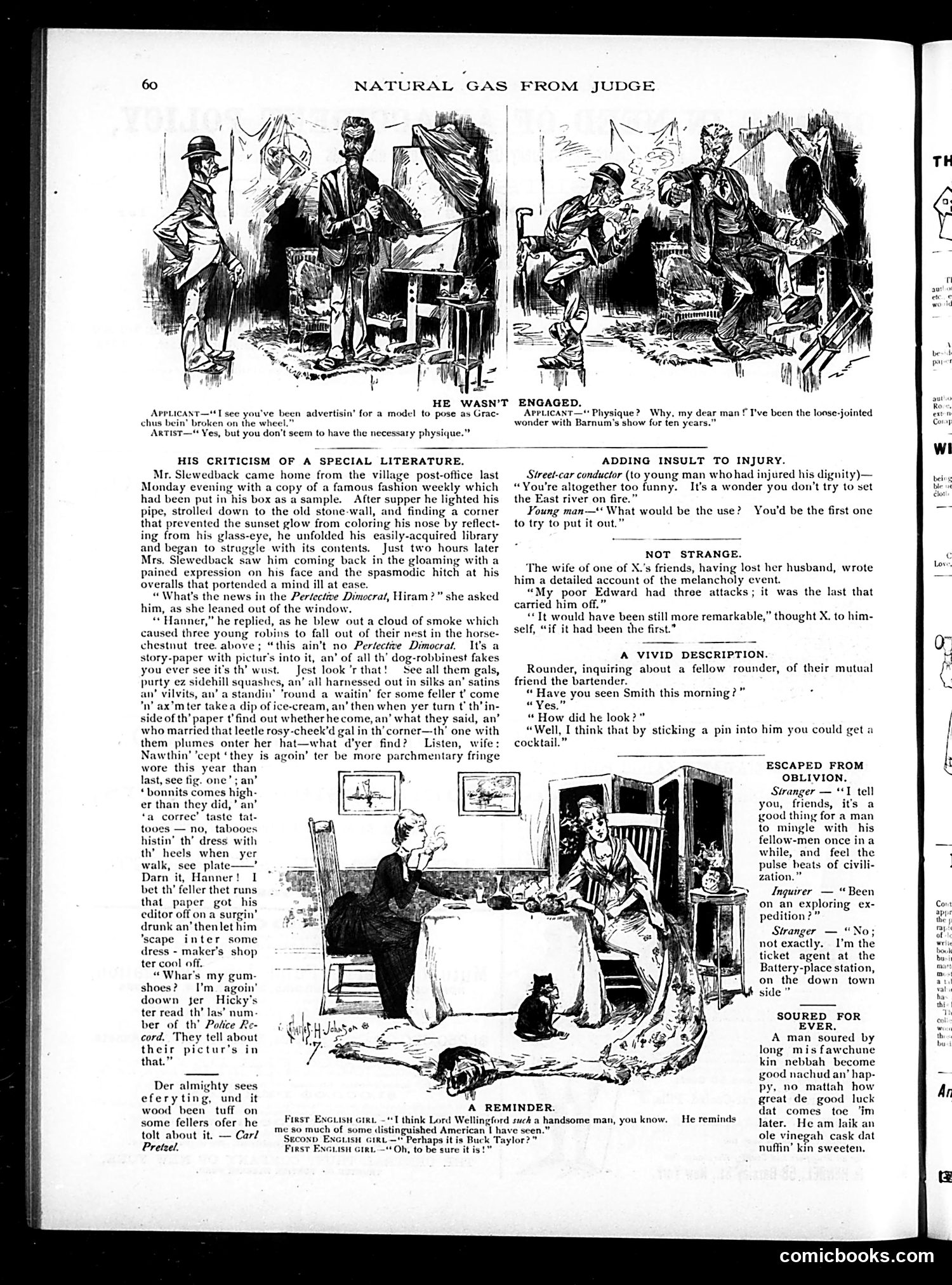
This page contains multiple brief satirical sketches typical of Judge magazine's humor: **"He Wasn't Engaged"**: An artist seeks a model; an applicant claims to be the "loose-jointed wonder" from Barnum's circus, but the artist dismisses him as lacking proper physique—ironic given his circus background. **"His Criticism of a Special Literature"**: A rural farmer (Hiram Slewedback) returns home frustrated with a fashion magazine. He complains that the illustrations show elaborately dressed women, but the text only discusses trivial fashion details (bonnets, fringe) rather than actual story—a critique of vapid fashion journalism prioritizing images over substance. **Minor sketches**: "Adding Insult to Injury," "Not Strange," and others offer quick joke-format humor about streetcar conductors, death, and drunkenness. **"Escaped from Oblivion"**: A stranger philosophizes about social mingling. The page satirizes contemporary fashion media, rural-urban cultural gaps, and urban social life through vernacular humor and dialect speech.
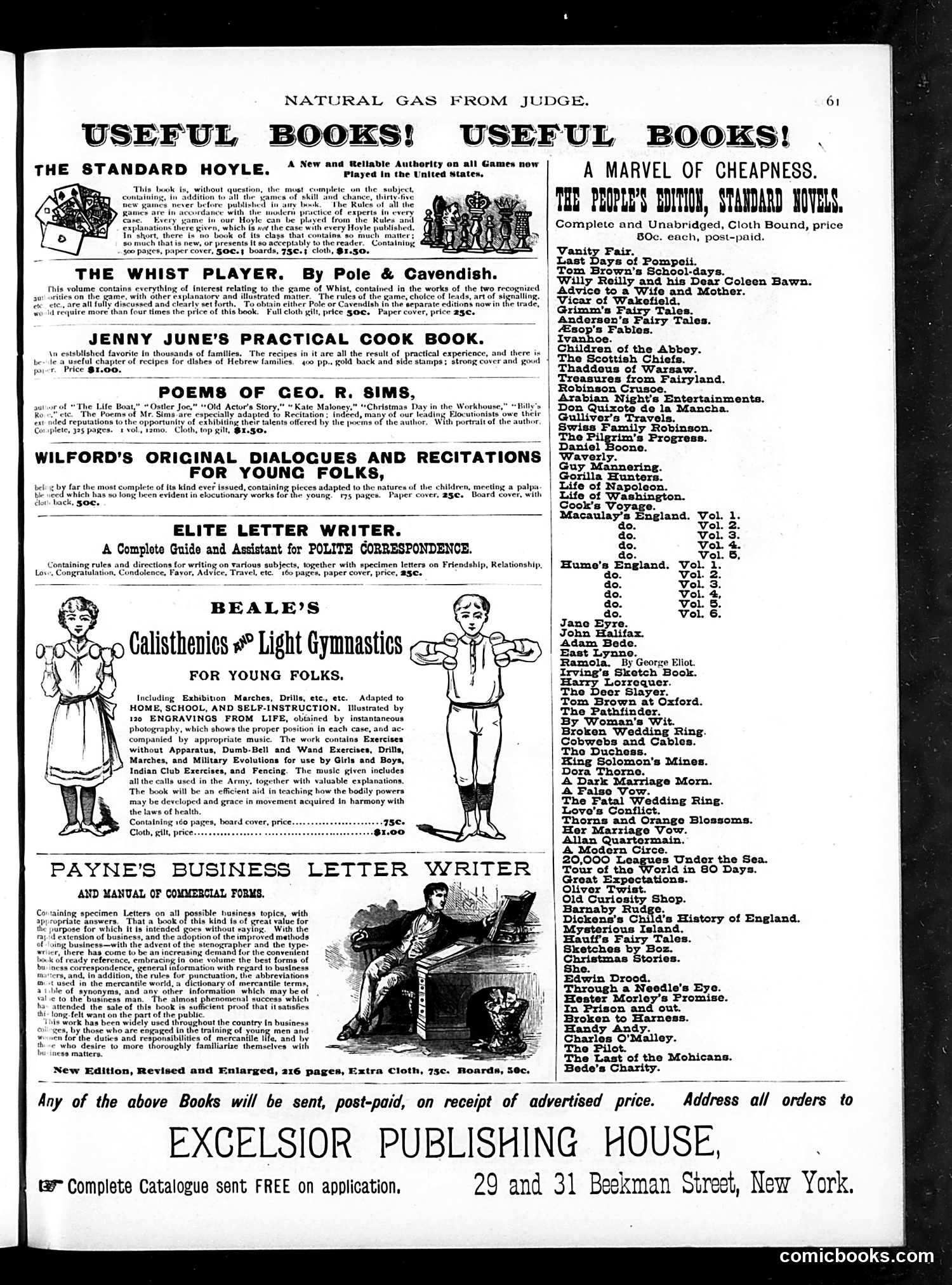
This page is primarily **advertising for books and instructional materials** from the Excelsior Publishing House, not political satire or cartoons. There is no political cartoon content to analyze. The page features illustrated advertisements for practical guides including cookbooks, letter-writing manuals, gymnastics instruction, and business correspondence—typical self-improvement literature of the period. Small illustrations accompany some entries (women and men performing exercises, a businessman at a desk), but these are commercial artwork, not satirical commentary. The page also lists "People's Edition, Standard Novels"—affordable reprints of classic literature like *Jane Eyre*, *Ivanhoe*, and *Arabian Nights*. The header references "Natural Gas from Judge," suggesting this advertising section appeared in the satirical magazine, but the content itself contains no discernible satire, political commentary, or humor requiring historical context to understand.
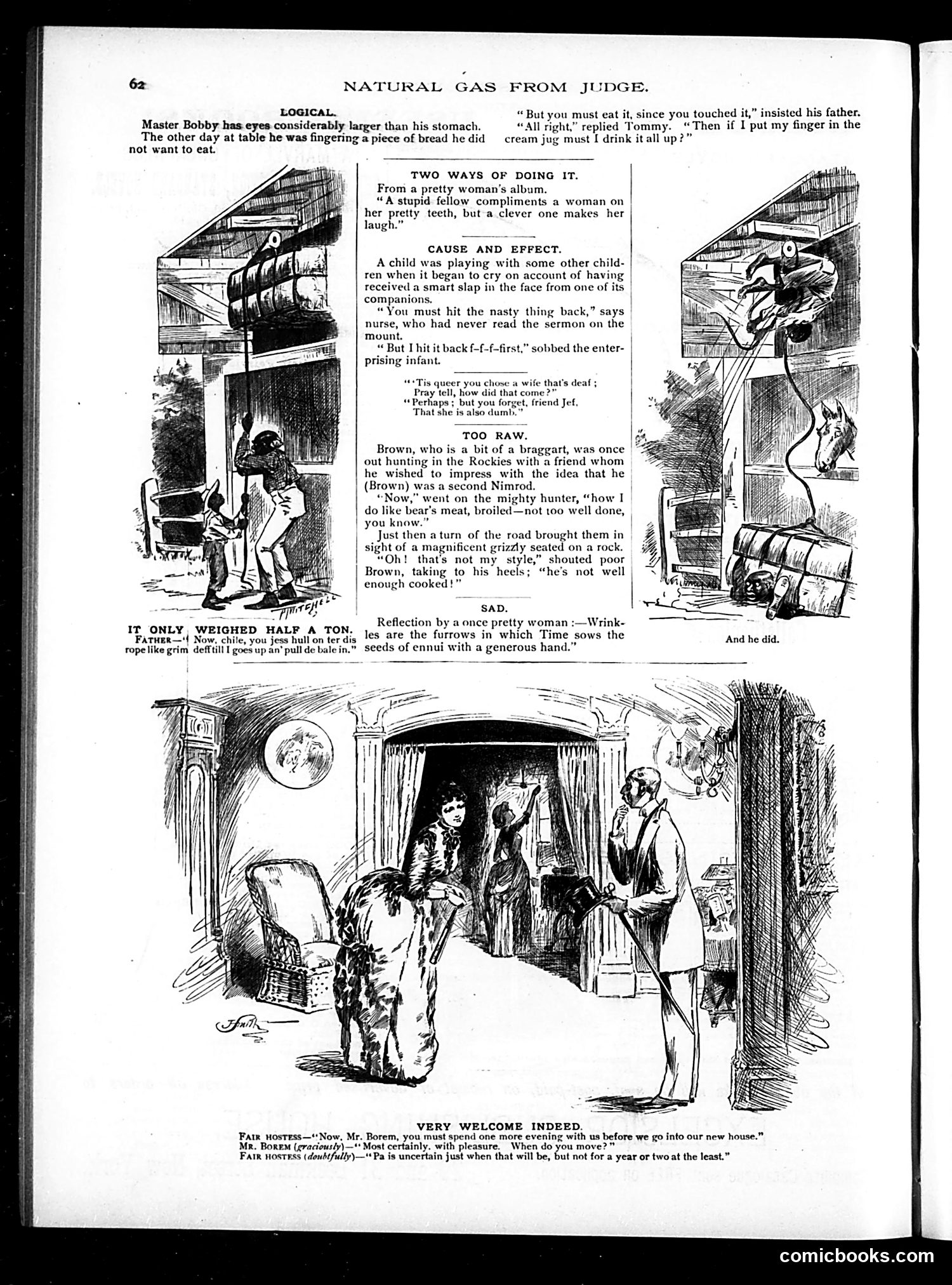
This page contains six brief humorous sketches typical of Judge's satirical style: **"Logical"**: A child's literal interpretation of parental logic—if he must eat touched food, shouldn't he drink spilled cream? **"Two Ways of Doing It"**: Contrasts complimenting a woman's teeth (stupid) versus making her laugh (clever). **"Cause and Effect"**: A child who hit back first claims innocence, satirizing both the child's logic and the nurse's un-Christian advice to retaliate. **"Too Raw"**: A braggart hunter boasts about eating bear meat, then flees in terror from an actual bear—mocking false bravado. **"Sad"**: A reflection on aging and wrinkles as time's bitter harvest. **"Very Welcome Indeed"**: Social satire on boring houseguests—the hostess invites a tedious Mr. Borem to visit again before moving, but her uncertain move date suggests she hopes to avoid him. These are genteel Victorian-era jokes about manners, vanity, and social hypocrisy rather than political commentary.
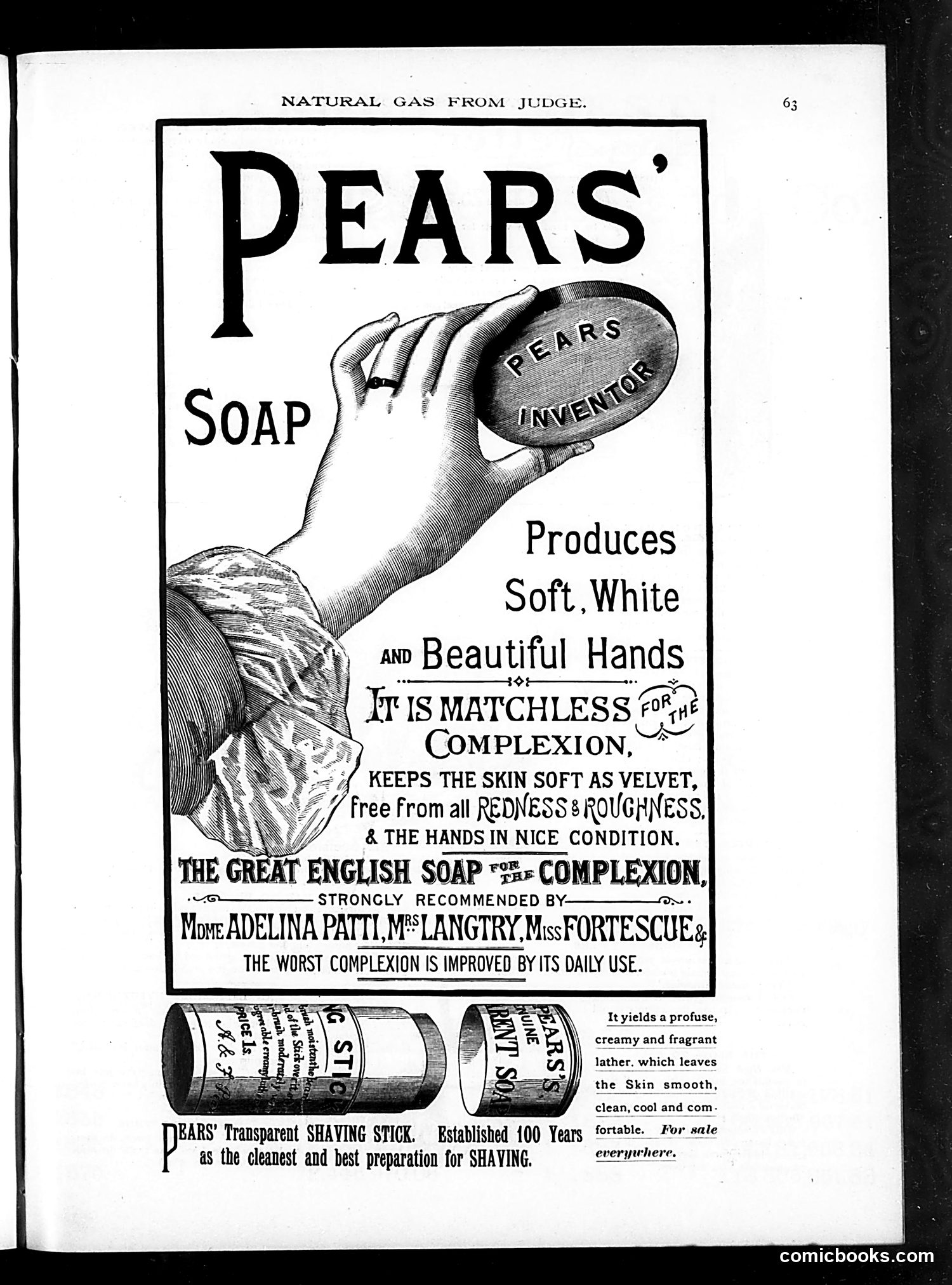
This page is primarily a **commercial advertisement**, not political satire. It promotes Pears' Soap, a real English product, positioning itself as "the great English soap for the complexion." The ad uses **celebrity endorsements** from famous Victorian-era women—Adelina Patti (renowned opera singer), Lillie Langtry (actress/socialite), and others—to market beauty claims about producing "soft, white and beautiful hands" and improving complexion. The title "NATURAL GAS FROM JUDGE" is a **pun**: Judge magazine's name is repurposed to suggest the soap generates "natural gas" (flatulence/humor) rather than actual natural gas. This wordplay was typical of Judge's satirical approach to advertising. The lower section advertises Pears' complementary shaving stick product. By modern standards, the beauty claims and racial undertones about "white" skin would be problematic; the ad reflects period attitudes about complexion as a beauty ideal.
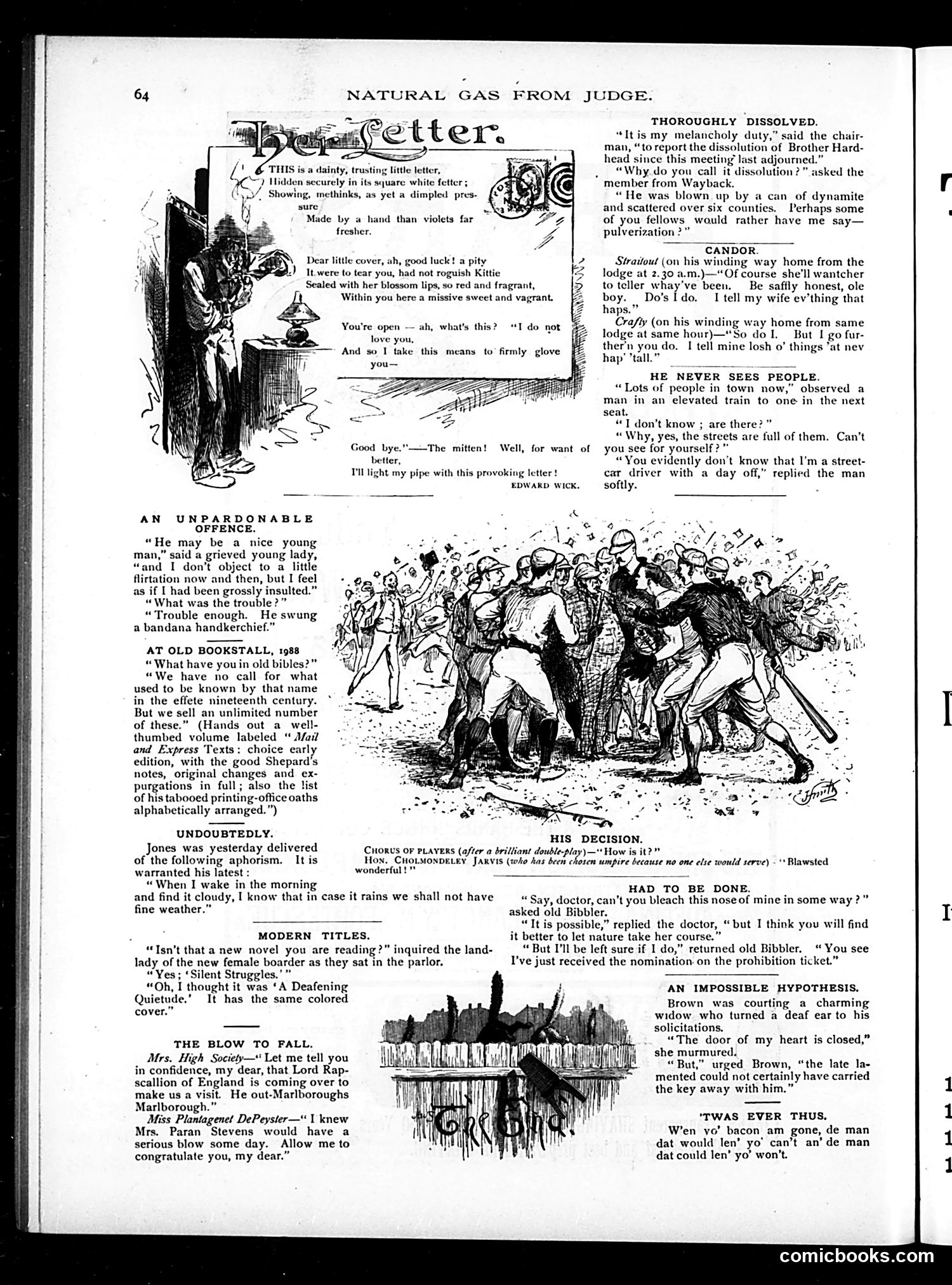
This page contains multiple short humorous pieces typical of Judge magazine's satirical format: **"Letter"** mocks romantic correspondence—a young man receives a love letter sealed with kisses, then dismissively uses it to light his pipe. **"Unpardonable Offence"** satirizes changing social etiquette: a young woman feels insulted by a suitor merely waving a handkerchief, suggesting evolving (and increasingly absurd) standards of propriety. **"At Old Bookstall, 1988"** is futuristic satire predicting that by 1988, "old bibles" will be replaced by censored volumes of "Mail and Express Texts"—mocking contemporary concerns about bowdlerized publications and changing moral standards. **Other pieces** mock various social types: a logically absurd aphorism, absurdly-titled novels, snobbish society women, fraternal lodge members, and a street-car driver claiming never to see pedestrians. The consistent theme: satirizing contemporary American social pretensions, changing manners, and human folly through exaggeration and irony.
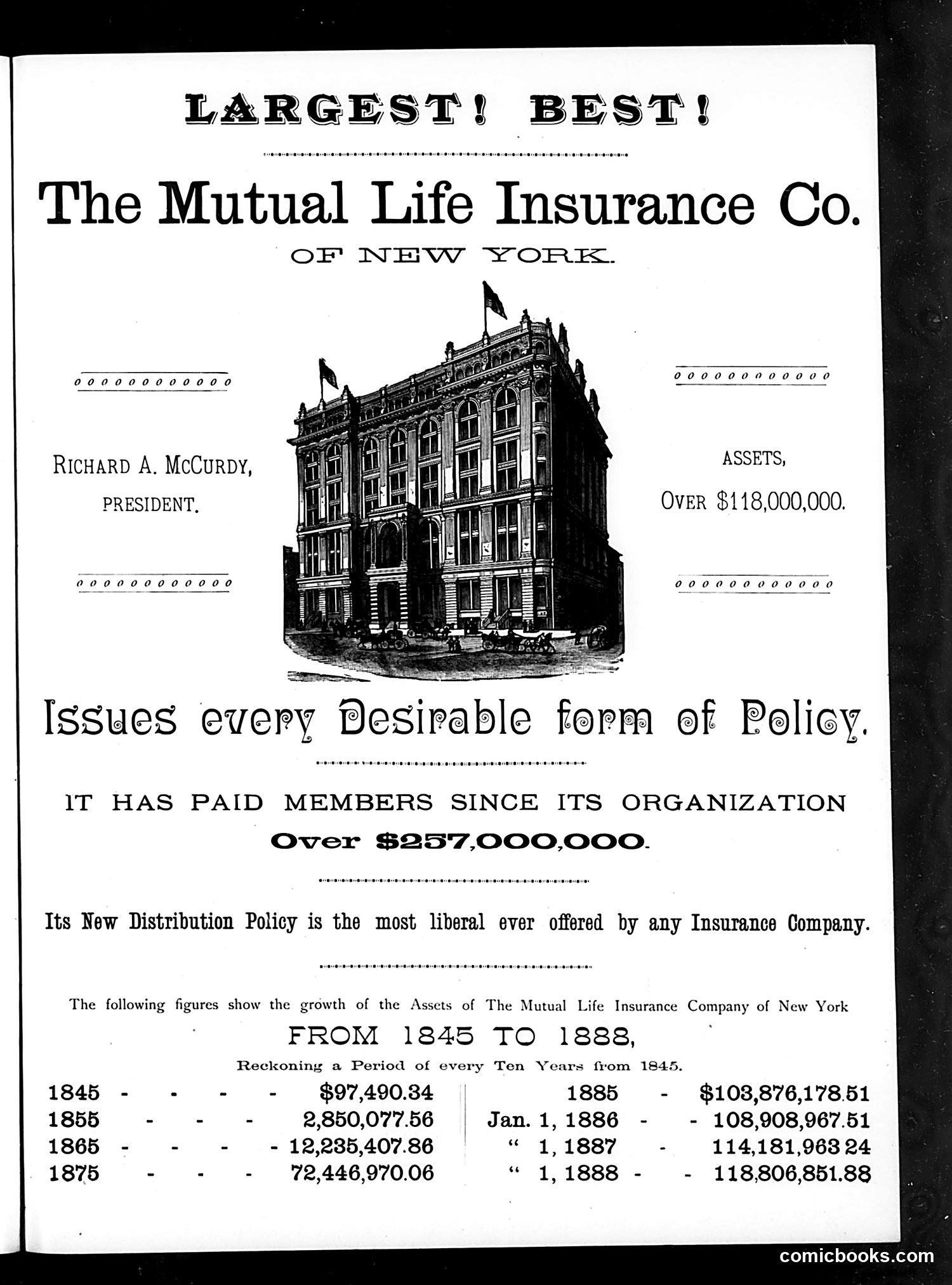
This is **not a cartoon or satire**—it's a straightforward **advertisement** for the Mutual Life Insurance Company of New York, appearing in Judge magazine (likely late 1880s). The page promotes the company's credentials through: - **Richard A. McCurdy** (President) as the authority figure - An **impressive building illustration** (their headquarters) as proof of stability - **Massive financial figures**: $118 million in assets, $257 million paid to members since founding - **Growth statistics** (1845-1888) demonstrating rapid expansion and reliability - Claims of offering "the most liberal" insurance policies available **Context for modern readers:** Before government regulation, insurance companies relied heavily on advertising their size and longevity to convince skeptical customers of their solvency. The building image and precise financial data were meant to reassure buyers that their premiums were safe. Judge's inclusion of such ads was typical—magazines survived on advertisements funding editorial content. There is no satirical commentary visible here; this is paid commercial content.
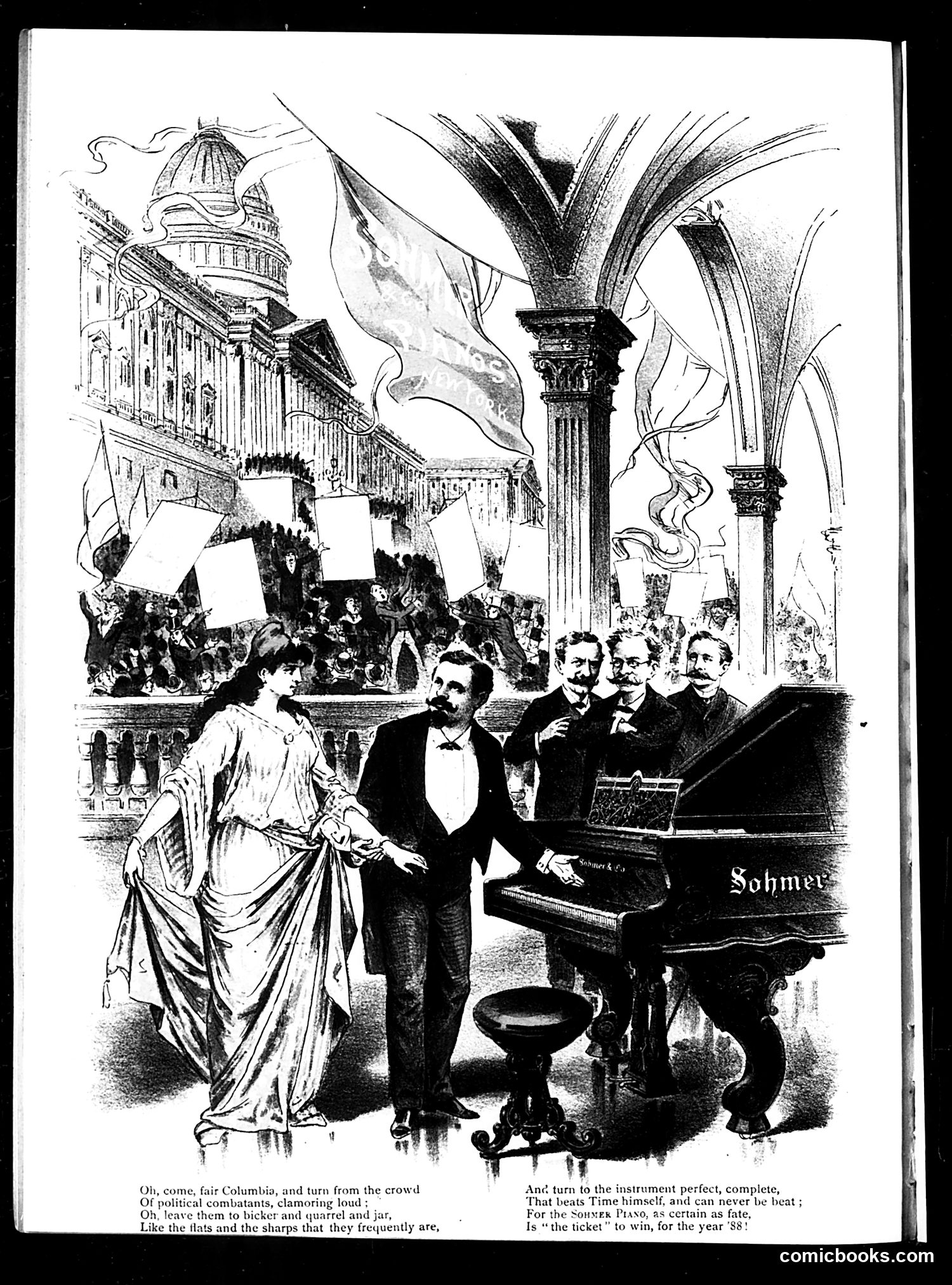
This appears to be a political cartoon from Judge magazine promoting the "Sohmer Piano" as a humorous solution to winning the 1888 presidential election. The scene depicts a formal concert hall with "Columbia" (female personification of America) and four men in formal dress around a grand piano. The visible text references turning from "political combatants" and "clamoring food" to the piano as the path to victory. The joke conflates American politics with musical performance: rather than engage in messy political debate, the cartoon satirically suggests that owning a quality Sohmer Piano is "the ticket" to electoral success in '88. This appears to be advertising disguised as political satire—a common Judge practice—mocking both the shallow nature of political campaigns and consumer culture's promises of transformation.

I can see this is a page from Judge magazine (as indicated by the watermark "comicbooks.com" at the bottom), but the image itself is almost entirely black with very low contrast. While faint outlines suggest there may be illustrations or text on the left and right margins, I cannot reliably make out specific figures, caricatures, text content, or political references clearly enough to explain the satire or jokes to a modern reader. To provide accurate historical context as you've requested, I would need either a higher-contrast version of this page or confirmation of its publication date and topic. I cannot responsibly guess at content I cannot see.
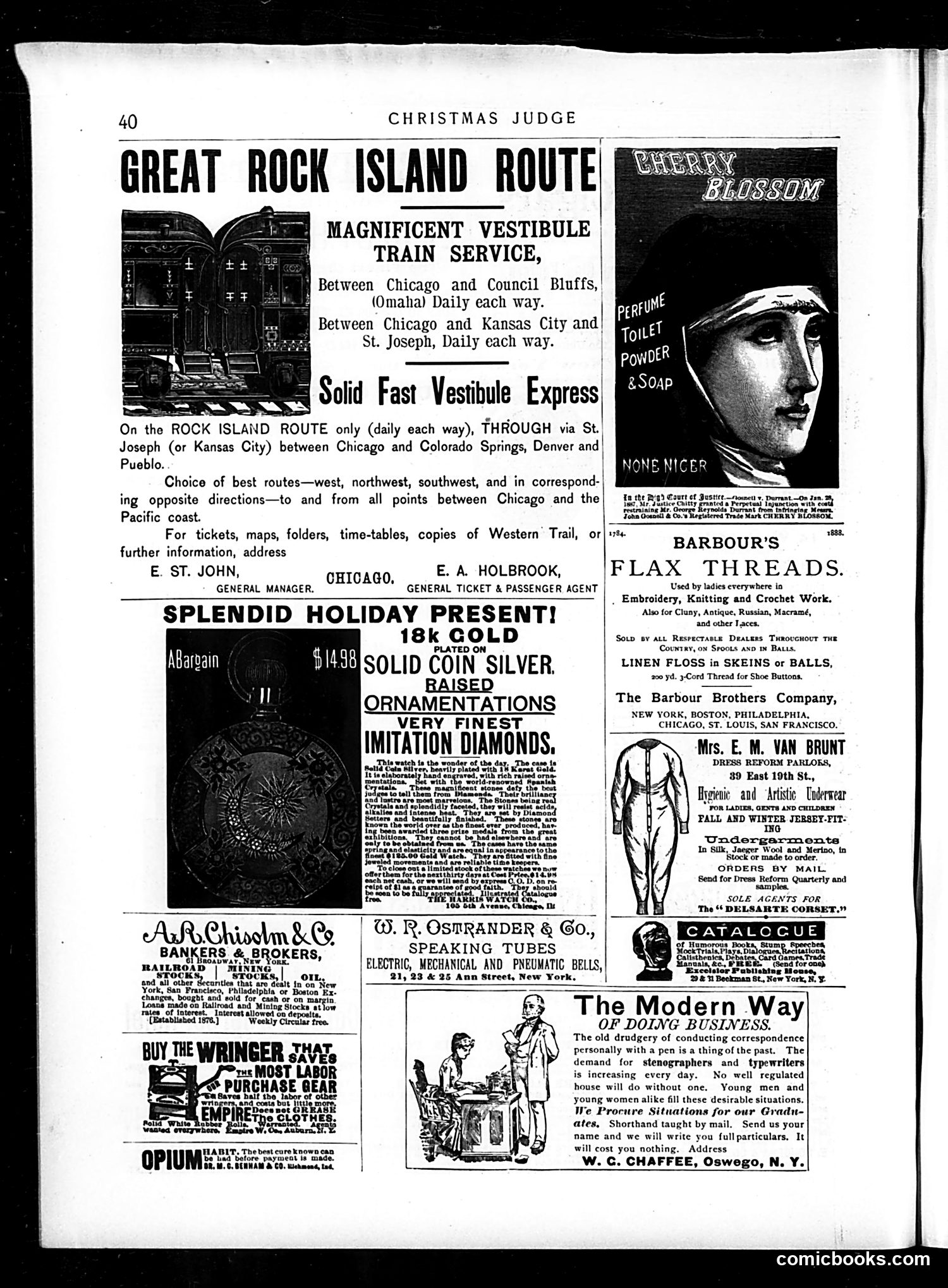
This page is primarily **advertising**, not satirical content. It's a Christmas issue featuring railroad, jewelry, textile, and business service advertisements typical of the late 19th century. The notable items are: **Great Rock Island Route**: A railroad advertisement promoting train service between Chicago and western destinations (Denver, Pueblo, Kansas City). This represents the era's rapid railroad expansion and competition for passenger travel. **Holiday jewelry ad**: Promotes an 18-karat gold pendant with "imitation diamonds"—notable because it's openly advertising costume jewelry as a luxury gift, reflecting both holiday consumerism and manufacturing innovation. **Dress Reform Parlors**: Advertises "hygienic" undergarments, reflecting late-Victorian health and dress reform movements that challenged restrictive Victorian clothing. **The Modern Way of Doing Business**: Promotes stenography and typewriter training by mail, capturing the emerging office revolution and new employment opportunities for young women entering the workforce—a significant social shift. The page reflects turn-of-century consumer culture, technological change, and evolving gender roles rather than political satire.
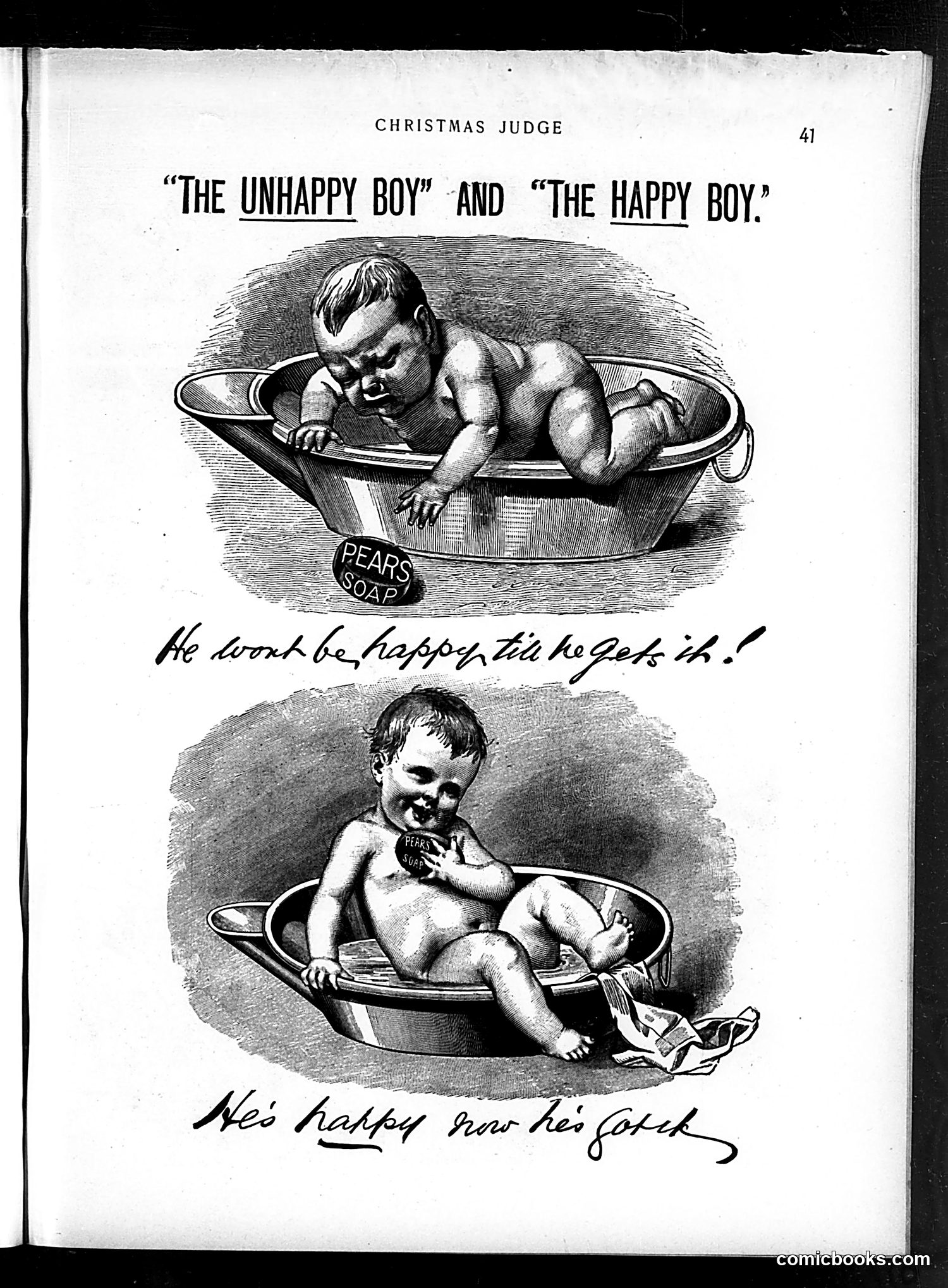
This is a **Pears' Soap advertisement** disguised as editorial content in *Judge* magazine. The two contrasting images show infants in bathtubs: **Top image ("The Unhappy Boy"):** A crying baby with Pears Soap visible, captioned "He won't be happy till he gets it!" **Bottom image ("The Happy Boy"):** A smiling baby holding Pears Soap, captioned "He's happy now he's got it." The satire is straightforward product advertising: using an infant's emotional state to suggest that Pears Soap ensures childhood happiness. This exploits parental anxieties about child welfare and cleanliness while presenting soap acquisition as essential to child contentment. The format mimics editorial material rather than appearing as obvious advertising, a common *Judge* practice of embedding promotional content within satirical commentary.
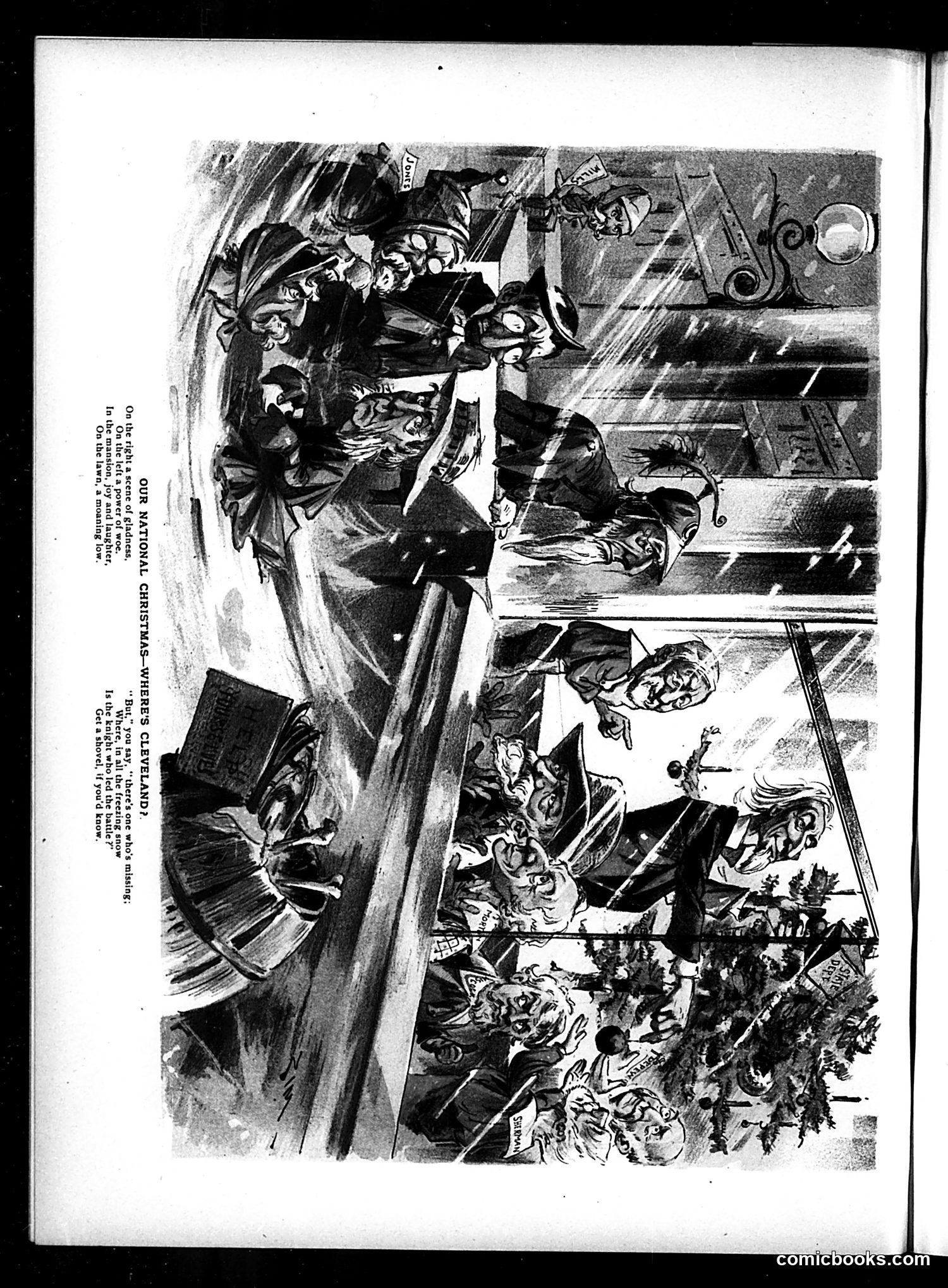
I can see this is a satirical illustration from Judge magazine, but the OCR text is largely corrupted and unreadable, making it difficult to identify specific figures or the precise political context. The image itself shows what appears to be a chaotic scene with multiple caricatured figures in period dress (likely late 19th or early 20th century), arranged vertically. There are exaggerated facial features typical of Judge's satirical style, and the composition suggests commentary on some social or political situation involving multiple parties or groups. Without legible text or visible identifying labels in the cartoon, I cannot confidently state which specific political figures or events are being satirized. To accurately explain this cartoon's meaning to a modern reader, I would need either clearer text or visible identifying marks within the illustration itself.