
Judge, 1888 · page 27 of 72
Judge — 1888 — page 27: what you’re looking at
What you’re looking at
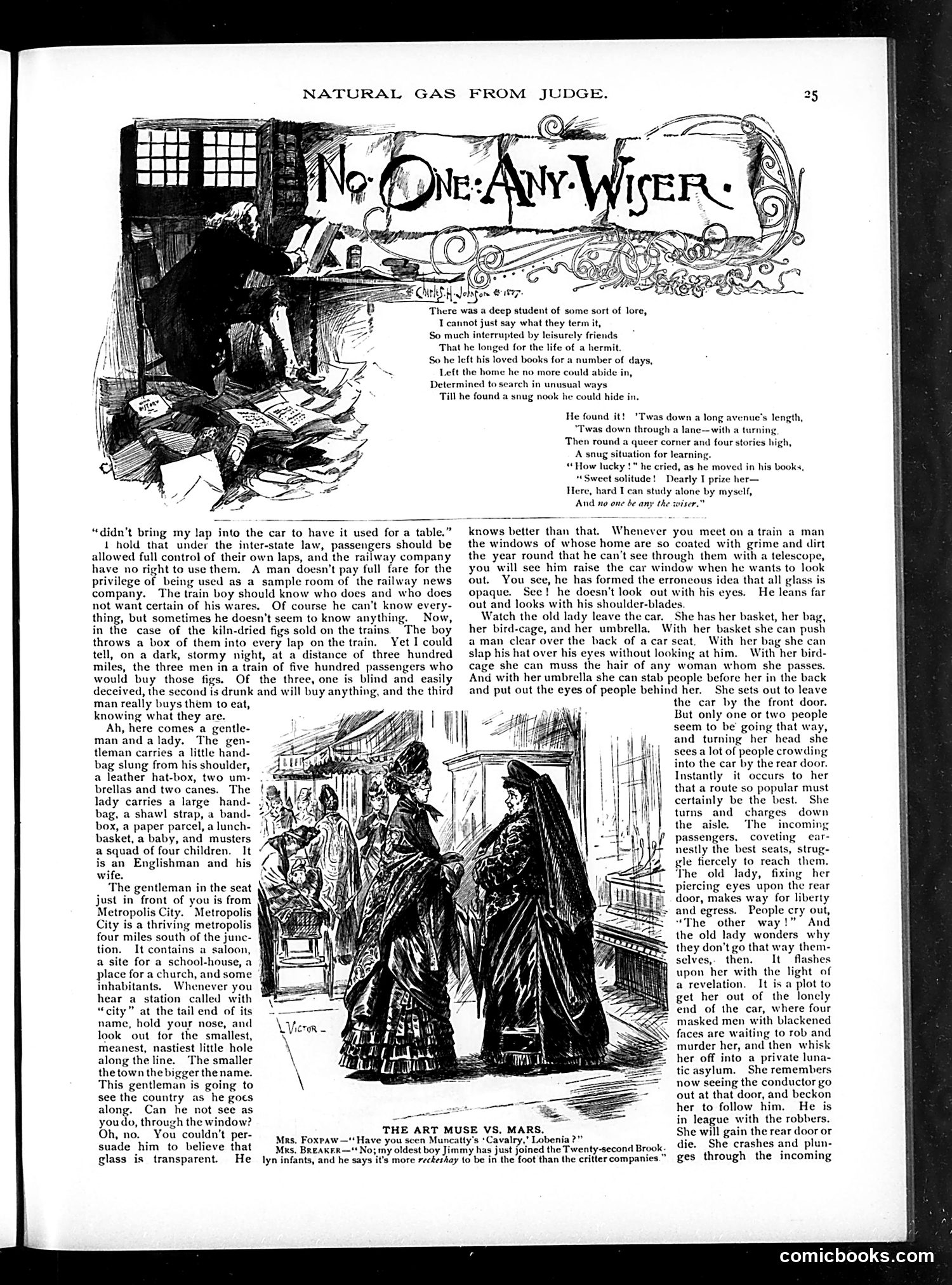
This page contains satirical sketches about train travel etiquette and passenger types. The main content mocks the annoying behaviors of different railway passengers: **"No One Any Wiser"** (top): A humorous poem about a scholarly hermit seeking solitude, illustrated with a figure among books. **Train Car Observations** (center text): Sharp social satire targeting specific passenger stereotypes—the blind-to-transparency man who won't believe windows are clear glass; the "Metropolis City" gentleman from a tiny town with a grandiose name; the oblivious newspaper-boy throwing figs into laps; and crucially, the English family occupying excessive space with luggage and children. **"The Art Muse vs. Mars"** (bottom): A brief comic dialogue where Mrs. Foxraw asks about Muncatty's "Cavalry" painting, and Mrs. Breaker replies that her son Jimmy prefers the actual Twenty-second Brooklyn Infantry to artistic depictions—a quip about real military service versus romanticized art. The overall humor targets middle-class Victorian train passengers' absurd behaviors and pretensions, common Judge magazine fare.
📄 Transcribed text from this page (OCR, searchable)
Machine-transcribed from the original scan — historical spelling and the odd misread are preserved.
NATURAL GAS FROM JUDGE. was a deep student of some sort of lore, T cannot just So much interruy y what they term it, 4 by leisurely friends ‘That he longed for the life of a hermit. So he left his loved books for a number of days, Left the home he no more could abide in, Determined to se: ch in unusual ways Till he found a snug nook he could hide in. He found it! 'Twas down a long avenue’s length, “Twas down through a lane—with a turning. ‘Then round a queer corner and four stories high, A snug situa “How luck ion for learning. he cried, as he moved in his books, ize her— “didn't bring my lap into the car to have it used for a table.” 1 hold that under the inter-state law, passengers should be allowed full control of their own laps, and the railway company have no right to use them. A man doesn't pay full fare for the privilege of being used as a sample room of the railway news company. The train boy should know who does and who does not want certain of his wares. Of course he can't know every- Now, ‘The boy Yet I could tell, on a dark, stormy night, at a distance of three hundred miles, the three men in a train of five hundred passengers who would buy those figs. Of the three, one is blind and easily deceived, the second is drunk and will buy anything, and the third man really buys them to eat, knowing what they are. Ah, here comes a gentle- man anda lady. The gen- tleman carries a little hand- bag slung from his shoulder, a leather hat-box, two um- brellas and two canes. The lady carries a large hand- bag, a shawl strap, a band- box, a paper parcel, a lunch- basket, a baby, and musters a squad of four children. It is an Englishman and his wife. ‘The gentleman in the seat just in front of you is from Metropolis City. "Metropolis City is a thriving metropolis four miles south of the junc- tion. It contains a saloon, a site for a school-house, a place for a church, and some inhabitants. Whenever you hear a station called with “city” at the tail end of its name, hold your nose, and look out for the smallest, meanest, nastiest little hole along the line. The smaller the town the bigger thename. This gentleman is going to see the country as he gocs along. Can he not see as you do, through the window? Oh, no. You couldn't per- suade him to believe that glass is transparent. He thing, but sometimes he doesn't seem to know anything. in the case of the kiln-dried figs sold on the train: throws a box of them into every lap on the train. Ms. Breaker: THE ART MUSE VS. MARS. Mrs. Foxraw—"' Have you scen Muncatty’s ‘Cavalry,’ Lobenia?” No; my oldest boy Jimmy has just joined the Twenty-second Brook. lyn infants, and he says it's more reckeshay (o be in the foot than the critter companies. knows better than that. Whenever you meet on a train a man the windows of whose home are so coated with grime and dirt the year round that he can’t see through them with a telescope, you will see him raise the car window when he wants to look out. You see, he has formed the erroneous idea that all glass is opaque. See! he doesn't look out with his eyes. He leans out and looks with his shoulder-blades. Watch the old lady leave the car. She has her basket, her bag, her bird-cage, and her umbrella, With her basket she can push aman clear over the back of a car seat, With her bag she can slap his hat over his eyes without looking at him. With her bird- cage she can muss the hair of any woman whom she passes. And with her umbrella she can stab people before her in the back and put out the eyes of people behind her. She sets out to leave the car by the front door. But only one or two people seem to be going that way, and turning her head she sees a lot of people crowding into the car by the rear door. Instantly it occurs to her that a route so popular must certainly be the best. She turns and charges down the le. ~The incoming passengers, coveting ear- nestly the best seats, strug- gle fiercely to reach them. The old lady, fixing her piercing eyes upon the rear door, makes way for liberty and egre: People cry out, “The other way!" And the old lady wonders why they don’t go that way them- selves, then. It flashes upon her with the light of a revelation. It is a plot to get her out of the loncly end of the car, where four masked men with blackened faces are waiting to rob and murder her, and then whi her off into a private lu ticasylum. She remembers now seeing the conductor go out at that door, and beckon her to follow him. He is in league with the robbers. She will gain the rear door or die. She crashes and plun- ges through the incoming comicbooks.com