
A complete issue · 100 pages · 1913
Life — January 9, 1913
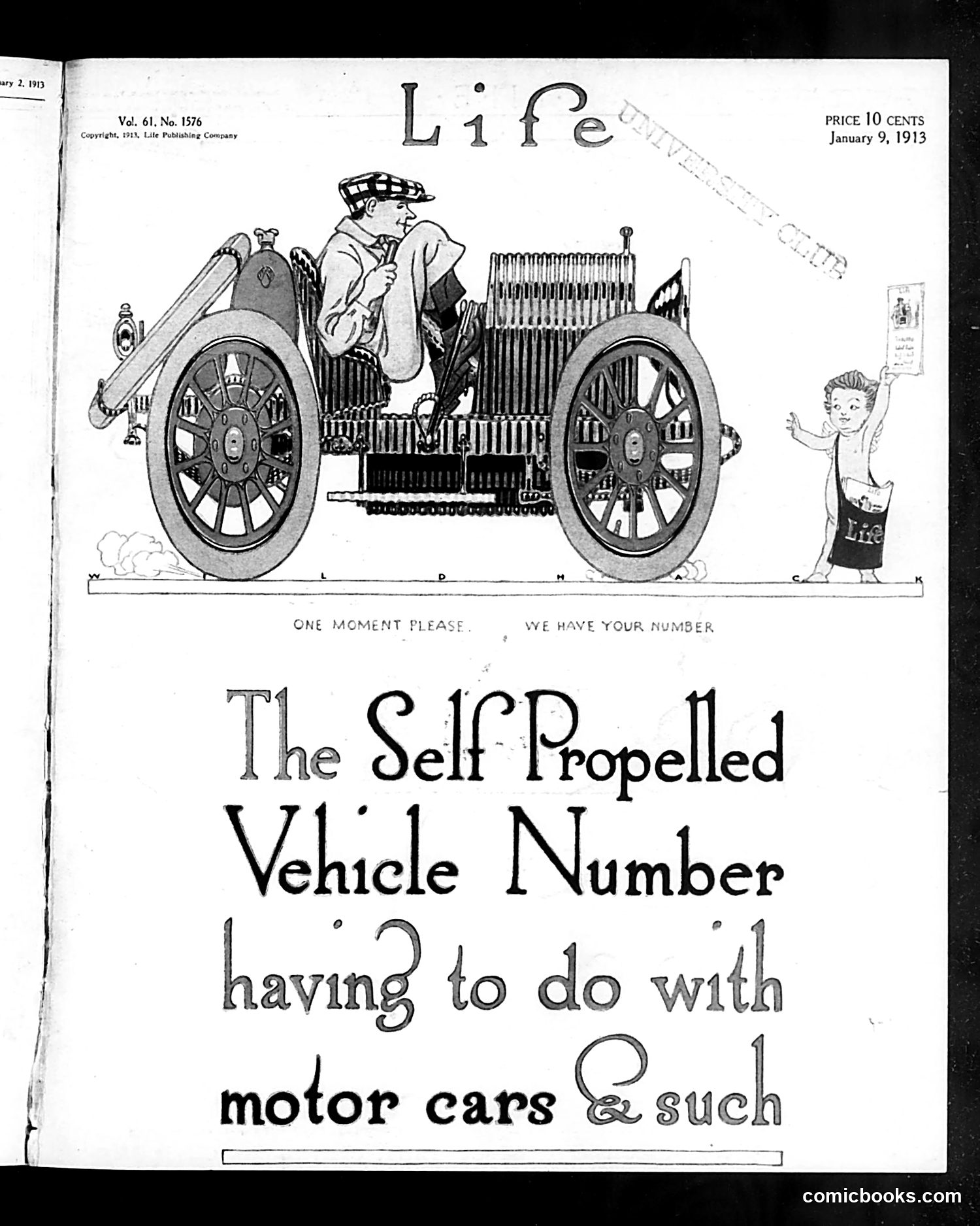
This cover satirizes the emerging automobile industry's claim of "self-propelled" innovation. The cartoon depicts a man in a car holding a large mechanical apparatus labeled "The Self Propelled Vehicle Number having to do with motor cars & such," while a child stands nearby saying "ONE MOMENT PLEASE . . . WE HAVE YOUR NUMBER"—meaning the scheme or trick is exposed. The joke mocks manufacturers' grandiose marketing language for what are essentially standard motor cars. By literalizing "self-propelled" as an absurdly complicated mechanical contraption, Life ridicules the industry's pretentious terminology and advertising excess. The child represents common sense seeing through corporate hype—a recurring satirical device.
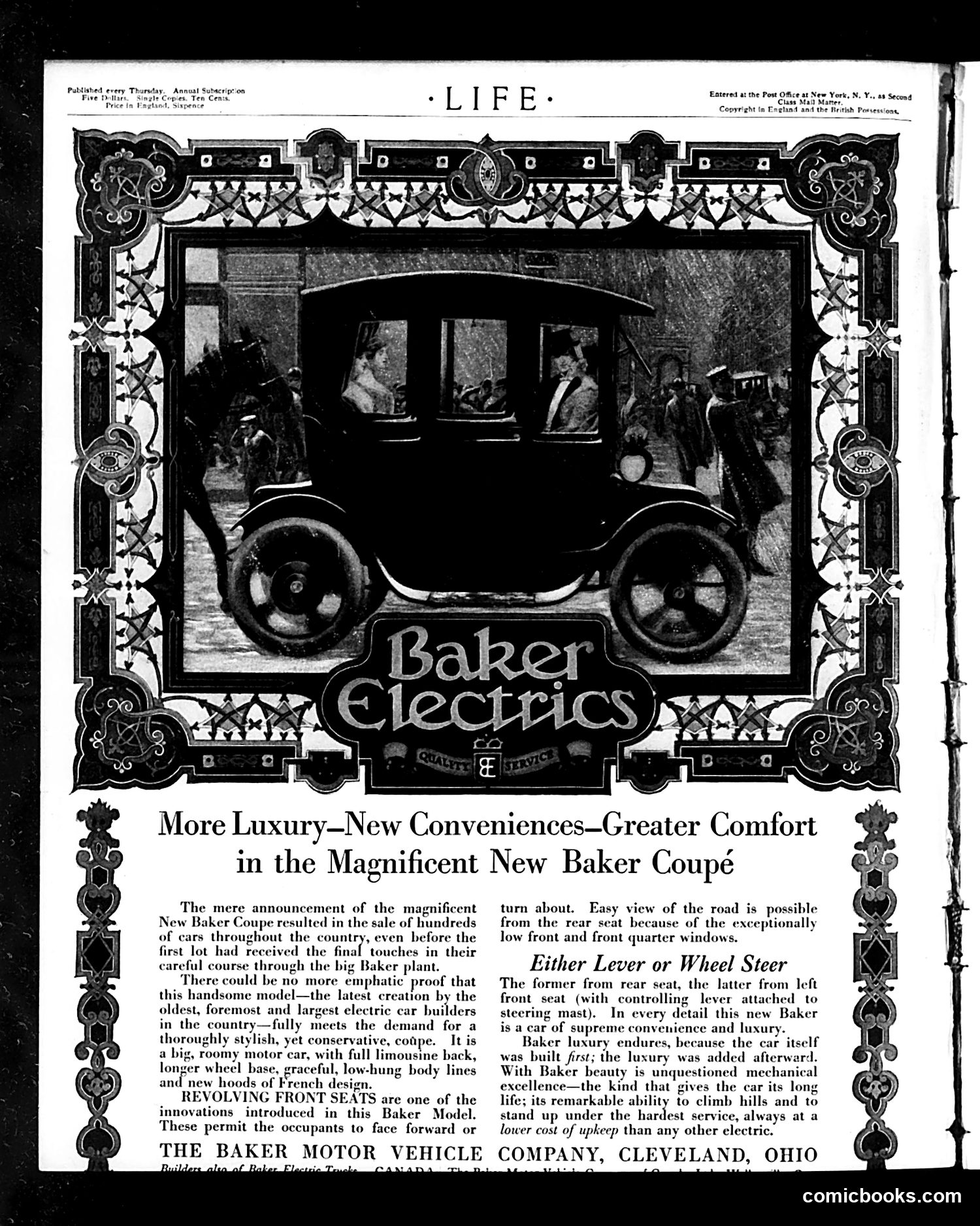
This page is **primarily an advertisement**, not satirical content. It promotes Baker Electric automobiles, manufactured by The Baker Motor Vehicle Company in Cleveland, Ohio. The ad emphasizes luxury features of the "New Baker Coupé": revolving front seats (allowing passengers to face forward or backward), either lever or wheel steering options, low front windows for rear visibility, and French design styling. The text stresses mechanical excellence, hill-climbing ability, and low operating costs compared to other electric vehicles. The ornate decorative border and period photograph of the enclosed automobile are typical design elements of early 1900s automotive advertising. This represents standard commercial promotion rather than satire or political commentary.
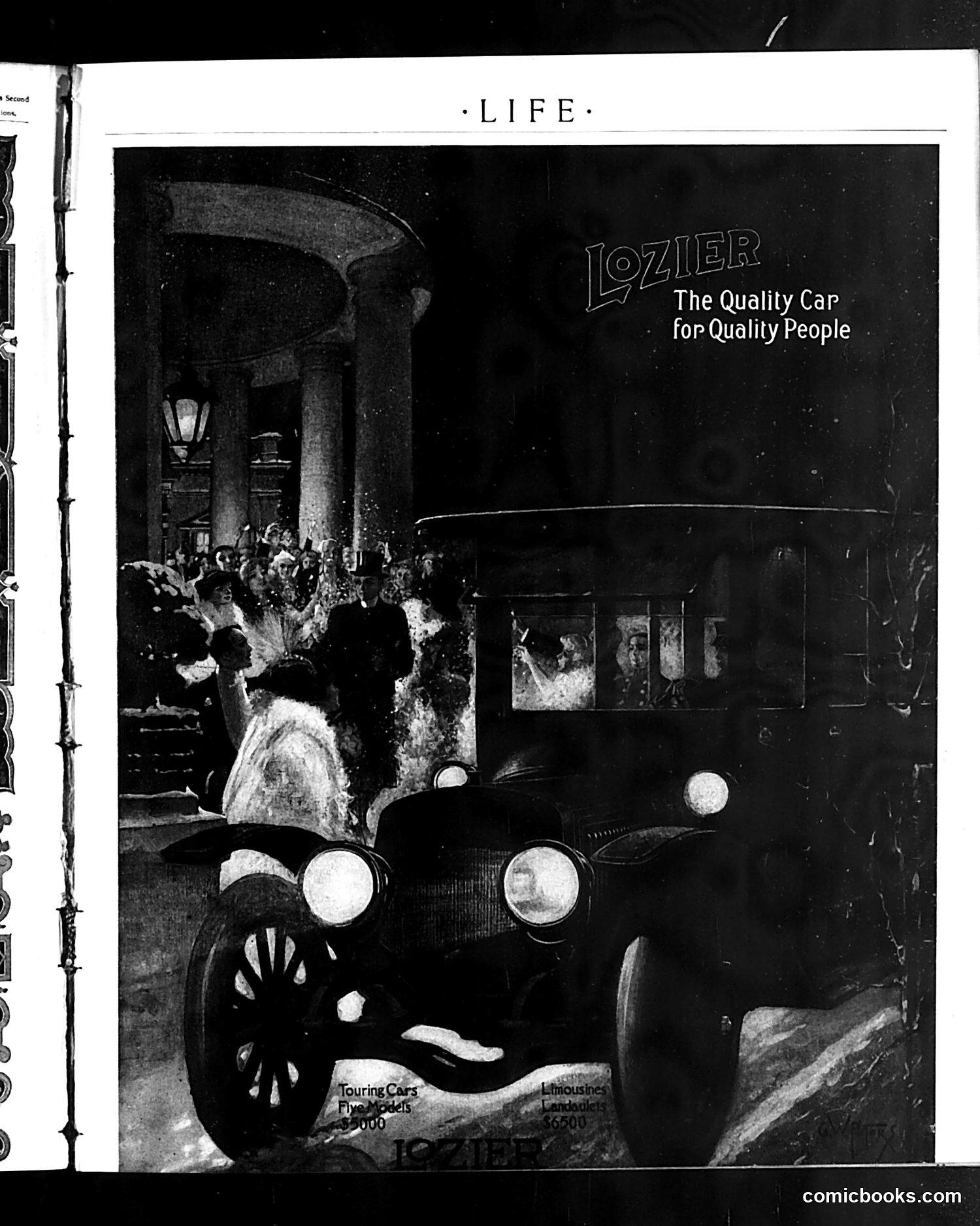
This is a Lozier automobile advertisement, not political satire. The ad depicts a luxury car arriving at an elegant evening event—likely an opera or formal social gathering, given the classical architecture with columns and well-dressed attendees in formal wear visible in the background. The advertisement's tagline, "The Quality Car for Quality People," emphasizes exclusivity and status. The Lozier was a high-end American automobile manufacturer, and this ad targets wealthy consumers by associating the vehicle with refined social occasions and sophisticated company. The dramatic nighttime scene with the car's prominent headlights creates an air of glamour and modernity. The price points listed ("Touring Cars Five Models $000" and "Limousines Landaulets $500") indicate these were expensive vehicles aimed at the affluent market.
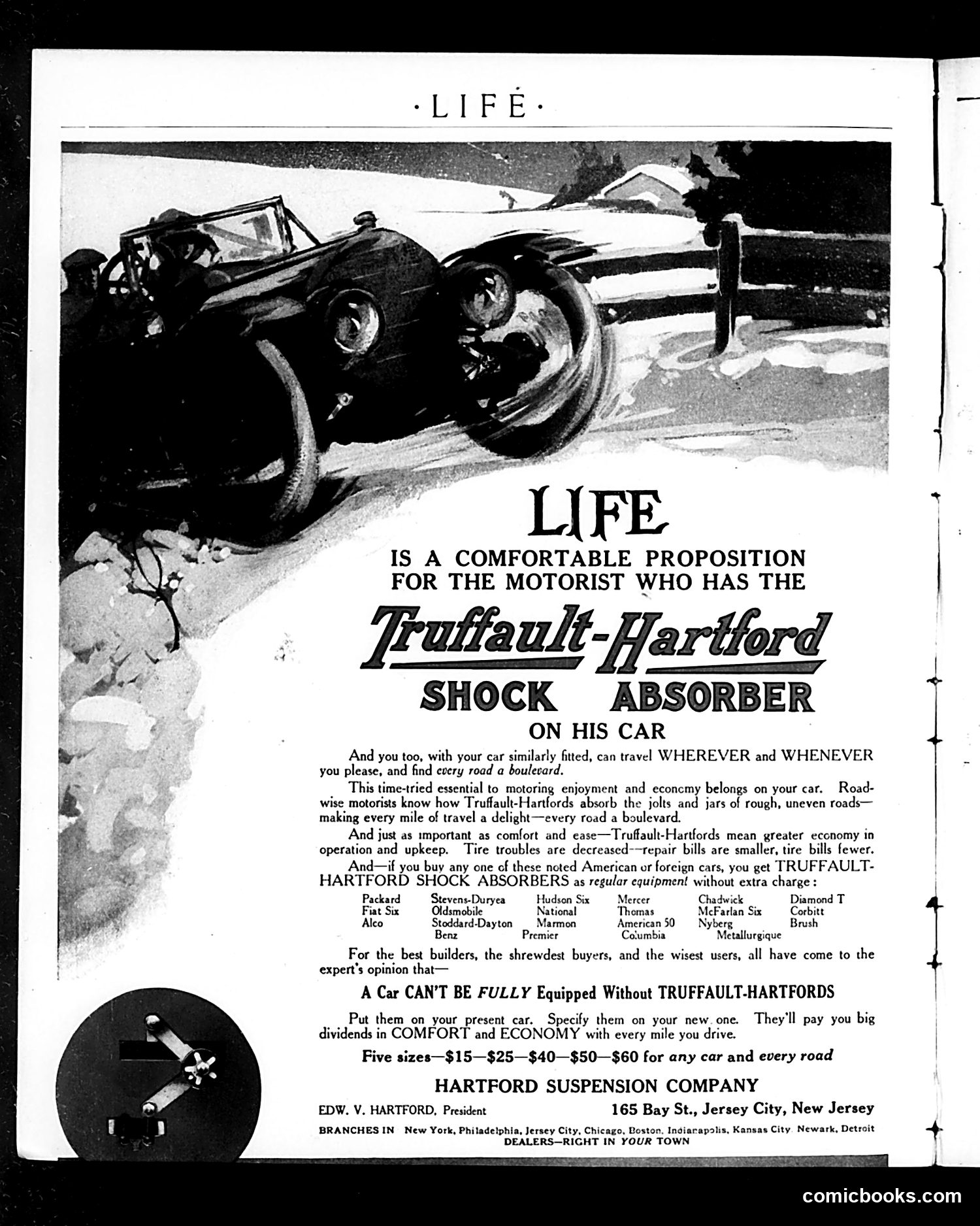
This page is **primarily an advertisement**, not satire or a political cartoon. It promotes Truffault-Hartford shock absorbers for automobiles. The image shows a car that has crashed into a fence, apparently after hitting a pothole or rough road. The advertisement's point is commercial, not satirical: it argues that installing Truffault-Hartford shock absorbers makes driving comfortable on any road condition ("Life is a comfortable proposition for the motorist who has the Truffault-Hartford shock absorber on his car"). The ad lists compatible car brands (Packard, Hudson, Oldsmobile, etc.) and pricing ($15-$60). The company's headquarters was in Jersey City, New Jersey. There is no political satire or social commentary—this is straightforward early-20th-century automotive advertising using a humorous mishap to sell a product.
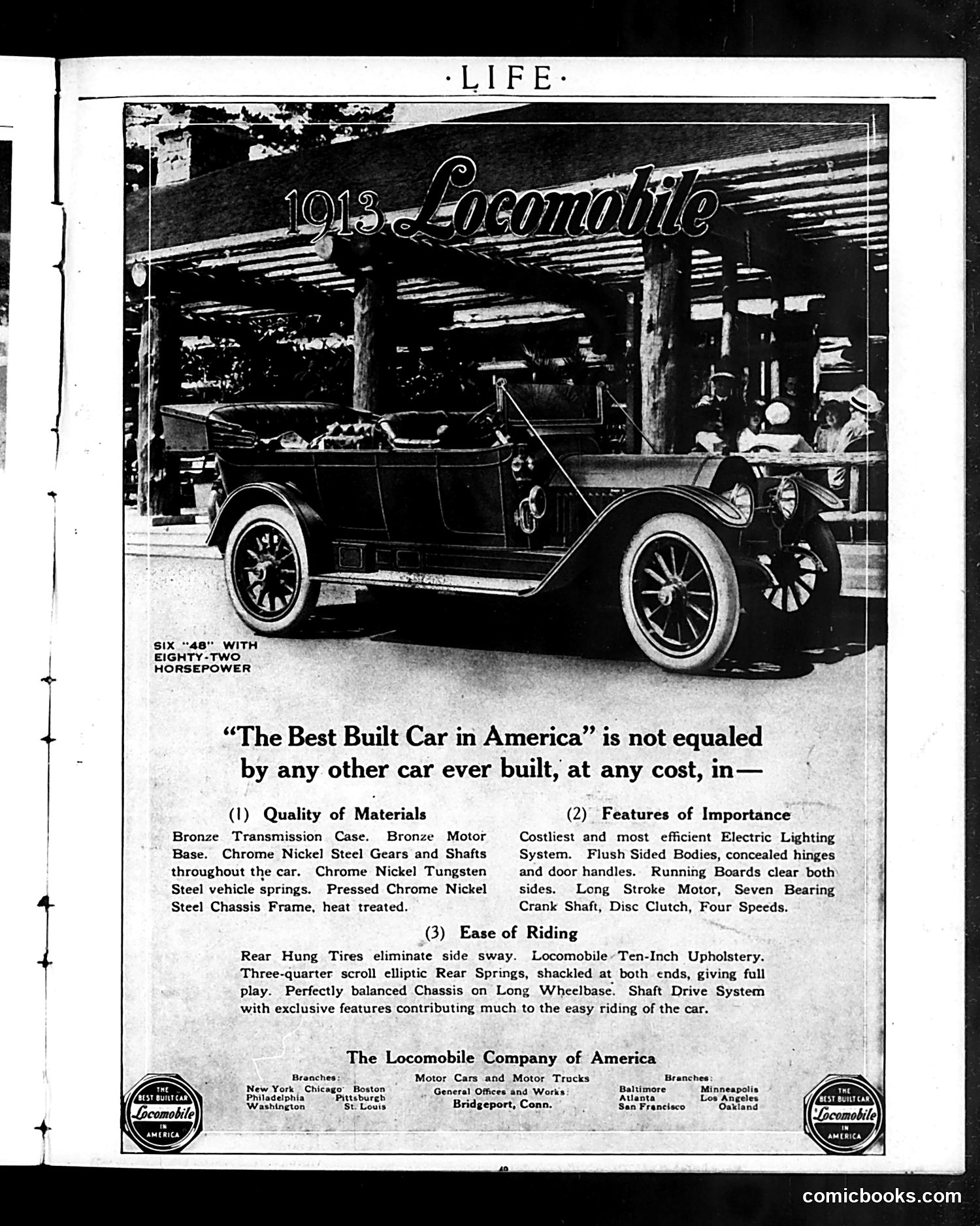
This page is **not a cartoon or satire**—it's a straightforward automobile advertisement from *Life* magazine for the 1913 Locomotive automobile by the Locomotive Company of America. The ad features a photograph of an open-air touring car parked outside what appears to be a showroom, with well-dressed potential customers visible. The marketing copy boasts that this is "The Best Built Car in America," emphasizing superior materials (bronze transmission case, chrome parts, nickel steel), advanced features (electric lighting, disc clutch, long wheelbase), and comfort (ten-inch upholstery, smooth ride). This represents early automotive advertising targeting wealthy consumers. No political satire is present; this is product promotion typical of the magazine's commercial content.
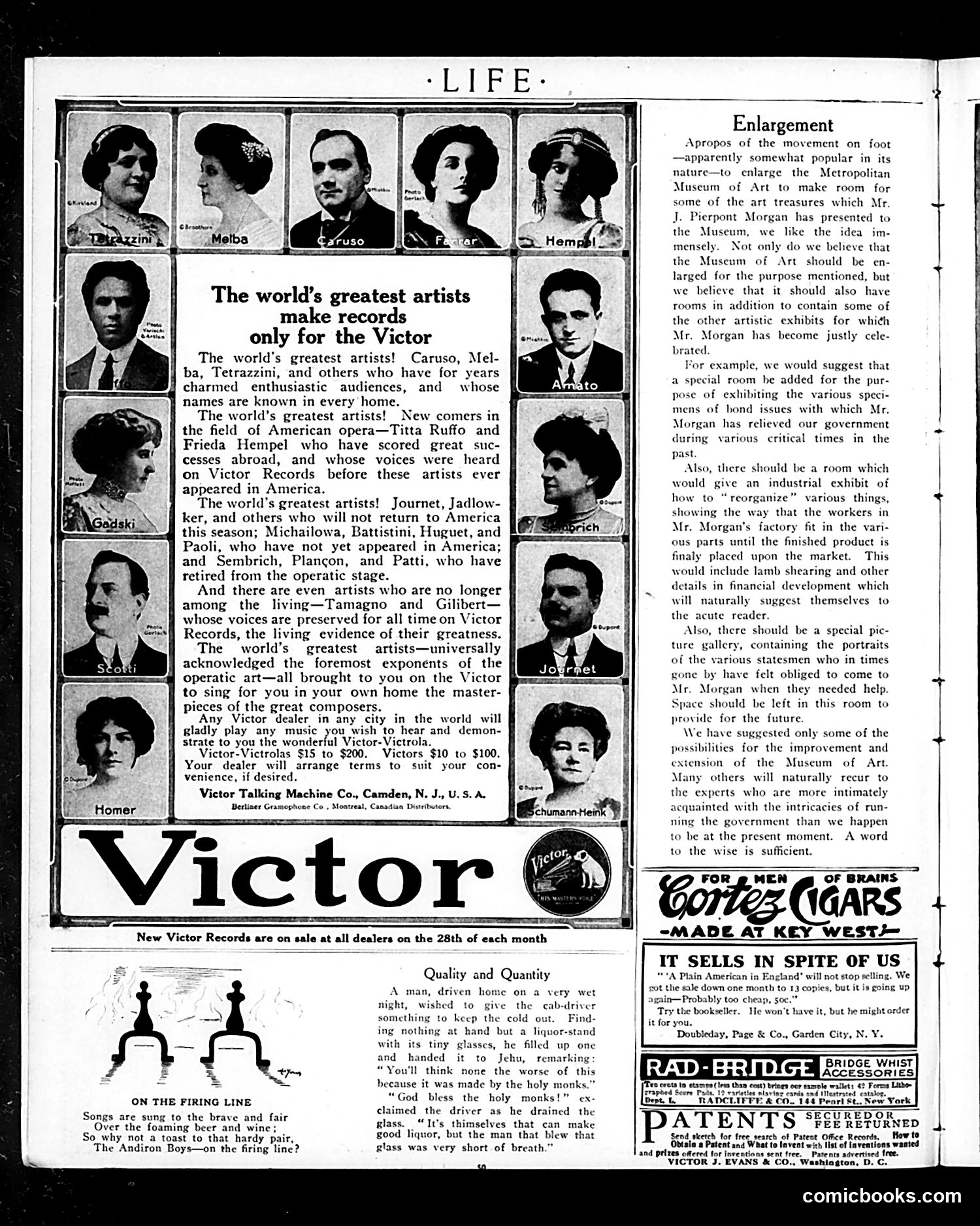
This page is primarily **advertising**, not political satire. The top half features a Victor Records advertisement showcasing famous opera singers and classical musicians of the era (Caruso, Melba, Tetrazzini, and others). The ad's central claim—that "the world's greatest artists make records only for the Victor"—is a straightforward commercial pitch promoting Victor's phonograph records and players. The bottom contains a small cartoon titled "On the Firing Line" depicting two chess pieces (appearing to be religious figures based on the crosses), with text about monks and beer. This appears to be a brief, unrelated humorous piece about monks drinking. The remaining content consists of additional advertisements (Cortes Cigars, Rad-Bridge auto accessories, and a patents notice), typical of Life magazine's revenue model at this time.
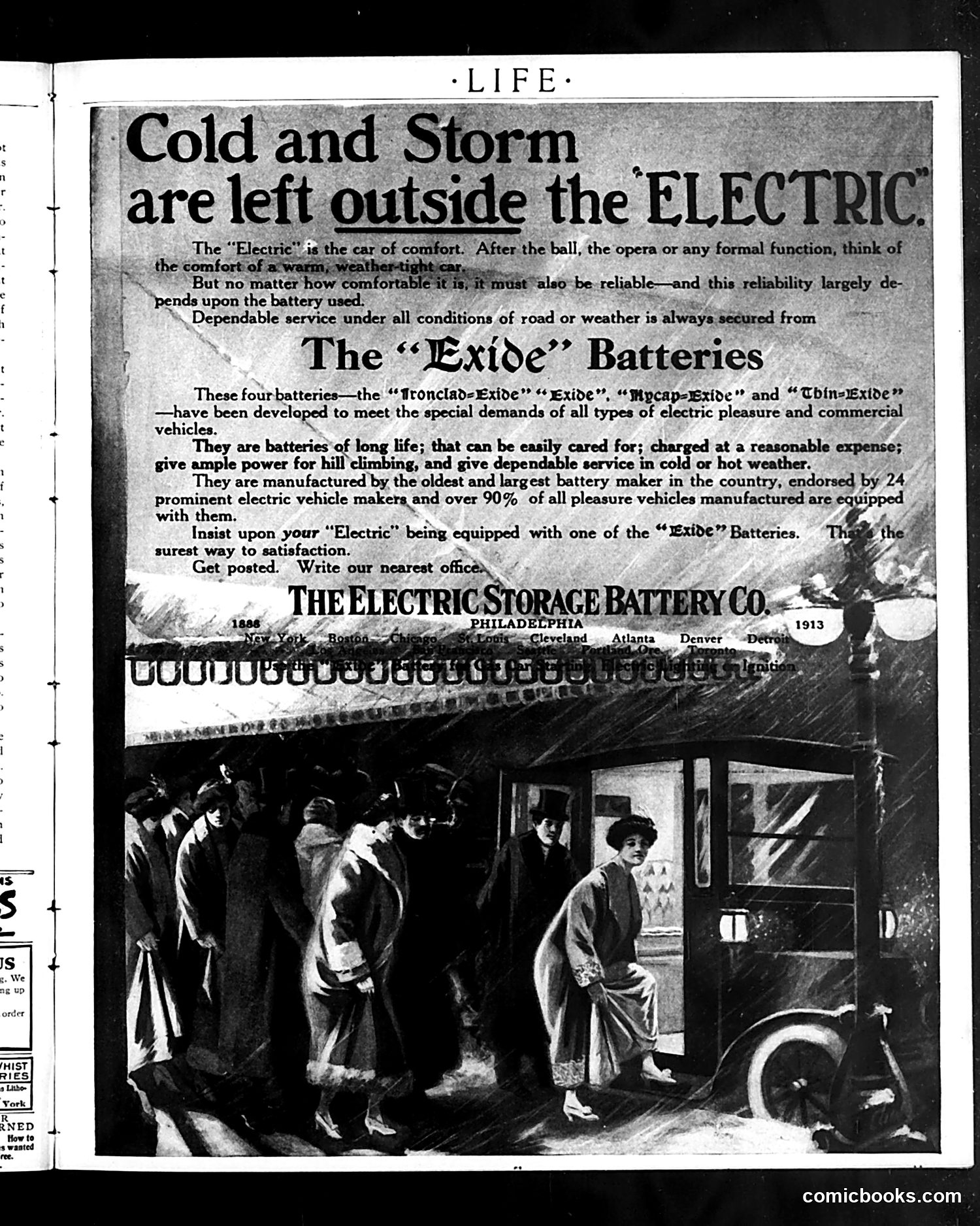
This is **not a political cartoon or satire** — it's a straightforward **advertisement for Exide batteries**, circa 1913. The image shows an electric automobile parked in harsh winter weather, with well-dressed passengers boarding. The ad's message is practical: electric cars were a luxury option for the wealthy, but their reliability depended entirely on battery quality. Exide batteries, manufactured by The Electric Storage Battery Company in Philadelphia, promised dependable performance "under all conditions of road or weather." The social context: electric vehicles were genuine competitors to gasoline cars in the early 1900s, particularly appealing to affluent urban drivers. The advertisement emphasizes that Exide batteries were endorsed by major manufacturers and promises comfort without sacrificing reliability — a key selling point for a new technology.
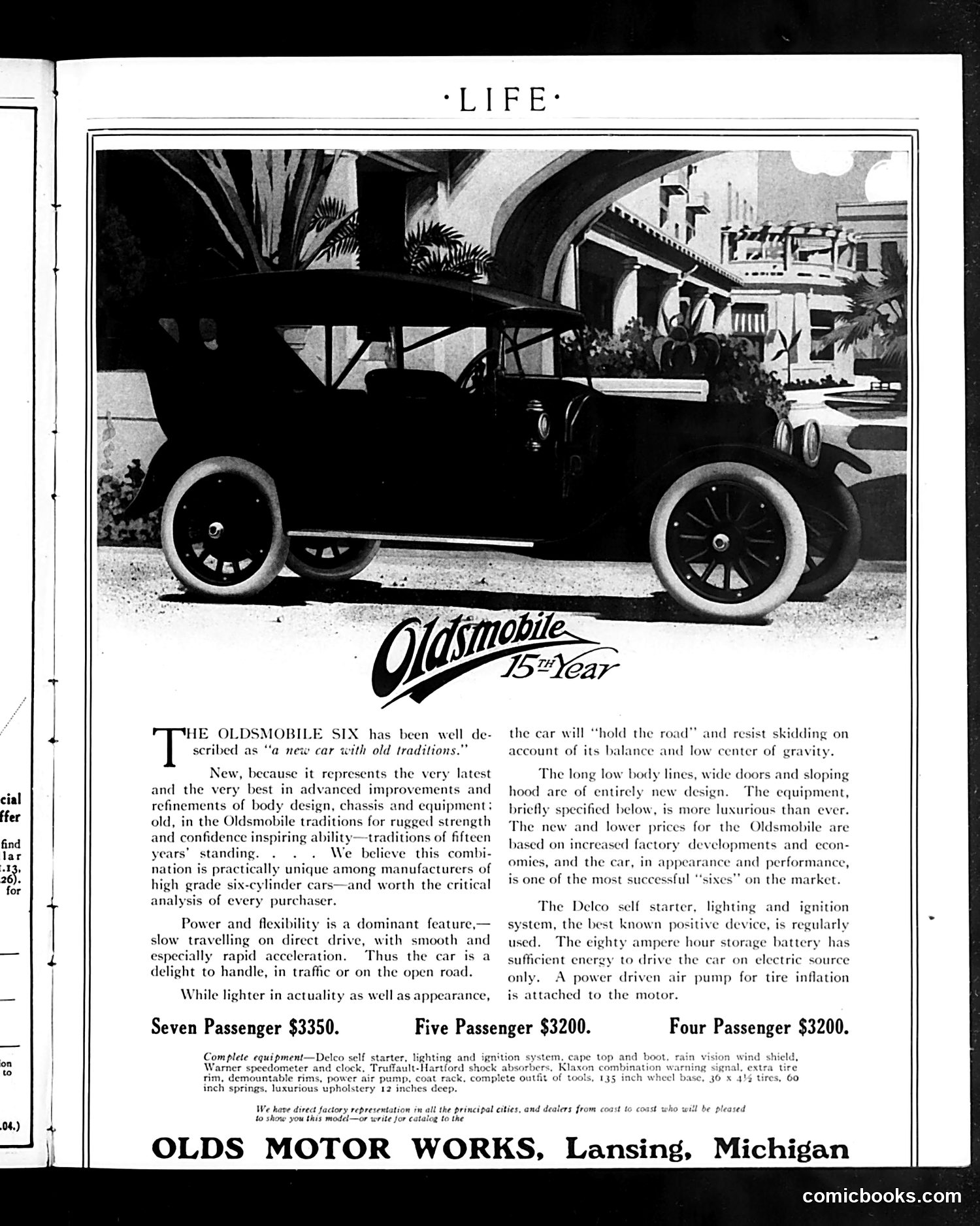
This is not a political cartoon or satirical content—it is a straightforward **automobile advertisement** for the Oldsmobile Six, presented as a full-page ad in Life magazine. The image shows a side profile of an early 1920s automobile parked under an arched structure. The accompanying text promotes the vehicle's features: its advanced engineering, balanced design, "rugged strength," and reliability. Three pricing tiers are listed ($3350, $3200, $3200), and the ad emphasizes luxury features like a Delco self-starter and electrical systems. The only potential mild satire appears in the phrase describing Oldsmobile's "fifteen years' standing"—subtly suggesting durability and tradition versus newer competitors. However, this is marketing rhetoric rather than satire. The page is fundamentally commercial, not editorial commentary.
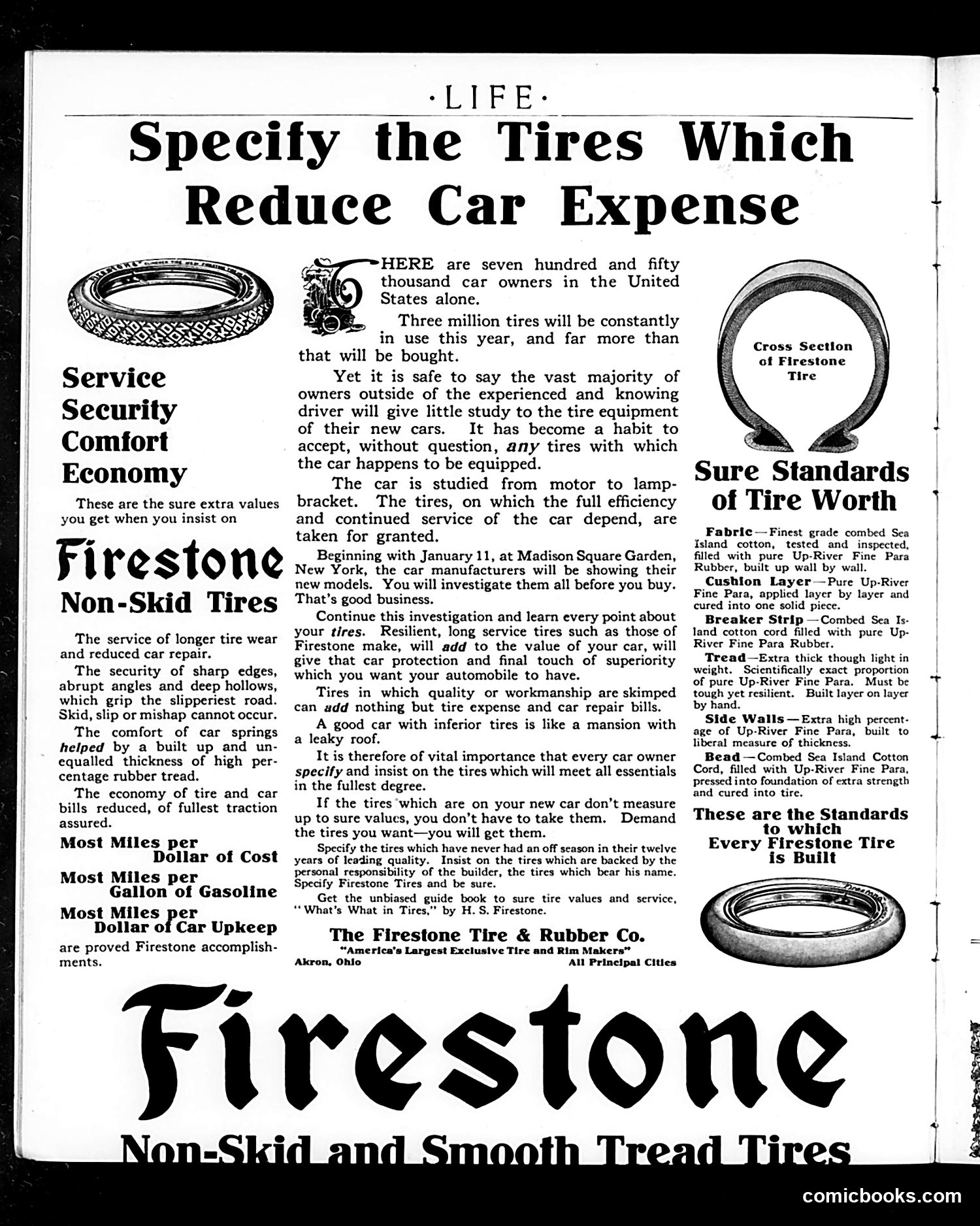
This is primarily a **Firestone tire advertisement**, not a political cartoon. The page combines advertising copy with product information rather than satire. The ad addresses car owners directly, arguing that tire selection significantly impacts vehicle expense and performance. Key claims include that most car owners uncritically accept whatever tires come with new vehicles, and that Firestone Non-Skid tires offer superior value through longer wear and reduced repair costs. The "Sure Standards of Tire Worth" section details Firestone's construction materials (Sea Island cotton, rubber layers, etc.), functioning as a product specification rather than satire. There is **no political cartoon or satirical content** on this page—it's straightforward early-20th-century automotive marketing emphasizing economy and quality to persuade consumers to specify better tires when purchasing vehicles.
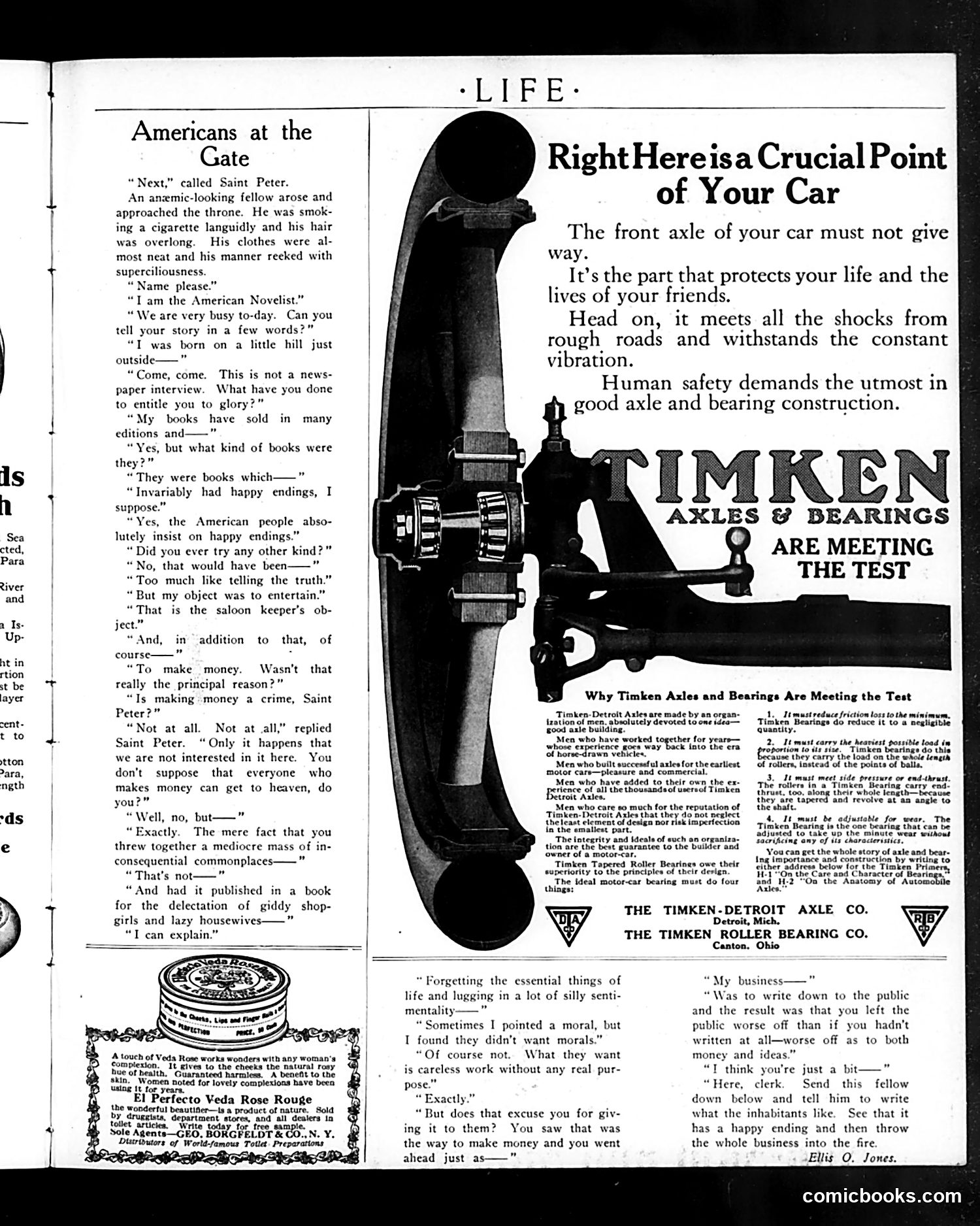
This page contains two distinct elements: **Left side:** A satirical dialogue titled "Americans at the Gate" featuring a character called "Saint Peter" at heaven's gates interviewing an American novelist. The conversation mocks American literary conventions—specifically the demand for "happy endings"—and satirizes authors who prioritize commercial success over artistic truth. Saint Peter questions whether the novelist's work was merely entertainment for "giddy shopgirls and lazy housewives," critiquing lowbrow popular fiction. **Right side:** A full-page advertisement for Timken Axles and Bearings, using a dramatic photograph of a car axle assembly. The ad emphasizes safety and engineering quality as selling points. The juxtaposition is striking: highbrow literary criticism alongside commercial promotion, potentially reflecting Life magazine's dual role as both satirical commentary on American culture and a vehicle for advertising revenue.
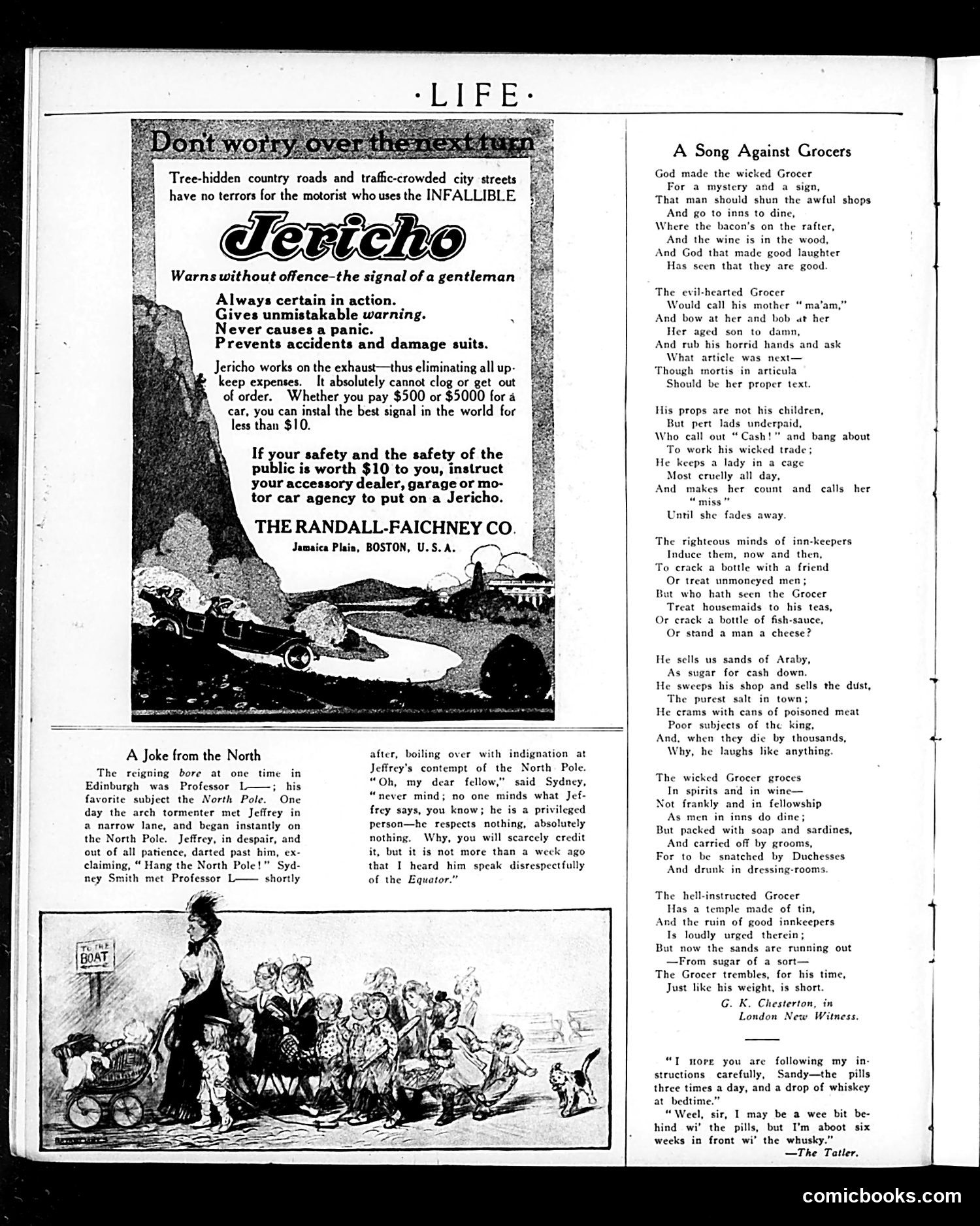
This page contains advertisements and satirical poetry rather than political cartoons. The **Jericho auto horn advertisement** occupies the upper left, promoting a safety device for motorists that "warns without offense." The main satirical content is **"A Song Against Grocers,"** a lengthy poem (credited to G.K. Chesterton, London New Witness) that viciously attacks grocery store owners. The poem portrays grocers as morally corrupt, exploitative of workers, and complicit in vice—keeping women in cages, selling adulterated goods, and profiting from human misery. A separate joke about a Professor L——'s encounter with "Jeffrey" in Edinburgh appears below the ad, mocking someone's pretension about the North Pole. The cartoon illustration shows a street scene with a vendor and crowd, supporting the grocer theme. This reflects early-20th-century class tensions and suspicion of merchants.
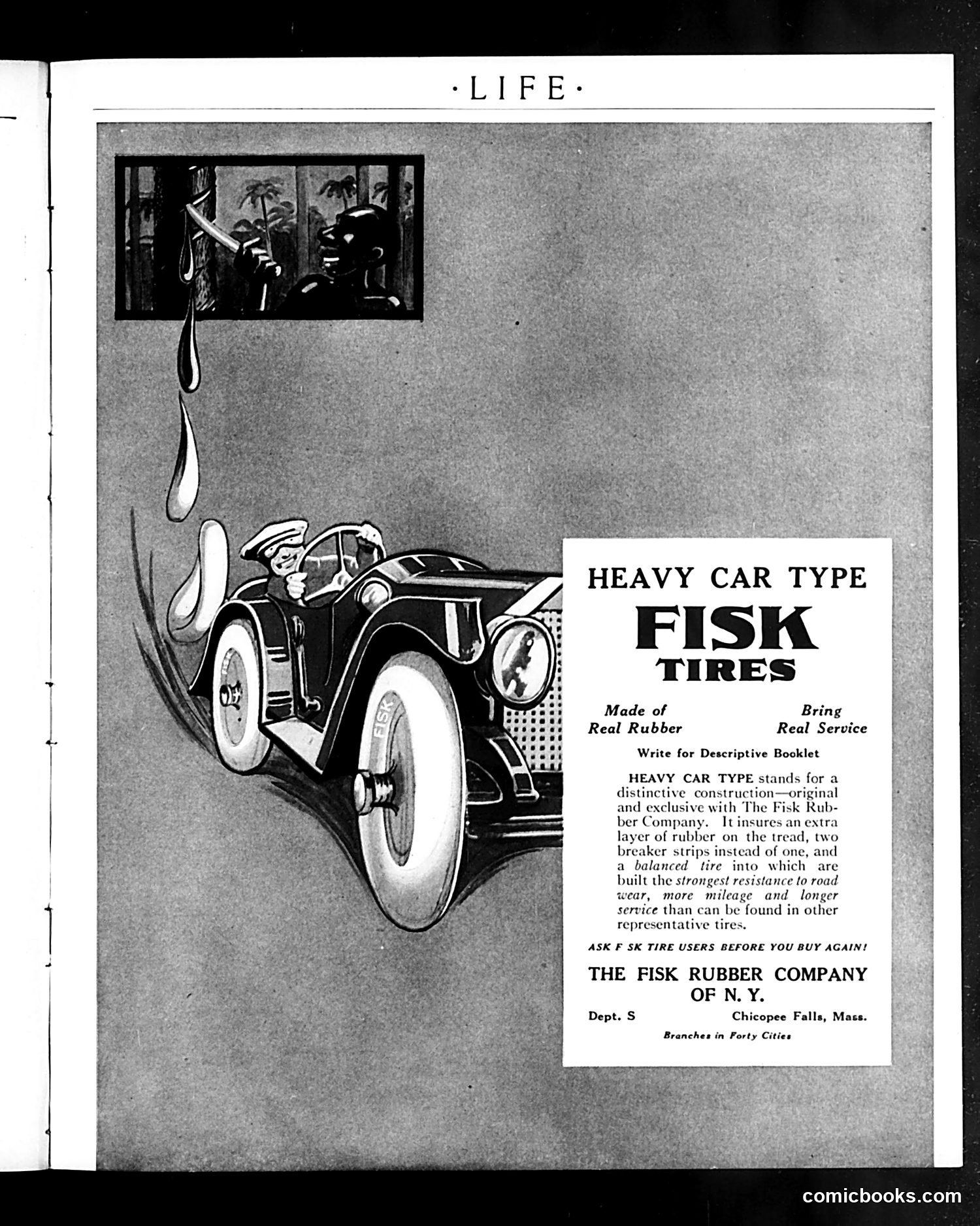
This page is primarily an **advertisement for Fisk Tires**, not satirical content. The upper panel appears to show a dramatic scene—possibly from a film or story—depicting figures in what looks like a tense indoor situation, but the connection to the tire ad below is unclear and may be purely visual. The main advertisement features an illustration of an early-1900s automobile with a driver, promoting "Heavy Car Type Fisk Tires." The ad emphasizes the tires are "Made of Real Rubber" and "Bring Real Service," highlighting distinctive construction features like extra rubber layers and two strip brakes (versus one) for durability and mileage. The company, based in New York with a factory in Chicopee Falls, Massachusetts, positions these as superior tires. The phrase "Ask six tire users before you buy again!" suggests competitive marketing in the early automotive era.
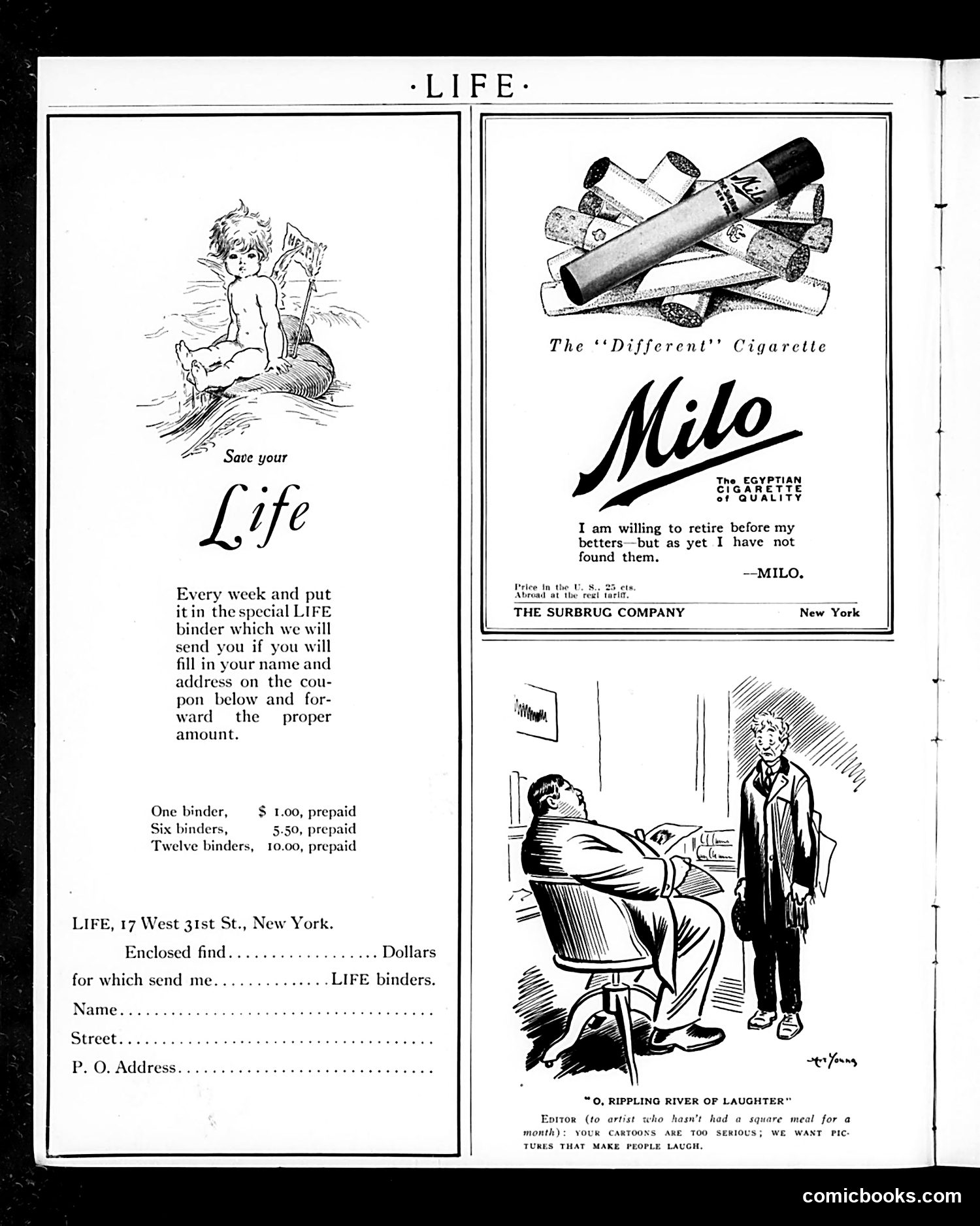
This page contains **advertising and promotional content** rather than political satire. The left side promotes LIFE magazine's subscription service, offering special binders to collect weekly issues—a common practice when magazines were collected and preserved as bound volumes. The right side advertises **Milo cigarettes** ("The 'Different' Cigarette"), made by The Subrug Company. The ad quotes someone named Milo claiming he'll retire once he finds "betters," using a humorous testimonial approach. Below is a cartoon titled **"O, Rippling River of Laughter"** by artist T. Yonn, depicting an editor speaking to a thin, haggard cartoonist. The caption notes editors want cartoons about serious topics that still make people laugh—social commentary on the tension between humor and gravity in editorial cartooning.
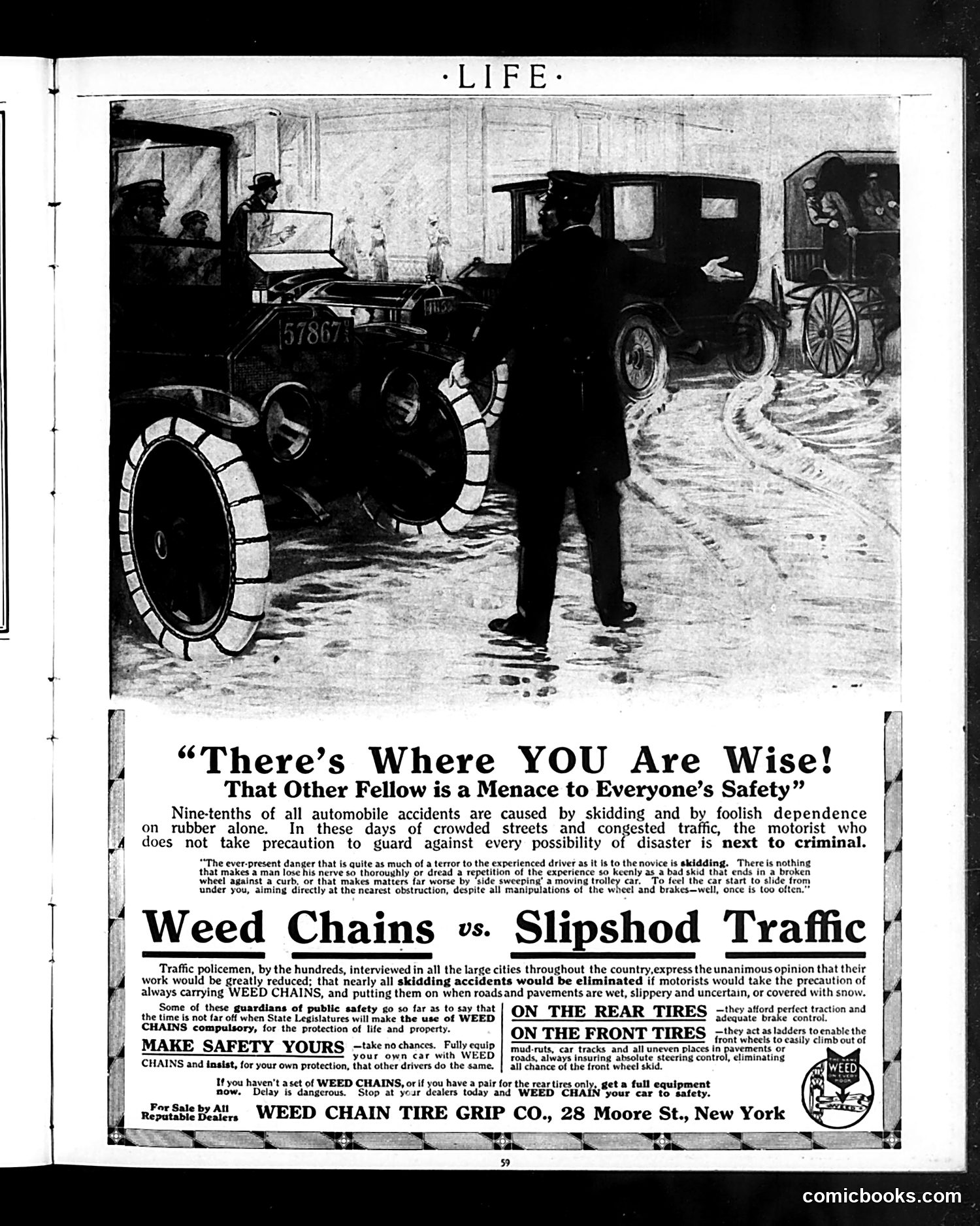
This is primarily a **safety advertisement**, not satire or political commentary. It promotes Weed Chain tire chains as automobile safety equipment. The image shows an early 1900s street scene with multiple cars and a pedestrian—illustrating congested traffic conditions of the era. The advertisement argues that nine-tenths of automobile accidents result from skidding on wet or snowy roads. The headline's phrase "That Other Fellow is a Menace" humorously positions unsafe drivers as public dangers, using peer pressure to encourage adoption of chains. The advertisement cites traffic police across major cities as endorsing mandatory chain use, suggesting legislatures may soon require them by law. The key sales point: chains provide traction on slippery surfaces, preventing skids that endanger both the driver and other road users. This reflects an era when pneumatic tires were relatively new and roads unpaved or inadequately surfaced—making traction devices genuinely necessary safety equipment rather than optional accessories.
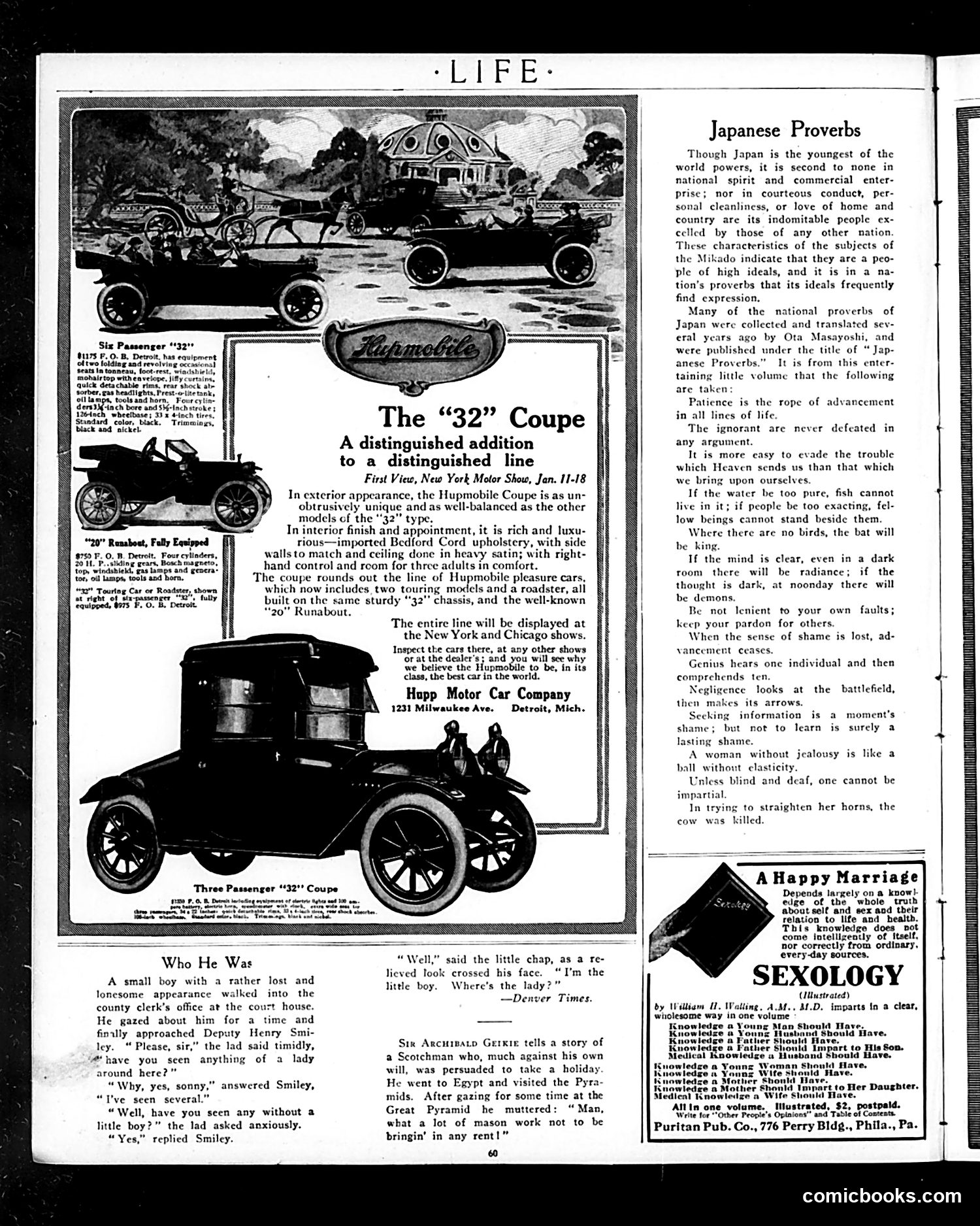
This page is primarily **automobile advertising** for Hupmobile cars, with secondary content including short humorous anecdotes and a feature on Japanese proverbs. The main advertisement showcases the Hupmobile "32" Coupe, positioning it as a luxury vehicle with refined interior appointments (imported Bedford Cord upholstery, satin ceiling) competing in the early automotive market. The ad emphasizes quality and invites inspection at upcoming motor shows. The humor pieces are light filler: "Who He Was" is a mild joke about a lost boy searching for his mother in a courthouse, playing on wordplay about "lady" versus "little boy." Another anecdote features a frugal Scotsman visiting the Great Pyramid, criticizing it for not generating rental income—typical period humor about Scottish penny-pinching. The "Japanese Proverbs" section appears to capitalize on early-20th-century American fascination with Japan as an emerging world power, presenting philosophical observations framed as cultural wisdom—likely reflecting contemporary orientalist interests rather than rigorous translation.
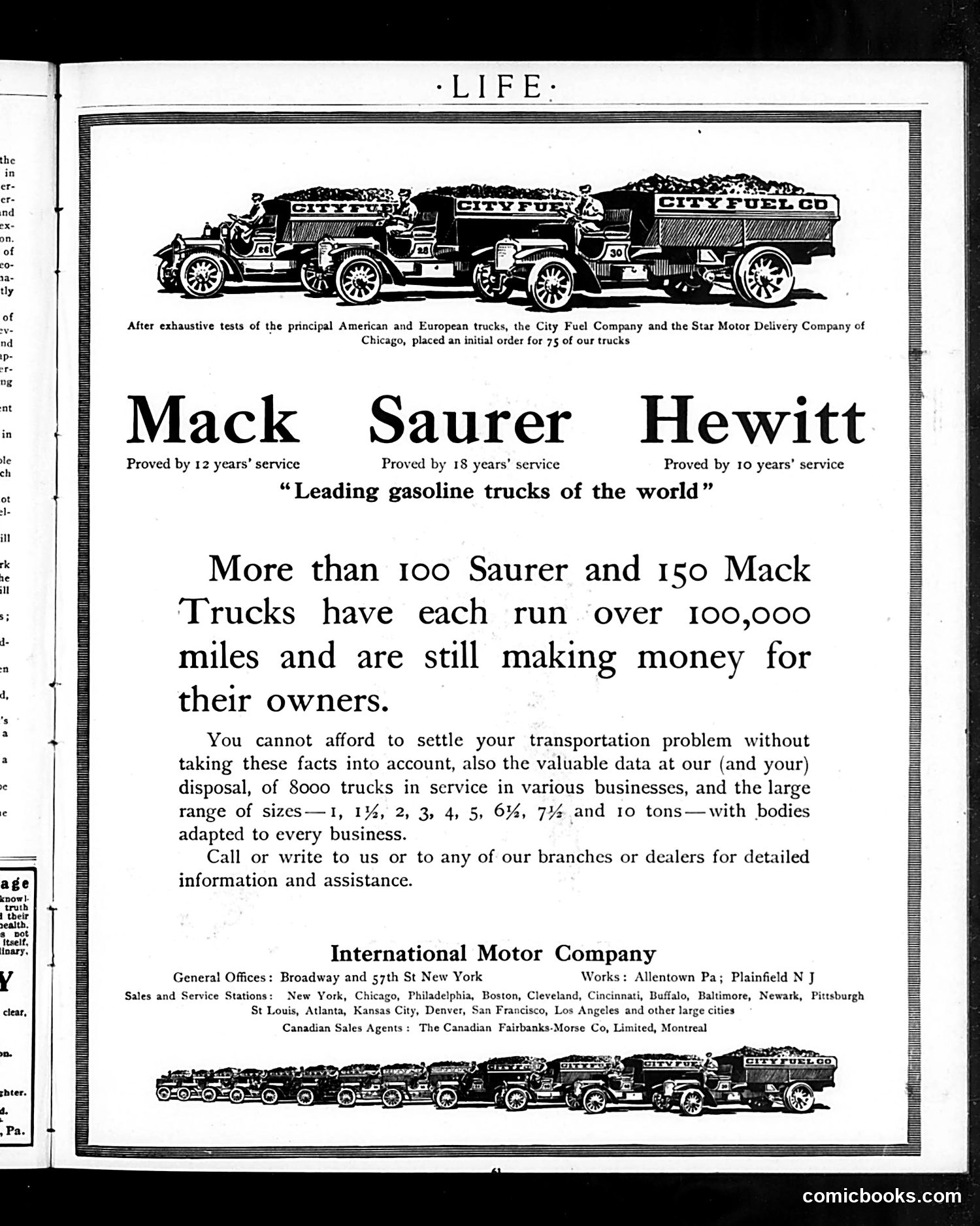
This is **not a political cartoon or satire**, but rather a straightforward commercial advertisement for the International Motor Company, placed in *Life* magazine. The page advertises three truck brands—Mack, Saurer, and Hewitt—positioning them as the "leading gasoline trucks of the world." The ad emphasizes durability through claimed service records (12, 18, and 10 years respectively) and cites real-world validation: Chicago's City Fuel and Star Motor Delivery companies allegedly ordered 75 trucks after testing competitors. The sales pitch targets business owners by highlighting that over 100 Saurer and 150 Mack trucks have each exceeded 100,000 miles while remaining profitable. The company offers various truck sizes (1 to 10 tons) and promises consulting support. This represents early 20th-century industrial advertising using performance claims and documented customer testimonials—standard marketing before modern regulatory standards.
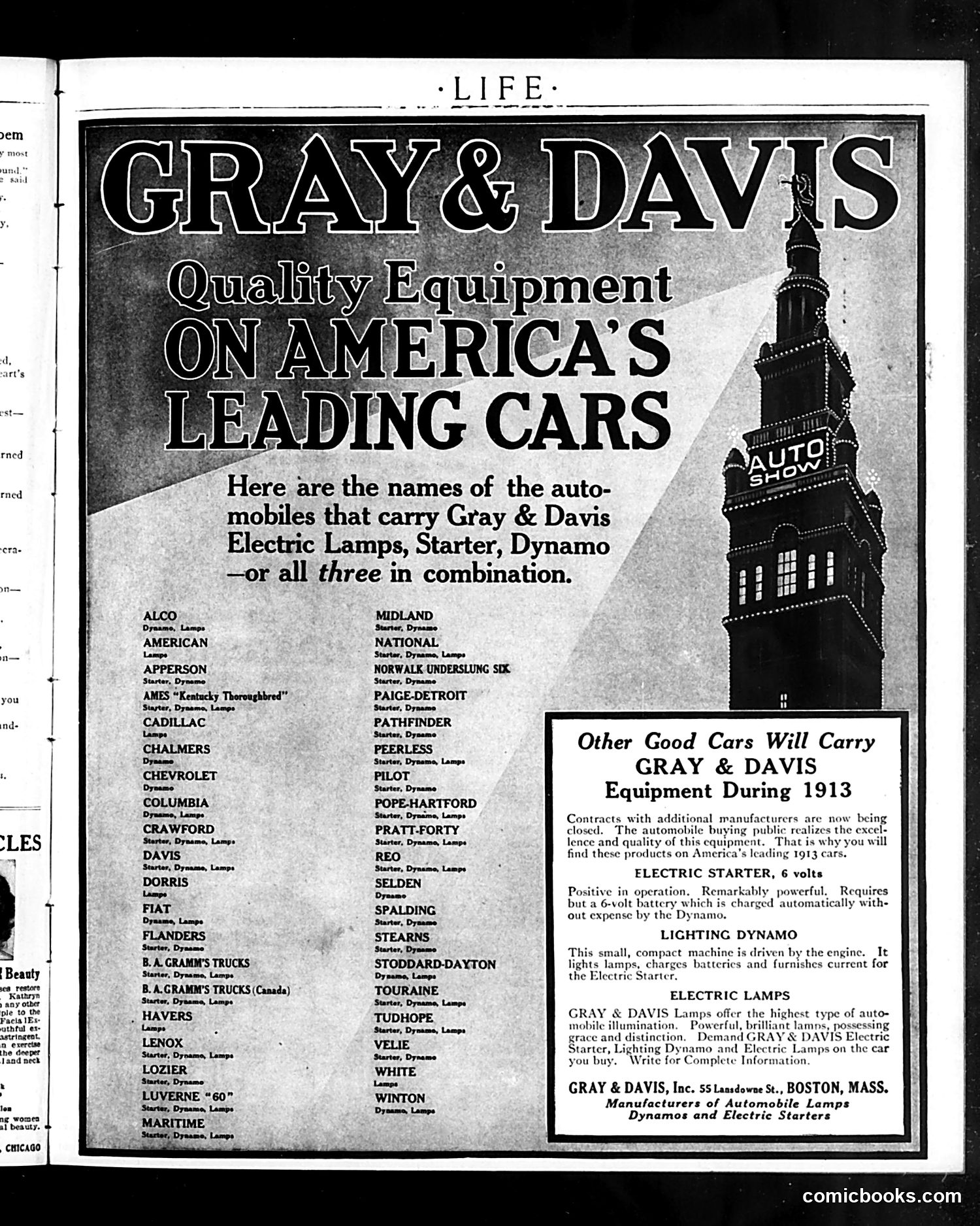
This is **not a cartoon or satire**—it's a straightforward advertisement from Life magazine for Gray & Davis automobile electrical equipment. The page lists dozens of 1913 car manufacturers (Cadillac, Chevrolet, Packard, Studebaker, etc.) that used Gray & Davis electric lamps, starters, and dynamos. The prominent Auto Show illustration is simply decorative branding. The ad emphasizes that Gray & Davis components were standard equipment on "America's leading cars," lending credibility through association. A sidebar explains the three products: the electric starter (which replaced hand-cranking—a genuine innovation), the dynamo (charging system), and electric lamps. **For modern readers:** This reflects the early automotive era when electric starting was a major luxury feature. The sheer number of car brands listed shows the fragmented, competitive auto industry before consolidation. The ad's strategy—demonstrating widespread adoption—remains standard marketing practice today.
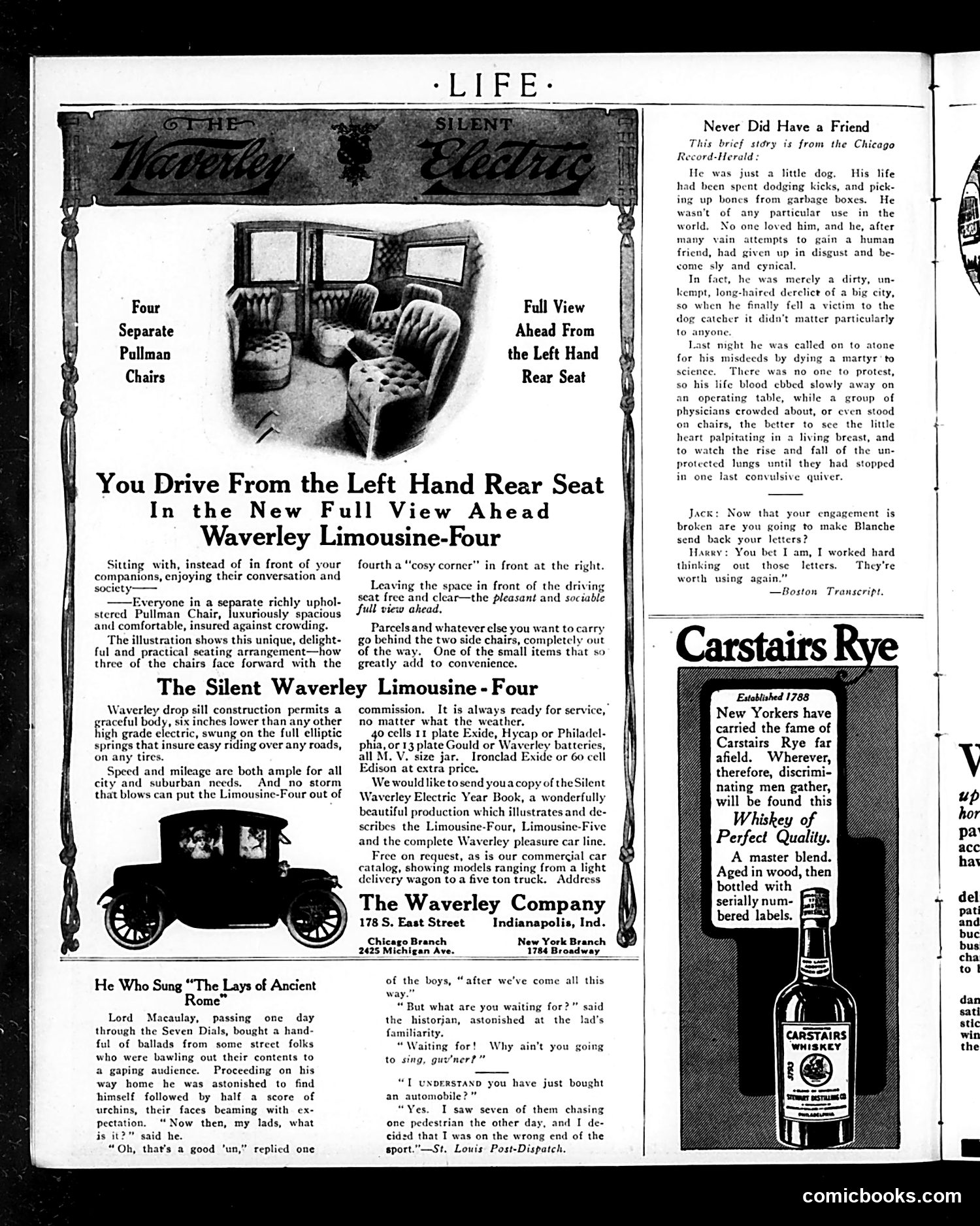
This page is primarily **automobile advertising** for the Waverley Limousine-Four electric car, with several unrelated humorous anecdotes in the margins. The main advertisement emphasizes the car's novel rear-seat driving position, allowing passengers to face each other in individual Pullman chairs rather than sit in traditional forward-facing rows. This represents a luxury feature—intimate social conversation while traveling. The surrounding content includes: - A story about Lord Macaulay (the 19th-century historian) encountering street ballad sellers who expected him to sing - A joke about someone buying an automobile after observing pedestrians being chased by cars—dark humor about automotive accidents - A tragic story about an unloved stray dog used for medical experimentation These pieces are disconnected from the advertisement. The Macaulay and automobile jokes appear designed as light entertainment, while the dog story is sentimental commentary on society's treatment of the powerless—typical of Life's mix of satire and social observation.
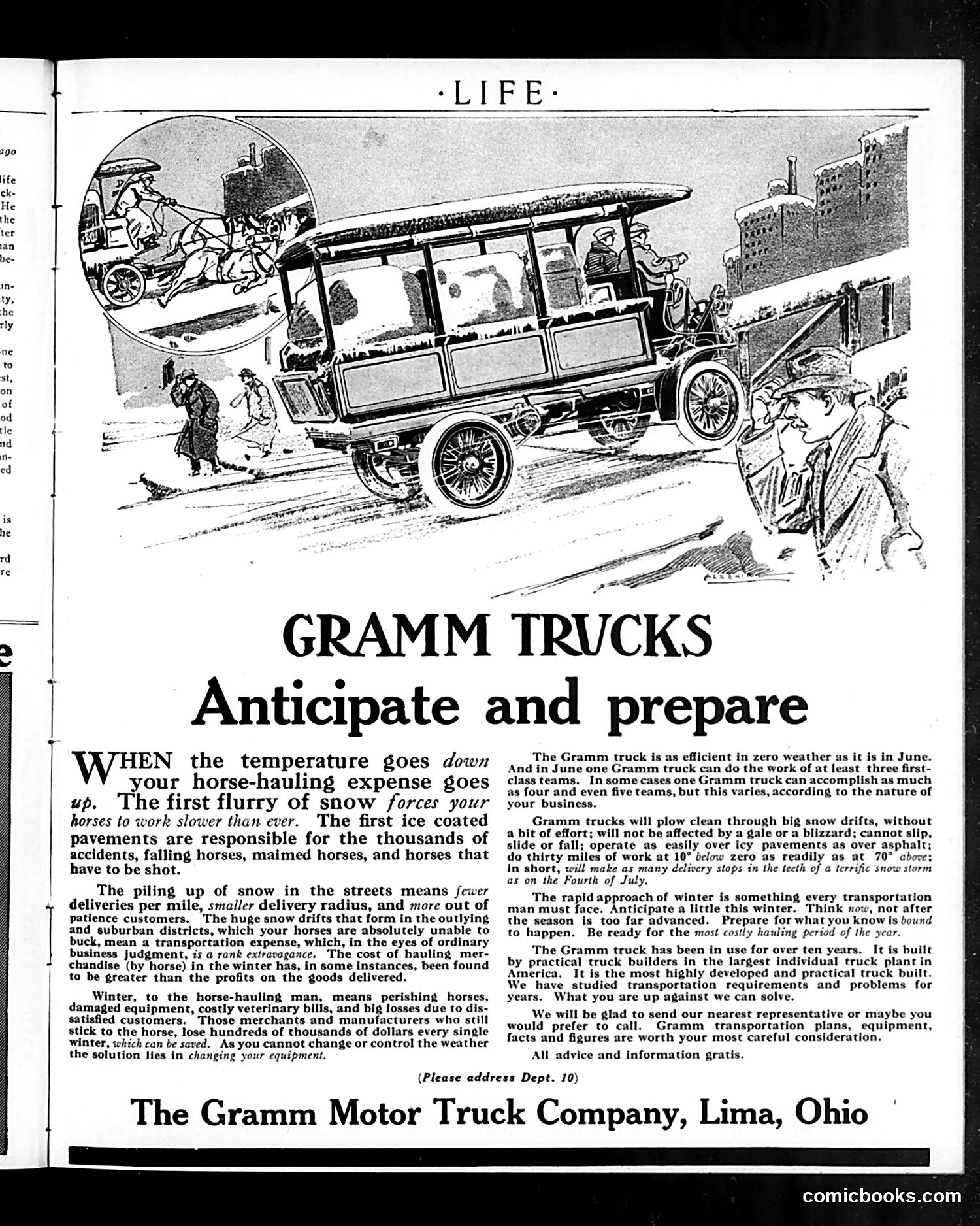
This is a **commercial advertisement**, not satire or political commentary. The Gramm Motor Truck Company uses practical argumentation to persuade horse-dependent businesses to switch to motorized trucks. The page contrasts winter horse-hauling difficulties (accidents, slower speeds, damaged equipment, veterinary costs) against the truck's all-weather reliability. The small inset cartoon shows an old horse-drawn cart struggling in snow, implicitly mocking outdated transportation while the main illustration depicts the modern Gramm truck confidently navigating urban streets. The pitch targets business logic: one truck replaces three to five teams year-round, and performs equally in zero-degree weather or summer heat. This addresses real industrial-era concerns—winter was genuinely costly for delivery services reliant on horses. The tone is earnest problem-solving rather than humorous. It represents the automobile industry's early efforts to convince skeptical business owners that motorization was economically rational, not merely fashionable.
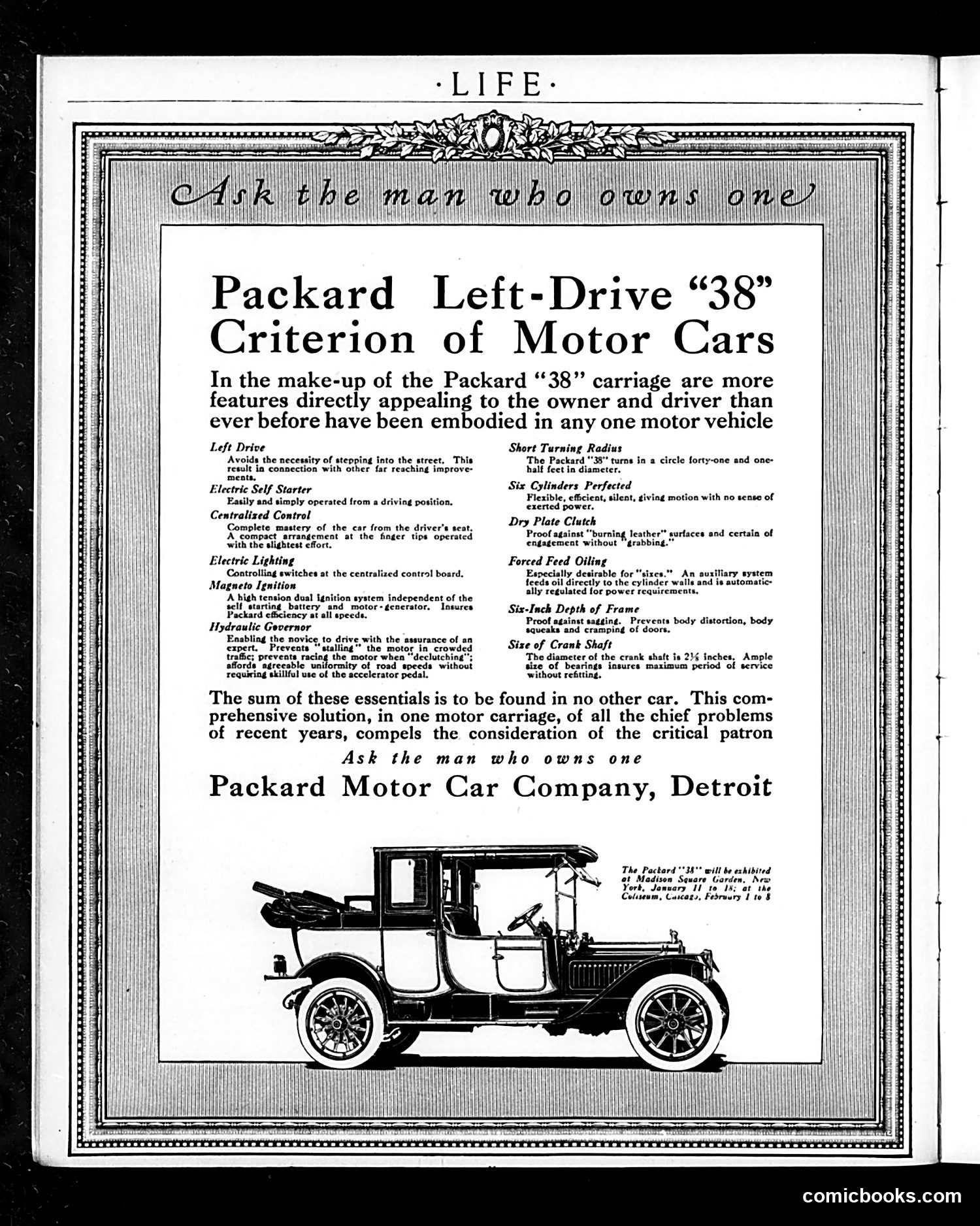
This is **not a cartoon or satire**—it's a straightforward automobile advertisement for the Packard Motor Car Company's "38" model, appearing in *Life* magazine (which was primarily a humor and satire publication, but also carried ads). The page lists technical features meant to appeal to wealthy car owners: left-hand drive, electric starter, centralized controls, electric lighting, six cylinders, and various mechanical innovations. The phrase "Ask the man who owns one" was a famous Packard advertising slogan emphasizing customer satisfaction and prestige. The only visual element is a line drawing of the actual vehicle—no caricatures or political commentary. This represents early 1900s automotive advertising targeting affluent readers, emphasizing engineering sophistication and modern conveniences. The detailed specifications reflect genuine technical advances that distinguished luxury automobiles from competitors of that era.
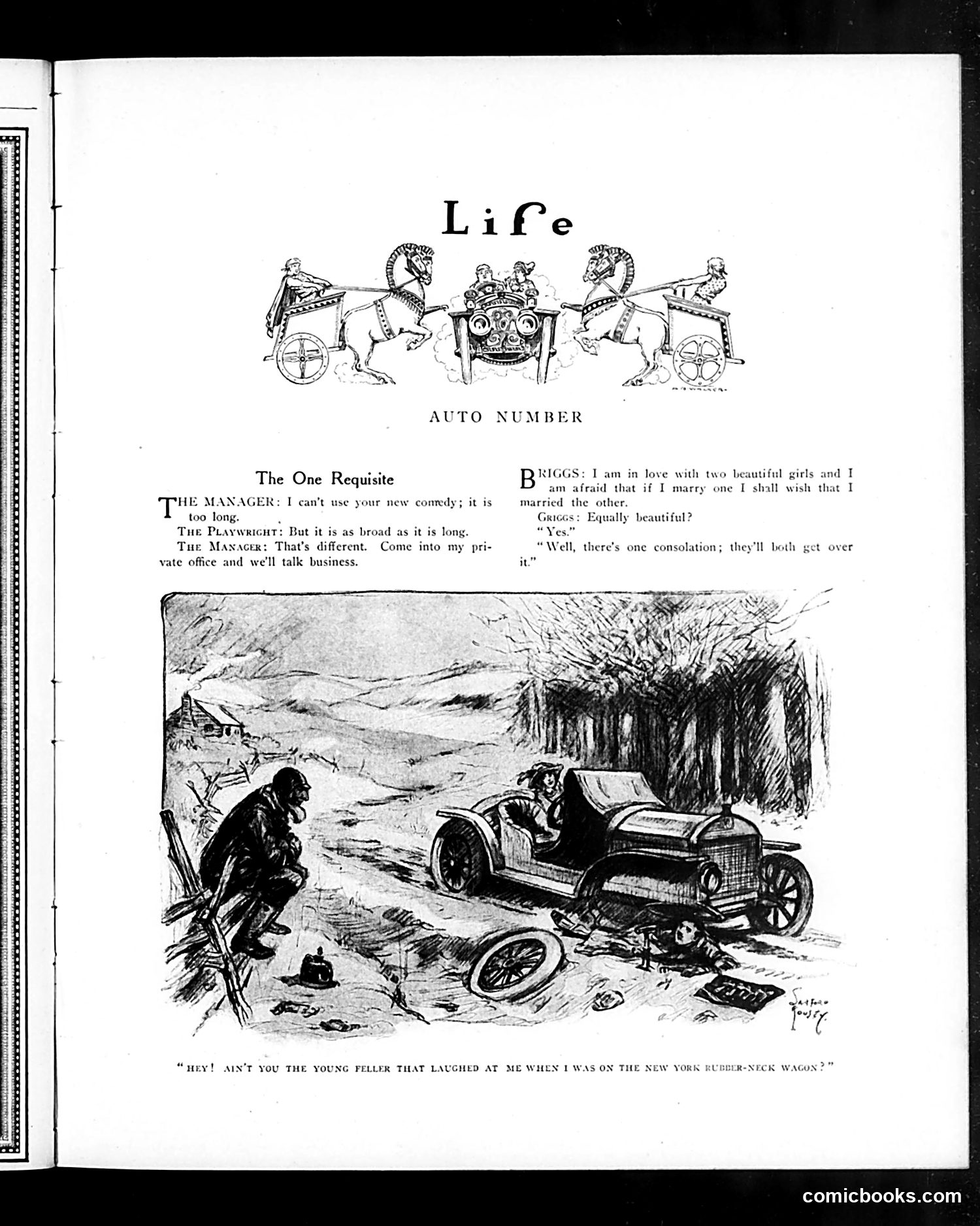
This page contains three separate jokes satirizing early 1900s American life: **"The One Requisite"** mocks theatrical producers' mercenary nature. A playwright defends his comedy's length, but the manager dismisses artistic merit—he only cares about making money ("we'll talk business"). **"Briggs" joke** ridicules romantic indecision. A man loves two equally beautiful women and fears marrying the wrong one, only to be told both will eventually stop caring about him—a cynical swipe at romance and women's constancy. **Main cartoon** depicts an automobile accident victim confronting the driver, claiming to recognize him from when he rode a "rubber-neck wagon" (a tourist sightseeing vehicle). The joke suggests poetic justice: the young man who once laughed at slower transportation now causes an accident. It satirizes automobiles as dangerous novelties and mocks early motorists' recklessness. The decorative header shows stylized horses pulling ornate vehicles—contrasting traditional transport with modern autos.
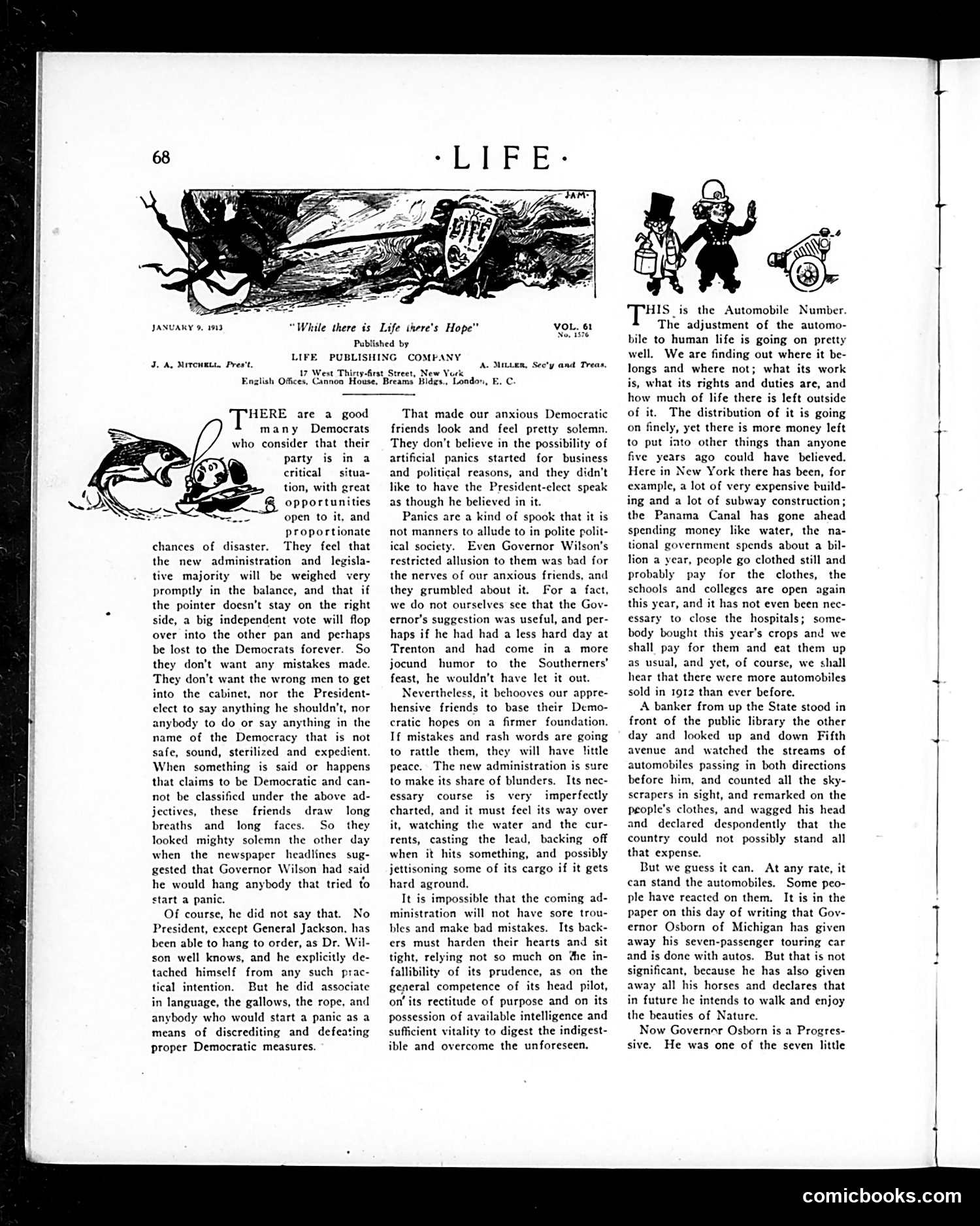
This issue addresses anxious Democrats worried about incoming President Woodrow Wilson's administration (Wilson was elected in November 1912, inaugurated in March 1913). The main editorial criticizes overly cautious party members who panicked when Wilson allegedly referenced hanging anyone starting a financial panic—a comment the editor clarifies Wilson didn't literally mean. The satire targets Democrats who are too nervous about the new administration's competence and want it to avoid any controversial statements or mistakes. The editor argues this anxiety is misplaced; they should trust Wilson's overall competence rather than demand perfection. The "Automobile Number" designation indicates this issue features automobiles as a secondary theme, reflecting the era's fascination with emerging technology and its social impact.
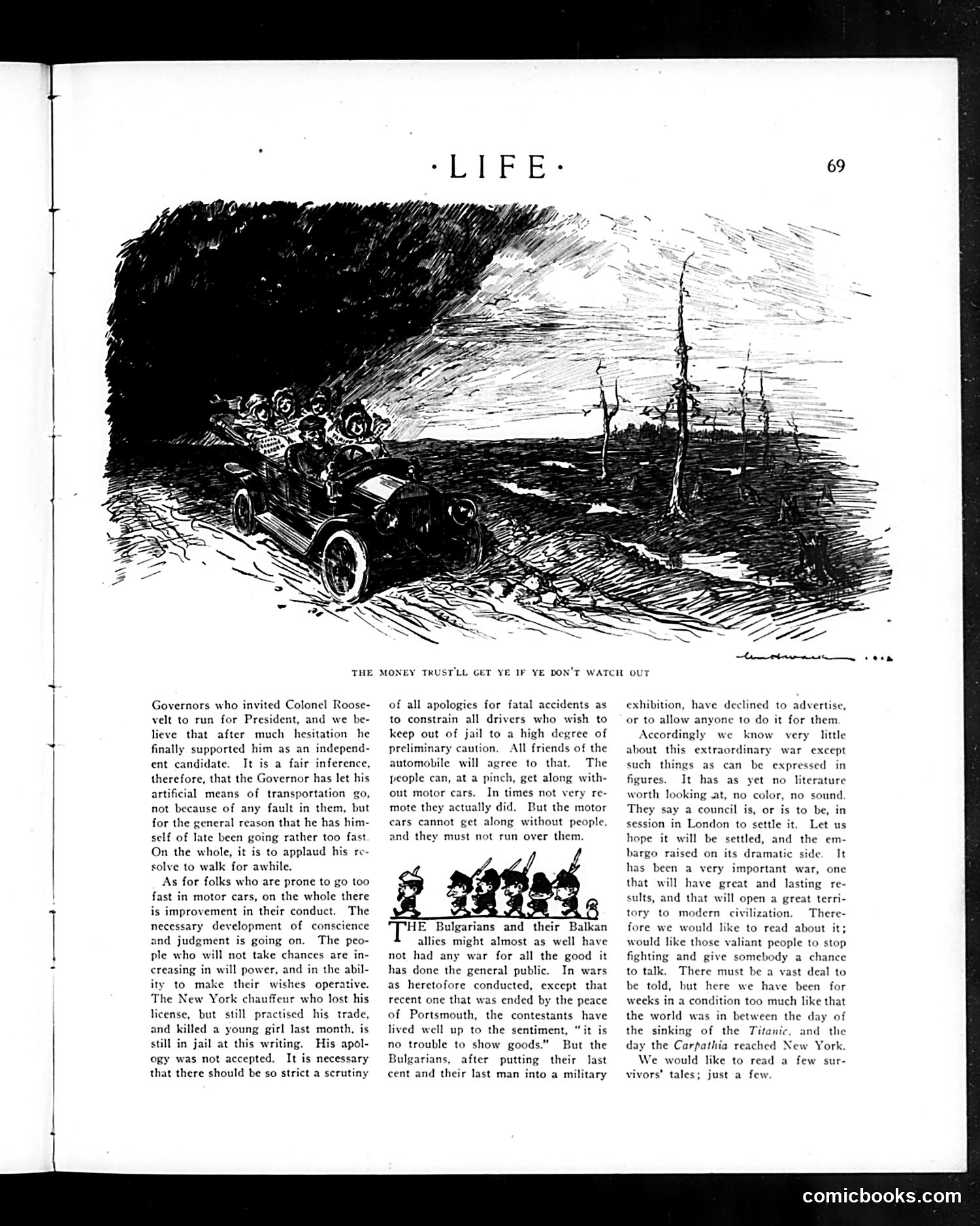
This satirical illustration and accompanying text criticize reckless automobile driving and advocate for stricter traffic safety enforcement. The cartoon depicts a speeding car approaching a harbor with ships, visualizing the danger of motor vehicles. The text discusses a New York chauffeur who lost his license but continued driving illegally, killing a young girl—and remained jailed without accepting his apology. Life argues that motor car operators must face strict consequences for fatal accidents to deter dangerous behavior. The underlying point: automobiles are dangerous machines that "cannot get along without people," so drivers must exercise extreme caution. The piece also criticizes lack of media coverage of the Balkan Wars, comparing the information blackout to the silence between the *Titanic* sinking and the *Carpathia's* arrival in New York—a recent, vivid reference for 1912-era readers.
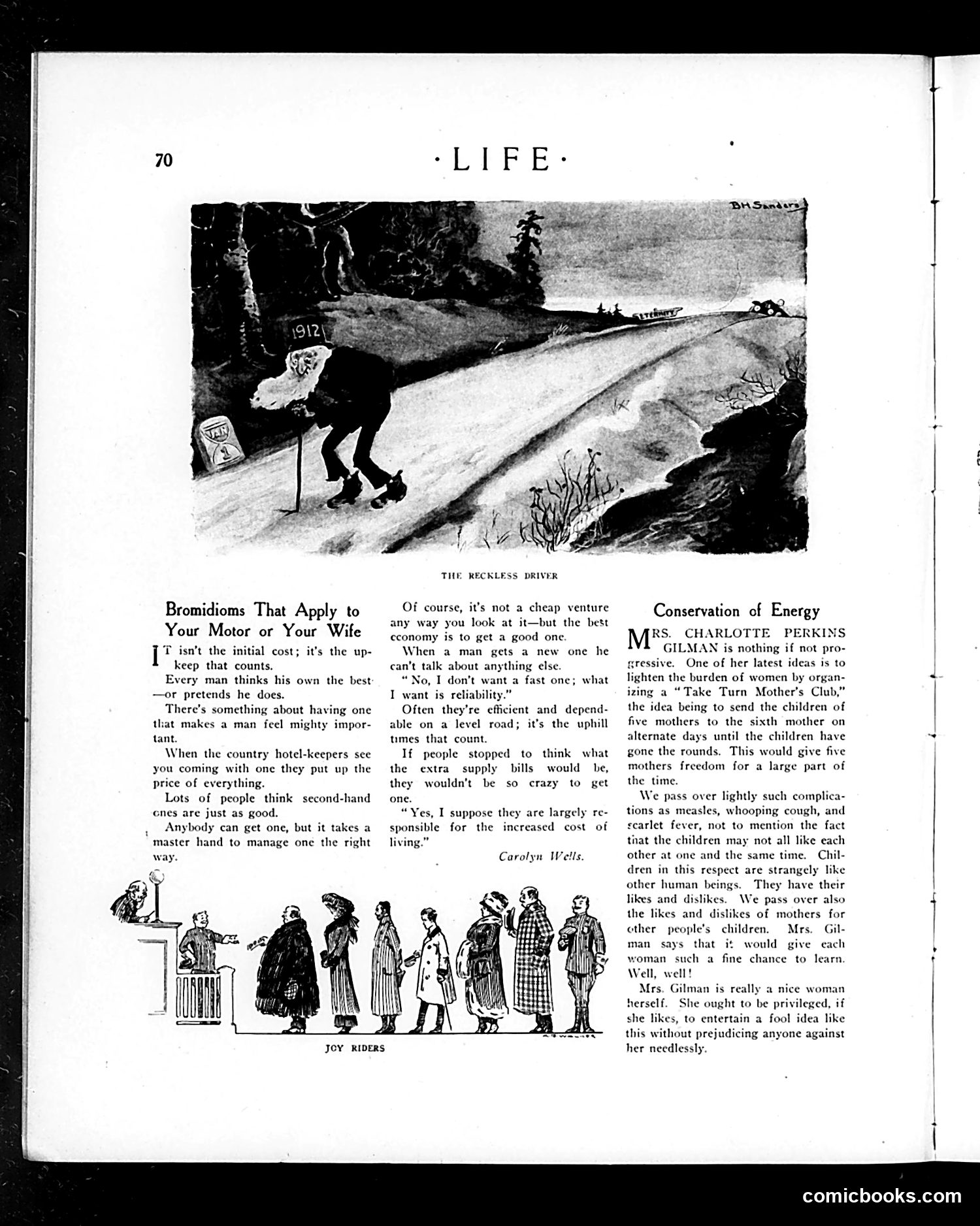
This page contains two satirical pieces mocking early 20th-century anxieties: **"Bromidioms"** (left): A humorous list comparing managing a motor car to managing a wife—both require upkeep, cause owners to boast endlessly, inflate local prices, and demand skilled handling. The "Reckless Driver" cartoon above shows a careless motorist endangering pedestrians, illustrating the era's concerns about dangerous driving. **"Joy Riders"** (bottom left): Illustrates frivolous young passengers in automobiles, reflecting period anxiety about cars enabling unsupervised youth socializing. **"Conservation of Energy"** (right): Satirizes feminist reformer Charlotte Perkins Gilman's proposal for a "Take Turn Mother's Club," where five mothers would rotate childcare to free up time. The author mock-sympathetically notes the plan ignores practical complications (disease transmission, children's personality conflicts), while defending Gilman's right to her "fool idea." This reflects contemporary debates over women's liberation and domestic labor.
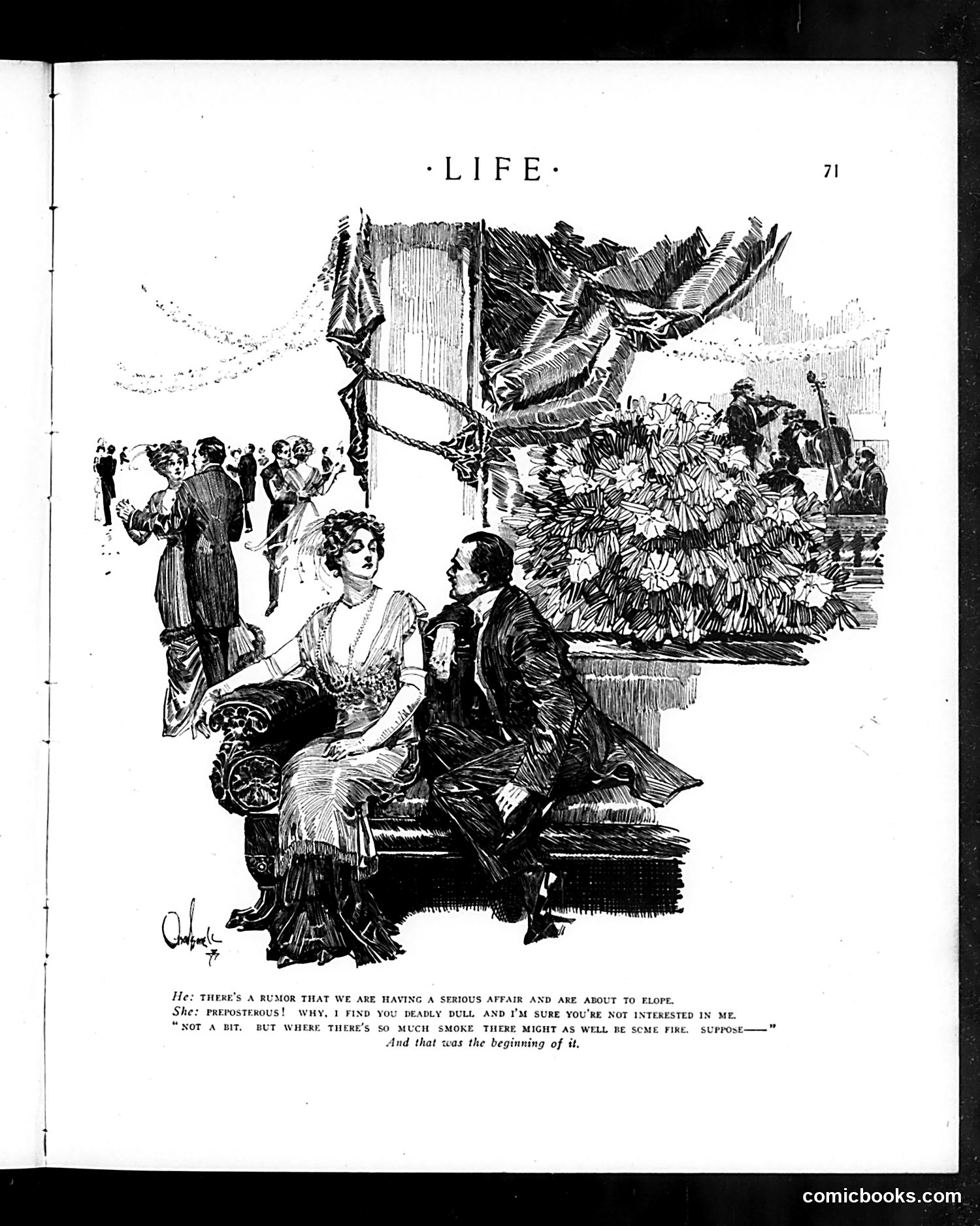
This is a satirical cartoon about social gossip and reputation management among the upper class. A man and woman, seated together at what appears to be a formal social gathering, discuss rumors of an affair between them. She dismisses him as dull and denies interest; he agrees he's not interested either. However, he then cynically suggests that since there's already "smoke" (gossip), they might as well create actual "fire" (an affair) to match the rumors. The satire targets how idle gossip can become self-fulfilling—people may act according to rumors about them simply because the rumors exist and damage their reputations anyway. It's commentary on the superficiality and moral flexibility of high society, where appearance and scandal matter more than genuine feeling. The cartoon suggests people will behave scandalously if scandal is already attributed to them.
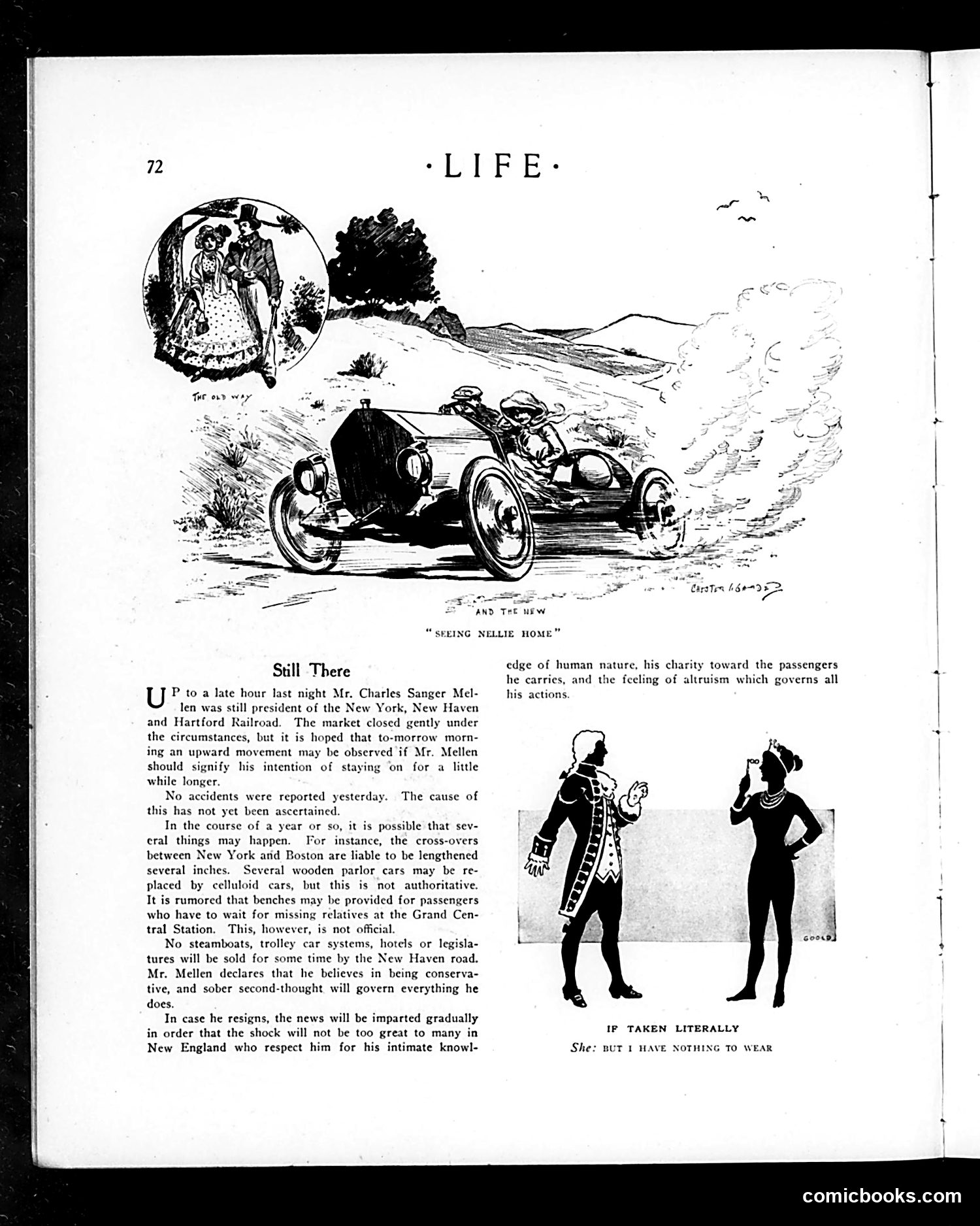
This page satirizes Charles Sanger Mellen, president of the New York, New Haven and Hartford Railroad. The article's deadpan tone mocks Mellen's conservatism and inaction—it sarcastically suggests that his mere continued employment is newsworthy enough to stabilize stock markets. The humor lies in absurd understatement: rumors of modest improvements (slightly longer crossovers, replacing wooden cars) are presented as tentative possibilities "in the course of a year or so," implying glacial progress and corporate stagnation. The bottom cartoon, captioned "If Taken Literally / She: But I Have Nothing to Wear," shows a woman responding literally to a man's statement (likely "take off your clothes" or similar), illustrating the comedy of misunderstanding everyday conversation. This is unrelated to the Mellen article—a typical magazine format mixing news satire with comic vignettes. The "Seeing Nellie Home" automobile illustration evokes nostalgic Americana, contrasting with the railroad industry critique above.
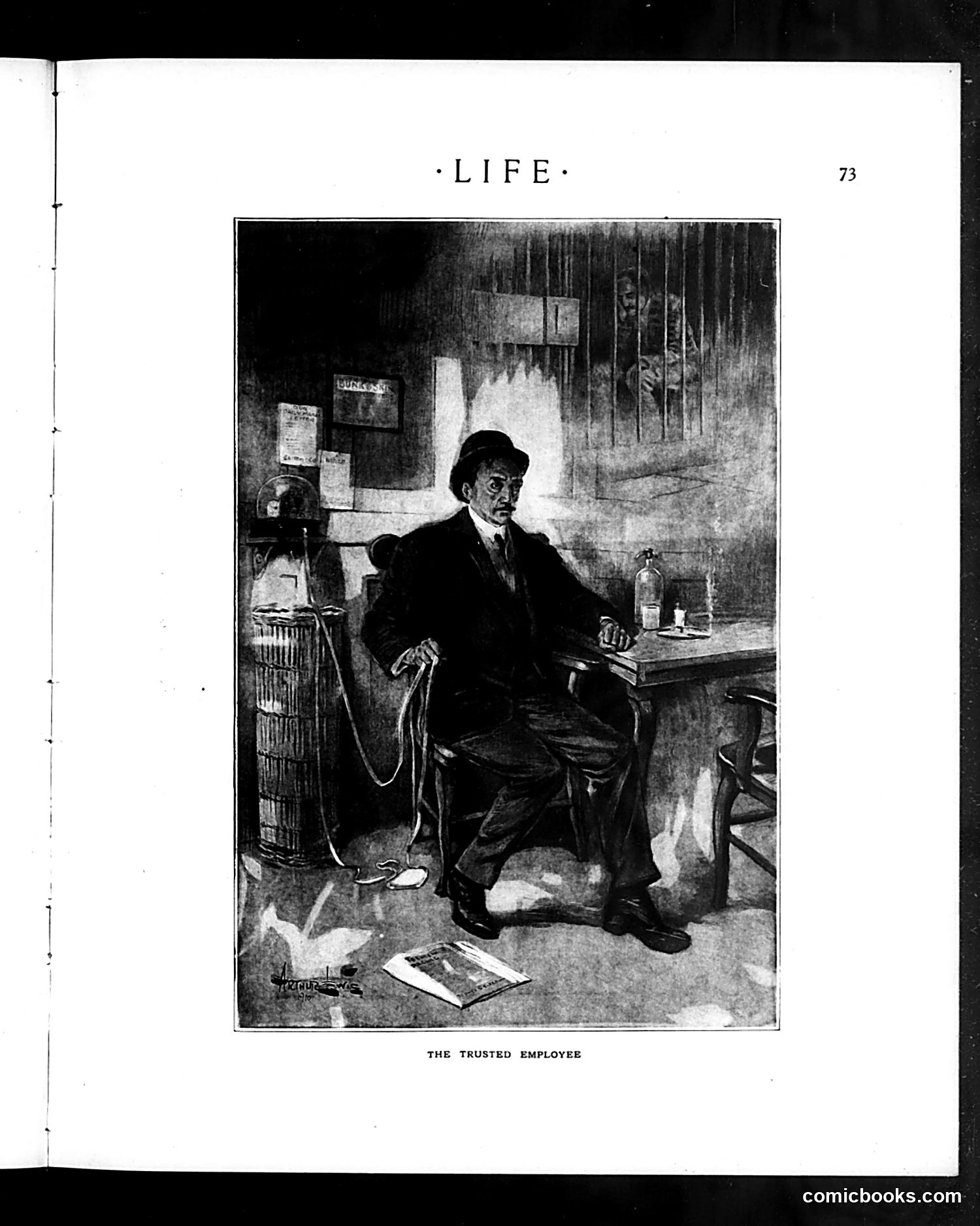
This satirical illustration depicts a well-dressed businessman in an office setting, appearing anxious or guilty while seated at his desk. The caption "The Trusted Employee" suggests irony—the figure's nervous posture and expression contradict the title's implication of reliability. The cartoon likely comments on workplace dishonesty or embezzlement. The presence of office equipment (a telephone visible on the left) and scattered papers reinforces the business setting. The man's formal attire contrasts with his apparent moral compromise, satirizing how respectable appearances can mask criminal behavior. This reflects early 20th-century American anxieties about white-collar crime and corporate malfeasance—the danger posed by trusted insiders who betray their employers' faith for personal gain.
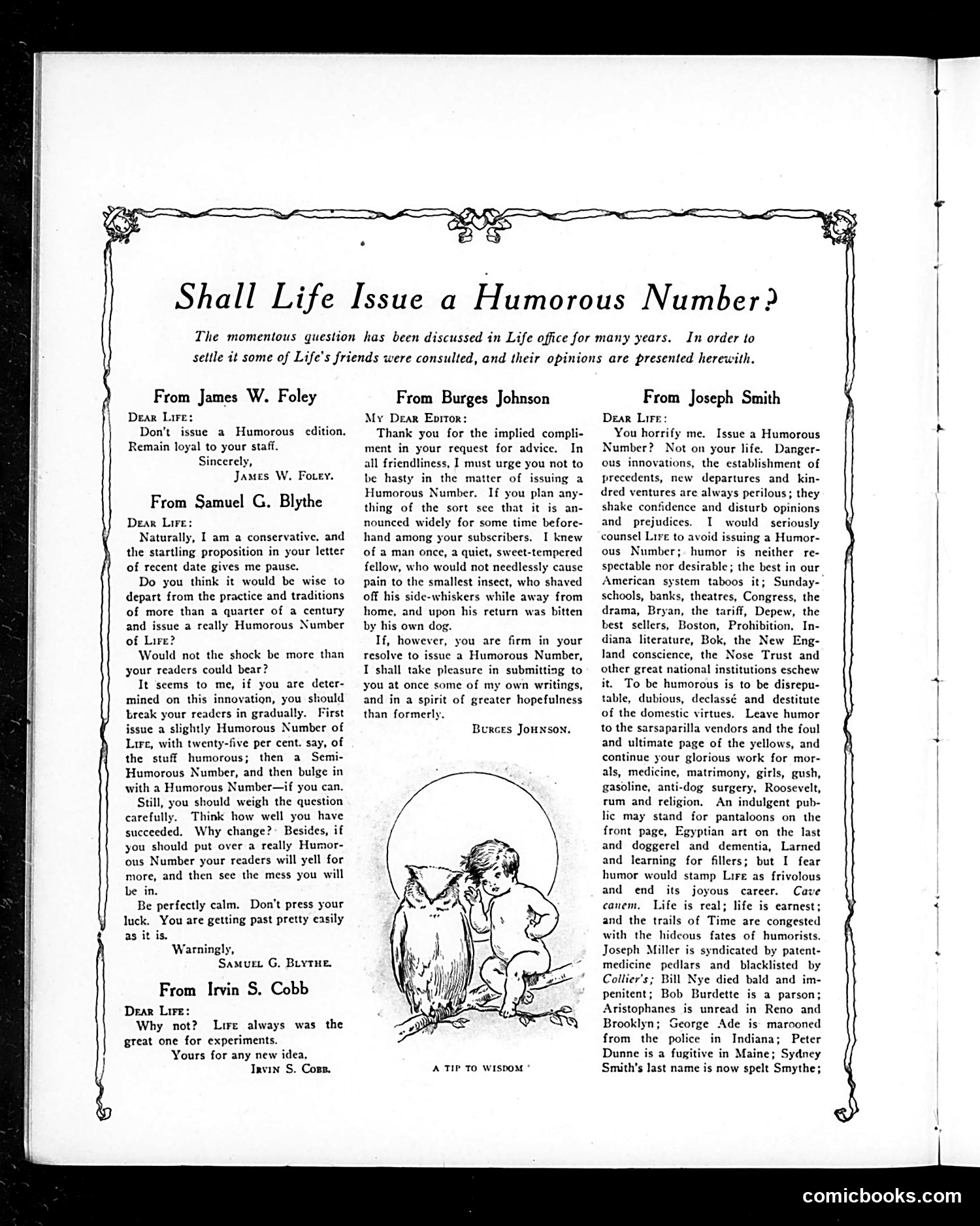
This page presents a humorous debate *about* whether Life should issue a humorous number—a self-referential satire. Five contributors offer contradictory advice to Life's editors. **The joke:** Life, a satirical magazine, is asking serious people whether it should be funny. The respondents' answers reveal period attitudes about propriety and respectability. **Key positions:** - **Foley & Blythe** warn against change, fearing it will shock conservative readers or create chaos - **Cobb** supports experimentation - **Johnson** cautions with an absurdist anecdote about a man bitten by his own dog—deflating the debate's importance - **Smith** delivers the satire's punchline: he catalogs American institutions (Congress, Bryan, Prohibition, Roosevelt) as humorless and "respectable," implying that humor threatens respectability itself **The cartoon** (bottom center) shows a child playing, reinforcing the "seriousness" theme—only children play. The piece satirizes American anxiety about maintaining dignity and propriety, suggesting that respectability and humor are seen as incompatible in early-20th-century culture.
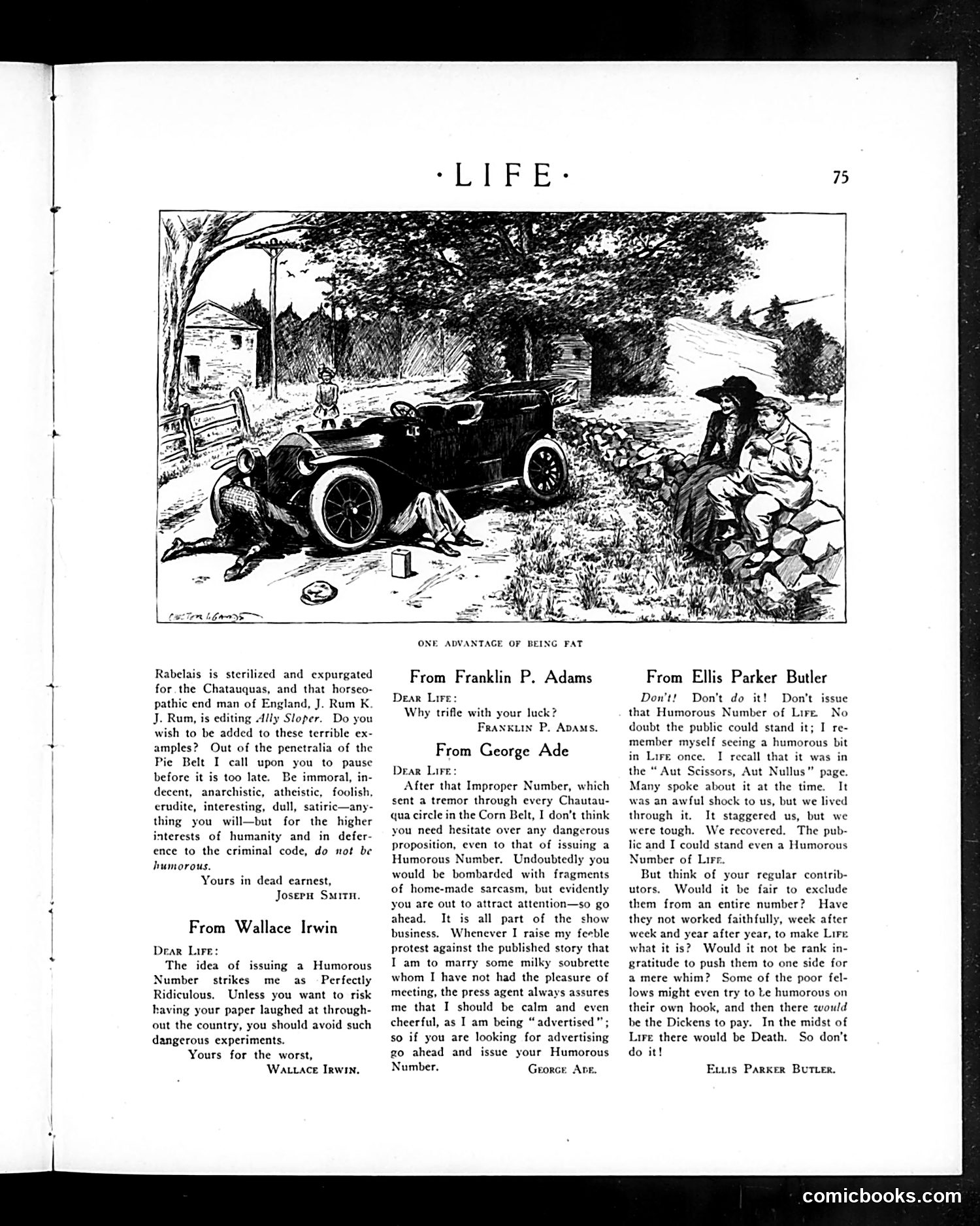
This page presents mock letters *opposing* Life's planned "Humorous Number" issue. The satire works by having prominent writers (Franklin P. Adams, George Ade, Ellis Parker Butler, and others) submit absurdly exaggerated objections—claiming humor is too dangerous, will shock the public, or unfairly exclude regular contributors. The cartoon above shows a car accident, illustrating the "one advantage of being fat" (presumably that extra weight provides cushioning in crashes). The joke is that these established literary figures are pretending to fear Life magazine attempting *humor*—suggesting their regular contributions lack comedic value. George Ade's response is the most transparent: he advocates going ahead precisely *because* it will generate publicity and attention, comparing it to theatrical "advertising." This is Life mocking both its own editorial timidity and the self-importance of its contributors, while teasing readers about whether the magazine can actually pull off being funny.
This page contains the opening of a short story, not a political cartoon. It depicts a romantic conflict centered on **women's automobile driving** — a contemporary social issue when this was published. The narrative follows a young man visiting his girlfriend, who owns and operates her own motor car. When she invites him for a drive, he refuses on principle, arguing that women shouldn't drive automobiles because it's unsafe and improper. His paternalistic objection infuriates her, leading to an angry breakup. The story appears to satirize **rigid male attitudes toward women's independence and changing social roles**. The girlfriend's competent self-sufficiency (she's practiced extensively with her machine) contrasts with the boyfriend's outdated conviction that women need male protection and control—even in matters they handle capably. The ending, where he encounters her broken down on the road, sets up a test of whether his principles will yield to genuine concern.
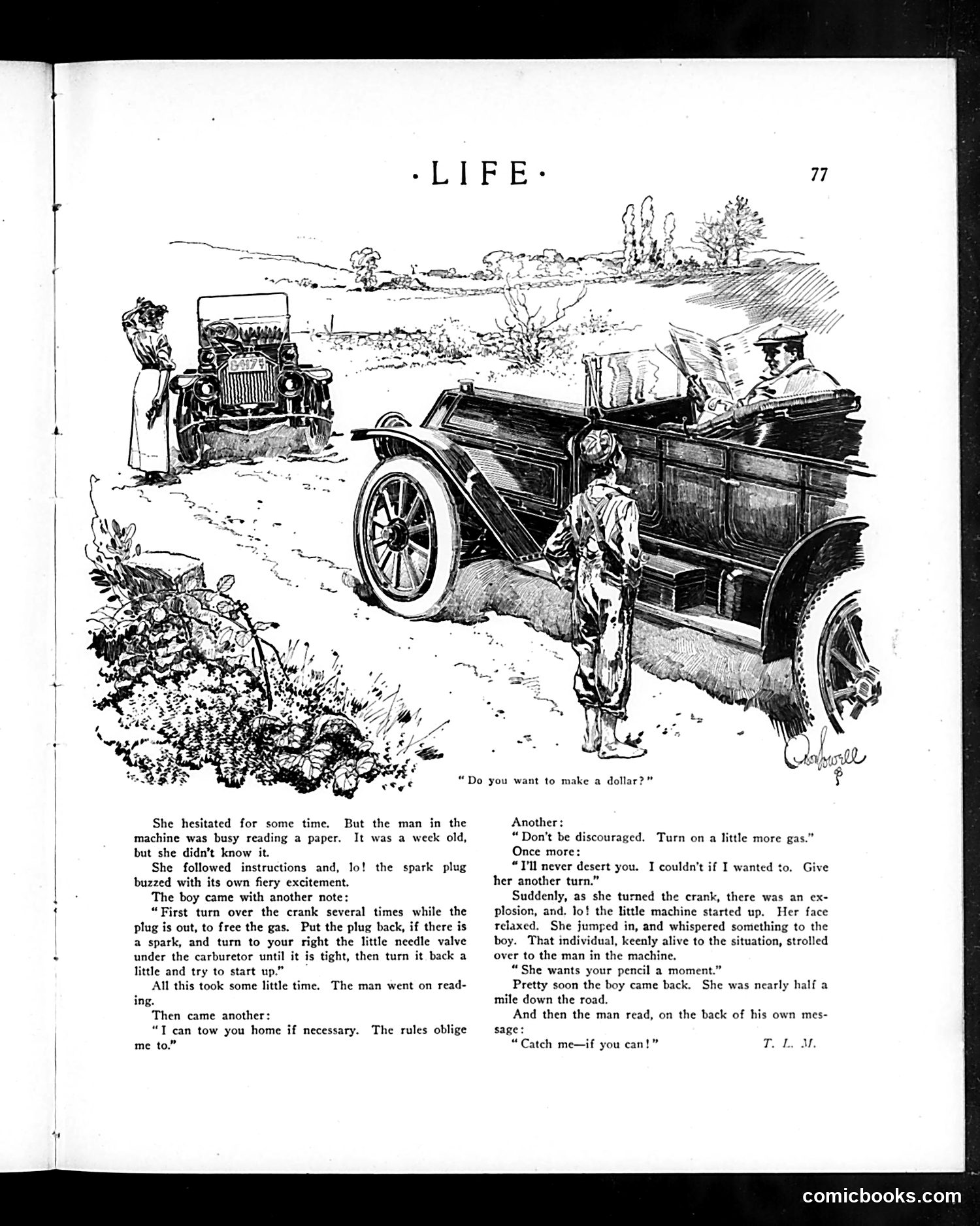
This is a satirical story about early automobile culture, likely from the 1910s-1920s when cars were still novel and unreliable. A woman asks a distracted man if she can earn a dollar by starting his broken-down car. He ignores her, absorbed in reading a newspaper, while she struggles through complex mechanical instructions (spark plugs, carburetors—real technical challenges of early cars). After finally getting the engine running, she outwits him: she asks the boy to request the man's pencil under false pretenses, then drives away and writes on his own message: "Catch me—if you can!" The joke satirizes masculine assumptions about women's mechanical incompetence and inattentiveness. The woman proves capable, resourceful, and clever enough to escape with a dollar earned through her own effort and wit—mocking the man's condescending dismissal.
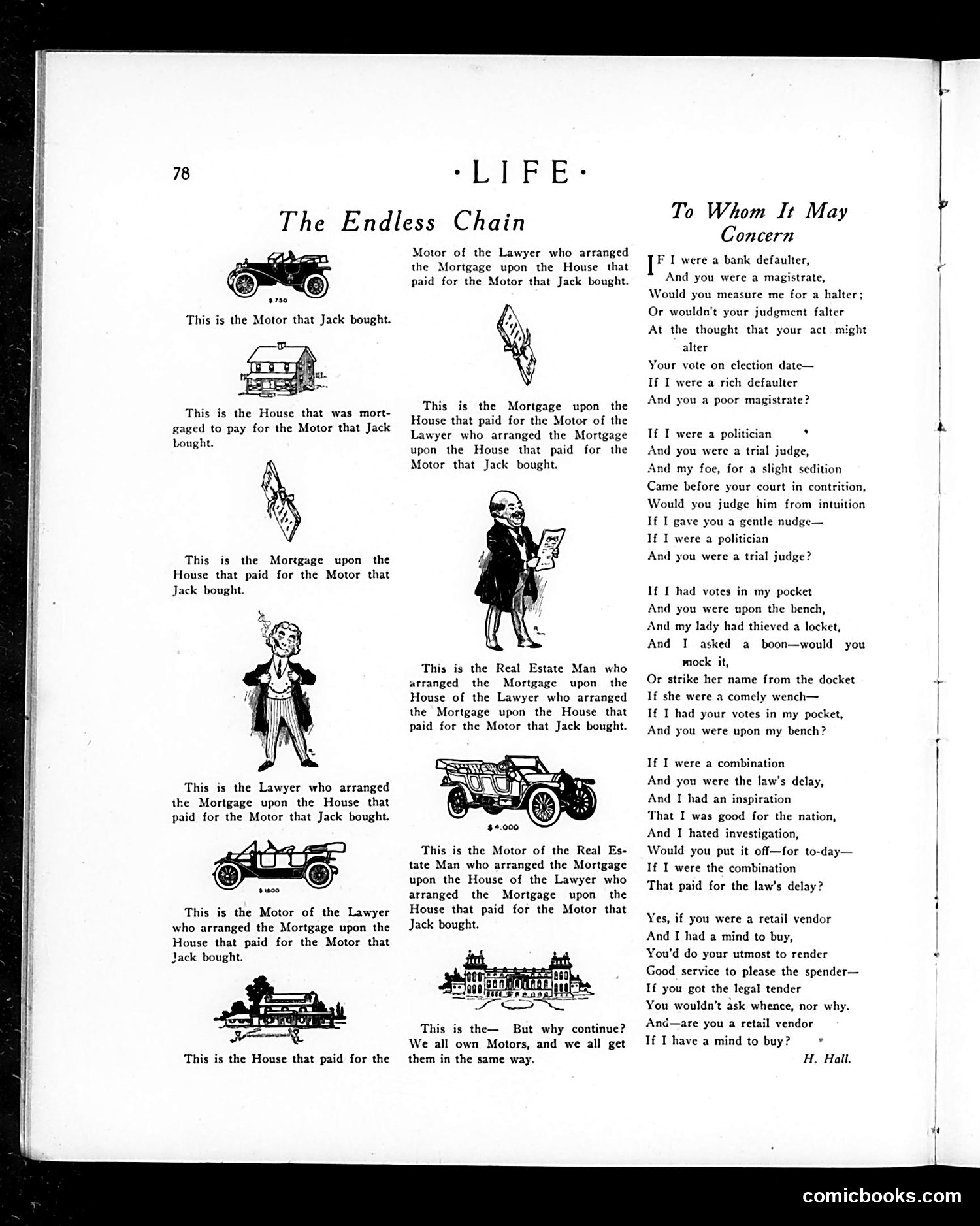
This page contains two distinct satirical pieces critiquing 1920s American consumer culture and judicial corruption. **"The Endless Chain"** (left) parodies the nursery rhyme "This Is the House That Jack Built." It traces how purchasing one automobile creates an endless cycle of debt: Jack buys a motor, mortgages his house to pay for it, requires a lawyer to arrange financing, whose own motor purchase creates further mortgages and real estate dealings. The satire's point: automobile purchases trigger cascading financial obligations affecting entire professional classes. The final line—"We all own Motors, and we all get them in the same way"—suggests this debt spiral is universal and inescapable in modern consumer society. **"To Whom It May Concern"** (right) by H. Hall presents hypothetical scenarios exposing judicial and political corruption: a magistrate's leniency toward wealthy defaulters, judges favoring politicians' friends, courtroom bias based on bribes or influence. Each verse asks whether justice depends on the defendant's wealth or connections rather than law itself—a scathing indictment of systemic corruption.
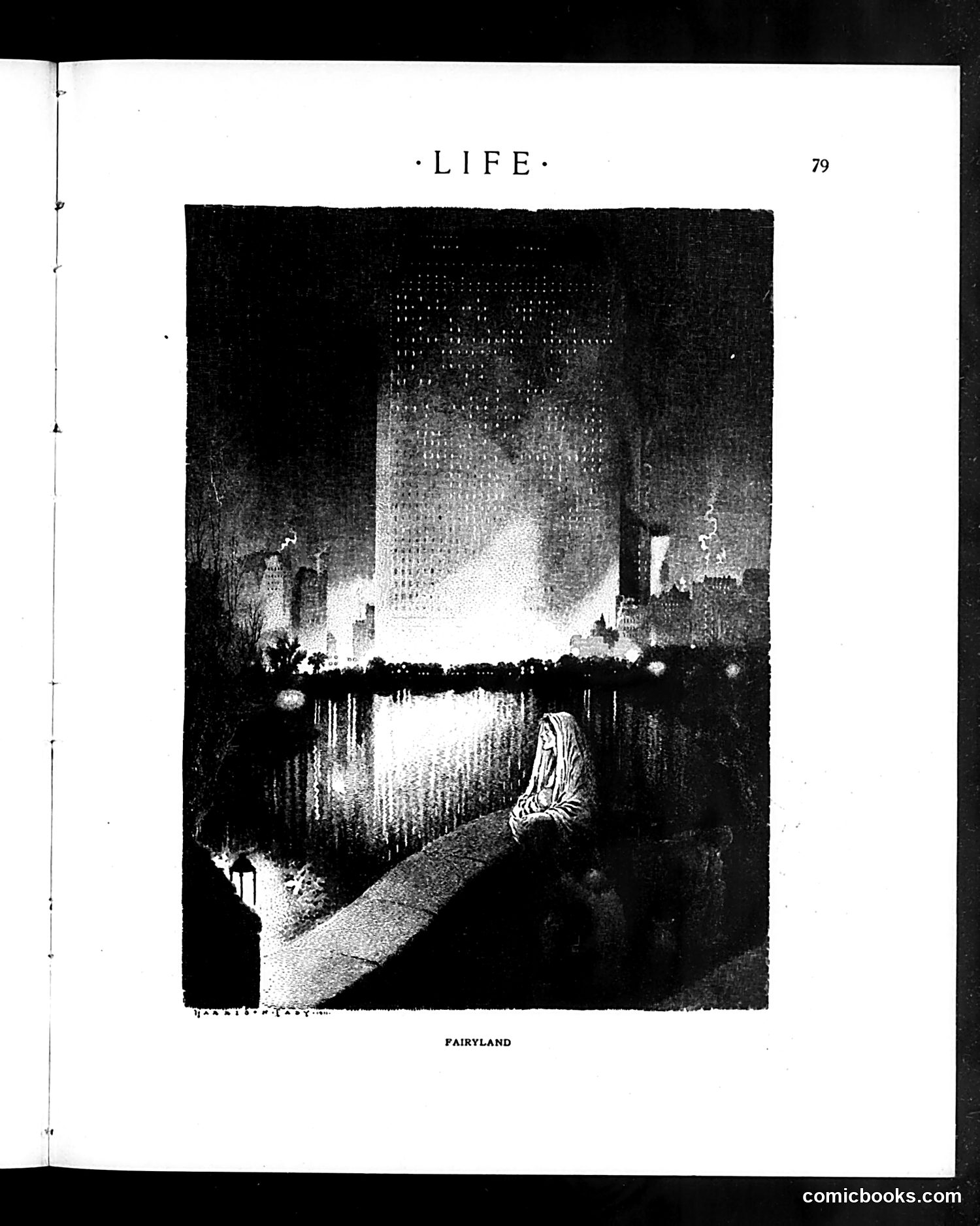
This appears to be an illustration titled "Fairyland" from Life magazine (page 79). The image depicts a solitary figure in light-colored clothing sitting by a body of water at night, gazing toward a distant illuminated cityscape with tall buildings. The contrast between the dark, natural foreground and the glowing urban landscape creates a dreamlike quality. Without additional context or visible text explaining the specific satire, the image likely represents romantic idealization of city life—the "fairyland" fantasy that urban centers represent to outsiders or dreamers. The isolated figure contemplating the distant lights could be satirizing either the allure of city living or the gap between urban fantasy and reality. The exact political or social commentary remains unclear without more contextual information.
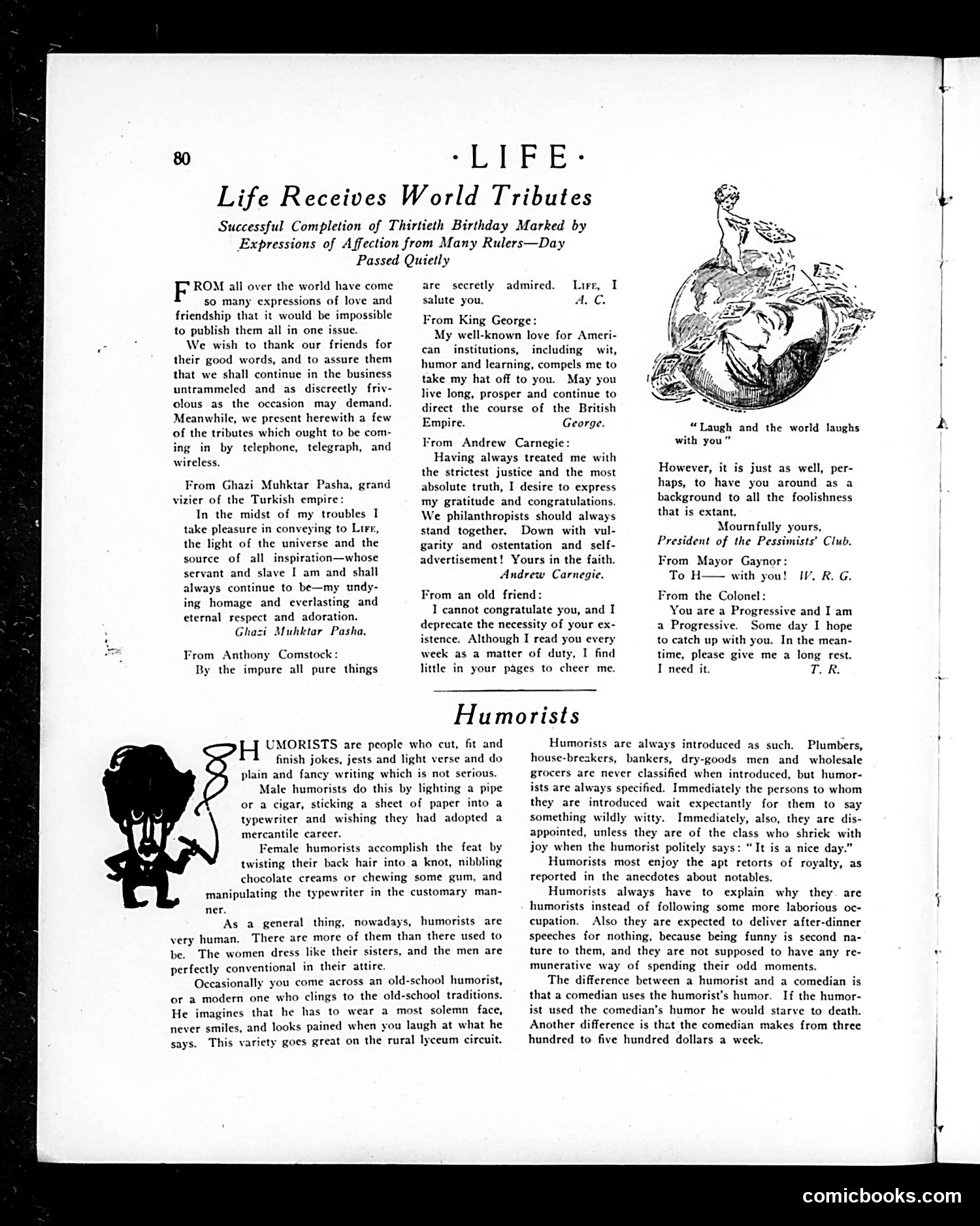
This page celebrates *Life* magazine's thirtieth anniversary with satirical mock "tributes" from world leaders and notable figures. The humor lies in the absurdity of the fictional congratulations: King George praises American "wit, humor and learning"; Andrew Carnegie emphasizes philanthropic solidarity while condemning "vulgarity and ostentation"; the Turkish Grand Vizier offers flowery, excessive flattery; and a "Pessimist Club President" backhanded-compliments the magazine as mere "background to all the foolishness." The cartoon below depicts a cherub-like figure labeled "Laugh and the world laughs with you," illustrating the accompanying article on "Humorists"—which wryly describes how humorists are always formally introduced as such (unlike plumbers or grocers), and immediately disappoint audiences expecting them to be "wildly witty." The satire gently mocks both *Life's* own pretensions and society's expectations of comedians.
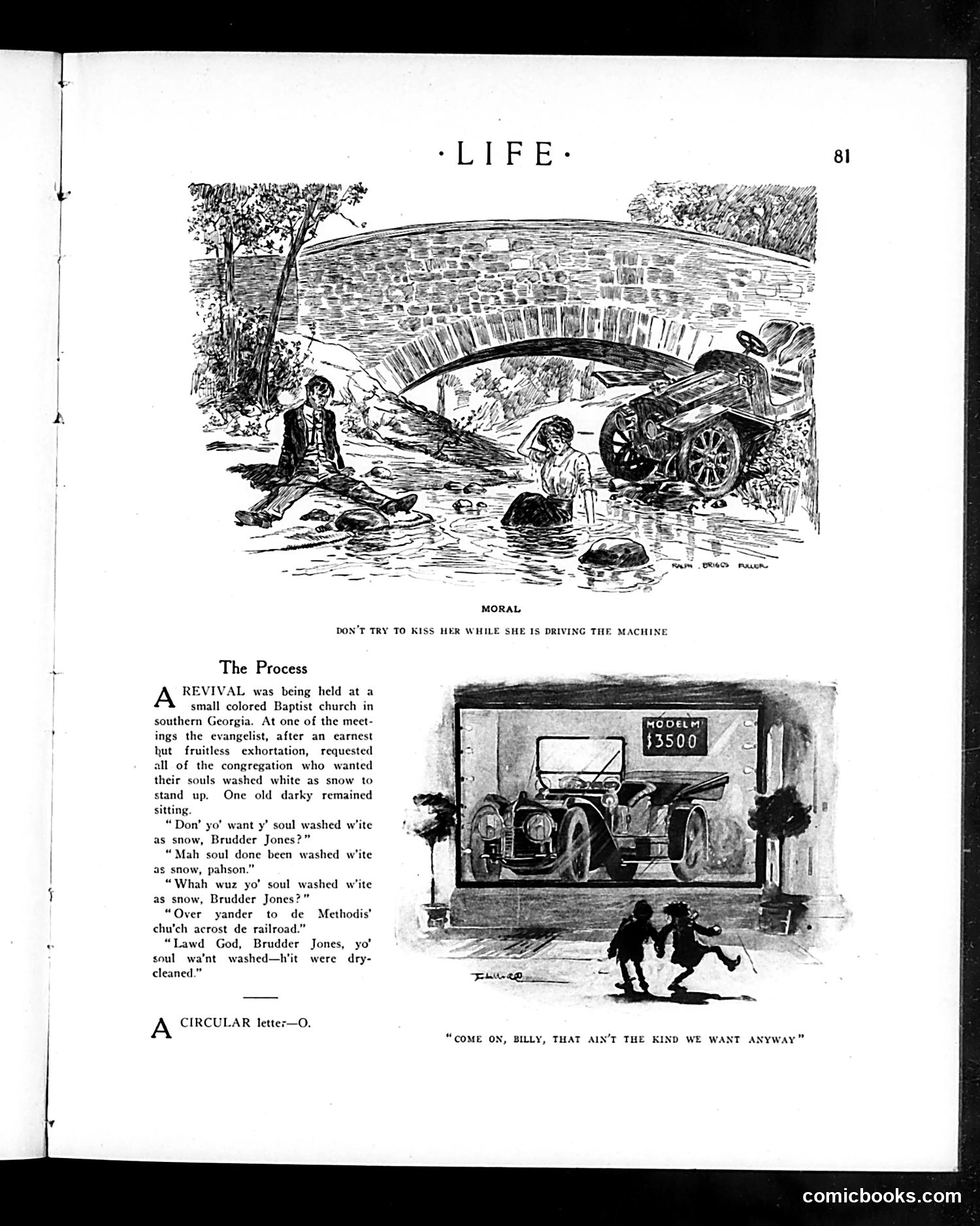
**Top Cartoon (Moral):** Depicts a car accident under a bridge where a woman driver has crashed. The moral warns men against distracting female drivers with romantic gestures—a commentary on the novelty and danger of women operating automobiles in the early automotive era. **Middle Text ("The Process"):** A dialect-heavy joke about a Baptist revival meeting in Georgia. An evangelist asks congregation members to stand if they want their souls "washed white as snow." One man declines, claiming his soul was already washed—at a Methodist church. The punchline: it was "dry-cleaned," not washed, mocking the man's spiritual authenticity and playing on sectarian differences between denominations. **Bottom Cartoon:** Shows men rejecting a type of car (appears to be a truck or commercial vehicle), preferring another kind—likely satirizing consumer preferences or automobile marketing during the early 1900s automotive boom. The page reflects early 20th-century American attitudes: anxieties about women drivers, racial stereotypes in dialect humor, and emerging car culture.
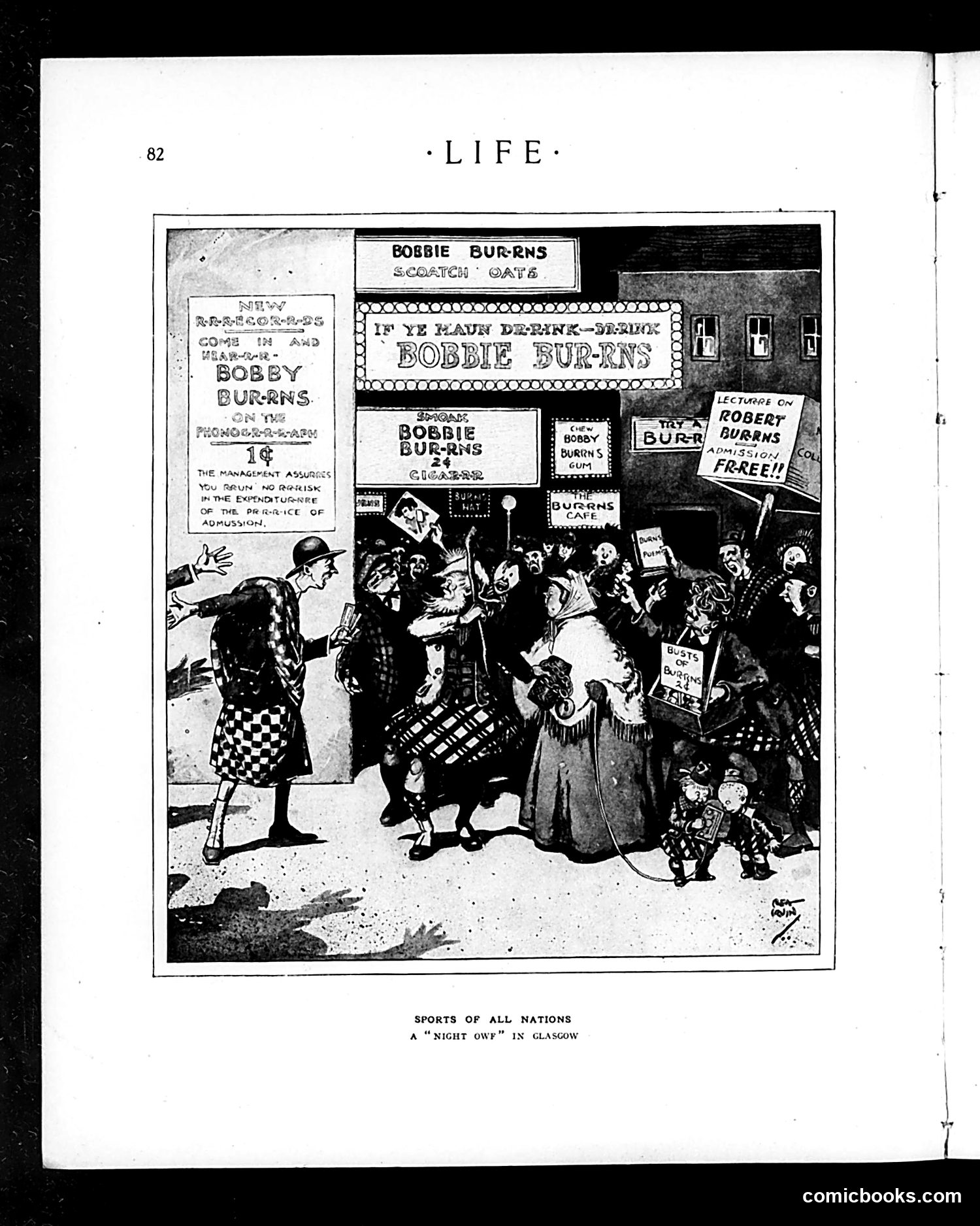
This satirical cartoon depicts a crowd frenzy outside a theater showing "Bobbie Burns" (likely a performance or film about Scottish poet Robert Burns). The advertisement in the upper left promises admission for just one cent, with a management assurance that "you run no risk in the expenditure of the price of admission." The satire mocks the spectacle of popular entertainment and mass marketing. The chaotic crowd—including children, women, and various onlookers—suggests the irrational appeal of cheap amusements and celebrity culture. The repetition of "Bobbie Burns" on multiple signs parodies aggressive advertising and commercialization of cultural figures. The caption "A 'Night Owl' in Glasgow" (referencing late-night entertainment venues) suggests this depicts actual contemporary behavior in Scotland, satirizing how even a modest price point creates frenzy among the working classes. The overall tone criticizes both the entertainment industry's exploitation and the public's susceptibility to promotional hype.
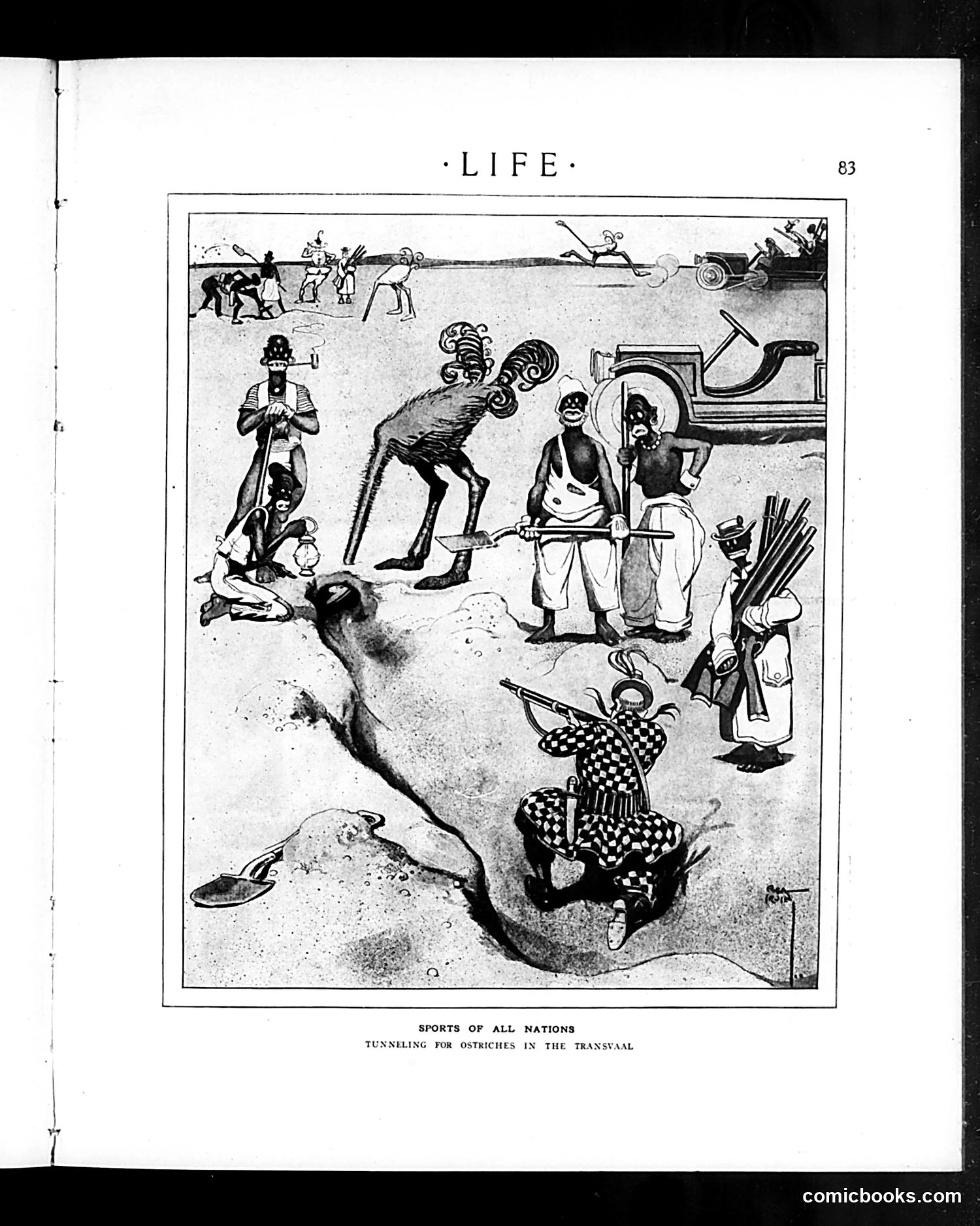
This is a satirical cartoon mocking international sporting pursuits. The caption "Tunneling for Ostriches in the Transvaal" references the Transvaal region in South Africa, known for ostrich farming. The cartoon depicts various national stereotypes engaged in absurd activities—digging tunnels to "catch" ostriches. The figures appear to represent different nationalities through their distinctive clothing and features (period caricature style). The contrast between modern mechanical equipment visible at top (automobiles, machinery) and the primitive, comical tunnel-digging below creates the humor. The satire likely mocks both European colonial ambitions in Africa and the competitive nationalism of the era, presenting these efforts as futile and ridiculous. The "sports of all nations" frame suggests international rivalry played for entertainment rather than genuine purpose.
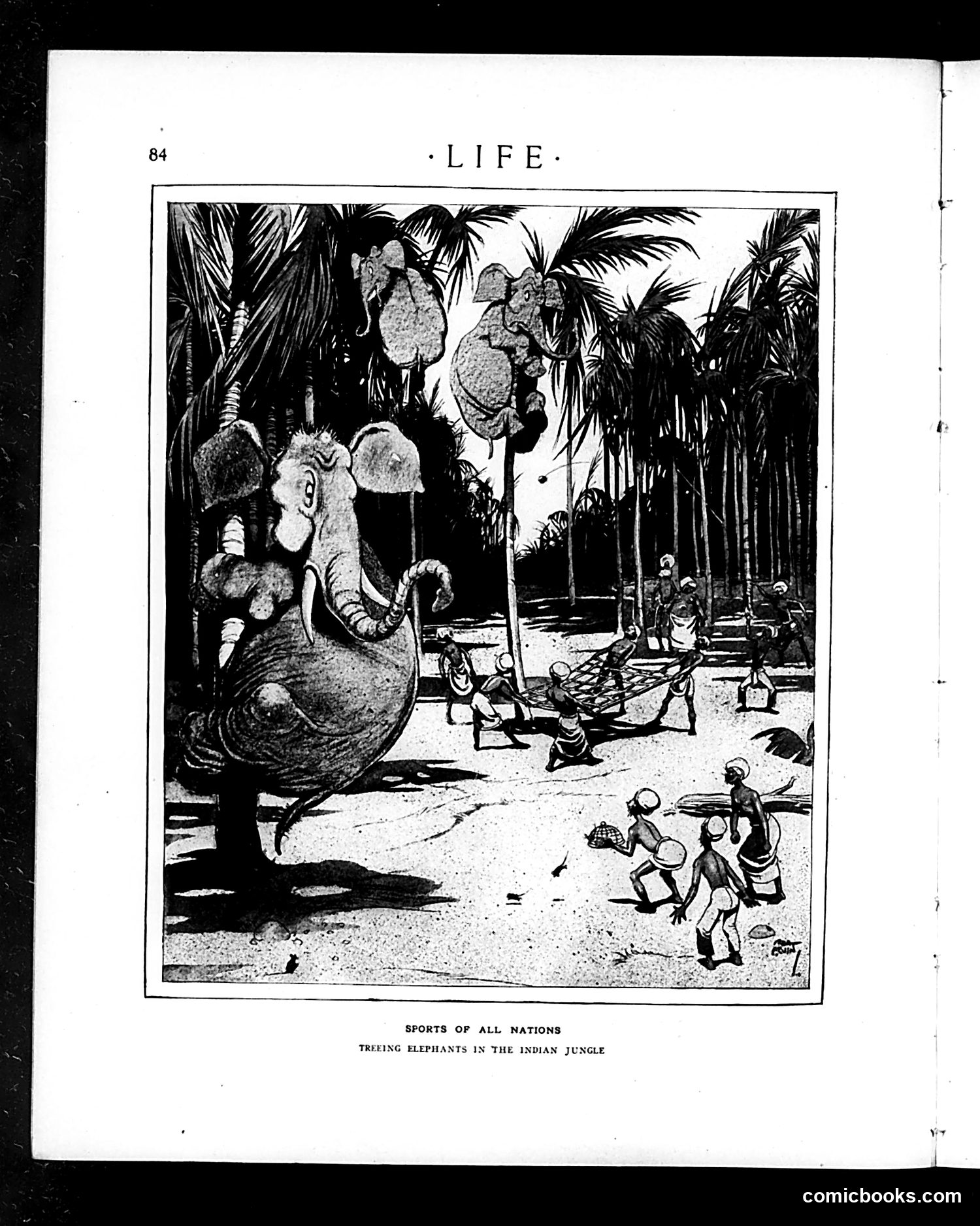
This satirical illustration depicts a humorous inversion of the hunting hierarchy. Indigenous people are shown chasing and cornering large elephants up into palm trees—an absurd reversal of the typical colonial-era big-game hunt where Western hunters pursued elephants. The joke appears to mock either: 1. Exaggerated travel narratives about exotic hunting exploits, or 2. The notion of "sports of all nations," suggesting different cultures have wildly different approaches to the same activity The illustration presents this "sport" as chaotic and comedic rather than prestigious. The small figures frantically pursuing massive animals creates visual comedy through scale disparity. This reflects Life magazine's tradition of satirizing both colonial attitudes toward non-Western peoples and the sensationalism of adventure literature.
This is a **reader letters page**, not a political cartoon. The decorative header shows small figures reading, establishing the "From Our Readers" theme. The page contains three substantial letters to the editor: 1. **"Our Sincere Regrets"**: A subscriber cancels after years because *Life* allegedly misrepresents the medical profession and Colonel Roosevelt's work and achievements. The editors graciously respond that losing thoughtful readers matters. 2. **"Habit"**: A reader sarcastically notes that the New York, New Haven & Hartford Railroad "takes Life more consistently" than any organization—a jab at *Life's* criticism of the railroad's practices. 3. **"The Zone System"**: A reader defends the proposed postal zone-rate system (distance-based pricing) as scientific, using railroad freight rates as analogy. 4. **"Abdul Baha Abbas"**: Begins defending Abdul Baha Abbas against *Life's* criticism, citing his integrity and refusing excessive donations. The page reflects *Life's* editorial role debating contemporary issues: postal reform, corporate accountability, and international figures.
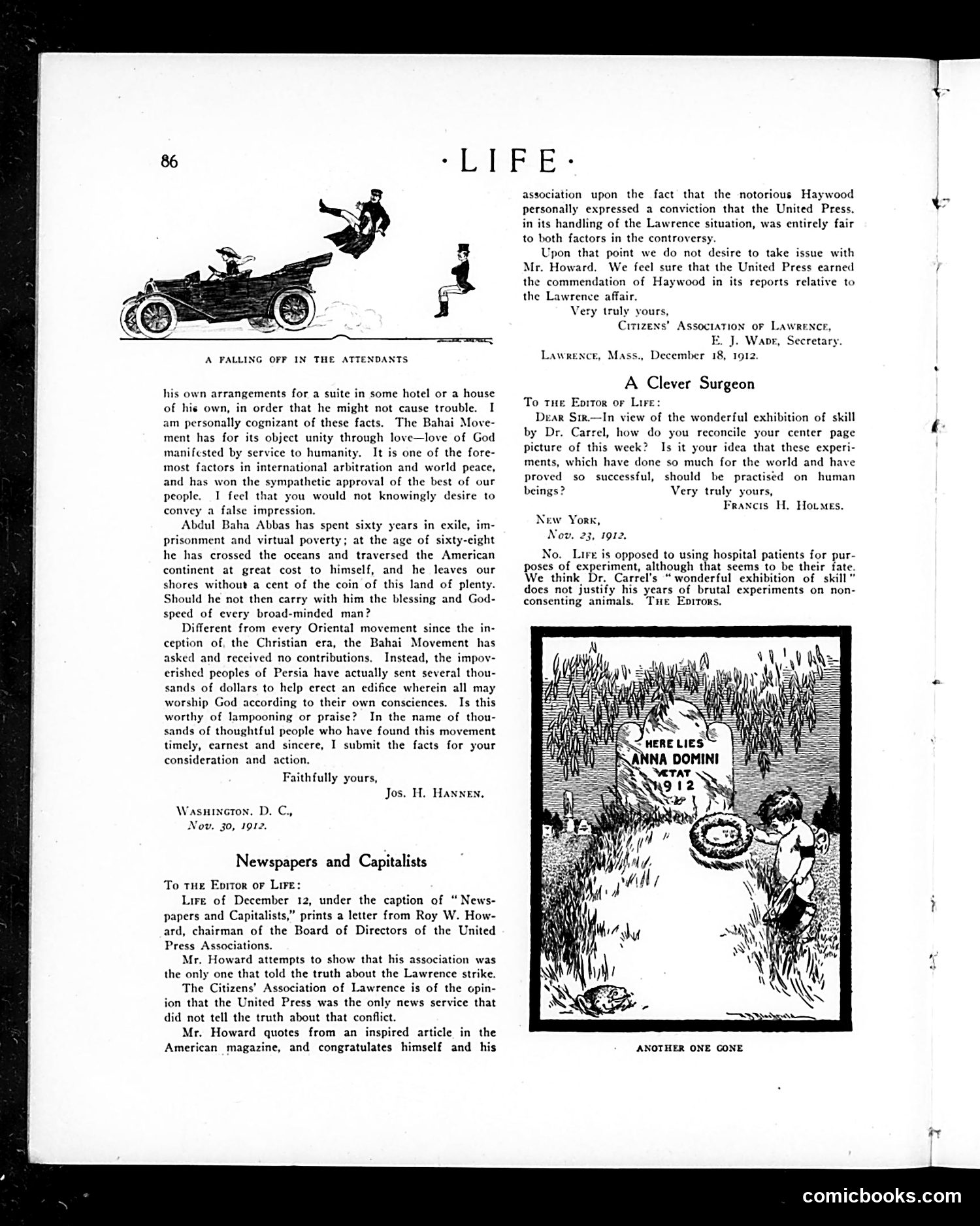
The cartoon depicts a car with occupants falling or being thrown from it—a visual pun on "falling off in the attendants" (losing attendees/followers). The context: The page features letters defending Abdul Baha Abbas, leader of the Bahai Movement, against ridicule in Life magazine. One letter defends the movement's peaceful principles and Abbas's costly American tour. The cartoon satirizes the movement's declining popularity or attendance at its events—literally showing people "falling off" rather than attending. The cartoon mocks the Bahai Movement's waning support in America, while the letters below argue for its legitimacy as a force for international peace and unity. The juxtaposition reveals Life's satirical stance toward the movement, contrasting with readers defending it as genuinely humanitarian.
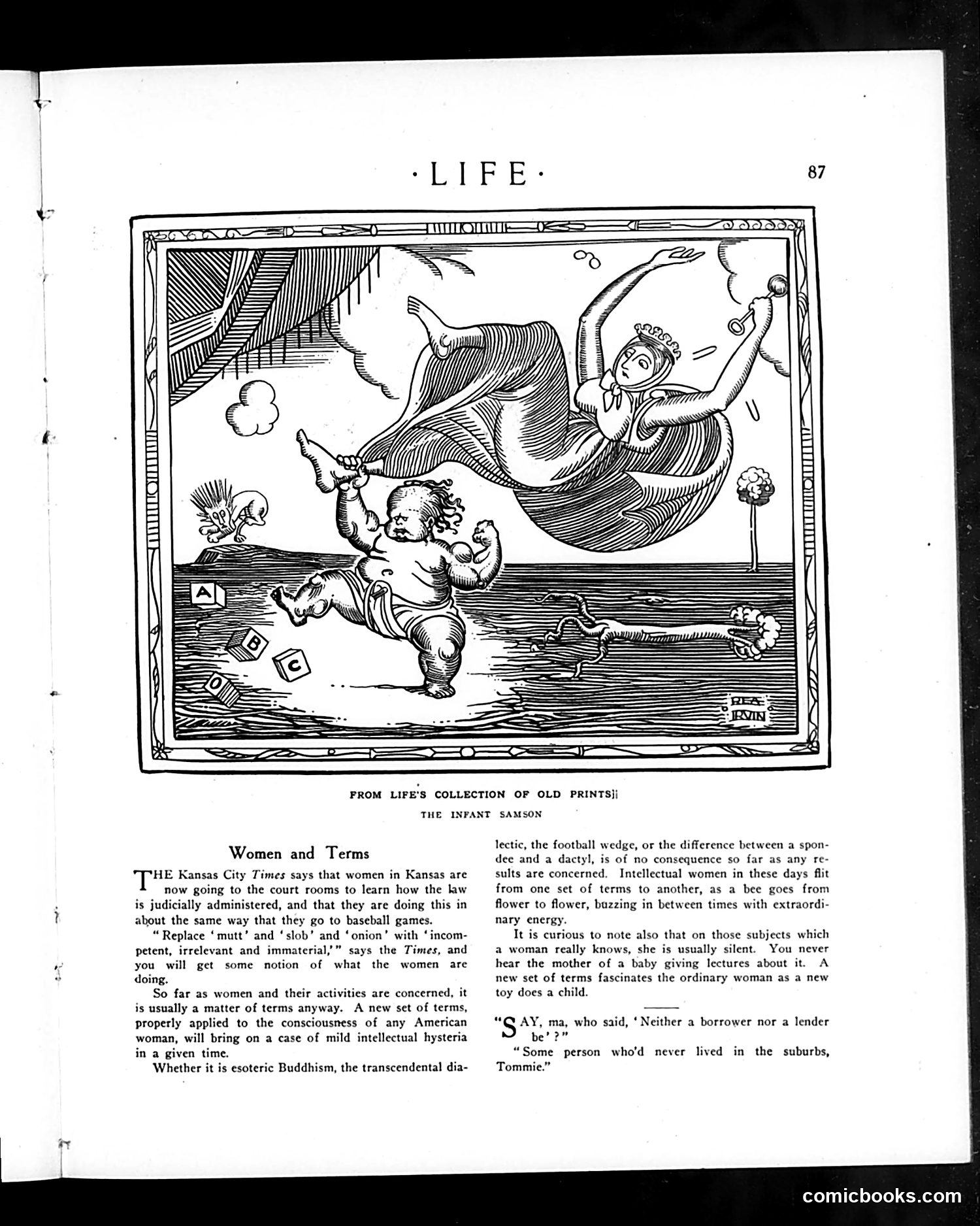
**The Cartoon:** "The Infant Samson" depicts a cherubic baby wielding a jawbone as a weapon while an adult woman (possibly representing "Woman" or modern womanhood) flies backward through the air, overwhelmed. The biblical reference to Samson suggests unexpected, destructive power emerging from an unlikely source. **The Article's Argument:** The text mocks women attending Kansas City courtrooms, claiming they approach legal terminology with superficial enthusiasm rather than genuine understanding. The author suggests intellectual women are easily distracted by novel concepts—whether "esoteric Buddhism" or legal jargon—treating them like toys, while remaining silent on subjects they actually understand (like motherhood). **The Satire:** This is anti-feminist commentary. The piece ridicules women's intellectual aspirations, implying they lack serious capacity for legal or philosophical engagement and are merely fashionable dilettantes. The final joke about suburban borrowing reinforces this condescension. **Historical Context:** This reflects early 20th-century backlash against women's expanding public participation and education, framing their intellectual pursuits as frivolous rather than legitimate.
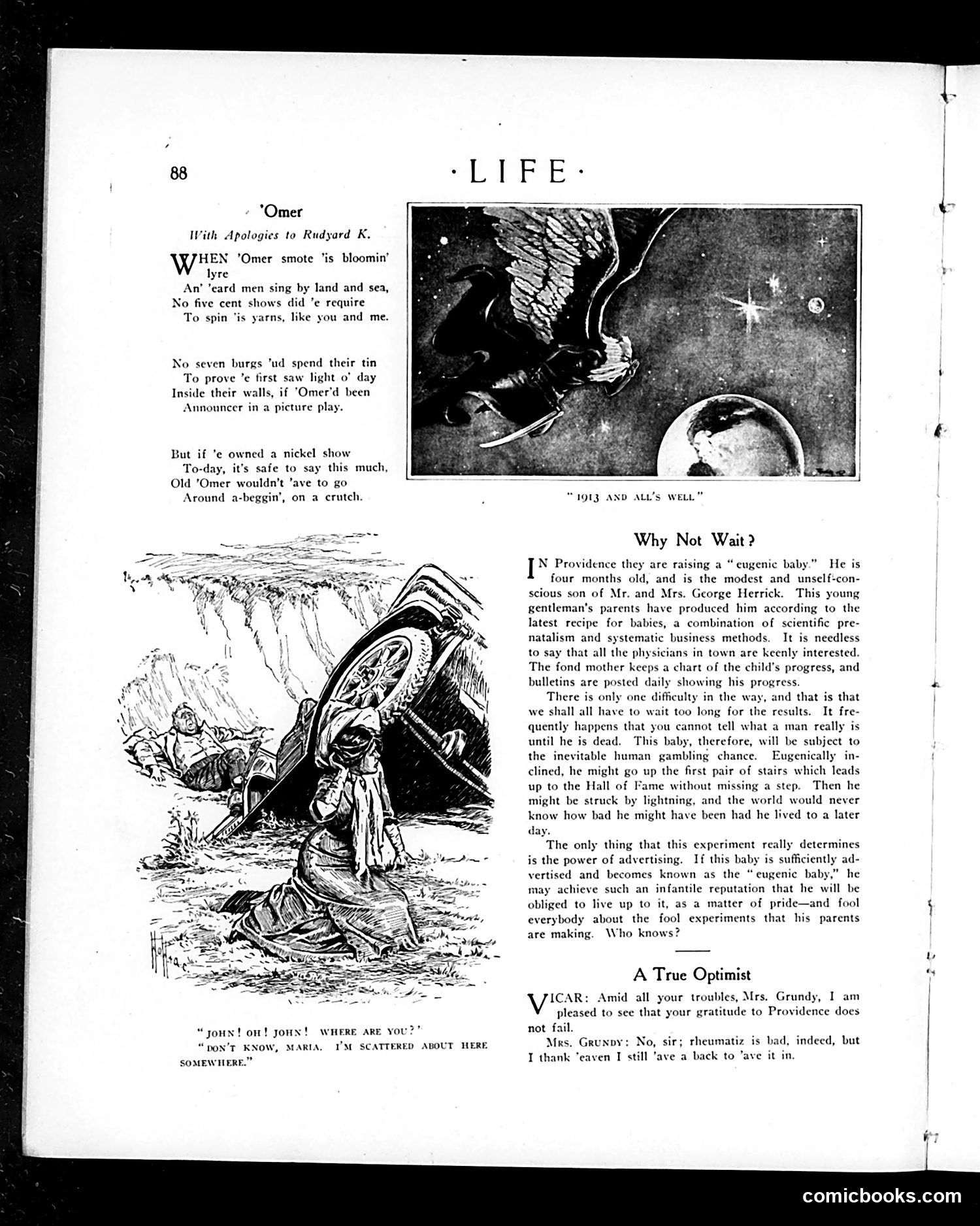
This page satirizes early 20th-century trends through multiple pieces: **"Omer"** parodies Rudyard Kipling's style, contrasting Homer's ancient storytelling with modern entertainment economics. The joke: if Homer owned a "nickel show" (cheap motion picture theater) today, he'd be wealthy rather than impoverished—mocking how commercial entertainment has replaced classical literature. **"Why Not Wait?"** criticizes the "eugenic baby" craze, where Mr. and Mrs. George Herrick scientifically engineered their infant according to eugenics principles. The satire targets the publicity stunt aspect: the baby's reputation (created through advertising) may matter more than actual merit. The underlying critique questions whether such experiments prove anything meaningful, since you can't judge a person until death. **"A True Optimist"** presents Mrs. Grundy (a stock character representing conventional morality) expressing gratitude to Providence despite rheumatism—she's grateful she still has a back to suffer with. This gentle humor celebrates working-class resilience and ironic optimism.
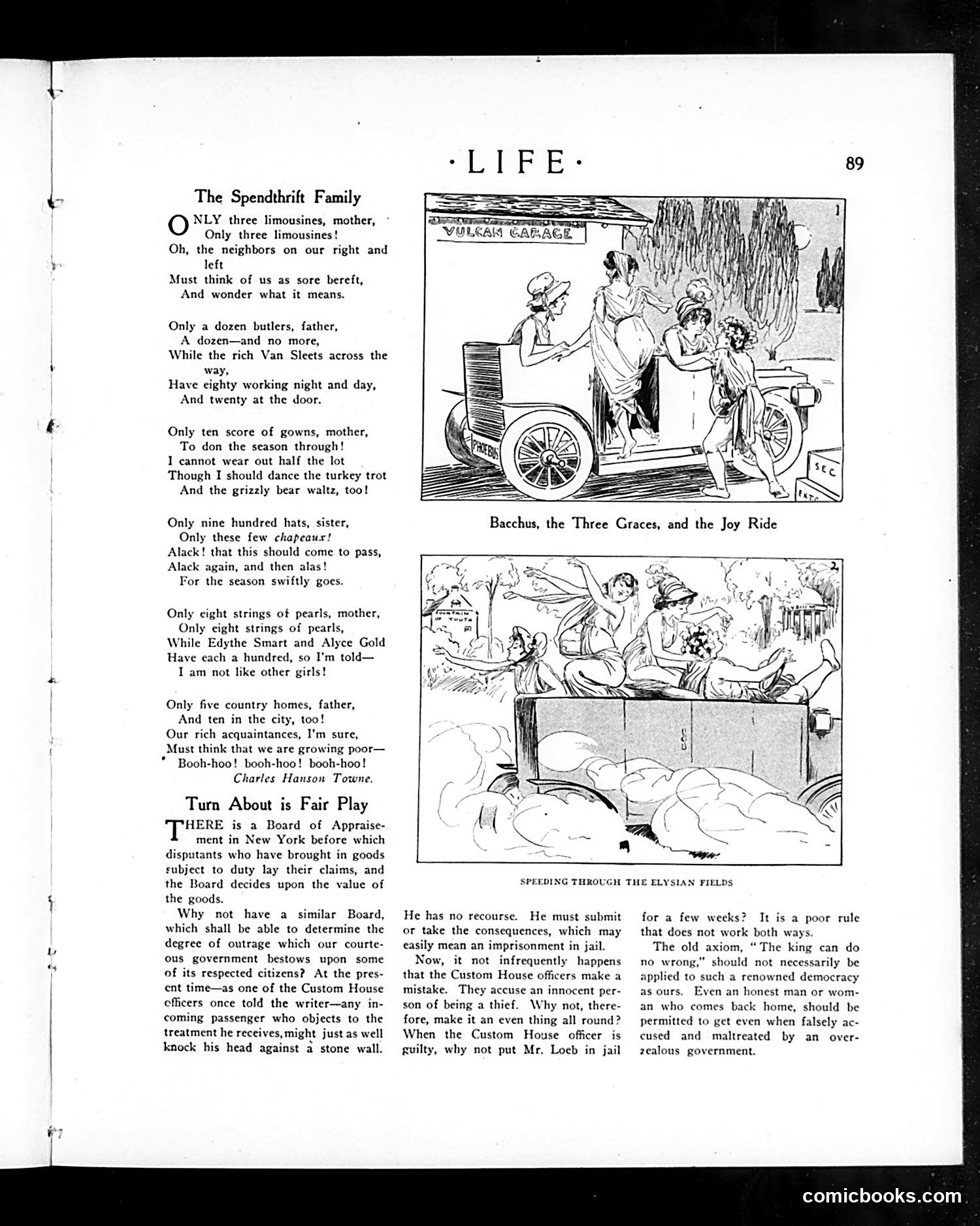
**"The Spendthrift Family"** satirizes the excessive consumption of the wealthy elite. A family complains of poverty while possessing three limousines, a dozen butlers, hundreds of hats and gowns, eight strands of pearls, and fifteen homes combined. The joke mocks the absurd relativity of the rich—they feel deprived only because neighbors have *more*. This reflects early 20th-century anxieties about conspicuous consumption and the widening gap between the ultra-wealthy and everyone else. **"Turn About is Fair Play"** critiques the power imbalance at U.S. Customs. It argues that Custom House officers can wrongfully accuse and jail innocent passengers with no recourse, while officers themselves face no consequences for mistakes. The piece advocates for a Board of Appraisement (similar to one existing for goods) to hold government officials accountable. References to "Mr. Loeb" suggest a specific official, though identity is unclear from the text alone. The satire attacks unchecked government authority and lack of due process.
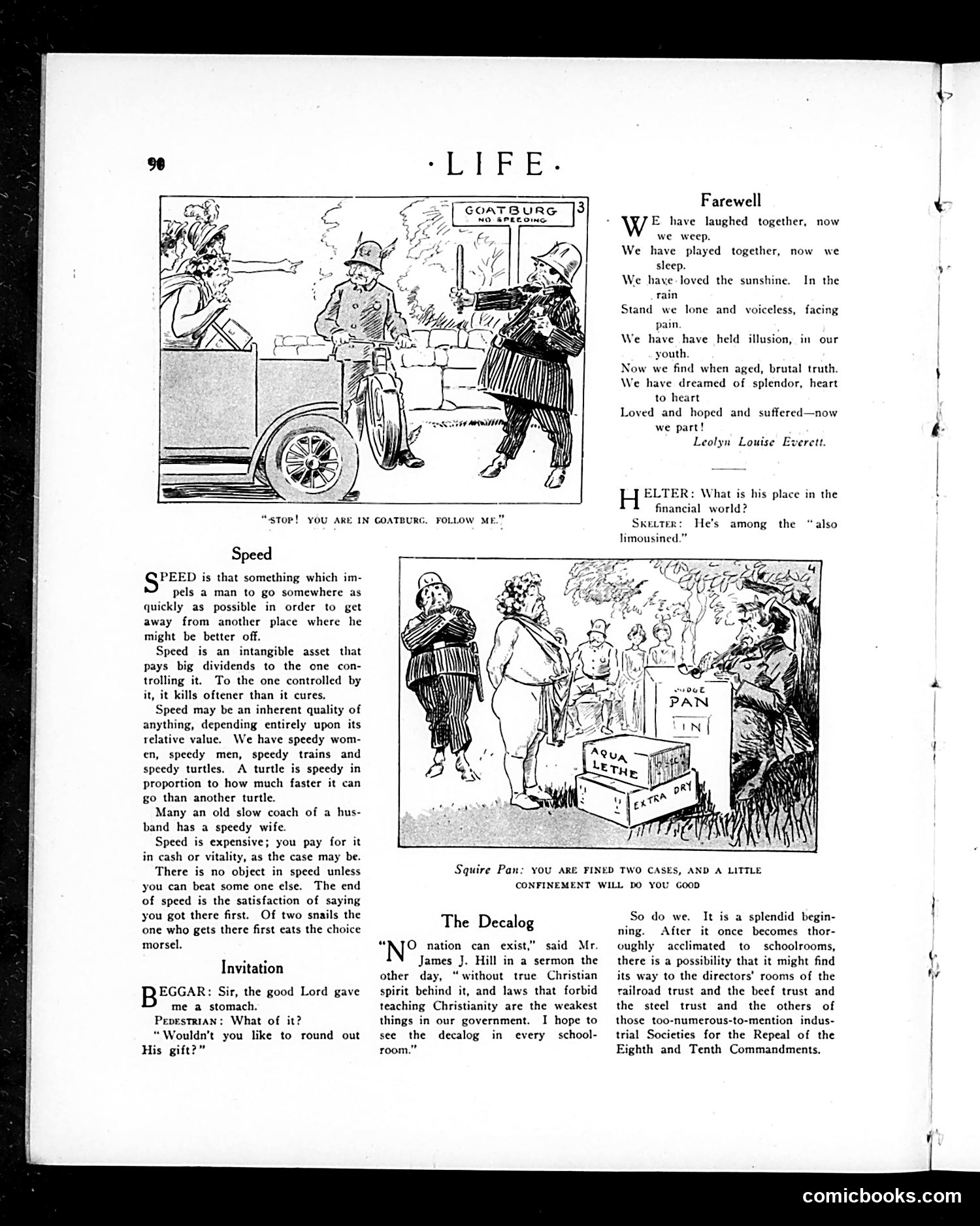
This page contains satirical pieces critiquing American society circa early 1900s. **Top cartoon**: Shows military figures in Goatburg (likely a fictional/mocking place name), satirizing militarism or possibly German militarism given the "Goatburg" reference and helmeted soldiers. **"Speed" essay**: A tongue-in-cheek definition mocking America's obsession with speed and efficiency. It notes speed is "expensive" and kills "oftener than it cures," suggesting criticism of reckless modernization and fast-paced living at the cost of human welfare. **"The Decalog" section**: Sarcastically responds to industrialist James J. Hill's call for the Ten Commandments in schoolrooms. The satire argues the *real* need is for the Commandments in corporate boardrooms—specifically addressing the "Eighth and Tenth Commandments" (prohibiting theft and covetousness), implying railroad, beef, and steel trusts violate these through their business practices. The humor relies on exposing hypocrisy: calls for Christian morality in schools ring hollow when industrial titans ignore Christian ethics in their monopolistic enterprises.
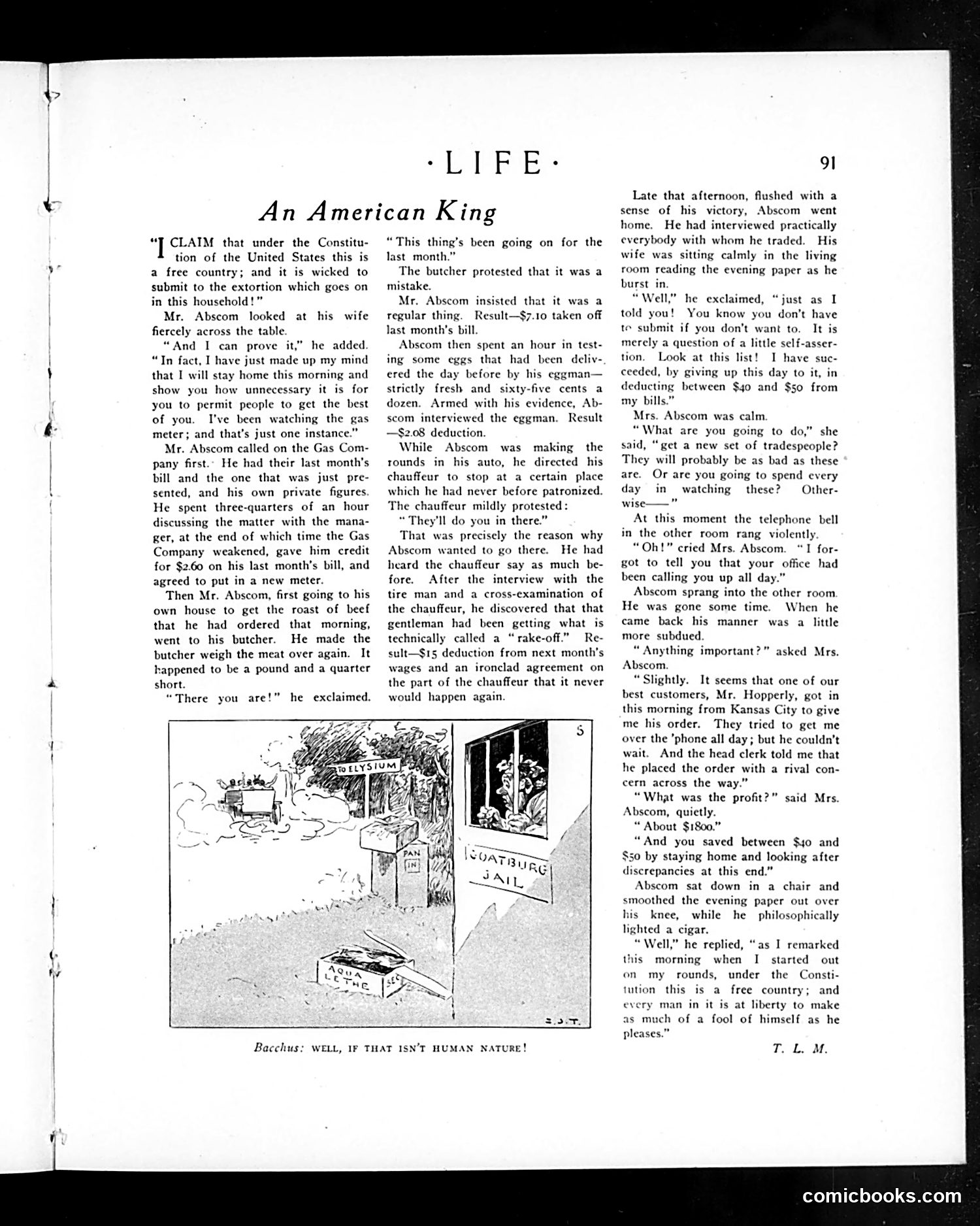
This story satirizes the American obsession with asserting individual rights and "getting value," mocking the contradiction between ideology and practice. Mr. Abscom spends his entire day scrutinizing tradespeople—the gas company, butcher, eggman, and chauffeur—recovering roughly $50 through aggressive questioning and accusations of dishonesty. He triumphantly demonstrates to his wife that Americans needn't "submit to extortion." The satire's punch arrives via the telephone: while Abscom wasted his day on petty savings, an important customer from Kansas City tried repeatedly to reach him. Unable to wait, the customer placed a major order with a competitor instead—a loss far exceeding his day's savings. The accompanying cartoon caption ("Well, if that isn't human nature!") emphasizes the irony: Abscom's principled stand for constitutional liberty and fair dealing ironically costs him real business through his own self-absorbed vigilance. The joke critiques American individualism as self-defeating and short-sighted.
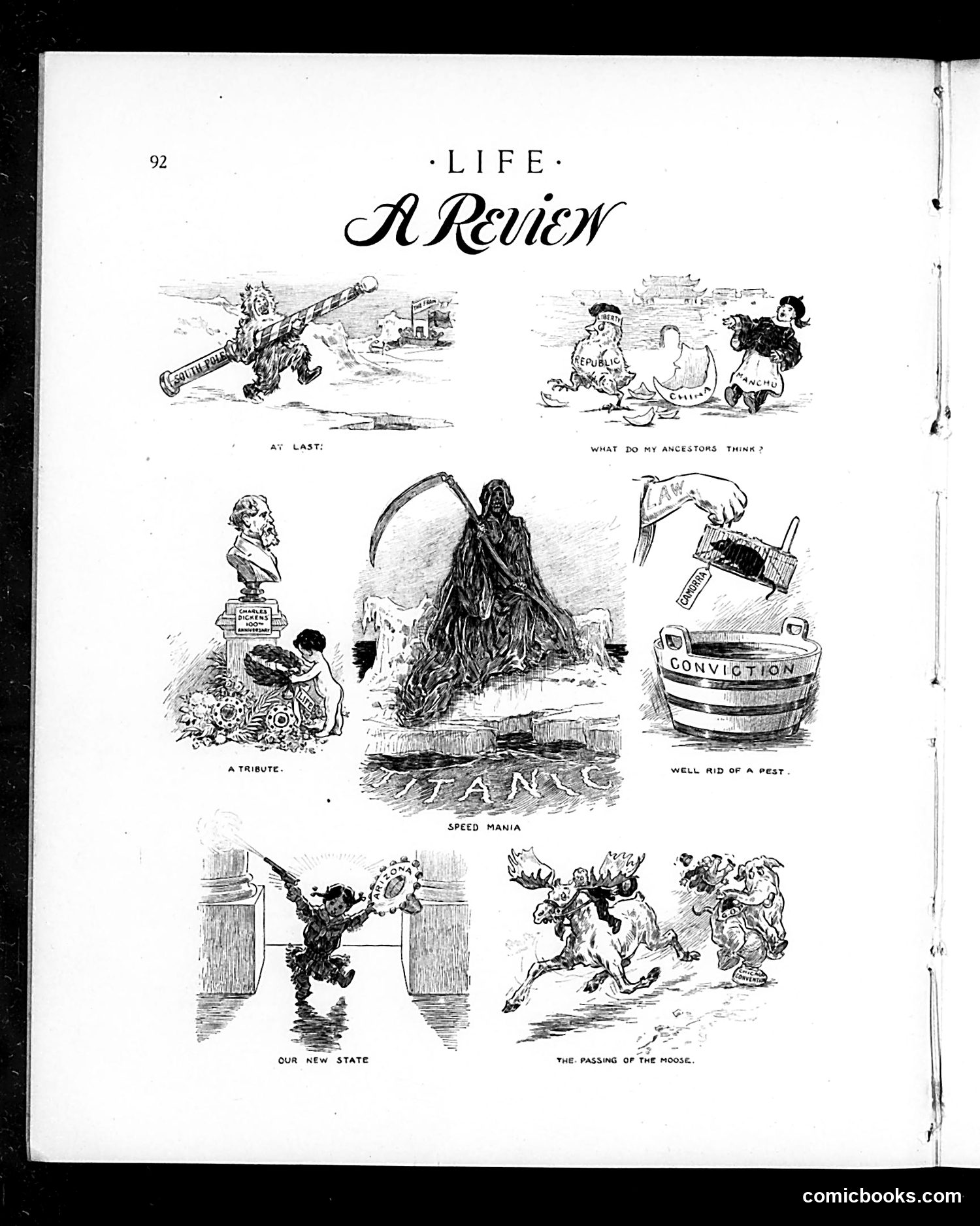
This satirical page from *Life* magazine contains several editorial cartoons commenting on contemporary politics and society. The central image labeled "SPEED MANIA" depicts Death as the Grim Reaper, likely critiquing dangerous driving habits of the era. "Well Rid of a Pest" shows someone dumping conviction into a barrel, satirizing selective justice or corruption. "Our New State" features a figure juggling between pillars, possibly mocking political instability or competing interests. "The Passing of the Moose" appears to reference the decline of the Progressive "Bull Moose" Party—Theodore Roosevelt's 1912 third-party political movement. Other panels ("At Last," "A Tribute," "What Do My Ancestors Think?") mock various social pretensions and historical revisionism, typical of *Life*'s satirical commentary on American culture and politics during the early 20th century.
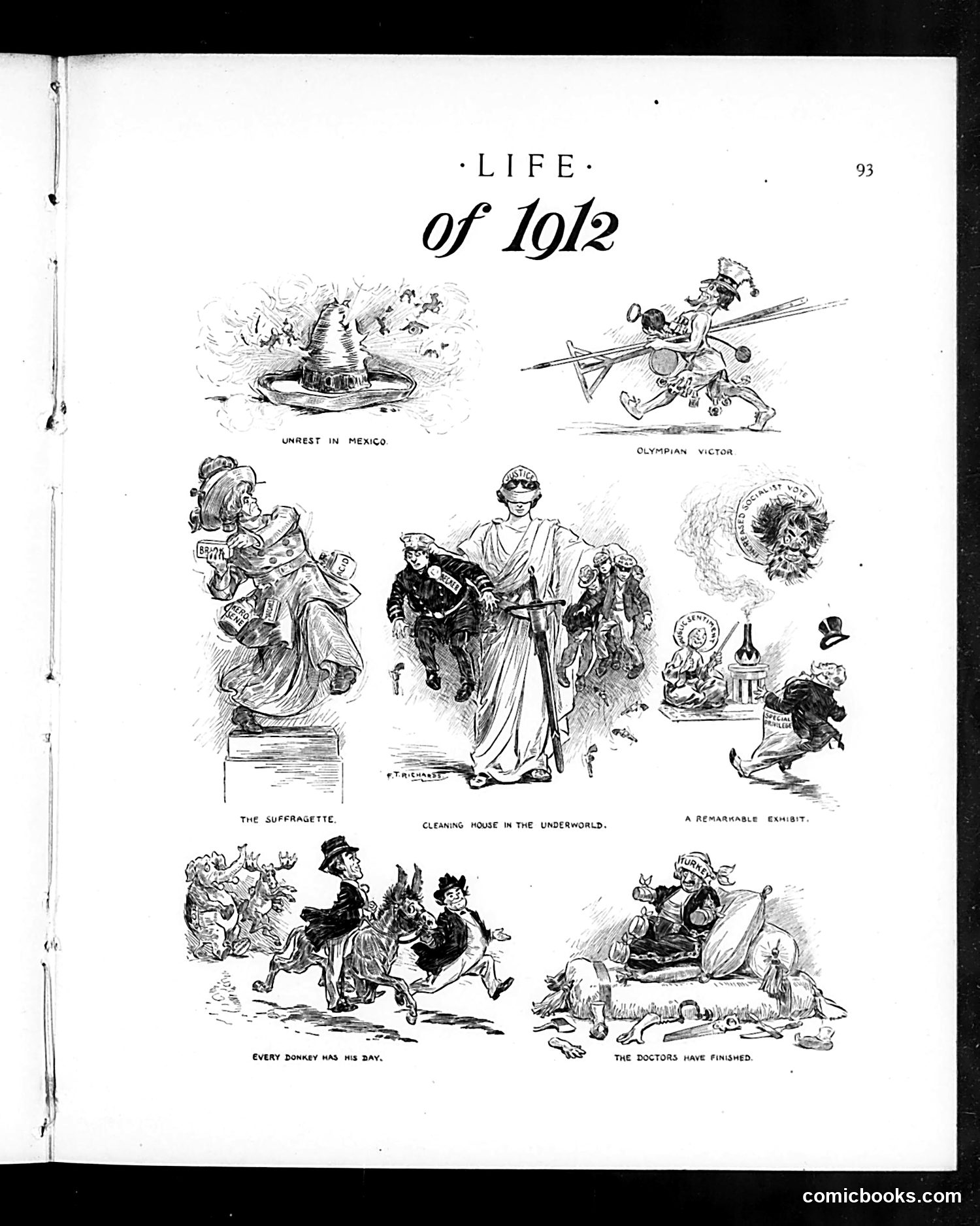
This satirical page presents eight cartoon vignettes commenting on 1912 American politics and culture. The cartoons likely mock the presidential election year's chaos: "Unrest in Mexico" references ongoing Mexican political turmoil; "Olympian Victor" appears to satirize political ambitions; "The Suffragette" caricatures the women's voting rights movement; "Cleaning House in the Underworld" suggests political corruption being addressed; "A Remarkable Exhibit" mocks some public spectacle; "Every Donkey Has His Day" references the Democratic Party symbol; and "The Doctors Have Finished" appears to comment on political remedies or interventions. The style is typical of Life's sharp political commentary, using exaggeration and personification to ridicule contemporary events and social movements from a conservative perspective.
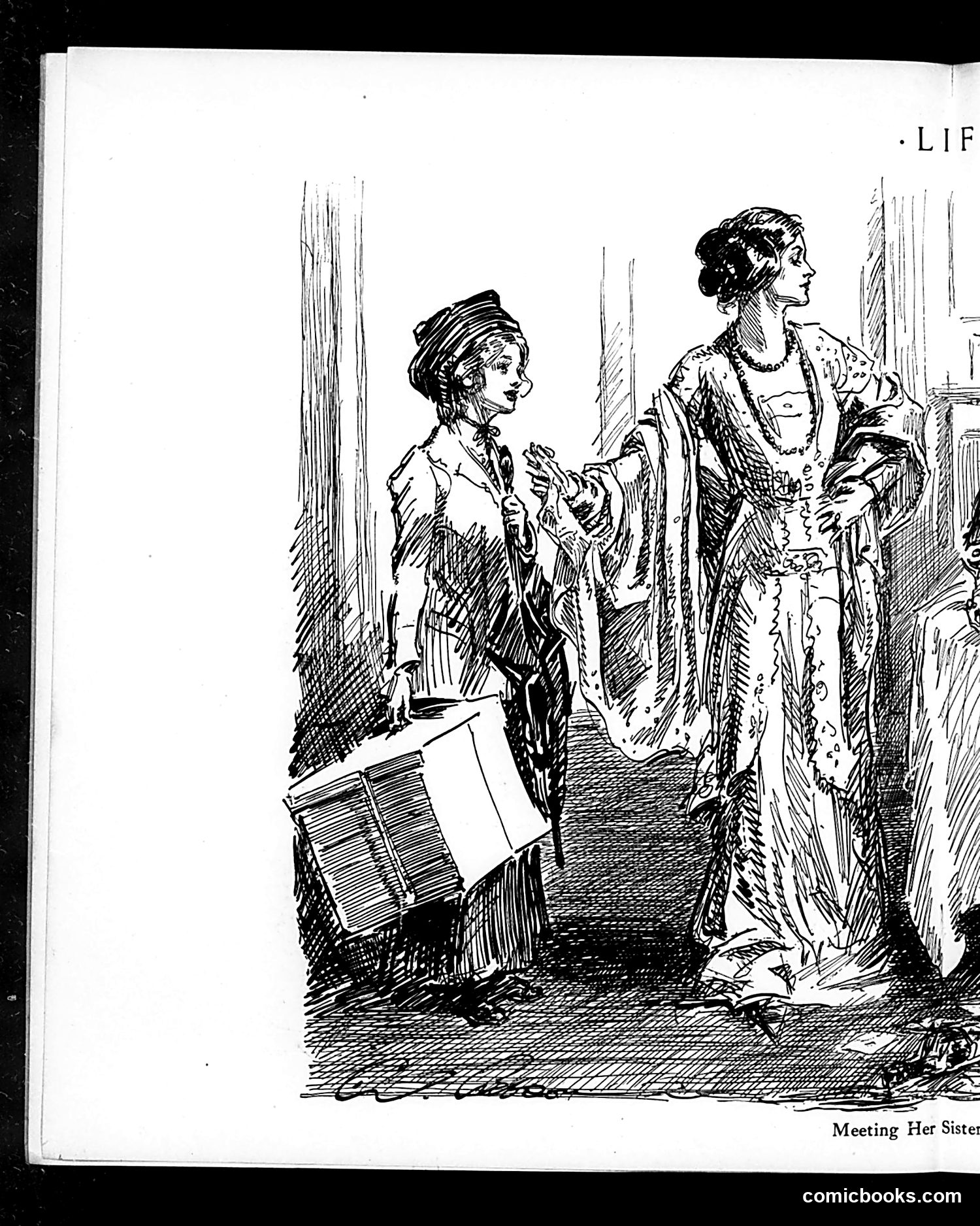
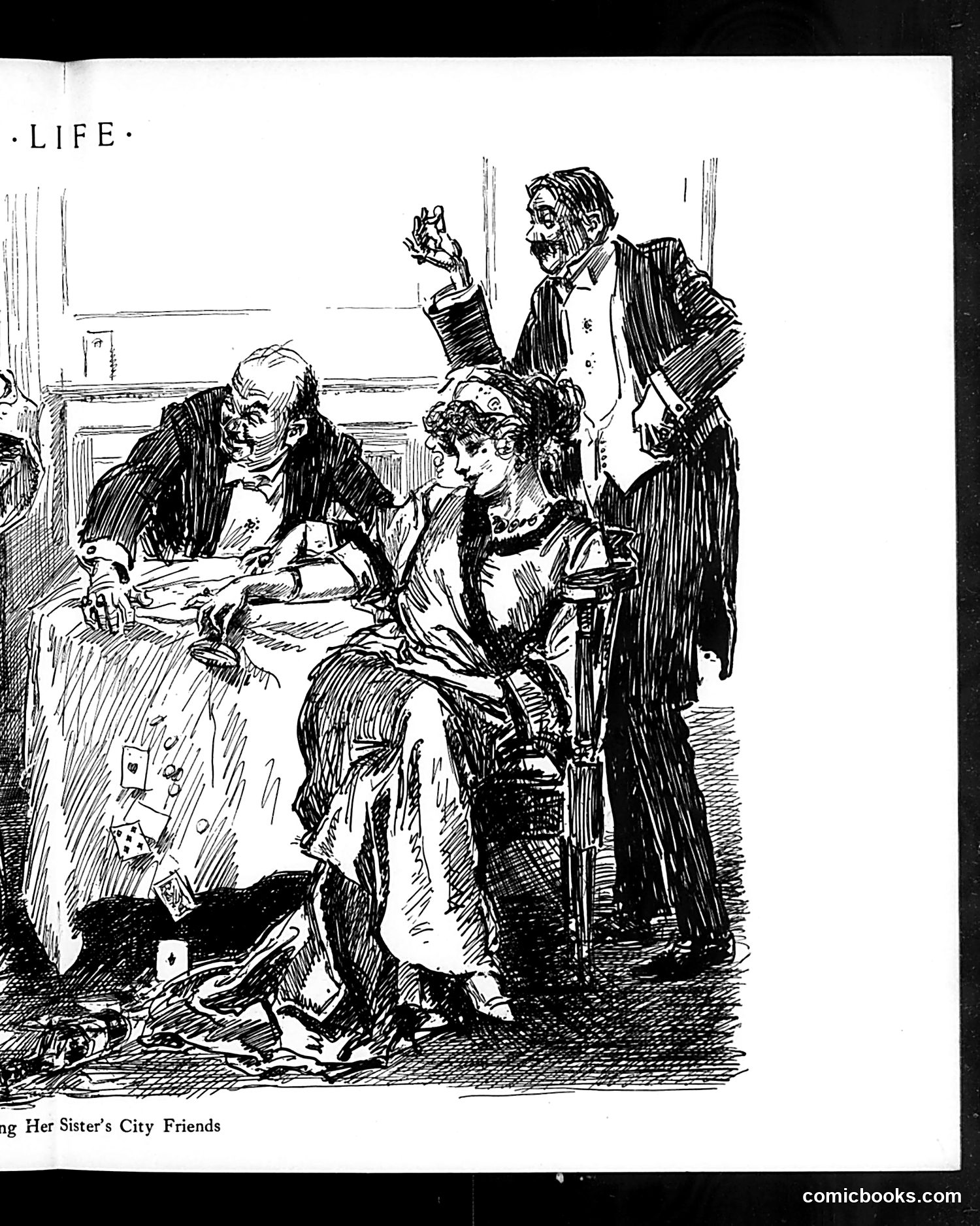
This appears to be a satirical cartoon from *Life* magazine titled "Visiting Her Sister's City Friends." The sketch depicts a social scene where a young woman (likely from the countryside or provincial area) is being entertained by urban sophisticates. The standing figures, dressed in formal evening wear, appear condescending or theatrical in their gestures, while the seated visitors look somewhat uncomfortable or out of place. The satire likely targets the contrast between rural/small-town sensibilities and the affected mannerisms of city society. The scattered playing cards on the floor suggest gaming or entertainment activities. The cartoon pokes fun at either the pretentiousness of urban socialites or the discomfort of provincial visitors encountering city culture—a common theme in late 19th/early 20th-century American humor about urban-rural social divisions.
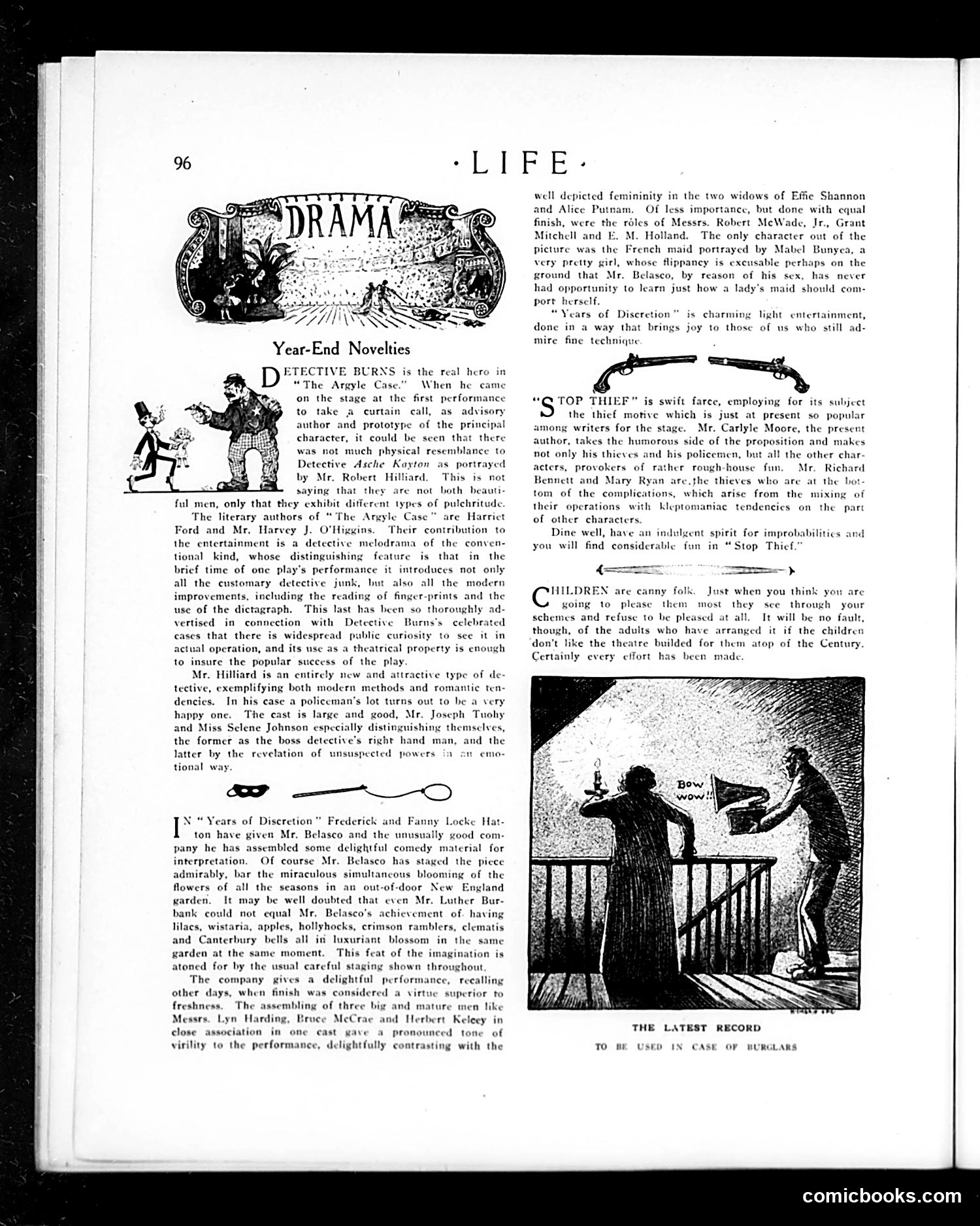
This page reviews three theatrical productions. "The Argyle Case" features Detective William Burns (a real-life famous detective) as the play's inspiration, though actor Robert Hilliard portrays him. The production showcases modern detective technology—fingerprinting and dictographs (early recording devices)—as theatrical novelties, capitalizing on public fascination with Burns's celebrated cases. "Years of Discretion," staged by impresario David Belasco, is praised as charming light entertainment with skilled ensemble acting, though the critic gently mocks Belasco's extravagant staging choice: blooming all seasons' flowers simultaneously in an outdoor garden—a feat even horticulturist Luther Burbank couldn't achieve. "Stop Thief" is a swift farce comedy exploiting the currently popular theatrical subject of thieves and policemen for humorous effect. The illustration (bottom right) appears to be a scene from one production, though its specific play isn't captioned in the visible text.
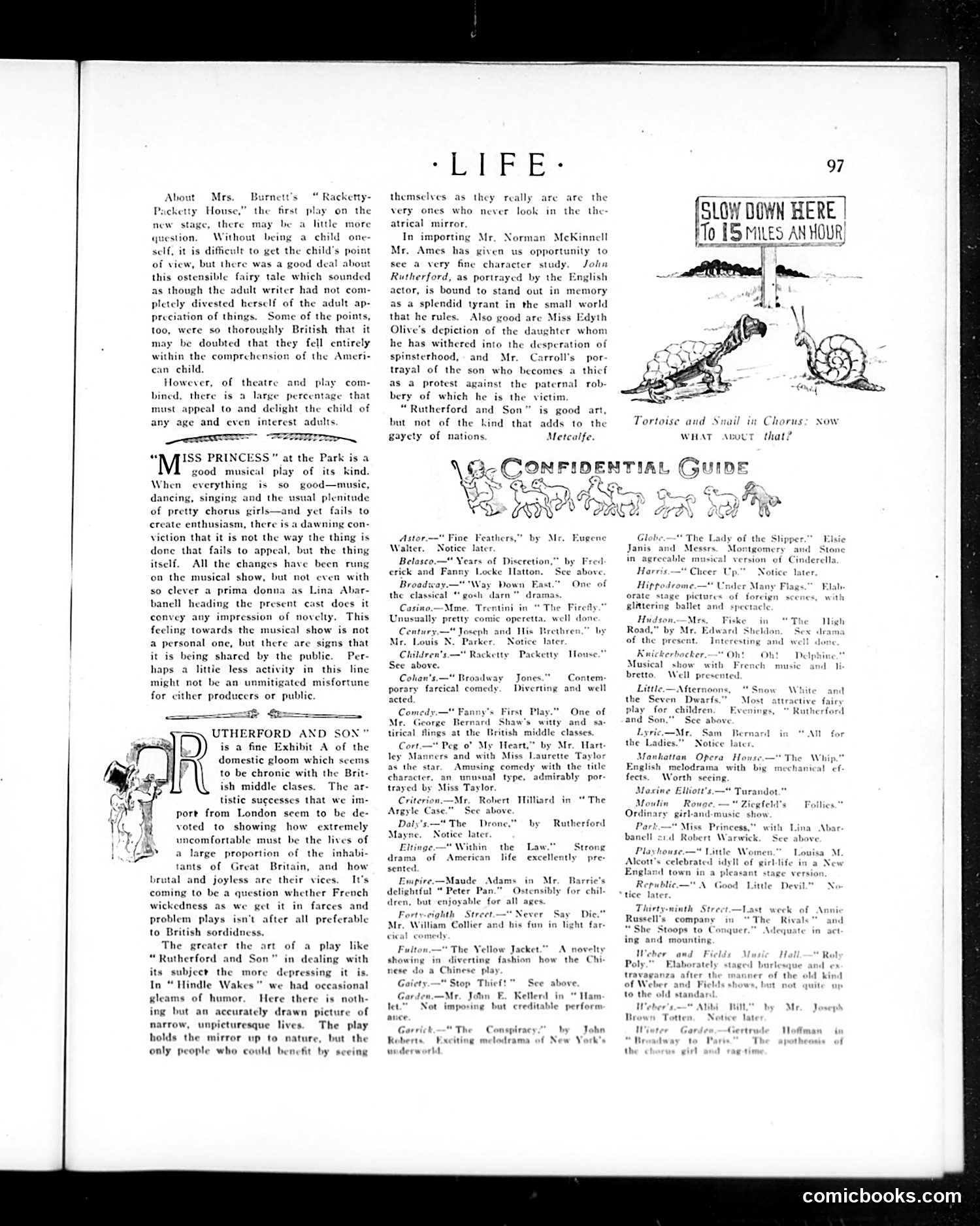
This page contains theater reviews rather than political cartoons. The small illustration in the upper right—"Tortoise and Snail in Chorus"—is a whimsical sketch accompanying a brief caption, likely a theatrical pun or jest unrelated to satire. The substantial content critiques contemporary Broadway productions. The reviewer discusses Mrs. Burnett's "Racketty-Packetty House" (a children's play), "Miss Princess" at the Park, and notably "Rutherford and Son"—a British import featuring actor Norman McKinnell. The satire here targets British theatrical imports. The reviewer observes that London's dramatic successes focus relentlessly on depicting the "domestic gloom," "sordidness," and "narrow, unpicturesque lives" of the British middle classes, suggesting French farces—despite their immorality—are preferable to this relentless bleakness. The implicit critique: British playwrights aestheticize misery while claiming artistic superiority.
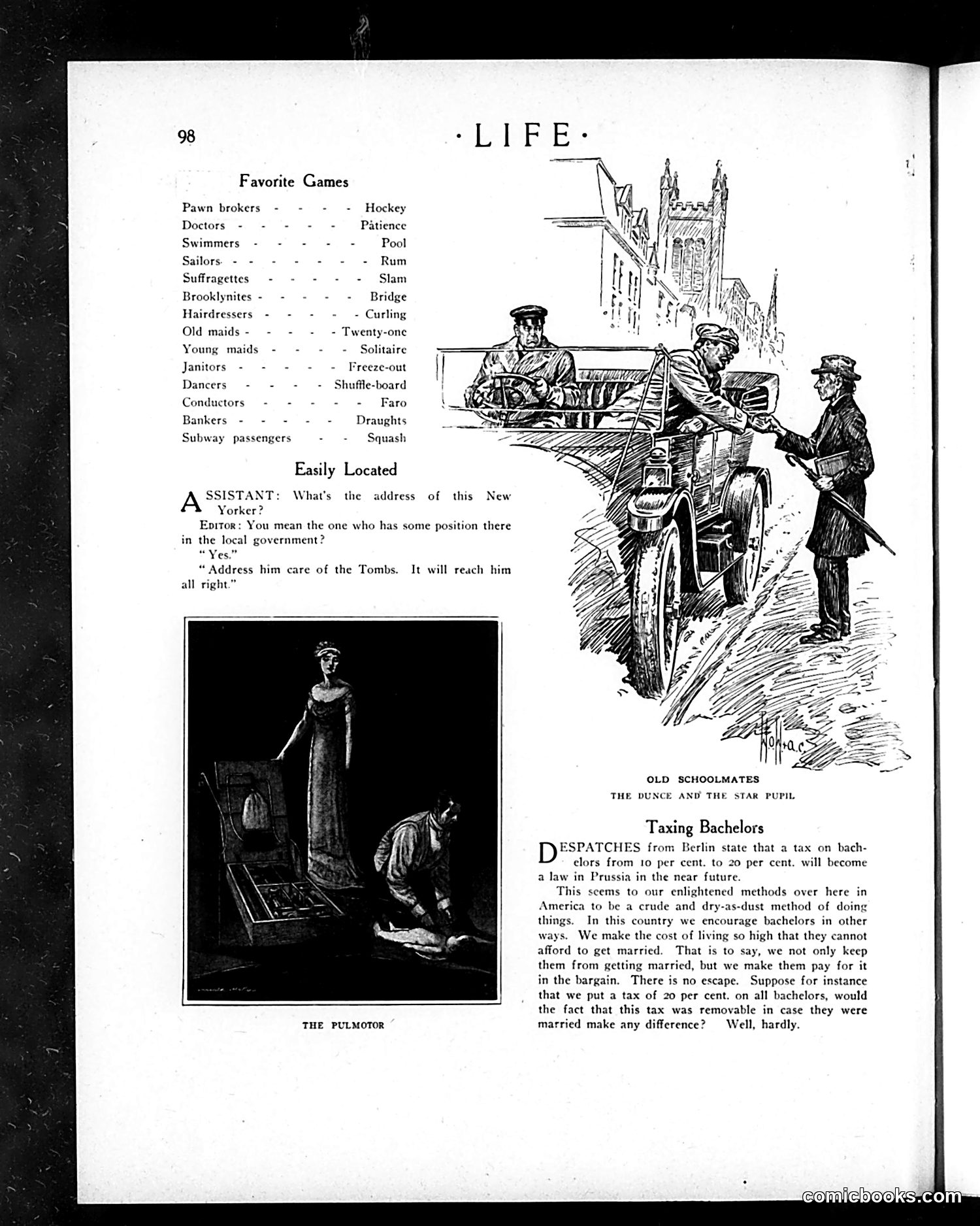
This page contains several satirical pieces typical of early 20th-century American humor: **"Favorite Games"** is a tongue-in-cheek list matching professions to card/parlor games—suggesting doctors play "Patience," suffragettes play "Slam," etc. The humor relies on stereotypes about each group's character. **"Easily Located"** is a brief joke about addressing a letter to a corrupt New York politician "care of the Tombs" (the city's jail), implying government officials inevitably end up incarcerated. **"Taxing Bachelors"** responds to Prussian tax policy by arguing America already effectively taxes unmarried men—through high cost of living that makes marriage unaffordable. The satire critiques both excessive taxation and American economic inequality, suggesting the outcome is the same whether intentional (Prussia) or accidental (America). The illustrations include "The Fulmoor" (unclear reference) and "Old Schoolmates" showing class disparities.
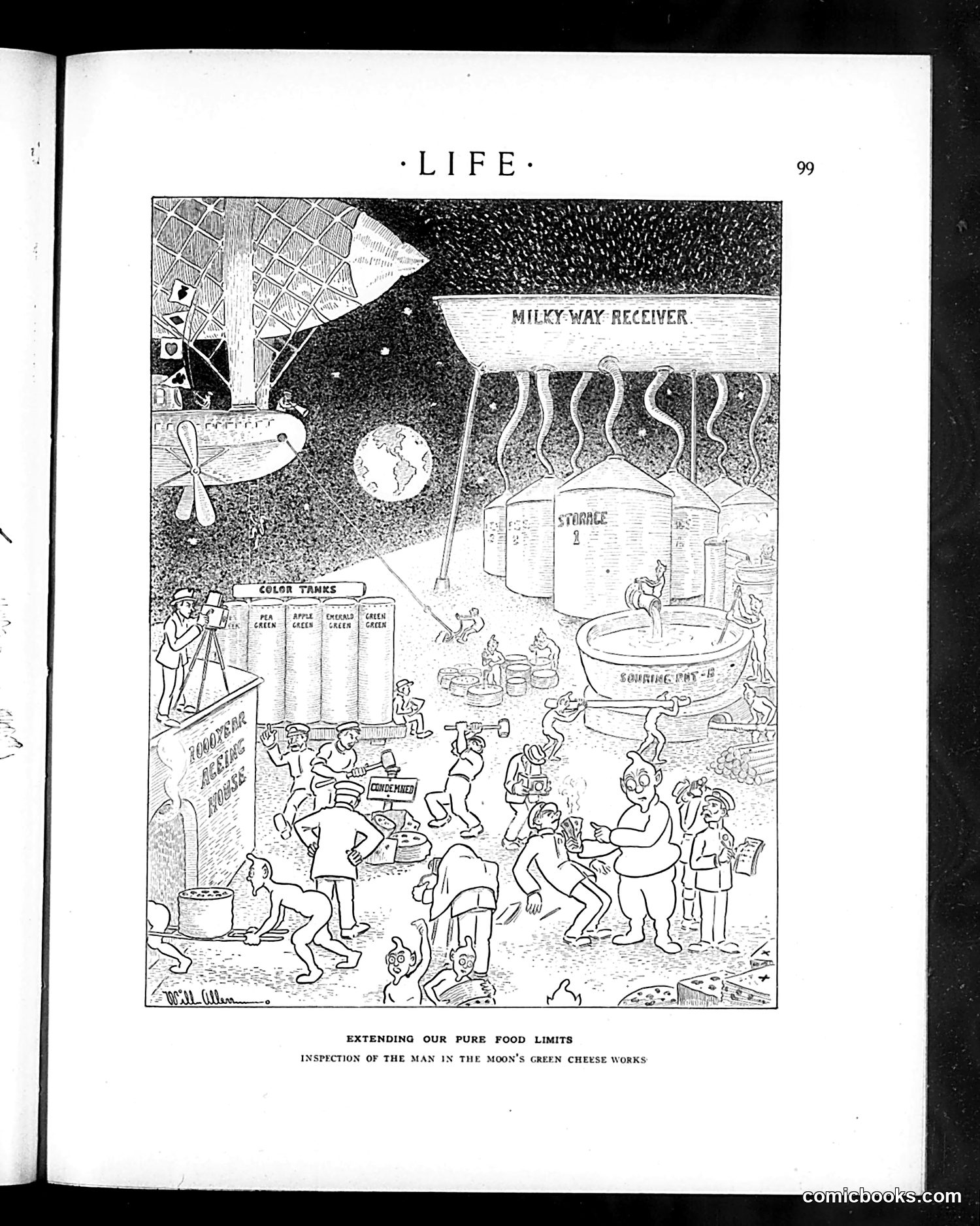
This satirical cartoon mocks the expansion of pure food inspection regulations. It depicts an imaginary lunar factory producing green cheese—a whimsical reference to the old myth that the moon is made of cheese. The scene shows inspectors, storage tanks labeled "Color Tanks," a "Milky Way Receiver," and workers at a "Souring Vat," all operating on the moon's surface. The joke suggests that food safety regulations have become so extensive and absurd that they've reached comical extremes—even extending to fictional moon-based cheese production. This likely satirizes early 20th-century American food safety legislation (possibly the 1906 Pure Food and Drug Act), critiquing regulatory overreach by pushing the concept to its logical absurdity: if inspections are this comprehensive, why not inspect the moon's cheese factories too?
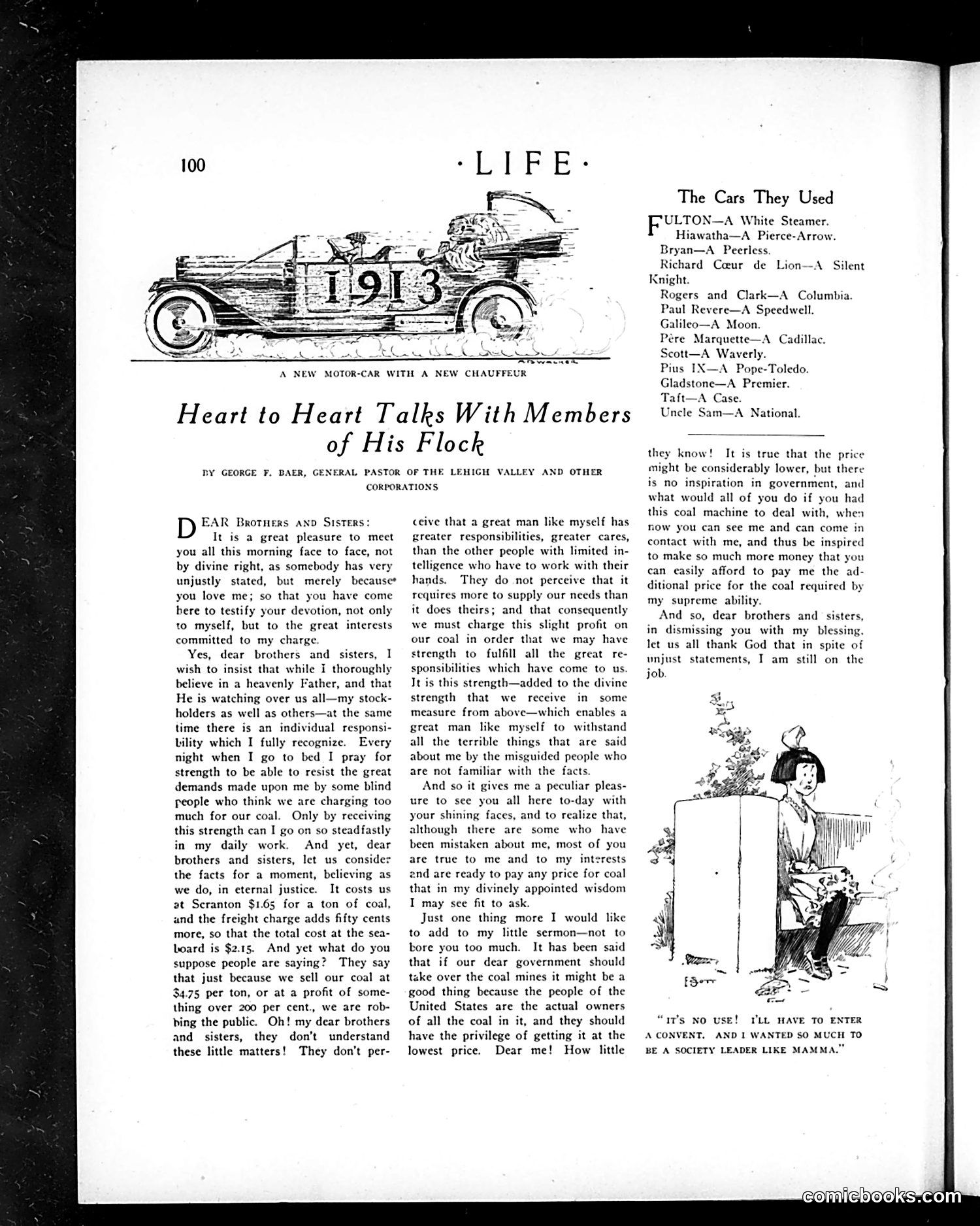
This is a **political cartoon satirizing George F. Baer**, a real coal magnate during the 1902 Anthracite Coal Strike crisis. The text mimics Baer's actual defense of charging exorbitant coal prices (over 200% profit margin). **The satire's targets:** - Baer's religious hypocrisy: he justifies greed by claiming divine appointment and personal moral superiority ("great man like myself") - His paternalism toward workers: addressing them as "dear brothers and sisters" while exploiting them - His circular logic: workers must pay inflated prices so Baer has "strength" to manage them - His opposition to government coal ownership, which would lower prices for ordinary citizens **The illustration** (bottom right) shows a woman entering a convent—apparently inspired by Baer's own daughter, who actually became a nun, suggesting the family benefited from coal profits while rejecting worldly concerns. The page is **pure satire**: the list of cars and their drivers is a separate joke about automobiles popular among the wealthy. The overall effect mocks Baer as a hypocrite using religious language to justify exploitation.
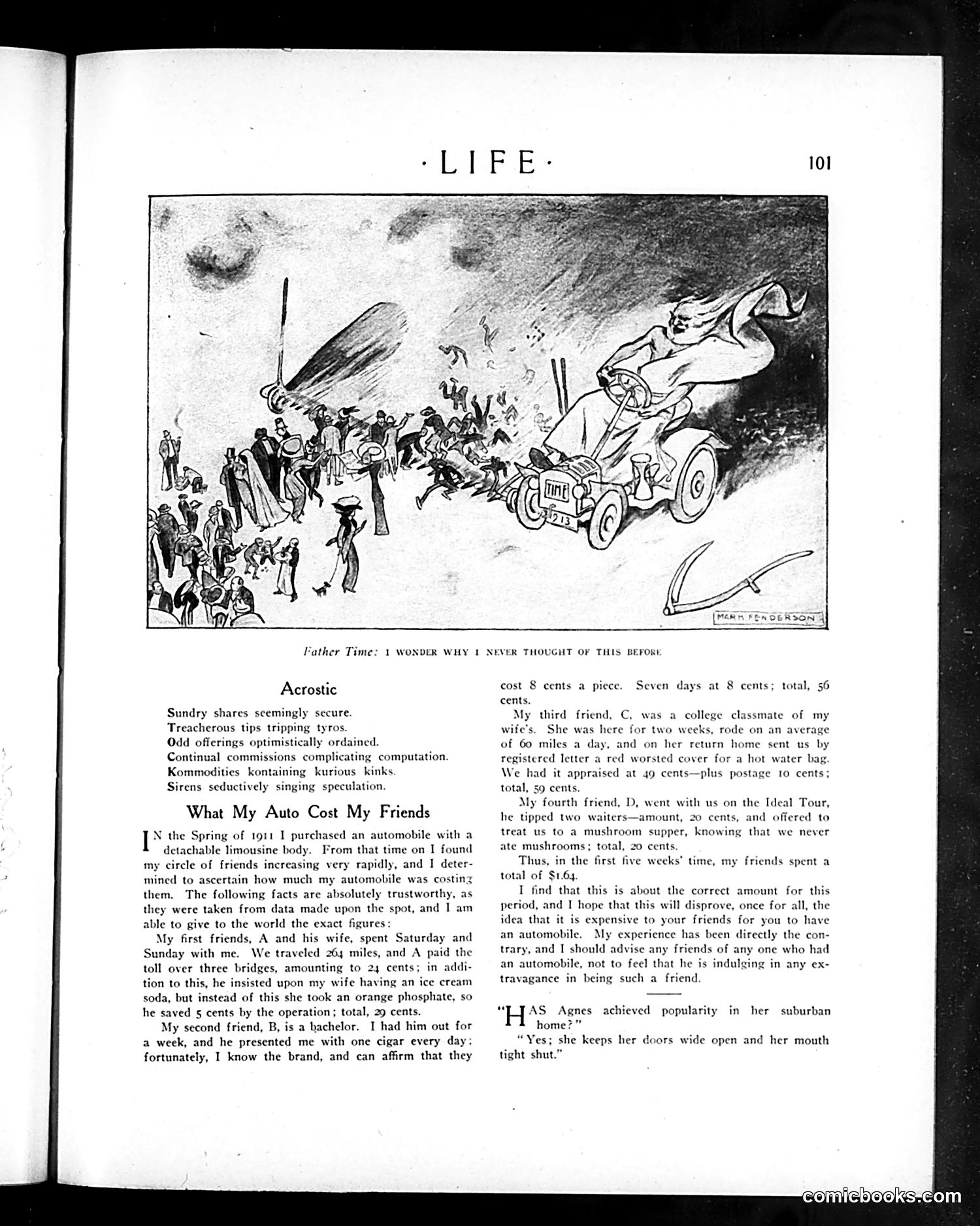
**The Cartoon:** Father Time contemplates giving humans automobiles—a satirical jab at how the automobile, newly commonplace in 1911, has dramatically altered social life. The chaotic crowd and absurd conveyance suggest bewilderment at this transformative technology. **The Main Article:** A humorous essay sarcastically "proves" that owning an automobile doesn't burden friends financially. The author meticulously tracks trivial expenses (bridge tolls, cigars, a hot water bag cover) totaling $1.64 from five visiting friends over five weeks. The deadpan accounting and absurdly low figures constitute the joke—the piece ridicules both automobile owners' penny-pinching anxiety and the pretense of detailed hospitality accounting. **The Acrostic Poem:** A critical commentary on stock market speculation and investment schemes, spelling "STOCK" vertically while warning of treacherous financial tips and risky commodities—reflecting early-20th-century anxieties about unregulated markets.
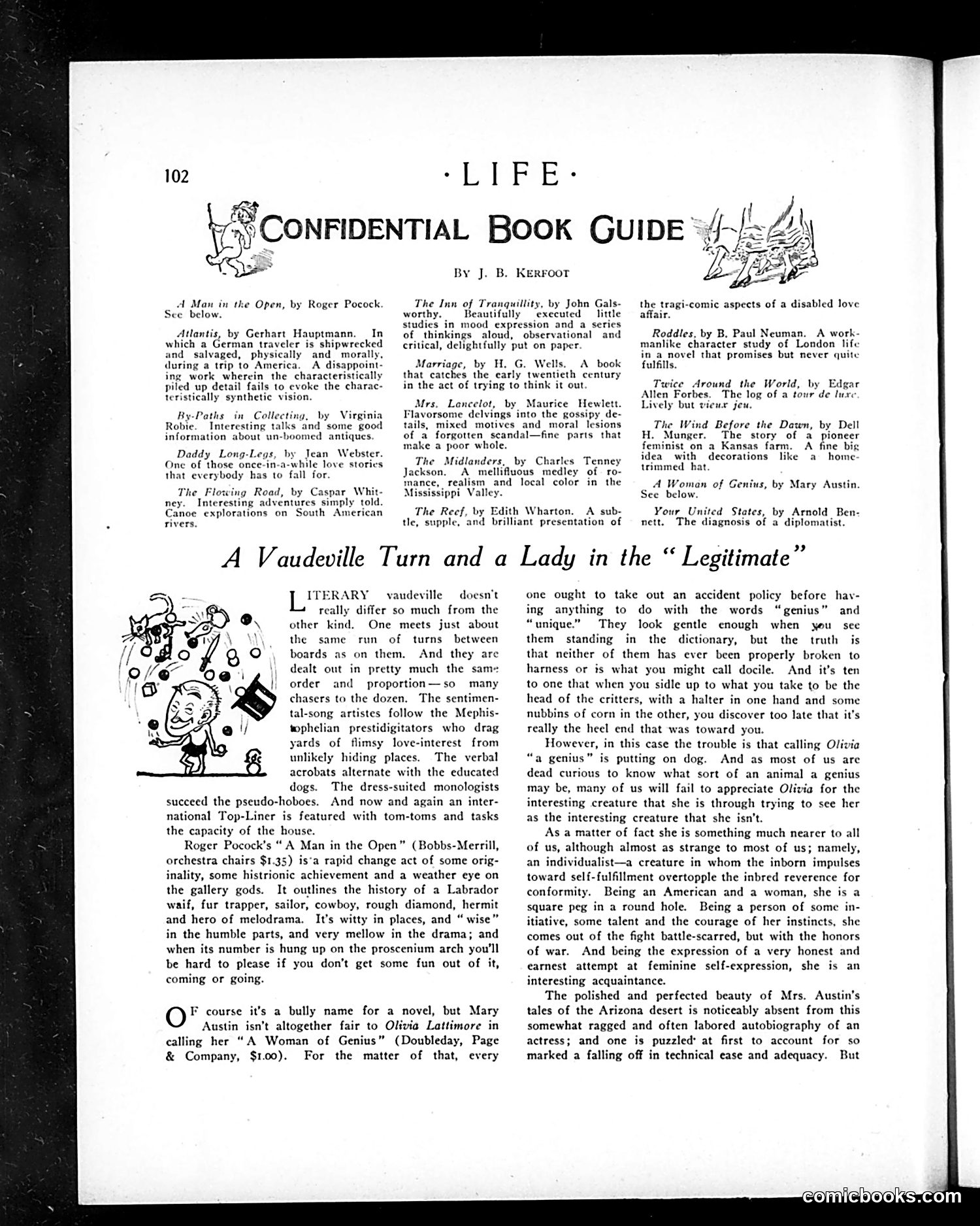
This is a **book review page** from Life magazine's "Confidential Book Guide" by J.B. Kerfoot, reviewing recent novels including works by H.G. Wells, Edith Wharton, and Mary Austin. The small cartoon at left depicts **vaudeville entertainment**—showing a performer amid scattered props and chaos, illustrating the "vaudeville turn" discussed in the main article. The piece compares vaudeville's formulaic structure (sentimental songs, acrobats, trained dogs, monologists) to literary works, suggesting both follow predictable patterns. The article's title references two theatrical genres: vaudeville (lowbrow, variety entertainment) versus the "legitimate" stage (serious drama). The review of Roger Pocock's *"A Man in the Open"* describes it as a rapid-fire entertainment like vaudeville—witty, melodramatic, designed to please audiences. The critique of Mary Austin's *"A Woman of Genius"* suggests the title oversells the protagonist, similar to how entertainers market themselves with grandiose claims. The satire gently mocks both popular entertainment and literary pretension.
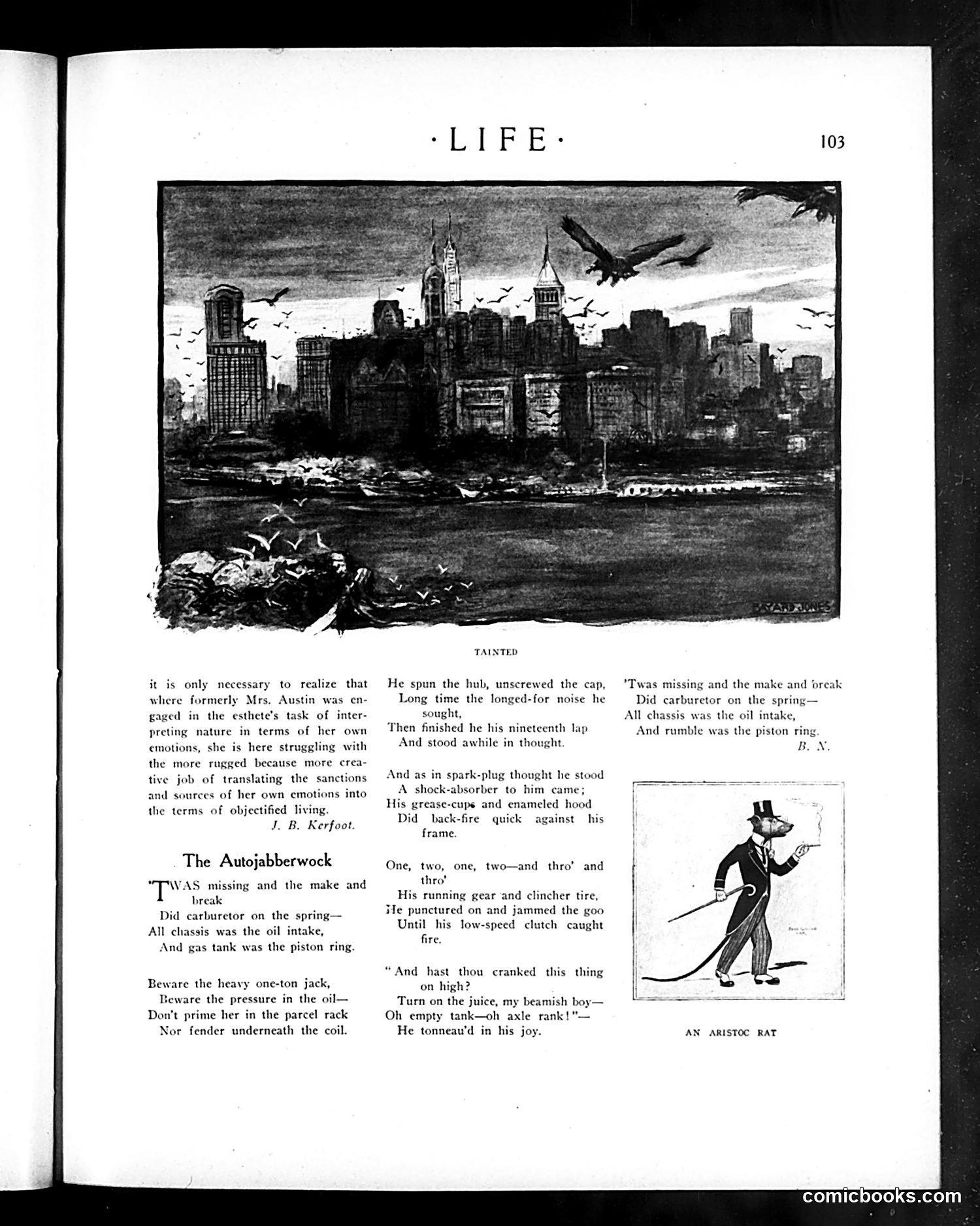
This page contains "The Autojabberwock," a satirical poem that parodies Lewis Carroll's "Jabberwocky" by substituting automotive jargon for nonsense words. The humor targets the early automobile era's mechanical complexity and the frustration of car owners unfamiliar with engines. The poem mocks drivers who attempt repairs without understanding mechanics—spinning hubs, checking spark plugs, and troubleshooting carburetors in absurd sequences. Phrases like "Oh empty tank—oh axle rank!" directly echo Carroll's style while substituting car parts for fantastical creatures. The accompanying illustration "An Aristocrat" (right) shows a well-dressed gentleman with a crank, likely depicting the stereotypical upper-class motorist fumbling incompetently with his vehicle's manual starter. The skyline illustration at top depicts a modern American city (likely New York), with an airplane overhead—emphasizing the contemporary industrial age that occasioned such mechanical bewilderment among society's leisure class.
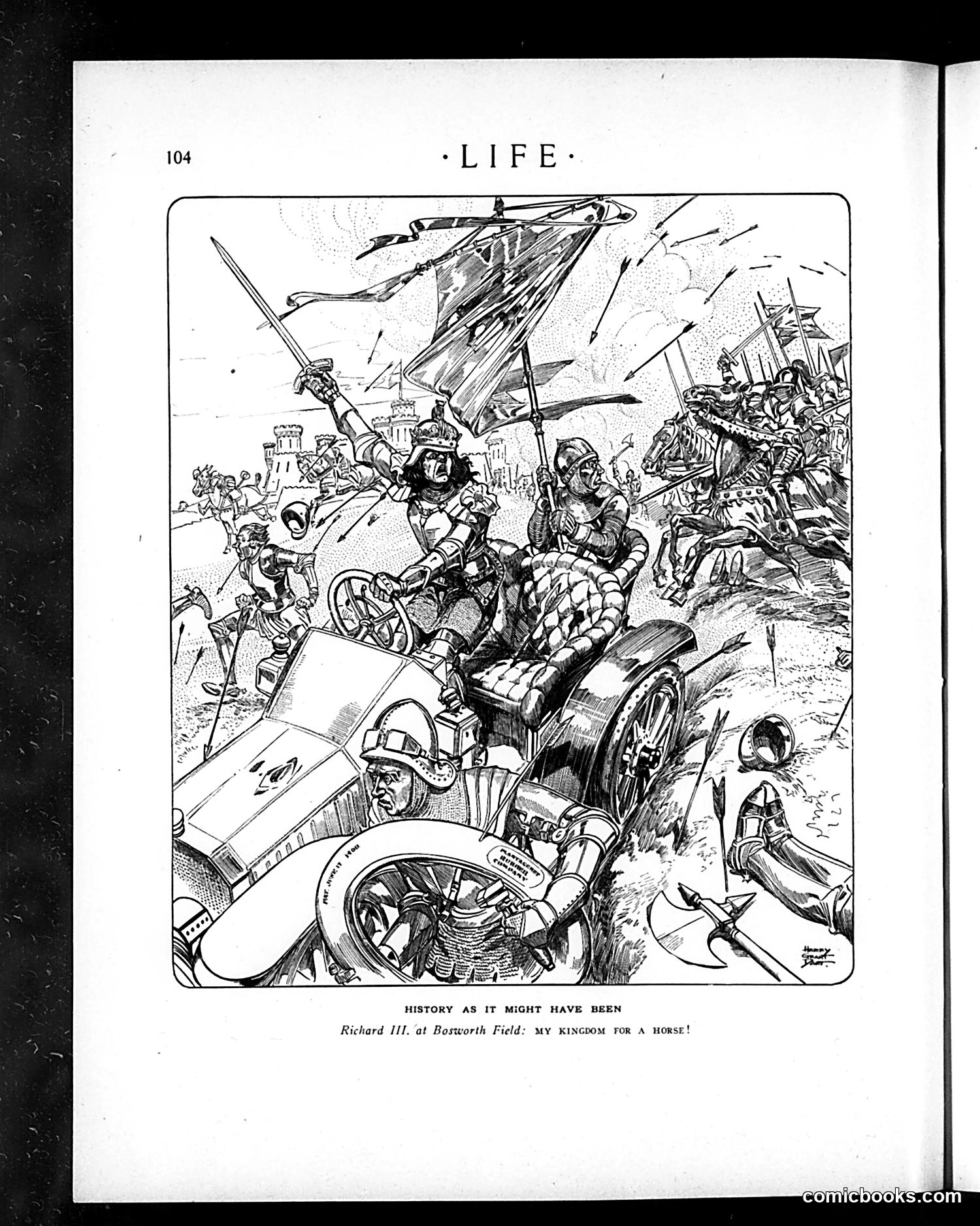
This satirical cartoon reimagines Richard III's famous final plea at the Battle of Bosworth Field (1485) with modern, anachronistic elements. The historical Richard allegedly cried "A horse! A kingdom for a horse!" as he faced defeat. Here, the artist depicts the medieval battle scene overlaid with modern machinery—automobiles, airplanes, and military vehicles—creating absurdist humor by suggesting "what if" historical figures had possessed contemporary technology. The crowded, chaotic composition mixes armored medieval soldiers with modern warfare equipment. The satire likely comments on how technology transforms warfare, or perhaps mocks the idea that historical outcomes could be altered by modern advantages. The juxtaposition of ancient and modern creates comedic incongruity, inviting readers to imagine how differently history might have unfolded with 20th-century tools.
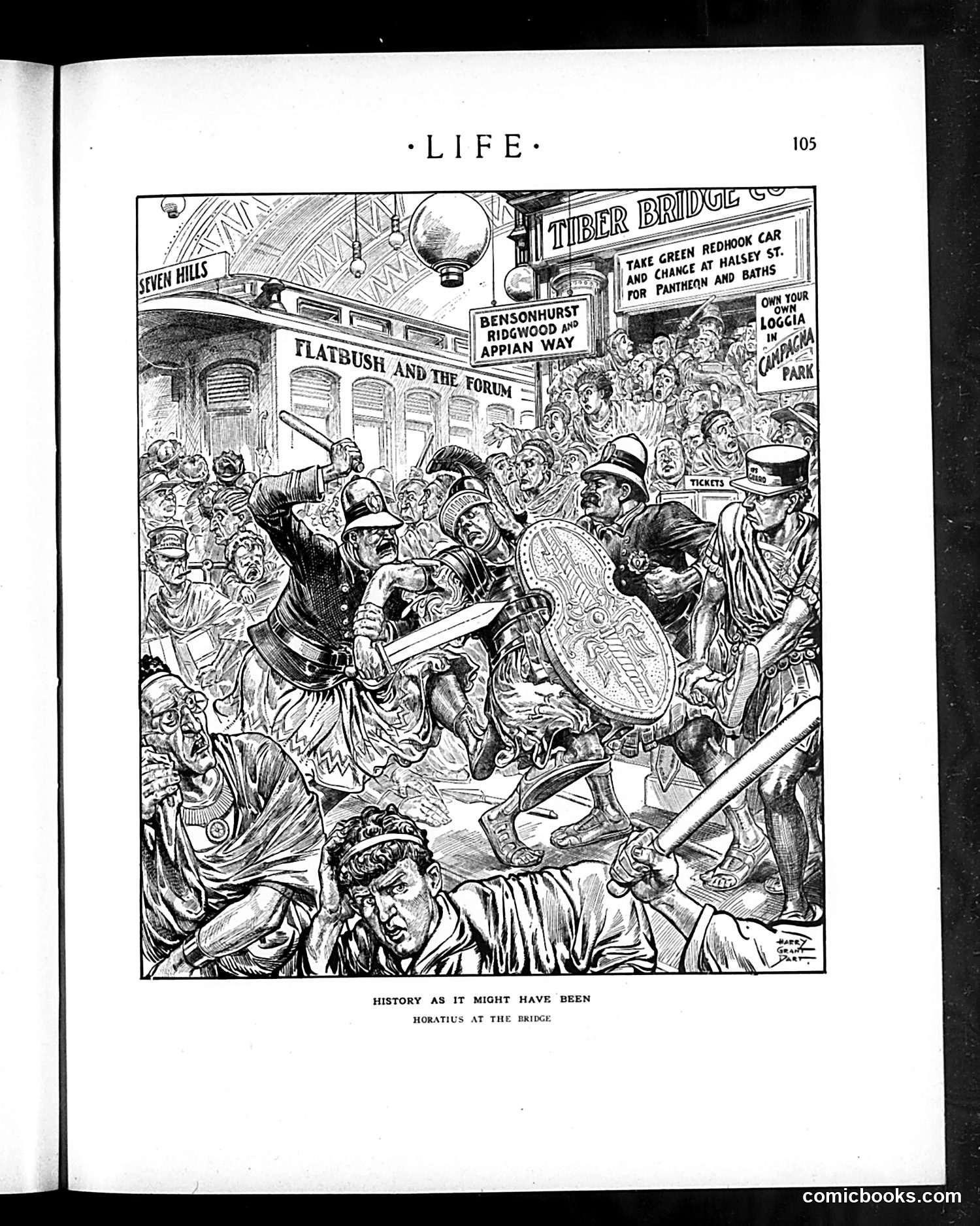
This is a humorous reimagining of the famous classical story "Horatius at the Bridge"—where the Roman hero Horatius defended a bridge against invaders. However, the cartoon relocates this ancient battle to modern London locations visible in the signage: "Seven Hills," "Flatbush and the Forum," "Bensonhurst," "Tiber Bridge Co.," and references to London transit ("Green Redhook Car," "Pantheon and Baths"). The satire juxtaposes Roman military heroism with contemporary urban chaos—a crowded, chaotic modern street scene replaces the heroic ancient narrative. The anachronistic mixing (Roman soldiers and shields amid 1920s crowds and advertisements) creates absurdist humor by treating mundane modern city life as if it were legendary historical drama. The joke mocks both excessive romanticization of the classical past and the ordinary chaos of modern urban existence.
This is a Henry Van Dyke short story (not a cartoon) satirizing New York's literary and publishing establishment through classical mythology. Diana, the Roman goddess of the hunt, encounters "Lions" on library steps—which are actually **personified literary institutions**: a Magazine Lion and an Academic Lion. The satire mocks: 1. **Literary pretension**: The "Lions" are timid creatures obsessed with propriety, hiding behind "Who's Who in America" rather than displaying genuine intellectual courage. 2. **Anti-Roosevelt sentiment**: The Magazine Lion boasts of escaping Roosevelt, calling him "Mucky"—reflecting early 1900s Progressive Era political tensions. 3. **Publishing world vanity**: References to "Book-Advertisements" and competitive noise-making between publications satirize aggressive commercial publishing tactics. The piece presents New York's literary scene as full of self-important but ultimately cowardly institutions, reduced to blushing at Diana's minimal clothing rather than engaging substantively with her.
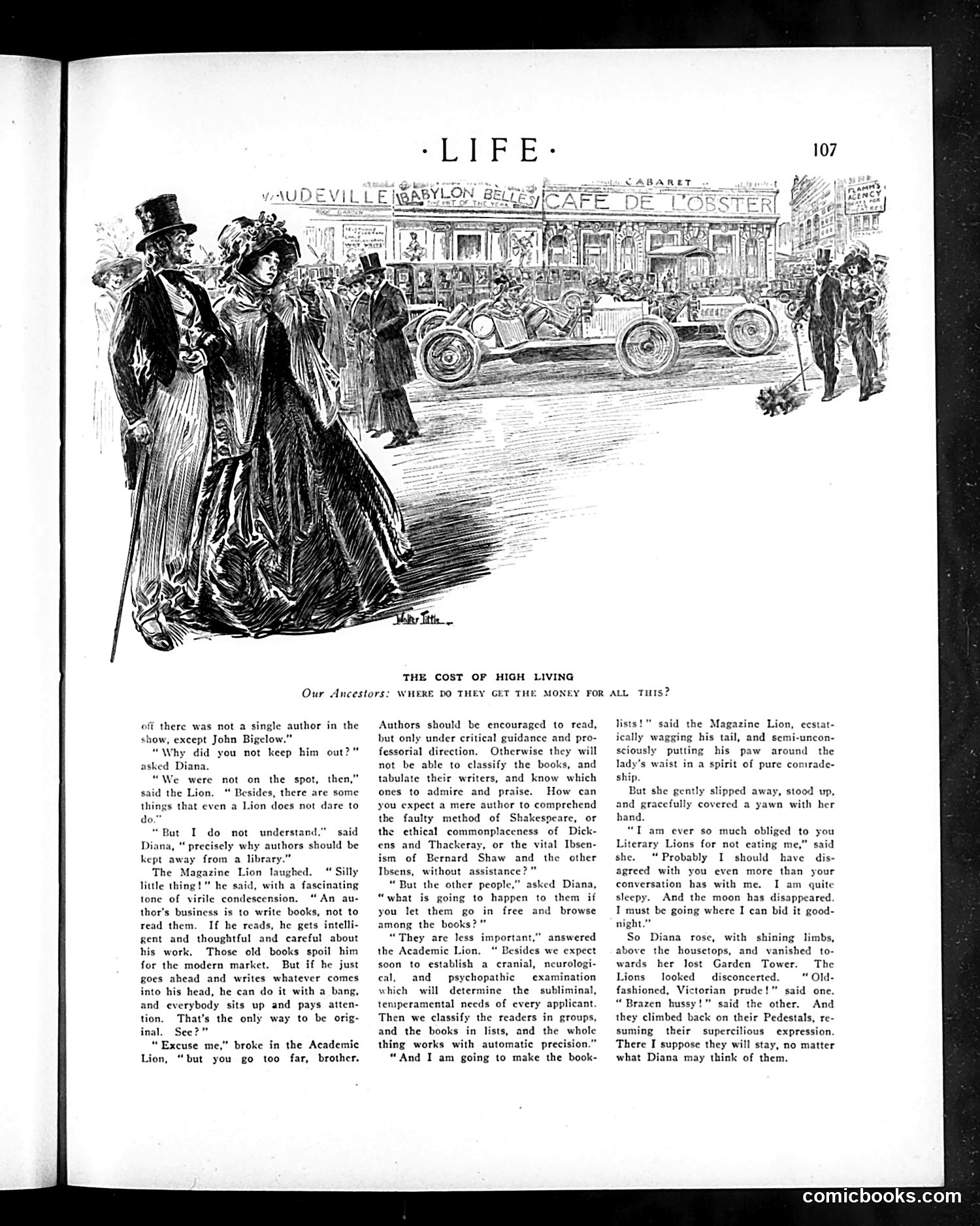
This satirical dialogue mocks intellectual pretension and gatekeeping in early 20th-century literary institutions. **The Setup:** Diana (representing the public or common sense) encounters two "Lions"—personifications of competing literary establishments—debating library access and reading. **The Satire:** - The **Magazine Lion** represents commercial publishers who profit from dumbed-down content, arguing authors shouldn't read serious literature because it makes their work too thoughtful and unmarketable. - The **Academic Lion** represents universities/scholars who over-complicate access through pseudo-scientific classification systems and "professional guidance," gatekeeping knowledge behind institutional authority. **The Point:** Both institutions exclude ordinary people from free intellectual access—one through commercialism, one through elitism—while pretending to serve the public good. Diana's dignified exit suggests the public is wiser than these self-important "authorities" competing over who controls culture and knowledge. The illustration shows a fashionable Parisian street scene, emphasizing that this critique applies to established cultural centers and their snobbish gatekeepers.
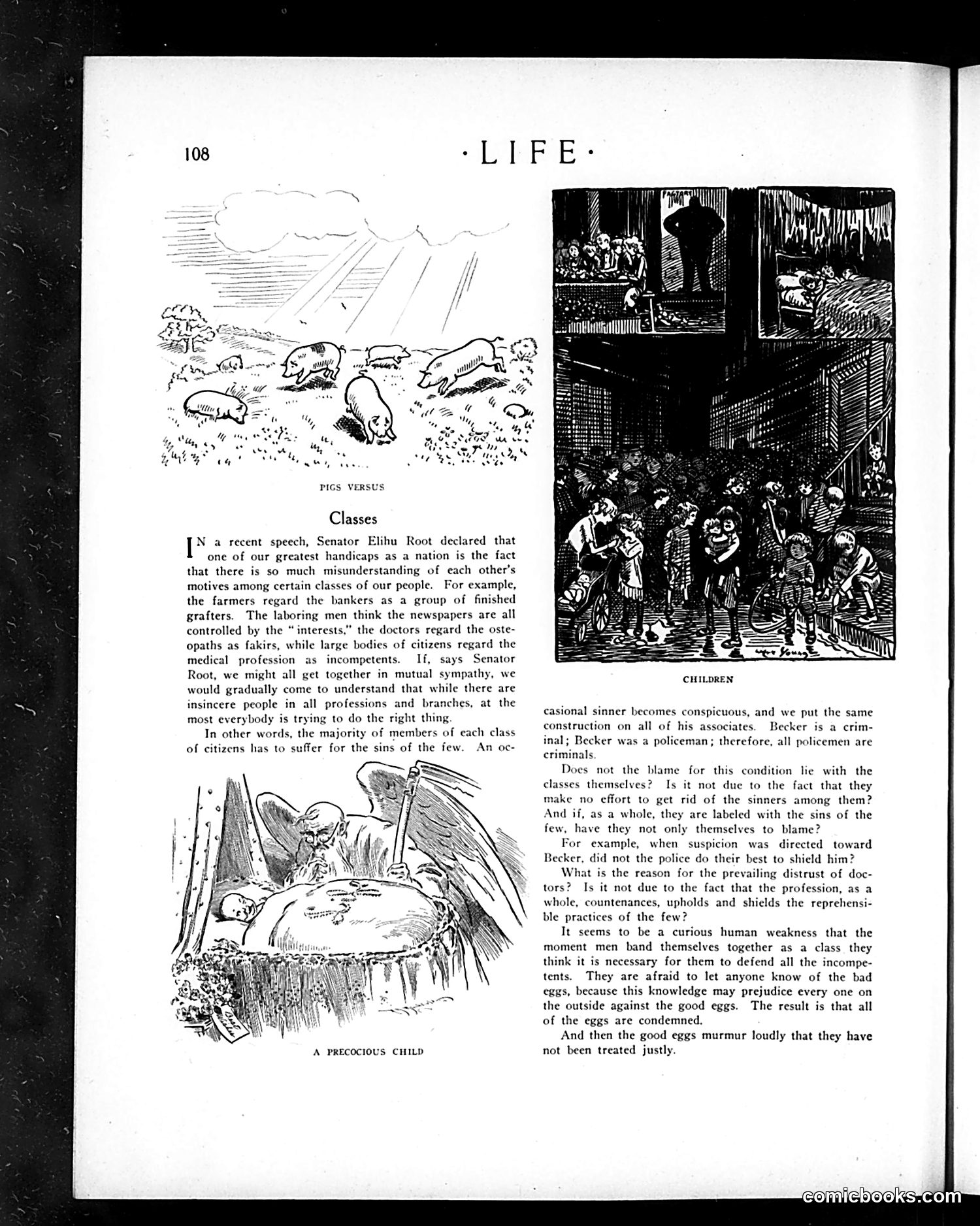
This page satirizes class divisions and professional corruption in early 20th-century America. Senator Elihu Root's argument—that mutual understanding between classes would reduce prejudice—is critiqued as incomplete. The essay uses "Becker" (likely Police Commissioner Charles Becker, convicted of corruption around 1912) as a case study: when one policeman is criminal, the entire profession gets blamed because the police force protects its own rather than disciplining wrongdoers. The central argument: professions actively shield corrupt members, then complain unfairly when all members face suspicion. The "good eggs" refuse to expel "bad eggs," so outsiders condemn the entire group. The cartoons illustrate class conflict ("Pigs Versus") and childhood innocence corrupted by institutional loyalty—suggesting that professional self-protection, not class misunderstanding, drives distrust.
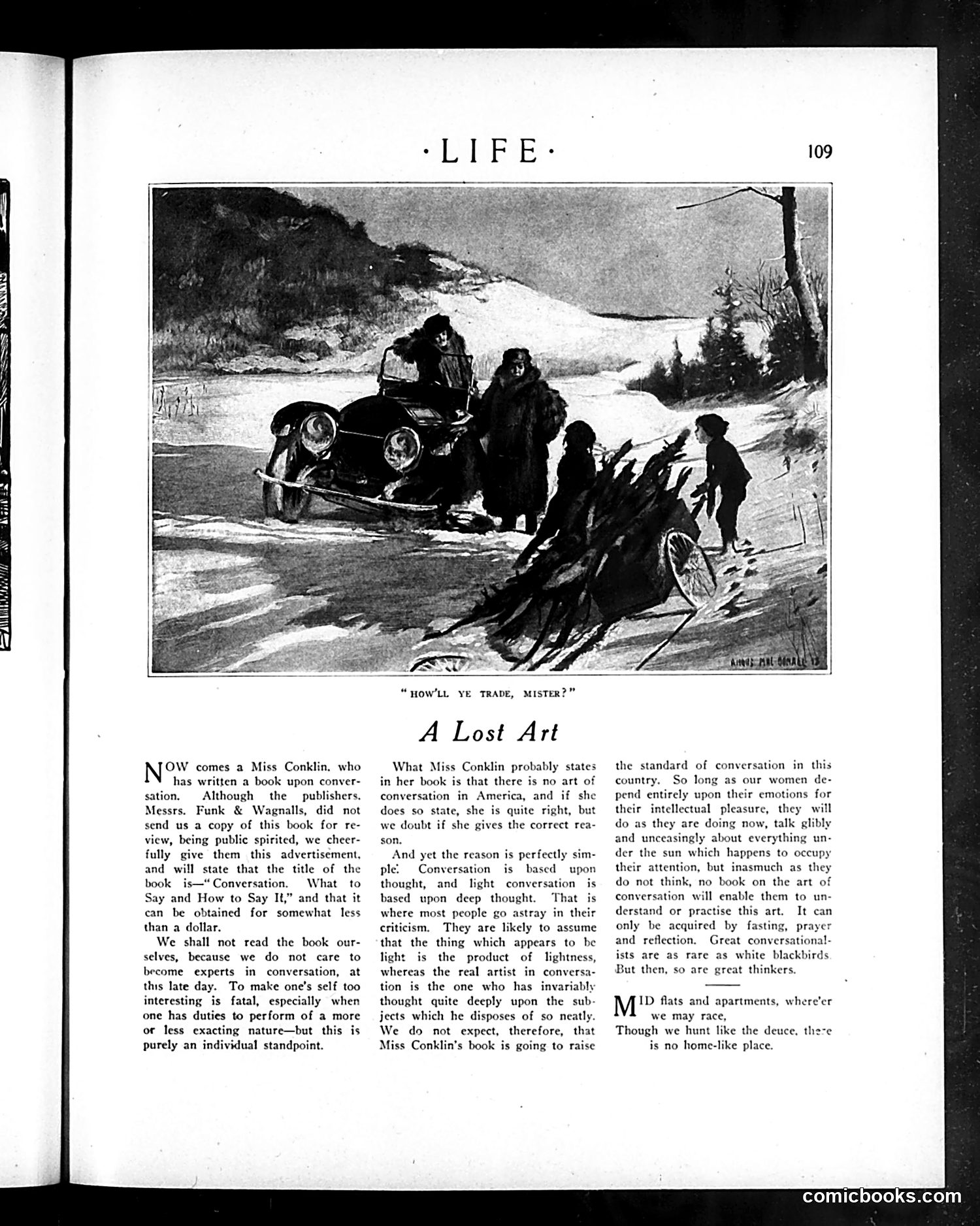
This satirical piece mocks a newly published book on conversation etiquette by Miss Conklin. The cartoon depicts a winter scene where fashionable people in an automobile encounter rural folk, with the caption "How'll ye trade, mister?"—suggesting the vast gap between polite urban conversation and plain rural speech. The article's satire operates on two levels: Life pretends to praise the book while actually dismissing it as useless. The core argument is that Americans—particularly women—lack the intellectual depth necessary for genuine conversation. The author argues that true wit requires deep thought, not mere emotional chatter. The dismissal of women as dependent on "emotions" rather than "intellectual pleasure" reflects period gender stereotypes. The cartoon illustrates this point visually: the sophisticated urbanites and humble country people literally cannot communicate across their social divide. The implication is that no etiquette book can bridge such fundamental differences in education and class.
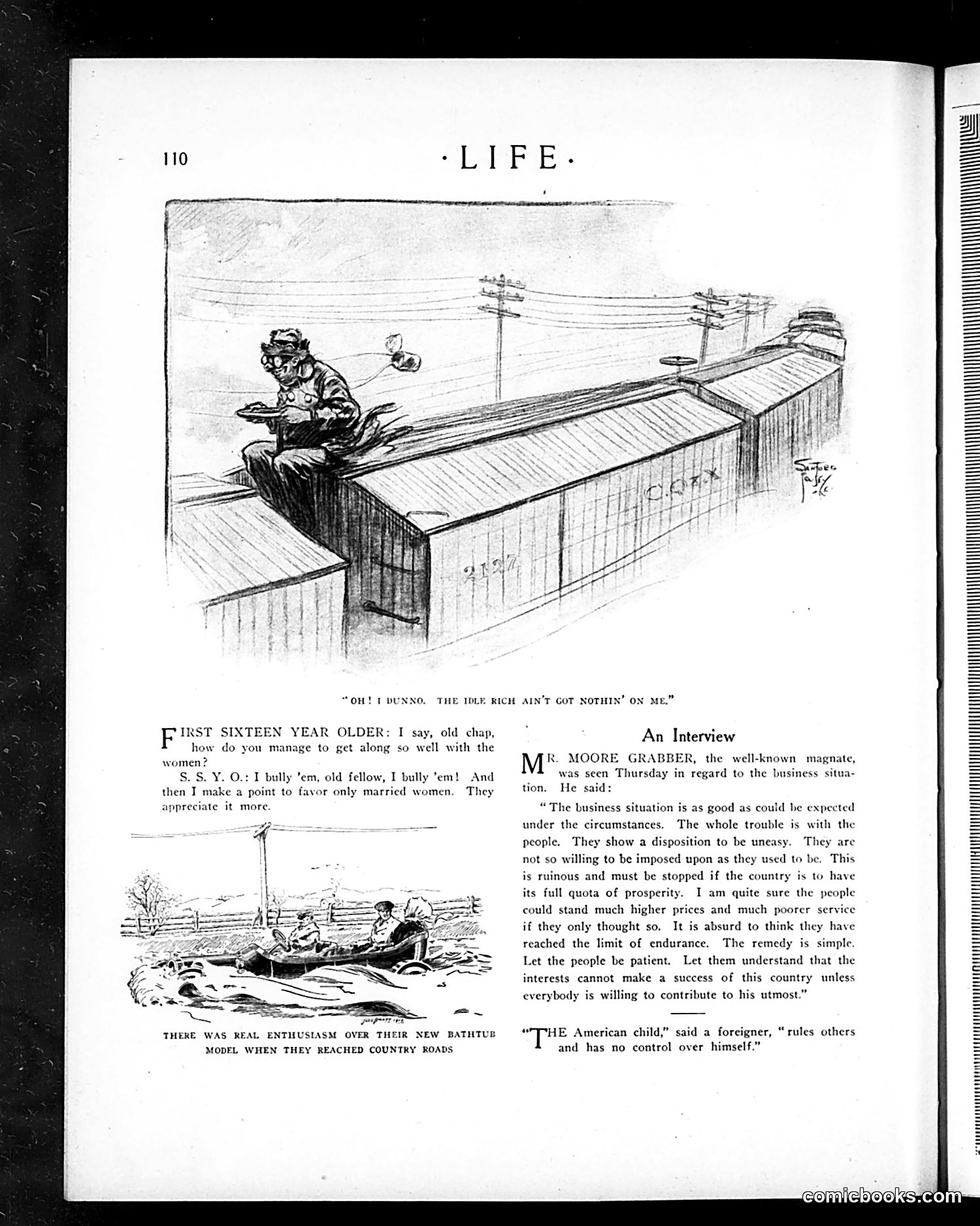
This page contains two satirical pieces critiquing American society circa the early 20th century. The top cartoon mocks working-class men's attitudes toward women, with a young man boasting he "bullies" women into compliance, particularly married women who "appreciate it more." The crude humor reflects period sexism while satirizing masculine bravado. The interview with "Moore Grabber" (a transparent pun on a greedy businessman) is sharper political satire. The magnate blames workers' uneasiness for economic troubles, arguing people should accept "higher prices and much poorer service" without complaint. He claims prosperity requires absolute worker obedience. Life magazine is mocking this robber-baron mentality—the arrogance of wealthy industrialists who view public discontent as the problem rather than their exploitation. The final foreign observation about American children—ruling others while lacking self-control—extends the critique to national character. This reflects Progressive Era anxieties about labor unrest and capitalism's excesses.
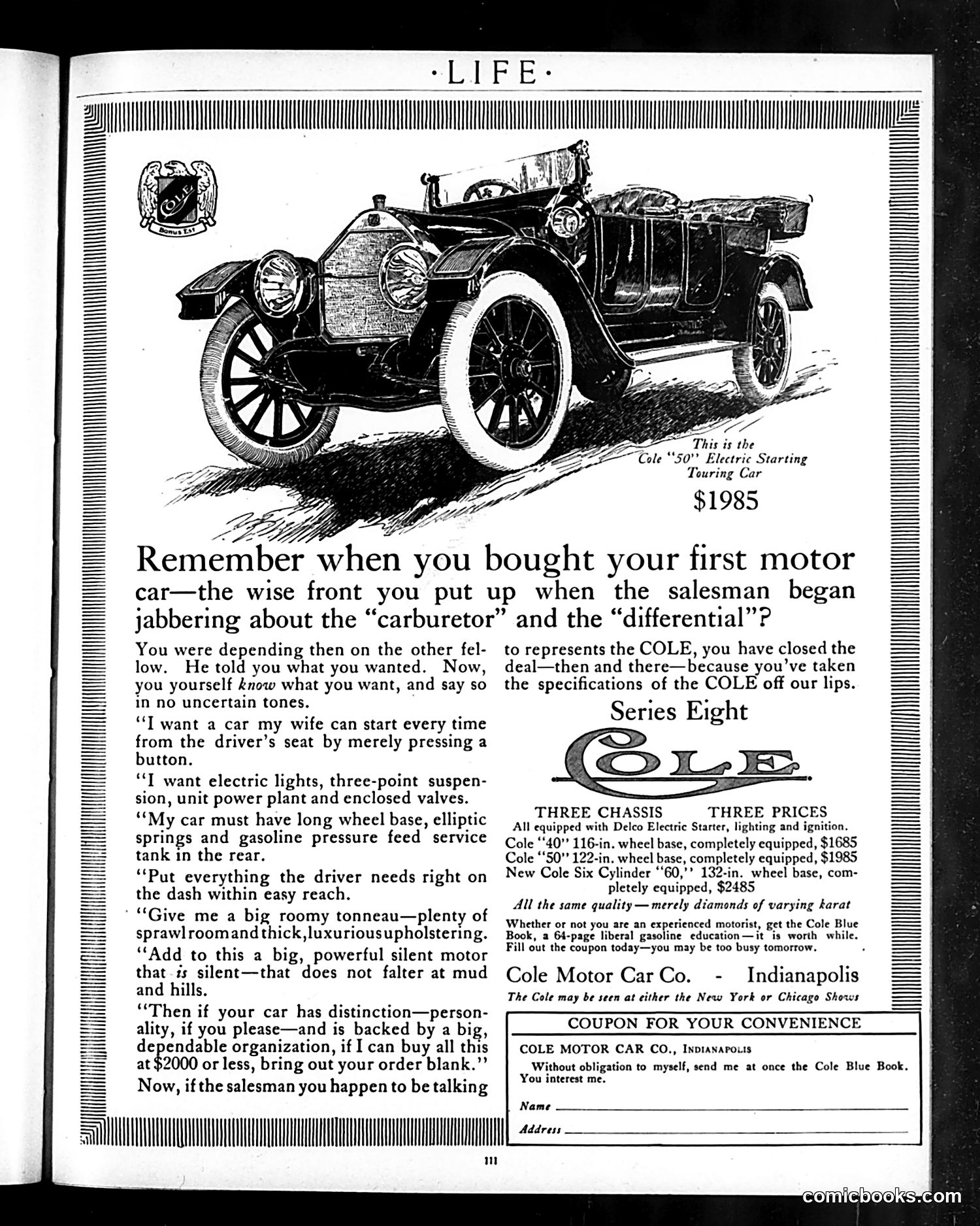
This page is primarily a **Cole Motor Car advertisement**, not satire. It appeared in *Life* magazine during the early automotive era (likely 1910s, based on the vehicle design and pricing). The "cartoon" element is the narrative framing: it humorously depicts an everyman customer who initially felt intimidated by car salesmen's jargon ("carburetor," "differential") but now—as an informed buyer—confidently demands specific features. The joke is gentle: the customer has become so knowledgeable he can rattle off technical specifications, and the salesman's job is now simply to confirm the Cole meets these demands. The ad's point: Cole cars embody exactly what modern, discerning customers want—electric starters (revolutionary for women drivers), comfortable seating, powerful engines, and prestigious manufacturing. By aligning Cole with the customer's newfound expertise, the ad positions the car as the obvious choice for the intelligent buyer who knows what he wants.
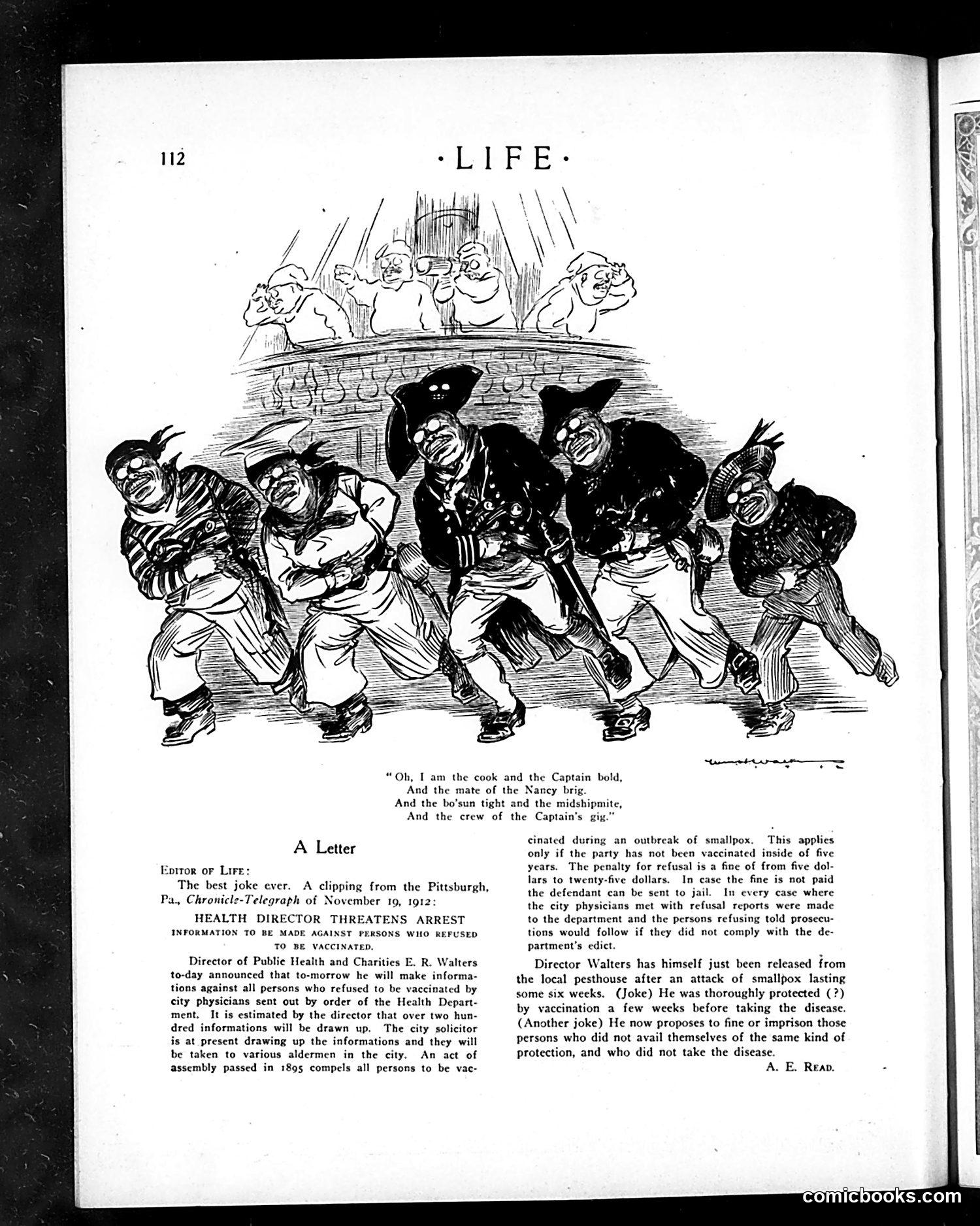
This page satirizes public health overreach during a smallpox crisis. The top cartoon shows military/naval figures (referencing Gilbert & Sullivan's *HMS Pinafore*)—a visual joke about bureaucratic absurdity. The main text is a letter mocking Pittsburgh's Health Director E. R. Walters, who threatened to arrest citizens refusing vaccination. The satire's punch: **Walters himself just recovered from smallpox despite being recently vaccinated**, yet now demands others be vaccinated under threat of fines and jail. The author uses this contradiction to argue vaccination's unreliability and question the government's authority to mandate medical procedures. This represents early anti-vaccination sentiment and distrust of public health mandates—concerns that resurface periodically throughout history. The "jokes" highlighted sardonically note Walters' failed vaccination protection, undermining his credibility to enforce it on others.
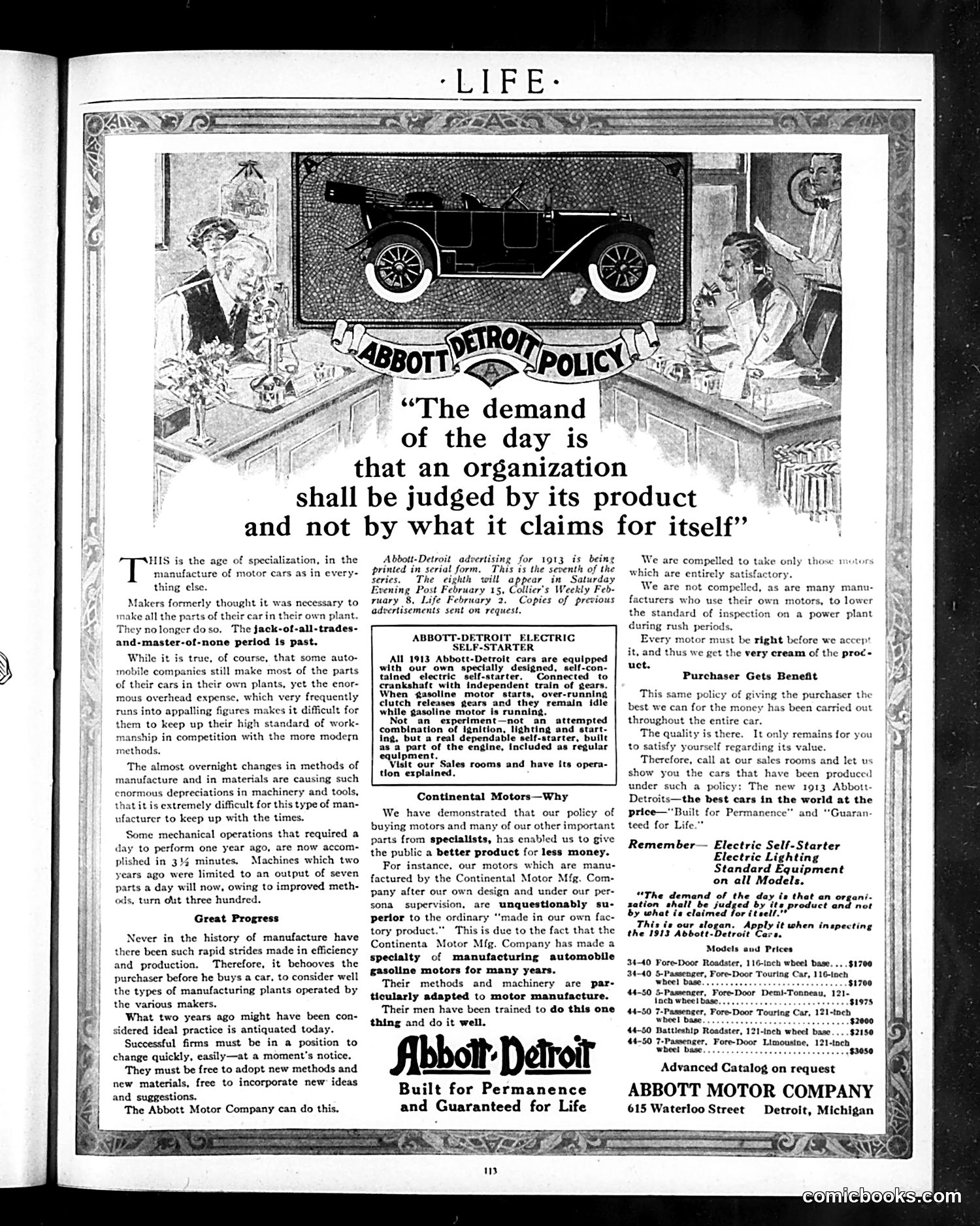
This is primarily an **automobile advertisement** rather than political satire. The 1913 Abbott-Detroit company uses the prominent quote—"an organization shall be judged by its product and not by what it claims for itself"—to argue for **manufacturing specialization** over vertical integration. The advertisement contrasts two approaches: traditional manufacturers who make all car parts in-house (now "antiquated") versus modern firms that outsource to specialists. Abbott-Detroit emphasizes buying motors from Continental Motor Manufacturing Company, claiming this produces superior quality at lower cost than in-house production. The cartoon figures flanking the car appear to represent business decision-makers, though they're not identified. The "Detroit Policy" banner suggests this reflects contemporary manufacturing trends in Detroit's auto industry. The underlying message: don't judge us by claims of self-sufficiency—judge us by our superior final product, made possible through modern outsourcing practices.
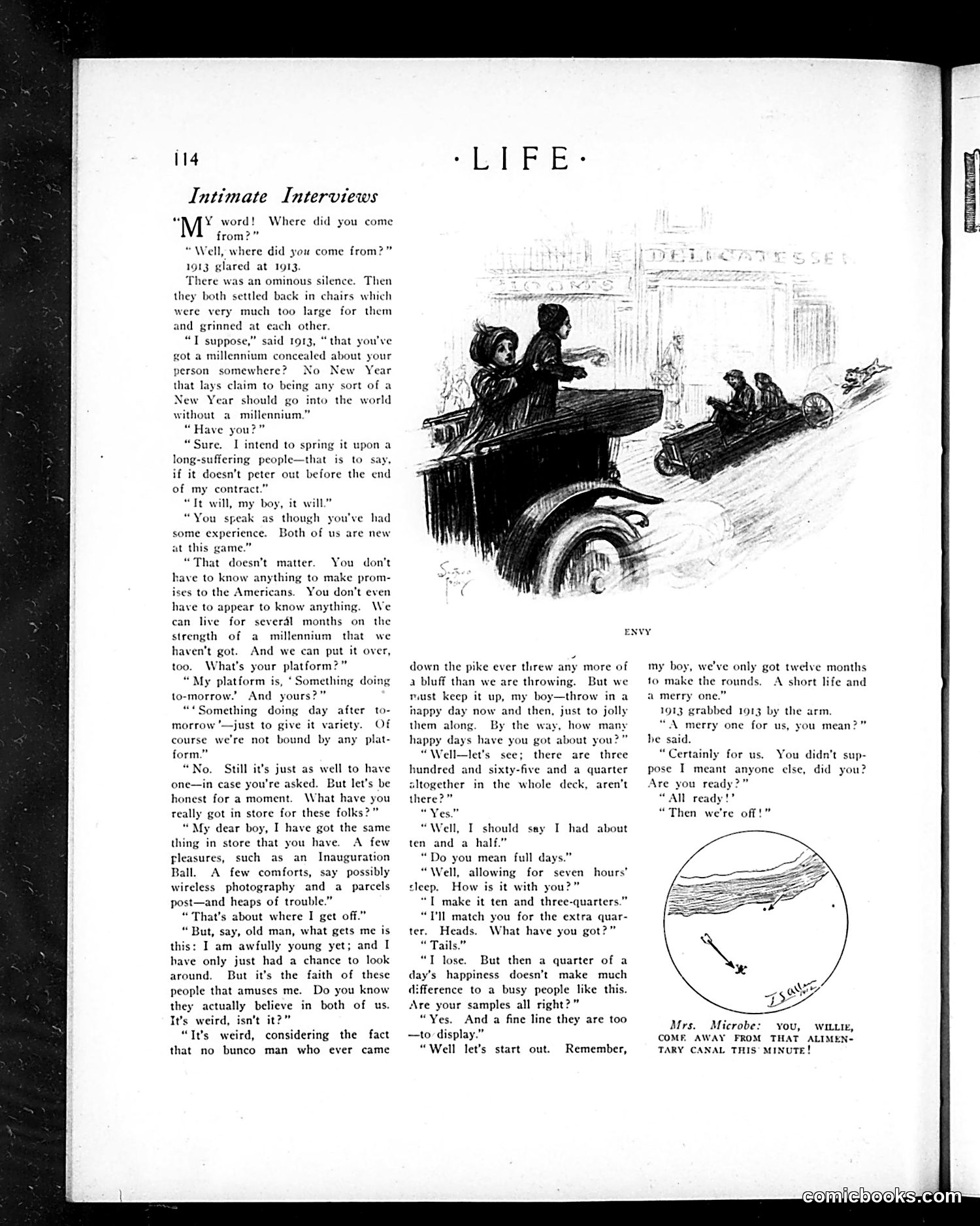
This satirical dialogue personifies the years 1912 and 1913 as two con artists ("bunco men") meeting to exchange notes. The joke targets American gullibility and political empty promises. The two years discuss their "platforms"—vague commitments like "Something doing to-morrow" versus "day after to-morrow"—acknowledging these are meaningless bluffs that citizens naively believe in anyway. They cynically admit they have little of substance to deliver: only an Inauguration Ball, maybe wireless photography, and "heaps of trouble." The satire mocks both the public's faith in political promises and the years themselves as fraudsters with nothing real to offer. The final cartoon (captioned "ENVY") appears unrelated—a domestic scene with Mrs. Microbe scolding creatures, likely a separate joke about microscopic life. This reflects 1913 Progressive Era skepticism toward political rhetoric and institutional reform promises.
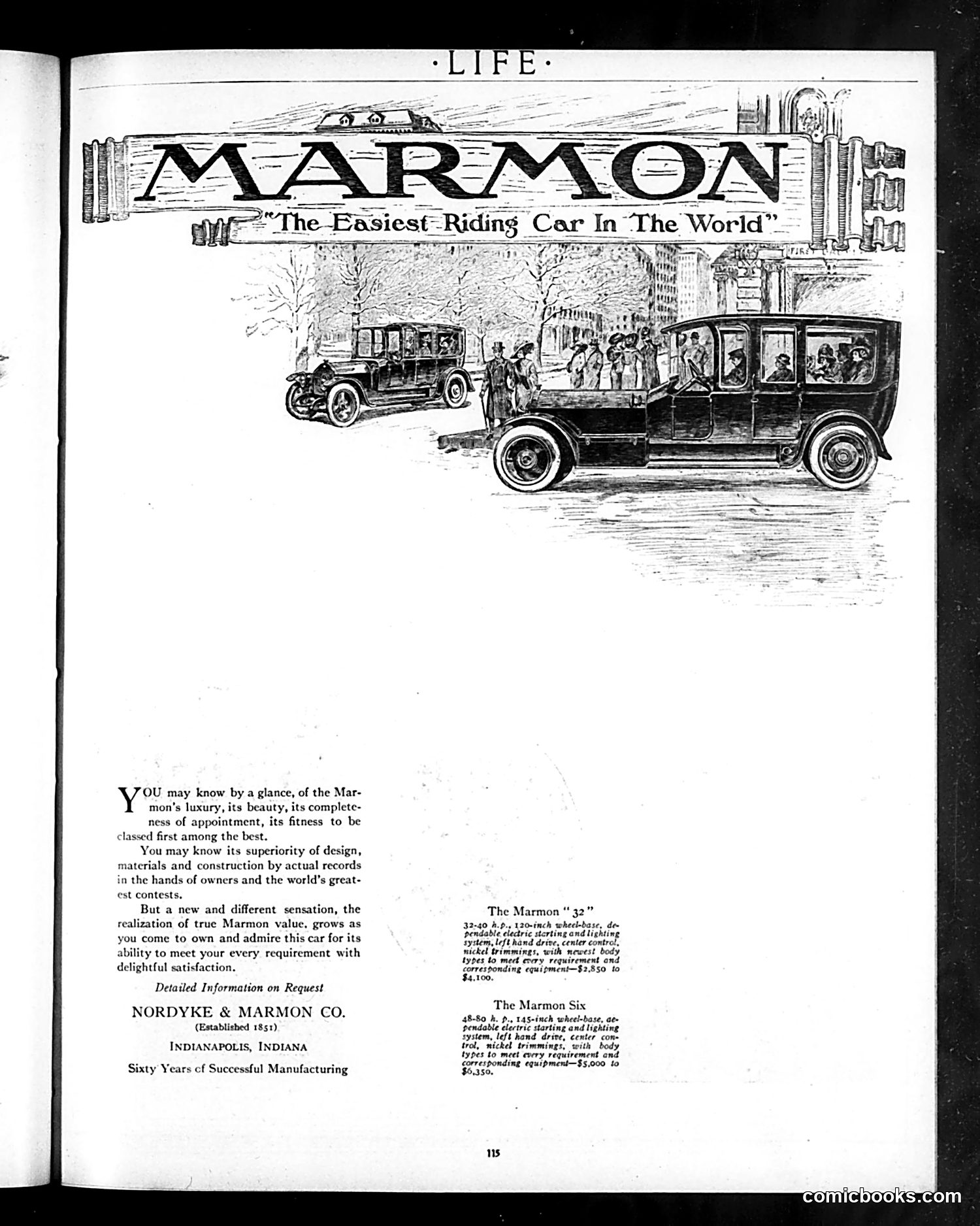
This page is primarily a **product advertisement** for Marmon automobiles, manufactured by Nordyke & Marmon Co. of Indianapolis. There is no political cartoon or satire present. The advertisement showcases two Marmon car models (the "32" and the "Six") through illustrated drawings showing the vehicles in urban settings with well-dressed passengers. The copy emphasizes the car's luxury, design superiority, and reliability, claiming it meets "every requirement with delightful satisfaction." The text appeals to affluent buyers by highlighting the car's track record in competitions and owner testimonials. Pricing ranges from $2,850 to $5,350—substantial sums for the era, indicating this was a premium vehicle targeting wealthy consumers. The tagline "The Easiest Riding Car in the World" was a common marketing claim of the period, emphasizing comfort and advanced engineering.
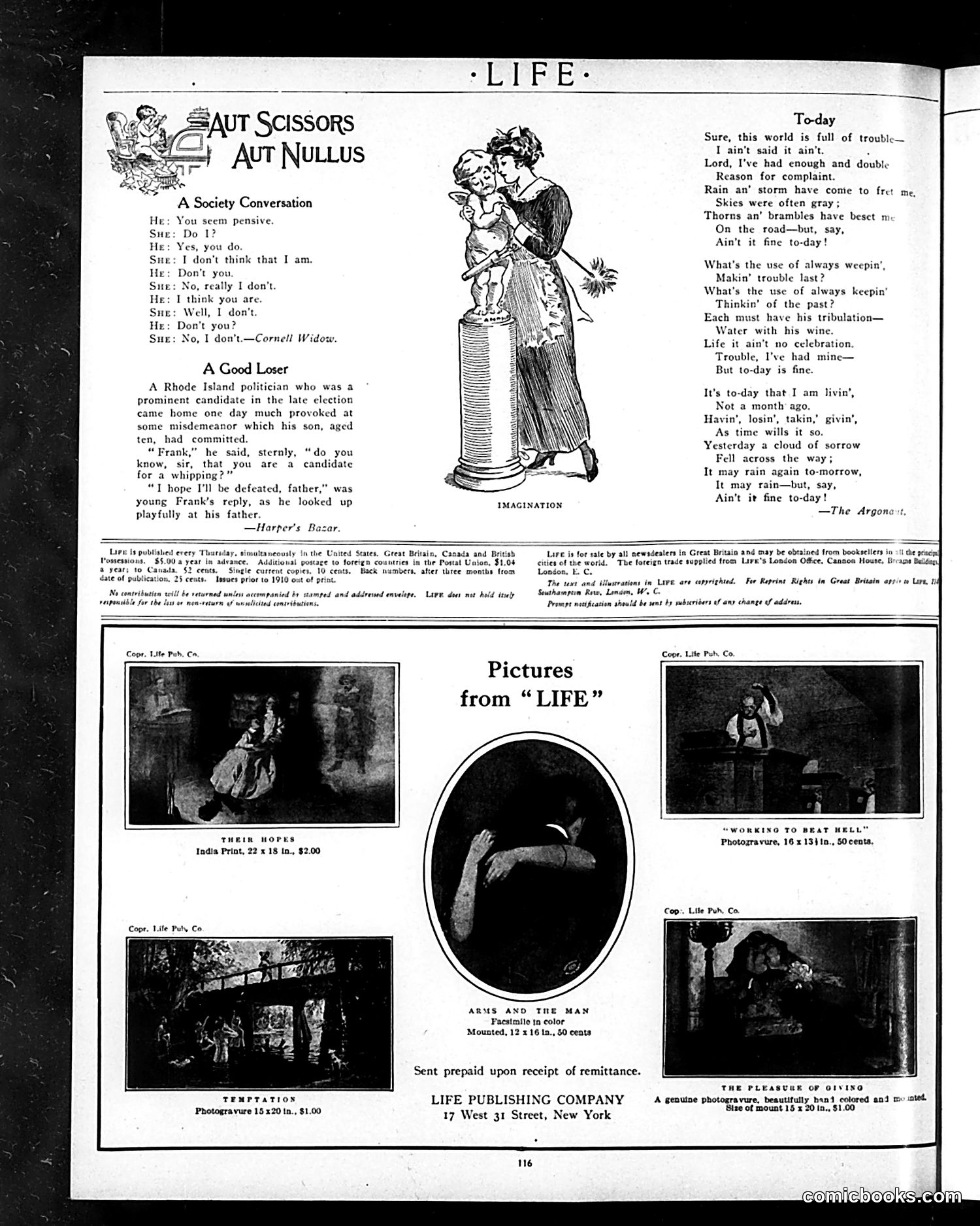
This page from *Life* magazine contains three humor pieces targeting social conventions of the era: **"A Society Conversation"** mocks vapid upper-class banter—a couple engaged in pointless disagreement about whether the woman seems "pensive," repeating the same exchange without substance. **"A Good Loser"** presents a political anecdote: a Rhode Island politician running for office comes home angry at his ten-year-old son's misbehavior and threatens punishment. The boy cleverly deflates the threat by saying "I hope I'll be defeated, father"—a joke comparing the punishment to an election loss, suggesting even children recognize political language as hollow. **"To-day"** is a sentimental poem about finding joy in the present moment despite life's hardships—typical feel-good verse of the period. The page footer advertises photogravure prints available for purchase, representing *Life's* secondary revenue stream beyond magazine sales. The satire reflects early 20th-century concerns with social pretension and political phoniness.
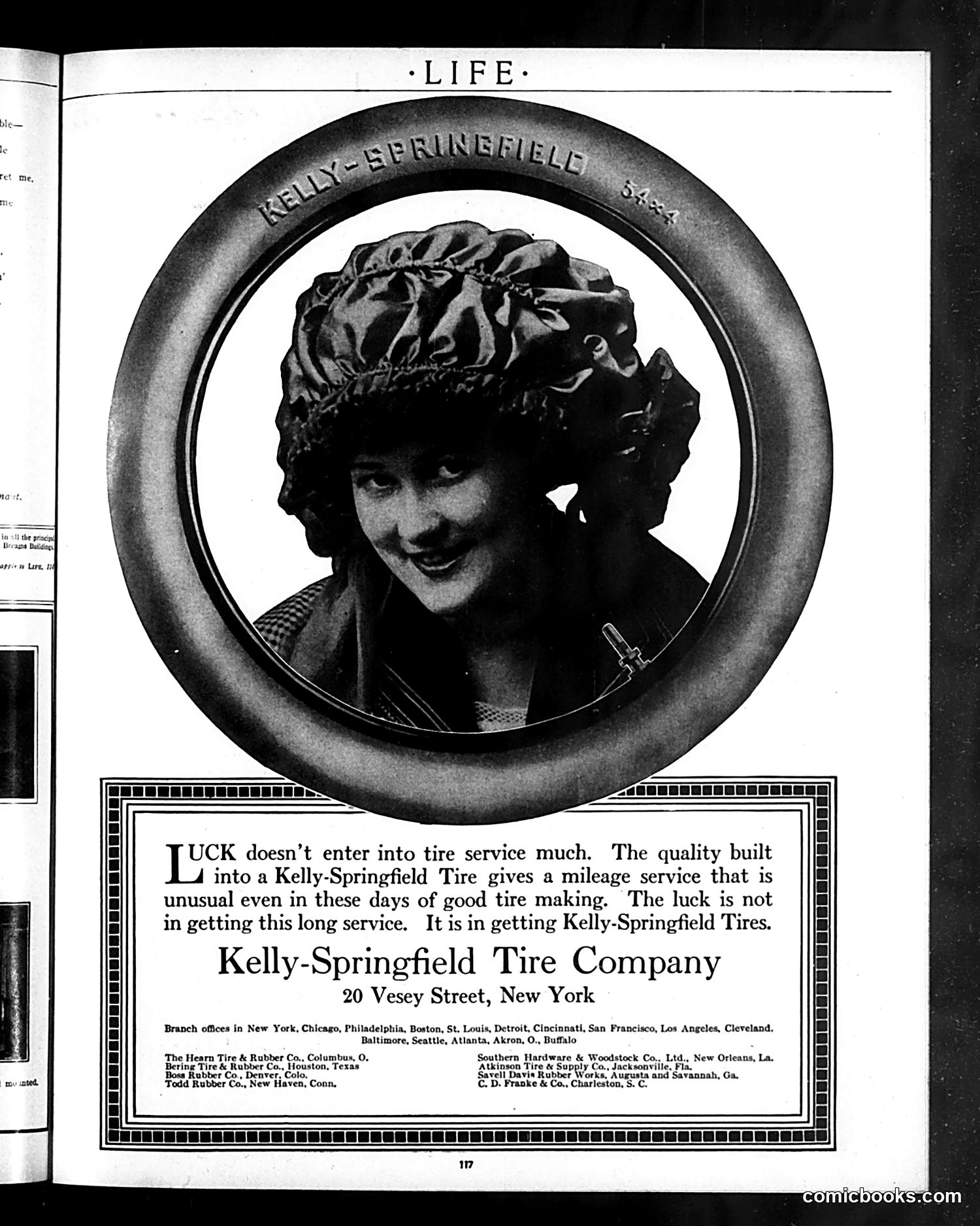
This page is primarily a **Kelly-Springfield Tire Company advertisement** rather than satire or political content. The image features a woman's portrait framed within a tire, and the ad copy uses a play on words: "LUCK doesn't enter into tire service much." The joke is that getting long tire life isn't about luck—it's about buying Kelly-Springfield brand tires, which are supposedly engineered for durability. There is no political cartoon or satirical commentary here. This is straightforward commercial advertising from the early-to-mid 20th century, typical of *Life* magazine's revenue model. The woman's image and elegant presentation were common advertising conventions of the era, using attractive portraiture to sell consumer products. The extensive list of branch offices and distributors demonstrates the company's national reach during this period.
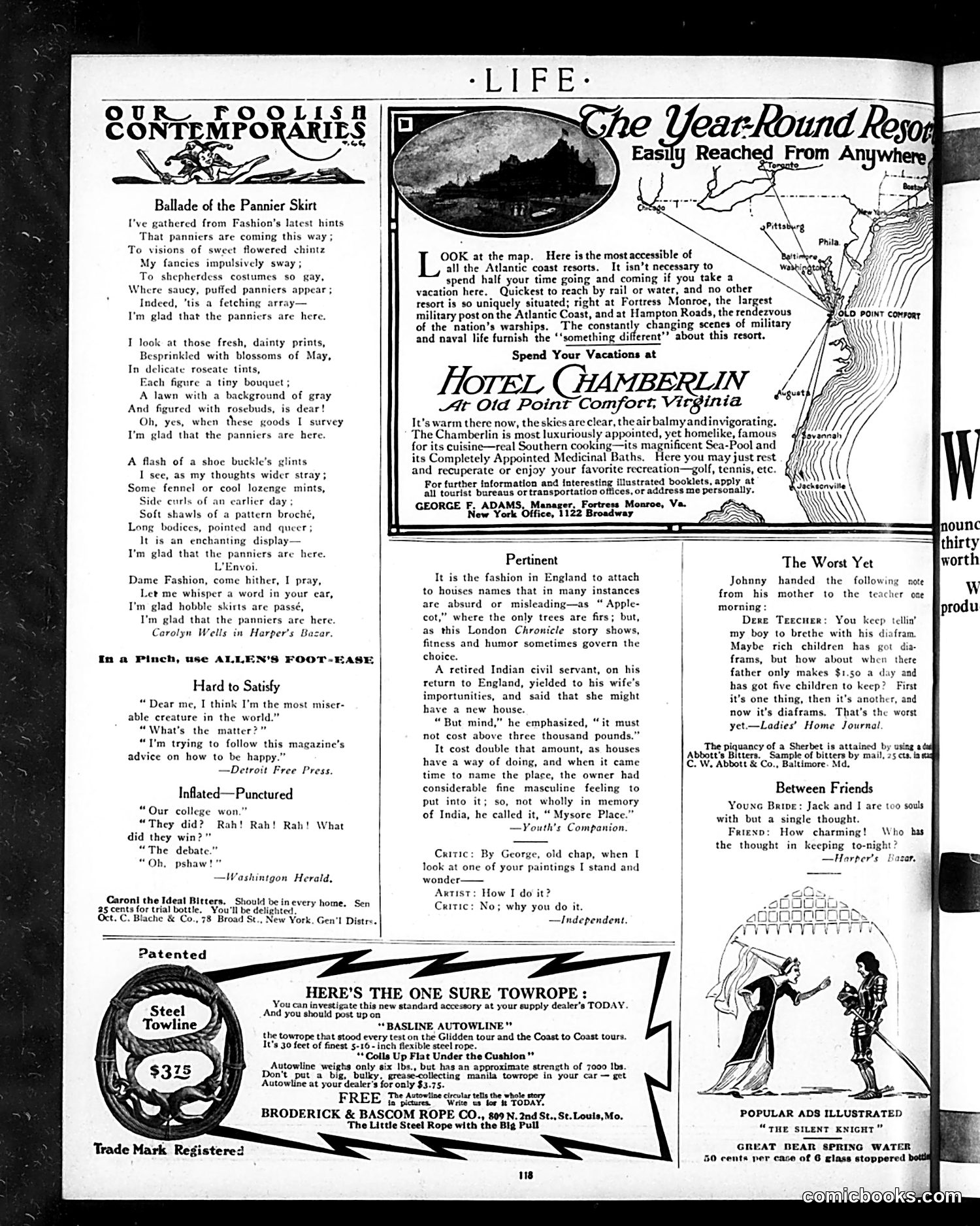
This Life magazine page is primarily **advertising and light humor** rather than political satire. The left column features "Ballad of the Pannier Skirt," a fashion poem celebrating the return of panniers (puffed fabric at the sides of skirts)—a historical silhouette. This reflects early 20th-century fashion nostalgia for 18th-century styles. The humor pieces are gentle social commentary: - **"Hard to Satisfy"** mocks marital dynamics and domestic discontent - **"The Worst Yet"** uses a child's note to a teacher to humorously critique parenting anxieties—the mother obsesses over breathing techniques while struggling financially - **"Between Friends"** contains a brief joke about social awkwardness The right side is dominated by **resort advertising** (Hotel Chamberlin at Fortress Monroe, Virginia) and a steel towrope product ad. No significant political figures or events are referenced. The satire targets universal human foibles—fashion vanity, marital discord, and parental worry—rather than specific political targets.
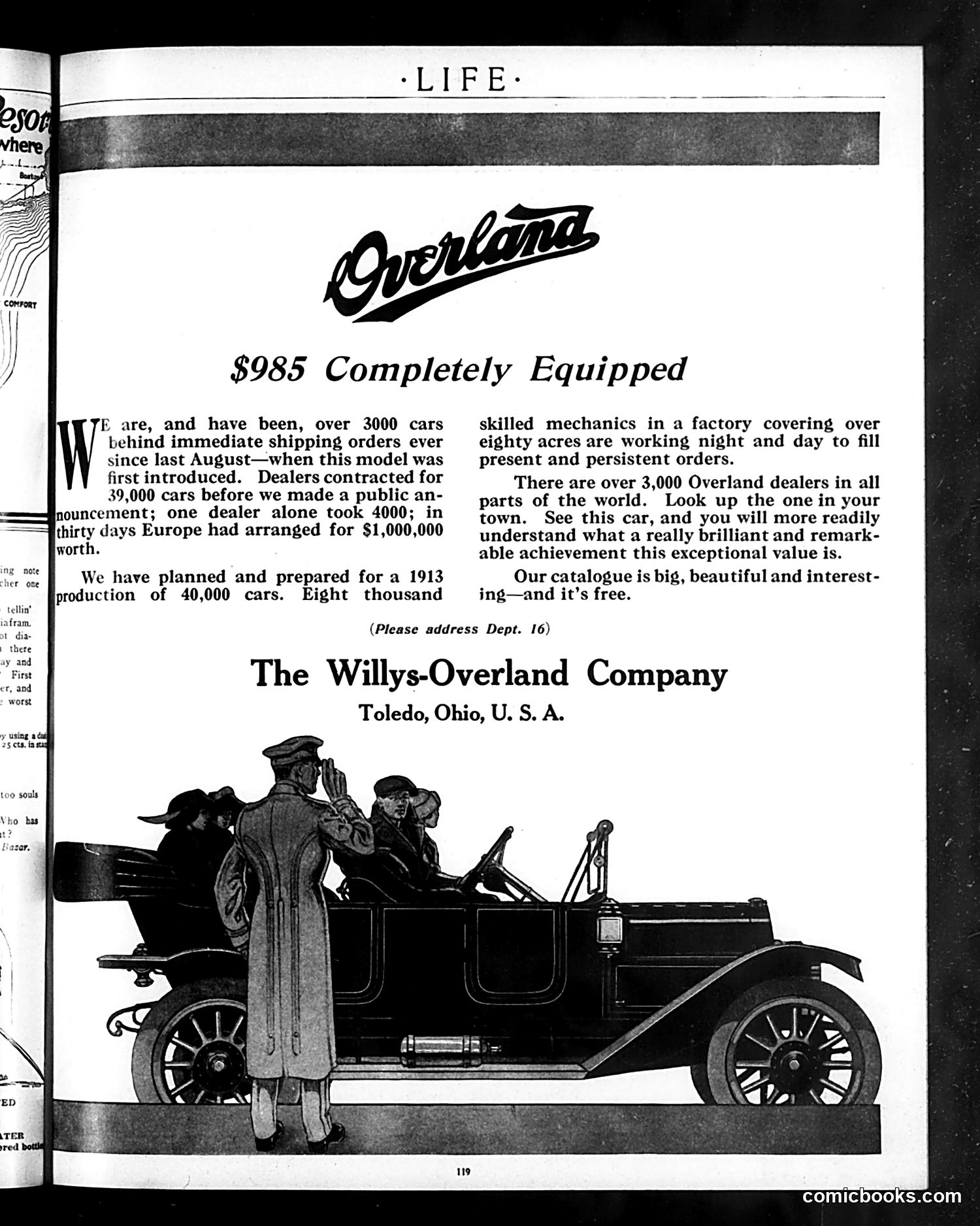
This is primarily **a full-page automobile advertisement**, not satirical content. It promotes the Overland car by Willys-Overland Company (Toledo, Ohio) at $985, "completely equipped." The ad's main claim is extraordinary demand: over 3,000 cars behind on orders since August, dealers pre-contracting for 39,000 units before public announcement, one dealer alone ordering 4,000. It boasts of European interest ($1 million worth ordered in thirty days) and plans for 40,000-car 1913 production with 8,000 mechanics working in an 80-acre factory. The illustration shows a well-dressed man in a long coat inspecting or approaching the automobile, with passengers visible inside—a typical advertisement image emphasizing the vehicle's appeal to affluent buyers. **No satire is evident.** This appears in *Life* because *Life* was a general-interest magazine accepting paid advertising, not because the content mocks anything. It's a straightforward sales pitch leveraging supply scarcity and mass production capability as selling points.
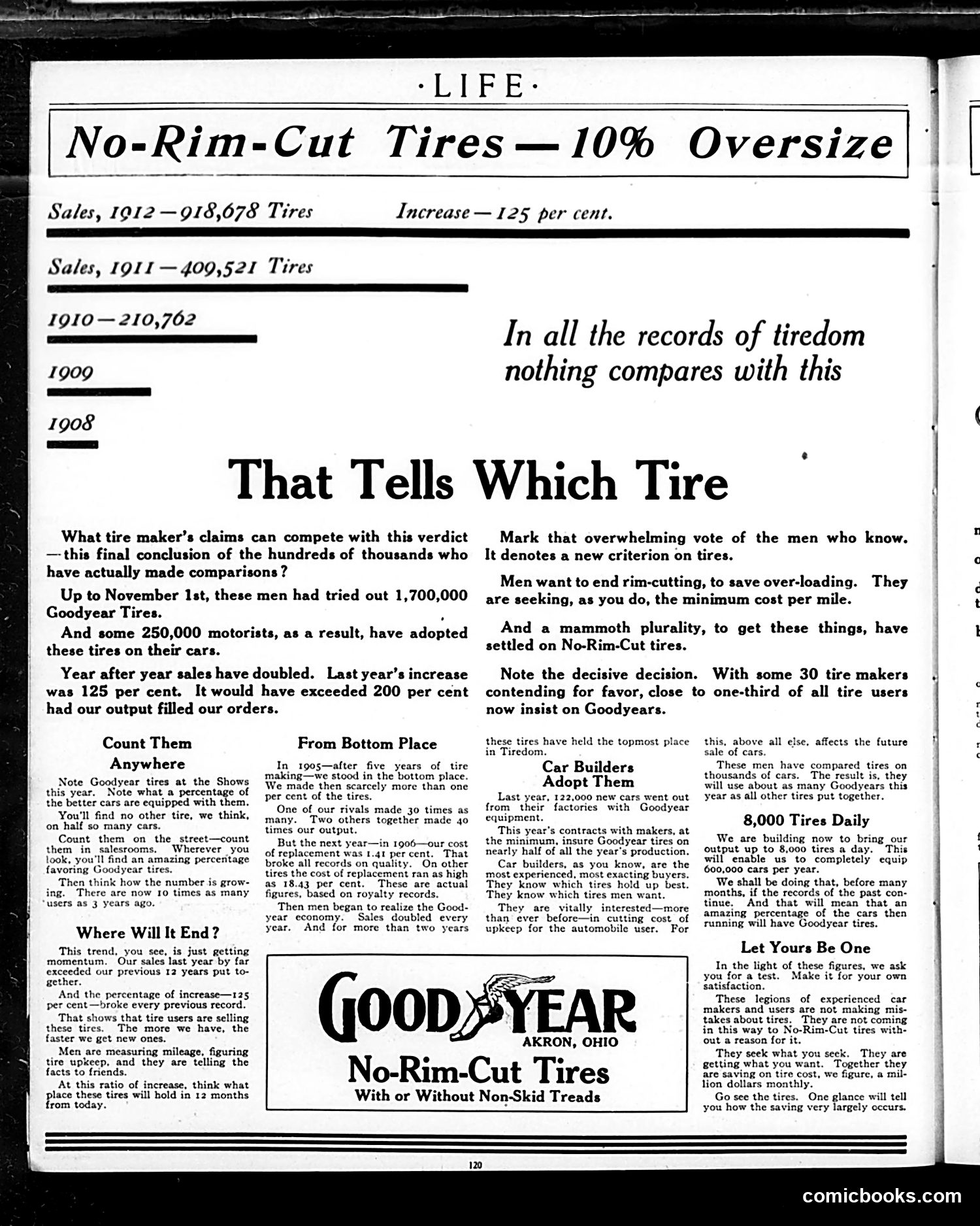
This is a **Goodyear Tire Company advertisement**, not satire or political content. It uses a bar chart format common to Life magazine's visual style to present sales data as evidence of product superiority. The central claim: Goodyear's "No-Rim-Cut Tires" outsell competitors dramatically—sales increased 125% between 1911-1912, and 250,000 motorists have adopted them. The advertisement argues this sales success proves the tire's quality, since consumers making direct comparisons choose Goodyear. Key selling points emphasized: the tires prevent rim-cutting (damage from overloading) and minimize cost-per-mile. The ad notes that even car manufacturers specify Goodyears on new vehicles, framing this as validation from "experienced, exacting buyers." The headline "That Tells Which Tire" suggests market choice itself serves as the ultimate quality verdict—a early example of consumer-preference marketing logic. The growth trajectory shown (from minimal market share in 1908 to dominant position by 1912) reinforces this "winning product" narrative.
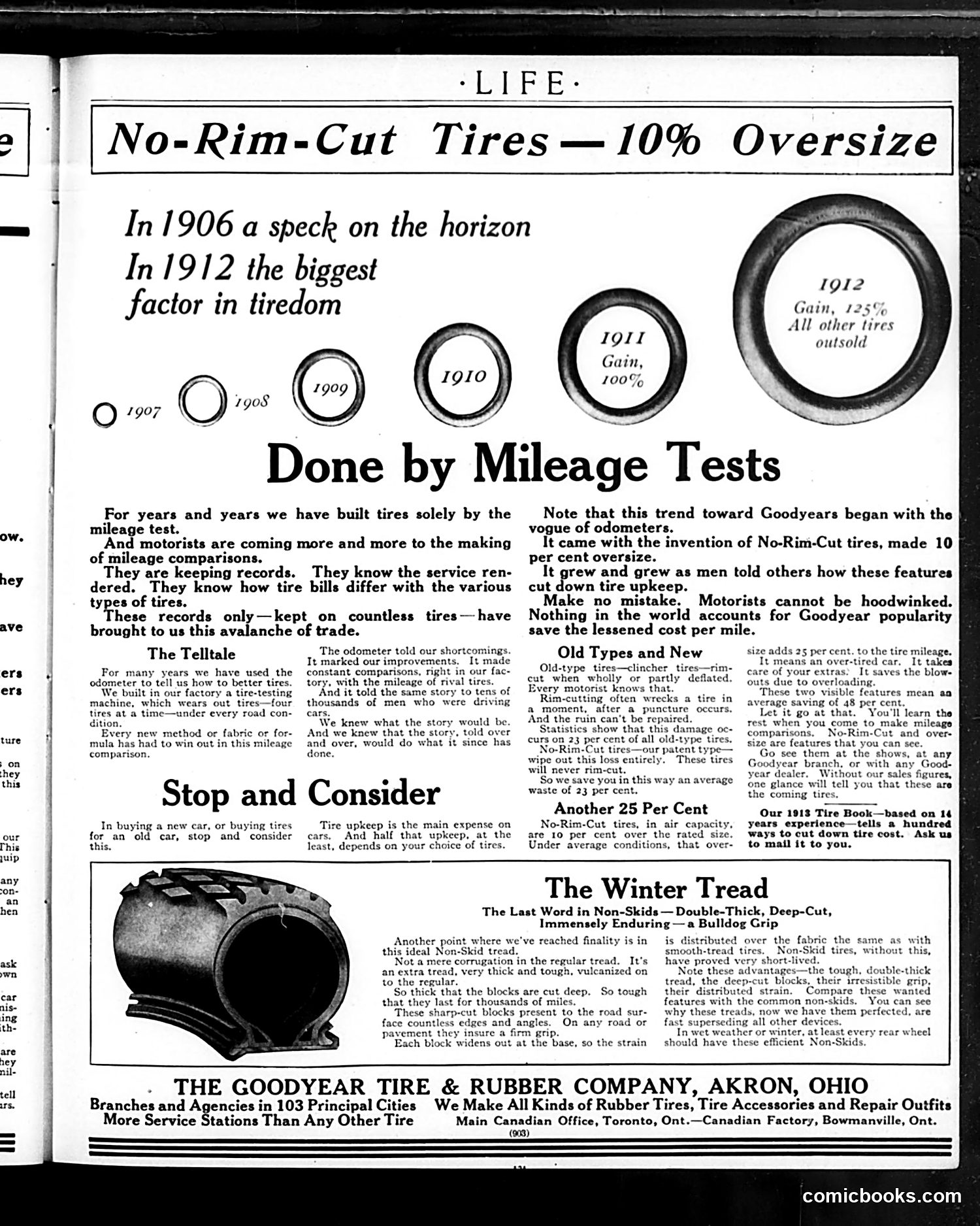
This is primarily a **Goodyear tire advertisement**, not political satire. The page showcases the company's marketing strategy around early automotive technology. The key visual element is a **series of tire illustrations growing progressively larger from 1907-1912**, representing Goodyear's claimed market dominance growth. The text emphasizes that this success resulted from **mileage testing and data collection**—motorists using odometers to measure tire performance and sharing results. The "satire" (light humor) lies in Goodyear's implicit critique of competitors: the company argues motorists cannot be "hoodwinked" and will naturally choose superior products. The ad suggests rival tire makers lack similar testing rigor. **Modern context**: This reflects early 20th-century industrial marketing—companies promoting scientific testing as proof of superiority. The "No-Rim-Cut" technology and "Winter Tread" are presented as innovations justifying premium pricing through documented performance, a proto-advertising approach emphasizing data over mere claims.
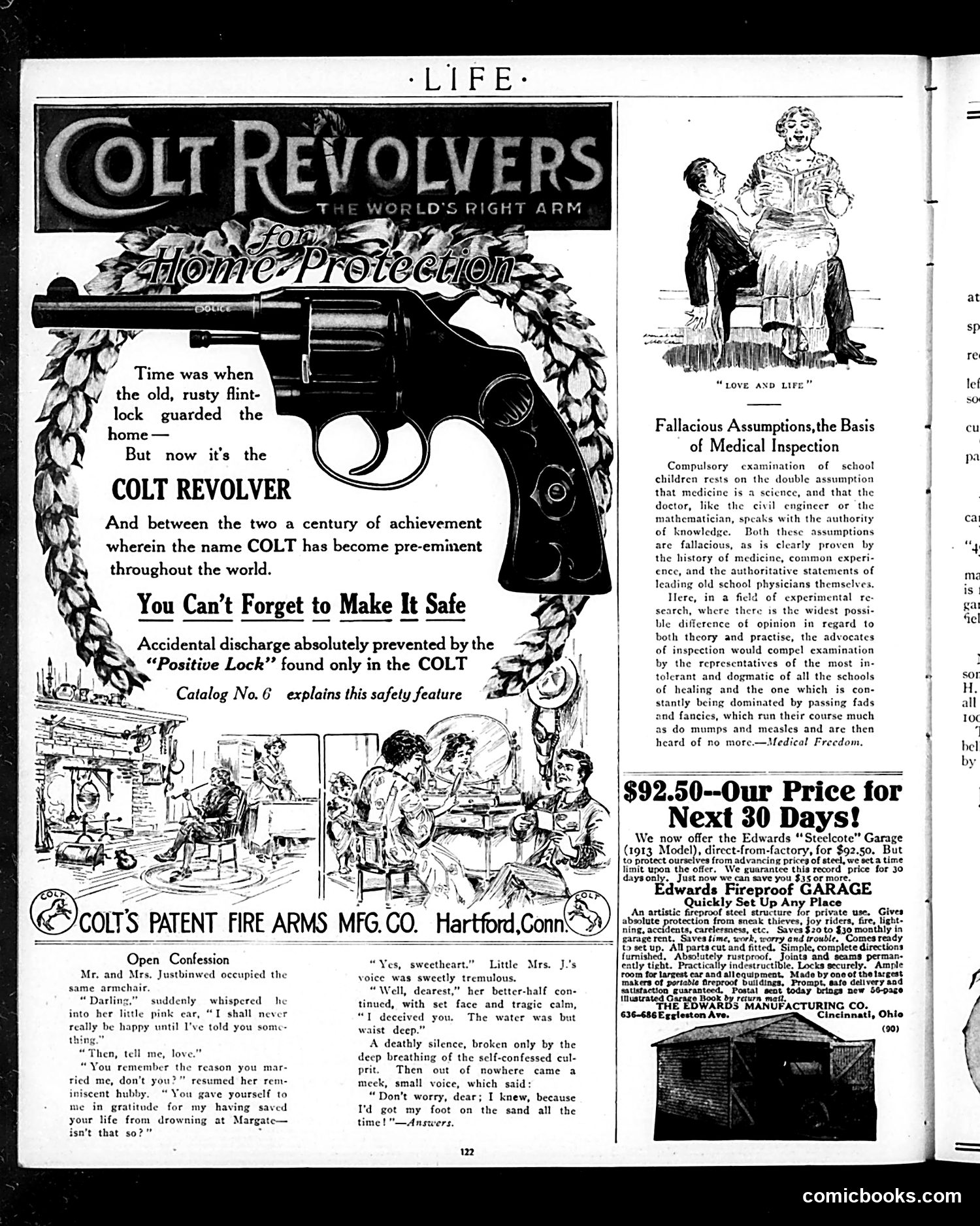
This page mixes **advertising with satirical fiction and commentary**, typical of Life magazine's format. The dominant feature is a **Colt Revolver advertisement** emphasizing the "Positive Lock" safety feature—a practical response to accidental shootings, a genuine public concern of the era. Below appears a **humorous short story titled "Open Confession,"** where a newlywed husband confesses he lied about saving his wife from drowning at Margate—the water was only waist-deep. The punchline: she knew all along because her foot touched bottom. It's a gentle marital comedy mocking masculine melodrama and female awareness. The page also includes a serious **critique of mandatory school medical inspections**, arguing that medicine isn't truly scientific and that doctors represent a dogmatic, fad-driven profession. This reflects early 20th-century skepticism toward medical authority—a debate that persisted for decades. The remaining content advertises an **Edwards steel garage** ($92.50 for 30 days), targeting automobile owners concerned with theft and weather protection.
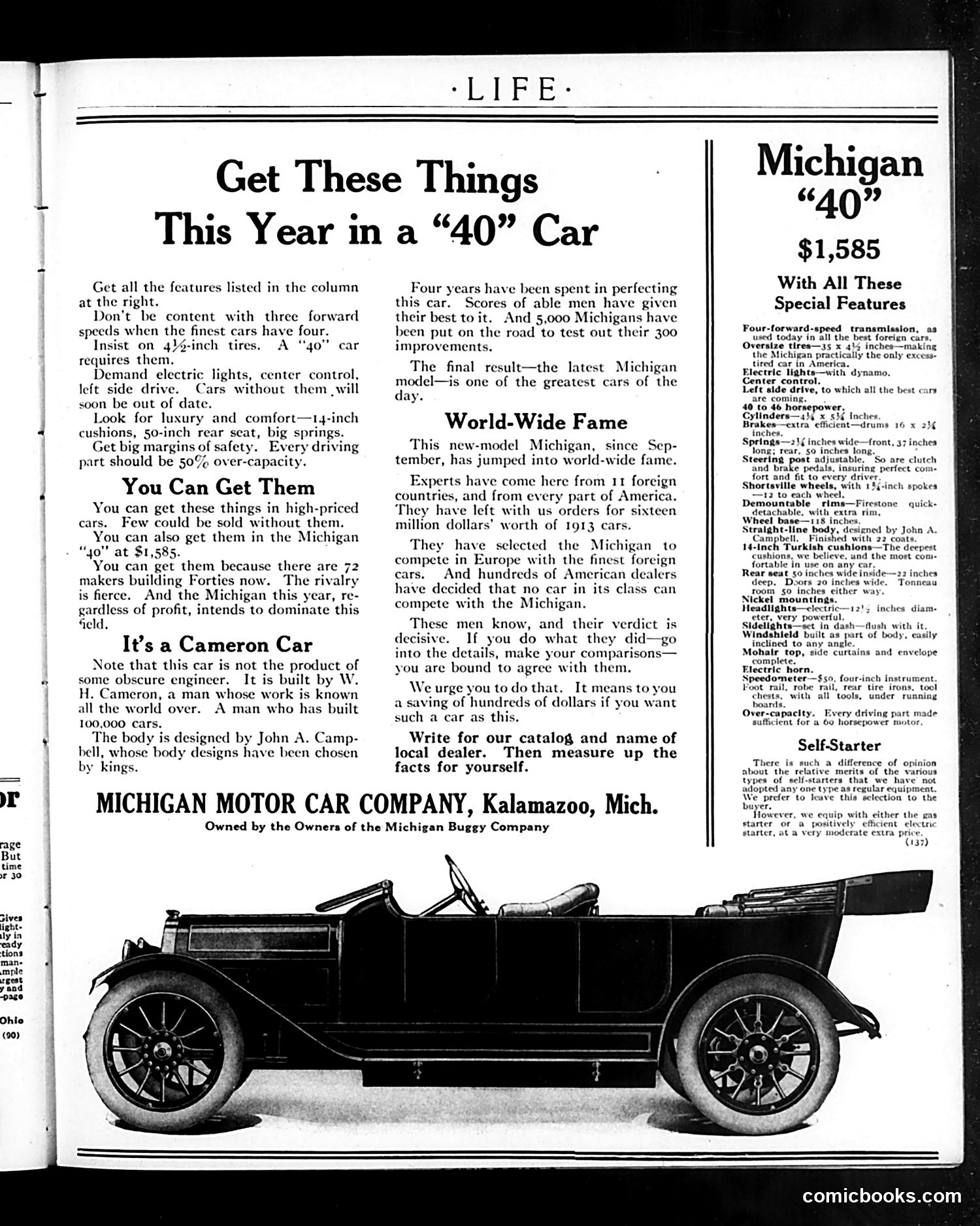
This is **not a cartoon or satire**, but rather a **straightforward automobile advertisement** from Life magazine, circa 1912-1913. The page promotes the Michigan "40" automobile ($1,585), manufactured by the Michigan Motor Car Company in Kalamazoo. The advertisement emphasizes competitive advantages: four forward speeds, oversized tires, electric lights, and luxury features like 14-inch cushions. It leverages designer credibility (W.H. Cameron, builder of 100,000 cars) and international validation—claiming orders worth $16 million from 11 foreign countries and European competition selections. The text argues that buyers can obtain premium features at lower cost than "high-priced cars" due to fierce competition among 72 manufacturers building "Forties" (likely referring to cars in the $1,500-$1,800 range). The accompanying vehicle illustration shows a touring car of the era. This represents typical early-automotive-era advertising: technical specifications, designer pedigree, and appeals to both economy and prestige—standard sales tactics for a competitive emerging industry.
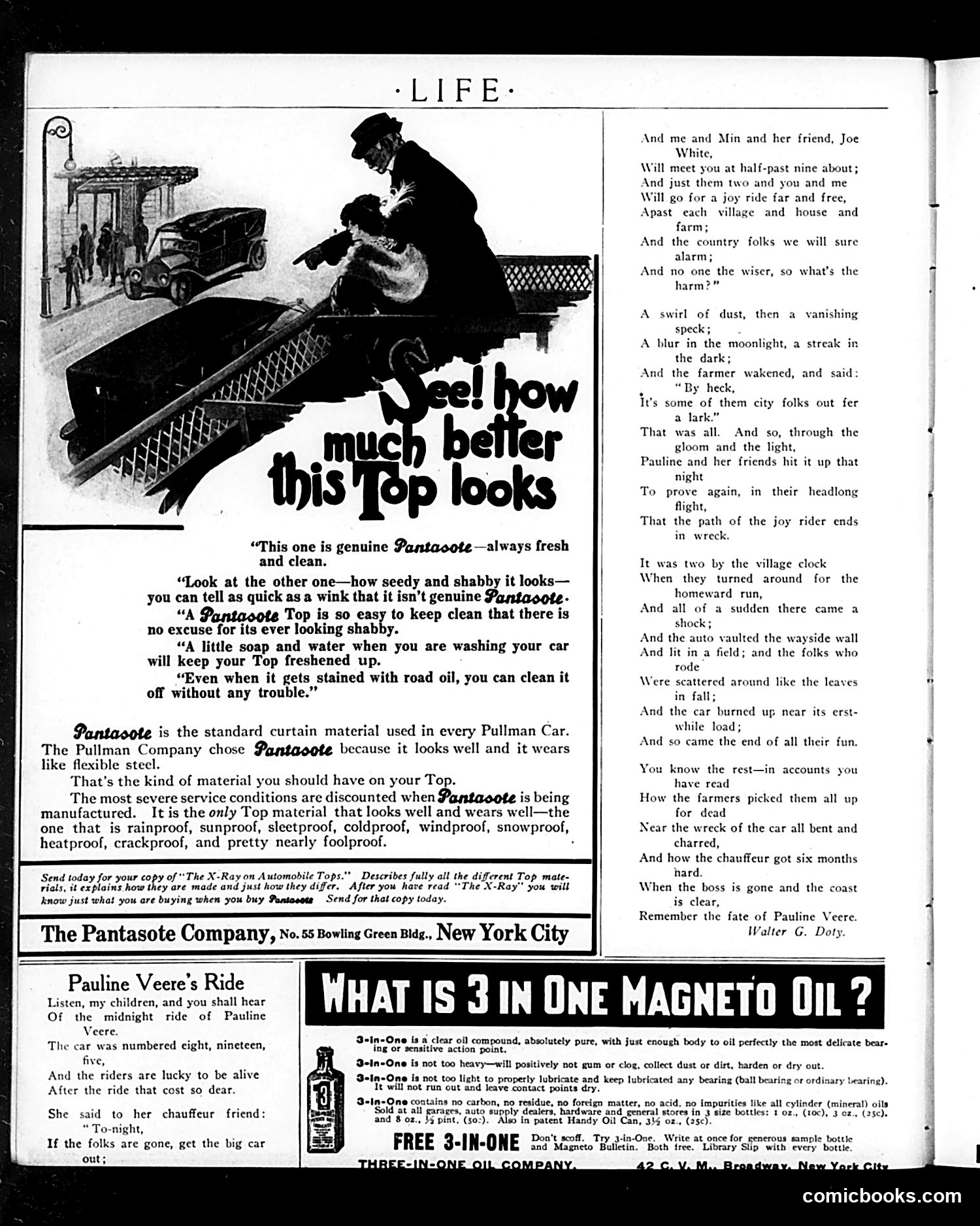
This page combines a cautionary narrative poem with automobile advertising. "Pauline Veere's Ride" tells of a young woman who takes a joyride in a car late at night with friends, deliberately alarming rural farmers. The reckless driving ends in catastrophe: the auto crashes, killing or severely injuring the passengers. The chauffeur receives six months hard labor. The poem serves as a moral warning against dangerous "joy riding"—a contemporary concern as automobiles became more common. The wealthy urbanites' contempt for country folk ("no one the wiser, so what's the harm?") adds social commentary: their carelessness endangers lives. Ironically, this cautionary tale shares the page with advertisements for Pantacote car tops and 3-in-1 Oil, promoting automobile accessories—capitalizing on the very car culture the narrative warns against.
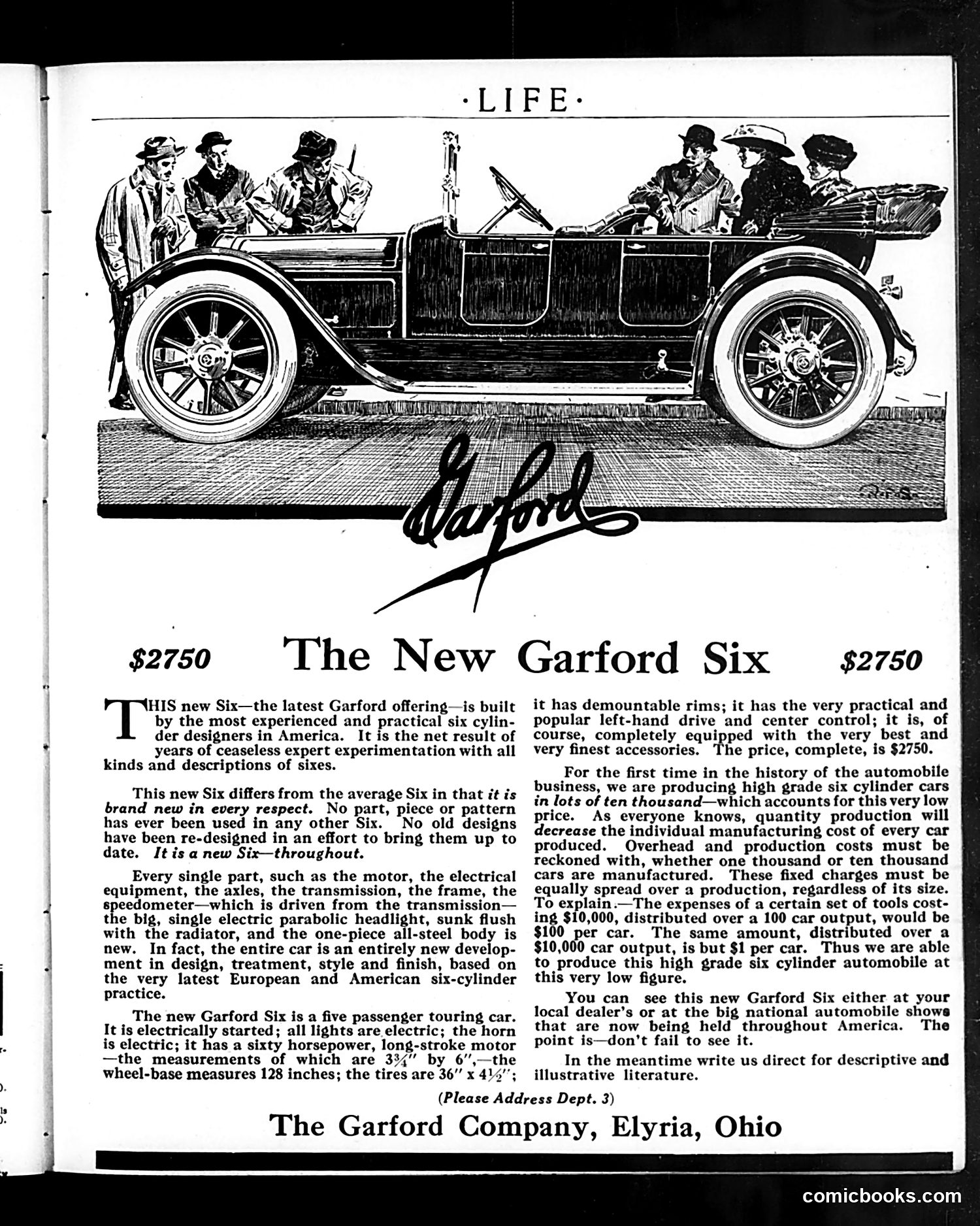
This page is **not a cartoon or satire**—it's a straightforward automobile advertisement from Life magazine's early automotive era. The image shows a line-drawn illustration of the 1910s-era Garford Six automobile with well-dressed passengers and onlookers. Below runs extensive advertising copy promoting the vehicle's features and price ($2,750). The advertisement's notable claim is that mass production of 10,000 units allows the manufacturer to offer a "high grade six cylinder" car at an unusually low price by spreading fixed costs across volume. This reflects early-20th-century American manufacturing optimism about industrial efficiency. There is **no political satire or social commentary** visible here. Life magazine, while known for humor and satire elsewhere, also published conventional advertisements. This represents standard commercial promotion of the era's automobile technology to affluent readers who could afford such vehicles.
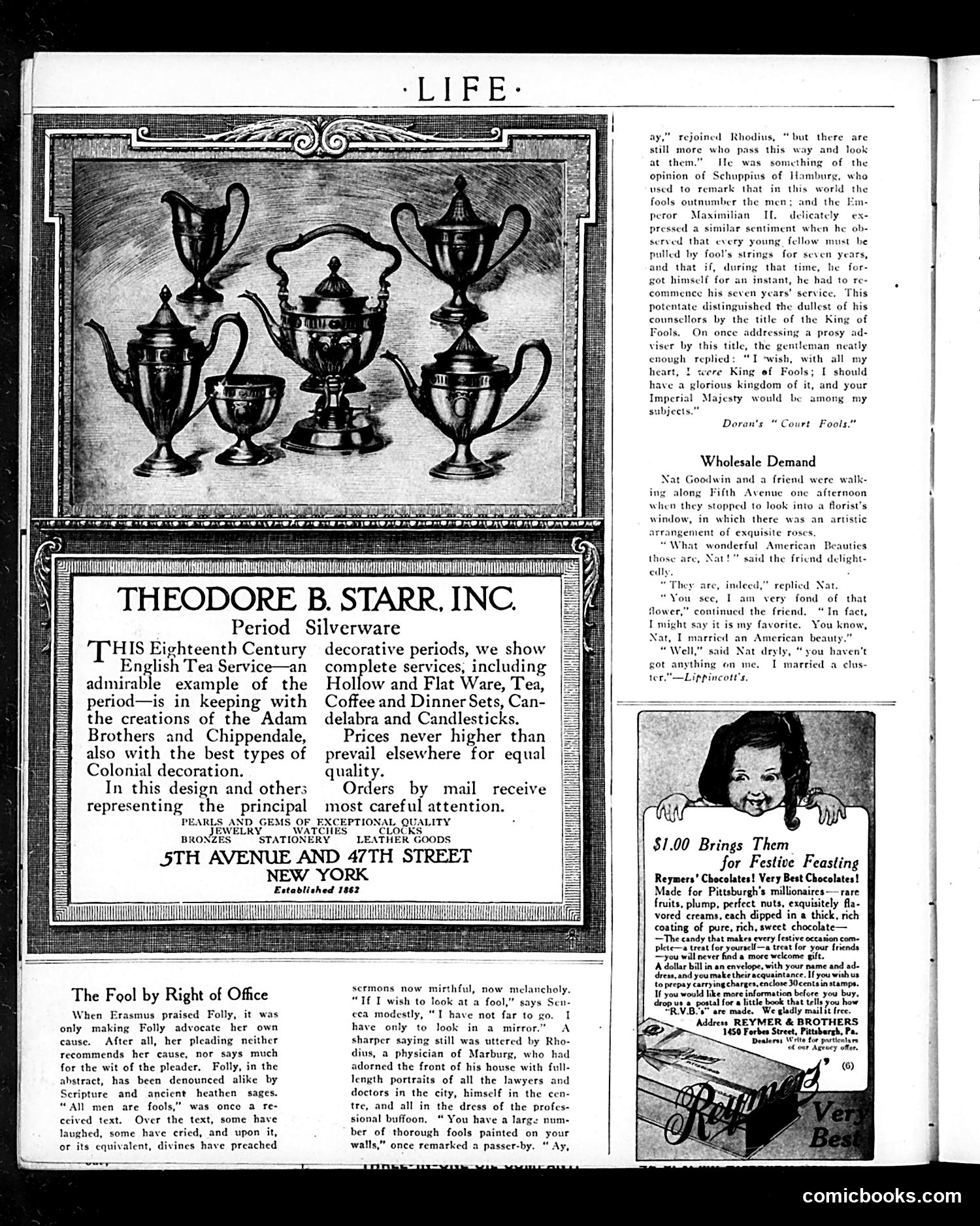
This page is primarily **advertising** for luxury goods (silverware, chocolates) rather than political satire. The main editorial content is "The Fool by Right of Office," a philosophical essay about foolishness drawing on classical sources (Erasmus, Seneca, Rhodius). The humorous anecdote labeled "Wholesale Demand" features **Nat Goodwin**, a prominent American actor and comedian of the early 1900s. The joke plays on his persona: when a friend praises American Beauty roses as his favorite flower and mentions marrying "an American beauty," Goodwin dryly responds he also married one—a clever play on words equating the flower with an attractive woman. The page reflects *Life* magazine's typical mix of literary wit, celebrity humor, and high-end product advertising targeting affluent readers. There is **no political cartoon visible**—the decorative silverware image is purely commercial.
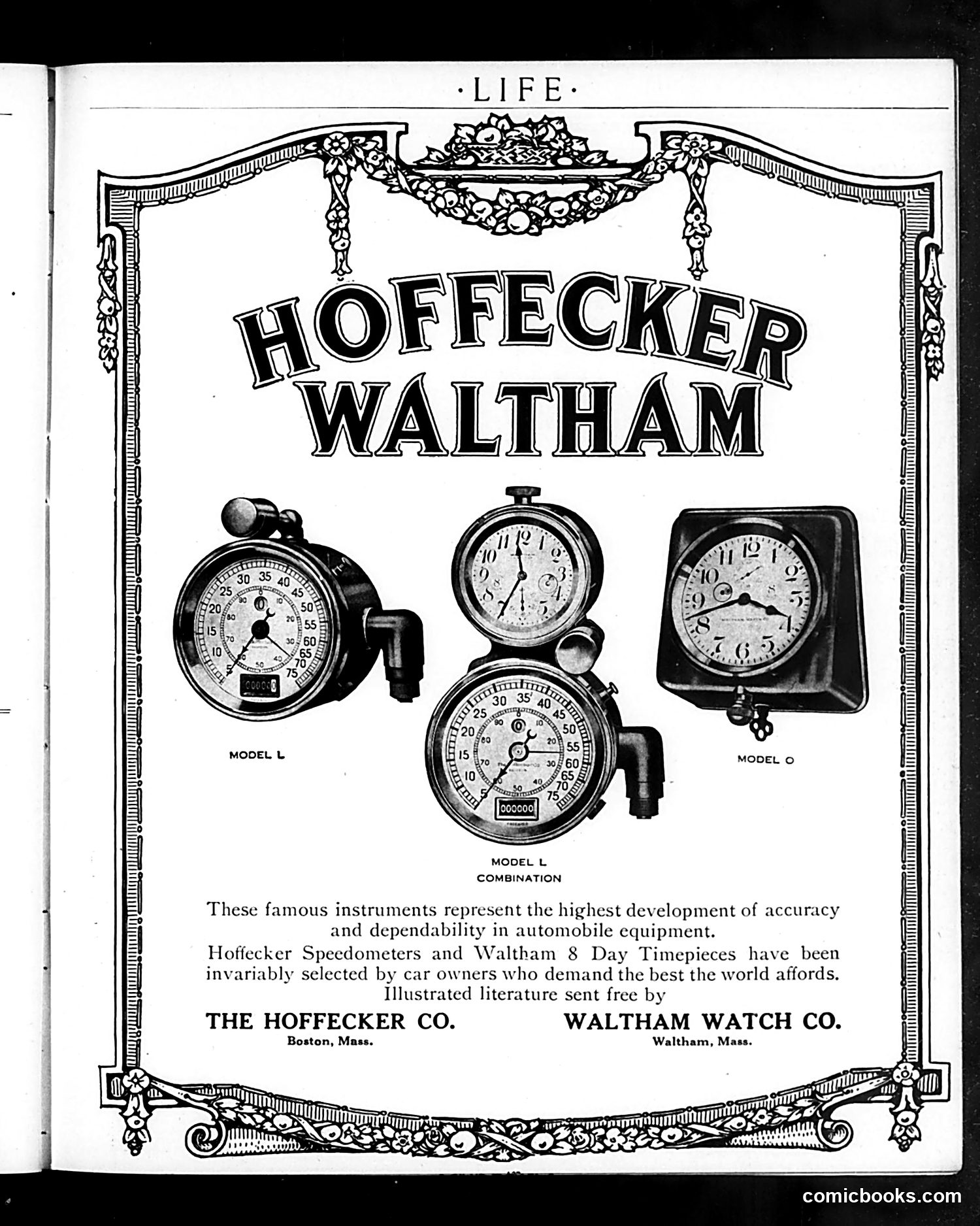
This page is **not a cartoon or satire**—it's a straightforward advertisement. It appears in *Life* magazine but contains no political or social commentary. The page advertises two products for automobiles: Hoffecker Speedometers and Waltham 8 Day Timepieces. Three timepiece models are illustrated (Models L, L Combination, and O). The ad emphasizes accuracy and dependability, targeting car owners who "demand the best." The decorative Art Nouveau border and formal layout reflect early 20th-century advertising design standards. This is purely a commercial endorsement combining two Boston-area manufacturers' products for the automobile market—no satire or hidden meaning is present.
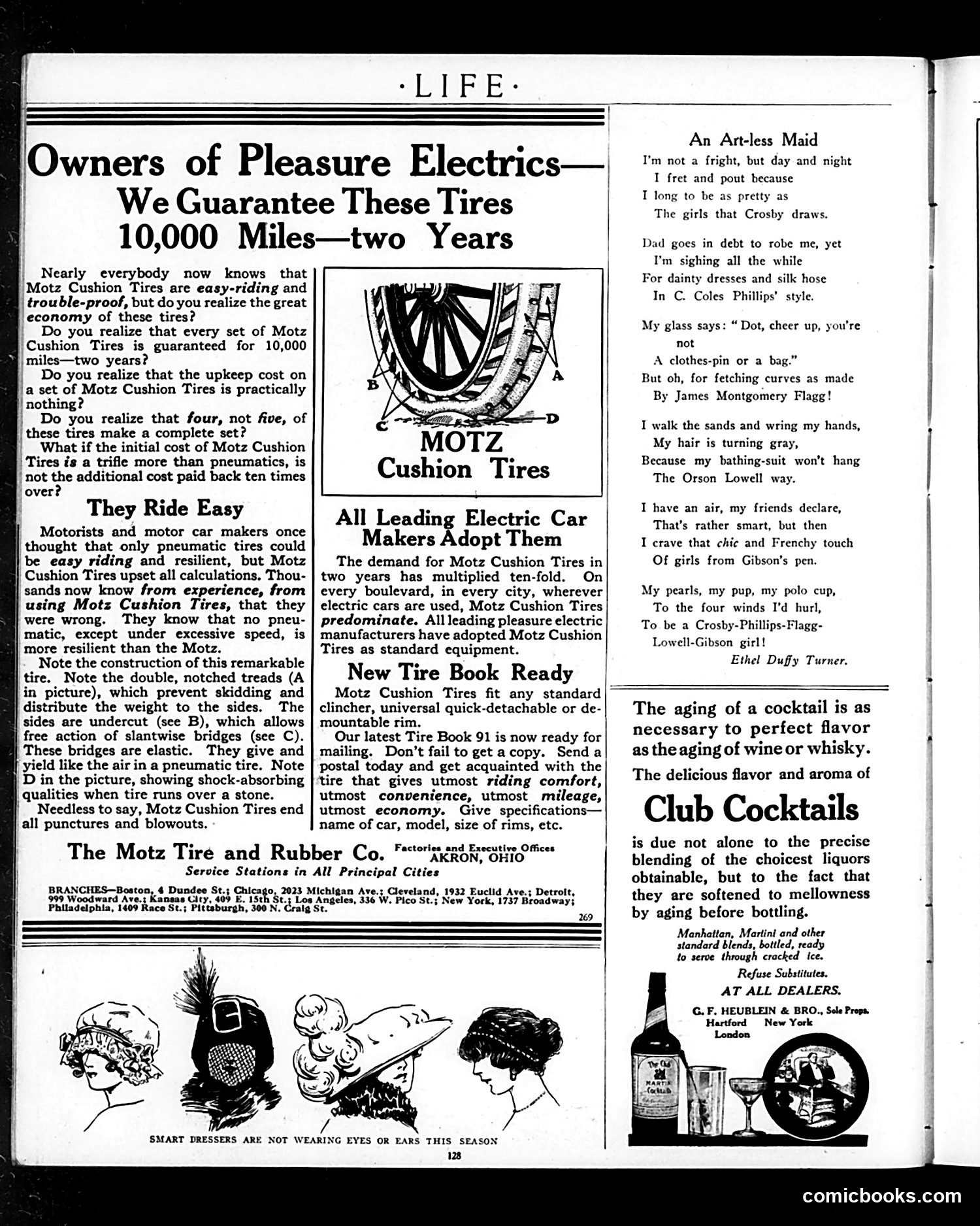
This page combines two distinct elements: a **Motz Cushion Tire advertisement** and **satirical poetry**. The tire ad dominates the left side, promoting solid rubber tires for electric cars with technical diagrams. It targets early-1900s motorists concerned with reliability and economy, claiming Motz tires last 10,000 miles and outlast pneumatic alternatives. The right side contains "An Art-less Maid" by Ethel Duffy Turner—a satirical poem mocking young women obsessed with fashionable beauty standards. The speaker laments she cannot resemble girls illustrated by famous commercial artists (Crosby, Coles Phillips, James Montgomery Flagg, Orson Lowell, Charles Gibson). She'd sacrifice wealth ("pearls," "pup," "polo cup") to achieve their idealized look. The satire targets both the illustrated-beauty industry and women's vanity, suggesting contemporary culture had created impossible aesthetic expectations through popular commercial art. The bottom illustration of four fashionable women's hats reinforces this focus on appearance.
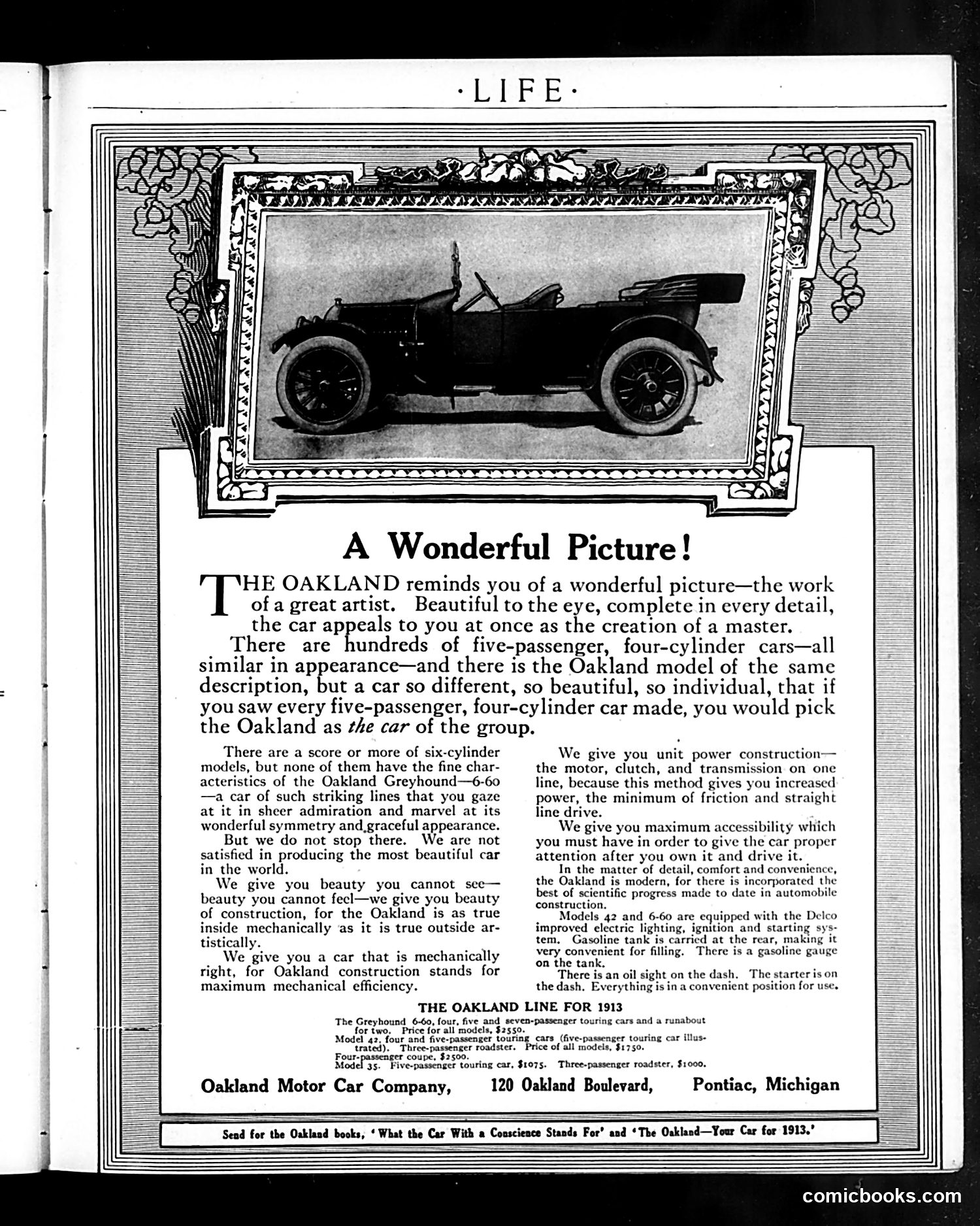
This is **not a cartoon or satire**—it's a straightforward automobile advertisement from *Life* magazine circa 1913. The page promotes the Oakland motor car, manufactured in Pontiac, Michigan. The ad uses artistic language comparing the car to "a work of a great artist," emphasizing its aesthetic beauty alongside mechanical superiority. It highlights specific features: the Greyhound 6-60 model, unit power construction, Delco electric starting/lighting systems, and convenience details like the rear-mounted gasoline tank and dashboard oil gauge. The accompanying photograph shows a side-view of an open-air touring car typical of the era—a five-passenger vehicle with spoke wheels and minimal weather protection. This represents early automotive advertising targeting middle-class buyers, appealing to both craftsmanship and modern mechanical innovation during the transitional period between hand-built and mass-produced automobiles.
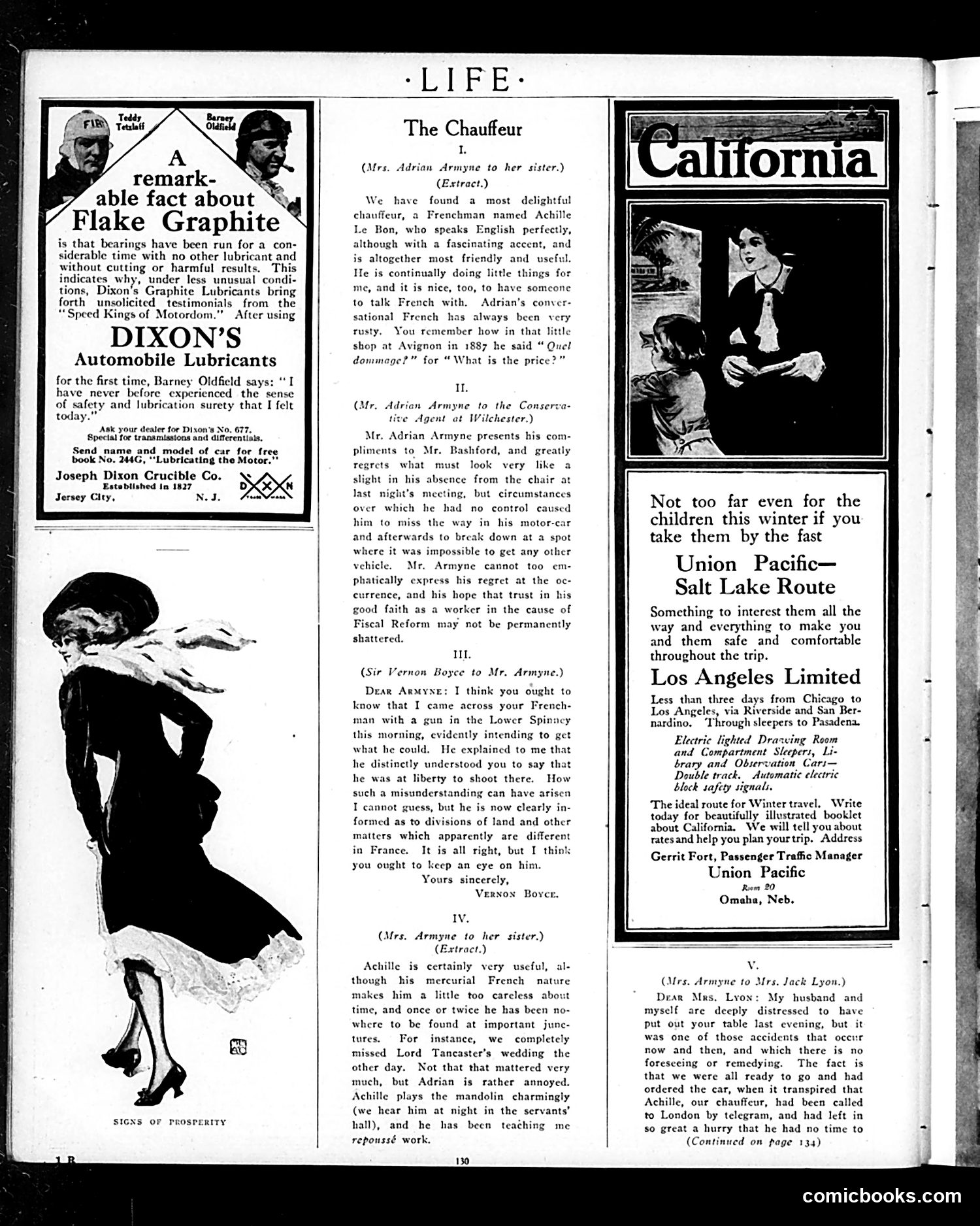
This multi-part satirical piece mocks the pretensions of the English upper-middle class through their French chauffeur, Achille Le Bon. The humor operates on several levels: **The Setup:** The Armynes hire a charming French chauffeur, which signals their aspirational status. Mrs. Armyne boasts about him in letters to her sister. **The Exposure:** Through subsequent letters from Mr. Armyne and Sir Vernon Boyce, we learn Achille is actually unreliable and presumptuous—he goes poaching on neighbors' land, misses important social events due to unexplained absences, and generally takes liberties. **The Satire:** The joke targets the Armynes' class anxiety and pretension. Hiring a Frenchman signals sophistication, but their inability to manage or properly instruct him reveals their actual social incompetence. The chauffeur becomes a mirror exposing their affectations rather than confirming their status. The illustration labeled "Signs of Prosperity" reinforces this—the fashionable woman symbolizes the ostentatious consumption the story gently ridicules.
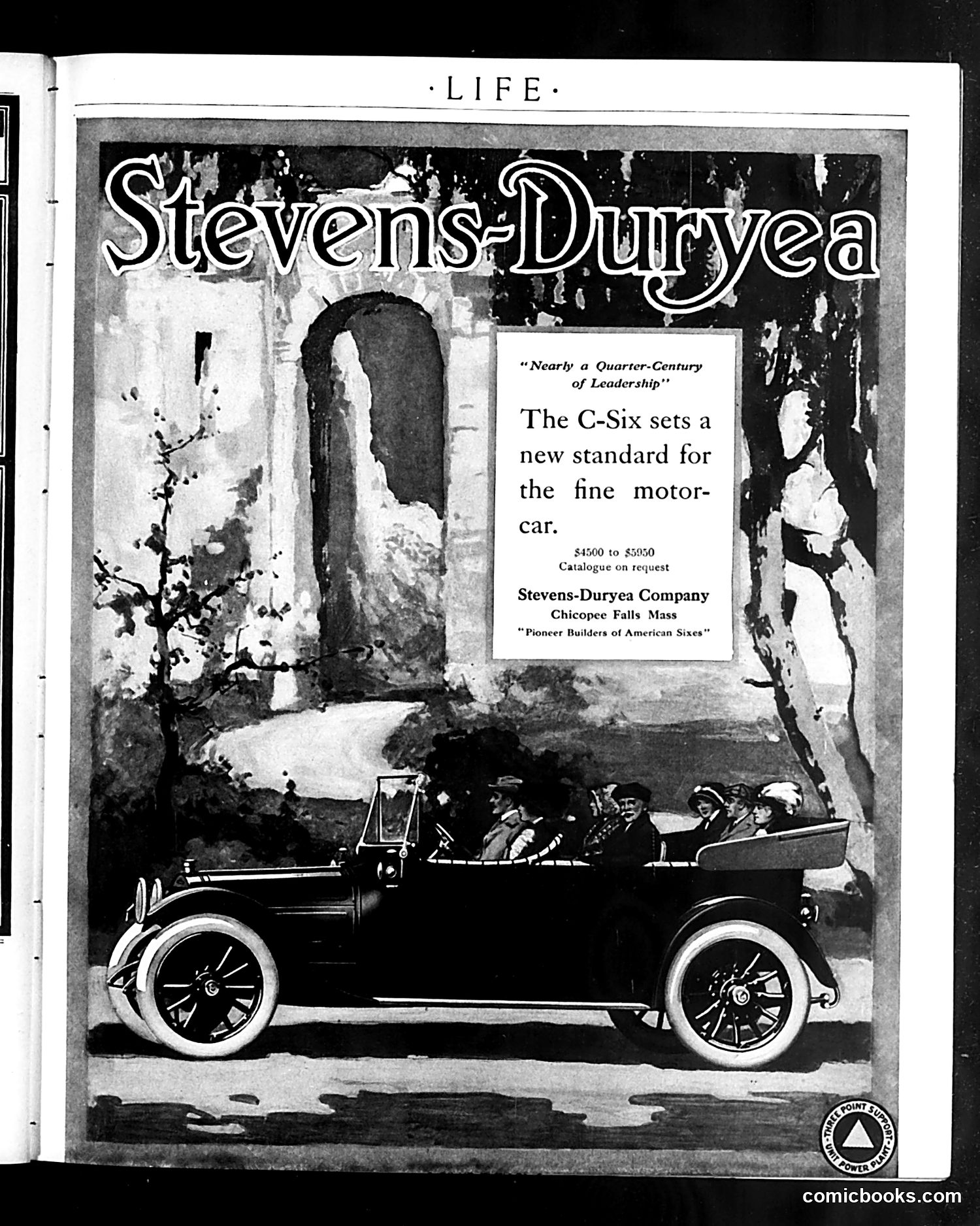
This is primarily an advertisement rather than political satire. It promotes the Stevens-Duryea C-Six automobile, manufactured in Chicopee Falls, Massachusetts. The ad claims the vehicle "sets a new standard for the fine motor-car" and emphasizes the company's "nearly a quarter-century of leadership" as "pioneer builders of American sixes" (referring to six-cylinder engines). The image shows a luxury car from approximately the 1910s-1920s with several well-dressed passengers driving through an ornate classical archway, suggesting sophistication and elegance. The price range of $4,500 to $5,050 positioned this as a premium vehicle. This is essentially high-end automotive marketing rather than satirical commentary.
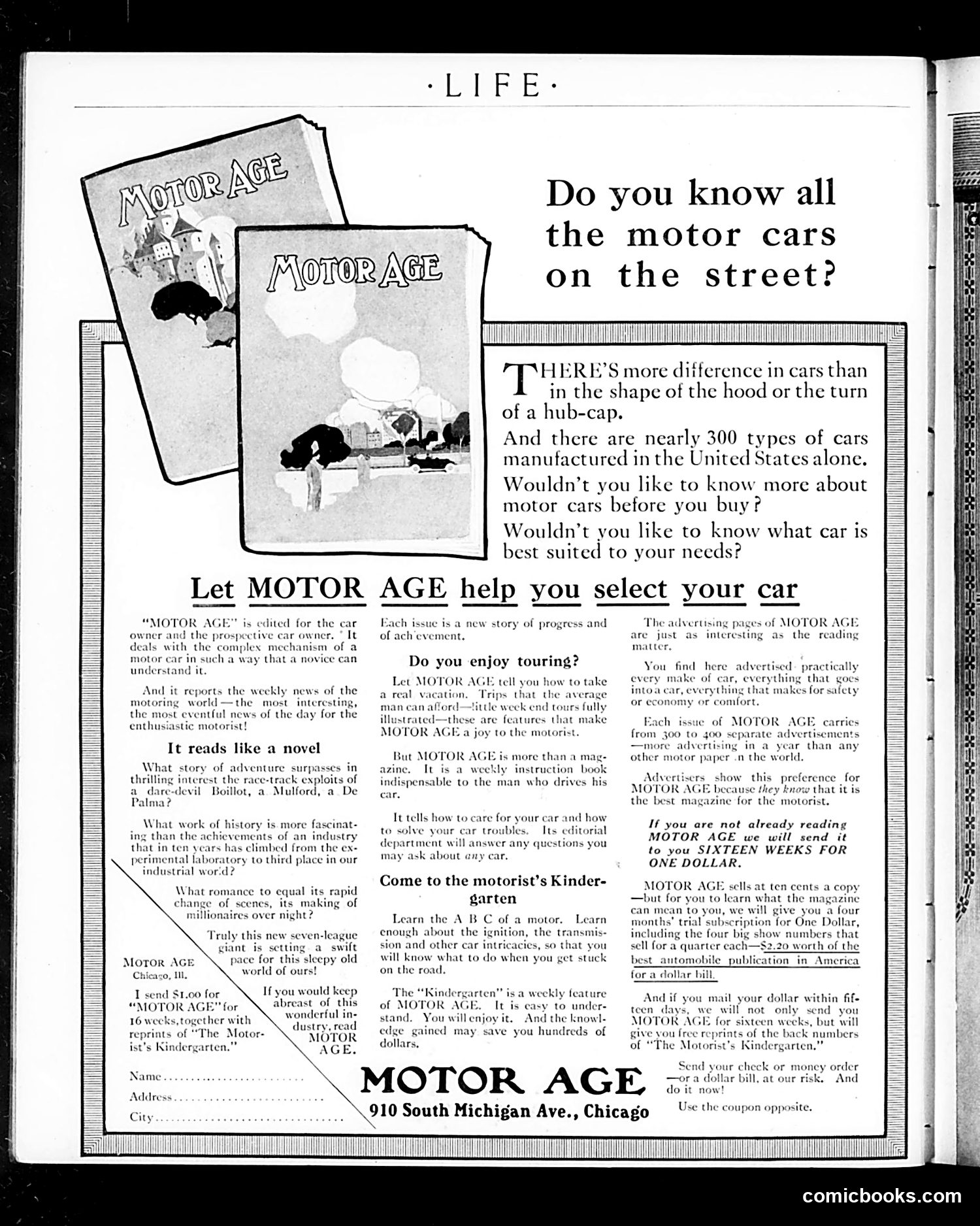
This is primarily a **magazine advertisement**, not a political cartoon. It promotes *Motor Age*, a weekly automotive publication aimed at car owners and potential buyers. **The Content:** The ad emphasizes that with nearly 300 car types manufactured in the U.S., buyers need guidance selecting vehicles. *Motor Age* offers this expertise through: - Technical instruction (the "Kindergarten" feature teaching ignition, transmission, etc.) - Adventure narratives about racing and industrial progress - Practical touring and maintenance advice **Historical Context:** This reflects the early automotive era (appears early 20th century) when cars were still novel, complex machines requiring education for owners. The romanticization of racing and the framing of automotive knowledge as thrilling adventure reflects public fascination with this new technology. **The Pitch:** For one dollar, readers get a four-month subscription plus back issues. The ad uses hyperbole—comparing the auto industry's growth to a "seven-league giant"—to position *Motor Age* as essential reading for the modern motorist. This is essentially consumer marketing dressed in period-appropriate enthusiasm for technological progress.
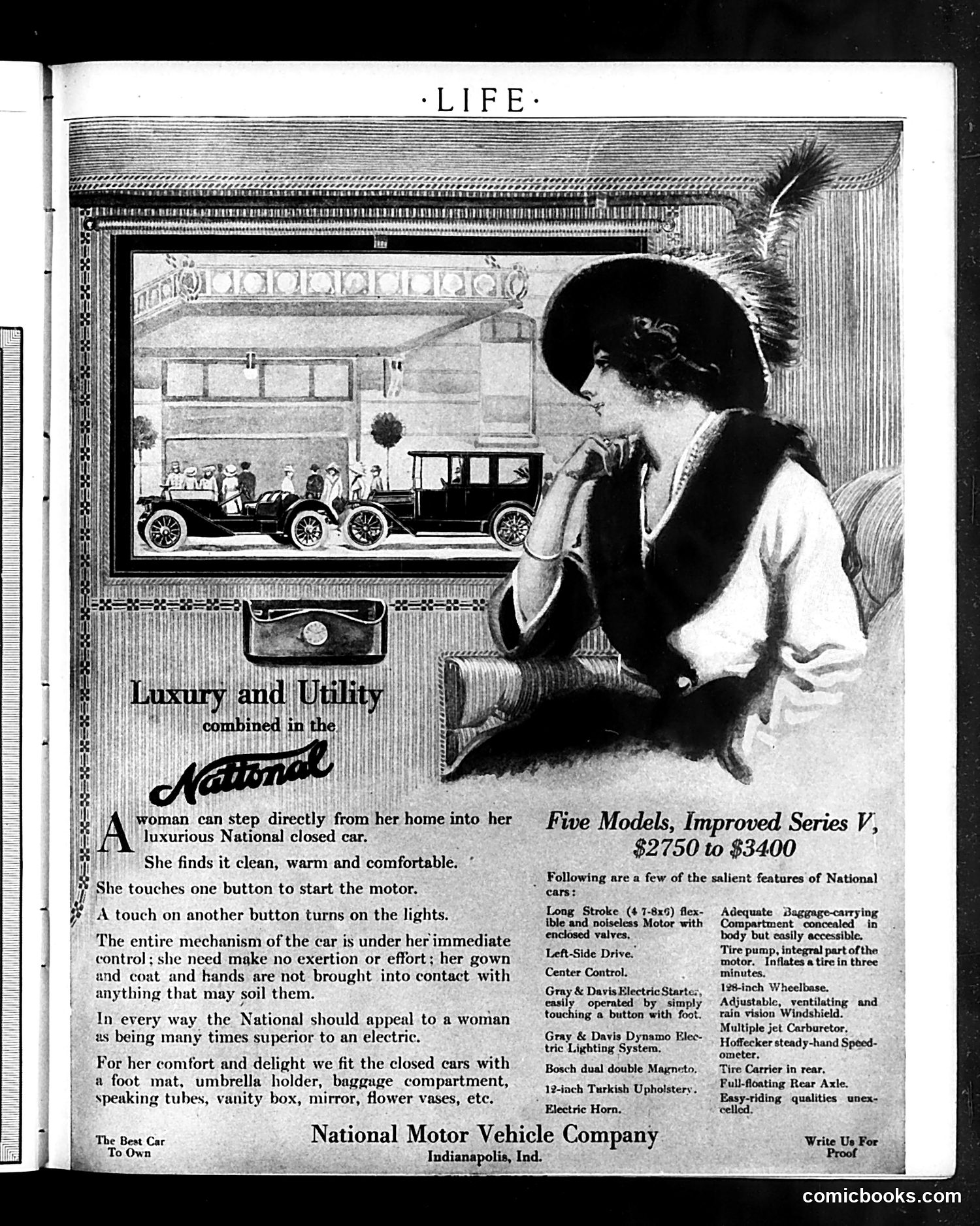
This is **not satire or a cartoon**, but rather a straightforward automobile advertisement from Life magazine's advertising section. The National Motor Vehicle Company promotes their closed cars by targeting **women drivers**—a relatively novel concept in the early automotive era. The ad emphasizes how the National appeals to female consumers by eliminating traditionally "unladylike" tasks: no hand-cranking engines, no contact with dirty machinery, simple button-operated controls, and luxurious interior amenities (vanity box, flower vases, umbrella holder). The illustration shows a well-dressed woman in a wide-brimmed hat observing a National automobile through a window, suggesting aspirational appeal. The ad explicitly positions the National as "many times superior to an electric" (electric cars were marketed to women as cleaner and easier). This reflects early 1910s gender marketing: the automobile industry recognized women as potential buyers and designed messaging around convenience, cleanliness, and comfort rather than mechanical performance. The ad's language—emphasizing that her "gown and coat and hands are not brought into contact with anything that may soil them"—reveals period assumptions about feminine propriety and maintenance of appearance.
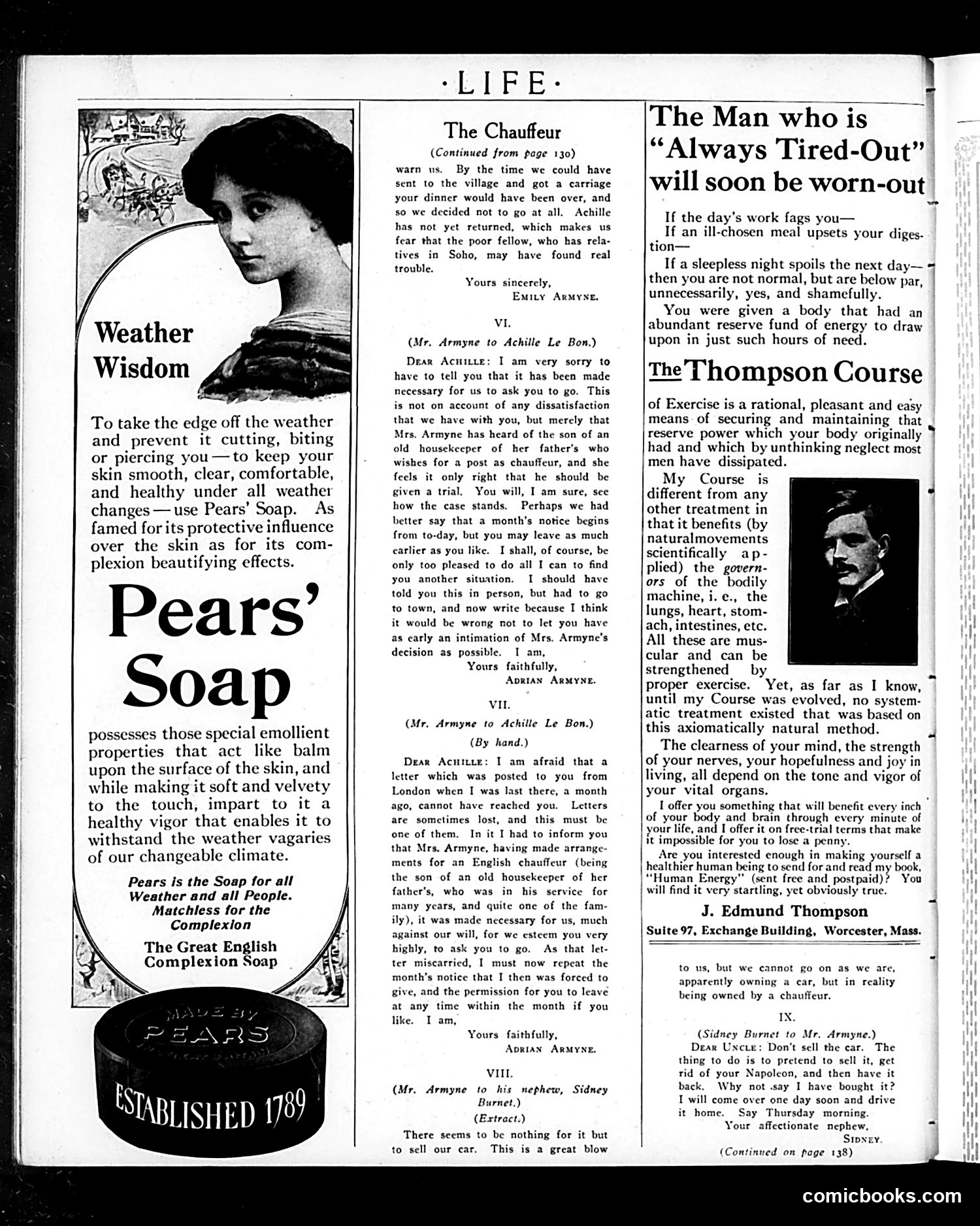
This page combines advertisements with a serialized story called "The Chauffeur." The narrative depicts the dismissal of a French chauffeur named Achille Le Bon by an English employer, Mr. Armyne, who must replace him with the son of an old family retainer—a decision driven by social obligation rather than dissatisfaction. The letters show the awkward formality of upper-class Victorian/Edwardian correspondence: Mr. Armyne must fire a loyal employee, and a follow-up letter suggests the original notice was lost in the mail, forcing an uncomfortable repetition. The surrounding advertisements—Pears' Soap and Thomson's Exercise Course—target genteel readers concerned with maintaining health and appearance through consumerism. The soap promises to protect against weather's harshness; the exercise course claims to restore vitality to the exhausted modern man. Together, they reflect period anxieties about bodily vigor and social respectability. The page illustrates early-1900s serialized fiction marketed to middle-class readers alongside lifestyle products.
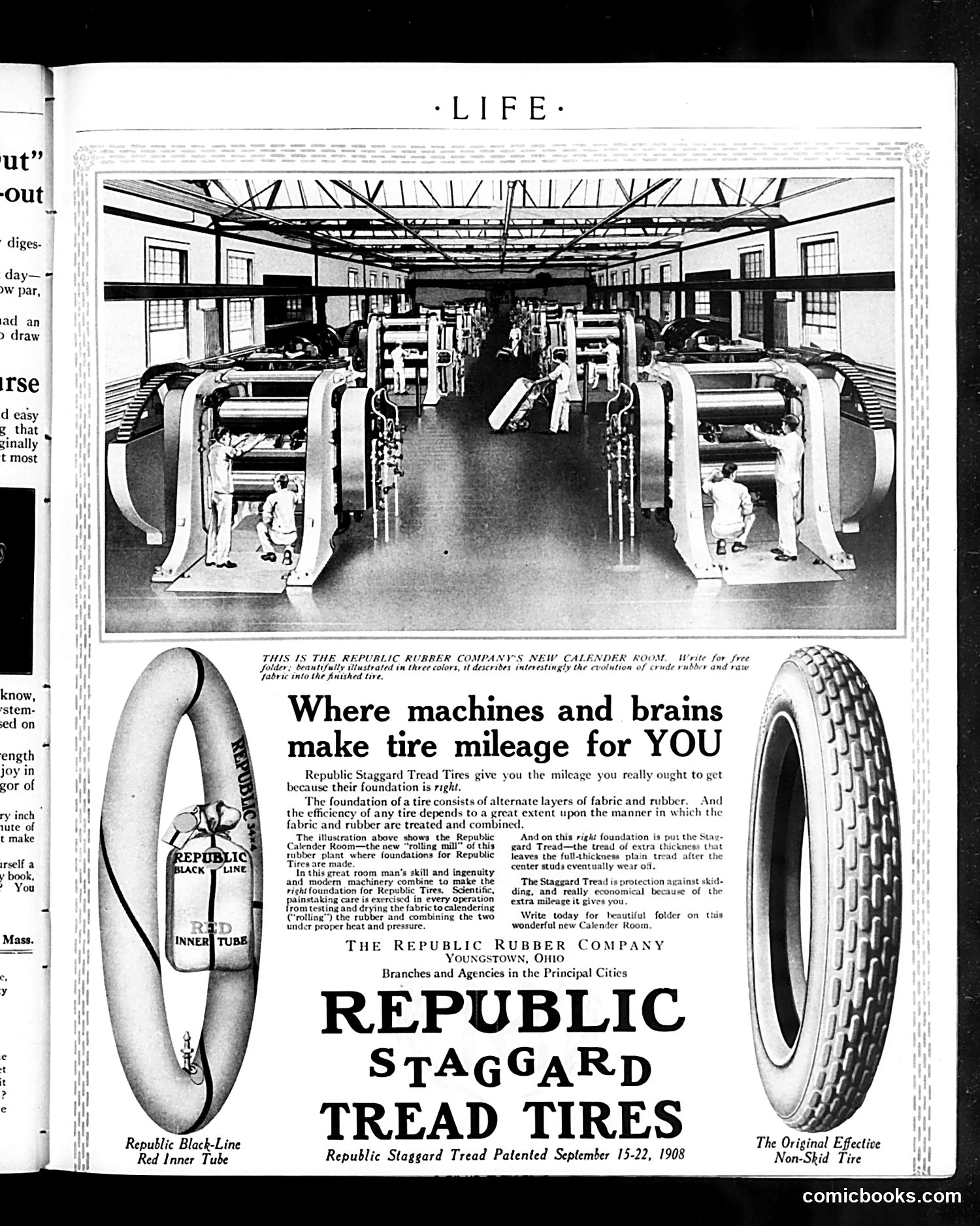
This page is **primarily an advertisement**, not a political cartoon. It's a Republic Rubber Company advertisement for "Staggard Tread Tires" from Life magazine. The main image shows the company's "Calender Room"—an industrial manufacturing facility where tire components are processed. The large photograph demonstrates the modern machinery and scale of tire production, appealing to consumers by emphasizing technological sophistication. The accompanying text and diagrams explain tire construction (layers of fabric and rubber) and promote the "Staggard Tread" design as superior because of proper foundational engineering and its anti-skid properties. Two tire cross-sections flank the central text. **For modern readers**: This reflects early automotive marketing (circa 1908), when tire technology was still developing and manufacturers competed on engineering claims. The appeal to "man's skill and ingenuity" combined with "modern machinery" reflects Progressive Era confidence in industrial advancement. The detailed explanation suggests consumers needed education about tire quality—a novel concern in the automobile's infancy.
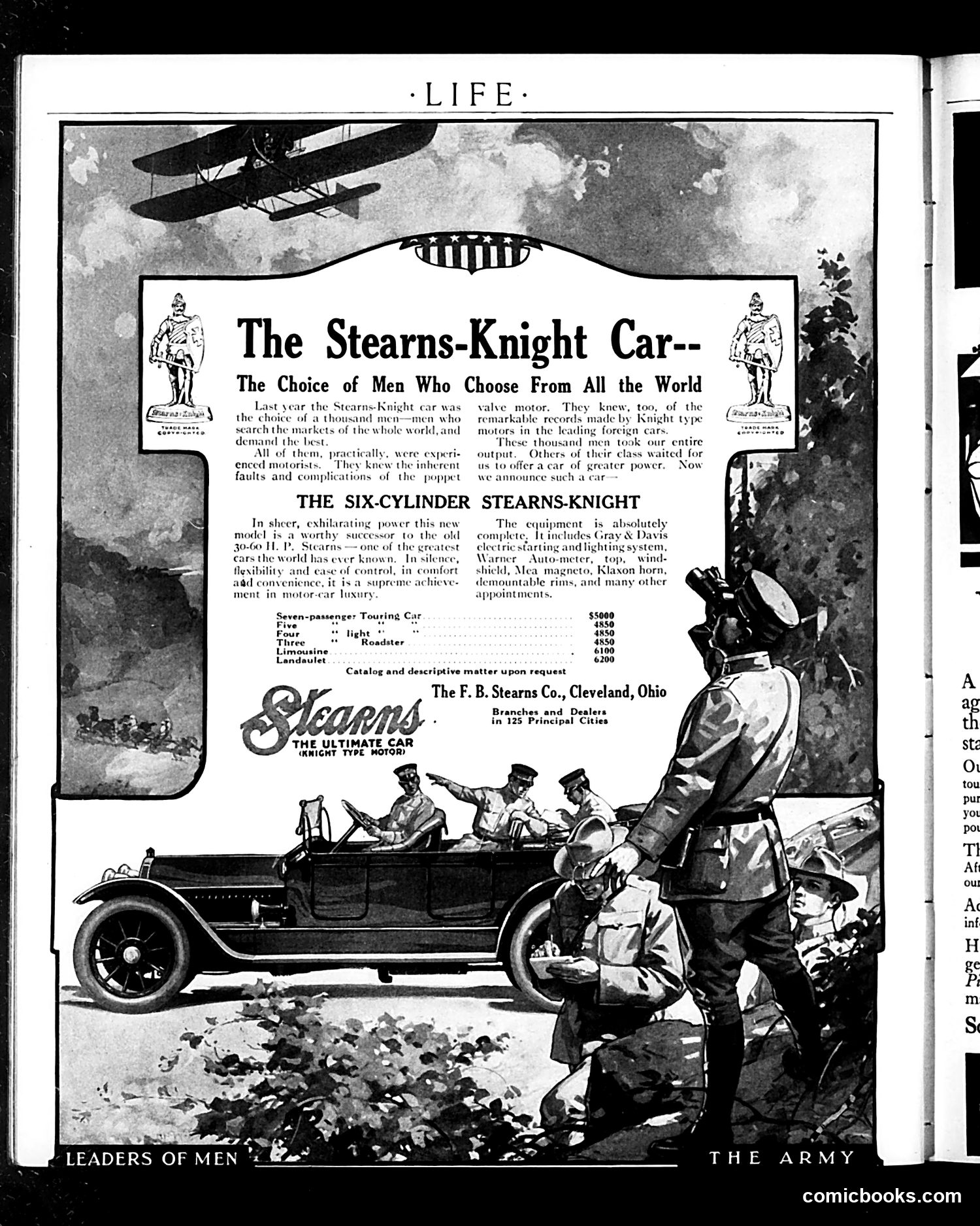
This page is primarily a **car advertisement**, not political satire. It promotes the Stearns-Knight six-cylinder automobile from Cleveland, Ohio. The ad employs patriotic and military imagery to market the vehicle: the header shows an airplane and soldiers, while the lower illustration depicts military officers examining the car. The tagline "The Choice of Men Who Choose From All the World" positions the car as elite and internationally respected. The appeal is to experienced motorists who understand automotive quality—men familiar with "the inherent faults and complications" of competing engines. The ad emphasizes the car's power, silence, and luxury as superiority markers. This represents typical early-20th-century advertising strategy: associating consumer products with military strength, sophistication, and masculine authority to boost sales. The page contains no political cartoon or satire—it is straightforward commercial promotion using patriotic framing.
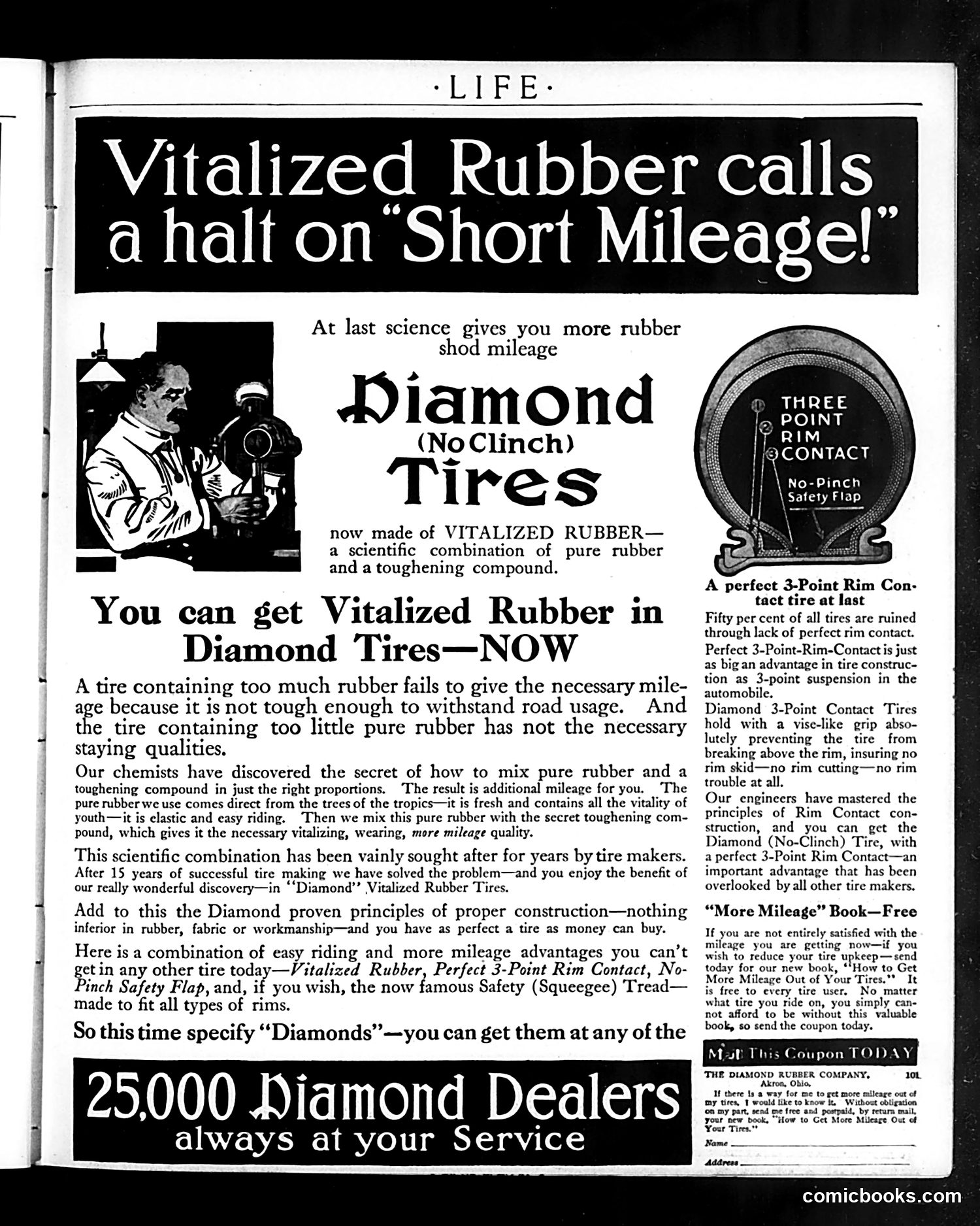
This is primarily a **tire manufacturer advertisement**, not political satire. The Diamond Rubber Company (Akron, Ohio) promotes their new "Vitalized Rubber" tires by claiming a scientific breakthrough. The central claim: previous tires failed because they contained either too much rubber (not durable) or too little (lacking staying power). Diamond's chemists allegedly solved this by mixing pure tropical rubber with a "toughening compound" in optimal proportions. The illustrated figure (left) appears to be a scientist or engineer demonstrating the product—a common advertising trope of the era to convey scientific legitimacy. Key selling points highlighted: extended mileage, a "3-Point Rim Contact" design preventing tire damage, and easy riding. The ad encourages readers to request a free "More Mileage" book and lists 25,000 Diamond dealers available nationwide. **This reflects early 20th-century automotive advertising strategy**: making technical claims about rubber composition to justify premium pricing during an era when tire durability was a genuine consumer concern.
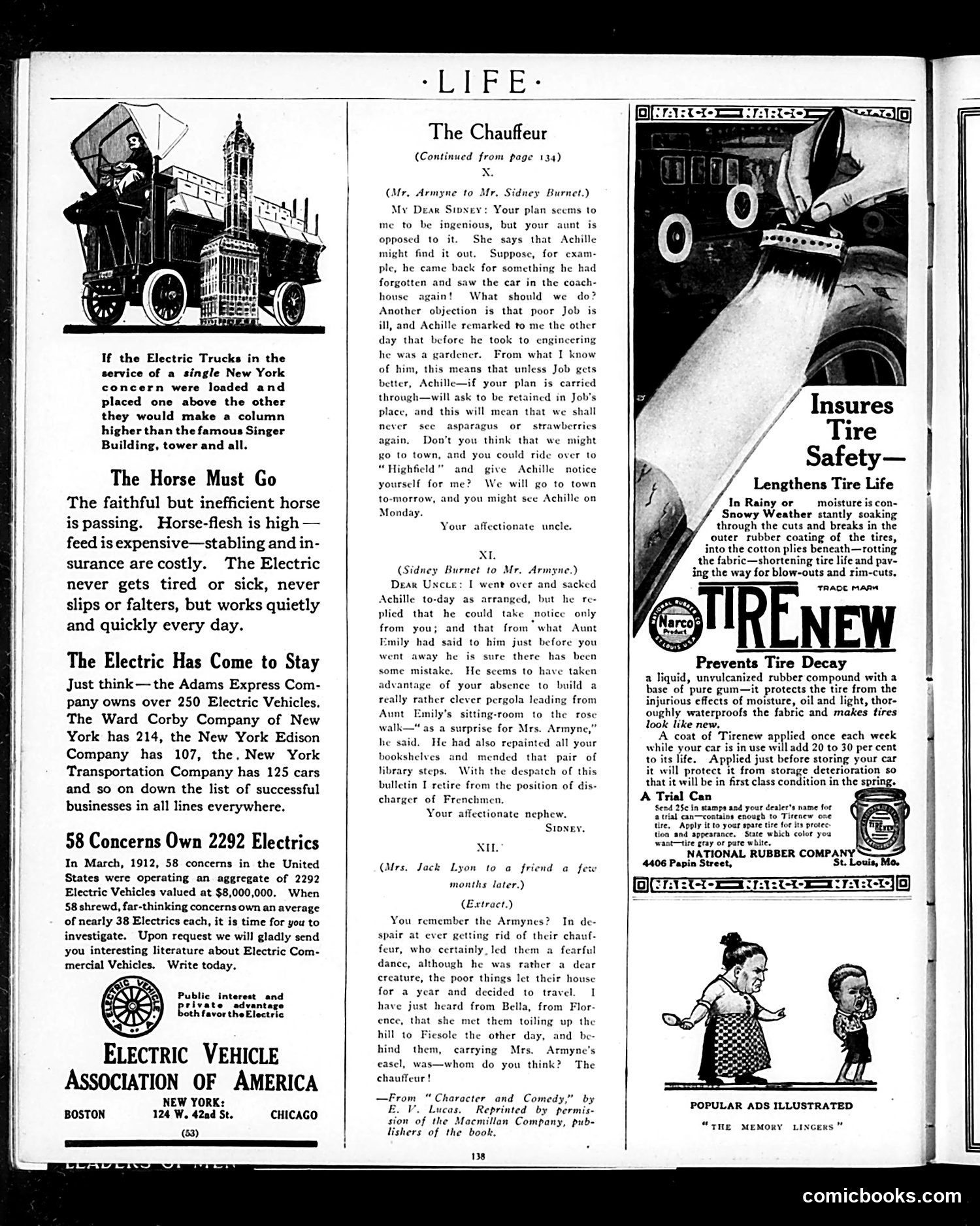
This page combines advertising for electric vehicles with a serialized humorous story about domestic life. **The Advertisements:** The left side aggressively promotes electric trucks and vehicles as superior to horses. The copy emphasizes reliability, low maintenance, and growing adoption by major companies (Adams Express, Ward Corby, New York Edison). This is early automotive marketing (circa 1912) targeting commercial businesses, positioning electrics as the inevitable future that will replace unreliable horse-drawn transport. **The Story ("The Chauffeur"):** The serialized narrative satirizes wealthy household dynamics. A gentleman (Mr. Armyne) schemes to fire his chauffeur Achille through his nephew Sidney, but his wife opposes it. Sidney bundles the firing, and Achille—claiming he needs notice from Mr. Armyne directly—continues working. The joke concludes with Achille following the Armynes on their year-long travels to Italy, accompanying them even on leisure trips. The humor lies in the servants' power over their employers: despite the family's attempts to escape him, Achille remains indispensable and unavoidable. The contrast is ironic: advertisements celebrating machines replacing unreliable servants, while the story shows servants proving irreplaceable.
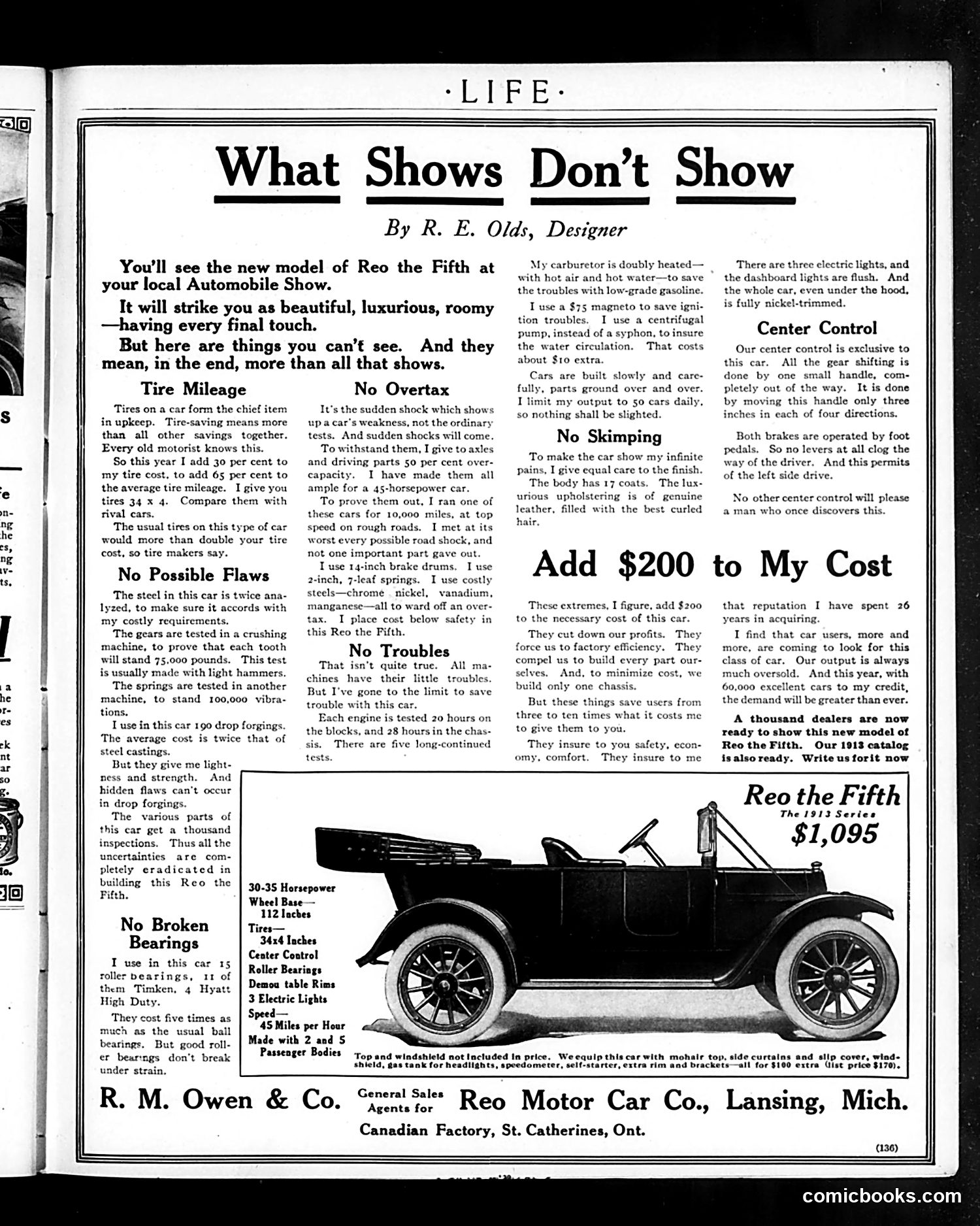
This is primarily a **car advertisement**, not political satire. R.E. Olds, designer of the Reo automobile company, uses the headline "What Shows Don't Show" to argue that a car's true quality lies in invisible engineering—not flashy appearance. The sales pitch emphasizes durability features buyers can't see at automobile shows: reinforced axles, superior steel tested 1,000 times, premium bearings, heavy-duty brakes, and careful hand assembly (limited to 50 cars daily). Olds claims these cost-intensive choices add $200 to the price but save owners money long-term through reliability and tire mileage. For modern readers: this represents early automotive marketing strategy—selling engineering credibility rather than style. The "Reo the Fifth" cost $1,095 (roughly $35,000 today), positioning itself as a premium, carefully-built alternative to mass-produced competitors. The emphasis on hidden quality reflects both legitimate manufacturing differences and the nascent car industry's need to justify premium pricing.
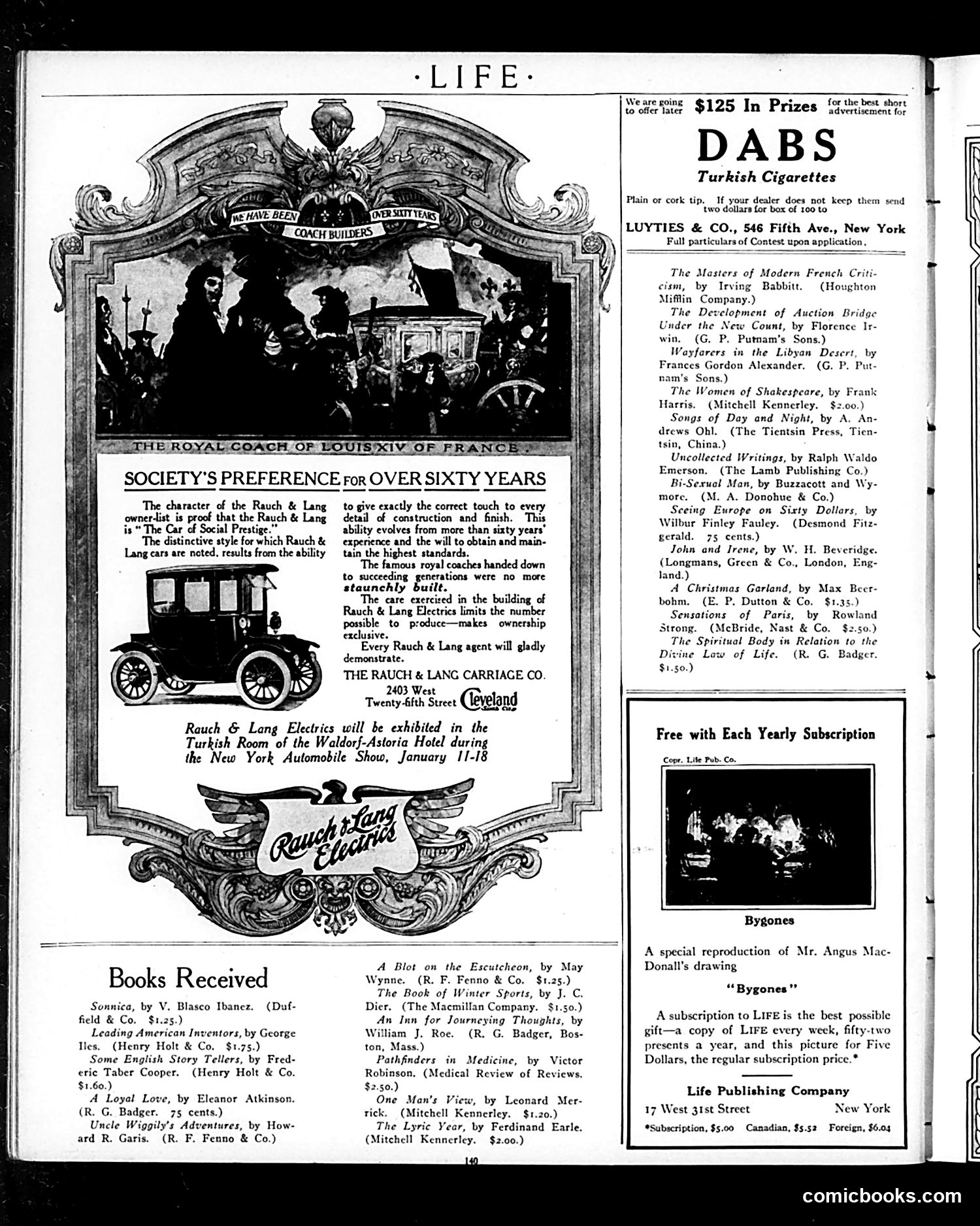
This page is primarily **advertising and book announcements**, not political satire. The main content advertises the Rauch & Lang electric automobile, using a historical comparison: the ornate illustration at top depicts King Louis XIV's royal coach, implying that owning a Rauch & Lang electric car represents similar exclusivity and prestige. The advertisement's logic: just as royal coaches were "staunchly built" with meticulous attention to detail across generations, Rauch & Lang cars claim superiority through 60+ years of craftsmanship. The limited production ("limits the number possible to produce") deliberately maintains exclusivity and social status. The page also lists newly published books and advertises DABS Turkish Cigarettes with a $125 prize contest. There is no political cartoon or satirical commentary—this is a typical early 1900s magazine page mixing luxury goods advertising with literary announcements, designed to appeal to Life's affluent readership.
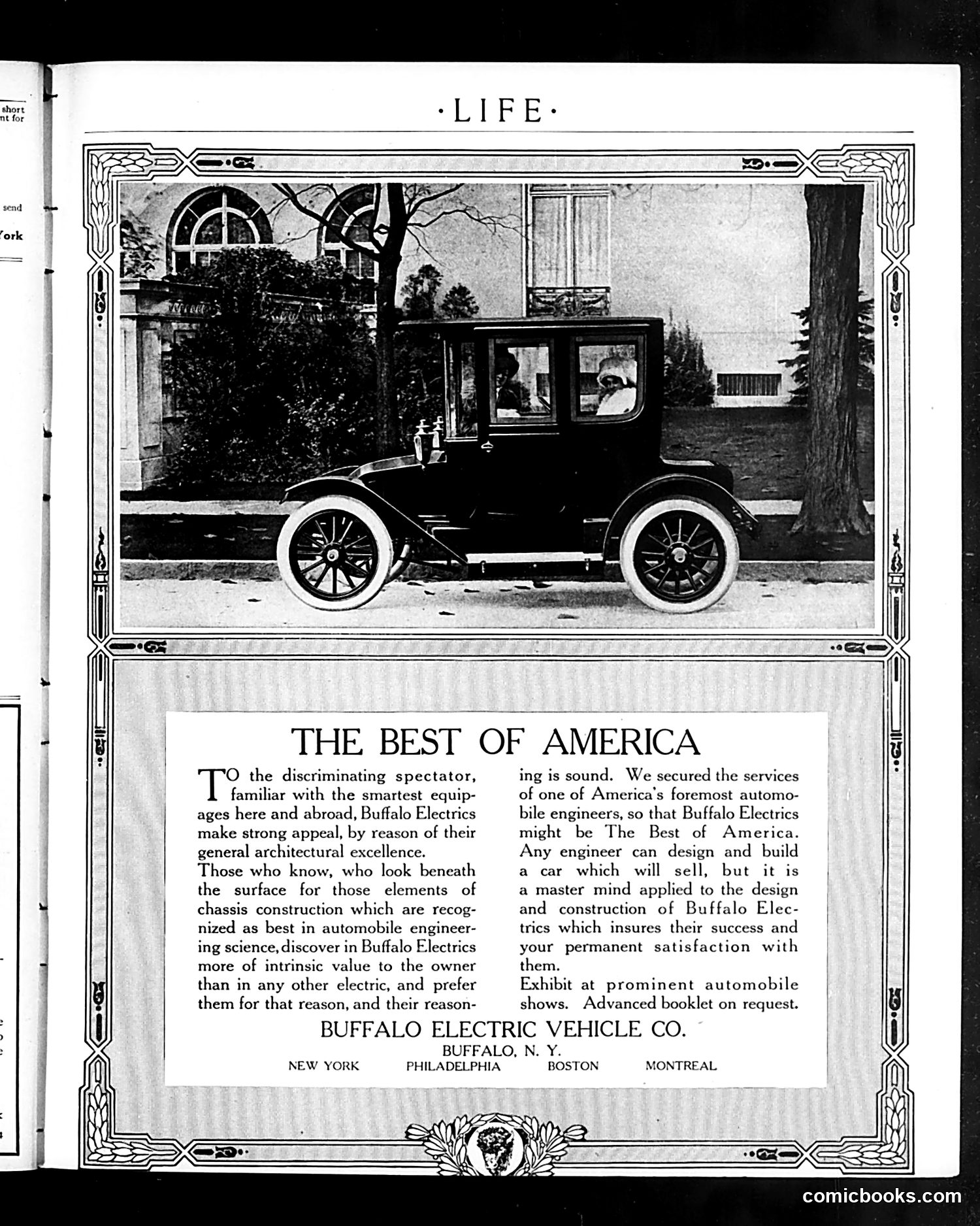
This is not a cartoon or satire—it's a straightforward **automobile advertisement** for Buffalo Electric Vehicle Company, appearing in *Life* magazine. The page features a photograph of an early electric car (appears to be from the 1910s era) parked on a residential street, shown in profile to display its design. The accompanying text markets the vehicle to "discriminating spectators" and wealthy buyers familiar with fine carriages, emphasizing engineering excellence and chassis construction quality. The ad claims Buffalo Electrics employed "one of America's foremost automobile engineers" to ensure superior design and lasting customer satisfaction. The company lists showrooms in major cities: Buffalo, New York, Philadelphia, Boston, and Montreal. This represents period marketing strategy: positioning electric vehicles as premium products for the affluent, before gasoline engines ultimately dominated the automotive market.
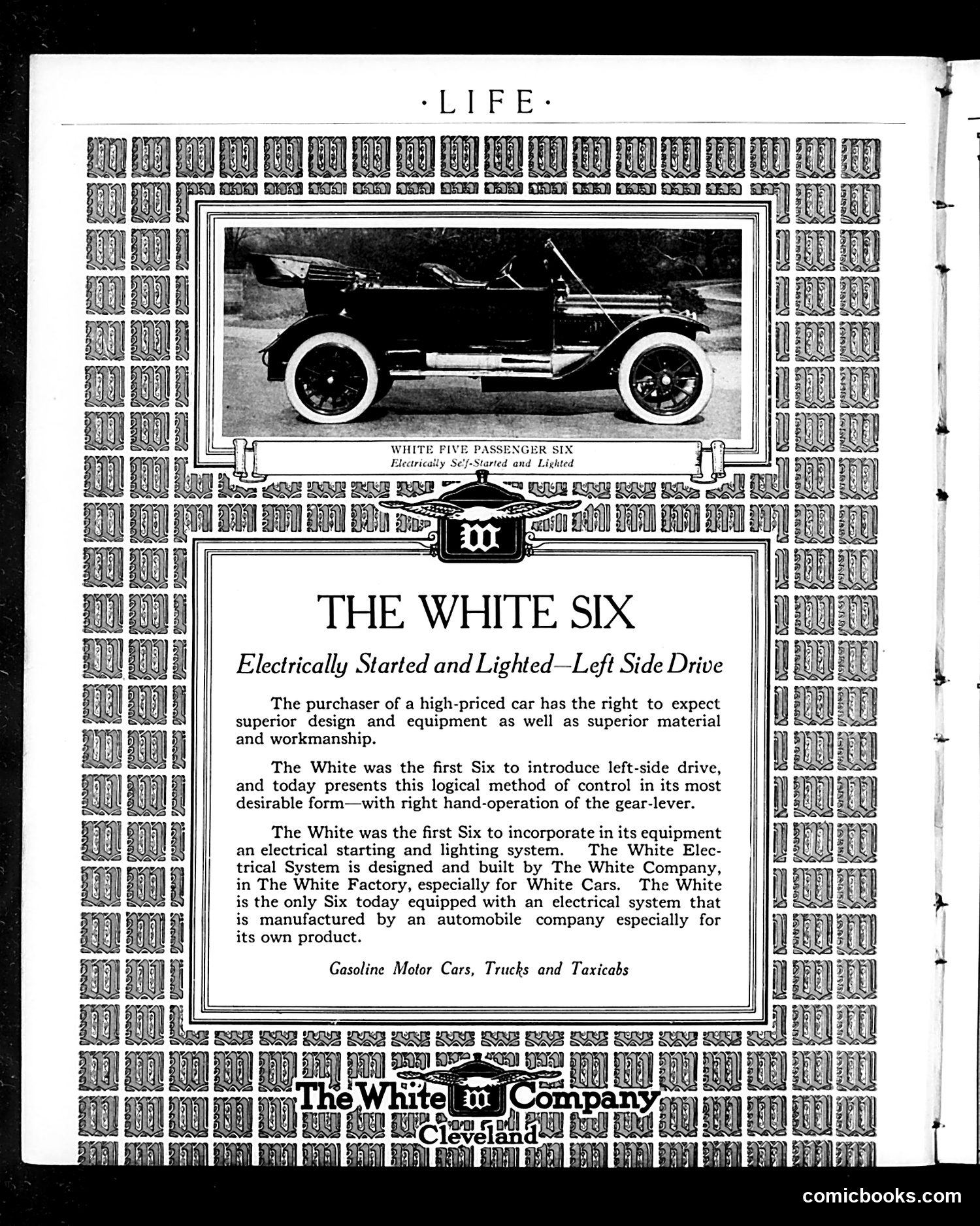
This is **not a cartoon or satire** — it's a straightforward **automobile advertisement** from Life magazine's pages. The White Company is promoting their "White Six" luxury car, emphasizing three technical innovations: 1. **Left-side drive** — a relatively new feature at the time, positioning the driver on the left rather than right 2. **Electrical starting and lighting system** — a major advancement over hand-cranking engines 3. **Vertical integration** — The White Company manufactured their own electrical system rather than buying from suppliers The page showcases a photograph of the vehicle and highlights the company's claim to be industry-first in these features. For a modern reader: this represents early automotive advertising targeting wealthy buyers by emphasizing engineering superiority and cutting-edge technology — similar to how luxury car brands today advertise innovations like electric powertrains or autonomous features. The ornate decorative border was typical of early 20th-century magazine design.
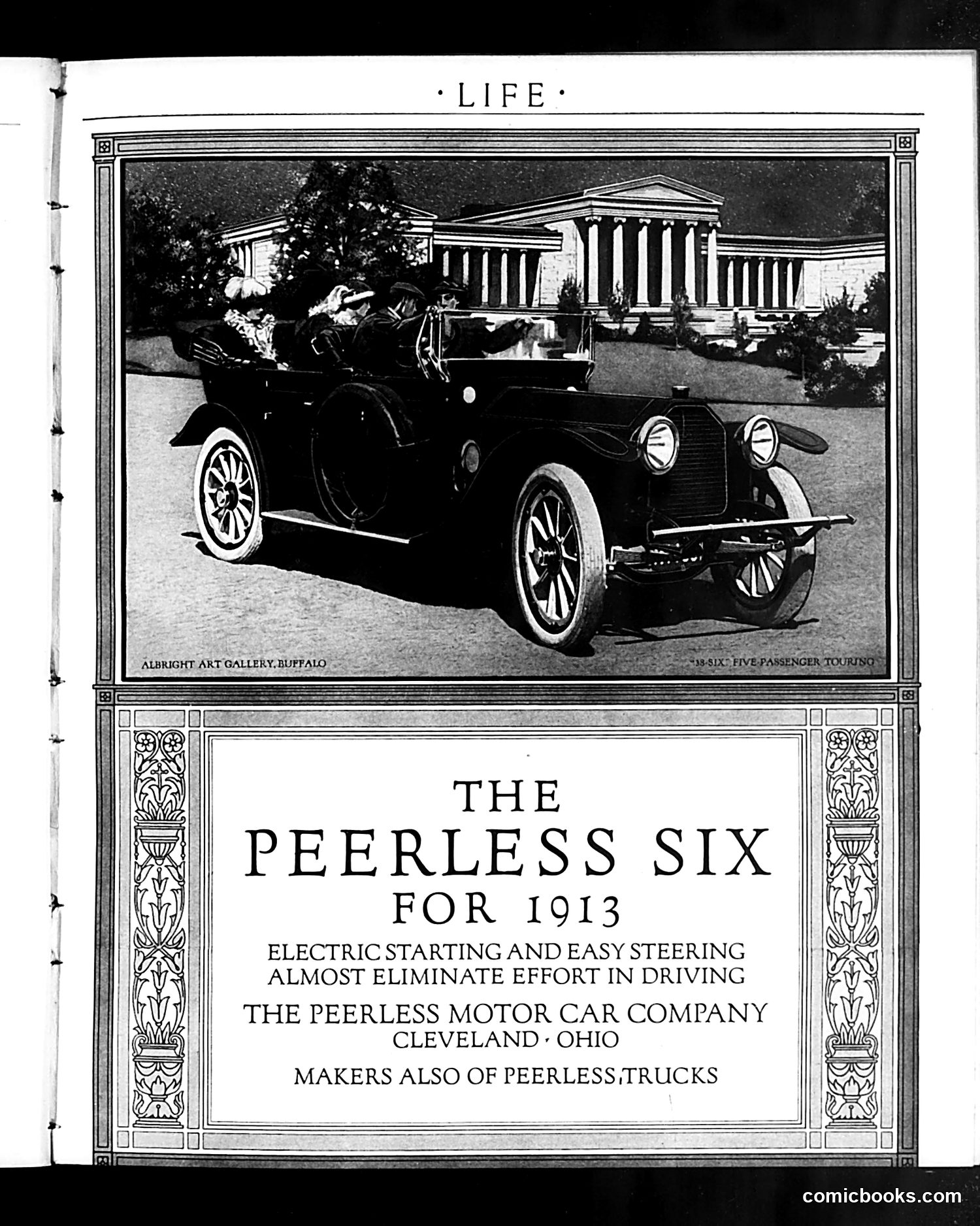
This is **not a political cartoon or satire**—it's a straightforward **advertisement** for the Peerless Motor Car Company of Cleveland, Ohio. The page features a photograph of a 1913 Peerless Six automobile with well-dressed passengers in front of a neoclassical building (likely meant to suggest wealth and respectability). The ad emphasizes technological innovations: electric starting and easy steering that "almost eliminate effort in driving." This represents early automotive marketing targeting affluent buyers by highlighting labor-saving features and social prestige. The classical architecture and elegant passengers convey luxury and status. There is no satirical content—this is a period advertisement from *Life* magazine's commercial pages.
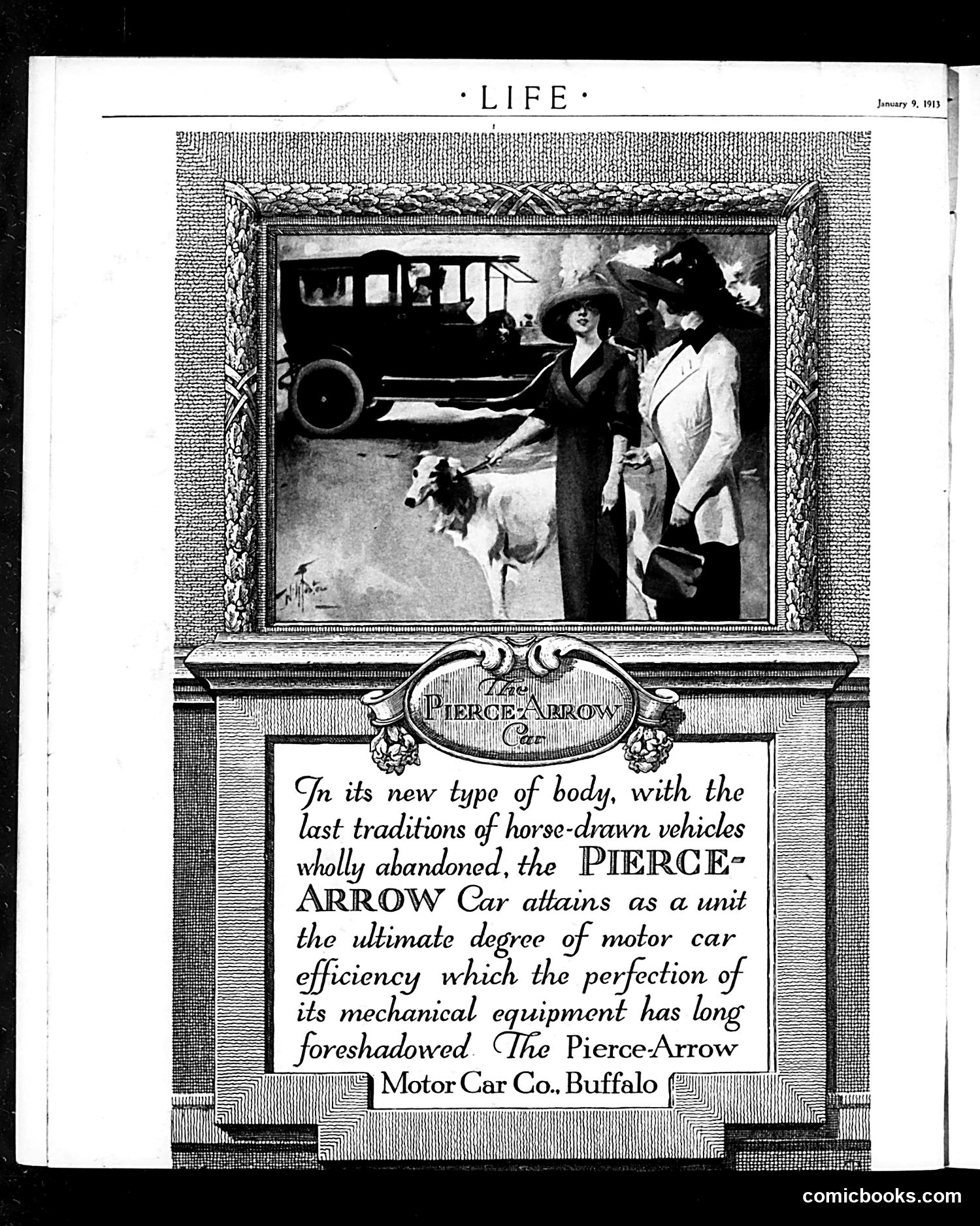
This is primarily a **automobile advertisement**, not political satire. The page shows a Pierce-Arrow motor car advertisement from Life magazine (January 9, 1913). The image depicts well-dressed women with a small dog examining or admiring a Pierce-Arrow automobile, with another car visible in the background. The ad copy emphasizes the car's modernity—specifically that it abandons "horse-drawn vehicle" traditions entirely and represents "the ultimate degree of motor car efficiency." The social context: This targets affluent women as consumers during the early automobile era, suggesting that owning a Pierce-Arrow represented sophistication and technological progress. The fashionable dress and leisurely scene position the car as a luxury lifestyle product. No political commentary or satire is apparent—this is straightforward product marketing.