
Life, 1913-01-09 · page 46 of 100
Life — January 9, 1913 — page 46: what you’re looking at
What you’re looking at
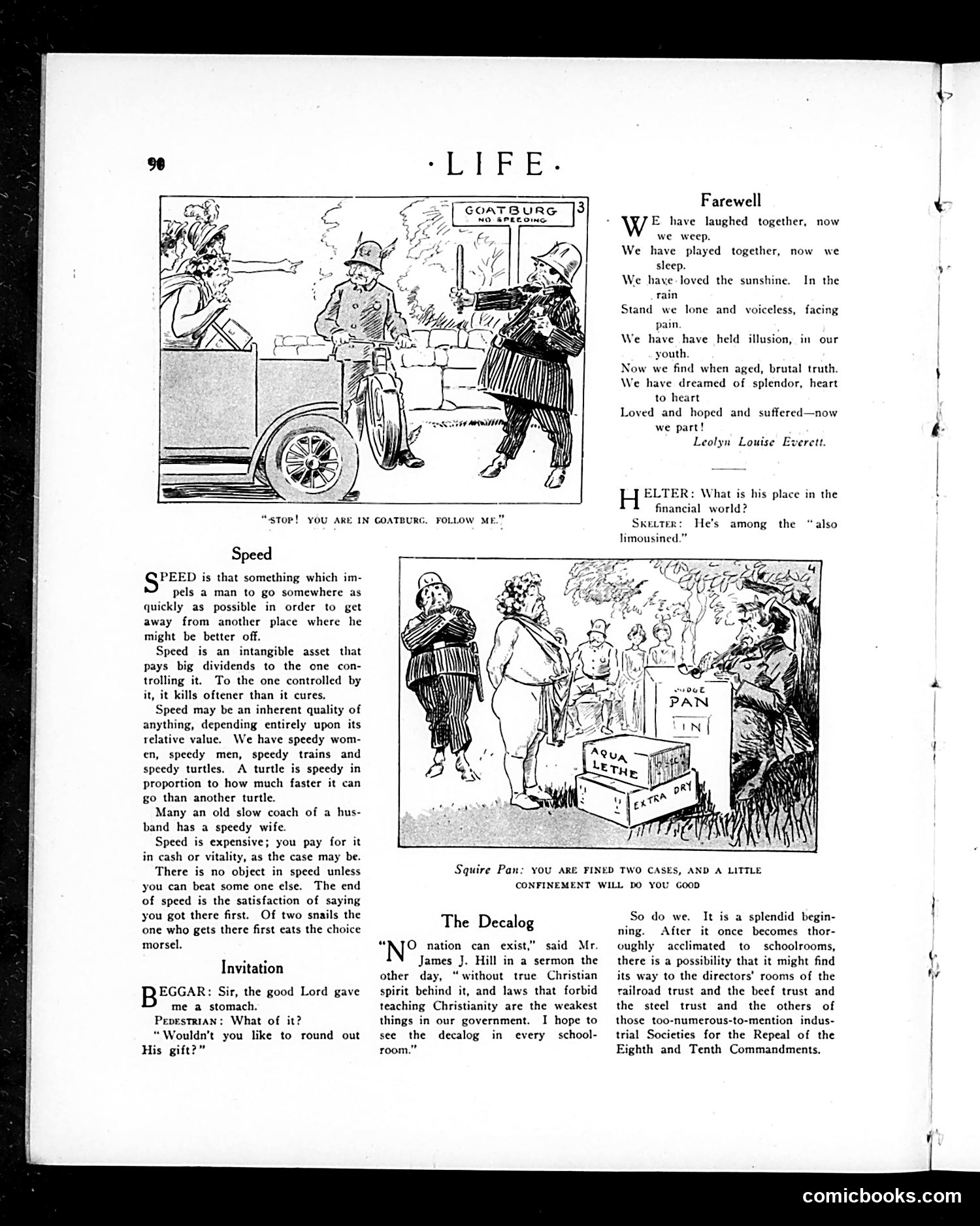
This page contains satirical pieces critiquing American society circa early 1900s. **Top cartoon**: Shows military figures in Goatburg (likely a fictional/mocking place name), satirizing militarism or possibly German militarism given the "Goatburg" reference and helmeted soldiers. **"Speed" essay**: A tongue-in-cheek definition mocking America's obsession with speed and efficiency. It notes speed is "expensive" and kills "oftener than it cures," suggesting criticism of reckless modernization and fast-paced living at the cost of human welfare. **"The Decalog" section**: Sarcastically responds to industrialist James J. Hill's call for the Ten Commandments in schoolrooms. The satire argues the *real* need is for the Commandments in corporate boardrooms—specifically addressing the "Eighth and Tenth Commandments" (prohibiting theft and covetousness), implying railroad, beef, and steel trusts violate these through their business practices. The humor relies on exposing hypocrisy: calls for Christian morality in schools ring hollow when industrial titans ignore Christian ethics in their monopolistic enterprises.
📄 Transcribed text from this page (OCR, searchable)
Machine-transcribed from the original scan — historical spelling and the odd misread are preserved.
“SEA BaE « “stop! YOU ARE IN GOATBURG. FOLLOW ME.” Speed PEED is that something which im- pels a man to go somewhere as quickly as possible in order to get away from another place where he might be better off. Speed is an intangible asset that pays big dividends to the one con- trolling it. To the one controlled by it, it kills oftener than it cures, Speed may be an inherent quality of anything, depending entirely upon its relative value. We have speedy wom- en, speedy men, speedy trains and speedy turtles. A turtle is speedy in proportion to how much faster it can go than another turtle. Many an old slow coach of a hus- band has a speedy wife. Speed is expensive; you pay for it in cash or vitality, as the case may be. There is no object in speed unless you can beat some one else. The end of speed is the satisfaction of saying you got there first. Of two snails the one who gets there first eats the choice morsel. Invitation EGGAR: Sir, the good Lord gave me a stomach. Pepestrian: What of it? “Wouldn’t you like to round out His gift?” Farewell WE have laughed together, now we weep. We have played together, now we sleep. We have loved the sunshine. In the rain Stand we lone and voiceless, facing pain We have have held illusion, in our youth. Now we find when aged, brutal truth. We have dreamed of splendor, heart to heart Loved and hoped and suffered—now we part! Leolyn Louise Everett. H ELTER: What is his place in the financial world? Sketter: He's among the “also limousined.” Squire Pan: you ARE FINED TWO CASES, AN CONFINEMENT WILL DO YOU GOOD The Decalog “ATO nation can exist,” said Mr. James J. Hill in a sermon the other day, “without true Christian spirit behind it, and laws that forbid teaching Christianity are the weakest things in our government. I hope to see the decalog in every school- room.” So do we. It is a splendid begin- ning. After it once becomes thor- oughly acclimated to schoolrooms, there is a possibility that it might find its way to the directors’ rooms of the railroad trust and the beef trust and the steel trust and the others of those too-numerous-to-mention indus- trial Societies for the Repeal of the Eighth and Tenth Commandments. comicbooks.com