
Life, 1913-01-09 · page 53 of 100
Life — January 9, 1913 — page 53: what you’re looking at
What you’re looking at
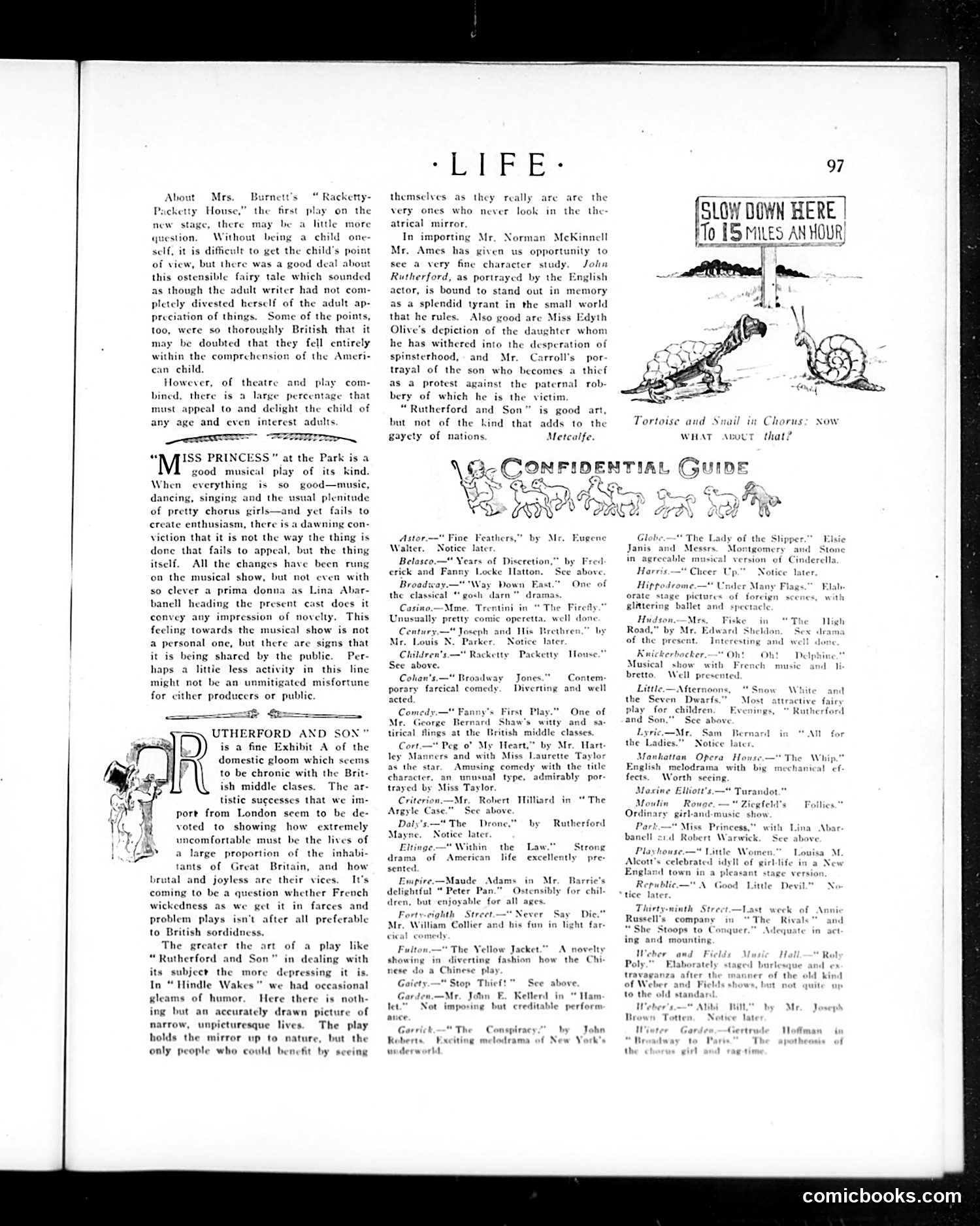
This page contains theater reviews rather than political cartoons. The small illustration in the upper right—"Tortoise and Snail in Chorus"—is a whimsical sketch accompanying a brief caption, likely a theatrical pun or jest unrelated to satire. The substantial content critiques contemporary Broadway productions. The reviewer discusses Mrs. Burnett's "Racketty-Packetty House" (a children's play), "Miss Princess" at the Park, and notably "Rutherford and Son"—a British import featuring actor Norman McKinnell. The satire here targets British theatrical imports. The reviewer observes that London's dramatic successes focus relentlessly on depicting the "domestic gloom," "sordidness," and "narrow, unpicturesque lives" of the British middle classes, suggesting French farces—despite their immorality—are preferable to this relentless bleakness. The implicit critique: British playwrights aestheticize misery while claiming artistic superiority.
📄 Transcribed text from this page (OCR, searchable)
Machine-transcribed from the original scan — historical spelling and the odd misread are preserved.
About Mrs, Burnett's Racketty- Packetty House,” the first play on the new stage, there may be a little more question. Without being a child one- sclf, it is difficult to get the child’s point of view, but there a good deal about fairy tale which sounded as though the adult writer had not com- pletely divested hersclf of the adult ap- preciation of things. Some of the points, too, were so thoroughly British that it may be doubted that they fell entirely this ostensible within the comprehension of the Ameri- can child, However, of theatre and play com- bined, there is a large percentage that must appeal to and delight the child of any age and even interest adults. ISS PRINCESS” at the Park is a good play of its kind. When everything is so good—music, dancing, singing and the usual plenitude of pretty chorus ¢' and yet fails to create enthusiasm, there is a dawning con- viction that it is not the way the thing is done that fails to appeal, but the thing itself. All the changes have been rung on the musical show, but not even with so clever a prima donna as Lina Abar- banell heading the present cast does it convey any impression of novelty. This feeling towards the musical show is not a personal one, but there are signs that it is being shared by the public. Per- haps a littie less activity in this line might not be an unmitigated misfortune for cither producers of public. 2 oo UTHERFORD AND SON” is a fine Exhibit A of the domestic gloom which scems to be chronic with the Brit- ish middle clases. The ar- tistic successes that we port from London seem to be de- voted to showing extremely uncomfortable must be the lives of arge proportion of the inhabi- s of t Britain, and how brutal and joyless are their vices. It’s coming to be a question whether French wickedness as we get it in farces and problem plays isn't after all preferable to British sordidness. The greater the art of a play like “Rutherford and Son” in dealing with ject the more depressing it is In “Hindle Wakes” we had occasional Here there ing but an accurately drawn picture of narrow, unpicturesque lives. The play holds the mirror up to nature, but the only people who coukl benefit by » musical m- how gleams of humor is noth- ng DNF E themselves as they really are are the very ones who never look in the atrical mirror, In importing Mr, Norman McKinnell Mr. Ames has given us opportunity to see a very fine character study. John Rutherford, as portrayed by the English actor, is bound to stand out in memory as a splendid tyrant in the small world that he rules. Also good are Miss Edyth Olive’s depiction of the daughter whom he has withered into the desperation of spinsterhood, and Mr. Carroll's por trayal of the son who becomes a thicf as a protest against the paternal rob- bery of which he is the victim “Rutherford and Son” is good art, but not of the kind that adds to the Tortoise and Snail in Chorus: sow gayety of nations. Metcalfe. WHAT Avout that? ae ead IDENTIAL GUIDE ora A, She si ves eae Astor.“ Fine Feathers,” by Mr. Eugene Glob “* The Lady of the $ Elsie Walter. Notice later and Messrs. Mor and Stone Belasco.—" Years of Discretion,” by Fred erick and Fanny Locke Hatton. See above Broadway.—" "Way Down Fast.” One of the classical “gosh darn” dramas, Casino.—Mme. Trentini in The Fire Unusually pretty comic operetta, well done Centur Joseph and His Brethren,” by Mr. Louis N. Parker. Notice later Children's—" Racketty Packetty House.” See above. Cohan’s.—" Broadway Jones ontem- porary farcical comedy. Diverting and well acted Comedy.—" Fanny's First Play.” One of Mr. George Bernard Shaw's witty and sa- tirical flings at the British middle classes Cort.—" Peg 0” My Heart,” by Mr. Hart: ley Manners and with Miss Laurette Taylor as the star. Amusing comedy with the title character, an unusual type, admirably por trayed by Miss Taylor. Criterion.—Mr. Rohert Hilliard in“ The Argyle Case.” See above The Drone.” by Notice later nge—" Within the of American life Rutherford Law.” Strong. excellently pre- sented. Adams in Mr. Ostensibly for chil mipire.—Maude delightful * Peter dren, but enjoyable for all ages Forty-cighth St “Never Say Dic.” Mr. William Collier and his fun in light far- Fulton.—" The Yellow Jacket.” A novelty showing in diverting fashion how the Chi nese do a Chinese play ty." Stop Thief!” See Garden.—Mr. John BE. Keller in Ham. let.” Not imposing but creditable perform b—"The Conspiracy.” by John 1c melodrama of New York's 97 (SLOW DOWN HERE | io IS mivés AN HOUR) in agreeable musical version of Cinderella Harris." Cheer Up.” Noti Hippodrome.—“ Many orate stage pictures of fore Flals glittering ballet and spectacle Hudson—Mes, Fiske in “The igh Road,” by Mr. Edward Sheldon Sex drama Knickerbocker." Ont Oh Te i Musical show with French mnssic mul bretto. Well presented. Little. —Afternoons, “Snow White and the Seven Dwarfs.” Most tractive fairy play for children. Evenings, “ Rutherford and Son.” See above Lyric.—Mr. Sam Bernard i the Ladies."” Notice later Manhattan Opera House—" The Whip.” English melodrama with big mechanical ef fects. Worth seeing. Maxine Elliott's —* Tur: ot.” Moulin Rouge, —“ Zicgfeld’s r es Ordinary. girl-and-musie show | Part.—" Miss Princess,” with Lina Abar banell cat Robert War Playhouse.—" Little Womer Lo M. 's celebrated idyll of girl-life a New gland town a pleasant stage versio: Republic —" A Good Little Devil.” N Thirtyninth Strect—Last week of Anni Russell's company in “The Rivale” and ing and mounting Weber and Fiel 1, Hu Rol travaganza after the manner of the old kind to the old standa Weber's.—" Alibi by Me. Joses Totten, Not , . r 1 { comicbooks.com