
Life, 1913-01-09 · page 25 of 100
Life — January 9, 1913 — page 25: what you’re looking at
What you’re looking at
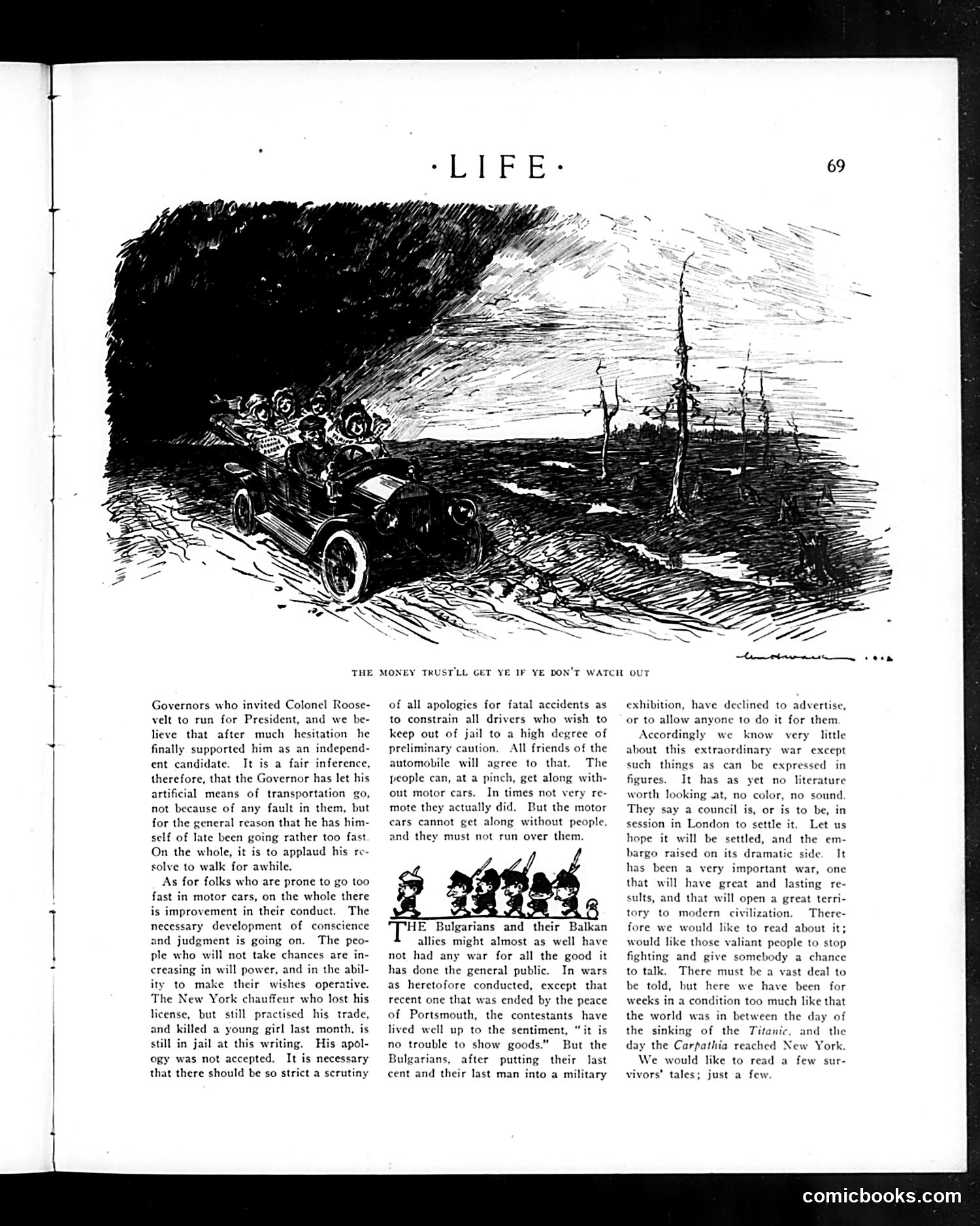
This satirical illustration and accompanying text criticize reckless automobile driving and advocate for stricter traffic safety enforcement. The cartoon depicts a speeding car approaching a harbor with ships, visualizing the danger of motor vehicles. The text discusses a New York chauffeur who lost his license but continued driving illegally, killing a young girl—and remained jailed without accepting his apology. Life argues that motor car operators must face strict consequences for fatal accidents to deter dangerous behavior. The underlying point: automobiles are dangerous machines that "cannot get along without people," so drivers must exercise extreme caution. The piece also criticizes lack of media coverage of the Balkan Wars, comparing the information blackout to the silence between the *Titanic* sinking and the *Carpathia's* arrival in New York—a recent, vivid reference for 1912-era readers.
📄 Transcribed text from this page (OCR, searchable)
Machine-transcribed from the original scan — historical spelling and the odd misread are preserved.
Governors who invited Colonel Roose- velt to run for President, and we be- lieve that after much hesitation he finally supported him as an independ- ent candidate. It is a fair inference, therefore, that the Governor has let his artificial means of transportation go, not because of any fault in them, but for the general reason that he has him- self of late been going rather too fast On the whole, it is to applaud his re- solve to walk for awhile. As for folks who are prone to go too fast in motor cars, on the whole there is improvement in their conduct. The necessary development of conscience and judgment is going on. The peo- ple who will not take chances are in- creasing in will power, and in the abi ity to make their wishes operative. The New York chauffeur who lost his license, but still practised his trade, and killed a young girl last month, is still in jail at this writing. His apol- ogy was not accepted. It is necessary that there should be so strict a scrutiny of all apologies for fatal accidents as to constrain all drivers who wish to keep out of jail to a high degree of preliminary caution. All friends of the automobile will agree to that. The people can, at a pinch, get along with- out motor cars. In times not very re- mote they actually did. But the motor cars cannot get along without people, and they must not run over them. HE Bulgarians and their Balkan allies might almost as well have not had any war for all the good it has done the general public. In wars as heretofore conducted, except that recent one that was ended by the peace of Portsmouth, the contestants have lived well up to the sentiment, “it is no trouble to show goods.” But the Bulgarians, after putting their last cent and their last man into a military THE MONEY TRUST'LL GET YE IF YE DON'T WATCH OUT exhibition, have declined to advertise, or to allow anyone to do it for them. Accordingly we know very little about this extraordinary war except such things can be expressed in figures. It has as yet no literature worth looking at, no color, no sound They say a council is, or is to be, in session in London to settle it. Let us hope it will be settled, and the em- bargo raised on its dramatic side. It has been a very important war, one that will have great and lasting re- sults, and that will open a great terri- tory to modern civilization. There- fore we would like to read about it; would like those valiant people to stop fighting and give somebody a chance to talk. There must be a vast deal to be told, but here we have been for weeks in a condition too much like that the world was in between the day of the sinking of the Titanic, and the day the Carpathia reached New York. We would like to read a vivors’ tales; just a few. few sur- comicbooks.com