
Life, 1913-01-09 · page 62 of 100
Life — January 9, 1913 — page 62: what you’re looking at
What you’re looking at
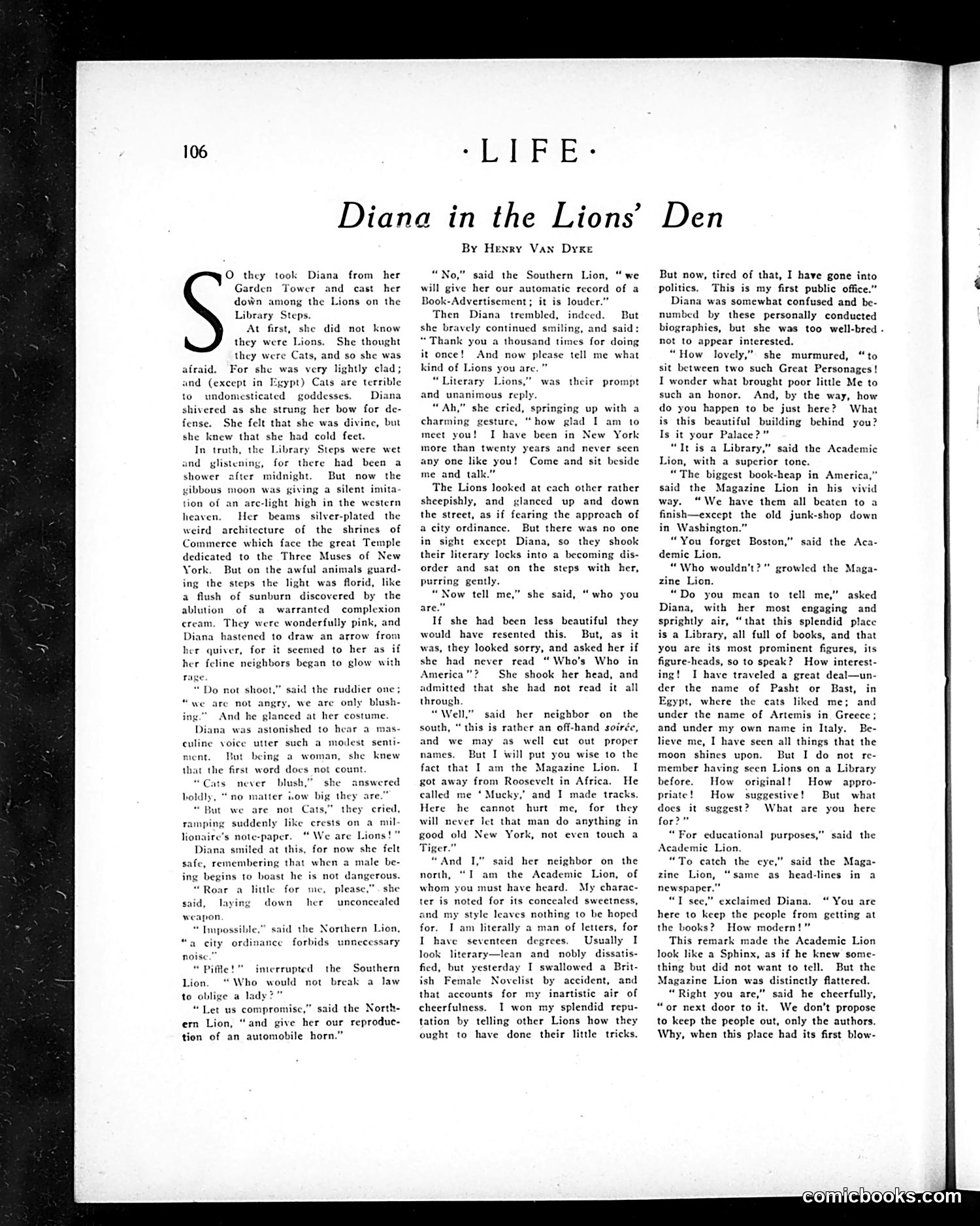
This is a Henry Van Dyke short story (not a cartoon) satirizing New York's literary and publishing establishment through classical mythology. Diana, the Roman goddess of the hunt, encounters "Lions" on library steps—which are actually **personified literary institutions**: a Magazine Lion and an Academic Lion. The satire mocks: 1. **Literary pretension**: The "Lions" are timid creatures obsessed with propriety, hiding behind "Who's Who in America" rather than displaying genuine intellectual courage. 2. **Anti-Roosevelt sentiment**: The Magazine Lion boasts of escaping Roosevelt, calling him "Mucky"—reflecting early 1900s Progressive Era political tensions. 3. **Publishing world vanity**: References to "Book-Advertisements" and competitive noise-making between publications satirize aggressive commercial publishing tactics. The piece presents New York's literary scene as full of self-important but ultimately cowardly institutions, reduced to blushing at Diana's minimal clothing rather than engaging substantively with her.
📄 Transcribed text from this page (OCR, searchable)
Machine-transcribed from the original scan — historical spelling and the odd misread are preserved.
sa bos) | Jee] ous Diana in the Lions’ Den O they took Diana from her Garden Tower and cast her down among the Lions on the Library Steps. At first, she did not know they were Lions. She thought they were Cats, and so she was afraid. For she was very lightly clad; and (except in Egypt) Cats are terrible to undomesticated goddesses, Diana shivered as she strung her bow for de- fense. She felt that she was divine, but she knew that she had cold feet. In truth, the Library Steps were wet and glistening, for there had been a shower after midnight. But now the gibbous moon was giving a silent imita- tion of an are-light high in the western heaven. Her beams. silver-plated the weird architecture of the shrines of Commerce which face the great Temple dedicated to the Three Muses of New York. But on the awful animals guard- ing the steps the light was florid, like a flush of sunburn discovered by the ablution of a warranted complexion They were wonderfully pink, and tened to draw an arrow from her quiver, for it seemed to her as if her feline neighbors began to glow with rage “Do not shoot,” said the ruddier one; we are not angry, we are only blush- ing.” And he glanced at her costume. Dians culine voice was astonished to hear a mas- utter such a modest senti- ment. But being a woman, she knew that the first word docs not count. “Cats never blush,” she answered boldly, “no matter Low big they are.” uit we are not Cats,” they cried, ramping suddenly like crests on a mil lionaire’s note-paper. “We are Lions!" Diana smiled at this, for now she felt when a male be- s not dangerous. safe, remembering ths ing begins to boast he “Roar a little for me, laying please,” . she said, down her unconcealed weapon aid the Northern Lion, forbids unnecessary * Tmpossible,” a city ordinance noise.” “Pifle!" imterrupted the Lion. “Who to oblige a lady?” “Let us compromise,” said the Nort! em Lion, “and give her our reproduc- tion of an automobile horn.” Southern would not break a law By Henry Van Dyke “No,” said the Southern Lion, “we will give her our automatic record of a Book-Advertisement; it is louder.” Then Diana trembled, indced. But she bravely continued smiling, and said: “Thank you a thousand times for doing it once! And now please tell me what kind of Lions you are. “ Literary and unanimous reply. “Ah,” she cried, springing up with a charming gesture, “how glad I am to meet you! I have been in New York more than twenty years and never seen any one like you! Come and sit beside me and talk.” The Lions looked at cach other rather sheepishly, and glanced up and down the street, as if fearing the approach of a city ordinance. But there was no one in sight except Diana, so they shook their literary locks into a becoming dis- order and sat on the steps with her, purring gently. ‘ow tell me,” she said, “who you Lions,” was their prom} are. If she had been less beautiful they would have resented this, But, as it was, they looked sorry, and asked her if she had never read “Who's Who in America”? She shook her head, and admitted that she had not read it all through. “Well,” said her neighbor on the south, “this is rather an off-hand soirée, and we may as well cut out proper names. But I will put you wise to the fact that Iam the Magazine Lion. I got away from Roosevelt in Africa. He called me ‘Mucky,’ and I made tracks. Here he cannot hurt me, for they will never Tet that man do anything in good old New York, not even touch a Tiger.” “And 1,” said her neighbor on the north, “I am the Academic Lion, of whom you must have heard. My charac- ter is noted for its concealed sweetness, and my style leaves nothing to be hoped for. I am literally a man of letters, for I have seventeen degrees. Usually I look literary—lean and nobly dissatis- fied, but yesterday I swallowed a Bri ish Female Novelist by accident, and that accounts for my inartistic air of cheerfulness. I won my splendid repu- tation by telling other Lions how they ought to have done their little tricks. But now, tired of that, I have gone into politics. This is my first public office.” Diana was somewhat confused and be- numbed by these personally conducted biographies, but she was too well-bred not to appear interested. How lovely,” she murmured, “to sit between two such Great Personages ! I wonder what brought poor little Me to such an honor. And, by the way, how do you happen to be just here? What is this beautiful building behind you? Is it your Palace?” “It is a Library,” said the Academic Lion, with a superior tone. “The biggest book-heap in America,” said the Magazine Lion in his vivid way. “We have them all beaten to a finish—except the old junk-shop down in Washington.” “You forget Boston,” said the Aca- demic Lion, “Who wouldn't?” growled the Maga- zine Lion. “Do you mean to tell me,” asked Diana, with her most engaging and sprightly air, “that this splendid place is a Library, all full of books, and that you are its most prominent figures, its figure-heads, so to speak? How interest- ing! I have traveled a great deal—un- der the name of Pasht or Bast, in Egypt, where the cats liked me; and under the name of Artemis in Greece ; and under my own name in Italy. Be- lieve me, I have seen all things that the moon shines upon. But I do not re- member having seen Lions on a Library before. How original! How appro- priate! How Suggestive! But what does it suggest? What are you here for?” “For educational purposes,” said the Academie Lion. “To catch the eye,” said the Maga- zine Lion, as head-lines in newspaper. “T see,” exclaimed Diana. “You are here to keep the people from getting at the books? How modern!” This remark made the Academie Lion look like a Sphinx, as if he knew some- thing but did not want to tell. But the Magazine Lion was distinctly flattered. “Right you are,” said he cheerfully, or next door to it, We don’t propose to keep the people out, only the authors. Why, when this place had its first blow- same