
Life, 1913-01-09 · page 36 of 100
Life — January 9, 1913 — page 36: what you’re looking at
What you’re looking at
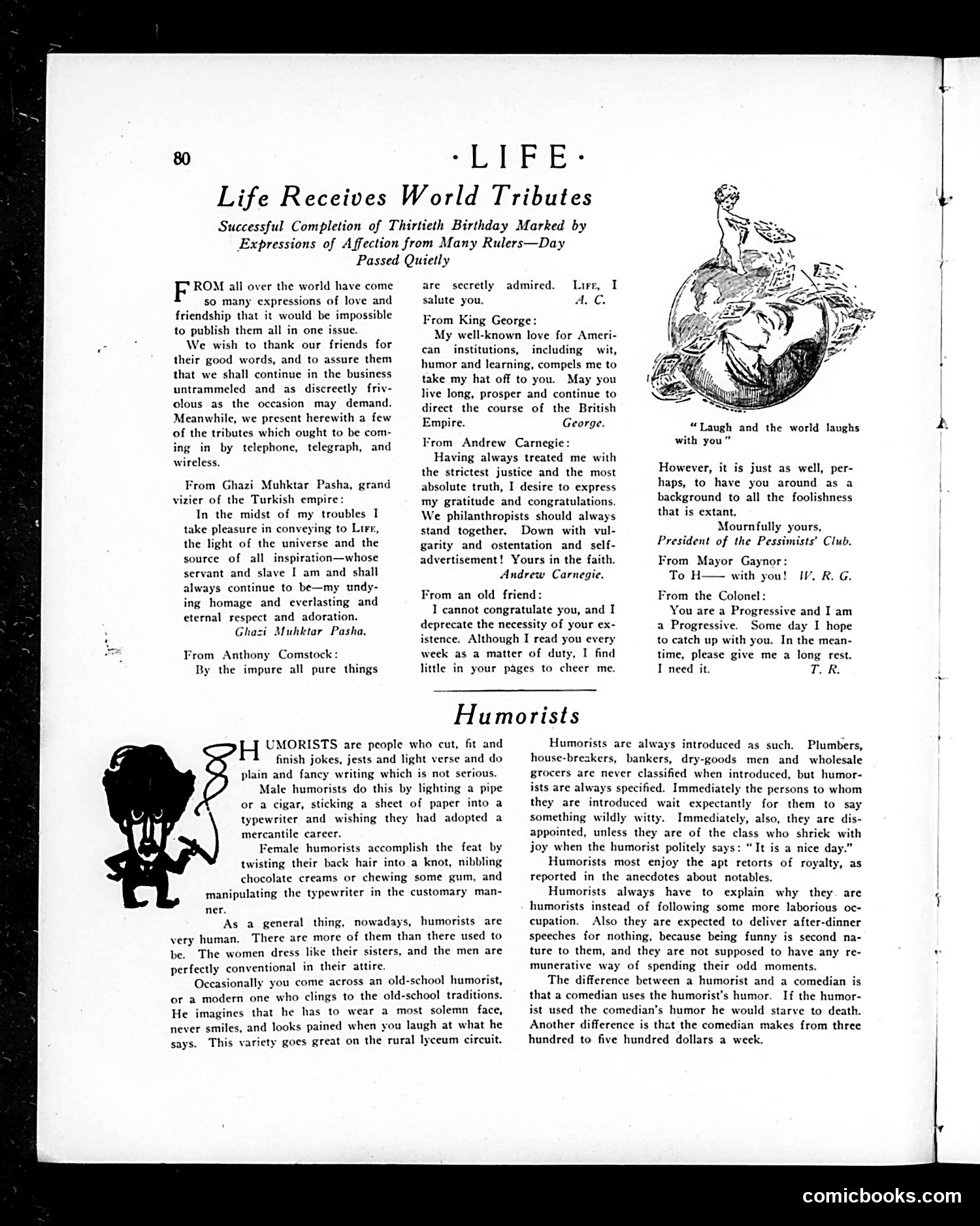
This page celebrates *Life* magazine's thirtieth anniversary with satirical mock "tributes" from world leaders and notable figures. The humor lies in the absurdity of the fictional congratulations: King George praises American "wit, humor and learning"; Andrew Carnegie emphasizes philanthropic solidarity while condemning "vulgarity and ostentation"; the Turkish Grand Vizier offers flowery, excessive flattery; and a "Pessimist Club President" backhanded-compliments the magazine as mere "background to all the foolishness." The cartoon below depicts a cherub-like figure labeled "Laugh and the world laughs with you," illustrating the accompanying article on "Humorists"—which wryly describes how humorists are always formally introduced as such (unlike plumbers or grocers), and immediately disappoint audiences expecting them to be "wildly witty." The satire gently mocks both *Life's* own pretensions and society's expectations of comedians.
📄 Transcribed text from this page (OCR, searchable)
Machine-transcribed from the original scan — historical spelling and the odd misread are preserved.
“iE TGRE + Life Receives World Tributes Successful Completion of Thirtieth Birthday Marked by Expressions of Affection from Many Rulers—Day Passed Quietly ROM all over the world have come so many expressions of love and friendship that it would be impossible to publish them all in one issue. We wish to thank our friends for their good words, and to assure them that we shall continue in the business untrammeled and as discreetly friv- olous as the occasion may demand. Meanwhile, we present herewith a few of the tributes which ought to be com- ing in by telephone, telegraph, and wireless. From Ghazi Muhktar Pasha, grand vizier of the Turkish empire: In the midst of my troubles I take pleasure in conveying to Li the light of the universe and the source of all inspiration—whose servant and slave I am and shall always continue to be—my undy- ing homage and everlasting and eternal respect and adoration. Ghazi Muhktar Pasha. are secretly admired. Lire, salute you. From King George: My well-known love for Ameri- can institutions, including wit, humor and learning, compels me to take my hat off to you. May you live long, prosper and continue to direct the course of the British Empire. George. From Andrew Carnegie: Having always treated me with the strictest justice and the most absolute truth, I desire to express my gratitude and congratulations. We philanthropists should always stand together. Down with vul- garity and ostentation and self- advertisement! Yours in the faith. Andrew Carnegie. From an old friend: 1 cannot congratulate you, and I deprecate the necessity of your ex- istence. Although I read you every week as a matter of duty, I find “Laugh and the world laughs with you” However, it is just as well, per- haps, to have you around as a background to all the foolishness that is extant. Mournfully yours, President of the Pessimists’ Club. From Mayor Gaynor: To H— with you! IV. R. G. From the Colonel: You are a Progressive and I am a Progressive. Some day I hope to catch up with you. In the mean- time, please give me a long res From Anthony Comstock: By the impure all pure things little in your pages to cheer me. I need it. T.R. Humorists H UMORISTS are people who cut, fit and finish jokes, jests and light verse and do plain and fancy writing which is not serious. Male humorists do this by lighting a pipe or a cigar, sticking a sheet of paper into a typewriter and wishing they had adopted a mercantile career. Female humorists accomplish the feat by twisting their back hair into a knot, nibbling chocolate creams or chewing some gum, and manipulating the typewriter in the customary man- ner. ‘As a general thing, nowadays, humorists are very human, There are more of them than there used to be. The women dress like their sisters, and the men are perfectly conventional in their attire. Occasionally you come across an old-school humorist, or a modern one who clings to the old-school traditions. He imagines that he has to wear a most solemn face, never smiles, and looks pained when you laugh at what he says. This variety goes great on the rural lyceum circuit. Humorists are always introduced as such. Plumbers, house-breakers, bankers, dry-goods men and wholesale grocers are never classified when introduced, but humor- ists are always specified. Immediately the persons to whom they are introduced wait expectantly for them to say something wildly witty. Immediately, also, they are di appointed, unless they are of the class who shriek with joy when the humorist politely says: “It is a nice day.” Humorists most enjoy the apt retorts of royalty, as reported in the anecdotes about notables. Humorists always have to explain why they. are humorists instead of following some more laborious oc- cupation. Also they are expected to deliver after-dinner speeches for nothing, because being funny is second na- ture to them, and they are not supposed to have any re- munerative way of spending their odd moments. The difference between a humorist and a comedian is that a comedian uses the humorist’s humor. If the humor- ist used the comedian’s humor he would starve to death. Another difference is that the comedian makes from three hundred to five hundred dollars a week. comicbooks.com j