
Life, 1913-01-09 · page 30 of 100
Life — January 9, 1913 — page 30: what you’re looking at
What you’re looking at
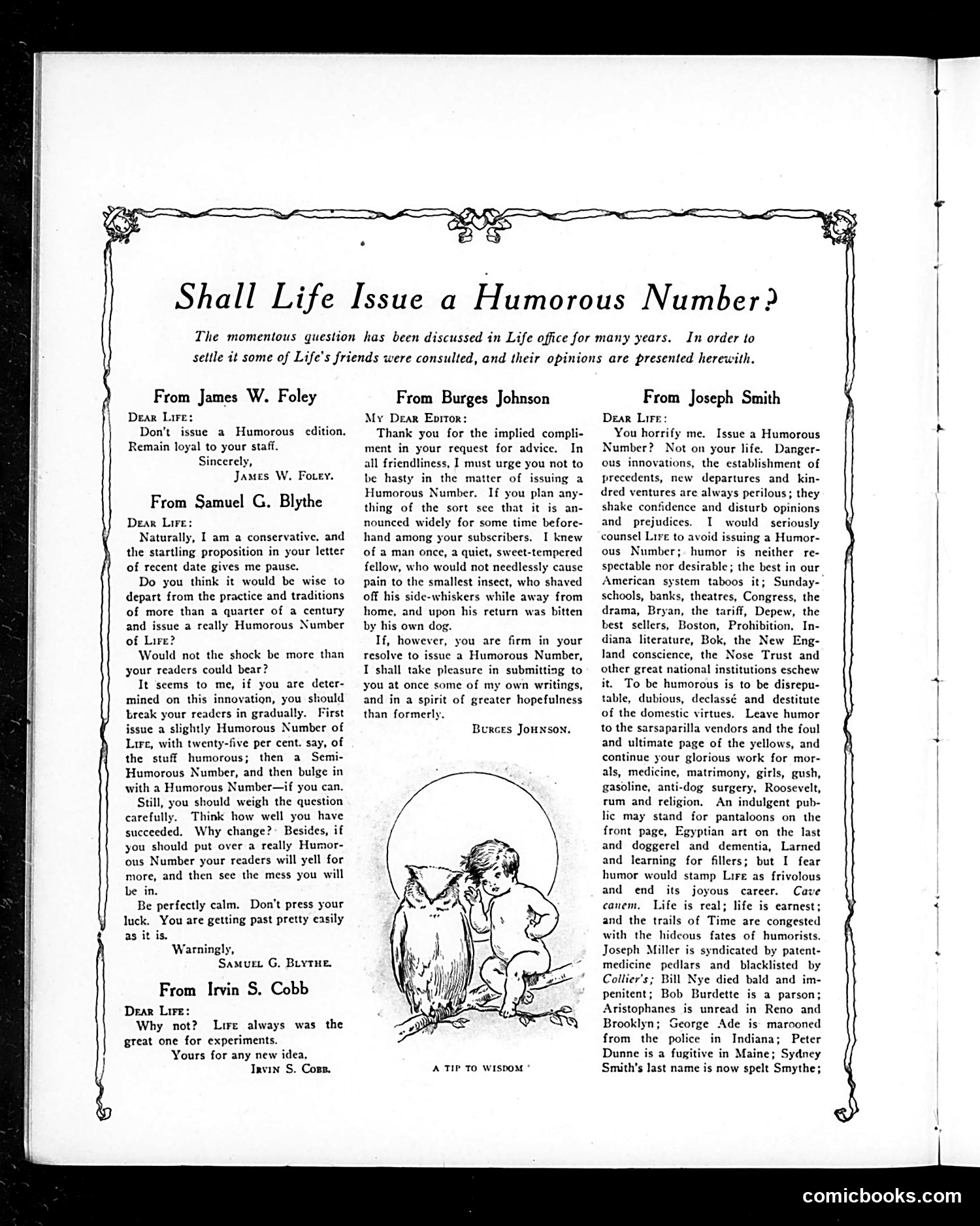
This page presents a humorous debate *about* whether Life should issue a humorous number—a self-referential satire. Five contributors offer contradictory advice to Life's editors. **The joke:** Life, a satirical magazine, is asking serious people whether it should be funny. The respondents' answers reveal period attitudes about propriety and respectability. **Key positions:** - **Foley & Blythe** warn against change, fearing it will shock conservative readers or create chaos - **Cobb** supports experimentation - **Johnson** cautions with an absurdist anecdote about a man bitten by his own dog—deflating the debate's importance - **Smith** delivers the satire's punchline: he catalogs American institutions (Congress, Bryan, Prohibition, Roosevelt) as humorless and "respectable," implying that humor threatens respectability itself **The cartoon** (bottom center) shows a child playing, reinforcing the "seriousness" theme—only children play. The piece satirizes American anxiety about maintaining dignity and propriety, suggesting that respectability and humor are seen as incompatible in early-20th-century culture.
📄 Transcribed text from this page (OCR, searchable)
Machine-transcribed from the original scan — historical spelling and the odd misread are preserved.
Shall Life Issue a Humorous Number? The momentous question has been discussed in Life office for many years. In order to selile it some of Life's friends were consulted, and their opinions are presented herewith. From James W. Foley Dear Lire: Don’t issue a Humorous Remain loyal to your staff. Sincerely, James W. Fotey. From Samuel G. Blythe Dear Lire: Naturally, I am a conservative, and the startling proposition in your letter of recent date gives me pause. Do you think it would be wise to depart from the practice and traditions of more than a quarter of a century and issue a really Humorous Number of Lire? Would not the shock be more than your readers could bear? It seems to me, if you are deter- mined on this innovation, you should break your readers in gradually. First issue a slightly Humorous Number of Lire, with twenty-five per cent. say, of the stuff humorous; then a Semi- Humorous Number, and then bulge in with a Humorous Number—if you can. Still, you should weigh the question carefully. Think how well you have succeeded. Why change?’ Besides, if you should put over a really Humor- ous Number your readers will yell for more, and then see the mess you will be in. Be perfectly calm. Don't press your luck. You are getting past pretty easily as it is. Warningly, Samuet G, BiytHe, From Irvin S. Cobb Dear Lire: Why not? Lire always was the great one for experiments. Yours for any new idea, Irvin S. Cons. edition. From Burges Johnson My Dear Eprtor: Thank you for the implied compli- ment in your request for advice, In all friendliness, I must urge you not to be hasty in the matter of issuing a Humorous Number. If you plan any- thing of the sort sce that it is an- nounced widely for some time before- hand among your subscribers. I knew of a man once, a quiet, sweet-tempered. fellow, who would not needlessly cause pain to the smallest insect, who shaved off his side-whiskers while away from home, and upon his return was bitten by his own dog. If, however, you are firm in your resolve to issue a Humorous Number, I shall take pleasure in submitting to you at once some of my own writings, and in a spirit of greater hopefulness than formerly, Burces JoHNson. A TIP TO WISDOM From Joseph Smith Dear Lire: You horrify me. Issue a Humorous Number? Not on your life. Danger- ous innovations, the establishment of precedents, new departures and kin- dred ventures are always perilous; they shake confidence and disturb opinions and prejudices. I would seriously counsel Lire to avoid issuing a Humor- ous Number; humor is neither re- spectable nor desirable; the best in our American system taboos it; Sunday- schools, banks, theatres, Congress, the drama, Bryan, the tariff, Depew, the best sellers, Boston, Prohibition, In- diana literature, Bok, the New Eng- land conscience, the Nose Trust and other great national institutions eschew it. To be humorous is to be disrepu- table, dubious, declassé and destitute of the domestic virtues, Leave humor to the sarsaparilla vendors and the foul and ultimate page of the yellows, and continue your glorious work for mor- als, medicine, matrimony, girls, gush, gasoline, anti-dog surgery, Roosevelt, rum and religion, An indulgent pub- lic may stand for pantaloons on the front page, Egyptian art on the last and doggerel and dementia, Larned and learning for fillers; but I fear humor would stamp Lire as frivolous and end its joyous career. Cave canem. Life is real; life is earnest; and the trails of Time are congested with the hideous fates of humorists. Joseph Miller is syndicated by patent- medicine pedlars and blacklisted by Collier's; Bill Nye died bald and im- penitent; Bob Burdette is a parson; Aristophanes is unread in Reno and Brooklyn; George Ade is’ marooned from the police in Indiana; Peter Dunne is a fugitive in Maine; Sydney Smith's last name is now spelt Smythe; comicbooks.com