
Life, 1913-01-09 · page 65 of 100
Life — January 9, 1913 — page 65: what you’re looking at
What you’re looking at
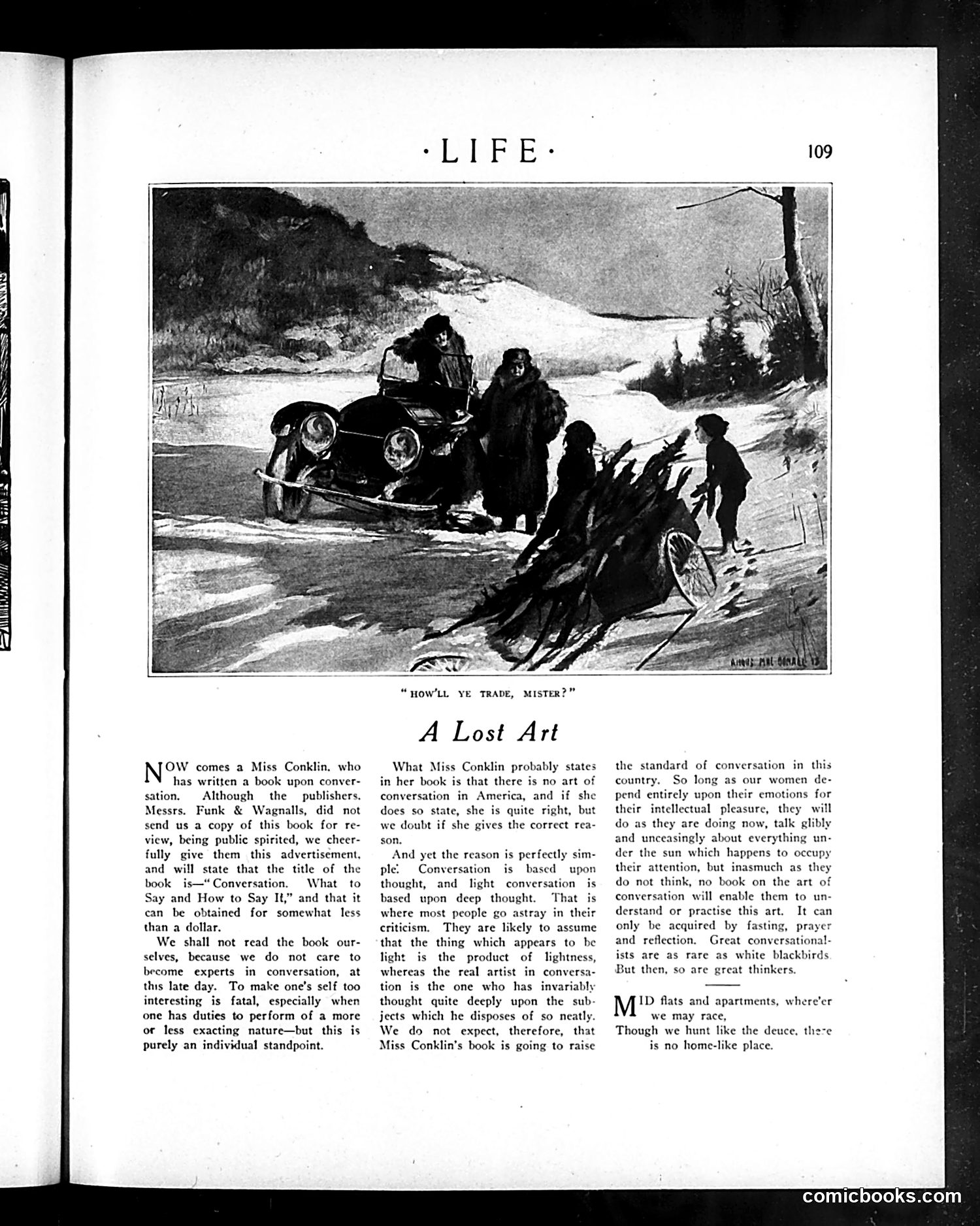
This satirical piece mocks a newly published book on conversation etiquette by Miss Conklin. The cartoon depicts a winter scene where fashionable people in an automobile encounter rural folk, with the caption "How'll ye trade, mister?"—suggesting the vast gap between polite urban conversation and plain rural speech. The article's satire operates on two levels: Life pretends to praise the book while actually dismissing it as useless. The core argument is that Americans—particularly women—lack the intellectual depth necessary for genuine conversation. The author argues that true wit requires deep thought, not mere emotional chatter. The dismissal of women as dependent on "emotions" rather than "intellectual pleasure" reflects period gender stereotypes. The cartoon illustrates this point visually: the sophisticated urbanites and humble country people literally cannot communicate across their social divide. The implication is that no etiquette book can bridge such fundamental differences in education and class.
📄 Transcribed text from this page (OCR, searchable)
Machine-transcribed from the original scan — historical spelling and the odd misread are preserved.
OW comes a Miss Conklin, who LN has written a book upon conver- sation. Although the _ publishers. Messrs. Funk & Wagnalls, did not send us a copy of this book for re- view, being public spirited, we cheer- fully give them this advertisement, and will state that the title of the book is—“ Conversation. What to Say and How to Say It,” and that it can be obtained for somewhat less than a dollar. We shall not read the book our- selves, because we do not care to become experts in conversation, at this late day. To make one’s self too interesting is fatal, especially when one has duties to perform of a more or less exacting nature—but this is purely an individual standpoint. “HOW’LL YE TRADE, MISTER?” A Lost Art What Miss Conklin probably stat in her book is that there is no art conversation in America, and if she does so state, she is quite right, but we doubt if she gives the correct rea- son, And yet the reason is perfectly sim- ple) Conversation is based upon thought, and light conversation is based upon deep thought. That is where most people go astray in their criticism. They are likely to assume that the thing which appears to be light is the product of lightness, whereas the real artist in convers: tion is the one who has invariably thought quite deeply upon the sub- jects which he disposes of so neatly. We do not expect, therefore, that Miss Conklin’s book is going to raise the standard of conversation in this country, So long as our women de- pend entirely upon their emotions for their intellectual pleasure, they will do as they are doing now, talk glibly and unceasingly about everything un- der the sun which happens to occupy their attention, but inasmuch as they do not think, no book on the art of conversation will enable them to un- derstand or practise this art. It can only be acquired by fasting, prayer and reflection. Great conversational- ists are as rare as white blackbirds But then, so are great thinkers. M” flats and apartments, where’er we may race, Though we hunt like the deuce, there is no home-like place. comicbooks.com