
Life, 1913-01-09 · page 64 of 100
Life — January 9, 1913 — page 64: what you’re looking at
What you’re looking at
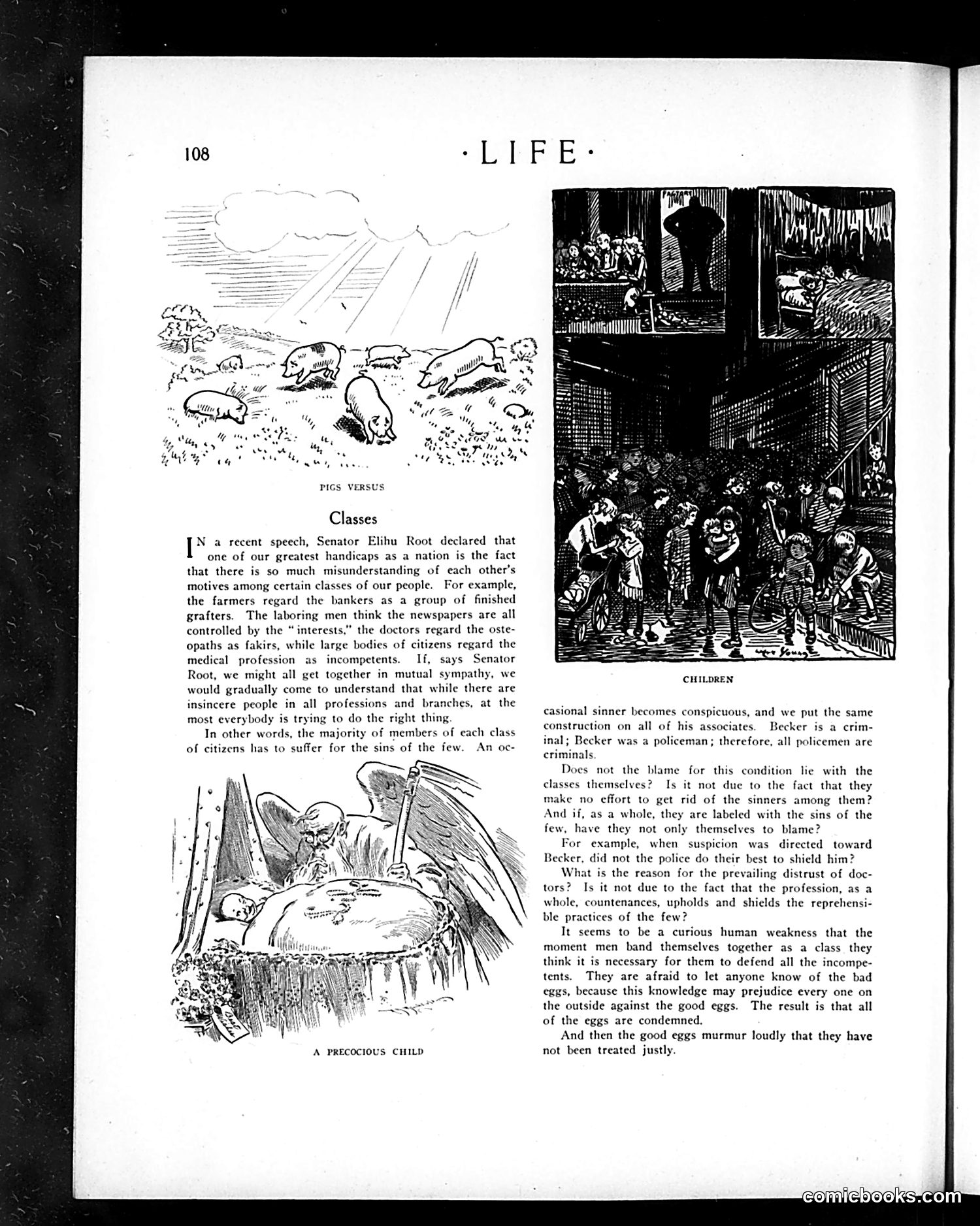
This page satirizes class divisions and professional corruption in early 20th-century America. Senator Elihu Root's argument—that mutual understanding between classes would reduce prejudice—is critiqued as incomplete. The essay uses "Becker" (likely Police Commissioner Charles Becker, convicted of corruption around 1912) as a case study: when one policeman is criminal, the entire profession gets blamed because the police force protects its own rather than disciplining wrongdoers. The central argument: professions actively shield corrupt members, then complain unfairly when all members face suspicion. The "good eggs" refuse to expel "bad eggs," so outsiders condemn the entire group. The cartoons illustrate class conflict ("Pigs Versus") and childhood innocence corrupted by institutional loyalty—suggesting that professional self-protection, not class misunderstanding, drives distrust.
📄 Transcribed text from this page (OCR, searchable)
Machine-transcribed from the original scan — historical spelling and the odd misread are preserved.
KM oy teat Pe ) PIGS VERSUS Classes [* a recent speech, Senator Elihu Root declared that one of our greatest handicaps as a nation is the fact that there is so much misunderstanding of each other's motives among certain classes of our people. For example, the farmers regard the bankers as a group of finished grafters. The laboring men think the newspapers are all controlled by the “interests,” the doctors regard the oste- opaths as fakirs, while large bodies of citizens regard the medical profession as incompetents. If, 's Senator Root, we might all get together in mutual sympathy, we would gradually come to understand that while there are insincere people in all professions and branches, at the most everybody is trying to do the right thing In other words, the majority of members of each class of citizens has to suffer for the sins of the few. An oc- A PRECOCIOUS CHILD CHILDREN casional sinner becomes conspicuous, and we put the same construction on all of his associates. Becker is a crim- inal; Becker was a policeman; therefore, all policemen are criminals. Does not the blame for this condition lie with the classes themselves? Is it not due to the fact that they make no effort to get rid of the sinners among them? And if, as a whole, they are labeled with the sins of the few, have they not only themselves to blame? For example, when suspicion was directed toward Becker, did not the police do their best to shield him? What is the reason for the prevailing distrust of doc- tors? Is it not due to the fact that the profession, as a whole, countenances, upholds and shields the reprehensi- ble practices of the few? It seems to be a curious human weakness that the moment men band themselves together as a class they think it is necessary for them to defend all the incompe- tents. They are afraid to let anyone know of the bad eggs, because this knowledge may prejudice every one on the outside against the good eggs. The result is that all of the eggs are condemned, And then the good eggs murmur loudly that they have not been treated justly.