
Life, 1913-01-09 · page 58 of 100
Life — January 9, 1913 — page 58: what you’re looking at
What you’re looking at
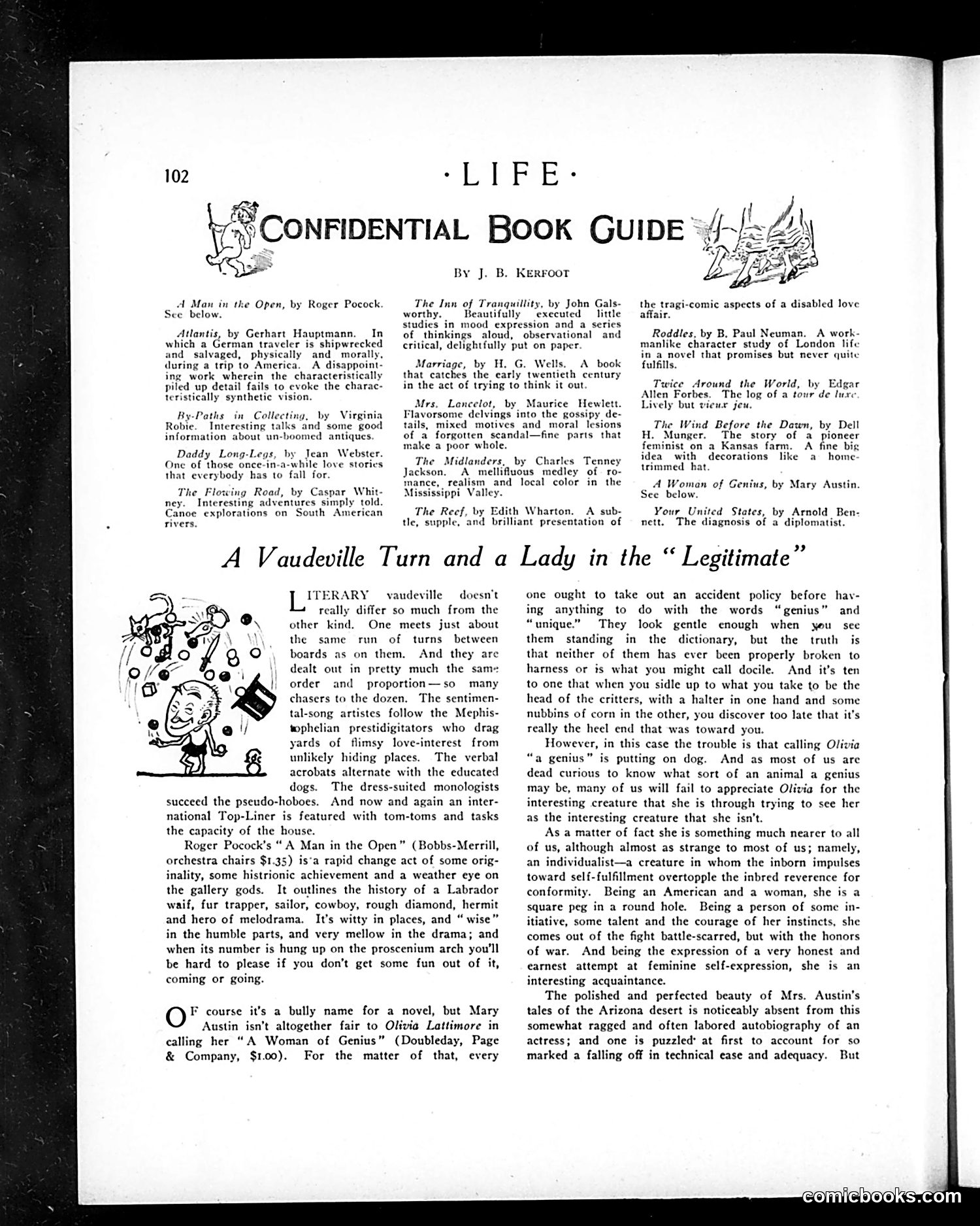
This is a **book review page** from Life magazine's "Confidential Book Guide" by J.B. Kerfoot, reviewing recent novels including works by H.G. Wells, Edith Wharton, and Mary Austin. The small cartoon at left depicts **vaudeville entertainment**—showing a performer amid scattered props and chaos, illustrating the "vaudeville turn" discussed in the main article. The piece compares vaudeville's formulaic structure (sentimental songs, acrobats, trained dogs, monologists) to literary works, suggesting both follow predictable patterns. The article's title references two theatrical genres: vaudeville (lowbrow, variety entertainment) versus the "legitimate" stage (serious drama). The review of Roger Pocock's *"A Man in the Open"* describes it as a rapid-fire entertainment like vaudeville—witty, melodramatic, designed to please audiences. The critique of Mary Austin's *"A Woman of Genius"* suggests the title oversells the protagonist, similar to how entertainers market themselves with grandiose claims. The satire gently mocks both popular entertainment and literary pretension.
📄 Transcribed text from this page (OCR, searchable)
Machine-transcribed from the original scan — historical spelling and the odd misread are preserved.
1 Man in the Open, by Roger Pocock See below. Atlantis, by Gerhart Hauptmann, In which a German traveler is shipwrecked and salvaged, physically and_ morally during a trip to America. A disappoin ing work wherein the characteristically piled up detail fails to evoke the charac- teristically synthetic vision. By-Paths in Collecting, by Virginia Robie. Interesting talks and some good information about un-boomed antiques. Daddy Long-Legs, by Jean Webster. One of those once-in-a-while love stories that everybody has to fall for. The Flowing Road, by Caspar Whit- ney. Interesting adventures simply told. Canoe explorations on South American rivers. ‘LIPE+ By J. B. KERFOOT The Inn of Tranquillity, by John Gals- worthy. Beautifully ‘executed litt studies in mood expression and a sei of thinkings aloud, observational and critical, delightfully put on paper. Marriage, by H. G. Wells. A book that catches the early twentieth century in the act of trying to think it out Mrs. Loncelot, by Maurice Hewlett. Flavorsome delvings into the gossipy de- tails, mixed motives and_moral lesions of a forgotten scandal—fine parts that make a poor whole. The Midlanders, by Charles Tenney Jackson. A mellifluous medley of ro- realism and local color in the sippi Valle The Recf, by Edith Wharton. A sub- tle, supple, and brilliant presentation of the tragi-comic aspects of a disabled love affair. Roddles, by B. Paul Neuman. A work- manlike character study of London life in a novel that promises but never quite fulfills. Twice Around the World, by Ed Allen Forbes. The log of a tour de lure. Lively but views jew. The Wind Before the Dawn, by Dell H. Munger, The story of a pioneer feminist on a Kansas farm. A fine big idea with decorations like a home trimmed hat. A Woman of Genius, by Mary Austin. See below. nited States, by Arnold Ben- The diagnosis of a diplomatist. Your nett. A Vaudeville Turn and a Lady in the “ Legitimate” other kind. the same run boards as on them. L" SRARY vaudeville cally differ so much from the ing One meets just about doesn't “unique.” turns between them standing And they are do with look gentle enough one ought to take out an accident policy before hav- anything to They the words “genius” and when you see the dictionary, but the truth is dealt out in pretty much the sam= order and proportion—so many chasers to the dozen. The sentimen- tal-song artistes follow the Mephis- wophelian prestidigitators who drag yards of flimsy love-interest from unlikely hiding places. The verbal acrobats alternate with the educated dogs. The dress-suited monologists succeed the pseudo-hoboes. And now and again an inter- national Top-Liner is featured with tom-toms and tasks the capacity of the house. Roger Pocock’s “ A Man in the Open” (Bobbs-Merrill, orchestra chairs $1.35) is’a rapid change act of some orig- inality, some histrionic achievement and a weather eye on the gallery gods. It outlines the history of a Labrador waif, fur trapper, sailor, cowboy, rough diamond, hermit and hero of melodrama. It’s witty in places, and “ wise” in the humble parts, and very mellow in the drama; and when its number is hung up on the proscenium arch you'll be hard to please if you don’t get some fun out of it, coming or going. Oo course it’s a bully name for a novel, but Mary Austin isn’t altogether fair to Olivia Lattimore in calling her “A Woman of Genius” (Doubleday, Page & Company, $1.00). For the matter of that, every that neither of them has ever been properly broken to harness or is what you might call docile. And it’s ten to one that when you sidle up to what you take to be the head of the critters, with a halter in one hand and some nubbins of corn in the other, you discover too late that it's really the heel end that was toward you. However, in this case the trouble is that calling Olivia “a genius” is putting on dog. And as most of us are dead curious to know what sort of an animal a genius may be, many of us will fail to appreciate Olivia for the interesting creature that she is through trying to see her as the interesting creature that she isn’t. As a matter of fact she is something much nearer to all of us, although almost as strange to most of us; namely, an individualist—a creature in whom the inborn impulses toward self-fulfillment overtopple the inbred reverence for conformity. Being an American and a woman, she is a square peg in a round hole. Being a person of some in- itiative, some talent and the courage of her instincts, she comes out of the fight battle-scarred, but with the honors of war. And being the expression of a very honest and earnest attempt at feminine self-expression, she is an interesting acquaintance. The polished and perfected beauty of Mrs. Austin's tales of the Arizona desert is noticeably absent from this somewhat ragged and often labored autobiography of an actress; and one is puzzled’ at first to account for so marked a falling off in technical ease and adequacy. But