
Life, 1913-01-09 · page 47 of 100
Life — January 9, 1913 — page 47: what you’re looking at
What you’re looking at
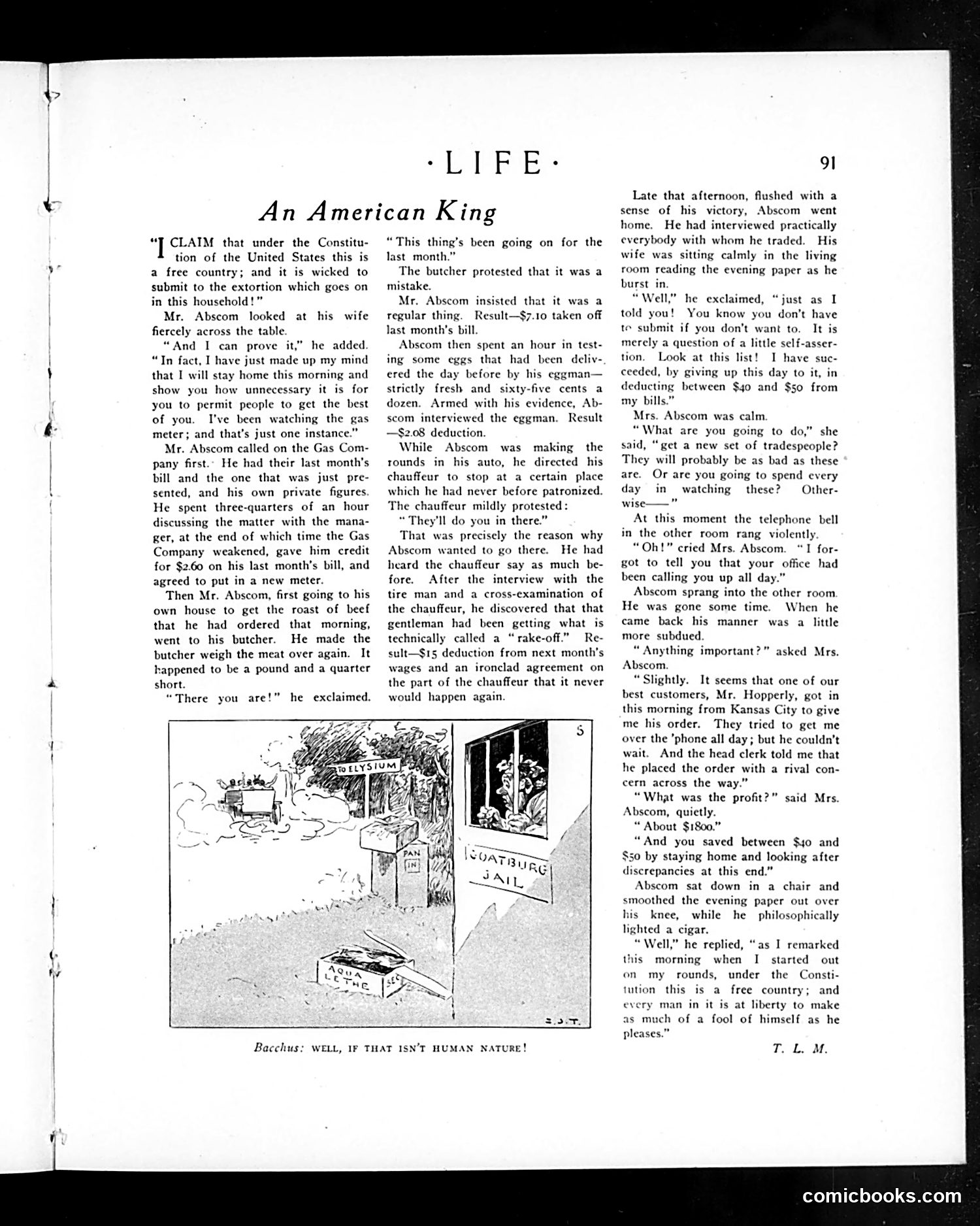
This story satirizes the American obsession with asserting individual rights and "getting value," mocking the contradiction between ideology and practice. Mr. Abscom spends his entire day scrutinizing tradespeople—the gas company, butcher, eggman, and chauffeur—recovering roughly $50 through aggressive questioning and accusations of dishonesty. He triumphantly demonstrates to his wife that Americans needn't "submit to extortion." The satire's punch arrives via the telephone: while Abscom wasted his day on petty savings, an important customer from Kansas City tried repeatedly to reach him. Unable to wait, the customer placed a major order with a competitor instead—a loss far exceeding his day's savings. The accompanying cartoon caption ("Well, if that isn't human nature!") emphasizes the irony: Abscom's principled stand for constitutional liberty and fair dealing ironically costs him real business through his own self-absorbed vigilance. The joke critiques American individualism as self-defeating and short-sighted.
📄 Transcribed text from this page (OCR, searchable)
Machine-transcribed from the original scan — historical spelling and the odd misread are preserved.
+ LP e An American King “T CLAIM that under the Constitu- tion of the United States this is a free country; and it is wicked to submit to the extortion which goes on in this household!” Mr. Abscom looked at his wife fiercely across the table. “And I can prove it,” he added. “Tn fact, I have just made up my mind that I will stay home this morning and show you how unnecessary it is for you to permit people to get the best of you. I've been watching the gas meter; and that’s just one instance.” Mr. Abscom called on the Gas Com- pany first.” He had their last month's bill and the one that was just pre- sented, and his own private figures. He spent three-quarters of an hour discussing the matter with the mana- ger, at the end of which time the Gas Company weakened, gave him credit for $2.60 on his last month’s bill, and agreed to put in a new meter. Then Mr. Abscom, first going to his own house to get the roast of beef that he had ordered that morning, went to his butcher. He made the butcher weigh the meat over again. It happened to be a pound and a quarter short. “There you are!” he exclaimed. “This thing’s been going on for the last month.” The butcher protested that it was a mistake. Mr. Abscom insisted that it was a regular thing. Result—$7.10 taken off last month's bill. Abscom then spent an hour in test- ing some eggs that had been deliv- ered the day before by his eggman— strictly fresh and sixty-five cents a dozen. Armed with his evidence, Ab- scom interviewed the eggman. Result —$2.08 deduction. While Abscom was making the rounds in his auto, he directed his chauffeur to stop at a certain place which he had never before patronized. The chauffeur mildly protested: “They'll do you in there.” That was precisely the reason why Abscom wanted to go there. He had heard the chauffeur say as much be- fore. After the interview with the tire man and a cross-examination of the chauffeur, he discovered that that gentleman had been getting what is technically called a “rake-off.” Re- sult—$15 deduction from next month's wages and an ironclad agreement on the part of the chauffeur that it never would happen again. Bacchus: WELL, 1F THAT ISN'T HUMAN NaTuRE! 91 Late that afternoon, flushed with a sense of his victory, Abscom went home. He had interviewed practically everybody with whom he traded. His wife was sitting calmly in the living room reading the evening paper as he burst in. “Well,” he exclaimed, “just as I told you! You know you don’t have te submit if you don’t want to. It is merely a question of a little self-asser- tion. Look at this list! I have suc- ceeded, by giving up this day to it, in deducting between $40 and $50 from my bills.” Mrs. Abscom was calm. “What are you going to do,” she said, “get a new set of tradespeople? They will probably be as bad as these are. Or are you going to spend every day in watching these? — Other- wise—” At this moment the telephone bell in the other room rang violently. “Oh!” cried Mrs. Abscom. “I for- got to tell you that your office had been calling you up all day.” Abscom sprang into the other room. He was gone some time. When he came back his manner was a little more subdued. “ Anything important?” asked Mrs. Abscom: Slightly. It seems that one of our best customers, Mr. Hopperly, got in this morning from Kansas City to give me his order. They tried to get me over the 'phone all day; but he couldn't wait. And the head clerk told me that he placed the order with a rival con- cern across the way.” “What was the profit?” said Mrs. Abscom, quietly. About $1800.” “And you saved between $40 and $50 by staying home and looking after discrepancies at this end.” Abscom sat down in a chair and smoothed the evening paper out over his knee, while he philosophically lighted a cigar. “Well,” he replied, “as I remarked this morning when I started out on my rounds, under the Consti- tution this is a free country; and every man in it is at liberty to make as much of a fool of himself as he pleases.” T. L. M. comicbooks.com