
Life, 1913-01-09 · page 63 of 100
Life — January 9, 1913 — page 63: what you’re looking at
What you’re looking at
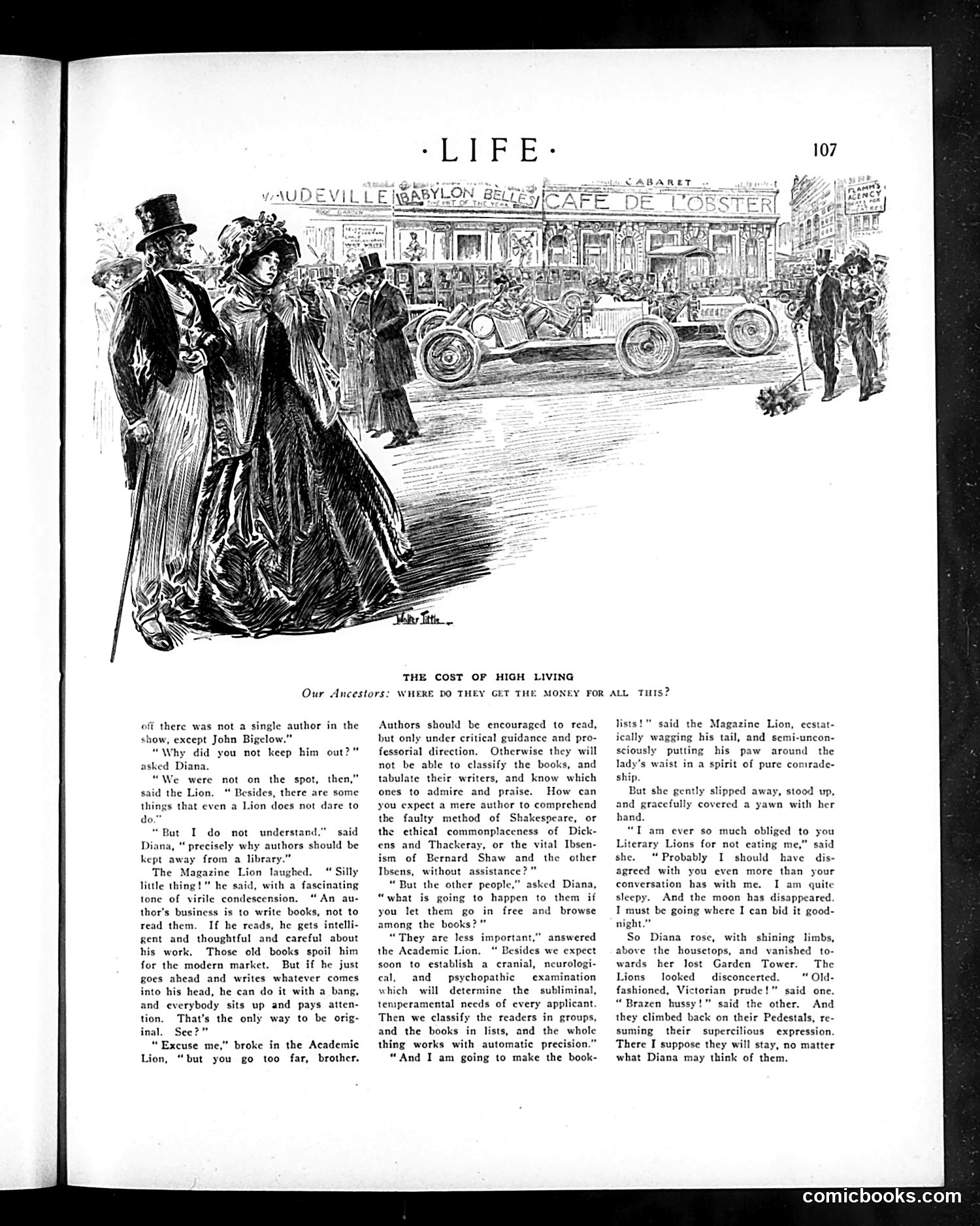
This satirical dialogue mocks intellectual pretension and gatekeeping in early 20th-century literary institutions. **The Setup:** Diana (representing the public or common sense) encounters two "Lions"—personifications of competing literary establishments—debating library access and reading. **The Satire:** - The **Magazine Lion** represents commercial publishers who profit from dumbed-down content, arguing authors shouldn't read serious literature because it makes their work too thoughtful and unmarketable. - The **Academic Lion** represents universities/scholars who over-complicate access through pseudo-scientific classification systems and "professional guidance," gatekeeping knowledge behind institutional authority. **The Point:** Both institutions exclude ordinary people from free intellectual access—one through commercialism, one through elitism—while pretending to serve the public good. Diana's dignified exit suggests the public is wiser than these self-important "authorities" competing over who controls culture and knowledge. The illustration shows a fashionable Parisian street scene, emphasizing that this critique applies to established cultural centers and their snobbish gatekeepers.
📄 Transcribed text from this page (OCR, searchable)
Machine-transcribed from the original scan — historical spelling and the odd misread are preserved.
Our Ancestors: WHERE DO THEY GET THE MONEY FOR ALL off there was not a single author in the show, except John Bigelow.” “Why did you not keep him out?” asked Diana. “We were not on the spot, then,” said the Lion. “ Besides, there are some things that even a Lion does not dare to do.” “But I do not understand.” said Diana, “ precisely why authors should be kept away from a library The Magazine Lion laughed. “ Silly Tittle thing!" he said, with a fascinating tone of virile condescension. “An au- thor’s business is to write books, not to read them. If he reads, he gets intelli- gent and thoughtful and careful about his work. Those old books spoil him for the modern market. But if he just goes ahead and writes whatever comes into his head, he can do it with a bang, and everybody sits up and pays atten- tion. That's the only way to be orig- inal. See? “Excuse me,” broke in the Academic Lion, “but you go too far, brother. THE COST OF HIGH LIVING Authors should be encouraged to read, but only under critical guidance and pro- fessorial direction. Otherwise they will not be able to classify the books, and tabulate their writers, and know which ones to admire and praise. How can you expect a mere author to comprehend the faulty method of Shakespeare, or the ethical commonplaceness of Dick- ens and Thackeray, or the vital Ibsen- ism of Bernard Shaw and the other Ibsens, without assistance?” “But the other people,” asked Diana, “what is going to happen to them if you let them go in free and browse among the books?” “They are less important,” answered the Academic Lion. “ Besides we expect soon to establish a cranial, ncurologi- cal, and psychopathic examination which will determine the subliminal, temperamental needs of every applicant. Then we classify the readers in groups, and the books in lists, and the whole thing works with automatic precision.” “And I am going to make the book- THIS? " said the Magazine Lion, ecstat- ly wagging his tail, and semi-uncon- sciously putting his paw around the lady's waist in a spirit of pure comrade- ship, But she gently slipped away, stood up, and gracefully covered a yawn with her hand. “Tam ever so much obliged to you Literary Lions for not eating me,” said she. “Probably I should have dis- agreed with you even more than your conversation has with me. I quite sleepy. And the moon has disappeared. I must be going where I can bid it good- night.” So Diana rose, with shining limbs, above the housetops, and vanished to- wards her lost Garden Tower. The Lions looked disconcerted. “ Old- fashioned, Victorian prude!" said one. “ Brazen hus: said the other. And they climbed back on their Pedestals, re- suming their supercilious expression. There I suppose they will stay, no matter what Diana may think of them. comicbooks.com