
Life, 1913-01-09 · page 42 of 100
Life — January 9, 1913 — page 42: what you’re looking at
What you’re looking at
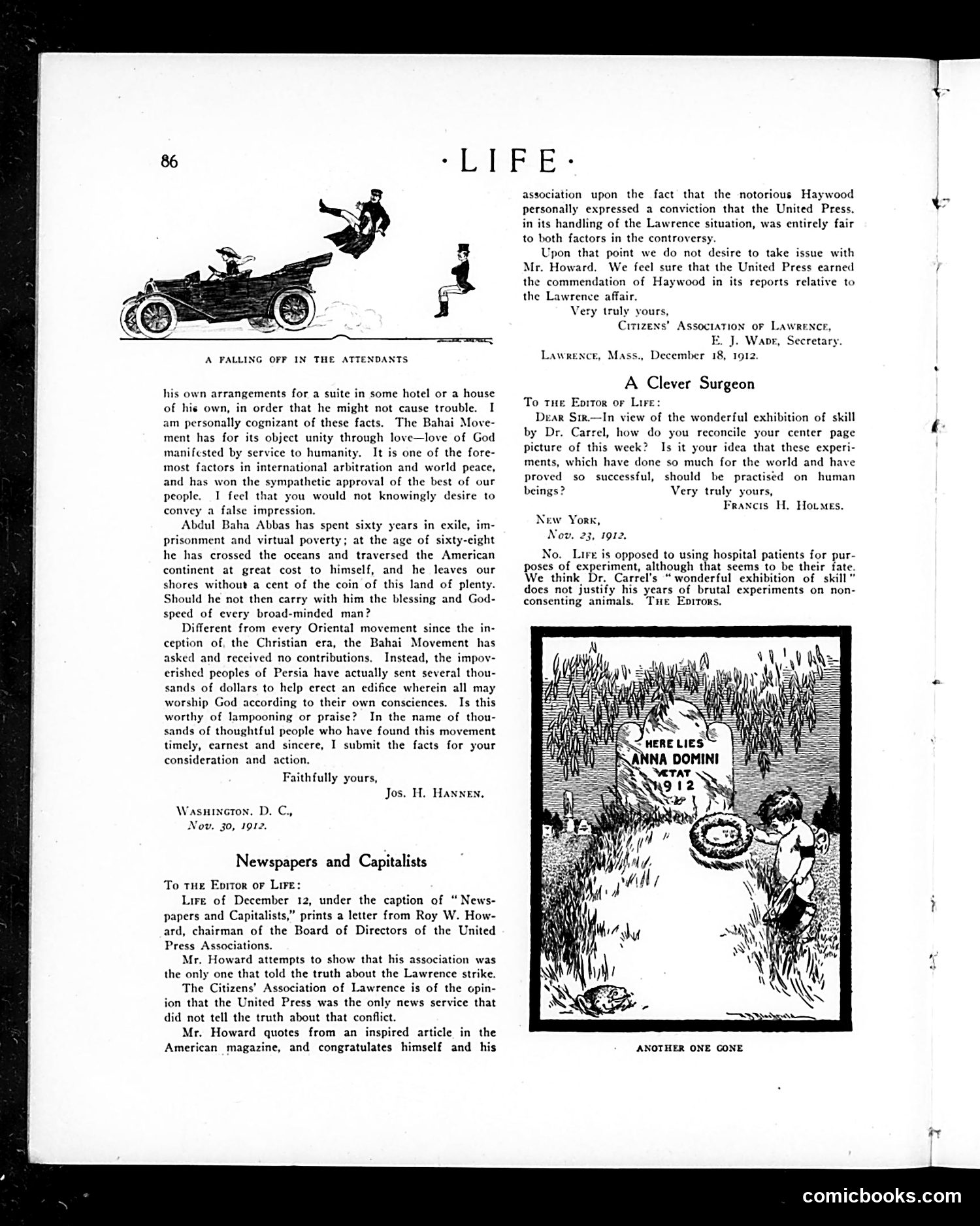
The cartoon depicts a car with occupants falling or being thrown from it—a visual pun on "falling off in the attendants" (losing attendees/followers). The context: The page features letters defending Abdul Baha Abbas, leader of the Bahai Movement, against ridicule in Life magazine. One letter defends the movement's peaceful principles and Abbas's costly American tour. The cartoon satirizes the movement's declining popularity or attendance at its events—literally showing people "falling off" rather than attending. The cartoon mocks the Bahai Movement's waning support in America, while the letters below argue for its legitimacy as a force for international peace and unity. The juxtaposition reveals Life's satirical stance toward the movement, contrasting with readers defending it as genuinely humanitarian.
📄 Transcribed text from this page (OCR, searchable)
Machine-transcribed from the original scan — historical spelling and the odd misread are preserved.
A FALLING OFF IN THE ATTENDANTS. his own arrangements for a suite in some hotel or a house of his own, in order that he might not cause trouble. I am personally cognizant of these facts. The Bahai Move- ment has for its object unity through love—love of God manifested by service to humanity. It is one of the fore- most factors in international arbitration and world peace, and has won the sympathetic approval of the best of our people. I feel that you would not knowingly desire to convey a false impression. Abdul Baha Abbas has spent sixty years in exile, im- prisonment and virtual poverty; at the age of sixty-eight he has crossed the oceans and traversed the American continent at great cost to himself, and he leaves our shores without a cent of the coin of this land of plenty. Should he not then carry with him the blessing and God- speed of every broad-minded man? Different from every Oriental movement since the in- ception of, the Christian era, the Bahai Movement has asked and received no contributions. Instead, the impov- erished peoples of Persia have actually sent several thou- sands of dollars to help erect an edifice wherein all may worship God according to their own consciences. Is this worthy of lampooning or praise? In the name of thou- sands of thoughtful people who have found this movement timely, carnest and sincere, I submit the facts for your consideration and action, Faithfully yours, Jos. H. Hannen. Wasurncton. D. C., Nov. 30, 1912. Newspapers and Capitalists To tHe Eprtor oF Lire: Lire of December 12, under the caption of “ News- papers and Capitalists,” prints a letter from Roy W. How- ard, chairman of the Board of Directors of the United Press Associations. Mr. Howard attempts to show that his association was the only one that told the truth about the Lawrence strike. The Citizens’ Association of Lawrence is of the opin- ion that the United Press was the only news service that did not tell the truth about that conflict. Mr. Howard quotes from an inspired article in the American magazine, and congratulates himself and his ~LAlRE-E » association upon the fact that the notorious Haywood personally expressed a conviction that the United Press. in its handling of the Lawrence situation, was entirely fair to both factors in the controversy. Upon that point we do not desire to take issue with Mr. Howard. We feel sure that the United Press earned the commendation of Haywood in its reports relative to the Lawrence affair. Very truly yours, Citizens’ Association oF Lawrence, E. J. Wane, Secretary. Lawrence, Mass., December 18, 1912. A Clever Surgeon To tHe Eprtor or Lire: Dear Six.—In view of the wonderful exhibition of skill by Dr. Carrel, how do you reconcile your center page picture of this week? Is it your idea that these experi- ments, which have done so much for the world and have proved so successful, should be practised on human beings? Very truly yours, Francis H. Hotes. New York, ov. 23, 1912, No. Lire is opposed to using hospital patients for pur- poses of experiment, although that seems to be their fate. We think Dr. Carrel’s “wonderful exhibition of skill” does not justify his years of brutal experiments on non- consenting animals. Tie Epitors. ANOTHER ONE GONE comicbooks.com