
A complete issue · 108 pages · 1910
Life — December 1, 1910
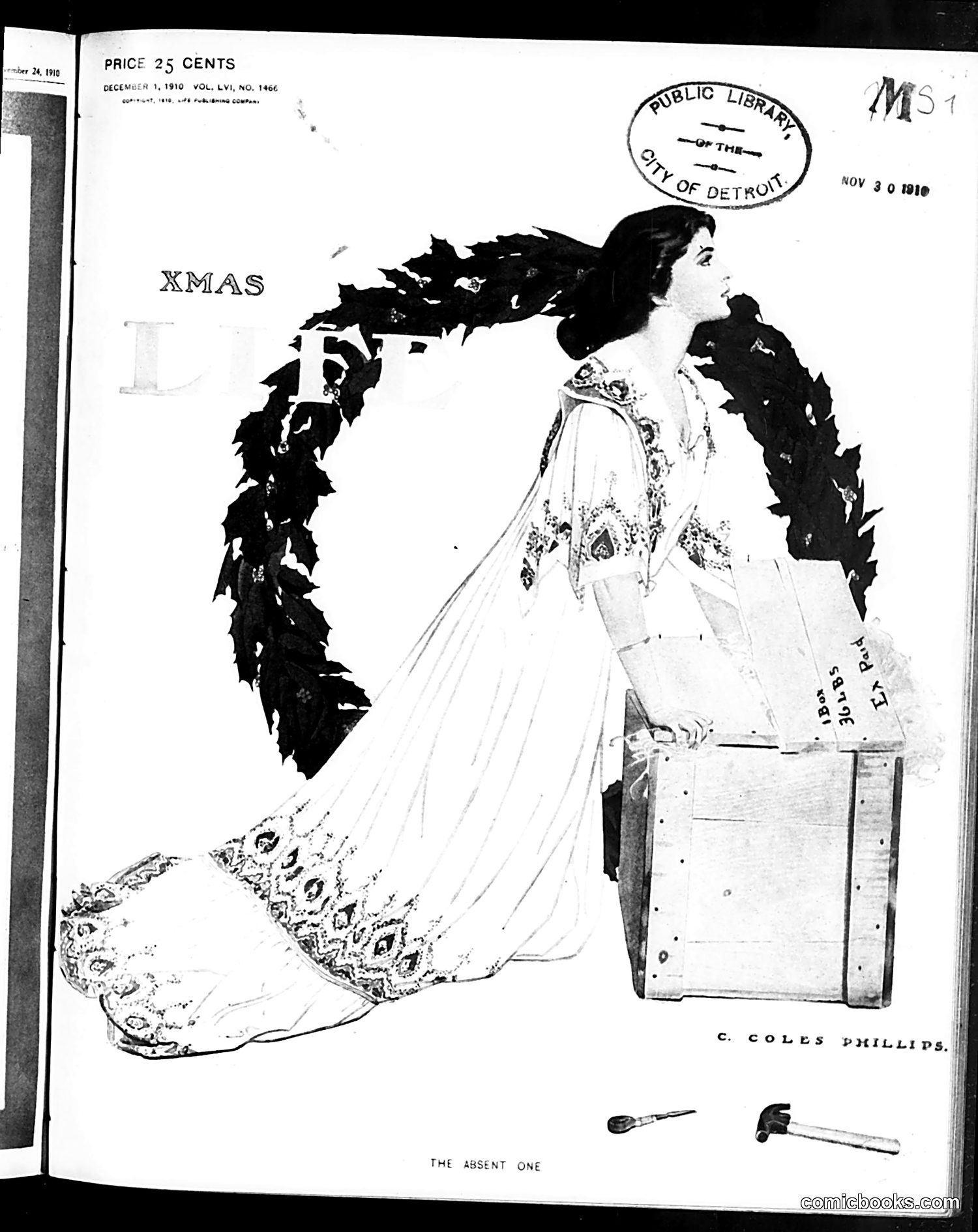
This satirical illustration depicts a woman in an elaborate wedding dress with a dramatic train, posed next to an empty steamer trunk. The title "The Absent One" and the woman's wistful expression suggest commentary on a missing bridegroom or husband. The steamer trunk and travel-ready composition suggest the woman was either abandoned before departure or stands waiting for someone who never arrived—likely a jilted bride or a wife whose husband is absent, perhaps due to infidelity or desertion. The illustration is credited to C. Coles Phillips, a prominent commercial illustrator of the era known for stylish women's fashion illustrations. This Christmas-season satire mocks romantic disappointment during what should be a joyful holiday period, playing on contemporary anxieties about marriage and commitment.
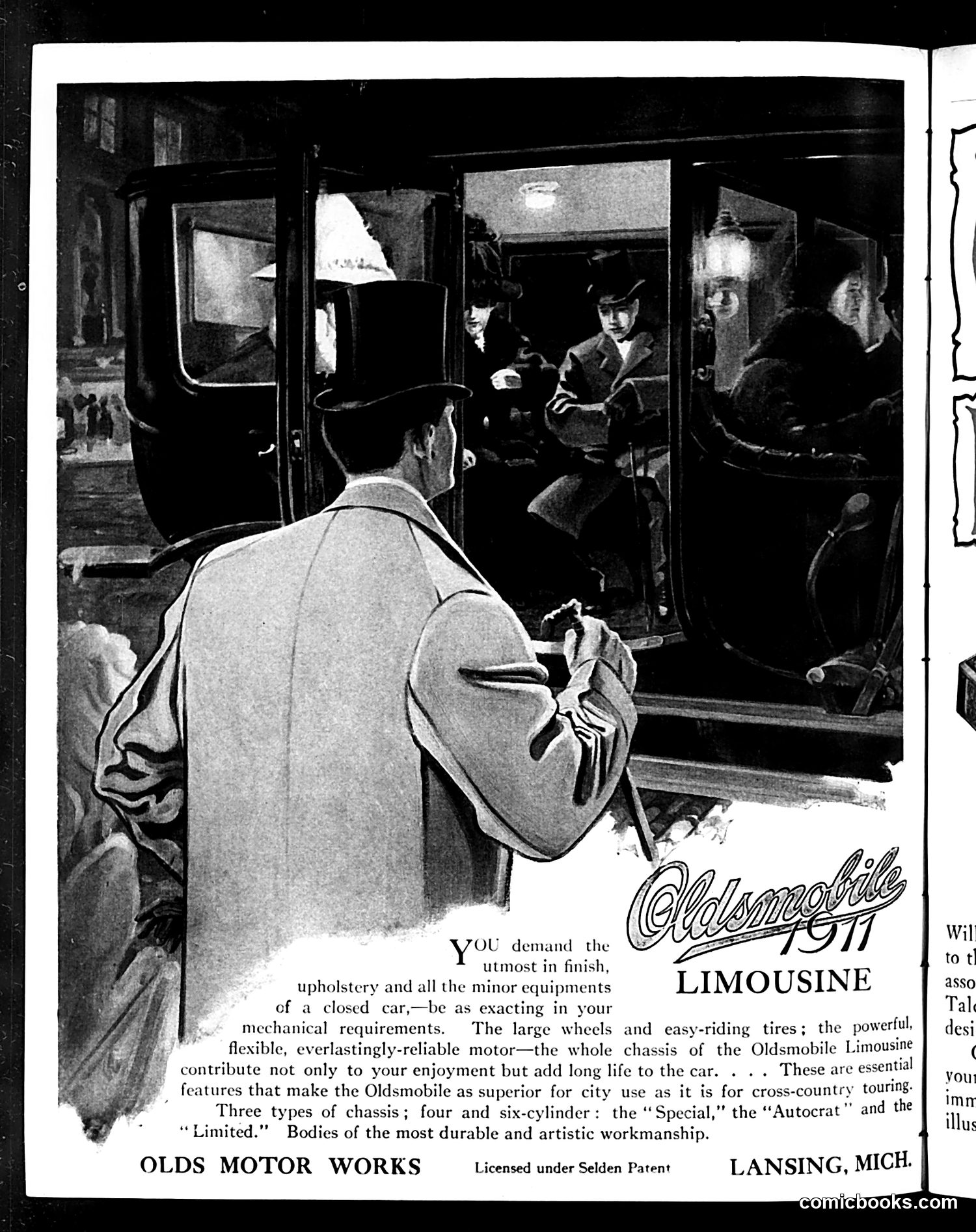
This page is primarily **advertising, not satire or political commentary**. It features a full-page advertisement for the Oldsmobile Limousine, produced by Olds Motor Works in Lansing, Michigan. The image shows a well-dressed man in a coat and hat viewed from behind, peering into a luxurious automobile filled with passengers. The ad emphasizes the vehicle's superior craftsmanship, reliability, and comfort features—highlighting "large wheels," "easy-riding tires," and a "powerful, flexible, everlastingly-reliable motor." The advertisement targets affluent buyers seeking a refined closed car suitable for both city driving and cross-country touring. No political figures or satirical commentary are present; this is straightforward commercial promotion typical of early 20th-century automobile advertising.
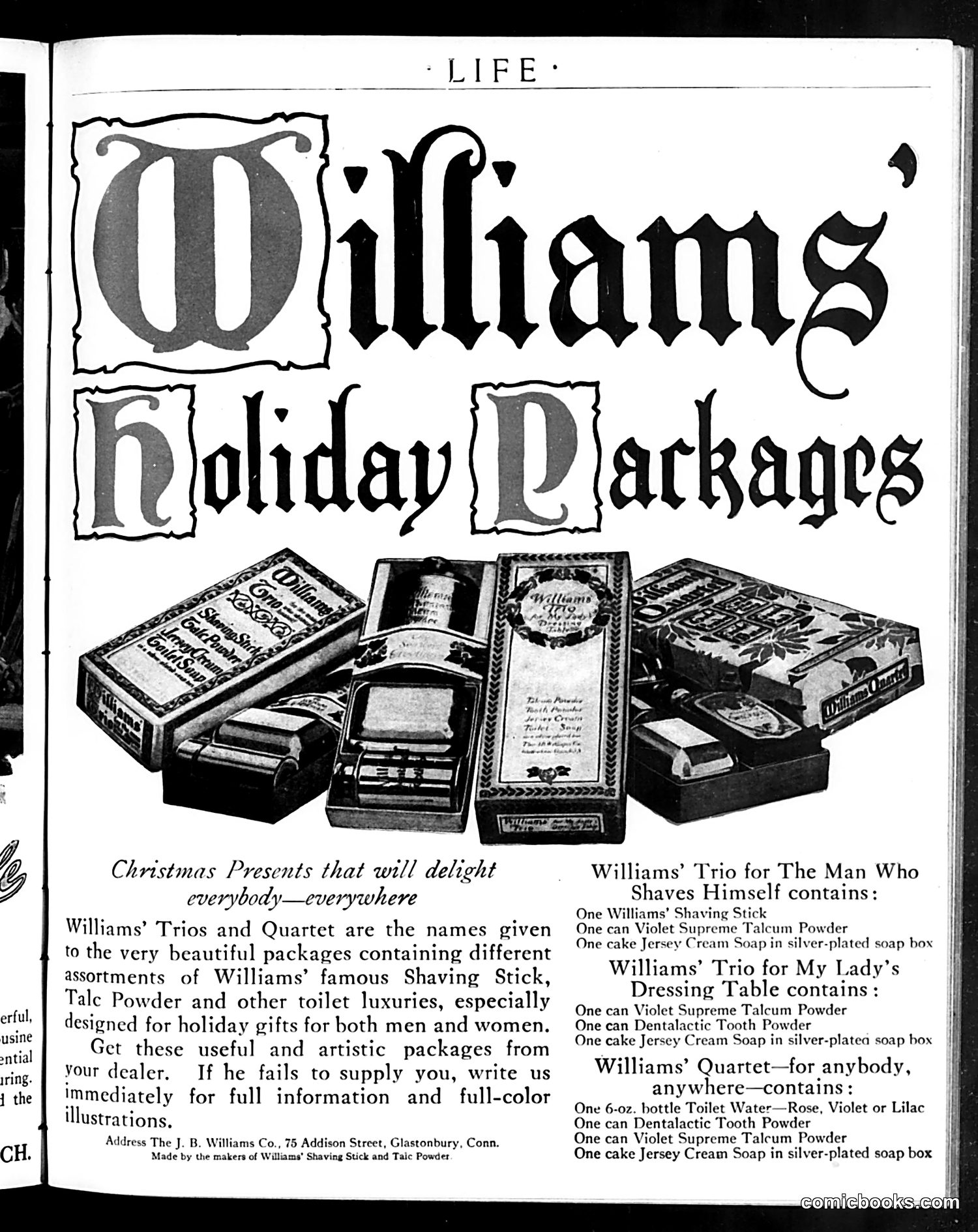
This is not a cartoon or satire—it's a straightforward advertisement from *Life* magazine promoting Williams' branded holiday gift packages. The page advertises three product lines: "Williams' Trio" packages for men (containing shaving stick, talcum powder, and soap) and women (toiletries), plus a "Williams' Quartet" for general gifting. The ad emphasizes these as attractive, useful Christmas presents "for both men and women." The decorative typography and illustrated product boxes reflect early-to-mid twentieth-century packaging design. The company's Connecticut address and distribution method (through retail dealers or direct mail) represent typical commercial practices of the era. This represents routine consumer advertising rather than satirical content.
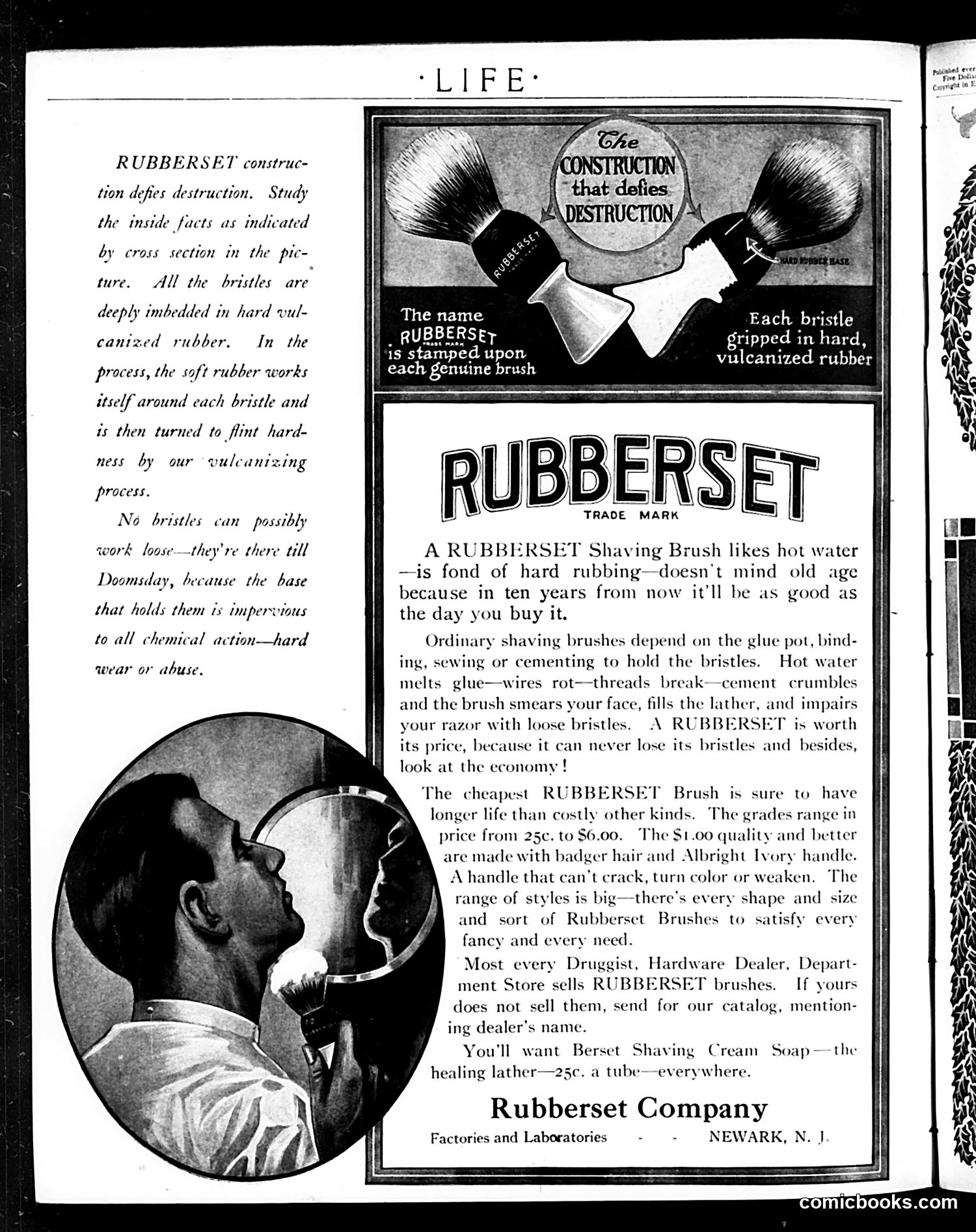
This page is primarily a **product advertisement** for Rubberset shaving brushes, not political satire. The page contains: 1. **Technical description** (left column): Explains Rubberset's vulcanized rubber construction, emphasizing bristle durability. 2. **Main advertisement** (right): Promotes Rubberset brushes as superior to competitors because bristles won't loosen or fall out, even with age and hard use. It contrasts this with ordinary brushes that fail due to deteriorating glue. 3. **Illustration** (bottom left): Shows a man using a shaving brush—a straightforward product demonstration image. The headline "The CONSTRUCTION that defies DESTRUCTION" is the advertising slogan, not a political reference. This appears to be a standard early 20th-century trade advertisement from the Rubberset Company in Newark, New Jersey.
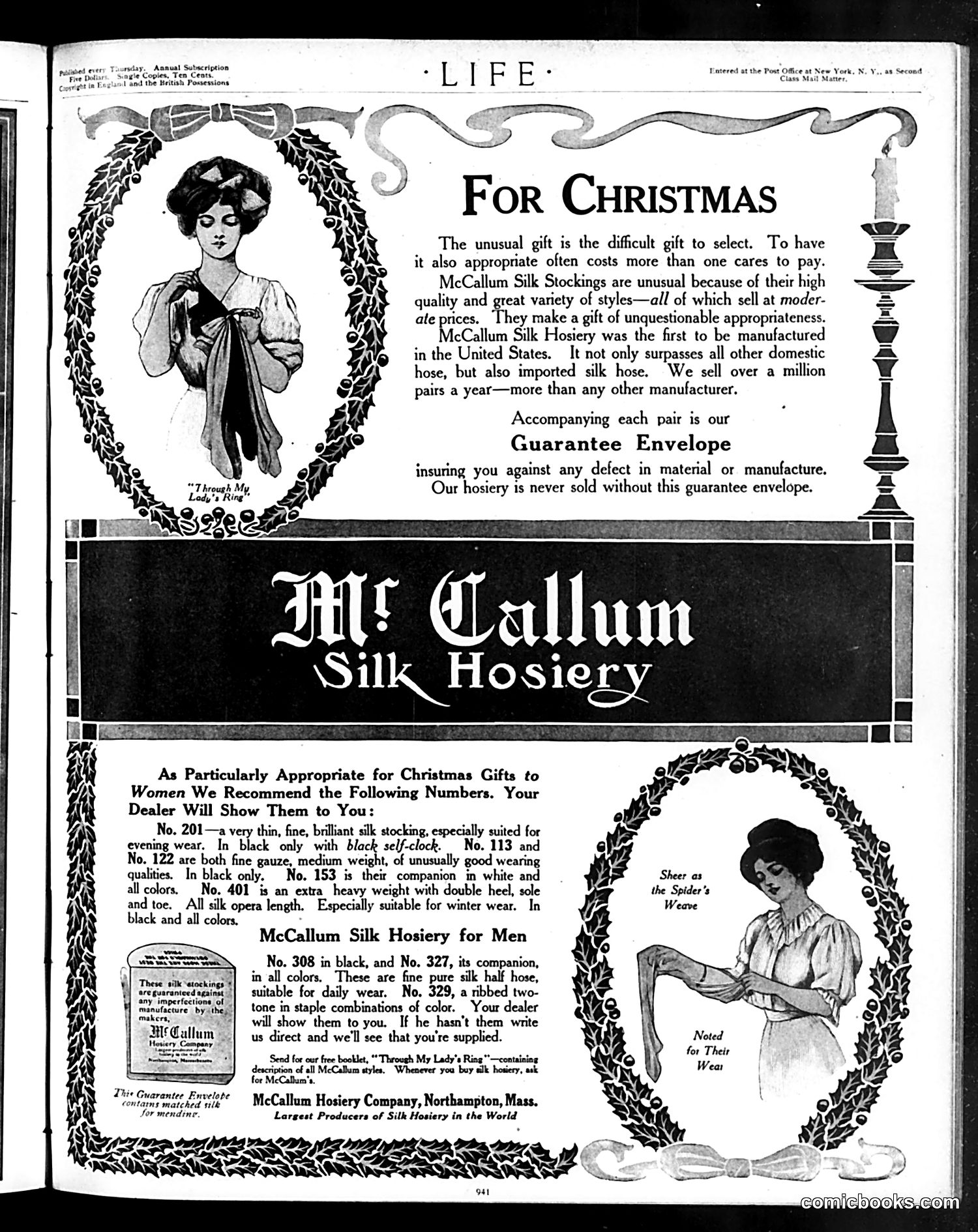
This page is primarily **advertising, not satire or political cartoon**. It's a full-page advertisement for McCallum Silk Hosiery, published in Life magazine during the Christmas season (based on the "For Christmas" headline and festive garland decorations). The page features illustrations of women and men modeling silk stockings and hosiery, with product descriptions and model numbers. There is no political commentary or satirical content visible. The decorative elements—wreaths, ribbons, and a candlestick—are purely ornamental holiday imagery meant to encourage Christmas gift-giving. This represents historical advertising conventions rather than editorial content or satire.
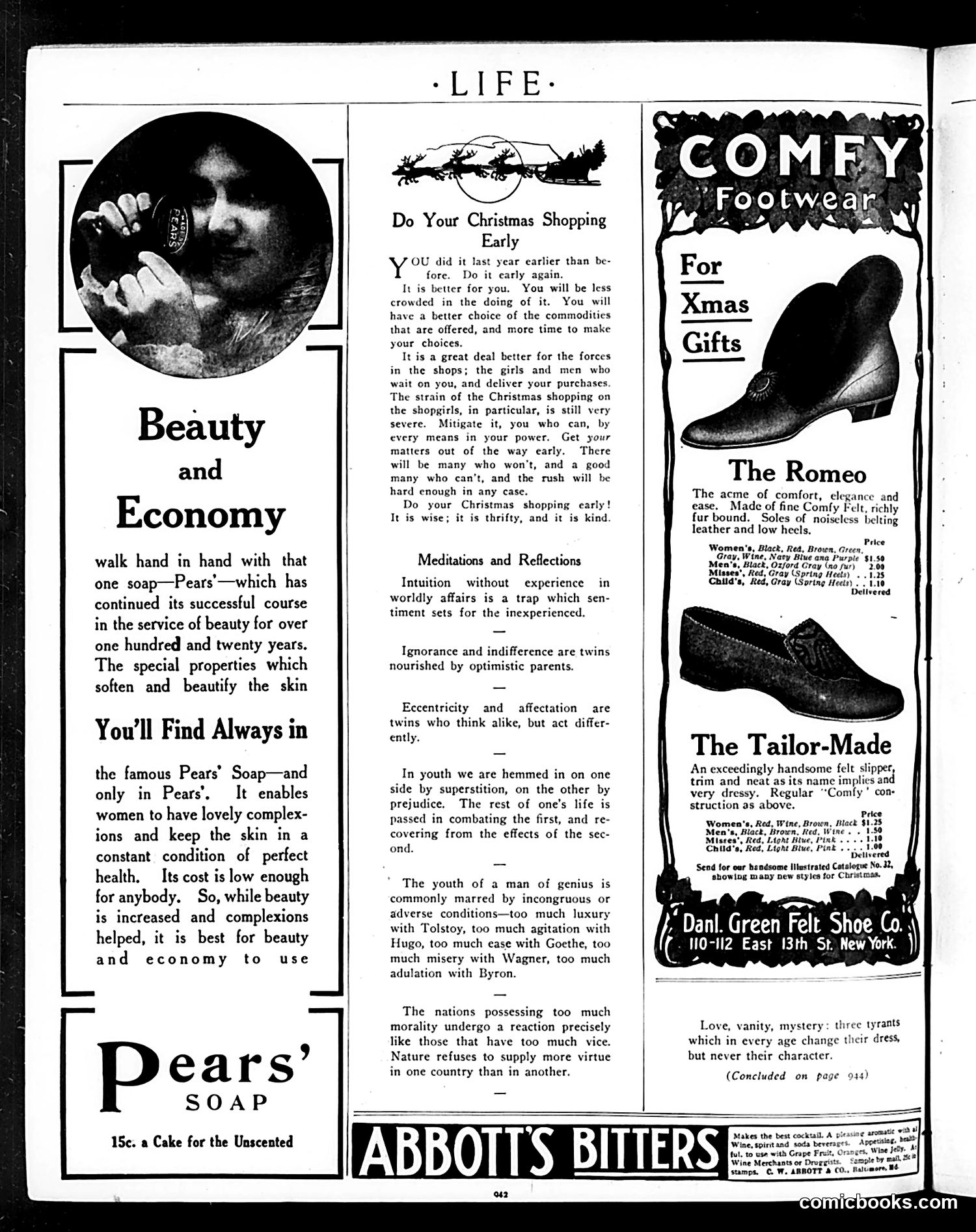
This page is primarily **advertising and editorial content**, not political satire. The left side features a Pears' Soap advertisement emphasizing "Beauty and Economy," promoting the product's 120-year history for skin care. The center contains "Meditations and Reflections"—philosophical observations about human nature, touching on themes like inexperience in worldly affairs, ignorance, eccentricity, and moral excess in nations. The right side advertises Comfy Footwear (Romeo and Tailor-Made shoes) and Abbott's Bitters. There is **no identifiable political cartoon** on this page. The only illustration besides product images is a woman's portrait at top-left associated with the soap advertisement. This appears to be a standard magazine page mixing commercial advertising with light philosophical musings rather than satirical commentary.
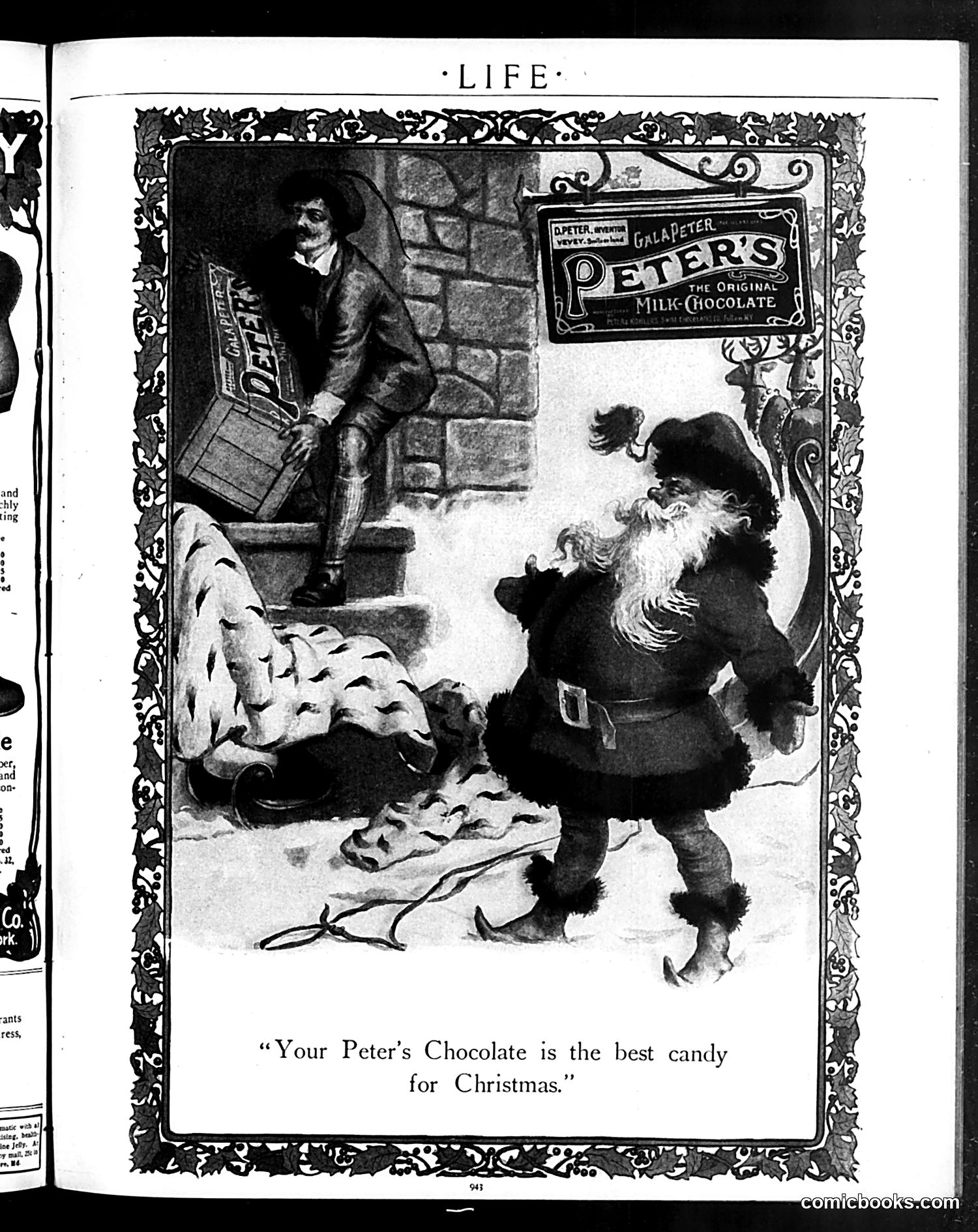
This is a commercial advertisement for Peter's milk chocolate, not political satire. The image depicts a Christmas scene: a figure in old-fashioned clothing (appearing to be dressed as Saint Nicholas or a similar character) stands on snowy steps holding a Peter's chocolate box, while a child in winter clothes looks up at him with apparent delight. The tagline reads: "Your Peter's Chocolate is the best candy for Christmas." This is straightforward holiday advertising from Life magazine's advertising pages, using nostalgic imagery and the appeal of gift-giving to promote the product. The ornate decorative border typical of early 20th-century print advertising frames the scene. No political commentary or satire is present—it's purely commercial content.
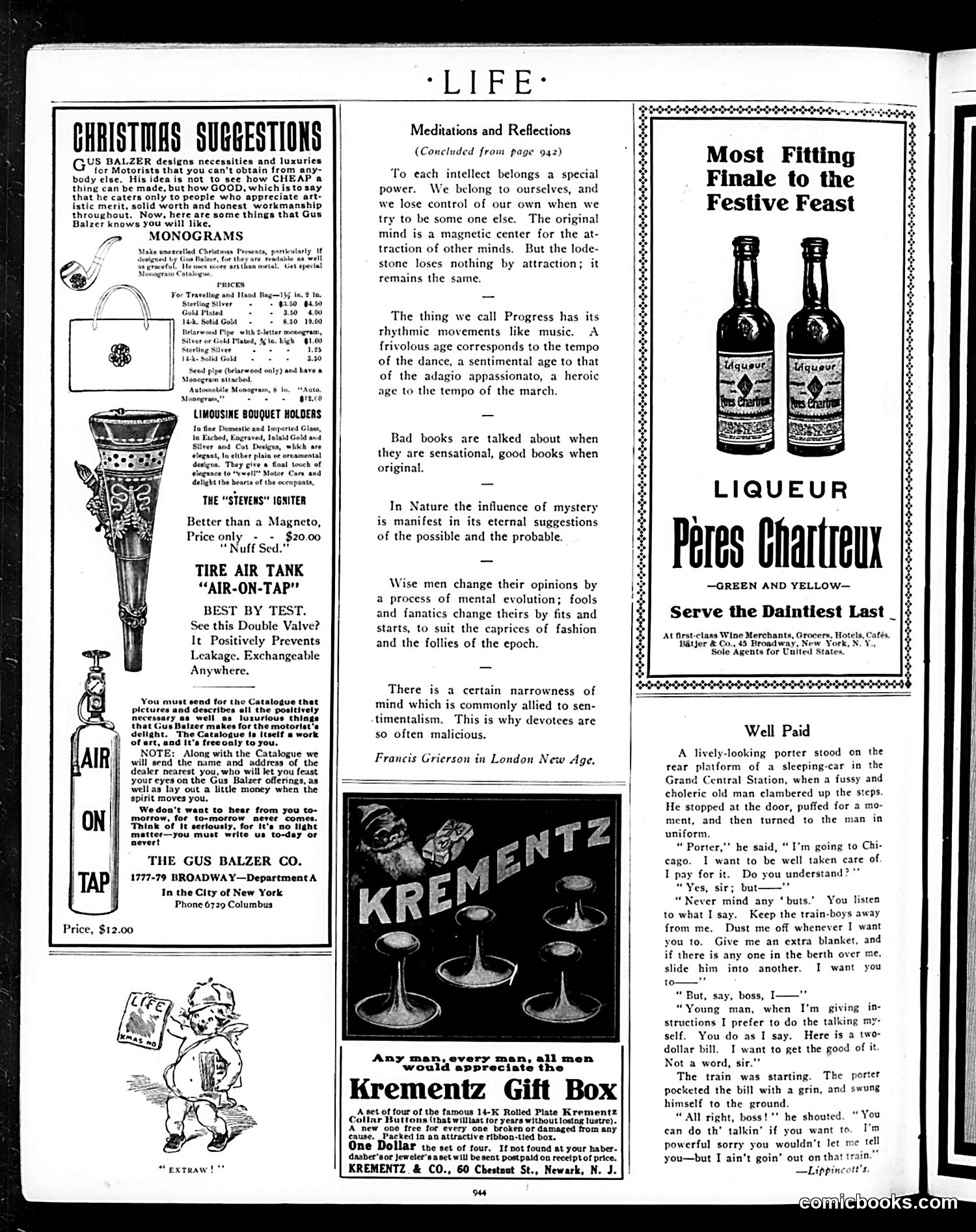
This page is primarily **advertising and editorial content**, not political satire. The left column features **Christmas gift suggestions** including monograms, decorative items (a "Stevens" lighter), and an "Air-on-Tap" tire air tank by Gus Balzer Co. The center contains **"Meditations and Reflections"**—philosophical essays about intellect, progress, nature, and human nature, attributed to Francis Grierson in *London New Age*. These are aphoristic observations rather than satire. The right side advertises **Liqueur Pères Chartreux** (a green and yellow liqueur) and **Krementz gift boxes**, with a brief humorous story titled "Well Paid" about a sleeping-car porter's interaction with a passenger. The page represents typical early-20th-century *Life* magazine content: a mix of genteel philosophical musings, advertisements for luxury goods, and light comic sketches.
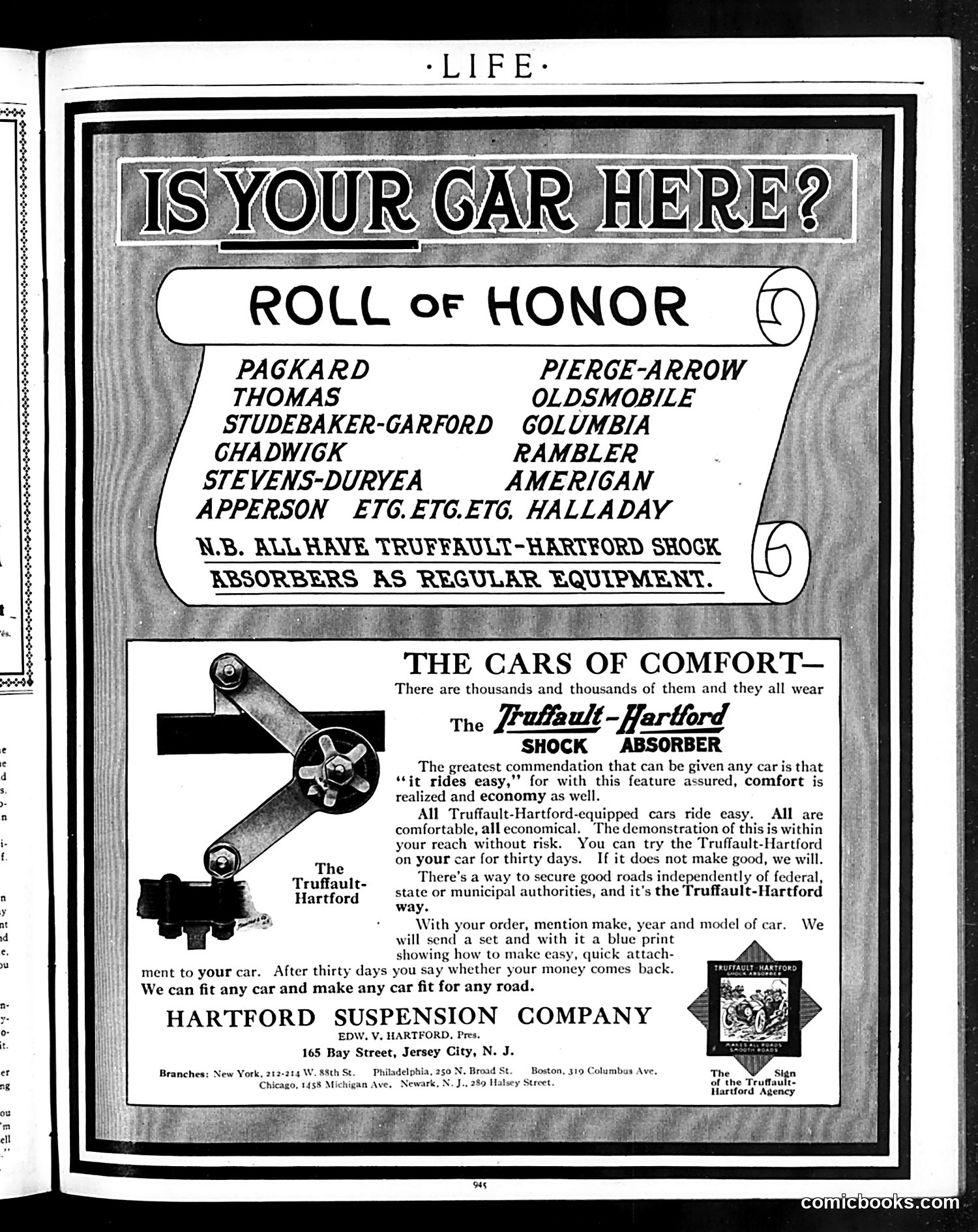
This is primarily **a full-page advertisement** for the Truffault-Hartford Shock Absorber, not political satire or editorial cartoon. The top section features a "Roll of Honor" listing automobile brands (Packard, Thomas, Studebaker-Garford, Pierce-Arrow, Oldsmobile, Columbia, Rambler, American, Halladay) — apparently all equipped with this shock absorber as standard equipment. The main advertisement emphasizes comfort and easy riding, positioning the shock absorber as essential to vehicle comfort. It includes technical diagrams and an offer allowing customers to test the product on their car for 30 days risk-free. This reflects early automotive marketing, when shock absorber technology was still a relatively new selling point for luxury and mid-range vehicles. The "Roll of Honor" format was a common advertising technique to build credibility through brand endorsements.
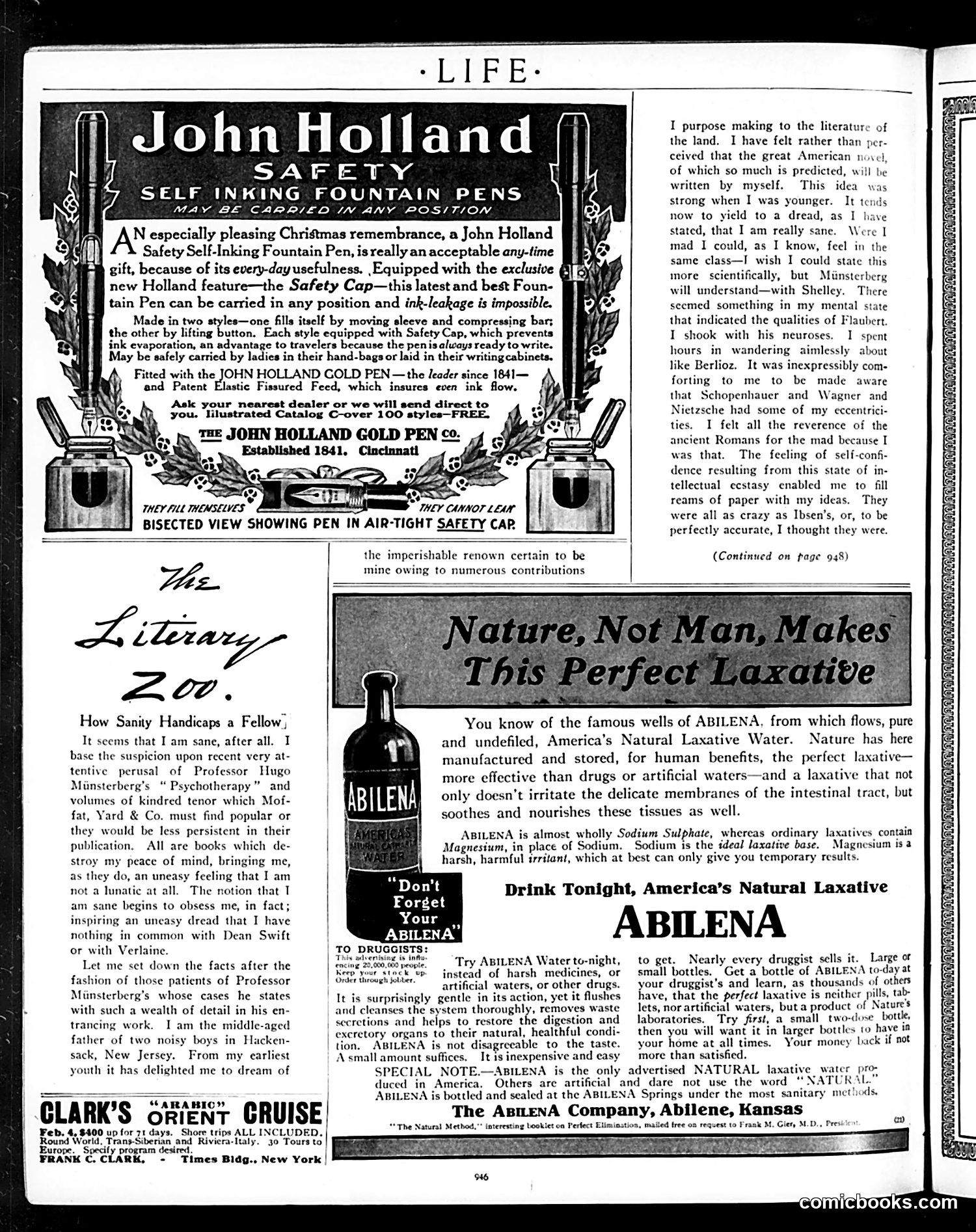
This page is primarily **advertising**, not satire. It contains three major ads: 1. **John Holland Safety Self-Inking Fountain Pens** — promoting pens as Christmas gifts, emphasizing their reliability and portability since 1841. 2. **Abilena Natural Laxative Water** — advertising a product from natural springs, claiming superiority over artificial laxatives containing harsh magnesium or sodium. 3. **Clark's "Ahab" Orient Cruise** — promoting a 21-day cruise including "Round World, Trans-Siberian and other routes to Europe." The left column contains the beginning of "The Literary Zoo," a satirical piece about Professor Hugo Munsterberg's "psychotherapy," but this is editorial content rather than political commentary. The page reflects early 20th-century consumer advertising practices and product claims common to that era.
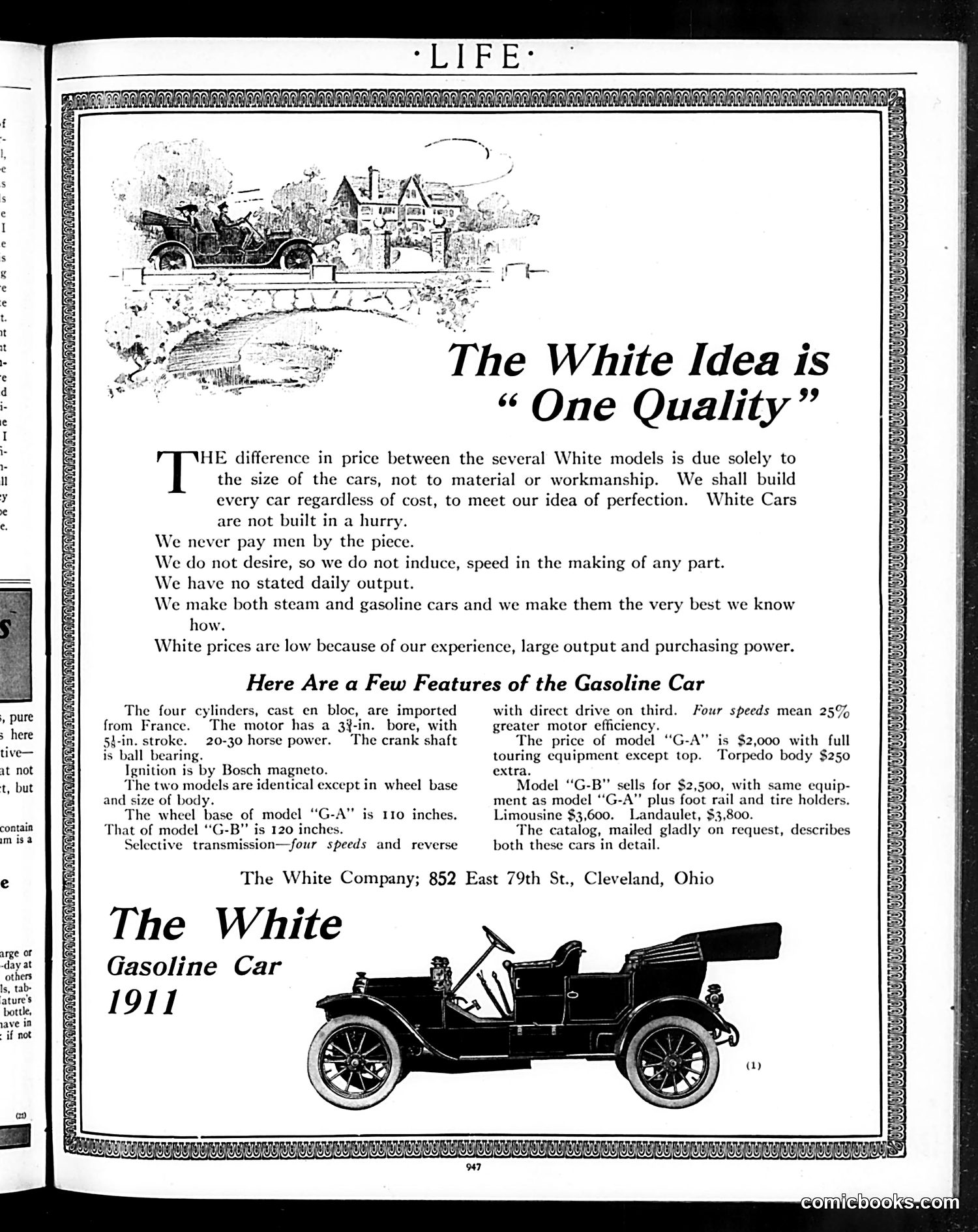
This is **not a political cartoon or satire**—it's a straightforward advertisement for White automobiles from 1911, appearing in *Life* magazine. The page promotes White's gasoline cars by emphasizing quality uniformity across models. The top illustration shows an early 1900s automobile and mansion. The ad claims price differences reflect only size, not material or craftsmanship, and that White maintains high standards without rushing production. Technical specifications are provided (four-cylinder French-imported engines, selective transmission with four speeds, pricing from $2,000-$3,600), along with the company address in Cleveland, Ohio. A side-view illustration of the 1911 White gasoline car appears at bottom. This represents early automotive advertising's appeal to quality-conscious, affluent buyers during the industry's formative decade.
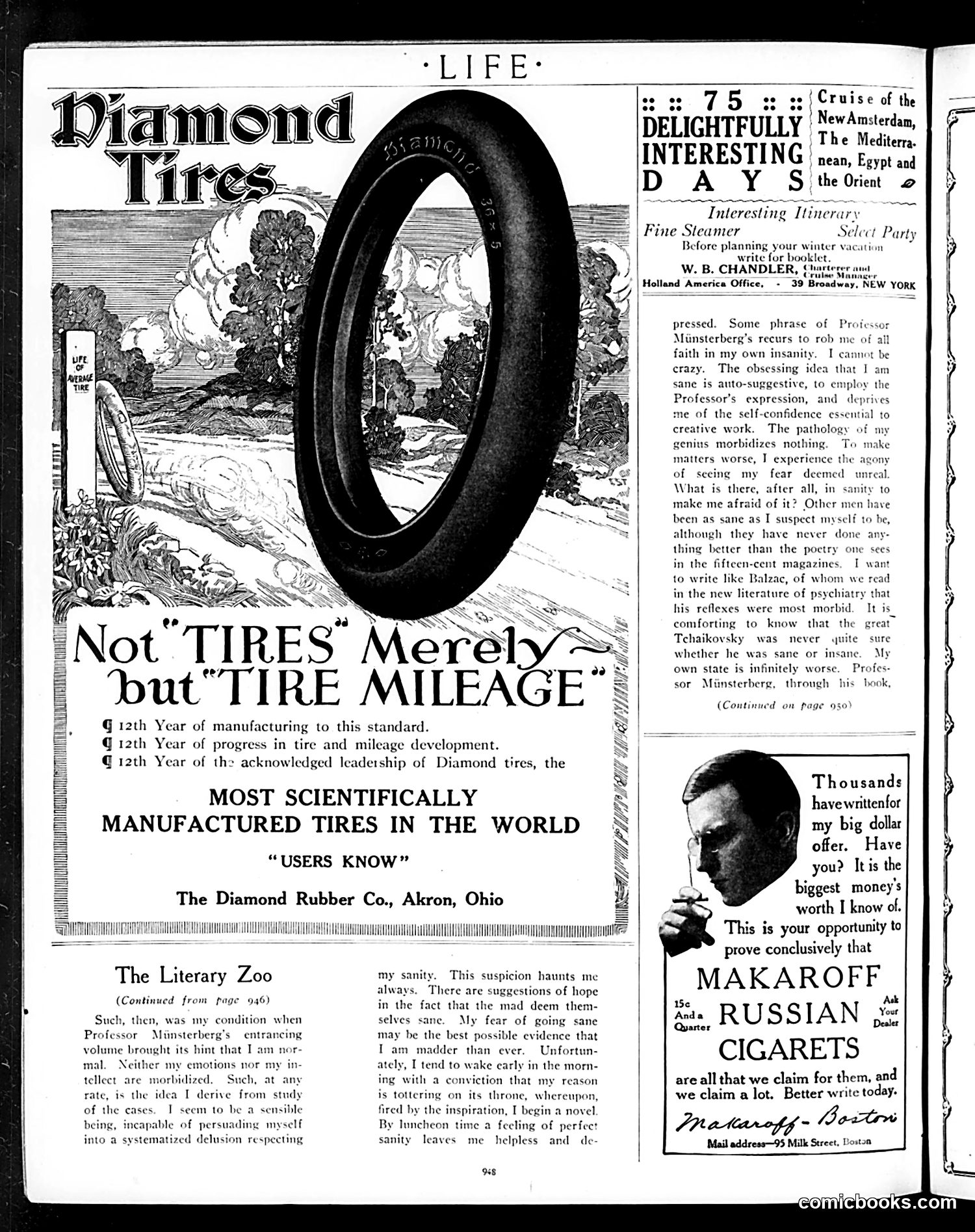
This page contains a Diamond Tires advertisement claiming they offer superior "tire mileage" (12 years of manufacturing leadership), positioned as "the most scientifically manufactured tires in the world." The ad uses an engraved pastoral landscape framing a large tire. The page also features "The Literary Zoo" (continued from page 948), a satirical piece apparently critiquing Professor Munsterberg's psychological theories. The narrator expresses anxiety about Munsterberg's suggestion that obsessive ideas indicate mental instability, worrying this diagnosis applies to himself. The text appears to mock both psychiatric diagnosis and the professor's authority on mental health. Additionally, there's a Makaroff Russian Cigarettes advertisement claiming superiority over competitors.
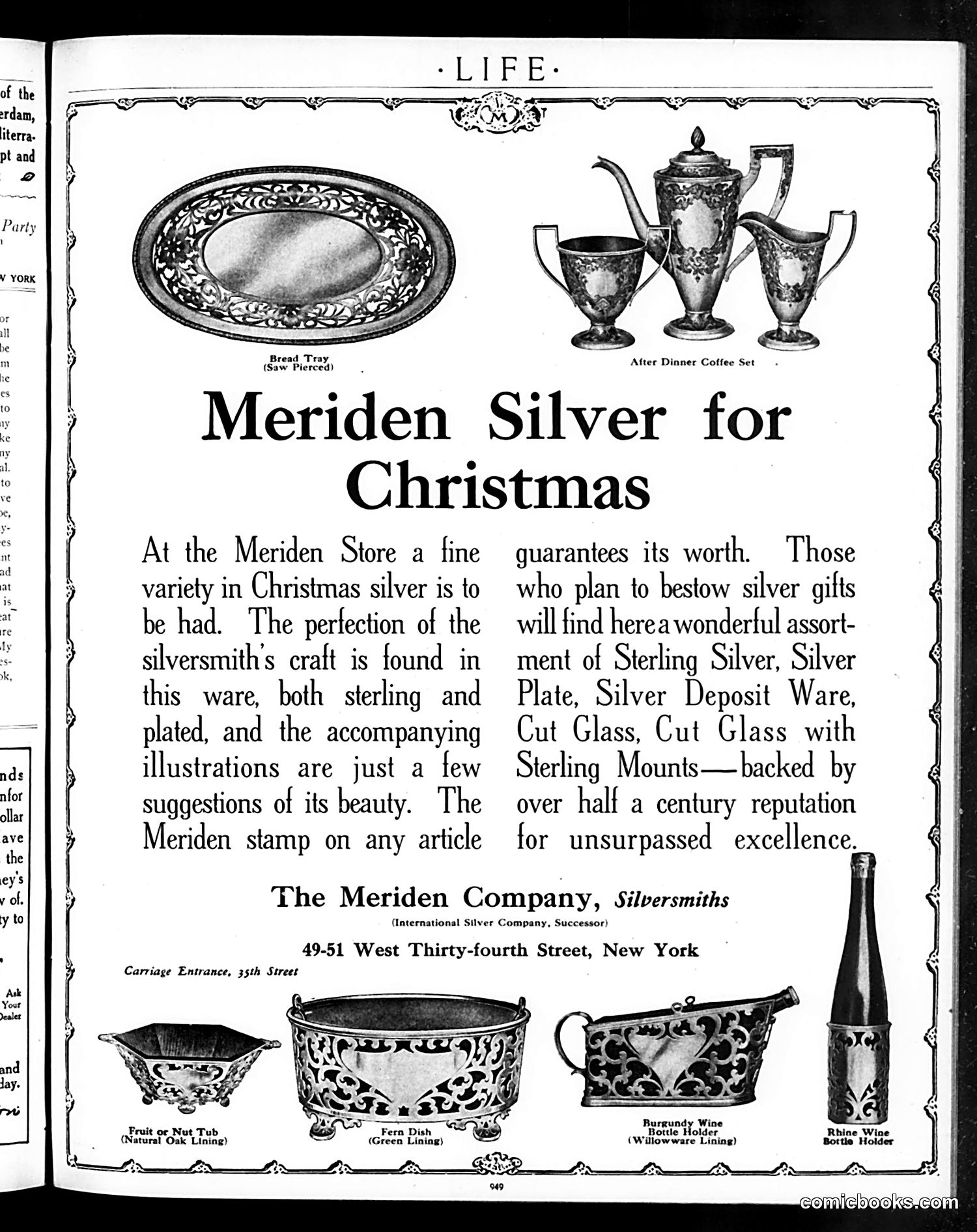
This is **not a cartoon or satirical content**—it is a straightforward **advertisement** for Meriden Company silver products, placed in Life magazine. The page promotes Meriden silver for Christmas gift-giving, featuring product illustrations (bread tray, coffee set, fruit tub, fern dish, wine bottle holder, etc.). The text emphasizes the company's reputation for quality craftsmanship in sterling silver and plated wares, claiming "over half a century reputation for unsurpassed excellence." The company's address is listed as 49-51 West Thirty-fourth Street, New York. This represents typical early-20th-century luxury goods advertising in a popular magazine, targeting affluent readers seeking upscale holiday presents. There is no satirical or political content present.
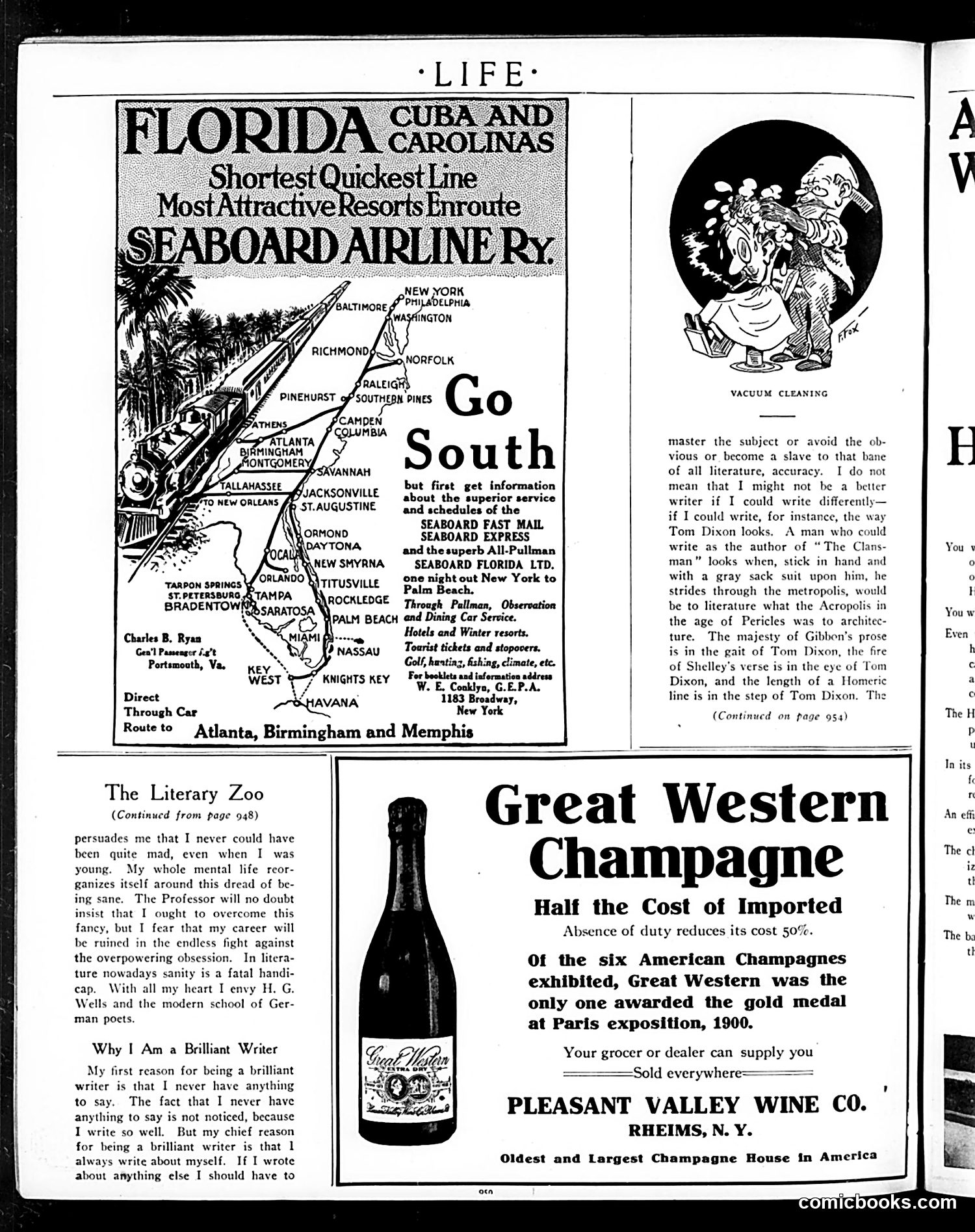
This Life magazine page is primarily **advertising and literary commentary**, not political satire. The left side features a **Seaboard Airline Railway advertisement** promoting train service to Florida and Cuba, with a route map and travel details. The center contains a **literary essay titled "Why I Am a Brilliant Writer,"** a self-satirical piece where the unnamed author humorously claims brilliance stems from having nothing to say and always writing about himself—a tongue-in-cheek critique of contemporary literary pretension. The author references Tom Dixon (likely the novelist Thomas Dixon) as an example of stylistic mastery. The right side shows a **"Vacuum Cleaning" illustration**—a small cartoon of a figure with cleaning implements, likely advertising domestic services. Bottom right features a **Great Western Champagne advertisement** claiming it won a gold medal at the 1900 Paris Exposition and costs half the price of imported champagne due to absent import duties. The page reflects early 20th-century consumer culture and literary self-mockery rather than political commentary.
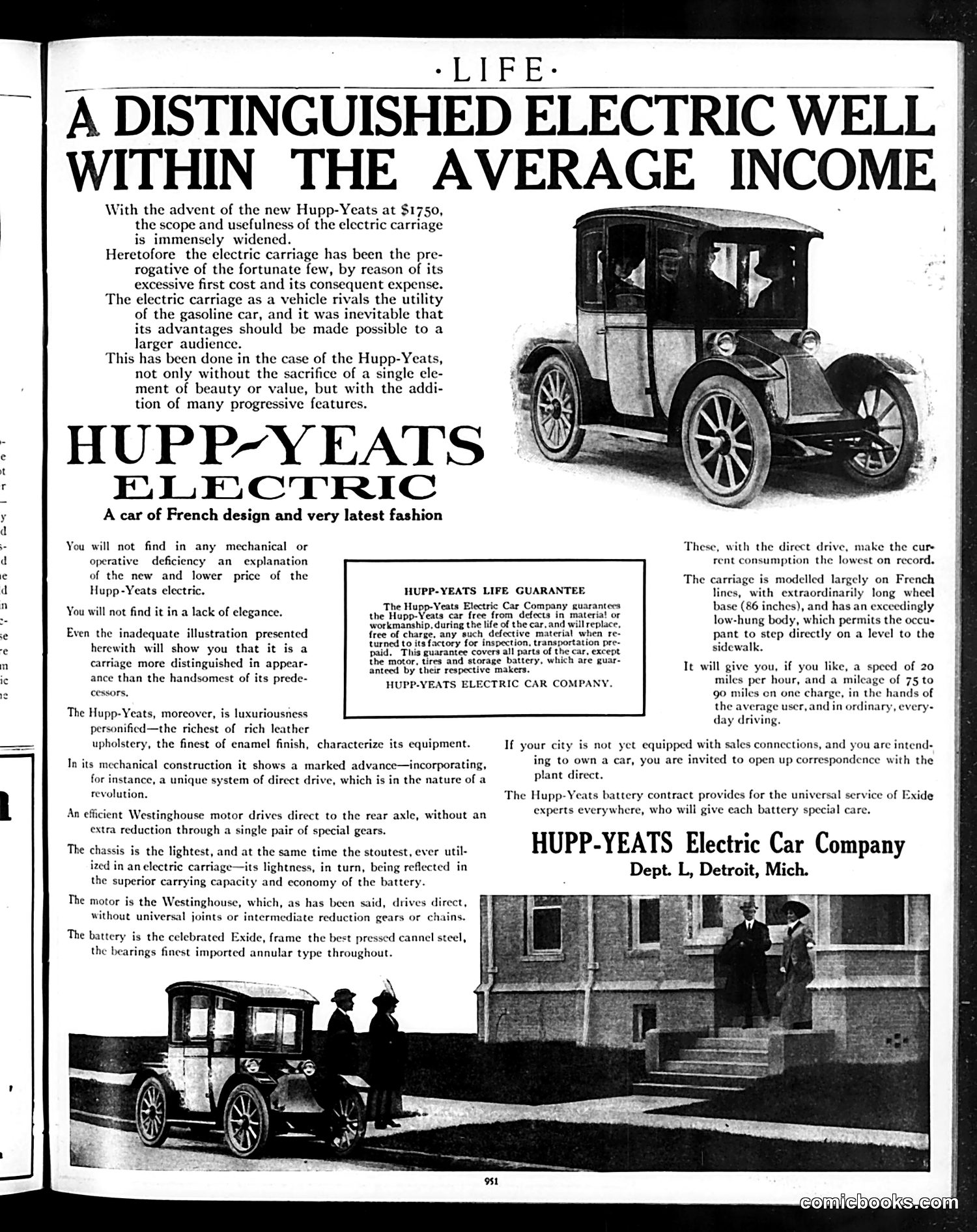
This is **not satire or political commentary**—it's a straightforward product advertisement for the Hupp-Yeats electric automobile, priced at $1,750. **Historical Context for Modern Readers:** The ad addresses a real market concern: electric cars were previously luxury items only wealthy people could afford. This model aimed to make electric vehicles accessible to middle-class Americans by lowering the price while maintaining quality. The advertisement emphasizes practical advantages (75-90 mile range, low operating costs, direct drive system) and luxury features (French design, leather upholstery) to justify affordability. It's positioned as bringing sophistication to "the average income" household. **Key Detail:** The lifetime guarantee (covering defects during "the life of the car") was a marketing strategy to overcome buyer hesitation about new technology. This reflects the early 1900s rivalry between electric and gasoline vehicles before gasoline ultimately dominated the market.
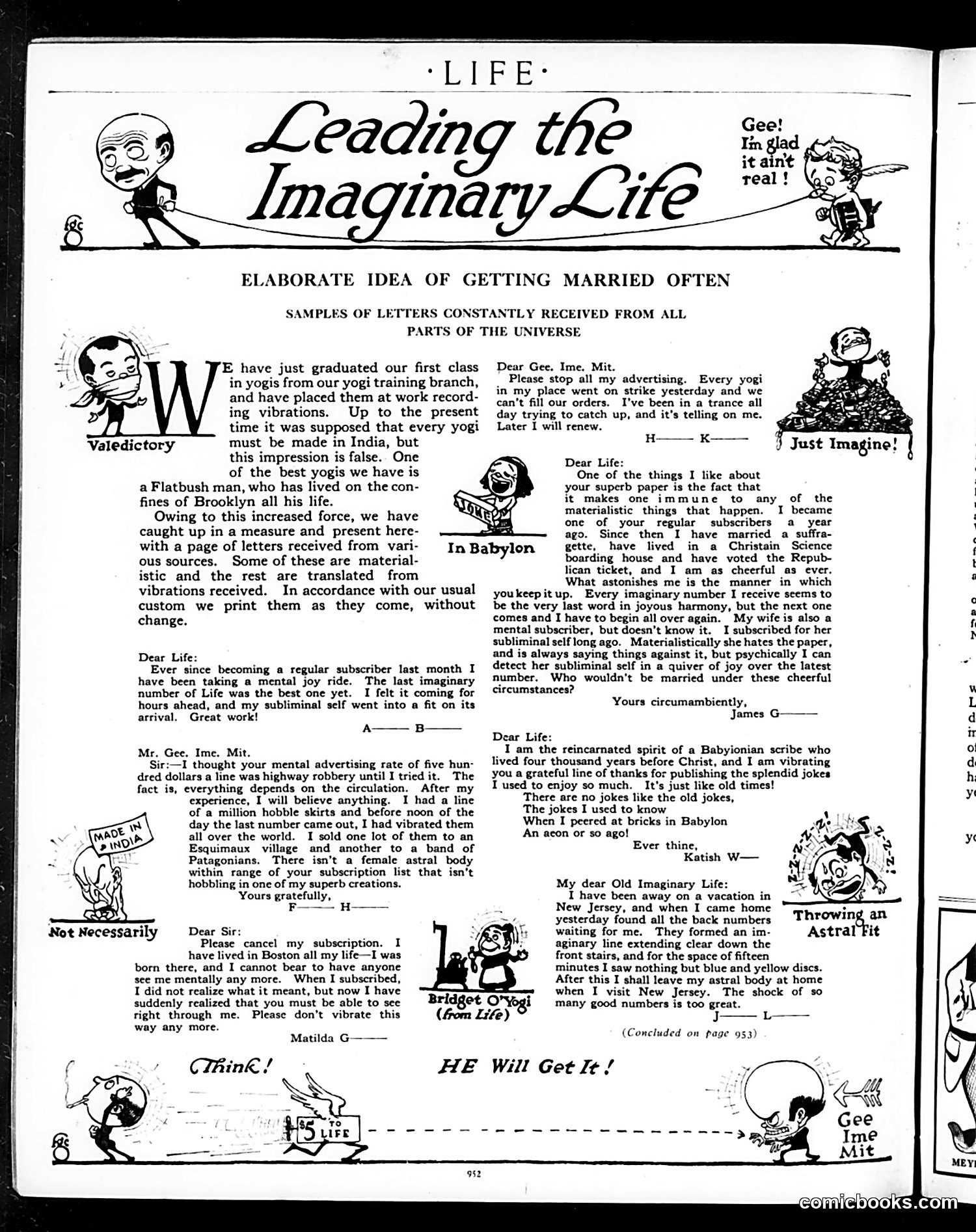
This page satirizes the contemporary craze for Spiritualism and yogic practices. The column's framing device mocks "yogi training branches" claiming to teach mental vibration and astral projection—suggesting such pseudo-scientific mysticism was genuinely marketed to Americans. The fake letters parody subscribers claiming the magazine produces "mental" effects: one reports selling hobble skirts through astral advertising; another begs to cancel to avoid being "seen mentally"; a third claims subscription made her immune to materialism (marriage, Christian Science, voting Republican) through purely mental means. The satire targets both gullible consumers buying into occult nonsense and the magazine itself for profiting from such absurdity. The "Imaginary Life" concept mocks the era's fascination with mental phenomena, reincarnation, and spiritualist claims—exposing how easily people rationalize magical thinking as science.
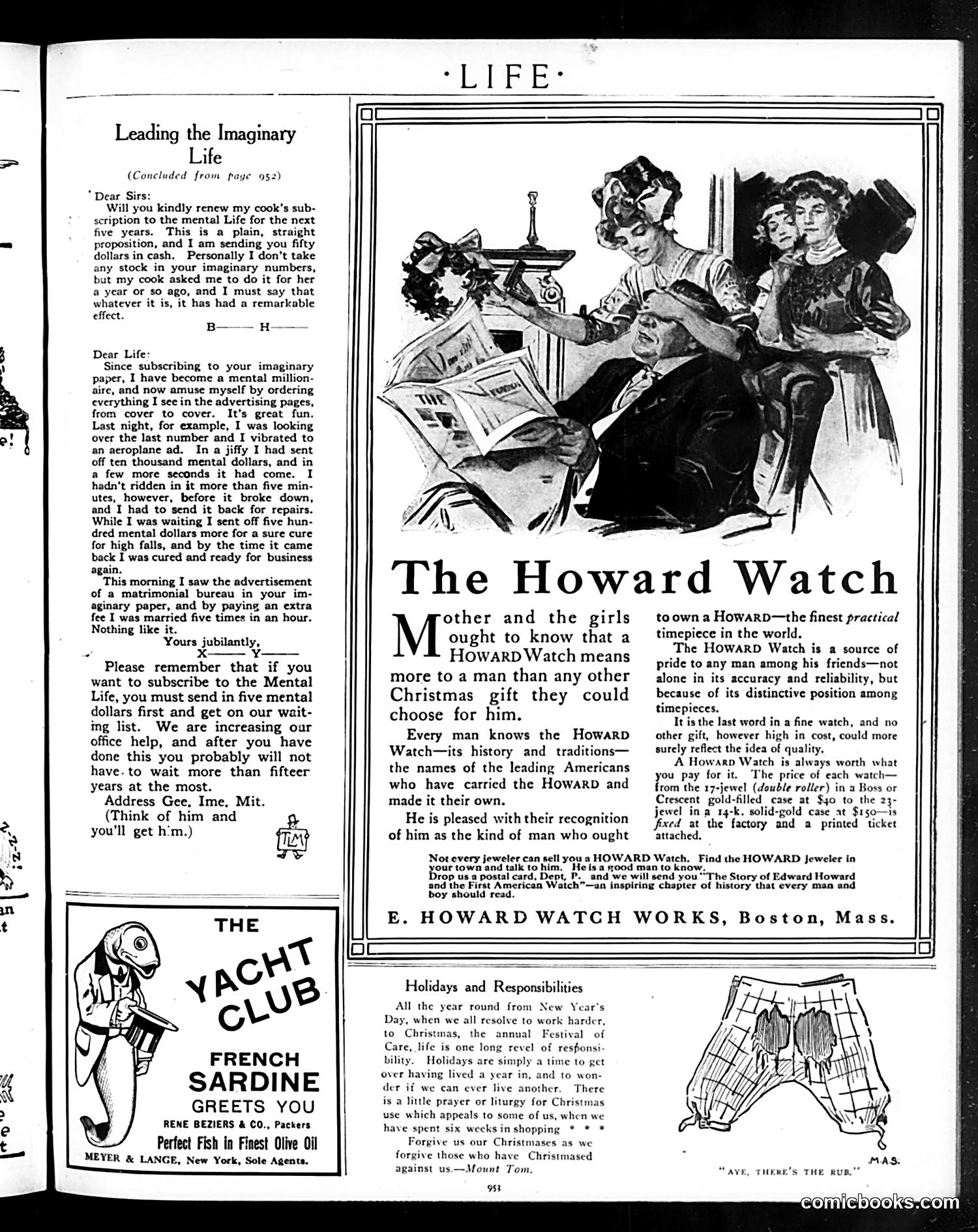
This page satirizes the concept of "Mental Life"—an imaginary publication where subscribers conduct fantasy transactions using imaginary money. The letters are humorous complaints/testimonies from readers. The first letter describes a cook benefiting mysteriously from the subscription. The second depicts someone ordering imaginary products from ads (an airplane, a cure), then marrying five times in an hour through a matrimonial bureau—all mentally, all harmlessly entertaining. The satire mocks the power of imagination and wishful thinking, particularly how advertising exploits desire. Modern parallels would be social media fantasies or online shopping addiction, though the 1910s context suggests commentary on consumerism and escapism during economic uncertainty. The page is mostly advertising (Howard Watch, Yacht Club sardines), typical of *Life* magazine's revenue model. The sidebar about "Holidays and Responsibilities" continues the theme of psychological relief through imagination rather than reality.
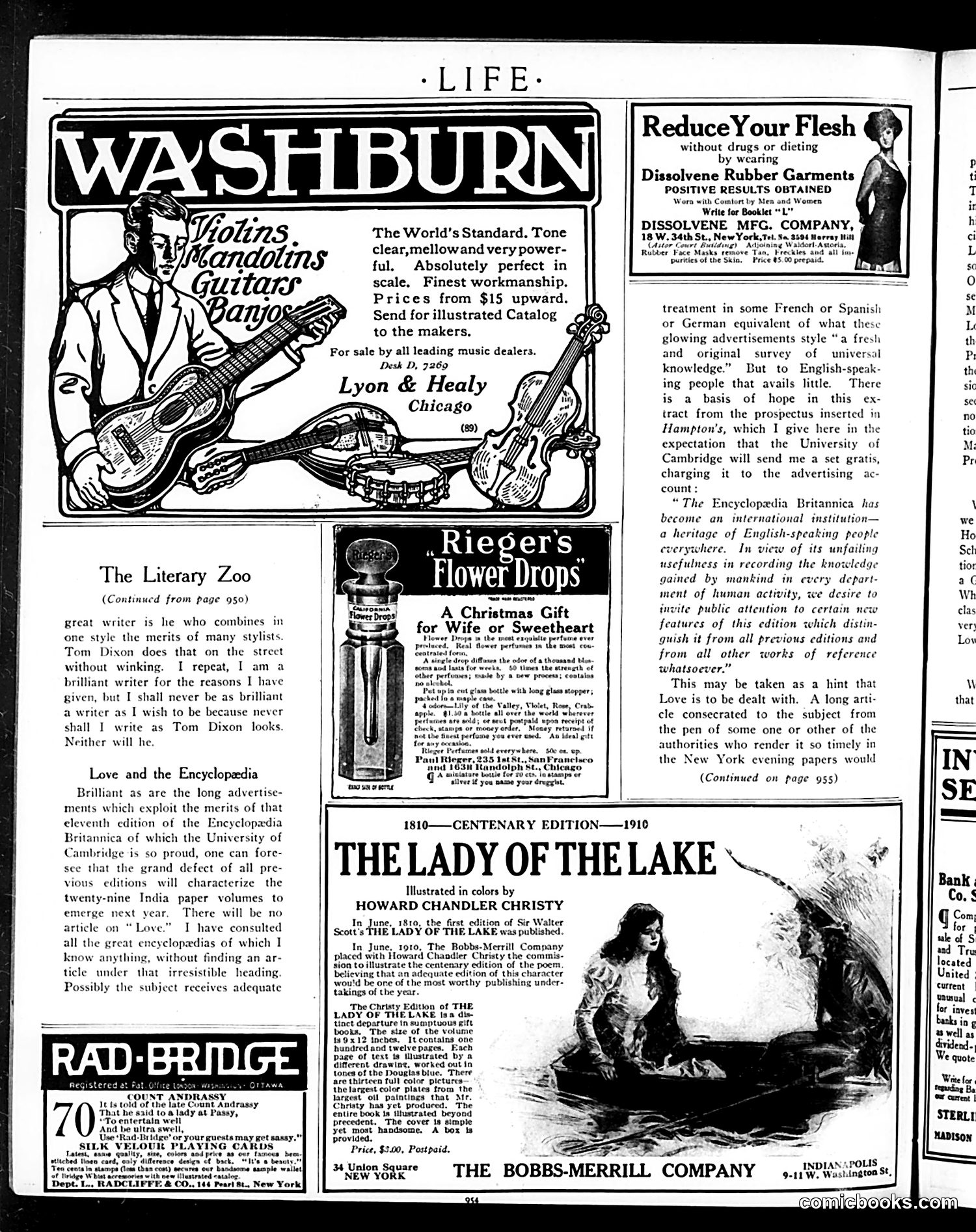
This is primarily a **page of advertisements and literary commentary**, not political satire. The main content includes: **"The Literary Zoo"** — A humorous essay criticizing writer Tom Dixon, arguing that while Dixon has merit, the author is actually more brilliant. It's self-satirizing literary criticism. **"Love and the Encyclopaedia"** — A tongue-in-cheek complaint that the new 11th edition of Encyclopedia Britannica, despite its grand ambitions, will likely omit an article on "Love" — the "irresistible heading" found in other encyclopedias. This gently mocks both the encyclopedia's pretensions and Victorian prudishness about the subject. **Advertisements dominate**: Washburn musical instruments, "Dissolvene" rubber garments for weight loss, Rieger's Flower Drop perfume, and a centenary edition of Sir Walter Scott's *The Lady of the Lake* illustrated by Howard Chandler Christy. The page reflects early 1910s consumer culture and light satirical commentary on publishing and social attitudes — not hard political messaging.
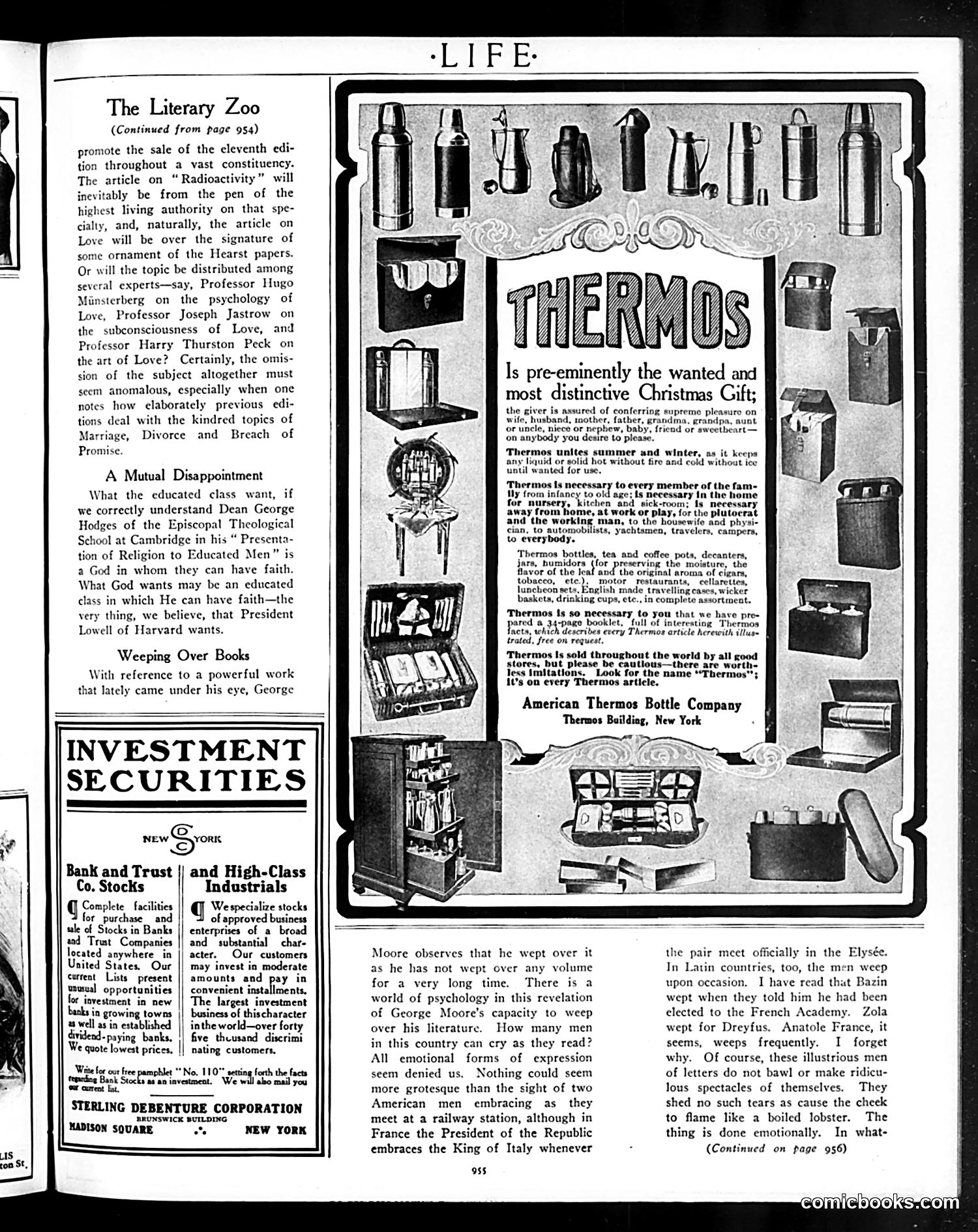
This page mixes literary commentary with period advertising. The main editorial content discusses literary topics: "The Literary Zoo" critiques how the eleventh edition of an encyclopedia will handle subjects like Love and Radioactivity, assigning them to famous experts. "A Mutual Disappointment" debates whether educated people need faith in God. "Weeping Over Books" discusses writer George Moore's emotional response to literature. The right half is dominated by a **Thermos bottle advertisement**, positioning vacuum bottles as the "pre-eminently wanted" Christmas gift for all family members—from infants to elderly—claiming universal necessity for keeping beverages hot or cold. Sidebar advertisements for investment securities and a Sterling Debenture Corporation round out the page. No political cartoons or caricatures appear here; this is primarily a magazine article page with substantial advertising, typical of Life's satirical-literary focus during this era.
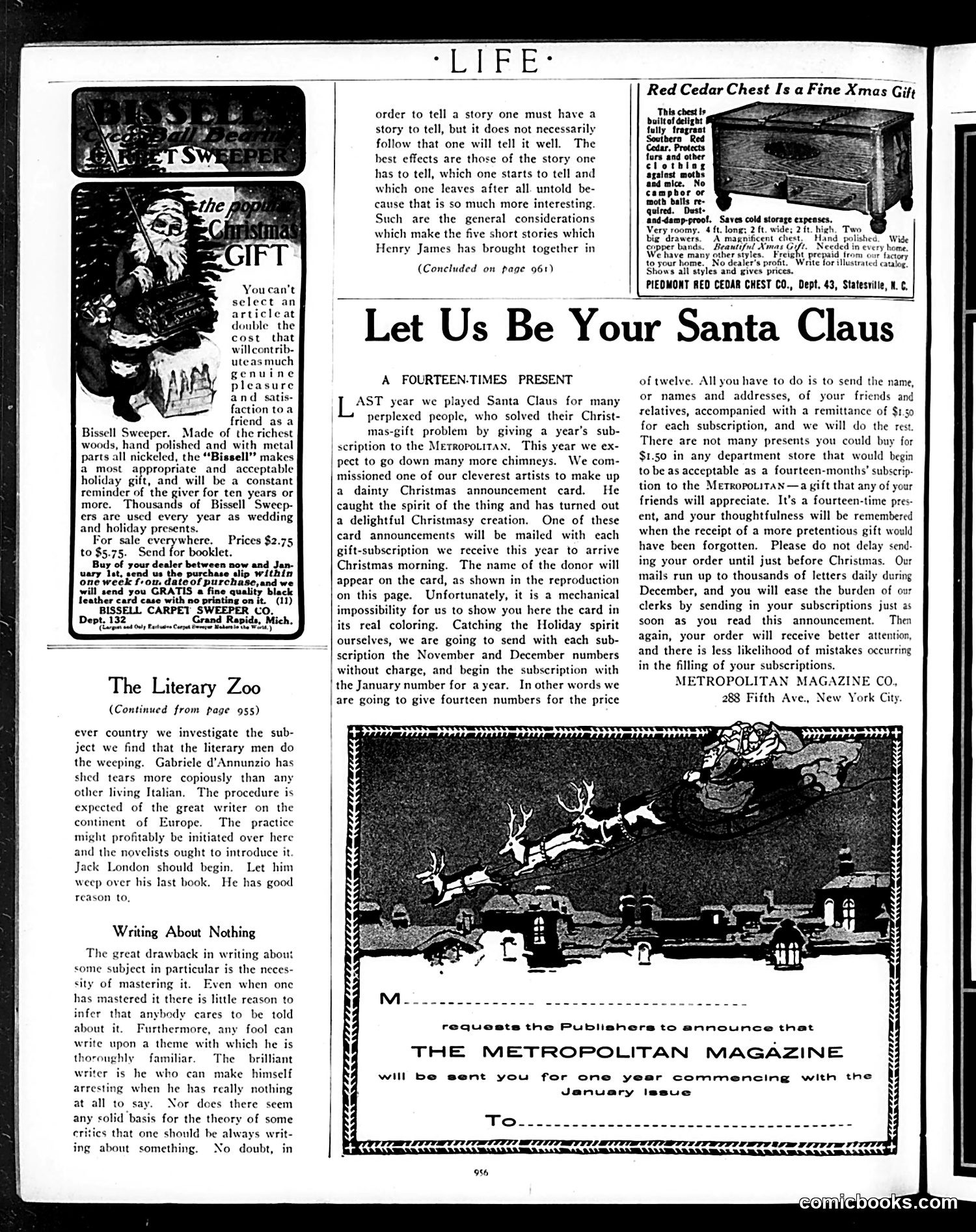
This page from *Life* magazine (undated, but likely early 1900s based on style) is primarily **advertising and promotional content**, not political satire. The main content is a "gift subscription" advertisement for *Metropolitan Magazine*. The pitch: readers can give a year's subscription as a Christmas present—14 issues for the price of one—and the publisher will mail a decorative announcement card to arrive Christmas morning, with the donor's name printed on it. This solves the gift-giver's problem elegantly. The page also features ads for practical holiday gifts: a **Bissell carpet sweeper** and a **red cedar chest** (for storing linens and protecting against moths and dampness). In the left column, "The Literary Zoo" and "Writing About Nothing" are book-review essays discussing contemporary writers like Jack London and Henry James—unrelated satire about literary culture. There is **no political cartoon** on this page. It's a commercial publication selling subscriptions and merchandise to affluent readers seeking appropriate Christmas gifts.
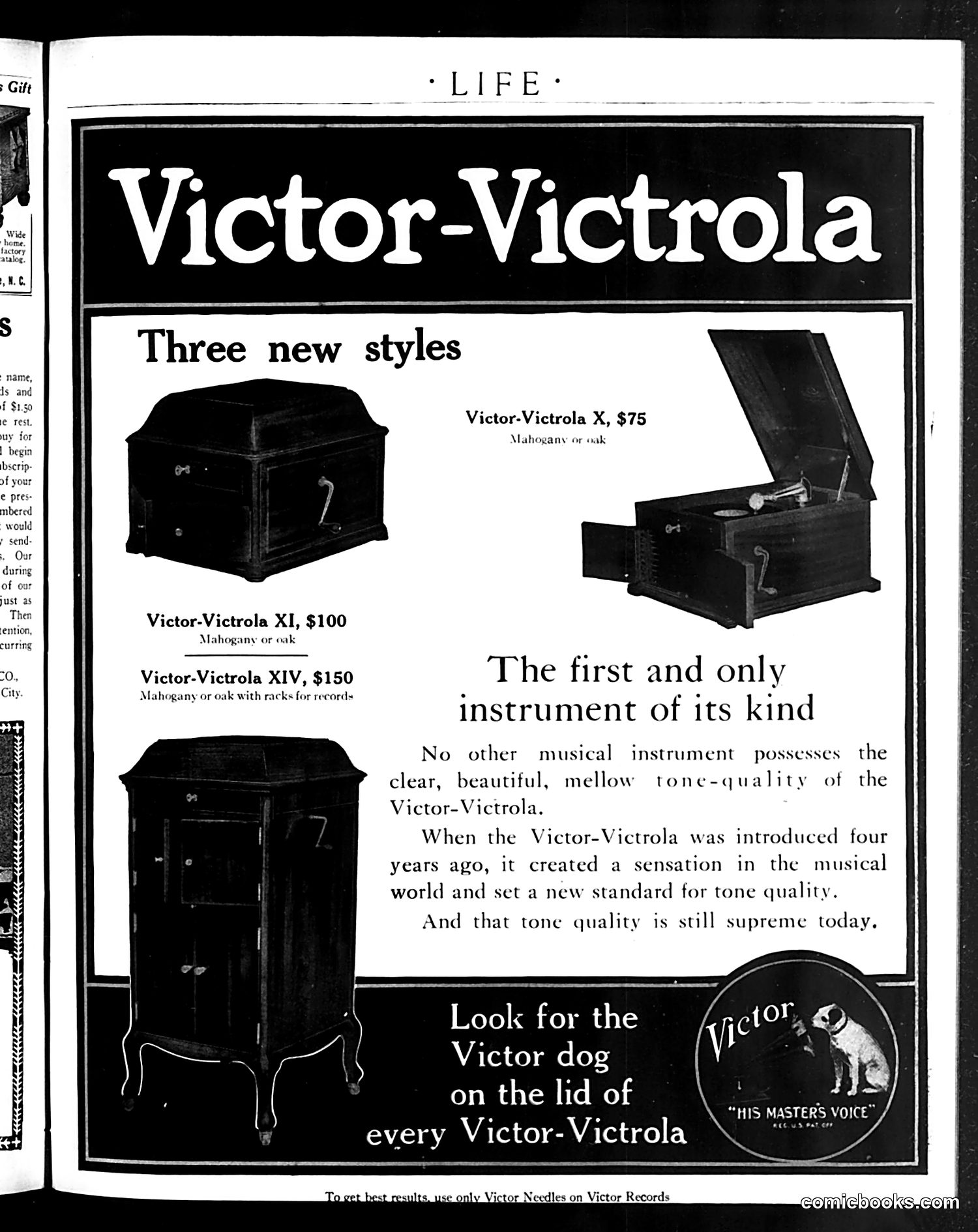
This is not a political cartoon but a product advertisement for Victor-Victrola phonographs. It appeared in *Life* magazine and promotes three model styles (priced $75–$150) featuring wooden cabinet designs. The ad emphasizes the instrument's superior "tone quality" and claims it set an industry standard when introduced "four years ago." The marketing strategy includes the famous Victor trademark—the dog listening to "His Master's Voice"—which appears on the lid of each machine. There is no satire or political content here; it's straightforward commercial advertising typical of early 20th-century *Life* magazine, which carried substantial advertising alongside editorial content.
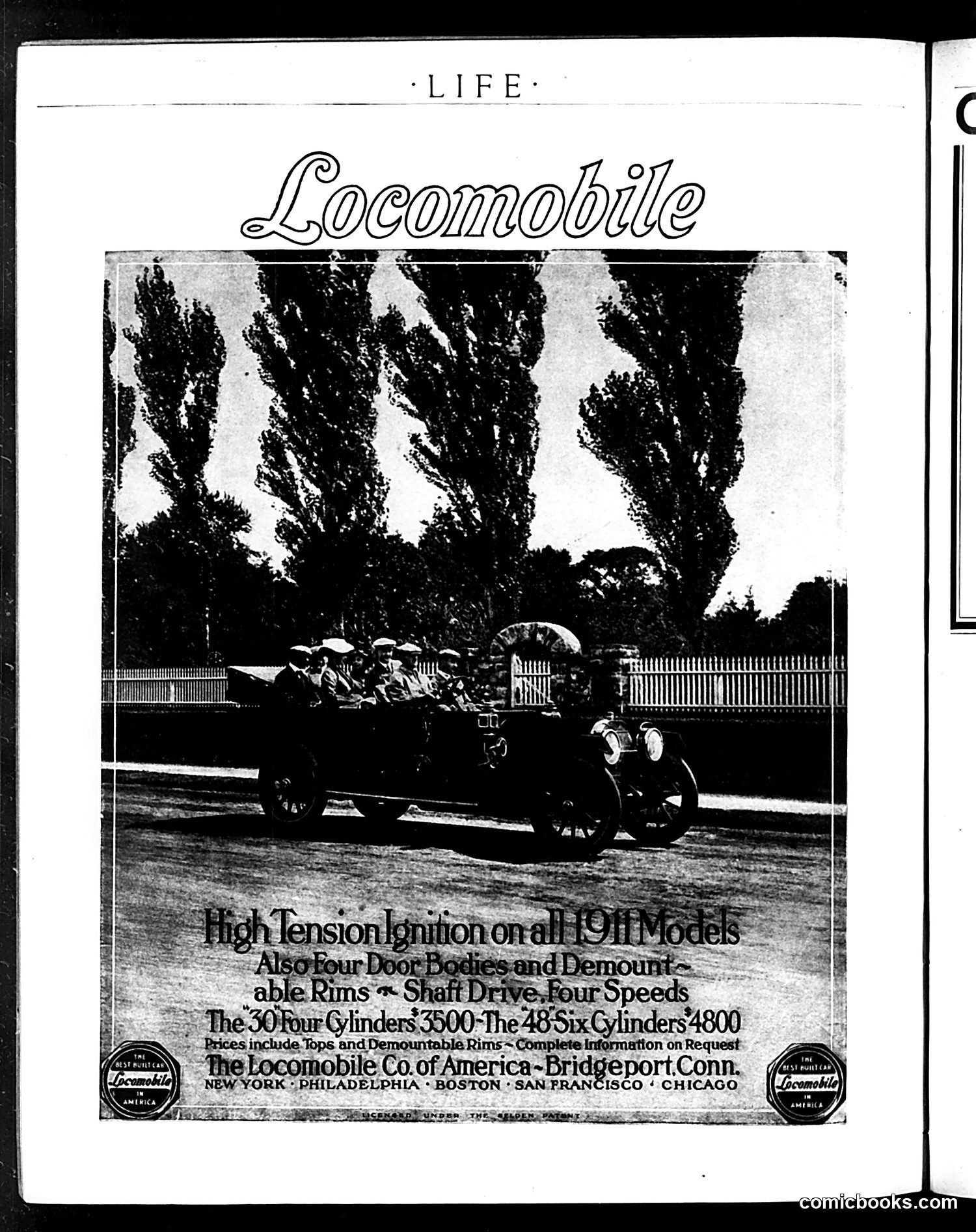
This page is primarily an **advertisement for Locomobile automobiles**, not political satire or a cartoon. The image shows two early racing cars on a track with spectators behind a white fence and tall poplar trees in the background, typical of 1911 motorsports venues. The ad promotes 1911 Locomobile models, highlighting features like high-tension ignition, four-door bodies, demountable rims, shaft drive, and four speed options. Two engine sizes are advertised: the 30 Four Cylinders (3500) and 48 Six Cylinders (4800). The Locomobile Company of America, based in Bridgeport, Connecticut, maintained offices in major American cities. This reflects the early automotive industry when car racing demonstrated technological advancement and appealed to wealthy buyers—the primary market for luxury automobiles.
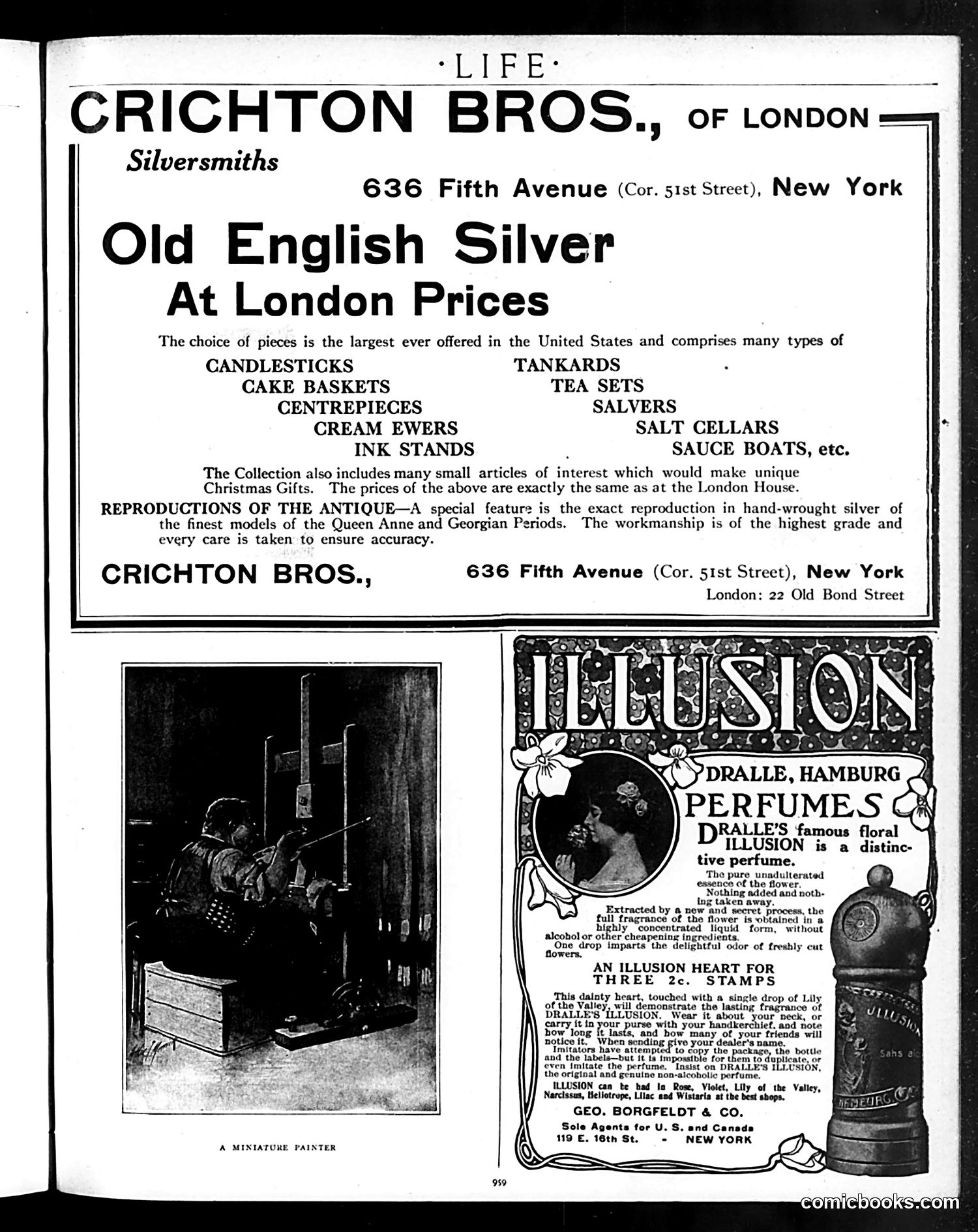
This page consists primarily of **advertisements** rather than political cartoons or satirical content. The top features **Crichton Bros.**, a London silversmith advertising Old English silver items (candlesticks, tea sets, etc.) sold at London prices in their New York location. The company emphasizes their collection includes reproductions of Queen Anne and Georgian period pieces. The bottom right shows a **Dralle's Illusion perfume advertisement** from Hamburg, highlighting their floral perfume extract made without alcohol. They're offering a promotional heart-shaped scent sample for three stamps. On the left is a small illustration labeled "**A Miniature Painter**"—a dark, atmospheric image of what appears to be an artist at work, though its exact satirical purpose (if any) is unclear from the image quality and context provided. The page number indicates this is **page 919** of Life magazine, during what appears to be an early 20th-century publication period.
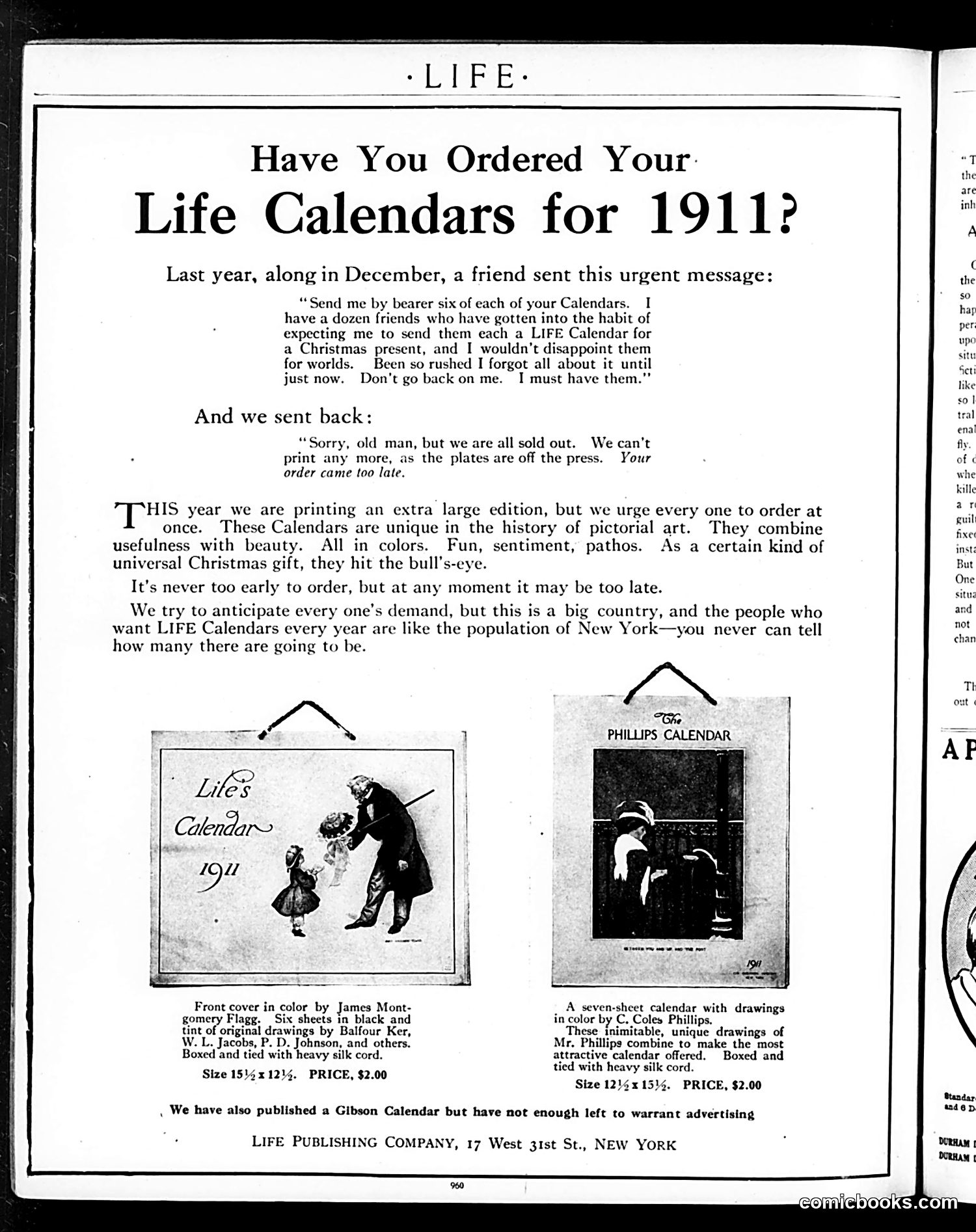
This is primarily a **product advertisement**, not political satire. Life Publishing Company is promoting their 1911 calendars as Christmas gifts. The page describes a familiar retail problem: last year, a customer's order arrived too late and sold out. This year, Life is printing extra copies but urging early ordering, warning that demand is unpredictable—"like the population of New York." Two calendar designs are shown: 1. **Life's Calendar** (left): Features illustrations by James Montgomery Flagg and other artists in color and black-and-white. Price: $2.00. 2. **Phillips Calendar** (right): Showcases drawings by C. Coles Phillips, a popular illustrator of the era known for stylized female figures. Also $2.00. The advertisement frames calendars as ideal universal gifts combining "usefulness with beauty" and "fun, sentiment, pathos." The underlying message: order now or risk disappointment. A Gibson Calendar is mentioned but noted as sold out.
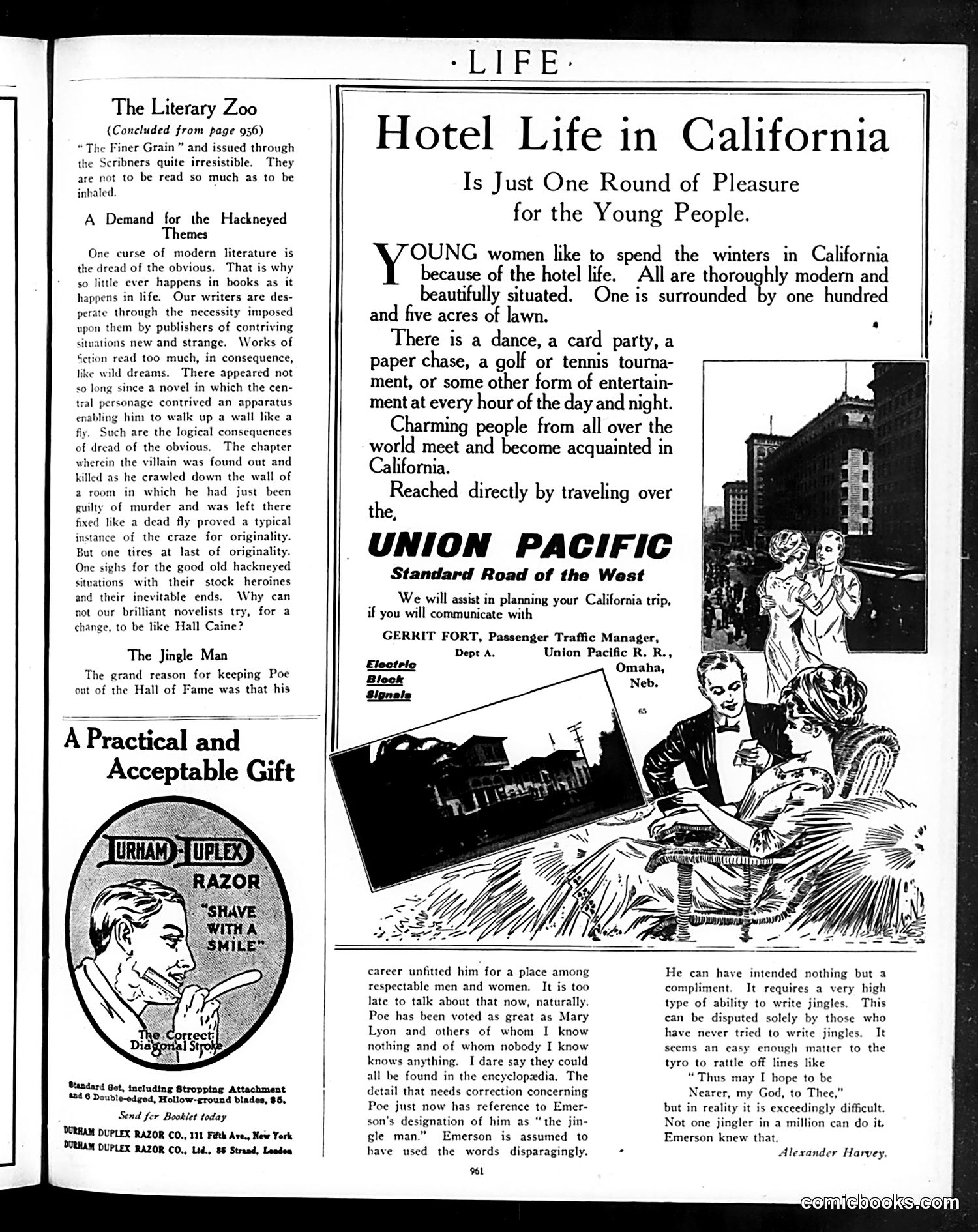
This page contains three distinct sections: **Left column:** Literary criticism essays on hackneyed themes in modern literature and Poe's "The Jingle Man," followed by a **Durham Duplex Razor advertisement** showing a man shaving—a straightforward product endorsement. **Main content:** A **Union Pacific Railroad advertisement** promoting California hotel life for young people, illustrated with stylized figures planning travel and examining photographs. The ad emphasizes leisure activities (dances, card parties, golf) and exotic social encounters. **Bottom right:** An essay by **Alexander Harvey** critiquing **Edgar Allan Poe's** literary reputation, arguing he's been overrated—claiming Poe couldn't write simple jingles and asserting encyclopedic entries about him contain errors. This is primarily an **advertising and literary criticism page**, not satirical political content. The railroad ad exemplifies early 20th-century tourism marketing targeting affluent young people.
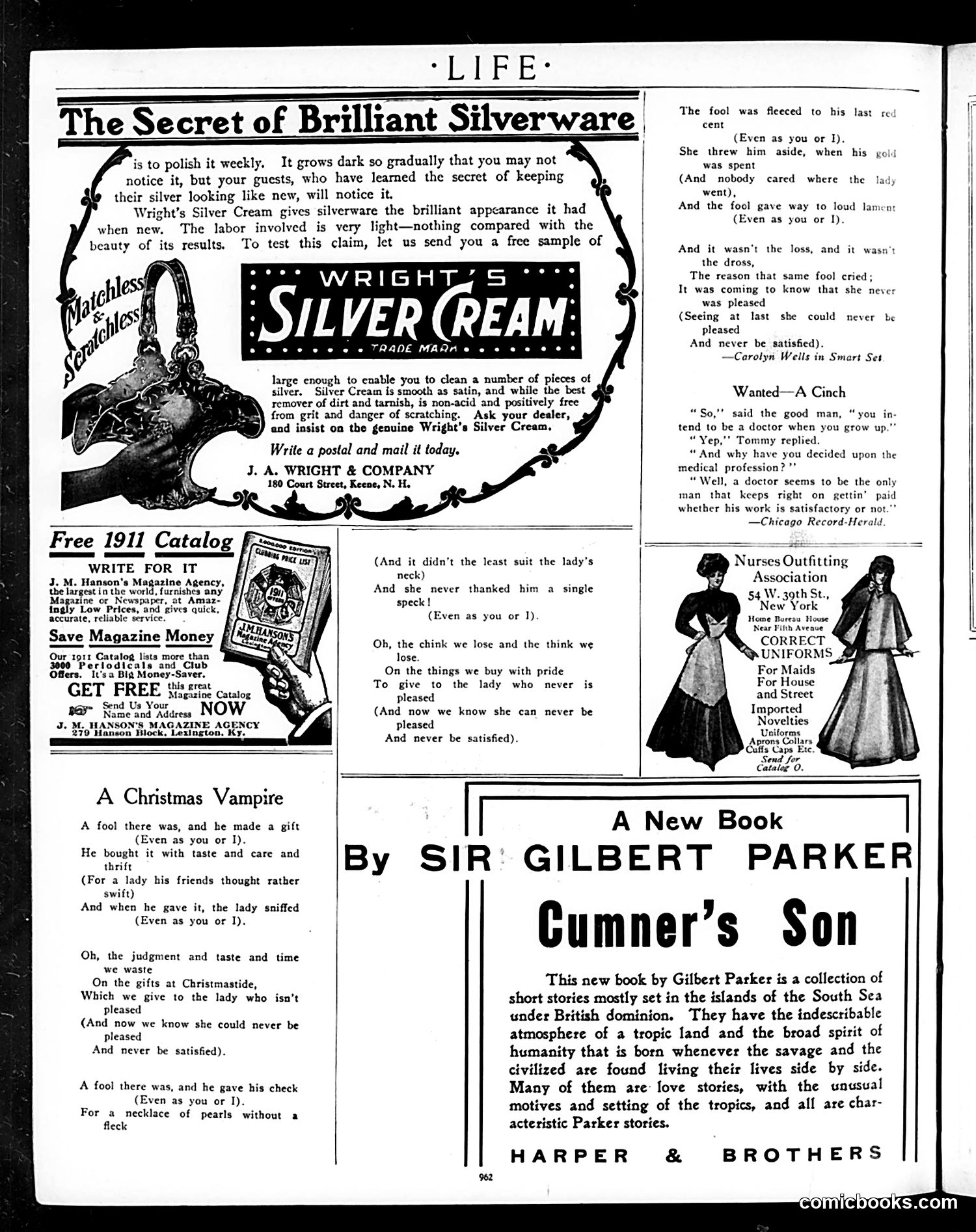
This page is primarily **advertising and light satirical poetry**, not political cartooning. The main content includes: 1. **Wright's Silver Cream ad** — a product advertisement emphasizing labor-saving convenience for household maintenance 2. **"A Christmas Vampire"** — satirical verse by Carolyn Wells mocking the futility of gift-giving to ungrateful women. The repeated refrain "(Even as you or I)" mimics Rudyard Kipling's "The Vampire," creating dark humor about wasted money and unappreciative recipients. The "fool" squanders resources on gifts that never satisfy. 3. **"Wanted—A Cinch"** — a brief joke about a boy who wants to become a doctor because doctors get paid regardless of whether their work is satisfactory—mocking both medical ethics and job security. 4. **Additional ads** for magazines, nurse uniforms, and a Gilbert Parker book collection about tropical colonial life. The humor reflects early 1900s attitudes: skepticism about feminine satisfaction, anxiety about consumer spending, and class-conscious commentary on labor and profession.
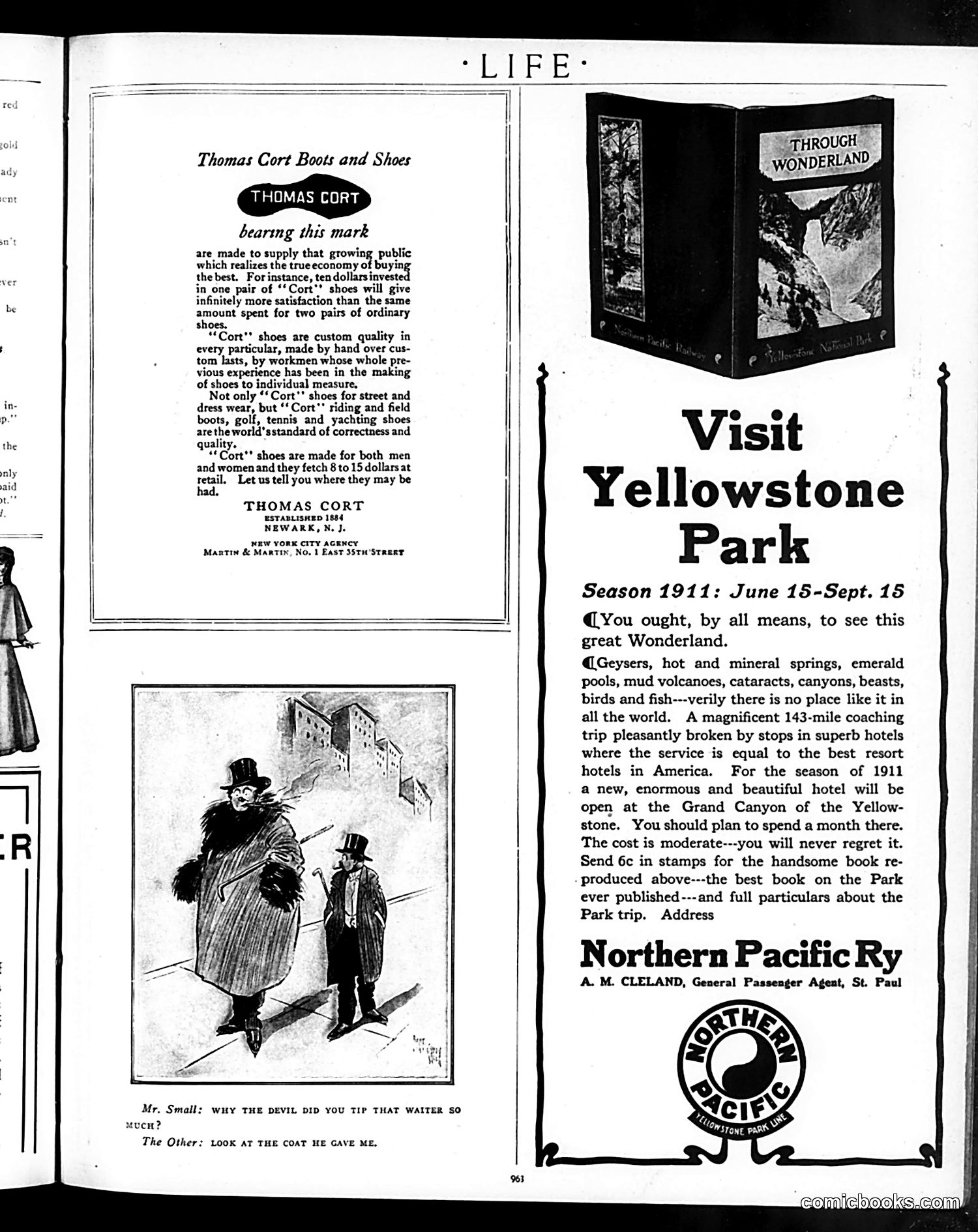
This page contains two main elements: **The Cartoon (lower left):** A short humorous exchange between two men. "Mr. Small" questions why his companion tipped a waiter so generously. The response: the waiter gave him a coat. The joke plays on the idea that the waiter's generosity (providing a coat) was so unexpected or valuable that it warranted an unusually large tip—inverting normal social expectations about who should give gifts in a service transaction. It's a simple gag about gratitude and social obligation. **The Advertisements:** The page is primarily filled with period advertisements: Thomas Cort Boots and Shoes (emphasizing quality and handmade craftsmanship) and Northern Pacific Railway's promotion of Yellowstone Park visits for the 1911 season. These ads reflect early 20th-century consumer marketing and tourism promotion, highlighting luxury, exclusivity, and the era's fascination with natural wonders accessible by rail. The page is typical Life magazine content: mixing light satire with commercial messaging.
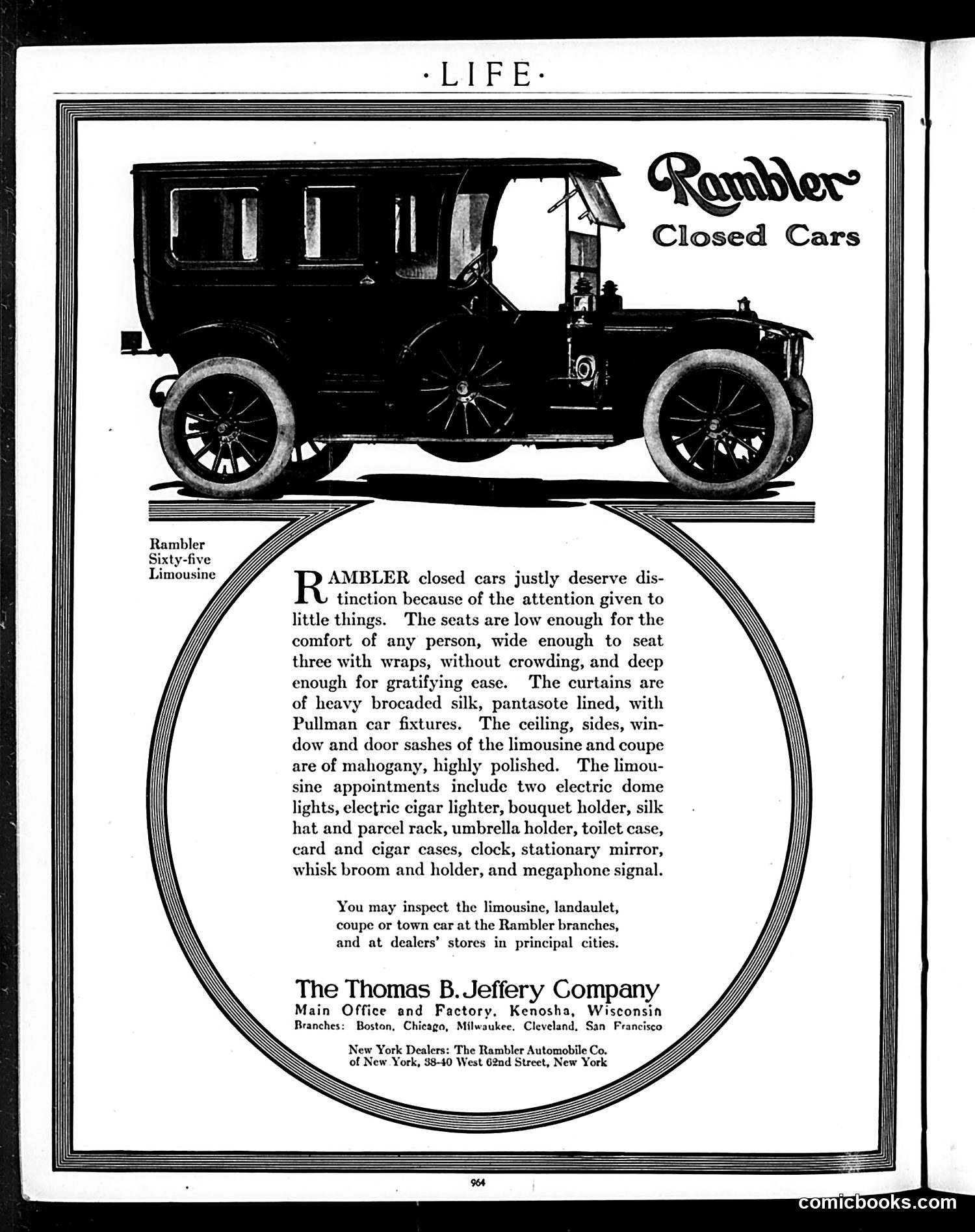
This is a straightforward advertisement—not satire—for the Rambler "Sixty-five" luxury closed car, manufactured by The Thomas B. Jeffery Company. The ad emphasizes comfort and refined interior details appealing to wealthy early-20th-century buyers: low, wide seats, silk curtains with Pullman-style fixtures, polished mahogany trim, and luxury amenities like electric dome lights, cigar lighters, bouquet holders, and a megaphone signal. The car illustration shows a typical enclosed limousine of the era. The ad's tone stresses that Rambler distinguishes itself through "attention to little things"—quality materials and thoughtful appointments that signal status and sophistication to prospective buyers of closed automobiles, which were premium vehicles at this time.
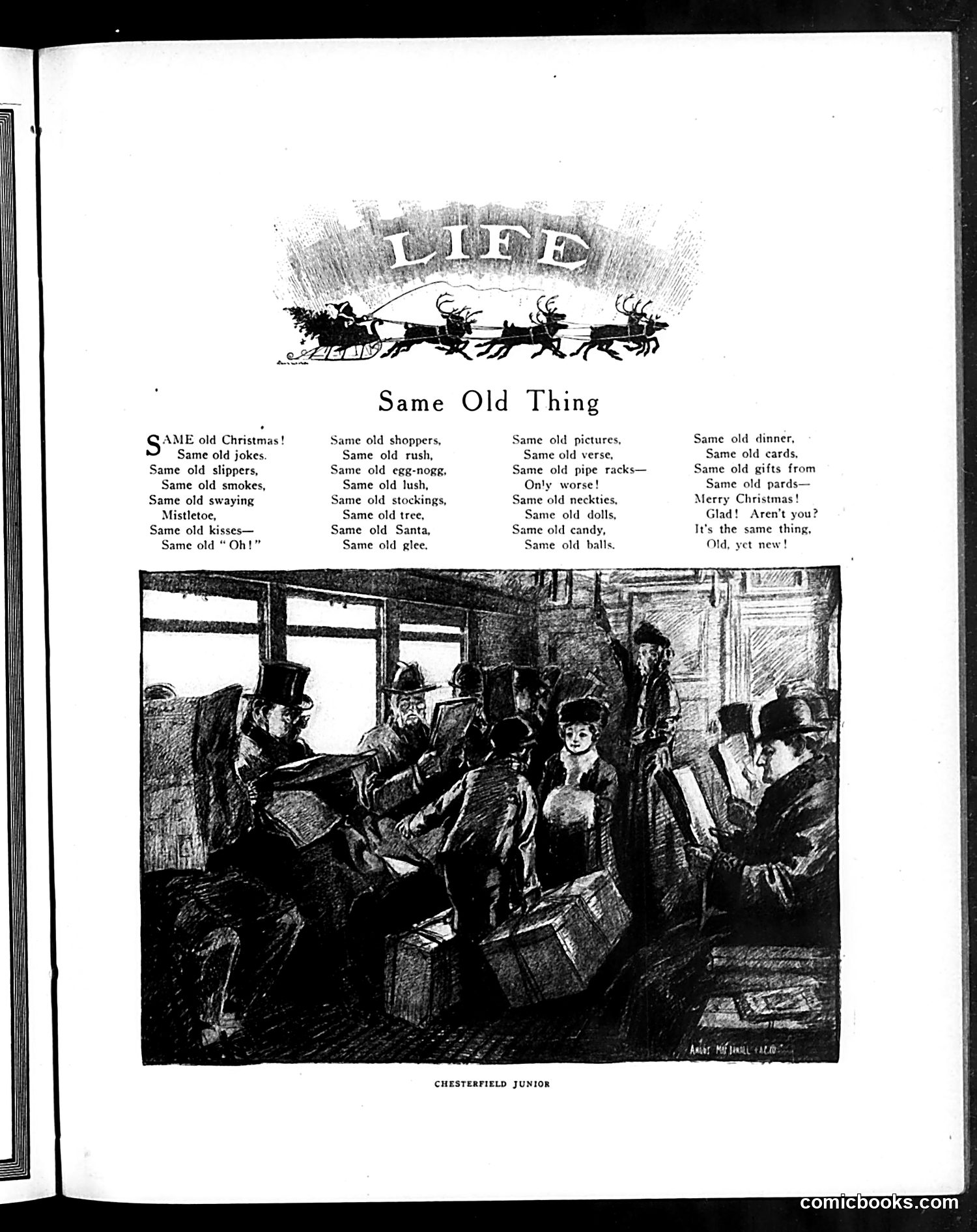
This page satirizes the predictability and monotony of Christmas traditions. The poem lists repetitive holiday elements—jokes, gifts, decorations, food, activities—to mock how Christmas remains unchanged year after year, with identical customs and predictable exchanges. The illustration shows a crowded streetcar or trolley filled with holiday shoppers, suggesting the commercialized, mass-produced nature of Christmas celebration. Everyone participates in the same ritualistic activities simultaneously. The final line—"It's the same thing, / Old, yet new!"—captures the satire's core: despite calling Christmas "new" each year, nothing actually changes. The piece critiques both the mechanical repetition of holiday customs and the false sense of novelty people maintain about what is fundamentally identical annual behavior. The Chesterfield Junior reference at bottom appears to be a magazine section marker.
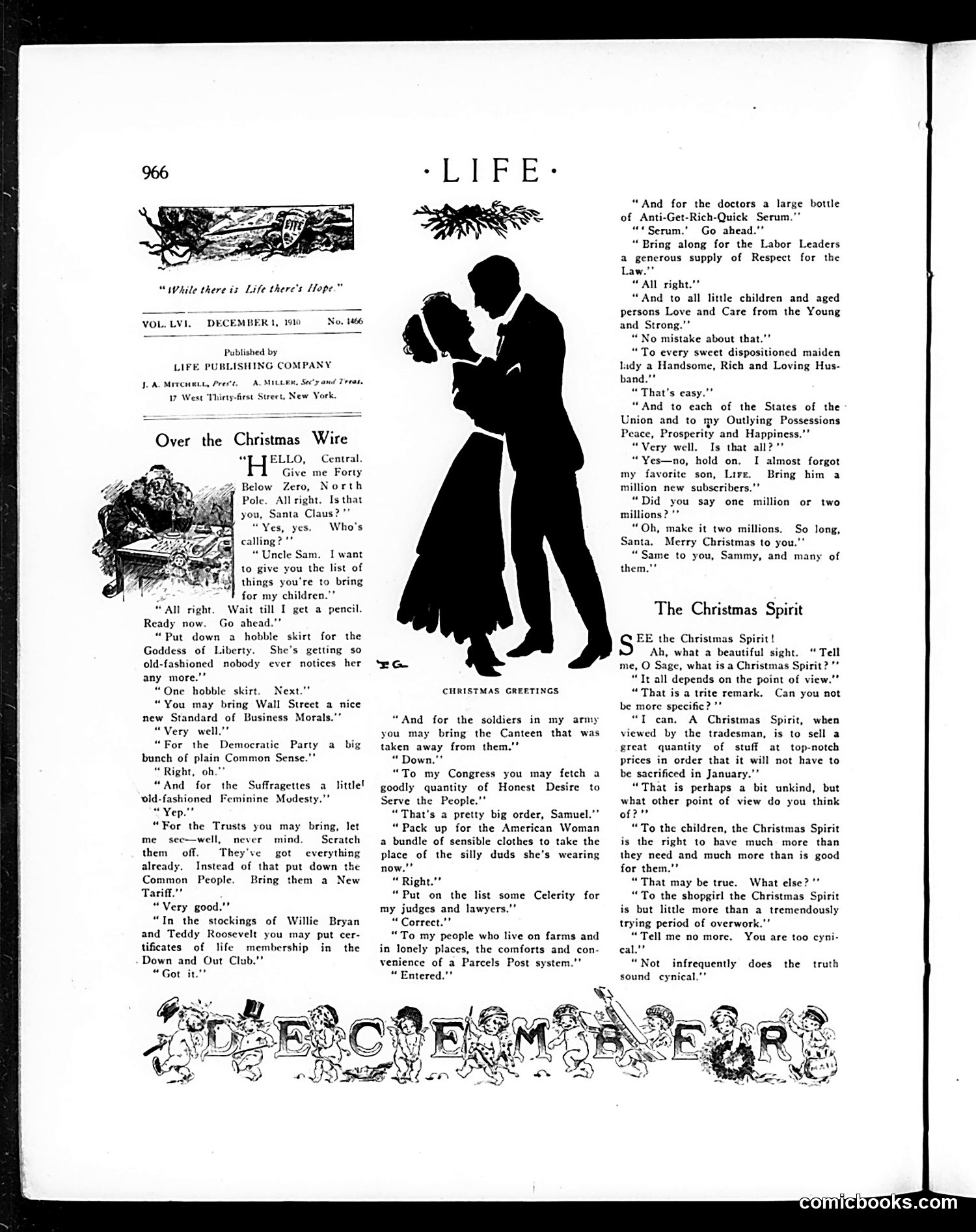
This satirical piece presents Uncle Sam telephoning Santa Claus with a Christmas wish list for America's institutions and groups. The humor lies in the ironic requests: asking for "Business Morals" for Wall Street, "Common Sense" for the Democratic Party, and "Feminine Modesty" for suffragettes—implying these groups critically lack these qualities. Other jabs target: judges needing "Celerity" (speed), doctors needing anti-greed serum, labor leaders needing "Respect for the Law," and farmers needing a parcel post system. The piece mocks contemporary social issues including women's fashion, trusts, political corruption, and labor relations. The accompanying dialogue "The Christmas Spirit" cynically contrasts idealistic versus commercial interpretations of Christmas—merchants seeking profit, children wanting excess, shopgirls facing overwork—concluding that truth itself sounds cynical when describing holiday commercialism.
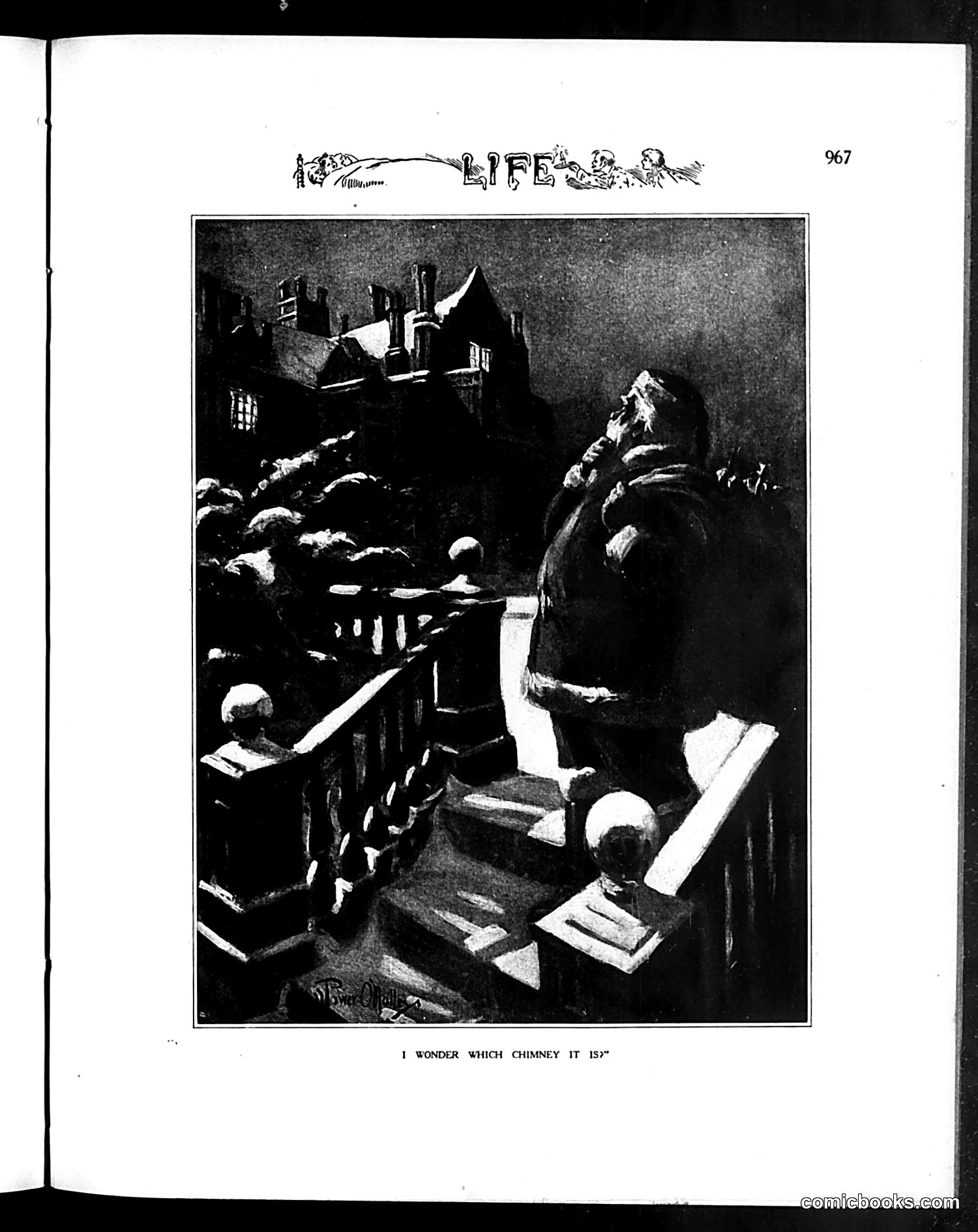
This satirical illustration depicts a nighttime winter scene with figures looking up at a castle or large building with multiple chimneys. The caption's question suggests uncertainty or confusion about which chimney to use or target. The image likely satirizes either: - **Santa Claus mythology** — confusion about chimney access for gift delivery - **Industrial/labor concerns** — possibly referencing chimney sweeps or workers - **Political/social commentary** — potentially about targeting someone or something specific, though the exact reference is unclear without additional context The stark black-and-white style and gothic atmosphere suggest darker satirical intent beyond simple holiday humor. The specific political or social target remains ambiguous from the image and caption alone.
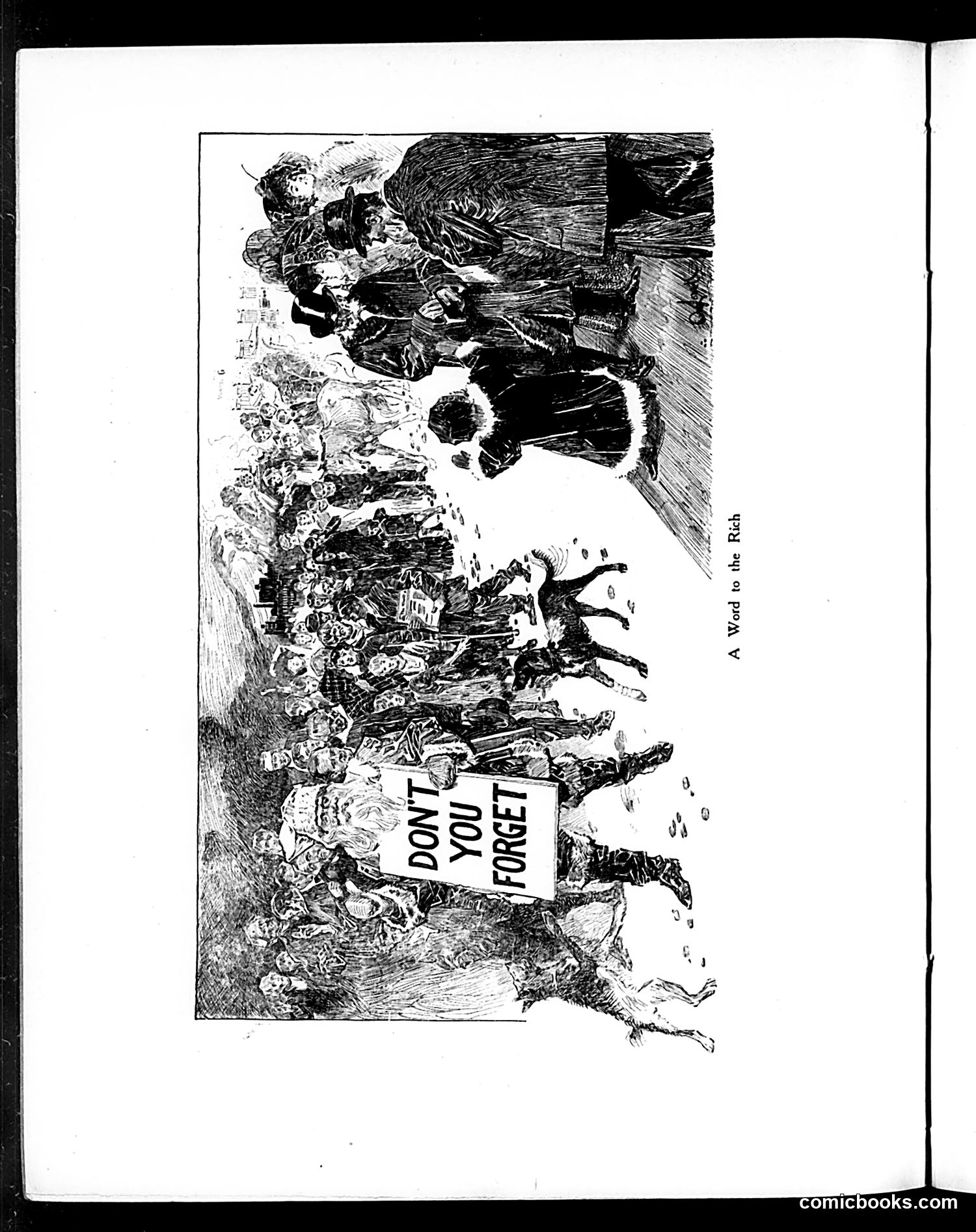
This is a satirical illustration titled "A Word to the Rich," depicting a wealthy figure (shown in formal dress at top) overlooking a chaotic scene below with text reading "DON'T YOU FORGET!" The cartoon appears to criticize wealth inequality and social responsibility. The wealthy person is positioned above a tumultuous crowd of common people rendered in detailed, somewhat grotesque style—suggesting masses of struggling citizens or the poor. The warning "Don't You Forget!" serves as a moral reminder to the rich not to ignore the plight of those below them. The satirical point likely addresses Gilded Age concerns about the obligations of wealthy individuals toward society's less fortunate, or warns against forgetting the human cost of economic disparity. The stark visual contrast between the isolated, dignified figure above and the swirling chaos below emphasizes social division.
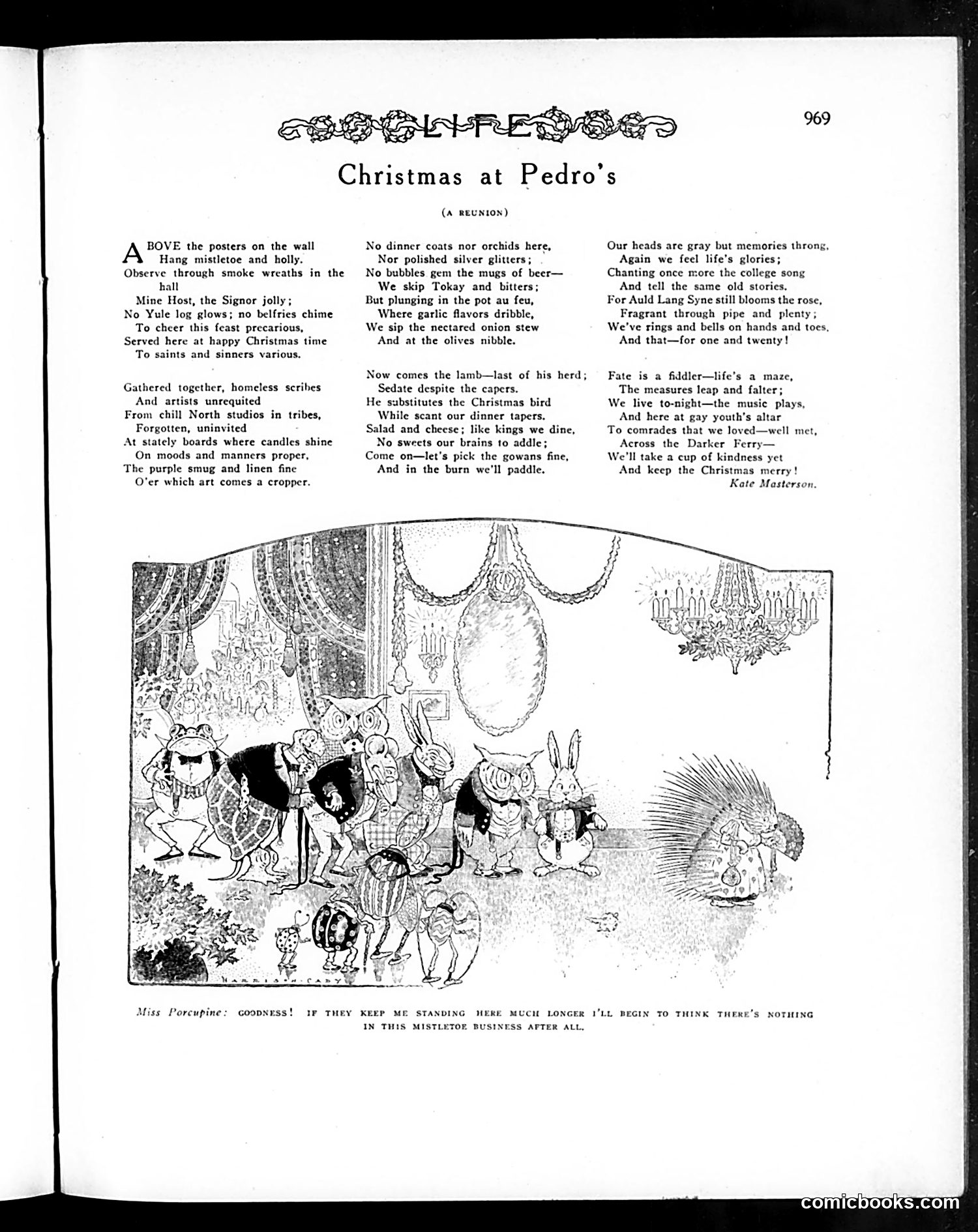
This page depicts a nostalgic Christmas gathering at Pedro's, apparently a modest Spanish restaurant ("pot au feu," "garlic," "onion stew"). The poem and accompanying illustration celebrate a reunion of struggling artists and writers—"homeless scribes," "artists unrequited" from "chill North studios"—excluded from wealthy society's formal Christmas celebrations. The satire contrasts their modest circumstances (no fancy dinner coats, polished silver, or champagne) with their genuine camaraderie and youthful spirit. The cartoon shows bohemian figures celebrating simply: lamb instead of turkey, cheese and salad, cheap beer instead of fine wines. The humor lies in their dignified poverty—living authentically among themselves rather than pretending at "stately boards." The bottom caption involves "Miss Porcupine" making a mistletoe joke, reflecting the lighthearted tone. Overall, it's romantic satire of bohemian life, celebrating artistic outsiders' fellowship over bourgeois respectability.
This is a dramatic sketch depicting the social dynamics of an upper-class household around 1910. The humor centers on **class pretense and unspoken hierarchy**. Mrs. van Meyer, a wealthy but idle housewife, takes her longtime butler Burroughs entirely for granted—leaving all domestic decisions to him while treating him as invisible. When Burroughs attempts to inform her of his intention to resign (likely seeking recognition or better treatment after ten years of faithful service), he's repeatedly interrupted and dismissed. The satire targets **Mrs. van Meyer's obliviousness**: she claims to have "only the kindest feelings" for Burroughs yet makes his life difficult through her negligence and demands. When her husband arrives, she instantly shifts to charming him with tea and attention—the same courtesy she denies her servant. The title's answer becomes clear: **Burroughs quits because employers like the van Meyers, despite professing kindness, fundamentally disrespect their servants' humanity and labor**. The sketch mocks the hypocrisy of wealthy households that claimed to treat servants well while taking their work for granted.
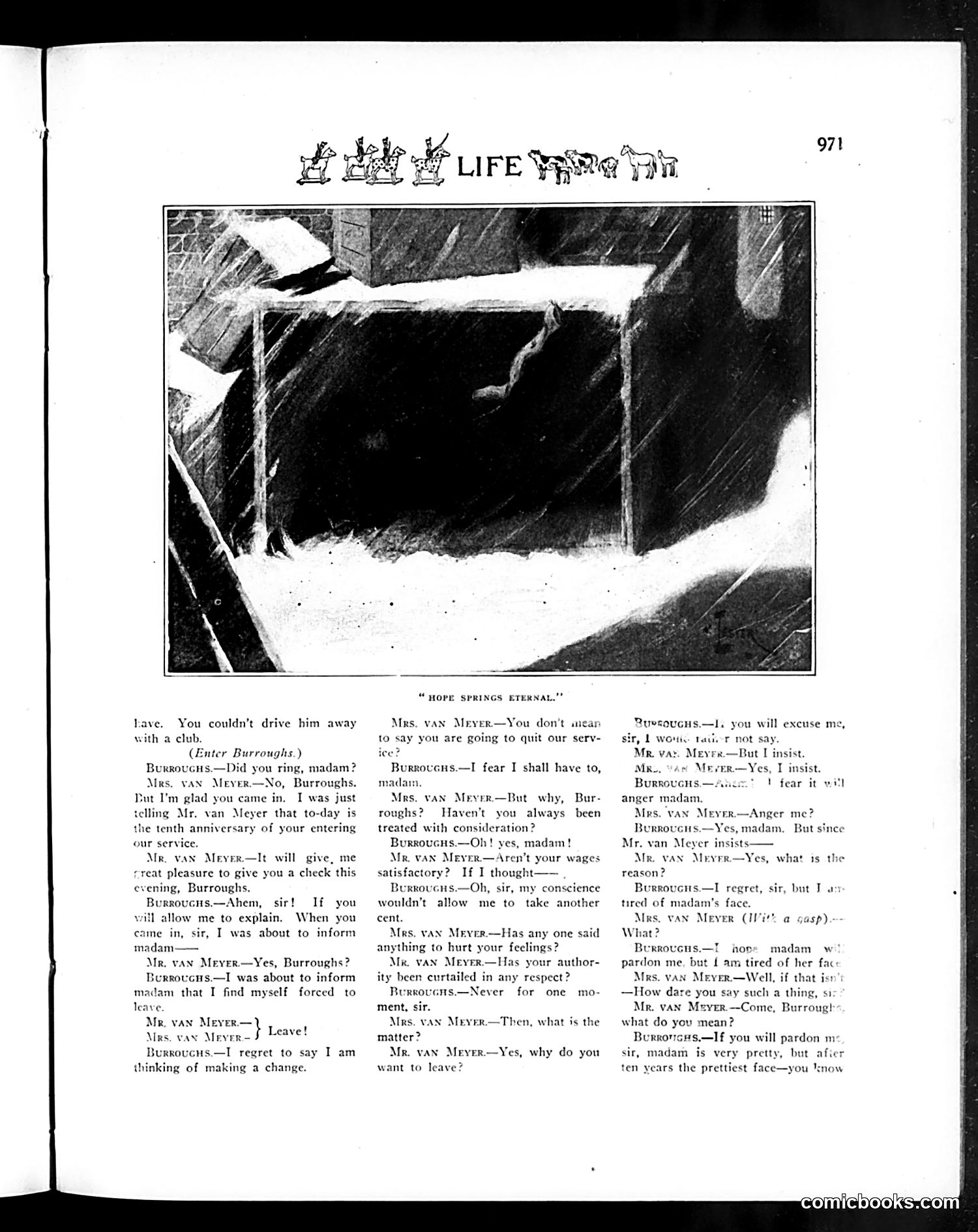
This is a domestic comedy sketch depicting a long-serving butler (Burroughs) announcing his resignation after ten years of employment to Mr. and Mrs. van Meyer, wealthy employers. The satire centers on the butler's increasingly brutal honesty: after the employers exhaust all conventional explanations (wages, treatment, authority), Burroughs finally admits he's simply tired of looking at Mrs. van Meyer's face daily. Despite acknowledging she's objectively "very pretty," even beauty becomes tedious after a decade. The joke critiques both servant-employer dynamics and marital familiarity—the title "Hope Springs Eternal" suggests optimism about change, though the real message is that even ideal circumstances become unbearable through repetition. The employer's shocked reaction underscores how his blunt candor violates social conventions that usually mask such thoughts. It's gentle satire on class relations and the monotony of domestic life.
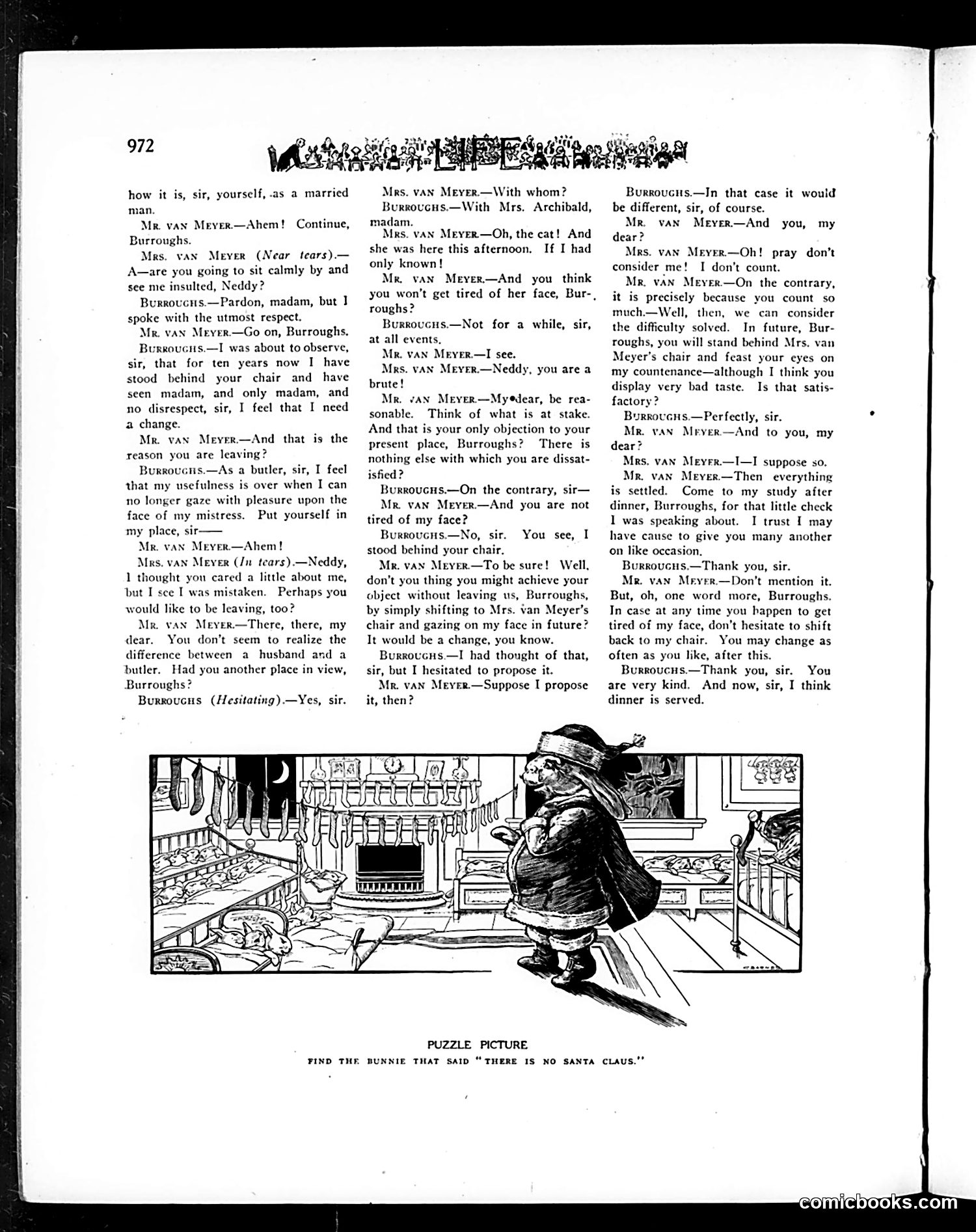
This page contains a satirical dialogue between Mr. and Mrs. van Meyer and their butler Burroughs. The humor turns on class dynamics and marital tension: Burroughs announces he's leaving because he's tired of looking at Mrs. van Meyer's face (a backhanded compliment disguised as respect). Mrs. van Meyer is insulted; Mr. van Meyer suggests a solution—Burroughs simply switches to standing behind *his* chair instead, thus gazing upon the husband's face rather than the wife's. The satire mocks the absurdity of upper-class domestic arrangements and wounded vanity. The "compromise" is ridiculous: nothing materially changes except which employer's face the butler observes, yet everyone accepts this as solving the problem. Below the dialogue is an unrelated puzzle asking readers to identify "the bunnie that said 'there is no Santa Claus'"—a separate entertainment feature common in period magazines.
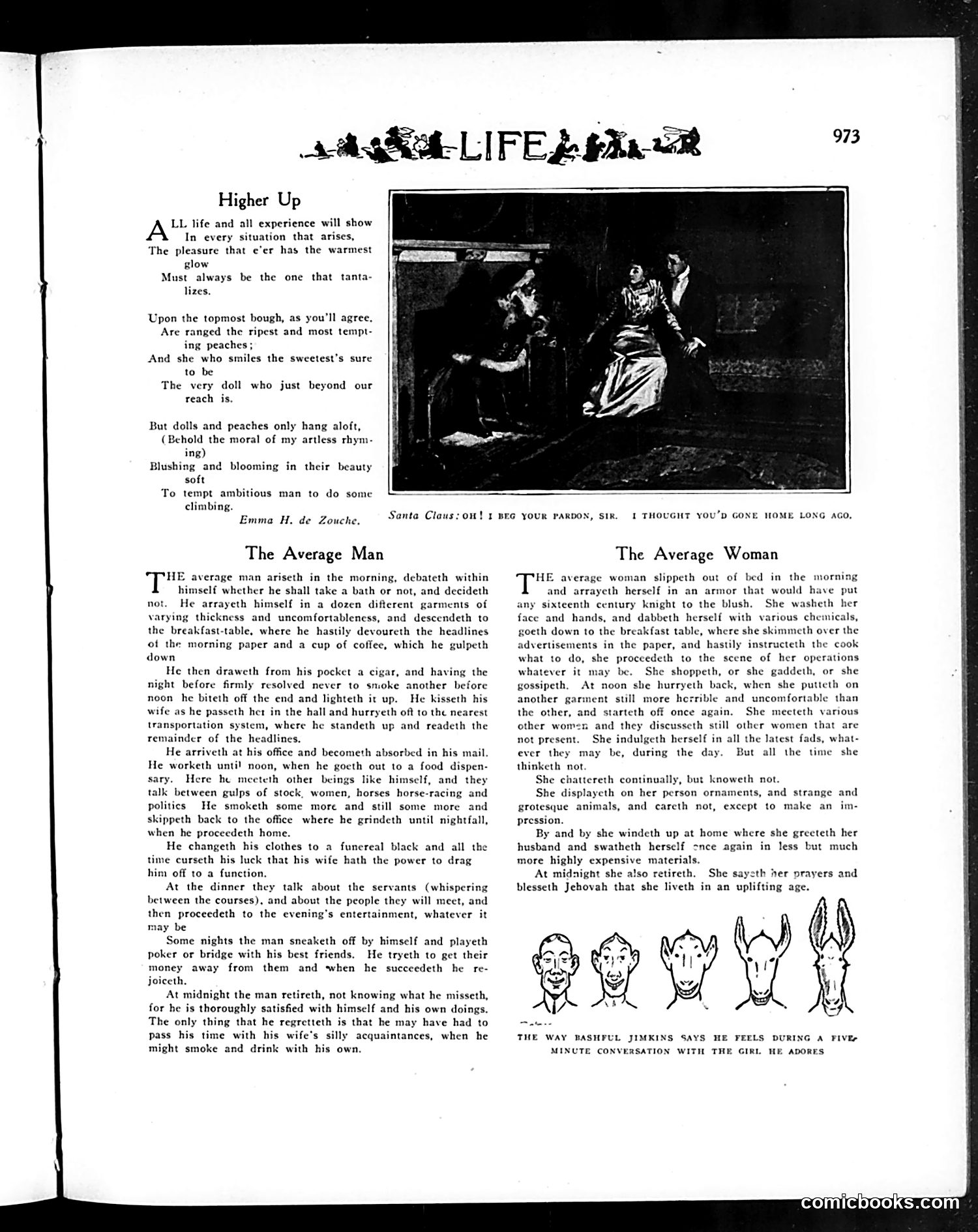
This 1920s Life magazine page presents satirical character sketches of "The Average Man" and "The Average Woman," written in mock-biblical language ("ariseth," "arrayeth"). **The satire targets:** - **The Average Man**: A creature of routine and self-deception who smokes despite resolutions, skims newspapers, works mindlessly, and resents social obligations with his wife's friends—yet considers himself perfectly content and unaware of what he's missing. - **The Average Woman**: A vain, superficial being obsessed with appearance (chemicals, fashions, ornaments), gossip, and shopping, who talks constantly but thinks nothing. **The joke** lies in the exaggerated, condescending portrayal revealing period prejudices: men are portrayed as complacent drones; women as frivolous and intellectually vacant. The biblical language mock-elevates these mundane routines into pseudo-profound observations. The accompanying illustration appears to show Santa Claus interrupting an evening scene, possibly suggesting displacement of domestic focus. This reflects 1920s gender stereotypes that modern readers would recognize as dated and patronizing.
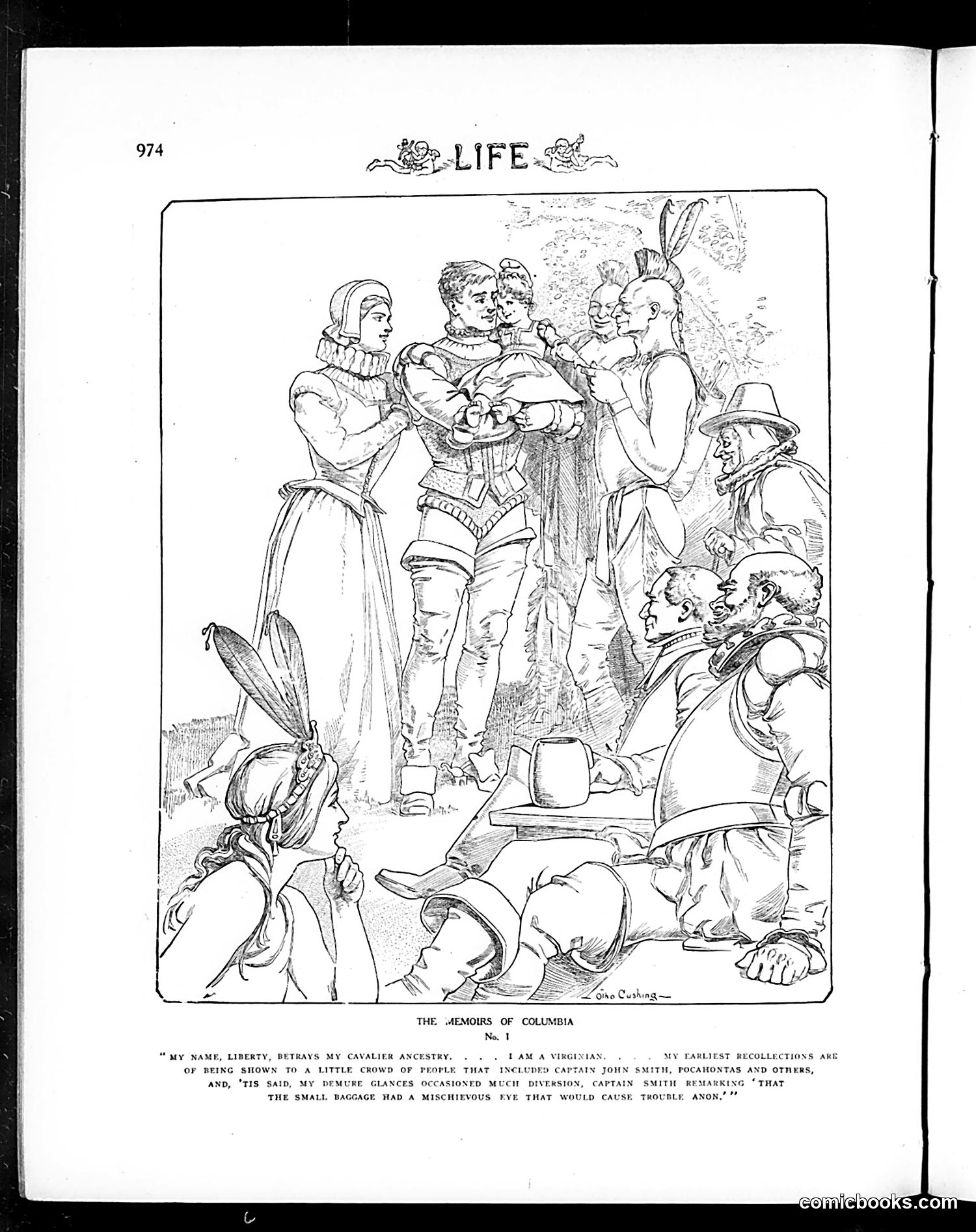
This is the first installment of a satirical serial where "Columbia" (the female personification of America) recounts her origins. The cartoon depicts her as a young woman surrounded by historical figures, narrating her "earliest recollections" of being introduced to Captain John Smith and Pocahontas during Virginia's colonial founding. The satire works by having Columbia speak in affected, flowery language ("'tis said," "demure glances"), presenting herself as an aristocratic Southern belle with "Cavalier ancestry." Smith's remark about her "mischievous eye" that would "cause trouble" is ironic foreshadowing—suggesting America's troublemaking character was apparent from birth. The humor targets both pretentious Southern historical mythology and America's actual trajectory as a nation prone to conflict and disruption.
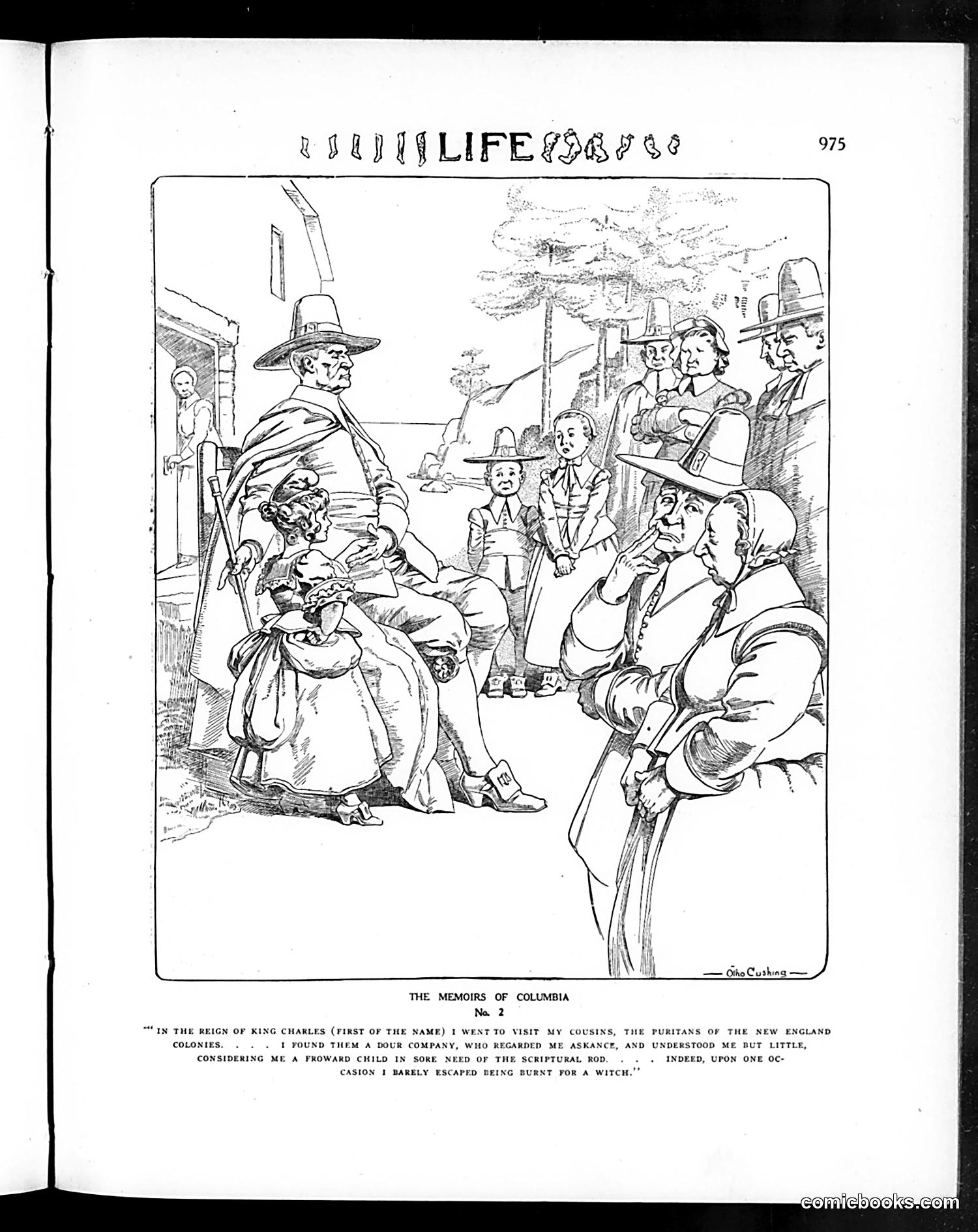
This satirical illustration depicts "Columbia" (personified America) recounting her colonial past. The caption presents her as a young, somewhat frivolous figure visiting stern Puritan cousins in New England during King Charles I's reign (1625-1649). The joke targets Puritan severity: Columbia was nearly burned as a witch—suggesting the Puritans' harsh intolerance and tendency toward persecution. The contrast between her fashionable, worldly appearance and their austere dress emphasizes cultural differences. The "froward child in sore need of the scriptural rod" phrase mocks Puritan rigidity and their impulse to discipline through punishment. This is early American satirical commentary on the Puritan founding legacy, presenting them as dangerously zealous ancestors.
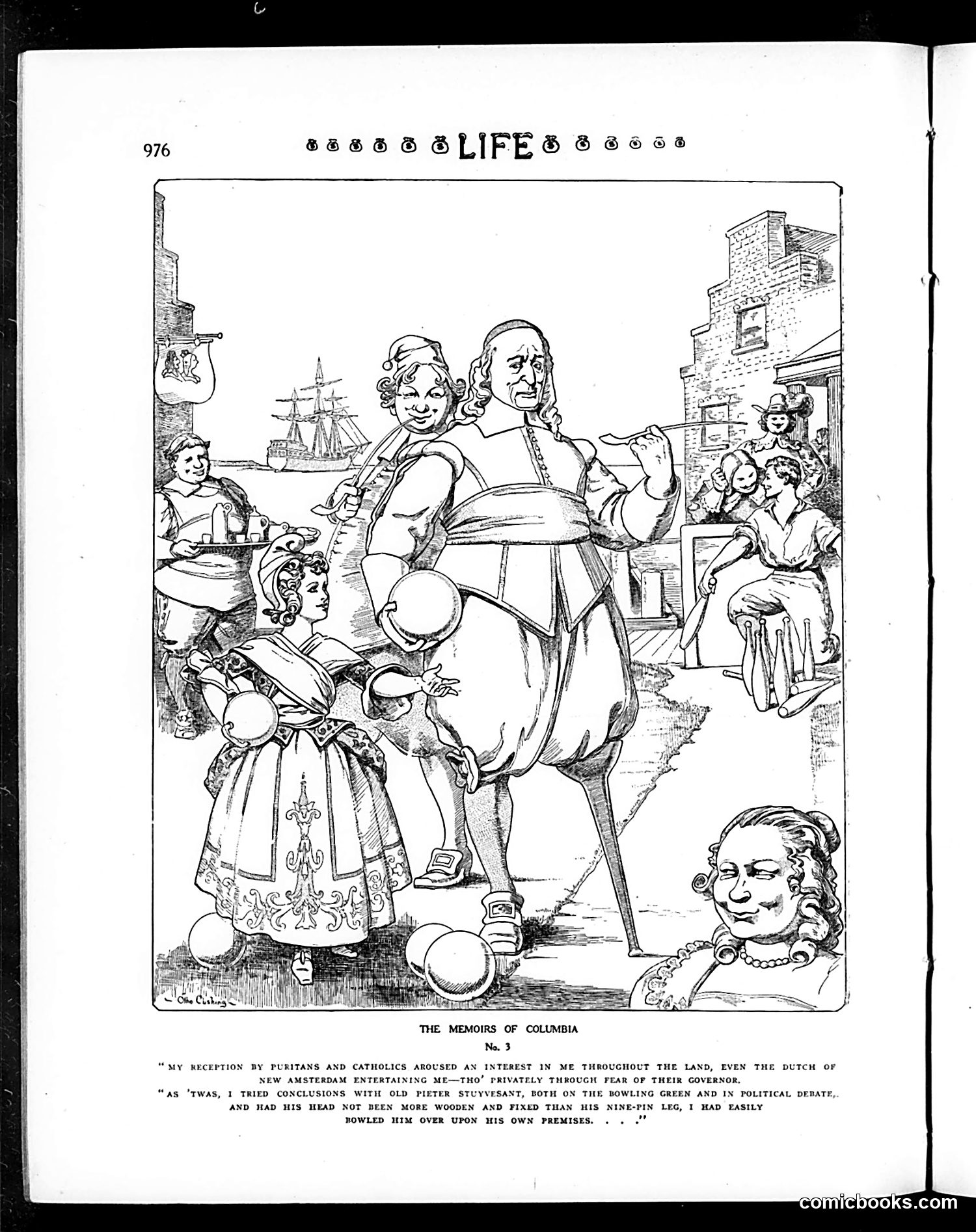
This Life magazine cartoon presents a fictionalized "memoir" of Columbia (the female personification of America), narrating her early colonial encounters. The scene depicts Columbia recounting her reception among America's founding populations—Puritans, Catholics, and Dutch colonists. The satire centers on **Peter Stuyvesant**, the historical Dutch governor of New Amsterdam (later New York), depicted here with his famous wooden leg. The text humorously claims Columbia "tried conclusions" with Stuyvesant through both bowling and political debate, joking that she would have "easily bowled him over" were his wooden leg less fixed. This puns on his literal wooden prosthetic while satirizing early American political rivalries and cultural tensions between competing colonial powers. The cartoon uses Columbia's personified perspective to offer a lighthearted, revisionist take on colonial history, emphasizing how various religious and national groups initially viewed early America with suspicion or fear.
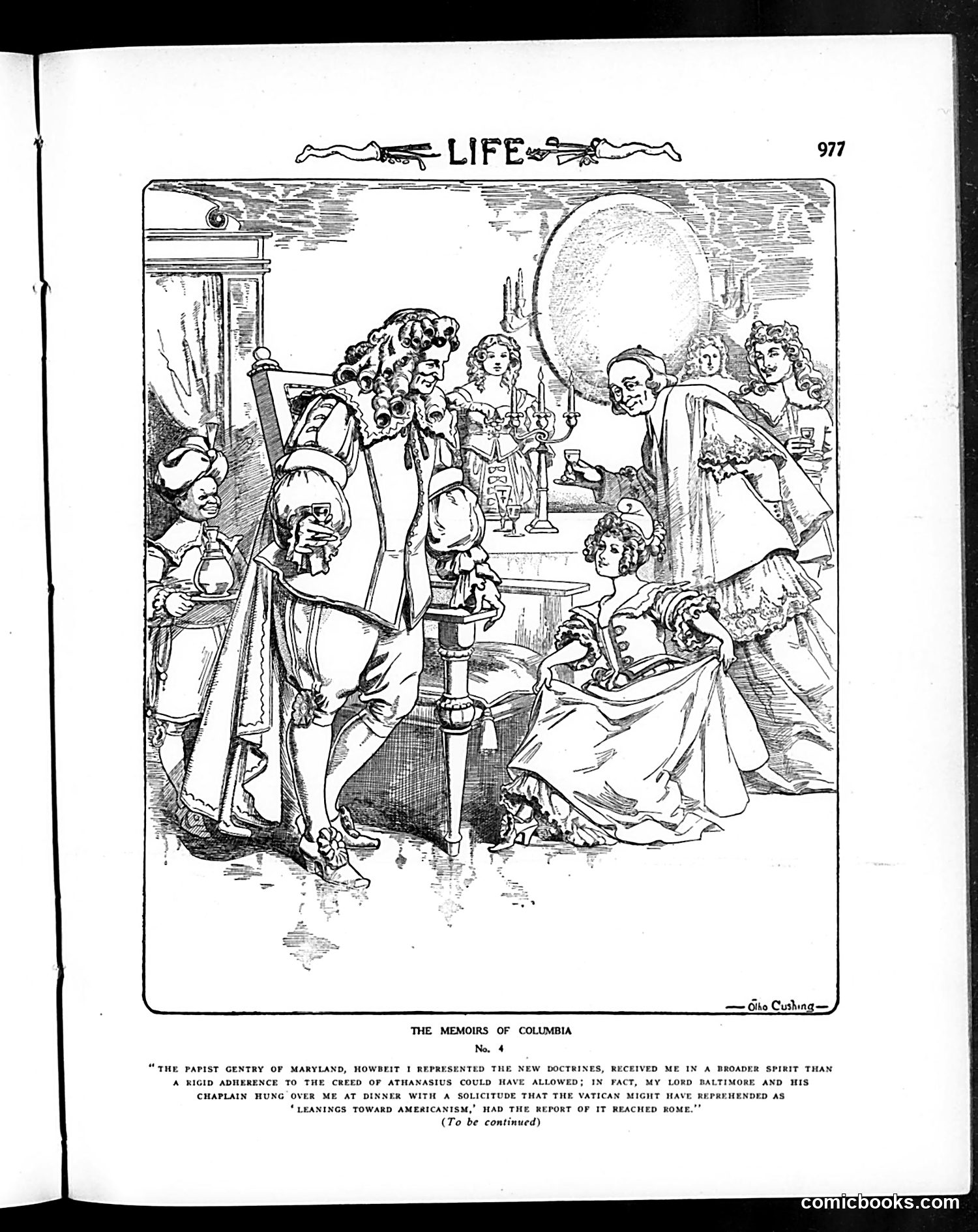
This is part of a serialized satirical feature titled "The Memoirs of Columbia" (No. 4), where "Columbia"—the personified United States—recounts her historical experiences. The illustration depicts a colonial-era dinner scene with religious and political figures. The text references Lord Baltimore of Maryland and his Catholic chaplain, who allegedly treated the narrator with tolerance despite doctrinal differences—specifically regarding the "Creed of Athanasius" (an early Christian theological statement). The satire targets Catholic anxiety about American pluralism: the joke is that Rome might view Maryland Catholics' hospitality toward different beliefs as dangerously "Americanist"—a real theological controversy where the Vatican feared American Catholics were compromising doctrine for democratic inclusivity. The cartoon illustrates early American religious tolerance as something that would have alarmed the Vatican, contrasting American pragmatism with rigid European ecclesiastical authority.
This is a satirical short story (not a cartoon) that critiques the then-popular "yellow journalism" — sensationalist newspapers that sold copies by printing lurid stories about infidelity and marital scandal. **The Setup:** Mrs. Santa Claus, influenced by reading scandal-mongering journals, becomes suspicious that her husband is unfaithful. She accuses him of deception during his mysterious annual Christmas Eve absence. **The Satire:** The joke is the absurdity of the situation — Santa Claus is literally spending Christmas Eve delivering toys to children worldwide, yet his wife suspects criminal behavior because yellow journals have conditioned her to believe all men are dishonest and all women are wronged angels. **The Point:** Author Thomas L. Masson mocks how sensationalist media poisons trust and reason, making people suspicious of innocent behavior. Even the world's most charitable figure can't escape suspicion once someone absorbs yellow journalism's cynical worldview. The story satirizes both gullible readers and irresponsible tabloid journalism.
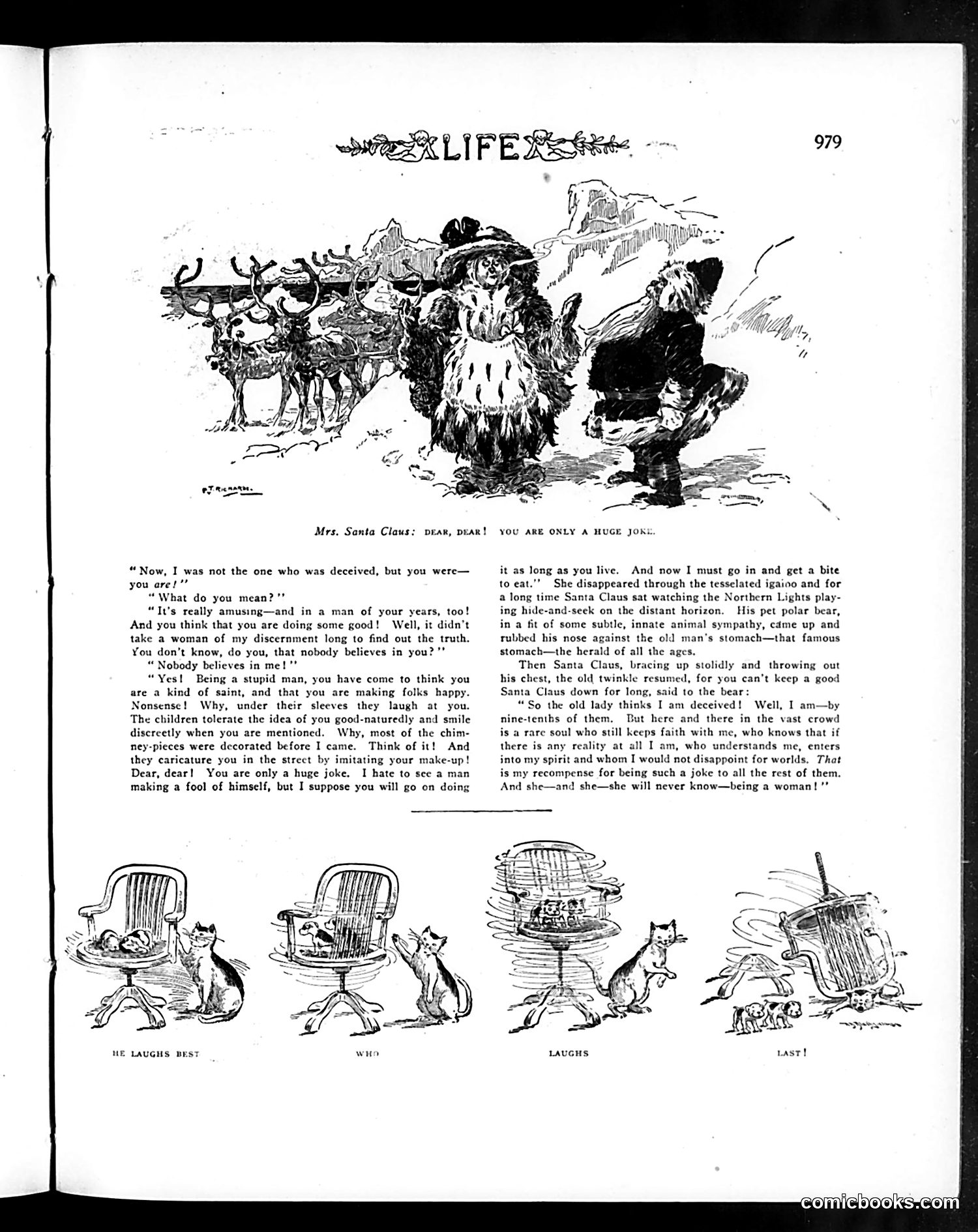
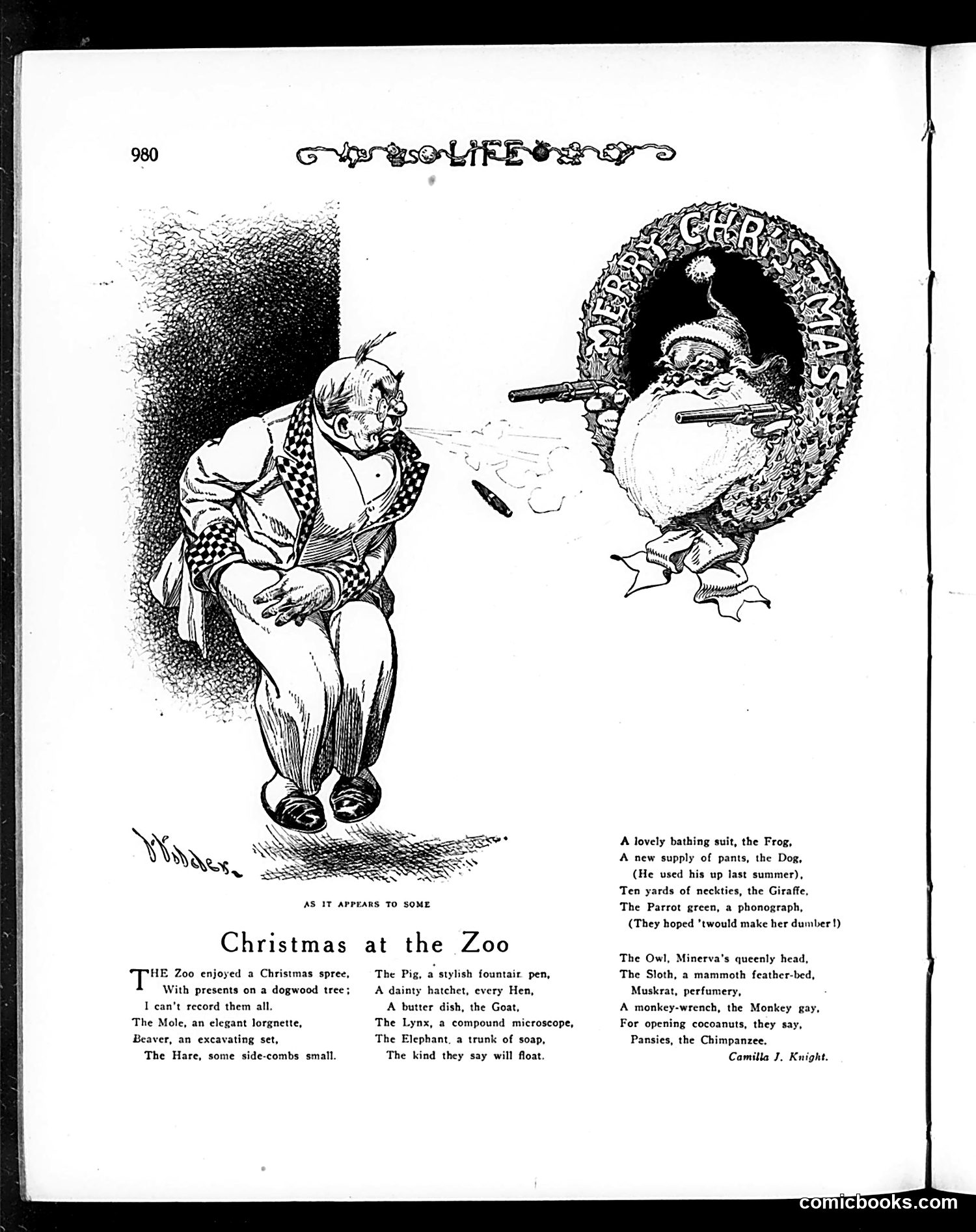
This is a humorous poem paired with satirical illustrations imagining Christmas gifts for zoo animals, with each present playing on animal characteristics or names. The left cartoon shows a man observing the scene "as it appears to some"—suggesting an outsider's perspective on this whimsical scenario. The humor works through puns and visual jokes: the Elephant receives "a trunk of soap," the Giraffe gets neckties, the Monkey receives a monkey-wrench. The parenthetical note about hoping a phonograph would make the Parrot "dumber" suggests commentary on noisy, repetitive behavior. The right illustration depicts Santa Claus in a wreath, representing the gift-giver. This is straightforward Victorian-era comic verse with animal personification—a popular genre of light entertainment in early 20th-century American magazines. No deep political satire is evident; it's children's humor dressed in sophisticated publication.
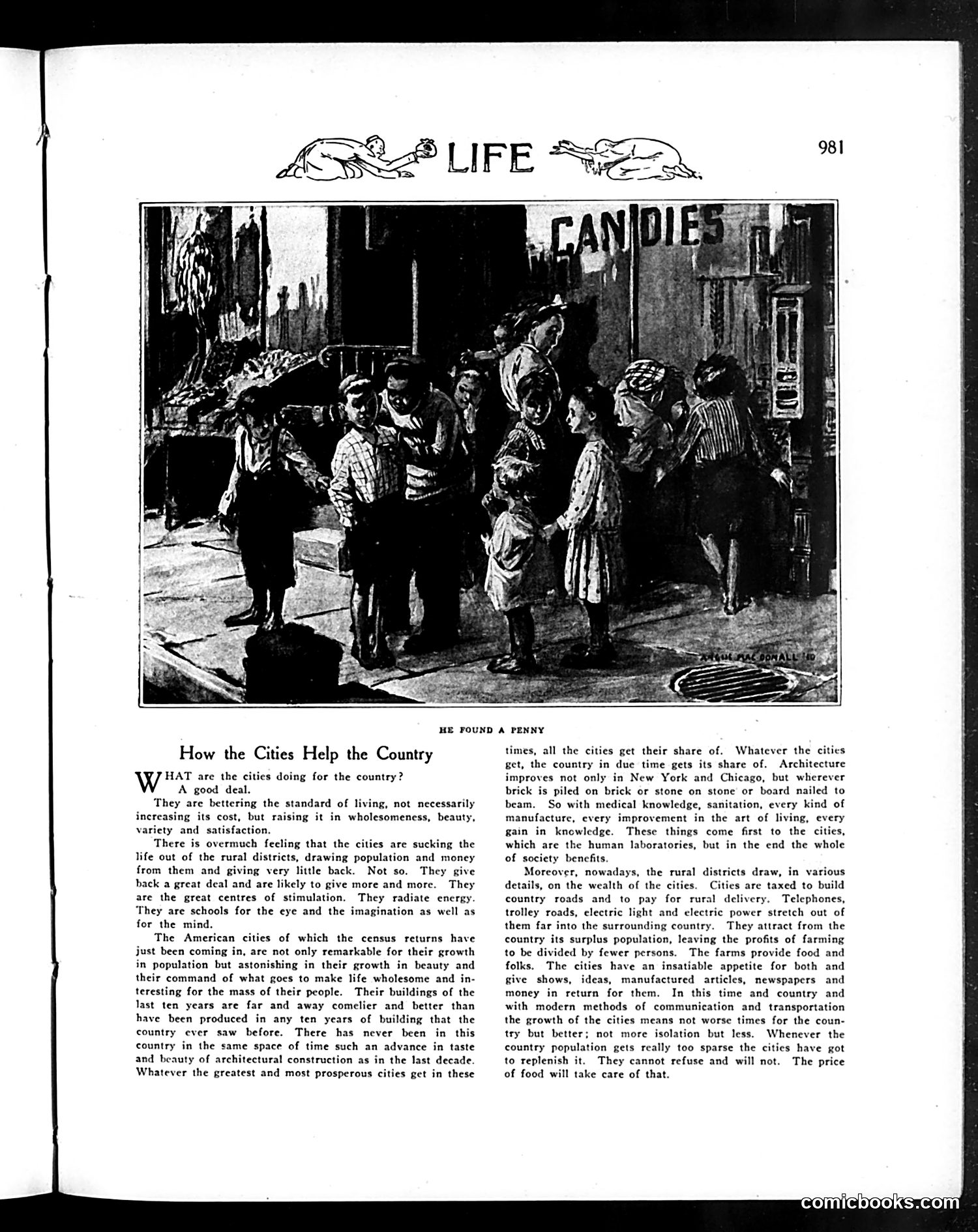
The image shows a street scene with children gathered around what appears to be a penny or small object on the ground—a common childhood moment of discovery. The title "He Found a Penny" serves as a gentle, humorous caption. However, this illustration accompanies a serious essay titled "How the Cities Help the Country," which argues against rural resentment of urban centers. The text defends American cities as engines of progress—cultural laboratories that eventually benefit rural areas through infrastructure (roads, telephone, electric lines), improved architecture, modern knowledge, and manufactured goods. The juxtaposition appears intentional: the small, innocent joy of finding a penny mirrors the essay's argument that even modest urban developments eventually "trickle down" to rural communities. The cartoon lightens what is otherwise a dense economic and social argument about urban-rural interdependence during the early 20th century, when agricultural decline and urban migration sparked rural anxieties.
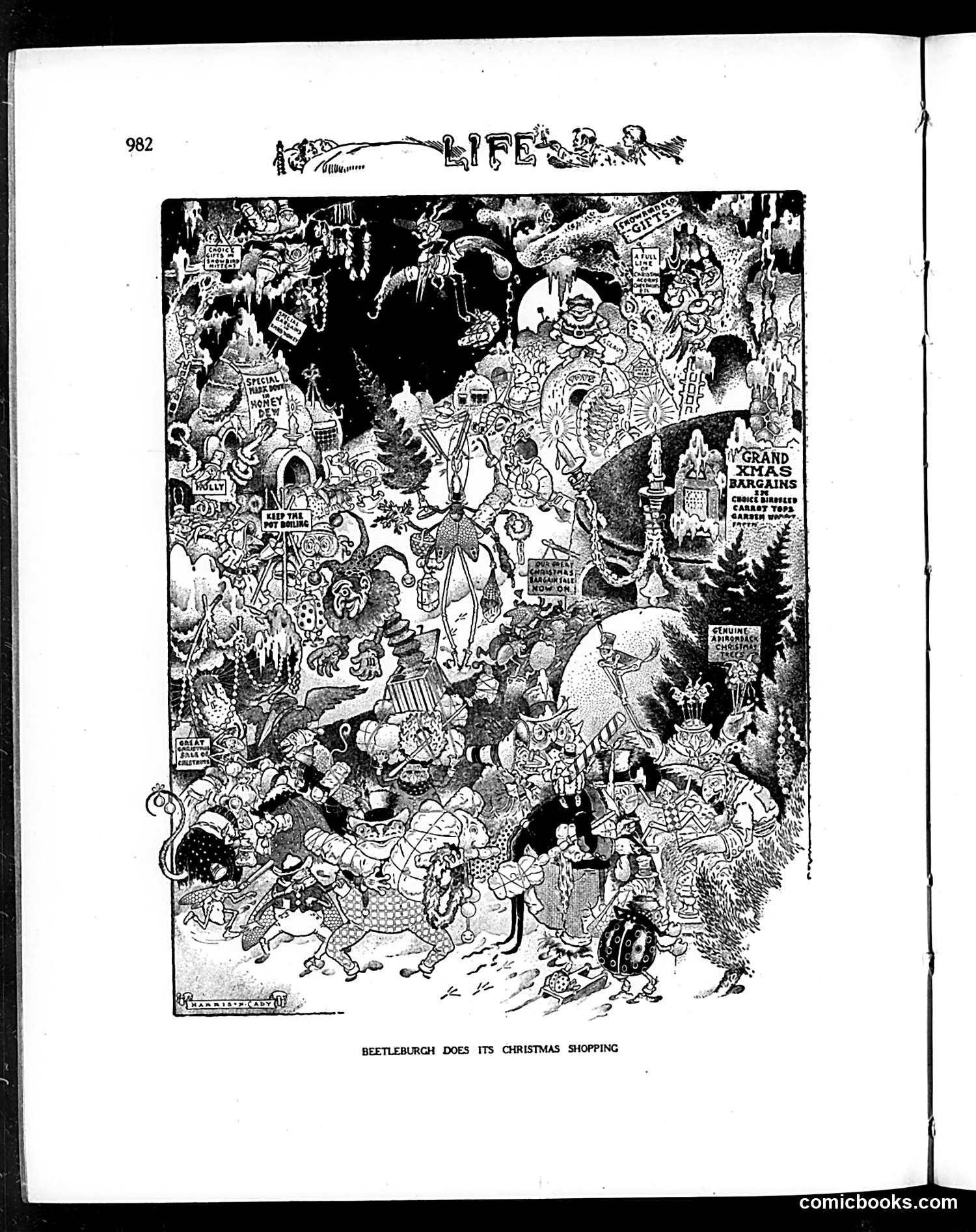
This is a densely packed satirical illustration depicting Christmas shopping chaos in what appears to be a fictional town called "Beetleburgh." The intricate black-and-white drawing is crowded with dozens of small figures, storefronts, and comedic vignettes showing the madness of holiday retail. Visible signs advertise "Grand Christmas Bargains" and various shops. The cartoon satirizes the consumer frenzy and commercialism of Christmas shopping—showing crowds, confusion, and the general pandemonium of holiday retail culture. The style and density suggest this is early-to-mid 20th century American satire critiquing materialist holiday excess and the hectic shopping season through exaggerated, humorous detail.
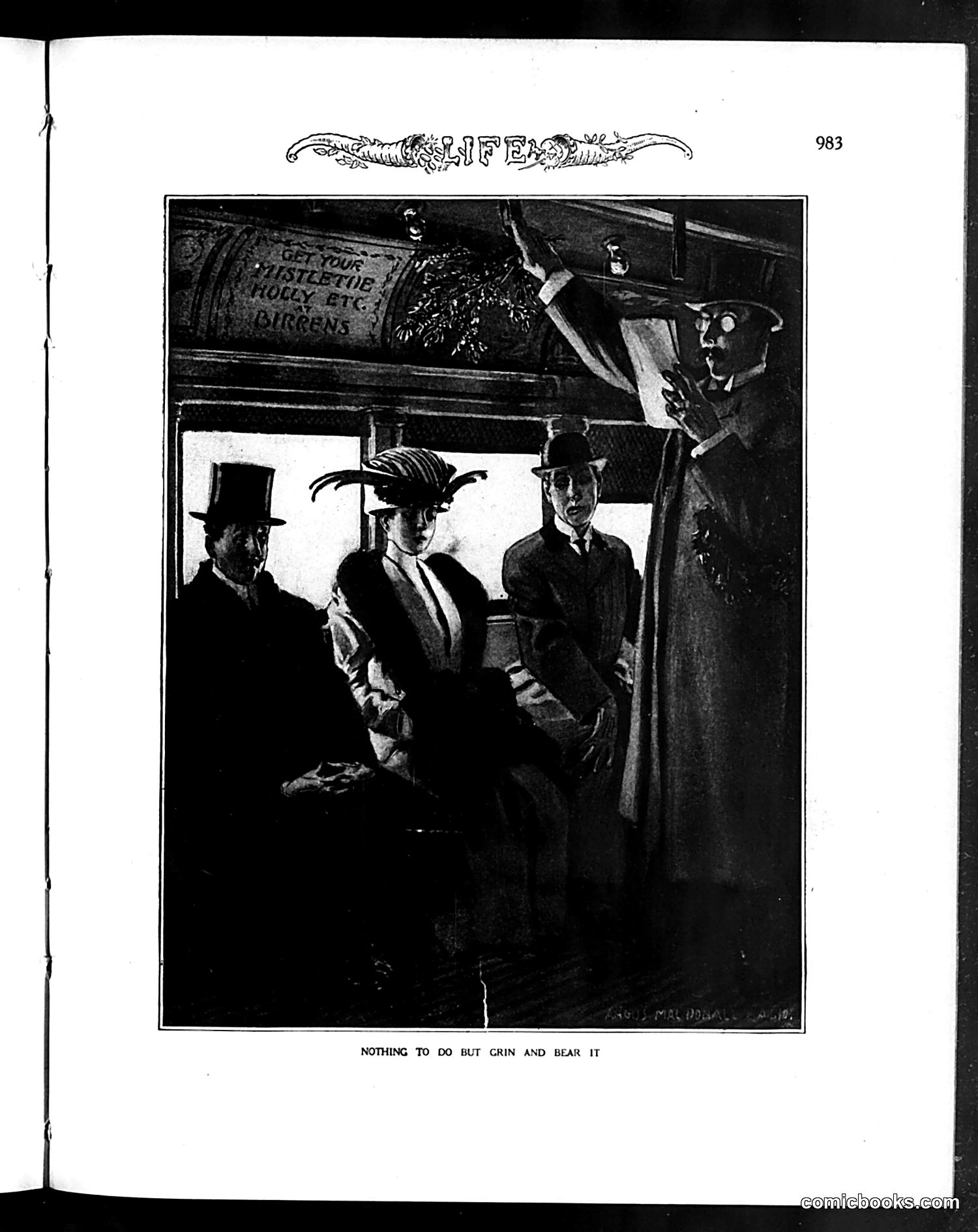
This appears to be a satirical illustration from Life magazine depicting well-dressed men in formal attire (top hats and coats) crowded inside what looks like a trolley or public conveyance. The sign above reads "GET YOUR LOTTERY TICKETS HOLLY & PIRRENS." The caption "Nothing to Do But Grin and Bear It" suggests social commentary on resigned acceptance during difficult times—likely economic hardship or a specific crisis period. The lottery reference implies people turning to gambling as a desperate measure, a common satirical target during economic downturns. The formal dress contrasts with their cramped, uncomfortable positioning, possibly critiquing the contrast between outward respectability and actual circumstances. Without clearer dating or context, the specific historical moment remains unclear, though the style suggests early-to-mid 20th century.
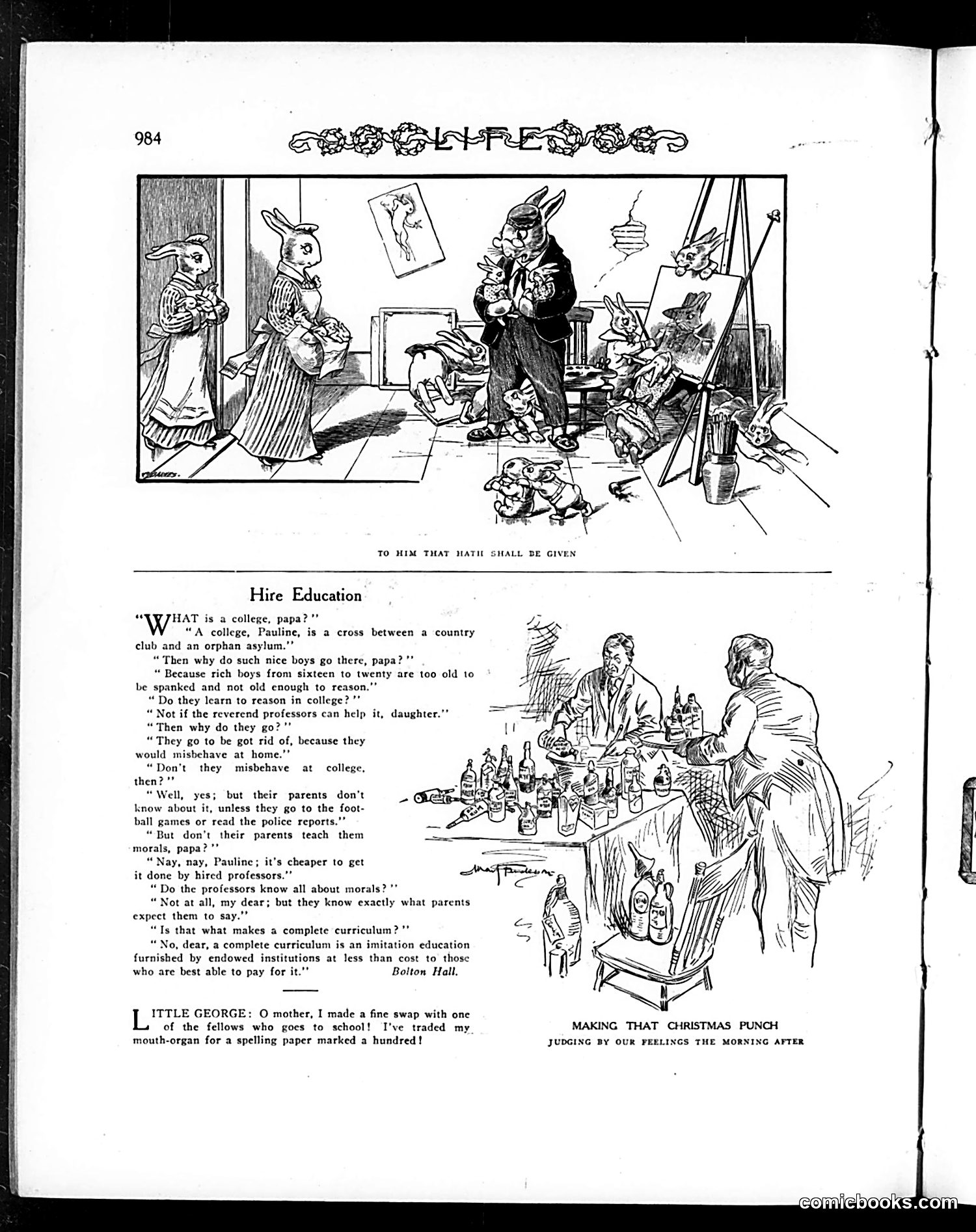
This page contains two separate satirical pieces criticizing early 20th-century American education and student behavior. **Top cartoon:** A Socratic dialogue mocking colleges as institutions that warehouse wealthy boys aged 16-20 who are "too old to be spanked and not old enough to reason." The satire targets colleges as expensive, morally hollow places where professors teach whatever parents *expect* rather than genuine education. The critique suggests colleges function as orphan asylums for the rich—places to contain misbehavior away from home while maintaining appearances through selective information control (parents see only football games and police reports). **Bottom joke:** "Little George" boasts of trading his mouth organ for a spelling paper marked "100"—implying he either cheated or obtained a forged perfect score, suggesting academic dishonesty among schoolchildren. **Right illustration:** Shows adults making Christmas punch, captioned to joke that their morning-after feelings (hangovers) reveal the punch's true potency. The page's overall theme criticizes both higher education as performative and expensive, and youthful dishonesty.
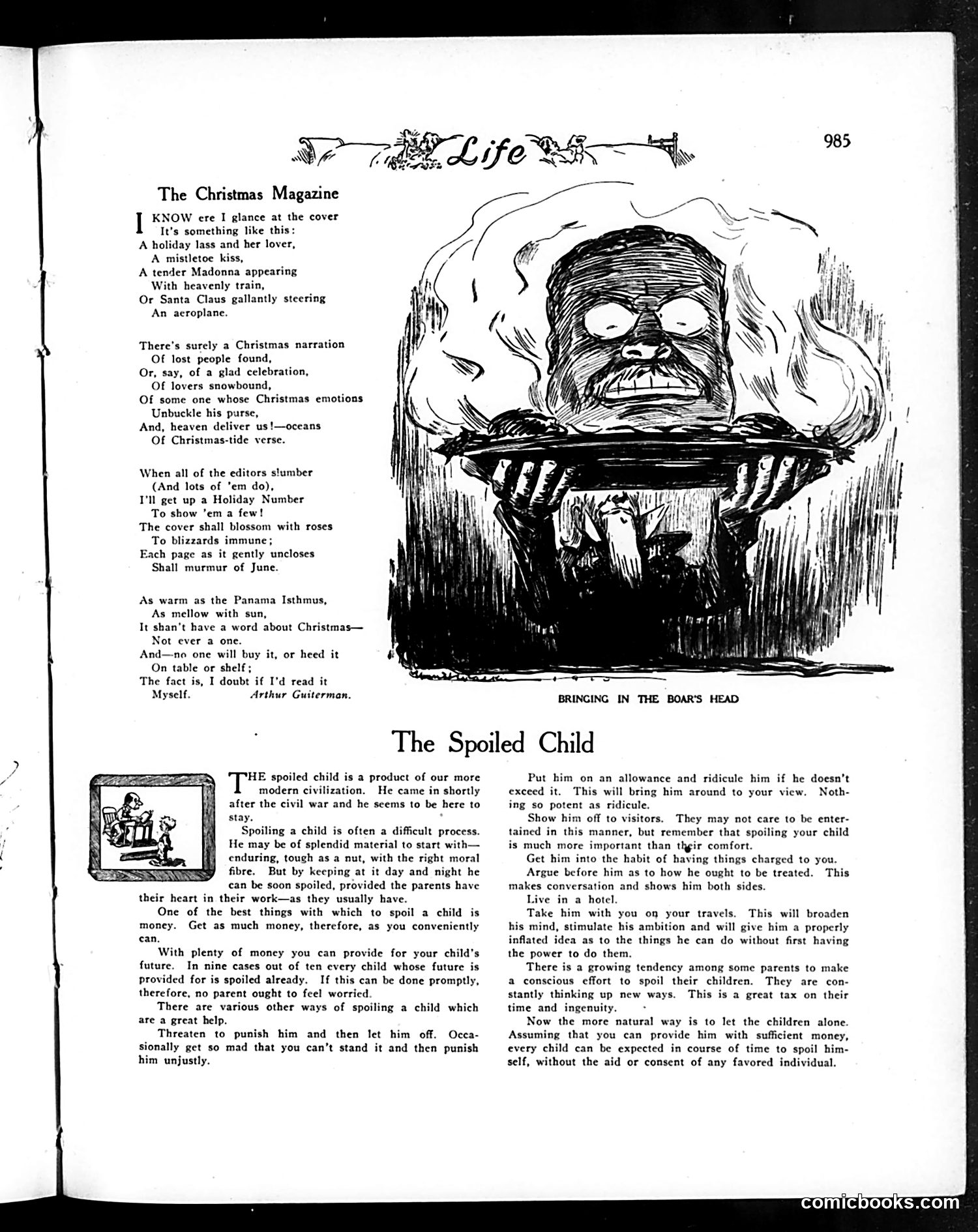
This Life magazine page contains two satirical pieces mocking contemporary society. **"The Christmas Magazine"** (poem by Arthur Guiterman) satirizes predictable holiday magazine covers and content. The speaker claims that when editors sleep, he'll create a Christmas issue featuring only summer imagery (roses immune to blizzards, references to June heat)—deliberately removing any Christmas mention. The joke: such a magazine would be completely ignored, yet he wouldn't even read it himself. This mocks the formulaic, saccharine nature of holiday publishing. **"The Spoiled Child"** article (likely post-Civil War era, based on the text) uses ironic "advice" to critique modern parenting. It recommends spoiling children through excessive money, inconsistent punishment, public display, and constant travel—all presented as instructional guidance. The satirical point: these practices are clearly destructive, yet parents pursue them anyway. The conclusion suggests children naturally spoil themselves given financial resources, making parental effort to spoil them redundant. This critiques wealthy American parents' indulgence of their children.
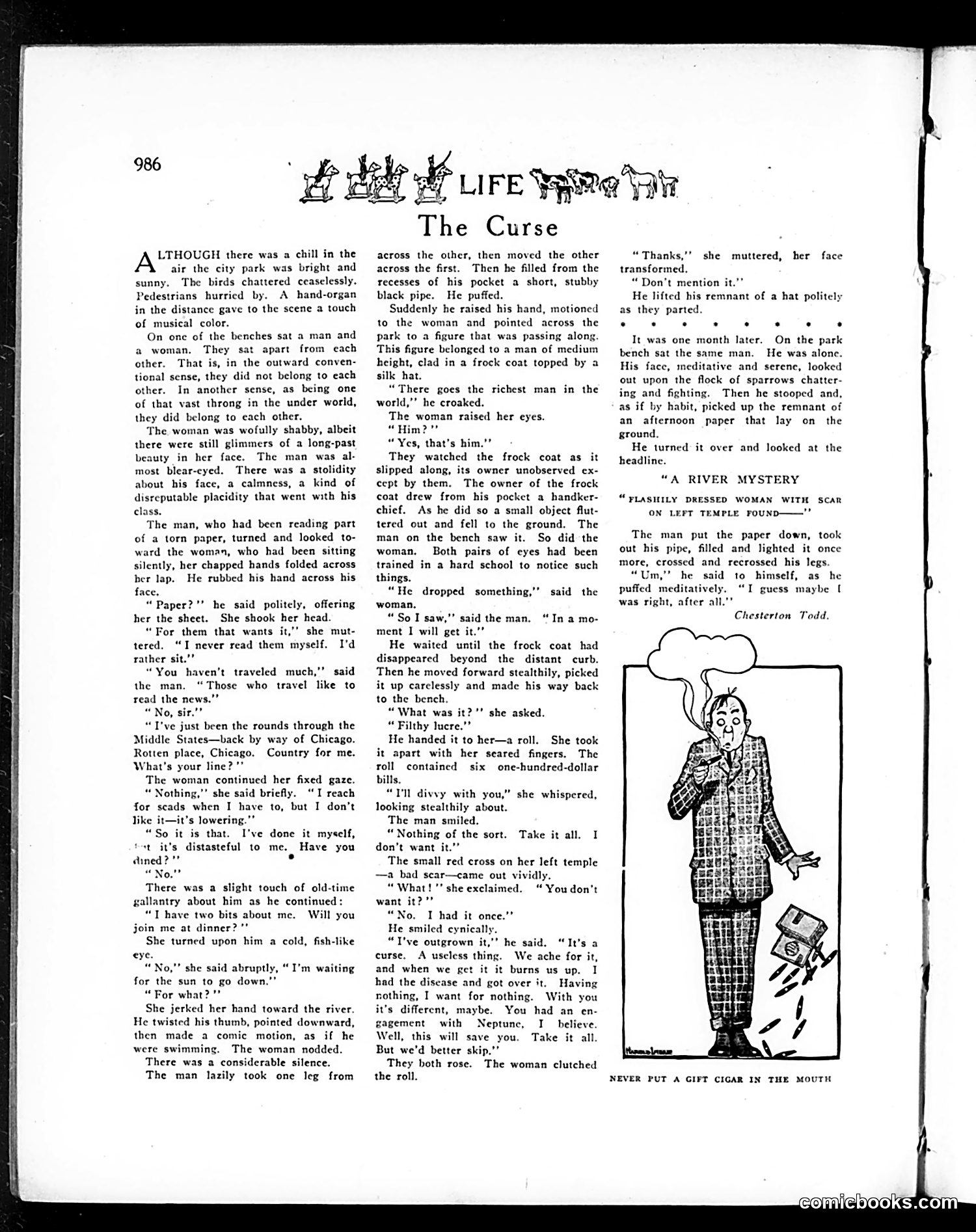
This page presents a short story rather than political cartoons. The narrative depicts two impoverished people in a city park who witness a wealthy man drop a roll of $600. The man retrieves it and offers it to the woman, but refuses to let her keep it. The story's "curse" appears to be wealth itself. The man explains he once possessed money but has "outgrown it" and now rejects it, suggesting that wealth corrupts or harms people. The woman's visible scar and their shared poverty indicate lives damaged by circumstance. The satire targets the assumption that money solves problems. The wealthy man passes by "unobserved except by them"—invisible to society despite his riches—while the poor characters possess moral clarity he lacks. The story implies that rejecting material wealth represents spiritual or moral advancement, critiquing both poverty and the corrupting nature of wealth in early 20th-century America.
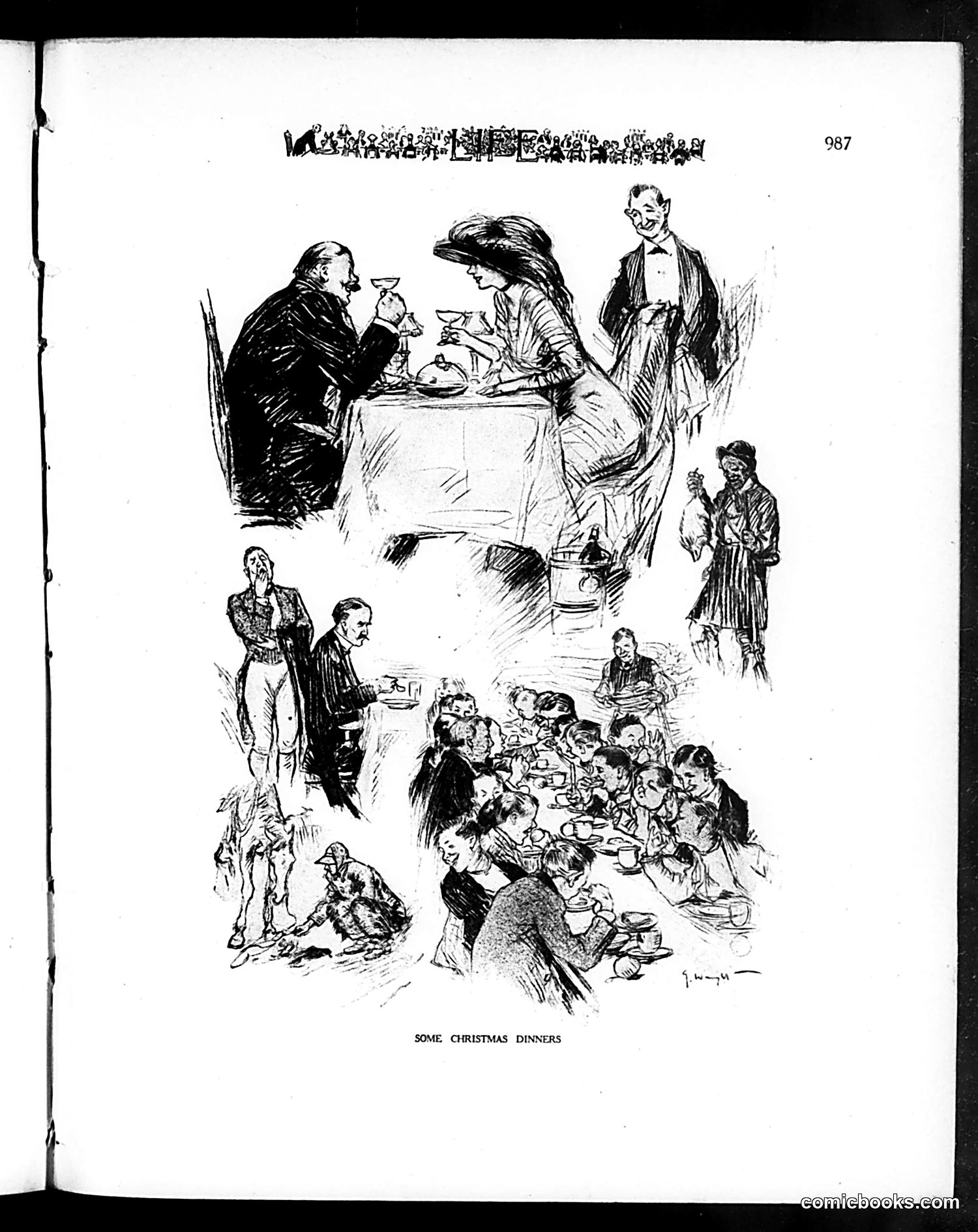
This satirical illustration contrasts wealth disparities during the Christmas season. The upper portion depicts affluent diners—well-dressed men and women in formal attire—enjoying an elegant meal with cocktails at a tablecloth-covered table, attended by waiters. The lower portion shows poor children and families crowded together eating simple meals on the ground, clearly underfed and destitute. The cartoon's message is straightforward social commentary: while the wealthy celebrate Christmas with luxury and abundance, the poor and homeless struggle to survive with minimal food and resources. This juxtaposition critiques economic inequality and indicts society's indifference to poverty during a season traditionally associated with charity and goodwill. The stark visual contrast makes the satire's point unmistakable.
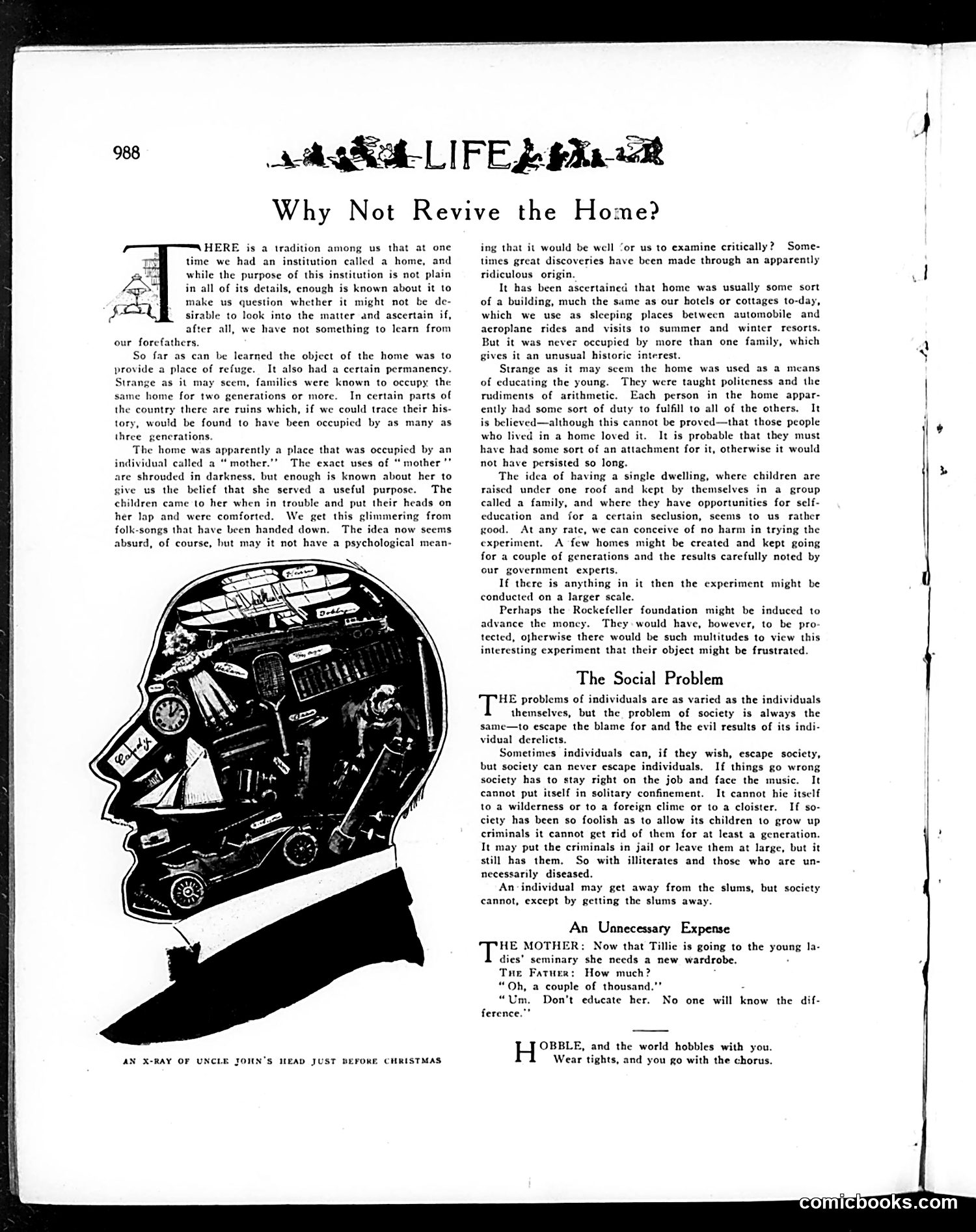
This 1920s Life magazine article satirizes modern American society's abandonment of traditional family life. The piece adopts mock-anthropological language to describe the "home" as if it were an extinct institution—treating concepts like mothers comforting children and multi-generational family occupancy as quaint historical curiosities. The X-ray illustration of "Uncle John's Head Just Before Christmas" shows a cluttered mind filled with cars, airplanes, and consumer goods, suggesting that modern people are consumed by material pursuits rather than domestic values. The satire targets how contemporary life (automobiles, air travel, resort visits) has displaced home-centered living. The author ironically proposes the Rockefeller Foundation fund a "home experiment"—treating domestic family life like a scientific study—to highlight how absurdly lost modern society has become from traditional values. The piece critiques materialism and social mobility at the expense of stable family structures and parental devotion.
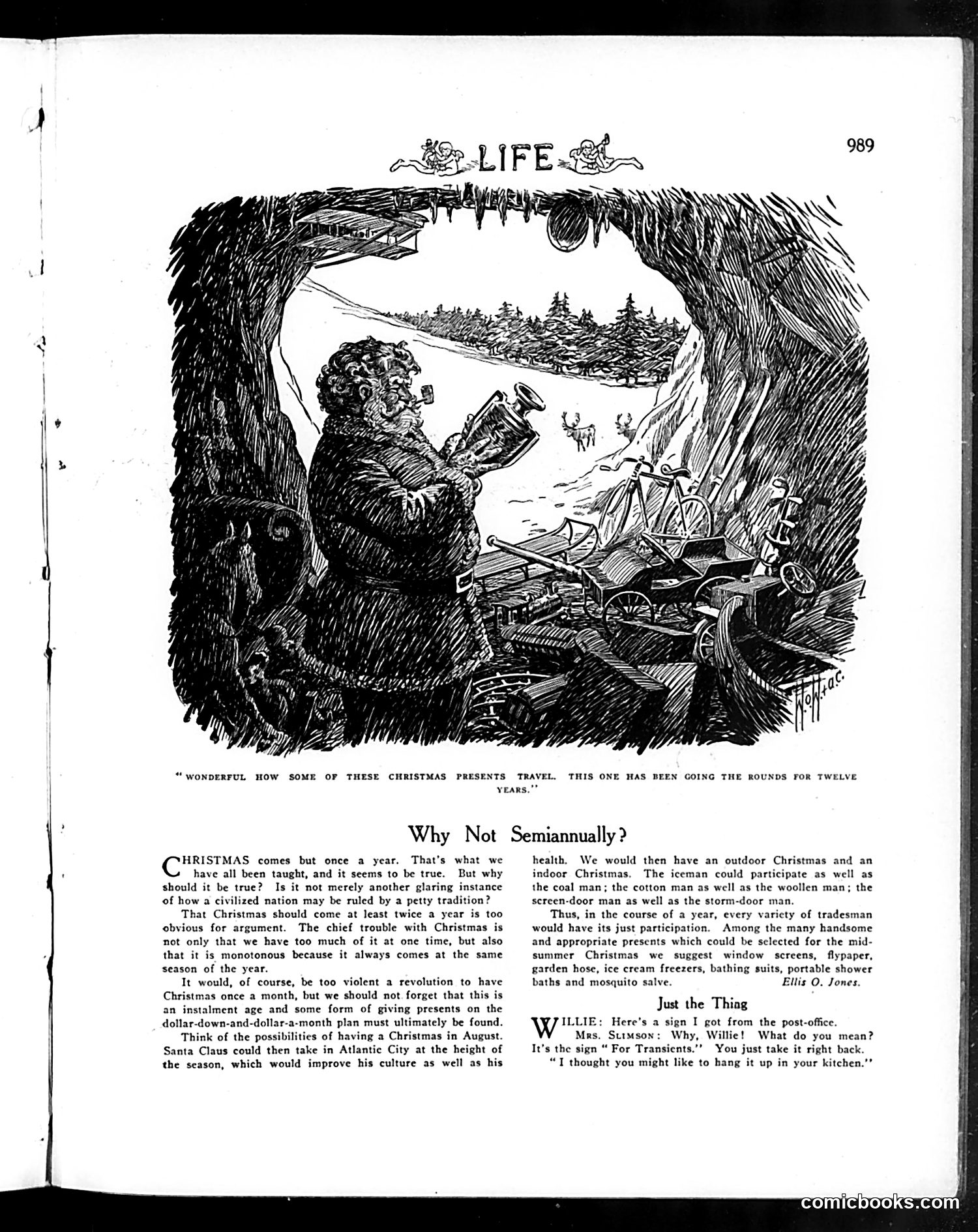
The page contains two satirical pieces mocking early-20th-century American consumer culture and social conventions. **Top Cartoon**: Shows a man in a cave examining a worn-out toy trumpet, captioned that this Christmas present has "been going the rounds for twelve years." The joke: cheap gifts circulate endlessly among poor families rather than being discarded, revealing the economic struggles hidden beneath holiday cheer. **"Why Not Semiannually?"**: An essay by Ellis O. Jones satirizes rigid holiday tradition. He proposes celebrating Christmas twice yearly—once in summer—so different tradesmen (icemen, coal men, screen-door salesmen) could all benefit from seasonal gift-giving. The humor lies in exposing how commercialized Christmas had become: the "solution" to tradition is simply more consumption. **"Just the Thing"**: A brief joke where a boy gives his mother a "For Transients" sign from the post office for her kitchen, implying she's an unstable housewife. Mild domestic humor typical of the era, though the insult would be considered harsh today. Together, these pieces critique both poverty and commercialism in American life.
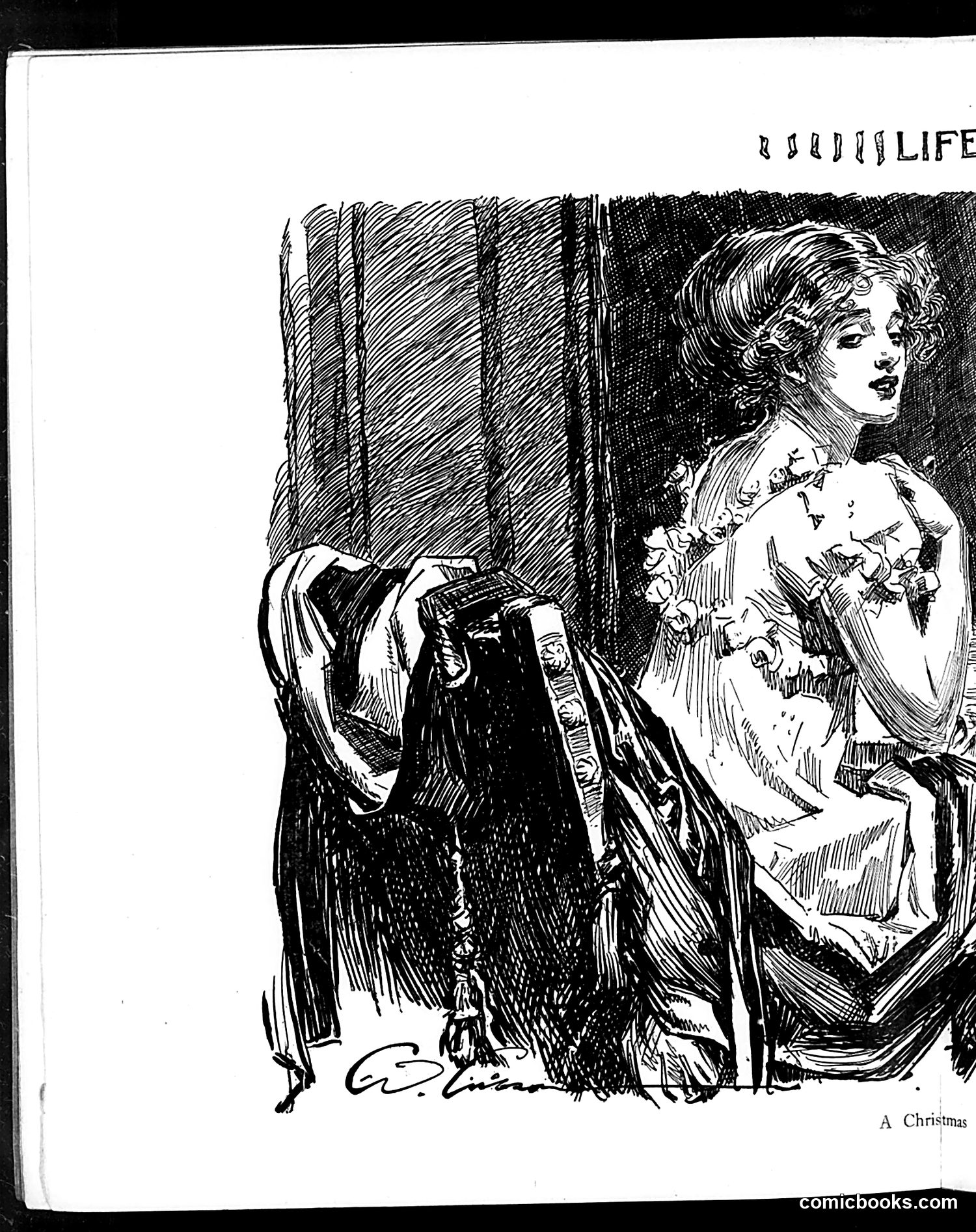
This appears to be an illustration from *Life* magazine titled "A Christmas" (the full title is cut off). The image shows a woman in an elegant, flowing dress decorated with what appears to be holly or Christmas foliage, posed near heavy curtains. A man's silhouette or figure appears in shadow on the left side. The sketch is rendered in a classical pen-and-ink style typical of early 20th-century magazine illustration. Without the complete title or accompanying text, the specific satirical point is unclear, but the festive dress and theatrical staging suggest this may be commenting on holiday fashion, social rituals, or romantic themes common in *Life* magazine's humor. The illustration's style and the visible artist signature indicate this is likely from the magazine's heyday as a satirical publication.
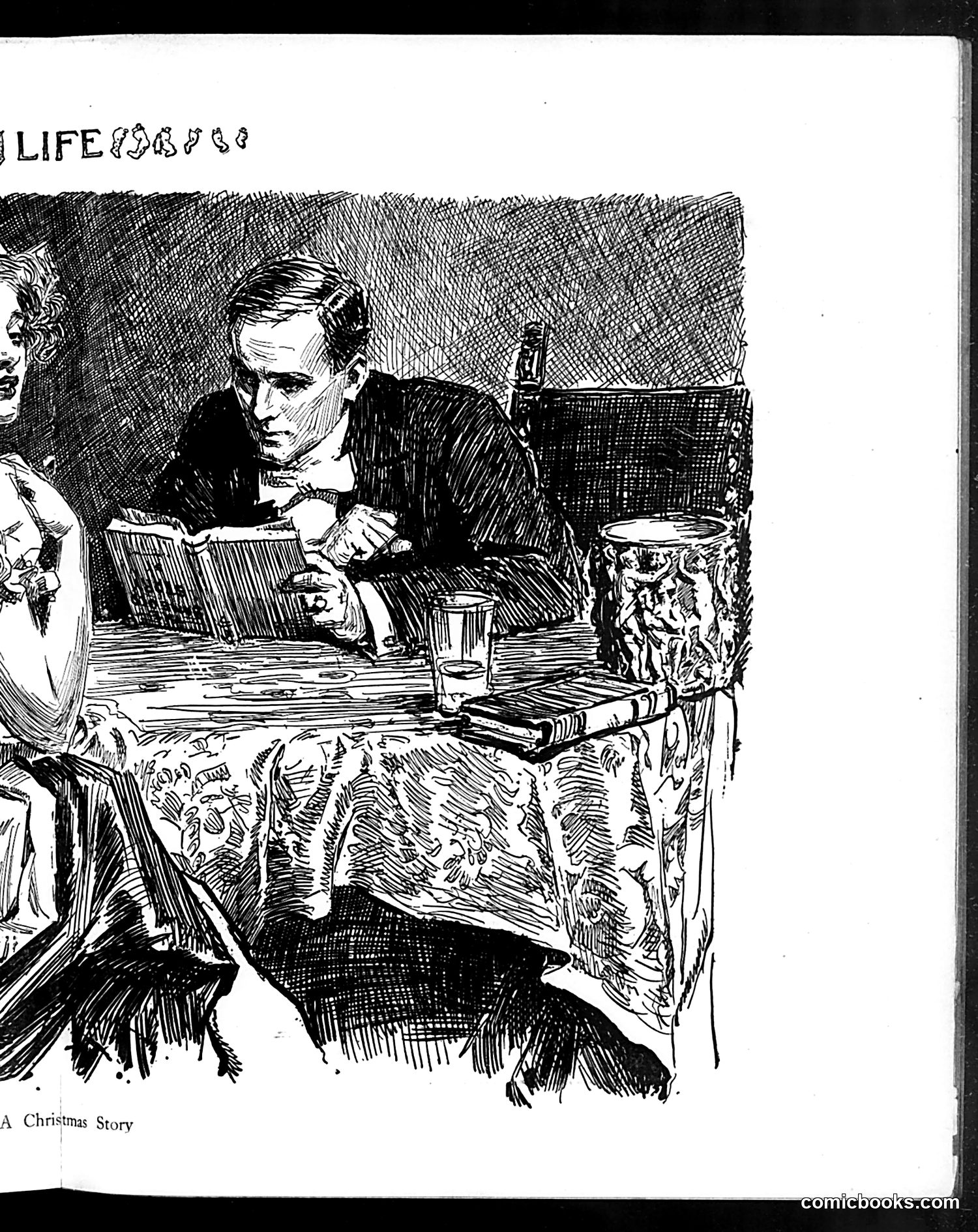
This page features a pen-and-ink illustration titled "A Christmas Story" from *Life* magazine. The drawing shows a man in formal attire (suit and bow tie) seated at a table, writing or reading by lamplight. A decorative tablecloth is visible, along with a glass and what appears to be an ornamental container on the table. Without additional context or visible captions identifying specific individuals or events, this appears to be a general holiday-themed illustration rather than a pointed political satire. The formal domestic scene suggests middle-class Victorian or Edwardian-era life. The garbled text at the top ("GDB? 62") may be OCR errors preventing clear identification of the specific satirical point or reference the illustration originally intended to convey.
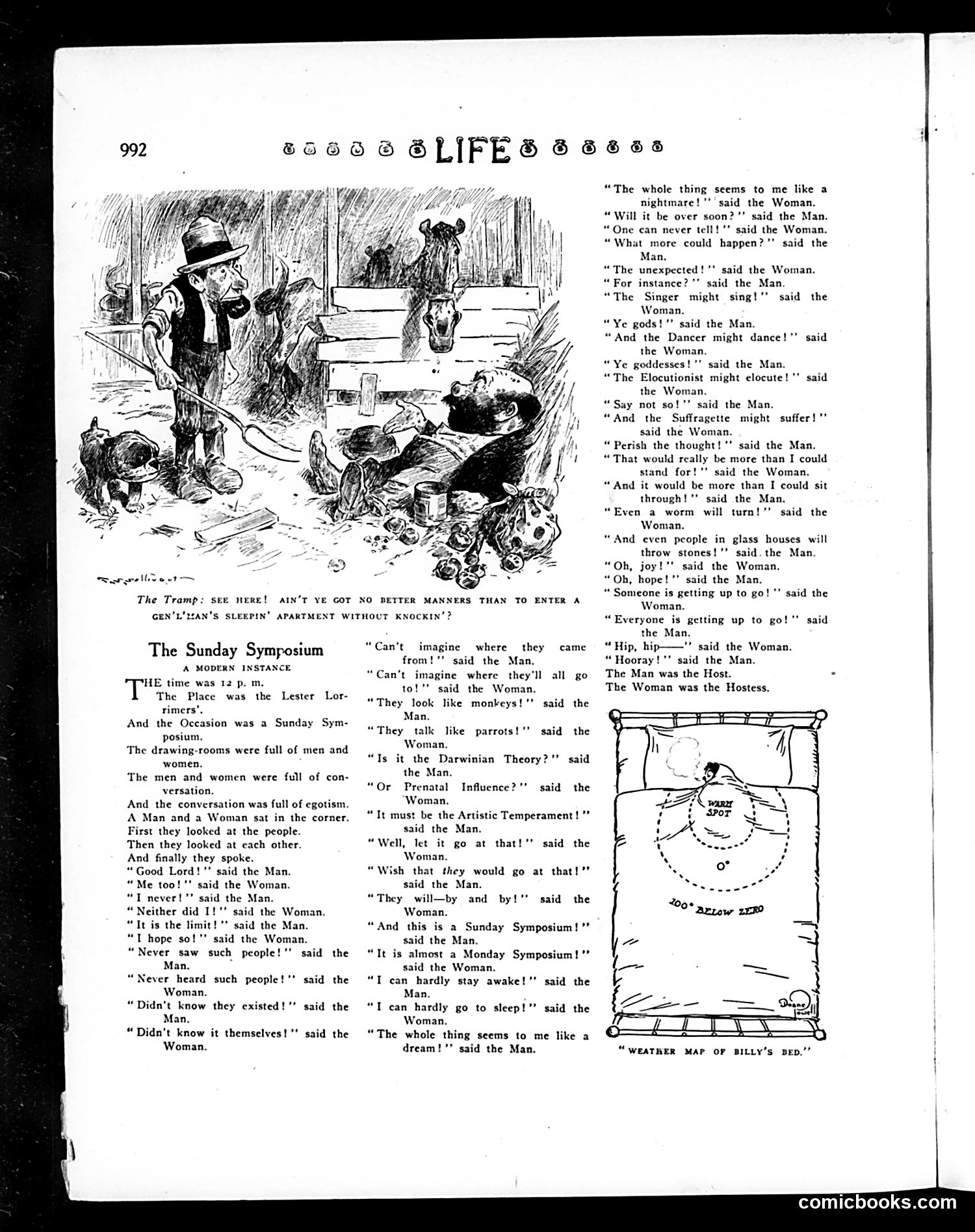
This page satirizes the tedious, self-absorbed conversation at a high-society drawing room gathering ("Lester Lorimer's" Sunday salon). A Man and Woman sit in a corner, exchanging remarks that mock both the pretentious guests and their own boredom. The humor lies in their perfectly synchronized complaints: they echo each other's disgust ("Good Lord!"/"Me too!") while sarcastically invoking intellectual frameworks—Darwinian Theory, Artistic Temperament, Prenatal Influence—to explain why these people are insufferable. Their escalating nightmare scenarios (the Singer might sing! The Elocutionist might elocute!) build absurdist dread. The twist: they're the **host and hostess**, stuck enduring their own party. The satire targets Edwardian social pretension, intellectual posturing, and the exhausting performance of polite society gatherings where conversation is performative egotism rather than genuine connection.
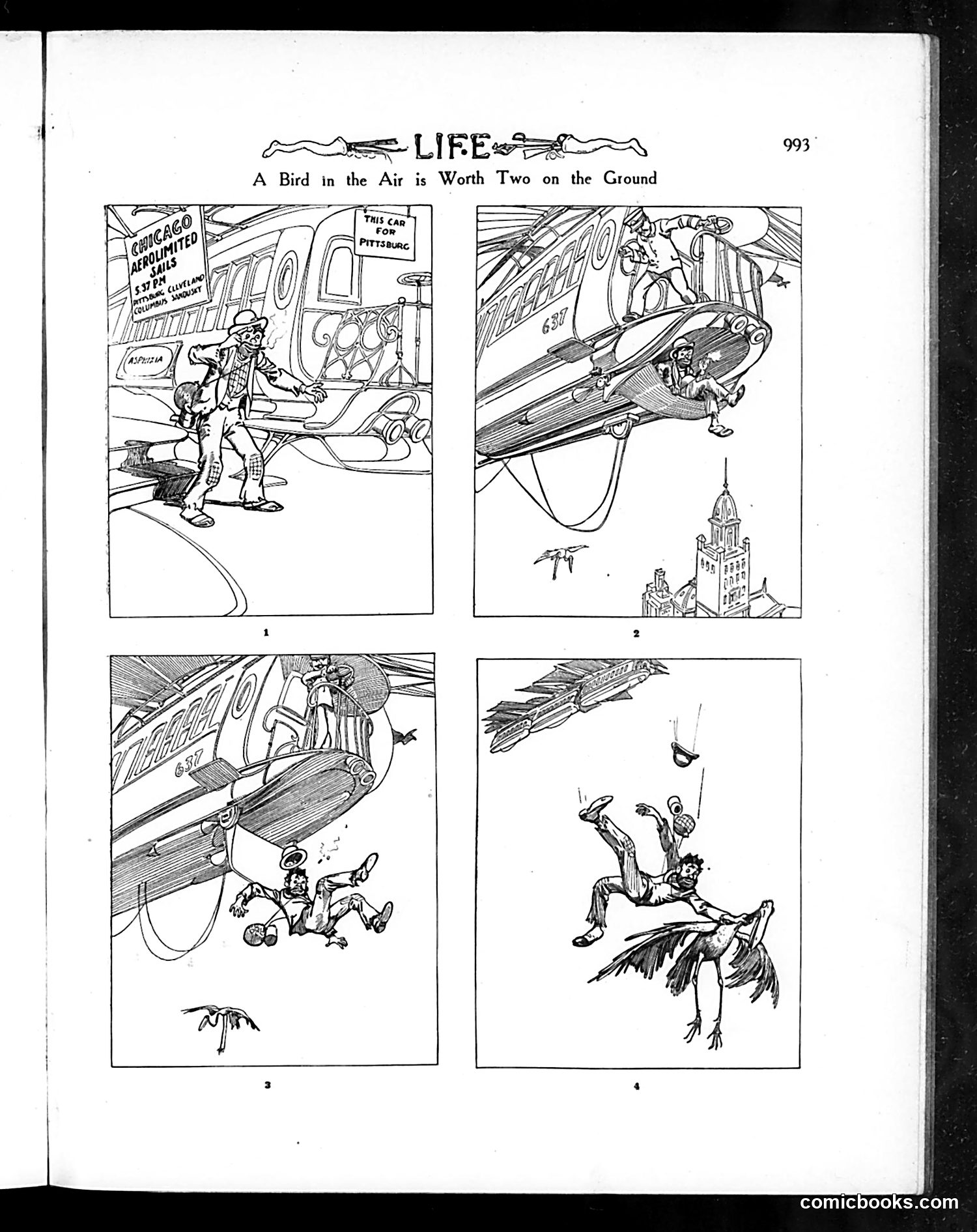
This four-panel comic appears to satirize early commercial aviation, playing on the proverb "a bird in the hand is worth two in the bush." Panel 1 shows a man at what appears to be a Chicago Aeronautics office, likely booking passage. Panels 2-4 depict his increasingly chaotic experience: being loaded onto an aircraft, then falling from it along with other passengers, and finally plummeting toward a city below with a bird. The satire mocks the danger and unreliability of early airplane travel, suggesting that while one might board a plane ("bird in the air"), it's safer to remain grounded ("two on the ground"). The escalating slapstick—culminating in multiple people and a bird all falling—emphasizes aviation's perceived hazards to audiences accustomed to safer ground transportation.
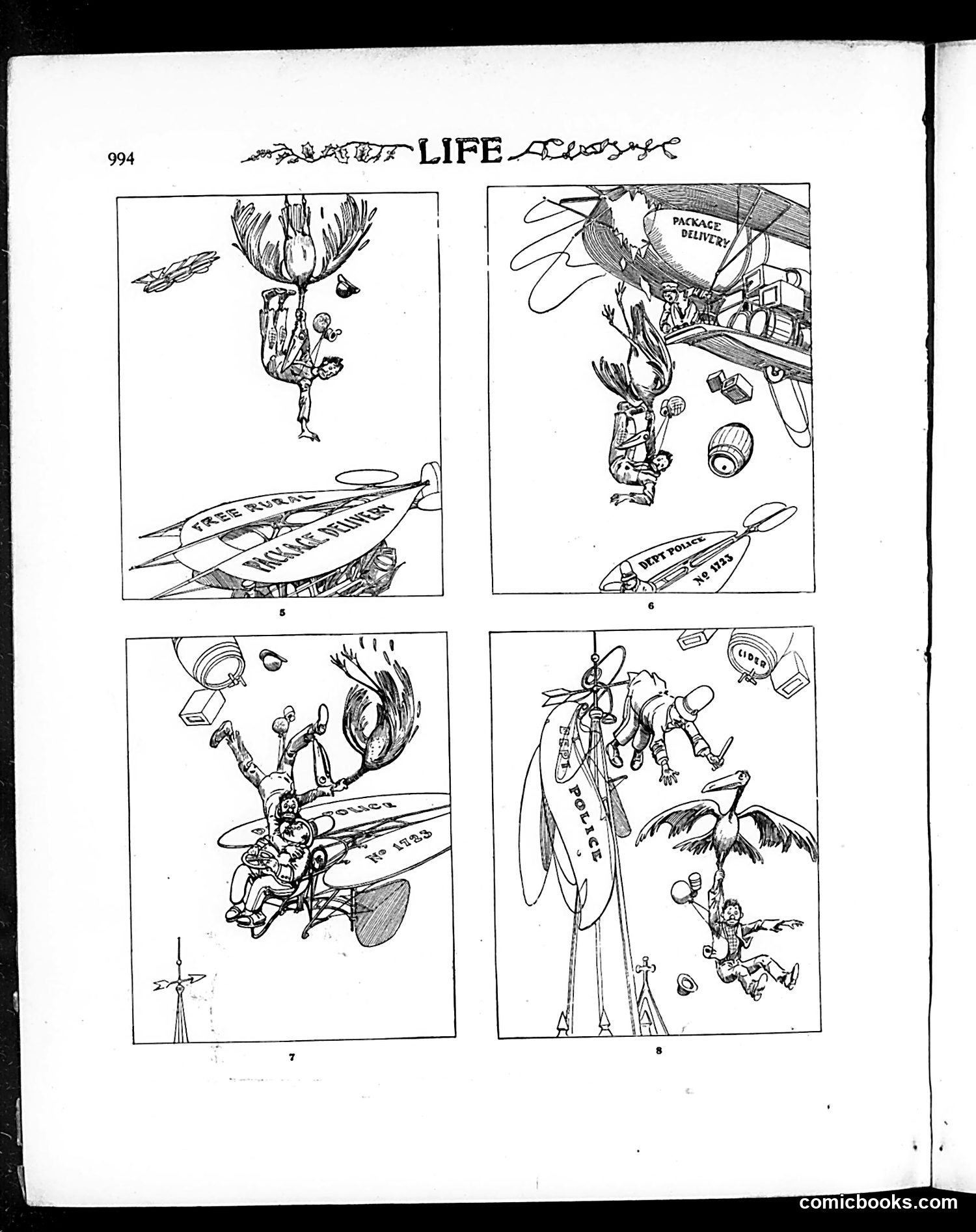
This page contains four numbered comic panels (5-8) depicting a surreal narrative involving small humanoid figures interacting with oversized objects and plants. The figures appear to be delivering or transporting packages and mail, suggested by visible text reading "PACKAGE DELIVERY" and "SPECIAL DELIVERY" on various items. The satire appears to mock postal or delivery services through exaggeration—showing tiny workers struggling comically with enormous packages, flowers, and aircraft. The panels progress through increasingly chaotic scenes of delivery attempts. Without clearer text or identifiable historical figures, the specific political target remains unclear, though the humor targets bureaucratic inefficiency or the absurdity of modern delivery systems. The surreal scale contrast provides the primary comedic device.
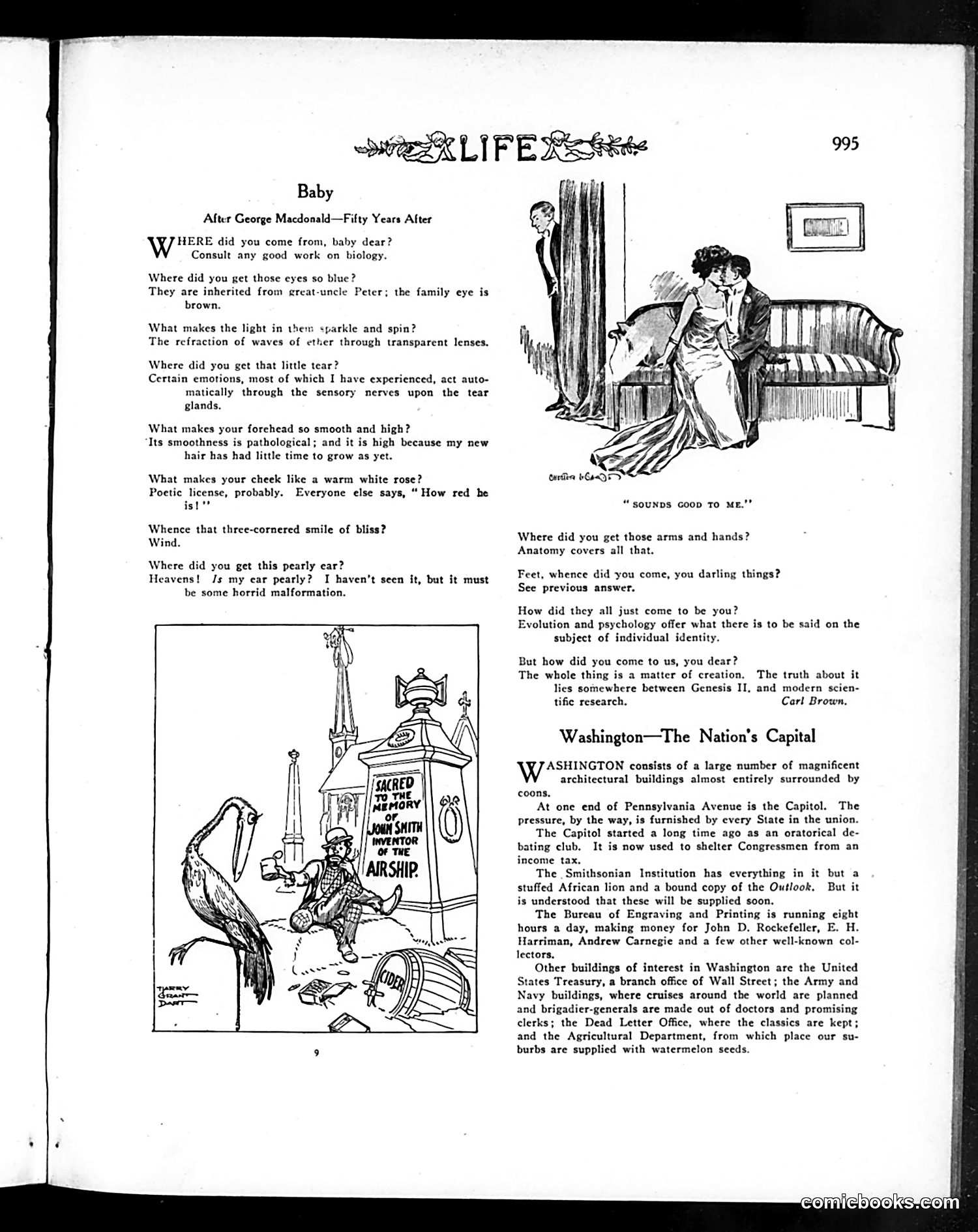
## "Baby" Poem This parody of George MacDonald's famous 1864 children's poem "Where Did You Come From, Baby Dear?" replaces MacDonald's sentimental, wonder-filled answers with coldly scientific ones. Instead of poetic mystery ("You came from far across the sea"), each feature gets a clinical explanation—inheritance, physics, anatomy, pathology. The satire mocks rigid scientism and materialism: the reduction of human beauty and emotion to mere mechanism. By answering "How did you come to us?" with "matter of creation" somewhere between Genesis and science, the author suggests both worldviews fail to capture what makes a baby meaningful. ## Washington Cartoon The accompanying text humorously debunks Washington institutions through cynical redefinition: the Capitol "shelters Congressmen from an income tax"; the Smithsonian lacks a stuffed lion; the Bureau of Engraving serves billionaire industrialists (Rockefeller, Harriman, Carnegie); and the Treasury is merely "Wall Street's branch office." This reflects Progressive-Era skepticism toward government corruption and corporate influence over public institutions.
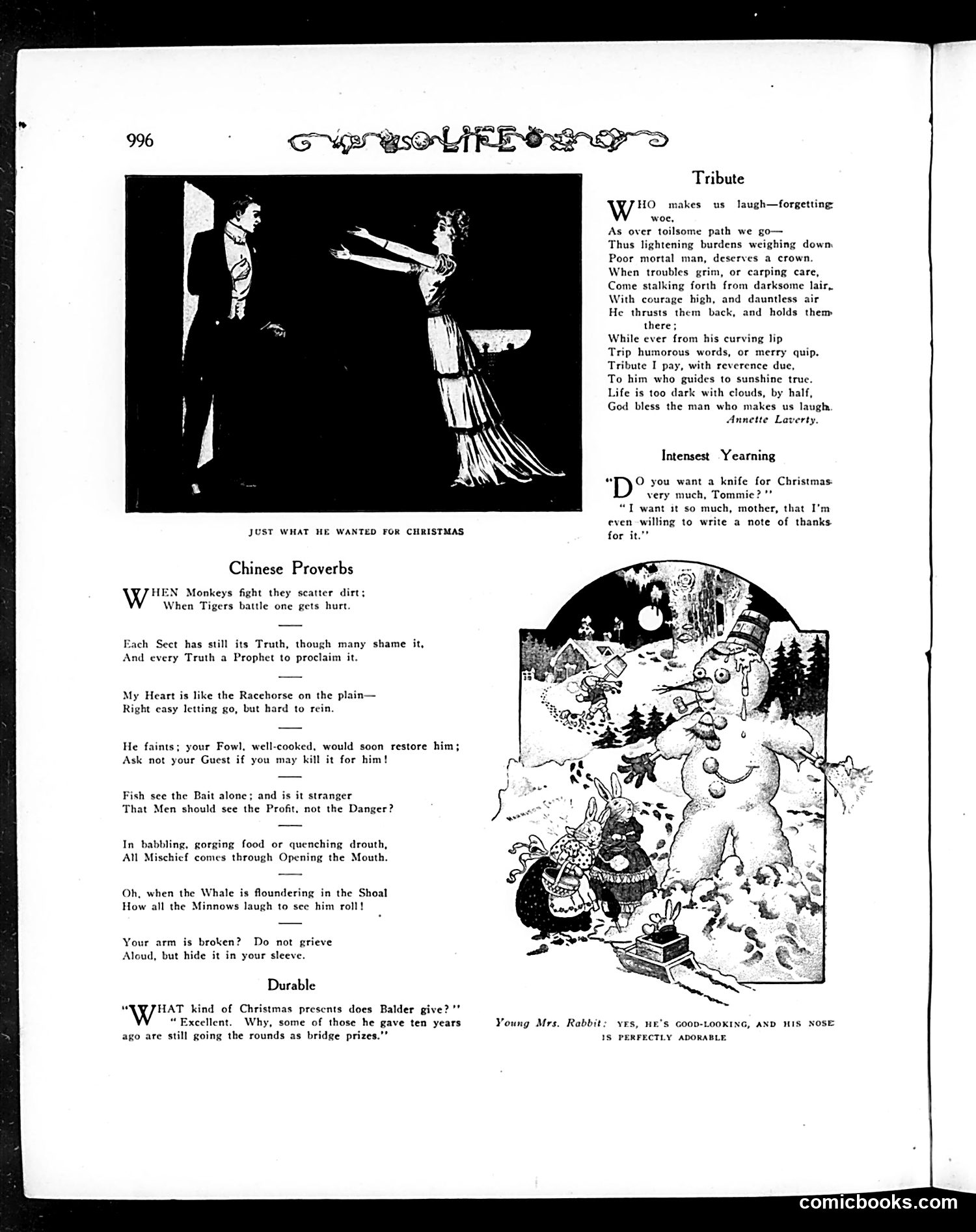
**Top Cartoon ("Just What He Wanted for Christmas"):** A man receives a knife as a Christmas gift—a darkly humorous visual joke about getting exactly what one desires, with the implication being something potentially dangerous or self-destructive. **"Chinese Proverbs" Section:** A collection of wisdom sayings presented as traditional Chinese philosophy. These appear genuine or plausibly authentic aphorisms about human nature, discretion, and behavior—likely included to add cultural sophistication to the magazine's humor section. **"Durable" Joke:** A quip about Balder's Christmas gifts remaining in circulation as bridge prizes a decade later, suggesting the gifts are either forgettable or of poor quality—durable only in their ability to be regifted. **"Tribute" Poem:** A sentimental celebration of humor and those who make others laugh during difficult times. **"Intensest Yearning" Joke:** A child wants a knife so badly he'll even write thank-you notes—mildly humorous commentary on childhood determination. **Right Illustration:** A snowman surrounded by Christmas imagery and animals; caption jokes about Young Mrs. Rabbit finding a male rabbit attractive.
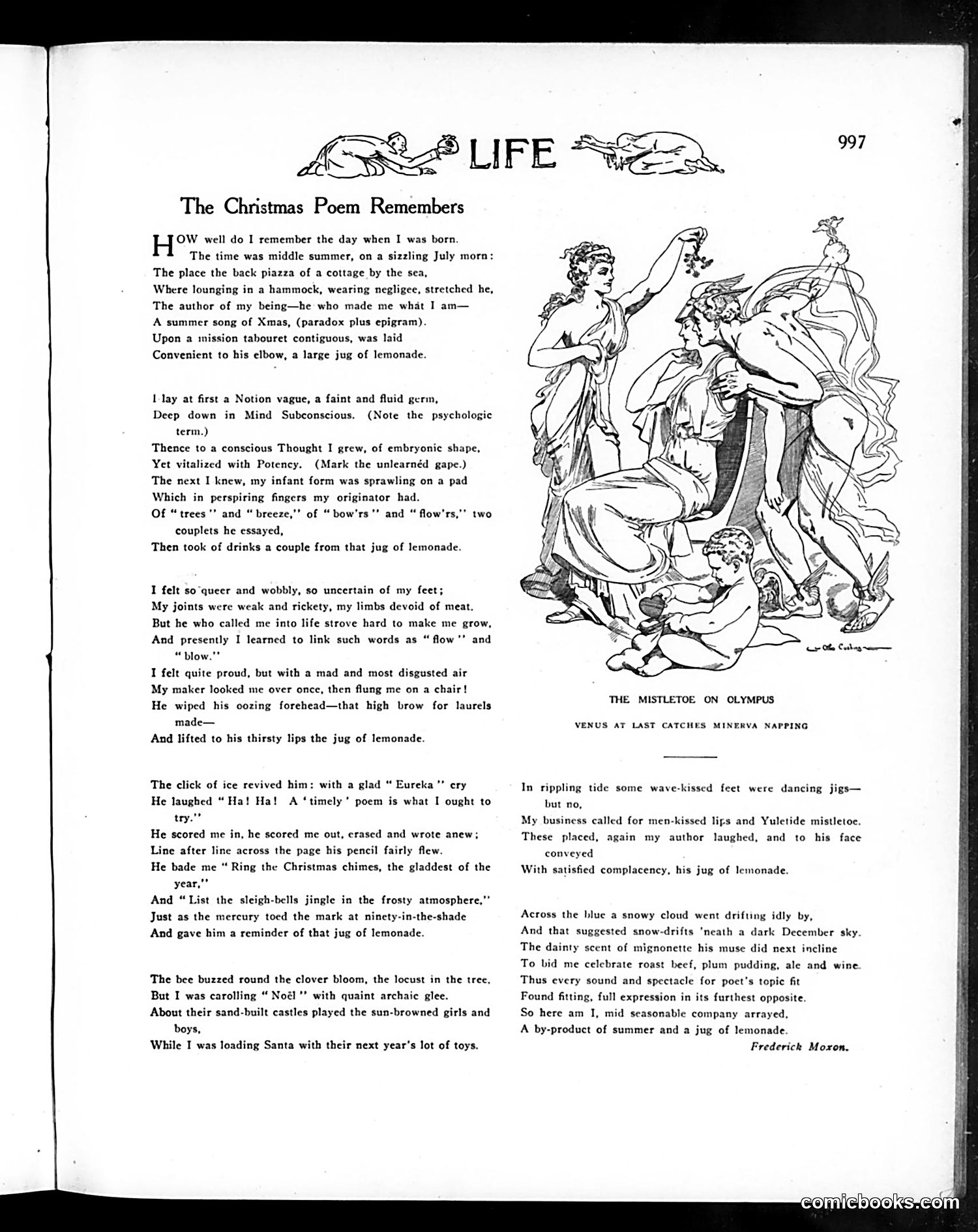
This is a humorous poem about creative writing, not political satire. The narrator is a Christmas poem personified, recounting its own composition during a sweltering July day. The joke centers on the absurdity of its origin: the poet conceived it while lounging in a hammock, repeatedly drinking lemonade to cope with summer heat. The poem itself describes winter imagery—snow, sleigh bells, Christmas cheer, roast beef—the opposite of the oppressive conditions in which it was written. The accompanying illustration, "The Mistletoe on Olympus," depicts classical figures (likely Venus and Minerva based on the caption) in a playful scene, establishing a lighthearted, whimsical tone throughout the page. The satire gently mocks both poets' struggle against uninspired conditions and the disconnect between creative subject matter and real circumstances.
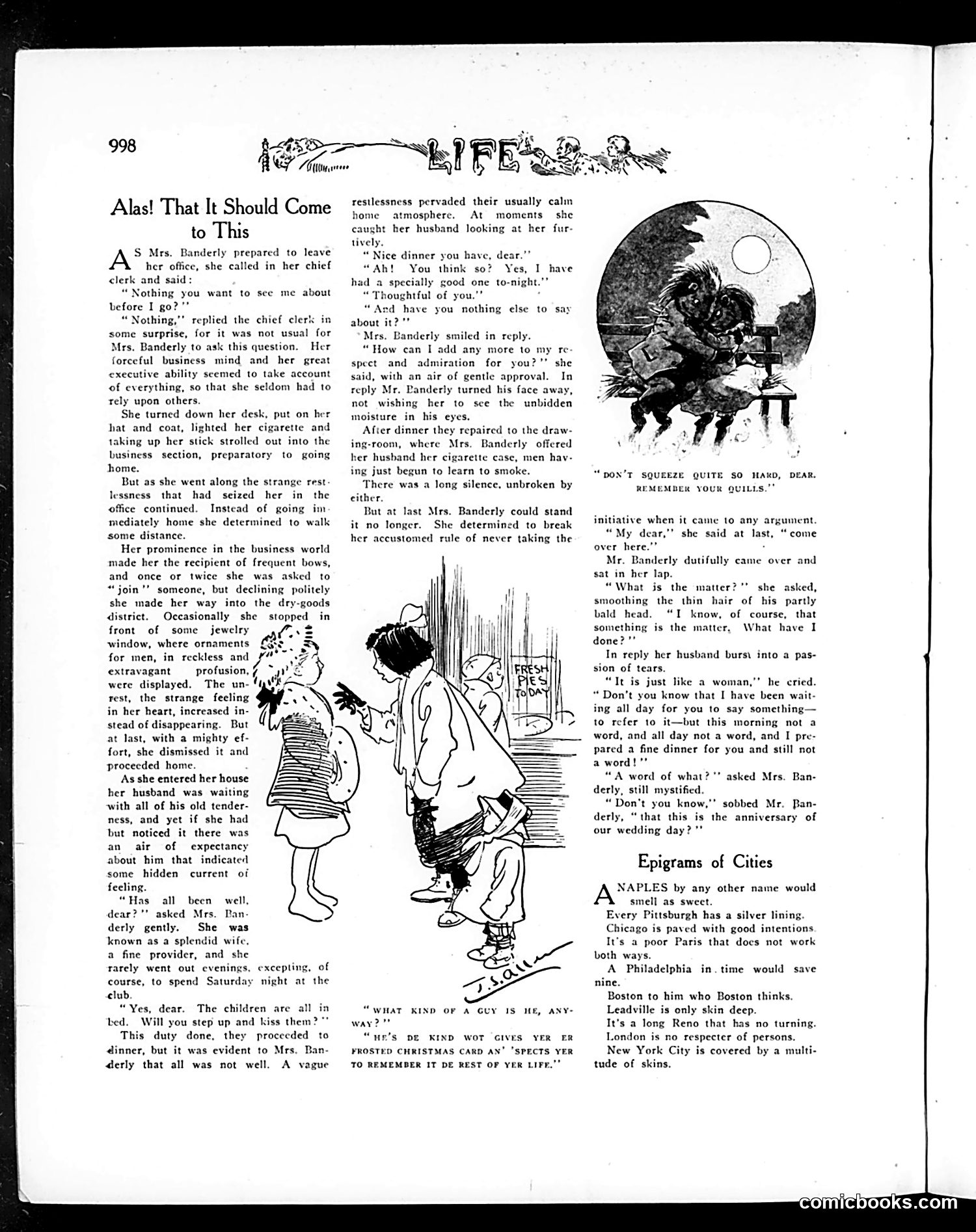
This page satirizes the modern professional woman and changing gender dynamics in early 20th-century marriage. The story "Alas! That It Should Come to This" depicts Mrs. Banderly, a successful businesswoman who neglects to acknowledge her husband's anniversary of their wedding day. The satire targets her complete absorption in her career—she's too distracted by business to notice her husband's emotional needs. The irony is sharp: she's described as "a splendid wife" and "fine provider," yet her very professional competence blinds her to basic marital sentiment. Her husband literally sits in her lap crying, reversing traditional gender roles where men were supposed to be emotionally stoic. The accompanying "Epigrams of Cities" section offers brief satirical observations about American cities—mild social commentary typical of Life's format. The cartoon at bottom (caption about squeezing and quills) appears unrelated editorial commentary. The piece gently mocks both the ambitious working woman and the emotionally vulnerable modern man, reflecting anxieties about shifting social roles during the early 1900s.
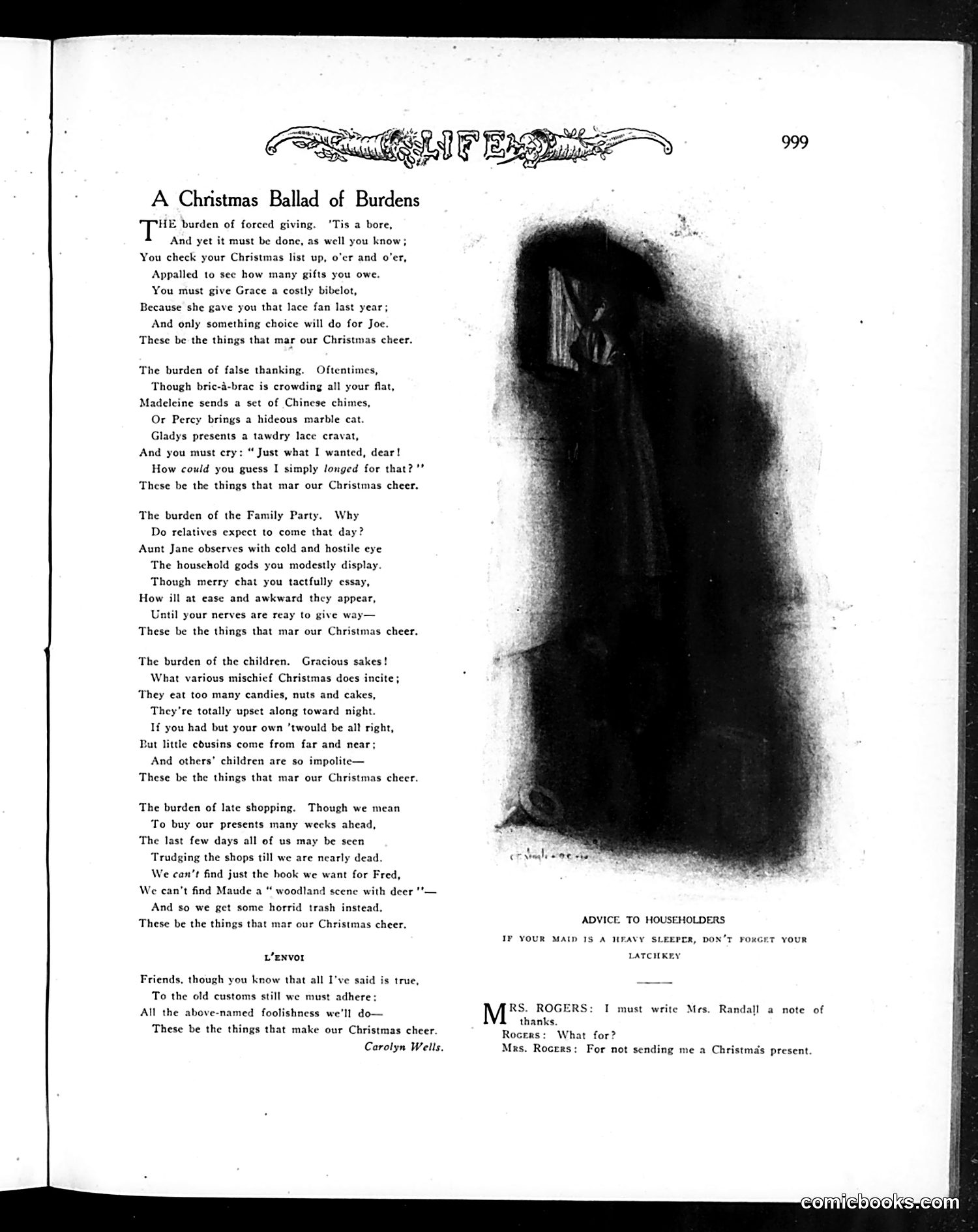
This satirical poem by Carolyn Wells catalogs the social obligations and hypocrisies that burden middle-class Americans during Christmas, targeting early 20th-century consumer culture and social etiquette. The ballad mocks: - **Obligatory gift-giving**: The anxiety of reciprocal presents, feeling forced to give expensive items to maintain social standing - **Insincere gratitude**: Pretending to love unwanted gifts (Chinese chimes, marble cats, tacky lace) - **Tedious family gatherings**: Uncomfortable visits from critical relatives like Aunt Jane - **Children's chaos**: The disruption caused by misbehaving cousins and visitors' children - **Last-minute shopping desperation**: The frantic, failed hunt for specific gifts, settling for "horrid trash" The humor lies in the paradox of the closing lines: despite recognizing all this as foolishness, society demands we continue the charade anyway—suggesting Christmas has become less about joy and more about exhausting social performance.
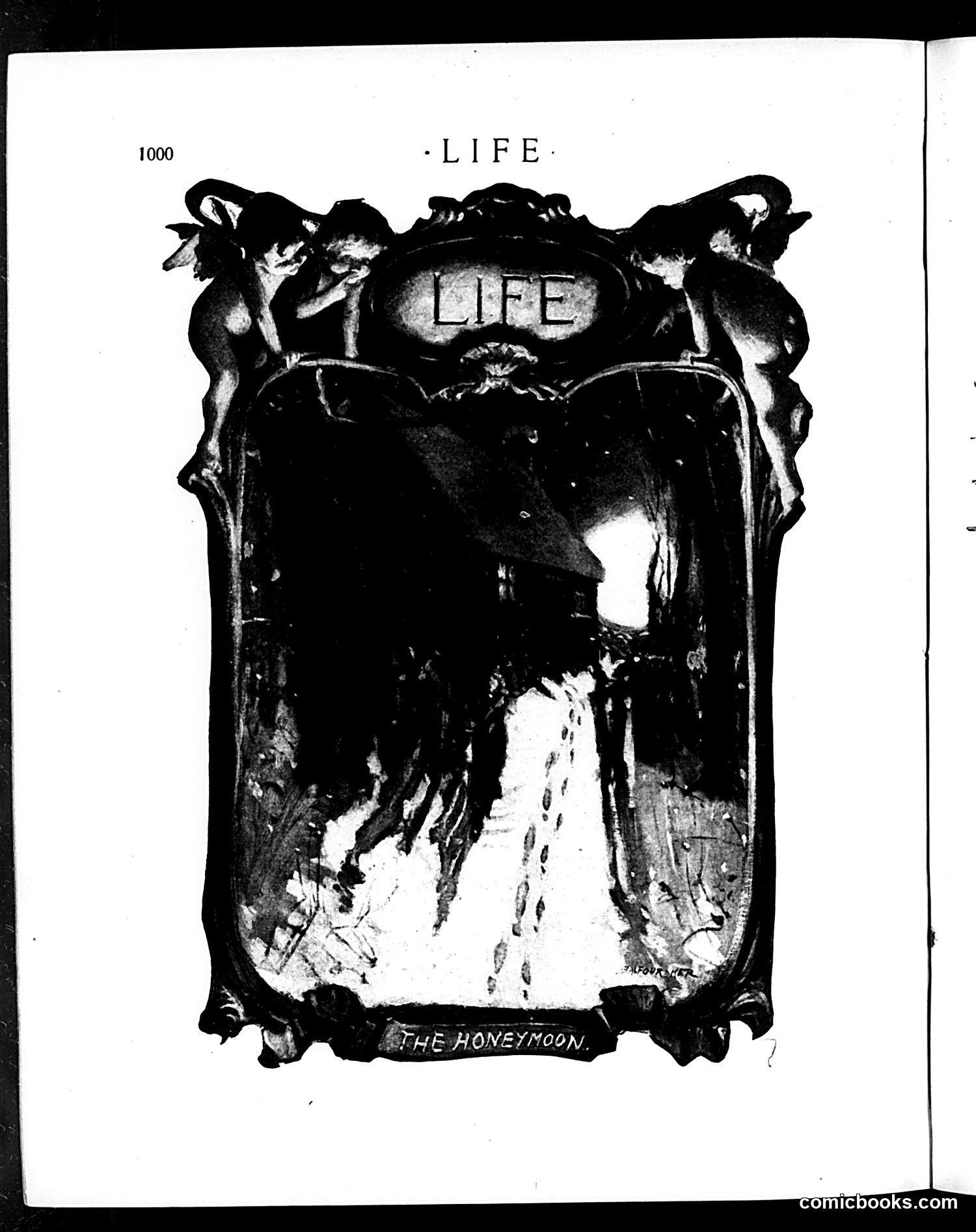
This appears to be a title page or cover from Life magazine, featuring an ornate Art Nouveau-style frame. The illustration labeled "THE HONEYMOON" depicts a woman in a white wedding dress viewed from behind, gazing out at a dark, somewhat ominous landscape. Two cherub or cupid figures perch atop the frame, traditionally symbols of love and marriage. The satire likely comments on the contrast between romantic ideals of honeymoons and marriage versus darker realities. The gloomy, barren scenery contradicts the joy typically associated with newlyweds, suggesting cynicism about matrimonial bliss. This reflects turn-of-the-century satirical humor common in Life magazine, which frequently mocked social conventions and romantic sentimentality with dark wit.
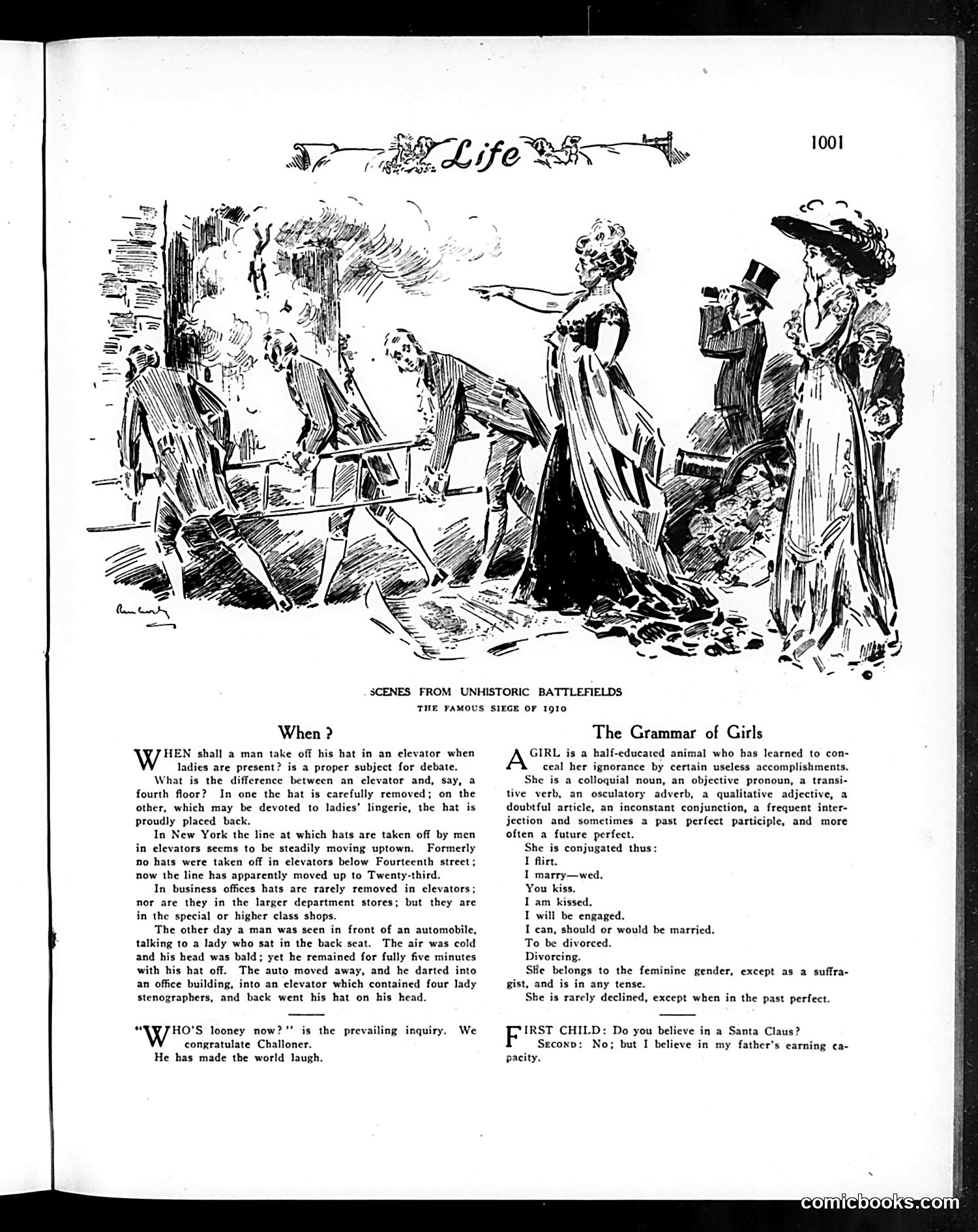
This 1910 *Life* magazine page contains two satirical pieces mocking contemporary social conventions and gender dynamics. **"When?" (Hat Etiquette)** The piece ridicules absurd rules about removing hats in elevators around ladies. It notes that the "proper" floor for hat removal has mysteriously migrated uptown (from 14th to 23rd Street), and ironically describes a bald man who removes his hat outdoors in cold weather but keeps it on in an elevator with female stenographers. The satire targets the arbitrary, class-based nature of Victorian politeness—the hypocrisy of men's behavior changing based on location rather than genuine respect. **"The Grammar of Girls"** This satirizes women as simultaneously ignorant and manipulative—describing girls as conjugating through flirtation, marriage, and divorce. The final joke presents a child rejecting Santa Claus but believing in fathers' earning capacity, mocking both parental deception and women's mercenary nature (marrying for money). The "unhistoric battlefields" subtitle frames gender relations as warfare. Both pieces reflect early 20th-century satirical attitudes toward women—simultaneously condescending about female education while anxious about female sexuality and economic power.
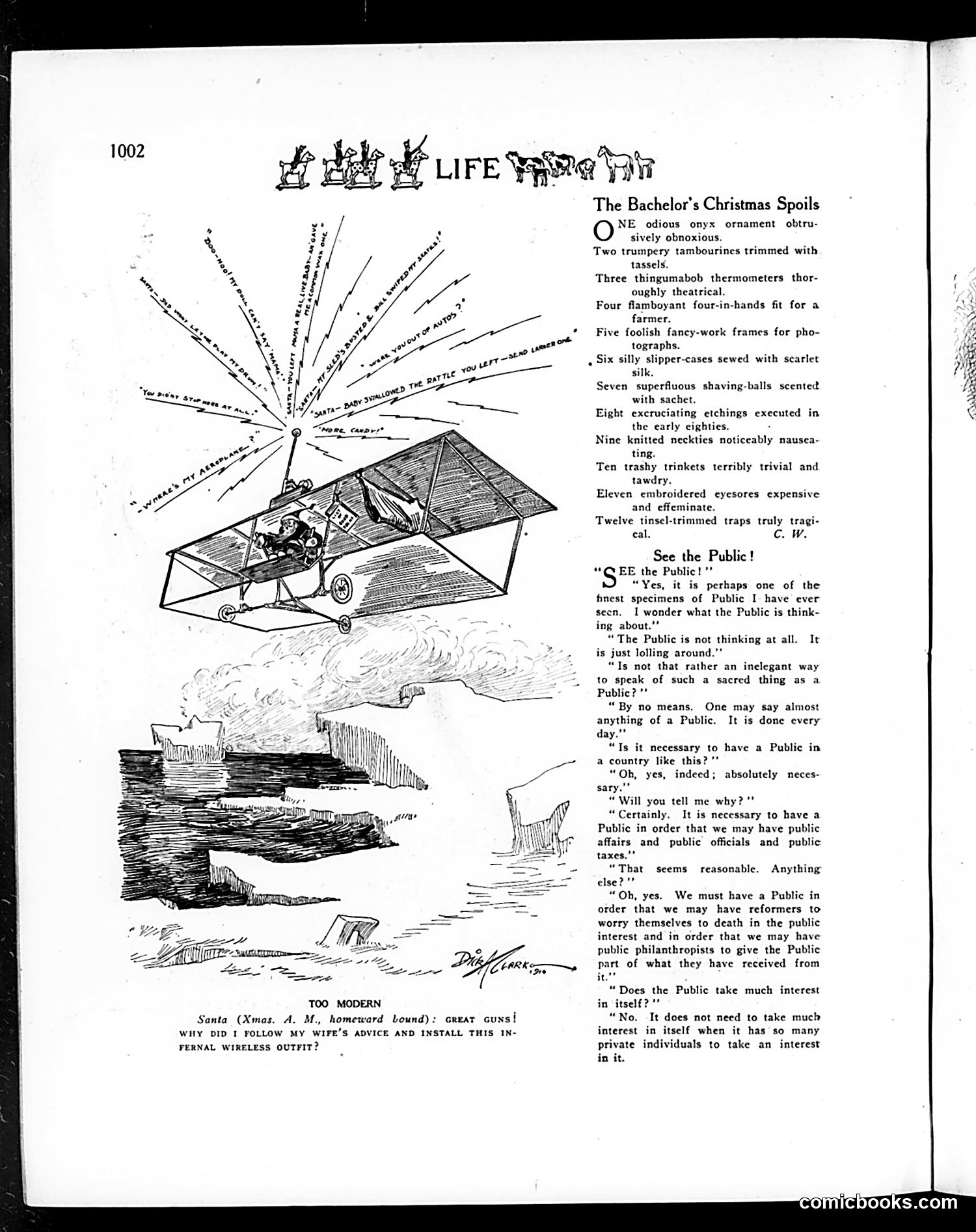
The page contains two distinct satirical pieces from *Life* magazine: **"The Bachelor's Christmas Spoils"** (top): A humorous list using alliteration mocking the impractical, tasteless gifts bachelors typically receive—onyx ornaments, tambourines, thermometers, neckties, etc. The satire targets both gift-givers' poor judgment and bachelor culture itself. **"See the Public!" (bottom)**: A dialogue satirizing public opinion and civic participation. Two speakers discuss "the Public" as an abstract entity, arguing it's necessary for justifying public officials, taxes, and reformers—though the Public itself is passive and unthinking. The satire mocks: (1) how elites reference "the Public" abstractly while dismissing actual public engagement; (2) self-interested reformers and philanthropists who claim to serve public interest; (3) the circular justification of bureaucracy and taxation. **"Too Modern"** (lower left): A brief joke about a man who installed a wireless (radio) outfit per his wife's advice, now regrets it—likely mocking newfangled technology and domestic decision-making.
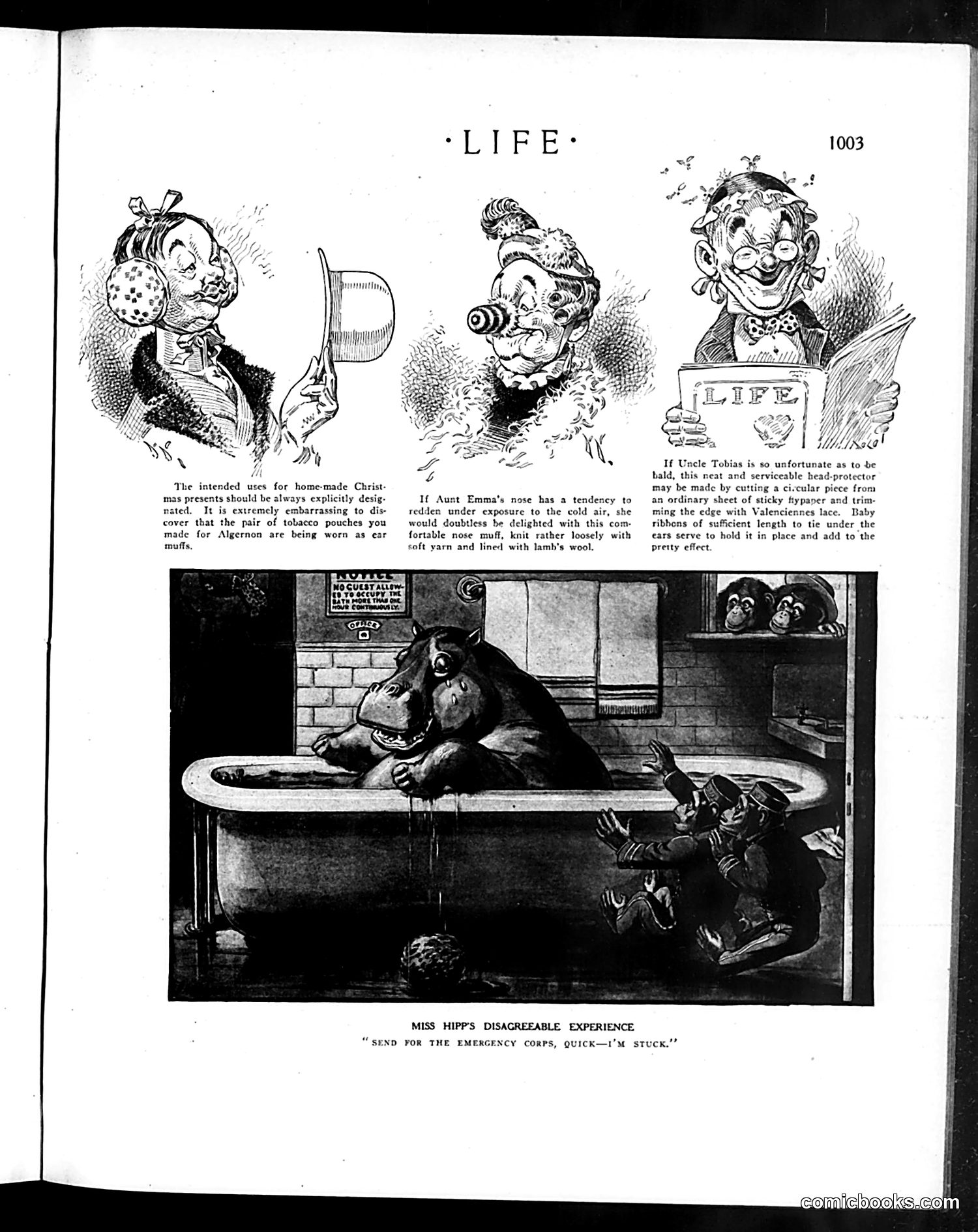
This 1903 *Life* magazine page combines practical Christmas gift advice with humorous caricatures and a satirical cartoon. **Top section**: Three grotesque caricatured faces illustrate absurd homemade gift ideas—poorly conceived presents that recipients use incorrectly (tobacco pouches as ear muffs, nose muffs, a flypaper head-protector). The humor mocks both the giver's lack of judgment and the recipient's desperation. **Bottom cartoon** ("Miss Hipp's Disagreeable Experience"): Shows a woman stuck in a bathtub with an ape or large primate, surrounded by smaller creatures. The caption requests "emergency corps"—comedic exaggeration of a domestic mishap. The cartoonist uses grotesque animal imagery typical of early-1900s slapstick humor, though the specific reference to "Miss Hipp" is unclear. Overall, the page satirizes homemade gift-giving failures and domestic mishaps through exaggerated caricature and physical comedy common to the era's satirical magazine style.
This satirical story by Frank Lovell Nelson depicts a 19th-century literary figure (styled as William Makepeace Thackeray) visiting a modern newspaper office—specifically Life magazine's headquarters on "Park Row" (New York's newspaper district). The joke targets the clash between classical literature and modern journalism's commercial machinery. An elderly, formally-dressed author submits a 300,000-word novel titled *Vanity Fair* to a harried Sunday editor, expecting it to revolutionize literature. The editor's dismissive response—noting it would take five years to serialize at current publication rates—satirizes how newspapers prioritize speed and profit over literary merit. The piece mocks both pretentious authors clinging to outdated publishing models and the mechanical, profit-driven newspaper industry that has no patience for serious fiction. The contrast between the visitor's antiquated appearance and the chaotic, modern newsroom emphasizes how irrelevant classical literature has become to contemporary mass media.
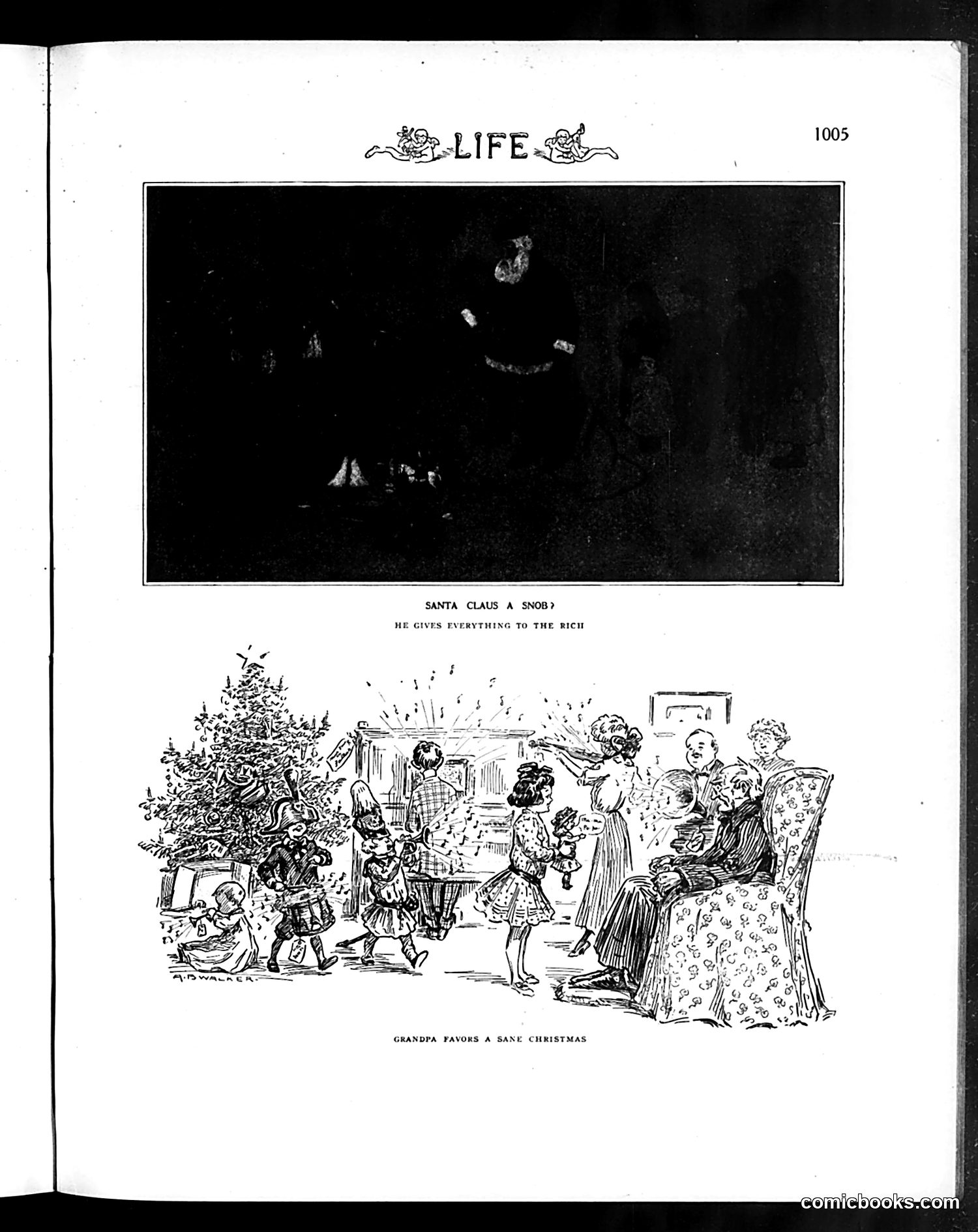
This page contains two cartoons critiquing wealth inequality during Christmas. The top image (heavily darkened, details unclear) appears to ask "Santa Claus a Snob?" with the caption claiming he "gives everything to the rich"—suggesting Santa favors wealthy families with better gifts. The bottom cartoon, "Grandpa Favors a Sane Christmas," depicts a multigenerational family scene around a Christmas tree. It likely contrasts excessive commercialism with modest, meaningful celebration. The presence of "Grandpa" suggests generational perspective on how Christmas gift-giving has become materialistic and class-based. Both pieces satirize early 20th-century American consumer culture and economic disparity, with the implicit message that Christmas commercialization benefits the wealthy while disadvantaging poor families—a social critique framed through holiday traditions.
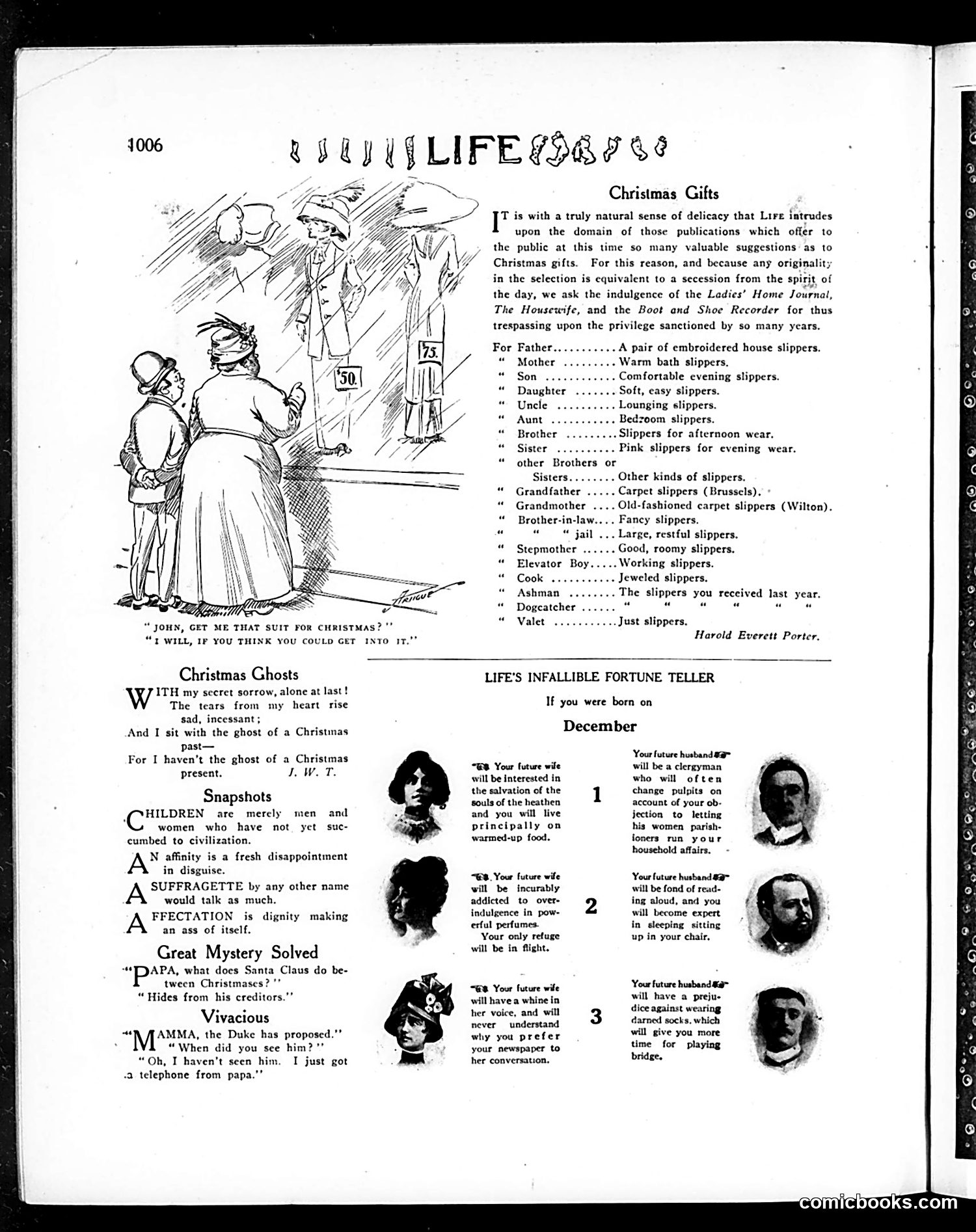
This page contains humorous Christmas content satirizing gift-giving conventions and Victorian social attitudes. **"Christmas Gifts"** (top): A cartoon shows people shopping, with the caption about a husband asking for a suit. The joke plays on marital dynamics—the wife sarcastically doubts he could fit into it, implying weight gain. The accompanying list mockingly suggests slippers for literally everyone (father, mother, servants, even the ashman and "jail"), satirizing the era's unimaginative, standardized gift-giving. **"Christmas Ghosts"** (lower left): Sentimental poetry about loneliness and regret, typical of the period's maudlin sentimentality. **"Snapshots"** section: Brief witticisms mocking social pretense—suffragettes, affected people, and children as "uncivilized." **"Fortune Teller"** (right): Humorous horoscope predictions for December births, joking about future spouses' annoying habits (over-perfuming, reading aloud, darning socks), reflecting period gender stereotypes and marital comedies. The overall tone uses gentle ridicule of consumer culture and social conventions typical of early 20th-century Life magazine's satirical approach.
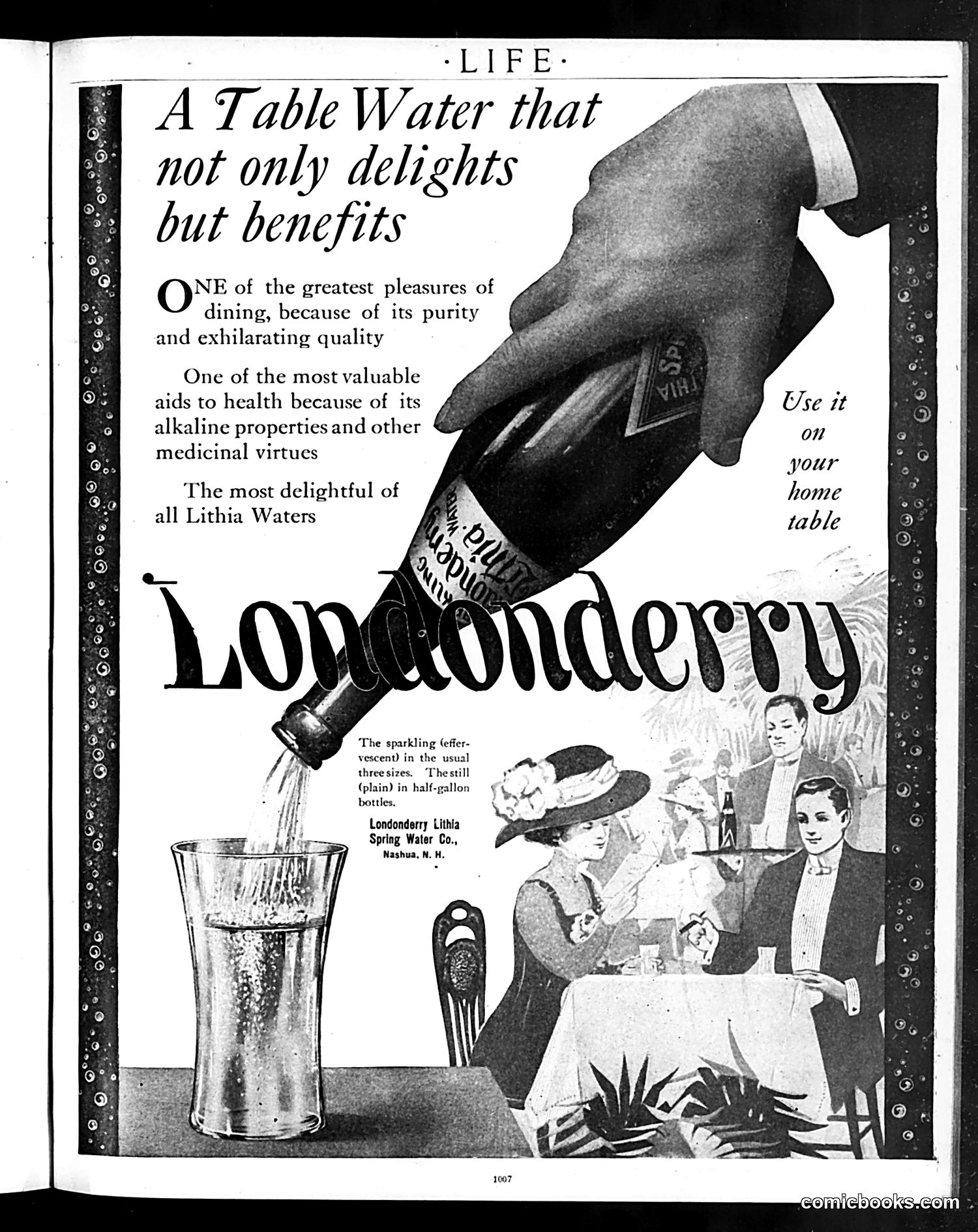
This is a **full-page advertisement**, not satire. It promotes Londonderry Lithia Spring Water from Nashua, New Hampshire. The ad makes health claims typical of early 20th-century patent medicines and mineral waters: the water's "alkaline properties" and "medicinal virtues" supposedly aid health. Such claims were common before the FDA strictly regulated advertising. The imagery shows an elegant dinner scene with well-dressed diners, suggesting the product's sophistication and suitability for refined tables. A hand pours the sparkling water into a glass, emphasizing its effervescence. The text emphasizes dual appeal—pleasure (purity, exhilarating quality) and health benefit—a marketing strategy common in this era when mineral waters were marketed as both luxuries and medicines. The specific mention of lithia (lithium) reflects genuine period belief that lithium salts had therapeutic properties.
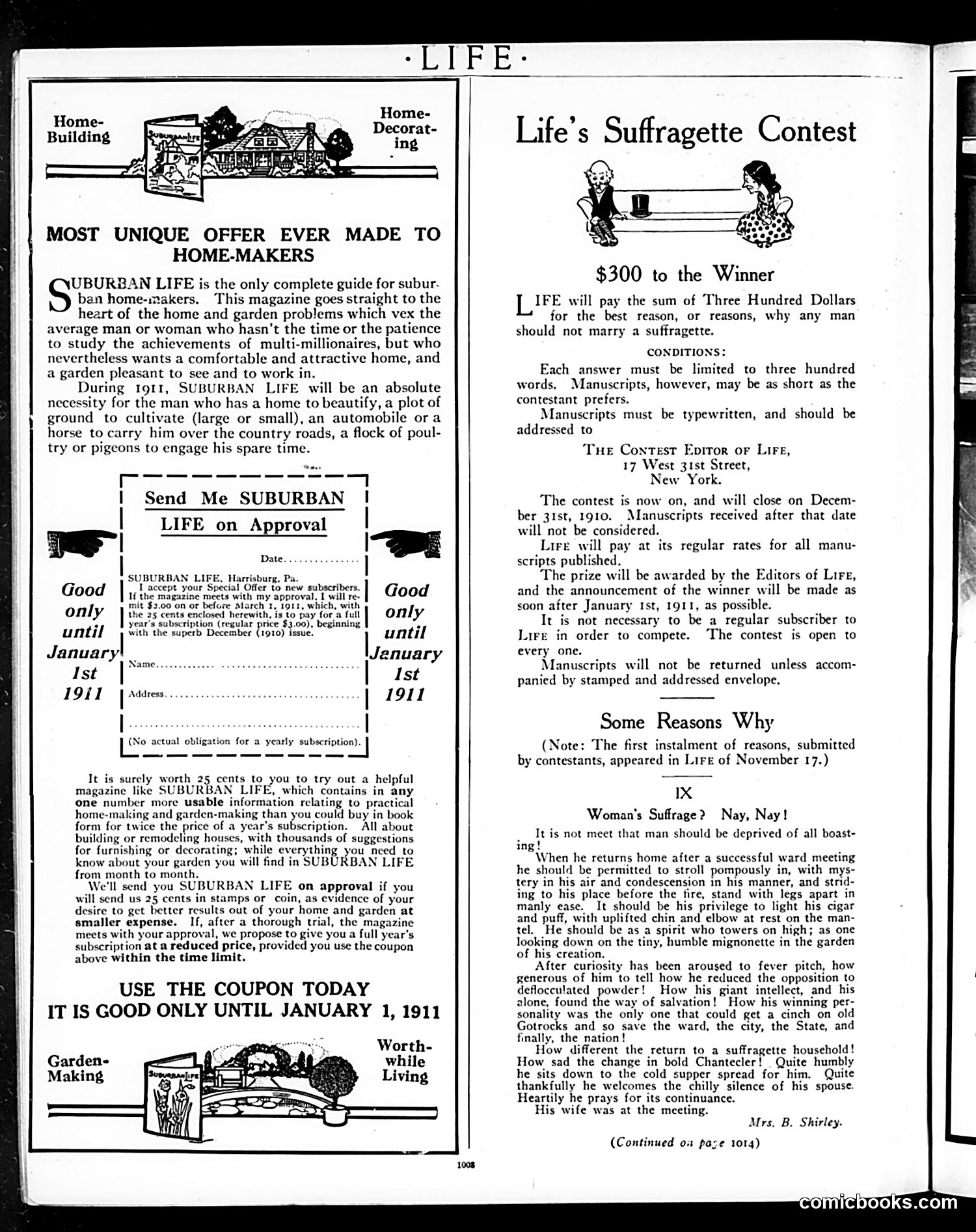
This page features Life's satirical contest offering $300 to the best answer to: "Why should any man not marry a suffragette?" The cartoon shows two figures at a table—likely representing a man and woman debating the issue. The contest solicits humorous arguments *against* women's suffrage and marriage to suffragettes, reflecting Life's anti-suffrage stance during the women's voting rights movement. The "Some Reasons Why" section begins with a submitted answer ("Woman's Suffrage? Nay, Nay!") mocking the concept through exaggerated scenarios—depicting suffragettes as domineering and unfeminine. The satire positions women's political equality as ridiculous and threatening to male domestic comfort. This reveals how mainstream publications like Life actively ridiculed the suffrage movement through humor before women gained voting rights (1920).
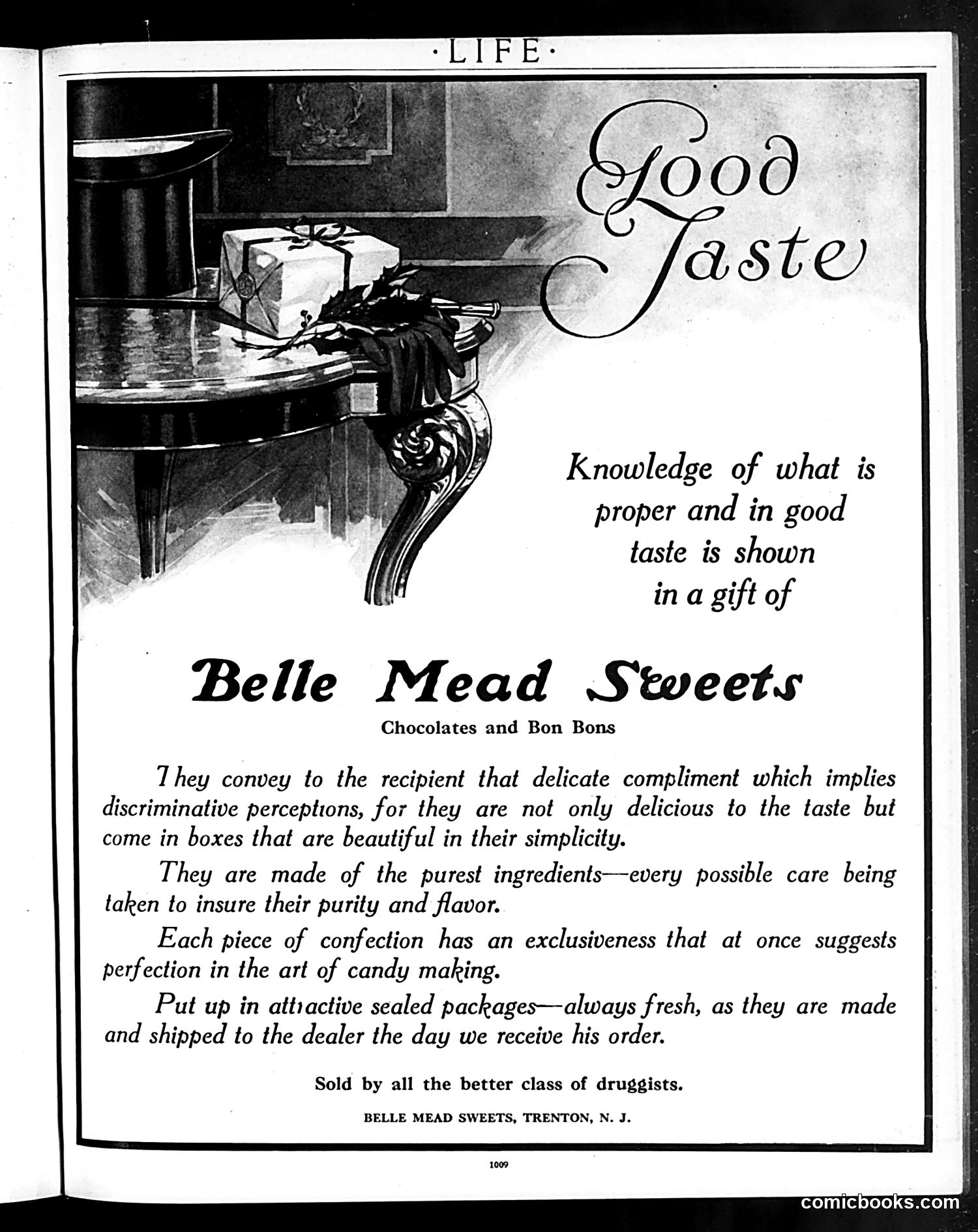
This is an advertisement, not a political cartoon. It's a Belle Mead Sweets candy advertisement from Life magazine, promoting chocolates and bon bons as luxury gifts. The illustration shows an elegantly wrapped gift box on a decorative table. The ad appeals to early 20th-century notions of refined taste and social status—positioning the candy as a marker of "discriminative perceptions" suitable for "the better class" of people. The emphasis on purity, simplicity, and freshness reflects consumer anxieties of the era about food safety and quality. The manufacturer (based in Trenton, New Jersey) uses the rhetoric of exclusivity and perfectionism common in period advertising, targeting affluent customers who valued refinement and propriety in gift-giving.
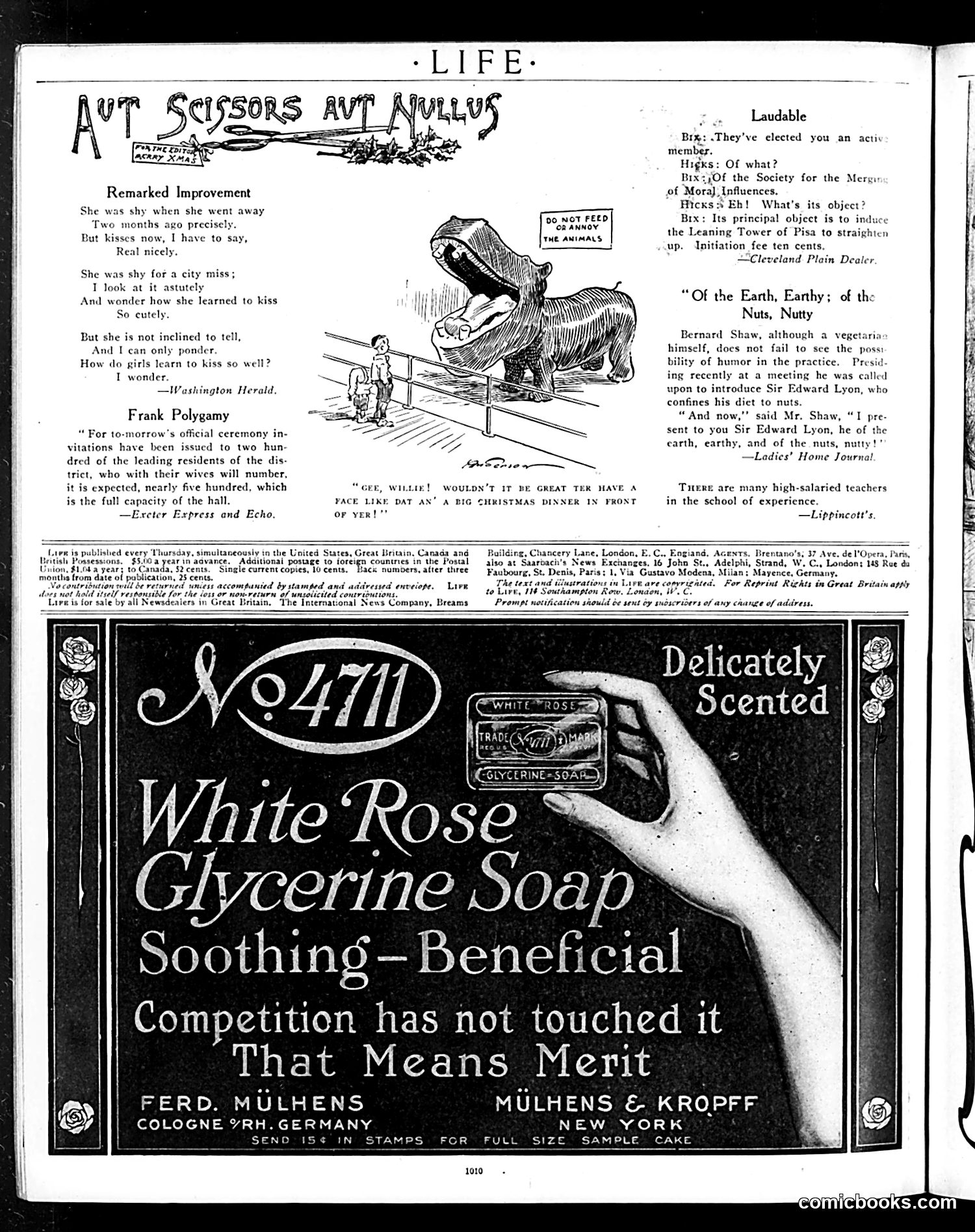
This page from *Life* magazine (circa 1919) contains three humorous short pieces and a soap advertisement. **"Remarked Improvement"** jokes about a shy woman who has learned to kiss expertly during a two-month absence—implying she gained this skill through romantic experience away from home. **"Frank Polygamy"** satirizes a newspaper report about an official ceremony where invitations to 200 leading residents plus their wives would fill a hall to capacity with "nearly five hundred" attendees. The joke highlights the mathematical absurdity: 200 people with spouses should equal 400, not 500—suggesting either polygamy or poor arithmetic by the newspaper. **The animal cartoon** shows someone at a zoo fence ignoring a "Do not feed or annoy the animals" sign, about to feed what appears to be a hippopotamus. The caption jokes about having "a big Christmas dinner in front of ye!"—anthropomorphizing the animal's perspective. The remaining content includes brief satirical items about Bernard Shaw's vegetarianism and society memberships, followed by a full-page advertisement for No. 4711 White Rose Glycerine Soap.
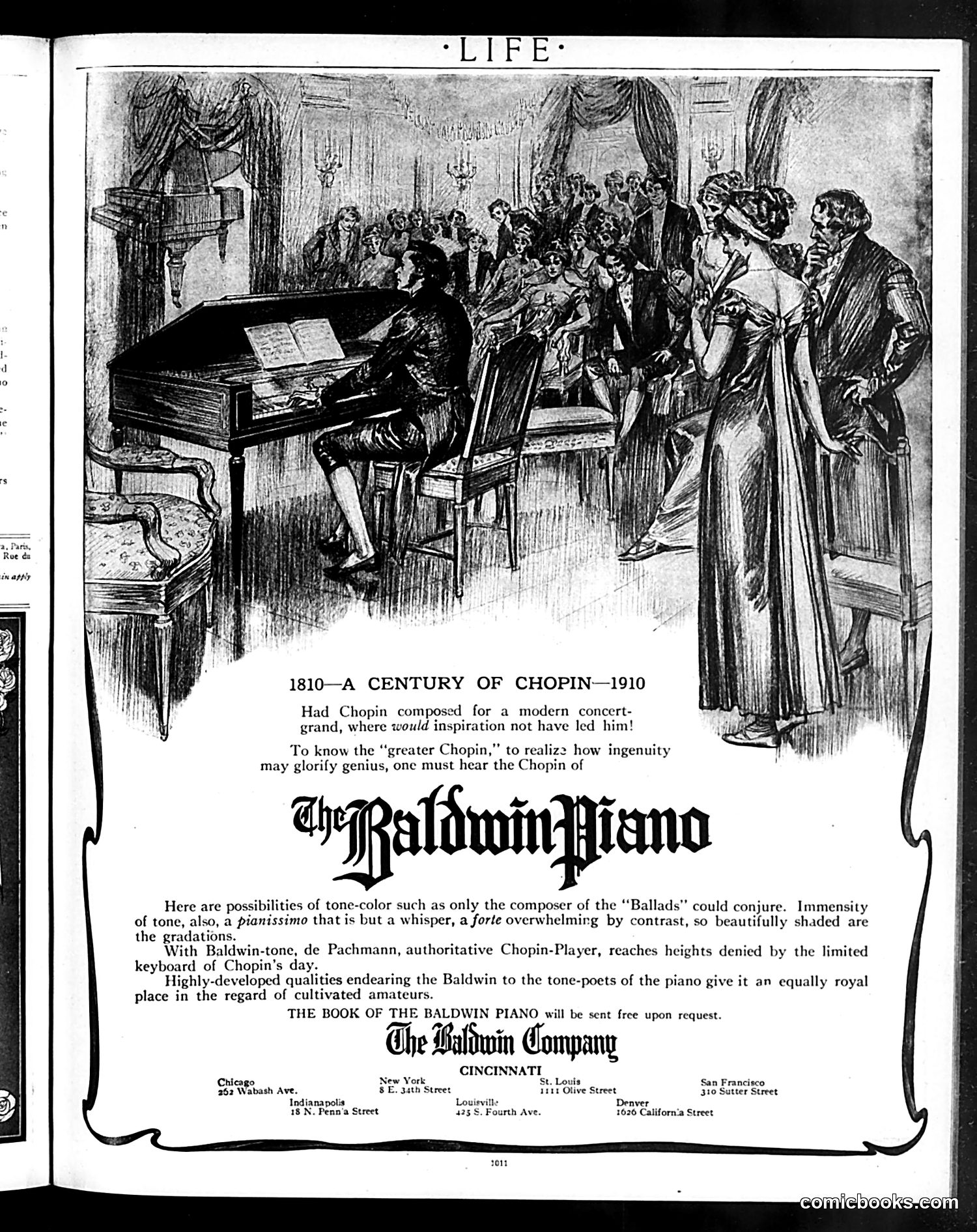
This is a **piano advertisement**, not political satire. The illustration depicts a formal concert scene where a pianist performs for an elegant audience in what appears to be a wealthy home or concert hall. The ad celebrates the 100th anniversary of composer Frédéric Chopin (1810-1910) by arguing that modern pianos—specifically Baldwin pianos—surpass the instruments available in Chopin's era. It claims that if Chopin had access to a Baldwin piano's superior tone and keyboard capabilities, he could have composed even greater works. The figure at the piano appears to be de Pachmann, identified as an "authoritative Chopin-Player," demonstrating how a Baldwin piano allows performers to achieve musical subtleties (soft *pianissimo* tones, overwhelming *forte* contrasts) impossible on 19th-century instruments. The ad targets "cultivated amateurs"—wealthy, educated consumers—positioning the Baldwin as the instrument of choice for serious musicians and music lovers.
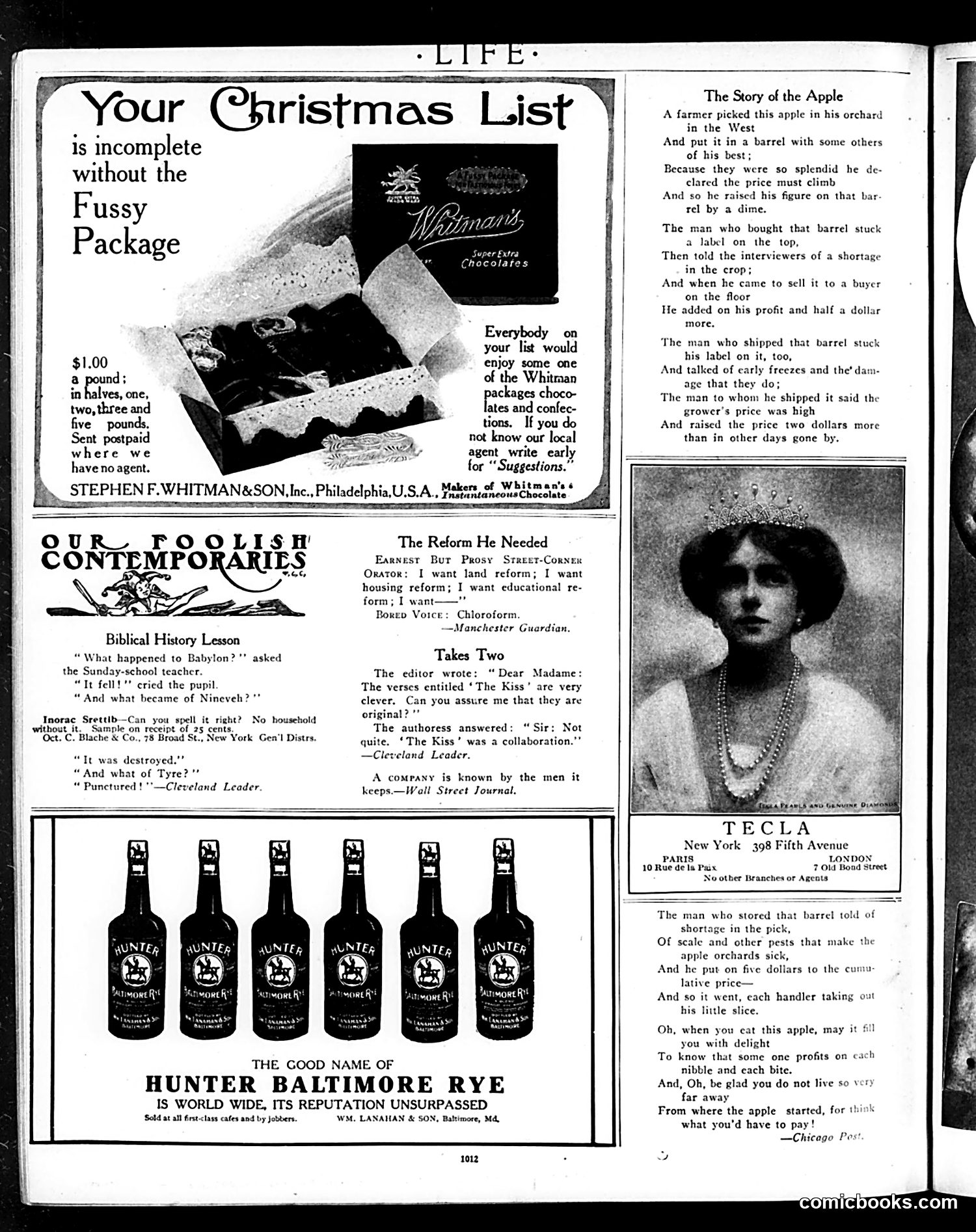
This page from Life magazine (1912) contains satirical commentary on economic markup and profiteering, centered on "The Story of the Apple." The poem traces how a single apple passes through multiple middlemen—farmer, barrel distributor, shipper, and retailer—each adding their own profit margin and fabricated justifications (crop shortage, freeze damage). Each handler invents excuses to justify raising prices, ultimately creating massive markup on the original product. The satire targets **economic inefficiency and dishonesty in the supply chain**. Rather than genuine scarcity, the poem exposes how intermediaries artificially inflate prices through speculation and misinformation. By poem's end, the consumer pays far more than justified, having unknowingly funded multiple layers of profits. The other brief satirical items on the page—about Biblical knowledge and editorial attribution—follow similar patterns of social critique, though they're lighter in tone. This reflects Progressive Era concerns about monopolies, price-fixing, and middleman exploitation of consumers.
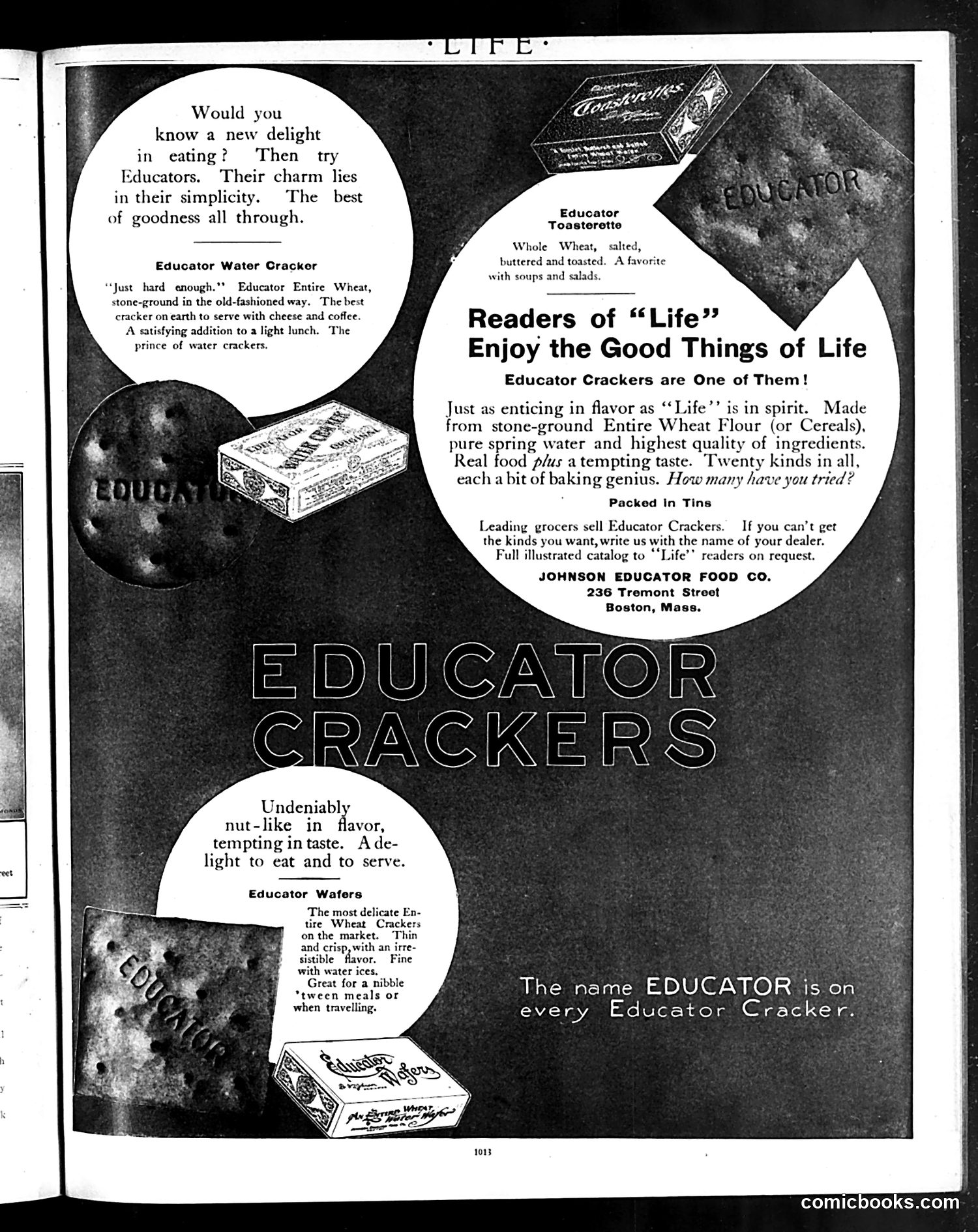
This is **not a cartoon or satire**—it's a straightforward advertisement for Educator brand crackers, placed in *Life* magazine. The page promotes three cracker products: Water Crackers, Toastettes, and Wafers. Each product description appears in circular text bubbles with accompanying product images. The ad emphasizes simplicity, quality ingredients (stone-ground whole wheat, pure spring water), and versatility—pairing with cheese, coffee, soups, or as travel snacks. The headline "Readers of 'Life' Enjoy the Good Things of Life" is a clever pun linking the magazine's name to the advertised products' quality. The company, Johnson Educator Food Co. (Boston), uses *Life* magazine's reputation for sophistication to market premium crackers. This represents early 20th-century food advertising: appeals to wholesomeness, variety of uses, and aspirational lifestyle positioning rather than price competition.
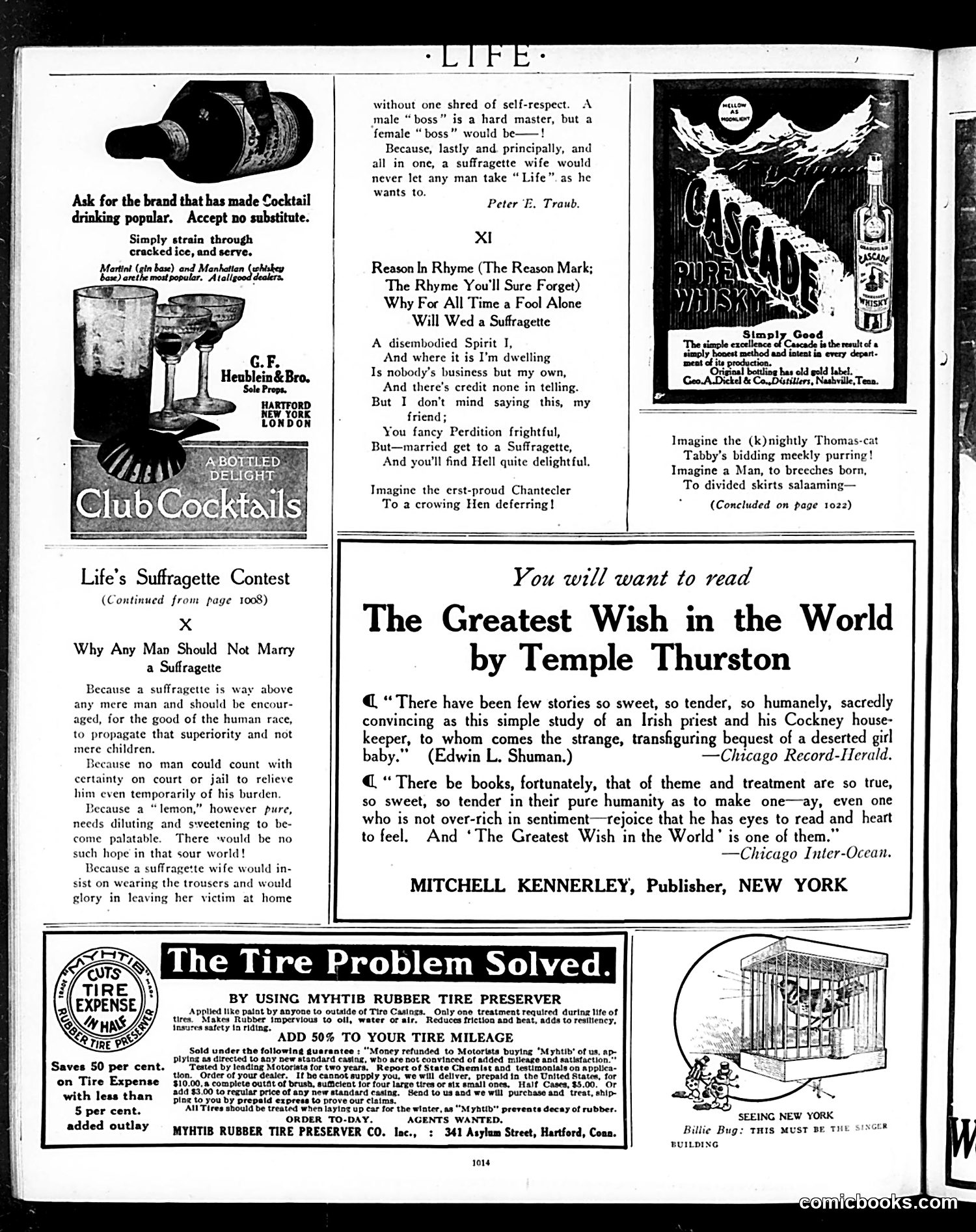
This page features satirical essays from Life magazine's contest mocking women's suffrage. The humor centers on anti-suffragette stereotypes common in early 20th-century opposition to voting rights. The entries present exaggerated fears: that suffragette wives would dominate households, wear "the trousers" (metaphorical authority), and emasculate men. One essay warns marriage to a suffragette would be worse than Hell itself. The rhymed piece uses animal metaphors—a cat obeying its master, a rooster deferring to a hen—to suggest gender role reversal would be absurd and unnatural. The satire targets not suffragettes themselves, but rather the irrational male anxieties about women's equality. By publishing these ridiculous arguments, *Life* appears to mock the anti-suffrage position, though the crude humor reflects genuine contemporary opposition to women's political participation. The page also advertises cocktails and tire preservatives—typical period magazine content alongside the political mockery.
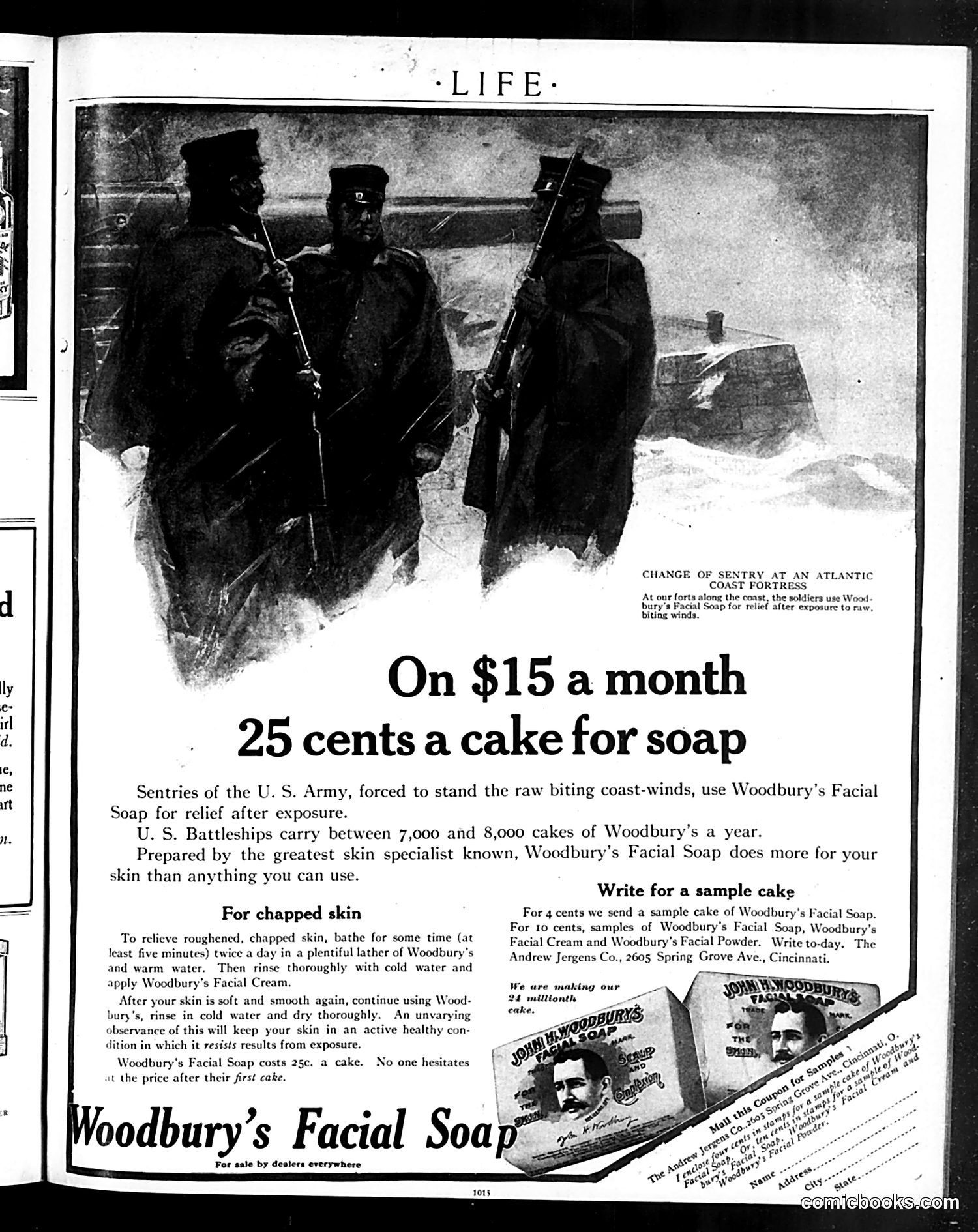
This is **not a political cartoon**—it's a commercial advertisement disguised as editorial content, a common practice in early 20th-century magazines. The page uses a photograph of U.S. Army sentries standing guard at a coastal fortress to advertise Woodbury's Facial Soap. The pitch is straightforward: soldiers earning $15/month spend 25 cents per cake on this soap to treat wind-chapped skin from standing exposed duty. The military context lends credibility—battleships allegedly carry 7,000-8,000 cakes annually. The "satire" (if any) is mild: the humorous juxtaposition of tough soldiers needing facial care products. The soap costs roughly equivalent to two days' wages, yet the ad claims "no one hesitates" after their first cake. This exemplifies early advertising's strategy of linking products to authority figures and real-world hardship to establish legitimacy and justify premium pricing to consumers.
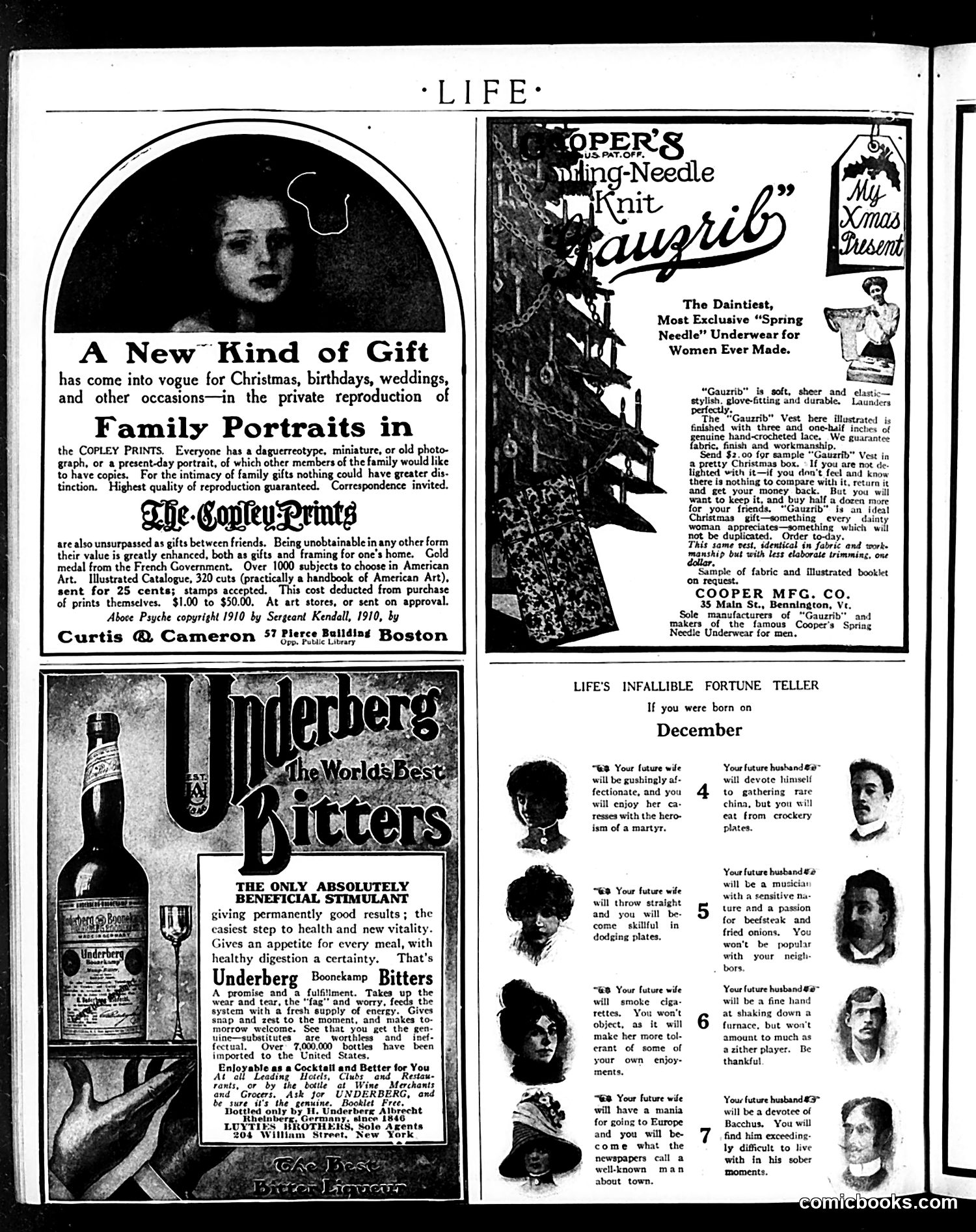
This page contains primarily **advertisements** interspersed with one humorous feature. The ads promote period luxury goods: Copley Prints (family portrait reproductions as gifts), Underberg Bitters (a digestive tonic marketed as a health stimulant), and Gauzrib underwear for women. The only satirical content is **"Life's Infallible Fortune Teller,"** a humor column predicting the romantic futures of people born in December. It mocks marital life through exaggerated scenarios: a wife who throws dishes (dodging plates as a "skill"), smoking wives, European travel obsessions, and mismatched domestic luxuries (rare china versus crockery plates). The jokes work by inverting romantic expectations—presenting marital annoyances as inevitable "fortunes"—and targeting upper-class concerns (collecting fine china, European travel) with working-class realities. This reflects Life's satirical approach to American social pretensions.
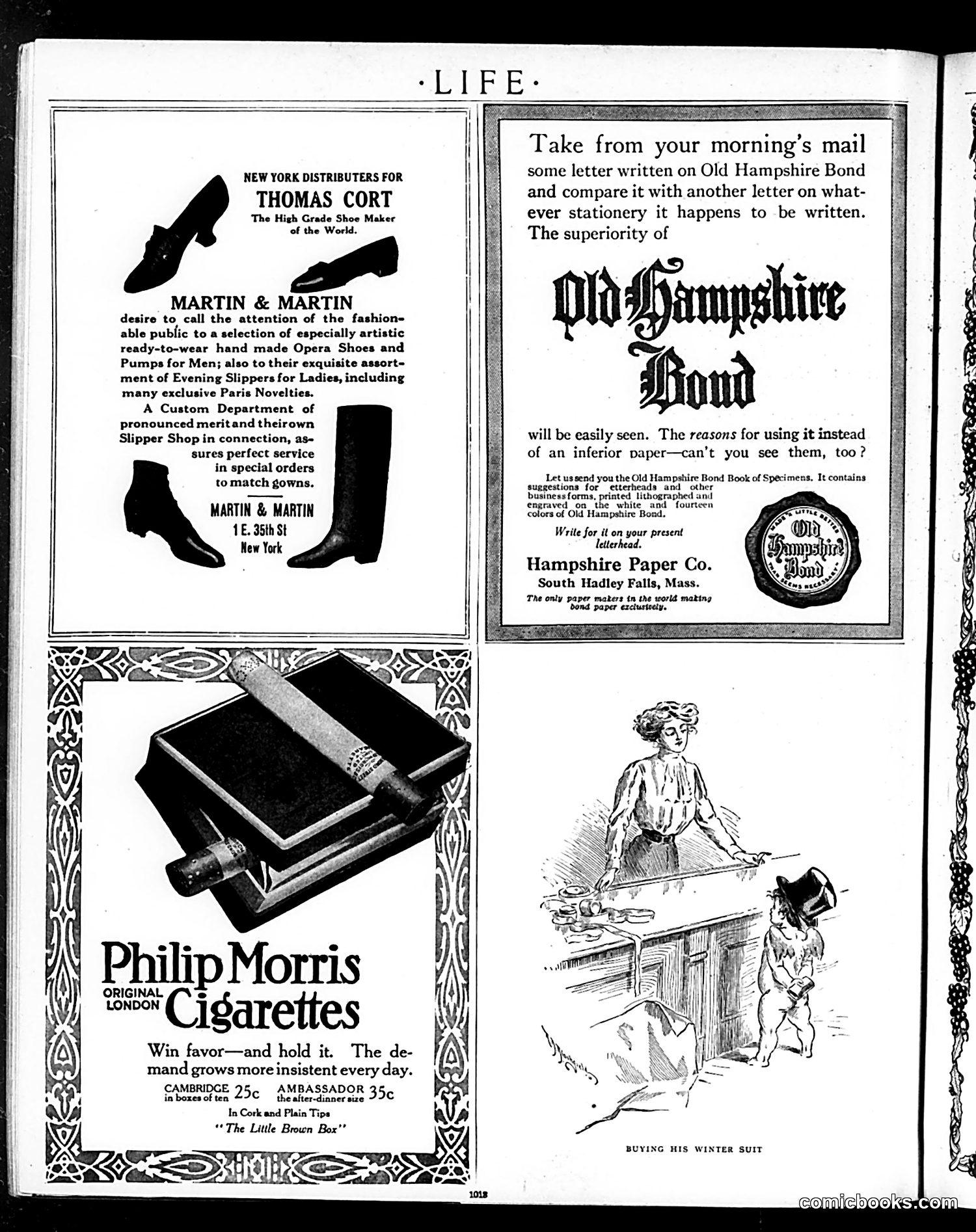
This is a page of vintage advertisements from *Life* magazine, not political cartoons or satire. It contains four commercial advertisements: 1. **Martin & Martin** (shoes): Promotes handmade opera shoes, pumps, and evening slippers for men and women, with a custom department in New York. 2. **Hampshire Paper Co.**: Advertises Old Hampshire Bond stationery, arguing its superiority by suggesting readers compare it to ordinary paper. Claims to be "the only paper makers in the world making bond paper exclusively." 3. **Philip Morris Cigarettes**: Notes growing demand, advertises pricing (29¢ and 35¢ boxes), and mentions varieties: Cork and Plain Tips, including "The Little Brown Box" brand. 4. **Thomas Cort**: Lists New York distributors for shoes. The small illustration titled "Buying His Winter Suit" appears to be a humorous social sketch unrelated to the advertisements. This is purely commercial advertising with no political content or satire.
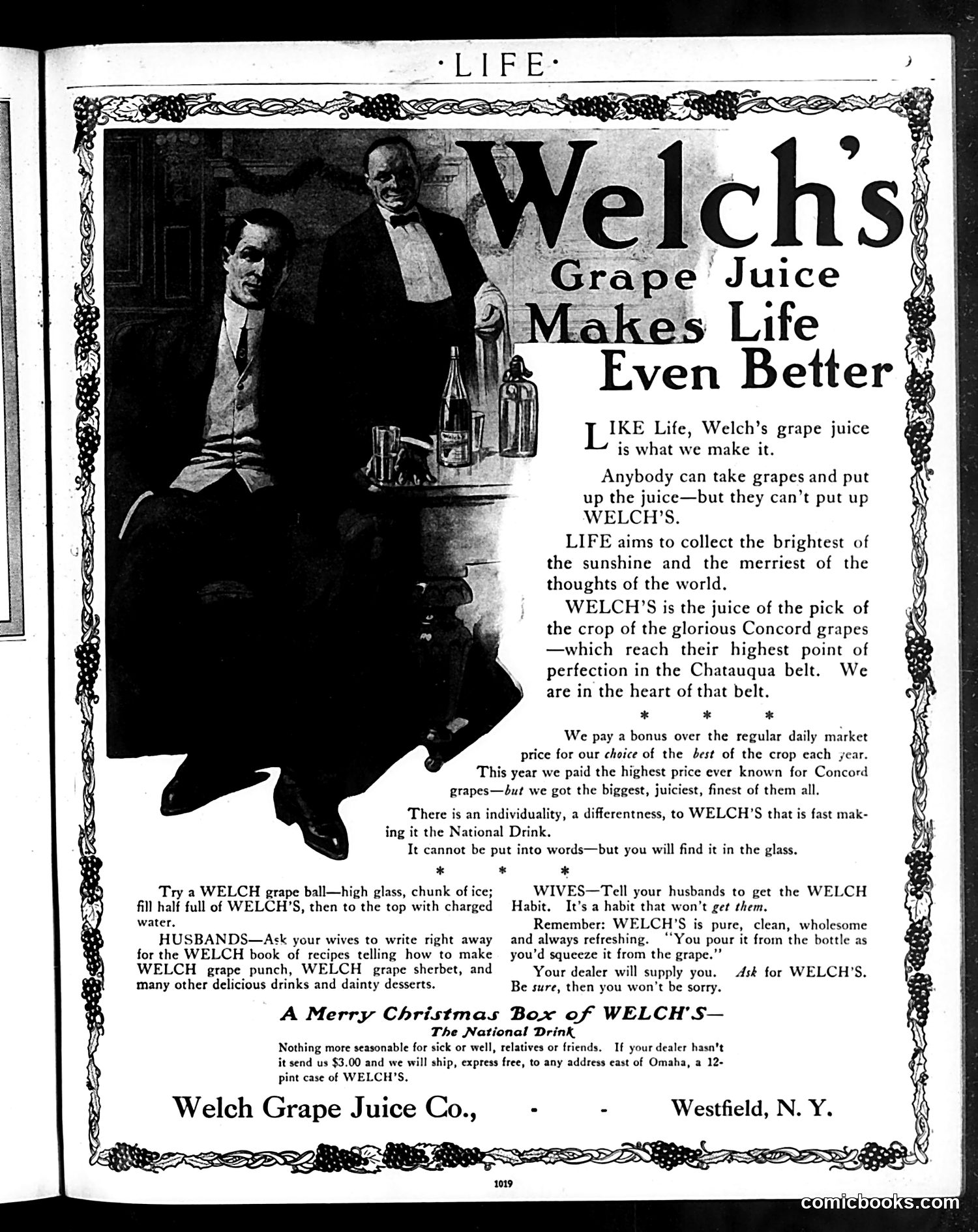
This is a full-page advertisement, not political satire. The image shows two men in business attire examining bottles of Welch's grape juice, establishing the product as a sophisticated, respectable beverage. The ad's humor is gentle and social rather than satirical. It plays on gender roles common to early 20th-century advertising: husbands are urged to adopt the "Welch Habit," while wives are instructed to request recipe books and encourage their husbands' consumption. The copy positions grape juice as a wholesome, pure "National Drink"—notably emphasizing its non-alcoholic virtue during the Prohibition era (though the date isn't specified here). The rhetorical strategy flatters the product as exceptional and difficult to imitate, while the decorative border and formal layout signal respectability. The Christmas gift suggestion and regional marketing (mentioning Omaha) reflect period sales tactics.
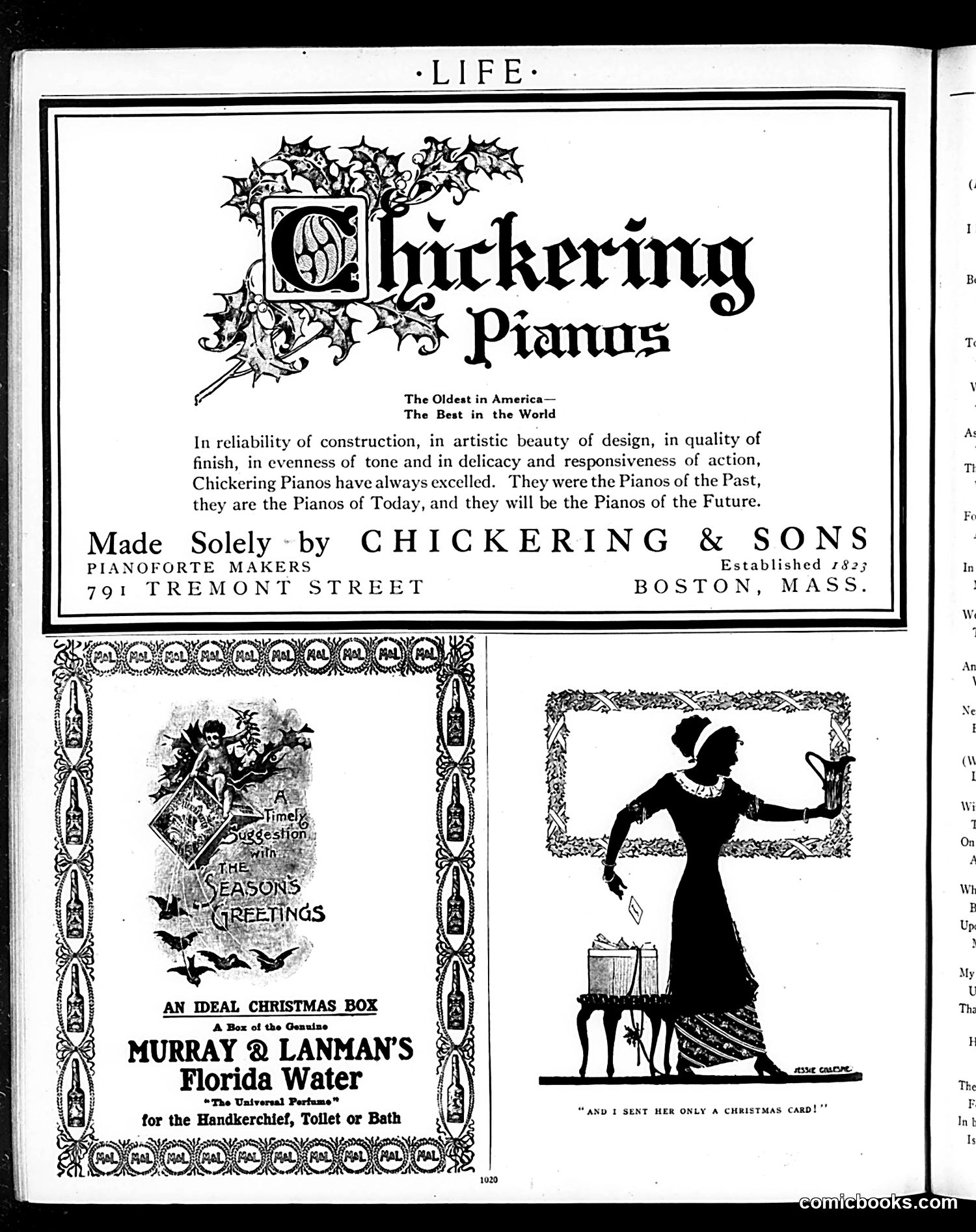
This page is primarily **advertising**, not satire or political commentary. It contains three advertisements for luxury goods: 1. **Chickering Pianos** (top): A Boston piano maker emphasizing their 1823 heritage and quality craftsmanship as a prestige Christmas gift. 2. **Murray & Lanman's Florida Water** (bottom left): A perfume marketed as an "ideal Christmas box" for grooming. 3. **A Christmas card scene** (bottom right): A silhouette illustration captioned "And I sent her only a Christmas card!" — a humorous advertisement playing on the awkwardness of giving an inexpensive gift when more lavish presents are expected. The page reflects early 20th-century consumer culture and holiday gift-giving expectations, targeting affluent readers. The cartoon on the right gently mocks those giving modest gifts during the Christmas season when larger purchases were customary among the wealthy.
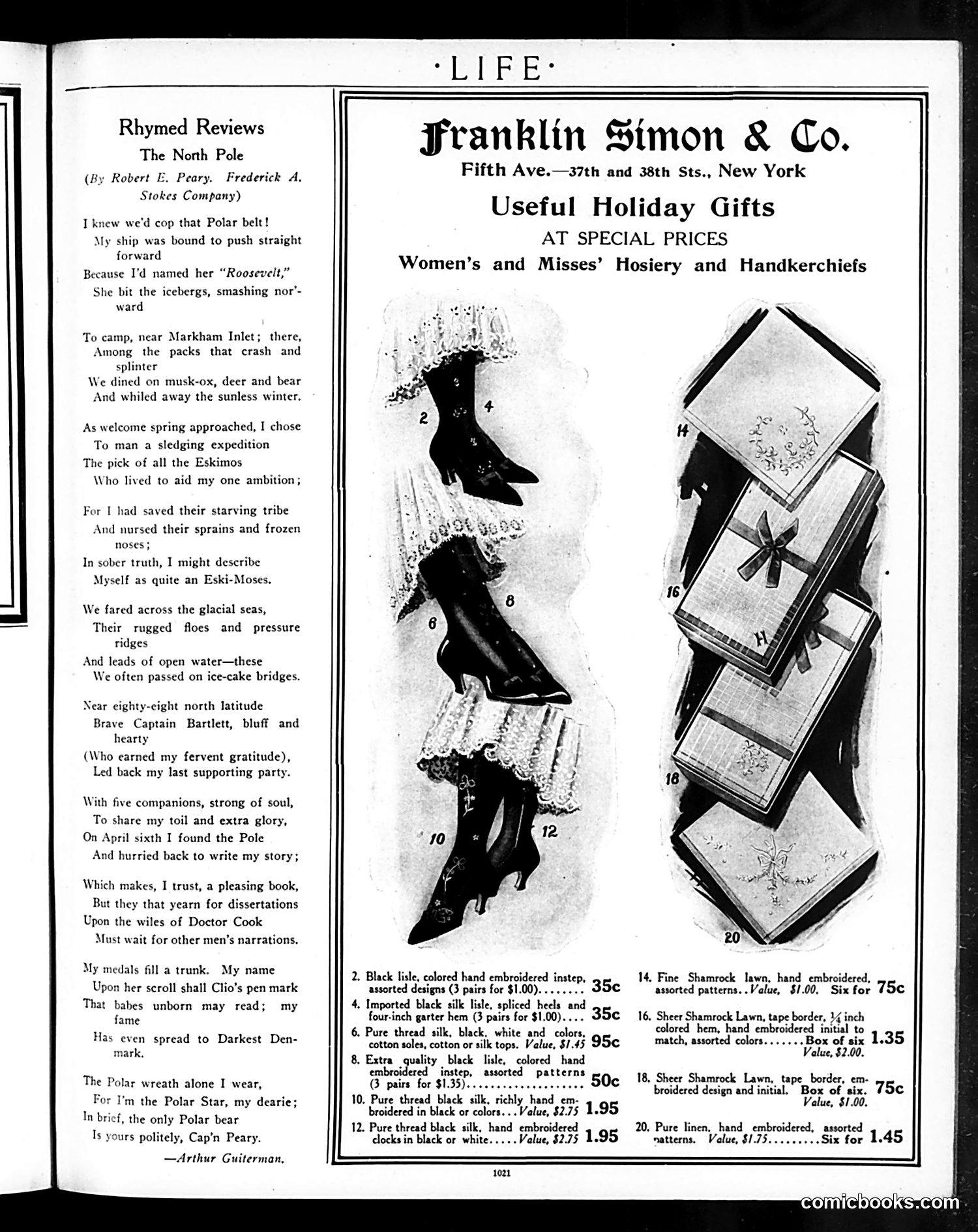
This page contains a **book review poem** (not a political cartoon) plus an advertisement. **The Poem:** Arthur Guiterman satirizes explorer Robert Peary's account of reaching the North Pole. The satire mocks Peary's self-aggrandizement—he names his ship "Roosevelt" (then-President Theodore Roosevelt) for good luck, credits himself with saving Eskimos, and boasts that his medals "fill a trunk." The final lines parody his vanity: he's the only "Polar bear" (pun on "Polar" explorer), claiming sole glory. The reference to "Doctor Cook" alludes to Frederick Cook, a rival explorer who also claimed reaching the Pole around the same time (1908-1909), creating public controversy over who actually got there first. Guiterman's joke: Peary won't discuss Cook's competing claims. **The Advertisement:** The rest of the page is a Franklin Simon & Co. holiday gift catalog for women's hosiery and handkerchiefs—entirely separate from the satirical poem above it.
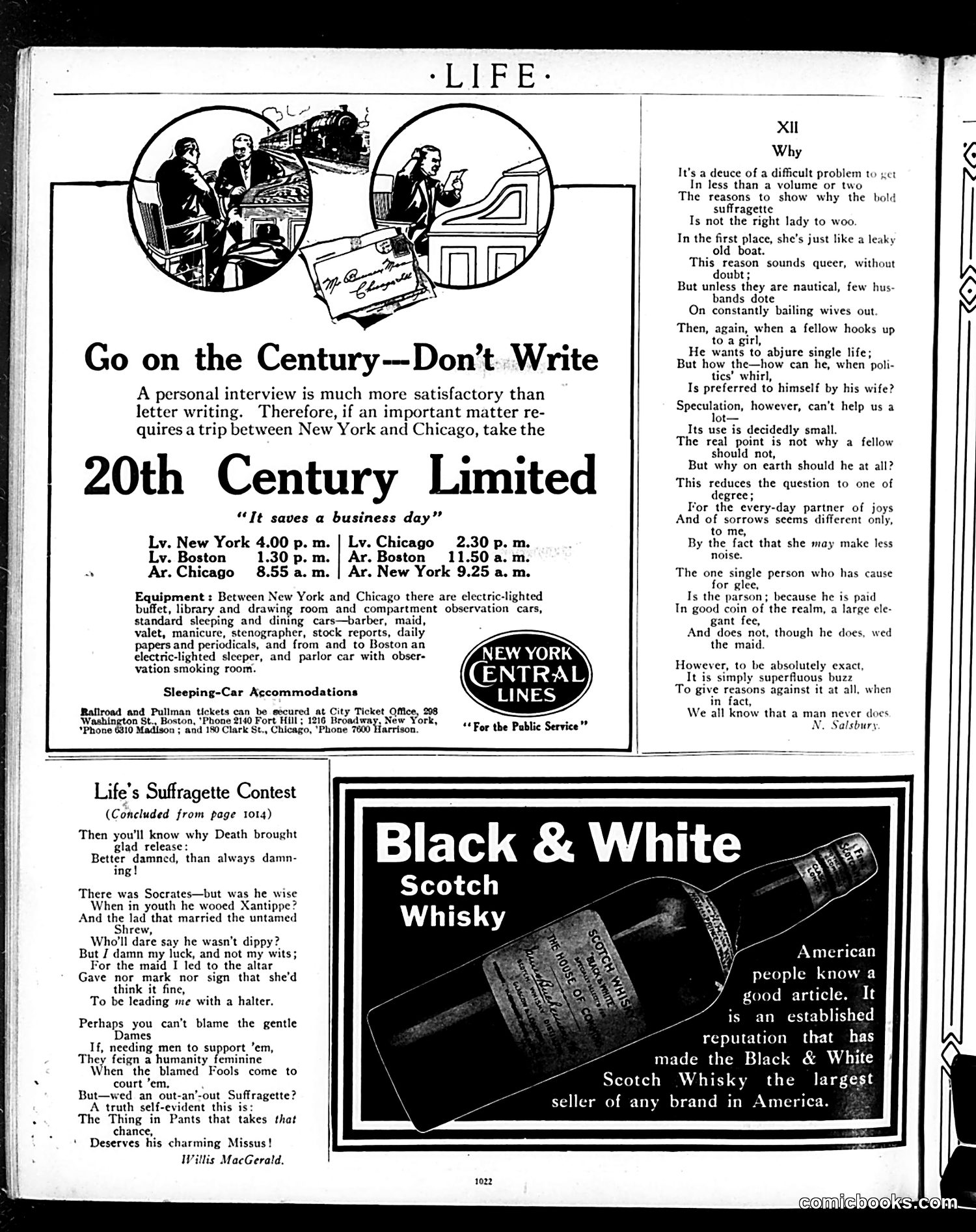
This page contains **railroad and whiskey advertisements** alongside **satirical poetry about suffragettes**. The main advertisement promotes the "20th Century Limited" train service between New York and Chicago, emphasizing speed for business travel—"It saves a business day." The satirical content is a poem titled "Why," mocking men who might marry suffragettes (women's voting rights activists). The poet argues suffragettes make poor wives because they're preoccupied with politics rather than domestic life, comparing one to "a leaky old boat" requiring constant "bailing out." The humor relies on the period's anti-feminist sentiment, portraying political women as undesirable partners. The poem concludes cynically that men never act rationally in marriage anyway. A secondary section, "Life's Suffragette Contest," contains additional mocking verses about marriage to activist women, using historical examples like Socrates' wife Xantippe. The Black & White Scotch Whisky advertisement claims market dominance through simple product endorsement.
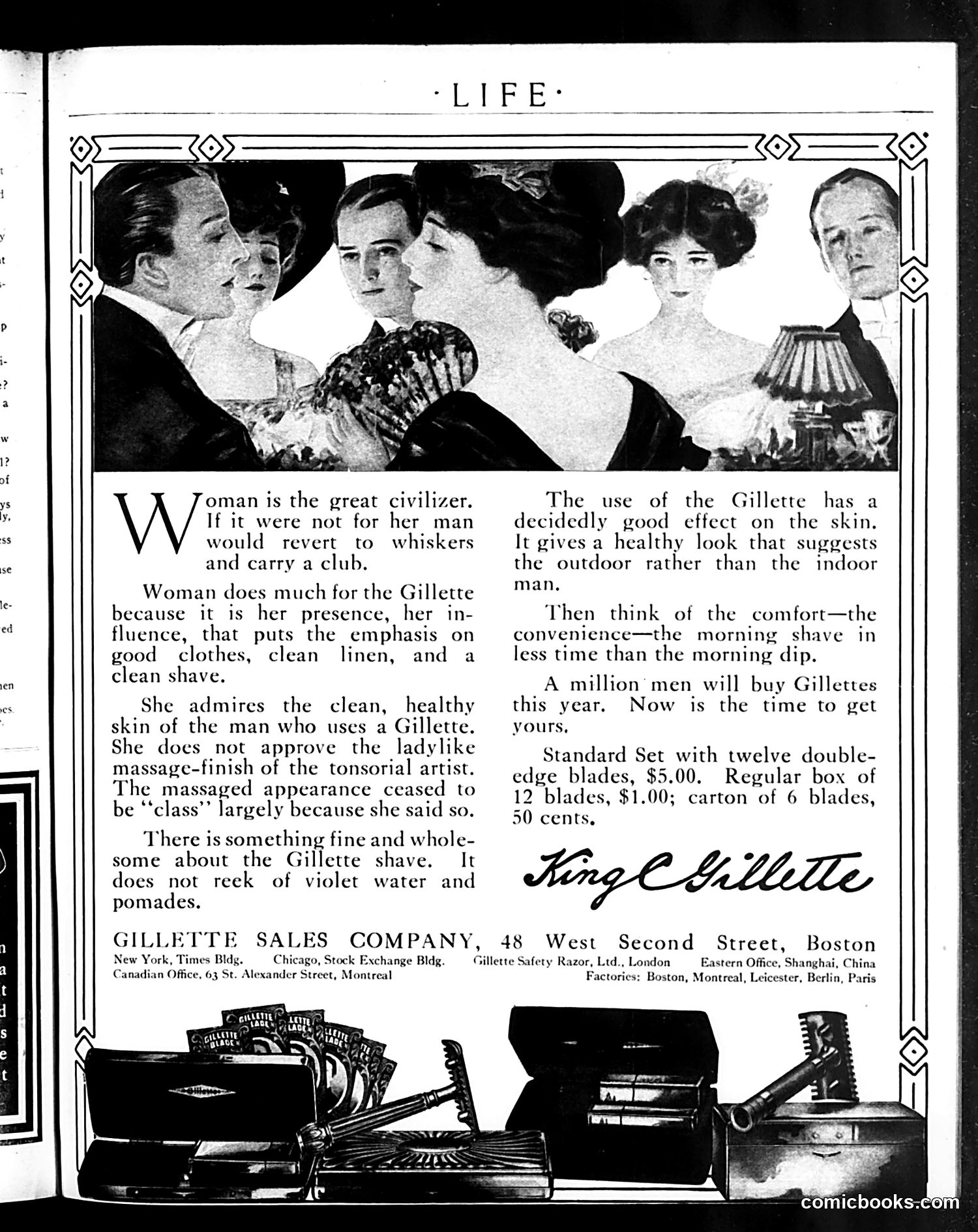
This is a **Gillette Safety Razor advertisement**, not political satire. It promotes the Gillette brand by arguing that women civilize men and prefer clean-shaven partners. The ad's central claim: women's influence drives men toward grooming standards. It contrasts the "Gillette shave"—presented as natural, healthy, and masculine (suggesting "outdoor" vitality)—against the "massage-finish" of professional barbers, dismissed as effeminate ("ladylike") and overly perfumed. The illustration shows well-dressed men and women, implying that using Gillette elevates one's social standing. The text appeals to masculine pride: proper shaving is "class," not vanity, and a million men will buy Gillettes because women demand it. This reflects early 20th-century advertising strategy: marketing safety razors by linking them to masculine virtue and female approval simultaneously.
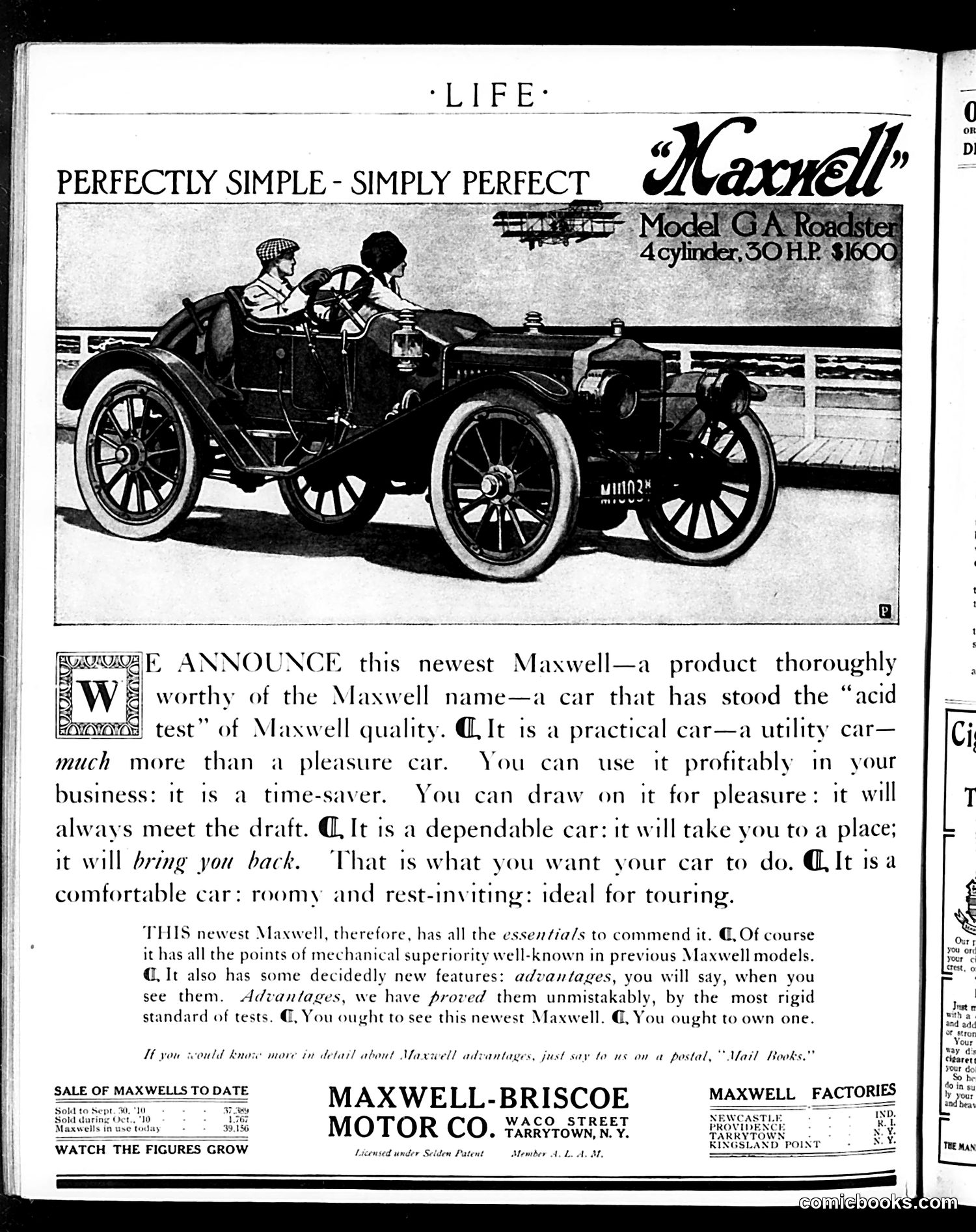
This is **not a cartoon or satire**—it's a straightforward automobile advertisement from *Life* magazine's early 1900s era. The page advertises the Maxwell Model GA Roadster, a 4-cylinder car priced at $1,600. The illustrated image shows two men in period dress (caps, suits) operating the vehicle, which was a common way to depict automobiles as modern, accessible technology for businessmen. The ad's pitch emphasizes practicality over luxury: the Maxwell is described as a "utility car" suitable for both business and pleasure, reliable enough to "bring you back," and comfortable for touring. The repetitive "¶" symbols (paragraph marks) structure the benefits claims. A small chart titled "SALE OF MAXWELLS TO DATE" with "WATCH THE FIGURES GROW" tracks sales growth, a marketing tactic suggesting the car's rising popularity and success. The manufacturer was Maxwell-Briscoe Motor Co., located in Tarrytown, New York. This represents early American automobile marketing aimed at middle-class buyers.
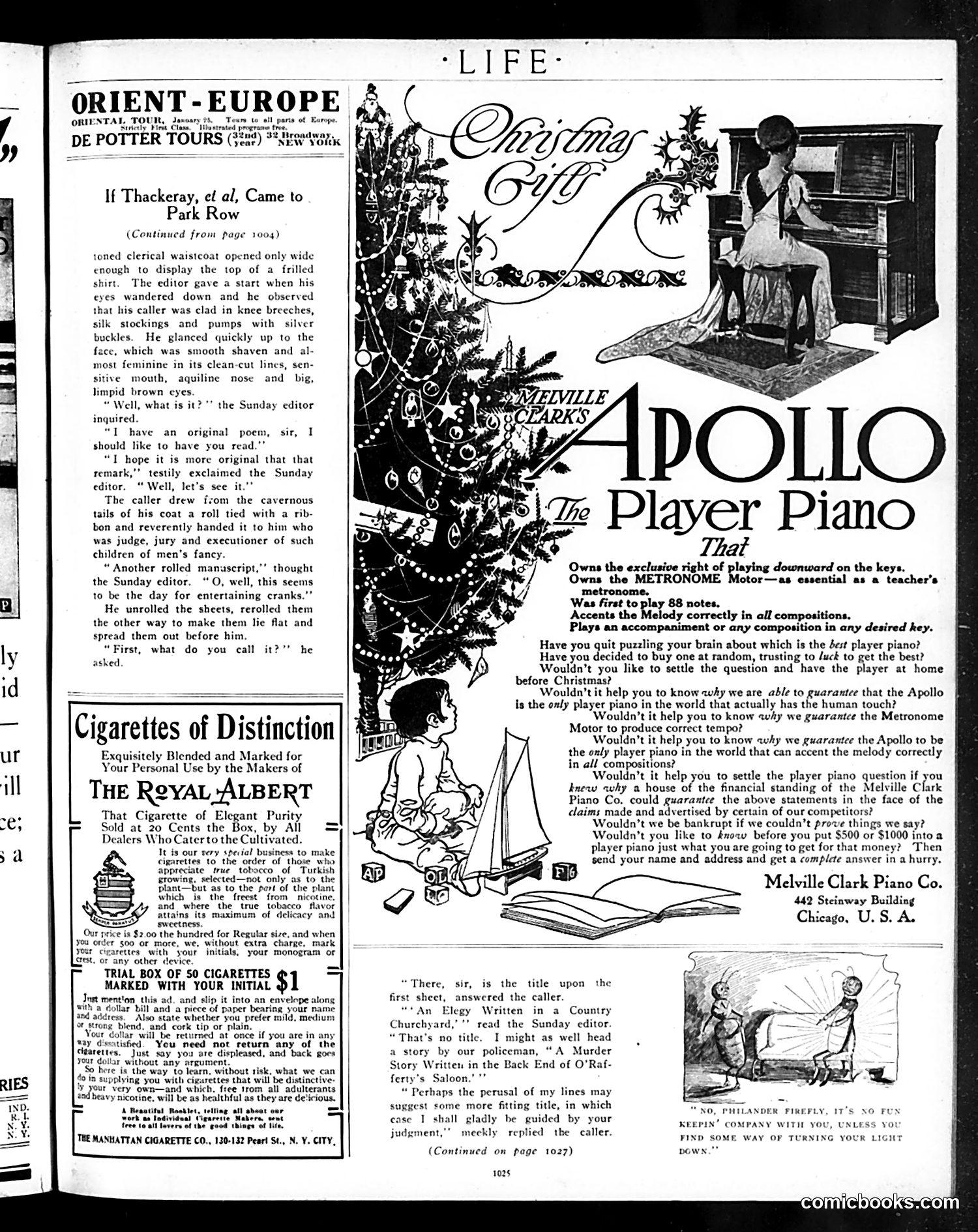
This page contains a serialized story titled "If Thackeray, et al, Came to Park Row"—a satirical piece imagining famous 19th-century literary figures visiting a modern (1920s) newspaper office. The excerpt describes an editor's encounter with a visitor dressed in anachronistic 18th-century attire: knee breeches, silk stockings, silver-buckled pumps, and a frilled shirt. The visitor appears to be presenting an original poem. The editor dismisses him dismissively as another "crank," reflecting the satirical point: even celebrated historical authors would be rejected by modern editors as mere eccentrics. The joke targets both the pretentiousness of historical literary figures and the philistinism of contemporary newspaper editors who reject genuine artistry. The page also features advertisements for the Apollo Player Piano and Royal Albert cigarettes—typical early-20th-century luxury goods marketing.
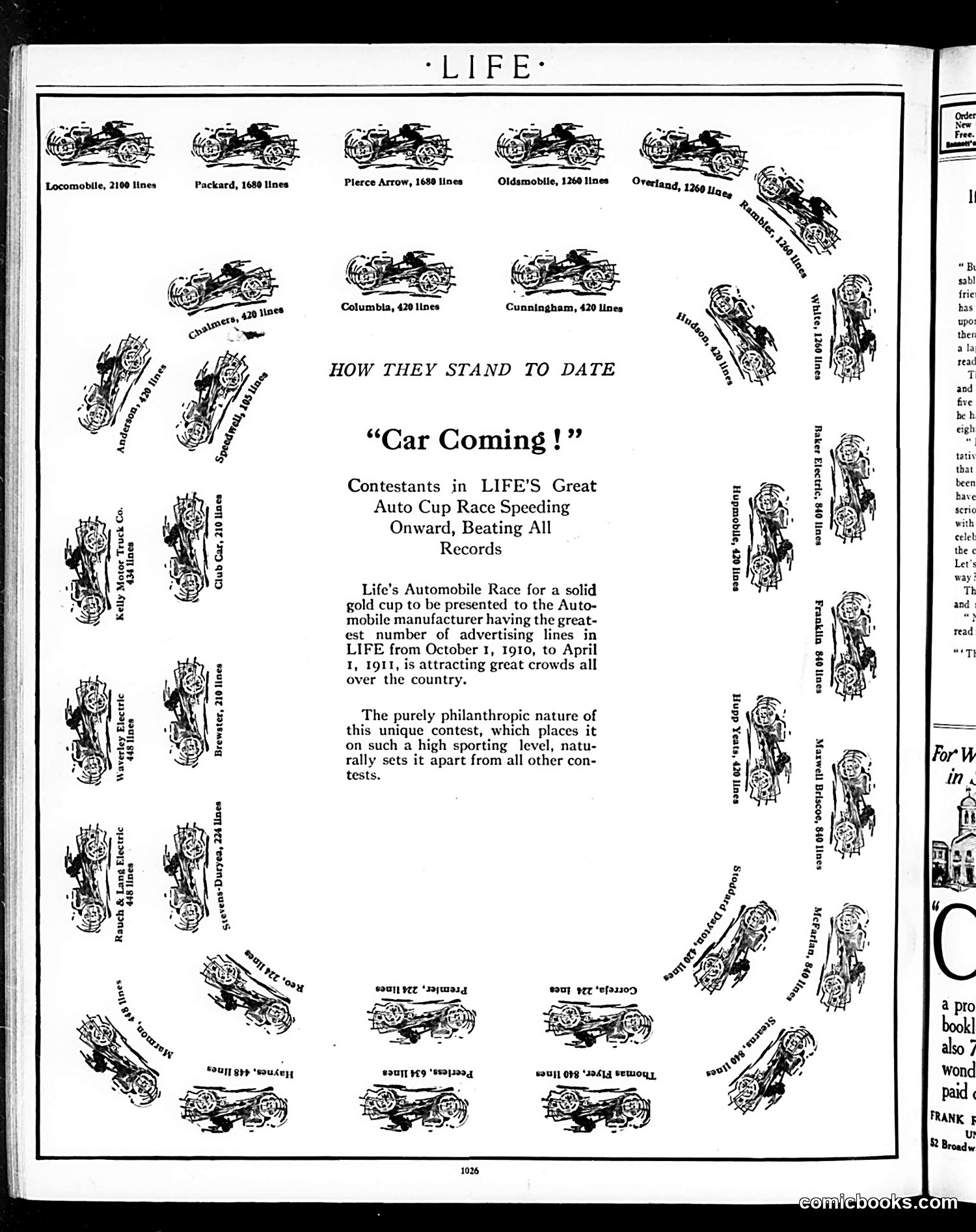
This is an advertisement/promotion for a competition among automobile manufacturers. From October 1910 to April 1911, LIFE magazine ran a "Great Auto Cup Race"—not an actual vehicle race, but a contest measuring which car company purchased the most advertising space in the magazine itself. The page lists competitors (Locomobile, Packard, Pierce Arrow, Oldsmobile, etc.) ranked by "lines" of advertising they've purchased. The humor lies in LIFE's self-aware irony: they're marketing this as a prestigious "sporting" competition with a solid gold trophy, when it's purely a scheme to sell more ad space. The text even admits the contest is "philanthropic" and "sets it apart from all other contests"—tongue-in-cheek language acknowledging this is really just competitive advertising spending disguised as sport. This reflects early-1900s magazine economics: publications relied heavily on advertising revenue and used creative promotions to boost corporate ad purchases.
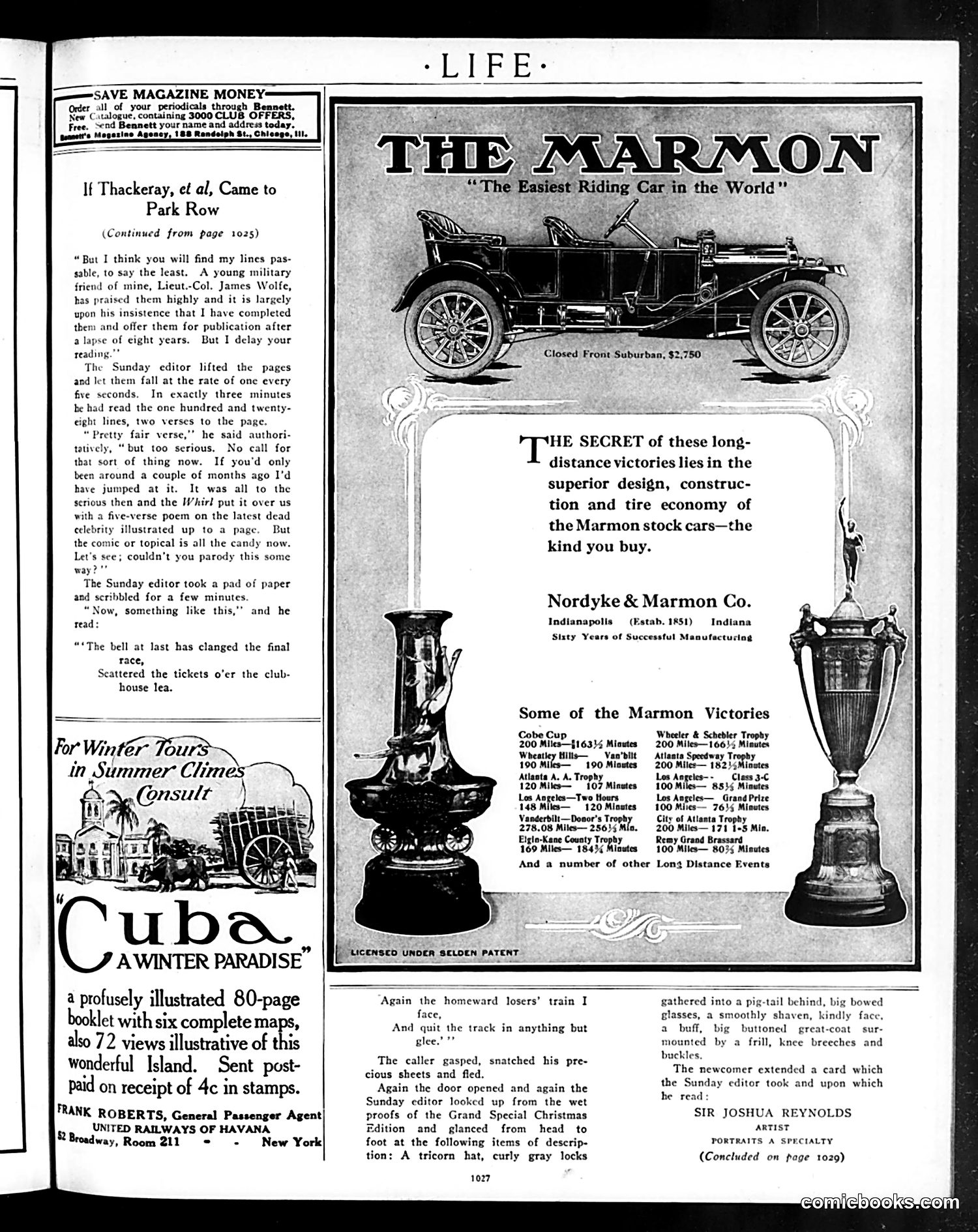
This page is primarily **advertising**, dominated by a full-page Marmon automobile advertisement featuring the car as "The Easiest Riding Car in the World," with trophies and a list of racing victories. The left column contains a satirical fiction piece titled "If Thackeray, et al, Came to Park Row" (continued from an earlier page). The narrative depicts a historical literary figure submitting serious verse to a modern Sunday newspaper editor, who dismisses it as uncommercial. The editor rewrites the poem as frivolous doggerel about horse racing—mocking how contemporary newspapers prioritize entertainment and "topical" comic content over serious literature. The joke: **What sold newspapers in the early 1900s was light, timely humor, not classical poetry**—a critique of lowbrow editorial tastes. The piece concludes with another famous historical figure (Sir Joshua Reynolds, the 18th-century painter) arriving, suggesting further satirical commentary on how modern journalism treats serious artists. The Cuba travel advertisement appears at bottom left.
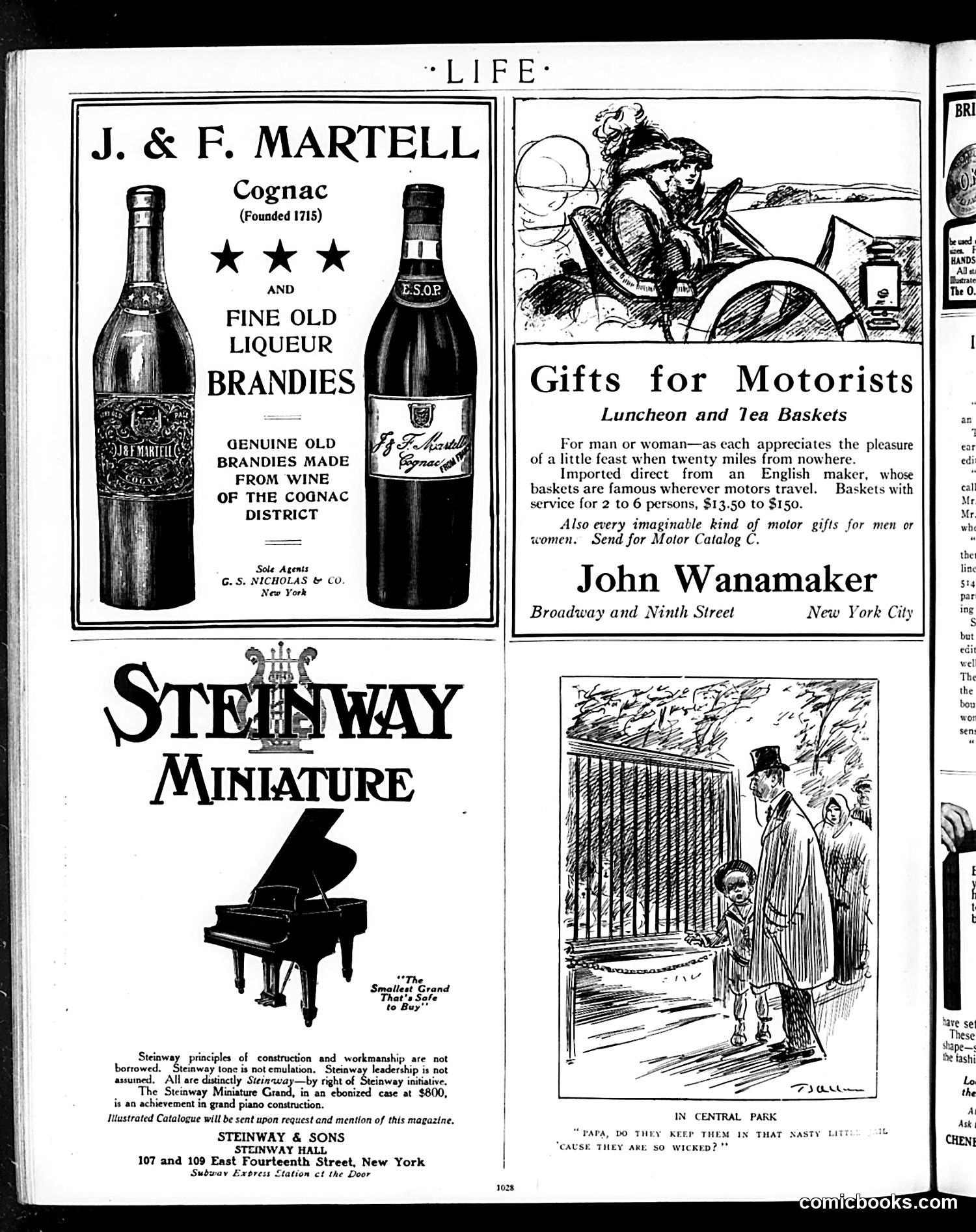
This page is primarily **advertising**, featuring luxury goods of the era: cognac, motorist gift baskets, and Steinway pianos. The ads reflect upper-class American consumer culture. The only cartoon appears at the bottom: a sketch in Central Park showing a child asking their father about animals kept in an enclosure, suggesting they're "wicked." The humor relies on the child's innocent misinterpretation—likely the child has confused the purpose of the zoo or animal pen with moral judgment about the creatures. This reflects period attitudes toward animals and parenting: the cartoon's gentle satire pokes fun at how children anthropomorphize animal behavior and adults' attempts to explain nature to them. The "nasty" and "wicked" language suggests the child has overheard adult gossip and applied it literally to animals. The overall page reflects Life's mix of satirical cartoons with upscale advertising targeting wealthy readers.
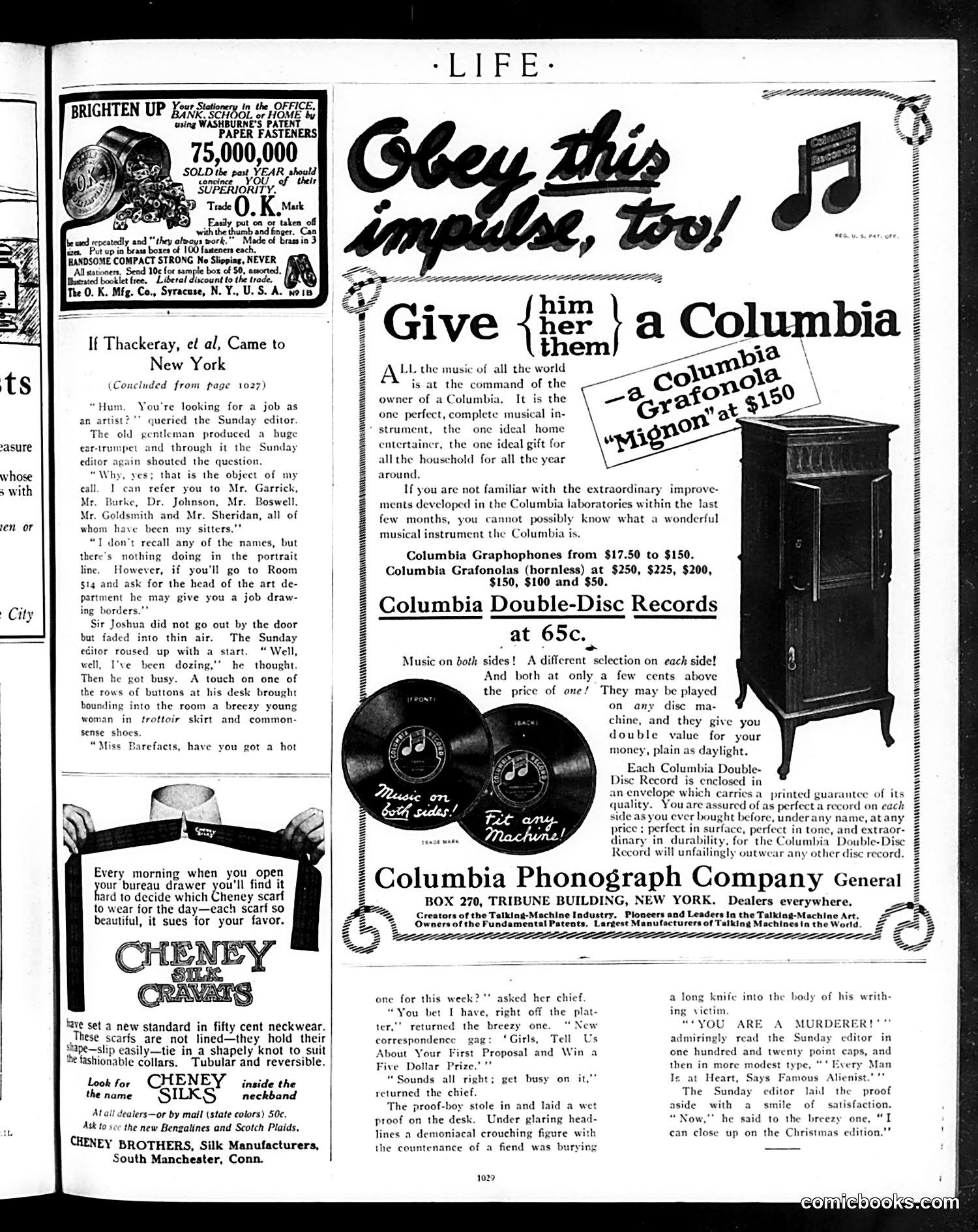
This page from *Life* magazine is primarily **advertising content**, not satire or political cartoons requiring historical interpretation. The main feature is a large **Columbia Phonograph advertisement** promoting gramophones and records. The ad uses the slogan "Obey this impulse, too!" to encourage purchasing Columbia products, emphasizing their superior sound quality and affordability (records at 65 cents, machines from $17.50–$250). Supporting advertisements include: - **Washburne's Patent Paper Fasteners** (75 million sold) - **Cheney silk scarves** (50 cents) - **Cheney Brothers neckwear** The page also contains a fictional narrative titled "If Thackeray, et al, Came to New York," imagining famous 18th-century British literary figures (Thackeray, Garrick, Johnson, Goldsmith, Sheridan) attempting to find work in modern New York. The piece gently satirizes how quickly creative figures become forgotten or irrelevant, and how bureaucratic modern employment differs from historical patronage systems. No political agenda is evident; this is primarily a commercial publication page.
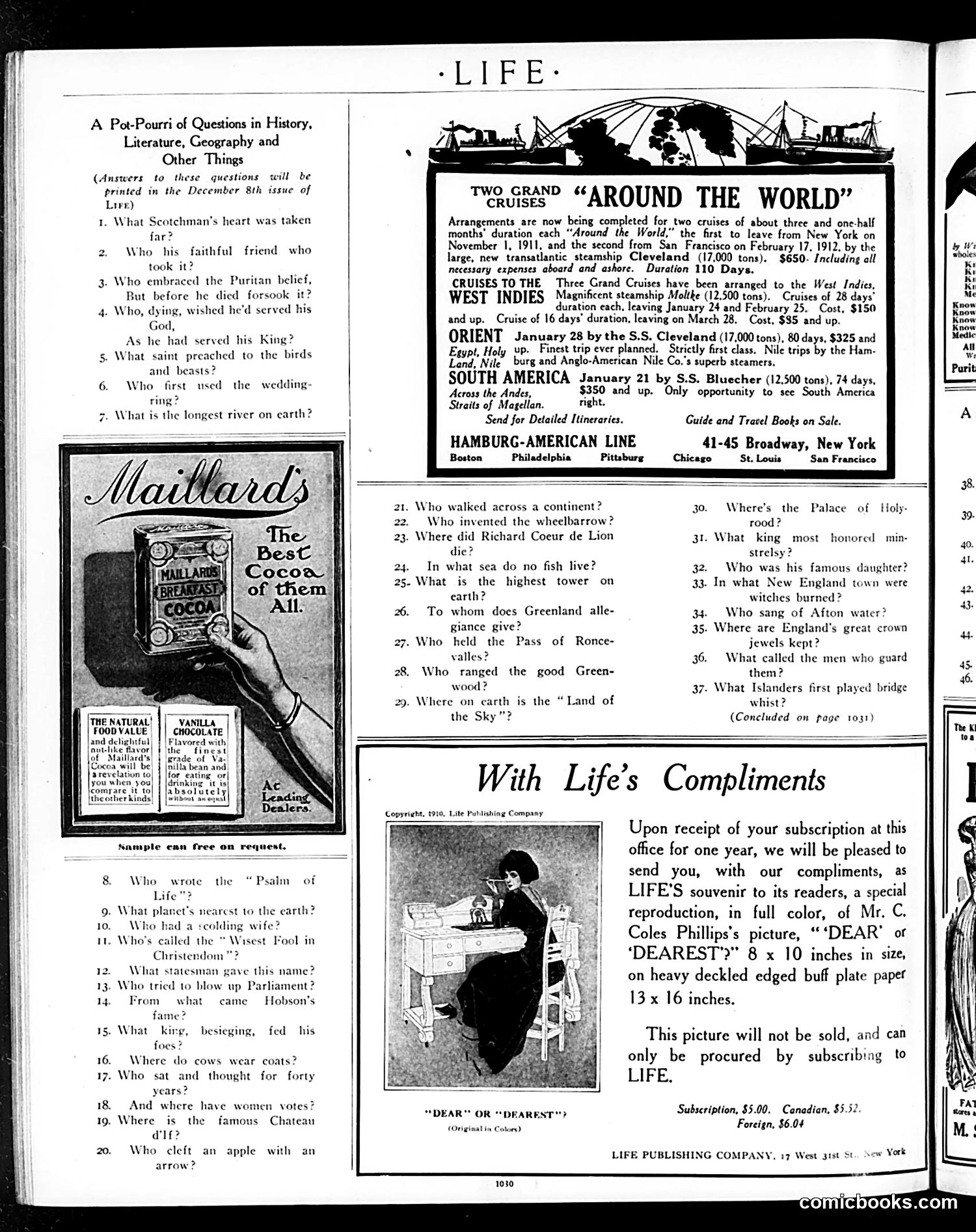
This page from Life (1910) is primarily **advertising and subscription material**, not political satire. The content includes: 1. **A trivia quiz** ("Pot-Pourri of Questions") covering history, literature, and geography—typical of early 20th-century magazines for reader engagement. 2. **Cruise advertisements** from the Hamburg-American Line promoting luxury voyages "Around the World" and to the Orient and West Indies—reflecting the era's expansion of leisure travel for the wealthy. 3. **A Maillard's Cocoa advertisement** promoting their chocolate product's "natural food value." 4. **A subscription offer**: Life promises new subscribers a reproduced C. Coles Phillips artwork titled "Dear" or "Dearest" (8x10 inches). Phillips was a popular illustrator of the era, known for glamorous female portraits. The page reflects **early 1900s consumer culture**—luxury travel, branded products, and magazines using attractive artwork as subscription incentives. There is no discernible political cartoon or social satire present on this particular page.
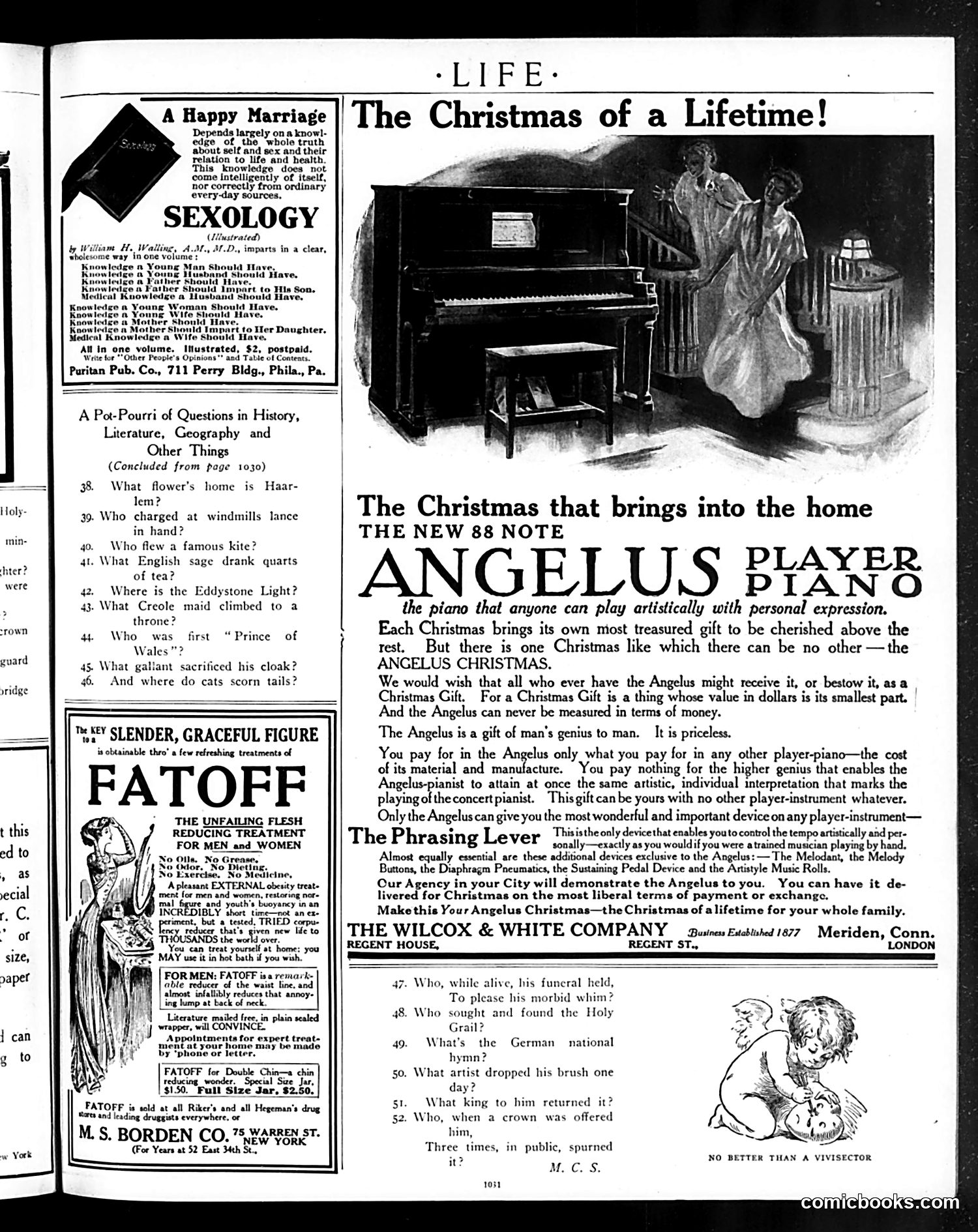
This page is primarily **advertising and educational content**, not political satire. The main elements are: **Left side**: Ads for "Sexology" (a marriage/sexual education book) and "Fatoff" (a weight-reduction treatment), reflecting early 1900s consumer products. The Fatoff ad promises obesity treatment without dieting or medicine—typical of dubious health claims of the era. **Right side**: A large advertisement for the Angelus Player Piano, featuring an idealized illustration of angelic figures and a piano in a home. The copy emphasizes the piano as the ultimate "Christmas gift"—positioning it as a luxury item conveying artistic refinement and personal expression, even for non-musicians (the "player" mechanism allows anyone to perform musically). **Bottom**: A trivia section ("Pot-Pourri of Questions") with literary and historical references. The content reflects **early 20th-century consumer culture**: selling self-improvement, domestic luxury, and aspirational lifestyle through appeals to health, education, and cultural refinement. There is no evident political satire on this particular page.
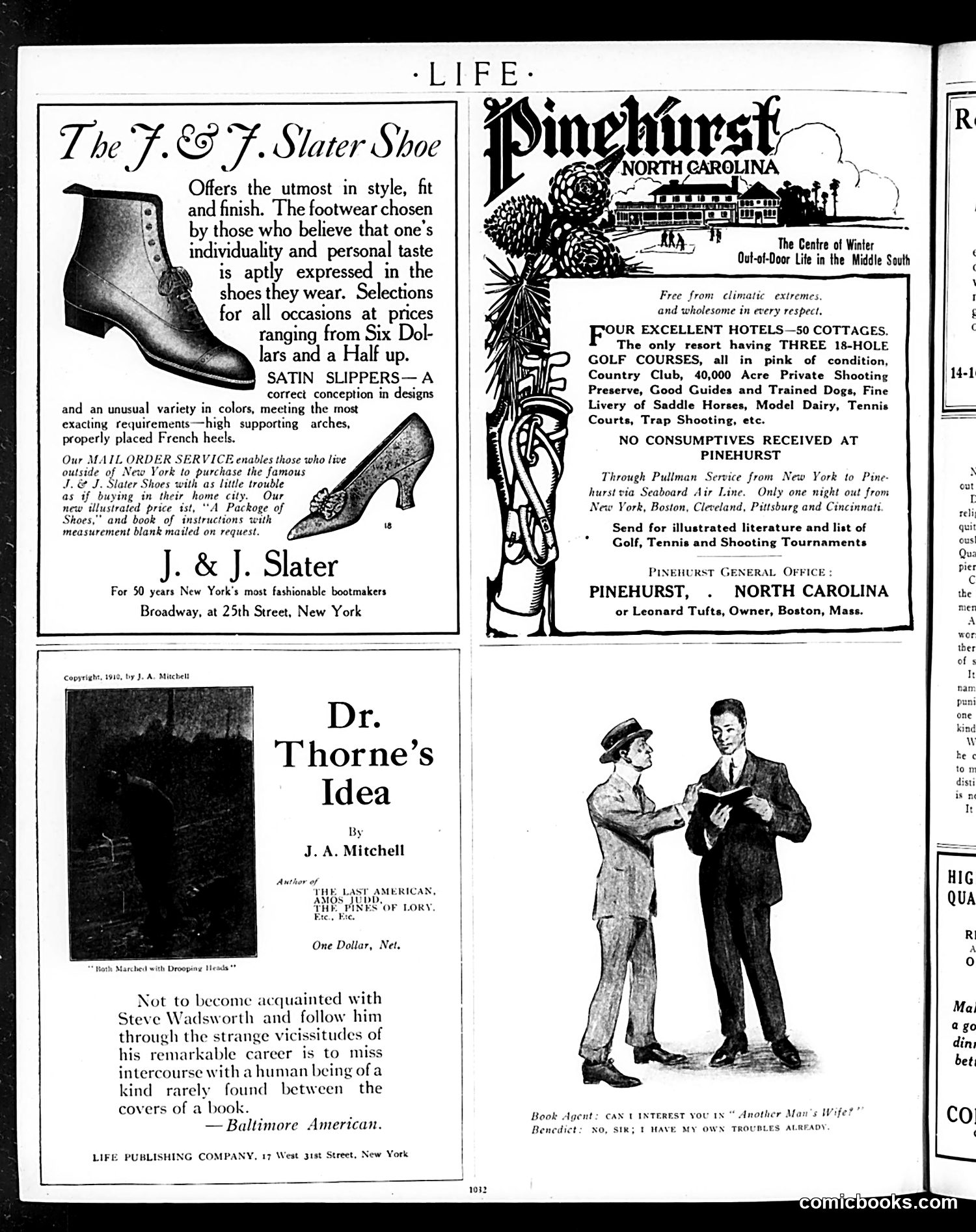
This page is primarily **advertising**, not political satire. It contains three distinct advertisements: 1. **J. & J. Slater Shoe** (top left): A standard luxury footwear ad emphasizing style, quality, and mail-order convenience for affluent customers. 2. **Pinehurst, North Carolina** (top right): A resort advertisement promoting winter leisure activities—golf courses, shooting, horseback riding—for wealthy clientele seeking escape from harsh northern climates. The restriction "NO CONSUMPTIVES RECEIVED" reflects period attitudes toward tuberculosis patients. 3. **Dr. Thorne's Idea** (bottom): A book advertisement by J.A. Mitchell. The cartoon shows two men discussing the novel; the caption jokes that one declines interest in reading about "Another Man's Wife," claiming he has "troubles already"—likely a mild domestic humor reference typical of the era. The page reflects early 20th-century advertising targeting the affluent leisure class, with no apparent political content.
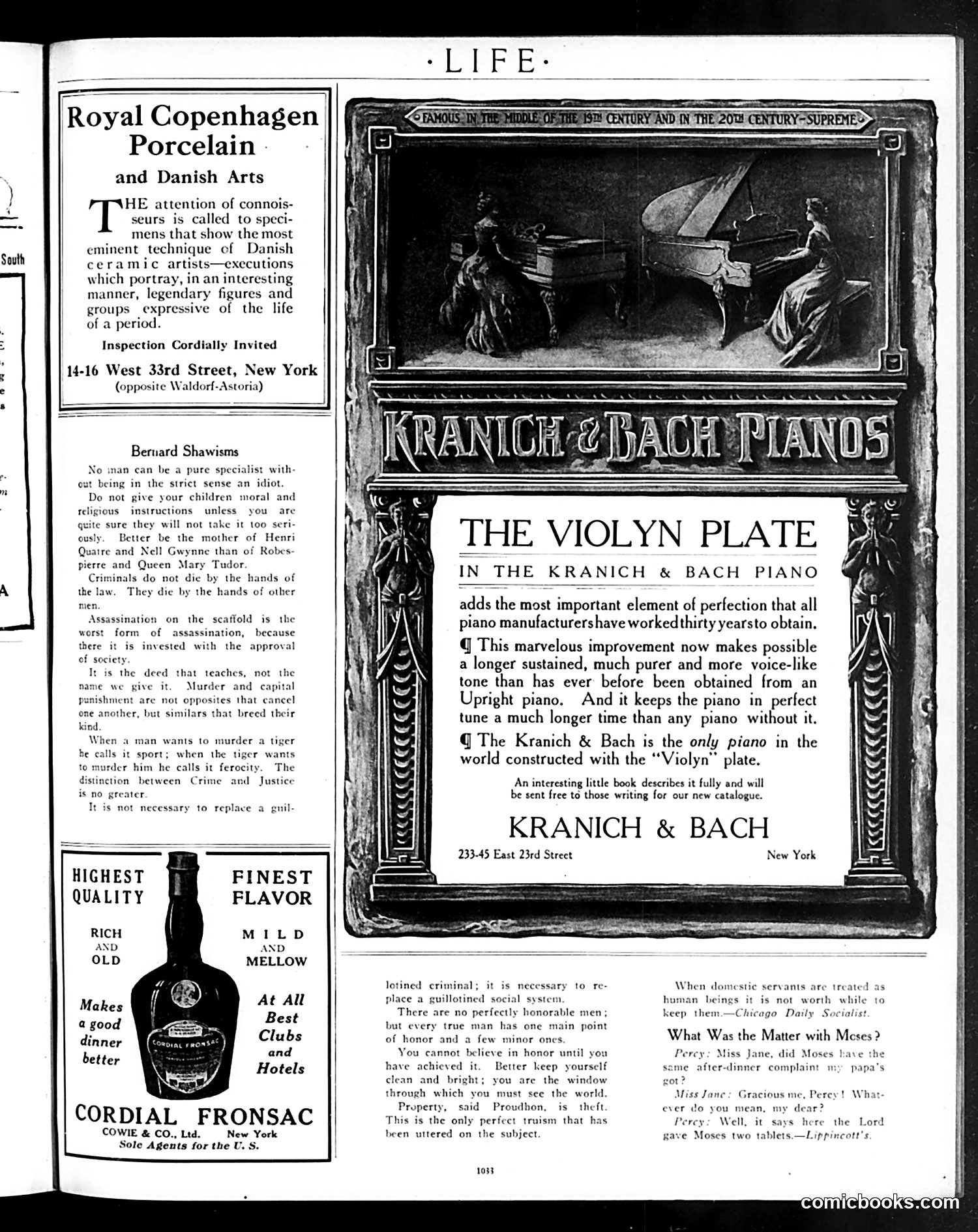
This page is primarily **advertising**, not political satire. It features commercial advertisements interspersed with a "Bernard Shawisms" column—quotations attributed to playwright George Bernard Shaw. The Shaw quotes present his iconoclastic views on morality, crime, and social systems. He argues that specialists without broad knowledge are "idiots," that religious instruction is often harmful, and that capital punishment is ineffective because the real problem is the "guillotined social system," not individual criminals. His assertion that "Property...is theft" references socialist philosophy. The advertisements promote Royal Copenhagen porcelain, Kranich & Bach pianos (featuring their patented "Violyn plate"), and Cordial Fronsac cognac. At the bottom, humorous brief exchanges ("What Was the Matter with Moses?") use wordplay—one joke plays on "tablets" (the biblical stone tablets versus medicinal tablets for indigestion). The page reflects early 20th-century Life magazine's format: mixing social commentary through Shaw's aphorisms with luxury goods advertising.
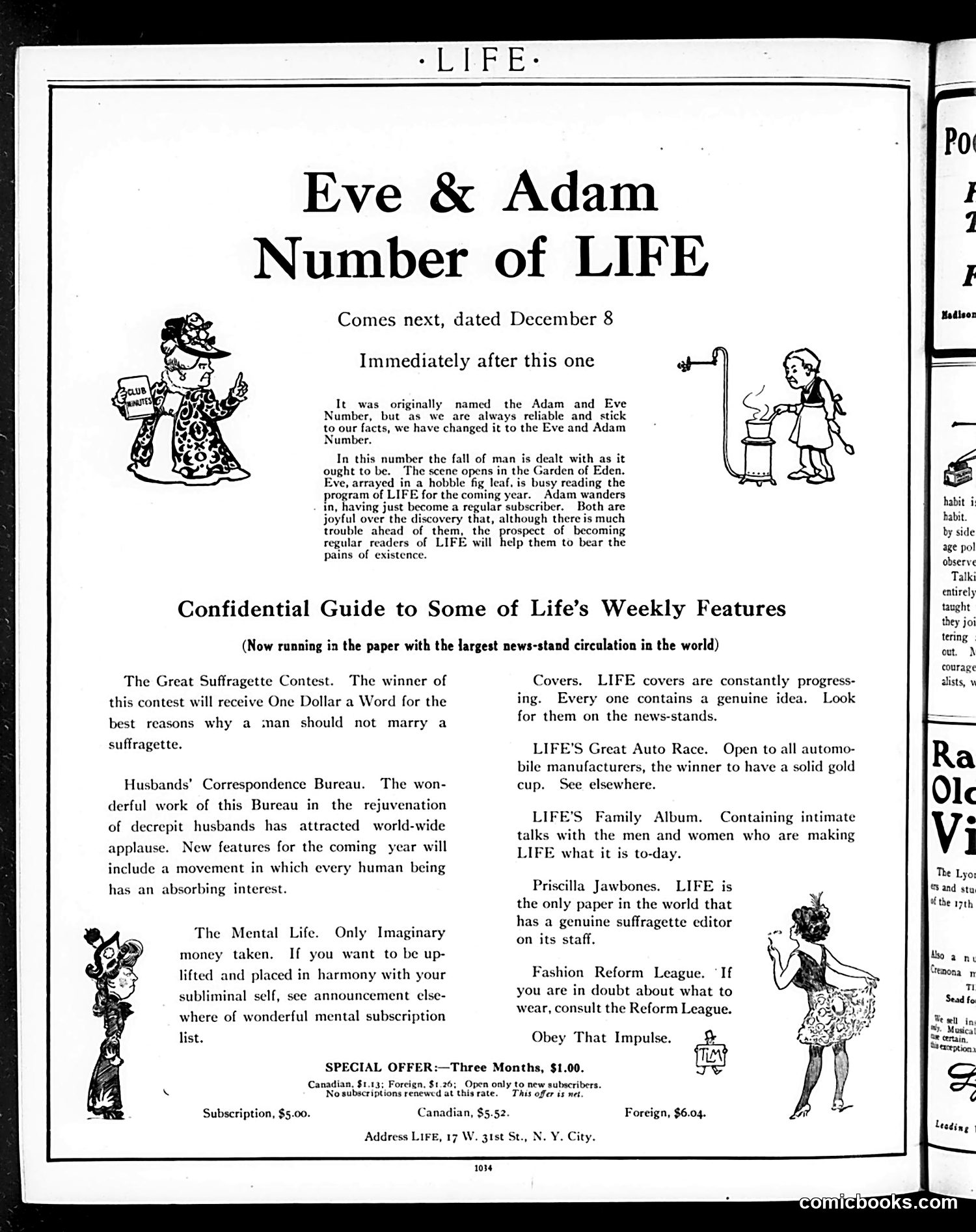
This is a house advertisement promoting an upcoming issue of *Life* magazine (dated December 8). The page uses biblical references to satirize contemporary social debates, particularly women's suffrage and changing gender roles. **The Setup:** Eve sits reading *Life*'s program while wearing only a "hobble fig leaf" (a joke about the restrictive hobble skirt fashion trend). Adam has become a subscriber. The satire suggests that even facing "trouble ahead," they'll find comfort in reading *Life*. **The Featured Columns Mocked:** - **"Great Suffragette Contest"**: Readers submit reasons why men shouldn't marry suffragettes—mocking anti-suffrage sentiment - **"Husbands' Correspondence Bureau"**: Promises to rejuvenate "decrepit husbands"—satirizing marriage dynamics - **"Priscilla Jawbones"**: Identified as *Life*'s "suffragette editor" - **"Fashion Reform League"**: Pokes fun at women's dress reform advocates The overall tone ridicules both progressive reformers AND their conservative critics, positioning *Life* as the sophisticated arbiter of these debates.
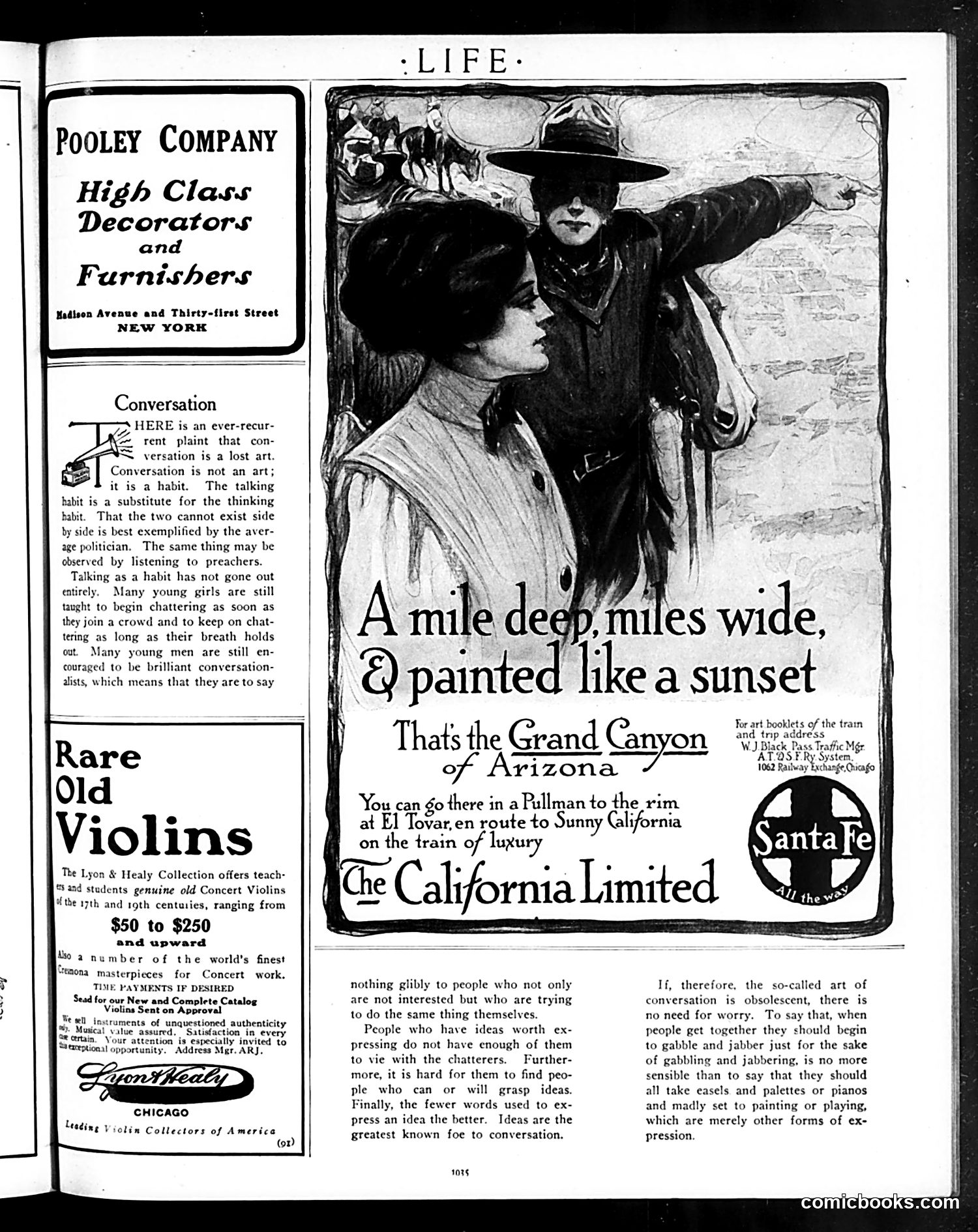
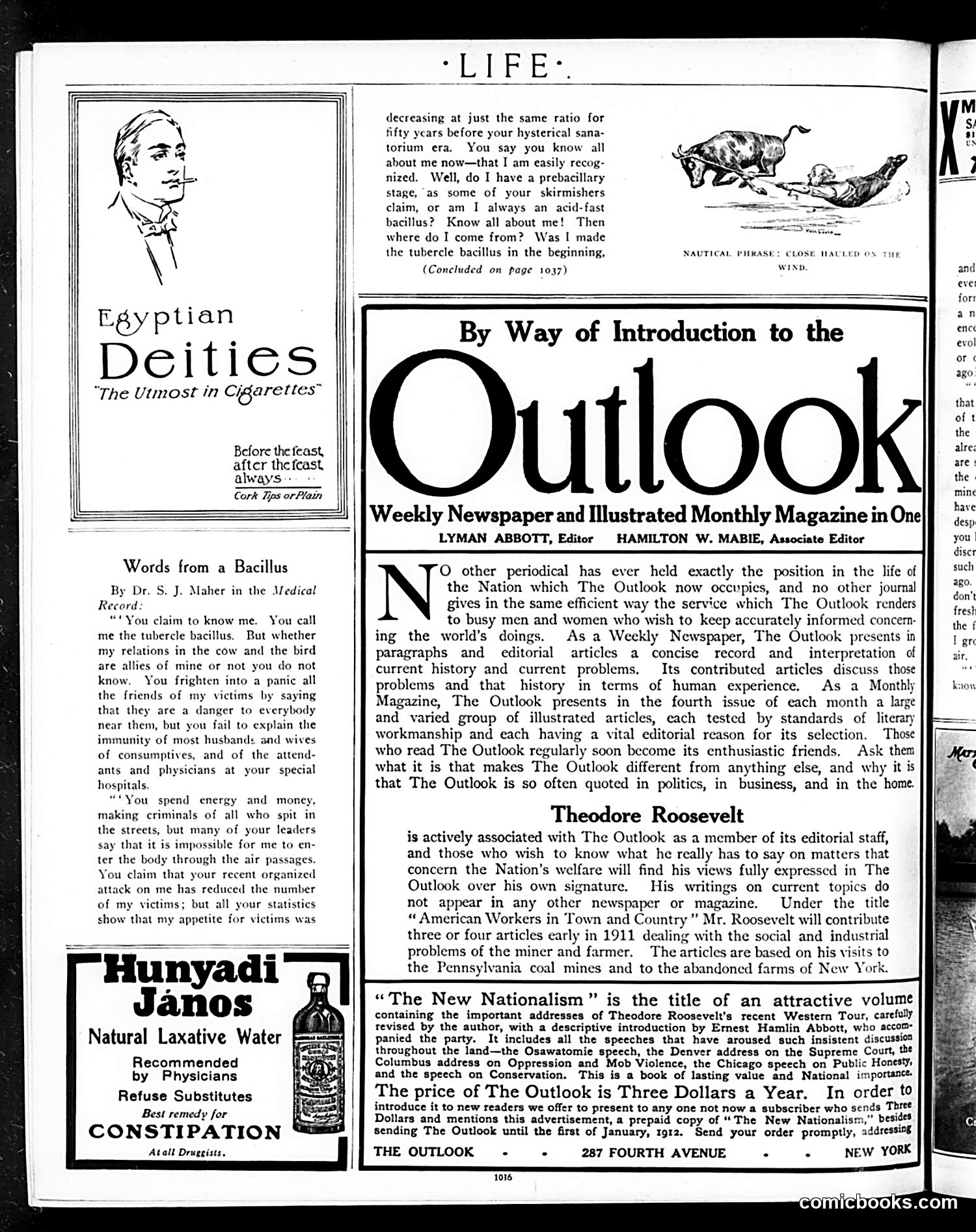
This page is primarily **advertising and promotional content** rather than satire or political cartooning. The main elements are: 1. **Egyptian Deities cigarette ad** (left): A simple product advertisement with no satirical content. 2. **"Words from a Bacillus" article**: A mock first-person account where tuberculosis bacteria speak, addressing public health claims about TB transmission. The satire is scientific/medical rather than political—it humorously anthropomorphizes the tubercle bacillus to question contradictions in tuberculosis prevention claims. 3. **The Outlook magazine promotion** (center): A lengthy advertisement promoting *The Outlook* magazine and emphasizing **Theodore Roosevelt's involvement** as a contributor. This is straightforward promotion, not satire. The text highlights Roosevelt's exclusive articles on labor and rural issues, positioning the magazine as authoritative. 4. **Hunyadi János laxative ad** (bottom left): A standard patent medicine advertisement. Overall, this is a **commercial page** with no political cartooning or satirical humor targeting specific figures or events.
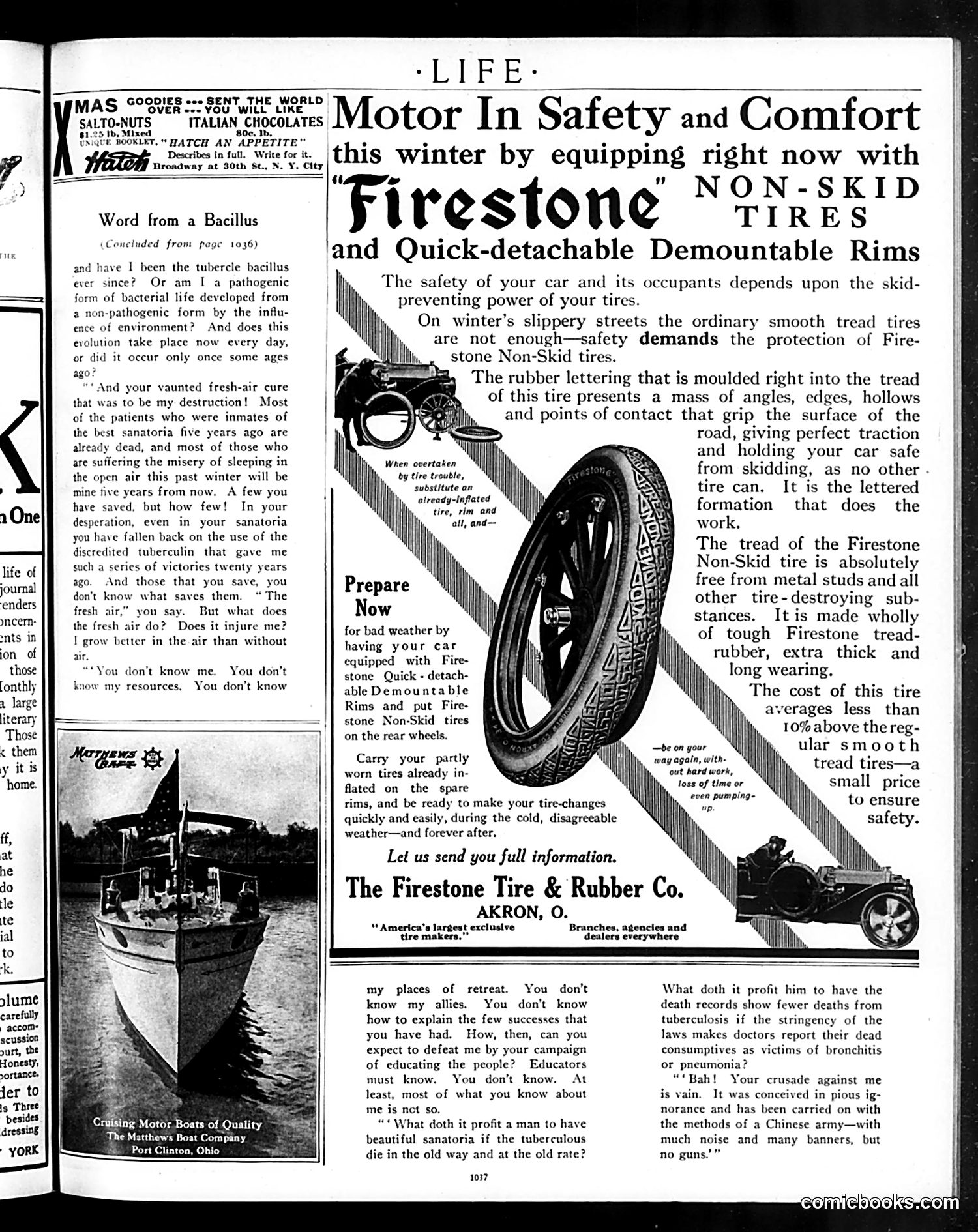
This page contains two distinct pieces: a satirical article and an advertisement. **The Article ("Word from a Bacillus"):** A tuberculosis bacterium personifies itself, mocking early-20th-century medical efforts to combat TB. The bacillus boasts that fresh-air sanitarium treatments—a popular cure of the era—don't actually harm it, and that patients still die at historical rates. It represents medical hubris: doctors claiming victory without understanding disease mechanisms. The satire critiques incomplete scientific knowledge and unproven treatments dressed up as progress. **The Advertisement:** Firestone tires dominates the right side, promoting "Non-Skid" winter tires with rubber tread lettering for safety. This reflects early automotive-era concerns about winter driving hazards. The ad emphasizes quick tire changes and cost-effectiveness—practical selling points for 1910s motorists. The juxtaposition is jarring: serious medical commentary alongside cheerful consumer marketing—typical *Life* magazine layout of this period.
This is primarily **advertising copy**, not political satire or cartoon content. It's a full-page promotional advertisement for Harper's Monthly Magazine, published in 1911, appearing in *Life* magazine. The page showcases Harper's upcoming editorial content: Margaret Deland's novel, a manuscript account of an interview with Napoleon, Mark Twain's final unpublished writings, and travel narratives from explorers in Indo-China and the Arabian Desert. It includes testimonial quotes from newspapers praising the magazine's "excellence" and "intelligence." **No cartoons or political satire appear on this page.** The page functions entirely as a marketing tool, using prominent endorsements and promises of exclusive literary content to persuade readers to subscribe. The rhetoric emphasizes Harper's 60+ years of prestige and cultural authority—a common advertising strategy emphasizing established institutional credibility to contemporary audiences.
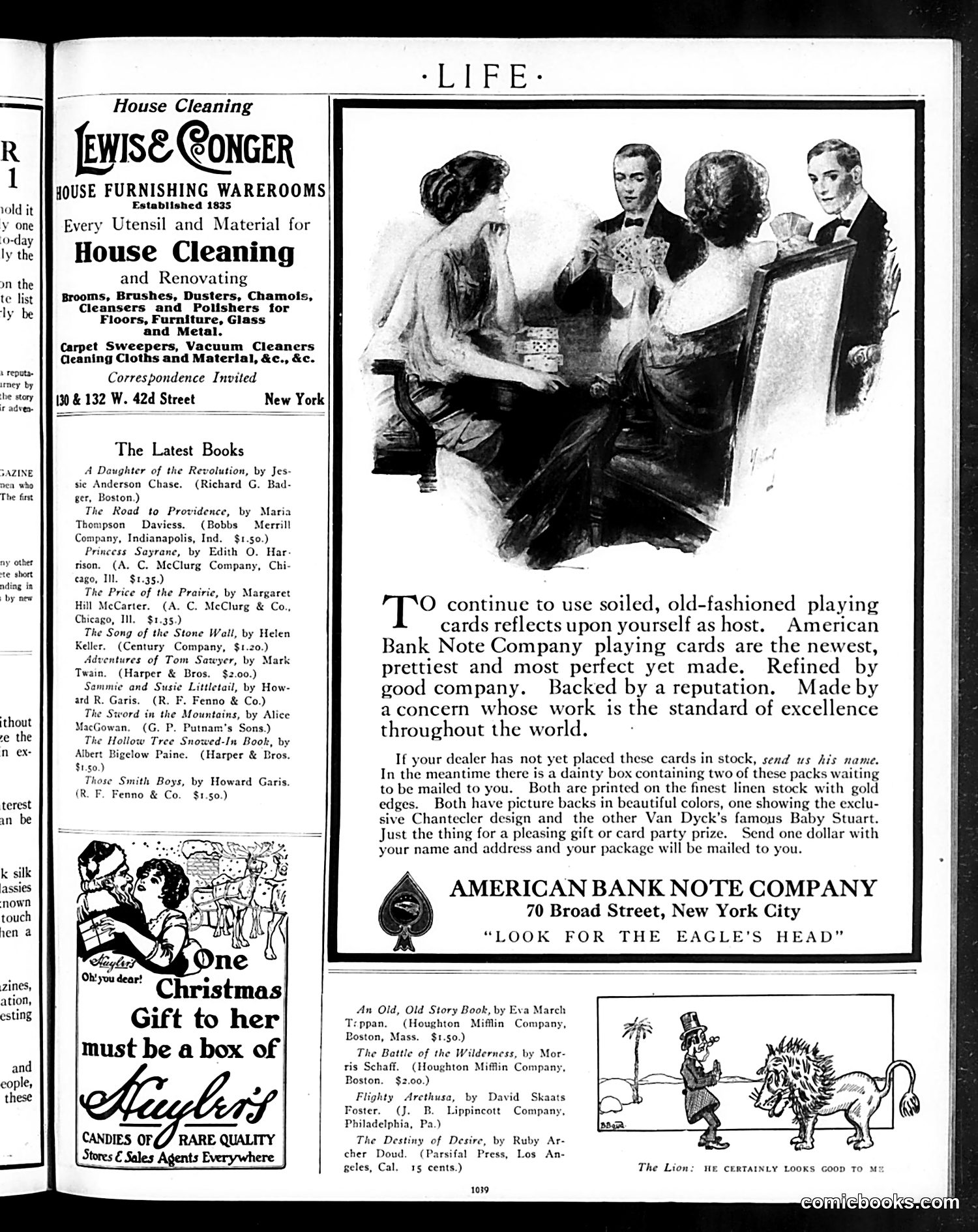
This page is primarily **advertising and book listings**, not political satire. The main content is a full-page advertisement for American Bank Note Company playing cards, featuring an illustration of four well-dressed people examining cards together. The ad's satire is **social, not political**: it mocks hosts who still use old, worn playing cards as reflecting poorly on themselves and their hospitality. The humor targets middle-class anxieties about appearing refined and up-to-date. By positioning new, elegant playing cards (with artistic designs like "Chantecler") as essential markers of good taste, the ad appeals to aspirational consumers concerned with maintaining social status through fashionable goods. The sidebar contains book advertisements and listings—mostly novels—typical of *Life*'s commercial content. A small cartoon at bottom right appears unrelated to the main page. This reflects early 20th-century magazine culture mixing editorial content with advertising.
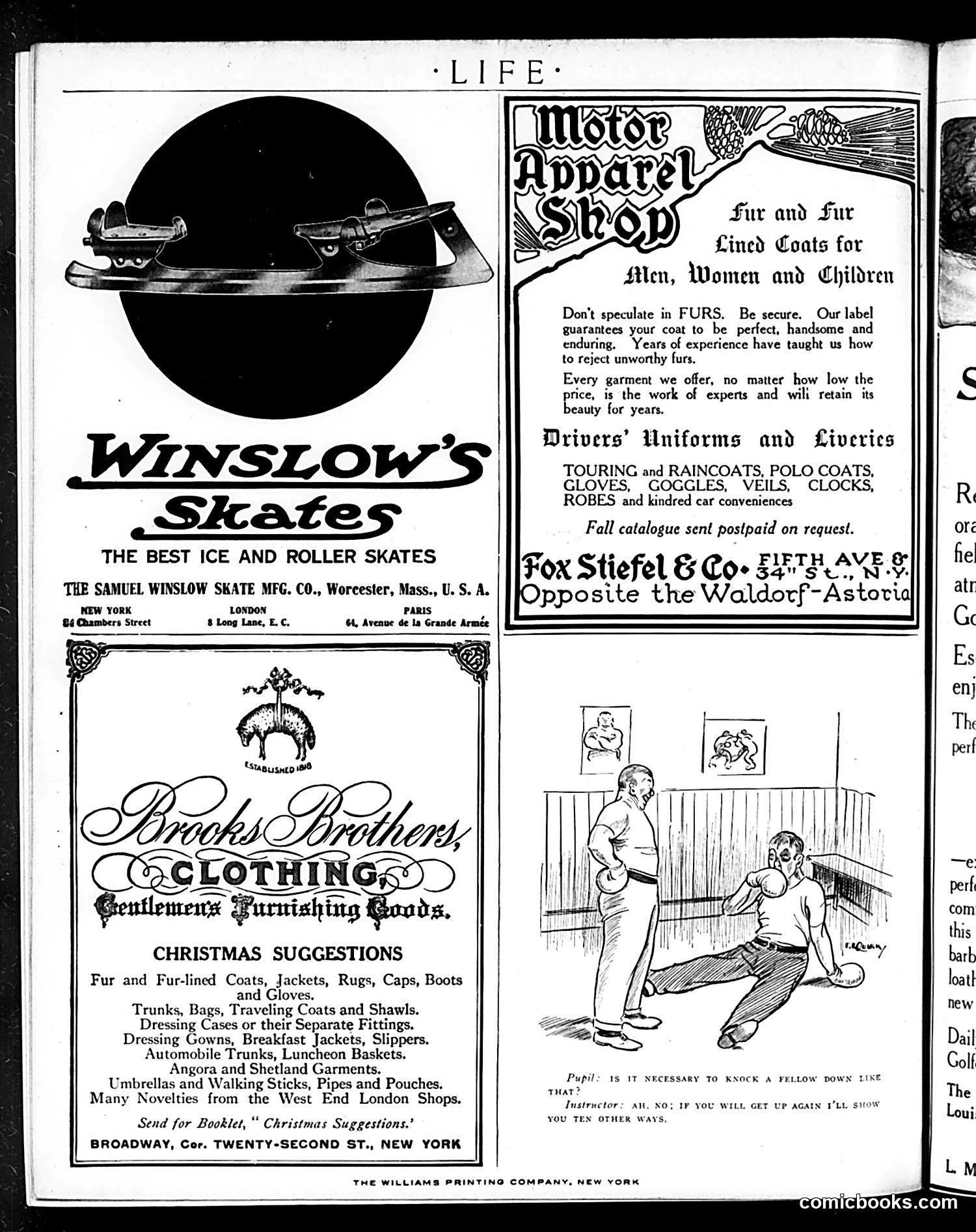
This page is primarily **advertisements** with one small cartoon at the bottom. The cartoon depicts a boxing or martial arts lesson: a student asks an instructor if it's necessary to knock someone down so forcefully. The instructor replies that if the student gets up again, he'll demonstrate ten other methods. The joke is straightforward physical comedy—the instructor's threatening response to the student's complaint. It reflects early 20th-century attitudes toward combat training as rough and uncompromising. The advertisements (Winslow's Skates, fur coats, drivers' uniforms, Brooks Brothers clothing) target affluent readers with luxury goods and Christmas gift suggestions, typical of Life's wealthy audience during this period. No political satire or complex historical reference is evident on this page—it's standard period advertising and light humor content.
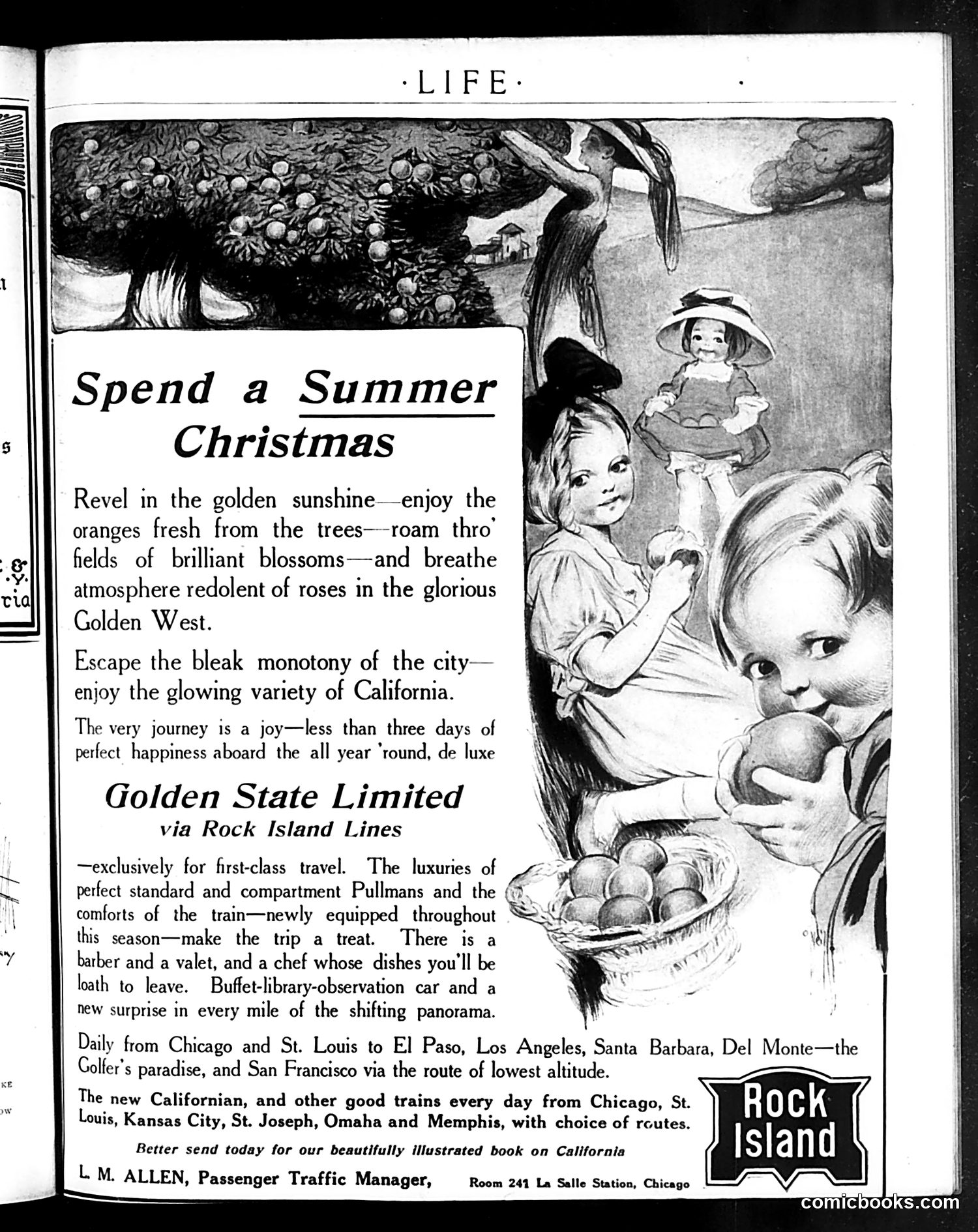
This is **not a political cartoon or satire**, but rather a **vintage travel advertisement** for Rock Island Lines railroad, appearing in Life magazine (likely 1910s-1920s based on style). The imagery shows children enjoying California fruits (oranges) beneath a fruit tree, illustrating the advertisement's appeal: escape winter's "bleak monotony" by taking a luxury train journey to sunny California for a "Summer Christmas." The ad promotes the "Golden State Limited" train, emphasizing its first-class amenities—Pullman cars, dining service, observation decks—and fast travel time (under three days from Chicago/St. Louis to California destinations). The satire, if present, is subtle: the ad conflates a winter holiday escape with an idyllic pastoral fantasy of California's perpetual sunshine and abundance, targeting affluent travelers seeking respite from Midwest winters. This reflects early 20th-century California boosterism and leisure-travel marketing to the wealthy.
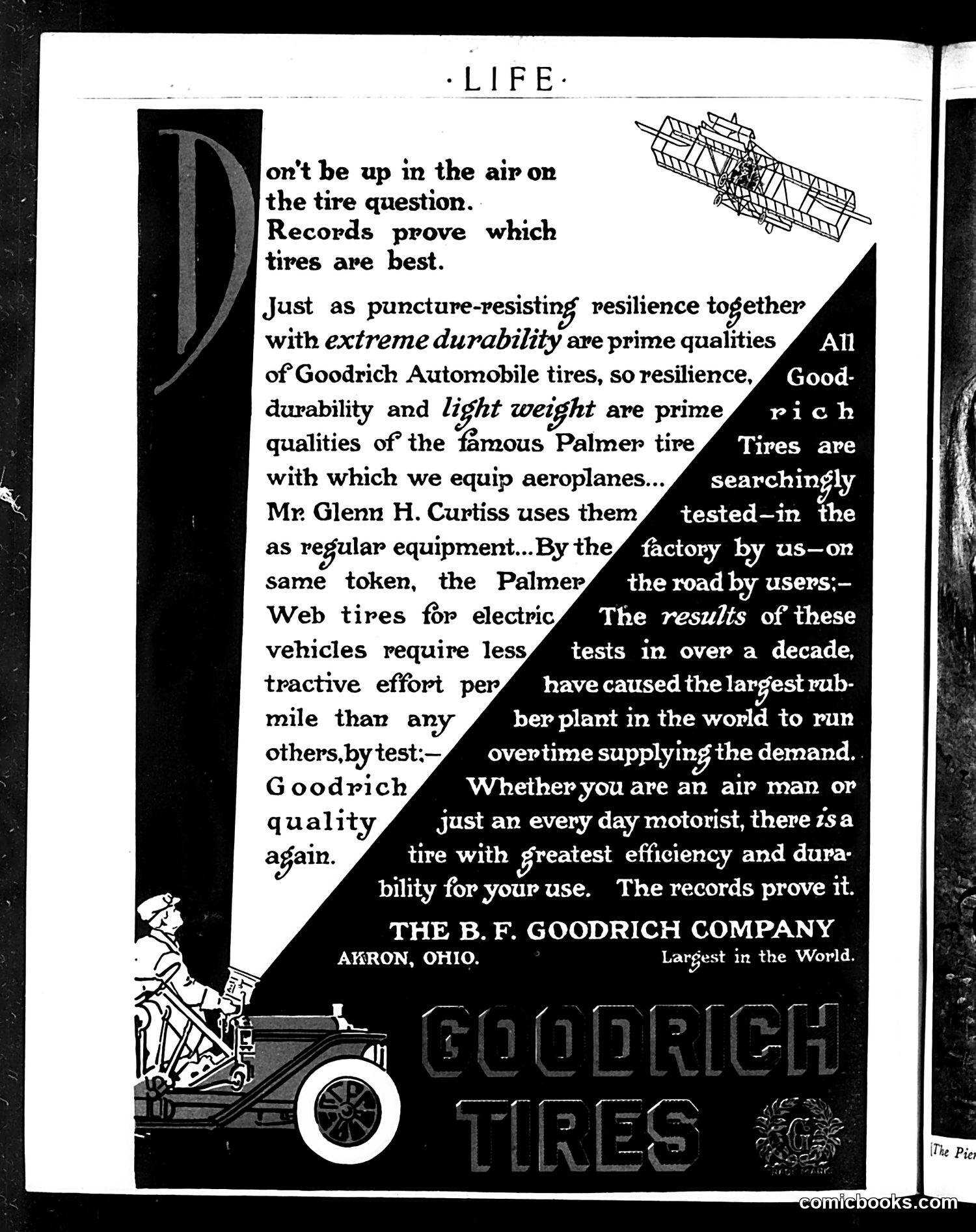
This is primarily a **Goodrich Tire company advertisement**, not satire or political commentary. The page references **Glenn Curtiss**, a pioneering aviator, to establish credibility for Palmer tires used in early aeroplanes. The advertisement argues that because Palmer tires perform well in aircraft—the most demanding application—they'll work equally well for ordinary automobile drivers. The "D" initial and vintage car illustration are decorative period elements. The diagonal black band dividing the layout is typical 1910s-20s modernist advertising design. **Context for modern readers**: This reflects an era when aviation was new and exotic enough that equipment endorsements from famous pilots (Curtiss was prominent) carried significant marketing weight. The implied logic—"if it's good enough for cutting-edge aviation, it's good for you"—was a common advertising strategy leveraging technological prestige. The page contains no actual humor or satire; it's straightforward product promotion emphasizing durability and proven performance records.
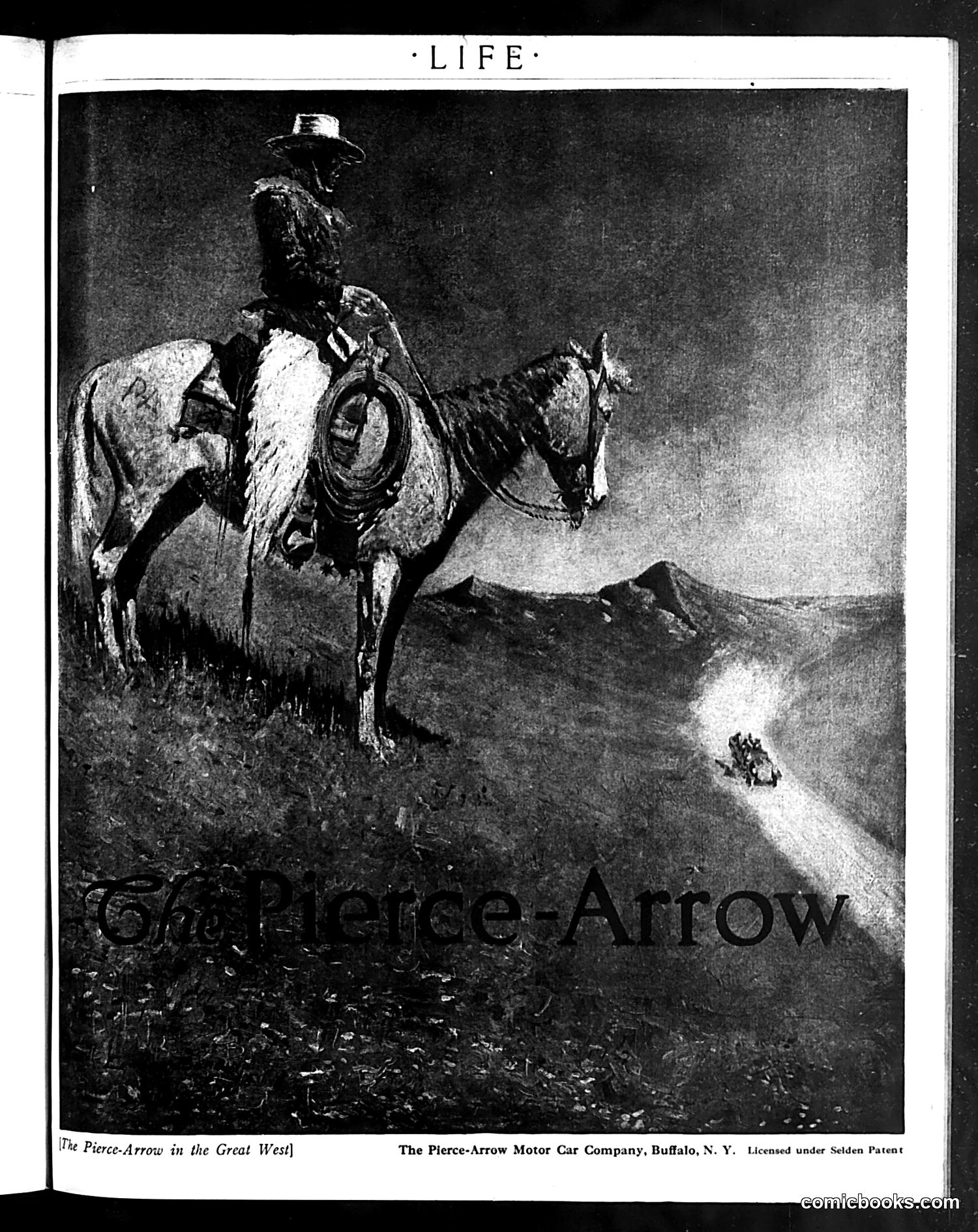
This is primarily an advertisement for the Pierce-Arrow Motor Car Company, but presented as a satirical illustration in Life magazine. The image shows a cowboy on horseback in the American West, gazing down at a Pierce-Arrow automobile traveling below in a valley—a striking juxtaposition of old and new. The satire lies in the contrast: the traditional Western frontier figure (representing America's past) observes the modern automobile (representing industrial progress). The cowboy's contemplative pose suggests amazement or bemusement at this technological intrusion into the wild frontier. This plays on early 1900s anxieties about industrialization transforming the American landscape and way of life. The "Great West" framing emphasizes the collision between frontier mythology and modern progress, making the ad itself a commentary on American cultural change.
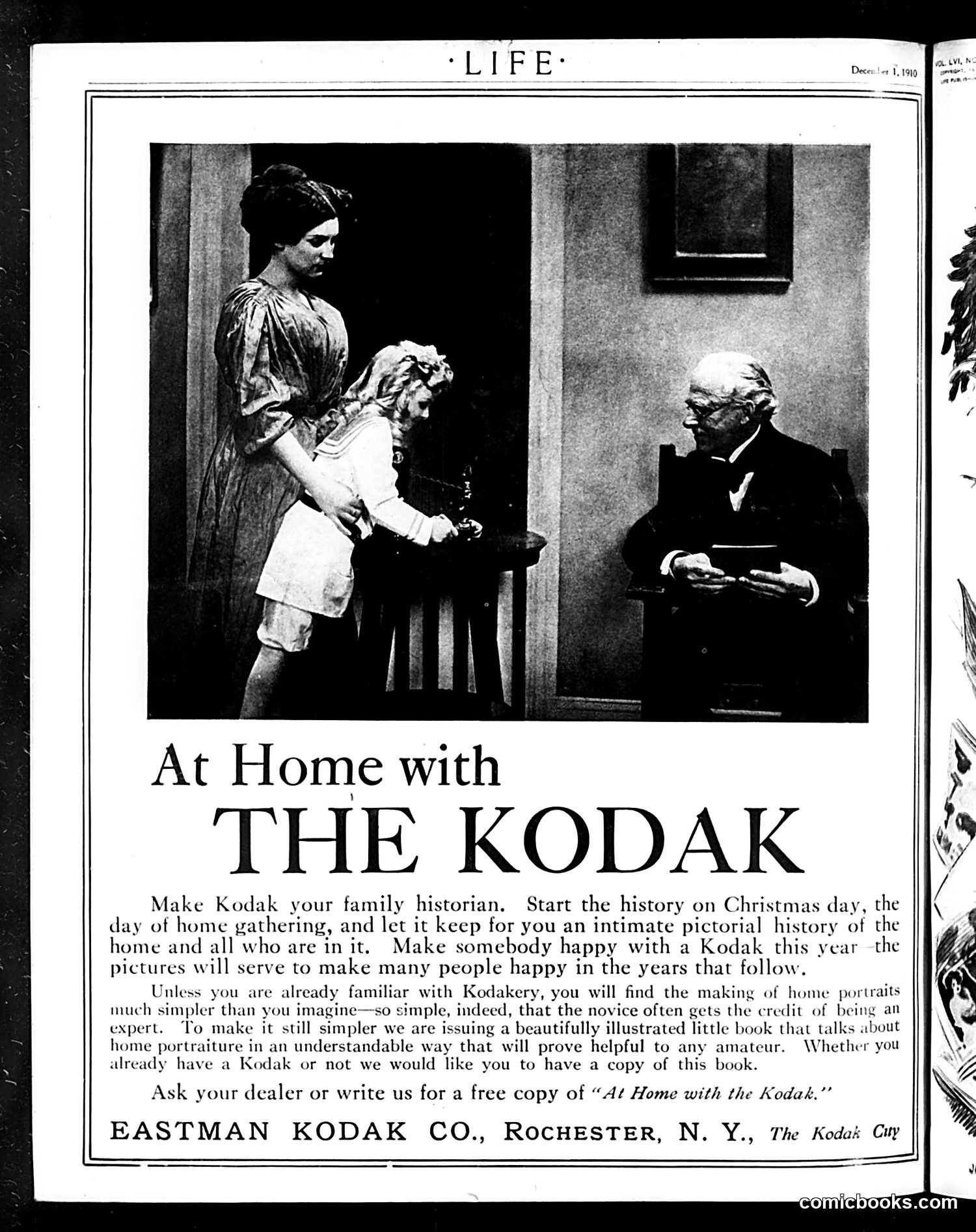
This is a **Kodak advertisement**, not political satire. The page promotes home photography as a Christmas gift and family practice. The image shows a domestic scene: a woman holding a child presents them to an elderly man (likely a grandfather figure), depicting a multi-generational family moment. This exemplifies Kodak's marketing message: photography preserves family memories across time. The advertisement's appeal is fundamentally about **sentimentality and domesticity**—positioning the camera as a tool for capturing and preserving intimate home life. The text emphasizes simplicity ("so simple, indeed, that the novice often gets the credit of being an expert") to lower barriers to camera ownership. For modern readers: this reflects early 20th-century marketing that positioned consumer technology as enhancing family bonds and creating lasting records. The "family historian" concept—treating photography as documentation of domestic life—was relatively novel advertising rhetoric at the time.