
Life, 1910-12-01 · page 52 of 108
Life — December 1, 1910 — page 52: what you’re looking at
What you’re looking at
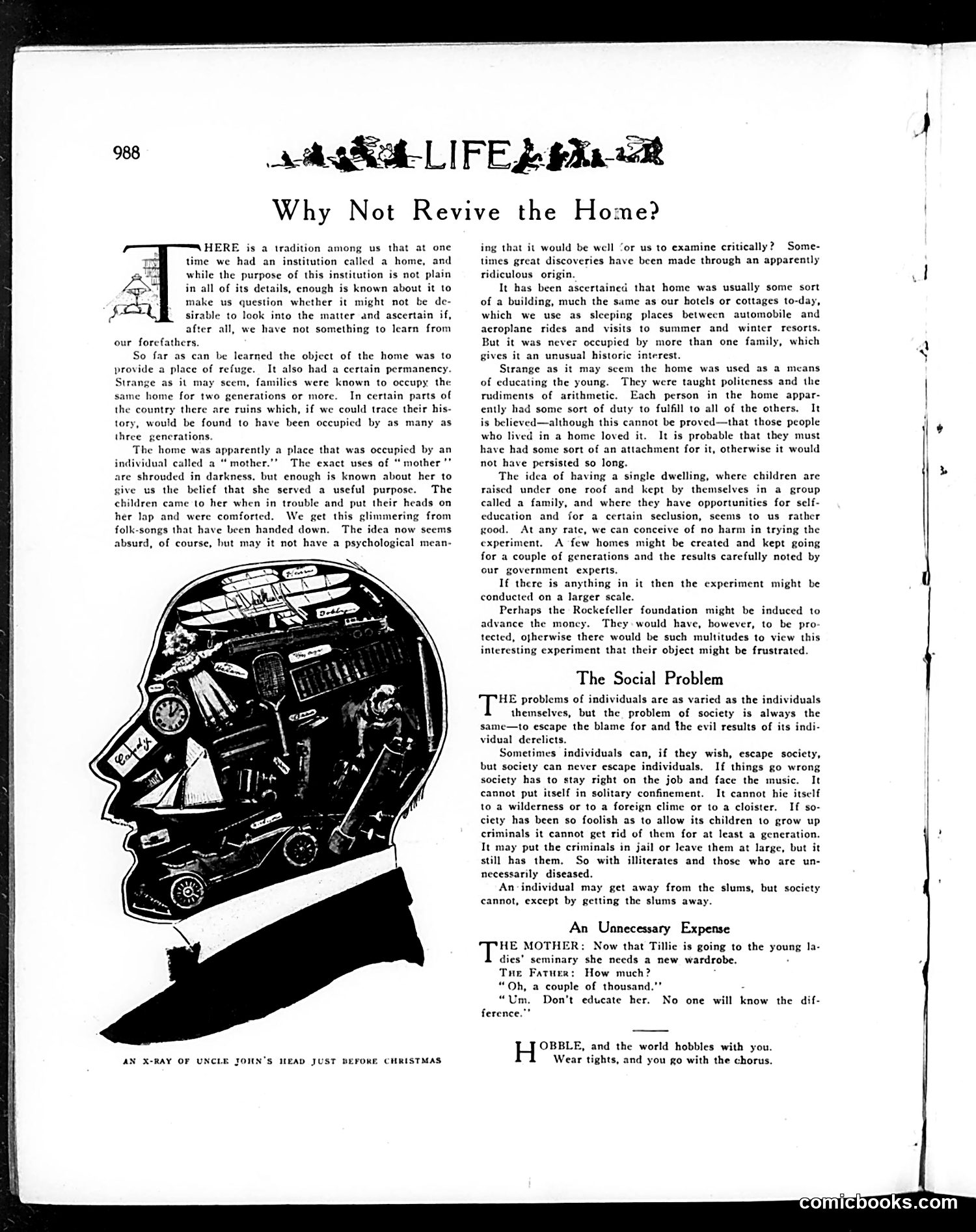
This 1920s Life magazine article satirizes modern American society's abandonment of traditional family life. The piece adopts mock-anthropological language to describe the "home" as if it were an extinct institution—treating concepts like mothers comforting children and multi-generational family occupancy as quaint historical curiosities. The X-ray illustration of "Uncle John's Head Just Before Christmas" shows a cluttered mind filled with cars, airplanes, and consumer goods, suggesting that modern people are consumed by material pursuits rather than domestic values. The satire targets how contemporary life (automobiles, air travel, resort visits) has displaced home-centered living. The author ironically proposes the Rockefeller Foundation fund a "home experiment"—treating domestic family life like a scientific study—to highlight how absurdly lost modern society has become from traditional values. The piece critiques materialism and social mobility at the expense of stable family structures and parental devotion.
📄 Transcribed text from this page (OCR, searchable)
Machine-transcribed from the original scan — historical spelling and the odd misread are preserved.
HERE is a tradition among us that at one time we had an institution called a home, and while the purpose of this institution is not plain in all of its details, enough is known about it to make us question whether it might not be de- sirable to look into the matter and ascertain if, after all, we have not something to learn from our forefathers. So far as can be learned the object of the home was to provide a place of refuge. It also had a certain permanency. Strange a . families were known to occupy the same home for two generations or more. In certain parts of the country there are ruins which, if we could trace their his- tory, would be found to have been occupied by as many as three generations. The home was apparently a place that was occupied by an individual called a “ mother.’ The exact uses of “ mother '" are shrouded in darkness. but enough is known about her to give us the belief that she served a useful purpose. The children came to her when in trouble and put their heads on her lap and were comforted. We get this glimmering from folk-songs that have been handed down. The idea now scems absurd, of course, but may it not have a psychological mean- it may sce AN X-RAY OF UNCLE JOUN'S MEAD JUST BEFORE CHRISTMAS +a gR-LIFES oie. Why Not Revive the Home? ing that it would be well Jor us to examine critically? Some- times great discoveries have been made through an apparently ridiculous origin. It has been ascertained that home was usually some sort of a building, much the same as our hotels or cottages to-day, which we use as sleeping places betwecn automobile and aeroplane rides and visits to summer and winter resorts. But it was never occupied by more than one family, which gives it an unusual historic interest. Strange as it may scem the home was used as a means of educating the young. They were taught politeness and the rudiments of arithmetic. Each person in the home appar- ently had some sort of duty to fulfill to all of the others. It is believed—although this cannot be proved—that those people who lived in a home loved it. It is probable that they must have had some sort of an attachment for it, otherwise it would not have persisted so long. The idea of having a single dwelling, where children are raised under one roof and kept by themselves in a group called a family, and where they have opportunities for self- education and for a certain seclusion, seems to us rather good. At any rate, we can conceive of no harm in trying the experiment. A few homes might be created and kept going for a couple of generations and the results carefully noted by our government experts, If there is anything in it then the experiment might be conducted on a larger scale. Perhaps the Rockefeller foundation might be induced to advance the moncy. They would have, bowever, to be pro tected, opherwise there would be such multitudes to view this interesting experiment that their object might be frustrated The Social Problem HE problems of individuals are as varied as the individuals themselves, but the problem of society is always the same—to escape the blame for and the evil results of its indi- vidual derelicts. Sometimes individuals can, if they wish, escape society, but society can never escape individuals. If things go wrong society has to stay right on the job and face the music. It cannot put itself in solitary confinement. It cannot hie itself to a wilderness or to a foreign clime or to a cloister. If so- ciety has been so foolish as to allow its children 10 grow up criminals it cannot get rid of them for at least a generation. It may put the criminals in jail or leave them at large, but it still has them. So with illiterates and those who are un- necessarily diseased. An individual may get away from the slums, but society cannot, except by getting the slums away. An Unnecessary Expense HE MOTHER: Now that Tillie is going to the young la- dies’ seminary she necds a new wardrobe. Tue Faturr: How much? “Oh, a couple of thousand."* : “Um. Don't educate her. No one will know the dif- ference.”” OBBLE, and the world hobbles with you. Wear tights, and you go with the chorus. ‘Comicbooks.com A> oo