
Life, 1910-12-01 · page 34 of 108
Life — December 1, 1910 — page 34: what you’re looking at
What you’re looking at
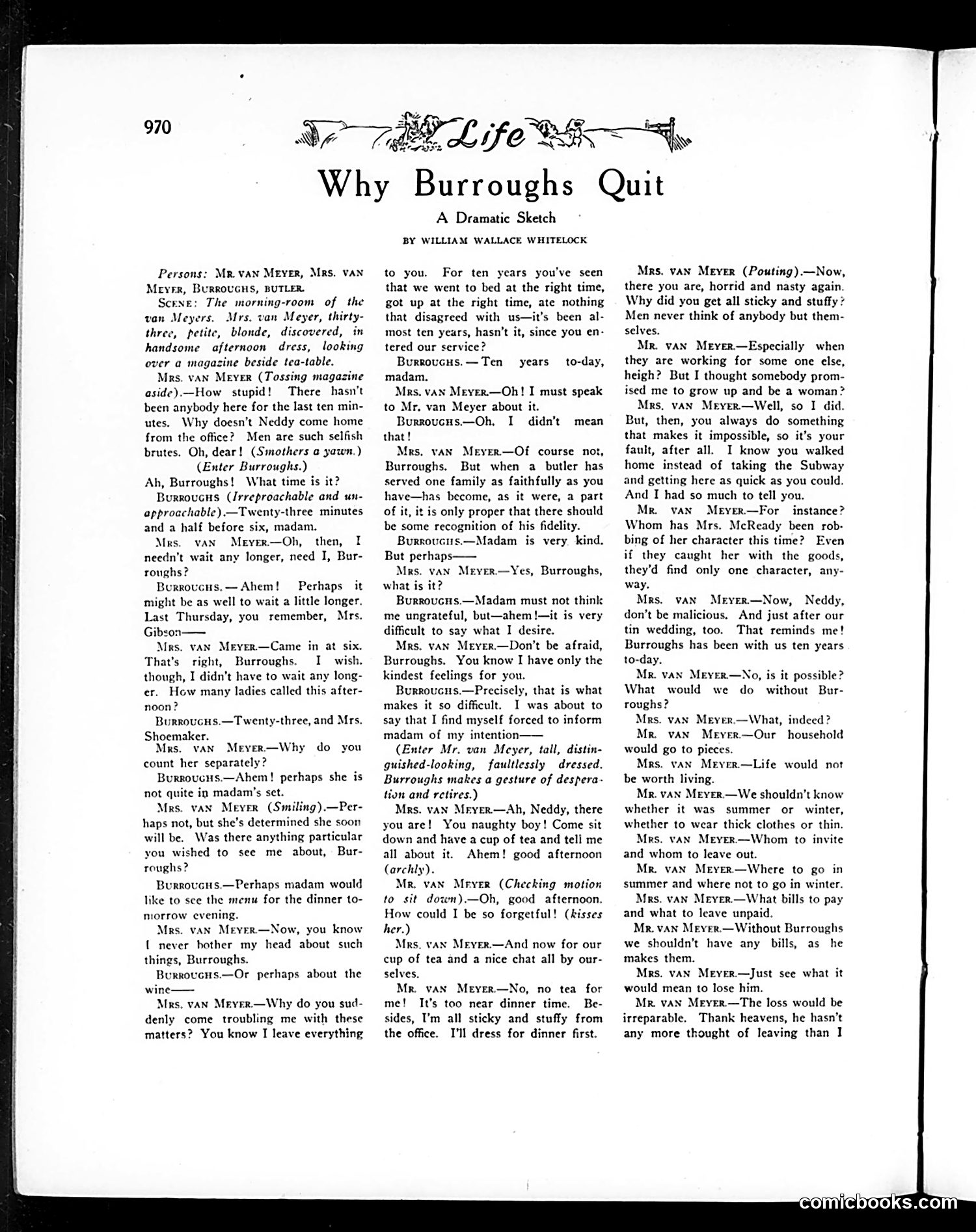
This is a dramatic sketch depicting the social dynamics of an upper-class household around 1910. The humor centers on **class pretense and unspoken hierarchy**. Mrs. van Meyer, a wealthy but idle housewife, takes her longtime butler Burroughs entirely for granted—leaving all domestic decisions to him while treating him as invisible. When Burroughs attempts to inform her of his intention to resign (likely seeking recognition or better treatment after ten years of faithful service), he's repeatedly interrupted and dismissed. The satire targets **Mrs. van Meyer's obliviousness**: she claims to have "only the kindest feelings" for Burroughs yet makes his life difficult through her negligence and demands. When her husband arrives, she instantly shifts to charming him with tea and attention—the same courtesy she denies her servant. The title's answer becomes clear: **Burroughs quits because employers like the van Meyers, despite professing kindness, fundamentally disrespect their servants' humanity and labor**. The sketch mocks the hypocrisy of wealthy households that claimed to treat servants well while taking their work for granted.
📄 Transcribed text from this page (OCR, searchable)
Machine-transcribed from the original scan — historical spelling and the odd misread are preserved.
We TALL if OC Ay Why Burroughs Quit Persons: Mr. vAN MEYER, Mrs. VAN Meyer, BurrouGHs, BUTLER. Scr: The morning-room of the van Meyers. Mrs, van Meyer, thirty- three, petite, blonde, discovered, in handsome afternoon dress, looking over a magazine beside tea-table. Mrs. van Meyer (Tossing magazine aside).—How stupid! There hasn't been anybody here for the last ten min- utes. Why doesn’t Neddy come home from the office? Men are such selfish brutes. Oh, dear! (Smothers a yawn.) (Enter Burroughs.) Ah, Burroughs! What time is it? Burroucns (/rreproachable and un- approachable).—Twenty-three minutes and a half before six, madam. Mrs. van Meyver—Oh, then, I needn't wait any longer, need I, Bur- roughs? Burroucus.— Ahem! Perhaps _ it might be as well to wait a little longer. Last Thursday, you remember, Mrs. Gibson—— Mrs. van Meyver—Came in at six. That’s right, Burroughs. I wish. though, I didn’t have to wait any long- er. How many ladies called this after- noon? Burroucus.—Twenty-three, and Mrs. Shoemaker. Mrs. van Meyer—Why do you count her separately? Burroucus.—Ahem! perhaps she is not quite in madam’s set. Mrs. vAN Meyer (Smiling).—Per- haps not, but she’s determined she soon will be. Was there anything particular you wished to see me about, Bur- roughs? Burrovucus.—Perhaps madam would like to see the menu for the dinner to- morrow evening. Mrs. vAN Mever—Now, you know { never hother my head about such things, Burroughs. Burroucus.—Or perhaps about the wine— Mrs. vAN Mever—Why do you sud- denly come troubling me with these matters? You know I leave everything A Dramatic Sketch BY WILLIAM WALLACE WHITELOCK to you. For ten years you've seen that we went to bed at the right time, got up at the right time, ate nothing that disagreed with us—it’s been al- most ten years, hasn’t it, since you en- tered our service? Burroucus. — Ten madam. Mrs. van Mever—Oh! I must speak to Mr. van Meyer about it. Burroucus.—Oh, I didn’t that! Mrs, vaN Meyer—Of course not, Burroughs. But when a butler has served one family as faithfully as you have—has become, as it were, a part of it, it is only proper that there should be some recognition of his fidelity. Burroucus.—Madam is very kind. But perhaps- Mrs. van Meyer—Yes, Burroughs, what is it? BurroucHs.—Madam must not think me ungrateful, but—ahem !—it is very difficult to say what I desire. Mrs. van Mever.—Don’t be afraid, Burroughs. You know I have only the kindest feelings for you. Burroucus.—Precisely, that is what makes it so difficult. I was about to say that I find myself forced to inform madam of my intention—— (Enter Mr. van Meyer, tall, distin- guished-looking, faultlessly dressed. Burroughs makes a gesture of despera- tion and retires.) Mrs. van Mryer—Ah, Neddy, there you are! You naughty boy! Come sit down and have a cup of tea and teli me all about it. Ahem! good afternoon (archly). Mr. van Mrver (Checking motion to sit down).—Oh, good afternoon. How could I be so forgetful! (hisses her.) Mrs. vaN Mrver.—And now for our cup of tea and a nice chat all by our- selves, Mr. van Meyer.—No, no tea for me! It’s too near dinner time. Be- sides, I’m all sticky and stuffy from the office. I'll dress for dinner first. years to-day, mean Mrs. vaAN MEYER (Pouting).—Now, there you are, horrid and nasty again. Why did you get all sticky and stuffy? Men never think of anybody but them- selves. Mr. van Meyer—Especially when they are working for some one else, heigh? But I thought somebody prom- ised me to grow up and be a woman? Mrs, vaN Meyer—Well, so I did. But, then, you always do something that makes it impossible, so it’s your fault, after all. I know you walked home instead of taking the Subway and getting here as quick as you could. And I had so much to tell you. Mr. van Meyer—For instance? Whom has Mrs. McReady been rob- bing of her character this time? Even if they caught her with the goods, they'd find only one character, any- way. Mrs. van Mever—Now, Neddy, don’t be malicious, And just after our tin wedding, too. That reminds me! Burroughs has been with us ten years to-day. Mr. van Mever—N. What would we do roughs? Mrs. van Meyer.—What, indeed? Mr. vAN Meyer—Our household would go to pieces. Mrs. van Meyer.—Life would not be worth living. Mr. vAN Meyer.—We shouldn’t know whether it was summer or winter, whether to wear thick clothes or thin. Mrs. vaN Meyer—Whom to invite and whom to leave out. Mr. vaAN Mever—Where to go in summer and where not to go in winter. Mrs. van Meyer—What bills to pay and what to leave unpaid. Mr. vAN Mever.—Without Burroughs we shouldn't have any bills, as he makes them. Mrs. vAN Meyer—Just sce what it would mean to lose him. Mr van Mevern—The loss would be irreparable. Thank heavens, he hasn't any more thought of leaving than I is it possible? without Bur-