
Life, 1910-12-01 · page 35 of 108
Life — December 1, 1910 — page 35: what you’re looking at
What you’re looking at
This is a domestic comedy sketch depicting a long-serving butler (Burroughs) announcing his resignation after ten years of employment to Mr. and Mrs. van Meyer, wealthy employers. The satire centers on the butler's increasingly brutal honesty: after the employers exhaust all conventional explanations (wages, treatment, authority), Burroughs finally admits he's simply tired of looking at Mrs. van Meyer's face daily. Despite acknowledging she's objectively "very pretty," even beauty becomes tedious after a decade. The joke critiques both servant-employer dynamics and marital familiarity—the title "Hope Springs Eternal" suggests optimism about change, though the real message is that even ideal circumstances become unbearable through repetition. The employer's shocked reaction underscores how his blunt candor violates social conventions that usually mask such thoughts. It's gentle satire on class relations and the monotony of domestic life.
📄 Transcribed text from this page (OCR, searchable)
Machine-transcribed from the original scan — historical spelling and the odd misread are preserved.
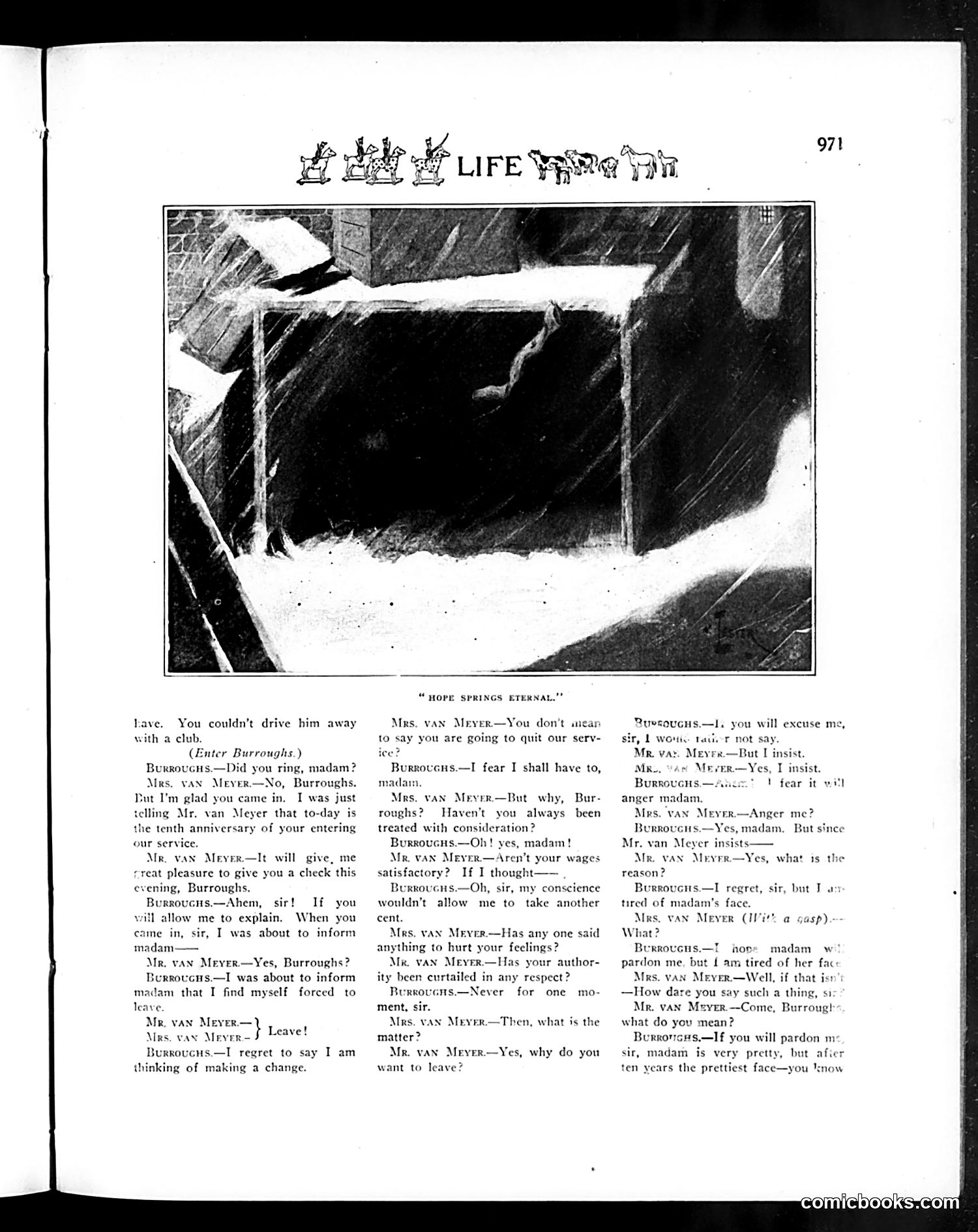
Lave. You couldn’t drive him away with a club. (Enter Burroughs.) Burrovcus.—Did you ring, madam? Mrs. van Meyer.—No, Burrough Dut I'm glad you came in. I was just telling Mr. van Meyer that to-day is the tenth anniversary of your entering our service. Mr. van Meyer—It will give, me reat pleasure to give you a check this evening, Burroughs. Burroucns.—Ahem, sir! If you allow me to explain. When you came in, sir, I was about to inform madam—— Mr. van Mever.—Yes, Burroughs? Berrovens.—I was about to inform madam that I find myself forced to leave. Mr. van Meyer. Mrs. vaN MEVE SURROUC } Leave! —I regret to say I am thinking of making a change. “HOPE SPRINGS ETERNAL.” Mrs. van Mever—You don’t snear to say you are going to quit our serv- Burrovcns.—I fear I shall have to, van Meyrr—But why, Bur- Haven't. you always been treated with consideration? Burrou Oh! yes, madam! Mr. van Meyer—Aren’t your wages satisfactory? If I thought 3uRROUGHS.—Oh, sir, my conscience wouldn't allow me to take another cent. —Has any one said anything to burt your feelings? Mk. vAN Meyer.—Has your author- ity been curtailed in any respect? Never for one mo- ment, sir. Mrs. van Meyer.—Then, what is the matter? Mr. van Mrver—Yes, why do you want to leave? RuesoucHs.—1. you will excuse me, 1 won rac , Mr. var. Meyrx.—But I insist. Mr. Mever—Yes, I insist. Burroucus.—Ancs* | fear it will anger madam. Mrs. van Meyer—Anger me? Burroucus.—Y But since Mr. van Meyer insists: Mr. van Mevrr—Yes, what is t reason? Burrovens.—I regret, sir, but Ta tired of madam’s face. Mrs, van Meyer (IVit® @ gasp) What? Berroveus.—I hone madam w pardon me. but { am tired of her fac Mrs. van Mever.—Well, if that ist —How dare you say such a thing, si Mr. van Meyer.—Come, Burroug! what do you mean? Burronc#s.—If you will pardon m sir, madam is very pretty, but afier ten years the prettiest face—you know s, madam,