
Life, 1910-12-01 · page 50 of 108
Life — December 1, 1910 — page 50: what you’re looking at
What you’re looking at
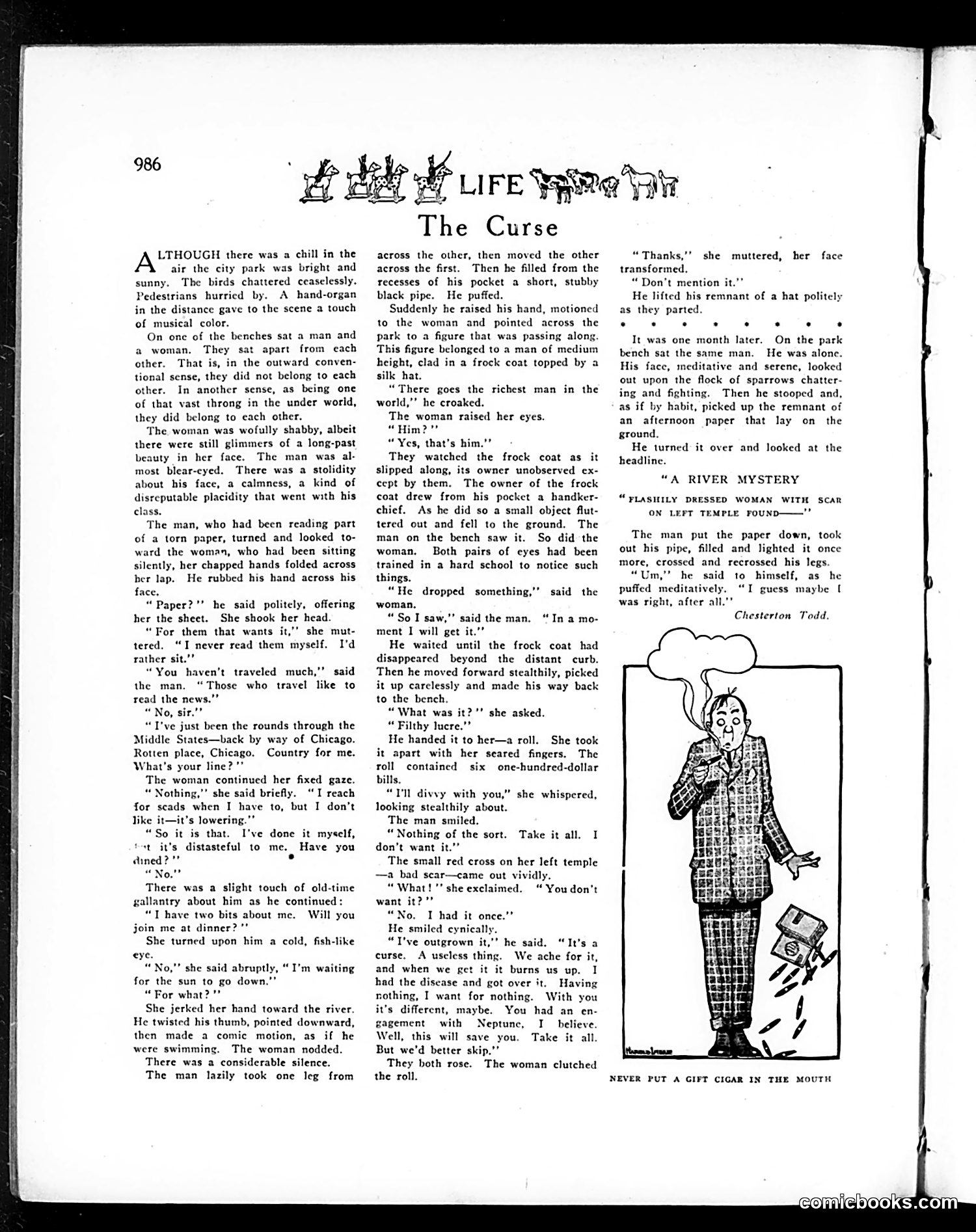
This page presents a short story rather than political cartoons. The narrative depicts two impoverished people in a city park who witness a wealthy man drop a roll of $600. The man retrieves it and offers it to the woman, but refuses to let her keep it. The story's "curse" appears to be wealth itself. The man explains he once possessed money but has "outgrown it" and now rejects it, suggesting that wealth corrupts or harms people. The woman's visible scar and their shared poverty indicate lives damaged by circumstance. The satire targets the assumption that money solves problems. The wealthy man passes by "unobserved except by them"—invisible to society despite his riches—while the poor characters possess moral clarity he lacks. The story implies that rejecting material wealth represents spiritual or moral advancement, critiquing both poverty and the corrupting nature of wealth in early 20th-century America.
📄 Transcribed text from this page (OCR, searchable)
Machine-transcribed from the original scan — historical spelling and the odd misread are preserved.
LTHOUGH there was a chill in the air the city park was bright and sunny, The birds chattered ceaselessly. Pedestrians hurricd by. A hand-organ in the distance gave to the scene a touch of musical color. On one of the benches sat a man and ‘a woman, They sat apart from cach other. That is, in the outward conven- tional sense, they did not belong to each other. In another sense, as being one of that vast throng in the under world, they did belong to each other. The woman was wofully shabby, albeit there were still glimmers of a long-past beauty in her face. The man was al- most blear-eyed. There was a stolidity about his face, a calmness, a kind of disreputable placidity that went with his class. The man, who had been reading part of a torn paper, turned and looked to- ward the woman, who had been sitting silently, her chapped hands folded across her lap. He rubbed his hand across his face, “Paper?'’ he said politely, offering her the sheet. She shook her head. “For them that wants it,’’ she mut- tered. “I never read them myself. I'd rather sit.’” “You haven't the man. “Those who read the news.”” “No, sir.” “T've just been the rounds through the Middle States—back by way of Chicago. Rotten place, Chicago. Country for me. What's your line?’’ The woman continued her fixed gaze. “Nothing,”’ she said briefly. “I reach for scads when I have to, but I don’t like it—it’s lowering. “So it is that. I've done it myself, tot it's distasteful to me. Have you dined?"’ hd “No. There was a slight touch of old-time gallantry about him as he continued “T have two bits about me. Will you join me at dinner?" She turned upon him a cold, fish-like eye. “No,"’ she said abruptly, “I'm waiting for the sun to go down." “ For what?” She jerked her hand toward the river. He twisted his thumb, pointed downward, then made a comic motion, as if he were swimming. The woman nodded. There was a considerable silence. The man lazily took one leg from traveled much,"’ said travel like to Af LIFE Fe WR The Curse across the other, then moved the other across the first. Then he filled from the recesses of his pocket a short, stubby black pipe. He puffed. Suddenly he raised his hand, motioned to the woman and pointed across the park to a figure that passing along. This figure belonged to a man of medium height, clad in a frock coat topped by a silk hat. “There goes the richest man in the world,’’ he croaked. The woman raised her eyes. “Him?” “Yes, that’s him,’’ They watched the frock coat as it slipped along, its owner unobserved ex- cept by them. The owner of the frock coat drew from his pocket a handker- chief. As he did so a small object flut- tered out and fell to the ground. The man on the bench saw it. So did the woman. Both pairs of eyes had been trained in a hard school to notice such things. “He dropped something,”’ woman, “ So I saw,’’ said the man. ment I will get i He waited until the frock coat had disappeared beyond the distant curb. Then he moved forward stealthily, picked it up carelessly and made his way back to the bench. “What was it?’ she asked. “ Filthy lucre.’ He handed it to her—a roll. She took it apart with her seared fingers. The roll contained six one-hundred-dollar bills. “Tl divvy with you,” she whispered, looking stealthily about. The man smiled. “Nothing of the sort. don’t want it.’” The small red cross on her left temple —a bad scar—came out vividly. “What! ''she exclaimed. “ want it? “No. I had it once.’’ He smiled cynically, “T've outgrown it,’ he said. “It’s a curse. A uscless thing. We ache for it, and when we get it it burns us up. I had the disease and got over it. Having nothing, I want for nothing. With you it’s different, maybe. You had an en- gagement with Neptune, I believe. Well, this will save you. Take it all. But we'd better skip. They both rose. The woman clutched the roll. said the “In a mo- Take it all. I ‘oudon’t “ Thanks,”’ transformed, “Don’t mention it.’" He lifted his remnant of a hat politely as they parted. a It was one month later. On the park bench sat the same man. He was alone. His face, meditative and serene, looked out upon the flock of sparrows chatter- ing and fighting. Then he stooped and, as if by habit, picked up the remnant of an afternoon paper that lay on the ground, He turned it over and looked at the headline. “A RIVER MYSTERY “FLASIILY DRESSED WOMAN WITH ON LEPT TEMPLE FOUND——’? she muttered, her face SCAR The man put the paper down, took out his pipe, filled and lighted it once more, crossed and recrossed his legs. “Um,” he said to himself, as he puffed meditatively. “I guess maybe ( was right, after all Chesterton Todd. NEVER PUT A GIFT CIGAR IN THE MOUTH