
Life, 1910-12-01 · page 62 of 108
Life — December 1, 1910 — page 62: what you’re looking at
What you’re looking at
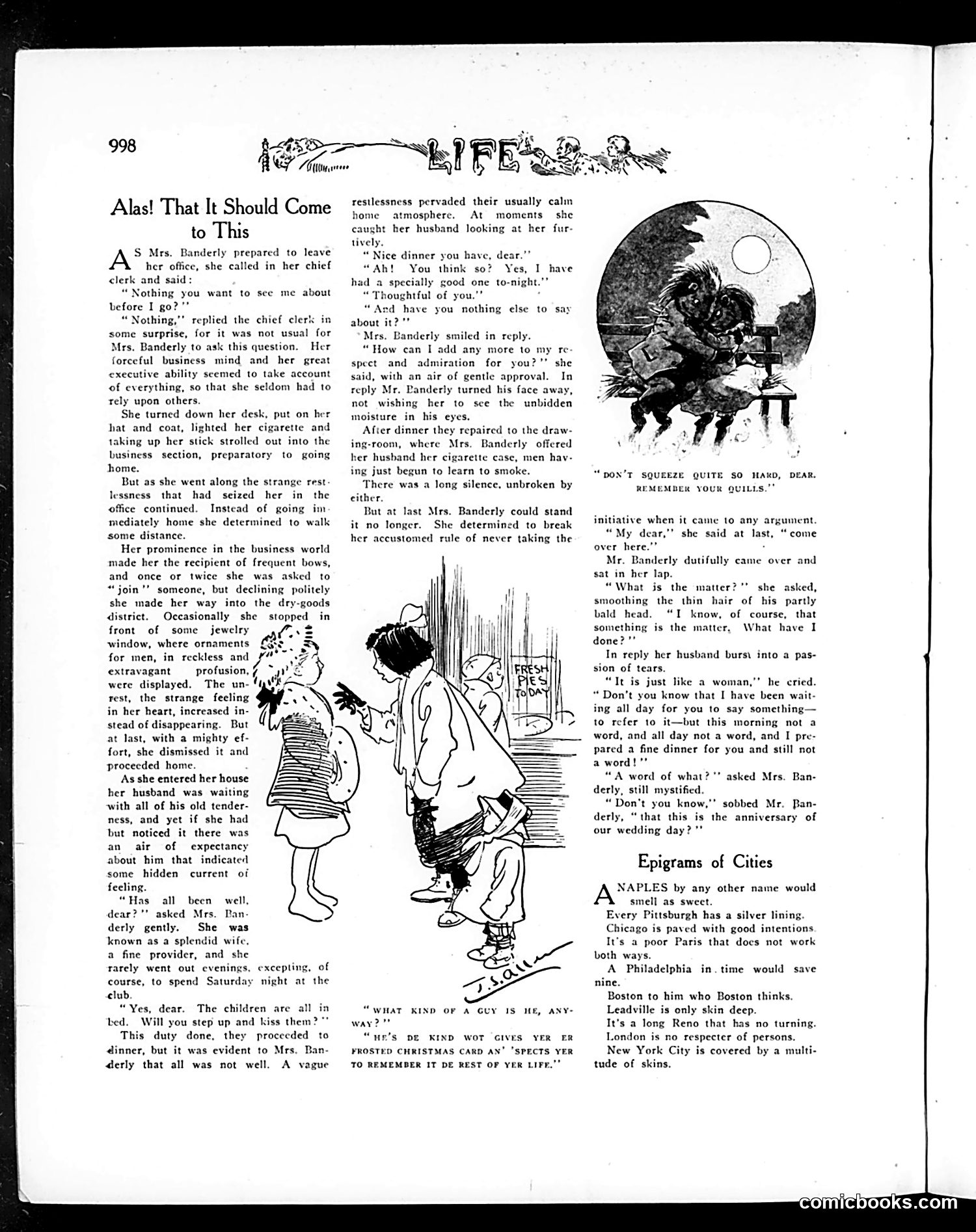
This page satirizes the modern professional woman and changing gender dynamics in early 20th-century marriage. The story "Alas! That It Should Come to This" depicts Mrs. Banderly, a successful businesswoman who neglects to acknowledge her husband's anniversary of their wedding day. The satire targets her complete absorption in her career—she's too distracted by business to notice her husband's emotional needs. The irony is sharp: she's described as "a splendid wife" and "fine provider," yet her very professional competence blinds her to basic marital sentiment. Her husband literally sits in her lap crying, reversing traditional gender roles where men were supposed to be emotionally stoic. The accompanying "Epigrams of Cities" section offers brief satirical observations about American cities—mild social commentary typical of Life's format. The cartoon at bottom (caption about squeezing and quills) appears unrelated editorial commentary. The piece gently mocks both the ambitious working woman and the emotionally vulnerable modern man, reflecting anxieties about shifting social roles during the early 1900s.
📄 Transcribed text from this page (OCR, searchable)
Machine-transcribed from the original scan — historical spelling and the odd misread are preserved.
“ey Alas! That It Should Come to This S Mrs. Banderly prepared to leave her office, she called in her chief clerk and sai “Nothing you want to sce me about Uefore I go?” “Nothing,’’ replied the chief cle: some surprise, for it was not usual for Mrs. Banderly to ask this question. Her forceful business mind and her great executive ability seemed to take account of everything, so that she seldom had to rely upon others. She turned down her desk, put on her hat and coat, lighted her cigarette and taking up her stick strolled out into the business section, preparatory to going home. But as she went along the strange rest lessness that had seized her in the office continued. Instead of going im mediately home she determined to walk some distance. Her prominence in the business world made her the recipient of frequent bows, and once or twice she was asked to join’? someone, but declining politely she made her way into the dry-goods district. Occasionally she stopped in front of some jewelry an 3 window, where ornaments “As 3 for men, in reckless and *~ extravagant profusion, 7 ~) were displayed. The un- “gw —~ — rest, the strange feeling in her heart, increased in- stead of disappearing. But at last, with a mighty ef- fort, she dismissed it and procecded home. As she entered her house her husband was waiting with all of his old tender- ness, and yet if she had but noticed it there was an air of expectancy about him that indicated some hidden current of feeling. “Has all been well, dear?"' asked Mrs. Pan- derly gently. She was known as a splendid wife. a fine provider, and she rarely went out evenings, excepting, of course, to spend Saturday night at the club. “Yes, dear. The children are all Led. Will you step up and kiss them? This duty done, they proceeded dinner, but it was evident to Mrs, Ban- derly that all was not well. A vague in to restlessness pervaded their usually calm home atmosphere. At moments she caught her husband looking at her fur- tivel: Nice dinner you have, dear.” “Ab! You think so? Yes, I have had a specially good one to-night.”” “ Thoughtful of you.’* “Ard have you nothing else to say about it?” Mrs. Banderly smiled in reply. “How can I add any more to my re spect and admiration for you?’ she said, with an air of gentle approval. In reply Mr. Panderly turned his face aw not wishing her to the unbidden moisture in his eyes. Afier dinner they repaired to the draw- ing-room, where Mrs. Banderly offered her husband her cigarette case, men hav- ing just begun to learn to smoke. There was a long silence, unbroken by either. But at last Mrs. Banderly could stand it no longer. She determined to break her accustomed rule of never taking the see WHAT KIND OF A GUY way?" “e's DE KIND WOT GIVES YER ER FROSTED CHRISTMAS CARD AN’ 'SPECTS YER TO REMEMBER IT DE REST OF YER LIFF."* “DON’T SQUEEZE QUITE SO HAKD, DEAR. REMEMBER YOUR QUILLS.”* initiative when it came to any argument. “My dear,’ she said at last, “come over here.” : Mr. Banderly dutifully came over and sat in her lap. “What is the matter?" she asked, smoothing the thin hair of his partly bald head. “I know, of course, that something is the matter, What have I done?" In reply her husband bursi into a pas- sion of tears. “It is just like a woman,’ he cried. “Don't you know that I have been wait- ing all day for you to say something— to refer 10 it—but this morning not a word, and all day not a word, and I pre- pared a fine dinner for you and still not a word! "* “A word of what?" asked Mrs. Ban- derly, still mystified. “Don't you know," sobbed Mr. Ban- derly, “that this is the anniversary of our wedding day? Epigrams of Cities NAPLES by any other name would smell as sweet. Every Pittsburgh has a silver lining. Chicago is paved with good intentions. It’s a poor Paris that docs not work Voth ways. A Philadelphia in.time would save nine. Boston to him who Boston thinks. Leadville is only skin deep. It's a long Reno that has no turning. London is no respecter of persons. New York City is covered by a multi- tude of skins. ‘omicbooks.com