
Life, 1910-12-01 · page 59 of 108
Life — December 1, 1910 — page 59: what you’re looking at
What you’re looking at
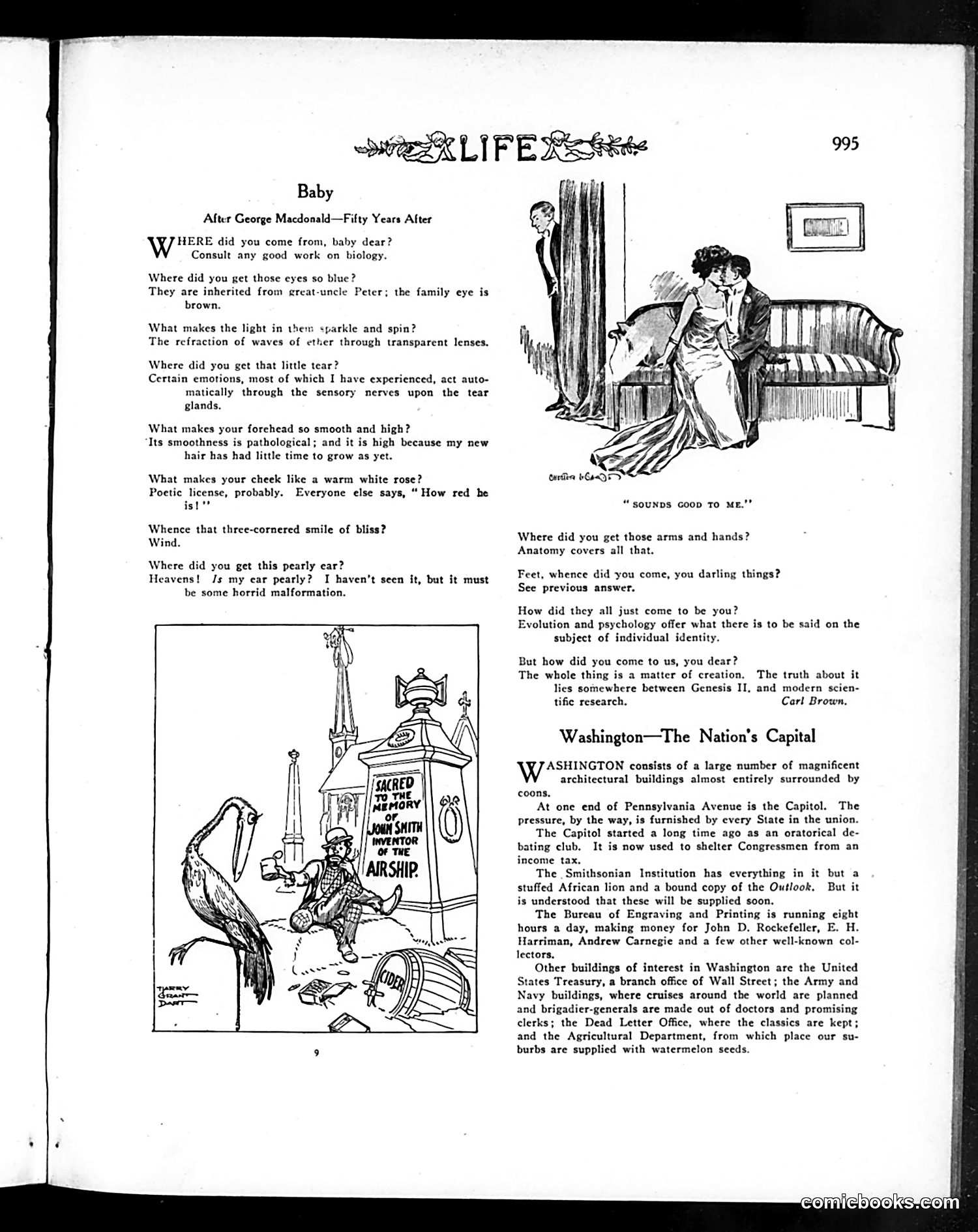
## "Baby" Poem This parody of George MacDonald's famous 1864 children's poem "Where Did You Come From, Baby Dear?" replaces MacDonald's sentimental, wonder-filled answers with coldly scientific ones. Instead of poetic mystery ("You came from far across the sea"), each feature gets a clinical explanation—inheritance, physics, anatomy, pathology. The satire mocks rigid scientism and materialism: the reduction of human beauty and emotion to mere mechanism. By answering "How did you come to us?" with "matter of creation" somewhere between Genesis and science, the author suggests both worldviews fail to capture what makes a baby meaningful. ## Washington Cartoon The accompanying text humorously debunks Washington institutions through cynical redefinition: the Capitol "shelters Congressmen from an income tax"; the Smithsonian lacks a stuffed lion; the Bureau of Engraving serves billionaire industrialists (Rockefeller, Harriman, Carnegie); and the Treasury is merely "Wall Street's branch office." This reflects Progressive-Era skepticism toward government corruption and corporate influence over public institutions.
📄 Transcribed text from this page (OCR, searchable)
Machine-transcribed from the original scan — historical spelling and the odd misread are preserved.
After George Macdonald—Fifty Years After HERE did you come from, baby dear? Consult any good work on biology. Where did you get those eyes so blue? They are inherited from great-uncle Peter; the family eye is brown. What makes the light in them sparkle and spin? The refraction of waves of ether through transparent lenses. Where did you get that little tear? Certain emotions, most of which I have experienced, act auto- matically through the sensory nerves upon the tear glands. What makes your forchead so smooth and high? Its smoothness is pathological; and it is high because my new hair has had little time to grow as yet. What makes your cheek like a warm white rose? Poetic license, probably. Everyone else says, “ How red he ist" Whence that three-cornered smile of bliss? Wind. Where did you get this pearly car? Heavens! 7s my ear pearly? I haven't seen it, but it must be some horrid malformation. “ souNDS Goop To ME.'” Where did you get those arms and hands? Anatomy covers all that. Feet, whence did you come, you darling things? See previous answer. How did they all just come to be you? Evolution and psychology offer what there is to be said on the subject of individual identity. But how did you come to us, you dear? The whole thing is a matter of creation, The truth about it lies somewhere between Genesis II, and modern scien- tific research, Carl Brown. Washington—The Nation’s Capital ASHINGTON consists of a large number of magnificent architectural buildings almost entirely surrounded by coons. At one end of Pennsylvania Avenue is the Capitol. The pressure, by the way, is furnished by every State in the union. The Capitol started a long time ago as an oratorical de- bating club. It is now used to shelter Congressmen from an income tax, The Smithsonian Institution has everything in it but a stuffed African lion and a bound copy of the Outlook. But it is understood that these will be supplied soon. The Bureau of Engraving and Printing is running eight hours a day, making money for John D. Rockefeller, E. H. Harriman, Andrew Carnegie and a few other well-known col- lectors. Other buildings of interest in Washington are the United States Treasury, a branch office of Wall Street; the Army and Navy buildings, where cruises around the world are planned and brigadier-generals are made out of doctors and promising clerks; the Dead Letter Office, where the classics are kept; and the Agricultural Department, from which place our su- burbs are supplied with watermelon seeds.