
Life, 1910-12-01 · page 68 of 108
Life — December 1, 1910 — page 68: what you’re looking at
What you’re looking at
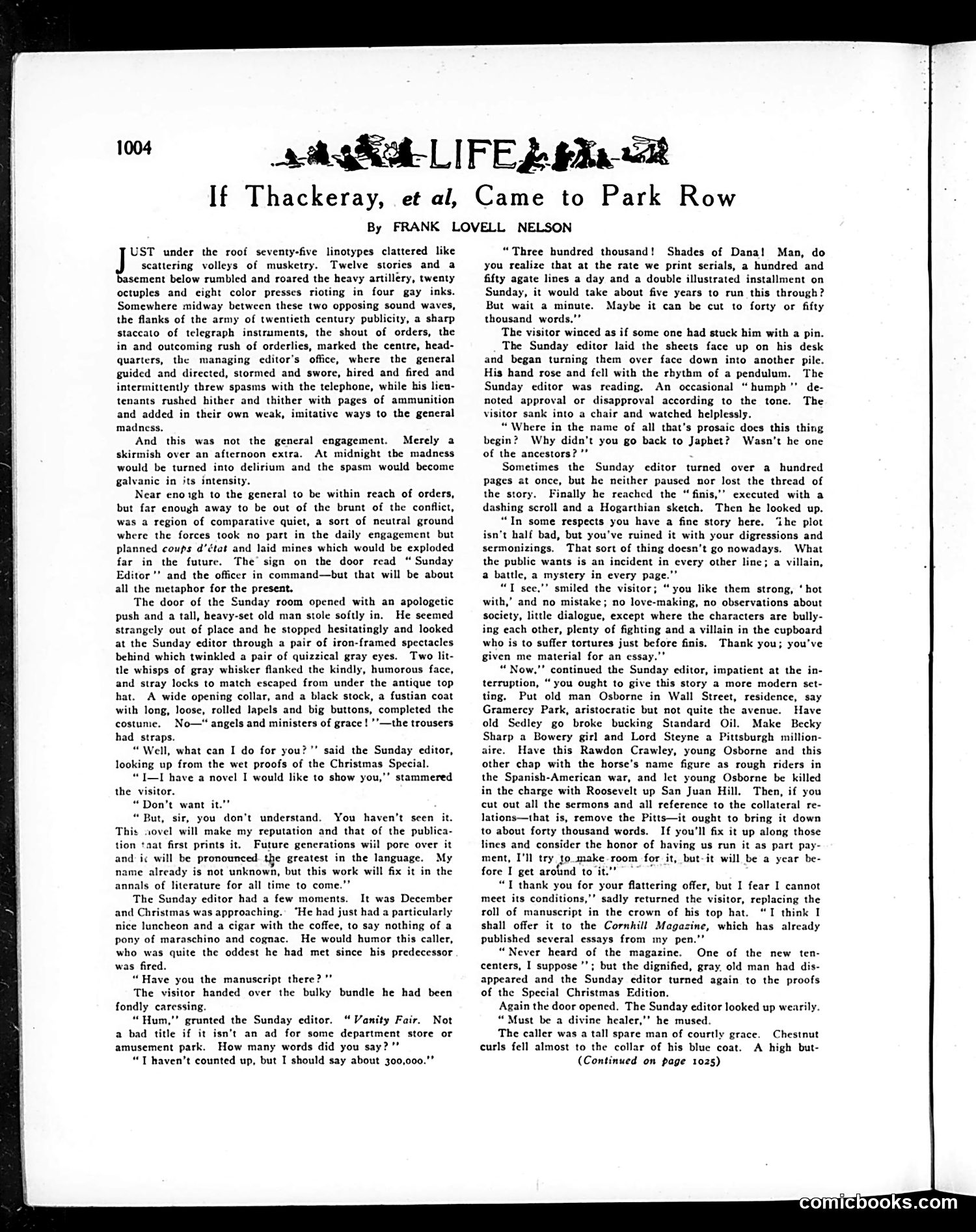
This satirical story by Frank Lovell Nelson depicts a 19th-century literary figure (styled as William Makepeace Thackeray) visiting a modern newspaper office—specifically Life magazine's headquarters on "Park Row" (New York's newspaper district). The joke targets the clash between classical literature and modern journalism's commercial machinery. An elderly, formally-dressed author submits a 300,000-word novel titled *Vanity Fair* to a harried Sunday editor, expecting it to revolutionize literature. The editor's dismissive response—noting it would take five years to serialize at current publication rates—satirizes how newspapers prioritize speed and profit over literary merit. The piece mocks both pretentious authors clinging to outdated publishing models and the mechanical, profit-driven newspaper industry that has no patience for serious fiction. The contrast between the visitor's antiquated appearance and the chaotic, modern newsroom emphasizes how irrelevant classical literature has become to contemporary mass media.
📄 Transcribed text from this page (OCR, searchable)
Machine-transcribed from the original scan — historical spelling and the odd misread are preserved.
GR LIFES ia 28 If Thackeray, et al, Came to Park Row By FRANK LOVELL NELSON scattering volleys of musketry. Twelve stories and a ment below rumbled and roared the heavy artillery, twenty octuples and eight color presses rioting in four gay inks. Somewhere midway between these two opposing sound waves, the flanks of the army of twentieth century publicity, a sharp staccato of telegraph instruments, the shout of orders, the in and outcoming rush of orderlies, marked the centre, head- quarters, the managing editor's office, where the general guided and directed, stormed and swore, hired and fired and intermittently threw spasms with the telephone, while his lieu- tenants rushed hither and thither with pages of ammunition and added in their own weak, imitative ways to the general madness. And this was not the general engagement. Merely a skirmish over an afternoon extra. At midnight the madness would be turned into delirium and the spasm would become galvanic in its intensity. Near eno igh to the general to be within reach of orders, but far enough away to be out of the brunt of the conflict, was a region of comparative quiet, a sort of neutral ground where the forces took no part in the daily engagement but planned coups d’état and laid mines which would be exploded far in the future. The sign on the door read “ Sunday Editor ’’ and the officer in command—but that will be about all the metaphor for the present. The door of the Sunday room opened with an apologetic push and a tall, heavy-set old man stole softly in. He seemed strangely out of place and he stopped hesitatingly and looked at the Sunday editor through a pair of iron-framed spectacles behind which twinkled a pair of quizzical gray eyes. Two lit- tle whisps of gray whisker flanked the kindly, humorous face, and stray locks to match escaped from under the antique top hat. A wide opening collar, and a black stock, a fustian coat with long, loose, rolled lapels and big buttons, completed the costume, No—“ angels and ministers of grace ! ’—the trousers had straps. “ Well, what can I do for you?"’ said the Sunday editor, looking up from the wet proofs of the Christmas Special. “I—I have a novel I would like to show you,’’ stammered the visitor. “Don’t want it.’’ “But, sir, you don’t understand. You haven't scen it. This sovel will make my reputation and that of the publica- tion taat first prints it. Future generations wiil pore over it and ic will be pronounced. the greatest in the language. My name already is not unknown, but this work will fix it in the annals of literature for all time to come.’’ The Sunday editor had a few moments. It was December and Christmas was approaching. ‘He had just had a particularly nice luncheon and a cigar with the coffee, to say nothing of a pony of maraschino and cognac. He would humor this caller, who was quite the oddest he had met since his predecessor was fired. “Have you the manuscript there?’ The visitor handed over the bulky bundle he had been fondly caressing. “Hum,’’ grunted the Sunday editor. “Vanity Fair. Not a bad title if it isn’t an ad for some department store or amusement park. How many words did you say?’ “T haven’t counted up, but I should say about 300,000."" ee under the roof seventy-five linotypes clattered like “Three hundred thousand! Shades of Dana! Man, do you realize that at the rate we print serials, a hundred and fifty agate lines a day and a double illustrated installment on Sunday, it would take about five years to run this through? But wait a minute. Maybe it can be cut to forty or fifty thousand words.’’ The visitor winced as if some one had stuck him with a pin. The Sunday editor laid the sheets face up on his desk and began turning them over face down into another pile. His hand rose and fell with the rhythm of a pendulum. The Sunday editor was reading. An occasional “humph" de- noted approval or disapproval according to the tone. The visitor sank into a chair and watched helplessly. “Where in the name of all that's prosaic docs this thing begin? Why didn’t you go back to Japhet? Wasn't he one of the ancestors?’ Sometimes the Sunday editor turned over a hundred pages at once, but he neither paused nor lost the thread of the story. Finally he reached the “ finis,’’ executed with a dashing scroll and a Hogarthian sketch. Then he looked up. “In some respects you have a fine story here. ‘ihe plot isn’t half bad, but you've ruined it with your digressions and sermonizings. That sort of thing doesn’t go nowadays. What the public wants is an incident in every other line; a villain, a battle, a mystery in every page.”’ “T see,’ smiled the visitor; “you like them strong, ‘hot with,’ and no mistake; no love-making, no observations about society, little dialogue, except where the characters are bully- ing each other, plenty of fighting and a villain in the cupboard who is to suffer tortures just before finis. Thank you; you've given me material for an essay.”" “ Now,’ continued the Sunday editor, impatient at the in- terruption, “ you ought to give this story a more modern sct- ting. Put old man Osborne in Wall Street, residence, say Gramercy Park, aristocratic but not quite the avenue. Have old Sedley go broke bucking Standard Make Becky Sharp a Bowery girl and Lord Steyne a Pittsburgh million- aire. Have this Rawdon Crawley, young Osborne and this other chap with the horse’s name figure as rough riders in the Spanish-American war, and Ict young Osborne be killed in the charge with Roosevelt up San Juan Hill. Then, if you cut out all the sermons and all reference to the collateral re- lations—that is, remove the Pitts—it ought to bring it down to about forty thousand words. If you'll fix it up along those lines and consider the honor of having us run it as part pay- ment, I'll try to make-room for it, but-it will be a year be- fore I get arolind to it.”” : “T thank you for your flattering offer, but I fear I cannot meet its conditions,’ sadly returned the visitor, replacing the roll of manuscript in the crown of his top hat. “I think I shall offer it to the Cornhill Magazine, which has already published several essays from my pen.’? “Never heard of the magazine. One of the new ten- centers, I suppose '’; but the dignified, gray, old man had dis- appeared and the Sunday editor turned again to the proofs of the Special Christmas Edition. Again the door opened. The Sunday editor looked up wearily. “Must be a divine healer,’’ he mused. The caller was a tall spare man of courtly grace. Chestnut curls fell almost to the collar of his blue coat. A high but- (Continued on page 1025) ‘Comicbooks.com