
Life, 1910-12-01 · page 45 of 108
Life — December 1, 1910 — page 45: what you’re looking at
What you’re looking at
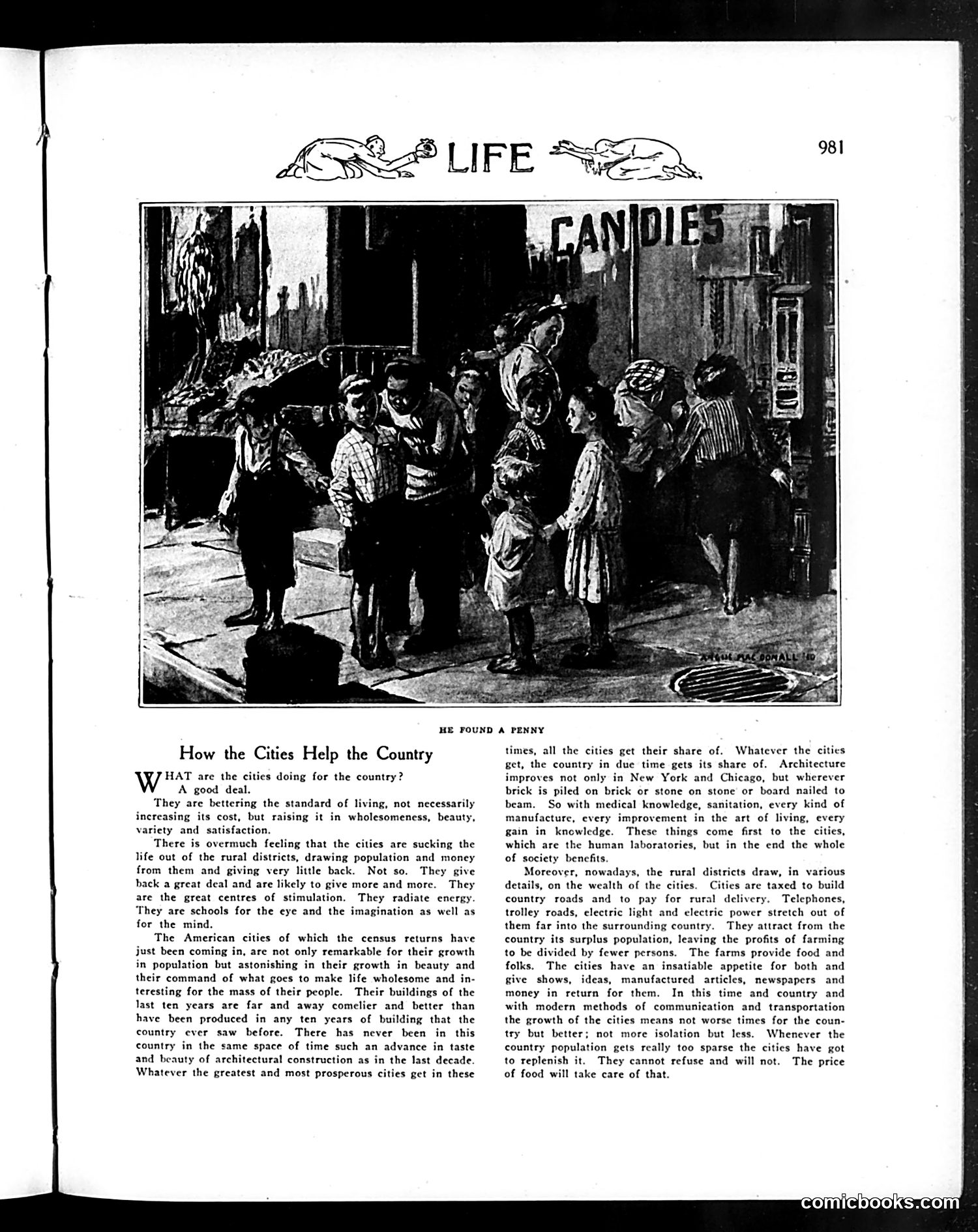
The image shows a street scene with children gathered around what appears to be a penny or small object on the ground—a common childhood moment of discovery. The title "He Found a Penny" serves as a gentle, humorous caption. However, this illustration accompanies a serious essay titled "How the Cities Help the Country," which argues against rural resentment of urban centers. The text defends American cities as engines of progress—cultural laboratories that eventually benefit rural areas through infrastructure (roads, telephone, electric lines), improved architecture, modern knowledge, and manufactured goods. The juxtaposition appears intentional: the small, innocent joy of finding a penny mirrors the essay's argument that even modest urban developments eventually "trickle down" to rural communities. The cartoon lightens what is otherwise a dense economic and social argument about urban-rural interdependence during the early 20th century, when agricultural decline and urban migration sparked rural anxieties.
📄 Transcribed text from this page (OCR, searchable)
Machine-transcribed from the original scan — historical spelling and the odd misread are preserved.
LIFE Sia HE FOUND A PENNY How the Cities Help the Country HAT are the cities doing for the country? A good deal. They are bettering the standard of living, not necessarily increasing its cost, but raising it in wholesomeness, beauty, variety and satisfaction. There is overmuch feeling that the cities are sucking the life out of the rural districts, drawing population and money from them and giving very little back. Not so. They give back a great deal and are likely to give more and more. They are the great centres of stimulation. They radiate energy. They are schools for the eye and the imagination as well as for the mind. The American cities of which the census returns have just been coming in, are not only remarkable for their growth in population but astonishing in their growth in beauty and their command of what goes to make life wholesome and in- teresting for the mass of their people. Their buildings of the last ten years are far and away comelier and better than have been produced in any ten years of building that the country ever saw before. There has never been in this country in the same space of time such an advance in taste and beauty of architectural construction as in the last decade. Whatever the greatest and most prosperous cities get in these times, all the cities get their share of. Whatever the cities get, the country in due time gets its share of. Architecture improves not only in New York and Chicago, but wherever brick is piled on brick or stone on stone or board nailed to beam. So with medical knowledge, sanitation, every kind of manufacture, every improvement in the art of living, every gain in knowledge. These things come first to the cities, which are the human laboratories, but in the end the whole of society benefits. Moreover, nowadays, the rural districts draw, in various details, on the wealth of the cities. Cities are taxed to build country roads and to pay for rural delivery, Telephones, trolley roads, electric light and electric power stretch out of them far into the surrounding country. They attract from the country its surplus population, leaving the profits of farming to be divided by fewer persons. The farms provide food and folks. The cities have an insatiable appetite for both and give shows, ideas, manufactured articles, newspapers and money in return for them. In this time and country and with modern methods of communication and transportation the growth of the cities means not worse times for the coun- try but better; not more isolation but less. Whenever the country population gets really too sparse the cities have got to replenish it. They cannot refuse and will not. The price of food will take care of that.