
Life, 1910-12-01 · page 65 of 108
Life — December 1, 1910 — page 65: what you’re looking at
What you’re looking at
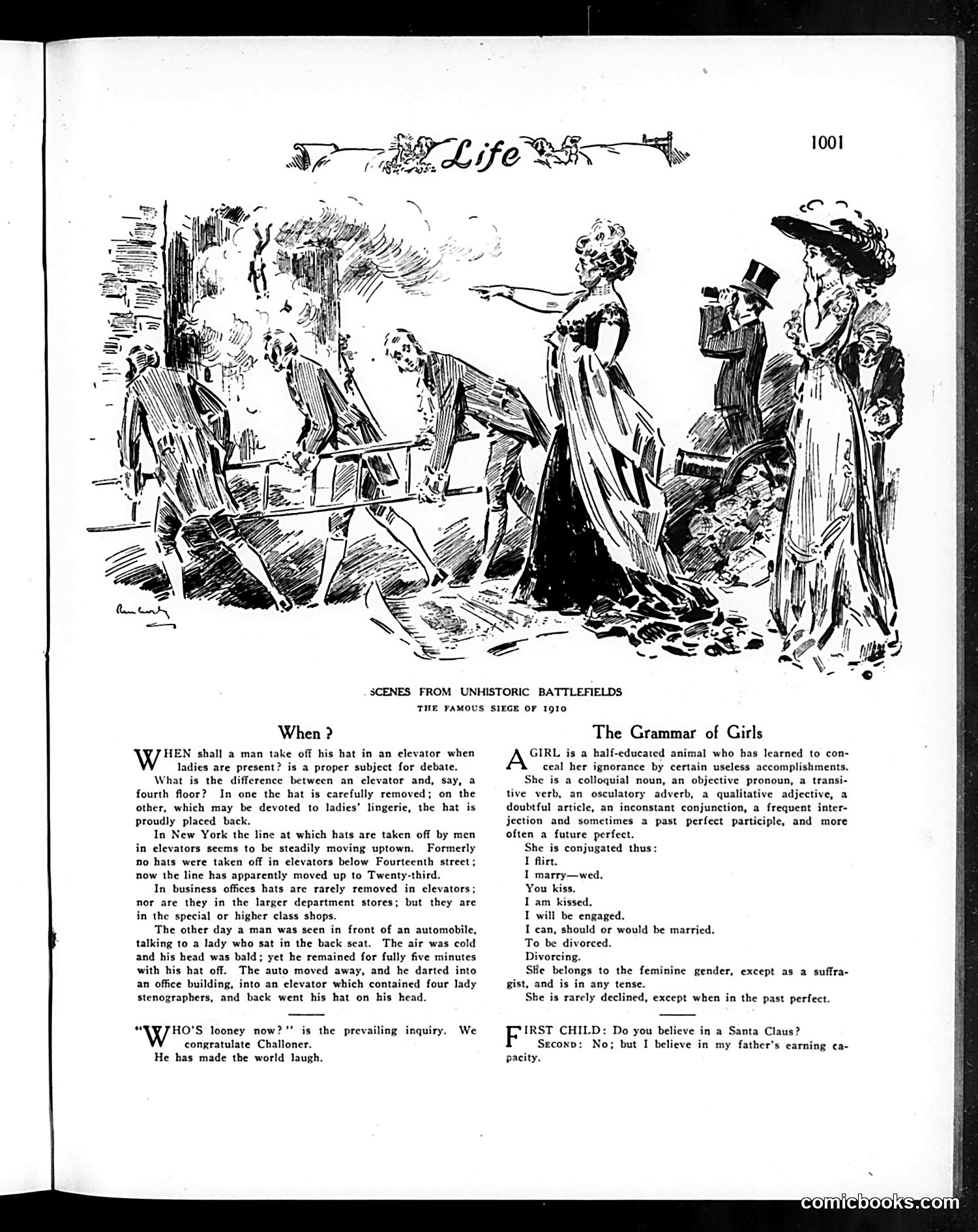
This 1910 *Life* magazine page contains two satirical pieces mocking contemporary social conventions and gender dynamics. **"When?" (Hat Etiquette)** The piece ridicules absurd rules about removing hats in elevators around ladies. It notes that the "proper" floor for hat removal has mysteriously migrated uptown (from 14th to 23rd Street), and ironically describes a bald man who removes his hat outdoors in cold weather but keeps it on in an elevator with female stenographers. The satire targets the arbitrary, class-based nature of Victorian politeness—the hypocrisy of men's behavior changing based on location rather than genuine respect. **"The Grammar of Girls"** This satirizes women as simultaneously ignorant and manipulative—describing girls as conjugating through flirtation, marriage, and divorce. The final joke presents a child rejecting Santa Claus but believing in fathers' earning capacity, mocking both parental deception and women's mercenary nature (marrying for money). The "unhistoric battlefields" subtitle frames gender relations as warfare. Both pieces reflect early 20th-century satirical attitudes toward women—simultaneously condescending about female education while anxious about female sexuality and economic power.
📄 Transcribed text from this page (OCR, searchable)
Machine-transcribed from the original scan — historical spelling and the odd misread are preserved.
IP TBS fe CS SCENES FROM UNHISTORIC BATTLEFIELDS THE FAMOUS SIEGE OF 1910 When ? HEN shall a man take off his hat in an elevator when ladies are present? is a proper subject for debate. What is the difference between an elevator and, say, a fourth floor? In one the hat is carefully removed; on the other, which may be devoted to ladies’ lingerie, the hat is Proudly placed back. In New York the line at which hats are taken off by men in elevators seems to be steadily moving uptown. Formerly no hats were taken off in elevators below Fourteenth street; now the line has apparently moved up to Twenty-third. In business offices hats are rarely removed in clevators; nor are they in the larger department stores; but they are in the special or higher class shops. The other day a man was seen in front of an automobile, talking to a lady who sat in the back seat. The air was cold and his head was bald; yet he remained for fully five minutes with his hat off. The auto moved away, and he darted into an office building, into an elevator which contained four lady stenographers, and back went his hat on his head. “YYTHO'S looney now?" is the prevailing inquiry. We congratulate Challoner. He has made the world laugh. The Grammar of Girls GIRL is a half-educated animal who has learned to con- ceal her ignorance by certain useless accomplishments. She is a colloquial noun, an objective pronoun, a transi- tive verb, an osculatory adverb, a qualitative adjective, a doubtful article, an inconstant conjunction, a frequent inter- jection and sometimes a past perfect participle, and more often a future perfect. She is conjugated thus: T flirt. I marry—wed. You kiss. I am kissed. I will be engaged. I can, should or would be married. To be divorced. Divorcing. Sle belongs to the feminine gender, except as a suffra- gist, and is in any tense. She is rarely declined, except when in the past perfect. IRST CHILD: Do you believe in a Santa Claus? Seconn: No; but I believe in my father’s earning ca- pacity.