A complete issue · 204 pages · 1865
Rose Mortimer; Or, The Ballet-Girl's Revenge
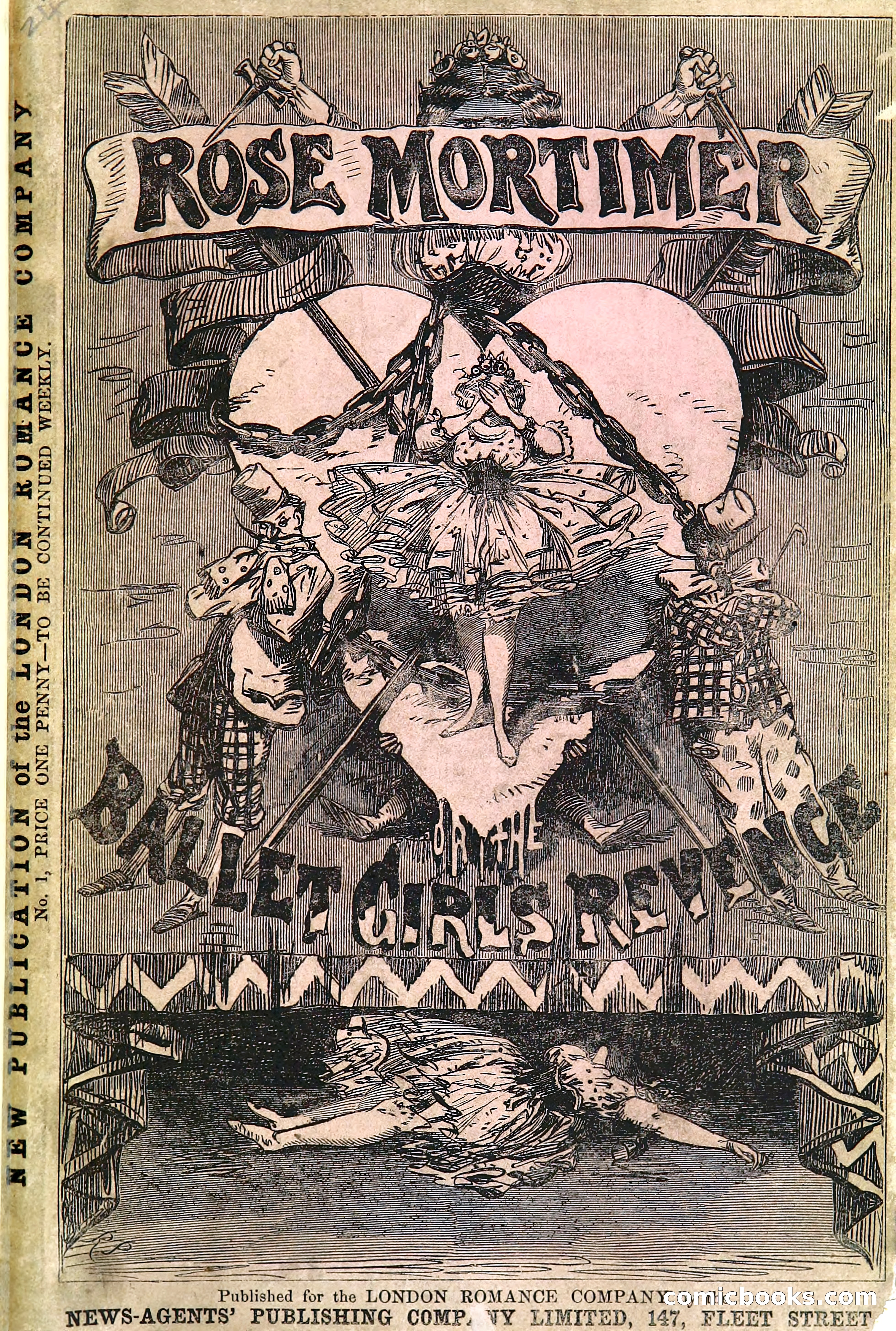
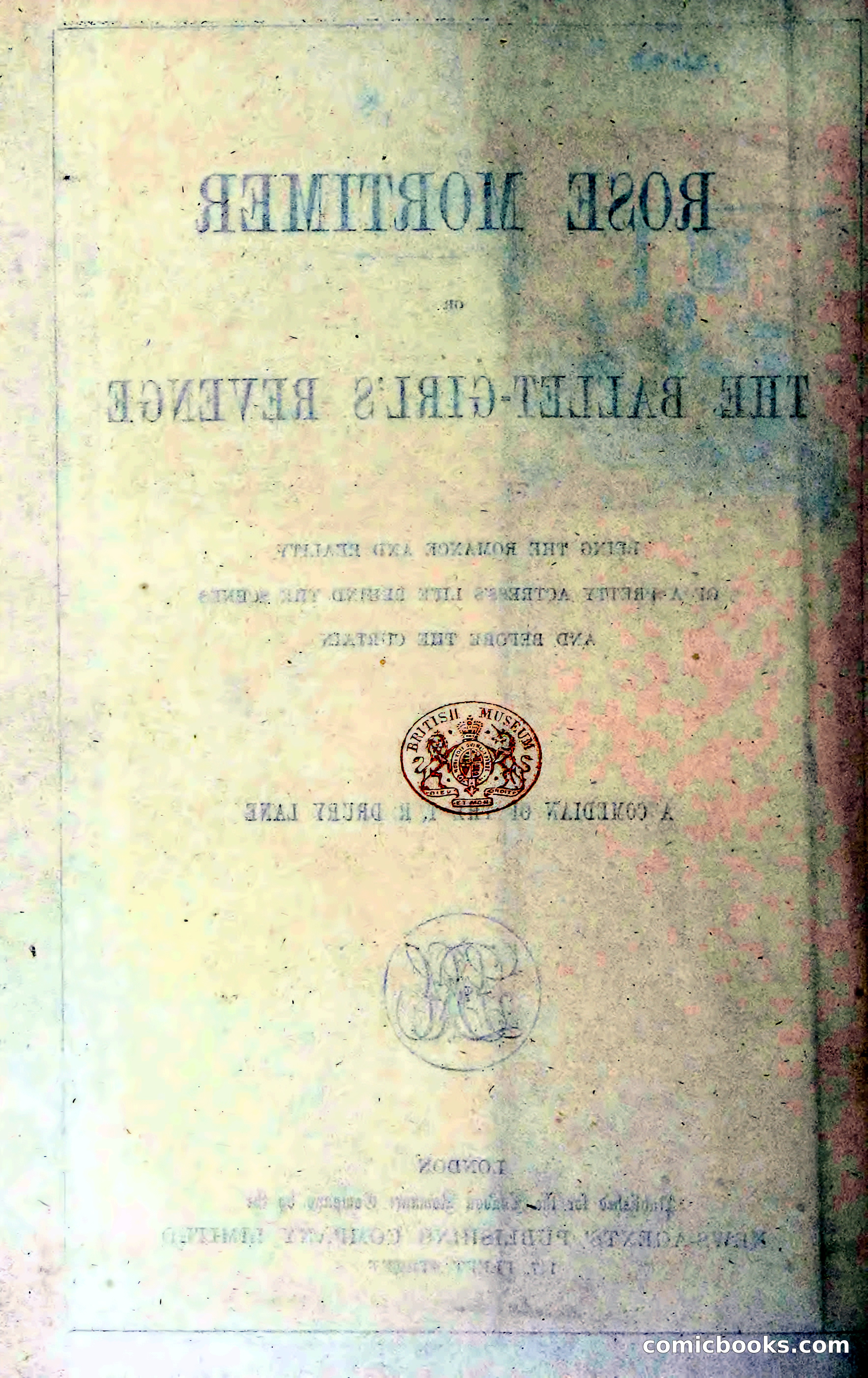
This is the title page of a Victorian penny dreadful. The ornate header reads "ROSE MORTIMER" and appears to feature a central illustration of a woman's face surrounded by decorative flourishes and small figures. The visible text indicates this is "No. 1, PRICE ONE PENNY—TO BE CONTINUED WEEKLY," published by the London Romance Company through News-Agents' Publishing Company Limited at 147 Fleet Street. The page establishes this as the first installment of a serialized weekly publication typical of Victorian sensational fiction.
# Analysis This is a heavily deteriorated page from a Victorian penny dreadful, with the surface significantly worn, stained, and discolored by age. The image shows predominantly purple and pink tones with green discoloration at the edges—characteristic of aged paper degradation. The OCR text provided is blank or unreadable, and the actual printed text on the page itself is too faint and obscured by the deterioration to decipher with confidence. A small watermark or publisher's mark reading "comicbooks.com" appears at the bottom right, suggesting this is a digitized archive image. The page's condition makes it impossible to reliably determine whether it contains prose, illustration, or title matter.
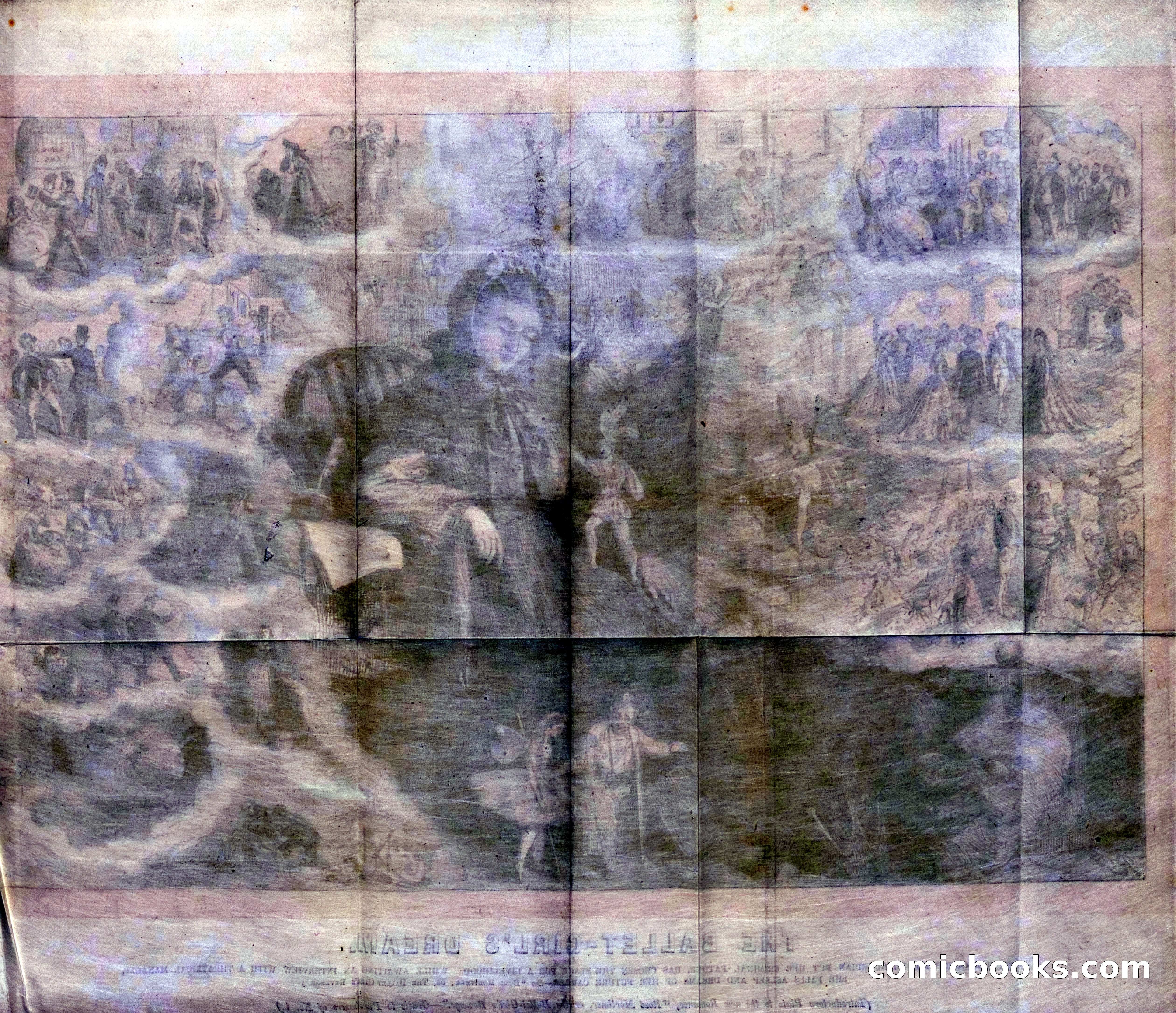
This page consists primarily of a large illustration depicting a crowded Victorian-era street scene with numerous figures in period dress. The scene appears chaotic and densely populated, showing what looks like a public gathering or disturbance, though the specific narrative context is unclear from the image alone. The OCR text at the bottom is too degraded and fragmented to read with confidence—it appears to be a caption or explanatory text but remains largely illegible. The illustration dominates the page, presented in the characteristic style of penny dreadful engravings, rendered in dark ink with fine cross-hatching typical of Victorian wood-block or steel-engraving techniques. The overall composition suggests this is a dramatic moment from a serialized narrative, though the exact plot details cannot be determined from the visible text.
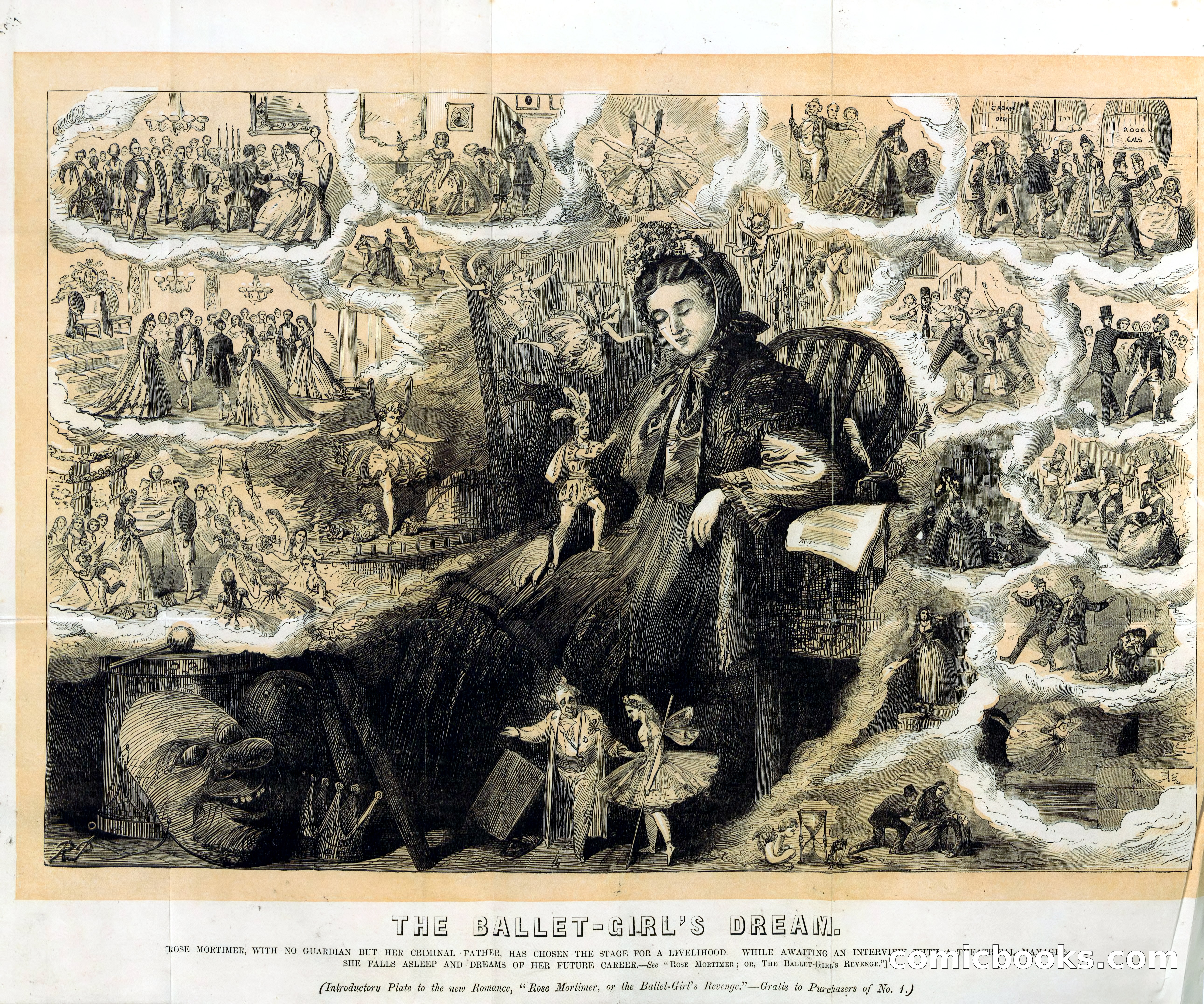
# Analysis This is an **illustrated page** from a Victorian penny dreadful. The image shows an ornate engraving titled "The Ballet-Girl's Dream," depicting a young woman in elaborate dress seated centrally, surrounded by numerous smaller scenes in clouds depicting her imagined future. The text explains that Rose Mortimer, an orphaned girl with only her criminal father as guardian, has chosen stage work for her livelihood. While awaiting an interview, she falls asleep and dreams of her future theatrical career. The caption indicates this is an introductory illustration for a serialized romance titled "Rose Mortimer; or, the Ballet-Girl's Revenge," distributed gratis with the first installment.
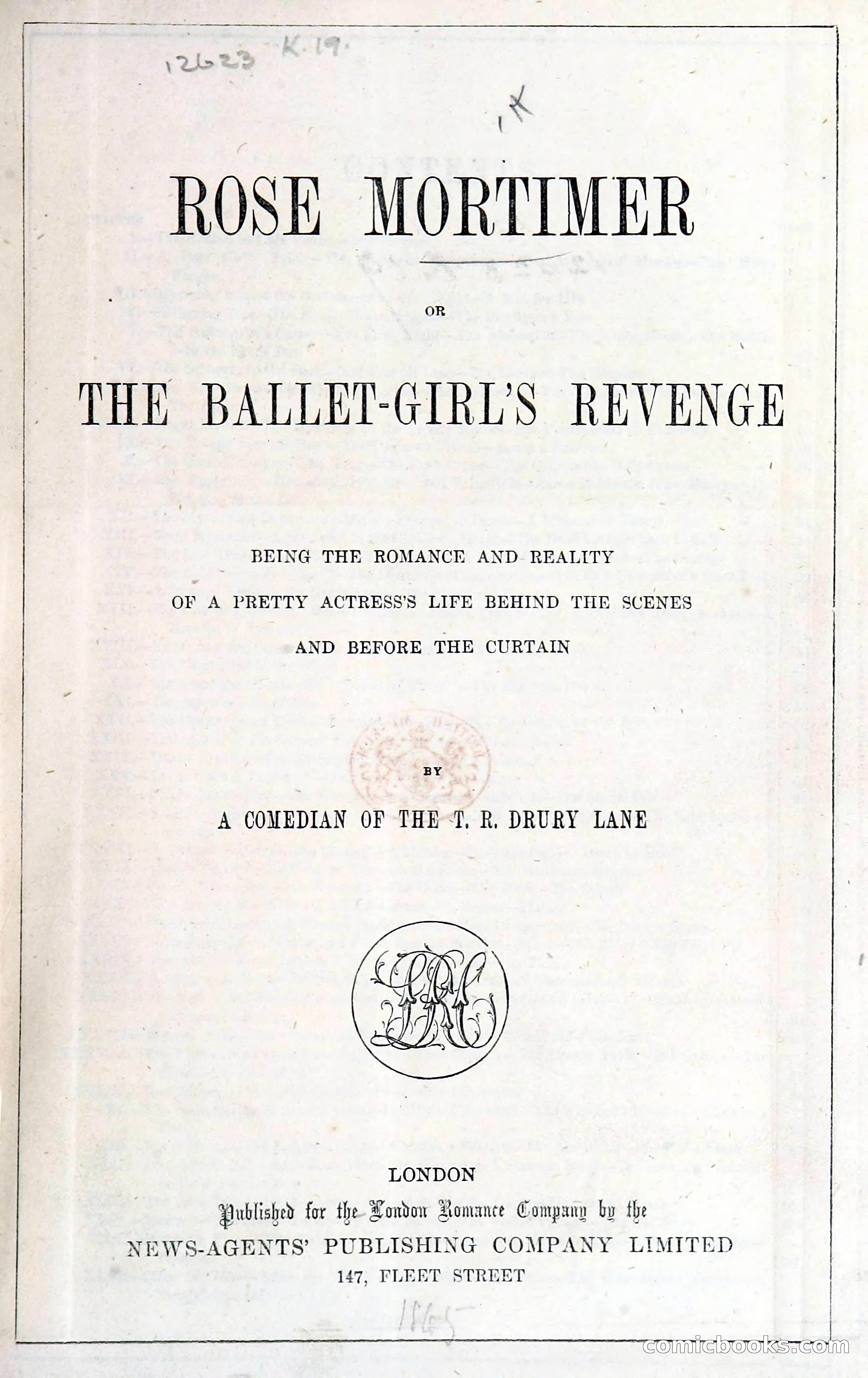
# This is a title page for a Victorian penny dreadful This is the title page of *Rose Mortimer; or The Ballet-Girl's Revenge*, described as "the romance and reality of a pretty actress's life behind the scenes and before the curtain." The work is credited to "a Comedian of the T. R. Drury Lane" (an apparent reference to Theatre Royal, Drury Lane). Published in London by the News-Agents' Publishing Company Limited at 147 Fleet Street, this sensational melodrama appears designed to appeal to Victorian readers interested in theatrical scandal and the supposedly scandalous private lives of performers. The anonymous authorship and focus on female revenge suggest typical penny dreadful themes of crime, seduction, and social transgression.
# Analysis of Page This is a **title or cover page** of a Victorian penny dreadful publication. The page is heavily aged and deteriorated, making most text difficult to read clearly in the OCR output. However, the image shows reversed/mirrored text at the top reading "ROSE MONTEITH" and "THE BALLET-GIRL'S BRIDAL" (or similar), along with what appears to be a publisher's seal or emblem in the center—characteristic of legitimate Victorian publishing houses. The page shows typical period wear with foxing and discoloration. While the exact title and publication details are partially obscured, this appears to be the front matter identifying the serialized work and publisher.
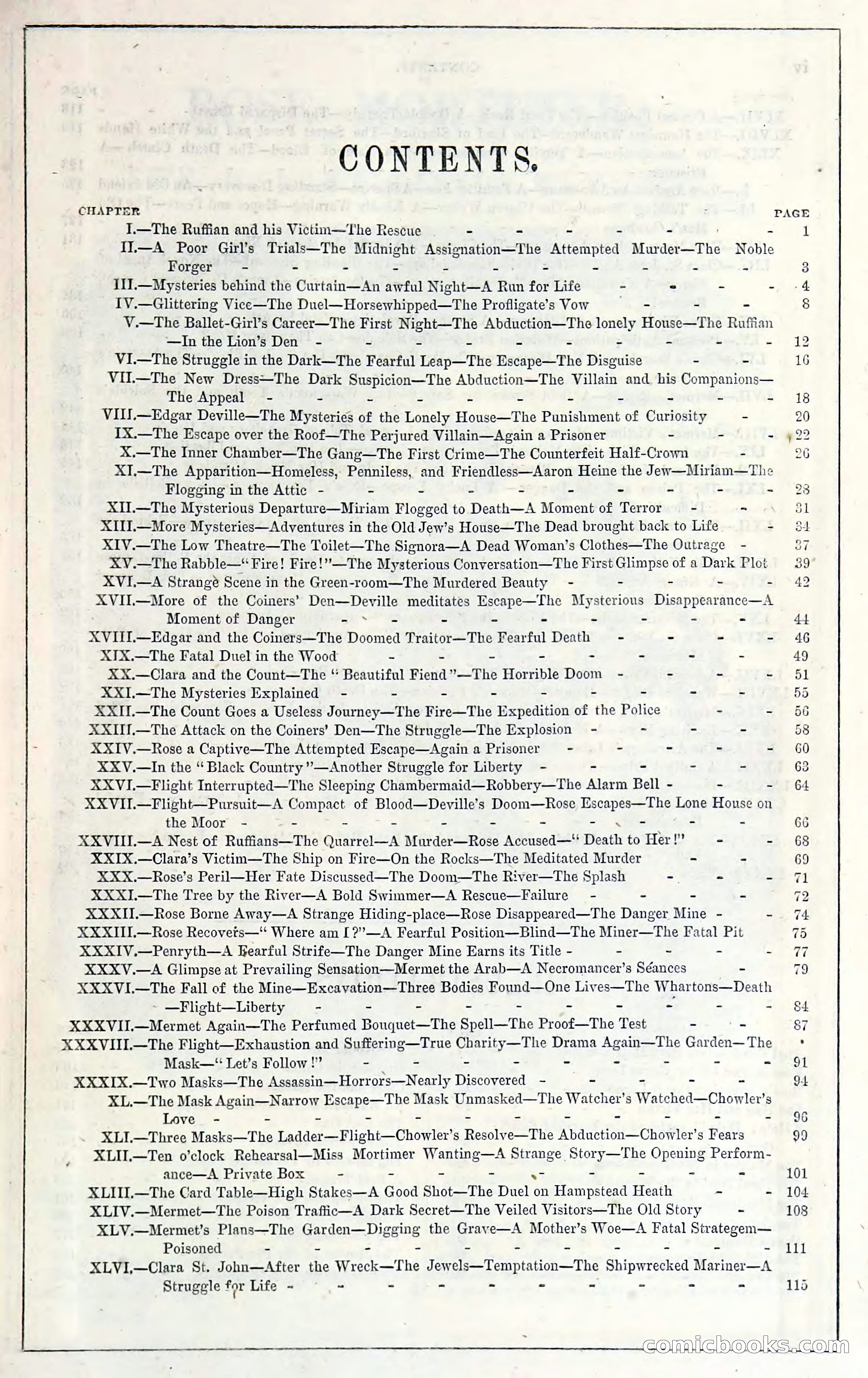
# Contents Page from a Victorian Penny Dreadful This is a **contents page** listing the forty-six chapters of a serialized Victorian melodrama. The visible text itemizes chapter titles with corresponding page numbers, revealing a sensational narrative involving crime, villainy, and mystery. Key plot elements mentioned include: a ruffian and rescue, attempted murder, a duel, abduction, a mysterious "lonely house," counterfeiting, flogging, a theatre, coiners' den, a fatal duel in the wood, a character named Rose in captivity and peril, a danger mine, and various pursuits and narrow escapes. The accumulation of violent and dramatic chapter headings—murder, explosion, poisoning, death—exemplifies penny dreadful conventions of lurid sensation fiction designed to entertain working-class readers with serialized melodrama.
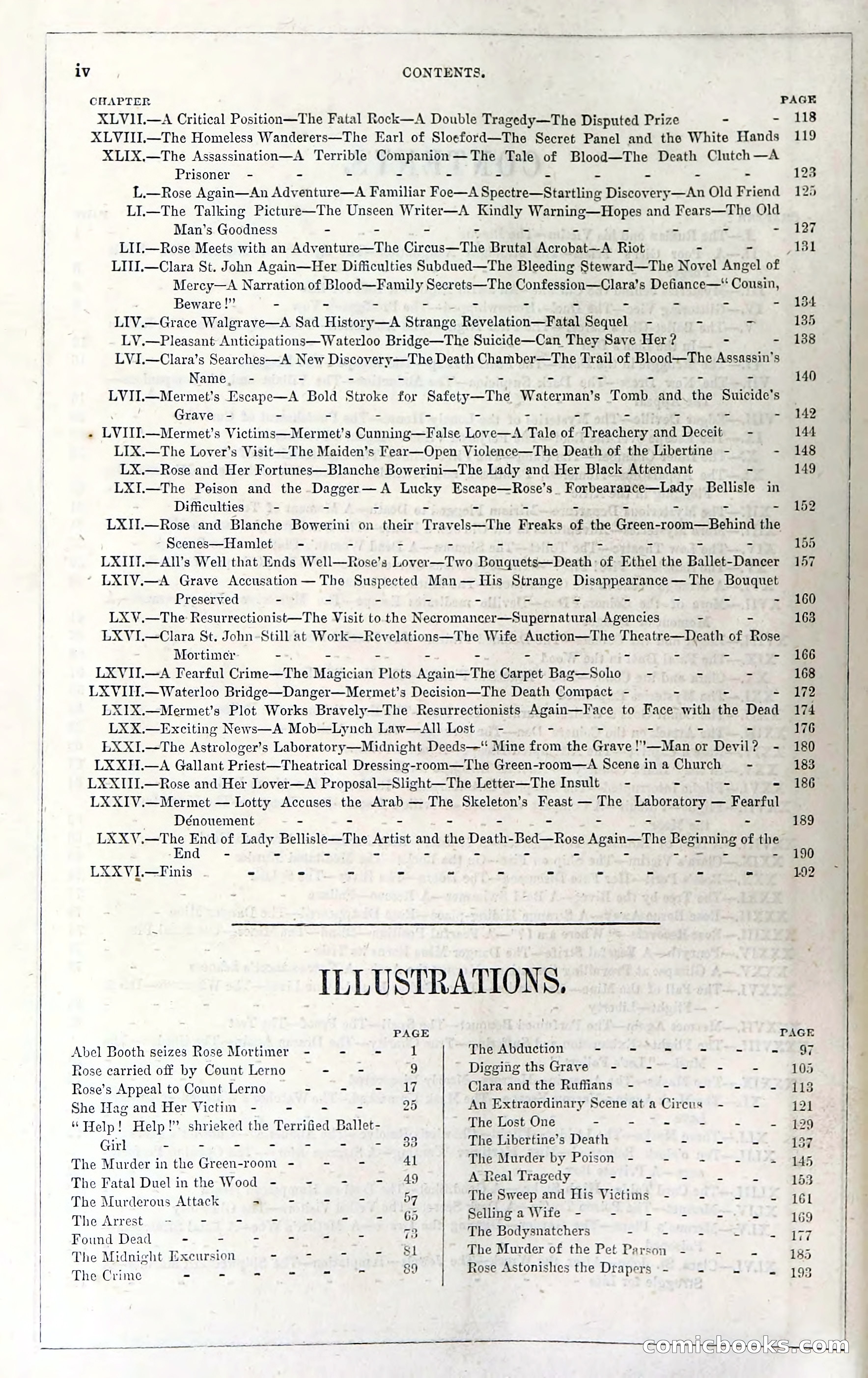
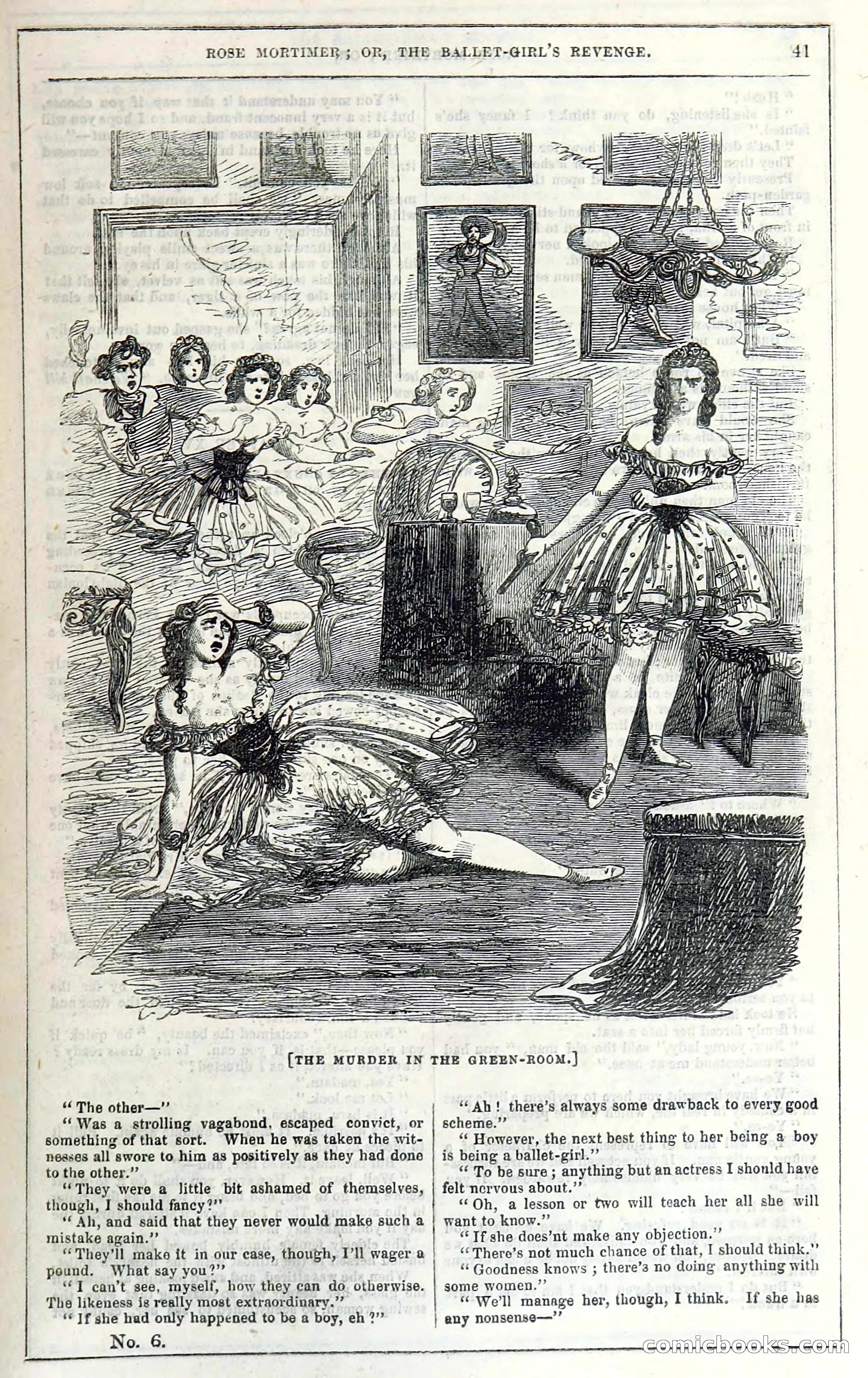
# Analysis of This Page This is a **contents and illustrations page** from a Victorian penny dreadful. The upper section lists 30 chapters (XLVII through LXXVI, marked "Finis") with their titles and page numbers, spanning pages 118–192. Chapter titles emphasize sensational melodrama: "The Fatal Rock," "A Double Tragedy," "The Assassination," "The Poison and the Dagger," "The Resurrectionist," and "The Death of Rose Mortimer." The lower section lists illustrations by title and page number, depicting scenes of violence and peril ("Abel Booth seizes Rose Mortimer," "Digging the Grave," "The Murder in the Green-room"). The narrative appears to center on a character named Rose Mortimer and involves crime, poison, supernatural elements, and death.
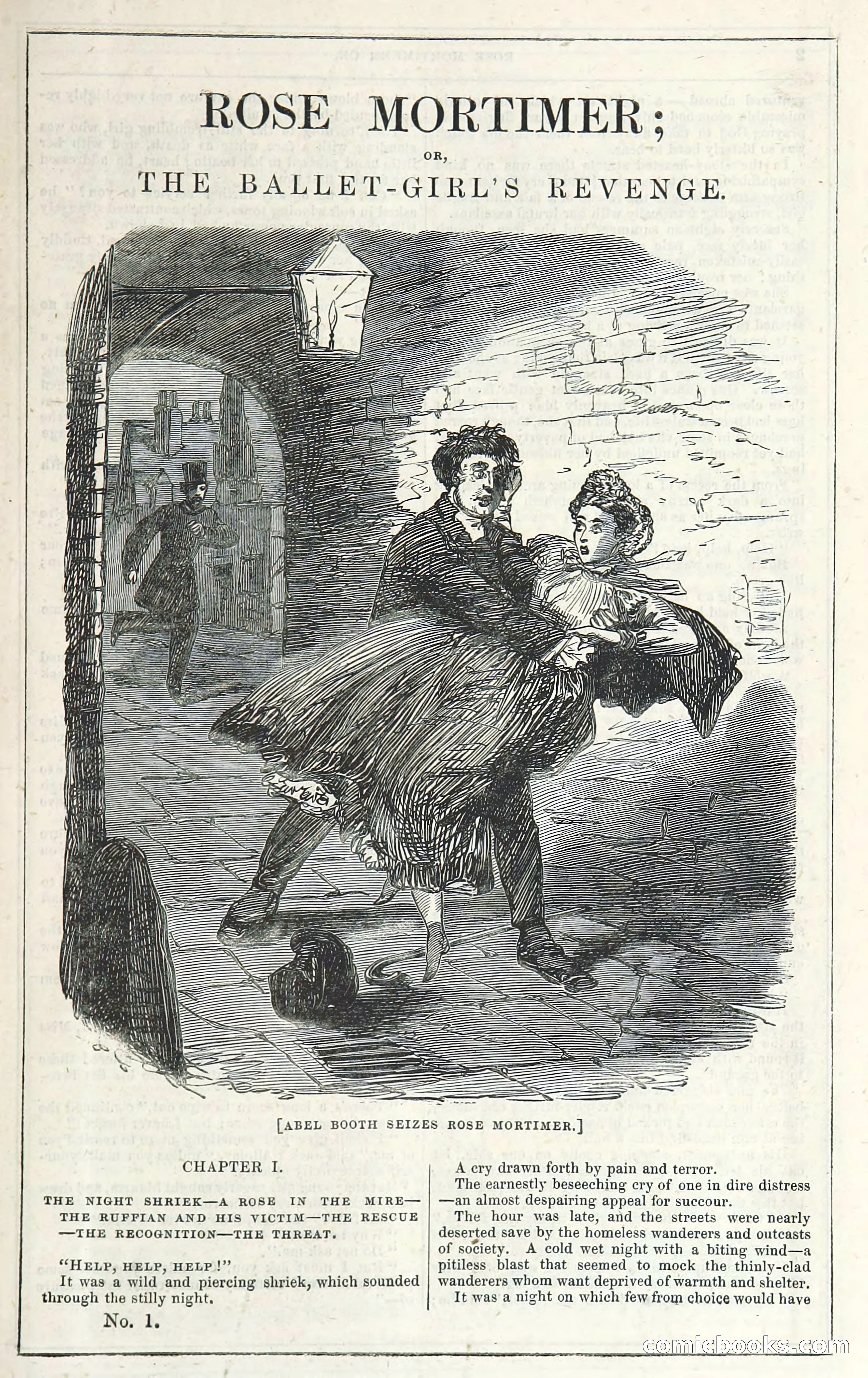
# Analysis of This Page This is the opening page of a Victorian penny dreadful serial. At the top is the title "Rose Mortimer; or, The Ballet-Girl's Revenge," followed by a dramatic engraving showing a man carrying a woman away from a doorway while a figure watches from within. Below the illustration, a caption reads "[Abel Booth Seizes Rose Mortimer.]" The page then begins Chapter I, titled "The Night Shriek—A Rose in the Mire," with running prose describing a woman's desperate cry for help on a cold, late night in the deserted streets. The text emphasizes "pain and terror" and "dire distress," establishing the melodramatic, sensational tone typical of the genre.
# Analysis of Page 2: Rose Mortimer; Or, This is a page of running prose from the middle of a Victorian penny dreadful serial. The text describes a violent assault on an eighteen-year-old girl named Rose Mortimer in Lambeth, London. A respectably-dressed man who appears to be a religious leader attacks her in a dark alley; she cries for help, but a stranger intervenes, fighting off her assailant with brutal efficiency. The passage emphasizes Rose's youth, virtue, and poverty through sentimental description, while depicting her attacker as a hypocritical villain—a "wolf in sheep's clothing"—a common melodramatic trope. The rescue scene showcases physical violence and class-inflected moral judgments typical of the genre.
# Analysis of Page 3 from *The Ballet-Girl's Revenge* This is a page of running prose from a Victorian penny dreadful serial. The narrative follows a poor ballet dancer named Rose Mortimer, who is rescued from an assailant by a scene-painter, then returns to her miserable home. There, her cruel father interrogates her about an evening out; she reveals she encountered Abel Booth, a man they fear, before a stranger rescued her. The text emphasizes melodramatic elements: Rose's distress, her father's callousness, mysterious threats, and hints of blackmail or sexual danger. Chapter II begins mid-page, introducing domestic poverty and family conflict as central plot drivers.
# Rose Mortimer; Or, [running prose page] This is a page of running prose text from a Victorian penny dreadful novel. The visible text depicts a tense confrontation between a mysterious "count" and Hugh Mortimer (apparently Rose's father) over some compromising documents. The count demands papers, Mortimer attempts extortion by demanding double payment, and the count responds by drawing a revolver, subduing Mortimer, and threatening him into compliance. The scene emphasizes melodramatic tension, class conflict, and criminal intrigue typical of the genre.
# Page Analysis: Running Prose from Victorian Penny Dreadful This is a page of running prose text from *The Ballet-Girl's Revenge*, a Victorian penny dreadful. The narrative follows Rose Mortimer, a young ballet dancer seeking employment, as she visits a theatre in Hardress Street to appeal to Mr. Flathers, the manager. She encounters Jack Halliday, a bearded artist who helped her the previous evening; he accompanies her backstage and arranges for her to meet with Flathers. The text is typical melodramatic serialized fiction, emphasizing Rose's desperation, her gratitude toward Halliday, and the theatrical setting's atmospheric details ("black beams," "complicated machinery"). The page concludes as she is finally summoned to see the manager.
# Page Analysis: Rose Mortimer; Or, [Running Prose] This is a page of running narrative prose (page 6) from a Victorian penny dreadful titled "Rose Mortimer; Or," containing no illustrations. The text depicts a melodramatic sequence in which Rose, a young woman who has just secured employment at a theatre, returns home and is alarmed to find a disreputable man named Abel Booth leaving her house. When she reports this to her father Hugh Mortimer, he becomes intensely distressed, refusing to explain his fear but pacing anxiously and staring into the street with a "scared white face." The passage emphasizes Rose's confusion and growing dread as her father's mysterious agitation suggests darker secrets at play.
# Page Analysis This is a **running prose page** from the penny dreadful *The Ballet-Girl's Revenge* (page 7). The text depicts a dramatic domestic scene in which Hugh Mortimer orders his daughter Rose to her room, reveals he has hidden a pistol, and announces he will "play a game" with Abel Booth that night "for life." After Rose retires to her room, she smells smoke rising from below, suspects the house is on fire, and discovers her door is locked from the outside—trapping her. The narrative builds suspense around an impending violent confrontation between her father and the mysterious Abel Booth.
# Page Description This is a page of running prose from a Victorian penny dreadful titled *Rose Mortimer*. The text depicts Rose trapped in her locked room, hearing violent sounds below. She breaks through the floor to investigate and falls into a bloodstained chamber below, where she discovers no body but hears a sinister laugh. She then sees the face of "her assailant" peering through the hole she made—a man named Abel Booth—who addresses her mockingly. The narrative combines melodramatic horror (blood-soaked walls, mysterious violence) with Gothic suspense typical of the genre.
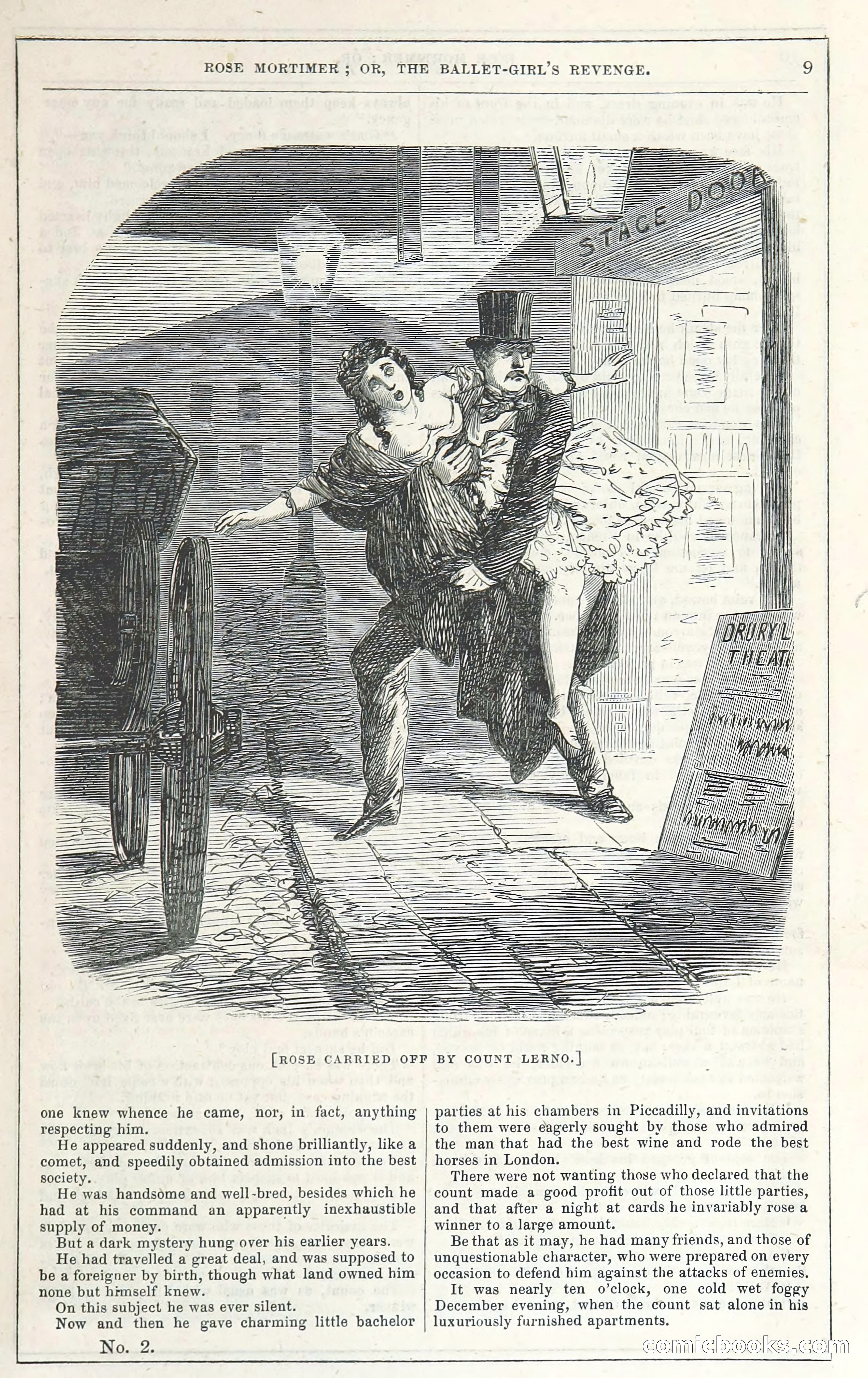
# Page Content Description This is page 9 of a Victorian penny dreadful serial titled *Rose Mortimer; or, The Ballet-Girl's Revenge*. The page features a wood-engraved illustration captioned "[ROSE CARRIED OFF BY COUNT LERNO]" showing a man in formal dress carrying away a woman in a ballet costume near a stage door. Below the illustration runs prose text describing Count Lerno—a mysterious, wealthy, well-bred foreigner of unknown origin who has gained admission to London society through his charm, money, and lavish parties in Piccadilly. The text notes rumors that he profits from cards at these gatherings, and describes a cold December evening when the count sits alone in his luxurious apartments.
# Page Analysis: Running Prose from "Rose Mortimer; Or," This page contains running prose narrative from a Victorian penny dreadful serial titled "Rose Mortimer; Or," (title visible at page top). The text describes a mysterious count in evening dress who, alone in his locked room, carefully marks the backs of playing cards with a needle—appearing to prepare them for cheating. He then receives guests, including Captain Roper (a man of questionable racing reputation) and Sir Harold King. The passage emphasizes the count's handsome appearance, his well-appointed reception room with its collection of weapons, and the arrival of sporting gentlemen for what appears to be a card game, establishing a sensational plot involving likely deception and gambling.
# Page Description This is a page of running prose (page 11) from a Victorian penny dreadful titled *The Ballet-Girl's Revenge*. The text depicts a dramatic scene at a gambling table where Sir Harold King accuses Captain Roper of cheating at cards by concealing one. When Sir Harold attempts to prove this by revealing the hidden card, his hand is mysteriously empty. Captain Roper, enraged at the accusation, seizes rapiers and challenges Sir Harold to a duel. After their swords cross and Sir Harold disarms him, Roper, in fury, reaches for a revolver to continue the confrontation. The passage showcases the melodramatic confrontation and accusation typical of sensation fiction.
# Rose Mortimer; Or, [page 12] This page is running prose text from a Victorian penny dreadful novel titled *Rose Mortimer*. The visible text consists of two sections: first, a dramatic scene where a count, apparently disgraced by a swindler captain, vows vengeance and obsesses over possessing the heroine Rose; second, Chapter V's opening, which describes Rose recovering from a swoon after escaping an assailant, only to be discovered by a crowd and aided by Jack Halliday, a scene-painter. The chapter promises melodramatic elements including rescue, a new home, ballet careers, and schemes.
# Page Analysis: "The Ballet-Girl's Revenge" This is a page of running prose narrative text (page 13) from a Victorian penny dreadful titled *The Ballet-Girl's Revenge*. The text describes Rose's rigorous training as a ballet dancer, detailing painful physical conditioning exercises using apparatus like a "groove box" and practice bars. It then shifts to mention Christmas approaching at the Royal Babylonian Theatre, introduces a visiting "count," and notes that Jack Halliday, appearing shabby from theatrical work, continues visiting Rose. The narrative presents Rose's suffering during training alongside hints of coming complications involving the mysterious count's attention to her.
# Page 14 of "Rose Mortimer; Or," This is a page of running prose from a Victorian penny dreadful. The text depicts a theatrical melodrama: Rose Mortimer, an actress, is persuaded by a mysterious count to leave the theatre with him, supposedly to visit her ill father. Despite vague misgivings, she accepts his offer of a carriage ride. The passage builds suspense through Rose's hesitation, a manager's suspicious exchange with the count, and the arrival of Jack Halliday—who appears to pose a threat to the count's plans to abduct the girl. The narrative emphasizes Rose's vulnerability and the count's sinister intentions.
# This Page from "The Ballet-Girl's Revenge" This is page 15 of a Victorian penny dreadful, containing running prose text (no illustrations). The page depicts a dramatic confrontation between a character named Rose and a Count who has deceived her and brought her to his house against her will. After the Count makes unwanted advances and leaves her locked in an upstairs room, Rose desperately searches for escape, attempting to open a window that is stuck shut from rain damage. The text emphasizes her terror and determination to flee before the Count returns.
This page is running prose from the serialized narrative "Rose Mortimer; Or," showing a dramatic escape sequence. The text describes Rose being attacked by a pursuer who seizes her by the throat with a knife raised above her. She stabs him with a dagger, draws blood, and escapes through a window into a river below, swimming to a moored boat. She unfastens the rope and drifts downriver while her attacker fires pistol shots at her. Finding boy's clothing in the boat, she changes disguise to avoid attention as she approaches the crowded parts of the river at dawn.
# Page Content Description This is a page of running prose text from *The Ballet-Girl's Revenge*, a Victorian penny dreadful. The narrative follows Rose, a young ballet dancer, as she recovers at the home of Mrs. Halliday after a traumatic night. Mrs. Halliday offers to repair Rose's damaged theatre costume, and Rose must dress and take a cab to Hardress-street for her evening performance. Despite her inner turmoil over encountering a mysterious count at the theatre, Rose dons her ballet costume as the "Fairy of the Dewy Dell" and prepares to leave, appearing beautiful but troubled. The text depicts her emotional struggle between financial necessity and personal fear.
This page contains running prose from a Victorian penny dreadful novel titled "Rose Mortimer; Or," appearing on page 20. The text describes Rose being forcibly abducted and imprisoned in a dark room by unknown assailants. She believes Count Lerno is responsible for her kidnapping, and the passage builds suspense as she hears someone approaching her locked door. The right column begins Chapter VIII, introducing a character named Edgar Deville and discussing Count Lerno's mysterious nature and his entertaining of companions at a lonely house called Fulham.
This is a page of running prose from "The Ballet-Girl's Revenge," a Victorian penny dreadful. The text follows Edgar Deville, a guest at a count's estate, who becomes increasingly curious about a forbidden, mysteriously sealed wing of the house after the count departs. Despite warnings not to explore it, Deville attempts to investigate the locked passage leading to the restricted area, eventually discovering that an ordinary-looking door is actually heavily reinforced with iron plating, suggesting the wing contains something the count wishes to conceal.
# Description of Page This is a running prose page (numbered 22) from "Rose Mortimer; Or," a Victorian penny dreadful. The text consists of two dramatic scenes: first, a man named Deville discovers counterfeit money and is caught at gunpoint by Count Lerno and his gang of coiners; second, a young woman named Rose begs a harsh woman for mercy and freedom from captivity, attempting to escape but being physically restrained. The page presents melodramatic dialogue and action typical of sensation fiction, with emphases on moral peril and emotional distress.
# Page Description This is page 23 of a running prose narrative from a Victorian penny dreadful titled "The Ballet-Girl's Revenge." The text depicts a dramatic chase scene in which a young woman named Rose flees from a male pursuer through a building. After he refuses her desperate pleas, she escapes through an open door, races up stairs to an attic, and climbs onto a narrow parapet eight inches wide on the roof. The pursuer, conflicted but unable to help her, watches from the window as she attempts this perilous crossing between adjoined rooftops, facing what appears to be certain death—though the narrative suggests she may attempt a dangerous jump to reach an adjacent building.
# Rose Mortimer, Page 94 This is a page of running prose from a Victorian penny dreadful serial. The text depicts a dramatic rooftop rescue scene in which a young woman named Rose, fleeing some unnamed danger, slips on a steep roof while a man above attempts to save her with a rope. Rose clings desperately to a waterpipe, refusing the man's initial rescue attempts because she distrusts him and fears returning to "that hateful house." The narrative emphasizes Rose's perilous situation and her terror through detailed descriptions of her near-fatal predicament, building melodramatic tension around whether she will accept the rope and the man's promises of her freedom.
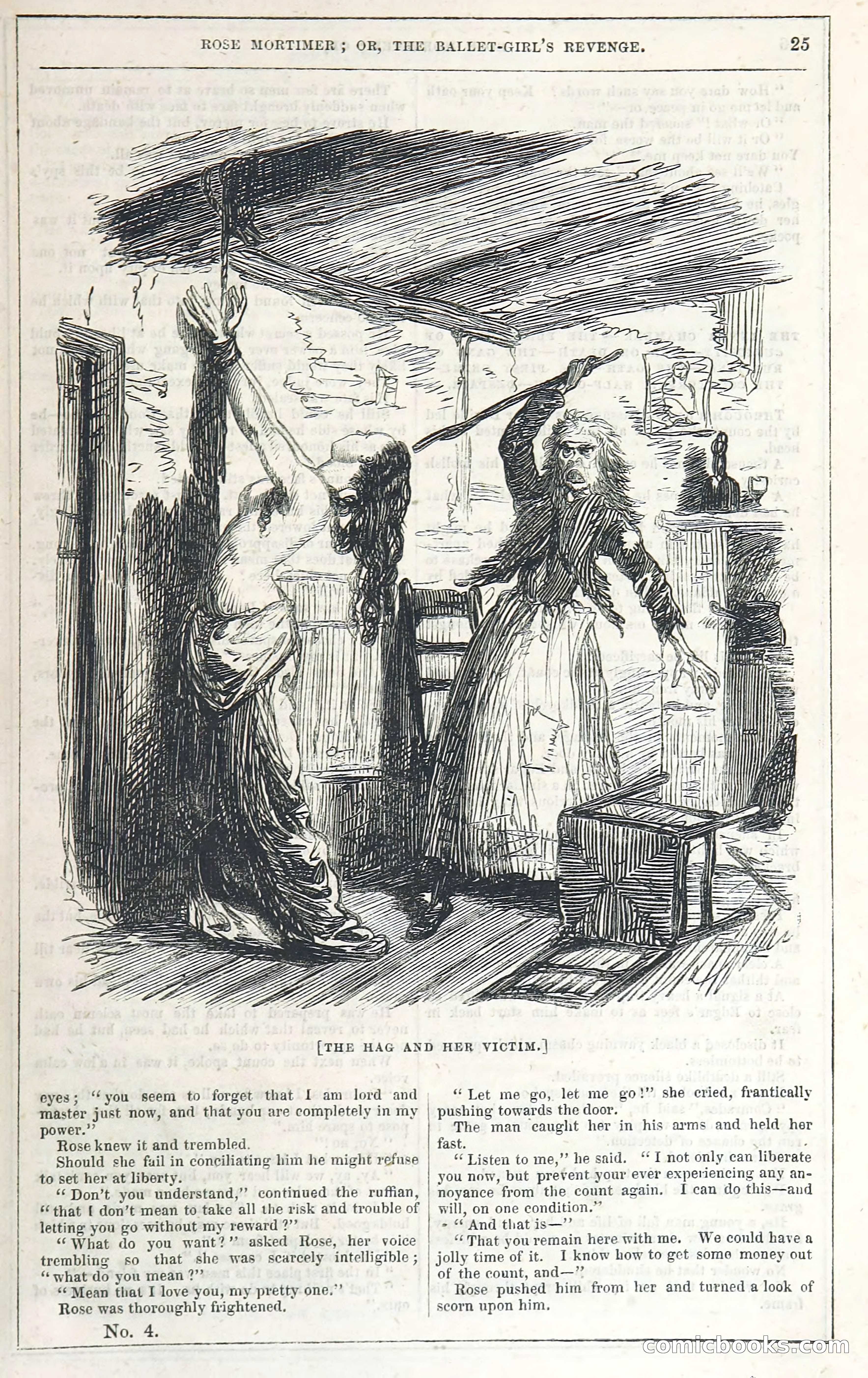
# Page Description This is an illustrated page from a Victorian penny dreadful serial. It features a woodcut engraving captioned "THE HAG AND HER VICTIM" depicting a dramatic confrontation between two figures in an interior setting. Below the illustration runs serialized prose dialogue in which a man restrains a woman named Rose, who desperately struggles to escape. He offers to help her escape from "the count" on the condition that she remain with him instead, declaring his love. Rose, terrified, pushes him away with disdain. The page is numbered 25 and labeled "No. 4," indicating this is part four of the serial installment.
# Page Analysis: *Rose Mortimer; Or* This is a text page (page 26) from a Victorian penny dreadful containing running prose narrative. The page presents Chapter X, titled "The Inner Chamber," which depicts the climax of a abduction and imprisonment scene. Edgar Deville has been taken by a criminal count and gang of ruffians into a secret room containing machinery, where he discovers a trap door to a bottomless chasm. The men debate his fate—whether to execute him—while he stands gagged and helpless, terrified of imminent death. The narrative emphasizes his youth, his fatal curiosity that led him into danger, and the gang's ruthless determination that any spy must die. The page contains no illustrations, only dense Victorian-style prose describing melodramatic suspense and moral peril.
# Page Description This is a page of running prose text from a Victorian penny dreadful titled *The Ballet-Girl's Revenge* (page 27). The text depicts a dramatic scene in which a count and his criminal gang interrogate a captive named Edgar Deville, whom they've caught spying on their counterfeiting operation. The count threatens Edgar's life and coerces him into swearing an oath and joining their criminal enterprise, while also demonstrating some kind of mechanical device used in their coin-counterfeiting scheme. The passage emphasizes melodramatic tension through threats of death and forced criminality.
# Page Analysis: *Rose Mortimer; Or,* (Penny Dreadful) This page contains running prose narrative from a Victorian penny dreadful. The left column depicts Edgar Deville working for a counterfeiting gang under duress, then being imprisoned with a fellow captive who reveals himself as Hugh Mortimer—a man with a vendetta against Count Lerno. The right column begins Chapter XI, describing Rose's despair in a locked chamber as she struggles against exhaustion and resignation to her fate. The text emphasizes melodramatic suffering: Edgar's moral horror at his crimes, Hugh's bitter resentment, and Rose's near-complete emotional collapse. No illustrations appear on this page.
# Page Description This is a page of running prose text from a Victorian penny dreadful titled "The Ballet-Girl's Revenge" (page 29). The narrative describes a young woman named Rose experiencing a terrifying supernatural encounter in a darkened bedroom—she witnesses what appears to be a ghostly apparition of a tall, luminous female figure with a dagger, which approaches her bedside. After fainting in terror, Rose awakens to find the apparition gone and a previously locked door now mysteriously open, offering her a chance to escape her "dreadful fate." The text emphasizes Gothic horror elements and melodramatic suspense typical of the genre.
# Page Analysis This is a page of running prose from a Victorian penny dreadful titled "Rose Mortimer; Or," containing two columns of text. The narrative describes Rose, a young woman cast out onto the street after a confrontation with Mrs. Halliday, being driven by a cab driver to the shop of Aaron Heine, a Jewish pawnbroker in a disreputable Westminster neighborhood. Rose, now penniless and homeless, must sell her late mother's locket to pay the cabman. The page emphasizes Rose's desperation, vulnerability, and the sordid circumstances into which she has fallen.
# Page 31 of a Victorian Penny Dreadful This is a page of running prose text from "The Ballet-Girl's Revenge," a Victorian penny dreadful serialized fiction. The visible text depicts a dramatic dialogue between Rose and a young Jewish woman named Miriam, in which Rose offers to help Miriam escape from an oppressive household. After Miriam leaves the room to check if an old woman downstairs is asleep, Rose hears a suppressed scream, sounds of scuffling, and a door slamming. Chapter XII begins mid-page, describing Rose's growing terror as an ominous silence follows, leaving her uncertain whether Miriam has been discovered and harmed. The prose emphasizes Victorian melodramatic tension and suspense.
# What This Page Contains This is running prose from a Victorian penny dreadful titled *Rose Mortimer* (visible at page header). The text depicts a brutal scene in which an elderly woman named Mrs. Starke viciously whips a young Jewish woman who is restrained against a wall. The victim loses consciousness from the beating. Rose (apparently the protagonist) witnesses this torture through a doorway and reacts with horror. The dialogue reveals Mrs. Starke's cruelty and the victim's pleas for mercy, establishing this as sensational melodrama centered on themes of captivity, abuse, and villainy—typical content of penny dreadful serialized fiction.
# Victorian Penny Dreadful Page Analysis This page contains both an illustration and running prose from "Rose Mortimer; or, The Ballet-Girl's Revenge" (page 33). The engraved illustration depicts a woman in flames near a tree with cherubs above and a fence below, captioned "Help! Help!" shrieked the Terrified Ballet-Girl." The text describes the woman hiding evidence of a crime by concealing bloodstains and concealing a torture instrument up the chimney. It then characterizes an antagonist—a tall, muscular woman with bloodshot eyes and protruding teeth—whom the protagonist Rose fears will kill her as the antagonist apparently killed someone named Miriam. The narrative emphasizes the brutal, melodramatic nature typical of penny dreadful sensation fiction.
# This Page from "Rose Mortimer" This is running prose from Chapter XIII of a penny dreadful serial titled "Rose Mortimer; or," printed on page 34. The text depicts a moment of sensational melodrama: the heroine Rose, trapped in a dark room with a murderous old hag, desperately searches for an escape. After a confrontation where the hag mysteriously collapses, Rose flees down the stairs only to be seized by an unseen assailant and loses consciousness. The chapter then shifts to Rose waking in a sickbed in what appears to be an old Jew's house, where she encounters an old woman at her bedside whose features oddly resemble the hag—though her expression is mild rather than sinister—deepening the mystery.
# Page Analysis: "The Ballet-Girl's Revenge" This page contains running prose narrative from a Victorian penny dreadful titled "The Ballet-Girl's Revenge." The text describes Rose, a bedridden young woman, encountering mysterious figures in what appears to be a house where she is being nursed. She questions an old woman about her whereabouts, then is startled by the arrival of Aaron Heine, a Jewish man who previously accused her of theft, followed by Miriam—a girl Rose believes she witnessed being brutally mistreated and buried. Miriam, however, shows no recognition of Rose, deepening the narrative's sense of mystery and dread. The prose focuses on Rose's confusion and growing unease about her circumstances.
# Description of Page This is a page of running prose from a Victorian penny dreadful novel titled *Rose Mortimer; or,* printed at page 36. The text depicts a dialogue in which Aaron Heine, a Jewish character, introduces Rose (a young woman seeking theatrical employment) to a theatre manager named Tom—a pale, sickly young man of about nineteen or twenty with distinctive physical peculiarities. Heine arranges for Rose to sign engagement forms for a ballet position, and the scene captures Rose's bewilderment and the rapid, transactional nature of the arrangement. The narrative combines sensational melodrama with the conventions of Victorian stage fiction.
This page contains running prose from a Victorian penny dreadful titled *The Ballet-Girl's Revenge* (page 37). The text depicts Rose being summoned mysteriously to an unfamiliar theatre in a poor London neighbourhood, where she is instructed to perform without explanation. She is given a gaudy, secondhand ballet dress that belonged to "the last one," and discovers a large audience awaits her performance. The narrative emphasizes Rose's confusion and growing dread about what she has been brought to do, building melodramatic tension typical of the genre.
# Page Description This is a page of running prose text from a Victorian penny dreadful titled "Rose Mortimer; Or," numbered page 38. The text describes Rose's first performance on stage at a shabby theatre. A manager instructs her to perform well despite the dilapidated conditions; she dances impressively for an audience of rowdy spectators. When coins are thrown onto the stage as tokens of appreciation, she startles and attempts to flee, but shouts of "Encore" and more halfpence raining down halt her escape. The narrative focuses on her bewilderment and the audience's enthusiastic but crude response to her dancing.
# Page from "The Ballet-Girl's Revenge" This is a page of running prose text from Chapter XV of a Victorian penny dreadful. The narrative describes a violent chase scene: a mob of roughs has stormed a theatre stage pursuing the protagonist Rose, who has refused to dance. Rose and a companion flee through backstage areas while the mob breaks down doors in pursuit. The text emphasizes melodramatic action—shrieking women, crashing doors, splintering panels, and desperate dialogue about escape routes. The chapter heading promises further complications: mysterious strangers, fire, and hints of "a dark plot" to come.
# Page Analysis: Running Prose from "Rose Mortimer" This is a page of running prose from a Victorian penny dreadful titled "Rose Mortimer" (visible at page header). The text describes a dramatic theatrical disaster: a young woman named Rose becomes trapped during a violent stage riot, attempts escape by descending a curtain rope, but her muslin garments ignite when contacting gas jets. She panics, her clothing catches fire, and a mysterious man wraps her in his cloak to extinguish the flames, then carries her safely through the hostile crowd into the street. The passage emphasizes melodramatic peril, physical danger, and Rose's helplessness in the face of successive crises—typical sensational content of the genre.
# Page Analysis: *Rose Mortimer; Or,* (Victorian Penny Dreadful) This is a page of running prose from a Victorian penny dreadful serialization. The text depicts Rose, a woman brought to a villa under false pretenses, being coerced by an old man and younger accomplice into impersonating a young gentleman for an unspecified "comedy in real life." When Rose protests, the old man physically restrains her wrist and makes veiled threats, his smile masking sinister intent. The passage emphasizes Rose's vulnerability and the men's menacing manipulation, characteristic of the sensation fiction genre's melodramatic plotting and moral peril narratives.
# What This Page Contains This page is running prose—text from a Victorian penny dreadful serialized story titled "The Ballet-Girl's Revenge." The visible narrative describes a dramatic murder scene: a beautiful woman at a ballet theatre is shot dead by another woman named Clara, whom she had refused to help or comply with. After the shooting, Clara confesses to the manager (Flathers) and a count that she committed the crime, claiming the victim came from "my hand." The passage combines melodramatic buildup (describing the victim's impending death) with sudden violence and its immediate aftermath.
# This Page from "Rose Mortimer; Or..." This is a page of running prose text from a Victorian penny dreadful novel. The visible text depicts a dramatic confrontation scene in which a woman named Clara threatens a Count Lerno and a manager with blackmail, revealing she knows they are escaped convicts and forgers who once worked together in galleys. The page then transitions to Chapter XVII, which begins narrating Edgar Deville's miserable imprisonment in a mysterious house at Fulham, where he is forced to perform hard labor. The text emphasizes both the melodramatic tension of the blackmail scene and Deville's exhaustion and suffering.
# Page Description This is a page of running prose from a Victorian penny dreadful titled "The Ballet-Girl's Revenge" (page 45). The text describes Edgar Deville's discovery that his fellow prisoner Hugh Mortimer is planning an escape. Deville follows Mortimer through darkened passages, observing him use a dark lantern to navigate toward what appears to be a skylit room below. The narrative emphasizes Deville's cautious movements and his decision to follow Mortimer's example and escape as well.
This is a page of running prose from the novel *Rose Mortimer; Or...* (page 46). The text describes Edgar Deville, a prisoner, discovering a trap-door in his ceiling through which a mysterious soft-voiced woman offers to help him escape—but only if he agrees to serve her in return. Just as Edgar begins climbing the rope ladder she provides, Hugh Mortimer suddenly appears, strikes Edgar down, and rushes up the ladder himself, pulling it after him. Above, Edgar hears sounds of struggle and a woman's scream before silence falls, leaving Edgar uncertain whether Mortimer has recaptured his chance at freedom and what has become of his mysterious female rescuer.
# Page Content Summary This is running prose text from page 47 of *The Ballet-Girl's Revenge*, a Victorian penny dreadful. The page depicts an interrogation scene in which a criminal count questions two prisoners—Edgar Deville and Hugh Mortimer—about a theft and escape involving a traitor named Mortimer. The count demands answers about their knowledge of the crime, threatening violence. Mortimer, brought in bound and terrified, faces judgment "by our band," while Edgar attempts to shield the real culprit. The text emphasizes melodramatic tension, moral betrayal, and impending punishment within what appears to be a criminal organization's hideout.
# Description of Page This is a page of running prose text from the penny dreadful "Rose Mortimer" (page 49). The narrative describes a man being executed by being thrown onto a revolving water-wheel below a pit while bound and helpless, followed by the discovery that another prisoner, Edgar Deville, has been rescued by a mysterious cloaked woman. The text then shifts to a scene where Edgar lies recovering while guarded by a sleeping old man, only to be stalked by a dark figure wielding a knife who repeatedly raises it to strike but holds back, creating suspense about the figure's identity and intentions.
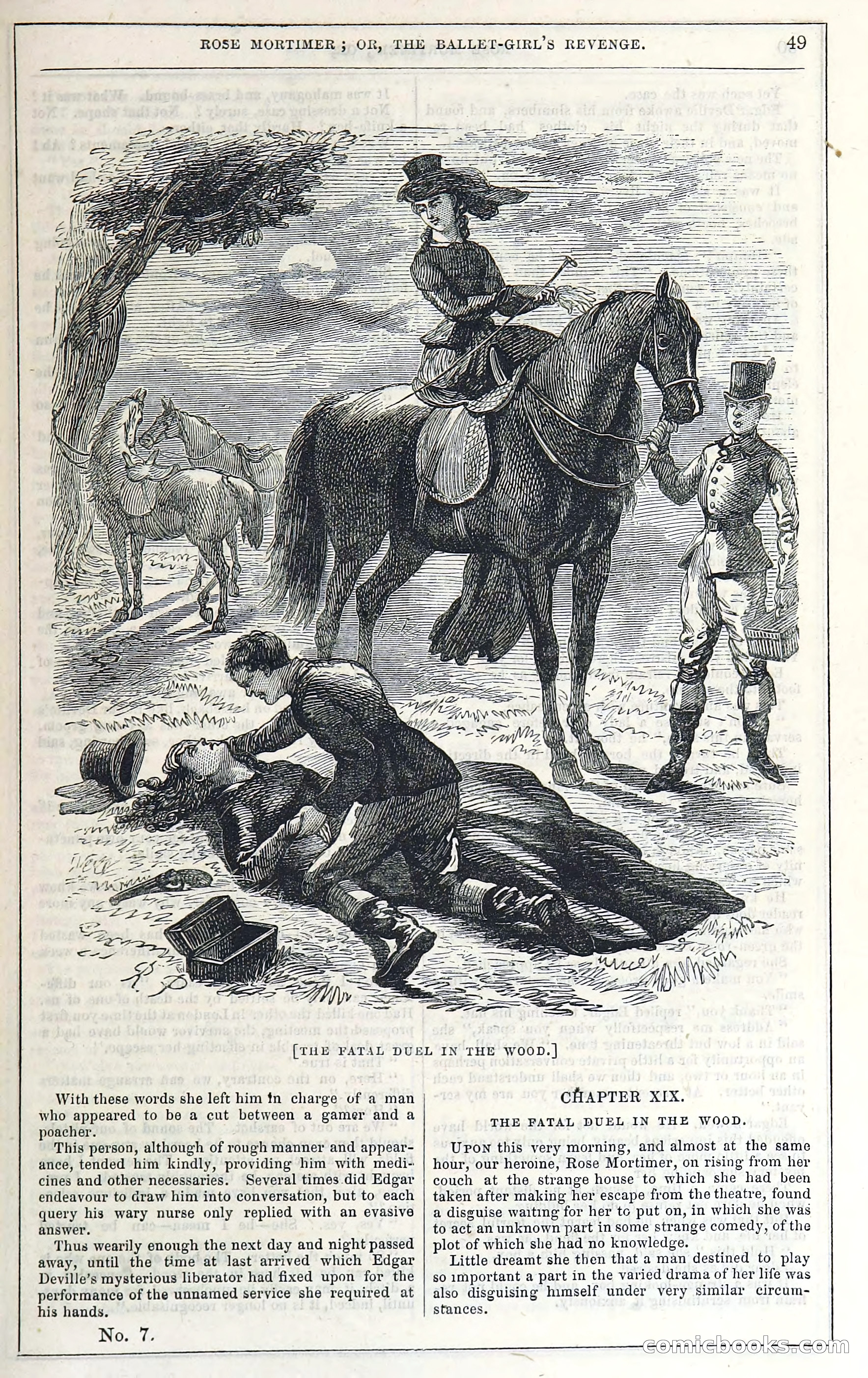
This is an interior page from a Victorian penny dreadful featuring both an engraved illustration and running prose. The illustration, captioned "THE FATAL DUEL IN THE WOOD," depicts a dramatic outdoor scene with a woman on horseback, a uniformed man, and two figures on the ground. The text introduces Chapter XIX, describing how the heroine Rose Mortimer discovers a disguise awaiting her at a mysterious house, and hints that an unknown man is simultaneously preparing himself for an important role in her life's drama, unaware of their connection.
# Page Analysis: *Rose Mortimer; Or,* (Page 50) This is a page of running prose from a Victorian penny dreadful serial. The narrative follows Edgar Deville, who wakes to find his clothes replaced with a servant's livery. Forced into the disguise of a groom, he is directed to meet a woman on horseback—revealed to be Clara, a murderer previously described in the story. She employs him as a servant and hands him a mysterious mahogany box bound in brass, instructing him to "take care of it" and hinting they will "want them directly." The page ends with Edgar beginning to understand the box's sinister contents, establishing mounting tension and mystery characteristic of the genre.
This page contains running prose from Chapter XIX of a Victorian penny dreadful titled "The Ballet-Girl's Revenge." The text describes a fatal duel between two women with pistols, overseen by a man named Edgar Deville. After one woman is shot and dies, her groom (who is revealed through description to possibly be disguised as male) discovers the body while the victor, Clara, remains coldly composed. The narrative focuses on the moral qualms of Edgar, who serves the murderer, as he witnesses this act of violence.
# Page Description This is a page of running prose (page 52) from a Victorian penny dreadful titled *Rose Mortimer; Or,* [text cut off]. The page contains dramatic dialogue and narrative between Count Lerno (revealed to be Pierre Duval, a forger and convict) and his wife Clara St. John in a Park Lane drawing room. The count demands Clara surrender her jewels to cover his gambling losses and failed criminal enterprises, while she refuses and accuses him of lifelong deception. The scene builds toward confrontation, ending mid-sentence as "the count started up," suggesting imminent action or violence.
# The Ballet-Girl's Revenge (Page 53) This page contains running prose from a Victorian penny dreadful serial. The narrative follows Clara, who discovers a mysterious woman's glove in her home late at night, then finds a beautiful woman—called "the Beautiful Fiend"—in her bedroom with her husband, the Count. The woman is pressuring him to reveal the location of jewels. Clara observes them from the doorway in growing rage, witnessing her husband on the floor searching a box while the other woman, adorned with a bracelet, taunts him about extracting information from "Clara" herself.
# What This Page Contains This page presents running prose from what appears to be the middle of a serialized story titled "Rose Mortimer." The narrative describes two women—Clara and Madge—descending through a secret passage in a house to retrieve diamonds hidden in a vault. Clara leads Madge through darkened corridors and down stone steps, operating hidden mechanisms (a moving painting, a concealed spring door) to access an iron-plated chamber deep underground. The text builds suspense through descriptions of darkness, dampness, and silence, while suggesting tension and possible danger between the two characters, with hints that Clara may harbor murderous intentions toward her rival.
# Page Description This is a page of running prose from a Victorian penny dreadful titled "The Ballet-Girl's Revenge." The page contains the conclusion of a dramatic scene where a woman escapes after being imprisoned, followed by Chapter XXI ("The Mysteries Explained"), which reveals the criminal history of Count Lerno and his wife Clara St. John. The text explains that the pair are actually con artists and thieves—the count is the escaped galley-slave Pierre Duval—who have perpetrated forgeries and robberies across multiple European cities and New York before arriving in London, where the count has introduced Clara as a ballet dancer at the Babylonian Theatre.
# Page 56 of "Rose Mortimer" This is a page of running prose from a Victorian penny dreadful novel. The text explains a plot to impersonate a character named Edgar Deville using a ballet-girl who resembles him, then shifts to Chapter XXII, depicting Count Lerno's frantic search for his mistress Madge. Finding her villa dark and empty, he rushes to Park Lane to his own house, discovering scattered belongings and an absent wife—suggesting betrayal and deception within the narrative's criminal conspiracy.
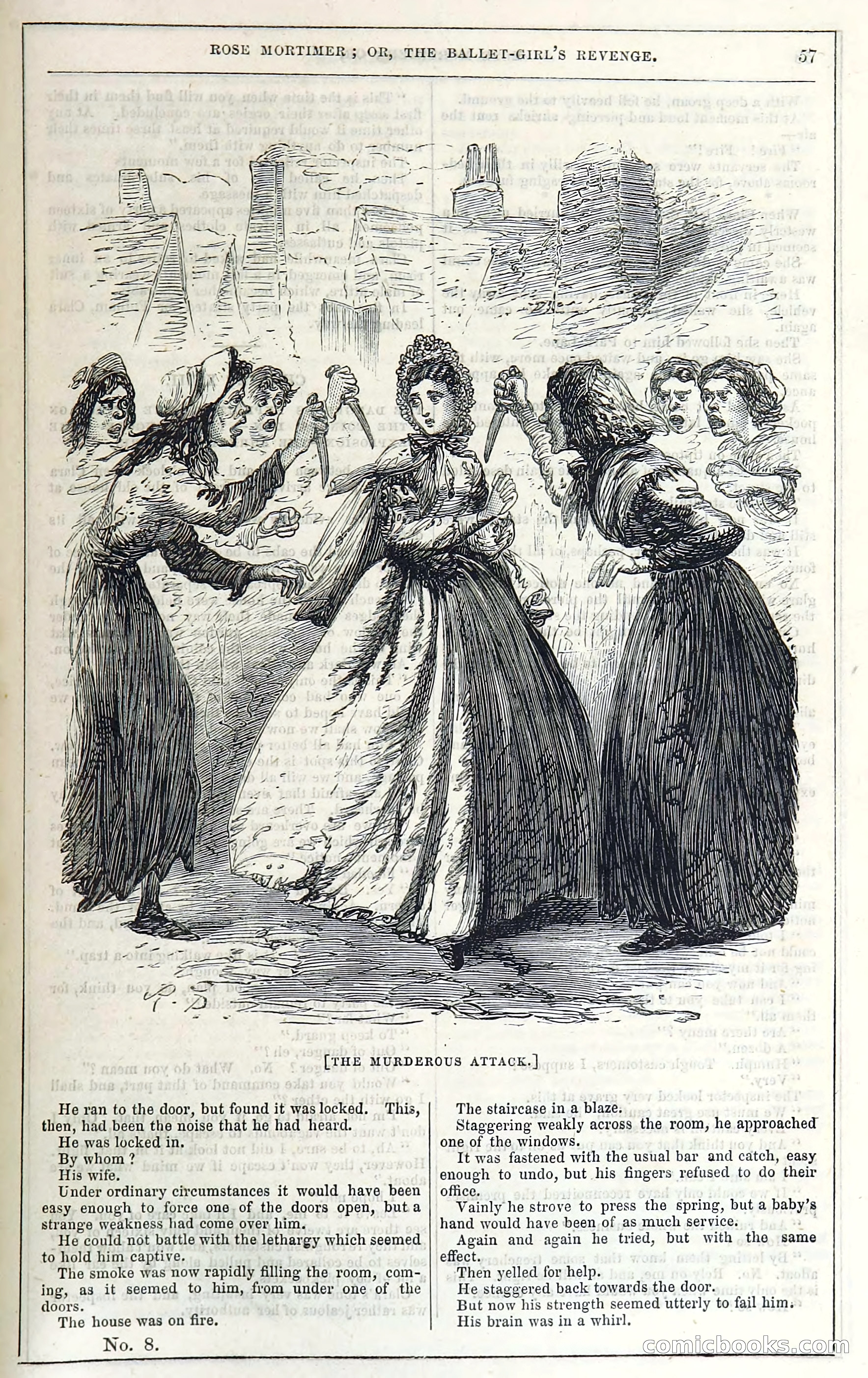
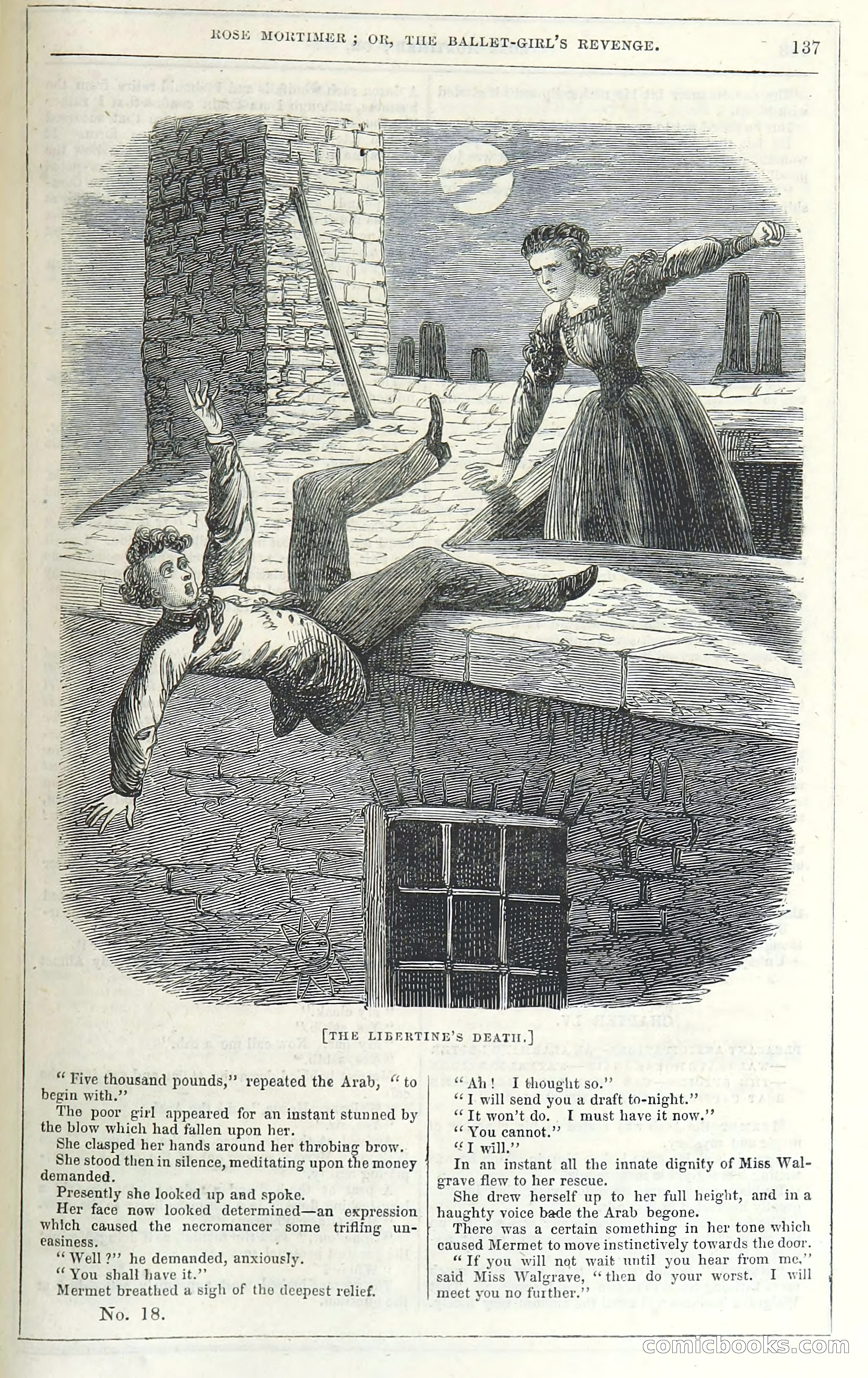
# Page Description This is an interior page from the Victorian penny dreadful *Rose Mortimer; or, The Ballet-Girl's Revenge* (No. 8), featuring both an illustration and running prose text. The engraved illustration depicts "[THE MURDEROUS ATTACK]"—a scene of a woman in a light dress surrounded by darker-clothed figures in what appears to be a confrontational moment. The accompanying text describes a man trapped in a locked, burning house, unable to escape due to mysterious weakness, with the staircase ablaze. His attempts to open windows and doors fail as smoke fills the room and he calls for help in desperation.
# Victorian Penny Dreadful Page Analysis This is a page of running prose from the serialized narrative "Rose Mortimer; Or," displaying Chapter XXIII mid-way through the page. The text depicts Clara orchestrating a police raid on a criminal operation: after discovering a house fire and visiting Scotland Yard, she directs sixteen plainclothed officers armed with pistols and cutlasses toward what appears to be a counterfeiting den in Fulham. She disguises herself in male clothing and leads the expedition. The chapter heading promises action—"The Dangerous Expedition," "The Attack on the Coiners' Den," and "The Explosion"—though the actual raid has not yet commenced on this page.
# This Page from "The Ballet-Girl's Revenge" This is a page of running prose text (page 59) from a Victorian penny dreadful serialized story. The narrative describes a police raid on a criminal gang's hideout, led by Clara, a woman disguised in male clothing. While police and gang members fight, Clara slips away to steal the gang's treasure from a storeroom, where she unexpectedly encounters an old cook woman guarding the gold. The text employs typical melodramatic elements: detailed action sequences, moral tension, and the revelation of secrets—all hallmarks of sensational Victorian popular fiction designed for working-class readers.
# Victorian Penny Dreadful Page Analysis This is a **running prose page** from the serialized melodrama *Rose Mortimer; Or*, showing Chapter XXIV. The text depicts Rose Mortimer awakening as a captive in a locked room, discovering her clothes have been replaced with male attire. Earlier passages describe her attempting to escape ruins with stolen treasure and other characters (Clara and Edgar Deville) pursuing a secret passage to a cell where "a hideous crime" occurred. The chapter concerns Rose's captivity, a mysterious disguise plot, and apparent fraud, with threats of terror from unnamed villains. The prose emphasizes sensational peril and mystery typical of penny dreadful melodrama.
# Page Analysis: "The Ballet-Girl's Revenge" This is a page of running prose narrative text (page 61) from a Victorian penny dreadful titled "The Ballet-Girl's Revenge." The text depicts a scene where Rose, apparently coerced, dresses in male clothing per the demands of two men—one identified as Maurice and an older, gruff gentleman. The older man instructs Maurice to escort Rose on a journey, while Rose remains confused about the purpose of her disguise and forced compliance. The passage shows Rose being manipulated through a combination of threat and politeness, with hints of mystery surrounding her fate and the men's intentions toward her.
# Victorian Penny Dreadful Page Analysis This is a **text-only page of running prose** from a serialized Victorian sensation novel titled "Rose Mortimer; Or," (page 62). The narrative describes Rose being disguised in male clothing as "Edgar Deville" by two men named Wharton and Maurice Wharton, then traveling by coach to a country inn. The text details Rose's anxiety about their intentions, her discomfort with her assumed male identity, and her arrival at an inn where the party stops to rest the horses—all hallmarks of melodramatic Victorian penny dreadful plotting involving deception, mystery, and implied danger.
# Page Description This is running prose text (page 63) from a Victorian penny dreadful titled "The Ballet-Girl's Revenge." The page contains two chapters: the conclusion of Chapter XXIV (in which Rose's escape attempt is thwarted by Mr. Wharton) and the beginning of Chapter XXV, titled "In the 'Black Country'—Forced Onwards—Another Struggle for Liberty." The text describes Rose being recaptured, transported by carriage through a mining district, and growing fearful about her captors' intentions. Mr. Wharton reassures her that local miners are harmless, while Rose privately wonders whether she will be imprisoned indefinitely.
# What This Page Contains This page is running prose from a Victorian penny dreadful novel titled "Rose Mortimer." The text is printed in two columns and continues the narrative across page 64. The visible text describes Rose's discovery of a dark secret regarding inheritance and property ownership, her resolve to escape from those holding her captive, and her attempt to flee the house at night. Realizing her clothing will make her easily traceable, she returns to find women's garments. Chapter XXVI begins mid-page, detailing her flight interrupted by practical difficulties—she must obtain a change of dress before she can successfully escape. The passage emphasizes her resourcefulness, desperation, and determination despite being friendless and penniless.
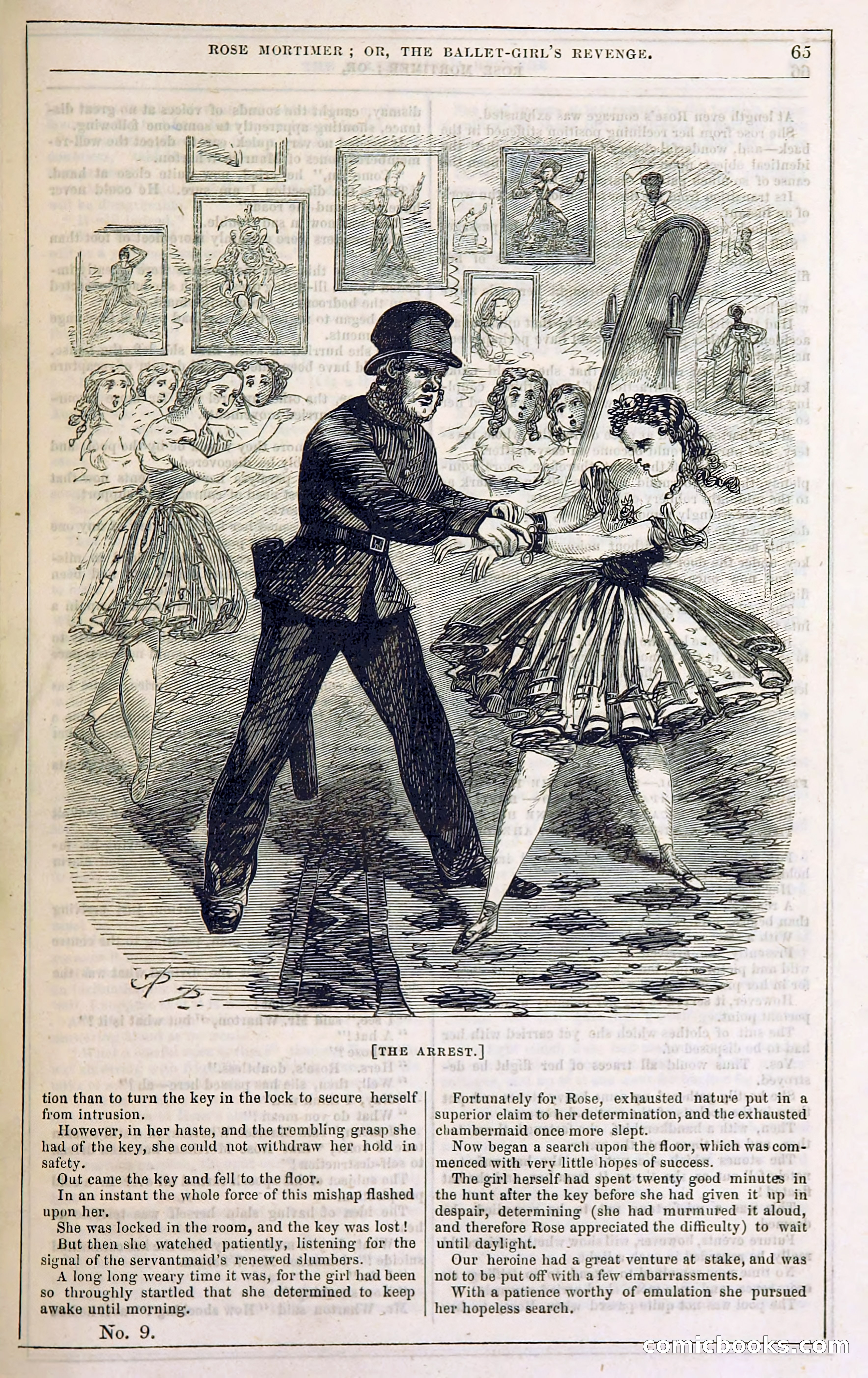
# Victorian Penny Dreadful Page Analysis This is an interior page of a penny dreadful serial numbered "No. 9," featuring both illustration and running prose. The page shows "The Arrest" — a dramatic engraving depicting a man in dark clothing confronting a young woman in a ballet dress, with onlookers in the background. The text describes Rose, the apparent protagonist, having dropped a key while locked in a room and then conducting a desperate nighttime search for it on the floor, determined to stay awake until morning to recover it before discovery. She is described as having "a great venture at stake" and pursues her "hopeless search" with determined patience.
# This Page from "Rose Mortimer; Or..." This is a running prose page (numbered 66) from a Victorian penny dreadful serial. The text follows the heroine Rose Mortimer's nocturnal escape from a house: she retrieves a hidden key, locks a door behind her to cover her tracks, and flees into the grounds. When an alarm bell sounds, she reaches a pool where she weights down stolen clothing with stones to destroy evidence of her flight. As she attempts to leave the area, she hears the voices of her pursuer Maurice Wharton and others giving chase. The page ends mid-chapter, with Rose in immediate danger and hampered by ill-fitting borrowed clothes, creating dramatic suspense typical of the genre.
# Page Analysis: The Ballet-Girl's Revenge, Page 67 This is a page of running prose from a Victorian penny dreadful. The text depicts a conversation between Mr. Wharton and his son Maurice immediately after what appears to be a murder. They discuss destroying evidence—foot-prints, a hat, and a body—to conceal their crime, while the protagonist Rose Mortimer hides nearby, overhearing their callous plans to eliminate a young man named Edgar Deville. The passage emphasizes Rose's growing horror and complicity as she realizes the extent of the Whartons' villainy.
# Page Description This is a page of running prose from a Victorian penny dreadful novel titled *Rose Mortimer; or,* continuing Chapter XXVIII. The text depicts a dramatic scene in which the protagonist Rose, a weary woman seeking shelter, enters a miners' cabin and finds herself surrounded by rough men. Two miners—Penryth (apparently the cabin's owner) and Miles Trunnion—quarrel violently over possession of her, with Trunnion claiming her as "treasure-trove" and offering to take her with him. The scene escalates when Penryth raises an ale jug to strike Trunnion, only to be stopped by other miners who insist Rose should decide her own fate. The passage emphasizes Rose's terror and the dangerous, lawless environment she has entered.
# Page Analysis: Running Prose from a Victorian Penny Dreadful This is a page of running prose text (page 69) from "The Ballet-Girl's Revenge," a Victorian penny dreadful. The visible text depicts a violent melodramatic sequence: after a brutal miner named Miles Trunnion abducts the heroine Rose Mortimer, another miner named Penryth strikes Trunnion dead with a stone to save her. When footsteps alarm the murderer and he flees, a mob of women discovers the body and identifies the victim as Miles Trunnion, immediately calling for vengeance against his killer. The passage emphasizes sensational violence and moral peril typical of the genre.
# Page Description This is a page of running prose (page 70) from a Victorian penny dreadful titled *Rose Mortimer; Or,* [incomplete]. The text depicts a dramatic scene in which a character named Clara descends into a subterranean vault to retrieve jewels from a corpse—apparently a victim she had deliberately imprisoned and left to die. Upon returning, she encounters Edgar Deville and they discuss concealing the hidden door. The narrative emphasizes Gothic horror elements: the decomposed body adorned with diamonds and emeralds, Clara's cold cruelty, and the secret mechanisms of the hidden vault. The page concludes as they prepare to leave, with mention of a ship crossing the Atlantic and a hurricane developing at sea.
This page from a Victorian penny dreadful contains running prose narrative across two columns. The visible text describes a shipwreck during a storm where passengers perish, followed by the discovery of a drowned woman's body—later revealed to be alive—by Irish fishermen who find valuable gems on her person and contemplate murdering her for the jewels. The narrative then shifts to Chapter XXX, depicting Rose Mortimer surrounded by hostile "hags" who threaten her life while she pleads for mercy. The text is melodramatic sensation fiction typical of the genre.
# Page Description This is a page of running prose from a Victorian penny dreadful titled *Rose Mortimer*. The visible text depicts the climactic drowning of the heroine Rose Mortimer by a vengeful mob of women led by "Mistress Madge," who blame her for a murder she did not commit. The page then transitions into Chapter XXXI, which begins with the mob's departure and hints at a mysterious "tall stalwart fellow" appearing in a tree overhanging the river—apparently positioned to attempt a rescue of Rose's body.
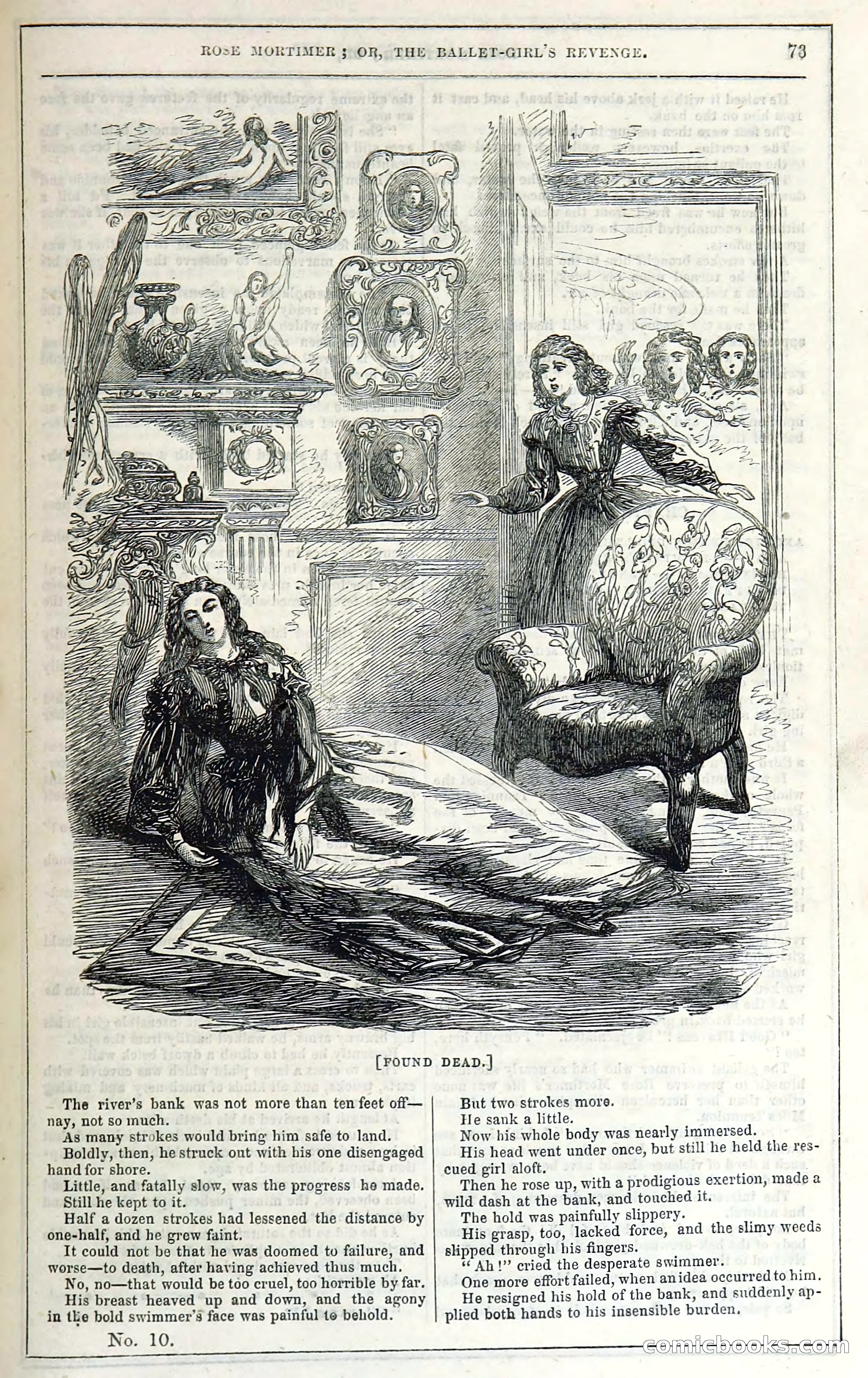
This is an illustrated page from the penny dreadful "Rose Mortimer; Or, The Ballet-Girl's Revenge" (page 73). The upper half contains a wood-engraved illustration depicting an interior scene with a woman in distress kneeling before seated figures, while three other figures observe from a doorway. Below the image, under the heading "[FOUND DEAD.]," runs prose narration describing a desperate swimmer attempting to reach shore while supporting an unconscious girl, struggling against exhaustion and slippery conditions as he tries to pull both of them to safety.
# Page Analysis: Running Prose from a Victorian Penny Dreadful This page contains running prose text from *Rose Mortimer; Or*, a Victorian penny dreadful. Chapter XXXII begins mid-page. The narrative describes a swimmer who has rescued an unconscious girl (Rose Mortimer) from drowning and collapsed beside her. A third person—another miner—arrives at the scene and discovers both the rescued girl and the swimmer, who is revealed to be Penryth, the man who killed Miles Trunnion. The miner observes Rose's pale, beautiful unconscious form and reflects on the violent dispute over her possession, while contemplating dark intentions toward the collapsed Penryth.
This page contains running prose from Chapter XXXIII of *The Ballet-Girl's Revenge*, a Victorian penny dreadful. The text describes a miner named Penryth awakening after near-drowning and searching desperately for Rose Mortimer, whom he believes has been taken into the dangerous "Danger Mine." The narrative follows his emotional distress over a man he has killed, his discovery of Rose's torn dress at a mine entrance, and his determination to follow her into the pit, concluding with Rose herself regaining consciousness in darkness underground. The chapter heading promises themes of peril, blindness, and fatal danger within the mine setting.
# Page Content Analysis This is a **page of running prose** from the penny dreadful serial *Rose Mortimer; Or,* (page 76). The text depicts Rose, a young woman trapped in darkness (apparently a mine), experiencing despair, then spotting a light and crying for help. A man with a safety-lamp responds to her calls. The passage emphasizes melodramatic emotional extremes—Rose's tears, her false belief she is blind, her prayers, her joy at seeing light—before introducing an ominous note: the man casually mentions that someone named Jerry Treewoof fell into a pit here in December and "there he lies now." The page ends mid-sentence, leaving the reader in suspense about Rose's fate.
# Page Description This is a page of running prose from a Victorian penny dreadful titled *The Ballet-Girl's Revenge* (page 77). The text describes Rose Mortimer fleeing through a dark mine from a pursuing miner who has captured her. After he falls, a second man appears descending into the mine by rope—revealed to be Penryth, a murderer she recognizes. He nearly catches her but she escapes again into the darkness, though exhausted and weakening. The narrative focuses on her desperate flight and narrow evasions from her two pursuers in the mine setting.
# Page 78 of "Rose Mortimer; Or," This is a page of running prose from a Victorian penny dreadful. The text depicts a tense confrontation underground in a mine between Rose Mortimer (a "ballet-girl"), the brutal miner Penryth, and Wat Lynwood. Lynwood, whom Penryth believed had fallen into a pit, suddenly appears alive. The two miners quarrel over possession of Rose and threaten each other with violence. Lynwood hints at damaging testimony ("the witness-box"), causing Penryth's face to turn "ghastly pale" then blood-red, suggesting Lynwood knows of some crime—possibly the murder Rose suspects one of them has committed.
# Page Analysis: The Ballet-Girl's Revenge This is a page of running prose narrative from a Victorian penny dreadful, numbered 79. The text depicts Rose Mortimer escaping a deadly mine fight between two men by climbing a rope. After securing a lantern to her waist, she begins ascending, but the rope makes a noise that alerts the surviving combatant to her presence. The right column continues the action as he demands she come down, discovering her location. The page concludes with the beginning of Chapter XXV, which promises further sensations: "THE FIRE—GOSSIP—A GLIMPSE AT PREVAILING SENSATION—A NEW PERSONAGE—MERMET THE ARAB" and other plot developments. The narrative is typical melodramatic serialized fiction emphasizing danger, suspense, and moral peril.
# Page 80 of *Rose Mortimer* This is a page of running prose from a Victorian penny dreadful. The text discusses the aftermath of a mysterious fire in Park Lane and the disappearance of Captain Roper, a detected cheat. Society speculates wildly about the incident, with Sir Harold King spreading gossip and invented fictions. The narrative then shifts to describe a new social sensation: a sudden wave of religious piety sweeping through fashionable London districts, featuring various eccentric clergy members and reformed working-class preachers, including one "Dick Steaver" who abandoned tobacco and other vices.
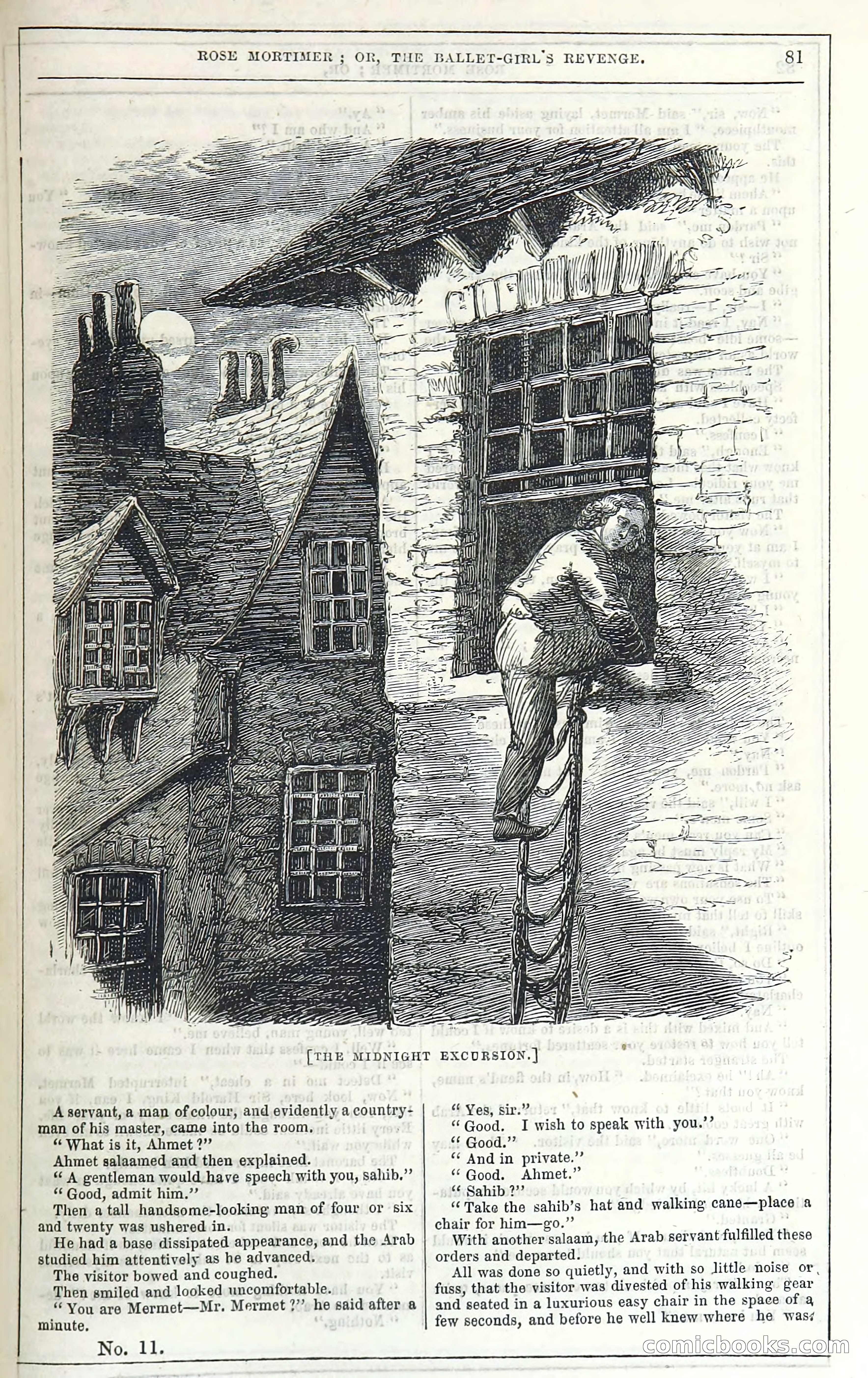
# Page Description This is page 81 of the penny dreadful *Rose Mortimer; or, The Ballet-Girl's Revenge*. The page contains both an engraved illustration and running prose text beneath it. The illustration, captioned "[THE MIDNIGHT EXCURSION]," depicts a man climbing a rope or ladder toward a building at night under a full moon. The text describes a servant admitting a tall, handsome visitor to meet someone named Mermet, with dialogue between the visitor and the master of the house regarding a private conversation. The servant then discreetly helps the visitor remove his outdoor garments and seats him in a chair.
# Page 82 of "Rose Mortimer; Or," This page contains running prose dialogue from a Victorian penny dreadful. A mysterious character named Mermet the Arab, posing as a fortune-teller or mind-reader, conducts a test with a young visitor. The Arab reads the visitor's face and deduces he is a spendthrift and gambler seeking to restore scattered fortunes. When challenged to reveal the visitor's name, Mermet consults an ancient volume filled with hieroglyphics and announces the man is "Sir Harold King." The dialogue reveals the visitor came to expose Mermet as a fraud, but becomes increasingly astonished by the Arab's apparent supernatural knowledge.
# Page Analysis This is a page of running prose from a Victorian penny dreadful titled "The Ballet-Girl's Revenge" (page 83). The text depicts a conversation between an Arab necromancer and two visitors. The first visitor, Sir Harold King, departs after a cryptic discussion; the Arab then receives a second, mysterious caller who inquires about deadly poisons. The Arab, recognizing something familiar in the visitor's manner, becomes suspicious when the man asks about poisons "for vermin" that don't affect human life—a request the Arab sees through as a cover for murderous intent. The dialogue grows tense as the Arab directly accuses the visitor of planning to kill someone.
# Page Description This is running prose text from page 84 of a Victorian penny dreadful titled *Rose Mortimer; Or,* presented in two columns. The passage depicts a dialogue between a visitor and an Arab character named Mermet, who appears to be some sort of occultist or fortune-teller using hieroglyphics to divine information. The visitor seeks Mermet's help locating a dog and learning names (the initials "H" and "K" are revealed). After the visitor departs, Mermet reveals he recognized the stranger and instructs his attendant Ahmet to follow him to learn his identity and residence. The text concludes with Chapter XXXVI's heading, which previews dramatic scenes involving a mine collapse and multiple discoveries.
# Analysis of Page from "The Ballet-Girl's Revenge" This page contains running prose narrative text from a Victorian penny dreadful serial. The visible text describes the dramatic collapse of the Danger Mine, apparently trapping the protagonist Rose Mortimer. After she falls through the earth, miners and local people gather at the site. Discovery of a man's cap and a torn piece of muslin from a woman's dress—along with a witness's account of hearing a female shriek—sparks desperate rescue efforts. The passage concludes as one of the diggers makes an astonishing discovery, the text cutting off mid-word. The narrative combines sensational melodrama with mining disaster, typical of the genre's lurid entertainment format.
# Page Analysis: Victorian Penny Dreadful This is a page of running prose text from a serial fiction story titled "Rose Mortimer; or," numbered page 86. The narrative describes Rose Mortimer being discovered unconscious after a mining disaster alongside two dead miners. A doctor declares her still alive, and she is taken to a miner's cottage to recover. As Rose regains consciousness, the cottage owner gives her medicine labeled "Margaret Black"—revealing that Rose had assumed a servant's identity to escape from people called "the Whartons." Rose attempts to clarify her real name, but the cottage owner dismisses her protests, apparently believing Rose is either confused or deliberately concealing her identity for safety reasons.
This is a page of running prose from a Victorian penny dreadful serial titled *The Ballet-Girl's Revenge* (page 87). The text describes Rose Mortimer's escape after the Whartons depart, fleeing into the night homeless and destitute but relieved to have her liberty. It then shifts to Chapter XXXVII, which introduces a second séance with Mermet, an Arab necromancer, who has summoned the wealthy but troubled Sir Harold King, claiming to have discovered through magical means that the baronet's life is in danger, though he refuses to name the threat.
# What This Page Shows This is a page of running prose (page 88) from a Victorian penny dreadful titled *Rose Mortimer*. The text depicts Sir Harold visiting an Arab magician or spiritualist named Mermet. After being shown to a waiting room decorated with anatomical drawings and scientific instruments, Sir Harold becomes entranced by an ornate flower-stand filled with artificially scented flowers. As he inhales their perfume, he falls into a trance-like state of rapture. Meanwhile, the Arab receives another visitor—apparently a Major Strangeway who had called the previous day—suggesting some conspiracy or supernatural plot is underway.
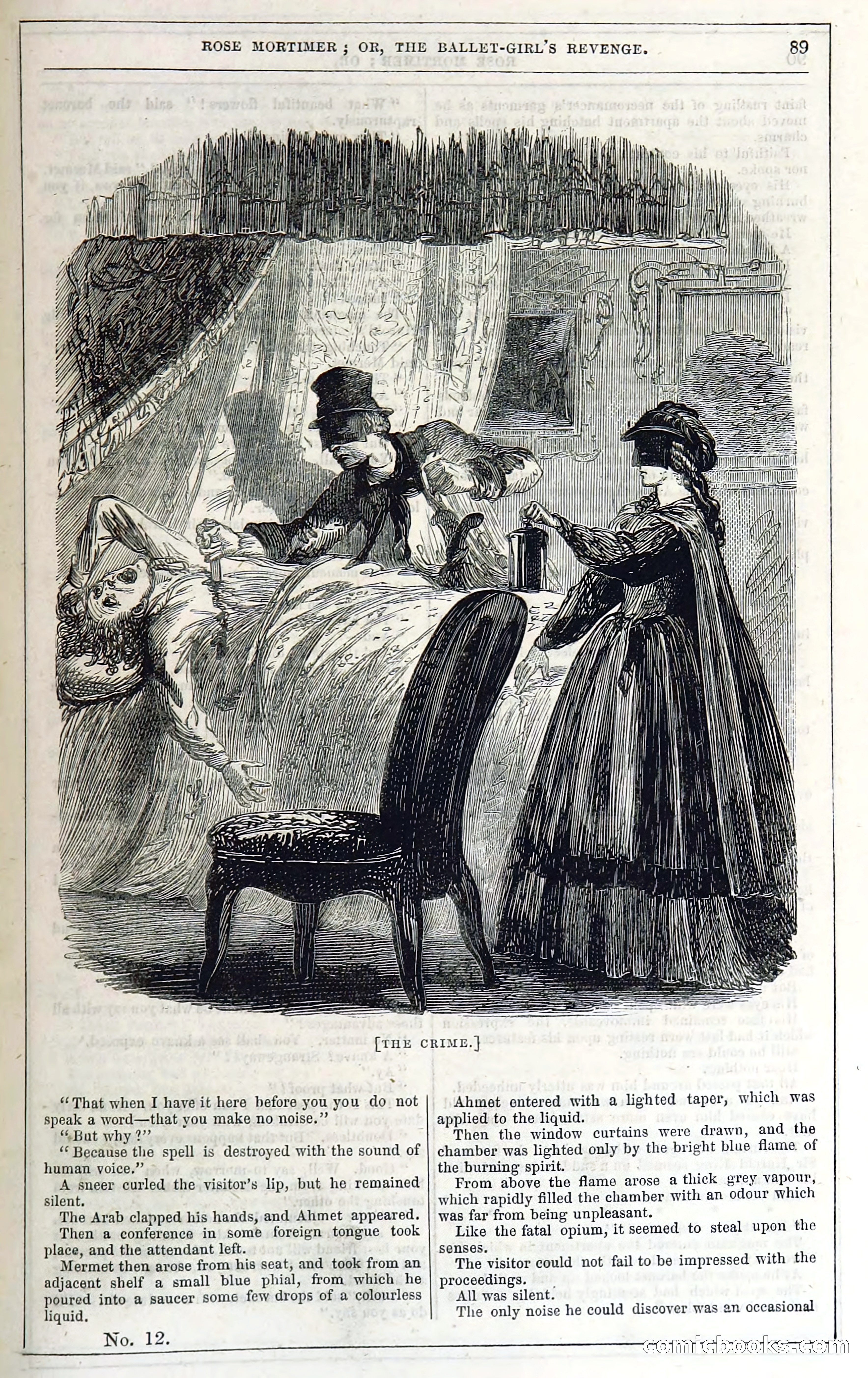
# Victorian Penny Dreadful Page Analysis This is an interior page (No. 12) from the serialized story *Rose Mortimer; or, The Ballet-Girl's Revenge*, featuring both an illustration and running prose. The page depicts a dramatic scene labeled "[THE CRIME.]" in which a mysterious Arab character named Mermet performs what appears to be an occult ritual for a visitor. The text describes Mermet producing a blue phial, pouring colorless liquid into a saucer, lighting it with a taper, and filling a darkened chamber with gray vapor and mysterious odor. The visitor is instructed to remain silent, as speech supposedly destroys "the spell." The prose emphasizes secrecy, supernatural atmosphere, and suspenseful silence—typical sensational elements of Victorian penny dreadfuls.
# Page 90: Running Prose from "Rose Mortimer" This page contains running text from a Victorian penny dreadful titled *Rose Mortimer*. The narrative describes a magician named Mermet performing supernatural illusions for a visitor, who witnesses a vision of Sir Harold King seated motionless among flowers. After the spell breaks, the visitor becomes unable to speak or respond to his surroundings. The scene concludes with Mermet entering where Sir Harold sits and conversing with him about the flowers and an apparent hidden enemy requiring the baronet's vigilance.
# Analysis of Page 91 from "The Ballet-Girl's Revenge" This page contains running prose text from a Victorian penny dreadful serial. The visible content shows two scenes: first, a concluded conversation between the character Mermet and Sir Harold King regarding a poisoned decanter and demands for secrecy; second, Chapter XXXVIII, which follows the protagonist Rose Mortimer after her escape from a mining cottage. The text describes her exhausted flight through the night, her relief at dawn, and her newfound sense of liberty despite being homeless and friendless. Rose contemplates traveling to London for employment and recalls kind acquaintances—a young scene-painter and his mother—whose existence renews her hope. The chapter heading lists upcoming plot elements including "the drama again" and "the mask."
# Page 92 of *Rose Mortimer; or,* [title incomplete] This is a page of running prose from a Victorian penny dreadful serial. The narrative follows Rose Mortimer, an exhausted and impoverished young woman who has walked all night and arrives at a roadside inn desperately hungry but without money. A sympathetic country servant girl discovers her distressed state, and Rose tearfully confesses her destitution. The text emphasizes Rose's beauty, suffering, and virtue through melodramatic language typical of the genre, while the servant's rough but kindhearted character provides emotional contrast.
# What's on This Page This page contains running prose from a Victorian penny dreadful titled "The Ballet-Girl's Revenge" (page 93). The text depicts a dialogue-heavy scene set in a theatre parlour where Rose, a young woman seeking employment, overhears the manager and his "heavy lead" actor (Chowler) arguing anxiously about an actress named Miss Lotty Siddings who has failed to appear for rehearsal. They debate which play to open with at the Theatre Royal, discussing alternatives like "The Stranger," "George Barnwell," and "The Mountain Gorge." The passage emphasizes Rose's sudden interest in this theatrical opportunity and the manager's growing desperation over the missing actress—clear setup for plot development regarding Rose's involvement with the theatre company.
# Page Content Analysis This page contains running prose from a Victorian penny dreadful novel titled *Rose Mortimer; Or,* (page 94). The text presents two distinct scenes: first, dialogue between Rose Mortimer and theatre manager Mr. Chowler arranging a rehearsal, then a transition to Rose and Chowler observing a masked man creeping through the grounds of a grand house at night. Chapter XXXIX begins mid-page, introducing the surveillance plot. The narrative emphasizes melodramatic tension—Rose's sudden good fortune, the mysterious masked intruder, and hints of impending danger—typical of sensation fiction designed to hook serialized readers.
# The Ballet-Girl's Revenge, Page 95 This page contains running prose text from a Victorian penny dreadful serial. The narrative describes two masked figures—a man and woman—who enter an invalid's bedroom at night while watched by the heroine Rose Mortimer and a manager. The woman searches the room, discovers an important document (possibly a will), and conceals it. When the old man wakes and addresses the woman as "Evelin," his demeanor suddenly shifts from peaceful to furious, prompting an angry discussion between them. The text emphasizes melodramatic tension and mystery surrounding the masked intruders' motives.
# Page Description This is a page of running prose from a Victorian penny dreadful titled "Rose Mortimer" (visible as the page header). The text depicts a dramatic murder scene: a masked woman and her accomplice watch as the man stabs an elderly victim in bed. The passage describes the old man's recognition of the mask, his terror, the fatal knife wound to his breast, and the shocked silence that follows. The page ends with Chapter XL beginning, which promises further sensational plot developments involving gardens, lanterns, and masked figures. There are no illustrations on this page—only dense, two-column printed text typical of cheap Victorian serial fiction.
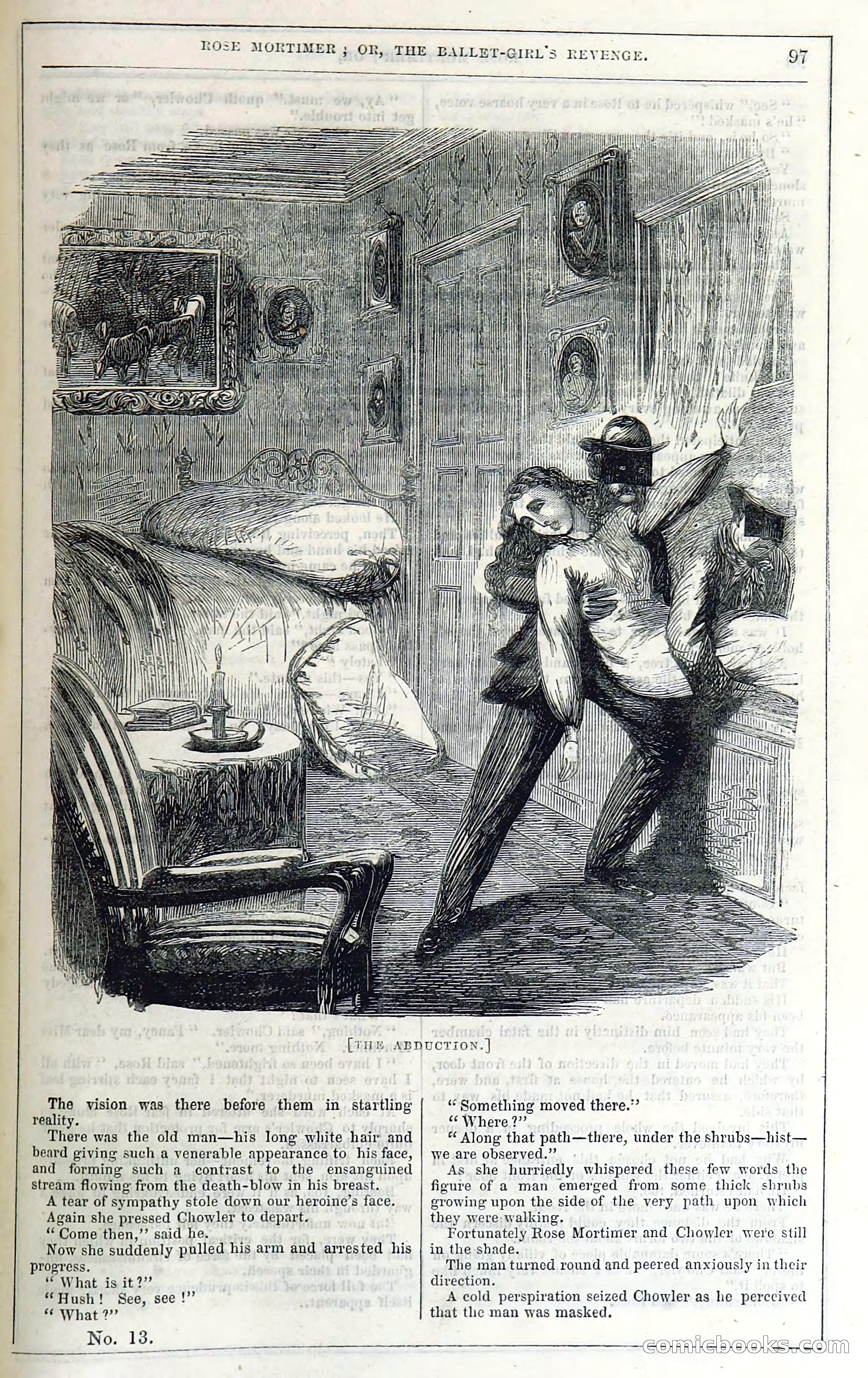
# Page Analysis This is an illustrated page (No. 13) from the penny dreadful *Rose Mortimer; or, The Ballet-Girl's Revenge*. The page features a wood engraving captioned "The Abduction" depicting a dramatic indoor scene where figures appear to be in distress or confrontation. The accompanying text describes the discovery of an old man with a mortal wound, while the protagonists Rose Mortimer and Chowler observe a mysterious masked man emerging from nearby shrubs, creating tension and suggesting danger. The narrative emphasizes their fear of being discovered.
# Rose Mortimer; Or, [page 98] This is a page of running prose from a Victorian penny dreadful serial. The text describes a tense scene in which Rose Mortimer and a man named Chowler witness a masked assassin—armed with a bloodstained Spanish knife—searching a room near where they are hiding. They recognize him as the same man they saw commit murder. After he departs mysteriously, they escape through the garden, only to realize they've turned in the wrong direction once outside.
This is a page of running prose from a Victorian penny dreadful titled "The Ballet-Girl's Revenge" (page 99). The text describes Mr. Chowler, a theater manager, becoming infatuated with Rose Mortimer, a ballet dancer in his company, and resolving to watch her window all night after witnessing mysterious and disturbing events at a nearby house. A mysterious woman is also shown following Rose, adding to the suspense. Chapter XLI begins partway down the page, outlining the chapter's melodramatic plot points including watches, ladders, masks, and abduction.
# A Page from a Victorian Penny Dreadful This is a page of running prose from *Rose Mortimer; Or,* a Victorian penny dreadful. The text describes Mr. Chowler's discovery of a mysterious nighttime intrusion: a woman carrying a lantern, two masked men, and a ladder positioned beneath Rose Mortimer's window. Believing a burglary or abduction is occurring, Chowler shouts an alarm ("Thieves!" "Murder and robbery!"), causing the intruders to flee. The passage emphasizes Chowler's fear and his selfless concern for Rose's safety, employing the sensational melodrama typical of the genre—mysterious masks, suspenseful dialogue, and moral urgency driving the action.
This page contains running prose from a Victorian penny dreadful titled "The Ballet-Girl's Revenge." The text describes Mr. Chowler's distressed night after witnessing what appears to be Rose Mortimer's abduction from her house. He experiences vivid, disturbing dreams involving masked villains and ballet sequences before waking in confusion and relief. The page then transitions to Chapter XLII, which previews the next day's full-dress theatrical rehearsal at ten o'clock, suggesting Chowler will soon discover whether Miss Mortimer has returned or remains missing.
# Victorian Penny Dreadful Page Analysis This page contains running prose dialogue from *Rose Mortimer; Or*, a Victorian penny dreadful. The text depicts a theatrical rehearsal scene where manager Chowler and actor Glanville Percy quarrel over a performance, followed by a private conversation between Chowler and actress Rose Mortimer in the theater's "Treasury" office. Rose reveals that the landlady from the previous night has mysteriously disappeared from her bedroom window—apparently abducted. Chowler's nervous reactions suggest he knows more about this disappearance than he admits, creating suspense about his involvement in the "awful doings" they both witnessed.
# Page Description This is a page of running prose (page 103) from a Victorian penny dreadful titled "The Ballet-Girl's Revenge." The text describes a theatrical performance at the Theatre Royal, where the character Rose Mortimer performs in a farce and then a dramatic piece called "The Mountain Gorge." While performing, Rose notices a lady and gentleman in a stage-box whose voices and appearance unsettlingly resemble those of a woman involved in a murder she witnessed previously—though she dismisses the suspicion as improbable. The page contains no illustrations, only dense printed text divided into two columns.
# What is on this page: This is a page of running prose from a Victorian penny dreadful serial. The left column concludes Chapter XLII, depicting a theatrical scene where an actress (Rose Mortimer) witnesses a murder discovery—the Earl of Sloeford found dead in his bed. The right column begins Chapter XLIII, shifting to a London club where two gentlemen, Sir Harold King and Major Strangeways, play cards (écarte) with escalating stakes. Sir Harold, despite losing heavily, insists on continuing play, refusing to leave with his losses.
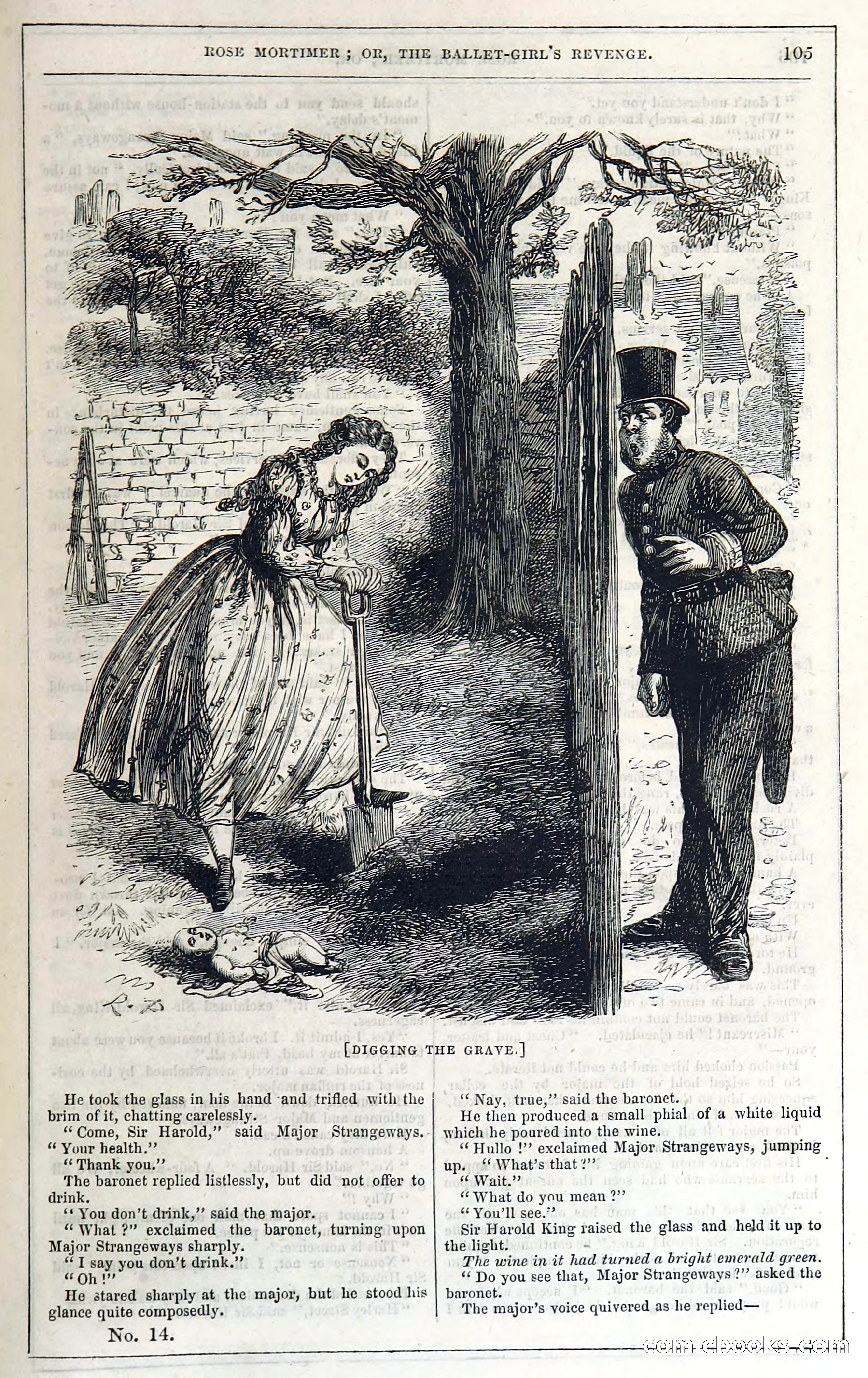
# Page Analysis: *Rose Mortimer; or, The Ballet-Girl's Revenge* This is an **illustrated page from a Victorian penny dreadful** showing both an engraving and running prose narrative. The central illustration, titled "[DIGGING THE GRAVE.]," depicts a woman in a full skirt bending toward the ground while a man in a top hat stands nearby observing. The text describes a tense scene between Sir Harold King and Major Strangeways involving a glass of wine. When the baronet adds a mysterious white liquid from a phial to the wine, it transforms to bright emerald green, prompting the major's shocked reaction. The page concludes mid-conversation as the major begins to respond with evident emotion.
# Page Description This is a page of running prose from *Rose Mortimer; Or,* a Victorian penny dreadful. The text depicts a confrontation between Sir Harold King and Major Strangeways over a poisoned liquid. Sir Harold accuses the major of attempted murder and threatens to involve the police, while the major denies the charge and demands witnesses. After a violent struggle in which Sir Harold seizes the major by the collar and throws him down, both men agree to a duel. Gentlemen enter the room as the scene concludes, apparently drawn by the disturbance.
# Page 107 of "The Ballet-Girl's Revenge" This is a page of running prose text from a Victorian penny dreadful. The narrative describes a duel in preparation between Sir Harold King and Major Strangeways. The text covers their arrival at King's shooting gallery in Harley Street, where King demonstrates his marksmanship with impressive accuracy, then their departure to Hampstead Heath for the actual duel. The major grows increasingly anxious as he realizes King is the superior shot. The passage ends as the combatants are being positioned back-to-back, about to fire at twenty paces distance.
# Page Analysis: Running Prose from a Victorian Penny Dreadful This page contains running prose text from *Rose Mortimer; Or,* a Victorian penny dreadful. The left column concludes a duel scene wherein a man dies mysteriously—apparently from poison rather than the pistol shot that struck him. His seconds deduce he is "Major Strangeways," a known cheater and blackleg seeking revenge. The right column begins Chapter XLIV, introducing Mermet, an Arab magician who traffics in poisons and holds secrets over noble families. A veiled lady visitor then arrives incognito to consult him about acquiring "subtle deadly" poisons that leave no trace. The text emphasizes mystery, deception, and criminal intrigue typical of the sensation genre.
# Page Analysis: Running Prose from "The Ballet-Girl's Revenge" This is a page of running prose text (page 109) from a Victorian penny dreadful titled "The Ballet-Girl's Revenge." The narrative depicts an Arab necromancer named Mermet demonstrating a deadly poison to a veiled lady visitor. Mermet shows her the poison's efficacy by having a canary inhale vapors from a bottle, causing the bird to die instantly. The lady, who came seeking the poison after hearing of Mermet's reputation, purchases the poison without paying a price—Mermet instead requests she show kindness to his servant. After she departs anxiously, Mermet reveals satisfaction with his "thriving trade" in poison, comparing himself to historical poisoners like the Borgias and Brinvilliers.
# Page Analysis: Running Prose from a Victorian Penny Dreadful This is a page of running prose (page 110) from *Rose Mortimer; Or...*, a Victorian penny dreadful. The text depicts a dramatic dialogue between a young pregnant woman in distress and Mermet, an Arab fortune-teller and necromancer, who reads her palm and reveals her tragic circumstances: she is an unmarried mother contemplating suicide, abandoned by the child's father. Mermet uses his supposed magical powers to manipulate her emotional vulnerability, predicting that either she or the child must die, while positioning himself as her only salvation.
# Page Description This is a page of running prose from a Victorian penny dreadful novel titled *The Ballet-Girl's Revenge*. The page contains the conclusion of Chapter XLV and dialogue between characters including a necromancer named Mermet, an Arab attendant, and a lawyer named Mr. Ignatius Scribb. The text discusses Mermet's plans involving poison, the identities of two women (Lady Bellisle and Miss Grace Walgrave), and Mermet's visit to Scribb's office at Furnival's Inn. The narrative involves melodramatic themes of crime, blackmail, and a concealed child.
# Rose Mortimer, Page 112 This page contains running prose dialogue from a Victorian penny dreadful serial. A lawyer named Ignatius Scribb reports to a mysterious man called Mermet (apparently an Arab) that he has successfully located Miss Grace Walgrave, who has left town for Richmond. The conversation reveals Scribb is drunk and somewhat insolent, while Mermet grows impatient for the address. Mermet offers Scribb a glass of water to sober him, and the exchange concludes with Mermet reassuring Scribb of his continued usefulness, suggesting an ongoing mercenary relationship between the two men.
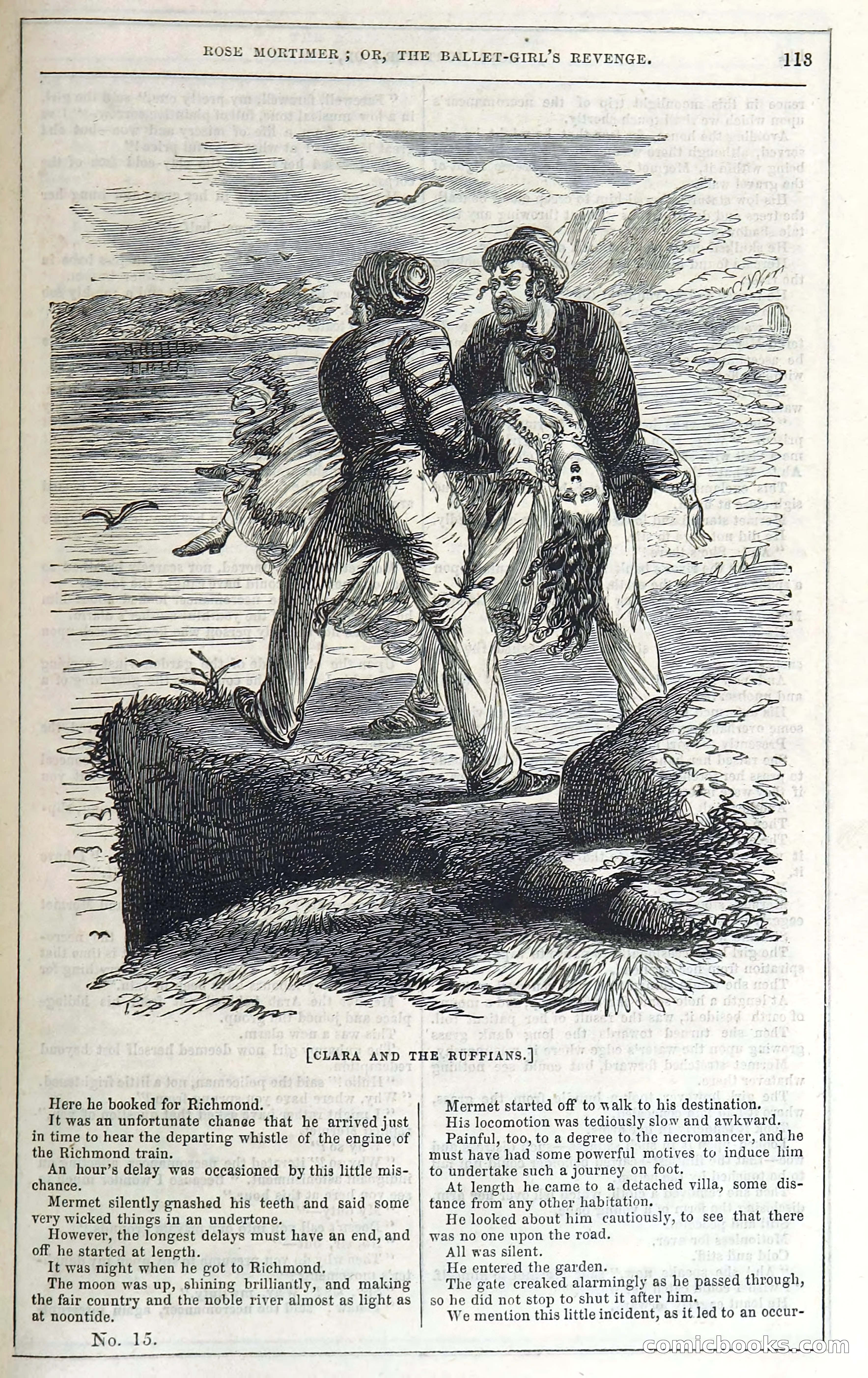
# Rose Mortimer; or, The Ballet-Girl's Revenge This is page 118 of a serialized Victorian penny dreadful (Issue No. 15). The page contains a wood-engraved illustration titled "Clara and the Ruffians," depicting two men on a riverbank, followed by running prose narrative. The text describes a character named Mermet's journey to Richmond by train and subsequent nighttime walk to a detached villa, where he cautiously enters a garden. The narrative emphasizes his slow, painful locomotion and notes that the creaking gate "led to an occur[rence]"—suggesting the beginning of a dramatic plot development typical of sensational Victorian fiction.
# Analysis of Page 114 from "Rose Mortimer; Or..." This is a page of running prose text from a Victorian penny dreadful serial. The visible text depicts a dramatic nighttime scene in which a character named Mermet secretly observes a young woman digging in a garden by a river. She retrieves a concealed bundle from the grass, which is revealed to contain a dead infant. The woman speaks a tearful farewell to the child's corpse before a policeman discovers her presence, leading to tense dialogue about the discovery. The scene combines Gothic melodrama with criminal suspense typical of the penny dreadful genre.
# Page Analysis: Running Prose from "The Ballet-Girl's Revenge" This is a page of running prose text (page 115) from a Victorian penny dreadful serial. The narrative depicts a tense confrontation between Mermet (an Arab necromancer), a policeman, and a young woman. The policeman suspects foul play after claiming to have "seen the body," while Mermet attempts to prevent the girl's arrest by offering bribes, then threats. When the policeman seizes a mysterious crystal phial Mermet carries, the necromancer tricks him into smelling its contents—apparently poisonous—and the constable begins to collapse mid-speech. The passage exemplifies the melodramatic crime and supernatural elements typical of penny dreadfuls.
# Page Analysis: Rose Mortimer; Or, [running prose] This page contains dense running prose from a Victorian penny dreadful serial. The narrative describes two fishermen discovering a half-drowned woman (Clara St. John) washed ashore with valuable jewels. Tempted by the treasure, they debate whether she is dead and consider robbing her, their consciences wavering. When the woman regains consciousness and speaks, asking where she is and recalling a shipwreck, the fishermen exchange a "meaning glance" heavy with sinister intent. The passage emphasizes their moral corruption and the woman's vulnerable position.
# Page Description This is page 117 of running prose from a Victorian penny dreadful titled "The Ballet-Girl's Revenge." The text depicts a dramatic confrontation between a woman named Clara and two fishermen who attempt to murder her. After a heated argument over stolen jewels, the fishermen decide to kill her to prevent her denouncing them. They hold her over a rock above the sea as she desperately clings to them and shrieks. The scene culminates in them swinging her over the edge. The passage concludes by introducing a mysterious half-naked man struggling to his feet on shore, a hundred yards away—apparently a shipwreck survivor whose connection to the preceding events remains unclear.
# Page Analysis This is a page of running prose text (page 118) from a Victorian penny dreadful titled *Rose Mortimer; or,* containing two chapters. The visible text describes a shipwrecked stranger who witnesses two fishermen attacking a woman on a rocky coast and stealing a parcel of jewels from her. The stranger attempts to intervene, hiding behind shrubs to observe the men and overhearing them discuss murdering both the woman and any witnesses. He then boldly confronts them and attempts to seize the jewels, though the passage cuts off mid-action before the outcome becomes clear.
# Page Analysis This is page 119 of running prose from a Victorian penny dreadful titled *The Ballet-Girl's Revenge*. The text depicts a violent confrontation between Edgar Deville and Clara St. John against fishermen over a disputed packet of jewels on coastal rocks. After a struggle, Clara fatally stabs one fisherman and pushes his body into the sea, justifying the murder as revenge ("An eye for an eye"). Edgar expresses horror at her actions. The narrative is melodramatic sensation fiction typical of the genre, emphasizing violent action and moral transgression.
# Rose Mortimer, Page 120 This is a page of running prose from a Victorian penny dreadful serial. The text depicts Edgar Deville's desperate attempt to dive into the sea to recover jewels from a shipwreck, which Clara St. John prevents. After fruitless searching, the exhausted pair walk inland, eventually reaching a farmhouse where they seek shelter. They present themselves as shipwreck survivors and are taken in by the kindly inhabitants. The insurers subsequently return their recovered packages from the wreck—described as "quite contrary to all practice"—apparently due to Clara's mysterious ability to fascinate those she encounters.
# Analysis of Page 121 This is an interior page of the penny dreadful *Rose Mortimer; or, The Ballet-Girl's Revenge*. It features a wood-engraved illustration captioned "[An Extraordinary Scene at a Circus]" depicting a dramatic confrontation—a man with a raised whip confronts a woman while onlookers shelter under an umbrella. Below the illustration, prose text describes two adventurers, Clara St. John and Edgar Deville, arriving in England in reduced circumstances, traveling to visit Clara's cousin Lady Bellisle, only to discover a recent death has occurred in the family—an unfortunate timing for their visit.
# Page Description This is a page of running prose from a Victorian penny dreadful titled *Rose Mortimer; Or,* (page 122). The text describes a murder mystery: the Earl of Sloeford has been assassinated in his bed by a robber, and his nephew Mr. Spencer Bellisle inherits the earldom and becomes engaged to his cousin Lady Bellisle—a circumstance that arouses suspicion in Clara St. John, a shrewd observer newly arrived at Sloeford House. The narrative then shifts to Clara exploring the house's secret passages and panels, apparently searching for evidence connected to the suspicious betrothal and murder.
# A Page from a Victorian Penny Dreadful This is a page of running prose text from "The Ballet-Girl's Revenge," a penny dreadful serialized novel. The page begins mid-narrative with Chapter XLIX and depicts Clara St. John discovering a murdered corpse—an elderly domestic servant with distinctive white hands and a diamond ring—thrust into a hidden passage where she has taken refuge. Though horrified by the blood, Clara shows no sympathy and presses forward searching for a secret door, driven by her criminal purpose. The chapter headings promise accumulating horrors involving assassination, poison, and schemes of revenge.
This page contains running prose from a Victorian penny dreadful titled "Rose Mortimer; Or," presenting serialized melodramatic fiction. The text depicts a dramatic confrontation scene in which Clara discovers a wounded servant in a dark passage who reveals that the Earl has stabbed him, just as the Earl previously stabbed his master and uncle. The narrative includes dialogue between the Earl and a woman named Alice discussing plans involving poison obtained from "the old Arab," establishing a plot of villainy and murder typical of sensation fiction.
# Page 125 of "The Ballet-Girl's Revenge" This is a page of running prose from a Victorian penny dreadful serial. The page contains the end of a scene where the character Clara becomes trapped in a locked passage, followed by Chapter L, which shifts focus to the character Rose Mortimer. The new chapter recounts recent events in Rose's life: the discovery of an Earl's murder, the mysterious disappearance of a landlady named Mrs. Davis, and a conversation between Rose and the stage manager Mr. Chowler about keeping silent regarding dangerous criminals they've witnessed, fearing the guilty parties will commit further crimes to hide their guilt.
# Description This is a page of running prose from a Victorian penny dreadful titled "Rose Mortimer; or..." (page 126). The text depicts a dramatic confrontation at Rose's lodgings: a masked, armed man appears at the door, Mr. Davis (the landlord) confronts him from a window, shots are exchanged, and Davis shoots the intruder with his fowling-piece. Rose watches anxiously from her window, torn between curiosity and fear about the outcome of this violent encounter between the masked man and her landlord.
# Page Analysis: "The Ballet-Girl's Revenge" This is a page of running prose from Chapter LI of a Victorian penny dreadful serial. The narrative depicts a dramatic domestic scene in which Mr. Davis, armed and suspicious of an approaching figure, nearly shoots his own wife (Moggy/Mrs. Davis), who has mysteriously reappeared after apparently being abducted. Rose Mortimer recognizes Mrs. Davis's voice and they embrace emotionally. The page ends with Mrs. Davis promising to recount her mysterious ordeal, though she claims not to know where she has been or what has happened to her.
# Analysis of Page 128 from "Rose Mortimer" This page contains running prose from a Victorian penny dreadful serial. Mrs. Davis recounts to Rose and others her experience as a captive of a masked man. The narrative describes how Davis received a mysterious warning note saying "Beware of all food!" hidden beneath a picture, followed by a second note from an unknown benefactor instructing her to pretend to eat poisoned food while secretly disposing of it in hidden locations. The passage emphasizes suspense and melodrama, with Davis uncertain whether to trust her mysterious helper, ultimately mixing "fear or security" as she reads his cryptic instructions to "Fear nothing and be bold."
# Victorian Penny Dreadful Page Analysis This is an interior page (129) of the serial *Rose Mortimer; or, The Ballet-Girl's Revenge*, containing both an illustration and running prose dialogue. The engraving depicts a woman in flowing dress positioned against stone archways near water, labeled "[THE LOST ONE.]" Below, the text shows a dialogue between a captive narrator and a masked man who guards her confinement. The narrator requests permission to walk in the garden; the man's reaction to this word "Garden" suggests some hidden significance she fails to understand, leaving both characters puzzled by the miscommunication.
# Analysis of Page 130 This page contains running prose—dialogue and narrative from what appears to be a mid-novel sequence. The visible text depicts a prisoner recounting interrogation and imprisonment to listeners named Rose and Davis. The narrator describes being questioned about his whereabouts on Tuesday, discusses a mysterious lodger, and recounts discovering a dead rat in his cell—apparently placed by his jailer as either a warning or test. The passage culminates with the narrator spotting his jailer opening a trap door, then hastily replacing his mask upon being seen. The dialogue suggests Rose and Davis are eagerly pressing for details, particularly about whether the narrator can identify the jailer's face.
# Page Description This page contains running prose from Chapter LI and the beginning of Chapter LII of a Victorian penny dreadful titled *The Ballet-Girl's Revenge*. The text depicts Mrs. Davis recounting her escape from captivity to Rose Mortimer and her husband—describing how a mysterious conductor helped her flee a strange house and provided her a horse to ride away, asking only her silence about his superiors in exchange. The chapter then transitions to Rose's concern for her safety, a conversation with theater manager Chowler about whether she should leave the company, and introduces the next chapter's promise of adventure, danger, and circus-related drama.
# Page Analysis **Page Type:** Running prose text (page 132 of a serialized narrative) **Content Summary:** This page from the penny dreadful *Rose Mortimer; Or,* depicts a dramatic chase scene in which Rose is pursued by a knife-wielding man toward a roadside inn. Mr. Davis, the publican, intervenes with a fowling-piece, forcing the attacker to flee. Afterward, Rose confides to the Davis couple that she has enemies working her destruction and must leave the area, believing the attack was originally intended to kill her, not merely to rob the inn.
# Page Analysis This is a page of running prose from a Victorian penny dreadful titled *The Ballet-Girl's Revenge* (page 133). The text depicts a confrontation between the heroine Rose Mortimer and a circus master named Signor Bowerini, who brutally mistreats his performers. Rose befriends an abused young dancer named Blanche Bowerini and urges her to leave the signor's employ, offering to protect her after Rose's own theatrical engagement ends. The passage culminates in Rose and Blanche rushing to the circus for a performance, with Rose positioning herself near the stable door to watch.
# This Page from "Rose Mortimer; Or..." This is a page of running prose from Chapter LIII of a Victorian penny dreadful serialization. The text depicts Clara St. John discovering a dying old man bleeding in a secret passage at Sloeford House. She helps him escape, then returns to her chamber where Lady Bellisle suddenly arrives. Clara becomes suspicious, recalling overhearing Bellisle in conversation with the Earl of Sloeford, and now wonders if Bellisle is connected to murders—both of an earl and of the wounded man. The chapter title promises "blood," "family secrets," and "confession," establishing the sensational melodrama typical of the genre.
# Analysis of Page 135 from "The Ballet-Girl's Revenge" This is a running prose page from a Victorian penny dreadful. The left column concludes a scene where Clara St. John nurses a wounded old man and persuades him to sign a document revealing that the late earl's stolen child still lives and can be restored to its rightful possessions. The right column begins Chapter LIV, shifting the scene to a fashionable London mansion belonging to an ancient, respectable family. The text introduces a character named Grace Walgrave in connection to this house, suggesting she has a "sad history" linked to the family's hidden secrets—establishing the melodramatic tone typical of the genre.
# Description of Page This is a page of running prose from a Victorian penny dreadful titled "Rose Mortimer" (page 156). The text consists of two columns of dense narrative and dialogue describing a scene in which Grace Walgrave, a woman burdened by guilt and shame, receives an unexpected visit from Mermet, a mysterious Arab necromancer dressed in a long cloak. Mermet demands money from her, and they engage in tense, menacing dialogue wherein Grace dismisses his threats and suggests that death would be preferable to her current misery. The passage deals with blackmail, moral transgression, and veiled supernatural threat.
This page is an illustration with accompanying prose from a Victorian penny dreadful serial. The engraving depicts a dramatic nocturnal confrontation between a woman and an Arab man on what appears to be castle battlements, with a full moon visible. The text shows dialogue in which the Arab demands five thousand pounds from "the poor girl" (identified as Miss Walgrave), who initially appears stunned but then regains her composure and dignity, refusing to provide the money immediately and dismissing him with threats.
This page contains running prose from a Victorian penny dreadful serial titled "Rose Mortimer; or," presented in two columns. The text depicts a confrontation between a necromancer named Mermet and a desperate woman (Grace Walgrave) who agrees to pay him five thousand pounds, followed by scenes showing Grace's anguished departure and Mermet's satisfied scheming in his chamber. The page concludes with Chapter IV beginning, as Mermet receives a mysterious letter from an unknown sender. The narrative emphasizes melodramatic tension, moral peril, and hints at dark supernatural intrigue.
# Page Description This is running prose from page 139 of a Victorian penny dreadful titled *The Ballet-Girl's Revenge*. The text depicts a scene in which a character named Mermet (described as an "Arab" and "necromancer") urgently pursues a woman named Miss Walgrave. After interrogating servants about her whereabouts, Mermet races by cab to Waterloo Bridge, where he observes white skirts on the parapet and shouts for the driver to stop, apparently witnessing or suspecting a suicide. The narrative is melodramatic crime/mystery fiction typical of the penny dreadful genre.
# Page Analysis This is running prose from a Victorian penny dreadful titled *Rose Mortimer*. The page depicts a dramatic rescue scene in the Thames where a boatman dives to recover a body while a character named Mermet, apparently seeking evidence of a suicide, watches from a rocking boat. The boat capsizes, leaving three people struggling in the water. The page ends with a chapter break announcing Chapter LVI, which promises revelations about Clara's investigations, mysterious passages, a death chamber, and evidence identifying an assassin. The narrative emphasizes melodramatic tension and supernatural mystery typical of the sensational genre.
# Page Analysis: Victorian Penny Dreadful This is a **page of running prose** from the middle of a serialized story titled "The Ballet-Girl's Revenge" (page 141). The text describes Clara St. John's investigation into a murder at Sloeford House. She discovers an elaborate secret subterranean passage connecting the garden to the hall and a bedroom, which she believes will provide crucial evidence. The page also includes a letter from Edgar Bellisle to his wife Rosalia, expressing grief over unspecified family troubles and urging her to keep his secrets. The narrative emphasizes Clara's determination to uncover the truth about "the house of crime" through careful exploration and note-taking.
This is a page of running prose from a Victorian penny dreadful. The text depicts Clara, apparently investigating a murder, discovering a hidden drawer in a cabinet containing a blood-stained packet left by a dying earl. She then traces a trail of blood across the room to a portrait and a Chinese screen, where she discovers a horrifying message—large red letters traced in human blood on the wall spelling out "SPENCER BELLISLE MY MURDERER! EDGAR BELLISLE, EARL OF SLOEFORD." The narrative combines gothic mystery elements with melodramatic crime investigation typical of the genre.
# Page Description This is a page of running prose from a Victorian penny dreadful titled "The Ballet-Girl's Revenge" (page 143). The text describes a dramatic rescue scene: three people—a man called the Arab (or Mermet), a waterman, and an unconscious woman named Grace Walgrave—have been pulled from a river after apparent drowning. As they recover, the narrative reveals that while the waterman seeks to save a life, the Arab/Mermet is motivated by financial gain (five thousand pounds). The page ends with complications: the boat's oars have been lost in the chaos, stranding them without means to reach shore.
This is a page of running prose from a Victorian penny dreadful titled *Rose Mortimer*. The text depicts a dramatic scene in which a character named Mermet, referred to as "the Arab" and "the necromancer," murders a waterman by throwing him into the river after the man witnesses Mermet disposing of a dead body (identified as Grace Walgrave). The passage consists of dialogue and narrative describing the confrontation between Mermet and the waterman, culminating in the waterman's drowning, followed by a chapter heading for Chapter LVIII.
# Victorian Penny Dreadful Page Analysis This is an illustrated story page from *Rose Mortimer; or, The Ballet-Girl's Revenge* (No. 19). The page features a wood-engraved illustration captioned "[THE MURDER BY POISON.]" depicting an interior scene with three figures, surrounded by decorative frames containing additional vignettes. The running prose below describes a mysterious visitor arriving at a residence to meet a man named Mr. Brownbill. A "necromancer" (a term suggesting occult knowledge) greets Brownbill, a tall, pale young man, referencing a prior appointment to discuss "that matter" they had previously discussed. The text suggests intrigue and potentially sinister business, consistent with the melodramatic crime fiction of penny dreadfuls.
# Victorian Penny Dreadful Page Analysis This is a page of **running prose** from a serialized sensation novel titled "Rose Mortimer; Or," presented as page 146 of the publication. The text depicts a confrontational dialogue between two men: Mr. Brownbill and a character named Mermet (described as a necromancer or conjuror). Brownbill presses Mermet to use his supernatural powers to secure the acquiescence of a young woman, Miss Chepstow, for romantic purposes. The exchange grows tense when Brownbill questions Mermet's integrity and references his mysterious nighttime activities, causing the necromancer visible anger. The conversation alternates between accusations, denials, and negotiation over Mermet's promised magical services and compensation.
# Page Description This is page 147 of running prose from a Victorian penny dreadful titled *The Ballet-Girl's Revenge*. The text depicts a dramatic confrontation between Miss Chepstow (a ballet girl) and Mermet (described as a "necromancer"), who arrives to inform her that Arthur Brownbill, the man she loves, is secretly married to Mermet's daughter. Mermet produces a letter in Brownbill's handwriting to prove his claim. The scene is heavy with melodramatic emotion—Miss Chepstow experiences shock, rage, and despair upon learning of the deception, while Mermet adopts a cynical tone, claiming to expose Brownbill's villainy and duplicity.
# Page Content Analysis This is a page of running prose text from a Victorian penny dreadful serial titled *Rose Mortimer; Or,* (page 148). Chapter LIX begins here, introducing a dramatic scene involving a character named Mermet (described as a "necromancer" or magician) who arranges an encounter between Arthur Brownbill and Miss Lotty Chepstow. Mermet secretly follows Brownbill upstairs to spy on their meeting, while the dimly-lit room sets an atmosphere of deception and impending confrontation. The text emphasizes melodramatic emotional tension: Chepstow weeps over Brownbill's apparent infidelity, unaware of Mermet's sinister machinations in the darkness.
# Page Description This is running prose text from page 149 of a Victorian penny dreadful titled *The Ballet-Girl's Revenge*. The page depicts a dramatic confrontation between a dissolute man named Mr. Arthur Brownbill and a young woman (referred to as "Miss Chepstow" and "Lotty") whom he has trapped alone in a house. After she resists his advances with moral indignation, he forcibly seizes her, and she flees screaming up the stairs while he pursues. The scene ends with her cornered at the top of the house with no escape. The text emphasizes melodramatic dialogue, the villain's callous cynicism, and the heroine's desperate cries for help.
# Page Description This is a page of running prose (page 150) from a Victorian penny dreadful titled *Rose Mortimer; Or,* containing dense narrative text in two columns. The visible text recounts a dramatic confrontation: after a young countryman violently throws an acrobat to the ground, an inquiry ensues. Rose Mortimer defends Blanche Bowerini, the acrobat Signor Bowerini's apprentice, testifying that Blanche is unrelated to him and has been mistreated. Though a committee votes to remove Blanche from Bowerini's protection, the acrobat refuses to cancel her indentures, leaving no one willing to prosecute him legally—a turn that appears to embolden him to warn the gathered crowd that he will defend his "rights to the last shilling."
# What is on this page This is a page of running prose from the penny dreadful *The Ballet-Girl's Revenge* (page 151). The text depicts Rose recounting her troubled past to her companion Blanche, then describes the two women traveling by coach and stopping at an inn for refreshment. A mysterious lady with a colored attendant arrives at the inn; when Rose hears the lady's voice, she recognizes it but cannot immediately recall where they have met before, setting up an apparent moment of dramatic revelation.
# Analysis of Page 152 from *Rose Mortimer* This page contains running prose—the continuation of Chapter LXI of a Victorian penny dreadful serial. The visible text depicts a dramatic rescue scene in which Rose Mortimer, held captive by a woman threatening her with poison or a dagger, is suddenly saved when the landlord and several men burst through the door. After the interruption, the mysterious woman coolly denies wrongdoing and claims her privacy was violated, while the landlord and his men dispute with her about what occurred, with Rose too frightened to speak in her own defense. The chapter heading promises further plot developments involving letters, bribes, and Lady Bellisle's difficulties.
# Page Analysis This is an **illustration with running prose** from a Victorian penny dreadful serial. The page shows an engraved scene depicting what appears to be a dramatic confrontation in an interior setting, with a woman in flowing dress gesturing toward a kneeling man, observed by onlookers in the background. The text describes Rose experiencing some distress or crisis; she asks Blanche to lead her from the room. A landlord has made accusations about truth, which a composed woman challenges. Rose departs supported by Blanche, the crowd disperses, and the passage concludes by mysteriously referencing "the murderous woman and her negro attendant," suggesting a plot involving crime or deception. The caption reads "[A REAL TRAGEDY.]"
# Victorian Penny Dreadful Page Analysis This is a page of running prose (page 154) from the serialized story "Rose Mortimer; Or," a Victorian penny dreadful. The visible text depicts a dramatic confrontation: a guilty woman and her Black attendant plot against the heroine Rose Mortimer, fearing exposure of their crimes. A landlord delivers a letter to the woman (addressed to "Lady Bellisle") from Rose herself, containing a threat—Rose claims to have sealed evidence of the woman's wrongdoings held by trusty persons, ready to be revealed if anything happens to her. The letter effectively blackmails the antagonist into ceasing her persecution, leaving Lady Bellisle shocked and calculating her narrow escape.
# Page Description This is a page of running prose text from Chapter LXII of a Victorian penny dreadful titled "The Ballet-Girl's Revenge" (page 155). The page contains two sections: the conclusion of Chapter LXI (showing Lady Bellisle's anxious thoughts about Spencer and her departure) and the opening of Chapter LXII, which introduces Rose and Blanche Bowerini's arrival at their new theatrical company. The narrative focuses on the arrival of the two ballet dancers and an emerging conflict involving Walters, a married actor who flirts aggressively with both women, causing jealousy in his wife, the dancer Ethel Warner. The text emphasizes the emotional torment of theatrical jealousy and social complications within the theater company.
# Page Analysis This is a page of running prose from a Victorian penny dreadful titled *Rose Mortimer; Or,* (page 156). The text depicts a backstage theatrical scene in which an actor named Walters repeatedly attempts flirtation and compliments toward the heroine, Rose Mortimer, who rebuffs him with increasing sharpness. The passage shows Rose becoming irritated by his persistent badinage during a performance of *Hamlet*, culminating in her curtly correcting his familiar form of address. The narrative explores themes of unwanted male attention and a woman's firm but proper resistance to it—typical melodramatic conflict of the penny dreadful genre.
# Page Analysis: The Ballet-Girl's Revenge This is a page of running prose from a Victorian penny dreadful serialized novel, page 157. The text depicts a theatrical backstage drama in which Rose Mortimer, a dancer, encounters the jealous wife of actor Hamlet Walters. Mrs. Walters confronts Rose about her husband's flirtations, while Rose diplomatically denies wrongdoing. The scene culminates in domestic tension between the Walters couple, after which Rose withdraws, observing their angry altercation from across the stage before performing her theatrical part. The chapter heading at bottom promises further plot developments involving death, mystery, and the ballet-dancer character.
# Page Content Summary This is a page of running prose from a Victorian penny dreadful titled *Rose Mortimer; Or,* (page 158). The text depicts melodramatic domestic tragedy: a jealous actress stabs her husband, actor Walters, with his own dagger during a confrontation. Though he survives, the scandal ruins his career. His wife Ethel, traumatized by her own violent act, refuses to live with him afterward, valuing her principles over his pleas and concern for public opinion. The passage emphasizes her obstinate moral resistance and his discovery that he truly loves her only after losing her.
# Page Analysis: The Ballet-Girl's Revenge This is a page of running prose from a Victorian penny dreadful titled "The Ballet-Girl's Revenge" (page 159). The text describes an encounter between Rose Mortimer, a theatre actress, and an admiring gentleman who sends her a bouquet and attempts to give her his calling card during a performance. Rose repeatedly refuses his attentions, which she considers insulting and impertinent. The gentleman eventually accepts her rejection and departs apologetically. The narrative focuses on the social impropriety of the gentleman's persistent advances toward an uninterested actress.
# Victorian Penny Dreadful Page: Running Prose This is a page of running prose text from a Victorian penny dreadful serial. It depicts the dramatic death of actress Ethel Warner at a theatre—she collapses after receiving a bouquet of flowers thrown by "the black beard," and dies suddenly. The text then shifts to Chapter LXIV, where Rose Mortimer reports her suspicions to the theatre manager that the flowers were poisoned, and a doctor confirms poison may indeed be the cause. The narrative concerns a murder mystery unfolding through theatrical melodrama and criminal investigation.
# A Page of Victorian Penny Dreadful Prose This is a page of running prose text from a Victorian penny dreadful serial novel titled "Rose Mortimer; Or," printed on page 162. The narrative concerns a poisoning investigation: a doctor examines a suspicious bouquet placed in a metal box provided by Rose Mortimer herself, while a messenger reports that a suspect named "Smithson" (likely assumed) has fled a hotel. The text switches between scenes at an inn and at Sloeford, where Lady Bellisle discovers an earl has departed suddenly after leaving a letter. The dialogue reveals plot complications involving Rose Mortimer's potential involvement in—or entanglement with—the criminal matter under investigation.
# Page Description This is a page of running prose (page 163) from a Victorian penny dreadful titled *The Ballet-Girl's Revenge*. The left column concludes a scene where Lady Bellisle pursues the Earl of Sloeford to Hatfield by train. The right column begins Chapter LXV, shifting the setting to London at night, where it describes dark and illegal activities occurring in the cellar vault of an abandoned, allegedly haunted house. The text explicitly references a corpse wrapped in a white sheet and alludes to "Resurrection Joe" and grave-robbing practices, establishing the melodramatic supernatural horror typical of the genre.
# Page Analysis: Rose Mortimer; Or, [Running Prose] This is a page of running prose from a Victorian penny dreadful titled "Rose Mortimer." The text depicts a body snatcher removing a corpse from a cellar vault. After a sweep nervously leaves the bodies he's deposited there, a second criminal discovers the corpse and, showing no moral qualms, begins hoisting it onto his shoulders to steal it. The passage emphasizes the man's hardened criminality—"long habit had blunted all sense of humanity within him"—as he prepares to cart away the body despite the "presence of the grim tyrant who calls alike upon the high-born and the humble" (death). The narrative is melodramatic and sensational, typical of the genre's focus on crime and depravity.
# Page Analysis: The Ballet-Girl's Revenge This is a page of running prose from a Victorian penny dreadful serial titled "The Ballet-Girl's Revenge" (page 165). The text depicts a dialogue between a body-snatcher and a man identified as a necromancer (or professor conducting illicit experiments) who arranges to purchase corpses. They visit a cellar to collect the bodies, but discover the vault is empty—the corpses have mysteriously disappeared. The passage establishes tension and suggests criminal dealings in human cadavers while hinting at further "villainy" to come. The language captures period-appropriate working-class slang and melodramatic plotting typical of sensational Victorian fiction.
# Page Analysis: Victorian Penny Dreadful This is a page of running prose from the middle of a serialized story titled *Rose Mortimer*. The left column contains dialogue between a character (apparently a necromancer named Mermet) and a visitor called "Resurrection Joe," who attempts to sell him stolen corpses. Mermet intimidates Joe by claiming supernatural knowledge of his crimes and coerces him into complicity. The right column begins Chapter LXVI, which summarizes upcoming plot developments involving Lady Bellisle, whose departure has endangered the life of Rose Mortimer. The page contains no illustrations, only text formatted in two columns.
# Page Analysis: "The Ballet-Girl's Revenge" This is a page of running prose from a Victorian penny dreadful (page 167). The text depicts a tense dialogue between Lady Bellisle and her cousin Clara, in which Clara appears to question Lady Bellisle about a murder connected to "the late earl." After Clara departs, she summons an old man named Martin (the earl's former steward, whom she has apparently sheltered) from a secret panel, and interrogates him about whether the earl and Lady Bellisle have enemies they wish eliminated. The narrative concerns itself with secrets, suspicion, and apparent criminal conspiracy.
# Page 169: "Rose Mortimer; or, The Ballet-Girl's Revenge" This page contains an engraved illustration labeled "[SELLING A WIFE.]" depicting a woman standing before a group of men in what appears to be a street scene with buildings in the background. Below the image is dialogue in which the woman explains she came from "below" and was in a house; a man (apparently called Merment or "the Arab necromancer") discusses having potentially prevented a murder, while another voice insists "Tis not murder." The scene suggests a dramatic confrontation involving accusations and moral debate about a crime.
# Analysis of Page 170 from "Rose Mortimer; Or..." This page contains running prose dialogue from a Victorian penny dreadful. The text depicts an intense conversation between Lotty Chepstow (a woman who has apparently committed murder) and a mysterious figure called "the necromancer" or "the Arab," who offers to help her conceal the crime. The necromancer attempts to convince Lotty that her victim deserved death and that she bears no moral responsibility, while Lotty wrestles with guilt over having killed a man named Arthur Brownbill. The scene ends with the necromancer departing after obtaining her carpet bag, which he suggests will help eliminate evidence. The dialogue captures typical penny dreadful concerns: murder, moral ambiguity, supernatural elements, and melodramatic emotion.
# Page Content Description This is page 171 of running prose from a Victorian penny dreadful titled *The Ballet-Girl's Revenge*. The text depicts a dramatic deathbed scene in which a necromancer named Mermet attends to an injured man, Arthur Brownbill, who has fallen from a housetop. Mermet administers a narcotic potion that gradually paralyzes the victim while the dying man, unaware of being deliberately poisoned, thanks his murderer for mercy and expresses remorse for past cruelties. The passage emphasizes the moral discomfort even a callous killer experiences when his victim expresses gratitude during his final moments.
This page contains running prose from a Victorian penny dreadful novel titled *Rose Mortimer*. The text depicts two scenes: first, a necromancer named Mermet coerces a poor woman to assist him in a mysterious errand by summoning her from her home at night; second, Chapter LXVIII describes Mermet and the woman crossing Waterloo Bridge, where he instructs her to drop a heavy carpet bag into the river. A toll keeper becomes suspicious of the bag's contents, creating a moment of tension. The narrative emphasizes Mermet's manipulative control over the woman and suggests a crime or sinister plot is underway.
# Page Analysis This is a page of **running prose** from the serialized penny dreadful "The Ballet-Girl's Revenge" (page 173). The text depicts a necromancer named Mermet orchestrating the disposal of a body—that of Arthur Brownbill—by having an accomplice drop a carpet bag containing the corpse from Waterloo Bridge into the Thames while Mermet distracts a toll-keeper in conversation. The money-taker grows suspicious upon hearing a splash and recognizing what appears to be a "little hunchback's" voice. The passage concludes by noting that days later, a major crime fills all London's newspapers, suggesting the body's discovery and the scandal that follows.
# Page Analysis This is a **page of running prose** from the middle of a Victorian penny dreadful serial titled *Rose Mortimer; Or,* (page 174). The text consists of dialogue between a necromancer named Mermet and an unhappy girl named Lotty Chepstow. She confesses to being a murderess and expresses suicidal intentions; Mermet attempts to dissuade her from suicide by promising assistance and suggesting her desire for life will return within a week. The passage ends with Mermet offering her aid "should your determination continue," with reference to "To-morrow" at the bottom.
# Page Content Description This is a page of running prose text (page 175) from a Victorian penny dreadful titled *The Ballet-Girl's Revenge*. The narrative depicts a poisoning plot: an Arab gives a young woman named Lotty Chepstow a phial of poison that will make her appear dead by morning, though she will not actually die until noon. The text then describes her funeral and burial, followed by a scene where two men—apparently grave robbers—break into a church vault at night using tools, with one man (Snatchem) assisting another who descends into the low-arched vault below ground. The passage combines melodramatic dialogue about poisoning with the beginning of a grave-robbing subplot.
# Page from "Rose Mortimer" Victorian Penny Dreadful This page contains running prose from a serialized Victorian penny dreadful. The text depicts body-snatchers—Resurrection Joe and Snatchem—exhuming a coffin from a churchyard and delivering it to a man named Mermet, who appears to be a scientist or anatomist with a laboratory containing "stills, retorts, crucibles, and other analytical and chemical contrivances." The narrative shows the criminals negotiating the theft, executing the grave robbery, and bringing the coffin to Mermet's residence, where they unload it into a prepared chamber. The scene is concerned with concealing the crime and proceeding with Mermet's unspecified purposes for the corpse.
# Page Analysis: Rose Mortimer; or, The Ballet-Girl's Revenge This is an **illustrated page of running prose** from a Victorian penny dreadful serial (page 177). The engraving depicts two figures examining what appears to be a body in a cemetery or graveyard, captioned "[THE BODYSNATCHERS.]" The text describes a woman (apparently Lady Bellisle) investigating a theatrical incident at a stage door. She learns from a doorkeeper that someone died of poison—a dancer, not an actor. The passage reveals Lady Bellisle's apparent prior knowledge of the victim and her subsequent confused state as she leaves the theater, uncertain of her next action. The narrative suggests themes of mystery, deception, and revenge central to the serial's melodramatic plot.
# Analysis of Page 178 This page contains running prose text from a Victorian penny dreadful titled "Rose Mortimer; Or," continuing a serial narrative. The text depicts Lady Bellisle encountering an angry mob gathered outside a hotel, demanding the surrender of a man accused of poisoning a dancer named Mr. Smithson. The landlord manages to calm the crowd by revealing that Smithson left an hour ago heading toward Whitleigh, whereupon the mob resolves to pursue him. Lady Bellisle deduces from this information that Smithson likely fled in the opposite direction to mislead his pursuers. The passage is typical sensational melodrama—featuring moral outrage, mob violence, and a clever protagonist piecing together clues.
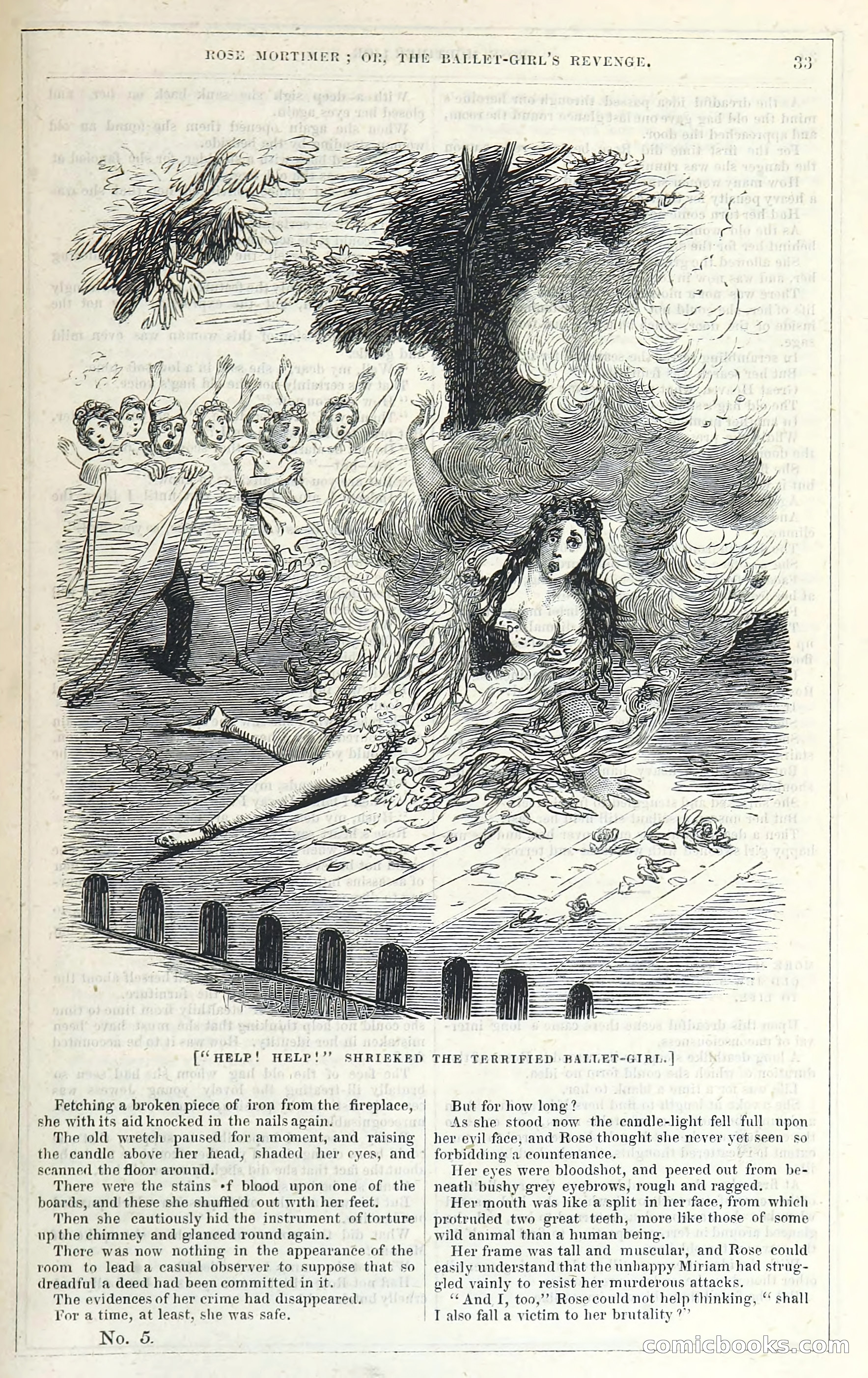
# Page Content Description This is a page of running prose from *The Ballet-Girl's Revenge*, a Victorian penny dreadful serialized fiction (page 179). The text describes Lady Bellisle at a railway station, where she pays a railway official five pounds to overlook her unauthorized train entry, then searches the waiting rooms for the Earl of Sloeford. She notices two men: a shabby lawyer's clerk and a dark, bearded foreign-looking man with a distinctive limp. Lady Bellisle follows the foreigner into the first-class waiting room, apparently recognizing him despite his disguise, and approaches him with suspicion.
# Page Analysis This page contains **running prose narrative text** from a Victorian penny dreadful titled *Rose Mortimer; Or,* (visible at page head, numbered 180). The text depicts a dramatic dialogue between the Earl of Sloeford, Lady Bellisle, and Spencer, who discuss their criminal predicament and plan to flee the country within ten days before incriminating evidence is revealed. The passage emphasizes melodramatic tension, with Lady Bellisle attempting to steel the despairing earl's resolve while he bitterly resents his dependence upon her. The page ends mid-sentence as a mysterious third voice interrupts them, cutting off mid-word at bottom.
This is a page of running prose from a Victorian penny dreadful titled "The Ballet-Girl's Revenge" (page 181). The text describes an Arab necromancer performing bizarre medical procedures on a corpse—administering mysterious liquids through a glass tube inserted between the dead woman's teeth, bathing her body, and apparently attempting to revive her. The passage culminates in an extraordinary moment when, after treatment with sal volatile and vinegar, the corpse's eyes appear to twitch—raising the question of whether she might actually be returning to life.
# Analysis of Page 182 from "Rose Mortimer; Or" This page contains running prose—dialogue-heavy narrative from a Victorian penny dreadful. The text depicts a confrontation between a necromancer named Mermet (described as an Arab) and a girl called Lotty, who has apparently been resurrected from death. Mermet reveals to the horrified Lotty that she has been dead and buried, then claims ownership over her because he restored her to life. He demands her loyalty and threatens that she cannot return to her former identity, as "Lotty Chepstow is dead." The passage is sensational melodrama typical of the genre, featuring supernatural horror, coercion, and intense emotional manipulation.
# Page Description This is a page of running prose (page 183) from a Victorian penny dreadful titled "The Ballet-Girl's Revenge." The visible text contains two narrative sections: first, a dialogue between a character named Mermet and a young woman he has apparently rescued or imprisoned, involving coercion and submission; second, a new chapter (LXXII) introducing theatrical characters including a flirtatious curate nicknamed the "Pet Parson" and an actress named Miss Clitheroe with whom he appears to be conducting a romantic entanglement. The narrative concerns scandal, seduction, and moral transgression typical of the melodramatic sensational fiction genre.
This is a page of running prose from a Victorian penny dreadful titled "Rose Mortimer." The text depicts a dramatic confrontation between characters in a theater green-room. Rose Mortimer, apparently an actress, overhears a conversation between Miss Clitheroe and a man called "the Pet Parson" (Wilfred), in which Miss Clitheroe complains of being insulted by other actresses and demands that Wilfred defend her honor. The dialogue reveals tension about their relationship, with Miss Clitheroe hinting at a secret engagement while Wilfred responds with casual indifference, leading to emotional accusations and recriminations between them.
# Page Analysis This is an **illustrated page of running prose** from a Victorian penny dreadful serial. The page shows "No. 24" of *Rose Mortimer; or, The Ballet-Girl's Revenge* and depicts a scene titled "[THE MURDER OF THE PET PARSON]." The visible dialogue concerns a confrontation between characters, apparently Kate and the Reverend Wilfred Ravenscroft, in which Kate threatens the clergyman with an outraged woman's vengeance ("You shall yet find that an outraged woman can hate as fiercely as she has loved fondly"). The wood-engraved illustration shows a Gothic interior with angelic or ghostly figures hovering above a gathered crowd witnessing what appears to be a supernatural or dramatic moment.
# Page Analysis: *Rose Mortimer; Or,* (Page 186) This is a page of running prose from a Victorian penny dreadful serial. The text covers two distinct scenes: first, a backstage encounter between Rose Mortimer and the "Pet Parson" (Reverend Ravenscroft), after which Kate Clitheroe suffers hysterics; second, a church service where Kate, grief-stricken and seated prominently in view of the pulpit, suddenly shoots the Pet Parson dead during his sermon. Kate flees with the pistol. The page concludes with an inquest finding her of unsound mind, leading to her lifetime restraint. The narrative then notes this sensational episode was forgotten within a week.
This is a page of running prose from a Victorian penny dreadful titled *The Ballet-Girl's Revenge*. The text depicts a confrontation between the ballet dancer Rose Mortimer and a persistent admirer who attempts to deliver her bouquets at the stage door, despite her explicit refusal. After Rose firmly rejects him, the narrative jumps to the following morning when an unnamed gentleman caller arrives at her lodgings. The page consists entirely of dialogue and narrative description without illustrations.
# Page Description This is a page of running prose from a Victorian penny dreadful titled *Rose Mortimer; Or,* (page 188). The text depicts a clumsy marriage proposal from Mr. Harry Fane, a draper, to Rose Mortimer, a ballet-girl actress, which she indignantly rejects. When she later arrives at theatre rehearsal, she discovers an opened letter circulating among the company—apparently from Fane, proposing to keep her as his mistress for two hundred pounds yearly pin-money, which creates scandal among her theatrical colleagues. The passage shows the draper's vengeful response to rejection and suggests Rose's reputation is now compromised.
# Page Description This is a page of running prose from a Victorian penny dreadful serialized novel. The page contains Chapter LXXIV of "The Ballet-Girl's Revenge," featuring dramatic dialogue and narration. The text describes Lotty Chepstow, who believes herself trapped by the mysterious necromancer Mermet (an Arab sorcerer), and their intense confrontation in which Mermet offers to provide "ocular proof" that he murdered Arthur Brownbill, a man Lotty apparently holds responsible for her suffering. The chapter explores themes of suspicion, deception, and occult mystery typical of the sensation fiction genre.
# Page Content Summary This page contains running prose from a Victorian penny dreadful novel titled "Rose Mortimer; or," numbered page 190. The text describes a dramatic scene in which the protagonist Lotty discovers a human skeleton seated at a banquet table, then faints. The villain Mermet plans further deceptions. A mysterious veiled lady then arrives at his laboratory and, upon unveiling herself, reveals she is Clara St. John—who was supposedly Mermet's wife and had become the "wife of the galley slave." The page ends mid-dialogue as she confronts him about his past betrayal.
# What This Page Contains This is a page of running prose—numbered 191—from the penny dreadful serial *The Ballet-Girl's Revenge*. The text depicts a dramatic scene in which a fleeing Earl and Lady Bellisle quarrel aboard a ship crossing the Channel. Lady Bellisle threatens to expose the Earl and reinstate the rightful heiress (Rosalia Hargreaves's daughter); the Earl raises his hand threateningly, and moments later a sailor reports that Lady Bellisle has disappeared, apparently fallen overboard. The page contains melodramatic dialogue and sensation-fiction plotting typical of Victorian serialized crime and murder narratives.
# Page 192: Running Prose from "Rose Mortimer" This page contains running prose dialogue and narrative from Chapter LXXVI (titled "FINIS"), the apparent final chapter of this penny dreadful. The text depicts Rose Mortimer receiving an urgent summons from the dying Clara St. John at Sloeford House. Rose learns her own father has died and left her a packet, while simultaneously receiving a mysterious letter from Clara demanding her immediate presence. The narrative establishes that Clara, described as "bold [and] unscrupulous," has been mortally injured after wreaking vengeance upon "Count Lerno" and is now on her deathbed.
# Analysis of Page 193 This is an **illustrated page from a Victorian penny dreadful**, combining a dramatic engraving with running prose text below. The illustration, captioned "[ROSE ASTONISHES THE DRAPER S]," depicts a woman on horseback amid chaos—figures scatter in alarm around her. The prose beneath reveals a deathbed confession: Spencer Bellisle, Earl of Sloeford, admits to murdering his uncle and suppressing proof of marriage to Rosalia Hargreaves, whose daughter is the actress Rose Mortimer. Bellisle confesses he has pursued Rose mercilessly but that Providence has thwarted his sinful purposes. The passage suggests Rose is his cousin and that her death would bring ruin to the family.
# Page 194: Running Prose from "Rose Mortimer; Or," This page contains continuous prose narrative from a Victorian penny dreadful. The text depicts a deathbed confession by Clara St. John, who reveals she withheld knowledge of Edgar Deville's property inheritance and kept him poor out of fear he would abandon her if he knew the truth. After Clara's death, Rose (the heroine) and Jack Halliday, an artist, leave the chamber together. The page ends with Rose addressing Halliday tenderly, asking him not to call her "my lady," suggesting romantic tension between them.
# Summary This page contains running prose text from a Victorian penny dreadful serial titled "The Ballet-Girl's Revenge" (page 195). The narrative covers several plot developments: a conversation about a man named Hugh Mortimer's escape from death at the hands of a coining gang; the trial of the Whartons, who collapse when the supposedly-dead heroine appears in court; the father's suicide by poison and the son's subsequent conviction for fraud; and a scene where Rose (now installed at Sloeford House with her betrothed Jack Halliday) visits a roadside inn where she had previously sought shelter, and is warmly greeted by the landlady Mrs. Davis, who does not recognize her true identity.
# Rose Mortimer, Page 196 This page contains running prose from the final installment of a Victorian penny dreadful serial. The text describes the climactic attack on the heroine Blanche by Signor Bowerini, a villain who breaks into her bedroom at night. After being discovered and fought off by the artist Jack Halliday, Bowerini is captured, tried, and sentenced to penal servitude for life. The narrative concludes with "THE END" marked at the bottom, and a British Museum library stamp appears on the page. The London Romance Company published this serial.
# Analysis of Page 10 from "Red Ralph; Or..." This is a page of **running prose narrative** from a Victorian penny dreadful serial published by the London Romance Company. The text depicts a dramatic highwayman robbery scene in which Red Ralph and his companion Jack Rann accost a gentleman traveler, demanding money and valuables. The passage includes dialogue between the robbers and their victim, culminating in Ralph's gallant treatment of a young lady passenger and the sudden alarm when mounted police ("the Runners") are reported approaching, forcing the criminals to flee in separate directions.
# Red Ralph: Or, The Daughter of Night This is an **illustration with accompanying prose text** from a Victorian penny dreadful serial (No. 2). The engraving depicts a mounted highwayman in a top hat on a rearing horse, leaping over a gravel pit at night under a moon, while other figures on horseback appear in the background. The prose describes a robbery in preparation: two robbers set a rope trap across a road to stop a nobleman's carriage, conceal themselves with crape masks, and successfully halt an approaching chocolate-colored coach, causing one of the leading horses to stumble. The text emphasizes suspenseful, sensational action typical of the genre.