
Penny Dreadfuls, 1865 · page 142 of 204
Rose Mortimer; Or, The Ballet-Girl's Revenge — page 142: what you’re looking at
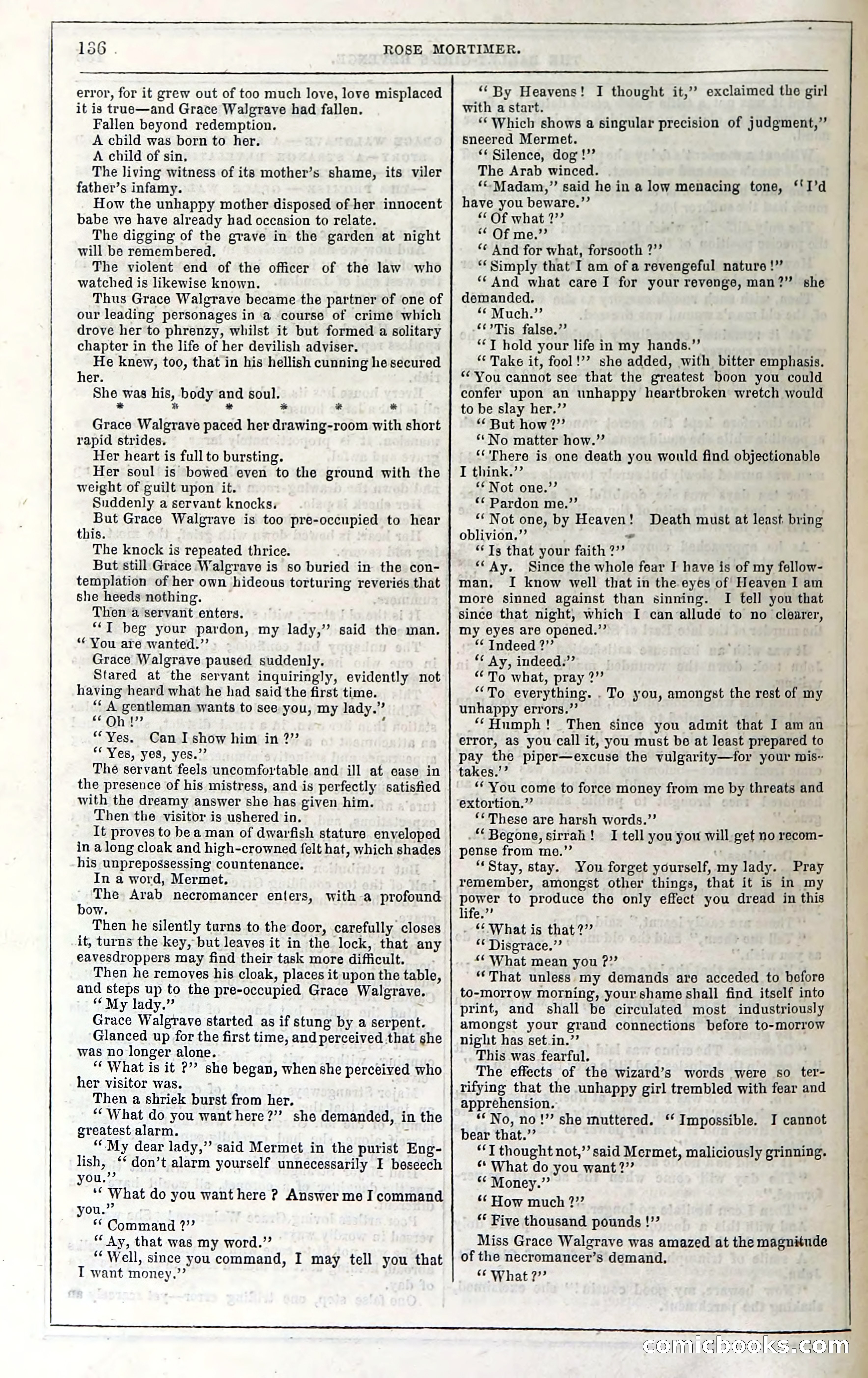
A restored page from Penny Dreadfuls, 1865. Page through the whole issue in the reader above.
📄 Transcribed text from this page (OCR, searchable)
Machine-transcribed from the original scan — historical spelling and the odd misread are preserved.
156 . ROSE MORTIMER. a eee error, for it grew out of too much love, love misplaced it is true—and Grace Walgrave had fallen. Fallen beyond redemption. A child was born to her. A child of sin. The living witness of its mother’s shame, its viler father’s infamy. How the unhappy mother disposed of her innocent babe we have already had occasion to relate. The digging of the grave in the garden at night will be remembered. The violent end of the officer of the law who watched is likewise known. Thus Grace Walgrave became the partner of one of our leading personages in a course of crime which drove her to phrenzy, whilst it but formed a solitary chapter in the life of her devilish adviser. He knew, too, that in his hellish cunning he secured her. She was his, body and soul. * % * Fd * * Grace Walgrave paced her drawing-room with short rapid strides. Her heart is full to bursting. Her soul is bowed even to the ground with the weight of guilt upon it. Suddenly a servant knocks. But Grace Walgrave is too pre-occupied to hear this. The knock is repeated thrice. But still Grace Walgrave is so buried in the con- templation of her own hideous torturing reveries that she heeds nothing. Then a servant enters. “‘T beg your pardon, my lady,” said the man. “¢ You are wanted.”’ Grace Walgrave paused suddenly. Stared at the servant inquiringly, evidently not having heard what he had said the first time. ‘“‘ A gentleman wants to see you, my lady.” 3 Oh 19) od “Yes. Can I show him in ?” “* Yes, yes, yes.”’ The servant feels uncomfortable and ill at ease in the presence of his mistress, and is perfectly satisfied with the dreamy answer she has given him. Then the visitor is ushered in. It proves to bea man of dwarfish stature enveloped in a long cloak and high-crowned felt hat, which shades his unprepossessing countenance. In a word, Mermet. The Arab necromancer enters, bow. Then he silently turns to the door, carefully closes it, turns the key, but leaves it in the lock, that any eavesdroppers may find their task more difficult. Then he removes his cloak, places it upon the table, and steps up to the pre-occupied Grace Walgrave. Grace Walgrave started as if stung by a serpent. Glanced up for the first time, and perceived that she was no longer alone. ‘* What is it ?”” she began, when she perceived who her visitor was. Then a shriek burst from her. * What do you want here?”? she demanded, in the greatest alarm. : “My dear lady,” said Mermet in the purist Eng- lish, ‘‘ don’t alarm yourself unnecessarily I beseech you.”’ ‘“ What do you want here ? Answer me I command you.” ** Command ?”” “‘ Ay, that was my word.”’ ‘Well, since you command, I may tell you that T want money,” with a profound ‘‘ By Heavens! I thought it,’ exclaimed the girl with a start. ‘Which shows a singular precision of judgment,” sneered Mermet. ‘* Silence, dog!” The Arab winced. ‘“-Madam,”’ said he in a low menacing tone, ‘‘I’d have you beware.”’ “Of what ?”’ ‘* Of me.” “¢ And for what, forsooth ?”’ ‘Simply that’'I am of a revengeful nature !” ‘*And what care I for your revenge, man?” she demanded. “© Much.” ‘‘?Tis false.” **T hold your life in my hands.” ** Take it, fool!’? she added, with bitter emphasis. “You cannot see that the greatest boon you could confer upon an unhappy heartbroken wretch would to be slay her.’’ “But how?” ‘No matter how.” ‘‘'There is one death you would find objectionable I think.”’ ‘Not one.”’ *< Pardon me.”’ , ** Not one, by Heaven! Death must at least bring oblivion.” - “Ts that your faith ?”’ ‘Ay. Since the whole fear I have is of my fellow- man, I know well that in the eyes of Heaven I am more sinned against than sinning. I tell you that since that night, which I can allude to no clearer, my eyes are opened.”’ ‘* Indeed ?” “¢ Ay, indeed.’’ “To what, pray ?”’ . “To everything. . To you, amongst the rest of m unhappy errors.”’ ‘‘Humph! Then since you admit that I am an error, as you call it, you must be at least prepared to pay the piper—excuse the vulgarity—for your mis~ takes.’’ | ‘You come to force money from me by threats and extortion.” ‘* These are harsh words.”’ .““Begone, sirrah! I tell you you will get no recom- pense from me.”’ tr “Stay, stay. You forget yourself, my lady. Pray remember, amongst other things, that it is in my power to produce the only effect you dread in this life;?? , - “What is that?” ** Disgrace.” ““ What mean you ?”’ | “‘That unless my demands are acceded to before to-morrow morning, your shame shall find itself into print, and shall be circulated most industriously amongst your grand connections before to-morrow night has set.in.”’ This was fearful. The effects of the wizard’s words were so ter- rifying that the unhappy girl trembled with fear and apprehension. “No, no !”’ she muttered. ‘‘ Impossible. I cannot bear that.” *‘T thought not,”’ said Mermet, maliciously grinning. ‘* What do you want?” ** Money.” ** How much 2”? ‘ Five thousand pounds !?” Miss Grace Walgrave was amazed at the magnitude of the necromancer’s demand, ce What ?”? (E|D@O)