
Penny Dreadfuls, 1865 · page 51 of 204
Rose Mortimer; Or, The Ballet-Girl's Revenge — page 51: what you’re looking at
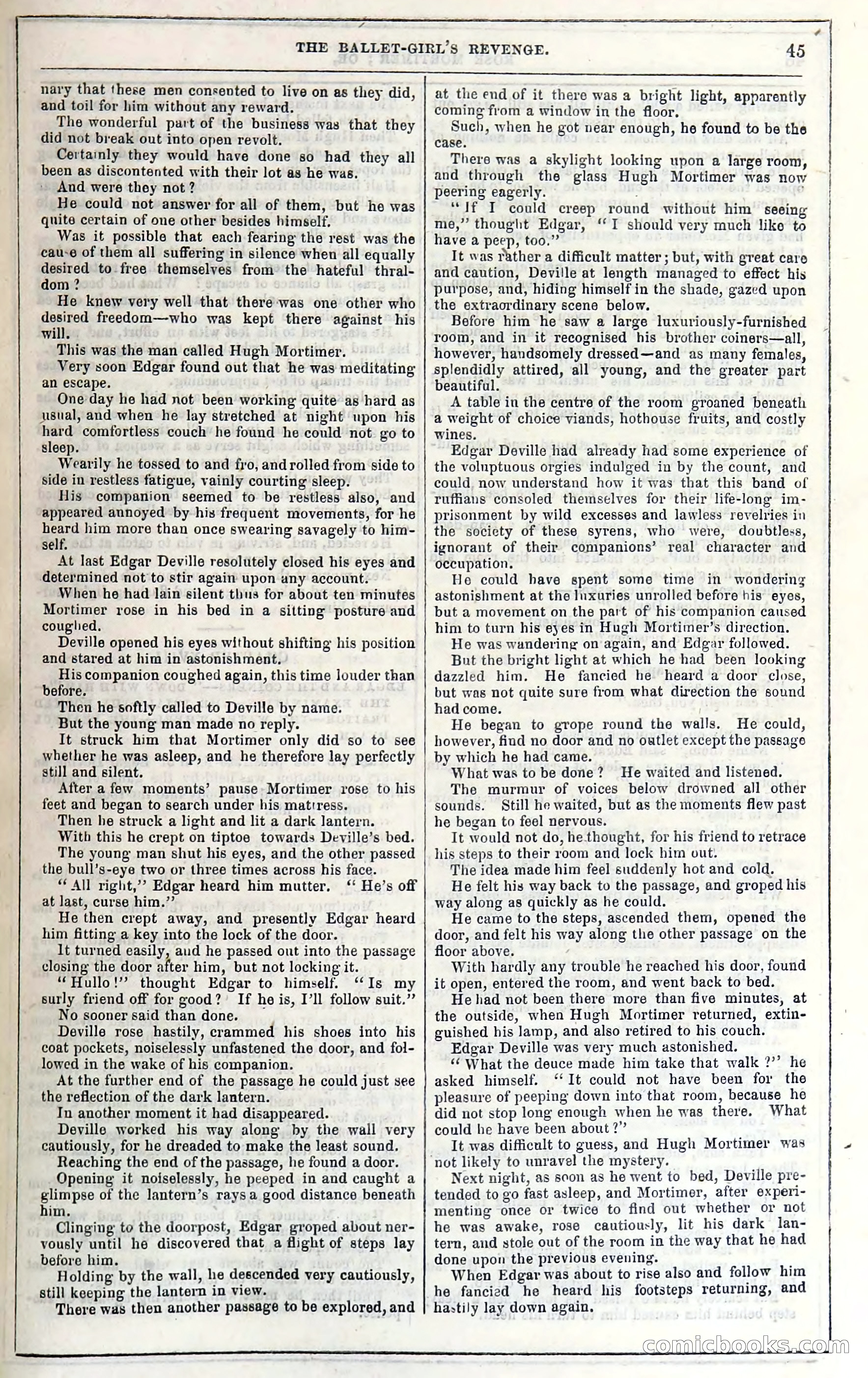
A restored page from Penny Dreadfuls, 1865. Page through the whole issue in the reader above.
📄 Transcribed text from this page (OCR, searchable)
Machine-transcribed from the original scan — historical spelling and the odd misread are preserved.
4 THE BALLET-GIRL’S REVENGE. 45 an ee —(s—CiC nary that these men consented to live on as they did, and toil for him without any reward. The wonderful part of the business was that they did not break out into open revolt. Certainly they would have done so had they all been as discontented with their lot as he was. And were they not? He could not answer for all of them, but he was quite certain of one other besides himself. Was it possible that each fearing the rest was the cause of them all suffering in silence when all equally desired to free themselves from the hateful thral- dom ? He knew very well that there was one other who pered freedom—who was kept there against his will. This was the man called Hugh Mortimer. Very soon Edgar found out that he was meditating an escape. , One day he had not been working quite as hard as usual, and when he lay stretched at night upon his hard comfortless couch he found he could not go to sleep. Wearily he tossed to and fro, androlled from side to side in restless fatigue, vainly courting sleep. His companion seemed to be restless also, and appeared annoyed by his frequent movements, for he os him more than once swearing savagely to him- self. At last Edgar Deville resolutely closed his eyes and determined not to stir again upon any account. When he had lain silent thus for about ten minutes Mortimer rose in his bed in a sitting posture and coughed. Deville opened his eyes without shifting his position and stared at him in astonishment. His companion coughed again, this time louder than before. Then he softly called to Deville by name. But the young man made no reply. It struck him that Mortimer only did so to see whether he was asleep, and he therefore lay perfectly still and silent. After a few moments’ pause Mortimer rose to his feet and began to search under his mattress. Then he struck a light and lit a dark lantern. With this he crept on tiptoe towards Deville’s bed. The young man shut his eyes, and the other passed the bull’s-eye two or three times across his face. “All right,’? Edgar heard him mutter. ‘ He’s off at last, curse him.’’ He then crept away, and presently Edgar heard him fitting a key into the lock of the door. lt turned easily, aud he passed out into the passage closing the door after him, but not locking it. “Hullo!” thought Edgar to himself. “Is my surly friend off for good? If he is, I’ll follow suit.” No sooner said than done. Deville rose hastily, crammed his shoes into his coat pockets, noiselessly unfastened the door, and fol- lowed in the wake of his companion. At the further end of the passage he could just see the reflection of the dark lantern. In another moment it had disappeared. Deville worked his way along by the wall very cautiously, for he dreaded to make the least sound. Reaching the end of the passage, he found a door. Opening it noiselessly, he peeped in and caught a glimpse of the lantern’s raysa good distance beneath him, Clinging to the doorpost, Edgar groped about ner- vously until he discovered that a flight of steps lay before him. Holding by the wall, he descended very cautiously, still keeping the lantern in view. There was then another passage to be explored, and at the end of it there was a bright light, apparently coming from a window in the floor, Such, when he got near enough, he found to be the case. There was a skylight looking upon a large room, and through the glass Hugh Mortimer was now peering eagerly. ; , “If I could creep round without him seeing meé,”’ thought Edgar, ‘I should very much like to have a peep, too.” It was rather a difficult matter; but, with great care and caution, Deville at length managed to effect his purpose, and, hiding himself in the shade, gazed upon the extraordinary scene below. Before him he saw a large luxuriously-furnished room, and in it recognised his brother coiners—all, however, handsomely dressed—and as many females, splendidly attired, all young, and the greater part beautiful. A table in the centre of the room groaned beneath a weight of choice viands, hothouse fruits, and costly wines. Edgar Deville had already had some experience of the voluptuous orgies indulged in by the count, and could now understand how it was that this band of ruffians consoled themselves for their life-long im- prisonment by wild excesses and lawless revelries in the society of these syrens, who were, doubtless, ignorant of their companions’ real character and occupation. He could have spent some time in wondering astonishment at the luxuries unrolled before his’ eyes, but a movement on the part of his companion caused him to turn his eyes in Hugh Mortimer’s direction. He was wandering on again, and Edgar followed. But the bright light at which he had been looking dazzled him. He fancied he heard a door close, but was not quite sure from what direction the sound had come. He began to grope round the walls. He could, however, find no door and no outlet except the passage by which he had came. What was to be done? He waited and listened. The murmur of voices below drowned all other sounds. Still he waited, but as the moments flew past he began to feel nervous. It would not do, he thought, for his friend to retrace his steps to their room and lock him out. The idea made him feel suddenly hot and cold. He felt his way back to the passage, and groped his way along as quickly as he could. He came to the steps, ascended them, opened the door, and felt his way along the other passage on the floor above. With hardly any trouble he reached his door, found it open, entered the room, and went back to bed. He had not been there more than five minutes, at the outside, when Hugh Mortimer returned, extin- guished his lamp, and also retired to his couch. Edgar Deville was very much astonished. ‘¢ What the deuce made him take that walk ?”’ he asked himself. ‘‘It could not have been for the pleasure of peeping down into that room, because he did not stop long enough when he was there. What could he have been about ?” It was difficult to guess, and Hugh Mortimer was ‘not likely to unravel the mystery. Next night, as scon as he went to bed, Deville pre- tended to go fast asleep, and Mortimer, after experi- menting once or twice to find out whether or not he was awake, rose cautiously, lit his dark lan- tern, and stole out of the room in the way that he had done upon the previous evening. When Edgar was about to rise also and follow him he fancied he heard his footsteps returning, and hastily lay down again, ty tt tt