
Penny Dreadfuls, 1865 · page 184 of 204
Rose Mortimer; Or, The Ballet-Girl's Revenge — page 184: what you’re looking at
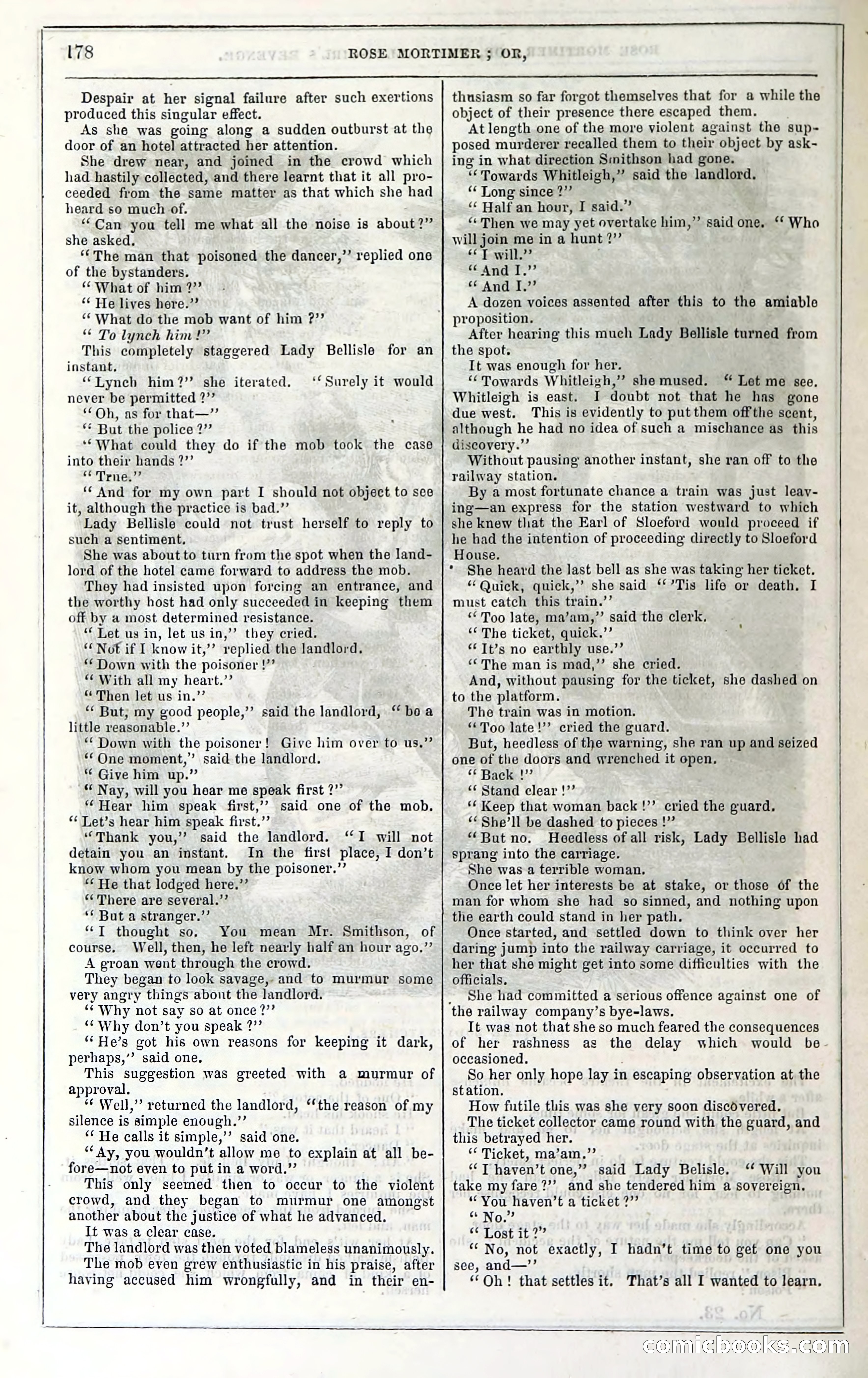
A restored page from Penny Dreadfuls, 1865. Page through the whole issue in the reader above.
📄 Transcribed text from this page (OCR, searchable)
Machine-transcribed from the original scan — historical spelling and the odd misread are preserved.
178 ROSE MORTIMER ; OR, Despair at her signal failure after such exertions produced this singular effect. As she was going along a sudden outburst at the door of an hotel attracted her attention. She drew near, and joined in the crowd which had hastily collected, and there learnt that it all pro- ceeded from the same matter as that which she had heard so much of. “Can you tell me what all the noise is about?” she asked. ‘The man that poisoned the dancer,’’ replied one of the bystanders. “What of him ?”” ‘* He lives here.” ‘What do the mob want of him ?”’ ** To lynch him!” This completely staggered Lady Bellisle for an instant. “Lynch him?’’ she iterated. never be permitted ?”’ ‘Oh, as for that—’’ ** But the police ?” ‘What could they do if the mob took the case into their hands ?”’ True.” ‘‘ And for my own part I should not object to see it, although the practice is bad.”’ Lady Bellisle could not trust herself to reply to such a sentiment, She was about to turn from the spot when the land- lord of the hotel came forward to address the mob. They had insisted upon forcing an entrance, and the worthy host had only succeeded in keeping them off by a most determined resistance. “‘ Let us in, let us in,’”’ they cried. “Not if I know it,’’ replied the landlord, *‘ Down with the poisoner !”’ “With all my heart.’’ “ Then let us in.”’ ‘“ But; my good people,” said the landlord, “ boa little reasonable.’’ *‘ Down with the poisoner! Give him over to us.” ‘One moment,” said the landlord, * Give him up.” ‘* Nay, will you hear me speak first ?”’ ‘Hear him speak first,’’ said one of the mob. ‘* Let’s hear him speak first.’’ “Thank you,’’? said the landlord. ‘I will not detain you an instant. In the first place, I don’t know whom you mean by the poisoner.”’ “‘ He that lodged here.”’ “There are several.’’ ‘* But a stranger.”’ “T thonght so. You mean Mr. Smithson, of course. Well, then, he left nearly half an hour ago.”’ A groan went through the crowd. They began to look savage, and to murmur some very angry things abont the landlord. ‘¢ Why not say so at once ?”’ “‘ Why don’t you speak ?” **He’s got his own reasons for keeping it dark, perhaps,”’ said one. This suggestion was greeted with a murmur of approval. ‘* Well,” returned the landlord, ‘the reason of my silence is simple enough.”’ “* He calls it simple,’’ said one. ‘Ay, you wouldn’t allow me to explain at all be- fore—not even to put in a word.” This only seemed then to occur to the violent crowd, and they began to murmur one amongst another about the justice of what he advanced. It was a clear case. The landlord was then voted blameless unanimously. The mob even grew enthusiastic in his praise, after having accused him wrongfully, and in their en- ‘Surely it would thusiasm so far forgot themselves that for a while the object of their presence there escaped them. At length one of the more violent against the sup- posed murderer recalled them to their object by ask- ing in what direction Sinithson had gone. ‘“Towards Whitleigh,” said the landlord. ** Long since 2?” ‘< Half an hour, I said.” “‘ Then we may yet overtake him,”’ said one. ‘* Who will join me in a hunt?” ball “And I.” ** And I.”’ A dozen voices assented after this to the amiable proposition. After hearing this much Lady Bellisle turned from the spot. It was enough for her. “Towards Whitleigh,’ she mused. “ Let me see. Whitleigh is east. I doubt not that he has gone due west. This is evidently to put them offthe scent, although he had no idea of such a mischance as this discovery.”’ Without pausing another instant, she ran off to the railway station. By a most fortunate chance a train was just leay- ing—an express for the station westward to which she knew that the Earl of Sloeford would proceed if he had the intention of proceeding directly to Sloeford House. * She heard the last bell as she was taking her ticket. “Quick, quick,’ she said ‘‘’Tis life or death. I must catch this train.’’ ‘Too late, ma’am,”’ said the clerk. ““The ticket, quick.’’ ** Tt’s no earthly use.’’ ‘“The man is mad,” she cried. And, without pausing for the ticket, she dashed on to the platform. The train was in motion. “Too late!’ cried the guard. But, heedless of the warning, she ran up and seized one of the doors and wrenched it open. 6° Back! “¢ Stand clear !”’ ** Keep that woman back !’’ cried the guard, ** She’ll be dashed to pieces !” ‘But no. Heedless of all risk, Lady Bellisle had sprang into the carriage. She was a terrible woman. Once let her interests be at stake, or those of the man for whom she had so sinned, and nothing upon the earth could stand in her path. Once started, and settled down to think over her daring jump into the railway carriage, it occurred to her that she might get into some difficulties with the officials. She had committed a serious offence against one of ‘the railway company’s bye-laws. It was not that she so much feared the consequences of her rashness as the delay which would be- occasioned. So her only hope lay in escaping observation at the station. How futile this was she very soon discdvered. The ticket collector came round with the guard, and this betrayed her. ** Ticket, ma’am.’’ ‘T haven’t one,” said Lady Belisle. ‘* Will you take my fare?’ and she tendered him a sovereign. “You haven’t a ticket ?” Ge No.’ SSALORE Tho *‘ No, not exactly, I hadn’t time to get one you see, and—’’ ‘“Oh! that settles it. That’s all I wanted to learn. GoOmichdoo