
Penny Dreadfuls, 1865 · page 56 of 204
Rose Mortimer; Or, The Ballet-Girl's Revenge — page 56: what you’re looking at
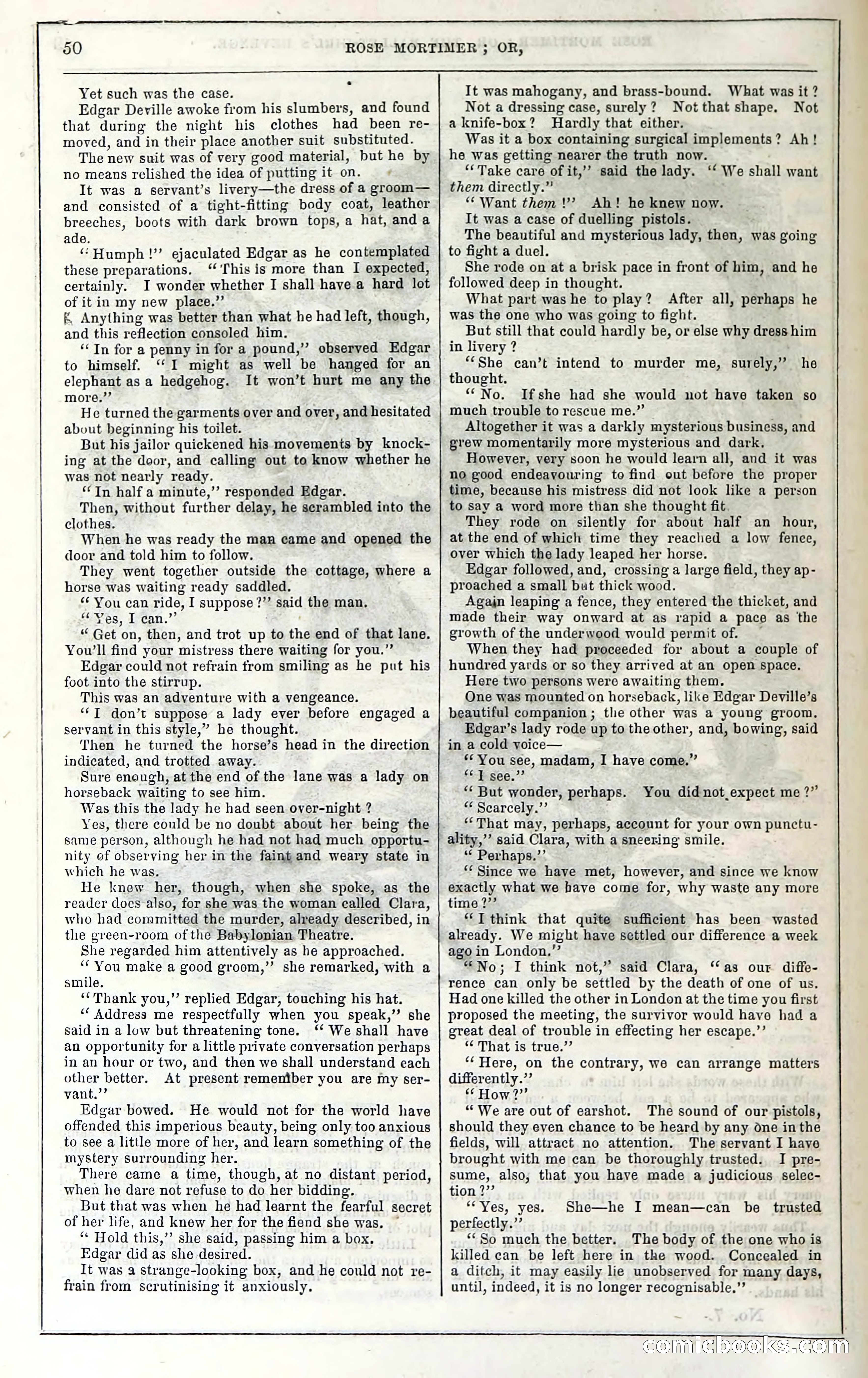
A restored page from Penny Dreadfuls, 1865. Page through the whole issue in the reader above.
📄 Transcribed text from this page (OCR, searchable)
Machine-transcribed from the original scan — historical spelling and the odd misread are preserved.
50 eS ROSE MORTIMER ; OR, Yet such was the case. Edgar Deville awoke from his slumbers, and found that during the night his clothes had been re- moved, and in their place another suit substituted. The new suit was of very good material, but he by no means relished the idea of putting it on. + It was a servant’s livery—the dress of a groom— and consisted of a tight-fitting body coat, leather breeches, boots with dark brown tops, a hat, anda ade. ‘‘Humph!” ejaculated Edgar as he contemplated these preparations. ‘This is more than I expected, certainly. I wonder whether I shall have a hard lot of it in my new place.” & Anything was better than what he had left, though, and this reflection consoled him. ‘Tn for a penny in for a pound,” observed Edgar to himself. “I might as well be hanged for an elephant as a hedgehog. It won’t hurt me any the more.”’ He turned the garments over and over, and hesitated about beginning his toilet. But his jailor quickened his movements by knock- ing at the door, and calling out to know whether he was not nearly ready. ‘In half a minute,’’ responded Edgar. Then, without further delay, he serambled into the clothes. When he was ready the man came and opened the door and told him to follow. They went together outside the cottage, where a horse was waiting ready saddled. “You can ride, I suppose ?”’ said the man. Yes, I ¢an.”’ ' “ Get on, then, and trot up to the end of that lane. You’ll find your mistress there waiting for you.” Edgar could not refrain from smiling as he put his foot into the stirrup. This was an adventure with a vengeance. ‘‘T don’t suppose a lady ever before engaged a servant in this style,” he thought. Then he turned the horse’s head in the direction indicated, and trotted away. Sure enough, at the end of the lane was a lady on horseback waiting to see him. Was this the lady he had seen over-night ? Yes, there could be no doubt about her being the same person, although he had not had much opportu- nity of observing her in the faingf and weary state in which he was. He knew her, though, when she spoke, as the reader does also, for she was the woman called Clara, who had committed the murder, already described, in the green-room of the Babylonian Theatre. She regarded him attentively as he approached. ‘‘ You make a good groom,” she remarked, with a simile. ‘‘Thank you,” replied Edgar, touching his hat. ‘‘ Address me respectfully when you speak,’’ she said in a low but threatening tone. ‘* We shall have an opportunity for a little private conversation perhaps in an hour or two, and then we shall understand each other better. At present remeniber you are my ser- vant.”’ Edgar bowed. He would not for the world have offended this imperious beauty, being only too anxious to see a little more of her, and learn something of the mystery surrounding her. There came a time, though, at no distant period, when he dare not refuse to do her bidding. But that was when he had learnt the fearful secret of her life, and knew her for the fiend she was. ~ ‘* Hold this,’’ she said, passing him a box. Edgar did as she desired. It was a strange-looking box, and he could not re- frain from scrutinising it anxiously. It was mahogany, and brass-bound. What was it? Not a dressing case, surely? Notthat shape. Not a knife-box? Hardly that either. Was it a box containing surgical implements? Ah! he was getting nearer the truth now. ‘Take care of it,’’ said the lady. ‘‘ We shall want them directly.” “Want them!’ Ah! he knew now. It was a case of duelling pistols. The beautiful and mysterious lady, then, was going to fight a duel. She rode on at a brisk pace in front of him, and he followed deep in thought. What part was he to play? After all, perhaps he was the one who was going to fight. But still that could hardly be, or else why dress him in livery ? | “‘She can’t intend to murder me, surely,” he thought. ‘No. Ifshe had she would not have taken so much trouble to rescue me.” Altogether it was a darkly mysterious business, and grew momentarily more mysterious and dark. However, very soon he would learn all, and it was no good endeavouring to find out before the proper time, because his mistress did not look like a person to say a word more than she thought fit. They rode on silently for about half an hour, at the end of which time they reached a low fenee, over which the lady leaped her horse. Edgar followed, and, crossing a large field, they ap- proached a small but thick wood. Agajn leaping a fence, they entered the thicket, and made their way onward at as rapid a pace as the growth of the underwood would permit of. — When they had proceeded for about a couple of hundred yards or so they arrived at an open space. Here two persons were awaiting them. One was mounted on horseback, like Edgar Deville’s beautiful companion ; tlle other was a young groom. Edgar’s lady rode up to the other, and, bowing, said in a cold yoice— ‘© You see, madam, I have come.” £¢-} see.” “‘ But wonder, perhaps. “* Scarcely.”’ “That may, perhaps, account for your own punctu- ality,’’ said Clara, with a sneering smile. ‘“* Perhaps.”’ ** Since we have met, however, and since we know exactly what we have come for, why waste any more time ?”’ “‘T think that quite sufficient has been wasted already. We might have settled our difference a week ago in London,” “No; I think not,” said Clara, “as our diffe- rence can only be settled by the death of one of us. Had one killed the other in London at the time you first proposed the meeting, the survivor would have had a great deal of trouble in effecting her escape.’’ ‘That is true.’’ ‘‘ Here, on the contrary, we can arrange matters differently.’’ ** How?” ““ We are out of earshot. The sound of our pistols, should they even chance to be heard by any one inthe fields, will attract no attention. The servant I haye brought with me can be thoroughly trusted. I pre- sume, also, that you have made a judicious selec- tion ?”’ “°"Y@s, Yes, perfectly.” ** So much the better. The body of the one who is killed can be left here in the wood. Concealed in a ditch, it may easily lie unobserved for many days, until, indeed, it is no longer recognisable,”’ You didnot_expect me?” She—he I mean—can be trusted COTM ClIOO KS nCO)