
Penny Dreadfuls, 1865 · page 68 of 204
Rose Mortimer; Or, The Ballet-Girl's Revenge — page 68: what you’re looking at
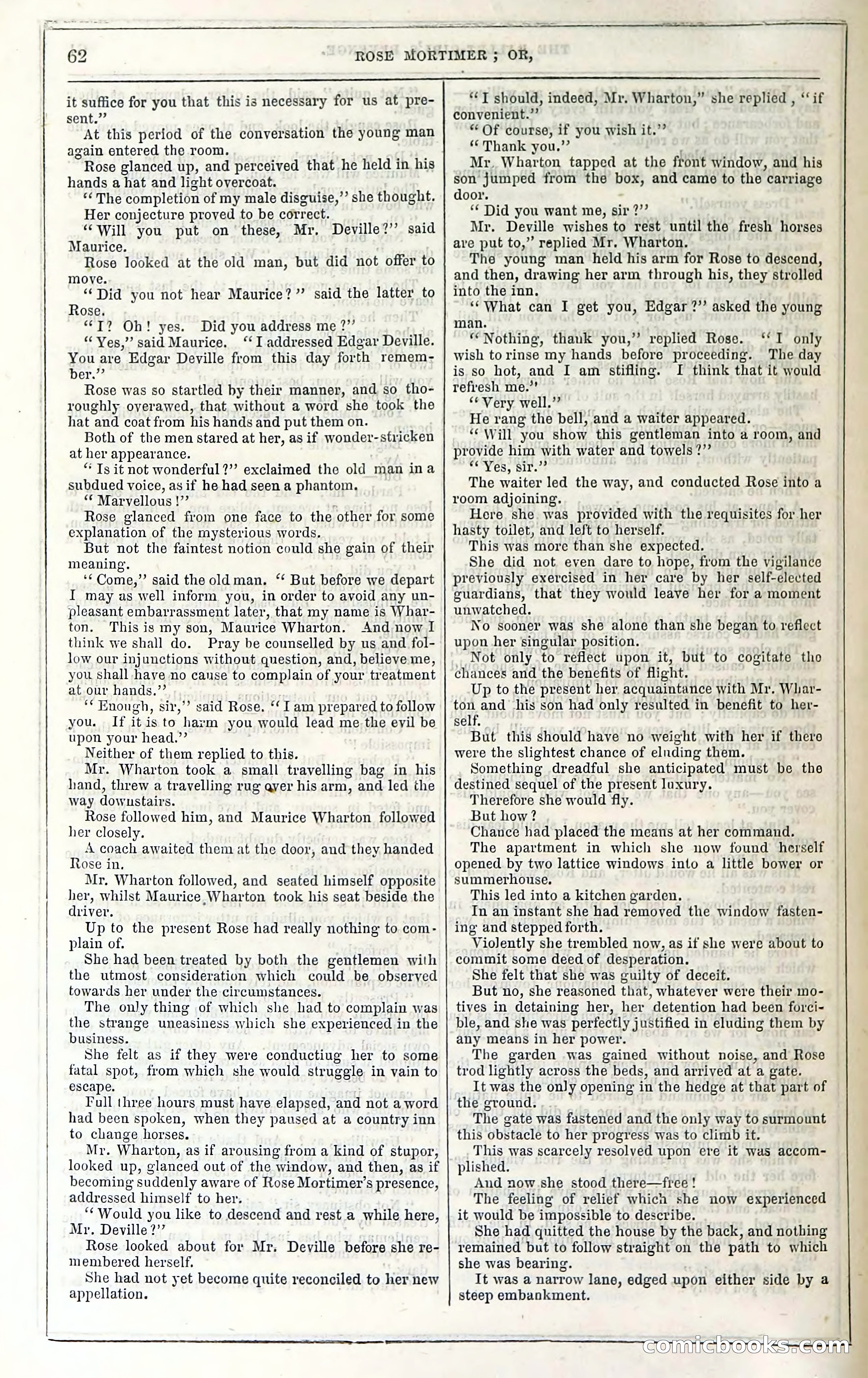
A restored page from Penny Dreadfuls, 1865. Page through the whole issue in the reader above.
📄 Transcribed text from this page (OCR, searchable)
Machine-transcribed from the original scan — historical spelling and the odd misread are preserved.
62 = —, — so — ROSE MORTIMER ; OR, a a a a a aaa aa a aA a ae aaa it suffice for you that this is necessary for us at pre- sent.” At this period of the conversation the young man again entered the room. (ra Rose glanced up, and perceived that he held in his hands a hat and light overcoat. ‘«¢ The completion of my male disguise,’’ she thought. Her conjecture proved to be correct. ‘Will you put on these, Mr, Deville?’ said Maurice. Rose looked at the old man, but did not offer to move. ‘Did you not hear Maurice? ’”’ said the latter to Rose. *“‘T? Oh! yes. Did you address me 2” “‘Ves,’”’ said Maurice. “I addressed Edgar Deville. You are Edgar Deville from this day forth remem- Der.”? Rose was so startled by their manner, and so tho- roughly overawed, that without a word she took the hat and coat from his hands and put them on. Both of the men stared at her, as if wonder-stricken at her appearance. “* Ts it not wonderful ?”’ exclaimed the old man ina subdued voice, as if he had seen a phantom. ‘€ Marvellous !”’ Rose glanced from one face to the other for some explanation of the mysterious words. But not the faintest notion could she gain of their meaning. ‘“Come,”’ said the oldman. ‘* But before we depart I may as well inform you, in order to avoid any un- pleasant embarrassment later, that my name is Whar- ton. This is my son, Maurice Wharton. And now I think we shall do. Pray be counselled by us and fol- low our injunctions without question, and, believe me, you shall have no cause to complain of your treatment at our hands.”’ ‘* Enough, sir,’’ said Rose. ‘I am prepared to follow you. If itis to harm you would lead me the eyil be upon your head.’’ Neither of them replied to this. Mr. Wharton took a small travelling bag in his hand, threw a travelling rug ayer his arm, and led the way dowustairs. Rose followed him, and Maurice Wharton followed her closely. A coach awaited them at the door, and they handed Nose in. Mr. Wharton followed, and seated himself opposite ah Whilst Maurice Wharton took his seat beside the river. Up to the present Rose had really nothing to com- plain of. She had been treated by both the gentlemen with the utmost consideration which could be obseryed towards her under the circumstances. The only thing of which she had to complain was the strange uneasiness which she experienced in the business. She felt as if they were conductiug her to some fatal spot, from which she would struggle in vain to escape. Full three hours must have elapsed, and not a word had been spoken, when they paused at a country inn to change horses. Mr. Wharton, as if arousing from a kind of stupor, looked up, glanced out of the window, and then, as if becoming suddenly aware of Rose Mortimer’s presence, addressed himself to her, ‘* Would you like to descend and rest a while here, Mr. Deville?” Rose looked about for Mr. Deville before she re- menbered herself. She had not yet become quite reconciled to her new appellation. En GOTT GI OOKS CON **T should, indeed, Mr. Wharton,” she replied , ‘if convenient.” ** Of course, if you wish it.’’ “Thank you.” , Mr, Wharton tapped at the front window, and his son jumped from the box, and came to the carriage door. ** Did you want me, sir ?”’ Mr. Deville wishes to rest until the fresh horses ave put to,” replied Mr. Wharton. The young man held his arm for Rose to descend, and then, drawing her arm through his, they strolled into the inn, ‘‘ What can I get you, Edgar?” asked the young man. Nothing, thank you,’ replied Rose. ‘TI only wish to rinse my hands before proceeding. The day is so hot, and I am stifling. I think that it would refresh me.” ‘¢Very well.’? ~~ He rang the bell, and a waiter appeared. ‘‘ Will you show this gentleman into a room, and provide him with water and towels?” Se°YES, BIL. The waiter led the way, and conducted Rose into a room adjoining. Here she was provided with the requisites for her hasty toilet, and left to herself. This was more than she expected. She did not even dare to hope, from the vigilance previously exercised in her care by her self-elected guardians, that they would leave her for a moment unwatched. No sooner was she alone than she began to, reflect upon her singular position. Not only to reflect upon it, but to cogitate tho chances and the benefits of flight. Up to the present her. acquaintance with Mr. Whar- ton and his son had only resulted in benefit to her- self. But this should have no weight with her if there were the slightest chance of elnding them. Something dreadful she anticipated must be the destined sequel of the present luxury. Therefore she would fly. But how? Chance had placed the means at her command. The apartment in which she now found herself opened by two lattice windows into a little bower or summerhouse, This led into a kitchen garden, In an instant she had removed the window fasten- ing and stepped forth. Violently she trembled now, as if she were about to commit some deed of desperation. She felt that she was guilty of deceit. But no, she reasoned that, whatever were their mo- tives in detaining her, her detention had been forci- ble, and she was perfectly justified in eluding them by any means in her power. The garden was gained without noise, and Rose trod lightly across the beds, and arrived at a gate. It was the only opening in the hedge at that part of the ground, The gate was fastened and the only way to surmount this obstacle to her progress was to climb it. This was scarcely resolved upon ere it was accom- plished. Aud now she stood there—free ! The feeling of relief which she now experienced it would be impossible to describe. She had quitted the house by the back, and nothing remained but to follow straight on the path to which she was bearing. It was a narrow lane, edged upon either side by a steep embankment. oO