
Penny Dreadfuls, 1865 · page 28 of 204
Rose Mortimer; Or, The Ballet-Girl's Revenge — page 28: what you’re looking at
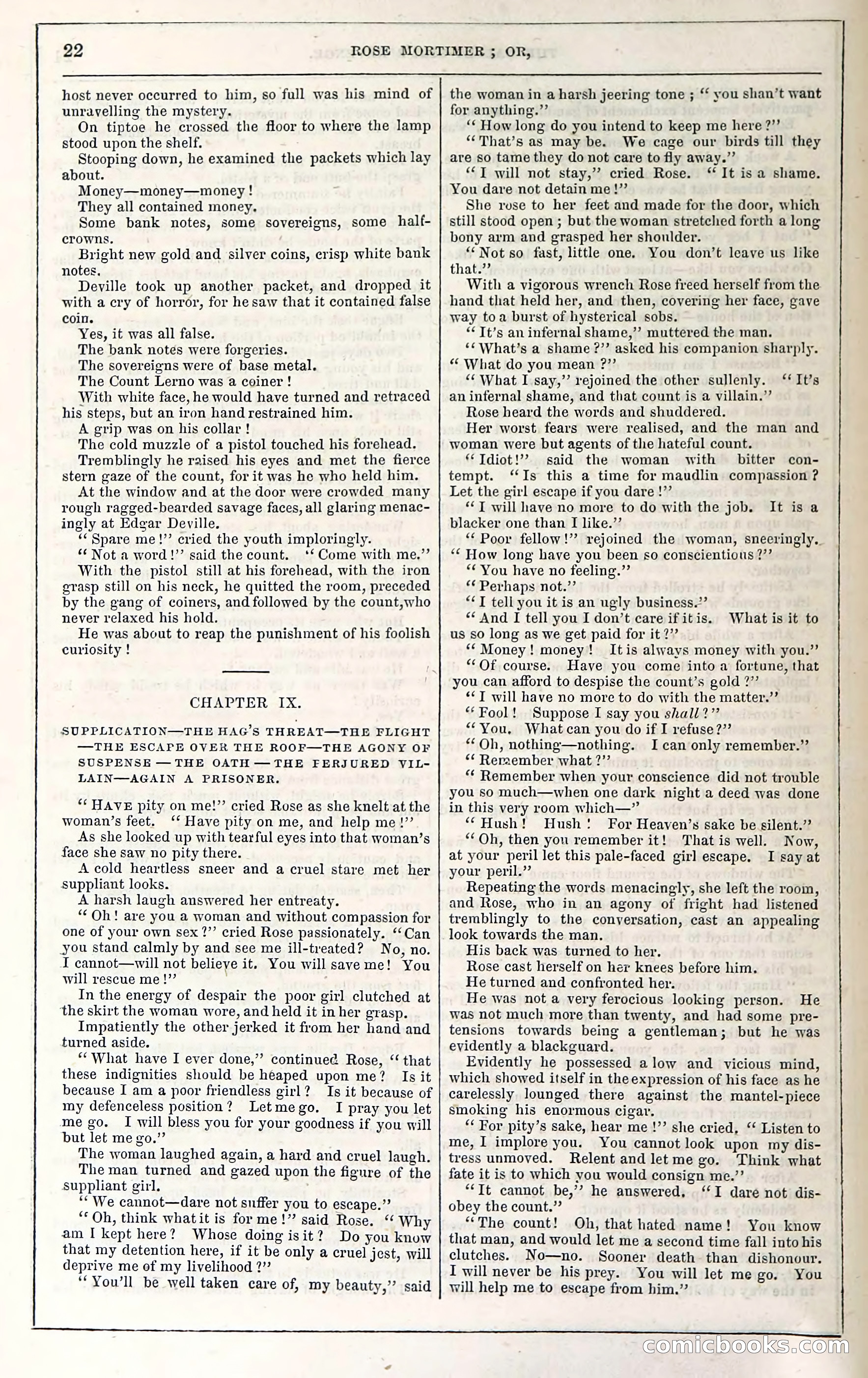
A restored page from Penny Dreadfuls, 1865. Page through the whole issue in the reader above.
📄 Transcribed text from this page (OCR, searchable)
Machine-transcribed from the original scan — historical spelling and the odd misread are preserved.
22 is Se te eee ROSE MORTIMER ; OR, host never occurred to him, so full was his mind of | the woman in a harsh jeering tone ; ‘‘ you shan’t want unravelling the mystery. On tiptoe he crossed the floor to where the lamp stood upon the shelf. Stoopine down, he examined the packets which lay about. Money—money—money ! They all contained money, Some bank notes, some sovereigns, some half- crowns. Bright new gold and silver coins, erisp white bank notes. Deville took up another packet, and dropped it with a cry of horror, for he saw that it contained false coin. Yes, it was all false. The bank notes were forgeries. The sovereigns were of base metal. The Count Lerno was a coiner ! With white face, he would have turned and retraced his steps, but an iron hand restrained him. A grip was on his collar! The cold muzzle of a pistol touched his forehead. Tremblingly he raised his eyes and met the fierce stern gaze of the count, for it was he who held him. At the window and at the door were crowded many rough ragged-bearded savage faces, all glaring menac- ingly at Edgar Deville. “‘ Spare me!” cried the youth imploringly. ‘Not a word!’’ said the count. ‘‘ Come with me,”’ With the pistol still at his forehead, with the iron erasp still on his neck, he quitted the room, preceded by the gang of coiners, and followed by the count,who never relaxed his hold. He was about to reap the punishment of his foolish curiosity ! CHAPTER IX. SUPPLICATION—THE HAG’S THREAT—THE FLIGHT —THE ESCAPE OVER THE ROOF—THE AGONY OF SUSPENSE — THE OATH —THE FERJURED VIL- LAIN—AGAIN A PRISONER. ‘‘ HAVE pity on me!”’ cried Rose as she knelt at the woman’s feet. ‘‘ Have pity on me, and help me!” As she looked up with tearful eyes into that woman’s face she saw no pity there. A cold heartless sneer and a cruel stare met her suppliant looks. A harsh laugh answered her entreaty. ‘Oh! are you a woman and without compassion for one of your own sex ?”’ cried Rose passionately. ‘Can you stand calmly by and see me ill-treated? No, no. JI cannot—will not believe it. You will saveme! You will rescue me !”’ In the energy of despair the poor girl clutched at the skirt the woman wore, and held it in her grasp. Impatiently the other jerked it from her hand and turned aside. ** What have I ever done,”’ continueé Rose, ‘‘ that these indignities should be heaped upon me? Is it because I am a poor friendless girl? Is it because of my detenceless position? Letmego. I pray you let me go. I will bless you for your goodness if you will but let me go.” The woman laughed again, a hard and cruel laugh. The man turned and gazed upon the figure of the suppliant girl. ‘“ We cannot—dare not suffer you to escape.” ‘Oh, think whatit is for me!” said Rose. ‘ Why am I kept here? Whose doing isit? Do you know that my detention here, if it be only a cruel jest, will deprive me of my livelihood ?” ‘‘You’ll be well taken care of, my beauty,’ said for anything.”’ ‘““ How long do you intend to keep me here ?”’ ““That’s as may be. We cage our birds till they are so tame they do not care to fly away.’’ *‘T will not stay,” cried Rose. “ It isa shame. You dare not detain me !”’ She rose to her feet and made for the door, which still stood open; but the woman stretched forth a long bony arm and grasped her shoulder. “Not so fast, little one. You don’t leave us like that.” With a vigorous wrench Rose freed herself from the. hand that held her, and then, covering her face, gave way toa burst of hysterical sobs. “‘Tt’s an infernal shame,”? muttered the man. ‘What's a shame ?’’ asked his companion sharply. «What do you mean ?” “‘ What I say,’’ rejoined the other sullenly. an infernal shame, and that count is a villain.” Rose heard the words and shuddered. Her worst fears were realised, and the man and woman were but agents of the hateful count. **Tdiot!”? said the woman with bitter con- tempt. ‘Is this a time for maudlin compassion ? Let the girl escape if you dare !”’ ‘JT will have no more to do with the job. blacker one than I like.’’ “* Poor fellow!” rejoined the woman, sneeringly,. ‘“ How long have you been so conscientious ?”’ “‘ You have no feeling.”’ *¢ Perhaps not.”’ “‘T tell you it is an ugly business.’ “¢ And I tell you I don’t care if it is. us so long as we get paid for it ?”’ ‘Money! money! Itis always money with you.’ “Of course. Haye you come into a fortune, that you can afford to despise the count’s gold ?”’ ‘*T will have no more to do with the matter.’’ “Fool! Suppose I say you shall?” ““You, Whatcan you do if I refuse?’’ ‘Oh, nothing—nothing. I can only remember.” “¢ Reraember what ?”’ “‘ Remember when your conscience did not trouble you so much—when one dark night a deed was done in this very room which—” ‘‘ Hush! Hush! For Heaven’s sake be silent.’ ‘* Oh, then you remember it! That is well. Now, at your peril let this pale-faced girl escape. I say at your peril.” Repeating the words menacingly, she left the room, and Rose, who in an agony of fright had listened tremblingly to the conversation, cast an appealing look towards the man. His back was turned to her, Rose cast herself on her knees before him. He turned and confronted her. He was not a very ferocious looking person. He was not much more than twenty, and had some pre- tensions towards being a gentleman; but he was evidently a blackguard. Evidently he possessed alow and vicious mind, which showed itself in the expression of his face as he carelessly lounged there against the mantel-piece smoking his enormous cigar. ‘* For pity’s sake, hear me !”’ she cried, “‘ Listen to me, I implore you. You cannot look upon my dis- tress unmoved. Relent and letme go. Think what fate it is to which you would consign me.’ ““It cannot be,’’? he answered, ‘‘I dare not dis- obey the count.” “‘The count! Oh, that hated name! You know that man, and would let me a second time fall into his clutches. No—no. Sooner death than dishonour. I will never be his prey. You will let me go. You will help me to escape from him.” ‘‘Tt’s It is a What is it to EGomichoo