
Penny Dreadfuls, 1865 · page 147 of 204
Rose Mortimer; Or, The Ballet-Girl's Revenge — page 147: what you’re looking at
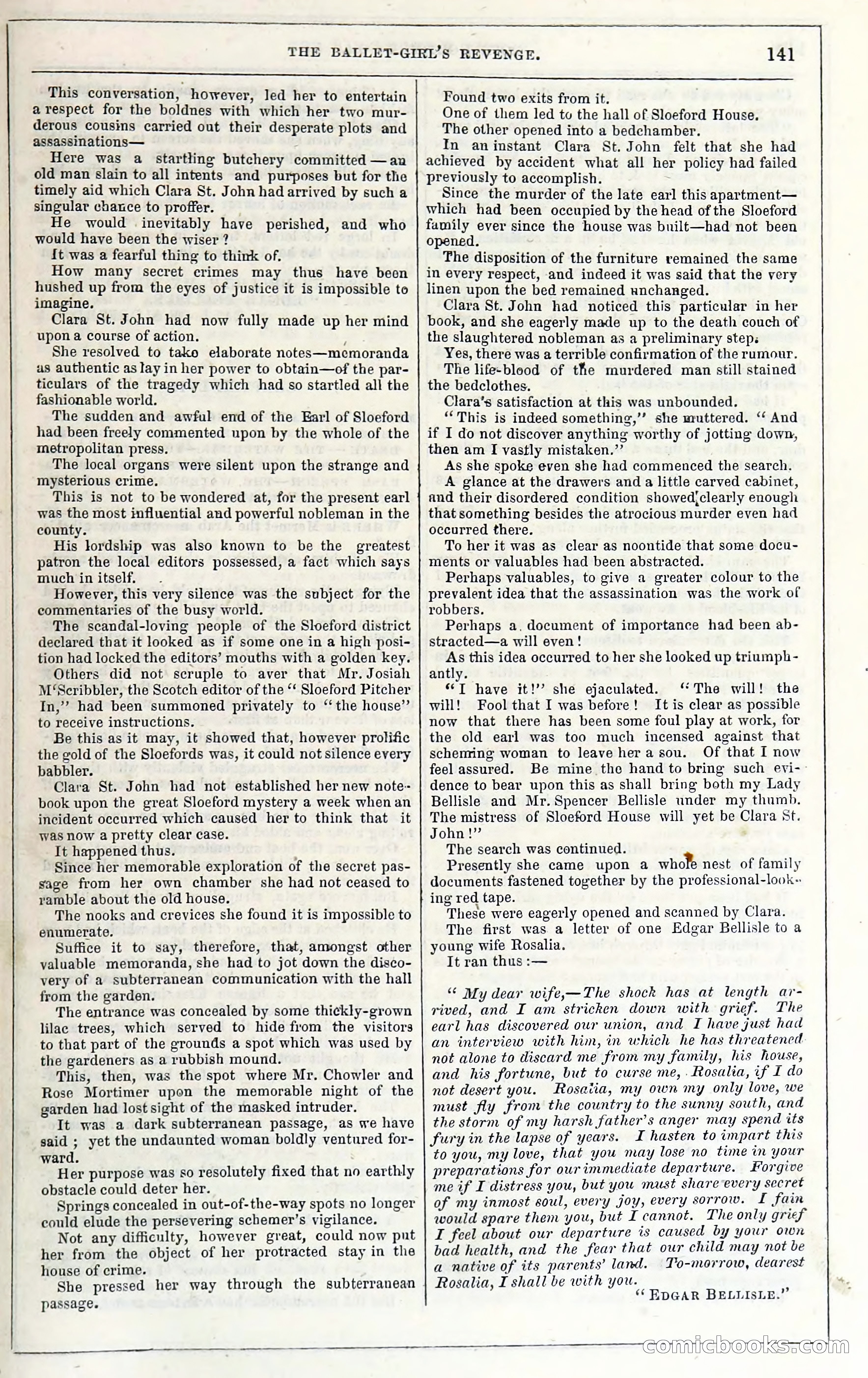
A restored page from Penny Dreadfuls, 1865. Page through the whole issue in the reader above.
📄 Transcribed text from this page (OCR, searchable)
Machine-transcribed from the original scan — historical spelling and the odd misread are preserved.
THE BALLET-GIRU’S REVENGE. 141 i This conversation, however, led her to entertain a respect for the boldnes with which her two mur- derous cousins carried out their desperate plots and assassinations— Here was a startling butchery committed —an old man slain to all intents and purposes but for the timely aid which Clara St. John had arrived by such a singular chance to proffer. He would inevitably have perished, and who would have been the wiser ? it was a fearful thing to think of. How many secret crimes may thus have been hushed up from the eyes of justice it is impossible to imagine. Clara St. John had now fully made up her mind upon a course of action. She resolved to tako elaborate notes—memoranda us authentic as lay in her power to obtain—of the par- ticulars of the tragedy which had so startled all the fashionable world. The sudden and awful end of the Earl of Sloeford had been freely commented upon by the whole of the metropolitan press. The local organs were silent upon the strange and mysterious crime. This is not to be wondered at, for the present earl was the most influential and powerful nobleman in the county. His lordship was also known to be the greatest patron the local editors possessed, a fact which says much in itself. However, this very silence was the subject for the commentaries of the busy world. The scandal-loving people of the Sloeford district declared that it looked as if some one in a high posi- tion had locked the editors’ mouths with a golden key. Others did not scruple to aver that Mr. Josiah M‘Scribbler, the Scotch editor of the ‘‘ Sloeford Pitcher In,’ had been summoned privately to ‘the house” to receive instructions. Be this as it may, it showed that, however prolific the gold of the Sloefords was, it could not silence every babbler. Clara St. John had not established her new note- book upon the great Sloeford mystery a week when an incident occurred which caused her to think that it was now a pretty clear case. It happened thus. - Since her memorable exploration of the secret pas- sage from her own chamber she had not ceased to ramble about the old house. The nooks and crevices she found it is impossible to enumerate. Suffice it to say, therefore, that, amongst other valuable memoranda, she had to jot down the disco- very of a subterranean communication with the hall from the garden. The entrance was concealed by some thickly-grown lilac trees, which served to hide from the visitors to that part of the grounds a spot which was used by the gardeners as a rubbish mound. This, then, was the spot where Mr. Chowler and Rose Mortimer upon the memorable night of the garden had lost sight of the masked intruder. It was a dark subterranean passage, as we have said ; yet the undaunted woman boldly ventured for- ward. Her purpose was so resolutely fixed that no earthly obstacle could deter her. Springs concealed in out-of-the-way spots no longer could elude the persevering schemer’s vigilance. Not any difficulty, however great, could now put her from the object of her protracted stay in the house of crime. She pressed her way through the subterranean passage. ere ee mpmmmmnuiiaiiiede nti: ier ti. en Mma Found two exits from it. One of them led to the hall of Sloeford House. The other opened into a bedchamber. In aninstant Clara St. John felt that she had achieved by accident what all her policy had failed previously to accomplish. Since the murder of the late earl this apartment— which had been occupied by the head of the Sloeford family ever since the house was built—had not been opened. The disposition of the furniture remained the same in every respect, and indeed it was said that the very linen upon the bed remained unchanged. Clara St. John had noticed this particular in her book, and she eagerly made up to the death couch of the slaughtered nobleman as a preliminary step. Yes, there was a terrible confirmation of the rumour. The life-bleod of the murdered man still stained the bedclothes. Clara’s satisfaction at this was unbounded. “This is indeed something,” she muttered. ‘‘ And if I do not discover anything worthy of jotting down, then am I vastly mistaken.”’ , As she spoke even she had commenced the search. A glance at the drawers and a little carved cabinet, and their disordered condition showedjclearly enough that something besides the atrocious murder even had occurred there. To her it was as clear as noontide that some docu- ments or valuables had been abstracted. Perhaps valuables, to give a greater colour to the prevalent idea that the assassination was the work of robbers. Perhaps a. document of importance had been ab- stracted—a will even! As this idea occurred to her she looked up triumph- antly. “‘T have it!’ she ejaculated. ‘The will! the will! Fool that I was before! It is clear as possible now that there has been some foul play at work, for the old earl was too much incensed against that scheming woman to leave herasou. Of that I now feel assured. Be mine the hand to bring such evi-- dence to bear upon this as shall bring both my Lady Bellisle and Mr. Spencer Bellisle under my thumb. The mistress of Sloeford House will yet be Clara St. John!” The search was continued. Presently she came upon a whofe nest. of famil y documents fastened together by the professional-look- ing red tape. These were eagerly opened and scanned by Clara. The first was a letter of one Edgar Bellisle to a young wife Rosalia. It ran thus :— “ My dear wife,—The shock has at length ar- rived, and I am stricken down with grief. The earl has discovered our union, and I have just had an interview with him, in which he has threatened not alone to discard me from my family, his house, and his fortune, but to curse me, Rosalia, if I do not desert you. Rosaiia, my own my only love, we must fly from the country to the sunny south, and the storm of my harsh father’s anger may spend its fury in the lapse of years. I hasten to impart this to you, my love, that you may lose no time in your preparations for our immediate departure. Forgive me if I distress you, but you must share every secret of my inmost soul, every joy, every sorrow. EB Fain would spare them you, but I cannot. The only grief I feel about our departure is caused by your own bad health, and the fear that our child may not be a native of its parents’ land. To-morrow, dearest Rosalia, I shall be with you. ‘EDGAR BELLISLE.”’ Oo —————___—_—_—_——— comniclboooksreconm