
Penny Dreadfuls, 1865 · page 156 of 204
Rose Mortimer; Or, The Ballet-Girl's Revenge — page 156: what you’re looking at
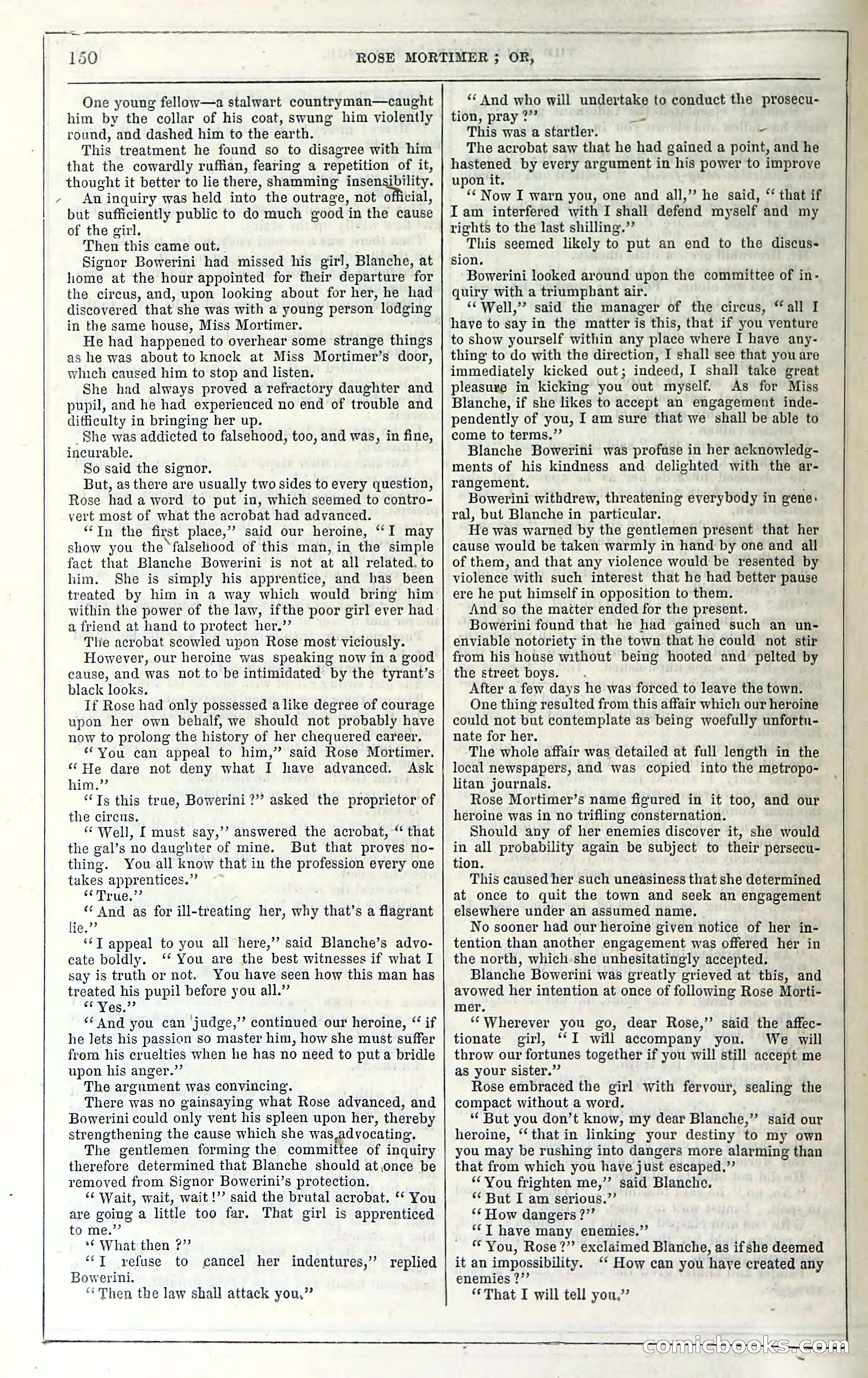
A restored page from Penny Dreadfuls, 1865. Page through the whole issue in the reader above.
📄 Transcribed text from this page (OCR, searchable)
Machine-transcribed from the original scan — historical spelling and the odd misread are preserved.
——_ a ee 8 er ee ee ~ ‘\ 150 ROSE MORTIMER ; OR, One young fellow—a stalwart countryman—caught him by the collar of his coat, swung him violently round, and dashed him to the earth. This treatment he found so to disagree with him that the cowardly ruffian, fearing a repetition of it, thought it better to lie there, shamming insensibility. An inquiry was held into the outrage, not official, but sufficiently public to do much good in the cause of the girl. Then this came out. Signor Bowerini had missed his girl, Blanche, at home at the hour appointed for their departure for the circus, and, upon looking about for her, he had discovered that she was with a young person lodging in the same house, Miss Mortimer. He had happened to overhear some strange things as he was about to knock at Miss Mortimer’s door, which caused him to stop and listen. She had always proved a refractory daughter and pupil, and he had experienced no end of trouble and difficulty in bringing her up. She was addicted to falsehood, too, and was, in fine, incurable. So said the signor. But, as there are usually two sides to every question, Rose had a word to put in, which seemed to contro- vert most of what the acrobat had advanced. “In the first place,” said our heroine, ‘‘I may show you the ‘falseliood of this man, in the simple fact that Blanche Bowerini is not at all related. to him. She is simply his apprentice, and has been treated by him in a way which would bring him within the power of the law, ifthe poor girl ever had a friend at hand to protect her.”’ The acrobat scowled upon Rose most viciously. However, our heroine was speaking now in a good cause, and was not to be intimidated by the tyrant’s black looks. If Rose had only possessed alike degree of courage upon her own behalf, we should not probably have now to prolong the history of her chequered career. ‘*You can appeal to him,” said Rose Mortimer. “He dare not deny what I have advanced. Ask him.” ‘Ts this true, Bowerini?’’ asked the proprietor of the circus, ‘Well, I must say,’ answered the acrobat, “ that the gal’s no daughter of mine. But that proves no- thing. You all know that in the profession every one takes apprentices.” Prue: “ And as for ill-treating her, why that’s a flagrant lie.”” ‘©T appeal to you all here,’ said Blanche’s advo- cate boldly. ‘‘ You are the best witnesses if what I say is truth or not. You have seen how this man has treated his pupil before you all.” ce Yos.’’ ‘*And you can judge,’’ continued our heroine, “ if he Jets his passion so master him, how she must suffer from his cruelties when he has no need to put a bridle upon his anger.”’ The argument was convincing. There was no gainsaying what Rose advanced, and Bowerini could only vent his spleen upon her, thereby strengthening the cause which she was.advocating. The gentlemen forming the committee of inquiry therefore determined that Blanche should at,once be removed from Signor Bowerini’s protection. ‘6 Wait, wait, wait!’ said the brutal acrobat. ‘* You are going a little too far. That girl is apprenticed to. me.” ‘© What then ?” “‘T refuse to cancel her indentures,’’ replied Bowerini. ‘Then the law shall attack you,” ‘‘ And who will undertake to conduct the prosecu- tion, pray ?” —_ This was a startler. - The acrobat saw that he had gained a point, and he hastened by every argument in his power to improve upon it. ‘© Now I warn you, one and all,” he said, “‘ that if I am interfered with I shall defend myself and my rights to the last shilling.” This seemed likely to put an end to the discus- sion. Bowerini looked around upon the committee of in- quiry with a triumphant air. ‘‘ Well,” said the manager of the circus, ‘all I have to say in the matter is this, that if you venture to show yourself within any place where I have any- thing to do with the direction, I shall see that youare immediately kicked out; indeed, I shall take great pleasure in kicking you out myself. As for Miss Blanche, if she likes to accept an engagement inde- pendently of you, I am sure that we shall be able to come to terms.”’ Blanche Bowerini was profuse in her acknowledg- ments of his kindness and delighted with the ar- rangement. Bowerini withdrew, threatening everybody in gene: ral, but Blanche in particular. He was warned by the gentlemen present that her cause would be taken warmly in hand by one and all of them, and that any violence would be resented by violence with such interest that he had better pause ere he put himself in opposition to them. And so the matter ended for the present. Bowerini found that he had gained such an un- enviable notoriety in the town that he could not stir from his house without being hooted and pelted by the street boys. After a few days he was forced to leave the town. One thing resulted from this affair which our heroine could not but contemplate as being woefully unfortu- nate for her. The whole affair was detailed at full length in the local newspapers, and was copied into the metropo- litan journals. Rose Mortimer’s name figured in it too, and our heroine was in no trifling consternation. Should any of her enemies discover it, she would in all probability again be subject to their persecu- tion. This caused her such uneasiness that she determined at once to quit the town and seek an engagement elsewhere under an assumed name. No sooner had our heroine given notice of her in- tention than another engagement was offered her in the north, which she unhesitatingly accepted. Blanche Bowerini was greatly grieved at this, and avowed her intention at once of following Rose Morti- mer. ‘‘ Wherever you go, dear Rose,’ said the affec- tionate girl, ‘‘I will accompany you. We will throw our fortunes together if you will still accept me as your sister.” Rose embraced the girl with fervour, sealing the compact without a word, ‘“* But you don’t know, my dear Blanche,” said our heroine, ‘‘ that in linking your destiny to my own you may be rushing into dangers more alarming than that from which you have just escaped.” ‘You frighten me,’’ said Blanche. ** But I am serious.” ** How dangers ?”’ **T have many enemies.” ** You, Rose?” exclaimed Blanche, as ifshe deemed it an impossibility. ‘* How can you haye created any enemies ?”’ ‘That I will tell you,” —COnnkel noo